Norfolk Vanguard Offshore Wind Farm Re-approved By Government
The title of this post, is the same as that of this article on the BBC.
These are the two introductory paragraphs.
An offshore wind farm capable of generating electricity for nearly two million homes has been re-approved by government after consent was previously overturned by a High Court judge.
Vattenfall’s 1.8-gigawatt Norfolk Vanguard project had been granted consent by the Department for Business, Energy and Industrial Strategy (BEIS).
Note.
- Norfolk Boreas and Norfolk Vanguard are a pair of 1.8 GW offshore wind farms to be developed 72 and 47 kilometres off the Norfolk coast by Swedish company; Vattenfall.
- Hinckley Point C will have a capacity of 3.25 GW.
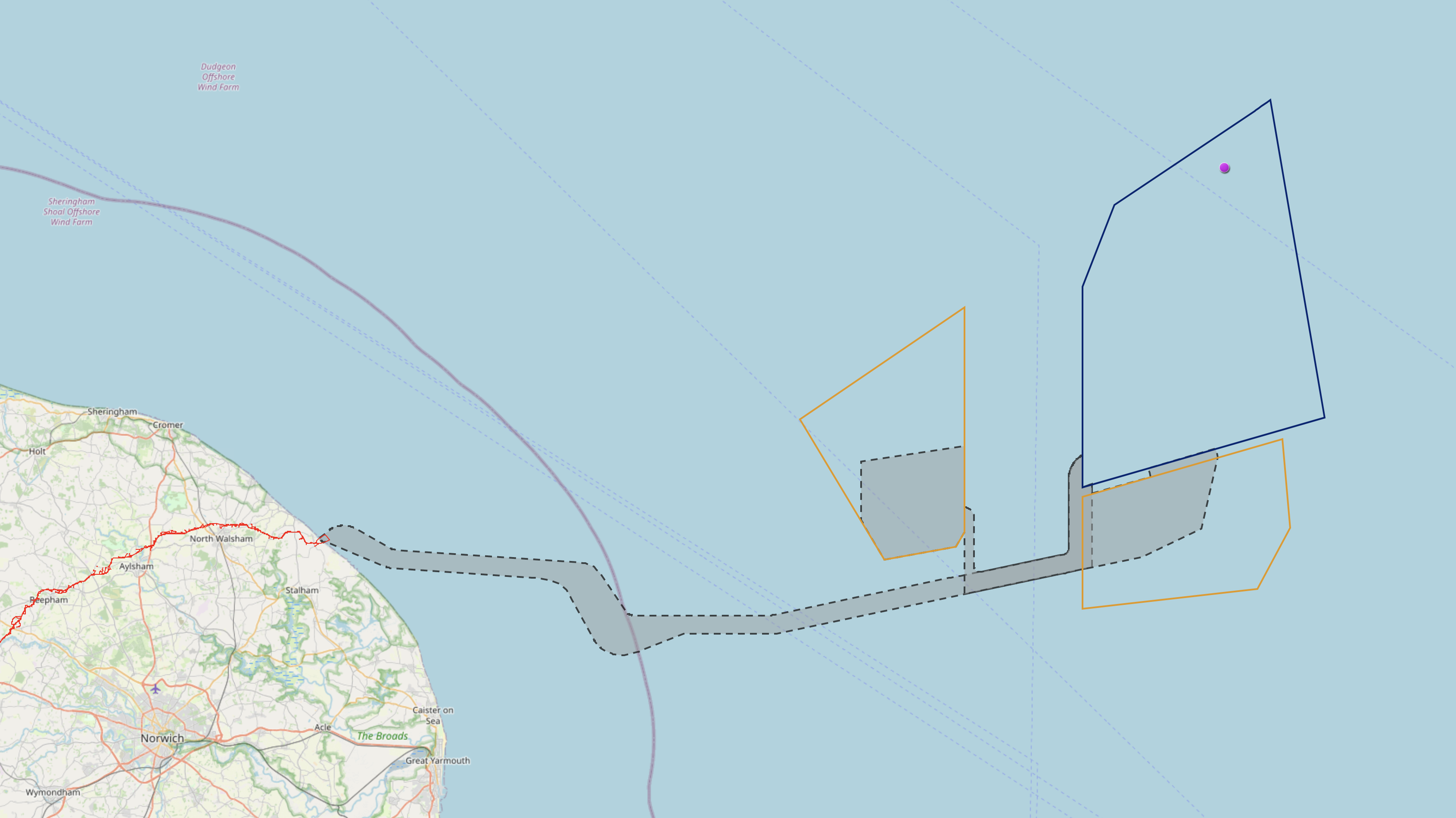
This map shows the two fields in relation to the coast.
Note.
- The purple line appears to be the UK’s ten mile limit.
- Norfolk Boreas is outlined in blue.
- Norfolk Vsnguard is outlined in orange.
- Cables will be run in the grey areas.
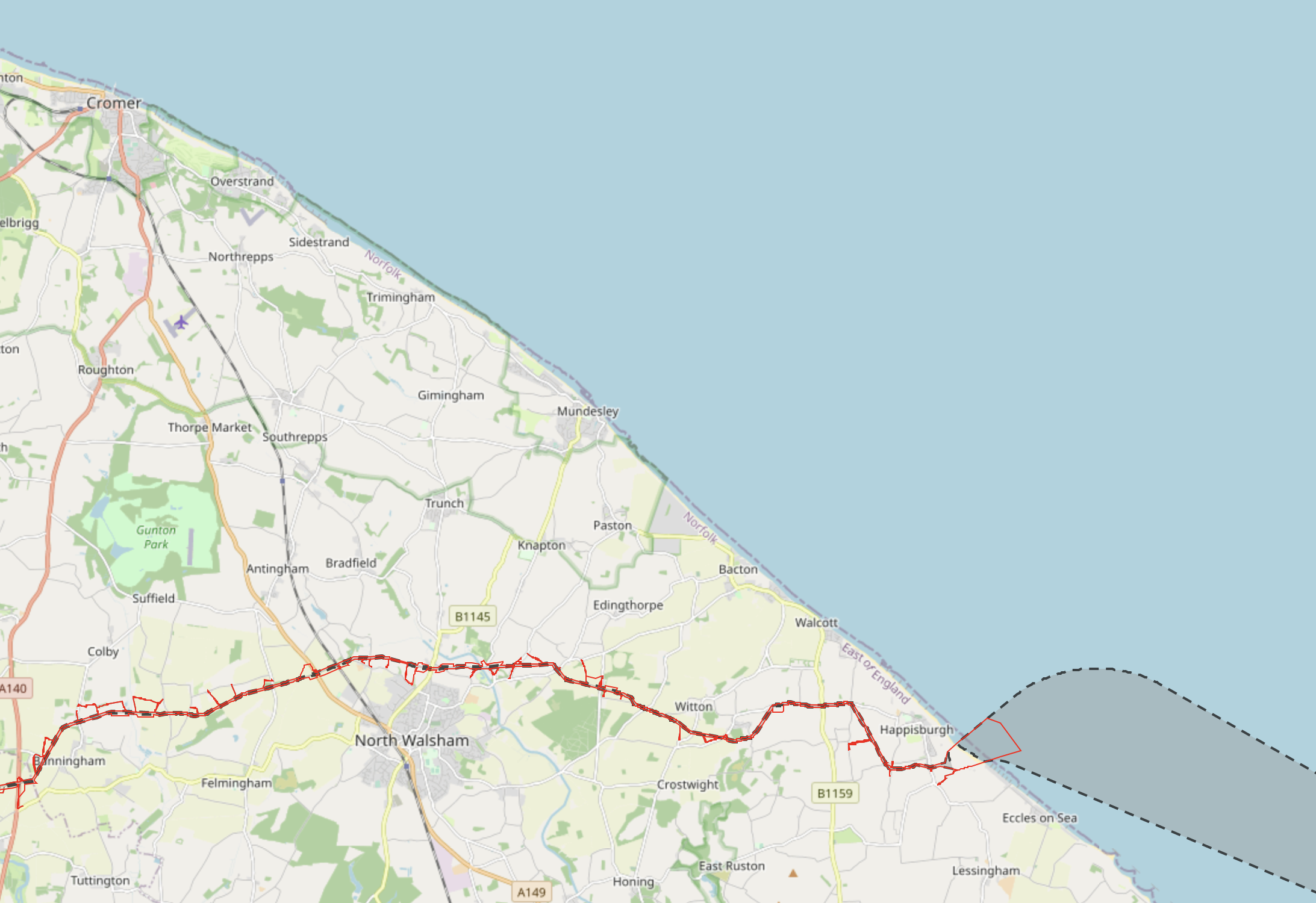
This second map shows the onshore cable.
Note.
- The cables are planned to come ashore between Happisburgh and Eccles-on-Sea.
- Bacton is only a short distance up the coast.
- The onshore cable is planned to go from here across Norfolk to the Necton substation.
But the planning permission was overturned by a legal ruling.
This article on the BBC is entitled Norfolk Vanguard: Ministers Wrong Over Wind Farm Go-Ahead, Says Judge.
These are the first four paragraphs.
A High Court judge has quashed permission for one of the world’s largest offshore wind farms to be built off the east coast of England.
The Norfolk Vanguard Offshore Wind Farm was granted development consent in July by the Secretary of State for Business, Energy and Industrial Strategy (BEIS).
But Mr Justice Holgate overturned the decision following legal action from a man living near a planned cable route.
A Department for BEIS spokeswoman said it was “disappointed by the outcome”.
This is a paragraph in today’s BBC article.
Kwasi Kwarteng, Secretary of State at the Department of Business, Energy and Industrial Strategy, granted development consent for the wind farm, having re-determined the application.
So will we be back to the Law Courts?
In Is There A Need For A Norfolk-Suffolk Interconnector?, I said this.
But seriously, is it a good idea to dig an underground cable all the way across Norfolk or in these times build a massive overhead cable either?
Perhaps the solution is to connect the Norfolk Boreas And Norfolk Vanguard wind farms to a giant electrolyser at Bacton, which creates hydrogen.
- The underground electricity cable across Norfolk would not be needed.
- Bacton gas terminal is only a few miles up the coast from the cable’s landfall.
- The UK gets another supply of gas.
- The hydrogen is blended with natural gas for consumption in the UK or Europe.
- A pure hydrogen feed can be used to supply hydrogen buses, trucks and other vehicles, either by tanker or pipeline.
- Excess hydrogen could be stored in depleted gas fields.
Thye main benefit though, would be that it would transform Bacton gas terminal from a declining asset into Norfolk’s Hydrogen Powerhouse.
For more information on blending hydrogen into our natural gas supply see HyDeploy.
Is There A Need For A Norfolk-Suffolk Interconnector?
The coast of East Anglia from the Wash to the Haven Ports of Felixstowe, Harwich and Ipswich is becoming the Energy Coast of England.
Starting at the Wash and going East and then South, the following energy-related sites or large energy users are passed.
Bicker Fen Substation
Bicker may only be a small hamlet in Lincolnshire, but it is becoming increasingly important in supplying energy to the UK.
Nearby is Bicker Fen substation, which connects or will connect the following to the National Grid.
- The 26 MW Bicker Fen onshore windfarm.
- The 1,400 MW interconnector from Denmark called Viking Link.
- The proposed 857 MW offshore wind farm Triton Knoll.
This Google Map shows the location of Bicker Fen with respect to The Wash.
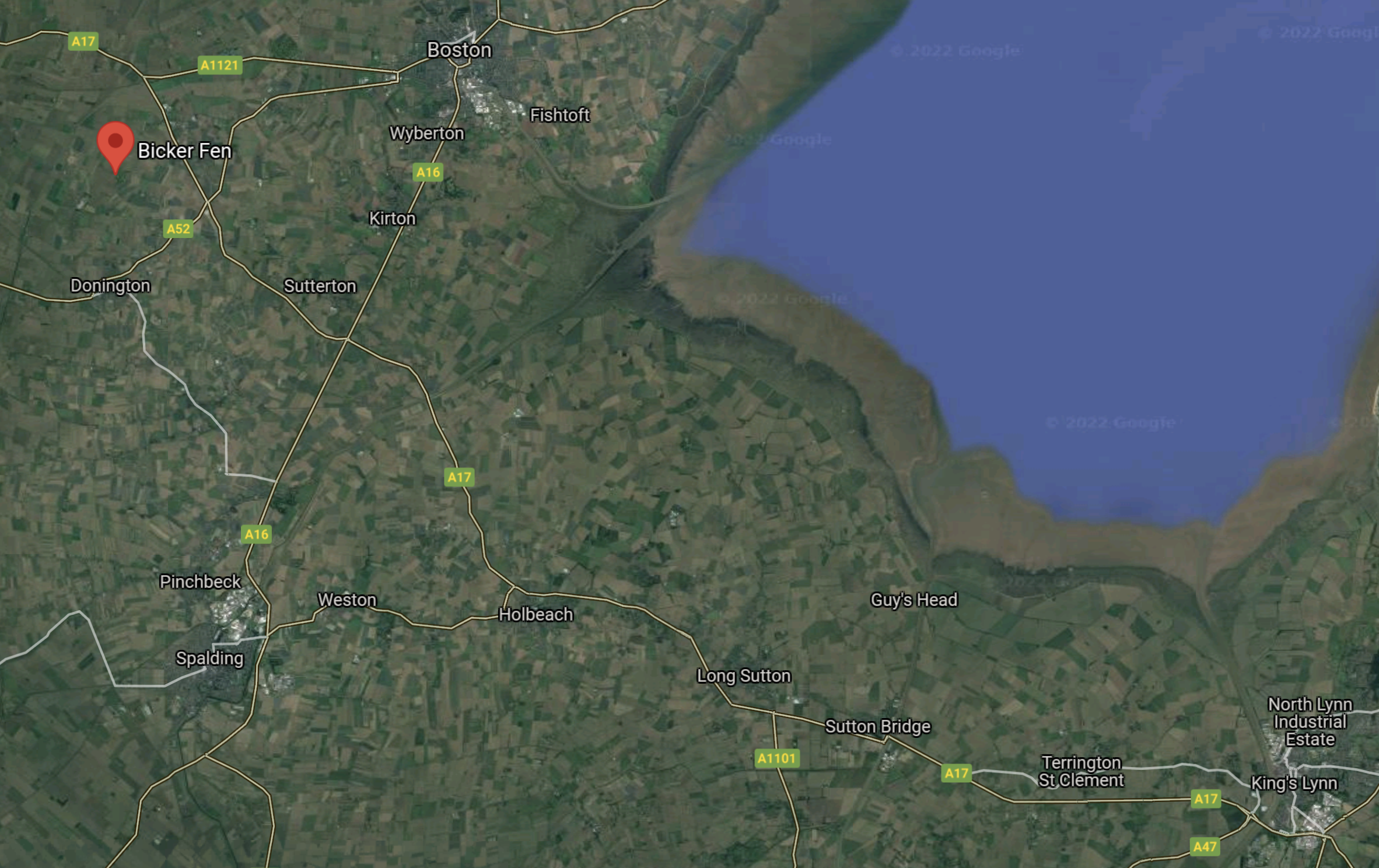
Bicker Fen is marked by the red arrow.
The Google Map shows the substation.
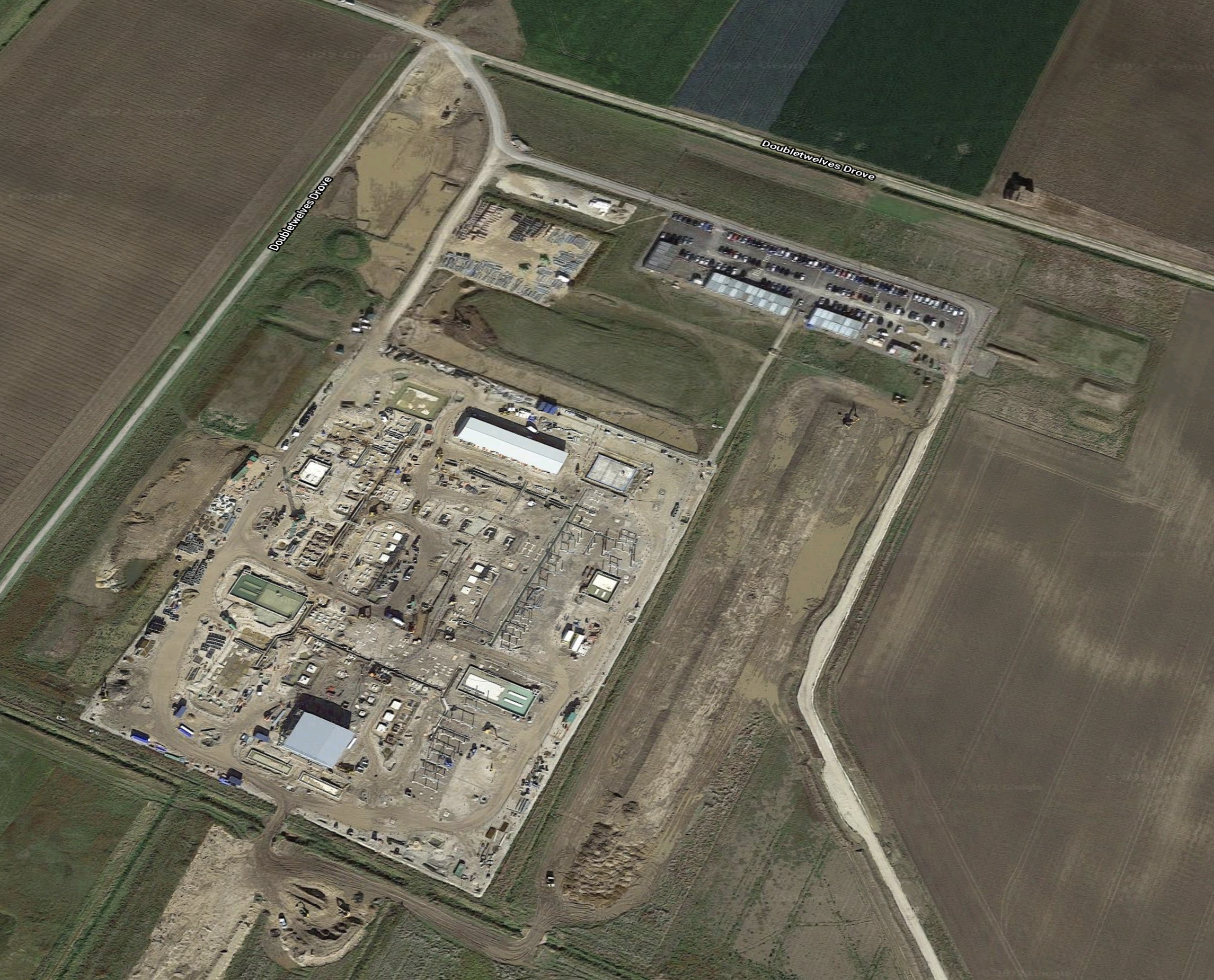
It must be sized to handle over 2 GW, but is it large enough?
Dudgeon Offshore Wind Farm
The Dudgeon offshore wind farm is a 402 MW wind farm, which is twenty miles off the North Norfolk coast.
- It has 67 turbines and an offshore substation.
- It is connected to the shore at Weybourne on the coast from where an underground cable is connected to the National Grid at Necton.
- It became operational in Oct 2017.
- Equinor and Statkraft are part owners of the windfarm and this is the home page of the wind farm’s web site.
- Equinor is the operator of the wind farm.
This Google Map shows the location of Weybourne on the coast.
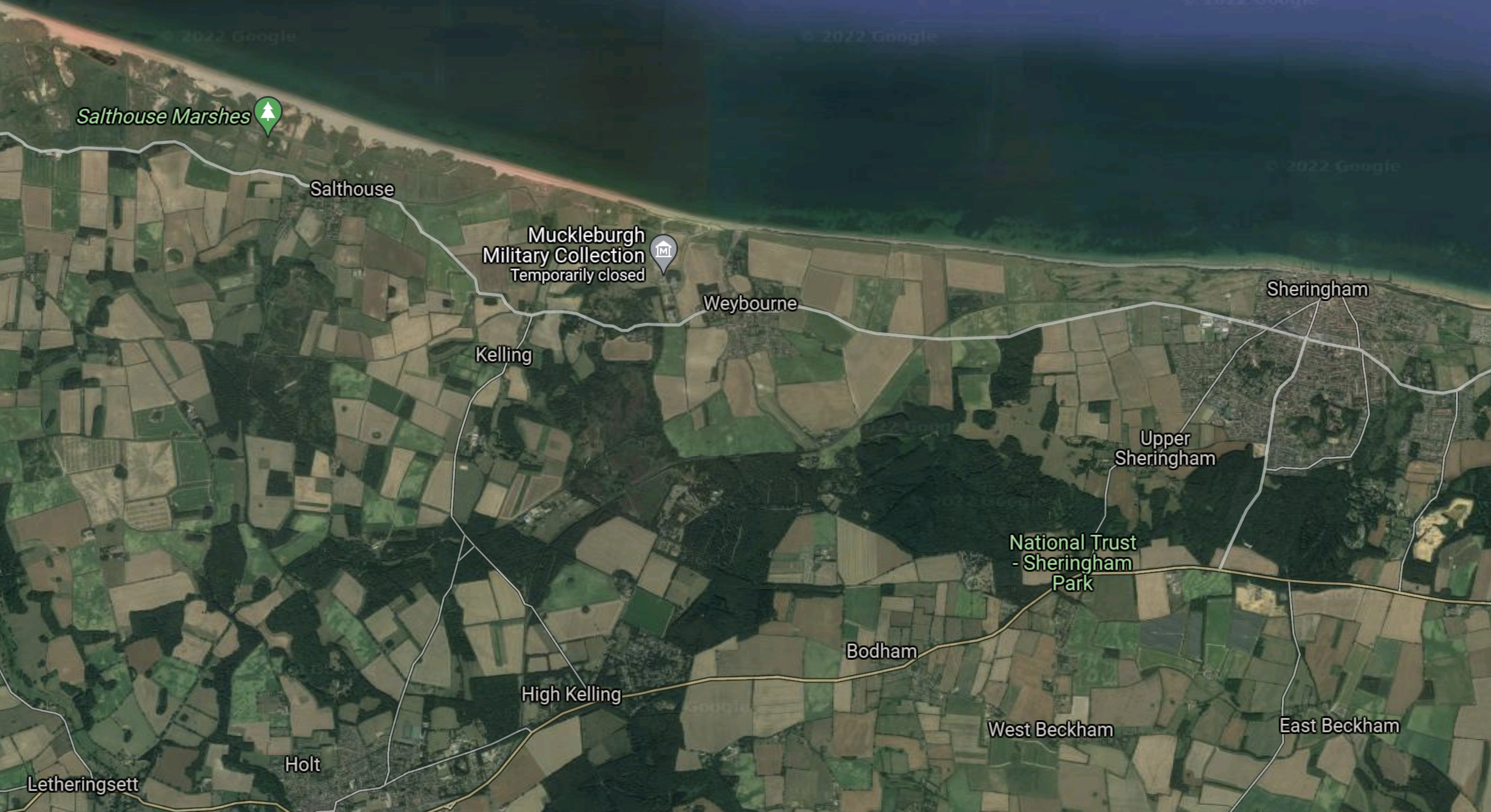
Note.
- Weybourne is in the middle on the coast.
- Sheringham is on the coast in the East.
- Holt is on the Southern edge of the map almost South of Weybourne.
This second map shows the location of the onshore substation at Necton, with respect to the coast.
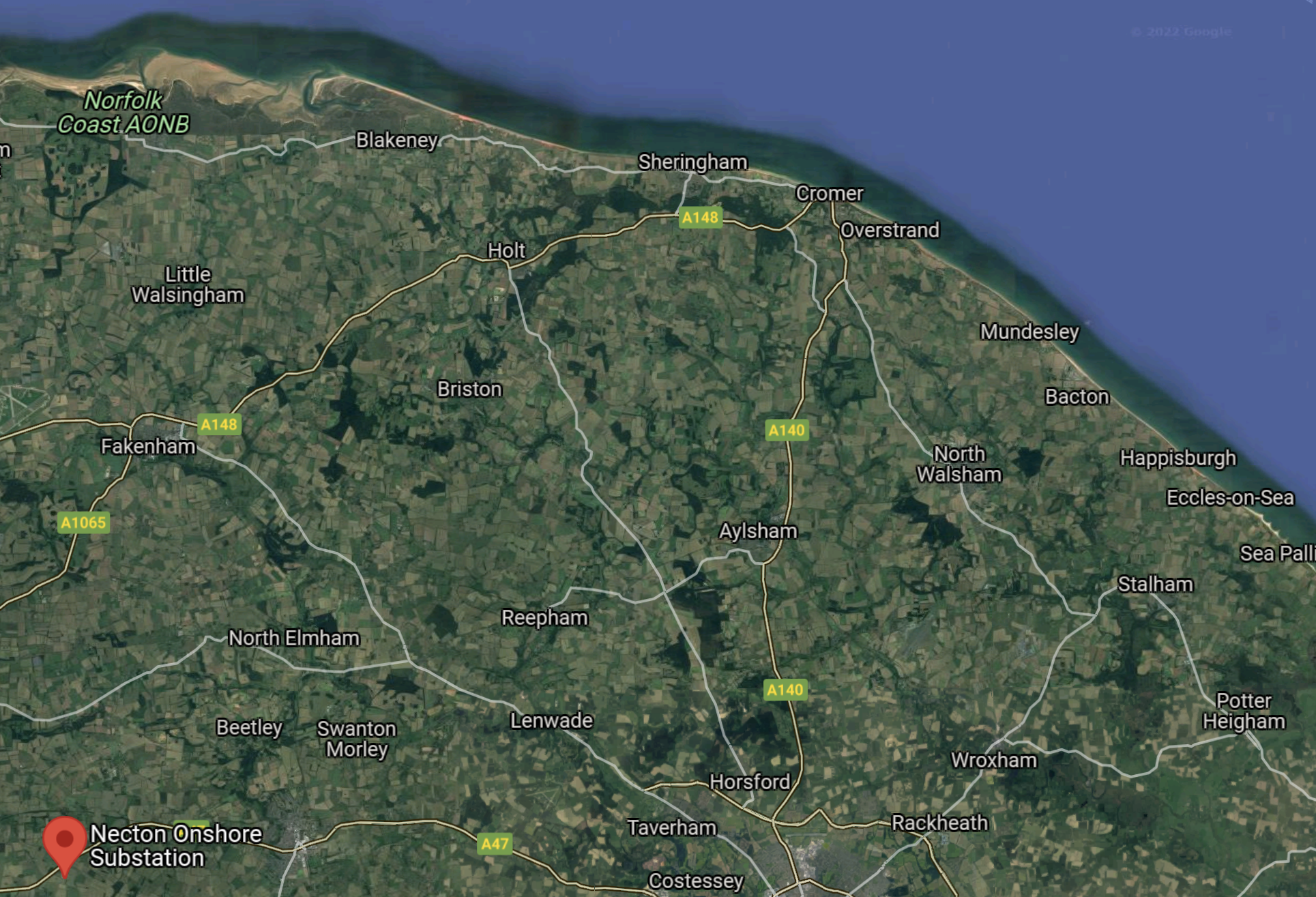
Note.
- The Necton substation is marked by a red arrow.
- Holt and Sheringham can be picked out by the coast in the middle.
- Weybourne is to the West of Sheringham.
- Necton and Weybourne are 35 miles apart.
Digging in the underground cable between Necton and Weybourne might have caused some disruption.
Looking at Weybourne in detail, I can’t find anything that looks like a substation. So is the Necton substation connected directly to Dudgeon’s offshore substation?
Sheringham Shoal Offshore Wind Farm
The Sheringham Shoal offshore wind farm is a 316.8 MW wind farm, which is eleven miles off the North Norfolk coast.
- It has 88 turbines and two offshore substations.
- As with Dudgeon, it is connected to the shore at Weybourne on the coast.
- But the underground cable is connected to an onshore substation at Salle and that is connected to the National Grid at Norwich.
- It became operational in Sept 2012.
- Equinor and Statkraft are part owners of the windfarm and this is the home page of the wind farm’s web site.
- Equinor is the operator of the wind farm.
This second map shows the location of the onshore substation at Salle, with respect to the coast.

Note.
- The Salle substation is marked by a red arrow.
- Holt, Weybourne and Sheringham can be picked out by the coast in the middle.
- Weybourne is to the West of Sheringham.
- Salle and Weybourne are 13.5 miles apart.
Could the following two statements be true?
- As the Sheringham Shoal wind farm was built first, that wind farm was able to use the shorter route.
- It wasn’t built large enough to be able to handle the Dudgeon wind farm.
The statements would certainly explain, why Dudgeon used a second cable.
Extending The Dudgeon And Sheringham Shoal Wind Farms
Both the Dudgeon And Sheringham Shoal web sites have details of the proposed join extension of both wind farms.
This is the main statement on the Overview page.
Equinor has been awarded an Agreement for Lease by the Crown Estate, the intention being to seek consents to increase the generating capacity of both the Sheringham Shoal Offshore Wind Farm and the Dudgeon Offshore Wind Farm.
They then make three points about the development.
- Equinor is proposing a joint development of the two projects with a common transmission infrastructure.
- As part of the common DCO application, the Extension Projects have a shared point of connection at the National Grid Norwich Main substation.
- These extension projects will have a combined generating capacity of 719MW which will make an important contribution to the UK’s target of 30GW of electricity generated by offshore wind by 2030.
This statement on the Offshore Location page, describes the layout of the wind farms.
The Sheringham Shoal Offshore Wind Farm extension is to the north and the east of the existing wind farm, while its Dudgeon counterpart is to the north and south east of the existing Dudgeon Offshore Wind Farm site. The proposed extension areas share the boundaries with its existing wind farm site.
They then make these two important points about the development.
- Equinor is seeking to develop the extension project with a joint transmission infrastructure. A common offshore substation infrastructure is planned to be located in the Sheringham Shoal wind farm site.
- The seabed export cable which will transmit the power generated by both wind farm extensions will make landfall at Weybourne.
There is also this map.

Note.
- The purple line appears to be the UK’s ten mile limit.
- The Sheringham Shoal Extension is outlined in red.
- The Dudgeon Extension is outlined in blue.
- The black lines appear to be the power cables.
I suspect the dotted blue lines are shipping routes sneaking their way through the turbines.
This statement on the Onshore Location page, describes the layout of the offshore and onshore cables.
A new seabed export cable will bring the electricity generated by both the Sheringham Shoal and Dudgeon Offshore Wind Farm extensions to shore at Weybourne, on the coast of Norfolk.
They then make these two important points about the development.
- From there a new underground cable will be installed to transmit that power to a new purpose built onshore substation, which will be located within a 3km radius of the existing Norwich main substation, south of Norwich. This will be the National Grid network connection point for the electricity from both wind farm extensions.
- The power will be transmitted from landfall to the substation using an HVAC system which eliminates the need for any relay stations along the onshore cable route.
There is also this map.
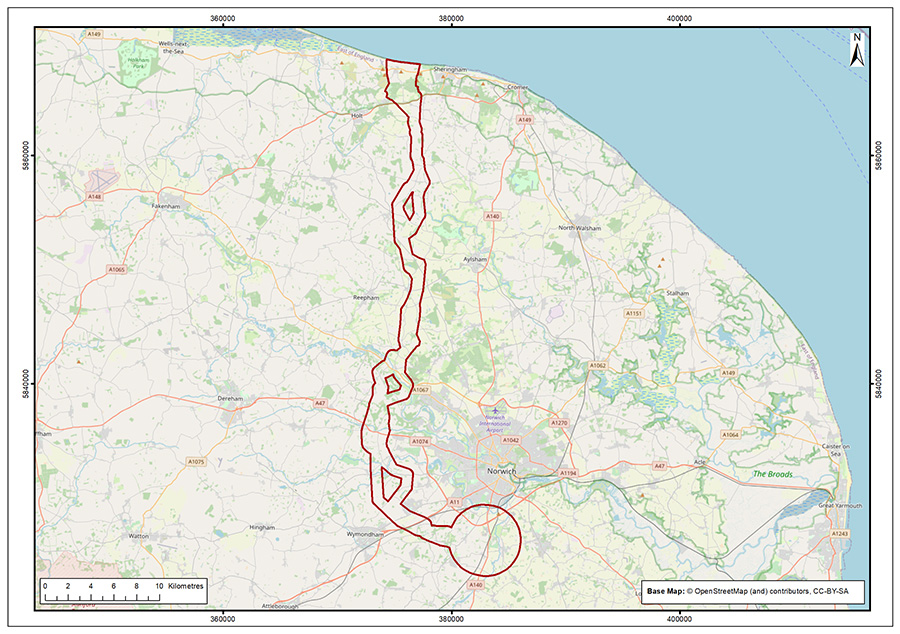
It will be a substantial undertaking to build the underground cable between Weybourne and South of Norwich.
Bacton Gas Terminal
The Bacton gas terminal is a complex of six gas terminals about ten miles East of Cromer.
- It lands and processes gas from a number of fields in the North Sea.
- It hosts the UK end of the BBL pipeline to The Netherlands.
- It hosts the UK end of the Interconnector to Zeebrugge in Belgium.
- The Baird and Deborah fields, which have been developed as gas storage, are connected to the gas terminal. They are both mothballed.
This Google Map shows the location of the terminal.
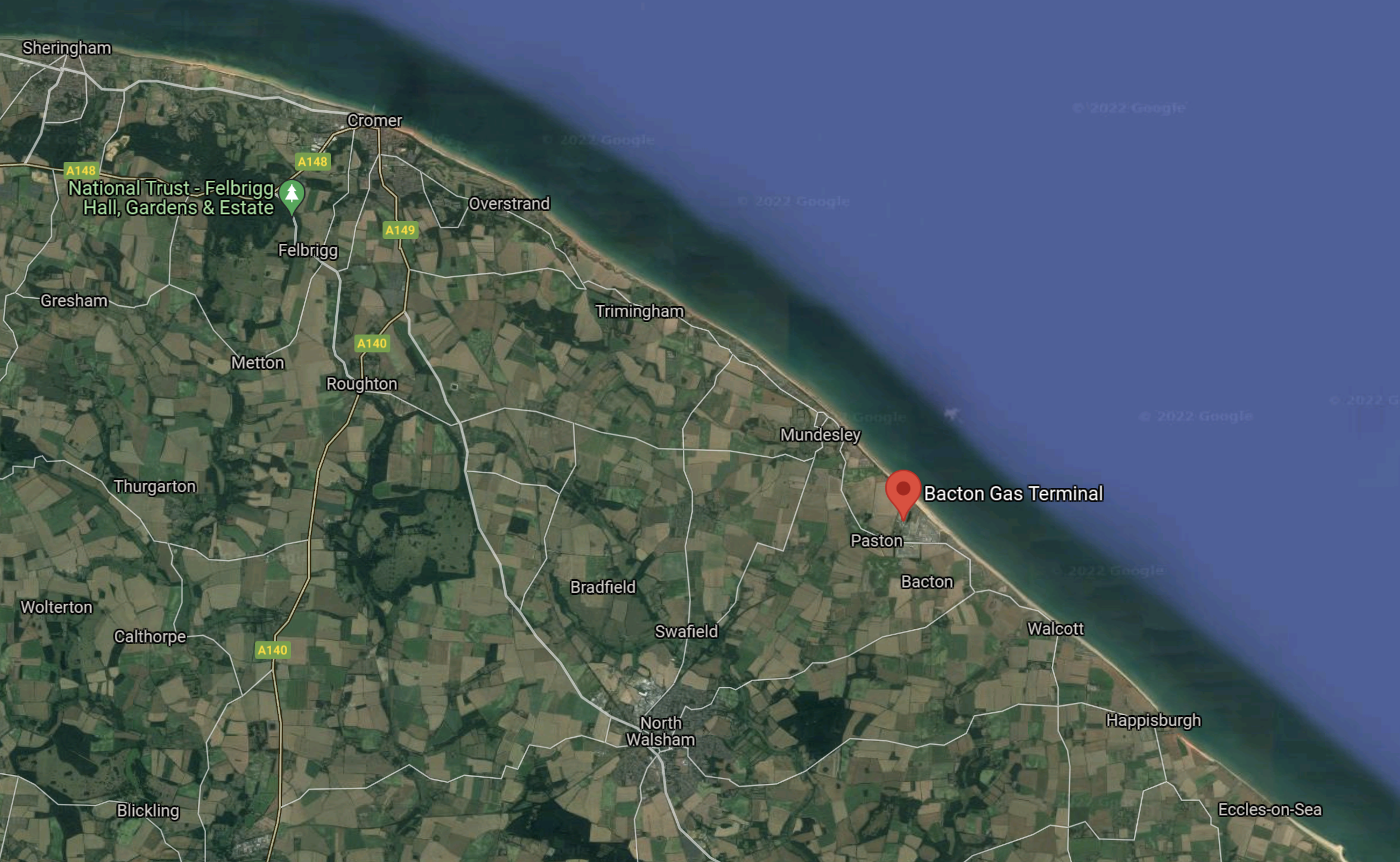
Note.
- The Bacton gas terminal is marked by a red arrow.
- Sheringham is in the North West corner of the map.
- Cromer, Overstrand, Trimingham and Mundesley are resort towns and villages along the coast North of Bacton.
This second map shows the Bacton gas terminal in more detail.
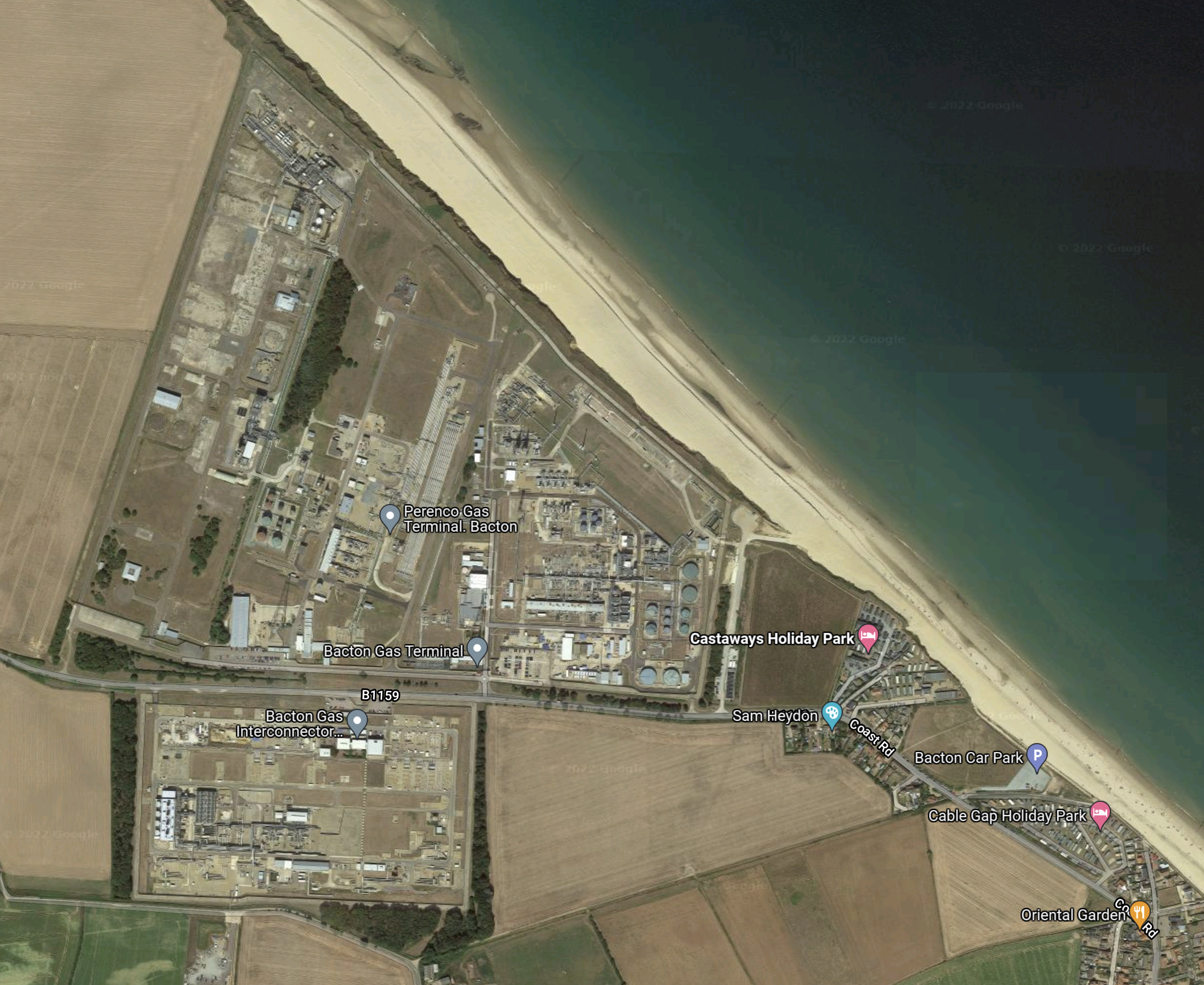
Would you want to have a seaside holiday, by a gas terminal?
Norfolk Boreas And Norfolk Vanguard
Norfolk Boreas and Norfolk Vanguard are two wind farms under development by Vattenfall.
- Norfolk Boreas is a proposed 1.8 GW wind farm, that will be 45 miles offshore.
- Norfolk Vanguard is a proposed 1.8 GW wind farm, that will be 29 miles offshore.
This map shows the two fields in relation to the coast.
Note.
- The purple line appears to be the UK’s ten mile limit.
- Norfolk Boreas is outlined in blue.
- Norfolk Vsnguard is outlined in orange.
- Cables will be run in the grey areas.
This second map shows the onshore cable.
Note.
- The cables are planned to come ashore between Happisburgh and Eccles-on-Sea.
- Bacton gas terminal is only a short distance up the coast.
- The onshore cable is planned to go from here across Norfolk to the Necton substation.
But all of this has been overturned by a legal ruling.
This article on the BBC is entitled Norfolk Vanguard: Ministers Wrong Over Wind Farm Go-Ahead, Says Judge.
These are the first four paragraphs.
A High Court judge has quashed permission for one of the world’s largest offshore wind farms to be built off the east coast of England.
The Norfolk Vanguard Offshore Wind Farm was granted development consent in July by the Secretary of State for Business, Energy and Industrial Strategy (BEIS).
But Mr Justice Holgate overturned the decision following legal action from a man living near a planned cable route.
A Department for BEIS spokeswoman said it was “disappointed by the outcome”.
I bet the spokeswoman was disappointed.
Vattenfall and the BEIS will go back to the drawing board.
But seriously, is it a good idea to dig an underground cable all the way across Norfolk or in these times build a massive overhead cable either?
Perhaps the solution is to connect the Norfolk Boreas And Norfolk Vanguard wind farms to a giant electrolyser at Bacton, which creates hydrogen.
- The underground electricity cable across Norfolk would not be needed.
- Bacton gas terminal is only a few miles up the coast from the cable’s landfall.
- The UK gets another supply of gas.
- The hydrogen is blended with natural gas for consumption in the UK or Europe.
- A pure hydrogen feed can be used to supply hydrogen buses, trucks and other vehicles, either by tanker or pipeline.
- Excess hydrogen could be stored in depleted gas fields.
The main benefit though, would be that it would transform Bacton gas terminal from a declining asset into Norfolk’s Hydrogen Powerhouse.
Great Yarmouth And Lowestoft
Great Yarmouth Outer Harbour and the Port of Lowestoft have not been the most successful of ports in recent years, but with the building of large numbers of wind farms, they are both likely to receive collateral benefits.
I wouldn’t be surprised to see the support ships for the wind farms switching to zero-carbon power, which would require good electrical connections to the ports to either charge batteries or power electrolysers to generate hydrogen.
Sizewell
Sizewell has only one nuclear power station at present; Sizewell B, but it could be joined by Sizewell C or a fleet of Small Modular Reactors (SMR).
The Sizewell Overhead Transmission Line
Sizewell also has a very high capacity overhead power line to Ipswich and the West.





I doubt, it would be possible to build an overhead transmission line like this today.
Sizewell And Hydrogen
EdF, who own the site are involved with Freeport East and may choose to build a large electrolyser in the area to create hydrogen for the Freeport.
East Anglia Array
The East Anglia Array will be an enormous wind farm., comprising up to six separate projects.
It will be thirty miles offshore.
It could generate up to 7.2 GW.
The first project East Anglia One is in operation and delivers 714 MW to a substation in the Deben Estuary, which connects to the Sizewell high-capacity overhead power line.
Most projects will be in operation by 2026.
Freeport East
As the Freeport develops, it will surely be a massive user of both electricity and hydrogen.
Problems With The Current Electricity Network
I don’t believe that the current electricity network, that serves the wind farms and the large energy users has been designed with the number of wind farms we are seeing in the North Sea in mind.
Every new windfarm seems to need a new connection across Norfolk or Suffolk and in Norfolk, where no high-capacity cables exist, this is stirring up the locals.
There is also no energy storage in the current electricity network, so at times, the network must be less than efficient and wind turbines have to be shut down.
Objections To The Current Policies
It is not difficult to find stories on the Internet about objections to the current policies of building large numbers of wind farms and the Sizewell C nuclear power station.
This article on the East Anglia Daily Times, which is entitled Campaigners Unite In Calling For A Pause Before ‘Onslaught’ Of Energy Projects ‘Devastates’ Region is typical.
This is the first paragraph.
Campaigners and politicians have called on the Government to pause the expansion of the energy industry in Suffolk, which they fear will turn the countryside into an “industrial wasteland” and hit tourism.
The group also appear to be against the construction of Sizewell C.
I feel they have a point about too much development onshore, but I feel that if the UK is to thrive in the future we need an independent zero carbon energy source.
I also believe that thousands of wind farms in the seas around the UK and Ireland are the best way to obtain that energy.
Blending Hydrogen With Natural Gas
Blending green hydrogen produced in an electrolyser with natural gas is an interesting possibility.
- HyDeploy is a project to investigate blending up to 20 % of green hydrogen in the natural gas supply to industrial and domestic users.
- Partners include Cadent, ITM Power, Keele University and the Health and Safety Executive.
- Natural gas naturally contains a small amount of hydrogen anyway.
- The hydrogen gas would be distributed to users in the existing gas delivery network.
I wrote about HyDeploy in a post called HyDeploy.
Thje only loser, if hydrogen were to be blended with natural gas would be Vlad the Poisoner, as he’d sell less of his tainted gas.
An Interconnector Between Bicker Fen And Freeport East
I believe that an electricity interconnector between at least Bicker Fen and Freeport East could solve some of the problems.
My objectives would be.
- Avoid as much disruption on the land as possible.
- Create the capacity to deliver all the energy generated to customers, either as electricity or hydrogen.
- Create an expandable framework, that would support all the wind farms that could be built in the future.
The interconnector would be a few miles offshore and run along the sea-bed.
- This method of construction is well proven.
- It was used for the Western HVDC Link between Hunterston in Scotland and Connah’s Quay in Wales.
- Most wind farms seem to have existing substations and these would be upgraded to host the interconnector.
Connections en route would include.
Dudgeon Offshore Wind Farm
The interconnector would connect to the existing offshore substation.
Sheringham Shoal Wind Farm
The interconnector would connect to the existing offshore substation.
Dudgeon and Sheringham Shoal Extension Offshore Wind Farms
These two wind farms could be connected directly to the interconnector, if as planned, they shared an offshore substation in the Sheringham Shoal Extension offshore wind farm.
Bacton Gas Terminal
I would connect to the Bacton Gas Terminal, so that a large electrolyser could be installed at the terminal.
The hydrogen produced could be.
- Stored in depleted gas fields connected to the terminal.
- Blended with natural gas.
- Exported to Europe through an interconnector.
- Supplied to local users by truck or pipeline.
After all, the terminal has been handling gas for over fifty years, so they have a lot of experience of safe gas handling.
Norfolk Boreas And Norfolk Vanguard
These two wind farms could be connected directly to the interconnector, if they shared an offshore substation.
It would also help to appease and silence the objectors, if there was no need to dig up half of Norfolk.
Great Yarmouth And Lowestoft
It might be better, if these ports were supplied from the interconnector.
- Either port could have its own electrolyser to generate hydrogen, which could be.
- Used to power ships, trucks and port equipment.
- Liquefied and exported in tankers.
- Used to supply local gas users.
- Hydrogen could be supplied to a converted Great Yarmouth power station.
Both Great Yarmouth and Lowestoft could become hydrogen hub towns.
Sizewell
This site has a high-capacity connection to the National Grid. This connection is a big eyesore, but it needs to run at full capacity to take electricity from the Energy Coast to the interior of England.
That electricity can come from Sizewell B and/or Sizewell C nuclear power stations or the offshore wind farms.
East Anglia Array
There would probably need to be a joint offshore substation to control the massive amounts of electricity generated by the array.
Currently, the only wind farm in operation of this group is East Anglia One, which uses an underground cable connection to the Sizewell high-capacity connection to the Bullen Lane substation at Bramford.
Freeport East, Ipswich And Bullen Lane Substation
This Google Map shows the area between Ipswich and the coast.
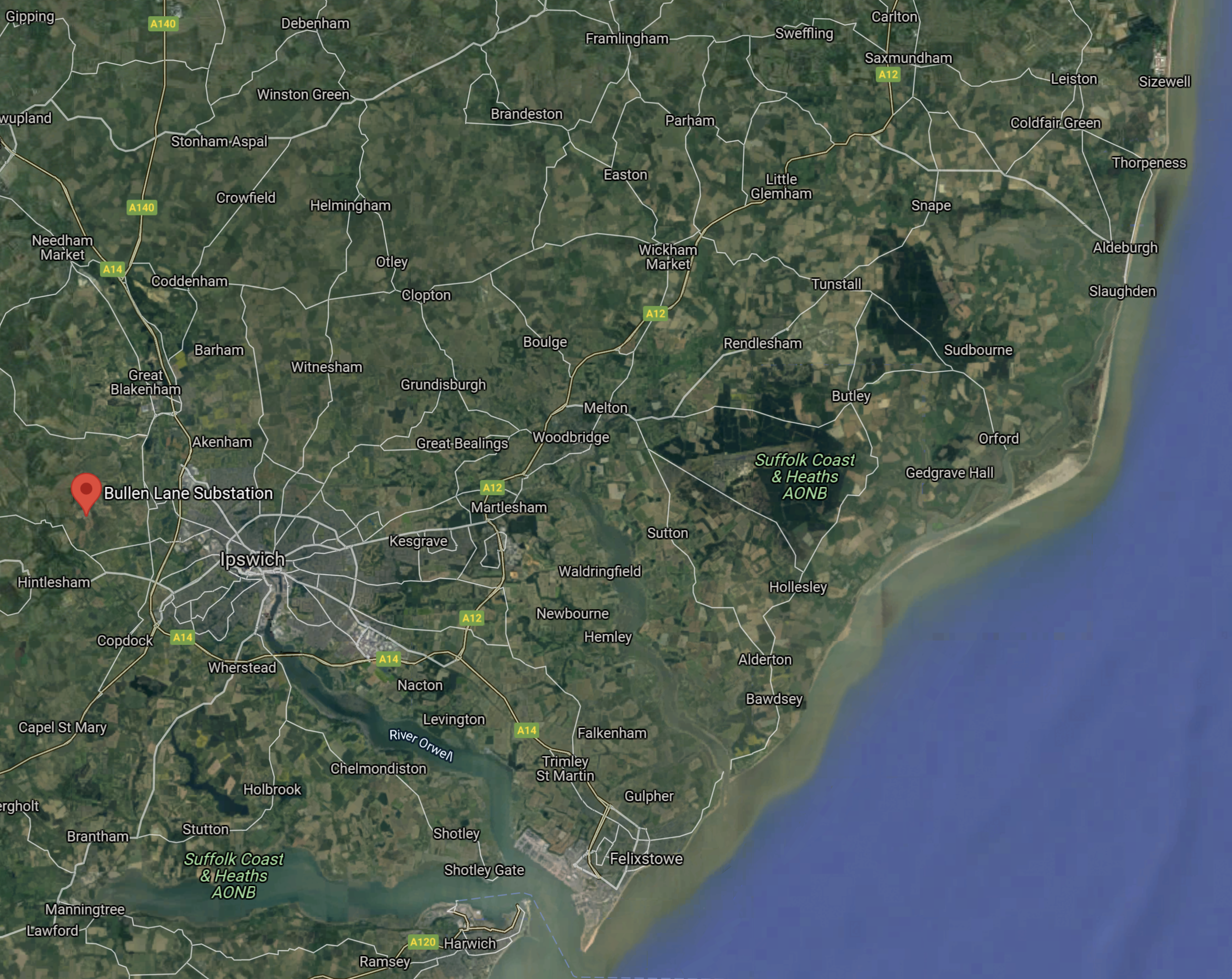
Note.
- Sizewell is in the North-East corner of the map.
- Felixstowe, Harwich and Freeport East are at the mouth of the rivers Orwell and Stour.
- The Bullen Lane substation is to the West of Ipswich and shown by the red arrow.
I would certainly investigate the possibility of running an underwater cable up the River Orwell to connect the Southern end of the interconnector Between Bicker Fen And Freeport East.
This Google Map shows the Bullen Lane Substation.
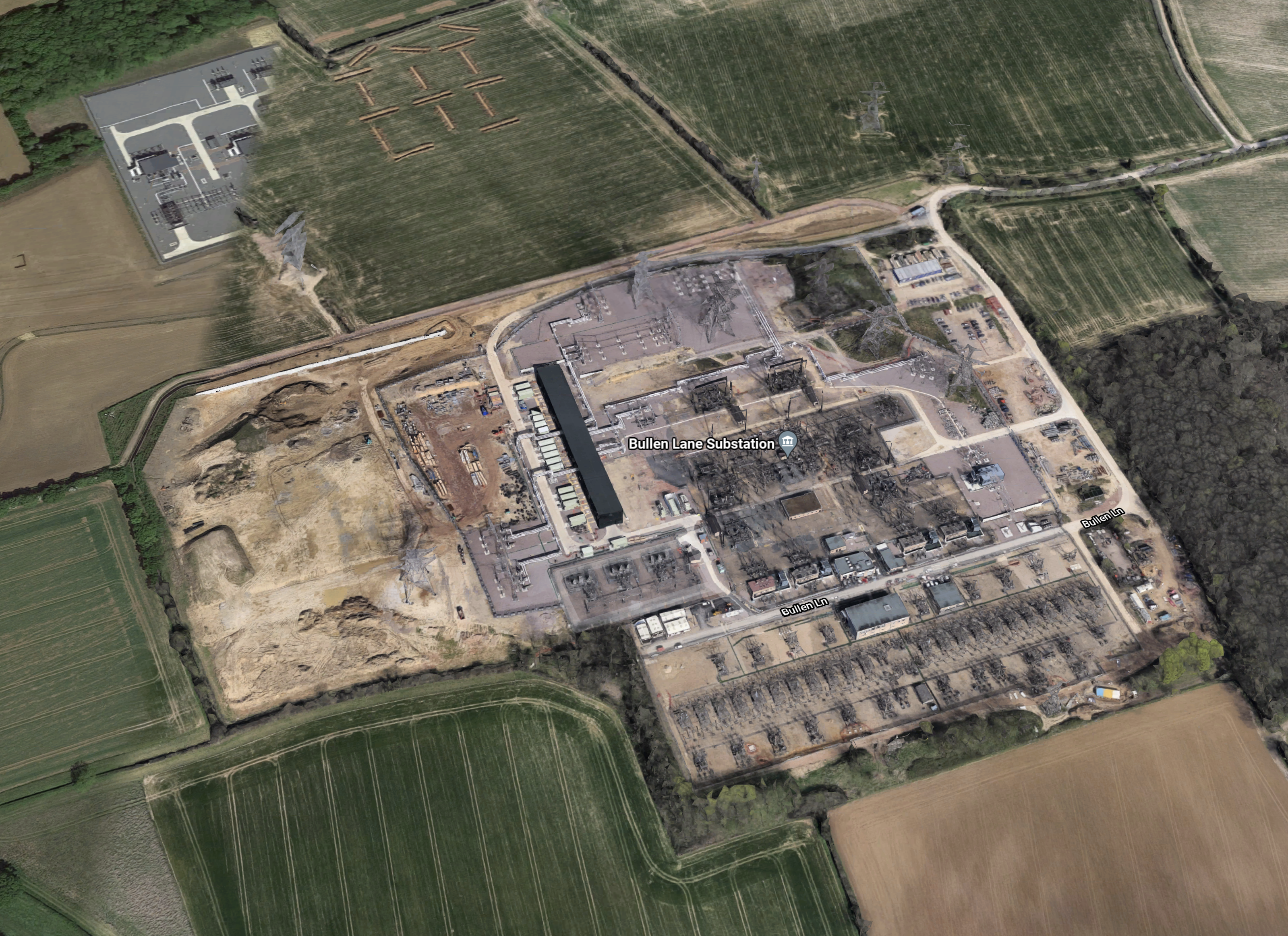
It looks impressive, but is it big enough to handle all the electricity coming ashore from the offshore wind farms to the East of Suffolk and the electricity from the power stations at Sizewell?
Conclusion
I believe there are a lot of possibilities, that would meet the threeobjectives, I stated earlier.
- Avoid as much disruption on the land as possible.
- Create the capacity to deliver all the energy generated to customers, either as electricity or hydrogen.
- Create an expandable framework, that would support all the wind farms that could be built in the future.
In addition, simple mathematics says to me, that either there will need to be extra capacity at both Bicker Fen and Bullen Lane substations and onward to the rest of the country, or a large electrolyser to convert several gigawatts of electricity into hydrogen for distribution, through the gas network.
Could Norfolk And Suffolk Be Powered By Offshore Wind?
This week this article on the BBC was published, which had a title of Government Pledges £100m For Sizewell Nuclear Site.
These are the first three paragraphs.
The government is putting up £100m to support the planned Sizewell C nuclear plant in Suffolk, Business and Energy Secretary Kwasi Kwarteng has announced.
The investment marks the latest stage in efforts to build the £20bn reactor on the east coast of England.
However, it does not commit the government to approving the project, which is still subject to negotiations.
My view of the proposed Sizewell C nuclear plant is that of an engineer, who used to live within thirty minutes of the Sizewell site.
- Hinckley Point C power station, which is currently being constructed, will have a nameplate capacity of 3.26 GW.
- Sizewell C would probably be to a similar design and capacity to Hinckley Point C.
- Sizewell C would likely be completed between 2033-2036.
- Sizewell B is a 1250 MW station, which has a current closing date of 2035, that could be extended to 2055.
- East Anglia and particularly the mega Freeport East, that will develop to the South at the Ports of Felixstowe and Harwich will need more electricity.
- One of the needs of Freeport East will be a large supply of electricity to create hydrogen for the trains, trucks, ships and cargo handling equipment.
- Sizewell is a large site, with an excellent connection to the National Grid, that marches as a giant pair of overhead cables across the Suffolk countryside to Ipswich.
But.
- We still haven’t developed a comprehensive strategy for the management of nuclear waste in the UK. Like paying for the care of the elderly and road pricing, it is one of those problems, that successive governments have kept kicking down the road, as it is a big vote loser.
- I was involved writing project management software for forty years and the building of large nuclear power plants is littered with time and cost overruns.
- There wasn’t a labour problem with the building of Sizewell B, as engineers and workers were readily available. But with the development of Freeport East, I would be very surprised if Suffolk could provide enough labour for two mega-projects after Brexit.
- Nuclear power plants use a lot of steel and concrete. The production of these currently create a lot of carbon dioxide.
- There is also a large number of those objecting to the building of Sizewell C. It saddened me twenty-five years ago, that most of the most strident objectors, that I met, were second home owners, with no other connection to Suffolk.
The older I get, the more my experience says, that large nuclear power plants aren’t always a good idea.
Small Modular Nuclear Reactors
In Is Sizewell The Ideal Site For A Fleet Of Small Modular Nuclear Reactors?, I looked at building a fleet of small modular nuclear reactors at Sizewell, instead of Sizewell C.
I believe eight units would be needed in the fleet to produce the proposed 3.26 GW and advantages would include.
- Less land use.
- Less cost.
- Less need for scarce labour.
- Easier to finance.
- Manufacturing modules in a factory should improve quality.
- Electricity from the time of completion of unit 1.
But it would still be nuclear.
Wind In The Pipeline
Currently, these offshore wind farms around the East Anglian Coast are under construction, proposed or are in an exploratory phase.
- East Anglia One – 714 MW – 2021 – Finishing Construction
- East Anglia One North 800 MW – 2026 – Exploratory
- East Anglia Two – 900 MW – 2026 – Exploratory
- East Anglia Three – 1400 MW – 2026 – Exploratory
- Norfolk Vanguard – 1800 MW – Exploratory
- Norfolk Boreas – 1800 MW – Exploratory
- Sheringham Shoal/Dudgeon Extension – 719 MW – Exploratory
Note.
- The date is the possible final commissioning date.
- I have no commissioning dates for the last three wind farms.
- The East Anglia wind farms are all part of the East Anglia Array.
These total up to 8.13 GW, which is in excess of the combined capacity of Sizewell B and the proposed Sizewell C, which is only 4.51 GW.
As it is likely, that by 2033, which is the earliest date, that Sizewell C will be completed, that the East Anglia Array will be substantially completed, I suspect that East Anglia will not run out of electricity.
But I do feel that to be sure, EdF should try hard to get the twenty year extension to Sizewell B.
The East Anglia Hub
ScottishPower Renewables are developing the East Anglia Array and this page on their web site, describes the East Anglia Hub.
This is the opening paragraph.
ScottishPower Renewables is proposing to construct its future offshore windfarms, East Anglia THREE, East Anglia TWO and East Anglia ONE North, as a new ‘East Anglia Hub’.
Note.
- These three wind farms will have a total capacity of 3.1 GW.
- East Anglia ONE is already in operation.
- Power is brought ashore at Bawdsey between Felixstowe and Sizewell.
I would assume that East Anglia Hub and East Anglia ONE will use the same connection.
Norfolk Boreas and Norfolk Vanguard
These two wind farms will be to the East of Great Yarmouth.
This map from Vattenfall web site, shows the position of the two wind farms.
Note.
- Norfolk Boreas is outlined in blue.
- Norfolk Vanguard is outlined in orange.
- I assume the grey areas are where the cables will be laid.
- I estimate that the two farms are about fifty miles offshore.
This second map shows the landfall between Eccles-on-Sea and Happisburgh.
Note the underground cable goes half-way across Norfolk to Necton.
Electricity And Norfolk And Suffolk
This Google Map shows Norfolk and Suffolk.
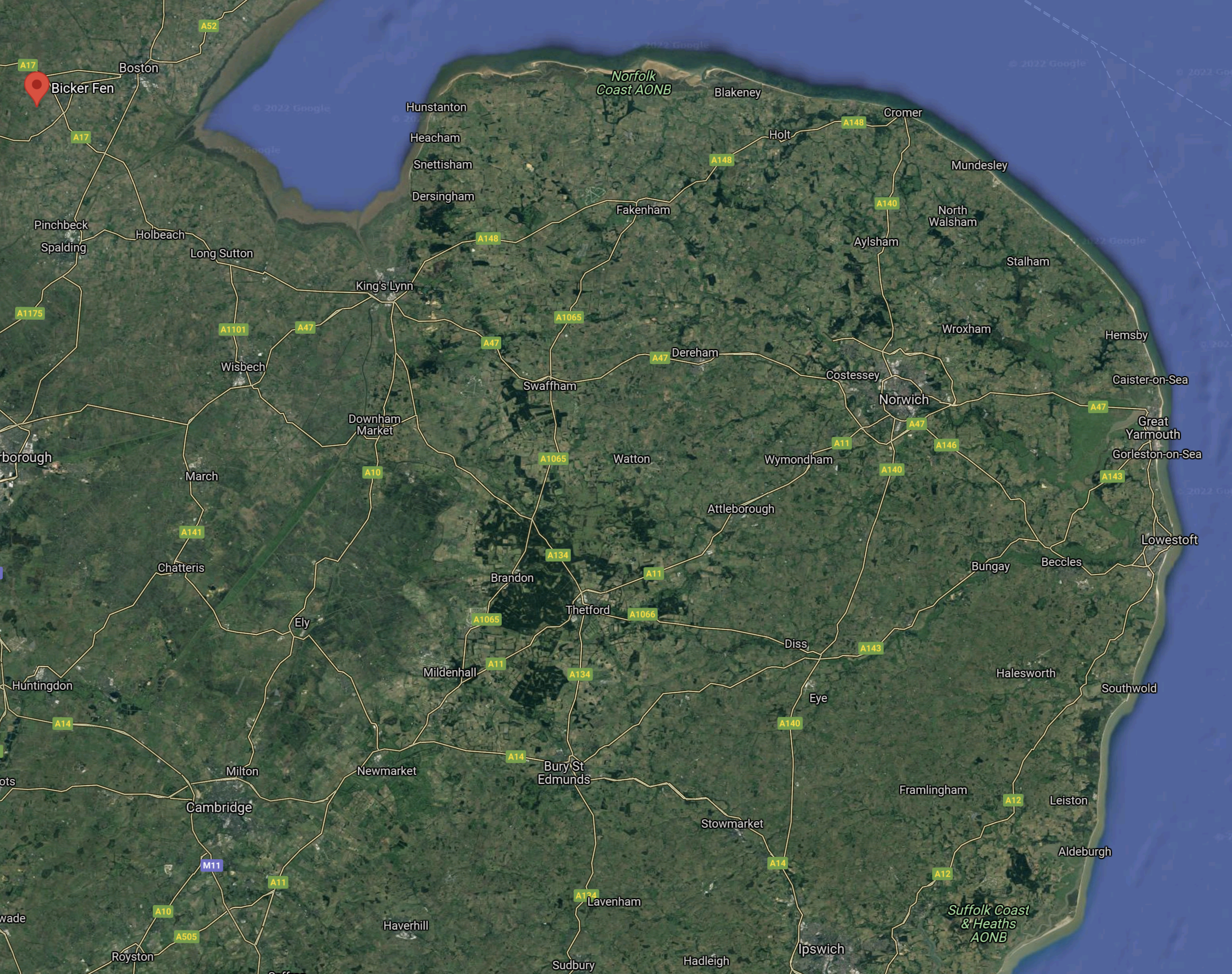
Note.
- The red arrow in the North-West corner marks the Bicker Fen substation that connects to the Viking Link to Denmark.
- The East Anglia Array connects to the grid at Bawdsey in the South-East corner of the map.
- Sizewell is South of Aldeburgh in the South-East corner of the map.
- The only ports are Lowestoft and Yarmouth in the East and Kings Lynn in the North-West.
There are few large towns or cities and little heavy industry.
- Electricity usage could be lower than the UK average.
- There are three small onshore wind farms in Norfolk and none in Suffolk.
- There is virtually no high ground suitable for pumped storage.
- There are lots of areas, where there are very few buildings to the square mile.
As I write this at around midday on a Saturday at the end of January, 49 % of electricity in Eastern England comes from wind, 20 % from nuclear and 8 % from solar. That last figure surprised me.
I believe that the wind developments I listed earlier could provide Norfolk and Suffolk with all the electricity they need.
The Use Of Batteries
Earlier, I talked of a maximum of over 7 GW of offshore wind around the cost of Norfolk and Suffolk, but there is still clear water in the sea to be filled between the existing and planned wind farms.
Batteries will become inevitable to smooth the gaps between the electricity produced and the electricity used.
Here are a few numbers.
- East Anglian Offshore Wind Capacity – 8 GW
- Off-Peak Hours – Midnight to 0700.
- Typical Capacity Factor Of A Windfarm – 20 % but improving.
- Overnight Electricity Produced at 20 % Capacity Factor – 11.2 GWh
- Sizewell B Output – 1.25 GW
- Proposed Sizewell C Output – 3.26 GW
- Largest Electrolyser – 24 MW
- World’s Largest Lithium-Ion Battery at Moss Landing – 3 GWh
- Storage at Electric Mountain – 9.1 GWh
- Storage at Cruachan Power Station – 7.1 GWh
Just putting these large numbers in a table tells me that some serious mathematical modelling will need to be performed to size the batteries that will probably be needed in East Anglia.
In the 1970s, I was involved in three calculations of a similar nature.
- In one, I sized the vessels for a proposed polypropylene plant for ICI.
- In another for ICI, I sized an effluent treatment system for a chemical plant, using an analogue computer.
- I also helped program an analysis of water resources in the South of England. So if you have a water shortage in your area caused by a wrong-sized reservoir, it could be my fault.
My rough estimate is that the East Anglian battery would need to be at least a few GWh and capable of supplying up to the output of Sizewell B.
It also doesn’t have to be a single battery. One solution would probably be to calculate what size battery is needed in the various towns and cities of East Anglia, to give everyone a stable and reliable power supply.
I could see a large battery built at Sizewell and smaller batteries all over Norfolk and Suffolk.
But why stop there? We probably need appropriately-sized batteries all over the UK, with very sophisticated control systems using artificial intelligent working out, where the electricity is best stored.
Note that in this post, by batteries, I’m using that in the loosest possible way. So the smaller ones could be lithium-ion and largest ones could be based on some of the more promising technologies that are under development.
- Highview Power have an order for a 50 MW/500 MWh battery for Chile, that I wrote about in The Power Of Solar With A Large Battery.
- East Anglia is an area, where digging deep holes is easy and some of Gravitricity’s ideas might suit.
- I also think that eventually someone will come up with a method of storing energy using sea cliffs.
All these developments don’t require large amounts of land.
East Anglia Needs More Heavy Consumers Of Electricity
I am certainly coming to this conclusion.
Probably, the biggest use of electricity in East Anglia is the Port of Felixstowe, which will be expanding as it becomes Freeport East in partnership with the Port of Harwich.
One other obvious use could be in large data centres.
But East Anglia has never been known for industries that use a lot of electricity, like aluminium smelting.
Conversion To Hydrogen
Although the largest current electrolyser is only 24 MW, the UK’s major electrolyser builder; ITM Power, is talking of a manufacturing capacity of 5 GW per year, so don’t rule out conversion of excess electricity into hydrogen.
Conclusion
Who needs Sizewell C?
Perhaps as a replacement for Sizewell B, but it would appear there is no pressing urgency.
Greater Anglia Trains Hit 10-year High For Punctuality
The title of this post is the same as that of this article on North Norfolk News.
This is the first two paragraphs.
Greater Anglia has recorded its best figures for punctuality in a decade, latest figures have revealed.
More than nine out of every ten trains ran on time in November, helping the company achieve its best punctuality result for 10 years and second-best of the past 20 years.
That is very good, with punctuality figures very close to a hundred percent.
What the article doesn’t mention, is that Greater Anglia’s trains in Norfolk and Suffolk are now typically step-free, with those in wheelchairs to be able to roll in without a ramp.
How much has this feature contributed to the outstanding punctuality?
Equipmake Opens New Electric Bus Factory In Snetterton
The title of this post, is the same as that of this press release from Equipmake.
This is the introductory paragraph.
Expert electrification company, Equipmake, has opened a brand-new factory in Snetterton, Norfolk, which will design and manufacture its fully-integrated electric bus chassis for an increasingly international customer base.
This paragraph sums up their marketing philosophy for their bus chassis.
Equipmake’s innovative electric bus chassis allows any bus coachbuilder to become a full electric bus manufacturer almost overnight. Such is the demand from bus makers wishing to go zero emissions that Equipmake has forged partnerships with companies in Brazil, Argentina and India and grown its UK staff from 15 employees to 52 in a little over two years.
Equipmake certainly seem to be doing something right.
- They make their own electric motors.
- They claim to make the world’s most power dense electric motors.
Perhaps, it’s all down to good design?
This paragraph from the press release gives more details of the bus chassis.
Thanks to efficient management of its onboard heating and cooling system, the bus – a 12m single deck model capable of carrying 70 passengers – will have enough electric range for one day’s running without the need for charging. To charge the vehicle, the operator simply needs access to a standard three-phase supply, which will fully charge it in around five hours.
That seems impressive to me!
Aerial Pictures Show New Trains Housed In Mid-Norfolk
The title of this post, is the same as that of this article on the Eastern Daily Press.
Greater Anglia has a storage problem for all the new trains being delivered from Stadler in Switzerland.
So the train operating company has done a deal with the Mid Norfolk Railway to store the trains in the depths of deepest Norfolk.
Wikipedia gives more details in a section, entitled Storage Of Main Line Stock.
Working with Abellio Greater Anglia, the Mid-Norfolk Railway have developed a rolling stock storage facility close to their Kimberley Park station. The £3 million sidings have been funded by Abellio Greater Anglia to allow them to store their Class 745 and 755 fleets until they are ready to be in service.
It has also been reported that the site, will be used to store the replaced trains, whilst they await new operators or the scrapyard.
This picture clipped from the Eastern Daily Press article, shows the trains.

Reading the Wikipedia entry for the Mid Norfolk Railway, which is obviously a well-maintained standard gauge heritage railway, it gets used for various rail-related training and other purposes, so as the multi-million pound deal shows, I’m pretty certain there is a lot of co-operation between all parties in Norfolk, including Greater Anglia, Network Rail, Balfour Beatty and the Emergency Services.
Will The Class 755 Trains Return With Passengers?
The following should be noted.
- Rail tours and charters use the branch and visit Dereham, several times a year.
- An InterCity 125 has even used the line.
- Dereham is a town of 19,000 people.
- Norfolk is a county, that welcomes lots of tourists.
- Wymondham station will soon have a direct hourly service to and from Stansted Airport.
Given the co-operation between Greater Anglia and the Mid-Norfolk Railway over the train storage, where a long term conveniently-located facility is of benefit to both parties, will we see occasional visits of Class 755 trains to Dereham?
There must be long-term possibilities.
- Weekend steam trains between Dereham and Norwich, similar to the Shakespeare Express, that runs between Birmingham Snow Hill and Stratford stations.
- A limited commuter service between Dereham and Norwich.
The Mid-Norfolk Railway’s long term ambition to extend their route past Dereham to reopened stations at County School and Fakenham, would surely increase the viability of these services.
New Greater Anglia Trains To Be Stored At Heritage Line
The title of this post is the same as that of this article in Rail Magazine.
- Greater Anglia are paying the Mid-Norfolk Railway, three million pounds to store the new trains.
- The heritage railway will create new sidings and some double track.
- It looks a good deal and both parties are quoted as being pleased with the deal.
I wonder, if this could be the start of something a lot bigger.
Norfolk County Council and other interests would like to create the Norfolk Orbital Railway to run National Rail services in a circular route starting and finishing at Norwich station and going via Cromer, Sheringham, Dereham and Wymondham stations.
It strikes me that the works proposed by the Mid-Norfolk Railway will improve the route to Dereham.
Dereham and Wymondham are towns with populations of just under nineteen thousand and fourteen thousand respectively and large numbers of residents of the area, commute to Norwich.
- It could be that a direct service to Norwich might work!
- Greater Anglia certainly have enough trains for a service of a few trains per day.
- The infrastructure will be there by Spring 2019.
Given the closeness to Crown Point Depot, could Greater Anglia use the line for testing trains and training drivers?
There is also the problem of Trowse swing bridge, which is one of the biggest bottlenecks on the UK rail network.
Rebuilding is talked about, but it would probably mean services from the South into Norwich station would have to be stopped.
- Trowse station lies just to the South of the bridge.
- It was last used in 1986 as a te,temporary terminus during electrification.
- According to Wikipedia, it could be reactivated.
Would sidings on the Mid-Norfolk Railway be useful for stabling trains, if the bridge was closed for rebuilding?
The Future Of Railways In East Anglia
There are several major drivers of growth in the usage of the railways in East Anglia, which for the purpose of this analysis is the four eastern counties of Cambridgeshire, Essex, Norfolk and Suffolk.
Freight
The Port of Felixstowe and to a certain extent those of Harwich, Great Yarmouth and London Gateway are going to add considerably to the number of trains trundling around the railways of East Anglia. The interim destinations of these trains for onward journeys to the rest of the country will be London and Peterborough, using either the Great Eastern Main Line, the Ipswich to Ely Line or the London, Tilbury and Southend Line.
The LTS is mentioned as it is being connected to the London Gateway Port by a rail link and not all traffic will be directed through London.
Tourism
East Anglia has always earned a lot of income from a wide variety of tourism, from birdwatching to food and real ale and sailing to horse racing.
Many of the tourism hot-spots for East Anglia like Norwich and Cambridge already have a good rail service, although much of it is London-centric. Other places like Newmarket, Bury St. Edmunds and Great Yarmouth have the rail links, but don’t have frequent trains, but there are tourism hot-spots that are difficult to get to by public transport.
High Technology
Driven by Cambridge, high technology will be a big driver of growth in the area, but how will it effect the railways?
It already has.in that a station is being built at Cambridge Science Park, although I didn’t see any sign of construction, as I passed through yesterday. But the station is scheduled to open in 2016.
Just as with tourism everywhere, the high-technology sector in Cambridge, will generate increased passenger traffic. Just as London uses every place it can find in the South East of England as a dormitory, Cambridge will draw in workers from all the nearby towns.
But the high-technology itself will spill out from Cambridge into the surrounding towns, further increasing demand for rail services in places like Norwich, Peterborough, Newmarket and Bury St. Edmunds and possibly even unfashionable towns like Haverhill and Ipswich.
Thameslink
When Thameslink opens to Cambridge in 2018, it will be a massive feeder of passengers into the western side of East Anglia. The provisional timetable shows four semi-fast 12-car Class 700 trains to Cambridge every hour, as opposed to the two 8-car Class 365 trains at present. This will go a long way to reversing the dominant commuter flow from into London to out of London.
Incidentally, no plans have been published about what happens to the Kings Cross-Cambridge-Kings Lynn service using Class 365 trains after Thameslink opens.
If it is assumed that the current trains still go into Kings Cross, then that would mean about a quadrupling of the number of seats between Kings Cross/St. Pancras and Cambridge in each hour. If they don’t it’ll be a tripling of seats.
I know the line is crowded, but this does seem a hell of a lot of seats.
Crossrail
You might say that an east-west cross-London link won’t have any effect on East Anglia! But it will! And in ways we just don’t expect!
A fellow Ipswich supporter drives up to every home match from near Tonbridge over the Dartford Crossing and up the A12. He has stated that after Crossrail, he’ll drive to Abbey Wood and get the train to Liverpool Street for a fast train to Ipswich. I suspect Crossrail with its direct access to Liverpool Street, Heathrow and Reading will alter the travel habits of many travellers, going to and from East Anglia.
Improved Electrification
To my untrained eye, the overhead electrification being erected in the Liverpool-Preston-Manchester triangle is going up a lot faster and more robustly, than we would have expected a few years ago.
We’re just getting much better at it!
Remember too, that one of the major costs f railway electrification is getting the power to the track. Where electrification is tacked on to an existing system, it is a lot easier and more affordable.
Improved Signalling
Over the next decade signalling will move into the cabs of trains. It is a massive hidden project being undertaken by Network Rail, as is described here. This first two paragraphs say it all.
This tried and tested system will replace traditional railway signals with a computer display inside every train cab, reducing the costs of maintaining the railway, improving performance and enhancing safety.
It will offer a host of benefits to the railway and the application of its cab signalling component, the European Train Control System, ETCS, will spell the end for traditional signalling.
Who’s to say what difference this will make.
If it does nothing else, improved signalling will help slot all those freight trains between the passenger trains.
No More New Diesel Trains
I think it is very unlikely any new diesel trains will be built, although refurbished ones might come available, as lines are electrified.
Are any actually on order at the moment for any line in the UK? There are some Class 66, Class 68 and Class 88 diesel locomotives, but I can’t think of any diesel multiple units in the pipeline.
On the other hand, Thameslink, Crossrail and the London Overground will release a lot of electric multiple units, that will be very good candidates for a full refurbishment.
So what do I think will happen to railways in East Anglia in the near future?
Service Expectations
There are five major stations in East Anglia; Cambridge, Ely, Ipswich, Norwich and Peterborough. The service frequency between Ipswich and Norwich is one train every half hour, so it is probably a reasonable expectation that this is the frequency between any pair of stations
Outlying stations such as Felixstowe, Great Yarmouth and Lowestoft generally get an approximately hourly service from the nearest main town, so this should be maintained.
If we insist on half hour service frequency between Cambridge, Ipswich and Norwich, then this means that important stations like Bury St. Edmunds, Diss, Newmarket, Stowmarket and Thetford would get a half hour service frequency too.
This would mean that journeys like I did once from Newmarket to Great Yarmouth changing at Stowmarket and Norwich would be a lot easier.
Norwich in Ninety?
I’ve talked about this before here, and so has the BBC.
With the completion of the Bacon Factory Curve, one of the first projects to achieve the Norwich in Ninety goal has been completed. It will be interesting to see if London to Norwich on-time statistics improve, just as I feel they have on the Felixstowe branch.
I’ve just found this Network Rail press release, about improving the track at Colchester, which is work that is going on now. Will be see a lot more of these smaller engineering-led projects over the next few years to achieve Norwich in Ninety?
I think the answer is yes!
Network Rail’s Great Eastern Main Line engineers have lived off table scraps for years. But now that there is a political will to get something done, the fag packets and used envelopes will be retrieved from the bin and over pints of real ale in country pubs, they will be turned into viable projects.
My only question on Norwich in Ninety is that it is a typical project title chosen to ring well in the press. I wonder what is the minimum time, that has been revealed by the envelopes.
It certainly won’t be ninety!
You do have to wonder if there is anything more to come from the nearly forty-year-old Class 90 locomotives that push and pull the trains to and from Norwich. The engineers have won awards for the most improved trains, so there can’t be much improvement left. Hopefully any chances in the deterioration of the engines has been minimised.
I certainly look forward to my first sub sixty minute run to Ipswich.
Electrification Of Ipswich To Ely
I would assume, as this line all the way to Peterborough and eventually to Nuneaton has been recently cleared to take the larger freight containers that the line also has sufficient clearance to allow overhead lines to be erected.
So as the number of freight trains on this route is large, this line must be a prime candidate for electrification all the way to Nuneaton. Especially, as it crosses numerous electrifed lines, which would mean getting the power to the line won’t be too difficult.
I also found this article on Railfuture. They say this about creating an East-West electric spine.
Similarly to the already planned Freight Spine from Southampton, one from East to West would also be strategically beneficial. This would involve electrification of the whole line from Felixstowe to Birmingham, already being upgraded to take more freight trains by, for example, the new chord at Nuneaton. Broken down, Felixstowe to Ipswich would also facilitate through electric haulage for freight trains to/through London. Ipswich to Peterborough would gain access to the East Coast Mainline. Peterborough to Leicester (Syston) would do the same in respect of the Midland Main Line. Leicester (Wigston) to Nuneaton for the West Coast Mainline, and Nuneaton to Birmingham for all its freight terminals. A most useful bi-product would be for the Cross Country passenger service from Birmingham to Stansted Airport to convert to electric trains.
That all seems very sensible. Note the bi-product of releasing some much needed diesel multiple units, which would probably be replaced by larger electric units.
Electrification Of The Felixstowe Branch
As Railfuture said in the extract I used above, if you electrify to Nuneaton, you might as well electrify the Felixstowe branch, as that would virtually make the line electric freight only.
Electrification Of Ipswich To Cambridge
If the main Ipswich to Ely line is electrified, it may seem logical to also electrify the single track Cambridge branch of the line. But this may not be that easy, as there is a tunnel under Warren Hill at Newmarket and the line loading guage of the line hasn’t been updated.
But obviously, if the whole Ipswich to Ely and Cambridge system, it would make it easier to increase passenger capacity due to the easier availability of electric multiple units.
Electrification Of Ely To Norwich
There are no freight reasons to electrify the Breckland Line, but it is effectively fill-in electrification between two electrified lines, which should make it easier.
It is not cleared to a big loading gauge except around Ely, but many of the bridges are new, so I would suspect there wouldn’t be that much expensive bridgework to make the line suitable for electrification.
Unfortunately, the long distance service from Norwich to Liverpool couldn’t be converted to an electric traction, as it will still use non-electrified lines in the Sheffield area, but Nottingham trains could go electric if Nottingham to Grantham was electrified.
Consequences Of Electrification Of Ely To Peterborough
If Ely to Peterborough is electrified and the passenger trains were to run say every thirty minutes, then there would be less need for the diesel trains from Birmingham, Liverpool and Nottingham, to travel to Ipswich or Norwich, as there would just be a simple change to or from an electric train at Peterborough.
Electric services such as Cambridge to Peterborough via Ely could also be as traffic dictated, rather than infrequent as they are now! Peterborough to Cambridge services are important, as many in Cambridge feel that Peterborough could be a high-technology satellite to Cambridge. There have been proposals to extend the Cambridge Guided Busway to Peterborough, but I suspect a rail link might be preferable to passengers. The current rail service takes fifty minutes and runs once an hour, which isn’t good enough for a lot of people.
Would a frequent service between Cambridge and Peterborough, also improve employment prospects in the area?
Electrification Of The Great Yarmouth Branch
When I first moved back to near Ipswich in the 1970s, the London to Norwich trains went on to Great Yarmouth. Even in the 1980s, I can remember taking a direct train to Great Yarmouth from London to see a horse run at the racecourse there. But now, there are no direct services, except in the summer.
If the line was electrified, it would surely make it easier to more services to the town and possibly direct services to London.
Perhaps if the Breckland Line was electrified and running at the oreferred half-hour service, then every other train could be extended to Great Yarmouth. Or perhaps all of them?
The possibilities are endless.
One benefit of an electrified railway is that it might breathe new life into the outer harbour, which seems to suffer from white elephant syndrome.
Further Electrification
I don’t think any of the other branches would be worth electrifying.
Last year the electried Braintree branch carried about 800,000 passengers, whereas the Sudbury branch carried about 328,000. Felixstowe incidentally carried about 210,000, but whether that branch gets electrified depends on the freight traffic.
New Stations
East Anglia is already getting one new station at Cambridge Science Park, with another proposed for Great Blakenham, if the SnOasis gets built.
A couple of new stations have been added in East Anglia in recent years and I suspect that in the next few years several could open, especially where new housing or other developments are concerned.
New And Reopened Lines
As I said in the post about the North Norfolk Railway, most schemes for new lines have connotations with pie and sky.
Although, there will be conversion of some lines from single to double track and there could be the odd curve to allow trains to go a better route.
The only line which has been mentioned seriously for reopening, is a freight line between Spalding and March. I can’t find much detail, but I suspect it would allow freight trains from Felixstowe to the North to bypass Peterborough and join up with the GNGE, which I talked about here.
Conclusion
After reading this again in the cold light of day, the key is to electrify the main lines and this gives frequent at least half-hourly services between the major towns and cities.
Isn’t this what Essex has got into Liverpool Street? So we’re only continuing what was started after the Second World War and applying to the rest of East Anglia. If we can have a half hour service between Norwich and Ipswich, surely everyone is entitled to at least that.
The North Norfolk Railway
The North Norfolk Railway runs from Sheringham to Holt and is connected by a short stretch of line to the Bittern Line at Sheringham.

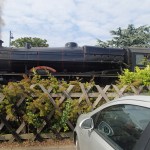
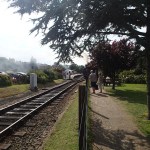
As the pictures show, they were showing off their Stanier Class 5 named George Stephenson.
One of the most interesting developments in rail in this area is the proposal for the Norfolk Orbital Railway, which would extend the route of the North Norfolk Railway onwards from Holt to the Ely to Norwich Line at Wymondham.
I do think sometimes, that if Doctor Beeching had seen the society we have today, he would have come to some different conclusions on the lines to be closed down. Sometimes though, as with the Varsity Line and the lines around Kings Lynn, he was for keeping lines open, but British Rail managers and politicians thought otherwise.
I have no view about whether the Norfolk Orbital Railway should be built, as I’m not privy to the true economics of the reinstatement. The railway does have a web site.
On the other hand if it was built my ranging around Norfolk and Suffolk could have been completed by going from Sheringham to Wymnondham, to get a train to Cambridge for return to London.
If we assume that the big drivers of the East Anglian economy in the next decades are going to be high technology and tourism, the pendulum must be swinging towards building the Norfolk Orbital Railway.
Sheringham
I spent an hour or so in Sheringham, but sadly I didn’t find anywhere suitable for lunch.
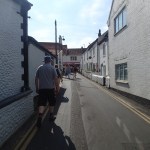
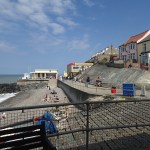
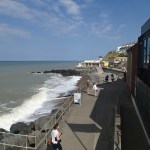

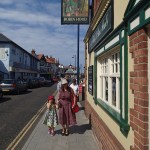
I was too late for lunch and too early for supper, so I just had half a pint of Aspall’s cyder and walked back up the hill to get the train back. I could have got plenty of unhealthy food and judging by the size of many of the visitors, there was an answer to “Who ate all the pies?”
It was a lovely day as the pictures show, but quite a few cafes and restaurants were closed.
It is also a town, crying out for the main street to be pedestrianised, as the traffic and the pavements crowded with the obese made walking up and down to the beach a real obstacle course.
 The Anonymous Widower