Shell And ScottishPower Win Bids To Develop 5 GW Of Floating Wind Power In The UK
The title of this post, is the same as that of this press release from Shell.
This is three paragraphs from the press release.
Shell and ScottishPower have secured joint offers for seabed rights to develop large-scale floating wind farms as part of Crown Estate Scotland’s ScotWind leasing. The partners have won two sites representing a total of 5 gigawatts (GW) off the east and north-east coast of Scotland.
The new wind farms will be delivered through two joint ventures called MarramWind and CampionWind. They bring together ScottishPower’s and Shell’s decades of experience working offshore and significant presence in Scotland, as well as their strong innovation capabilities for delivering world-class offshore energy projects.
The development, construction and operation of ScotWind projects is set to bring new skilled jobs and manufacturing opportunities and boost local supply chains.
ScottishPower are actually involved in three large ScotWind projects; one by themselves and two in partnership with Shell.
MacHairWind
MachairWind is a project that Scottish Power is developing alone.
- It has its own page on the ScottishPower Renewables web site.
- It will be a 2 GW wind farm to the North-West of Islay.
- The turbines will be on fixed foundations.
I wrote about this project in MacHairWind Wind Farm.
MarramWind And CampionWind
These two wind farms are being developed in partnership with Shell.
They both have their own web sites.
MarramWind’s web site has this introduction.
ScottishPower and Shell have joined forces to develop the MarramWind offshore windfarm following success in the recent ScotWind auction process by Crown Estate Scotland.
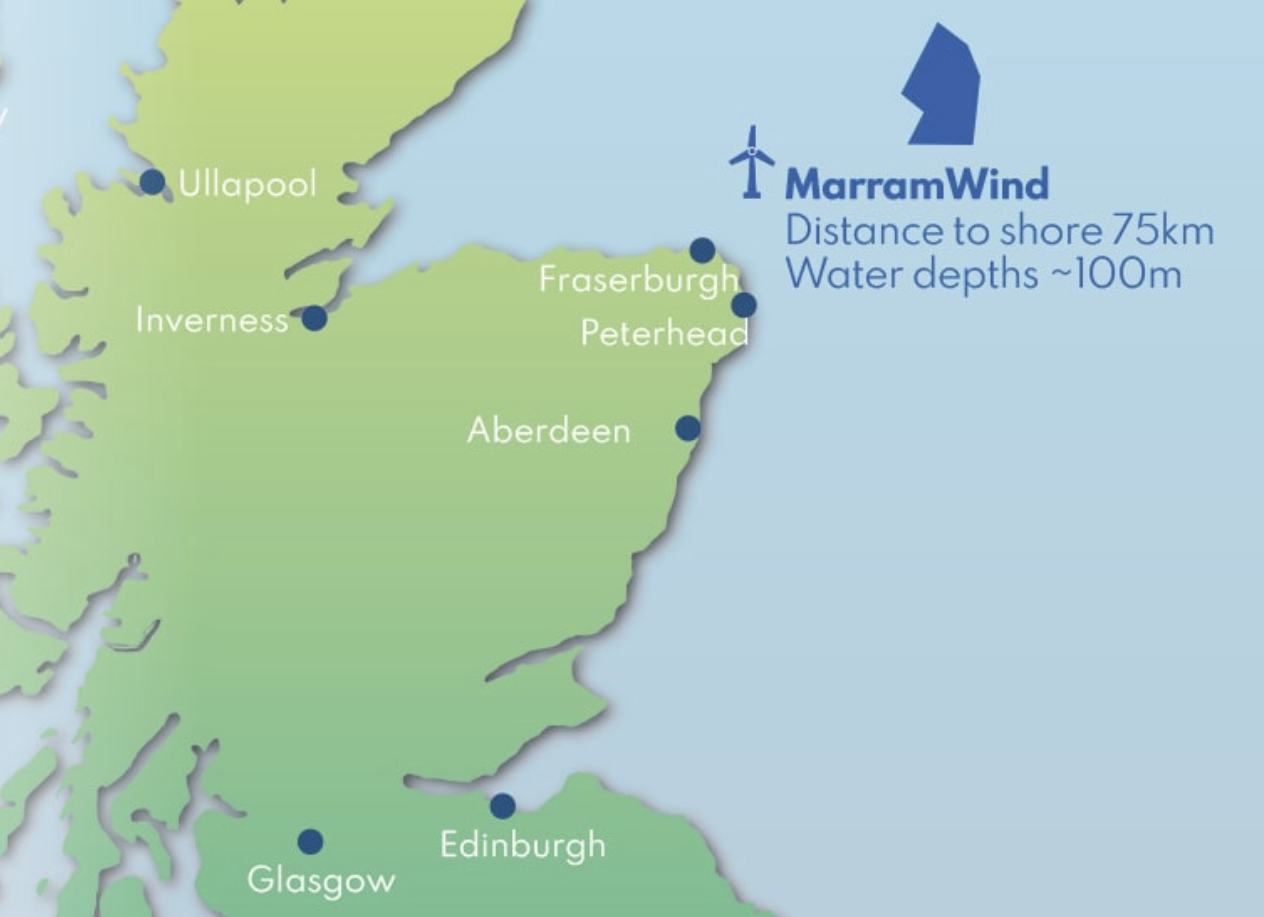
Located 75 kilometres off the North East coast of Scotland in water depths averaging 100 metres, the proposed MarramWind floating offshore windfarm could deliver up to 3 gigawatts (GW) of cleaner renewable energy.
This map clipped from the MarramWind web site, shows the location of the wind farm.
CampionWind’s web site has this introduction.
ScottishPower and Shell have joined forces to develop the CampionWind offshore windfarm following success in the recent ScotWind auction process by Crown Estate Scotland.
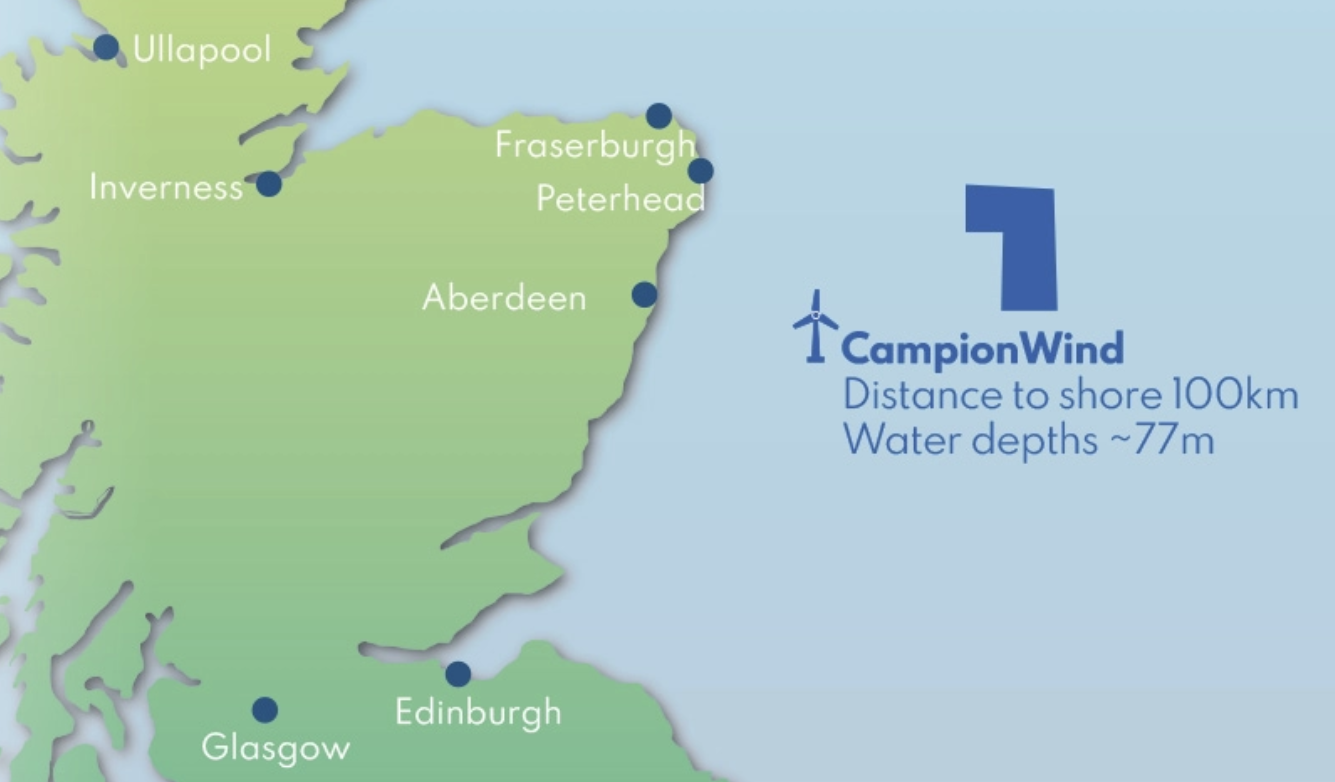
Located 100 kilometres from the east coast of Scotland, in water depths averaging 77 metres, the proposed CampionWind floating offshore windfarm could deliver up to 2 gigawatts (GW) of cleaner renewable energy.
This map clipped from the CampionWind web site, shows the location of the wind farm.
Note.
- The two wind farms will be within a few miles of each other.
- Both wind farms will use floating wind turbines.
- The water is a bit deeper at MarramWind, but this surely doesn’t bother a floating turbine.
- MarramWind and CampionWind will have a total capacity of 5 GW.
- Hywind Scotland is the world’s first commercial wind farm using floating wind turbines, situated 29 kilometres off Peterhead. This wind farm is only 30 MW, but in its first years of operation has achieved a capacity factor of over 50 %.
- The proposed turbines at Northern Horizons‘ 10 GW wind farm, which is 130 kilometres to the North-East of Shetland will be 20 MW giants and nearly as tall as The Shard in London.
So will Scottish Power and Shell design and build a combined field, similar in concept to Northern Horizons’ wind farm, using an armada of 250 floating wind turbines?
- The wind turbines might be moored around a fixed or floating mother platform or structure, that will collect the electricity and deliver it to the shore.
- Turbines could be serviced in situ or moved into port, as needed.
- Extending the wind farm could just be a matter of mooring the extra turbines in position and then connecting them to the mother platform.
- Is there a convenient disused oil or gas platform, that could be repurposed as the mother platform?
It certainly would appear to be a way of building large offshore fields in deep waters.
Where Would The Combined MarramWind And CampionWind Rank In Terms of UK Wind Farms?
Consider.
- MarramWind and CampionWind will have a total capacity of 5 GW.
- Phase one of the Hornsea Wind Farm is the largest offshore wind farm in the world, with a capacity of just over 1.2 GW and when complete it will have a capacity of 6 GW.
- Northern Horizons is planned to be 10 GW.
- The East Anglian Array could be as large as 7.2 GW.
- The Dogger Bank Wind Farm is planned to be as large as 4.8 MW.
- Norfolk Vanguard and Norfolk Boreas are a pair of 1.8 GW wind farms.
- MacHairWind will be a 2 GW wind farm.
Note.
- This is not a complete list of large wind farms in the development pipeline.
- BP have obtained leases, but have not published their plans.
- Most farms under development are at least one GW.
- These farms are a total of 38.6 GW.
The Combined MarramWind and CampionWind would be one of several large wind farms around 5 GW.
There Is A Desperate Need For Energy Storage
If we are generating upwards of 40 GW of wind and solar energy in the UK, there will be a desperate need for energy storage to cover for the times, when the wind doesn’t blow and the sun doesn’t shine.
Scotland should be OK, as there are various energy storage projects in development.
- The 1.5 GW/ 30 GWh Coire Glas project is according to SSE shovel-ready and has planning permission.
- The 450 MW/2.8 GWh Red John project is being constructed.
- Drax, ILI Group and SSE have several other projects under development.
So what would happen in the South?
The government appears to be on the case as I wrote in Ministerial Roundtable Seeks To Unlock Investment In UK Energy Storage.
But there is also the possibility of using hydrogen.
- Hydrogen could be created by a series of giant electrolysers.
- It could be blended with natural gas to eke out our natural gas and save carbon. According to HyDeploy, it appears that up to 20 % can be added, without needing to change boilers and appliances.
- It can be stored in depleted offshore gas fields.
- It can be used to power heavy transport like buses, trucks, trains and ships.
- It can be burned in gas-fired power stations to generate electricity.
Hydrogen can also be used as a feedstock or green energy source for the making of chemicals, concrete and steel.
Conclusion
We are approaching the end of the first phase of the development of renewable energy in the UK.
Massive floating wind farms using armadas of floating wind farms, a large expansion of pumped storage hydro and a huge expansion of the use of hydrogen will see us through to a carbon-free future.
MacHairWind Wind Farm
MachairWind wind farm has its own page on the ScottishPower Renewables web site.
These are the two introductory paragraphs.
The MacHairWind project off the coast of Islay, which could deliver 2GW of cleaner renewable energy, will make a significant contribution to tackling climate change and achieving Net Zero, with the potential to generate enough clean electricity to power over 2 million homes in Scotland.
It will also build on ScottishPower’s long-standing presence and positive track record of investing in and working with local communities and businesses across Argyll & Bute to realise the benefits of renewable energy developments.
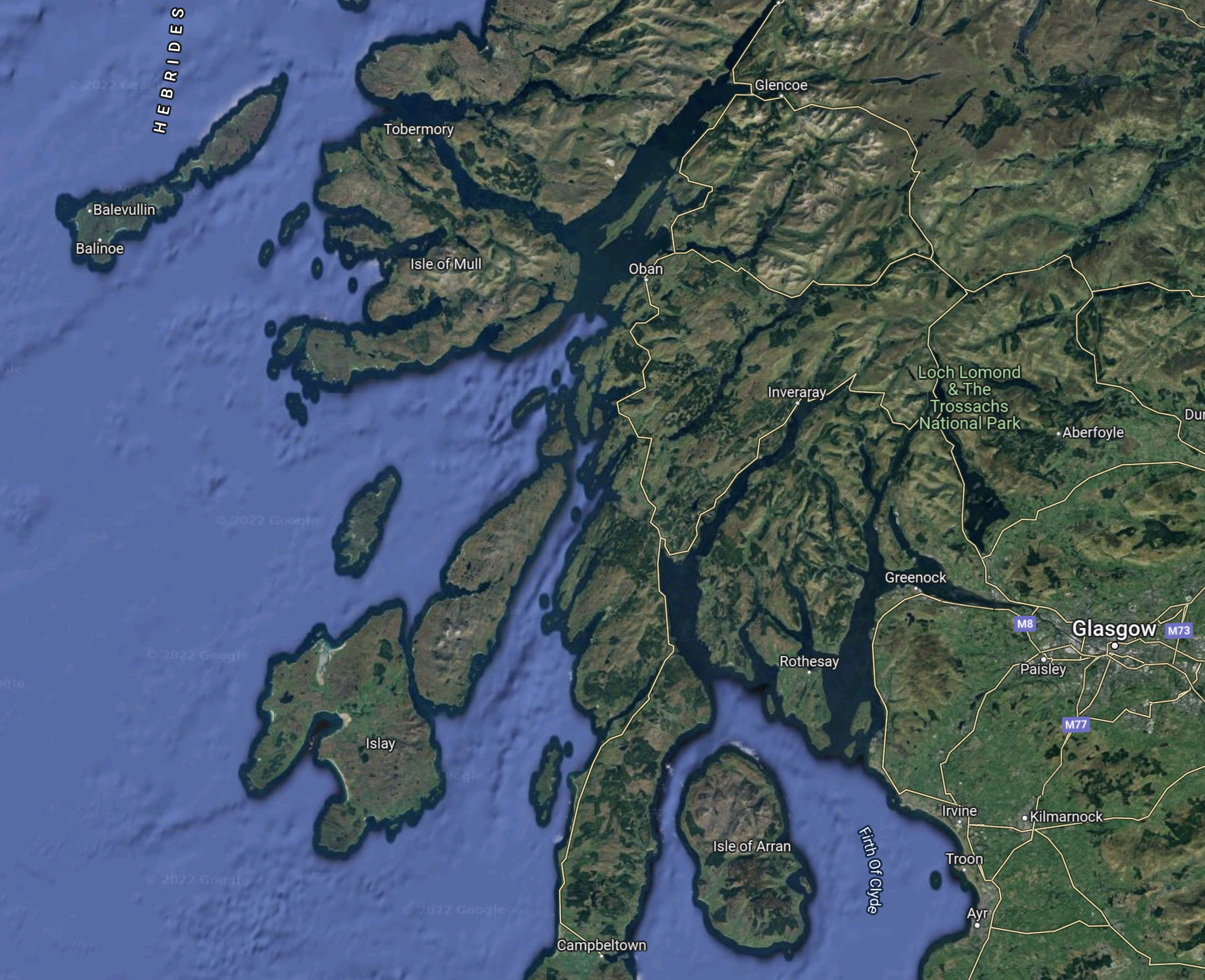
This Google Map shows the area of the wind farm, which is to the North West of the island of Islay.
Note.
- There certainly is a large space of empty sea to the North-West of Islay.
- Glasgow is not far away.
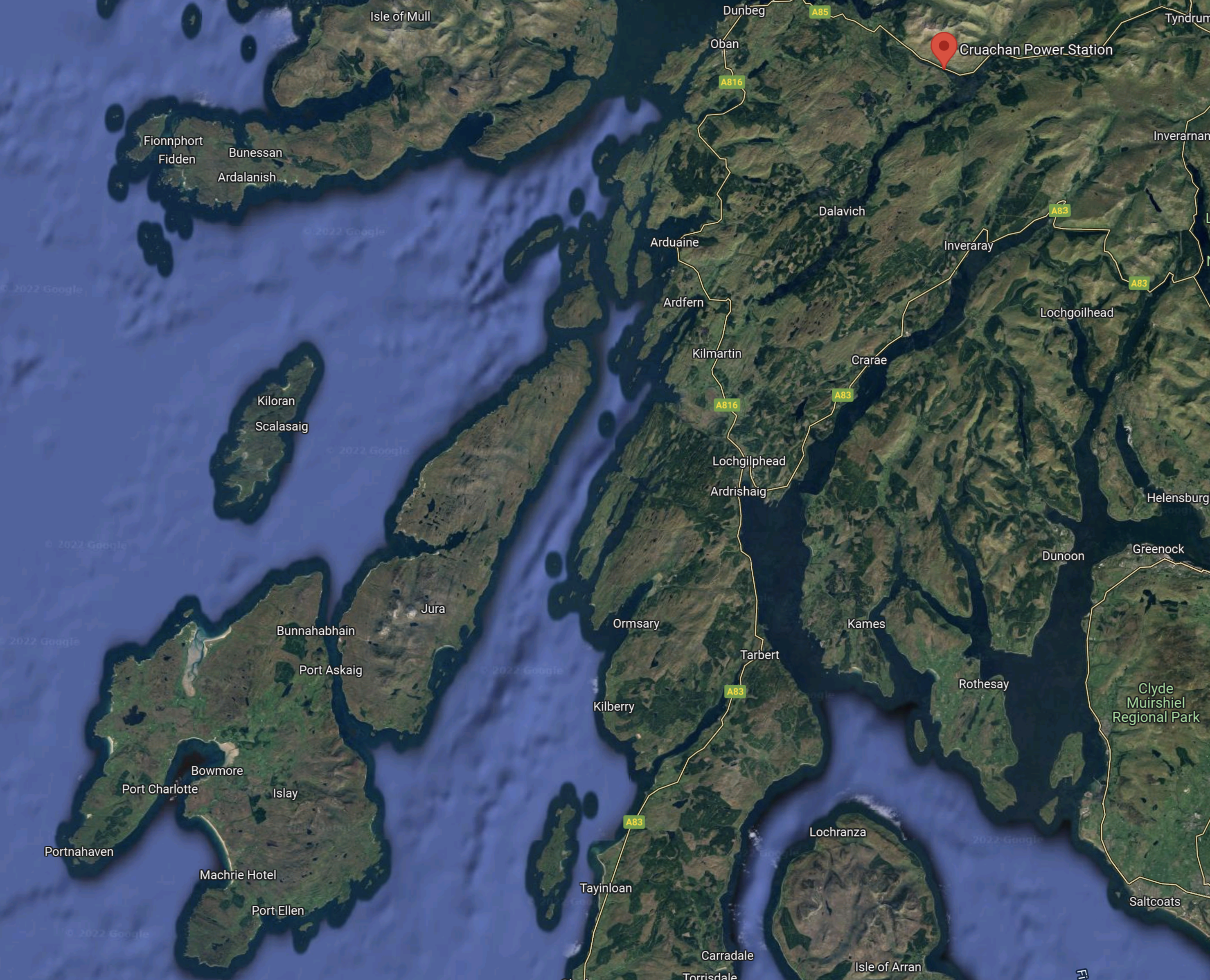
This second Google Map shows the area to the North-East of Islay.
Note.
- Islay is in the South-West corner of the map.
- Colonsay is the smaller island to the North.
- In the North-East corner of the map the red arrow indicate Cruachan pumped hydro power station.
- In the South-East corner of the map is the Clyde Estuary, where the two nuclear power stations at Hunterston were located.
- Hunterston is also the Northern end of Western HVDC Link to North Wales.
Wikipedia says this about the relationship of the Cruachan power station and Hunterston’s nuclear stations.
Construction began in 1959 to coincide with the Hunterston A nuclear power station in Ayrshire. Cruachan uses cheap off-peak electricity generated at night to pump water to the higher reservoir, which can then be released during the day to provide power as necessary.
Now that the two nuclear stations are being decommissioned, will the MacHairWind wind farm be used to pump water to Cruachan’s higher reservoir?
Conclusion
The MacHairWind wind farm seems a well-positioned wind farm.
- It is close to Glasgow.
- It can be used in tandem with the Cruachan pumped hydro power station.
- It will have access to the Western HVDC Link to send power to the North-West of England.
Is Scotland replacing the 1.2 GW Hunterston B nuclear power station with a 2 GW wind farm, with help from Cruachan and other proposed pumped storage hydro schemes to the North of Glasgow?
It also looks like increasing the power at Cruachan from the current 440 MW to a GW, by the building of Cruachan 2 would give the area even more energy security.
Germany Weighs Norway Hydrogen Pipeline To Avoid Russian Energy
The title of this post, is the same as that of this article on Hydrogen Central.
This the introductory paragraphs.
Germany and Norway are considering building a hydrogen pipeline linking the two nations to reduce Europe’s dependence on Russian energy supplies.
The countries plan to soon conduct a feasibility study on the project that would eventually transport green hydrogen from Norway to Germany, they said after a meeting between German Economy Minister Robert Habeck and Norwegian Prime Minister Jonas Gahr Store.
There is a joint statement that gives more details.
Developments like this and lots of wind power in the North Sea and around the UK, are the sort of actions, that could seriously reduce the size of Russia’s oil and gas industry and the money it pays to that group of war criminals like Vlad the Mad and his friends.
Shell Resurrects Plans For Rejected North Sea Gasfield
The title of this post, is the same as that of this article on The Times.
This is the first two paragraphs.
Shell has submitted a revised plan for a North Sea gasfield that was rejected by regulators on environmental grounds last year.
The oil and gas major is seeking to develop the Jackdaw field, about 155 miles east of Aberdeen, which it says could produce 6.5 per cent of UK domestic gas output at peak — enough to heat 1.4 million homes. It hopes to start production in 2025 at the field, which would keep producing until 2033.
Other points in the article include.
- The platform would be unmanned.
- One of the problems with the field is that the gas naturally contains a lot of carbon dioxide.
- Shell plans to capture and store this carbon dioxide.
- The gas would be brought to shore using a nineteen mile pipeline to the Shearwater platform.
Surprisingly, the Shearwater platform is connected by the 295 mile SEAL pipeline to the Bacton terminal in Norfolk. But then Bacton is connected by the BBL pipeline to the Netherlands.
- There are depleted gas fields connected to Bacton, that can be used to store the carbon dioxide from the Jackdaw gas field.
- Shell manage the BBL pipeline.
- Shell are sitting in the middle with gas, that can be sold to the highest bidder.
It could be good for Shell without a great deal of expenditure on infrastructure.
In the short term, Jackdaw could make up our gas shortage, but as we start to blend wind-produced hydrogen into the gas network, we can export the surplus gas to the Continent. Shell might have plans for other gas fields to participate in the export of British gas to Germany, that has been replaced by wind-produced hydrogen.
It would be an interesting point, as to who would be responsible for the carbon dioxide produced by Jackdaw’s gas, that is burned in Germany. I suspect it will be the Germans.
In the long-term, when Shearwater and Jackdaw have given up all their gas, I wonder if Shell’s plans could be.
- Surround the platforms serving these fields with floating wind farms.
- Put a giant electrolyser on the Shearwater platform and bring hydrogen to the shore in the SEAL pipeline.
- Distribute the hydrogen from Bacton to the UK or through the BBL pipeline to the Continent.
I feel that Shell could do very nicely thank you out of the Jackdaw gas-field.
But it is also a plan, that produces a lot of energy, without emitting vast amounts of carbon dioxide.
Wind Farms On The East Coast Of Scotland
This map shows the proposed wind farms off the East coast of Scotland.
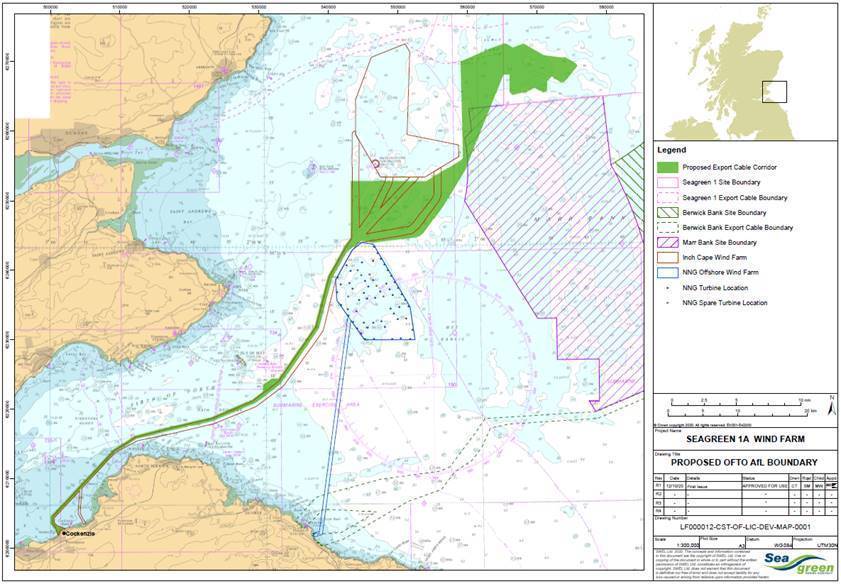
There are five wind farms in the map.
- The green area is the cable corridor for Seagreen 1a
- Inch Cape is the odd-shaped wind farm to the North and West of the green area
- Seagreen at the top of the map, to the North of Inch Cape.
- Marr Bank with the pink NE-SW hatching
- Berwick Bank with the green NW-SE hatching
- Neart Na Gaoithe is edged in blue to the South of the green area.
Berwick Bank and Marr Bank are both owned by SSE and appear to have been combined.
These are some more details on each of the now four wind farms.
Seagreen
These are details of the Seagreen wind farm.
- Seagreen will be Scotland’s largest and the world’s deepest offshore wind farm when complete.
- The first phase will have 114 turbines and a capacity of 1075 MW.
- It will connect to the grid at a new substation at Tealing near Dundee.
- The cables will run to the North of the Inch Cape wind farm.
- It will be completed in 2023.
- The second phase (1a), will have 36 turbines.
- It may have larger turbines.
- The cables will run in the green area to Cockenzie in East Lothian.
This press release from SSE is entitled Another Milestone For Scotland’s Largest Offshore Wind Farm As 4,800 Tonnes Offshore Platform Completed.
This is the first paragraph.
The topside forms the backbone of the offshore wind farm. At 40 metres long, 45 metres wide and 15 metres high, the heavyweight superstructure’s role is to collect and manage 1,075MW of power generated by the 114 Vestas wind turbines before transferring it ashore via around 60km of offshore subsea cabling.
This platform is used to connect the 114 turbines to the shore.
Inch Cape
This paragraph from the home page of the Inch Cape web site, describes the wind farm.
The Inch Cape Offshore Wind Farm, currently in late stage development, will see up to 72 turbines located 15 km off the Angus Coast and connect to the National Grid at Cockenzie, East Lothian. Once complete, it will be one of Scotland’s largest single sources of renewable energy and power up to 1 million homes with clean electricity.
The home page says it will generate up to 1 GW of electricity.
Neart Na Gaoithe
This sentence for the Wikipedia entry for the Neart Na Gaoithe web site describes the wind farm.
It is being developed by Mainstream Renewable Power at a cost of £1.4bn. Offshore work began in 2020, with completion planned for 2023.
The Wikipedia entry says it will generate up to 450 MW of electricity.
Berwick Bank
These two paragraphs from the project page of the Berwick Bank web site describes the wind farm.
Located in the North Sea, in the outer Firth of Forth, Berwick Bank Offshore Wind Farm has the potential to deliver up to 4.1 GW of installed capacity, making it one of the largest offshore opportunities in the world.
Berwick Bank Wind Farm is in the development stage and previously the project was comprised of two separate proposals, Berwick Bank Wind Farm and Marr Bank Wind Farm. Following initial rounds of consultation, it has been decided to combine our proposals into one single opportunity – Berwick Bank Wind Farm.
At 4.1 GW, Berwick Bank is a big wind farm.
The capacity of the four farms can be summarised as follows.
- Seagreen – 1075 MW
- Neart Na Gaoithe – 450 MW
- Inch Cape – 1000 MW
- Berwick Bank – 4100 MW
This gives a total of 6625 MW.
Onshore And Offshore Wind Energy Capacity Predicted To Increase By 230% By 2030
The title of this post, is the same as that of this article on insider.
The report was commissioned by Scottish Renewables to assess the effects on the supply chain in Scotland.
But it does show that Scotland is on the way to be able to supply a lot of its electricity from wind farms, which would be backed up by some of another of pumped storage schemes under development.
Norfolk Wind Farms Offer ‘Significant Benefit’ For Local Economy
The title of this post, is the same as that of this article on the BBC.
This is a comprehensive article, which looks at the benefits of the huge Norfolk Boreas and Norfolk Vanguard wind farms will have to the economy of Norfolk.
The last section is devoted to Norfolk Nimby; Raymond Pearce.
This is the section.
Following the re-approval of the decision by the government, Mr Pearce says he is considering a new appeal over what he calls “a very poor decision”.
He is also sceptical of claims the two new wind farms will bring the economic gains promised by Vattenfall.
“It’s renewable energy at any cost and the cost here is to the environment in Norfolk,” he says.
“I don’t blame them for being positive about it, it’s their industry but they’re not looking at it holistically.”
He says he is not against renewable energy but thinks a better plan is needed to connect the offshore windfarms and minimise the number of cables and substations onshore.
It’s his money if he appeals, but we do need more wind, solar and other zero-carbon energy to combat global warming and its effects like the encroachment of the sea around Norfolk.
I believe, that building wind farms off the coast of Essex, Suffolk and Norfolk is a good move, as in the future, if we have spare electricity, it will be easy to export energy to Europe, through existing interconnectors.
But I do agree with him, that a better plan is needed to connect the offshore windfarms and minimise the number of cables and substations onshore.
A Norfolk Powerhouse
This map from Vattenfall, the developer of the two wind farms, shows the position of the farms and the route of the cable to the shore.
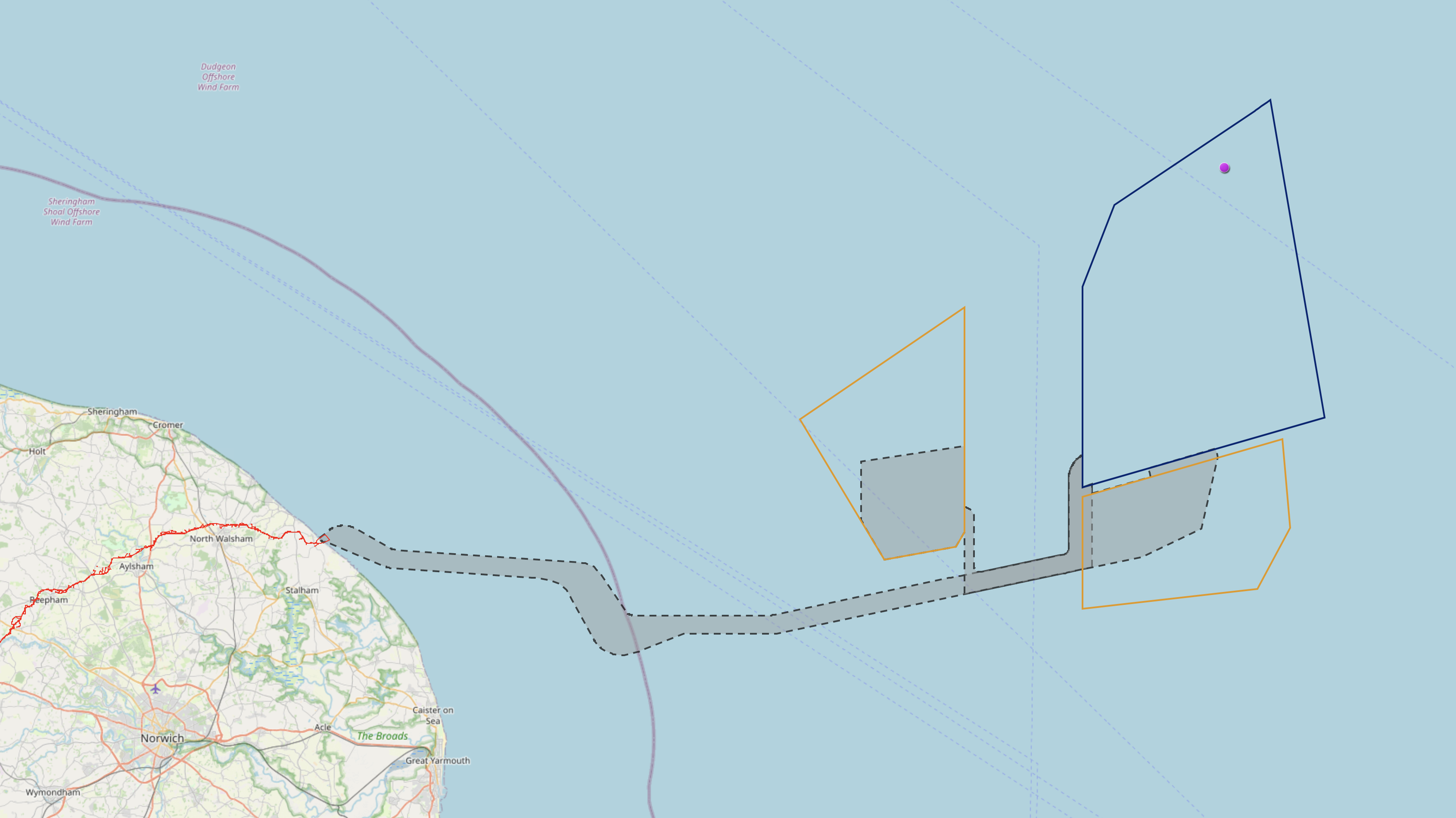
Note.
- The purple line appears to be the UK’s ten mile limit.
- Norfolk Boreas is outlined in blue.
- Norfolk Vanguard is outlined in orange.
- Cables will be run in the grey areas.
- Both wind farms are planned to have a capacity of 1.8 GW
Landfall will be just a few miles to the South of the Bacton gas terminal.
Bacton Gas Terminal
Bacton gas terminal is much more than a simple gas terminal.
- It is a complex of six gas terminals on four sites.
- There is a National Grid terminal, that odourises and blends the gas before distributing it into the National Transmission System via five outgoing 36-inch feeders to much of Southern England.
- There is a gas interconnector to Belgium.
- There is a gas interconnector to The Netherlands.
- There is coastal erosion in the area.
With the need to decarbonise, I can’t help feeling that the Bacton gas terminal is very much on the decline and the site will need to be repurposed in the next few years.
Blending Hydrogen With Natural Gas
If you blend a proportion of hydrogen into natural gas, this has two beneficial effects.
- Gas used in domestic and industrial situations will emit less carbon dioxide.
- In the near future we will be replacing imported natural gas with hydrogen.
The hydrogen could be produced by a giant electrolyser at Bacton powered by the electricity from the two Norfolk wind farms.
At the present time, a research project call HyDeploy is underway, which is investigating the blending of hydrogen into the natural gas supply.
- Partners include Cadent, Northern Gas Networks, the Health and Safety Executive, Keele University and ITM Power and Progessive Energy.
- A first trial at Keele University has been hailed as a success.
- It showed up to twenty percent of hydrogen by volume can be added to the gas network without the need to change any appliances or boilers.
Larger trials are now underway.
A Giant Electrolyser At Bacton
If hydrogen were to be produced at Bacton by a giant electrolyser, it could be used or distributed in one of the following ways.
- Blended with natural gas for gas customers in Southern England.
- Stored in a depleted gas field off the coast at Bacton. Both Baird and Deborah gas fields have been or are being converted to gas storage facilities, connected to Bacton.
- Distributed by truck to hydrogen filling stations and bus and truck garages.
- Greater Anglia might like a hydrogen feed to convert their Class 755 trains to hydrogen power.
- Sent by a short pipeline to the Port of Great Yarmouth and possibly the Port of Lowestoft.
- Exported to Europe, through one of the interconnectors.
Note.
- If the electrolyser were to be able to handle the 3.6 GW of the two wind farms, it would be the largest in the world.
- The size of the electrolyser could be increased over a few years to match the output of the wind farms as more turbines are installed offshore.
- There is no reason, why the electrical connection between Bacton and the landfall of the wind farm cable couldn’t be offshore.
If ITM Power were to supply the electrolyser, it would be built in the largest electrolyser factory in the World, which is in Sheffield in Yorkshire.
A Rail Connection To The Bacton Gas Terminal
This Google Map shows the area between North Walsham and the coast.
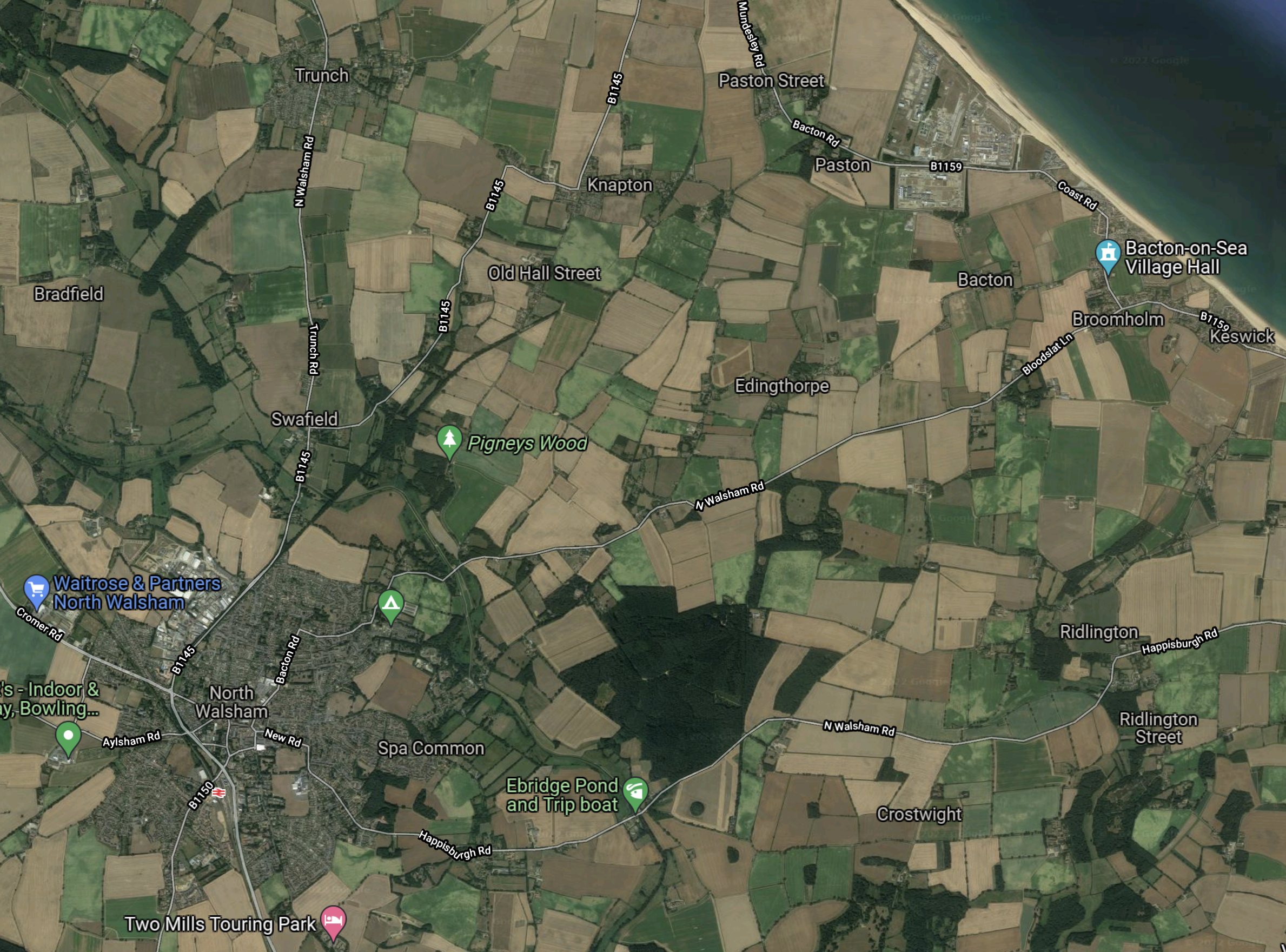
Note.
- North Walsham is in the South-Western corner of the map.
- North Walsham station on the Bittern Line is indicated by the red icon.
- The Bacton gas terminal is the trapezoidal-shaped area on the coast, at the top of the map.
I believe it would be possible to build a small rail terminal in the area with a short pipeline connection to Bacton, so that hydrogen could be distributed by train.
How Much Hydrogen Could Be Created By The Norfolk Wind Farms?
In The Mathematics Of Blending Twenty Percent Of Hydrogen Into The UK Gas Grid, I said the following.
Ryze Hydrogen are building the Herne Bay electrolyser.
- It will consume 23 MW of solar and wind power.
- It will produce ten tonnes of hydrogen per day.
The electrolyser will consume 552 MWh to produce ten tonnes of hydrogen, so creating one tonne of hydrogen needs 55.2 MWh of electricity.
Each of the Norfolk wind farms, if they were working flat out would produce 43.2 GWh of electricity in a day.
Dividing the two figures gives a daily production rate of 782.6 tonnes of hydrogen per day.
But what happens if the wind doesn’t blow?
This is where the gas storage in the Baird, Deborah and other depleted gas fields comes in.In times of maximum wind, hydrogen is stored for use when the wind doesn’t blow.
Conclusion
I believe a plan like this, would be much better for Norfolk, the UK and the whole planet.
Using the existing gas network to carry the energy away from Norfolk, could mean that the electricity connection across Norfolk could be scaled back.
New Electricity ‘Superhighways’ Needed To Cope With Surge In Wind Power
The title of this post, is the same as that of this article on the Telegraph.
This is the first two paragraphs.
Energy companies are pushing for the rapid approval of new electricity “superhighways” between Scotland and England amid fears that a lack of capacity will set back the country’s wind power revolution.
Businesses including SSE and Scottish Power are calling on the industry regulator Ofgem to approve a series of major new north-south power cables in a bid to ease congestion on the existing electricity network.
These points are mentioned in the article.
- Current capacity is 6 GW, which even now is not enough.
- Another 17 GW of capacity will be needed by 2033.
- Wind farms in Scotland have been switched off and replaced by gas-fired power stations because of a lack of grid capacity.
- Another 25 GW of wind farms could be built after leases were awarded last month.
Two North-South interconnectors are being planned.
Peterhead And Drax
This is being proposed by SSE and National Grid.
- It will be an undersea cable.
- It will be two cables, each with a capacity of 2 GW.
- Peterhead and Drax power station are four hundred miles apart by road and 279 miles as the seagull flies, as a lot of the route would be over the sea. So an undersea connection would appear to be sensible.
- Peterhead is on the coast, so connecting an undersea interconnector shouldn’t be too challenging or disruptive to the locals.
- Drax power station is a 4 GW power station and the largest in the UK, so it must have good grid connections.
This Google Map shows the location of Drax power station in relation to Hull, Scunthorpe and the rivers in the area.
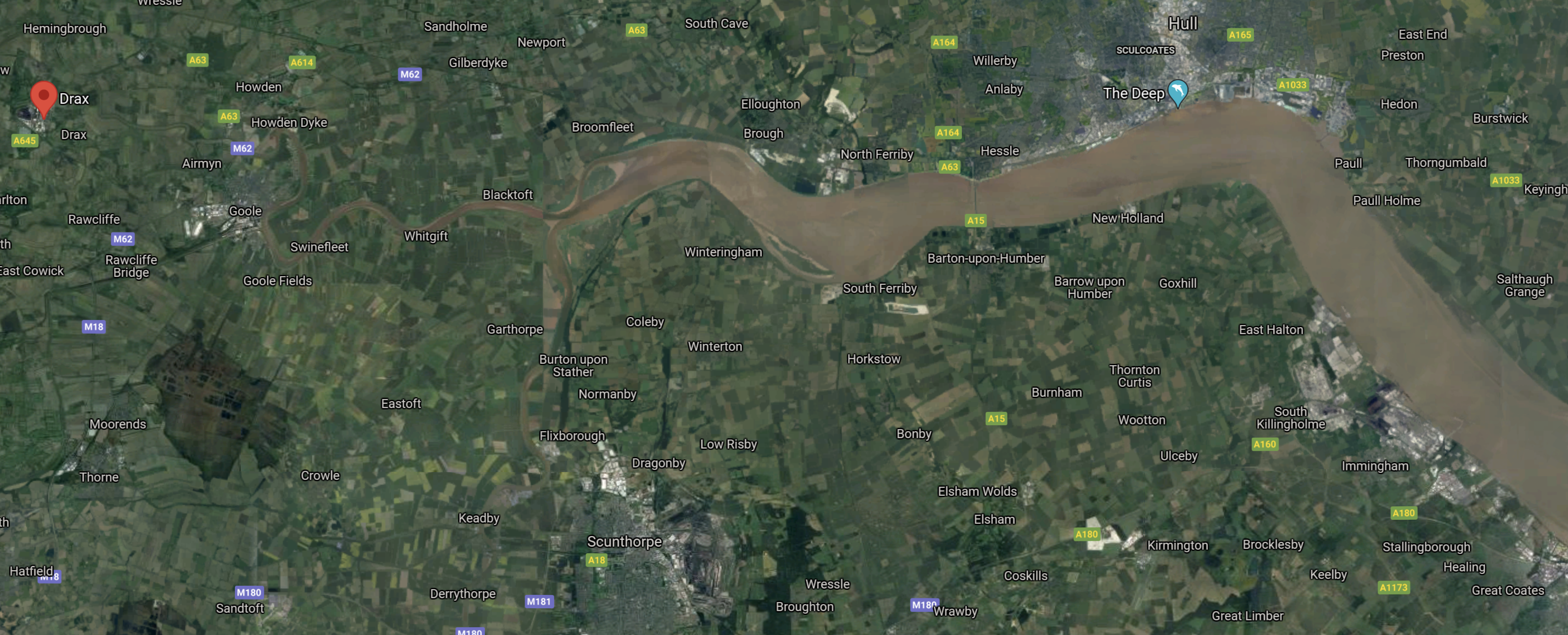
Note.
- Drax is marked by the red arrow in the West of the map.
- The large body of water in the East is the Humber Estuary.
- Hull is on the North Bank of the Humber.
- Scunthorpe, which is famous for its steel industry is South of the Humber in the middle of the map.
- To the West of Scunthorpe the Humber splits into the Trent and the Ouse.
- The Ouse leads all the way to Drax power station.
I suspect an undersea cable could go up the Humber and Ouse to Drax power station.
Is it a coincidence that both Drax power station and the proposed link to Peterhead are both around 4 GW?
Consider.
- Drax is a biomass power station, so it is not a zero carbon power station.
- Drax produces around six percent of the UK’s electricity.
- Most of the biomass comes by ship from North America.
- Protest groups regularly have protests at Drax because of its carbon emissions.
- Drax Group are experimenting with carbon capture.
- Drax is a big site and a large energy storage system could be built there.
- Wind is often criticised by opponents, saying wind is useless when the wind doesn’t blow.
- The Scots would be unlikely to send power to England, if they were short.
This is also said about Drax in Wikipedia.
Despite this intent for baseload operation, it was designed with a reasonable ability for load-following, being able to ramp up or down by 5% of full power per minute within the range of 50–100% of full power.
I take this it means it can be used to top up electricity generation to meet demand. Add in energy storage and it could be a superb load-follower.
So could the similar size of the interconnector and Drax power station be deliberate to guarantee England a 4 GW feed at all states of the wind?
I don’t think it is a coincidence.
Torness And Hawthorn Pit And Torness and South Humberside
These two cables are being proposed by Scottish Power.
- Each will be two GW.
- Torness is the site of the 1.36 GW Torness nuclear power station, which is likely to be decommissioned before 2030.
- Torness will have good grid connections and it is close to the sea.
- Hawthorn Pit is a large closed coal mine to the North of Newcastle, with a large substation close to the site. I suspect it will be an ideal place to feed power into the grid for Newcastle and it is close to the sea.
- Just South of Hawthorn Pit are the 1.32 GW Hartlepool nuclear power station, which will be decommissioned in 2024 and the landfall of the cables to the massive Dogger Bank wind farm.
- As I showed earlier with Drax, the Humber would be an ideal estuary to bring underwater power cables into the surrounding area. So perhaps the cable will go to Scunthorpe for the steelworks.
- As at Drax, there is backup in South Humberside, but here it is from the two Keadby gas-fired power stations.
The article in the Telegraph only gives the briefest of details of Scottish Power’s plans, but I suspect, that given the locations of the ends of the interconnectors, I suspect the cables will be underwater.
Conclusion
It strikes me that all three interconnectors have been well thought thought and they serve a variety of objectives.
- Bring Scottish wind power, South to England.
- Connect wind farms to the two nuclear power station sites at Hartlepool and Torness, that will close at the end of the decade.
- Allow the big 4 GW biomass-fired station at Drax to back up wind farms and step in when needed.
- Cut carbon emissions at Drax.
- Use underwater cables as much as possible to transfer the power, to avoid the disruption of digging in underground cables.
It looks to be a good plan.
Norfolk Vanguard Offshore Wind Farm Re-approved By Government
The title of this post, is the same as that of this article on the BBC.
These are the two introductory paragraphs.
An offshore wind farm capable of generating electricity for nearly two million homes has been re-approved by government after consent was previously overturned by a High Court judge.
Vattenfall’s 1.8-gigawatt Norfolk Vanguard project had been granted consent by the Department for Business, Energy and Industrial Strategy (BEIS).
Note.
- Norfolk Boreas and Norfolk Vanguard are a pair of 1.8 GW offshore wind farms to be developed 72 and 47 kilometres off the Norfolk coast by Swedish company; Vattenfall.
- Hinckley Point C will have a capacity of 3.25 GW.
This map shows the two fields in relation to the coast.
Note.
- The purple line appears to be the UK’s ten mile limit.
- Norfolk Boreas is outlined in blue.
- Norfolk Vsnguard is outlined in orange.
- Cables will be run in the grey areas.
This second map shows the onshore cable.
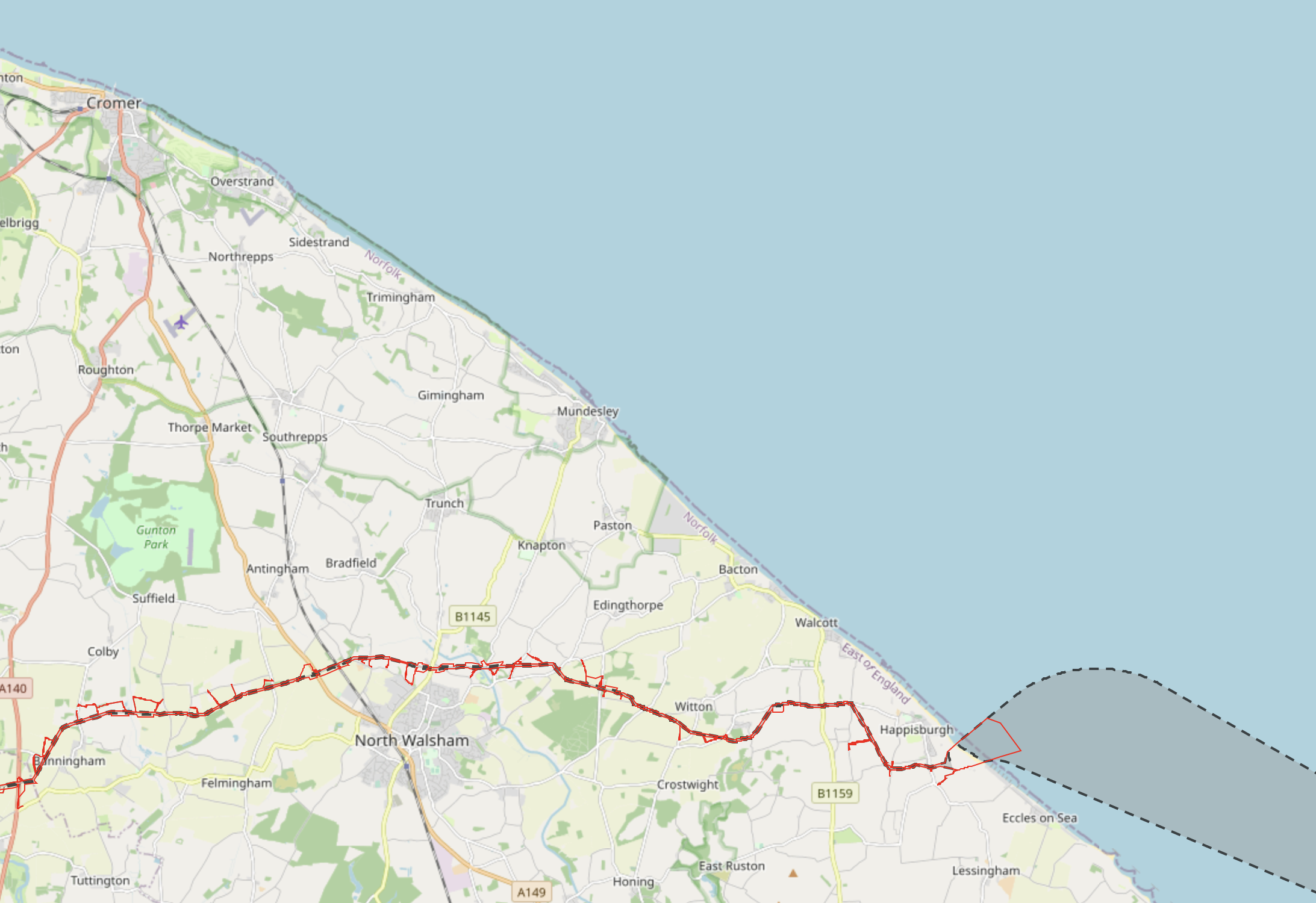
Note.
- The cables are planned to come ashore between Happisburgh and Eccles-on-Sea.
- Bacton is only a short distance up the coast.
- The onshore cable is planned to go from here across Norfolk to the Necton substation.
But the planning permission was overturned by a legal ruling.
This article on the BBC is entitled Norfolk Vanguard: Ministers Wrong Over Wind Farm Go-Ahead, Says Judge.
These are the first four paragraphs.
A High Court judge has quashed permission for one of the world’s largest offshore wind farms to be built off the east coast of England.
The Norfolk Vanguard Offshore Wind Farm was granted development consent in July by the Secretary of State for Business, Energy and Industrial Strategy (BEIS).
But Mr Justice Holgate overturned the decision following legal action from a man living near a planned cable route.
A Department for BEIS spokeswoman said it was “disappointed by the outcome”.
This is a paragraph in today’s BBC article.
Kwasi Kwarteng, Secretary of State at the Department of Business, Energy and Industrial Strategy, granted development consent for the wind farm, having re-determined the application.
So will we be back to the Law Courts?
In Is There A Need For A Norfolk-Suffolk Interconnector?, I said this.
But seriously, is it a good idea to dig an underground cable all the way across Norfolk or in these times build a massive overhead cable either?
Perhaps the solution is to connect the Norfolk Boreas And Norfolk Vanguard wind farms to a giant electrolyser at Bacton, which creates hydrogen.
- The underground electricity cable across Norfolk would not be needed.
- Bacton gas terminal is only a few miles up the coast from the cable’s landfall.
- The UK gets another supply of gas.
- The hydrogen is blended with natural gas for consumption in the UK or Europe.
- A pure hydrogen feed can be used to supply hydrogen buses, trucks and other vehicles, either by tanker or pipeline.
- Excess hydrogen could be stored in depleted gas fields.
Thye main benefit though, would be that it would transform Bacton gas terminal from a declining asset into Norfolk’s Hydrogen Powerhouse.
For more information on blending hydrogen into our natural gas supply see HyDeploy.
Dogger Bank C In UK Offshore Wind First To Provide Reactive Power Capability
The title of this post, is the same as that of this press release from the Dogger Bank wind farm.
This paragraph gives an explanation.
Dogger Bank Wind Farm has secured a UK power first by becoming the first offshore wind farm project to win a tender from National Grid ESO to provide reactive power capability. The sector-first contract will help deliver a greener grid, maintain a stable voltage power supply, and help drive down UK consumer costs by millions of pounds.
Note that the three Dogger Bank wind farms; A, B and C will each have a capacity of 1.2 GW and that Hartlepool nuclear power station has a capacity of 1.32 GW. The latter is due to be decommissioned in 2024.
So the wind farms will effectively replace the nuclear power station.
This paragraph describes the contract.
Under new £22.5m Pennines Voltage Pathfinder contracts announced today, National Grid ESO has awarded a 10-year power contract to Dogger Bank C that will see its onshore converter station at Lazenby in the North-East of England provide 200 MVAr* of reactive power capability between 2024 and 2034. This marks the first time that an offshore wind transmission asset has been awarded a contract through a reactive power tender by National Grid ESO.
I suspect that there will need to be some form of energy storage added to the system somewhere, either at Lazenby or could we see a system like one of Highview Power’s CRYOBattery installed offshore?
It should be noted that CRYOBatteries are no more complicated, than some of the equipment installed on offshore gas and oil platforms.
The Lackenby Substation
It does seem that there has been a mix-up between the two nearby villages of Lazenby and Lackenby.
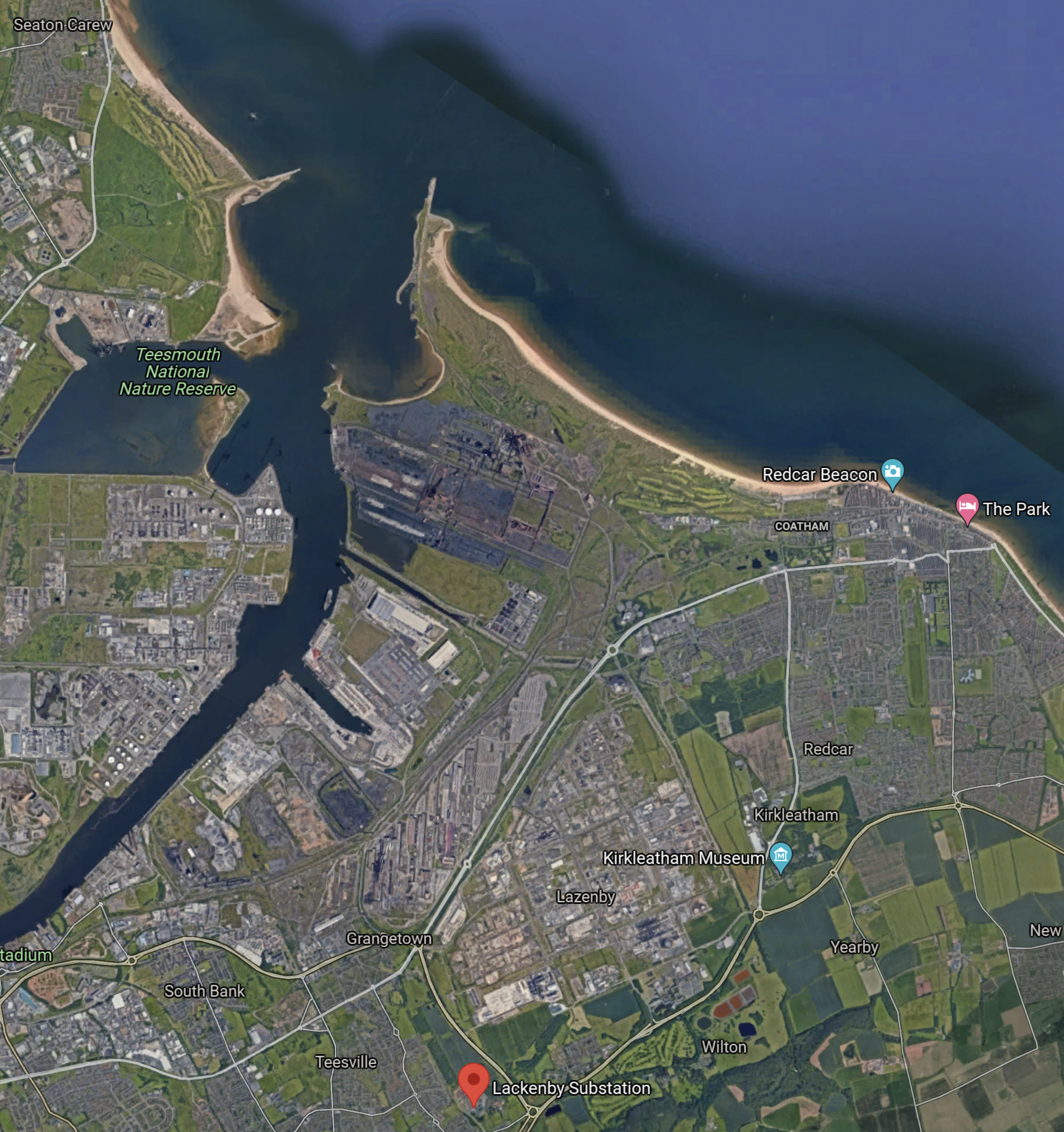
I can’t find a Lazenby substation, but I can find one at Lackenby.
This Google Map shows that the location of the Lackenby substation.
This second map shows the substation in more detail.
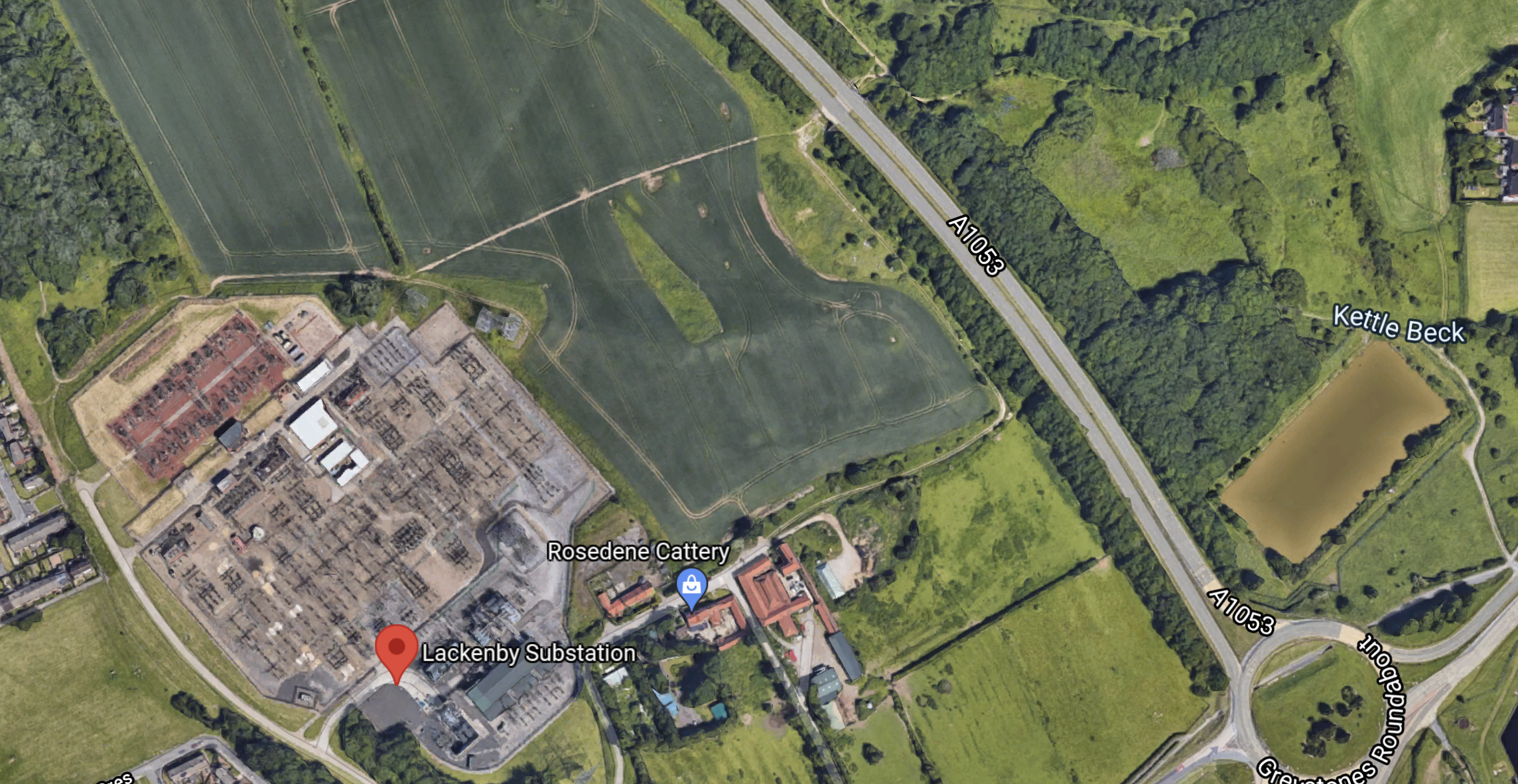
Note.
- There are a lot of large chemical works on both banks of the Tees.
- I can find nothing on the route of the cable from Dogger Bank C to Lackenby substation.
- Perhaps, it’s planned to go up the River Tees or it could come ashore South of the mouth of the River Tees.
Plans must be published soon, so that the substation can be updated before the wind farm is commissioned.

