WSMR Resubmits Formal Application To The ORR
The title of this post, is the same as that of this press release from Wrexham, Shropshire and Midlands Railway.
These three paragraphs give full details of the application.
Wrexham, Shropshire and Midlands Railway is committed to delivering the connectivity that communities across Wales and England need and deserve. Our resubmitted application reflects stakeholder feedback and demonstrates how we’ve listened to MPs and regional partners who urged us to reapply.
This application differs from our previous submission, which includes us requesting fewer train paths and offering an additional stop at Wellington, enhancing connectivity for people in Shropshire. Furthermore, by making better use of available capacity – including paths that have been released and remain unused – we aim to strengthen regional links and support economic growth.
WSMR’s new open access service will provide faster, more convenient travel options for passengers in Wrexham, Shrewsbury, Wellington, Telford, Walsall and beyond, improving access to jobs, education and leisure opportunities. We remain committed to introducing this service for the regions we serve and delivering benefits for communities along the route.
Note.
How Will The East Coast Main Line Timetable Change Affect Sheffield?
This article in the October 2025 Edition of Modern Railways is entitled Industry Gears Up For December ECML Timetable Change.
This is the first paragraph.
Major changes are planned to trains along the East Coast main line from 14 December as the long-heralded timetable takes effect.
In this post, I will see how the changes detailed in the article in Modern Railways will affect Sheffield and Doncaster.
Aberdeen-Edinburgh
This is said about Aberdeen and Edinburgh services.
Monday-Saturday services will not change between Aberdeen and Edinburgh, with all intermediate stations served at similar times.
The LNER service to and from King’s Cross will call additionally at Doncaster, Newark Northgate and Peterborough; the last LNER Monday-Friday departure from Aberdeen will terminate at Doncaster instead of Leeds, and the first LNER Monday-Saturday train to Aberdeen will start from King’s Cross at 05:48 instead of Leeds.
Note.
- An hourly fast train between Edinburgh and King’s Cross will have a journey time of 4 hours and 10 minutes, which is a saving of at least 12 minutes.
- There is an Aberdeen-Manchester air service, but no Edinburgh-Manchester or Leeds-Scotland air services.
- In Could London And Central Scotland Air Passengers Be Persuaded To Use The Trains?, I speculated about how air passengers could be tempted to use the trains between London and Central Scotland.
- It looks to me, that LNER are strengthening their services between Doncaster and Scotland.
- Will that 05:48 King’s Cross departure for Aberdeen, enable a working day in Aberdeen and return?
Is LNER’s aim to get travellers to use the trains between Doncaster and Scotland, as an alternative to driving or trains from Leeds?
Alnmouth and Berwick
This is said about Alnmouth services.
Quicker LNER journey times are promised to stations South of York, with King’s Cross-Alnmouth journey times up to 15 minutes quicker.
More TPE trains will run between Newcastle, Morpeth, Alnmouth, Berwick, Reston, Dunbar, East Linton and Edinburgh Waverley.
The number of trains calling at Durham on weekdays will fall from 18 to 13 Southbound and from 15 to 10 Northbound.
This is said about Berwick services.
LNER trains will call every two hours during the middle of the day, and the number of weekday trains to King’s Cross falls from 15 to 11 Southbound with a 13 to nine fall Northbound. More TPE trains will call.
Note.
- Lumo serves Newcastle, Morpeth and Edinburgh.
- Reston and East Linton are new stations.
- The stations between Newcastle and Edinburgh need adequate parking to attract commuters.
It looks to me, that LNER are timing the trains to attract day trips along the East Coast Main Line.
Bradford Forster Square/Interchange
This is said about Bradford Forster Square services.
The number of weekday trains will remain as per May 2025, but on Sundays, the number of trains serving Forster Square increases from two to six each way on a two-hourly interval. LNER stopping patterns change, with fewer trains calling at Peterborough and none at Grantham or Retford.
Trains currently stop at Peterborough, Doncaster, Wakefield Westgate, Leeds and Shipley, but surely a more regular six trains per day (tpd) is preferable.
This is said about Bradford Interchange services.
At Interchange, Grand Central Trains will run at different times to the May 2025 timetable, with King’s Cross journeys up to 20 minutes quicker. One GC each way will call at Peterborough, while some will stop at Pontefract Monkhill on Sundays for the first time.
Note.
- Trains currently stop at Peterborough, Doncaster, Pontefract Monkhill, Wakefield Kirkgate, Mirfield, Brighouse, Halifax and Low Moor
- Is the twenty minutes time saving due to the new digital signalling to the South of Doncaster?
- Is this another open access operator being allowed to do what they do best?
This looks to be a very useful service, which serves several stations, with no other service to London.
Doncaster
This is said about Doncaster services.
Additional trains calling at destinations including Birmingham New Street, Sheffield, York, Newark and Berwick-upon-Tweed. LNER Aberdeen/Inverness trains will call at Doncaster. EMR trains will be retimed at Doncaster to provide better connections with LNER’s revised timetables, but journeys from Doncaster to Sleaford and Spalding will require a change at Lincoln. This change has been made to “enable improved connections” at Peterborough, Sleaford, Lincoln and Doncaster. The number of trains calling at Stevenage falls from 24 to 19 Southbound and 24 to 21 Northbound, with Grantham stops dropping by seven trains to 28 Southbound and 4 to 29 Northbound.
If CrossCountry Trains were to switch their trains to Hitachi InterCity Battery trains, I believe that a version of these trains could handle routes like Plymouth and Aberdeen.
- This would speed up services.
- Trains would run close together and thus increase capacity.
- Services could even be faster.
So expect a replacement order for CrossCountry Trains diesel multiple units soon.
Glasgow
LNER gave up serving Glasgow Central from King’s Cross in the December 2024 timetable change.
In Lumo Will Extend Its King’s Cross And Edinburgh Service To Glasgow, I talked about Lumo extending their King’s Cross and Edinburgh service to Glasgow Central station.
Hull
This is said about Hull services.
On Mondays-Fridays, Hull Trains will provide an extra train from London.
The LNER Monday-Friday Hull-Doncaster train will be withdrawn;
Northern will operate a 20:25 departure to Doncaster; calling at Brough and Selby.
Note.
- It looks like Great British Railways have surrendered Hull and Beverley to Hull Trains.
- Hull Trains are converting their Class 802 trains to battery-electric power.
- It is likely that Hull Trains upgraded trains will be able to use the Great Northern and Great Eastern Joint Line via Lincoln on battery power.
The new timetable appears to be ready for the future of Hull Trains.
Leeds
This is said about Leeds services.
LNER services will depart to King’s Cross at xx.10 and xx.40.
Northern will introduce an extra mostly hourly service between Leeds and Sheffield calling at Wakefield Westgate. They will depart about 30 minutes earlier or later than the CrossCountry service.
Note.
- I would expect the two King’s Cross and Leeds services which would both stop at Doncaster and Wakefield Westgate would set the timings between Doncaster and Leeds.
- Currently, of the four trains that run to and from Leeds every two hours, two are planned to terminate at Leeds, one at Harrogate and one at Bradford Forster Square.
- There is also a daily service between King’s Cross and Skipton via Leeds.
- I can envisage another service between King’s Cross and Ilkley via Leeds, Kirkstall Forge, Guiseley, Burley-in-Wharfedale and Ben Rhydding.
- I can envisage another service between King’s Cross and Huddersfield, via Leeds, White Rose, Morley, Batley, Dewsbury, Ravensthorpe, Mirfield and Deighton.
- I can envisage another service between King’s Cross and Hebden Bridge, via Leeds, White Rose, Morley, Batley, Dewsbury, Ravensthorpe, Mirfield, Sowerby Bridge, Mytholmroyd and Brighouse.
- An alternative to Hebden Bridge would be Rochdale, which already has four platforms and is on the Manchester Metrolink
- It appears that Bradford Forster Square, Harrogate, Huddersfield, Leeds and Skipton stations can turn nine or ten-car trains and Ilkley can turn five-car trains.
- I also believe that one of Hitachi’s InterCity Battery trains could use battery power to take the spectacular Settle and Carlisle Line to Carlisle or even Glasgow Central.
- If needed pairs of five-car trains could split and join at Leeds, with one train waiting at Leeds and the other train going on to another destination.
- The CrossCountry and Northern Trains services on the Sheffield and Leeds route via Doncaster and Wakefield Westgate would probably need to be modern battery-electric trains to maximise the capacity on the route.
There certainly seem to be opportunities to give a number of stations in Yorkshire an all-electric service to King’s Cross with a two-hourly frequency, in a time of a few minutes over two hours.
Lincoln
This is said about Lincoln services.
One more LNER train from King’s Cross will run, with the first train arriving earlier and the last train later. There will no longer be an LNER train serving Stevenage with passengers having to change at Newark Northgate or Peterborough. An improved service will run to and from Nottingham, with an increase from one to two trains per hour on Mondays-Saturdays. An hourly service will run to Crewe, and a new Matlock-Nottingham-Lincoln-Cleethorpes service will run. EMR will cease all bar morning peak direct trains to/from Leicester. Newark Northgate-Lincoln trains will be reduced from five to four on Mondays-Fridays, eight to four on Saturdays and ten to eight on Sundays.
Note.
- Travellers between Lincoln/Nottingham and the North/Scotland will have two trains per hour to Newark Northgate, where there will be two tph to the North/Scotland.
- The hourly Crewe service will give access to Liverpool Manchester and the West Coast Main Line.
- Will there still be a Liverpool and Norwich service or will this be replaced by East-West Rail?
There seems to be a big sort out to EMR services.
Newcastle
This is said about Newcastle services.
The number of trains serving King’s Cross increases from 35 to 53 Southbound on weekdays and from 36 to 52 Northbound. One train every hour will run non-stop to York. More TPE trains will run Northbound (see Alnmouth and Berwick), while Northern is retiming services on the Northumberland Line in anticipation of Northumberland Park and Bedlington stations opening in early 2026. A semi-fast hourly service between Newcastle and Middlesbrough will run on Mondays-Saturdays and there will be an hourly stopping service between them.
Note.
- There will be a big increase in services between King’s Cross and Newcastle.
- Is the aim to persuade travellers to use trains rather than airlines?
- LNER also runs one train per day (tpd) between King’s Cross and Middlesbrough.
- Grand Central Trains will be running at a frequency of six tpd between King’s Cross and Sunderland via Thirsk, Northallerton, Eaglescliffe, Hartlepool and Seaham.
Hull appears to have been left to Hull Trains and Glasgow to Lumo, and Sunderland appears to be left for Grand Central Trains.
Conclusions
I am coming to some conclusions about services on the East Coast Main Line, with respect to Sheffield.
Doncaster Is A Well-Equipped Station
Doncaster is the nearest station to Sheffield on the East Coast Main Line.
- Over the last few years, Doncaster station has been improved.
- It has a subway with a more than adequate number of lifts.
- The station has nearly 600 parking spaces.
- There is a taxi rank.
- There is no Marks & Spencer’s food store, which is important for a coeliac like me.
- There are thirty bus stands close to Doncaster station.
- Doncaster station is well-equipped with cafes, a pub and coffee stalls.
- All trains to Aberdeen, Bradford Forster Square, Bradford Interchange, Edinburgh, Hull, King’s Cross, Leeds, Sheffield and Wakefield seem to stop at the station.
- There are several local trains per hour.
- Changing trains is not a strenuous exercise.
Doncaster is one of the UK’s better regional stations.
Doncaster Needs A Connection To The Sheffield Supertram
One of the first things, I do when I arrive in a strange town or city is look for the local public transport network.
In 2019, Sheffield published an ambitious plan for their tram network, which I wrote about in Sheffield Region Transport Plan 2019 – Doncaster Sheffield Airport.
The post contained this map, of Sheffield’s plans for the trams.
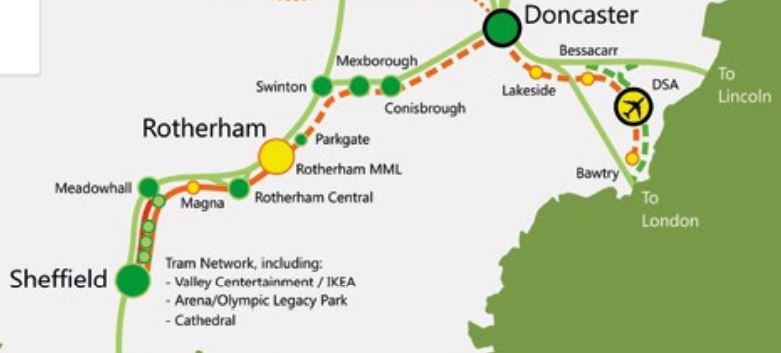
Doncaster and Doncaster Sheffield Airport are connected to the current end of the tram-train route at Rotherham Parkgate.
This OpenRailwayMap shows the rail lines between Rotherham Parkgate and Doncaster.
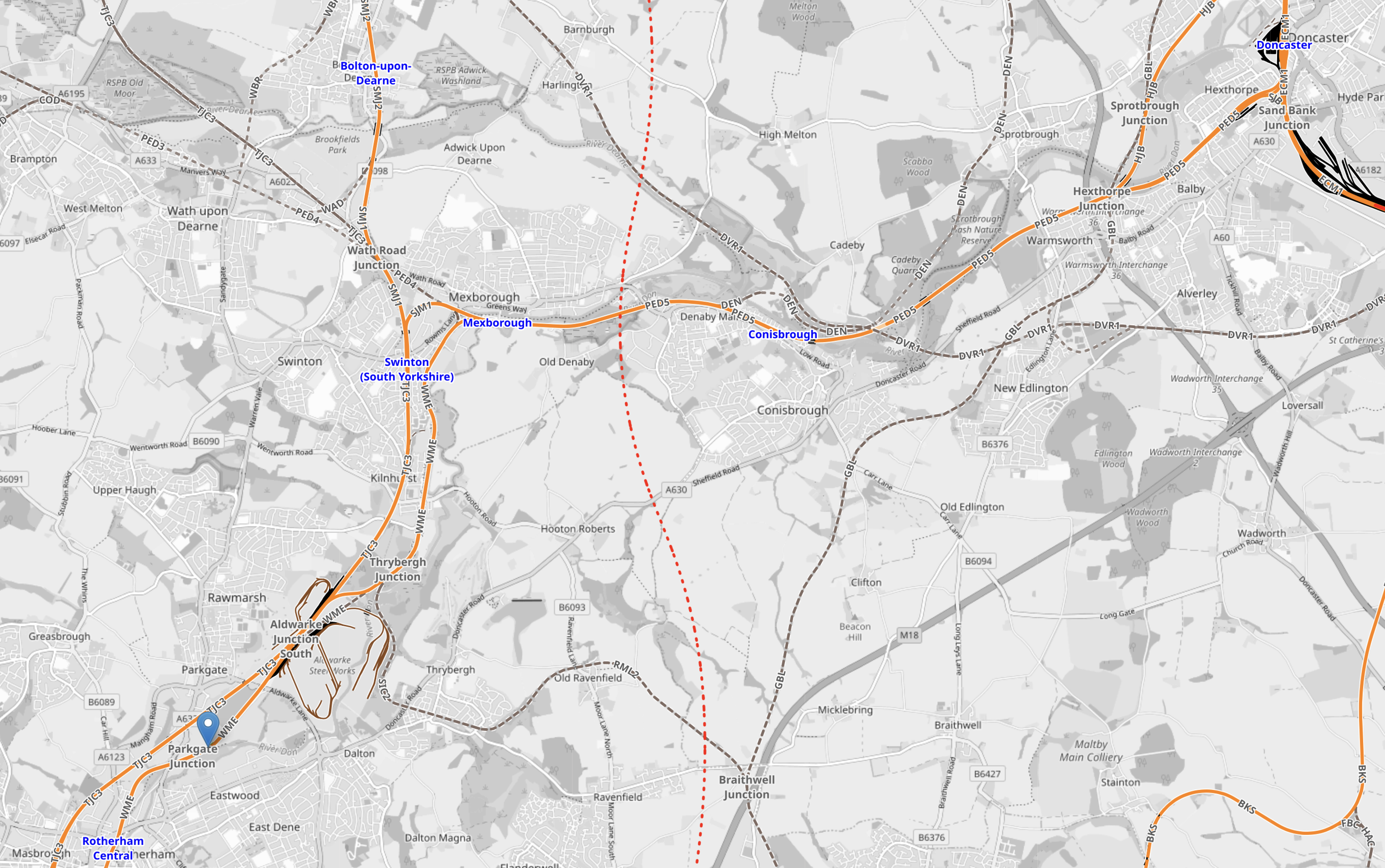
Note.
- Doncaster station is in the North-East corner of the map.
- Rotherham Central station is in the South-West corner of the map.
- The blue arrow in the South-West corner indicates Rotherham Parkgate tram stop.
- Swinton, Mexborough and Conisbrough stations can be picked out.
- The dotted red line running North-South across the map is the route of the ill-fated Eastern Leg of High Speed Two.
It is a simple application of tram-train technology to connect Doncaster station and Doncaster Sheffield Airport to the Sheffield Supertram.
With all the comings and goings on the East Coast Main Line at Doncaster station, I believe that the tram-train connection to Sheffield and Rotherham is essential.
The Cities Of Bradford, Doncaster, Leeds, Sheffield and Wakefield Can Have a High-Frequency Rail Connection
Consider.
- Four stations are all step-free with a bridge or subway served by lifts.
- Bradford Forster Square station has level access to the platforms from the street.
- The rail lines between the five stations are electrified, with the exception of Sheffield and Doncaster.
- Services between the cities are run by CrossCountry Trains, Grand Central Trains, Hull Trains, LNER and Northern Trains.
- Most maximum speeds are not unduly slow.
Consequently the five cities can have a high-frequency rail connection in excess of four tph.
Could this be the basis of a Five-Cities Metro?
Open Access Services
There are six open access services running on the East Coast Main Line.
- Grand Central Trains – King’s Cross-Bradford Interchange via Peterborough, Doncaster, Pontefract Monkhill, Wakefield Kirkgate, Mirfield, Brighouse, Halifax and Low Moor – 4 tpd
- Grand Central Trains – King’s Cross-Sunderland via Peterborough, York, Thirsk, Northallerton, Eaglescliffe and Hartlepool – 6 tpd
- Hull Trains – King’s Cross-Hull via Stevenage, Grantham, Retford, Doncaster, Selby, Howden, Brough – 4 tpd
- Hull Trains – King’s Cross-Beverley via Stevenage, Grantham, Retford, Doncaster, Selby, Howden, Brough, Hull and Cottingham – 2 tpd
- Lumo – King’s Cross-Edinbugh via Stevenage, Newcastle and Morpeth – 5 tpd
- Lumo – King’s Cross-Glasgow Queen Street via Stevenage, Newcastle, Morpeth, Edinburgh and Falkirk High – 2 tpd
Note.
- tpd is trains per day.
- All seem to serve an exclusive area, except Lumo.
- In a couple of years, all could be using Hitachi trains.
- I suspect some services will swap their diesel generators for batteries.
Battery-power would allow some services to be zero-carbon, even when using the GNGE diversion.
Batteries Ordered For Grand Central Inter-City Trains
The title of this post, is the same as that of this article on Railway Gazette.
These three paragraphs add detail to the article.
Hitachi Rail has selected Turntide Technologies to supply lithium iron phosphate batteries for use on electric-diesel-battery hybrid inter-city trainsets it is to build for Arriva’s open access operator Grand Central.
Nine five-car trainsets are to be manufactured at Hitachi Rail’s Newton Aycliffe factory for delivery in 2028 under a order placed by leasing company Angel Trains in March.
Under the latest agreement announced on July 2 Hitachi Rail will place orders worth nearly £10m for Turntide to continue with R&D and supply next-generation LFP batteries, which are designed to be smaller and more powerful than previous lithium-ion batteries. The Safety Integrity Level 2 and IEC 61508 compliant battery management system will detect and mitigate hazards and meet the IEC 62243 cybersecurity standard.
There is also this paragraph, which describes the benefits of the trains.
The battery technology is expected to cut the Grand Central trains’ emissions and fuel consumption by around 30%, with the trains entering and exiting stations in zero-emission mode to improve air quality and reduce noise in urban centres.
Angel Trains, Grand Central, Hitachi Rail and Turntide Technologies seem to be playing this all carefully, as I suppose that they don’t want to be left with a large problem, if the current government decides to take over open access services.
Network Rail Objects To Wrexham To London Service
The title of this post, is the same as that of this article on the BBC.
This is the sub-heading.
Concerns have been raised about plans for a direct rail service between Wrexham and London, including fears over safety at level crossings.
These three paragraphs add details to the story.
Network Rail warned the line was already congested and there was not enough timetable capacity for extra services.
In a report, it said increased use would raise the risk of a collision at crossings along the route and that it could not support the application, put forward by a new open-access rail operator called the Wrexham, Shropshire and Midlands Railway (WSMR).
The new service would link Wrexham, Gobowen, Shrewsbury, Walsall and Coleshill up with the capital.
This Google Map shows the area of the crossing.
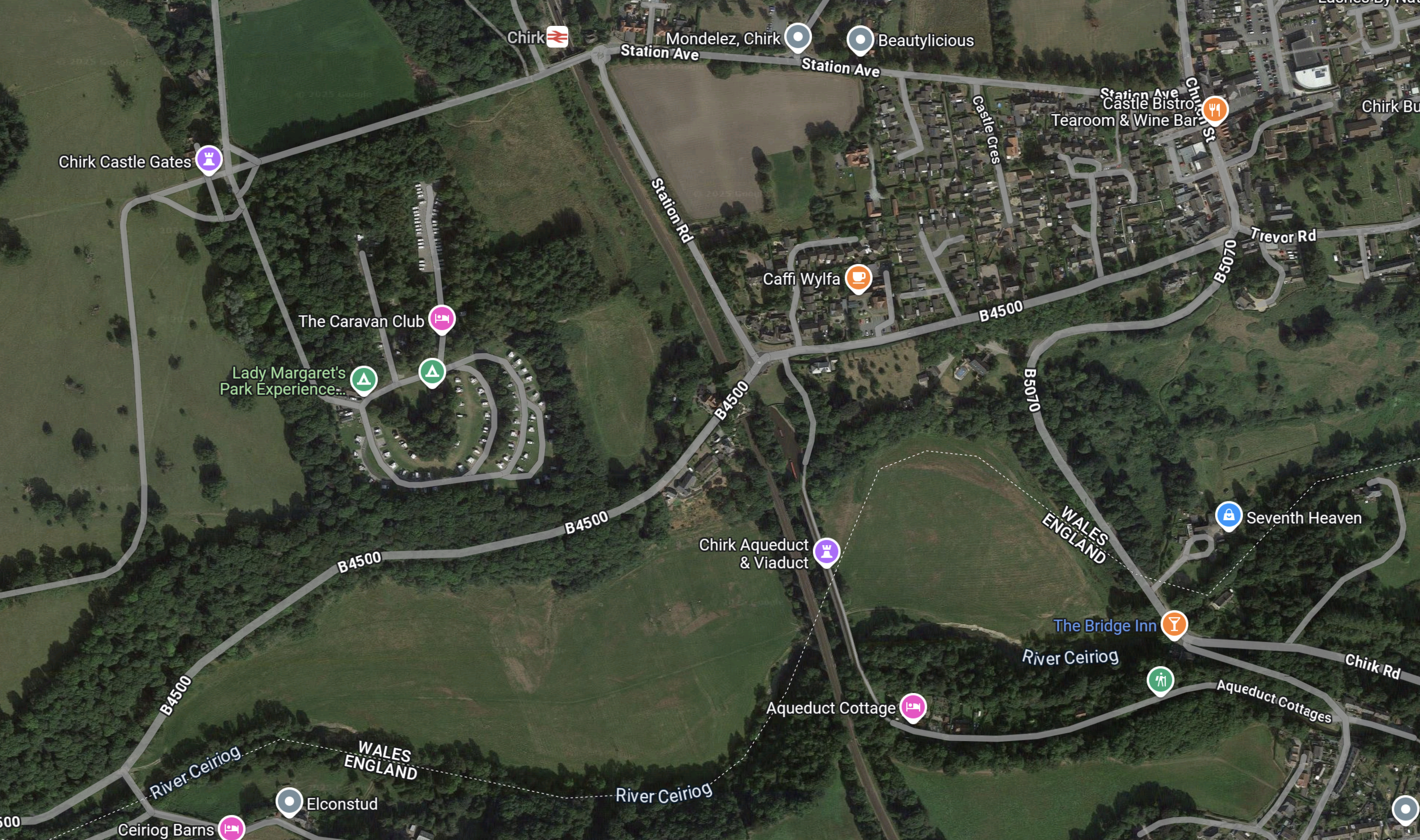
Note.
- Chirk station, which is fully-accessible via ramps, is at the top of the map.
- The railway between and running down the middle of the map.
- The railway has a maximum speed of 70 mph.
- The Aqueduct and the Viaduct crossing the valley of the River Ceirog together.
- The large caravan park.
- Chirk Castle Park.
If the Viaduct level crossing is in this area, it is a serious accident waiting to happen.
The BBC article says this about the crossing.
They include the Viaduct level crossing in Shropshire, which it said was “used by large groups and is also a hot spot for trespassing and fatalities”.
The operator said work would need to be carried out to make it safe.
North Shropshire MP Helen Morgan has previously spoken out on the safety of the crossing, which is close to the Chirk Viaduct.
She has written to Network Rail to request additional safety measures be put in place.
Network Rail said it had reviewed the safety of the crossing and brought forward plans to install crossing lights, which should be in place in December this year.
Note.
- I hope this is enough. But, I do know that the level crossing lights work well at Thurston station in Suffolk.
- It must help, that there is a bridge at the station.
The line between Wolverhampton and Wrexham, except for a short 15 mph section at Shrewsbury has at least a 70 mph maximum speed.
As electric trains, including battery-electric ones, have fast acceleration and deceleration would it not be possible for them to slow down for the level crossings?
This could even be done automatically using digital signalling.
Conclusion
I believe that this level crossing problem is solvable.
A Taste Of The Future
On Friday, I went to Chester and took a train home from Crewe to Euston.
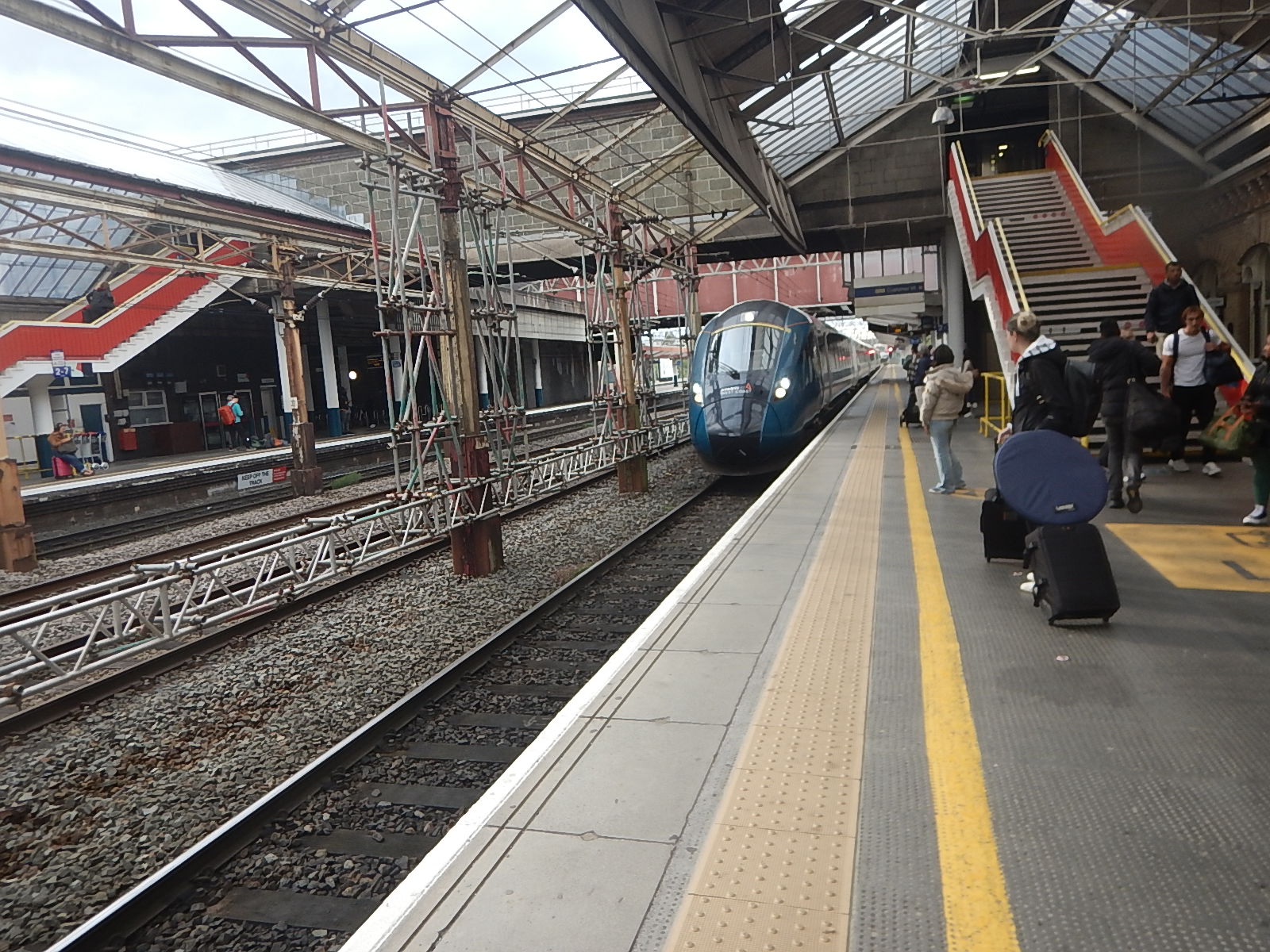
It was a new Hitachi Class 805, that sped me to London, with just a stop at Milton Keynes.
This picture shows the train arriving at Crewe.
Note.
- High Speed Two it is not, but it went most of the way to Euston at 125 mph in an hour and 50 minutes.
- High Speed Two will take 56 minutes, although that is not cast in stone and steel yet.
- Crewe is one of the towns and cities, that will benefit most from High Speed Two.
But whether High Speed Two is delivered or or not, Crewe’s train service should improve in Spring 2026, as the first Lumo service on the West Coast Main Line service will be starting.
I describe the service in Lumo To Expand Scotland’s Rail Network With New London-Stirling Rail Route From Spring 2026.
This paragraph from the linked post, describes the route.
Lumo’s new route will link London Euston directly to Stirling, also calling at Milton Keynes, Nuneaton, Crewe, Preston, Carlisle, Lockerbie, Motherwell, Whifflet (serving Coatbridge), Greenfaulds (serving Cumbernauld) and Larbert.
It is fully-electrified and can support 125 mph running most, if not all, of the way.
It will certainly give knowledgeable travellers options on how they travel on the West Coast Main Line.
Lumo are also proposing another open access service on the West Coast Main Line to Rochdale, which will increase travel options.
My only worry is that Heidi Alexander will cancel it, on the grounds that open access services abstract the revenue of Great British Railways.
But then after announcing the service in a reception in Holyrood, she surely couldn’t cancel it now.
On the other hand, it could be that this Labour Government has discovered that open access trains are a more affordable way of developing rail services to and from London and over longer distances.
Consider.
- Recently, Lumo has proposed open access services from London to Carmarthen, Paignton, Rochdale and Stirling.
- Recently, Arriva has proposed open access services from London to Cleethorpes, Grimsby and Scunthorpe and between Newcastle and Brighton.
- Recently, Alsthom has proposed open access services from London to Shewsbury and Wrexham.
Not one of these services will cost the government a lot of money, but Network Rail will pick up access charges.
So has Heidi Alexander seen sense and feels that it is better to allow more open access services?
Could Any Other Open Access Services Be Opened On The West Coast Main Line?
London Euston and Rochdale is planned by Lumo and I wrote about it in FirstGroup’s Lumo Seeks To Launch Rochdale – London Open Access Service.
This sentence from the linked post, gives the route.
The trains would call at Warrington Bank Quay, Newton-le-Willows, Eccles and Manchester Victoria.
Other possibilities would surely be Blackpool and Barrow-in-Furness, but Blackpool gets a three trains per day (tpd) service from Euston and frequent trains from Preston.
Barrow-in-Furness could be a very useful destination.
With increased defence spending, the shipyards will be busy.
It could be another gateway to the Lake District.
Services could be extended to Sellafield, Whitehaven and Workington.
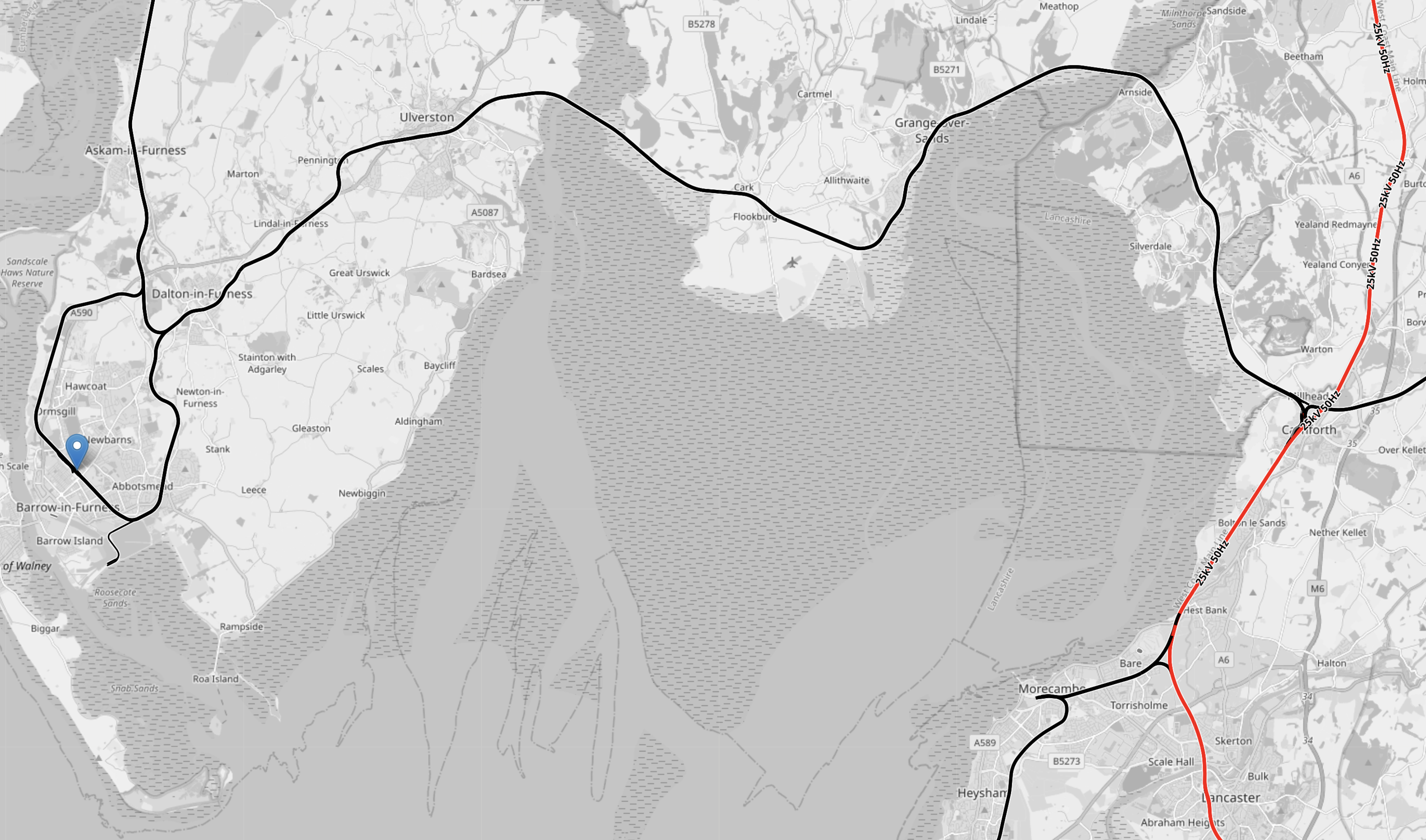
This OpenRailwayMap shows the Cumbrian Coast Line between the West Coast Main Line and Barrow-in-Furness.
Note.
- The red tracks on the Eastern side of the map is the electrified West Coast Main Line.
- At the bottom of the map on the West Coast Main Line is Lancaster, with its station.
- The black track going West from Lancaster is the Morecambe and Heysham branch.
- The black track going West across the top of the map is the Cumbrian Coast Line.
- Barrow-in-Furness station is indicated by the blue arrow.
- The length of track without electrification on the route is less than thirty miles.
One of Lumo’s battery-electric trains would easily handle a London Euston and Barrow-in-Furness route.
Conclusion
There is obviously scope for new railway routes in the UK and some will be suitable for open access operators.
Perhaps, we need the Office of Road and Rail to be more proactive in deciding, when a route is to be served and then select an operator.
It would need to be an unbiased apolitical process, to stop an incumbent political party running trains to marginal seats, they hoped to win.
FirstGroup Applies To Run Rail Services Between Hereford And London via Cwmbran
The title of this post, is the same as that of this news item from FirstGroup.
These first two paragraphs, add more detail to the title.
FirstGroup plc has submitted the first phase of an application for a new open access rail service between Hereford and London to the Office of Rail and Road (ORR).
FirstGroup plans to expand its open access rail operations as part of its successful Lumo business, building on Lumo’s existing service which has transformed long-distance connectivity between London and Edinburgh. This has helped materially grow rail demand on the East Coast Mainline in recent years, through a new and enhanced choice for customers and providing more trains to more destinations.
These are some more points from the press release.
Route and Frequency
The news item says this about route and frequency.
FirstGroup’s proposal is for two return journeys a day (one on Sundays) between London Paddington and Hereford, calling at Bristol Parkway and Severn Tunnel Junction as well as providing direct London services at Cwmbran, Pontypool & New Inn and Abergavenny.
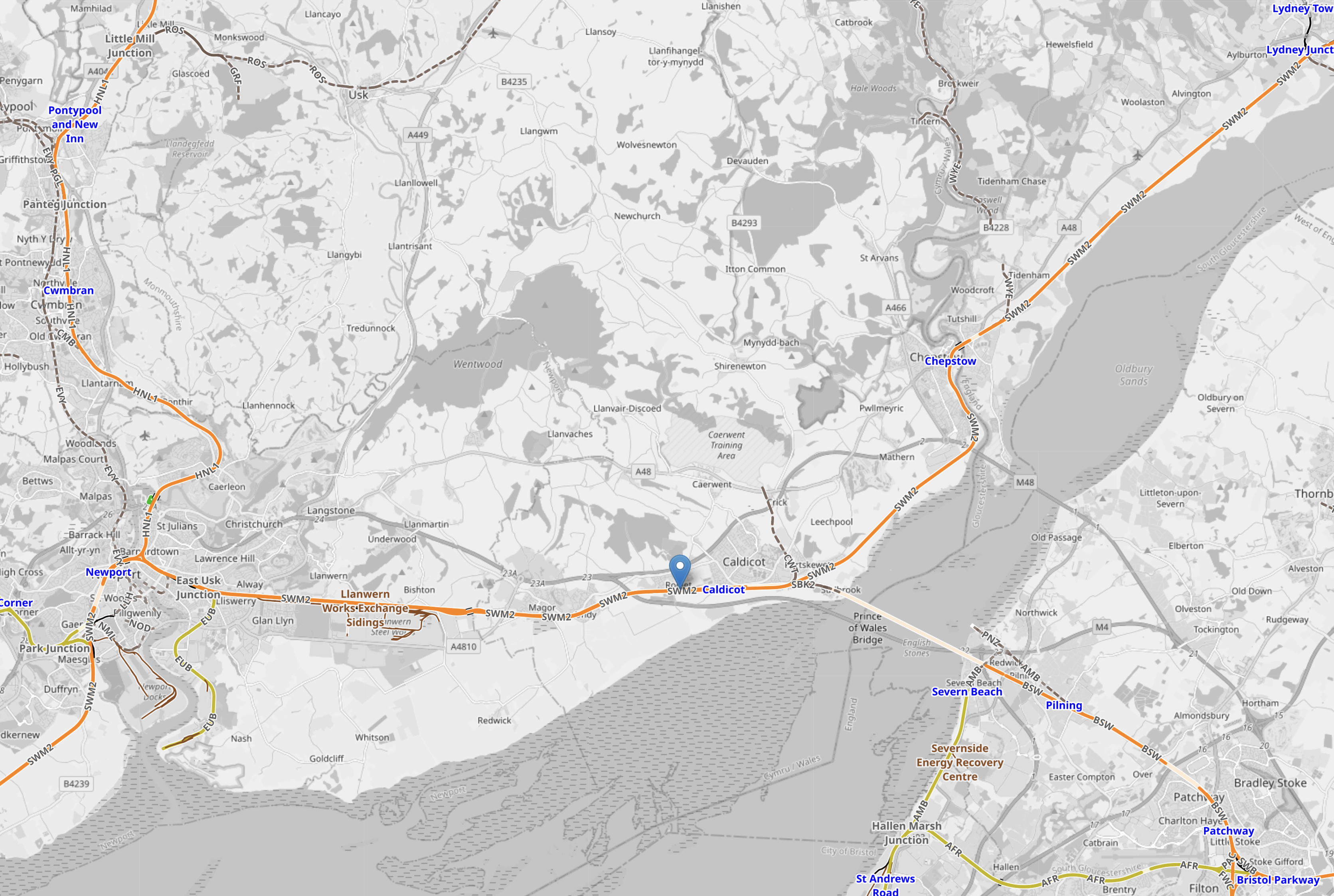
This OpenRailwayMap shows the route between Bristol Parkway and Pontypool & New Inn stations.
Note.
- Bristol Parkway station is in the South-East corner of the map.
- Severn Tunnel Junction station is marked by the blue arrow in the middle of the map.
- The electrified South Wales Main Line connects Bristol Parkway and Severn Tunnel Junction stations.
- From Bristol Parkway, the electrified Great Western Main Line goes to London Paddington via Swindon and Reading.
- From Severn Tunnel Junction station the South Wales Main Line goes West to Newport, which is on this map and then to Cardiff, Swansea and West Wales.
- Pontypool & New Inn station is in the North-West corner of the map on the Welsh Marches Line between Newport and Crewe stations.
- Welsh Marches Line is connected to the South Wales Main Line at Maindee triangular junction, which is a few miles East of Newport station.
- Cwmbran station is on the Welsh Marches Line between Newport and Pontypool & New Inn stations.
After a quick look on Wikipedia and Real Time Trains, it appears that few if any trains run in either direction between Cwmbran and Severn Tunnel Junction stations using the North-East side of Maindee junction.
Lumo’s trains would use this route to go between Bristol Park and Pontypool & New Inn stations via Severn Tunnel Junction, and Cwmbran.
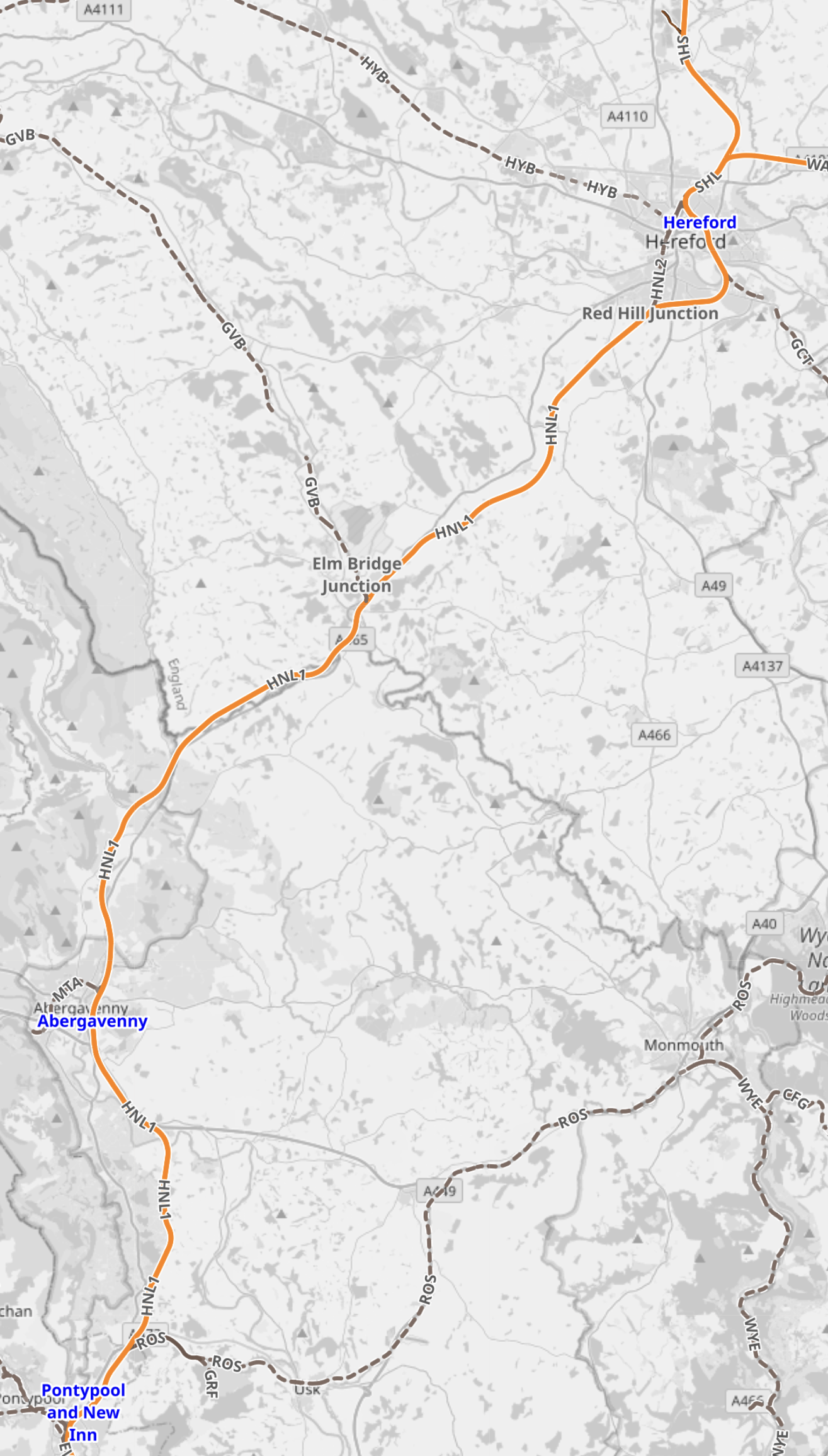
This second OpenRailwayMap shows the Northern part of the route between Pontypool & New Inn and Hereford stations.
Note.
- The orange track is the Welsh Marshes Line between Newport and Crewe.
- Pontypool & New Inn station is in the South-West corner of the map.
- Abergavenny station is on the West side of the map.
- Hereford station is in the North-East corner of the map.
Looking at the route as a whole, it is a very simple route.
- Trains go as fast as traffic allows, non-stop to Bristol Parkway station.
- Trains then take the South Wales Main Line with a single stop at Severn Tunnel Junction station to Maindee Junction, just to the East of Newport.
- Trains then take the Welsh Marches Line to Hereford stopping at Cwmbran, Pontypool & New Inn and Abergavenny stations.
It is an innovative route, that has these advantages.
- It uses a little-used leg of Maindee Junction.
- London Paddington and Maindee Junction is electrified.
- The fastest Hitachi trains seem to take about one hour and forty minutes between London Paddington and Maindee Junction.
As direct trains between Newport and Hereford take around fifty minutes, a time of two-and-a-half hours between London Paddington and Hereford could be possible.
This would compare with current Great Western Railway services, which take upwards of two hour and forty-five minutes, which often have a change of train.
Lumo Trains Should Be Faster Between London Paddington And Bristol Parkway
This may seem surprising, but most if not all current services stop between London Paddington and Bristol Parkway, stop at Swindon and Reading.
Cutting out a stop saves a few minutes on the journey.
New Trains
The news item says this about new trains.
The new Hereford service would support further investment in new trains. In December 2024 FirstGroup placed a £500m order for 14 trains from Hitachi Rail in County Durham. The Group has an option for a potential second order of similar size and the Hereford fleet would form part of this option.
Yesterday, I went to North Wales and used Avanti West Coast from Euston. The trains both ways were new Class 805 trains, which are bi-mode versions of Lumo’s Class 803 trains. These Class 805 trains travel all the way between Crewe and Holyhead on their diesel engines, so the much shorter leg between Maindee Junction and Hereford will definitely be in range.
But Hitachi are developing battery-electric versions of these trains and as there-and-back between Maindee Junction and Hereford is only 88 miles, I wouldn’t be surprised in a couple of years that Cwmbran, Pontypool & New Inn, Abergavenny and Hereford stations have a direct electric service from London.
Services At Hereford
The news item says this about services at Hereford station.
For Hereford, the two direct London paths each weekday would increase services on this flow from four today, to six. The new services would help mitigate the current large gaps in the timetable with additional daytime and evening arrivals into London, giving Hereford more regular connectivity. The new services would also provide the stations on the route with new direct journey opportunities to Bristol Parkway.
I also believe it would be a faster, fully electric service.
Services At Abergavenny
The Wikipedia entry for Abergavenny station says this about services at the station.
With a few exceptions, the weekday daytime service pattern typically sees one train per hour in each direction between Manchester Piccadilly and Cardiff Central, with most trains continuing beyond Cardiff to Swansea and West Wales. There is also a two-hourly service between Cardiff and the North Wales Coast Line to Holyhead via Wrexham General. These services are all operated by Transport for Wales. The northbound Premier service from Cardiff to Holyhead calls here on Monday to Fridays but the southbound service does not call here.
Note.
- The station has partial step-free access
- The station has 74 parking spaces.
Two trains in each direction would improve the services at Abergavenny station.
Services At Pontypool & New Inn
The Wikipedia entry for Pontypool & New Inn station says this about services at the station.
On weekdays and Saturdays, there is generally a two hourly service between Holyhead and Cardiff in the middle of the day, with additional peak time services southbound in the mornings and northbound in the evenings for commuters to Newport and Cardiff. These include services between Manchester Piccadilly and West Wales via Crewe and Swansea. From December 2013 the evening northbound Arriva “Premier” service train began to call at Pontypool for the first time. The southbound service in the morning does not call here. On Sundays, an irregular service operates, with 8 trains calling southbound and 10 northbound. These mainly run between Manchester and Cardiff.
Note.
- The station is step-free with lifts.
- The station has 150 parking spaces.
Two trains in each direction would improve the services at Pontypool and New Inn station.
Services At Cwmbran
The Wikipedia entry for Cwmbran station says this about services at the station.
Services that stop at Cwmbran in both directions are all operated by Transport for Wales and include the hourly service between Manchester Piccadilly, Cardiff Central and West Wales and the two hourly service between Holyhead and Cardiff Central. Most Sunday services only run on the former route (there are only two services each way to/from Holyhead).
Note.
- The station is being made step-free with lifts.
- The station has 76 parking spaces.
Two trains in each direction would improve the services at Pontypool and New Inn station.
The Heads Of The Valleys Road
The A465 or Heads of the Valleys Road could be considered the South Wlaes equivalent of the North of England’s M62 Motorway.
This description is from the first paragraph of the Wikipedia entry.
Approximately following the southern boundary of the Bannau Brycheiniog National Park, the Ordnance Survey Pathfinder guide describes it as the unofficial border between rural and industrial South Wales. The A465 provides an alternative route between England and the counties in South West Wales and to the ferries to Ireland.
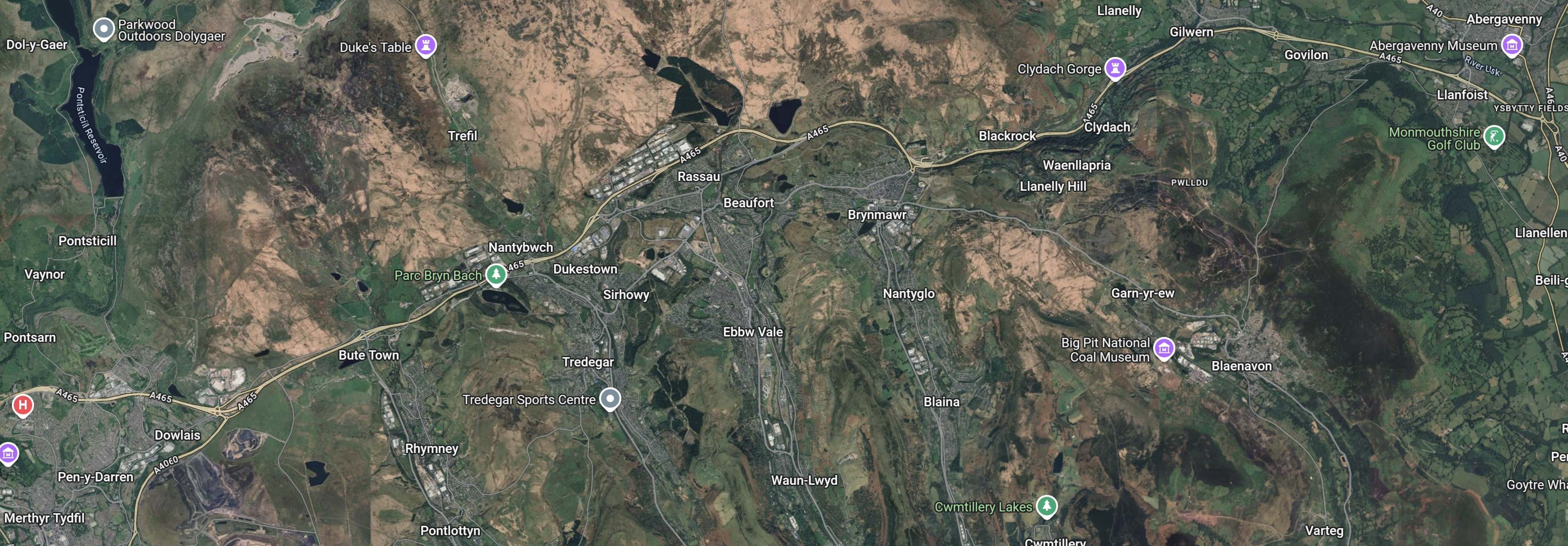
This Google Map shows its route between Merthyr Tydfil and Abergavenny.
Note.
- Merthyr Tydfil is in the South-West corner of the map.
- Abergavenny is in the North-East corner of the map.
- The full length of the road is just under seventy miles.
- The Heads of the Valleys Road connects to all the towns, that are the Northern termini of the South Wales Metro.
- At it’s Western end, the A 465 connects to the M4 near Swansea.
The news item says this about the tourism benefits of the service.
The new service is expected to have positive economic and social benefits for the communities it serves. Both of FirstGroup’s open access services Lumo and Hull Trains are on track to deliver more than £1.4bn in economic benefits along their routes and FirstGroup hopes to have a similar positive effect for the South Wales and Herefordshire communities.
The service should also provide a convenient link for visitors travelling to the Brecon Beacons/ Bannau Brycheiniog National Park; Blaenavon World Heritage Site and cathedral city of Hereford, driving growth and supporting jobs in the area’s tourism sector.
I do wonder if other tourism related services will be developed at Pontypool & New Inn, Abergavenny and Hereford?
Monmouthshire
This paragraph from the Wikipedia entry for Monmouthshire gives a flavour of the Welsh county.
The county is rural, although adjacent to the city of Newport and the urbanised South Wales Valleys; it has an area of 330 square miles (850 km2) and a population of 93,000. After Abergavenny (population, 12,515), the largest towns are Chepstow (12,350), Monmouth (10,508), and Caldicot (9,813).
I was surprised that the population of the county, was as high as 93,000.
This second paragraph, lists the railway stations.
Monmouthshire is served by four railway stations: in the south are the Severn Tunnel Junction railway station at Rogiet on the South Wales Main Line, which connects South Wales to London; and Chepstow railway station and Caldicot railway station on the Gloucester–Newport line; and in the north, Abergavenny railway station on the Welsh Marches line.
Severn Tunnel Junction and Abergavenny stations will be served by Lumo’s new service.
From my experience of using parkway stations in East Anglia with connections to London, I suspect residents of several towns outside of Monmouthshire will use these two stations for trips to the capital.
Are plans in place for extra parking and bus services?
Travelling To And From Heathrow Airport
I wouldn’t be surprised if Lumo picks up quite a few passengers, who are going to and from Heathrow.
Consider.
- I suspect Severn Tunnel Junction to London Paddington will take about one hour and forty minutes, with just the single stop at Bristol Parkway.
- The Elizabeth Line to the Airport will take 28 minutes and cost £13.90, according to Transport for London.
- The Elizabeth Line is an easy step-free change from National Rail at Paddington.
- Elizabeth Line trains between Paddington and Heathrow are every six minutes.
- It’s not a very long walk at Heathrow between the Elizabeth Line and the terminals.
- Driving from say Monmouth to Heathrow will take about two-and-a-quarter hours and cost you to cross the Severn Bridge and for parking.
If your local Great Western Main Line station is between say Chippenham and Cardiff, you might be surprised at how fast and affordable it can be to go to and from Heathrow by Great Western Railway and Elizabeth Line.
When Lumo starts running to Heathrow, I am sure it will be faster, as the trains will not stop East of Bristol Parkway station.
Running In Conjunction With Services Between London Paddington And Carmarthen
The news item says this about running services in conjunction with Lumo’s services to Carmarthen.
The service would operate in conjunction with the planned service from London to Carmarthen which is due to launch in December 2027, and it is anticipated it could begin at the same time.
Consider.
- Both routes are identical between London Paddington and Maindee Junction.
- Both routes could share depots.
- Hitachi’s trains can split and join with alacrity.
- Class 800, 801, 802 and 803 trains have twenty-six metre cars, which mean a five-car train is 130 metres long.
- Bristol Parkway station has 280 metre long platforms. Pairs of trains could split and join here.
- Seven Tunnel Junction has three 171 metre long platforms. Pairs of trains could not use this station, unless the platforms were lengthened.
- Newport station has three platforms longer than 278 metres. Pairs of trains could split and join here, if the Hereford trains reversed direction.
I suspect if trains split and joined, it would be at Bristol Parkway station.
Note that Bristol Parkway station has 1,800 car park spaces, so Lumo could target passengers wanting to park and take the train to London, Cardiff, Newport and other Welsh destinations.
Co-operation With Great Western Railway
In Does Innovation Get Mr. Ed Miliband Better Prices To Doncaster?, I talked about the ticketing on the East Coast Main Line.
It appears to me, that if you put more seats on a popular route, like King’s Cross and Doncaster, then the availability drives down prices.
I also believe that if the tickets are all available through a common walk-up system, then this fills the seats.
The system has now been applied to the West Coast Main Line and I believe that if Great Western Railway and Lumo collaborated on ticketing, this would improve competition between London Paddington, Bristol Parkway and Cardiff.
There is also the issue of train rescue.
Supposing a pair of five-car Hitachi trains broke down with a fault, that allowed the train to be towed to the nearest station, so that passengers could be disembarked.
Hitachi trains are designed, so that up to twenty-four trains can be joined together in rescue mode.
That would certainly be an impressive sight.
Uber Partners With Gemini For Channel Tunnel Train Plan
The title of this post is the same as that of this article on Railway Gazette.
These two introductory paragraphs give more details.
Ridesharing app company Uber has announced a co-branding partnership with Gemini Trains, which is developing plans to launch open access passenger services through the Channel Tunnel.
Gemini plans to purchase 10-newly designed trains to offer ‘comfortable high-quality and frequent’ services with competitive fares, running from London Stratford International station – which has never been used for international services – to Paris Nord and Brussels Midi. All trains would call at Ebbsfleet International, which Eurostar no longer serves. Gemini also plans to expand services to ‘further exciting European destinations’, suggesting that Paris and Brussels are ‘just the start’.
It looks like Gemini Trains will run the trains and Uber will help with marketing, publicity and ticket sales.
After 104 Years UK’s Longest Train Route Is Cancelled For Ever
The title of this post, is the same as that of this article on The Times.
These three paragraphs describe the last journey.
With a muted fanfare the UK’s longest train rolled out of Aberdeen on Friday morning for its final sojourn down to Penzance, ending a service that connected both ends of the country for more than 100 years.
The 8.20am CrossCountry train took 13 hours and 20 minutes, with stops at 35 stations along the way, to cover the 774-mile route. Passengers spent more than two hours of the journey in the stations.
The service, which was launched in 1921, headed south through York, Bristol, Taunton and Truro on its way past some of the country’s finest landscapes, and arrived in Penzance at 9.31pm.
Looking at a ticket site and it appears that by using two trains from Aberdeen to King’s Cross and Paddington to Penzance you can be a few minutes faster, if you know your Underground.
This route will get quicker.
- As the East Coast Main Line rolls out its new digital signalling, this should speed up trains, by allowing some running at 140 mph instead of the current 125 mph.
- LNER will also be bringing their new tri-mode (electric/battery/diesel) trains into service, which could give some speed improvements on the diesel section North of the Forth Bridge in terms of speed and ride noise, especially as ScotRail will be partially electrifying part of this section.
- GWR should also be upgrading some of their fleet to tri-mode, which should improve speed and ride noise on the sections, where the route is not electrified.
- CrossCountry could compete, by buying new trains, but it would be a big financial risk, as the London route should get quicker, as track improvements and increased use of digital signalling speed up services from London to Aberdeen and Penzance.
CrossCountry ‘s owner; Arriva isn’t standing still, but have applied for extra Grand Central open access services on the East Coast Main Line to Scunthorpe and Cleethorpes and a new service from Newcastle to Brighton via Birmingham, which will partly fill the gap caused by the loss of the Aberdeen and Penzance service, by linking with GWR at Reading and LNER at Newcastle.
Key Rail Route To London Scrapped A Year Ago Could Return – Here’s Why
The title of this post, is the same as that of this article on the Shropshire Star.
This is the sub-heading.
A key railway line to London that was scrapped a year ago, could be set for a return.
This is said in the article.
South Shropshire MP Stuart Anderson is among those who has thrown his support behind plans to restore direct rail services to London, after Avanti ceased to operate the route almost a year ago in June 2024.
On March 12, Mr Anderson met with Wrexham, Shropshire and Midlands Railway (WSMR) who have developed the plans.
If their application is approved, it would see the return of direct services between Wrexham and London via Shropshire. WSMR, the aspirant open access operator, plans to deliver five daily train services between the county and capital city.
It’s only sketchy information and given the Government’s lukewarm support for open access services, I don’t hold out much hope, especially as Stuart Anderson is a Conservative MP.
Arriva Group Submits Open Access Rail Application To Connect Newcastle And Brighton, Via London Gatwick
The title of this post, is the same as that of this press release from Arriva Group.
These three bullet points act as sub-headings.
- New services operated by Arriva’s Grand Central would introduce a direct rail connection between the Northeast and Midlands to London Gatwick and the South Coast.
- Making better use of available network capacity, the proposed route would connect underserved communities in the UK and enhance long-distance connectivity without the need to interchange through London.
- The application reflects Arriva’s wider European strategy to connect people and places through sustainable transport solutions, strengthening regional economies and supporting modal shift.
This introductory paragraph provides more details.
Arriva Group has today announced it is submitting an open access application to the Office of Rail and Road (ORR) to introduce a new direct rail service between Newcastle and Brighton, via London Gatwick, providing vital connectivity for underserved communities along the route.
Other points to note include.
- There will be five trains per day in each direction.
- The proposed service would call at Durham, Darlington, Northallerton, York, Doncaster, Sheffield, Derby, Burton-on-Trent, Birmingham New Street, Warwick Parkway, Banbury, Oxford, Reading, Wokingham, Guildford, Redhill, London Gatwick and Haywards Heath.
- The service would be operated by Grand Central.
- The service could be introduced from December 2026.
It will be the be the first direct service between Newcastle and Brighton.
This final paragraph outlines where the service fits in Arriva’s wider philosophy.
The plans are part of Arriva Group’s broader commitment to strengthening regional connectivity and making better use of available rail capacity. By opening up new travel corridors, Arriva is helping to connect more people to jobs, education and leisure opportunities – and to encourage a greater shift from private cars to public transport.
There are certainly plenty of places in Europe, that could use a service like this one between Brighton and Newcastle.
In The Ultimate Open Access Service, I describe a possible open access service between Amsterdam and Hamburg, which is about the same distance as Brighton and Newcastle, which is 372.8 miles by Arriva’s proposed route.
These are some of my thoughts in no particular order.
A High-Class Service Between Oxford And Brighton Could Be An Interesting Development In Its Own Right
Governments, rail operators and passenger groups of all persuasions and flavours have warmly welcomed the planned reopening of the rail route between Oxford and Cambridge.
I suspect an Oxford and Brighton service would be equally welcomed.
Brighton may not be an academic powerhouse yet, but it does have one thing that Oxford and Cambridge lack ; the sea.
Gatwick Airport Will Surely Welcome The Extra Connectivity
Gatwick Airport will expand and extra rail services will do the following for the airport.
- Make it easier to get the planning permission for the second runway.
- Make it easier for passengers and airport and airline staff to get to the airport.
- Surely, the more direct rail connections the airport has, will increase the likelihood, that families and other groups, will choose to fly from Gatwick.
- More train services could cut the amount of car parking per flight needed at the airport.
Gatwick Airport station has recently rebuilt and added extra capacity, so I doubt there will be trouble accommodating another ten trains per day.
Would The Army Welcome The New Service?
Two of the British Army’s main training areas are in North Yorkshire and in Surrey.
Would they find a train service between the two areas useful?
What Trains Will Grand Central Trains Use For The New Service?
In Arriva Group Invests In New Battery Hybrid Train Fleet In Boost To UK Rail Industry, I talked about how Grand Central will be acquiring Hitachi trains for their routes between London and Bradford and Sunderland.
- These will be Hitachi tri-mode trains.
- The trains will have a range of over forty miles on batteries.
- They will probably be serviced in Yorkshire or the North-East.
- The trains will be built by Hitachi at Newton Aycliffe, with batteries from Turntide Technologies in Sunderland.
- The first trains will be delivered in 2028.
As Arriva intend to start services from December 2026, they would probably use diesel trains to start with.
I would expect that Grand Central would go for a unified fleet, which would mean more Hitachi tri-mode trains.
For convenience, they could all be serviced at Doncaster, which all Grand Central services will pass through.
What Sections Will Not Be Electrified Between Brighton and Newcastle?
As far as I can see from OpenRailwayMap, the following sections of the route are not electrified.
- Two sections of the North Downs Line – 29 miles.
- Didcot and Birmingham New Street – 80.9 miles
- Birmingham New Street and Derby – 41.3 miles
- Derby and Sheffield – 36.4 miles
- Sheffield and Doncaster – 18.4 miles
Note.
- Electrification South of Reading will be third rail, so some trains will need to have third-rail shoes.
- The length without electrification is a total of 206 miles.
- As Newcastle and Doncaster, Redhill and Brighton, Reading and Didcot, and Birmingham New Street station are all electrified, the longest sections the trains would run without electrification would be between Didcot and Birmingham New Street and between Birmingham New Street and Doncaster.
- The planned electrification between Derby and Sheffield would make life easier.
It appears that trains capable of handling a hundred miles of unelectrified railway are needed.
Hitachi have shown that a five-car train with one battery will travel 70 km (43.5 miles) on a full battery, so one with three batteries should be able to manage the hundred miles needed in a few years.
Will Any Extra Electrification Be Needed?
I think Birmingham New Street station will be the critical point.
- The next electrification on the route to the South of Birmingham New Street is at Didcot, which is 80.9 miles away.
- The next electrification on the route to the North of Birmingham New Street is at Doncaster, which is 96.1 miles away.
These battery ranges should be possible, but an alternative would be to provide an electrified platform at one or more intermediate stations to be safe.
Stations that could be equipped to the South would include Oxford and Banbury and to the North would include Burton-on-Trent, Derby and Sheffield.
Perhaps electrifying a single platform at these stations, should be the first thing to be done, so that battery-electric trains can run on some useful routes as soon as they are delivered and approved.
Electric Trains, Even Battery-Electric Ones, Will Be Quick Off The Mark
Electric trains have good acceleration and I wonder, if this acceleration will enable stops, that are not feasible with diesel trains to be fitted in with electric trains, without having to take the same time penalty.
This might allow useful stops to be added to the service.
- Chesterfield is not mentioned, but most trains passing through stop.
- As I said, Farnborough North could be a useful stop for the Army.
- There might be a case for selective stopping patterns.
Battery-electric trains stop without any noise or pollution.
Connection To The Ivanhoe Line At Burton-on-Trent
The proposed Ivanhoe Line is intended to link Burton-on-Trent and Leicester.
As it is intended that the Newcastle and Brighton service will call ten times per day at Burton-on-Trent station, this must surely improve the economics of the Ivanhoe Line.
Are there any other new or reopened rail schemes, that will be helped by the proposed Brighton and Newcastle service?
Updated Frequencies At Sheffield
Currently, trains at Sheffield have these daily frequencies to the towns and cities on the proposed Newcastle and Brighton route.
- Newcastle – 18
- Durham – 16
- Darlington – 15
- Northallerton – 0
- York – 19
- Doncaster – 64
- Derby – 58
- Burton-on-Trent – 9
- Birmingham New Street – 21
- Warwick Parkway – 0
- Banbury – 0
- Oxford – 3
- Reading – 4
- Wokingham – 0
- Guildford – 0
- Redhill – 0
- London Gatwick – 0
- Haywards Heath – 0
- Brighton – 0
Note.
- Sheffield gets five trains per day (tpd) direct connections to nine new destinations.
- Other useful destinations will get five more tpd.
- Reading is a useful interchange for Wales and the West.
- Guildford is a useful interchange for Portsmouth, Southampton and West Surrey.
- Reading and Guildford have coach services to Heathrow.
There are also a large number of universities along the route.
Hitachi Can Offer A One-Supplier Battery-Electric Train Solution
It should be noted that Hitachi can offer a complete package including battery-electric trains and all the electrification, transformers and other electrical gubbins needed.
So perhaps for the Chiltern Main Line, which is used for part of the route between Didcot and Birmingham, Hitachi could deliver a one-supplier solution, that would also electrify Chiltern’s services between Marylebone and Birmingham Moor Street.
Remember, Chiltern are another Arriva Group company.
If Hitachi get this right, I can see other lines being electrified in this way.
Could This One-Supplier Battery-Electric Solution Be Exported?
I discussed this in Arriva Group Invests In New Battery Hybrid Train Fleet In Boost To UK Rail Industry, where I suggested that the United States could be a market.
- Arriva Group are ultimately American-owned.
- Hitachi’s battery technology is also American-owned.
In these days of Trump’s tariffs, these could prove useful facts.
As Arriva Group used to be owned by Deutsche Bahn, they may be another interested party, especially as they have a lot of lines, where I believe Hitachi’s solution would work.
Conclusion
A battery-electric railway service of nearly four hundred miles would certainly attract the passengers.

