Does Innovation Get Mr. Ed Miliband Better Prices To Doncaster?
The East Coast Main Line has ticketing unlike any other in the UK.
Turn up at any LNER station to go to any station that is served by trains from that station and you will be given a choice of the best prices at the ticket machines or at the booking office.
Effectively, you are sold your choice of the cheapest Advance tickets for your journey, at the time of booking.
In the last few months, I have taken three trips from London to Doncaster. All were priced between £20 and £25, with one trip on each of Grand Central, Hull Trains and LNER.
Some might argue it is because of the three Open Access operators on the route, that good value is available. But I would argue that it is down to the fact that because of the Open Access operators there is more seats on the route.
This ticketing model should be adopted on the West Coast Main Line and the Midland Main Line.
The ticketing has certainly modified my behaviour.
If I want to go to Sheffield, I go to Doncaster, as it’s a lot cheaper, then get a local train between Doncaster and Sheffield.
Ed Miliband Is A Doncaster MP
When he is going between his Doncaster North constituency and London, does he use last minute ticketing?
FirstGroup Makes Last-Minute Open Access Plea
The title of this post, is the same as that of this article on Railnews.
The article is definitely worth a full read.
A little bit of competition never hurt anybody, unless they weren’t very good.
I have already decided to give Great Socialist Railways a miss, unless I have a desperate need.
Grand Central To Submit Application For Direct Services Between Lincolnshire And London
The title of this post, is the same as that of this news item from Grand Central.
These three bullet points act as sub-headings.
- Grand Central has today launched an application process for direct services between Cleethorpes, Grimsby, Habrough, Scunthorpe and London – plans to bring significant benefits to underserved areas.
- The application will be welcomed by communities, businesses, and organisations, who have been actively campaigning for the introduction of direct rail links to London.
- If approved, the new services could unlock £30.1 million annually for the region.
These three paragraphs add more details.
Grand Central has today notified Network Rail of its plans to operate new direct services between Lincolnshire and London that, if approved by the rail regulator (the ORR), will bring significant benefits to underserved areas across Lincolnshire and the wider region.
Under the proposals, direct services to London will be provided from Cleethorpes, Grimsby, Habrough, and Scunthorpe, with Grand Central planning to operate the services from as early as December 2026.
The plan makes best use of capacity on the rail network by running trains from the proposed new stops before connecting into existing Grand Central services at Doncaster.
The service seems very similar to the proposed King’s Cross and Cleethorpes service described in the this section of the Grand Central Wikipedia entry, where this is said.
In December 2017, Grand Central announced plans to bid for a service from London King’s Cross to Cleethorpes in early 2018 for a date in 2020. It would involve the existing Bradford Interchange service extended to ten coaches from London to Doncaster then dividing with five coaches going to Cleethorpes via Scunthorpe, Barnetby, Habrough and Grimsby. The other five coaches would be the existing service to Bradford Interchange. This proposal would require permission for a split of trains as it has not been used on the East Coast Main Line before. In February 2018, Grand Central announced plans for an additional call at Crow The company planned to operate four trains per day from 2020. However, in July 2018, the Office of Rail and Road announced new access charges which would affect the business case for the new service, leading to Grand Central announcing that it would delay bidding until 2019.
Note.
- It appears that the service is not calling at Crow.
- By splitting and joining at Doncaster, Grand Central will be getting more coaches and passengers, up and down a single path between King’s Cross and Doncaster stations.
- Grand Central run four trains per day (tpd) between King’s Cross and Bradford Interchange, so as four tpd will be running between King’s Cross and Doncaster stations, it appears Grand Central will be running a full service.
It appears that open access applications come to those who wait eight years.
I have some further thoughts.
What Class Of Trains Do Grand Central Currently Use?
According to Real Time Trains on Friday the 21st of March 2025, two Class 180 trains and two Class 221 trains each ran a service between King’s Cross and Bradford Interchange stations.
Both type of train appear to be able to run as a pair of trains.
As Bradford is the UK City of Culture in 2025, that could prove useful.
What Trains Will Grand Central Use For The New Service?
It would appear that either type of train type could run the service,
So it would probably come down to factors like reliability, comfort and what is available.
I Was Mildly Surprised When I Saw This Application Had Gone In
But, circumstances change.
- Grand Central now run two Class 221 trains, in addition to the Class 180 trains.
- There are more Class 221 trains in store, if needed.
- The UK has had several changes of government since the original application in 2017 and track-access charges may have been reduced.
- Cleethorpes station has been refurbished.
Cleethorpes Station – 28th June 2023 shows the station in 2023.
But a new problem has arisen. The new Transport Secretary doesn’t seem keen on open access services, from some of the things she’s said.
Perhaps, she has had a change of heart or as she looks to be a good doer, someone has bought her a decent meal of fish and chips in Cleethorpes? My meal in the town is described in Lunch On The Pier In Cleethorpes.
But would Grand Central put in an application, if they knew they were wasting their money?
Or could this be an application funded by all the open access operators to get a definitive view on the government’s policy?
Could The Cleethorpes Service Be Run By Battery-Electric Trains?
Consider.
- Doncaster and Cleethorpes are 52.1 miles apart.
- Surprisingly Doncaster and Bradford Interchange are 52.1 miles apart.
- King’s Cross and Doncaster are 155.9 miles apart and fully-electrified.
- A battery that had enough capacity to do the return trips from Doncaster to either Cleethorpes or Bradford Interchange, would be easily recharged on the way to and from London.
With careful calculation of the battery size and good capacity management, I also suspect a battery-electric train could be able to take the GNGE Diversion via Lincoln.
Could The Cleethorpes Service Be Run By Hydrogen-Electric Trains?
Consider the daily services will be made up of these runs.
- Eight runs between London and Bradford Interchange each consisting of 155.9 miles on wires and 52.1 miles on hydrogen.
- Eight runs between London and Cleethorpes each consisting of 155.9 miles on wires and 52.1 miles on hydrogen.
Which means there are 833.6 miles per day run on hydrogen.
If there are four trains running the service as now, that is 208.4 miles per train per day on hydrogen.
A hydrogen-powered train with this daily range is very much a possibility.
The German Dimension To Grand Central Trains
Consider.
- Grand Central are owned by Arriva.
- Arriva are owned by Deutche Bahn.
- Siemens have a train factory at Goole close to Doncaster.
- Siemens have built quite a few electric multiple units for various UK railways.
- Siemens have designs for battery-electric and hydrogen-electric multiple units, that would be suitable for Grand Central Trains.
- Jürgen Maier was senior in Siemens UK, when the train factory at Goole was built and is now chair of Great British Energy.
I believe that Siemens at Goole could build trains, that would do nicely for Grand Central Trains.
- It would surely be handy for Grand Central Trains to have their fleet stabled in easy reach of the factory.
- In addition, hydrogen will soon be readily-available in the Doncaster area.
Grand Central trains could do a lot worse than buy trains built or assembled at Siemen’s factory at Goole.
Times Of Avanti West Coast Trains Between London Euston And Crewe
This table shows the first few Avanti West Coast trains between London Euston and Crewe on the 17th March 2025.
- 390119 – IS37 – Glasgow – 11 cars – 05:31 – 07:29 – 2 stops – 118 mins – 80.3 mph.
- 390155 – IH61 – Manchester Piccadilly – 11 cars – 06:29 – 08:08 – 2 stops – 99 mins – 95.7 mph.
- 807007 – IF11 – Liverpool Lime Street – 7 cars – 06:36 – 08:23 – 2 stops – 107 mins – 88.6 mph.
- 390104 – IS42 – Glasgow – 11 cars – 07:29 – 08:59 – 0 stops – 90 mins – 105.3 mph
- 390010 – IH62 – Manchester Piccadilly – 9 cars – 07:33 – 09:10 – 1 stop – 97 mins – 97.7 mph.
- 390044 – IF12 – Liverpool Lime Street – 9 cars – 07:43 – 09:18 – 2 stops – 95 mins – 99.7 mph.
- 390118 – IS45 – Glasgow – 11 cars – 08:30 – 10:01 – 0 stops – 91 mins – 104.2 mph
- 390040 – IH63 – Manchester Piccadilly – 11 cars – 08:33 – 10:19 – 1 stop – 106 mins – 89.4 mph.
- 807001 – IF14 – Liverpool Lime Street – 7 cars – 08:43 – 10:28 – 1 stop – 95 mins – 99.7 mph.
- 805001/805011 – ID83 – Holyhead – 10 cars – 09:02 – 10:51 – 1 stop – 109 mins – 86.9 mph.
- 390136 – IS48 – Glasgow – 11 cars – 09:30 – 11:02 – 0 stops – 92 mins – 103.0 mph
- 390040 – IH64 – Manchester Piccadilly – 9 cars – 09:33 – 11:08 – 1 stop – 95 mins – 99.7 mph.
- 390154 – IF16 – Liverpool Lime Street – 11 cars – 09:43 – 11:31 – 1 stop – 108 mins – 87.7 mph.
- 805012/805003 – ID84 – Chester – 10 cars – 10:10 – 11:53 – 1 stop – 103 mins – 92.0 mph.
- 390130 – IS52 – Glasgow – 11 cars – 10:30 – 12:00 – 0 stops – 90 mins – 105.3 mph
- 390151 – IH65 – Manchester Piccadilly – 11 cars – 10:35 – 12:09 – 1 stop – 94 mins – 100.8 mph.
- 807008 – IF18 – Liverpool Lime Street – 7 cars – 10:43 – 12:30 – 1 stop – 107 mins – 88.6 mph.
- 805009 – ID85 – Chester – 5 cars – 11:00 – 11:46 – 1 stop – 106 mins – 89.4 mph.
Note.
- All trains shown, go through Crewe.
- Some trains were delayed, hence their slow average speed.
- The Glasgow trains, which run non-stop from Euston to Warrington Bank Quay were the fastest, with four trains over 100 mph.
I have a few other thoughts.
The Class 805 Trains Are Crying Out For Batteries
In The Data Sheet For Hitachi Battery Electric Trains, I said this on how the Hitachi Class 80x trains will perform on batteries.
These are my conclusions about Hitachi’s battery packs for Class 80x trains.
- The battery pack has a capacity of 750 kWh.
- A five-car train needs three battery-packs to travel 100 miles.
- A nine-car train needs five battery-packs to travel 100 miles.
- The maximum range of a five-car train with three batteries is 117 miles.
- The maximum range of a nine-car train with five batteries is 121 miles.
Holyhead and Crewe is only 105.5 miles.
As battery technology gets better, these distances will increase.
The Fast Glasgow Train Appears To Be Leading A Convoy
The non-stop to Warrington Bank Quay Glasgow trains, also appear to be leading one Manchester Piccadilly, a Liverpool Lime Street and a Chester/North Wales train in a convoy, through Milton Keynes Central and the Trent Valley.
This convoy could grow as other services are added to the West Coast Main Line.
The Open Access Services Might Have Their Own Convoy
It would seem to me, that it might be possible to run a second convoy every hour, out of phase with the current one following the Glasgow service.
It also might be more virtual than real and under the control of the digital signalling, that will be installed on the line.
DfT Objects To Eight Open Access Applications
The title of this post is the same as that of an article in the March 2025 Edition of Modern Railways.
Surprise! Suprise! There are no prizes for innovation and risk, to be given out by Starmer’s Government Of All The Lawyers.
- Alliance Rail – Cardiff and Edinburgh – opposed
- Grand Central – London and York – opposed
- Hull Trains – London and Hull – opposed
- Hull Trains – London and Sheffield – opposed
- Lumo – London and Glasgow – opposed
- Lumo – London and Rochdale – opposed
- Virgin Trains – London and Liverpool – opposed
- Virgin Trains – London and Glasgow – opposed
Wrexham, Shropshire and Midlands Railway – London and Wrexham – supported.
Splitting And Joining Of Trains
Several of the objections, seem to be on grounds of capacity.
So why not pair up some services and split and join at a convenient station?
Hull Trains – A Hull and a Sheffield service could start together in London and split in Retford.
Lumo – A Newcastle and an Edinburgh service could start together in London and split in Newcastle.
Lumo – An Edinburgh and a Glasgow service could start together in London and split in Edinburgh.
Virgin Trains – A Liverpool and a Glasgow service would start together in London and split in Crewe.
A Bad Decision
I believe the Government’s decision is a very bad one.
At the weekend I wrote Sutton Station To Gatwick Airport By Hydrogen-Powered Bus, about my trip in a hydrogen-powered bus to Gatwick-Airport.
- The quality, performance and roadholding of this new zero-carbon bus was superb.
- I can’t wait to try out Wrightbus’s new hydrogen-powered coach in the next twelve months.
- In the future, I can see high speed hydrogen coaches steaming along the motorways of the UK and Ireland.
Hydrogen-powered coaches will do for cheap travel on the roads of these islands, what Ryanair and easyJet for did above our heads.
Thoughts On Lumo’s Proposed Paddington And Carmarthen Service
Lumo have permission for an open access service between London Paddington and Carmarthen.
- Stops will be Bristol Parkway, Newport, Severn Tunnel Junction, Cardiff Central, Gowerton and Llanelli
- It will be run under the Lumo brand.
- There will be five services per day.
Lumo hope services will start in 2027.
I would suspect that the train would run between London Paddington and Carmarthen like this.
- Run between London London Paddington and Cardiff Central using the 25 KVAC overhead electrification.
- Whilst running between London Paddington and Cardiff Central, the train’s batteries will be fully charged using the overhead electrification.
- Run between Cardiff Central and Carmarthen using the onboard battery power.
- Charge the train as required at Carmarthen.
Note.
- London Paddington and Cardiff Central is 145.2 miles or 233.7 km.
- Cardiff Central and Carmarthen via Gowerton is 75.3 miles or 121.2 km.
- In case of disruption, trains could wait at Cardiff Central, until the batteries had enough charge.
A battery capability of 75.3 miles or 121.2 km will be needed to reach Carmarthen.
A Fast Run Between London Paddington And Bristol Parkway
Consider.
- Currently, the fastest trains to Bristol Parkway take one hour and thirteen minutes between London Paddington and Bristol Parkway.
- The route is fully electrified.
- But the trains do make as many as three stops at Reading, Didcot Parkway and Swindon, before they stop at Bristol Parkway.
- London Paddington and Bristol Parkway are 111.7 miles apart.
This is an average speed of 91.8 mph.
Lumo will be making Bristol Parkway the first stop.
- 60 mins will be 111.7 mph.
- 54 mins will be 125 mph.
It could be a very fast time from London Paddington, if the trains can hold their operating speed of 125 mph for long periods to Bristol Parkway.
I would expect that a fast service between London Paddington and Bristol Parkway could attract passengers, if there were lots of parking.
A Fast Run Between Bristol Parkway And Cardiff Central
Consider.
- Currently, the fastest trains take thirty-five minutes between Bristol Parkway and Cardiff Central.
- The route is fully electrified.
- The speed limit varies between 75 and 90 mph.
- The train makes a single stop at Newport.
- Bristol Parkway and Cardiff Central are 34.2 miles apart
This is an average speed of 58.7 mph.
Lumo will be stopping at Severn Tunnel Junction and Newport.
The time may be a couple of minutes slower.
But I still expect that Cardiff Central will be reached in ninety minutes from London Paddington.
A Battery Run Between Cardiff Central and Carmarthen via Gowerton
Consider.
- Cardiff Central and Carmarthen via Gowerton is 75.3 miles or 121.2 km.
- The route has no electrification
- The train makes stops at Gowerton and Llanelli
- Cardiff Central and Carmarthen via Gowerton has a speed limit of mainly 75 mph, although there are sections up to 90 mph.
Times between Cardiff Central and Carmarthen via Gowerton would be.
At 75 mph the trip would be 60 minutes.
At 80 mph the trip would be 56 minutes.
I would estimate a time between London Paddington and Carmarthen of two hours and 35 minutes, as opposed to an hour longer by Great Western Railway, but that train makes eleven stops, as opposed to the six that Lumo intend to make.
Conclusion
It looks like Lumo will make most of their time savings to Camarthen by cutting stops and high speed running to betweeen London Paddington and Bristol Parkway stations.
Thoughts On Lumo’s Proposed Paddington And Paignton Service
Modern Railways says this about Lumo’s proposed new service between Paddington and Paignton.
Under the plans for Paignton, announced on 5 December, there would be five return Lumo trains running between Paddington and Paignton, serving Bath Spa, Bristol Temple Meads, Taunton, Exeter St David’s and Torquay. These could start in May 2028. A sixth path is planned between Highbridge & Burnham and London Paddington.
Modern Railways says that currently there are only three direct trains between Torbay and London and that rail has a 29% modal share on that route compared to 71% for road.
Modern Railways tell us that GWR current run three trains per day to Paignton and these call at Reading, Newbury, Hungerford, Pewsey, Westbury, Castle Cary, Taunton, Tiverton Parkway and Exeter St. David’s and Torquay.
Note.
- Lumo will be taking five stops using a longer route.
- GWR currently take ten stops using a shorter route via Westbury.
- GWR currently take ten stops between London Paddington and Bristol Temple Meads.
- The fastest GWR service I can find takes three hours and four minutes between London Paddington and Paignton.
- The fastest GWR service I can find takes one hour and thirty-five minutes between London Paddington and Bristol Temple Meads.
- The fastest service I can find takes one hour and thirty-nine minutes with five stops between Bristol Temple Meads and Paignton.
- Lumo’s trains will probably be fitted with traction batteries rather than diesel engines, so it is likely, that the fewer stops they execute will be done quieter and faster.
I would not be at all surprised to find that Lumo’s journey times would be of this order.
- London Paddington and Bath Spa – One hour
- London Paddington and Bristol Temple Meads – One hour and thirty minutes
- London Paddington and Taunton – Two hours
- London Paddington and Exeter St. David’s – Two hours and thirty minutes
- London Paddington and Torquay – Two hours and fifty minutes
- Paddington and Paignton – Three hours
These sections would not be electrified.
- Chippenham and Bristol Temple Meads – 24.4 miles
- Bristol Temple Meads and Paignton – 103.8 miles
In Fast Battery-Electric Hitachi Trains Between Paddington And Bristol Temple Mead Stations, I discuss how Lumo and Great Western Railway will speed trains to Bristol Temple Meads via Bath Spa and Chippenham.
If 128.2 miles on batteries sounds a tough ask, remember that a similar-sized Stadler Addu ran 139 miles on one charge in 2021. Lumo, Hitachi and their battery makers from Sunderland didn’t enter this contest to come a distant second.
Paignton has a big advantage, as this OpenRailwayMap shows.
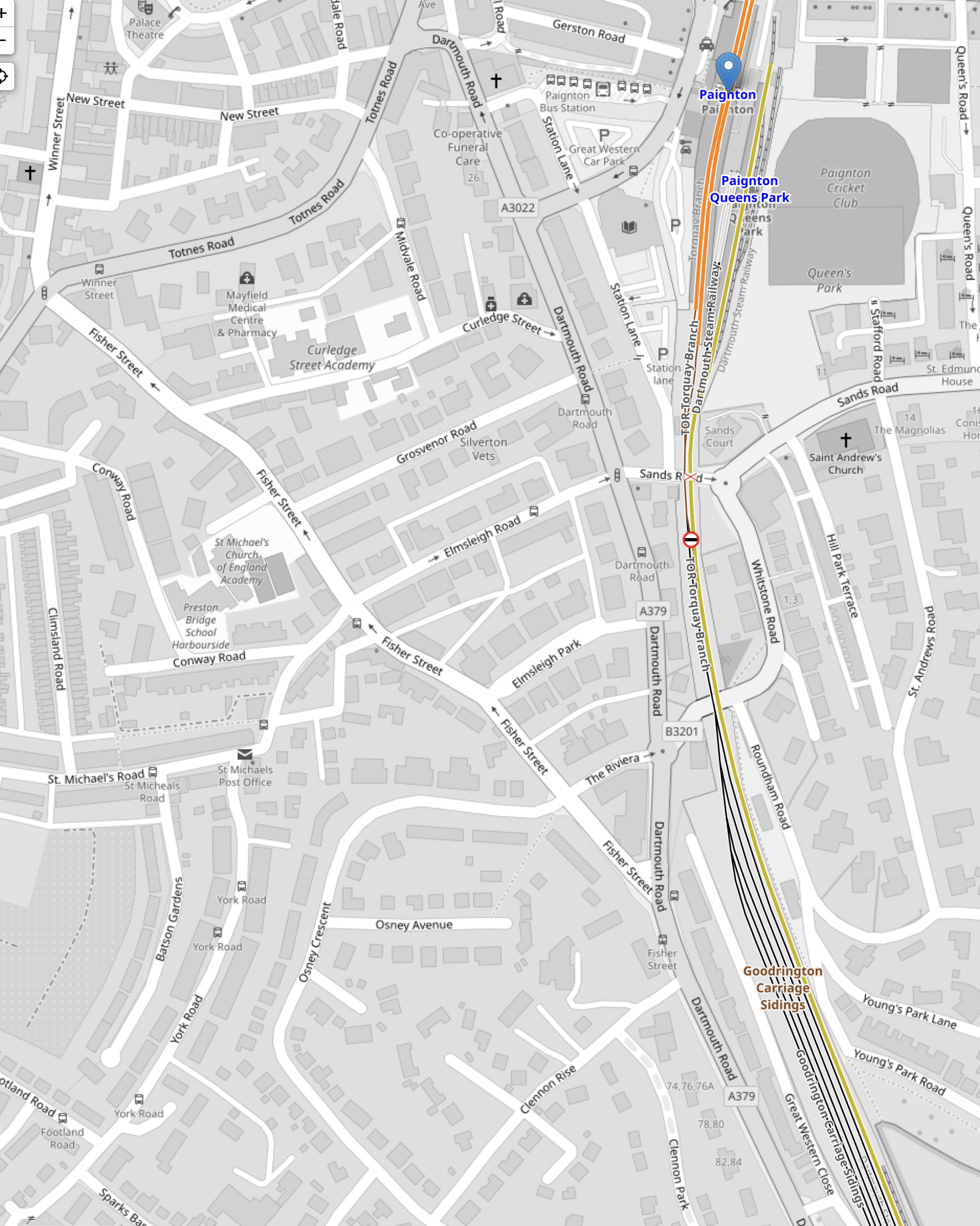
Note.
- Paignton station is marked by the blue arrow and writing at the top of the map.
- There are two platforms, one of which normally handles arrivals and the other departures.
- There are the Goodrington Carriage sidings to the South of the station.
I’m sure Hitachi will electrify some of the sidings, so that Lumo’s trains can leave Paignton with full batteries. But they only need enough charge to cover the 128.2 miles to Chippenham!
I have a few extra thoughts.
The Train’s Batteries Will Get Bigger
Hitachi must have access to the best battery chemistry, that the world and especially Japan can offer.
I feel very strongly, that the performance of Hitachi’s trains will get better, as the years progress.
Pairs Of Trains Could Be Used
I suspect all the stations that will be used by the service ; Paddington, Bath Spa, Bristol Temple Meads, Taunton, Exeter St David’s, Torquay and Paignton can handle a pair of five-car Hitachi trains on a busy day.
The Goodrington Carriage sidings at Paignton station would certainly appear to be long enough.
This could be useful.
An Early Bath
Consider.
- Currently, the fastest trains to Bath Spa take one hour and fourteen minutes from London Paddington.
- But the trains do make as many as three stops at Reading, Swindon and Chippenham, before they stop at Bath Spa.
- London Paddington and Bath Spa are 106.8 miles apart.
- The route is fully electrified between London Paddington and Chippenham.
This is an average speed of 86.6 mph.
Lumo will have two advantages
- They will be making Bath Spa the first stop.
- They will be able to maintain at least 100 mph for a large part of the route between London Paddington and Bath Spa, by the use of traction batteries, where there are no wires.
- To go between London Paddington and Bath Spa in an hour, requires an average speed of 106.8 mph
If they could average 100 mph, the time would be 66 minutes.
Bath Spa may not be an hour from Paddington, but it will be very close to it.
I would expect that a fast service to Bath could fill up with day-trippers.
How Long Will A Round Trip Take?
If I’m right that Lumo’s battery-electric high speed trains will be able to do one-way in three hours, then adding in half-an-hour to turn and charge the train at Paignton would suggest a six-an-a-half hour round trip.
How Many Trains Will Be Needed For A Full Service?
Lumo are talking of five round trips per day to Paignton and one to Highbridge & Burnham, so this would probably need two trains to run the service.
The Wikipedia entry for Highbridge & Burnham station says this.
A loop on the west side of the line south of the station can be used by goods trains in either direction, southbound trains crossing over to run wrong line through the northbound No.2 platform to do so. This crossing also allows terminating passenger trains from the north to reverse here if required.
Perhaps this loop will be used to allow one train to start from here in the morning and at the end of the day stable here overnight.
The loop could be electrified to make sure that the first train of the day gets to Chippenham.
Trains could follow a schedule like this.
- Train 1 – Leaves Highbridge & Burnham – 06:00
- Train 1 – Arrives London Paddington – 08:00
- Train 1 – Leaves London Paddington – 08:30
- Train 1 – Arrives Paignton – 11:30
- Train 1 – Leaves Paignton – 12:00
- Train 1 – Arrives London Paddington – 15:00
- Train 1 – Leaves London Paddington – 15:30
- Train 1 – Arrives Paignton – 18:30
- Train 1 – Leaves Paignton – 19:00
- Train 1 – Arrives London Paddington – 22:00
- Train 2 – Leaves London Paddington – 06:30
- Train 2 – Arrives Paignton – 09:30
- Train 2 – Leaves Paignton – 10:00
- Train 2 – Arrives London Paddington – 13:00
- Train 2 – Leaves London Paddington – 13:30
- Train 2 – Arrives Paignton – 16:30
- Train 2 – Leaves Paignton – 17:00
- Train 2 – Arrives London Paddington – 20:00
- Train 2 – Leaves London Paddington – 20:30
- Train 2 – Arrives Highbridge & Burnham – 22:30
Someone with more experience of writing timetables could make this work.
But it does appear to me, that using Highbridge & Burnham station for an early start and an overnight charge of one of the trains could mae the whole service work.
The Ultimate Open Access Service
London and Windermere are 223 miles away by train with a single change at Oxenholme Lake District.
In a straight line the distance between Amsterdam and Hamburg is 227 miles.
I’ve done both journeys by train and the continental journey was a pain.
- In From Amsterdam To Hamburg The Hard Way, I describe a typical journey between the two cities.
- In From Hamburg To Osnabruck By Train, I describe how I only got halfway.
I’ve also tried splitting the route at Groningen.
- The first leg was a train to Groningen, where I spent the night.
- I spent the second day exploring and wrote about my experiences in The Train Station At The Northern End Of The Netherlands.
- On the third day, I started by going between Groningen and Leer in Germany.
- This section of the route at present is under repair after a ship destroyed the swing bridge over the River Ems.
- I describe its rebuilding in From Groningen To Leer By Train.
Once at Leer, you’re on the German main line and the route is electrified all the way to Bremen and Hamburg.
I believe that the route would be within the scope of a battery-electric high speed train, such as both Hitachi and Siemens are developing.
Some thoughts on the route.
The Competition
The trains need a change at Osnabruck to go between Amsterdam and Hamburg.
I suspect many travellers fly, as there are thirty-nine flights per week.
The service could be better.
Why Would I Run It As An Open Access Route?
Consider.
- If what I have experienced on the current Amsterdam and Hamburg via Osnabruckservice, then surely an experienced open access operator using trains designed for the route could do much better.
- This service could be run almost as a shuttle between two terminal stations. Several open access services like Hull Trains, Lumo and Grand Central are run this way.
- If a government service fails, governments get the blame, but if an open access service fails, the government gets no blame.
So would some governments, prefer open access operators to take the risk?
Would Any New Infrastructure Be Needed?
Very little if any!
Although, I do feel, that some of the level crossings and bridges could be improved or removed.
Where Is The Route Not Electrified?
The section without electrification is at the Dutch end.
This OpenRailwayMap shows the lines around Groningen station.
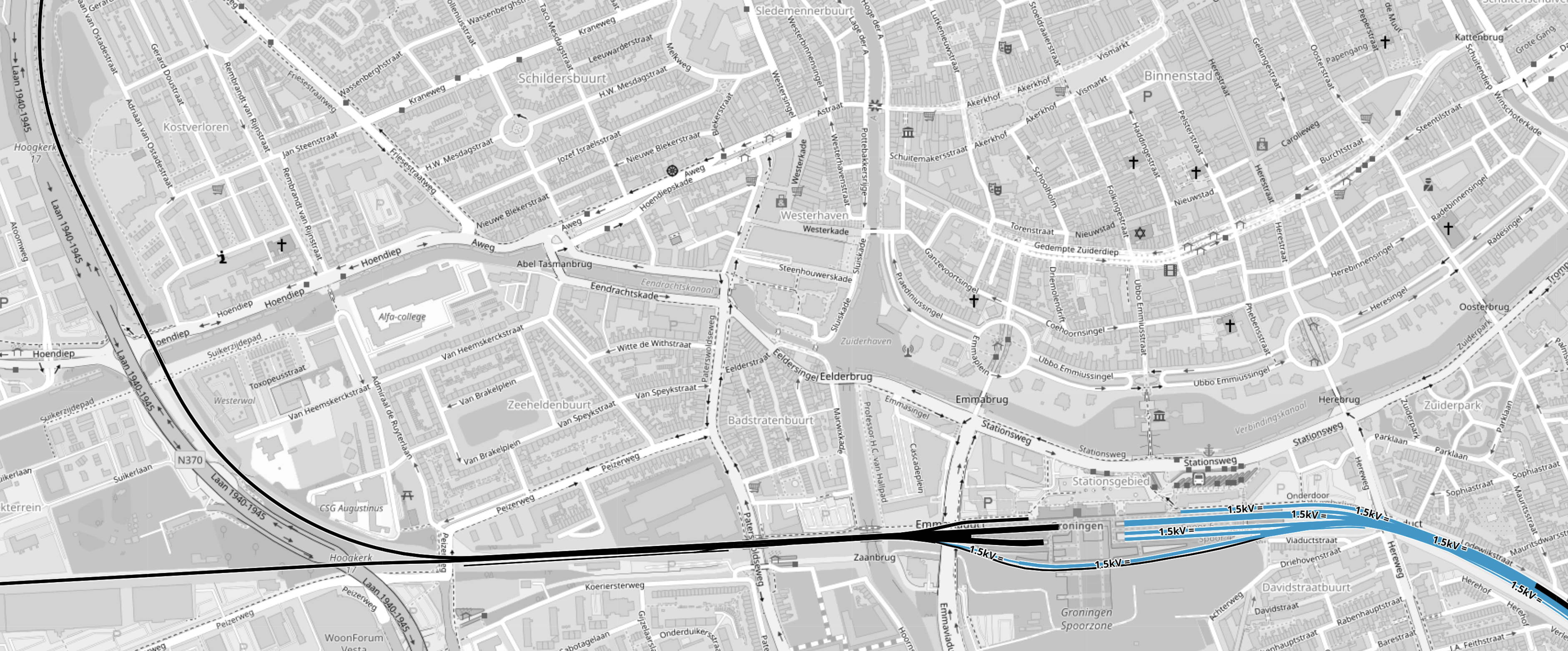
Note.
- Lines in black are not electrified.
- Lines in blue are electrified at 1.5 KVDC overhead.
- The mass of blue lines is Groningen station.
- Hamburg is to the East.
- Eemshaven us to the North.
- Harbinger is to the West.
Amsterdam trains use the electrified lines to the East.
This second OpenRailwayMap shows a wider view of the lines around Groningen.
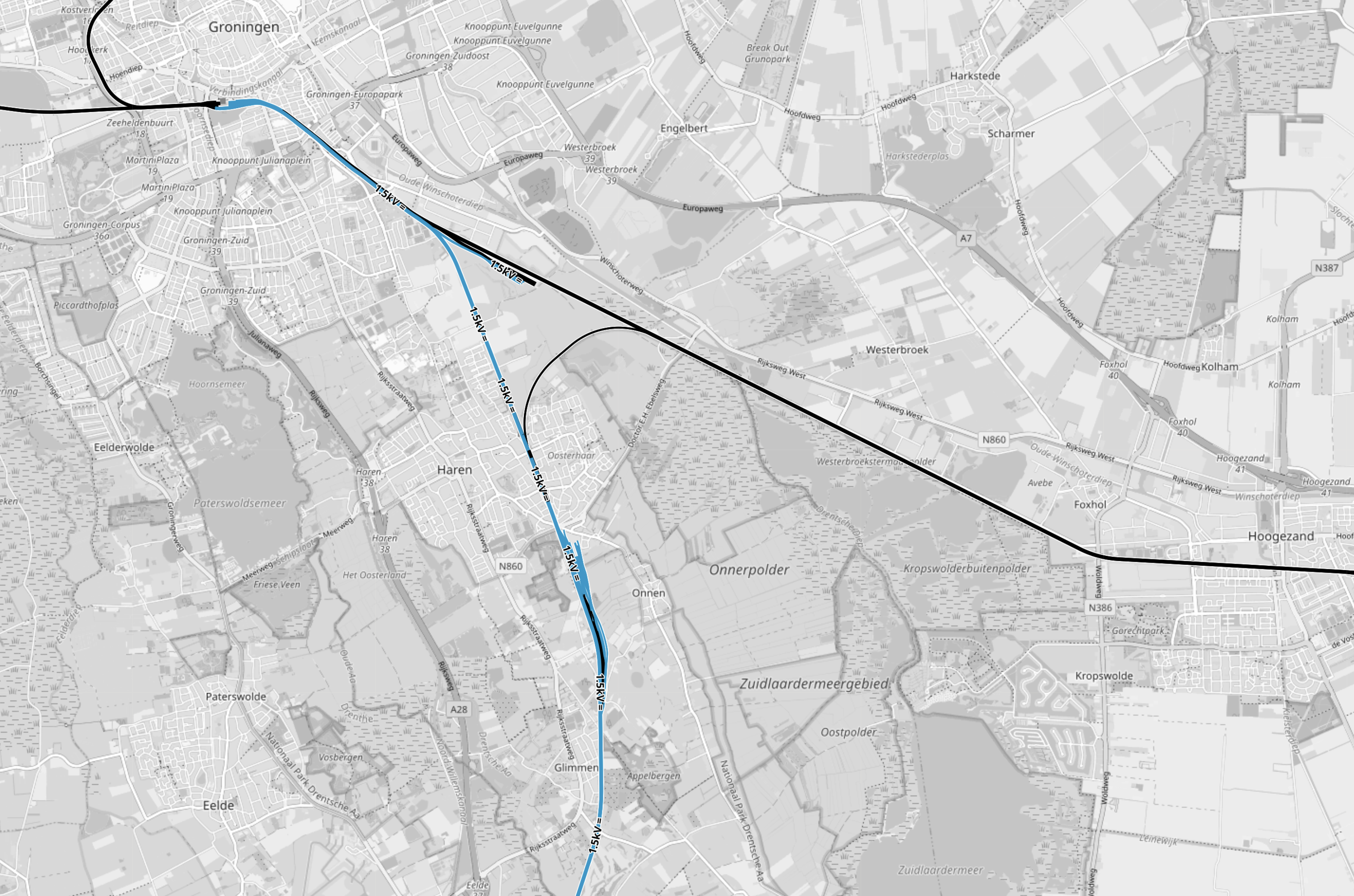
Note.
- Lines in black are not electrified.
- Lines in blue are electrified at 1.5 KVDC overhead.
- Groningen is in the North-West corner of the map.
- Trains between Groningen and Amsterdam use the electrified line to the South via Zwolle.
- Trains between Groningen and Bremen and Hamburg use the unelectrified line to the East.
- There is a single track chord, that would allow trains to go between Amsterdam and Germany.
I suspect that a battery-electric high speed train could be fully recharged before leaving Groningen for Germany.
This third OpenRailwayMap shows between the chord to the East of Groningen and the German railway system at Leer.
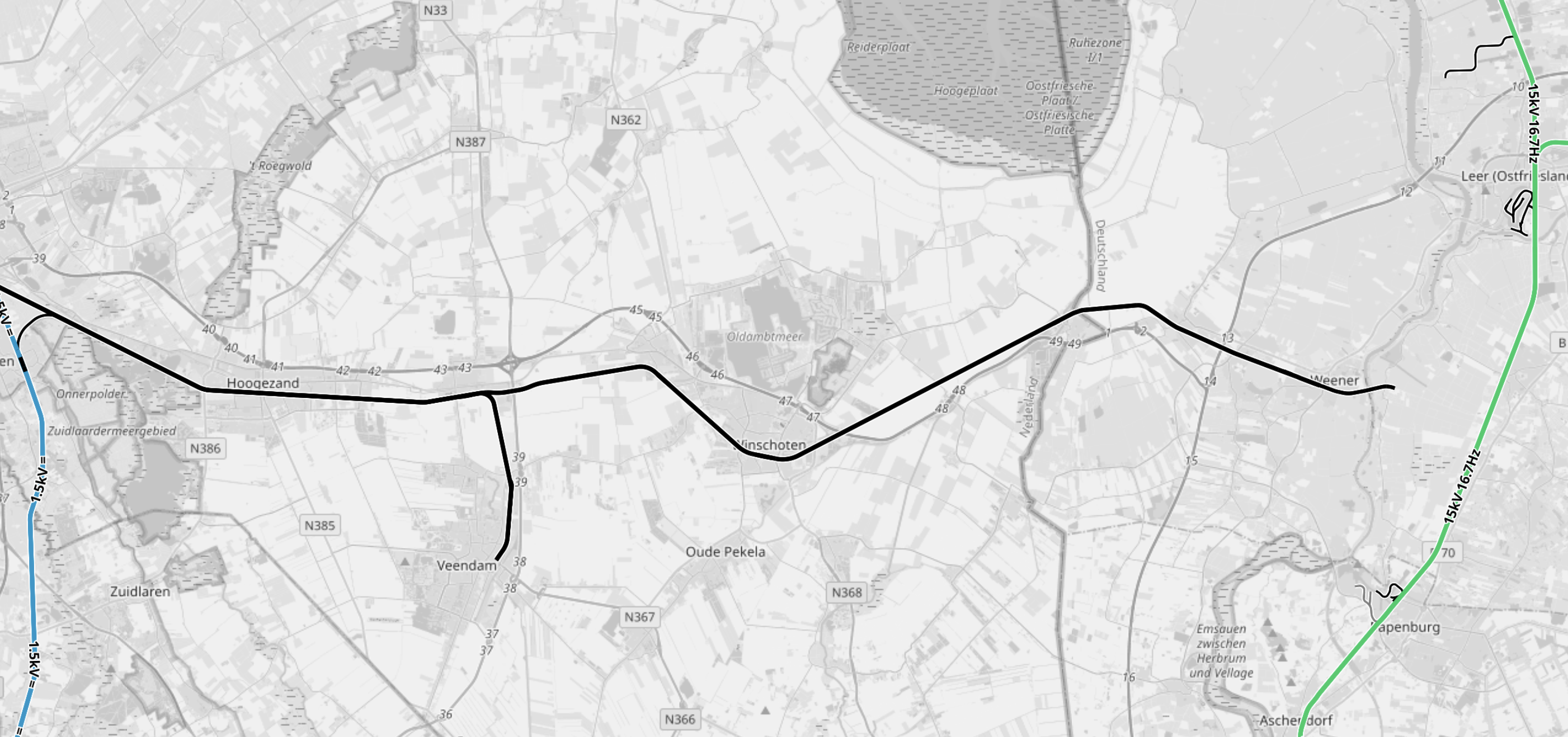
Note.
- Lines in black are not electrified.
- Lines in blue are electrified at 1.5 KVDC overhead.
- Lines in green are electrified at 15 KVAC overhead.
- Groningen is off the Western side of the map.
- The chord connecting the Amsterdam and German lines from Groningen can be picked out.
- The unelectrified line East from Groningen seems to end in the middle of nowhere.
- The green lines in the East of the map are the electrified German railway system.
- Leer station, which is indicated by the tangle of lines in the North-East cornet of the map, has services to Bremen and Hamburg.
This forth OpenRailwayMap shows the Dutch and German railways at Leer.
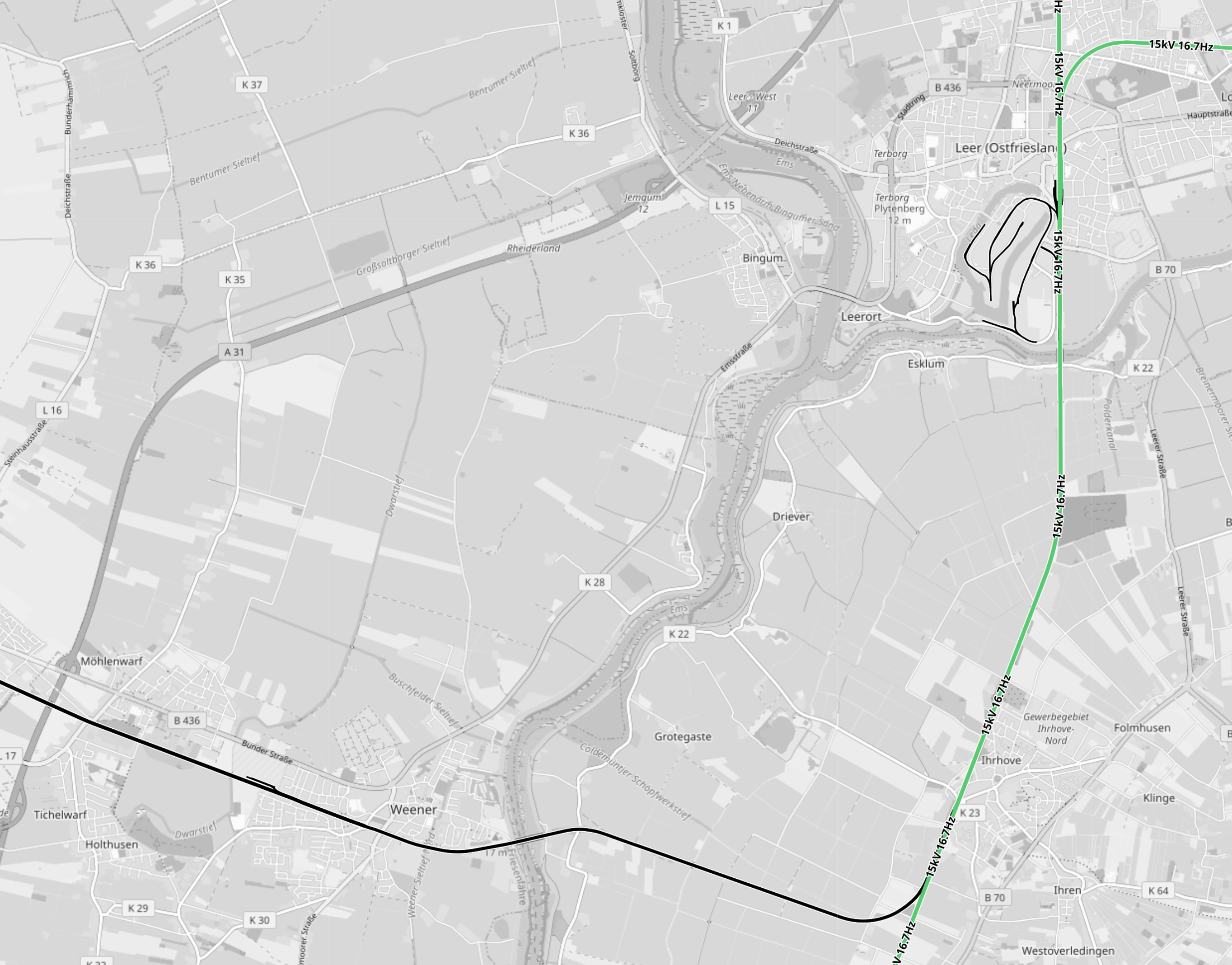
Note.
- Lines in black are not electrified.
- Lines in green are electrified at 15 KVAC overhead.
- Leer station is in the North-East corner of the map.
- The green lines in the East of the map are the electrified German railway system.
- The River Ems runs down the middle of the map.
The unelectrified line East from Groningen seems to link up with the German railway system.
It used to link up until a German freighter called the Emsmoon demolished the Freisenbrücke over the River Ems.
In From Groningen To Leer By Train, I link to two videos and give the history of the accident.
The Freisenbrücke should be rebuilt in the next few months.
It looks like less than fifty miles of the route between Groningen and Leer is not electrified.
As all the other sections of Amsterdam and Hamburg are electrified, a battery-electric train with a range of less than fifty miles would be needed,
But the train would need to be compatible with both the Dutch and German electrification systems.
What Mode Of Trains Would Be Needed?
Trains would need three methods of operation.
- Using 15 KVAC overhead.
- Using 1.5 KVDC overhead.
- On battery power.
Batteries would be charged using regenerative braking or overhead wires, where they exist.
Lumo’s recently ordered Hitachi trains will probably work the same way.
Conclusion
This could be an open access service that could work.
Could An Open Access Operator Develop A Train Service Along The South Coast of The UK Between Kent and Fishguard?
Before I go into detail, I will answer a question that explains the terminology and the why’s and wherefores’ of the title of this post.
What Is An Open Access Operator?
This is the first paragraph of the Wikipedia entry of an Open Access Operator.
In rail transport, an open-access operator is an operator that takes full commercial risk, running on infrastructure owned by a third party and buying paths on a chosen route and, in countries where rail services run under franchises, are not subject to franchising.
In the UK, these are all open access operators, that are running services.
Note.
- Other groups are developing services.
- Regional, High Speed, International, Local and Sleeper services seem to be offered by various open access operators.
- Grand Central is a subsidiary of Deutsche Bahn,
- Hull Trains and Lumo are both subsidiaries of FirstGroup.
Open Access operators seem to operate in most European Union countries.
Why Run Between Kent and Fishguard?
- The main purpose of the train service would be to provide a low-cost rail connection between the island of Ireland and particularly the Republic of Ireland, with the Southern part of England and the European Union.
- At both ends of the route the train service would connect to ferries.
- At the Eastern end, the train service would also connect to Eurostar services through the Channel Tunnel.
- The Port of Dover could be efficiently connected to Dover Priory Station.
- Dover Priory Station could be the Eastern terminus.
- The service could stop at Folkestone Central station, if ferries call at the Port of Folkestone in the future.
- The service could stop at Ashford International station for Eurostar services.
- Fishguard Harbour station has been built as a train terminus for the Port of Fishguard.
- Fishguard Harbour station could be the Western terminus.
This could be a busy service.
Where Would The Trains Call?
Intermediate stations would depend on passenger umbers, but could start as Folkestone Central, Ashford International, Hastings, Eastbourne, Brighton, Portsmouth & Southsea, Southampton Central, Romsey, Salisbury, Warminster, Westbury, Trowbridge, Bradford-on-Avon, Bath Spa, Bristol Temple Meads, Bristol Parkway, Newport, Cardiff Central, Gowerton, Llanelli and Carmarthen.
How Long Would The Journey Be?
The journey would be around 377 miles and I suspect could take about three and a half hours with modern digital signalling.
Surprisingly, the route is fully-electrified except for the following.
- Ashford International and Ore – 27.9 miles
- Southampton Central and Bristol Parkway – 82 miles
- Cardiff Central and Fishguard Harbour – 115.6 miles
All gaps should be able to be bridged using battery power.
I suspect trains would be Hitachi high speed battery-electric trains.
Would Any European Funding Be Available?
This is an interesting question, as the service does join up two separate sections of the European Union.
Fourteen New Trains To Drive First Rail Open Access Growth
The title of this post, is the same as that of this press release from First Group.
These four bullet points are sub-headings.
- The Group has signed an agreement with Angel Trains and Hitachi to lease 14 new five-car class 80X Hitachi electric, battery electric or bi-mode trains (70 cars in total) at a cost of c.£500m including maintenance, over a ten year lease period
- The trains will be manufactured by Hitachi in County Durham, securing the skills base and jobs in the local area
- The new trains will enable FirstGroup to significantly expand its open access portfolio and will be used on the newly announced London-Carmarthen route and to increase the number of cars on the existing Lumo and Hull Trains services
- The agreement also contains an option for FirstGroup to lease up to an additional 13 trains on the same terms if the Group’s open access applications are granted by the Office of Rail and Road (‘ORR’)
These first three paragraphs add a bit more detail.
Prime Minister Sir Keir Starmer is visiting Newton Aycliffe, County Durham, today to celebrate a significant agreement for the Hitachi factory which has secured an order to manufacture 70 new rail cars for FirstGroup’s growing open access business, creating certainty for the manufacturing skills base, and the factory’s future.
The Lease Agreement will deliver 14 new trains, which will not only give the Group a homogenous fleet across its open access operations, ensuring flexibility and reliability for customers, but also facilitates the Group’s strategic objective of materially increasing its open access capacity. Delivery of the new trains is expected to commence in late 2027. The lease will be financed by Angel Trains, adding to their portfolio of Hitachi assets. The trains will be maintained by Hitachi at their facilities around the country.
The trains will be used on the Group’s open access rail services, including the Carmarthen-London route announced on 5 December, and the existing Hull Trains and Lumo services on the East Coast Mainline.
Note.
- Does the presence of Keir Starmer indicate any approval for open access?
- Trains could be electric, battery electric or bi-mode.
- Bi-mode trains should only be purchased these days, if they are convertible to battery-electric trains. Hitachi’s can.
- Delivery is expected to commence in late 2027.
- The first fourteen trains will be deployed on the London to Carmarthen, Edinburgh and Hull routes.
This table shows the trains needed initially for each route.
- Carmarthen – Class 802 trains – 5 tpd – 5 trains – 75.3 miles unelectrified
- Edinburgh – Class 803 trains – 5 tpd – 5 trains – electrified
- Hull – Class 802 trains – 5 tpd – 5 trains – 44.3 miles unelectrified
Note.
- tpd is trains per day.
- I’m assuming that as unelectrified distances to Carmarthen and Hull are not that far apart, the number of trains needed is the same.
- Class 802 trains are bi-mode.
- Class 803 trains are electric.
After the fourteen new trains are delivered, there will be a combined fleet of 29 trains.
Consider.
- Hull Trains have started running some services as pairs of trains. I wrote about this in Ten-Car Hull Trains.
- Lumo has been a success and perhaps needs more capacity.
The Wikipedia entry for Grand Union says this.
Grand Union proposed to operate with ex-LNER Class 91s and Rail Operations Group Class 93s hauling nine-car Mark 4s and a Driving Van Trailer.
So perhaps the Carmarthen service needs ten-car trains.
That would mean that the number of routes needed for the three routes would be as follows.
- Carmarthen – Class 802 trains – 5 tpd -10 trains
- Edinburgh – Class 803 trains – 5 tpd -10 trains
- Hull – Class 802 trains – 7 tpd – 10 trains
It would appear that we’re a train short with 29 in the combined fleet against a need of 30 trains.
But then it would also appear that Hull Trains can provide the required five/ten car service with only four trains.
I would assume that the extra train, goes to make up the numbers for Lumo’s Carmarthen service.

