Rail Agreement Signed ‘Subject To Value For Money’
The title of this post, is the same as that of this article on the BBC.
This is the sub heading.
An agreement to reopen a regional rail line has been signed by the transport secretary, subject to the assurance that it delivers good value for money.
These three paragraphs add detail to the story.
Further development work on the Leamside Line, which runs from Pelaw in Gateshead to Tursdale in County Durham, is set to progress as part of the Northern Powerhouse Rail (NPR) initiative.
Regional politicians said the line could provide train links for 100,000 people in the north-east of England, after it closed to passengers in the 1960s.
The document stated the government would ensure resources were available for the Leamside Line reopening “subject to agreement of that business case and assurance that this delivers good value for money”.
Note.
- There is an excellent map in the BBC article.
- It looks like there will be at least five new or refurbished stations at Ferryhill, Sincliffe, Belmont, West Rainton and Penshaw.
- Belmont appears to have an alternative name of Durham Parkway, so will it be a Park-and-Ride for the area?
- There will be an alternative path for freight trains between Newcastle and York.
- In New Direct Rail Link To Seaham: How This Picturesque Seaside Town Will Connect To London Starting December 2025, I described Seaham’s new link to London, courtesy of Grand Central Trains.
- In Arriva Group Invests In New Battery Hybrid Train Fleet In Boost To UK Rail Industry, I talked about Grand Central’s new trains, which should be in service by 2028 to Seaham and Sunderland.
- It was in June 2020, that I wrote about Boris Johnson making a speech about the Leamside Line in Boris Johnson Backs Station Opening Which Could See Metro Link To County Durham.
This important link has been a long time coming.
Will The Rail Improvements Between London and The North East Create More Tourism?
Consider.
- The digital signalling will create more paths for trains between London and the North East.
- Journey times will come down to generally below three hours.
- There is a lot of excellent walking in the area.
- The North-East doesn’t just host top-class football and athletics.
- A trip could be combined with a day-trip to Edinburgh, Glasgow or the Scottish Borders.
- I have met Americans, who’ve started their holiday in Europe, in Edinburgh and worked their way down via York and London to Paris by train, and then flown back non-stop to the United States.
As I’ve spent a couple of enjoyable weekends in Newcastle and Sunderland, I don’t see why the area can’t attract tourists.
Should The East Coast Main Line Be Renamed?
Consider.
- It is one of the oldest long-distance main lines in the world.
- It links two of the UK’s capitals.
- It is 331 miles long, which is covered in four and a half hours.
- There are some of the world’s best hotels at either end.
- There is good shopping at either end.
- There is no Trump hotel in London or Edinburgh.
Perhaps, it should be called High Speed East Coast?
An Interesting Comment From Lord Peter Hendy
This article on Modern Railways is entitled Chiltern FINALLY Signs Mk 5 Deal.
This extract from the article describes the deal.
An agreement for Chiltern Railways to lease the Mk 5A coaches previously operated by TransPennine Express and owned by Beacon Rail Leasing has been signed – and the trains are due to replace the current Mk 3 stock in phases from 2026. A 10-year lease has been agreed for the vehicles.
Chiltern will take on all 13 five-car sets as well as the spare Driving Trailer and the dedicated pool of 14 Class 68 locomotives.
The article also, has this excellent quote from Lord Peter Hendy, who is the Rail Minister at the end.
This government is putting passengers back at the heart of the 21st century railway by investing to make journeys easier, greener, and more comfortable.
“We are continuing to support Chiltern as they develop a plan to introduce additional services into their timetable, giving people more opportunities to work, live, and socialise.
I agree with much of what Lord Peter Hendy says, but could we see some actions to back up the words.
I have a few thoughts.
Lumo To Glasgow
I wrote about this new service in Lumo Will Extend Its King’s Cross And Edinburgh Service To Glasgow.
Given the opposition of the Transport Minister to open access services, I didn’t think this innovative service would be approved.
- But it does add an affordable passenger-friendly service to London and Glasgow routes.
- It will certainly be an easier route to London for some in Scotland.
- It also adds some much-needed direct services between Newcastle and Glasgow.
Did Lord Peter Hendy have words to help Lumo get its approval?
As I wrote in Could London And Central Scotland Air Passengers Be Persuaded To Use The Trains?, I also believe that this new Lumo service could persuade more air passengers to take the train to Scotland.
Lumo To Stirling
I wrote about this service in ORR: Open Access Services Given Green Light Between London And Stirling.
- First Group has taken over Grand Union Trains and the service will now be run by Lumo, who will use diesel Class 222 trains.
- But Lumo will have the option of running their electric Class 803 trains on the route, as it is fully electrified, when their fleet receives more trains.
This was another service, that I didn’t think would be approved, as no other services on the West Coast Main Line were approved, as Network Rail objected.
But it certainly meets the words in Lord Peter Hendy’s statement.
Like Lumo’s service to Glasgow, when the Stirling service gets electric trains, it will surely cut carbon emissions of travellers to Central Scotland.
Chiltern’s Replacement Trains
Chiltern Railways are replacing this fleet of locomotive hauled trains.
- 8 Class 68 locomotives
- 25 Mark 3 coaches
- 6 Driving Van Trailers
As services between London Marylebone and Birmingham Moor Street stations consist of one locomotive, five coaches and one driving van trailer, that means there are two spare locomotives, one spare coach and one spare driving van trailer, if there are five rakes of coaches in service.
The new fleet will be.
- 14 Class 68 locomotives
- 52 Mark 5A coaches
- 14 Driving Van Trailers
If services between London Marylebone and Birmingham Moor Street stations consist of one locomotive, four coaches and one driving van trailer, that means there are one spare locomotive and one spare driving van trailer, which gives a possible thirteen rakes of coaches in service.
There are certainly enough to expand Chiltern’s services. The obvious destination would surely be Oxford. These pictures show the two North-pacing platforms at Oxford station.








The platforms would be shared with East-West Rail, but they are around 160 metres in length.
The Modern Railways article quote Arriva Group Managing Director UK Trains Amanda Furlong as saying this.
Upgrading our fleet is a vital next step in Chiltern’s modernisation plans and an important part of Arriva’s wider ambition to support the transition to more sustainable rail travel across the UK and Europe.
We are proud to support this important milestone for Chiltern Railways, which is a great example of what can be achieved through strong collaboration with Government to deliver practical improvements for passengers. We look forward to seeing these upgraded trains improve journeys and lower emissions across the network.
She certainly would agree on some issues with Lord Peter Hendy.
So will Chiltern Railways do something to reduce the carbon footprint of their fourteen Class 68 locomotives?
- The Class 68 locomotives don’t have too many miles on the clock.
- Chiltern have already run some their Class 68 locomotives on HVO, so this must be a possibility.
- In total there are thirty-four Class 68 locomotives in service all of which have Caterpillar engines, so a conversion to zero-carbon power could be worthwhile.
I asked Google for an AI Overview on How many diesel locomotives have caterpillar engines worldwide? I got this answer.
While a precise worldwide count of diesel locomotives powered by Caterpillar (CAT) engines is difficult to pinpoint, it’s estimated that hundreds, if not thousands, of locomotives are equipped with CAT engines. Caterpillar has a long history of supplying engines to the rail industry, with engines like the 3500 series powering both mainline and switcher locomotives. Additionally, CAT engines are also used in generator sets for Head End Power (HEP) in passenger locomotives.
Note.
- It appears that, Caterpillar might have given up making truck engines because of emission issues.
- London Marylebone and Oxford is 66.8 miles
- London Marylebone and Birmingham Snow Hill is 112.3 miles.
Perhaps one of the consultants like Ricardo could convert these locomotives to run on hydrogen.
Could East Midlands Railway Run A St. Pancras And Leeds Service?
East Midlands Railway’s new Class 810 trains have been designed, so that a pair will fit into one platform at St. Pancras.
If we assume one platform at St. Pancras is used for the Corby and Luton Airport Express services, that leaves three platforms for pairs of Class 810 trains to run expresses to the East Midlands.
This could be as many as twelve pairs of five-car trains per hour.
Where wioll they all terminate in the North?
Leeds station must be the obvious new destination.
- Leeds has the largest population and is the largest commercial and finance centre in Yorkshire and the North-East.
- Leeds would have gained three trains per hour (tph) from London, two tph from Birmingham and four tph from the East Midlands Hub at Nottinham.
- Leeds is getting a brand new metro.
- Leeds is a fully-electrified station, so it could charge the trains before they return to Sheffield, Leicester, Wigston junction and St. Pancras.
- Leeds and Wigston junction is 107.8 miles, which should be within the range of a battery-electric Class 810 train. If it is too far, an extended stop could be taken at Sheffield to top up the batteries.
- Note that Stadler hold the Guinness World Record for the greatest distance covered on one charge at 139 miles. Hitachi Rail, who are partnered with JCB’s battery-maker in Sunderland, should be able to smash that.
The Rail Minister; Lord Peter Hendy went to Leeds University.
Which Route Would The Trains Take Between Sheffield And Leeds?
Consider.
- The fastest trains between Sheffield and Leeds, go via Meadowhall, Barnsley and Wakefield Kirkgate stations.
- Trains take about an hour.
- The current frequency is two tph.
- The distance is 41.1 miles with no electrification.
A frequency of two additional tph between St. Pancras and Leeds would give the following.
- A nice round four tph between Yorkshire’s two most important cities.
- Four fast tph between Meadowhall, Barnsley and Wakefield Kirkgate stations, and Leeds and Sheffield.
- Two direct trains between Meadowhall, Barnsley and Wakefield Kirkgate, and Chesterfield, Derby, Long Eaton, East Midlands Parkway, Loughborough, Leicester and St. Pancras.
It would be complimentary to any Leeds Metro.
Could East Midlands Railways Also Serve Huddersfield?
Consider.
- Huddersfield is 36.4 miles further than Sheffield on the Penistone Line, which is not electrified.
- Wigston junctionand Huddersfield station is 105.3 miles.
- Huddersfield is a Grade I Listed station with two pubs in the middle of the town.
- Huddersfield station is being fully-electrified in connection with the TransPennine Upgrade.
- All trains from Sheffield, that use the Penistone Line terminate in Platform 2 at Huddersfield station.
This OpenRailwayMap shows the position of Platform 2 in the station.
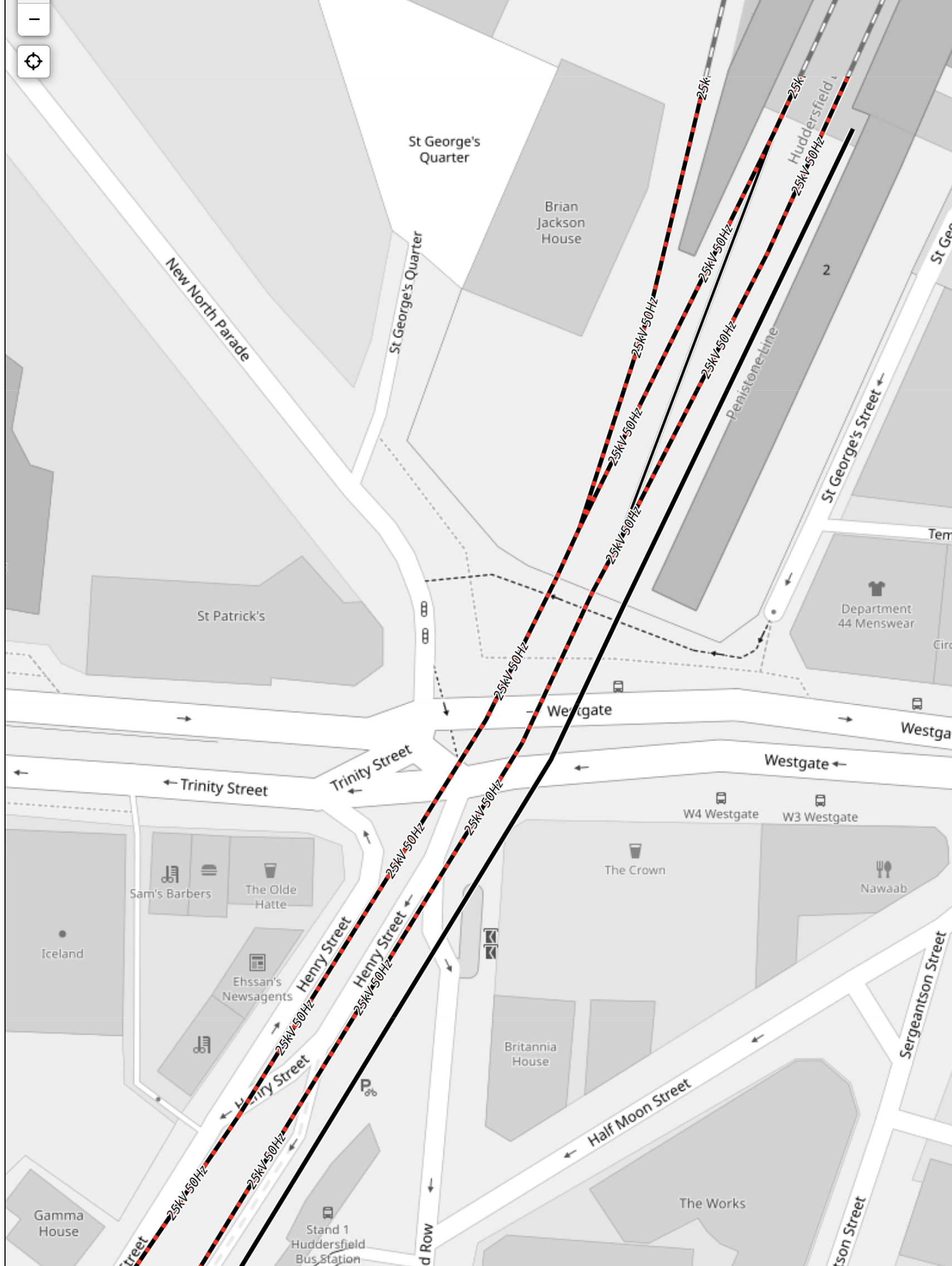
Note.
- The red-and-black dotted tracks are being electrified.
- The black tracks are not going to be electrified.
- Platform 2 is marked 2 in the top-right corner of the map.
- Platform 2 looks to be about 90 metres long.
- Five-car Class 810 trains are 120 metres long.
- From the map, it looks like the platform could be lengthened by the required thirty metres.
I suspect that some form of charger can be squeezed into the available space. After all, you don’t often get the chance to put charging into one of the most grand stations in Europe. Power supply would not be a problem, because of the electrification.
A frequency of twotph between St. Pancras and Huddersfield would give the following.
- Two fast tph between Meadowhall, and Barnsley, and Huddersfield and Sheffield.
- Two extra direct trains between Meadowhall and Barnsley, and Chesterfield, Derby, Long Eaton, East Midlands Parkway, Loughborough, Leicester and St. Pancras.
It would connect many stations to the TransPennine Route at Huddersfield station.
What Could The Sheffield and St. Pancras Look Like?
Consider that currently.
- There are two tph.
- Trains stop at Leicester, Loughborough (1tph), East Midlands Parkway (1tph), Long Eaton (1tph), Derby and Chesterfield.
- Trains are five- or seven-cars.
The simplest solution would probably be.
- A pair of five-car trains run all services.
- Trains split and join at Sheffield with one train going to Leeds and one going to Huddersfield.
I estimate that the Class 810 trains will offer about thirty more seats in every hour.
Jurgen Maier To Chair Great British Energy
This article in The Times is entitled Pylons Are The Price Of Lower Bills, Keir Starmer Tells Rural Britain.
These are two paragraphs from the article.
Starmer confirmed that Jürgen Maier, the former UK chief executive of the Siemens conglomerate, would chair the energy company.
Maier has advised Labour on rail and transport since December. He was openly critical of the party’s decision to drop a pledge to spend £28 billion a year on green investment, saying the figure was an “absolute minimum” and that scrapping the promise was “not good for climate change or for the growth of our economy”.
Note.
- His Wikipedia entry is impressive.
- He has dual Austrian and British citizenship.
- He went to school in Leeds and is a graduate of Nottingham Trent University.
- He rose to be Chief Executive of Siemens UK and retired in 2019 at 55.
- I have heard him several times on the radio and he seems to talk a lot of sense.
In my view he could be an excellent choice as Chair of Great British Energy.
I also have some further thoughts.
Jürgen Maier And Peter Hendy
Jürgen Maier and Peter Hendy, who is Starmer’s Rail Minister, have remarkably similar backgrounds and I wouldn’t be surprised if they know each other well, through dealings around Siemens’ contract for Transport for London’s new trains for the Piccadilly Line.
When last, were two technological heavyweights, so close to the heart of a UK government?
RWE
German energy company; RWE are the UK’s largest power generator.
- RWE have five gas-fired power stations with a total output of 6.56 GW.
- RWE have two onshore wind farms in operation with a total output of 67 MW.
- RWE have four offshore wind farms in operation with a total output of 1.88 GW.
- RWE have eight offshore wind farms under development with a total output of 9.90 GW.
- RWE also has other electrical gubbins, like an electrolyser in South Wales.
Would Jürgen Maier be an ideal person, to persuade RWE to keep investing in the UK?
When he was with Siemens, he certainly invested heavily in the UK.
The German Problem
Germany’s problem is how they generate electricity.
Sources are as follows for Germany and the UK.
- Coal – 26 % – 1 %
- Natural Gas – 10.5 % – 32 %
- Wind – 32 % – 29.4 %
- Solar 12.2 % – 4.9 %
- Biomass – 9.7 % – 12.3 %
- Nuclear – 1.5 % – 14.2 %
- Hydro – 4.5 % – 1.8 %
- Oil – 0.7 % – 0 %
- Other – 2.9 % – 0 %
- Storage – 0 % – 1 %
- Imports – 0 % – 10.7 %
Note.
- Figures are for 2023.
- Germany is the first percentage.
- UK is the second percentage.
- Germany has pledged to end coal-fired electricity production by 2030.
- Both countries seem to generate similar amounts of electricity from wind, biomass and hydro.
To replace the coal and make up for lack of nuclear, Germany needs to find a new power source.
The German Solution
The Germans are going for hydrogen in a big way.
The title of this page of the RWE web site is Welcome To The Age Of Hydrogen.
The page starts with this paragraph.
RWE is actively involved in the development of innovative hydrogen projects. The H2 molecule is considered to be an important future building block of a successful energy transition. RWE is a partner in over 30 H2 projects and is working on solutions for decarbonising the industry with associations and corporations like Shell, BASF and OGE. Hydrogen projects are comprehensively supported in the separate Hydrogen department of the subsidiary RWE Generation.
I also suggest, that you read this page on the RWE web site called AquaVentus.
The page starts with this RWE graphic.
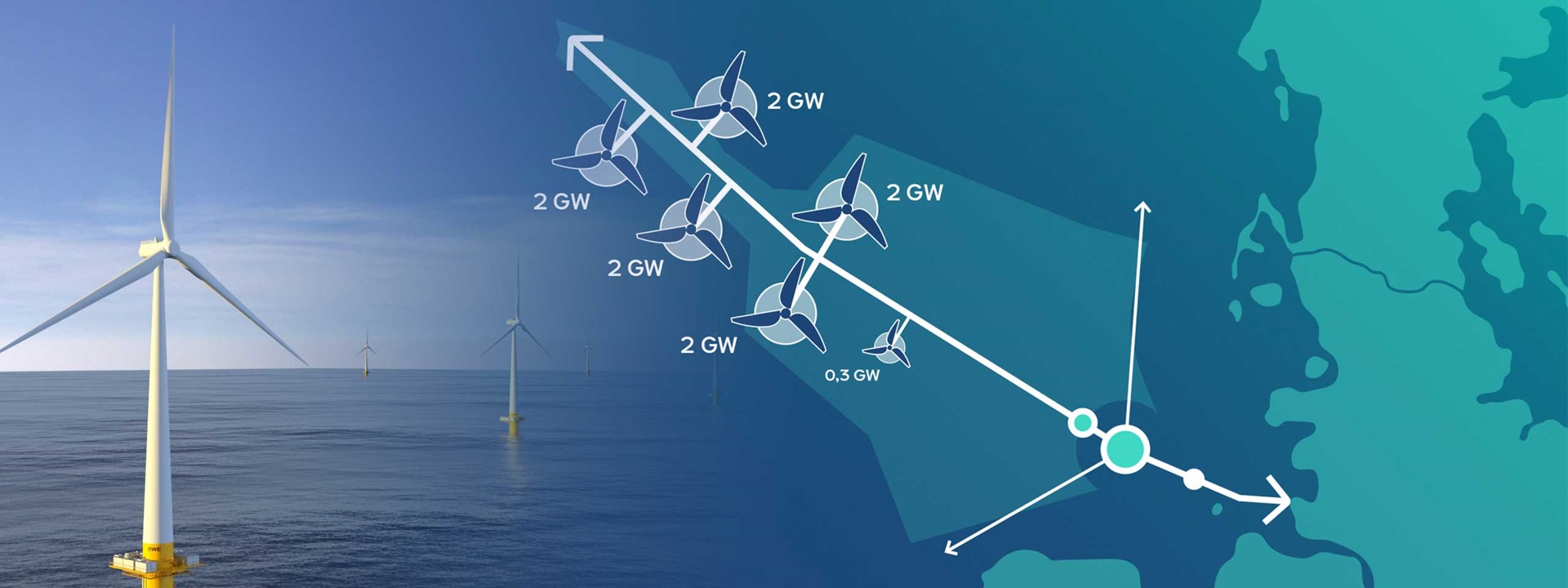
It appears that 10.3 GW of hydrogen will be created by wind farms and piped to North-West Germany.
These two paragraphs outline the AquaVentus initiative .
Hydrogen is considered the great hope of decarbonisation in all sectors that cannot be electrified, e.g. industrial manufacturing, aviation and shipping. Massive investments in the expansion of renewable energy are needed to enable carbon-neutral hydrogen production. After all, wind, solar and hydroelectric power form the basis of climate-friendly hydrogen.
In its quest for climate-friendly hydrogen production, the AquaVentus initiative has set its sights on one renewable energy generation technology: offshore wind. The initiative aims to use electricity from offshore wind farms to operate electrolysers also installed at sea on an industrial scale. Plans envisage setting up electrolysis units in the North Sea with a total capacity of 10 gigawatts, enough to produce 1 million metric tons of green hydrogen.
The page also gives these numbers.
- Total Capacity – 10 GW
- Tonnes Of Green Hydrogen – 1 million
- Members – 100 +
The web site says this about commissioning.
Commissioning is currently scheduled for early/mid 2030s.
The Germans can’t be accused of lacking ambition.
AquaVentus And The UK
This video shows the structure of AquaVentus.
I clipped this map from the video.

Note.
- There is a link to Denmark.
- There appears to be a undeveloped link to Norway.
- There appears to be a link to Peterhead in Scotland.
- There appears to be a link to just North of the Humber in England.
- Just North of the Humber are the two massive gas storage sites of Aldbrough owned by SSE and Brough owned by Centrica.
- There appear to be small ships sailing up and down the East Coast of the UK. Are these small coastal tankers distributing the hydrogen to where it is needed?
In the last century, the oil industry, built a substantial oil and gas network in the North Sea. It appears now the Germans are leading the building of a substantial hydrogen network.
AquaVentus And Aldbrough And Rough Gas Storage
Consider.
- In The Massive Hydrogen Project, That Appears To Be Under The Radar, I describe the Aldbrough Gas Storage.
- In Wood To Optimise Hydrogen Storage For Centrica’s Rough Field, I describe Centrica’s plans to turn Rough Gas Storage into the world’s largest hydrogen store.
- There is a small amount of hydrogen storage at Wilhelmshaven.
It looks like the East Riding Hydrogen Bank, will be playing a large part in ensuring the continuity and reliability of AquaVentus.
Dogger Bank South And AquaVentus
This Google Map shows the North Sea South of Sunderland and the Danish/German border.
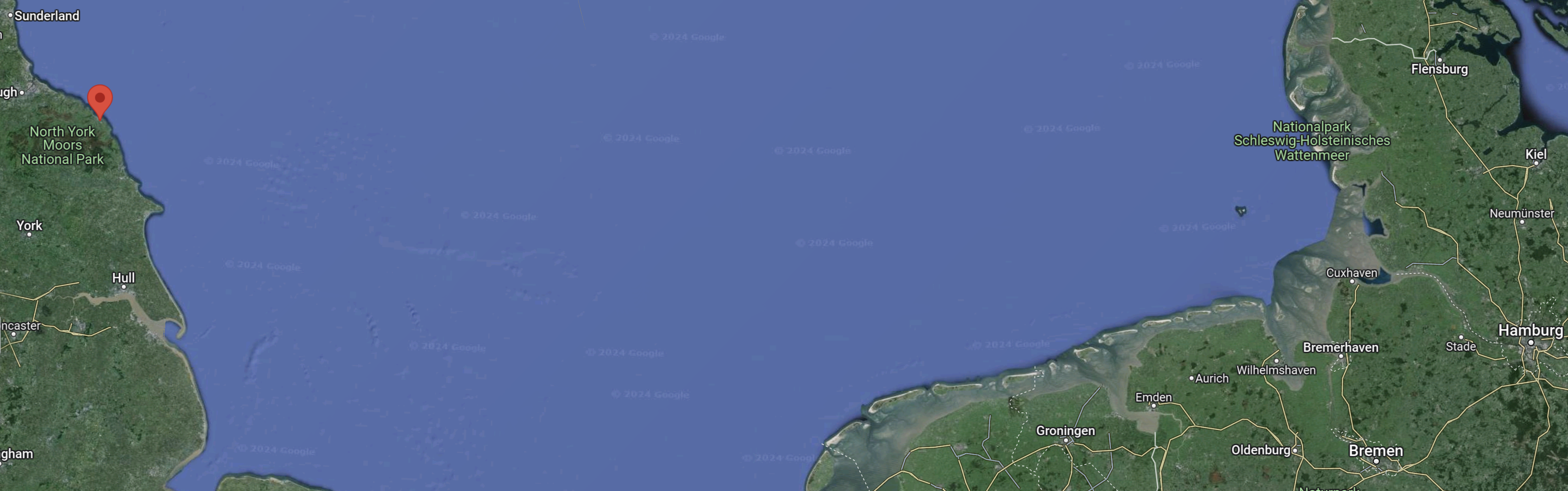
Note.
- Sunderland is in the top-left hand corner of the map.
- A white line in the top-right corner of the map is the Danish/German border.
- Hamburg and Bremen are in the bottom-right hand corner of the map.
If you lay the AquaVentus map over this map, I believe that RWE’s Dogger Bank South wind farm could be one of the three 2 GW wind farms on the South-Western side of the AquaVentus main pipeline.
- Two GW would be converted to hydrogen and fed into the AquaVentus main pipeline.
- Two GW of hydrogen will be a nice little earner for UK plc.
- One GW of electricity would be sent to the UK.
But this is only one of many possibilities.
Conclusion
Could Jürgen Maier, be the man to develop British links to AquaVentus for the benefit of both the UK and Germany?
- The UK’s wind farms could provide a lot of hydrogen for AquaVentus.
- Aldbrough And Rough Gas Storage are conveniently places to add the hydrogen storage, that AquaVentus needs.
- AquaVentus can certainly be expanded to Norway, and possibly Orkney and Shetland.
He certainly has a lot of relevant experience.
HS2 Manchester Route Not Sold Off Yet As Labour Weighs Up Rail Options
The title of this post, is the same as that of this article on i.
This is the sub-heading.
The Government has a looming dilemma with climbing costs and pressure from supporters to bring back the Birmingham to Manchester line
These first three paragraphs explain the problems.
Labour faces a £500m decision on what to do with HS2 land which was not sold despite promises by Rishi Sunak, as Sir Keir Starmer braces for new calls to resurrect the cancelled Birmingham to Manchester line.
The £50bn rail line is likely to cause the new Labour government a headache as supporters push for the party to support the project which was initially launched by former Prime Minister Gordon Brown in 2009.
Within Whitehall, civil servants are currently thought to be calculating the value for money of Mr Sunak’s HS2 plan in comparison to the previous HS2 plan to Manchester, with the result expected to favour the longer route.
These are my thoughts.
The Appointment Of Lord Peter Hendy As Rail Minister
Two of the more unusual ministerial appointments by Sir Keir Starmer were the appointment of James Timpson as Minister of State for Prisons, Parole and Probatio, and Lord Peter Hendy as Minister of State in the Department of Transport.
But if you read their Wikipedia entries, they both have great knowledge of the area to where they have been appointed.
This picking of Ministers outside of elected MPs has happened before, with the most recent being Rishi Sunak’s appointment of David Cameron as Foreign Secretary.
This is a paragraph from the article in the i, gives some views about Lord Hendy and High Speed Two.
The appointment of Lord Peter Hendy as rail minister has been received positively by many supporters of the high speed rail line, given his previous work around the project and Euston’s redevelopment, where he pushed for a more ambitious project. One industry source told i that Lord Hendy was “one of the most respected figures in the UK rail industry”, and a “definite supporter of HS2 to Manchester”.
As the current Chairman of Network Rail, I suspect Lord Hendy has had endless thoughts on how he can get High Speed Two to Manchester, within an acceptable budget.
I also believe that since being appointed to be Chairman of Network Rail, the performance of that company has improved.
Has Lord Hendy improved the quality of the workforce or imposed better top down project management?
The Euston Station Problem
The article in the i has several paragraphs on the Euston station problem.
Lord Hendy has probably, the best directory of contacts of property developers, architects and engineers in the UK and with his background of economics, he probably know how to sort the wheat from the dross.
So could Lord Hendy somehow conjure a solution for Euston station out of the speculation?
I wonder if he could find someone to develop a multi-billion commercial complex over the station, that this could generate the cash to pay for Birmingham and Manchester section of High Speed Two.
Like Baldrick, I suspect Lord Hendy could have a cunning plan, but based on sound economic sense.
For instance, I believe, that the best way to serve Leeds by High Speed Two could be via Manchester.
- Leeds would have a choice of routes from London; King’s Cross and Euston.
- It could possibly have three, if St. Pancras and Leeds via Derby and Sheffield were to be improved.
- Birmingham and Leeds services would be greatly improved if High Speed Two to Leeds, went via Manchester.
I would suspect every idea will be on the table.
UK And Welsh Governments To Explore New Rail Links Between South Wales And England
The title of this post, is the same as that of this press release from the UK Government.
These are the three bullet points.
- UK and Welsh governments today (2 February 2023) announce a new study to improve transport connectivity between south-east Wales and west of England
- the study, backed by £2.7 million of UK government funding, will look at options for new railway stations and rail services on the South Wales Main Line
- this project will focus on relieving congestion on the M4, a vital connector between south Wales and the rest of the UK
The stations are not named, but it is said that they could be between Cardiff and the Severn Tunnel.
The last paragraph changes direction a bit.
Lord Peter Hendy also proposed reviewing the route connecting north Wales to the north-west of England, better connectivity with HS2 and a package of railway improvements to increase connectivity and reduce journey times between Cardiff, Birmingham and beyond.
I find this development very interesting, but typical of the sensible approach one would expect from Lord Peter.
In Could High Speed Two Serve Holyhead?, I looked at the route and came to this conclusion.
London Euston and Holyhead could be a serious proposition.
With some development and a new fast ferry, it could also open up a practical zero-carbon route between Great Britain and Ireland.
Times of four and a half hours between London Euston and Dublin could be possible.
I suspect that time would appeal to green tourists, especially those in First with a good meal.
Nuggets From The Union Connectivity Review
The Union Connectivity Review has now been published and it can be read online.
This paragraph outlines the objective of the Review.
The UK Government asked Sir Peter Hendy CBE to undertake a detailed review into how transport connectivity across the UK can support economic growth and quality of life in England, Scotland, Wales and Northern Ireland.
Sir Peter was also asked to make recommendations as to whether and how best to improve transport connectivity between the nations of the UK.
Sir Peter Hendy is the Chairman of Network Rail.
In no particular order, these are some nuggets from the review.
The Case For UKNET – A Strategic Transport Network For The Whole United Kingdom
This paragraph introduces the case for UKNET.
Having identified the importance of good connections across internal borders and the challenges that currently prevent a pan-UK strategic vision or investment strategy, the Review recommends that the UK Government develop UKNET – a strategic transport network for the whole United Kingdom which would connect all the nations of the
UK, with appropriate funding and coordination with the devolved administrations to deliver it.
The creation only follows best practice from the European Union and large countries like the United States.
These three paragraphs sum up how UKNET would work and how it would bring benefits to the whole of the UK.
UKNET would provide a network into which transport investment would be made on a pan-UK basis to support economic growth, jobs, housing and social cohesion, across the nations of the UK, for the benefit of the whole country.
It would allow transport appraisals for schemes on the network to be undertaken on a UK-wide basis with all costs and benefits being fully accounted for. This would limit the risk of cross-border schemes being deprioritised.
The development of such a network would provide additional certainty for businesses and the private sector, allowing them to plan complementary investments in specific regions and to invest in the supply chain across the country.
I think overall that UKNET is sound thinking, but my only feeling is that it should also look at transport links to and from the whole island of Ireland.
The Case for Faster Rail Journey Times Between England And Scotland
These three paragraphs probably apply to most rail journeys in the world, that compete against air and road travel.
Both the UK and Scottish Governments have previously agreed to develop options which could support a rail journey time between London and Scotland of three hours. A journey time improvement of this size, even when compared to expected journey times once HS2 opens, would dramatically increase the number of people travelling by rail.
There is a correlation between journey times and how many people choose to travel by rail over air. If it takes the same amount of time to travel by rail or by air, the evidence shows that people choose to travel by rail. Rail is typically favoured when the journey time is around three hours between city centres.
Work undertaken by Network Rail and HS2 Ltd on behalf of the Review has demonstrated the potential for increased trips by rail if journey times are reduced. For assurance purposes, two forecasting models were used to assess savings of 20, 35 and 50 mins on the journey times forecast for HS2 Phase 2b. The outcomes for both models were broadly similar and the approach built upon the changes in mode share observed between rail and aviation following previous UK and European rail investments.
Three hours between London and Scotland could be a tough ask.
Note these points about the East Coast Main Line.
- An InterCity 225 ran between London and Edinburgh on the 26th September 1191 in three hours and 29 minutes.
- Full digital in-cab signalling will allow running at 140 mph.
- There are improvements to come on the East Coast Main Line.
- As now, the review says two tph will run between London and Edinburgh.
- London Kings Cross and Edinburgh is 393 miles
- On the East Coast Main Line a non-stop train between would need to average 131 mph.
Three hours is tough but not impossible.
And these points about the West Coast Main Line.
- Trains will run on High Speed Two between London Euston and Crewe.
- High Speed Two are claiming fifty-six minutes between London Euston and Crewe.
- Full digital in-cab signalling will allow running at 140 mph.
- Crewe and Glasgow Central is 243.4 miles.
- Current fastest time between Crewe and Glasgow Central is three hours and five minutes.
- Between Crewe and Glasgow Central, a non-stop train would need to average 118 mph.
A well-driven InterCity 125, with a clear track, could average that speed between Crewe and Glasgow Central.
Three hours is tough but very possible.
This paragraph sums up the mode shift expected between air and road to rail.
These initial estimates indicated that a three-hour journey time was forecast to increase the number of passengers by around four million a year and increase rail mode share from the 2019 level of 29% to around 75%. It was also forecasted that journey times in the region of three hours would generate considerable transport user benefits and revenues over the lifetime of the scheme.
People travelling from the Midlands and North West England to and from Scotland would also get substantial reductions in journey times.
Linking High Speed Two With The WCML
The review says this about linking High Speed Two with the West Coast Main Line.
The UK Government has already acknowledged some of the issues identified by the Review. The ‘Golborne Link’—the current proposed connection between HS2 and the WCML—is expected to deliver quicker journey times and more capacity between England and Scotland and resolve some of the constraints between Crewe and Preston.
However, the ‘Golborne Link’ does not resolve all of the identified issues. The suitability of alternative connections between HS2 and the WCML have been considered by the Review. The emerging evidence suggests that an alternative connection to the WCML, for example at some point south of Preston, could offer more benefits and an opportunity to reduce journey times by two to three minutes more than the ‘Golborne Link’. However, more work is required to better understand the case for and against such options.
These benefits could also include additional operational flexibility when timing freight services and less disruption to the WCML than major upgrades as most construction could take place away from the railway.
An infrastructure philosophy is also detailed.
- Replacing and enhancing track, signalling and power supply.
- Possible new sections of line north of Preston.
- Maximising of line speed.
My feeling is that for good project management reasons and to give faster journey times with the existing trains, that a lot of these improvements should be started as soon as possible.
Borders Railway
The Review says this about the Borders Railway.
Communities in the Scottish Borders region are enthusiastic about the economic and social benefits they see resulting from an extension of the Borders Railway south, across the border, to Carlisle.
The Review also welcomes the £5 million in funding that the UK Government has made available for the development of a possible extension to the Borders Railway which would support improved connections to and from Scotland and with the WCML at Carlisle.
I would build this early, as when the West Coast Main Line is being upgraded between Carlisle and Glasgow, this would be available as a diversion route.
Perhaps too, the Glasgow South Western Line should be improved and electrified as well.
Air Passenger Duty
The Review has a sizeable session on Air Passenger Duty, where it concentrates on the problems of its application to domestic flights.
The Review makes this recommendation.
Where journeys are too long to be reasonably taken by road or rail, the UK Government should reduce the rate of domestic aviation tax.
I believe that before the end of this decade, there will be smaller zero-carbon airliners, that will be ideal for domestic routes, which could totally change the regime of domestic Air Passenger Duty.
Decarbonisation And The Future Of Flight
This is a section in the Review, where this is the first paragraph.
In July 2021, the Department for Transport published the Jet Zero Consultation: a consultation on our strategy for net zero aviation127, alongside the Transport Decarbonisation Plan. This includes the ambition to have zero-emission routes connecting different parts of the UK by 2030 and a commitment to assess the feasibility of serving PSO routes with low carbon aviation. The Review welcomes the commitments made in both publications to accelerate the uptake of sustainable aviation fuels (SAFs) and develop low and zero-emission aircraft.
The Review goes on to make two recommendations.
- Drive the uptake of sustainable fuels and zero emission technologies on domestic aviation through a combination of incentives, tax benefits and subsidies to make the UK a world leader in developing these fuels and technologies.
- Support the development of sustainable aviation fuel plants in parts of the United Kingdom that are particularly reliant on aviation for domestic connectivity.
Note.
- PSO means Public Service Obligation.
- One of the world leaders in the field of sustainable aviation fuels is Velocys, which is a spin out from Oxford University.
- The Review also suggests building a sustainable aviation fuel plant in Northern Ireland.
The Review gives the impression it is keen on the use of sustainable aviation fuel
Conclusion
There are some good nuggets in the sections I have read in detail.
This post is not finished and there will be additions to the list.
 The Anonymous Widower