Germany ‘A Laughing Stock’ After Minister’s Plane Grounded
The title of this post, is the same as that of this article in The Times.
This is the first paragraph.
Faulty wing flaps on an ageing Airbus have left officials red-faced after Germany’s foreign minister was forced to abandon the plane en route to Australasia.
Germany’s foreign minister is Annalena Baerbock, who is a Green Party politician.
A lot of the comments are asking, what was a Green Party politician doing flying all the way to Australia in a fuel-hungry four-engine Airbus A 340.
The article got me thinking.
Consider.
- Government ministers, diplomats and some business people, will always need to fly around the world for some important face-to-face meetings.
- Perhaps, this won’t happen as much as it did in the past with the development of better communications technology, but there will always be a need in some cases.
- There are over 20,000 business jets in service.
- Most business jets could be run on sustainable aviation fuel.
- Some business jets have a very long-rage.
I can see one of the manufacturers developing sustainable business aircraft to fit various segments.
Lightweight Zero-Carbon Business Aircraft
Aircraft like the Eviation Alice will dominate this field.
- The aircraft is battery-powered.
- It can carry nine passengers.
- It has a range of 440 nautical miles.
- It can operate as either a feeder airliner, business aircraft or small parcel carrier.
- It is planned to be in service in 2027.
The Alice already has a substantial order book.
There are several other aircraft in this segment under development.
Lightweight Hybrid-Electric Business Aircraft
Aircraft like the Faradair BEHA are under development.
- The aircraft is powered by a Honeywell turbo generator running on sustainable aviation fuel.
- It can carry eighteen passengers.
- It has a range of around a thousand miles.
- It is being developed at Duxford Airfield.
- The aircraft has a radical quick-change interior.
- Operational trials are planned to start in 2026.
Like the Alice the Faradair BEHA is different.
Lightweight Business Aircraft Running On Sustainable Aviation Fuel
I can see several of the smaller business aircraft being certified for sustainable aviation fuel.
Cessna sold 8,000 of their Citation jets in 2022 and have delivered around 7,500 according to Wikipedia.
Cessna won’t be giving up that market without a fight.
Certifying the aircraft to run on sustainable aviation fuel would be the interim solution until a hydrogen-powered business aircraft becomes available as it surely will.
The biggest problem will be to make enough sustainable aviation fuel.
Long-Range Business Aircraft Running On Sustainable Aviation Fuel
Long-range business jets like the Gulfstream G800 are true intercontinental transport.
- They can carry nineteen passengers and sleep ten.
- Range is 8,000 nautical miles.
- The jets are powered by Rolls-Royce Pearl 700 engines.
- This press release from Rolls-Royce is entitled Rolls-Royce Conducts First Tests Of 100% Sustainable Aviation Fuel For Use In Business Jets.
I think it is right to assume that long-range business jets like the Gulfstream G800 will be able to fly intercontinental routes on a net-zero basis.
An Airbus A321 XLR Running On Sustainable Aviation Fuel
Airbus and to a certain extent Boeing are the elephants in the room.
Airbus have launched an A321 XLR for long routes.
- The aircraft can carry over 200 passengers.
- It can fly up to 5,400 miles.
- It is selling well.
- Air Canada are thinking of using the plane on transatlantic routes.
The engines are from either CFM or Pratt & Whitney and I would be very surprised if the aircraft couldn’t run on sustainable aviation fuel.
Conclusion
I can see a new pattern of flying developing.
To return to the case of Germany’s foreign minister, I could see her going to Australia in a long-range business jet like the Gulfstream G800 running on sustainable aviation fuel.
- She might take a flight from Berlin or perhaps a more convenient airport with a rail connection.
- The plane would refuel in the Middle East and possibly Singapore.
It would be interesting to see how her green supporters reacted.
I can also see Airbus A321 XLRs running on sustainable aviation fuel across the Atlantic, being marketed as the net-zero way to the USA.
After all, Lumo market themselves as the net-zero way to Scotland against the airlines.
The Power Behind Rolls-Royce
My post entitled ‘Spirit of Innovation’ Stakes Claim To Be The World’s Fastest All-Electric Vehicle, was based on this press release from Rolls-Royce, which has the same title.
In the post I talk about Rolls-Royce’s experimental electric aircraft; Sprit of Innovation.
- The aircraft set a world record for electric-aircraft of 345.4 mph.
- the aircraft clocked up a maximum speed of 387.4 mph.
- The aircraft was propelled on its record breaking runs by a 400kW electric powertrain.
- Rolls-Royce worked in partnership with aviation energy storage specialist; Electroflight and automotive powertrain supplier; YASA.
For comparison, my Cessna 340A had two 230 kW engines and a maximum speed of 281 mph.
Electroflight, Evolito And YASA
YASA has this description of the company on their home page.
YASA is at the forefront of eMotor innovation and development. Our axial flux technology motors are up to 4x more powerful than those used in nearly all Electric Vehicles on the road today, whilst being around 50% smaller & lighter.
We already feature in some of the best eMotor applications across multiple sectors, and now as part of Mercedes-Benz, with sites in Oxfordshire and Welshpool, we are accelerating development of axial flux eMotors and Control Systems for of the next generation of Electric Vehicles.
Evolito has this description of the company on their About page.
Evolito was spun out in 2021 by YASA, the world-leading pioneer of automotive axial-flux electric motors acquired by Mercedes-Benz in July 2021, to exclusively commercialise YASA’s next-generation electric motor technology and IP for the rapidly-growing aerospace market. Evolito is funded by a portfolio of private investors including B-FLEXION and Oxford Science Enterprises (OSE).
Electroflight has this company story on their About page.
Founded in 2011 to address battery-electric issues in the aerospace market, we are a UK-based innovation engineering company, taking expertise from across the automotive and aerospace sectors, working with leading airframers to develop and supply next-generation battery technology.
In 2019, Electroflight, Rolls-Royce and YASA partnered to design and build the worlds fastest all-electric vehicle – The Spirit of Innovation. 3 years of dedication from the team involved integrating the full powertrain into a NXT aircraft, optimising the system to peak performance and following rigorous testing processes in an emerging market with new regulations; in 2021 the record breaking flight reached a staggering 345.5 mph!
Following the successful spinout of Evolito (YASA’s Aerospace Division) in 2021, Evolito acquired Electroflight in July 2022 to offer a fully optimised powertrain solution for the electric aerospace industry.
It appears that Mercedes-Benz now own YASA’s technology for the the automotive industry and Evolito have the aerospace technology.
Evolito’s Technology
The Evolito web site has a Technology page, which is entitled The World’s Most Advanced Electric Propulsion Solution.
- Their Axial Flux Motors are certainly a revolutionary approach.
- It looks like one of their motors has a peak power of 280 kW, a continuous power of 100 kW and weighs just 35 Kg.
There is also this page, which gives more details about the creation of the Spirit of Innovation, which has this video.
Evolito And Project Fresson
This press release from Cranfield Aerospace Solutions is entitled Cranfield Aerospace Welcomes Ground-Breaking UK Technology Innovator Onboard Project Fresson.
These paragraphs explain the link-up.
Cranfield Aerospace Solutions (CAeS) welcomes Evolito, a ground-breaking UK technology innovator onboard as the motor & inverter supplier for its hydrogen-powered aircraft demonstrator – Project Fresson.
Evolito join Reaction Engines and Ricardo as technology collaborators on Project Fresson, showcasing the UK innovation that is redefining the aviation industry.
Based in Oxfordshire, Evolito is the aerospace spin out of YASA – the world-leading pioneer of automotive axial-flux electric motors.
Producing the world’s most advanced electric propulsion system, Evolito’s motors are smaller, lighter, and typically 4 times more power dense than radial flux solutions, making them ideally suited to the emerging zero-emissions aviation markets.
Evolito’s axial-flux technology requires up to 75% less iron, less copper and fewer permanent magnets than competing radial solutions, making it lighter and more environmentally friendly.
Note.
- Project Fresson is a project to develop an electric propulsion system for Britten-Norman Islanders.
- There are 700 Islander aircraft in service.
A hydrogen propulsion system, would be useful for new aircraft and conversions.
New Rolls-Royce Small Engine Set To Begin Tests To Advance Hybrid-Electric Flight
The title of this post, is the same as that of this press release from Rolls-Royce.
These are the first two paragraphs.
Rolls-Royce today announces its new small gas turbine that has been specifically developed to power hybrid-electric flight is set to begin testing. The engine is part of a turbogenerator system that is being developed for the Advanced Air Mobility market. This includes electrical vertical take-off and landing (eVTOL) Aircraft for Urban Air Mobility and Commuter Aircraft applications up to 19 seats.
The turbogenerator system will complement the Rolls-Royce Electrical propulsion portfolio by delivering an on-board power source with scalable power offerings between 500kW and 1200kW enabling extended range on sustainable aviation fuels (SAF) and later, as it becomes available, through hydrogen combustion. This will open up new, longer routes than electric battery powered aircraft can support as of today.
The press release also lays out these design targets.
- Power – 600-1200 kW
- Voltage – 850 Volts
- Power to Weight Ratio – 4 kW/Kg
- Noise – 62 dbA
- Specific Fuel Consumption v in-service products – 15% better
- MTBO – 10,000 cycles
- Length – 1,500 mm.
- Diameter – < 500 mm.
Note.
- At first look, it appears to be small and powerful.
- If they can meet the Power to Weight Ratio of 4 kW/Kg, this would mean that a 1200 kW engine will weigh just 300 Kg.
- The engine has been designed to run on sustainable aviation fuel and hydrogen.
I wouldn’t be surprised to see this engine used in non-aviation applications.
Universal Hydrogen And Railway Locomotives
On the product page of the Universal Hydrogen web site, there is a section, which is entitled Other Transportation Applications, where this is said.
Our lightweight, aviation-grade modular hydrogen capsules can be used in a wide range of transportation applications where weight, safety, and speed of refueling are important. We are working with partners in automotive, heavy equipment, maritime, and railroad domains. If you have an application that can benefit from our global modular green hydrogen distribution network, please get in touch!
I believe that the railway locomotive of the future will be hydrogen-electric. And so do some of the UK’s rail freight companies, judging, by some of their press releases.
- It would have an electric transmission. like most locomotives today, such as the UK’s Class 66, Class 68, Class 70, Class 88, Class 93 and the upcoming Class 99 locomotives.
- It will be able to use 25 KVAC overhead electrification, where it exists.
- Hydrogen-power will be used, where there is no electrification.
The lowest-carbon of the locomotives, that I listed, will probably be the Class 99 locomotive.
- Thirty have been ordered by GB Railfreight, from Swiss company; Stadler.
- The locomotives will be built at Valencia in Spain.
- It will have up to 6 MW, when running using electrification.
- It will have up to 1.6 MW, when running using a Cummins diesel, with a rating of 2,150 hp.
- Because a proportion of UK freight routes are electrified, it is likely that these locomotives will substantially reduce carbon emissions for many locomotive-hauled operations.
It should be noted that Cummins are heavily into hydrogen and their philosophy seems to embrace families of engines, which are identical below the cylinder head gasket, but with appropriate cylinder heads and fuel systems, they can run on diesel, natural gas or hydrogen.
I wouldn’t be surprised to find out that the Class 99 locomotive will have a diesel engine, that has a hydrogen-powered sibling under development at Cummins.
With perhaps a power on hydrogen of about 2.5 MW, these zero-carbon locomotives would be able to handle upwards of ninety percent of all heavy freight trains in the UK.
These are further thoughts.
Alternatives To Cummins Hydrogen Internal Combustion Engines
There are two main alternatives, in addition to similar engines from companies like Caterpillar, JCB, Rolls-Royce mtu and others.
- Fuel cells
- Gas-turbine engines.
Note.
- Universal Hydrogen and others have fuel cells, that can probably deliver 2.5 MW.
- Universal Hydrogen use Plug Power fuel cells.
- Rolls-Royce have developed a 2.5 MW electrical generator, based on the engine in a Super Hercules, that is about the size of a typical beer-keg. I wrote about this generator in What Does 2.5 MW Look Like?.
Cummins may be in the pole position with Stadler, but there are interesting ideas out there!
Cummins have also indicated, they will build hydrogen internal combustion engines at Darlington in the UK.
Would One Of Universal Hydrogen’s Hydrogen Capsules Fit In A Railway Locomotive?
These are various widths.
- Class 66 locomotive – 2.63 metres.
- ATR72 airliner – 2.57 metres.
- DHC Dash-8 airliner – 2.52 metres
- Class 43 power car – 2.74 metres
I suspect that even if it was a bit smaller a hydrogen capsule could be made for a UK locomotive.
How Big Is The Market?
The UK has around five hundred diesel railway locomotives.
Preparing For Take-Off: Aviation Embraces Clean Hydrogen
The title of this post, is the same as that, of this article on Ryse Hydrogen.
These three paragraphs introduce the article.
Aviation’s clean hydrogen revolution is coming from all directions.
Taking a bottom-up approach, start-ups such as ZeroAvia are developing technology to convert small aircraft to hydrogen fuel, while at the other end of the spectrum, industry giants such as Airbus and Rolls-Royce are exploring how they can carry hundreds of passengers 1,000s of miles across the world.
The timescales for these projects are very different but progress is visible for both approaches.
The last two paragraphs are optimistic.
Hydrogen fuel could make up 32% of the market by 2050 if it becomes commercially available by 2035, according to a study from climate think-tank Energy Transition Commission.
It would seem that it’s only a matter of time before truly clean air travel is cleared for take-off and hydrogen-powered aircraft are carrying passengers and cargo across the skies.
The article is a good summary of the state of zero-carbon hydrogen-powered aircraft. Read it!
Rolls-Royce Successfully Tests mtu Engines With Pure Hydrogen
The title of this post, is the same as that of this press release from Rolls-Royce.
These are the two bullet points.
- mtu gensets and cogeneration units to be further developed for 100% hydrogen use
- First use in the new CO2-neutral container terminal in the German inland port of Duisburg
This is the first paragraph.
Rolls-Royce (LSE: RR., ADR: RYCEY) today announces that it has conducted successful tests of a 12-cylinder gas variant of the mtu Series 4000 L64 engine running on 100% hydrogen fuel. The tests, carried out by the Power Systems business unit, showed very good characteristics in terms of efficiency, performance, emissions and combustion. These tests mark another important step towards the commercial introduction of hydrogen solutions to meet the demand of customers for more sustainable energy.
Note.
- Rolls-Royce mtu have converted and tested a natural gas version of the Series 4000 L64 engine.
- The Class 43 power cars used in the iconic InterCity 125 train and powered by mtu V16 4000 R41R engines.
Are the two engines related? If so, can Rolls-Royce mtu build a hydrogen engine that could power an InterCity 125?
It was a rapid development.
Andrea Prospero, an engineer at Rolls-Royce responsible for the development of the hydrogen engine, is quoted as saying.
We are very pleased with the rapid progress. The very low engine emissions are well below the strict EU limits, no exhaust gas aftertreatment is required.
Due to the different combustion behaviour of hydrogen compared to natural gas, some engine components including fuel injection, turbocharging, piston design and control, were modified in the test engine. However, by using proven technologies within the Power Systems’ portfolio, such as mtu turbochargers, injection valves, and engine electronics and control, the development of the engine to use hydrogen was advanced quickly and efficiently.
Diesel and natural gas internal combustion engine manufacturers like Cummins, Rolls-Royce mtu and several other companies, have a long history of research, that they have the knowledge to convert diesel or natural gas engines to hydrogen.
So far only Cummins, JCB and Rolls-Royce mtu have disclosed a multi-fuel line of engines.
First Deployment For CO2-Neutral Power Supply At Duisport
There is a section in the press release called First Deployment For CO2-Neutral Power Supply At Duisport, where this is said.
Duisport, one of the world’s largest inland ports, is working with several partners to build a hydrogen-based supply network for its new terminal, ready for operation in 2024. In the future, most of the electricity required by the port itself will be generated directly on site from hydrogen in a CO2-neutral manner. This will be achieved by two combined heat and power plants with mtu Series 4000 hydrogen engines (with a total installed capacity of 2MW) as well as three mtu fuel cell systems (with a total installed capacity 1.5MW).
As part of its sustainability program, Rolls-Royce is realigning the product portfolio of Power Systems towards more sustainable fuels and new technologies that can further reduce greenhouse gas emissions.
There is also this Rolls-Royce graphic, which shows the energy sources.

It would appear batteries, combined heap and power (CHP), grid electricity, hydrogen electrolyser, hydrogen storage and renewable electricity are being brought together to create a climate-neutral energy system.
Is this a world-first, where hydrogen engines and fuel cell systems will be working together?
World’s First Net Zero Transatlantic Flight To Fly From London in 2023, Powered By The Rolls-Royce Trent 1000
The title of this post, is the same as that of this press release from Rolls-Royce.
These are the three main bullet points.
- World first as Virgin Atlantic wins UK government funding to operate historic London – New York flight
- Rolls-Royce, Boeing, Imperial College London, University of Sheffield, Rocky Mountain Institute (RMI) and ICF also form part of an iconic British-led consortium
- Heralds future of low carbon aviation, with the wider sustainable aviation fuel (SAF) industry potentially creating thousands of UK jobs while supporting delivery of net zero aviation emissions by 2050
Note.
- The flight will take place next year.
- The aircraft will be one of Virgin Atlantic’s flagship Boeing 787s, which are powered by a pair of Rolls-Royce Trent 1000 engines.
- When fully replacing kerosene, SAF can slash lifecycle carbon emissions by more than 70% compared to conventional fossil jet fuel.
- This flight is expected to be fuelled by SAF made primarily from waste oils and fats, such as used cooking oil.
- SAF could create a UK industry with an annual turnover of £2.4bn by 2040, and which supports up to 5,200 UK jobs by 2035.
The flight could be made net zero, if it used 100 % SAF and offset any carbon dioxide produced.
What Is Sustainable Aviation Fuel?
It is also known as Aviation biofuel, which has a comprehensive Wikipedia entry, which has this first paragraph.
An aviation biofuel or bio-jet fuel or bio-aviation fuel (BAF) is a biofuel used to power aircraft and is said to be a sustainable aviation fuel (SAF). The International Air Transport Association (IATA) considers it a key element to reducing the carbon footprint within the environmental impact of aviation. Aviation biofuel could help decarbonize medium- and long-haul air travel generating most emissions, and could extend the life of older aircraft types by lowering their carbon footprint.
Sustainable Aviation Fuel (SAF) can be made in a variety of ways, which are described in the Wikipedia entry.
Could A Plane Run On Kerosene One Flight And SAF The Next?
I suspect that the practicalities of airline operation and schedules and the production and distribution of aviation fuel, will mean that if an airliner can run on both kerosene and SAF would be a great advantage.
This is a paragraph from the press release.
It comes hot off the heels of the world’s first sustainable fuel military transporter flight using 100% SAF, completed by the RAF last month using the iconic Voyager aircraft.
Note.
- The Voyager is an RAF military transport/tanker aircraft based on the Airbus 330 and fitted with Rolls-Royce Trent 772B-B-60 engines.
- Rolls-Royce Trent engines power both the Dreamliner and the Voyager.
- I’m sure that for operational reasons, the RAF would mandate a dual fuel capability.
This press release on the RAF web site, which is entitled Royal Air Force Completes World-First Sustainable Fuel Military Transporter Flight, gives more details of the RAF flight.
Rolls-Royce And Gulfstream Give Wings To Sustainable Business Aviation
The title of this post, is the same as that of this press release from Rolls-Royce.
These are the first two paragraphs of the press release.
Rolls-Royce and Gulfstream Aerospace Corp. are leading the way towards sustainable business aviation by conducting the first original equipment manufacturer test flight of an ultralong-range business jet powered by 100% Sustainable Aviation Fuel (SAF). The test took place on the BR725-powered Gulfstream G650 twin-jet over Gulfstream’s headquarters in Savannah, Georgia.
Demonstrating that current Rolls-Royce engines for business jet and large civil applications can operate with 100% SAF as a full “drop-in” option, this test lays the groundwork for moving this type of fuel towards certification. At present, SAF is only certified for blends of up to 50% with conventional jet fuel and can be used on all current Rolls-Royce engines.
Note.
- The BR725 is described in this Wikipedia entry.
- The Gulfstream G650 is described in this Wikipedia entry.
- All current Rolls-Royce engines can run with blends of up to 50 % SAF and conventional jet fuel.
The BR725 or other engines in the family have other applications.
- It is used in the Bombardier Global Express.
- It was used in the Boeing 717 airliner.
- The military version of the BR725 will be used to re-engine the USAF’s Boeing B52-H Stratofortresses.
- The Dassault Falcon 10X will be powered by a development of the BR725.
I can certainly see, the owners of business jets being very interested in operating a sustainable business jet.
But would the USAF be interested in running a seventy-year-old bomber on 100% Sustainable Aviation Fuel?
The Fuel Used In The Test
This paragraph of the press release describes the fuel.
The SAF that was used in the test consists of two components: HEFA (Hydroprocessed Esters and Fatty Acids), produced from waste fat and waste plant oils by low-carbon fuel specialist World Energy in Paramount, California, and (SAK) Synthesised Aromatic Kerosene made from waste plant-based sugars by Wisconsin-based Virent Inc. This innovative and fully sustainable fuel in development eliminates the need for the addition of further petroleum-based components and enables a 100% drop-in SAF that can be used in existing jet engines and infrastructure without any modifications. This sustainable fuel has the potential to reduce net CO2 lifecycle emissions by about 80% compared to conventional jet fuel, with the possibility of further reductions in future.
That sounds impressive.
A Sustainable Airliner
The Boeing 717 is a hundred seat airliner, with about a hundred still in service. They appear to have a good safety record.
One of the operators is Hawaiian Airlines and might be the sort of airline, that would like to decarbonise their flights.
So might we see some airlines using the Boeing 717 on SAF to attract passengers?
I wouldn’t rule it out and after certifying the engine on the Gulfstream, certification on another type wouldn’t be the most demanding of certifications.
I also think, it is quite likely, that an aircraft manufacturer could use engines in the BR 725 family to create a hundred seat sustainable airliner.
Rolls-Royce And easyJet Set New World First
The title of this post, is the same as that of this press release from Rolls-Royce.
These three paragraphs explain what the two companies have done and are planning to do.
Rolls-Royce and easyJet today confirmed they have set a new aviation milestone with the world’s first run of a modern aero engine on hydrogen.
The ground test was conducted on an early concept demonstrator using green hydrogen created by wind and tidal power. It marks a major step towards proving that hydrogen could be a zero carbon aviation fuel of the future and is a key proof point in the decarbonisation strategies of both Rolls-Royce and easyJet.
Both companies have set out to prove that hydrogen can safely and efficiently deliver power for civil aero engines and are already planning a second set of tests, with a longer-term ambition to carry out flight tests.
The test today was carried out at Boscombe Down and are shown in this picture from Rolls-Royce.
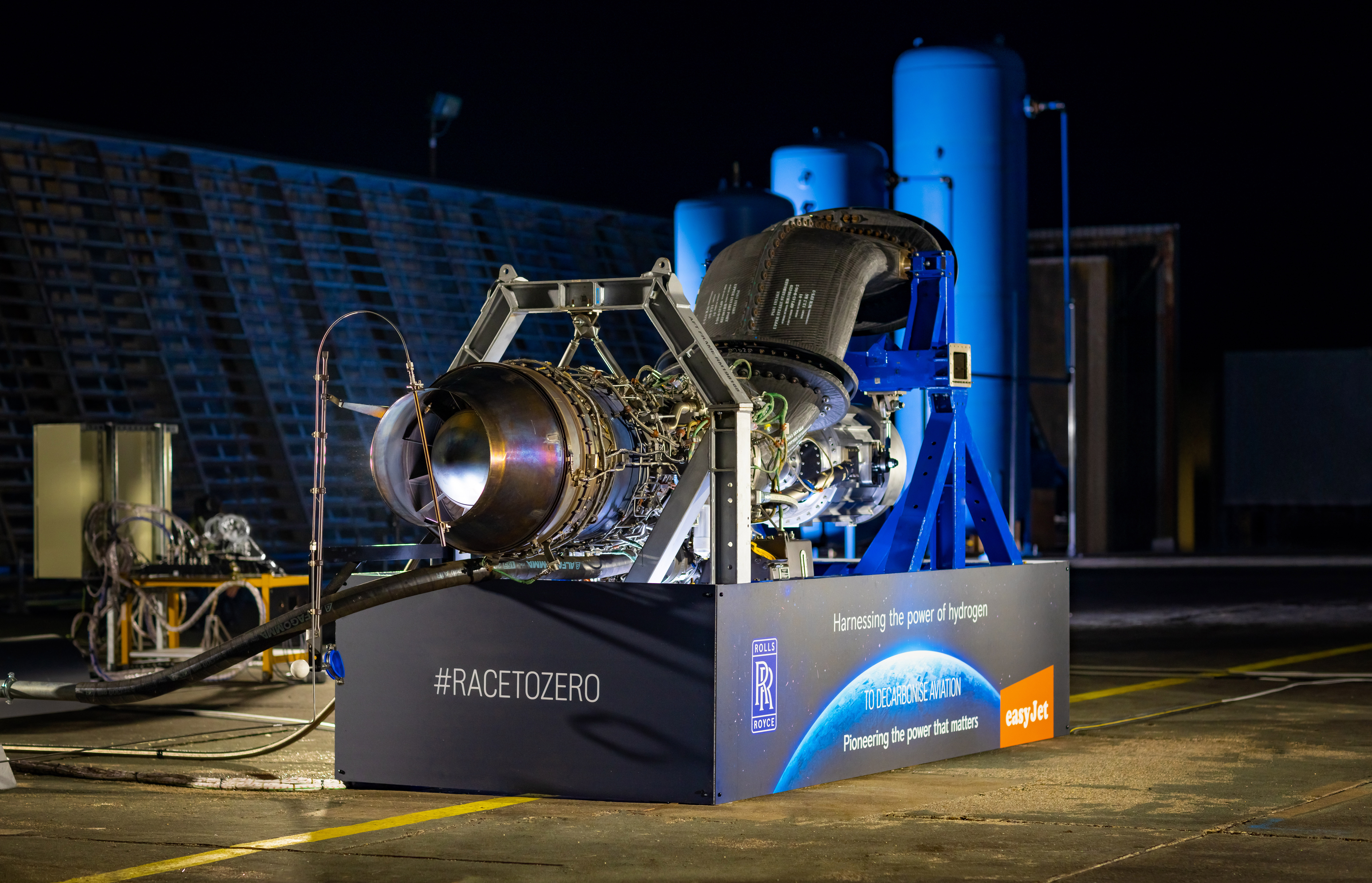
Rolls-Royce AE2100 Hydrogen Demonstrator engine preparing for test at RAF Boscombe Down
Note that the green hydrogen produced using Orcadian winds and tides.
We live in desperate times and I predict that a hydrogen-fuelled and Rolls-Royce-powered easyJet plane, will fly sooner than anybody thinks.
As with athletes, engineers love to be first!
Rolls-Royce And SOWITEC Cooperate On Power-To-X Projects
The title of this post, is the same of that of this press release from Rolls-Royce.
The press release starts with these two bullet points.
- Target: up to 500 MW electrolysis capacity for power-to-X projects
- Production of green hydrogen and e-fuels for shipping, aviation, mining, agriculture, data centers
In Rolls-Royce Makes Duisburg Container Terminal Climate Neutral With MTU Hydrogen Technology, I wrote how Rolls-Royce were building a carbon-neutral energy supply for the port.
This Rolls-Royce graphic illustrates the project.
It looks like SOWITEC would be the sort of company to install the decentralised renewables for this project.
Rolls-Royce seem to be collecting the technology to build complex projects like the power supply for the Duisburg Container Terminal, either by acquisition or negotiating friendly links.
But I do think, that Rolls-Royce possibly need two items for a complete portfolio.
A factory with a large capacity to build electrolysers. The press release says they need 500 MW by 2028 or nearly 100 MW per year.
Some form of GWh-sized energy storage. I wouldn’t be surprised to see Rolls-Royce do a deal with an energy storage company.
 The Anonymous Widower