Rolls-Royce And Zero Petroleum Join Forces To Develop Sustainable Future
The title of this post, is the same as that of this press release from Rolls Royce.
This is the sub-heading.
Rolls-Royce has entered a landmark agreement with breakthrough Energy company Zero Petroleum to promote further development of the company’s power and propulsion solutions with fossil-free synthetic fuels.
These two paragraphs outline the agreement.
The new agreement will see the two parties collaborate to demonstrate Rolls-Royce engines for aviation, marine and defence with Zero® synthetic fuels.
This has the potential to include Zero’s entire range of synthetic fuels – petrol, diesel and jet fuel – with data gathered from engine testing used to prove the credentials required to achieve international fuel certification standards. Synthetic fuels deployed by Rolls-Royce in engine tests will directly reduce associated carbon emissions.
Are Rolls-Royce going to do their engine testing using synthetic fuels to reduce their carbon emissions?
It certainly looks like they might and I suppose it does two tests at the same time.
Rolls-Royce Seem To Be Using Technology To Save The Company
Big companies like Rolls-Royce, who are very much toed up with fossil fuels have two options; give up or fight using the only weapons they have; superb technology and a lot of experience.
There are only a small group, that seem to be fighting to succeed. To Rolls-Royce, I would add Cummins, Fortescue Future Industries, Ricardo and SSE, and possibly BP and Centrica.
SSE And RWE Tweak North Falls Project Following Public Input, DCO Application Now Expected In 2024
The title of this post, is the same as that of this article on offshoreWIND.biz.
This is the sub-heading.
RWE and SSE Renewables have made a number of changes to the North Falls offshore wind project in the UK, a proposed extension to the existing 504 MW Greater Gabbard, whose implementation will likely move the planned date for filing a development consent order (DCO) application into 2024. The most significant changes to the project plans include removing the northern array area and reducing the number and height of wind turbines.
These two paragraphs introduce the article.
The developers are tweaking the project following a review of the feedback received from the North Falls statutory consultation held during the summer.
Initially, North Falls comprised two offshore array areas totalling 150 square kilometres and will now have a single array occupying 95 square kilometres. This also moves the wind farm farther offshore, with its closest point to shore now being 42 kilometres, 20 kilometres farther out at sea than proposed originally.
It looks like RWE and SSE Renewables have listened to the public and acted.
But then the developers are two of the most experienced in the UK.
SSE Becomes First Utility To Trial First Hydrogen Fuel Cell EV Van
hydrThe title of this post, is the same as that of this article on Hydrogen Central.
This is the first two paragraphs.
The low-carbon energy infrastructure company will be the first utility to trial the hydrogen-powered vehicle – and the first to put it to the test in real-life fleet operations by deploying the vehicle with SSE engineers.
The project will enable First Hydrogen’s team to gather data on fuel consumption, usage, and efficiency. The trials are being used to inform development of First Hydrogen’s Generation II series, currently in development, and will help enhance Total Cost of Ownership (TCO) data.
The deployment will take place in Aberdeen, as the city has some of the UK’s best hydrogen infrastructure.
The Mayor of London please note how being a hydrogen denier causes London to have more pollution.
SSEN Transmission Signs Debut £750m Sustainability-Linked Facility
The title of this post, is the same as that of this news item from SSE.
This is the sub-heading.
SSEN Transmission has signed its first ever sustainability-linked Revolving Credit Facility (RCF), further reinforcing the company’s commitment to sustainability in line with its Sustainability Action Plan.
This is the first paragraph.
The facility has been upgraded to include four key performance indicators, which have been designed to align with SSEN Transmission’s commitment to sustainability, and each indicator will be assessed annually during the term of the loan, thus bringing greater alignment between SSEN Transmission’s sustainability and financing strategies.
It seems to be that SSEN Transmission are benefitting from some innovative financing.
As someone, who benefited from innovative financing from a bank manager in the past, I’m all for more of this, if it helps development of our renewables.
Japanese Companies To Invest GBP 14.2 Billion In UK’s Offshore Wind, Green Hydrogen
The title of this post, is the same as that of this article on offshoreWIND.biz.
This is the sub-heading.
Japanese giants Marubeni Corporation, Sumitomo Corporation, and Sumitomo Electric Industries have committed to investing a total of GBP 14.2 billion (approximately EUR 16.3 billion) in offshore wind and green hydrogen projects, and the offshore wind supply chain in the UK
These two paragraphs add a bit of context and flesh to the deal.
Ahead of the UK Prime Minister’s business reception in Tokyo on 18 May, the UK government announced that leading Japanese businesses have committed to invest GBP 17.7 billion (approx. EUR 20.3 billion) in businesses and projects across the UK.
Of this, GBP 14.2 billion has been committed by Marubeni, Sumitomo and Sumitomo Electric for projects in offshore wind, green hydrogen and offshore wind supply chain.
SSE’s Berwick Bank Wind Farm will have a capacity of 4.1 GW and is budgeted to cost just short of £18 billion. Doing a quick calculation, indicates that £14.2 billion would only finance £3.23 GW of offshore wind.
But the Japanese say they will invest in offshore wind, green hydrogen and offshore wind supply chain. Investing in the offshore wind supply chain, would surely attract more money as the developers placed orders for foundations, floaters, electrical gubbins and support vessels.
Note.
- In Japanese Giant Sumitomo Heavy Invests In Liquid-Air Energy Storage Pioneer, I wrote about Sumitomo’s investment in English energy storage. company; Highview Power.
- Electrolyser company; iTM Power has also sold a 1.4 MW electrolyser to Sumitomo and signed an agreement over American sales with another Japanese company.
I can see other similar co-operative deals being developed. Possible areas could be cables, transformers and support vessels.
SSE To Help Decarbonise 5000 Homes In Major London Retrofit Project
The title of this post, is the same as that of this news item on SSE.
These three paragraphs outline the work.
SSE Energy Solutions has agreed a deal with Berkeley Homes that will help to decarbonise a heat network for up to 5,000 homes in London, thought to be one of the largest retrofits of its kind in the country.
An Air Source Heat Pump (ASHP) system will be installed to supply the homes on an existing district heating network at the Woolwich Arsenal site after several options were considered, including the use of waste heat and ground and river source solutions. An ASHP was chosen as the best low carbon, low tariff option over the length of the supply contract.
The system will be installed in nearby Wellington Park where a new landscape will be created through a unique planting scheme that broadens the biodiversity of the area by responding to the microclimate. The ASHP will connect directly to the existing district heating network pipes, reducing the carbon content of the heat provided by the network.
It strikes me, that no new housing estates or blocks of flats, should be built without a district heating system.
In this example, SSE are able to decarbonise a large number of houses and flats, by just replacing a boiler with an air source heat pump.
Just imagine the hassle if five-thousand individual boilers had to be replaced.
Green Light For Orkney Transmission Link
The title of this post, is the same as that of this news item from SSE.
These three paragraphs outline the project.
SSE’s Transmission business, SSEN Transmission, has welcomed today’s publication by Ofgem in which the energy regulator has provisionally approved long awaited and much needed plans to provide a subsea electricity transmission link to Orkney.
The Orkney Islands are home to some of the world’s greatest resources of renewable electricity, from established onshore wind, to emerging marine technologies, where Orkney is at the forefront of global developments in marine energy generation.
Following significant growth in small-scale renewable electricity generation in Orkney, the local electricity network has long been at full capacity and no new electricity generation can connect without significant reinforcements.
This paragraph describes the scope of the project.
SSEN Transmission’s proposed solution would enable the connection of up to 220MW of new renewable electricity and consists of a new substation at Finstown in Orkney, and around 57km of subsea cable, connecting to a new substation at Dounreay in Caithness.
200 MW seems a good return for a substation and forty miles of cable.
SSE Thermal Charts Path To Green Hydrogen Future With First-Of-A-Kind Project
The title of this post, is the same as that of this press release from SSE Thermal.
This is the sub-heading.
SSE Thermal is developing a first-of-a-kind project in the Humber which would unite hydrogen production, storage and power generation in one location by the middle of this decade.
These paragraphs explain the project.
The Aldbrough Hydrogen Pathfinder project will support the evidence base for wider deployment of flexible hydrogen power in the UK’s net zero journey and is a major enabler of SSE Thermal’s wider Humber ambitions.
Located at SSE Thermal and Equinor’s existing Aldbrough Gas Storage site on the East Yorkshire coast, the project is designed to demonstrate the interactions between hydrogen electrolysis, hydrogen cavern storage and 100% hydrogen dispatchable power.
The concept would see green power sourced from grid through Renewable PPAs, in compliance with the Low Carbon Hydrogen Standard. Hydrogen would then be produced via a 35MW electrolyser before being stored in a converted salt cavern and then used in a 100% hydrogen-fired turbine, exporting flexible green power back to grid at times of system need. In future, hydrogen storage will also benefit offtakers in other sectors, for example in industry, heat or transport.
Note.
- The Aldbrough Gas Storage site currently can store the equivalent of 320 GWh of electricity, It is currently being expanded to be one of the largest hydrogen stores in the world according to this page on the SSE web site.
- SSE Thermal are proposing to build a hydrogen-powered power station at Keadby to the South of the Humber. The press release says this power station could have a peak demand of 1,800MW of hydrogen.
- Aldbrough at its current size could keep the Keadby hydrogen-powered power station going for a week. But Aldbrough will be a lot bigger than the current 320 GWh.
- The Hornsea and Dogger Bank wind farms off the coast of East Yorkshire will have a capacity of at least 13.5 GW.
- A 35 MW electrolyser will produce 15.2 tonnes of hydrogen per day.
SSE and Equinor hope to be storing hydrogen by 2025.
Conclusion
It is an enormous project and it will surely grow with more electrolysers and hydrogen-powered power stations.
Global Port Services Wins Pre-Assembly Contract For Scottish Offshore Wind Farm
The title of this post, is the same as that of this article on offshoreWIND.biz.
These are the first two paragraphs.
Global Port Services, owned by Global Energy Group alongside the Port of Nigg, has secured multiple contracts to support Seagreen Wind Energy Limited (SWEL) with site-enabling works for the pre-assembly construction of wind turbine components at its Port of Nigg facility.
The news comes as the final turbine foundations for the Seagreen offshore wind project arrive at Nigg to be prepared for installation 27 kilometres off the coast of Angus.
Note.
- Nigg is a village in the Highlands to the North of Inverness.
- The Port of Nigg has a busy Marine Fabrication Yard.
- There is a very interesting BBC documentary called Rigs of Nigg, which tells some of the stories of the port from the 1970s.
- As the article indicates, the yard is now very much involved in the wind power industry.
- SSE have invested in the yard.
This Google Map shows the port.
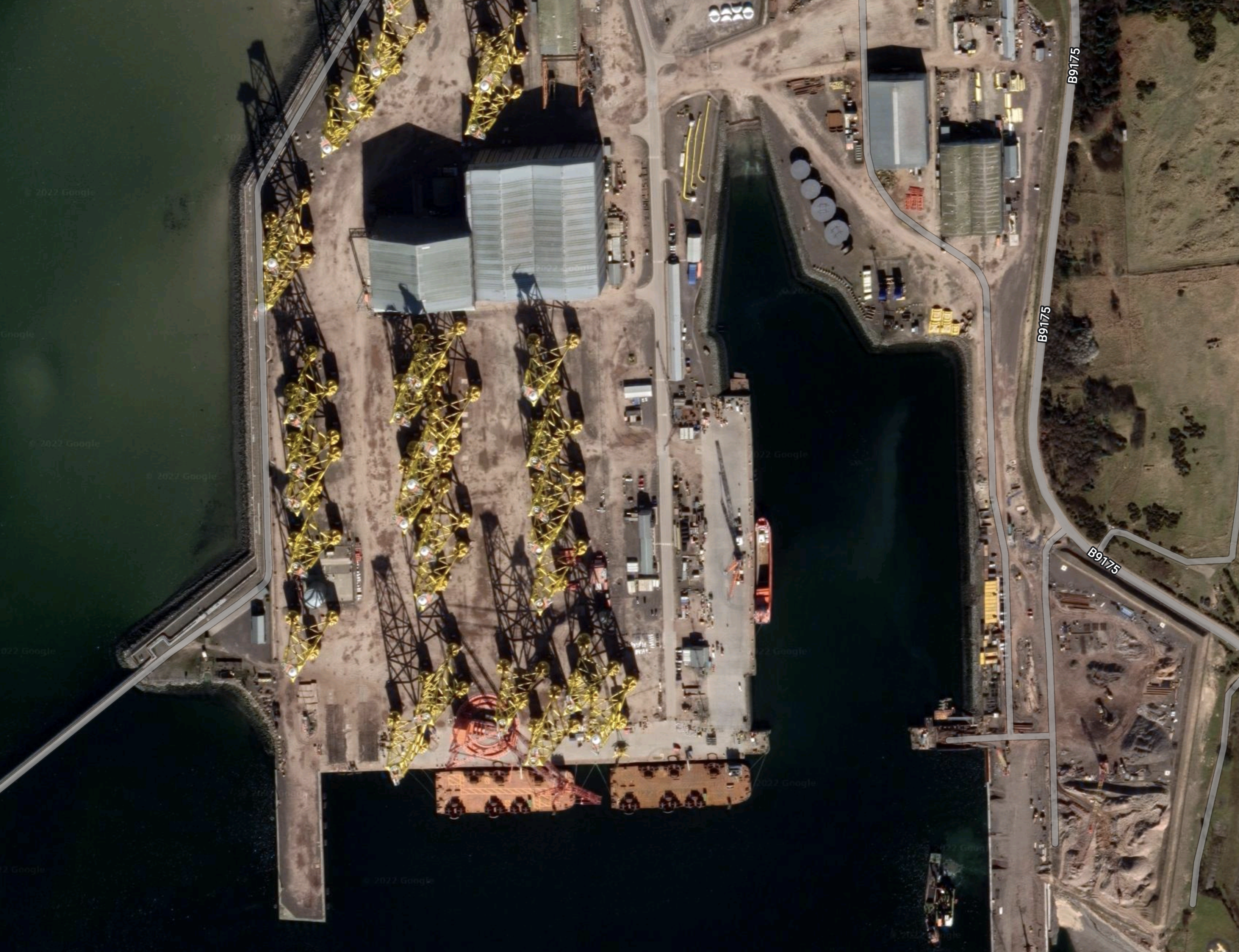
Note. all the yellow steel structures, which look like the fixed foundations for the Seagreen Wind Farm.
I am a bit surprised that foundations for Seagreen are being assembled a fair distance from Angus.
Is there not a fabrication yard on the Firth of Forth?
Increased CCS Can Decarbonise GB Electricity Faster On Route To Net Zero
The title of this post, is the same as that of this news item on the SSE web site.
This is the first paragraph.
Building more power carbon capture and storage plants (Power CCS) could significantly accelerate the UK’s plans to decarbonise the GB electricity system on route to net zero, according to new analysis commissioned by SSE.
I am not surprised, as in my time, I have built several production, storage and distribution mathematical models for products and sometimes bringing things forward has beneficial effects.
These three paragraphs summarise the findings.
The UK Government’s proposed emissions reductions from electricity for 2035 could be accelerated to 2030 by combining its 50GW offshore wind ambition with a significant step up in deployment of Power CCS. This would require 7-9GW (equivalent to 10-12 plants) of Power CCS compared to the current commitment of at least one Power CCS plant mid-decade, according to experts at LCP Delta.
Replacing unabated gas with abated Power CCS generation will deliver significant reductions in greenhouse gas emissions. The analysis suggests that adding 7-9GW Power CCS to the UK’s 2030 offshore wind ambition will save an additional 18 million tonnes of CO2 by 2040, by preventing carbon emissions during periods when the sun isn’t shining, and the wind isn’t blowing.
Gas consumption for electricity generation would not significantly increase, given the 7-9GW Power CCS would displace older and less efficient unabated gas power stations already operating and reduce importing unabated gas generation from abroad via the interconnectors. Importantly, Power CCS can provide a safety net to capture emissions from any gas required to keep the lights on in the event of delays to the roll out of renewables or nuclear.
The report is by LCP Delta, who are consultants based in Edinburgh.
The report says this about the transition to hydrogen.
Power CCS also presents significant opportunities to kickstart, then transition to, a hydrogen economy, benefitting from the synergies between CCS and hydrogen, including proximity to large-scale renewable generation and gas storage facilities which can support the production of both electrolytic and CCS-enabled hydrogen.
And this about the reduction in carbon emissions.
The existing renewables ambition and the accelerated Power CCS ambition are expected to save a total of 72 million tonnes of CO2 by 2040 compared to commitments in the UK’s Net Zero Strategy from October 2021.
I don’t think there’s much wrong with this analysis.
But of course the greens will trash it, as it was paid for by SSE.
I have a few thoughts.
Carbon Capture And Use
I believe we will see a great increase in carbon capture and use.
- Carbon dioxide is already an ingredient to make Quorn.
- Carbon dioxide is needed for fizzy drinks.
- Carbon dioxide can be fed to tomatoes, salad plants, herbs and flowers in giant greenhouses.
- Carbon dioxide can be used to make animal and pet food.
- Carbon dioxide can be used to make building products like plasterboard and blocks.
- Carbon dioxide can be added to concrete.
- Carbon dioxide can be used as a refrigerant and in air-conditioning. There are one or two old Victorian systems still working.
Other uses will be developed.
Carbon Capture Will Get More Efficient
Carbon capture from power stations and boilers, that use natural gas is a relatively new process and its capture will surely get better and more efficient in the next few years.
Gas From INTOG
I explain INTOG in What Is INTOG?.
One of INTOG’s aims, is to supply electricity to the oil and gas rigs and platforms in the sea around the UK.
Currently, these rigs and platforms, use some of the gas they produce, in gas turbines to create the electricity they need.
- I have seen reports that ten percent of the gas that comes out of the ground is used in this way.
- Using the gas as fuel creates more carbon dioxide.
Decarbonisation of our oil and gas rigs and platforms, will obviously be a good thing because of a reduction of the carbon dioxide emitted. but it will also mean that the gas that would have been used to power the platform can be brought ashore to power industry and domestic heating, or be exported to countries who need it.
Gas may not be carbon-neutral, but some gas is more carbon-neutral than others.
SSE’s Plans For New Thermal Power Stations
I have taken this from SSE’s news item.
SSE has deliberately chosen to remain invested in the transition of flexible thermal electricity generation due to the key role it plays in a renewables-led, net zero, electricity system and is committed to decarbonising the generation.
Together with Equinor, SSE Thermal is developing two power stations equipped with carbon capture technology. Keadby 3 Carbon Capture Power Station is based in the Humber, the UK’s most carbon-intensive industrial region, while Peterhead Carbon Capture Power Station is located in the North East of Scotland. Combined, the two stations could capture around three million tonnes of CO2 a year.
Studies have shown that Keadby and Peterhead Carbon Capture Power Stations could make a lifetime contribution of £1.2bn each to the UK economy, creating significant economic opportunity in their respective regions. Both will be vital in supporting the huge amount of renewables which will be coming on the system.
SSE Thermal and Equinor are also collaborating on Keadby Hydrogen Power Station, which could be one of the world’s first 100% hydrogen-fuelled power stations, and Aldbrough Hydrogen Storage, which could be one of the world’s largest hydrogen storage facilities.
Note.
- SSE appear to think that gas-fired power stations with carbon capture are an ideal backup to renewables.
- If gas is available and it can be used to generate electricity without emitting any carbon dioxide, then why not?
- Hydrogen is coming.
Things will get better.
Is A Virtuous Circle Developing?
Consider.
- Spare wind electricity is turned into hydrogen using an electrolyser or perhaps some world-changing electro-chemical process.
- The hydrogen is stored in Aldbrough Hydrogen Storage.
- When the wind isn’t blowing, hydrogen is used to backup the wind in Keadby Hydrogen power station.
- The other Keadby power stations can also kick in using natural gas. The carbon dioxide that they produce, would be captured for storage or use.
- Other users, who need to decarbonise, can be supplied with hydrogen from Aldbrough.
Note.
- Gas turbines are throttleable, so if National Grid wants 600 MW to balance the grid, they can supply it.
- As time progresses, some of the gas-fired power stations at Keadby could be converted to hydrogen.
- Rough gas storage is not far away and could either store natural gas or hydrogen.
- Hydrogen might be imported by tanker from places like Africa and Australia, depending on price.
Humberside will be levelling up and leading the decarbonisation of the UK.
If you have an energy-hungry business, you should seriously look at moving to Humberside.
 The Anonymous Widower