RWE And the Norfolk Wind Farms
In March 2024, I wrote RWE And Vattenfall Complete Multi-Gigawatt Offshore Wind Transaction In UK, which described how Vattenfall had sold 4.2 GW of offshore wind farms, situated off North-East Norfolk to RWE.
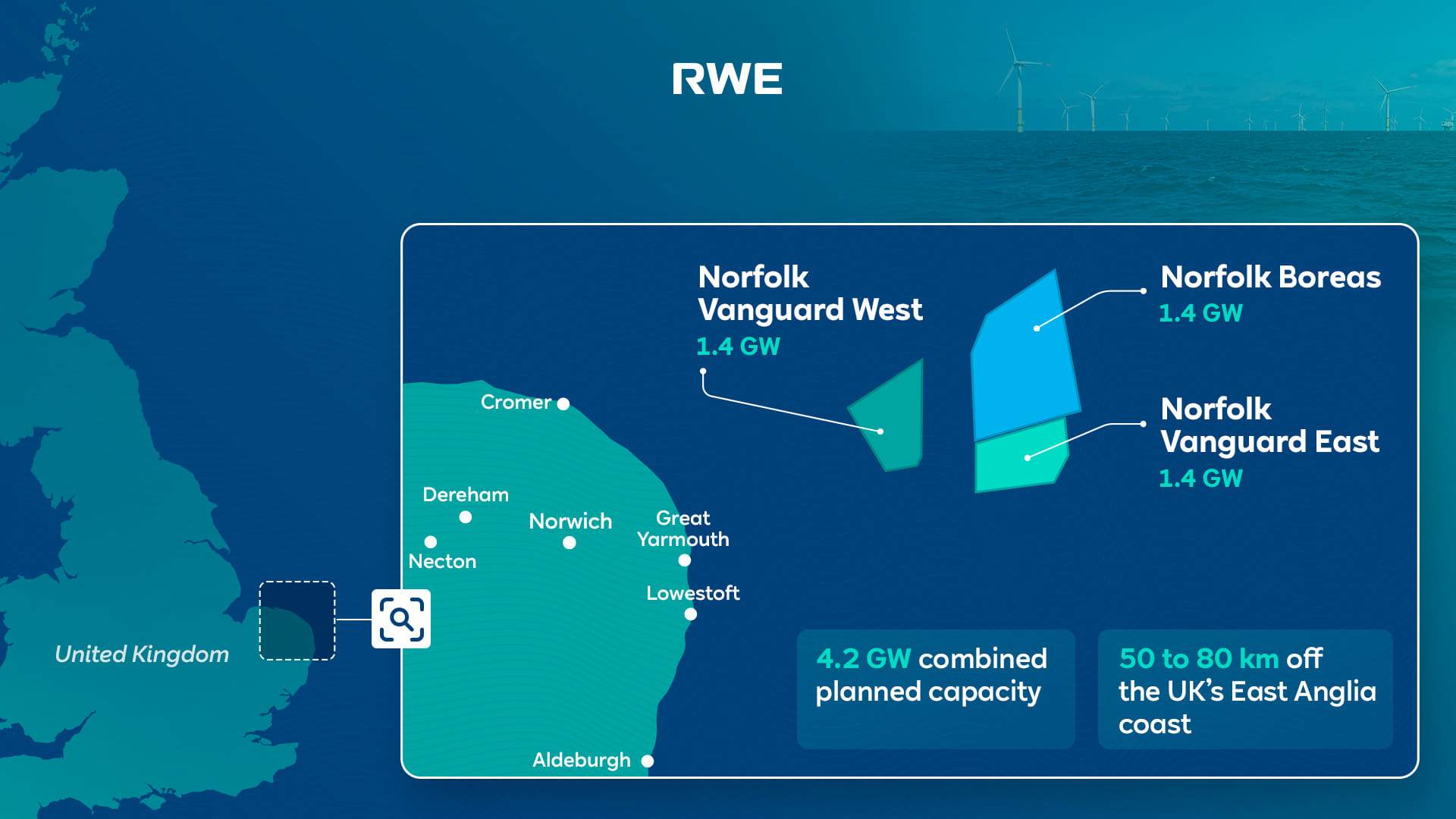
This map from RWE shows the wind farms.
Note.
- The Norfolk Zone consists of three wind farms; Norfolk Vanguard West, Norfolk Boreas and Norfolk Vanguard East.
- The three wind farms are 1.4 GW fixed-foundation wind farms.
- In Vattenfall Selects Norfolk Offshore Wind Zone O&M Base, I describe how the Port of Great Yarmouth had been selected as the O & M base.
- Great Yarmouth and nearby Lowestoft are both ports, with a long history of supporting shipbuilding and offshore engineering.
The wind farms and the operational port are all close together, which probably makes things convenient.
So why did Vattenfall sell the development rights of the three wind farms to RWE?
Too Much Wind?
East Anglia is fringed with wind farms all the way between the Wash and the Thames Estuary.
- Lincs – 270 MW
- Lynn and Inner Dowsing – 194 MW
- Race Bank – 580 MW
- Triton Knoll – 857 MW
- Sheringham Shoal – 317 MW
- Dudgeon – 402 MW
- Hornsea 3 – 2852 MW *
- Scroby Sands – 60 MW
- East Anglia One North – 800 MW *
- East Anglia Two – 900 MW *
- East Anglia Three – 1372 MW *
- Greater Gabbard – 504 MW
- Galloper – 353 MW
- Five Estuaries – 353 MW *
- North Falls – 504 MW *
- Gunfleet Sands – 172 MW
- London Array – 630 MW
Note.
- Wind farms marked with an * are under development or under construction.
- There is 4339 MW of operational wind farms between the Wash and the Thames Estuary.
- An extra 6781 MW is also under development.
If all goes well, East Anglia will have over 11 GW of operational wind farms or over 15 GW, if the three Norfolk wind farms are built.
East Anglia is noted more for its agriculture and not for its heavy industries consuming large amounts of electricity, so did Vattenfall decide, that there would be difficulties selling the electricity?
East Anglia’s Nimbies
East Anglia’s Nimbies seem to have started a campaign against new overground cables and all these new wind farms will need a large capacity increase between the main substations of the National Grid and the coast.
So did the extra costs of burying the cable make Vattenfall think twice about developing these wind farms?
East Anglia and Kent’s Interconnectors
East Anglia and Kent already has several interconnectors to Europe
- Viking Link – Bicker Fen and Jutland – 1.4 GW
- LionLink – Suffolk and the Netherlands – 1.8 GW – In Planning
- Nautilus – Suffolk or Isle of Grain and Belgium – 1.4 GW – In Planning
- BritNed – Isle of Grain and Maasvlakte – 1.0 GW
- NeuConnect – Isle of Grain and Wilhelmshaven – 1.4 GW – Under Construction
- GridLink Interconnector – Kingsnorth and Warande – 1.4 GW – Proposed
- HVDC Cross-Channel – Sellinge and Bonningues-lès-Calais – 2.0 GW
- ElecLink – Folkestone and Peuplingues – 1.0 GW
- Nemo Link – Richborough and Zeebrugge – 1.0 GW
Note.
- Five interconnectors with a capacity of 6.4 GW.
- A further four interconnectors with a capacity of 6 GW are on their way.
At 12.4 GW, the future capacity of the interconnectors between South-East England and Europe, is nor far short of South-East English wind power.
There are also two gas pipelines from the Bacton gas terminal between Cromer and Great Yarmouth to Europe.
The Wikipedia entry for the Bacton gas terminal gives these descriptions of the two gas pipelines.
Interconnector UK – This can import gas from, or export gas to, Zeebrugge, Belgium via a 235 km pipeline operating at up to 147 bar. There is a 30-inch direct access line from the SEAL pipeline. The Interconnector was commissioned in 1998.
BBL (Bacton–Balgzand line) – This receives gas from the compressor station in Anna Paulowna in the Netherlands. The BBL Pipeline is 235 km long and was commissioned in December 2006.
It would appear that East Anglia and Kent are well connected to the Benelux countries, with both electricity and gas links, but with the exception of the Viking Link, there is no connection to the Scandinavian countries.
Did this lack of connection to Sweden make convincing the Swedish government, reluctant to support Vattenfall in their plans?
Bringing The Energy From The Norfolk Wind Farms To Market
It looks to me, that distributing up to 4.2 GW from the Norfolk wind farms will not be a simple exercise.
- Other wind farms like the 2852 MW Hornsea 3 wind farm, may need a grid connection on the North Norfolk coast.
- The Nimbies will not like a South-Western route to the National Grid at the West of Norwich.
- An interconnector to Denmark or Germany from North Norfolk would probably help.
But at least there are two gas pipelines to Belgium and the Netherlands.
RWE, who now own the rights to the Norfolk wind farms, have a large amount of interests in the UK.
- RWE are the largest power producer in the UK.
- They supply 15 % of UK electricity.
- They have interest in twelve offshore wind farms in the UK. When fully-developed, they will have a capacity of almost 12 GW.
- RWE are developing the Pembroke Net Zero Centre, which includes a hydrogen electrolyser.
RWE expects to invest up to £15 billion in the UK by 2030 in new and existing green technologies and infrastructure as part of this.
Could this be RWE’s plan?
As the Norfolk wind farms are badly placed to provide electricity to the UK grid could RWE have decided to use the three Norfolk wind farms to produce hydrogen instead.
- The electrolyser could be placed onshore or offshore.
- If placed onshore, it could be placed near to the Bacton gas terminal.
- There are even depleted gas fields, where hydrogen could be stored.
How will the hydrogen be distributed and/or used?
It could be delivered by tanker ship or tanker truck to anyone who needs it.
In Developing A Rural Hydrogen Network, I describe how a rural hydrogen network could be developed, that decarbonises the countryside.
There are three major gas pipelines leading away from the Bacton gas terminal.
- The connection to the UK gas network.
- Interconnector UK to Belgium.
- BBL to The Netherlands.
These pipelines could be used to distribute hydrogen as a hydrogen blend with natural gas.
In UK – Hydrogen To Be Added To Britain’s Gas Supply By 2025, I describe the effects of adding hydrogen to the UK’s natural gas network.
SeaTwirl And Verlume Join Forces To Drive Decarbonisation Of Offshore Assets
The title of this post, is the same as that of this article on offshoreWIND.biz.
This is the sub-heading.
Swedish energy-tech company SeaTwirl and UK-based energy management and energy storage firm Verlume have signed a memorandum of understanding (MoU) to collaborate on the electrification of offshore assets and decarbonisation of the oil and gas industry.
This is the first two paragraphs.
The MoU will see the two companies identify and pursue potential opportunities for decarbonisation of offshore oil and gas and other associated offshore electrification opportunities using renewable energy, seabed-based energy storage, and intelligent energy management.
SeaTwirl and Verlume plan to develop systems for commercial sale, using combined technologies.
Note.
- This YouTube video introduces SeaTwirl.
- This YouTube video introduces Verlume.
This could be an MoU made in engineering heaven.
Verlume And Wave Power
The last two paragraphs of the article describe another project involving Verlume.
Aberdeen’s intelligent energy management specialists Verlume has developed a GBP 2 million (approximately USD 2.5 million) project linking the Blue X wave energy converter constructed by Mocean Energy with a Halo underwater battery storage system.
The industry-supported project, situated five kilometres east of Orkney Mainland, demonstrates the integration of green technologies to deliver consistent and sustainable low-carbon power and communication to subsea equipment.
Could Verlume, be the missing link that wave power needs?
H2 Green Steel Raises More Than €4 billion In Debt Financing For The World’s First Large-Scale Green Steel Plant
The title of this post, is the same as that of this press release from H2 Green Steel.
This is the sub-heading.
H2 Green Steel signs definitive debt financing agreements for €4.2 billion in project financing and increases the previously announced equity raised by €300 million. Total equity funding to date amounts to €2.1 billion. The company has also been awarded a €250 million grant from the EU Innovation Fund. H2 Green Steel has now secured funding of close to €6.5 billion for the world’s first large-scale green steel plant in Northern Sweden.
These three paragraphs describe the company and outlines the financing.
H2 Green Steel is driving one of the largest climate impact initiatives globally. The company was founded in 2020 with the purpose to decarbonize hard-to-abate industries, starting by producing steel with up to 95% lower CO2 emissions than steel made with coke-fired blast furnaces. The construction of the flagship green steel plant in Boden, with integrated green hydrogen and green iron production, is well under way. The supply contracts for the hydrogen-, iron- and steel equipment are in place. A large portion of the electricity needed has been secured in long-term power purchase agreements, and half of the initial yearly volumes of 2.5 million tonnes of near zero steel have been sold in binding five- to seven-year customer agreements.
Today H2 Green Steel announces a massive milestone on its journey to accelerate the decarbonization of the steel industry, which is still one of the world’s dirtiest. The company has signed debt financing of €4.2 billion, added equity of close to €300 million and been awarded a €250 million grant from the Innovation Fund. Funding amounts to €6.5 billion in total.
H2 Green Steel has signed definitive financing documentation for €3.5 billion in senior debt and an up-to-€600 million junior debt facility:
Note.
- I first wrote about H2 Green Steel about three years ago in Green Hydrogen To Power First Zero Carbon Steel Plant.
- The Wikipedia entry for Boden in Northern Sweden, indicates it’s a coldish place to live.
- In that original post, H2 Green Steel said they needed €2.5 billion of investment, but now they’ve raised €4 billion, which is a 60 % increase in financing costs in just three years.
Is this Sweden’s HS2?
The Future Of Green Steelmaking
The finances of H2 Green Steel look distinctly marginal.
I have a feeling that green steel, as the technology now stands is an impossible dream.
But I do believe that perhaps in five or ten years, that an affordable zero carbon method of steel production will be developed.
You have to remember, Pilkington developed float glass in the 1950s and completely changed an industry. Today, we’d call that a classic example of disruptive innovation.
The same opportunity exists in steelmaking. And the rewards would be counted in billions.
Beware Beaver At Work!
Some years ago, I went on a wildlife tour of Sweden, called Sweden’s Mammals.
The company; Wild Sweden, have just sent me this YouTube video.
Enjoy!
30 MW Offshore Wind Turbines Being Considered For New Project In Sweden
The title of this post, is the same as that of this article on offshoreWIND.biz.
This is the sub-heading.
Freja Offshore, a joint venture between Hexicon and Mainstream Renewable Power, has submitted an application for an offshore wind farm in Sweden that could have an installed capacity of between 2 GW and 2.5 GW and, according to the project’s consultation document, could feature wind turbines of up to 30 MW per unit.
This paragraph, indicates how turbines have grown over the last two decades.
The wind turbines in the future will probably be taller, the rotor diameter larger and the turbines more powerful, the joint venture says in the consultation document, and compares the largest wind turbines launched in 2011, which have a rotor diameter of 164 metres and an installed capacity of 8 MW, with those launched 10 years later, featuring a rotor diameter of 236 metres and an output of 15 MW.
Moving on a few years to 2030 and it doesn’t seem unreasonable that turbine size will double again to 30 MW.
I could see them becoming the standard turbine, providing they aren’t too heavy for the fixed foundations or floats.
It would be an interesting exercise to model the costs of wind farms, as the turbines get bigger.
With North Sea oil and gas, I was told several times, by Artemis users, that as cranes got larger, which allowed bigger lifts, the costs of offshore infrastructure decreased.
Note.
British Five-Year-Olds Up To 7cm Shorter Than Western Peers
The title of this post, is the same as that of this article in The Times.
This is the sub-heading.
Poor diet and health service cuts blamed for ‘pretty startling’ trend
These are the first two paragraphs.
Five-year-olds in Britain are on average up to seven centimetres shorter than their peers in other wealthy nations, in a trend described as “pretty startling”.
A poor national diet has been highlighted as a major culprit in Britain’s fall down international rankings of child height.
I am coeliac and am only 170 cm.
During the pandemic, I did some statistical research on coeliac disease and the covids for my own interest.
I found a peer-reviewed Indian medical paper entitled Coeliac Disease: Can We Avert The Impending Epidemic In India? The author felt that modern high-gluten wheats, were increasing the rate of the disease.
The author also said this about introduction gluten to babies in Sweden.
The time of first exposure to wheat influences the development of celiac disease. In countries such as Finland, Estonia, and Denmark, characterized by low gluten consumption in infancy, celiac disease prevalence is much lower than in Sweden where gluten consumption is high in infancy. A natural experiment occurred in Sweden about two decades ago when national recommendations were made to introduce wheat into the diet after cessation of breast feeding at six months. This change was coupled with increased wheat gluten consumption through infant feeds. Together these measures resulted in a two-fold increase in incidence of celiac disease in Sweden, which was attributed to introduction of wheat into the diet after cessation of breast feeding. In 1996 this recommendation was changed to introduce gluten in gradually increasing amounts while the infant was still being breast fed. This led to a dramatic decrease in celiac disease incidence.
It is interesting to look at heights of five-year-olds given in the Times article for the four countries.
- Denmark – 117.4 – 118.1
- Estonia – 116.9 – 115.7
- Finland – 116.3 – 114.5
- Sweden – 115.1 – 115.1
Note that all heights are in centimetres, with boys first.
As according to the graphs in the article the UK and the US have shown the biggest declines in height, is gluten-rich junk food, the major cause of this decline?
More research needs to be done!
UK Offshore Wind Pipeline Now At 98 GW, Second Only To China – Report
The title of this post, is the same as that of this article on offshoreWIND.biz.
This is the sub-heading.
The UK’s pipeline of offshore wind projects has reached 97,944 MW, up from 91,287 MW a year ago, while the global pipeline topped 1.23 TWh, an increase of nearly 400 GW in the last year, according to RenewableUK’s latest EnergyPulse market intelligence data report.
These are the first two paragraphs.
The pipeline includes projects at every stage of development, including operational, under construction, consented, or planned.
The UK total pipeline was second globally at 98 GW, second only to China with 157 GW, followed by the USA in third place with 82 GW, Sweden is fourth with 75 MW, and Brazil fifth with 63 GW.
These is also a pie-chart saying in which part of the UK, wind energy is being developed.
- North Sea (Scotland) – 41,977 MW
- North Sea (England) – 33,845 MW
- Irish Sea – 8,659 MW
- North Atlantic Ocean – 7,435 MW
- Celtic Sea – 4,428 MW
- English Channel – 1,600 MW
As Cilla would say. “What a lorra, lorra lot of wind!”
Denmark And Germany Sign Bornholm Energy Island Agreement, First Legally Binding Cooperation On Joint Offshore Renewable Energy Project In EU
The title of this post, is the same as that of this article on offshoreWIND.biz.
This is the sub-heading.
German Federal Minister for Economic Affairs and Climate Action, Robert Habeck, and Danish Minister for Climate, Energy and Utilities, Lars Aagaard, have signed an agreement for the Bornholm Energy Island in the Baltic Sea. This is the first legally binding cooperation agreement in Europe on a joint offshore energy project under the EU Renewable Energy Directive.
Bornholm is a Danish island between Denmark, Germany and Sweden, as this map shows.

Note.
- Malmo is in Sweden.
- Copenhagen is in Denmark.
- Germany is in the South-West corner of the map.
Bornholm is the island in the North-East corner of the map.
This paragraph gives the bare details of the generation and transmission capacities.
Bornholm Energy Island, located in the Danish sector of the Baltic Sea, will facilitate connecting at least 3 GW of offshore wind generation capacity to the grid by the early 2030s. The electricity will then be transported via new grid connections to Germany (2 GW ) and to the Danish mainland (1.2 GW).
The great advantage of an energy island, is that the electricity can be sent both ways according to where it is needed.
Some of the energy islands that have been proposed also include energy storage and/or hydrogen production.
This web site gives more details of the Bornholm Energy Island.
Under a heading of Why Build Energy Islands?, these reasons are given.
- Environment and climate
- Energy security in Europe
- Inspiration for the world
Under a heading of What is an Energy Island?, this is said.
An energy island makes it possible to establish large wind farms at sea far from the coast. The energy produced by the wind turbines is sent via cables to the energy island, from where it is sent out to consumers. On Bornholm, a high-voltage facility must therefore be established on the island which can receive and distribute the electricity. After that, green power can be sent from Bornholm to millions of consumers in Denmark and Germany. Bornholm’s Regional Municipality is working hard to seize the energy island’s potential for job creation and local business growth, and in turning Bornholm into the green business beacon and transport hub for green fuels in the Baltic Sea.
I suppose it could be argued that in the UK, Orkney and Shetland are already energy islands and will become more so in years to come.
Energy islands, whether real or man paid certainly seems to be a concept that is growing in populatity, with several being developed.
ZeroAvia To Bring Zero-Emissions Flight To Sweden
The title of this post, is the same as that of this article on AviationSourceNews.
These three paragraphs outline the deal.
ZeroAvia has announced this week that it has struck a deal to bring zero-emissions flights to Sweden.
Such a deal has been struck to allow commercial routes from Skellefteå Airport using hydrogen-electric powertrains with Braathens Airlines.
Braathens Airlines operates a fleet of 14 ATR 72 aircraft, which will eventually have these powertrains utilized for flights across Sweden.
ZeroAvia are also targeting de Havilland Canada Dash 8 airliners for conversion to hydrogen.

