Let The Diving Under Begin!
The page on the Network Rail web site is entitled Network Rail Completes Major Signalling Work Near Peterborough Ready For Freight Trains To Begin Diving Under East Coast Main Line This Winter.
The Network Rail web page gives details of the innovative techniques used to build and insert the dive-under.
This Network Rail picture shows the dive-under going under the East Coast Main Line from the North East.
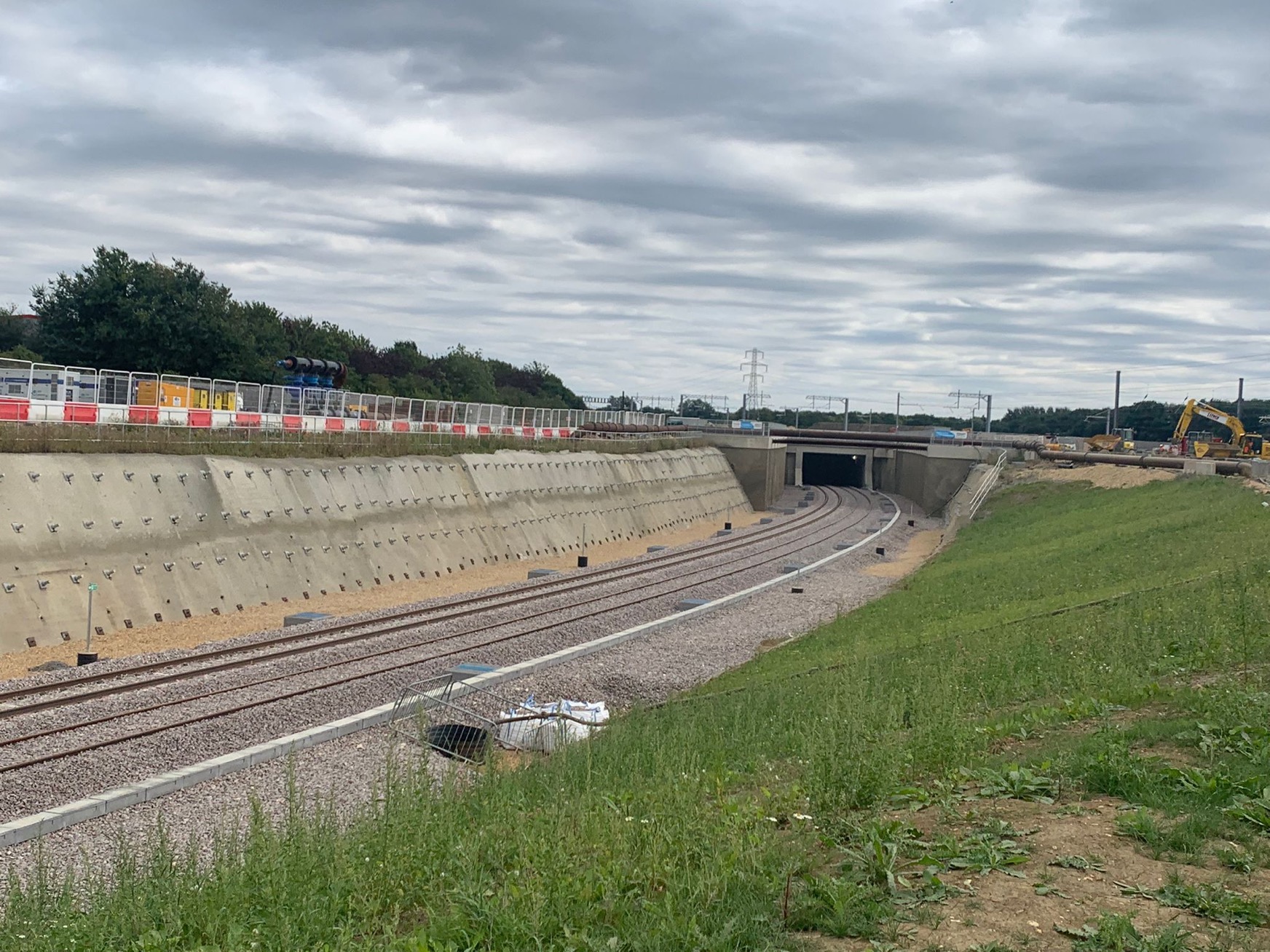
It certainly looks to be strongly constructed.
Freight Trains Through The Werrington Dive-Under
I have just counted the number of freight trains that would have used the route had it been open last Friday between 0600 and 2400.
It was twenty-seven trains or almost one train per hour (tph) in each direction.
- How long will it be before the residents of Lincoln and the other towns and cities on the route start protesting about the noisy, smelly and polluting Class 66 locomotives, that haul most of these freight trains?
- The long trains will also annoy drivers and residents at the many level crossings on the route.
Operators may not be able to do much about the train length, but they can start looking for some more environmentally-friendly locomotives, which could be hydrogen-powered.
At least there is funding for a lower-emission dual-dual-fuel locomotive, that I wrote about in Freightliner Secures Government Funding For Dual-Fuel Project.
Railway To Hell To Be Electrified
This is the title of a serious article on Railway Gazette.
Hell is a village near to Trondheim in Norway and the railways around Trondheim are being electrified.
Walking Under Old Street Roundabout – 4th September 2021
On Saturday, I walked under Old Street Roundabout from North to East.










Note the green line leading to Moorfields Eye Hospital.
Electrification Between Clay Cross North Junction And Sheffield Station
Long term readers of this blog, will have noticed that I make regular references to this proposed electrification, that is part of High Speed Two’s proposals to connect Sheffield to the new high speed railway.
So I thought I would bring all my thoughts together in this post.
Connecting Sheffield To High Speed Two
Sheffield is to be accessed from a branch off the Main High Speed Two route to Leeds.
This map clipped from High Speed Two’s interactive map, shows the route of the Sheffield Branch, from where it branches North West from the main Eastern Leg of High Speed Two.
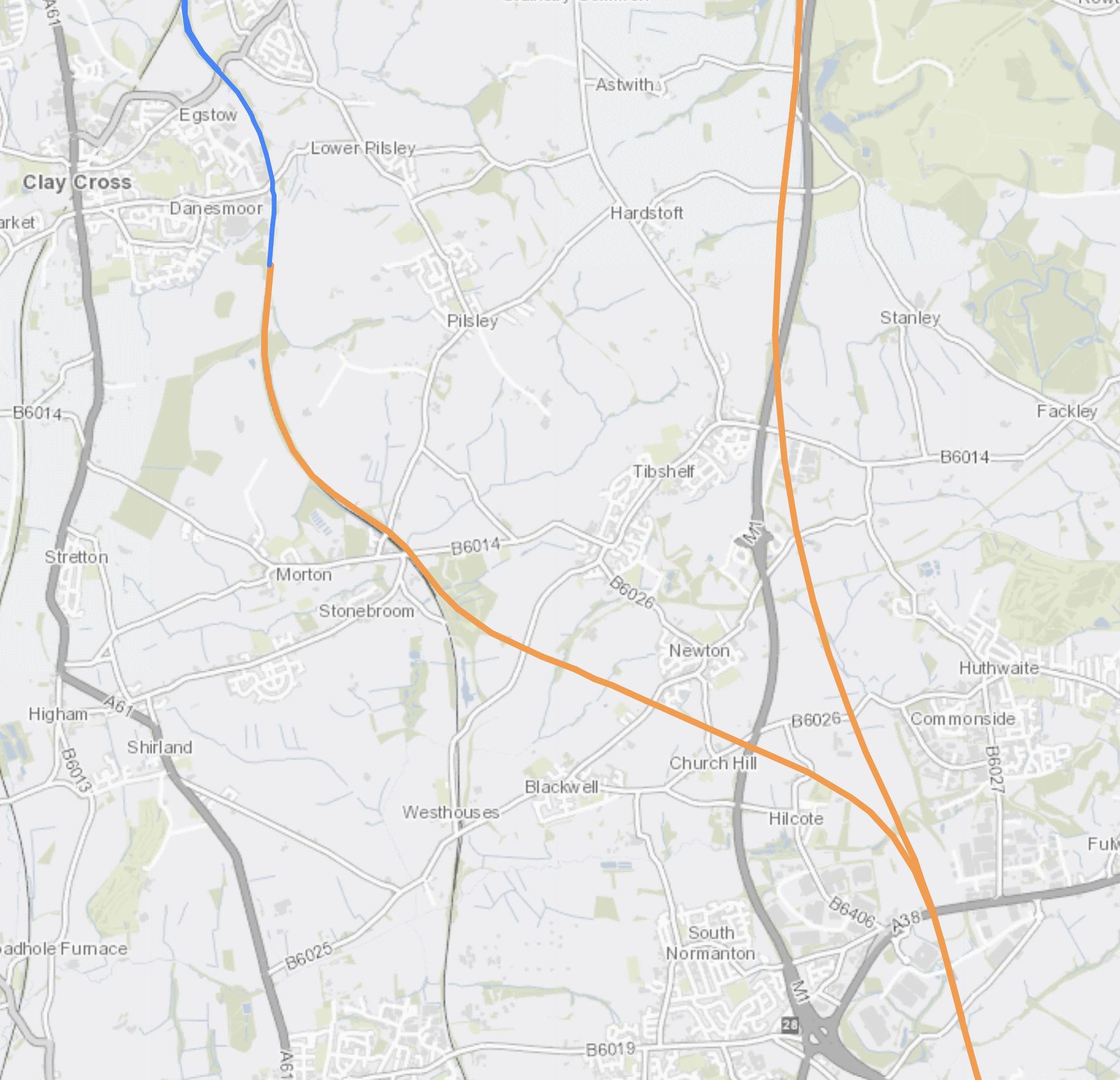
Note.
- Orange indicates new High Speed Two track.
- Blue indicates track that High Speed Two will share with other services.
- The orange route goes North to Leeds, along the M1
- The blue route goes North to Chesterfield and Sheffield, after skirting to the East of Clay Cross.
- The orange route goes South to East Midlands Hub station.
This second map, shows where the Erewash Valley Line joins the Sheffield Branch near the village of Stonebroom.
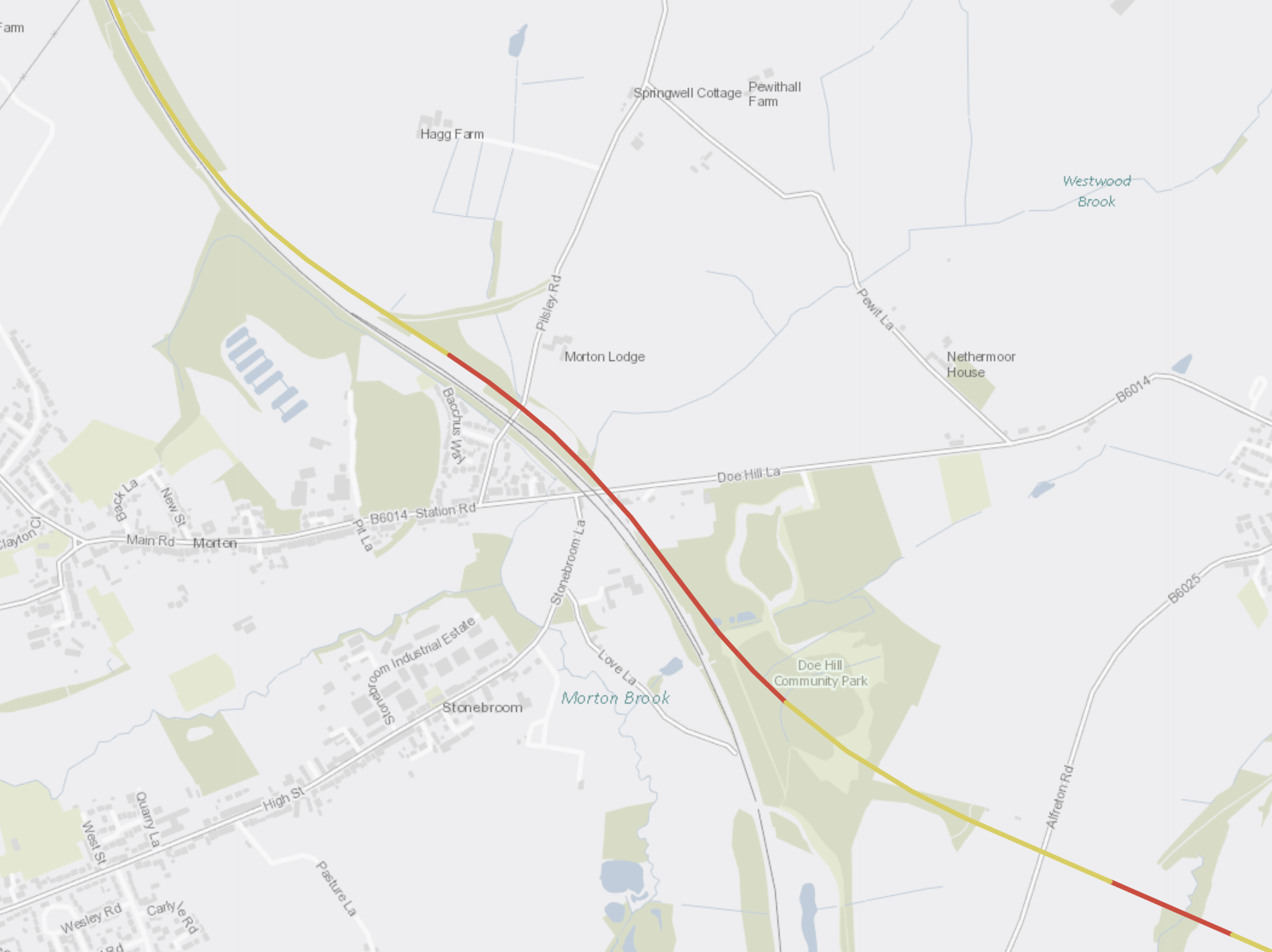
Note.
- Red is an embankment.
- Yellow is a cutting.
- The Sheffield Branch goes North-West to Clay Cross, Chesterfield and Sheffield
- The Sheffield Branch goes South-East to East Midlands Hub station.
- The Sheffield Branch goes through Doe Hill Country Park.
- The Sheffield Branch runs alongside the existing Erewash Valley Line, which goes South to Langley Mill, Ilkeston and the Derby-Nottingham area.
The Sheffield Branch and the Erewash Valley Line appear to share a route, which continues round Clay Cross and is shown in this third map.
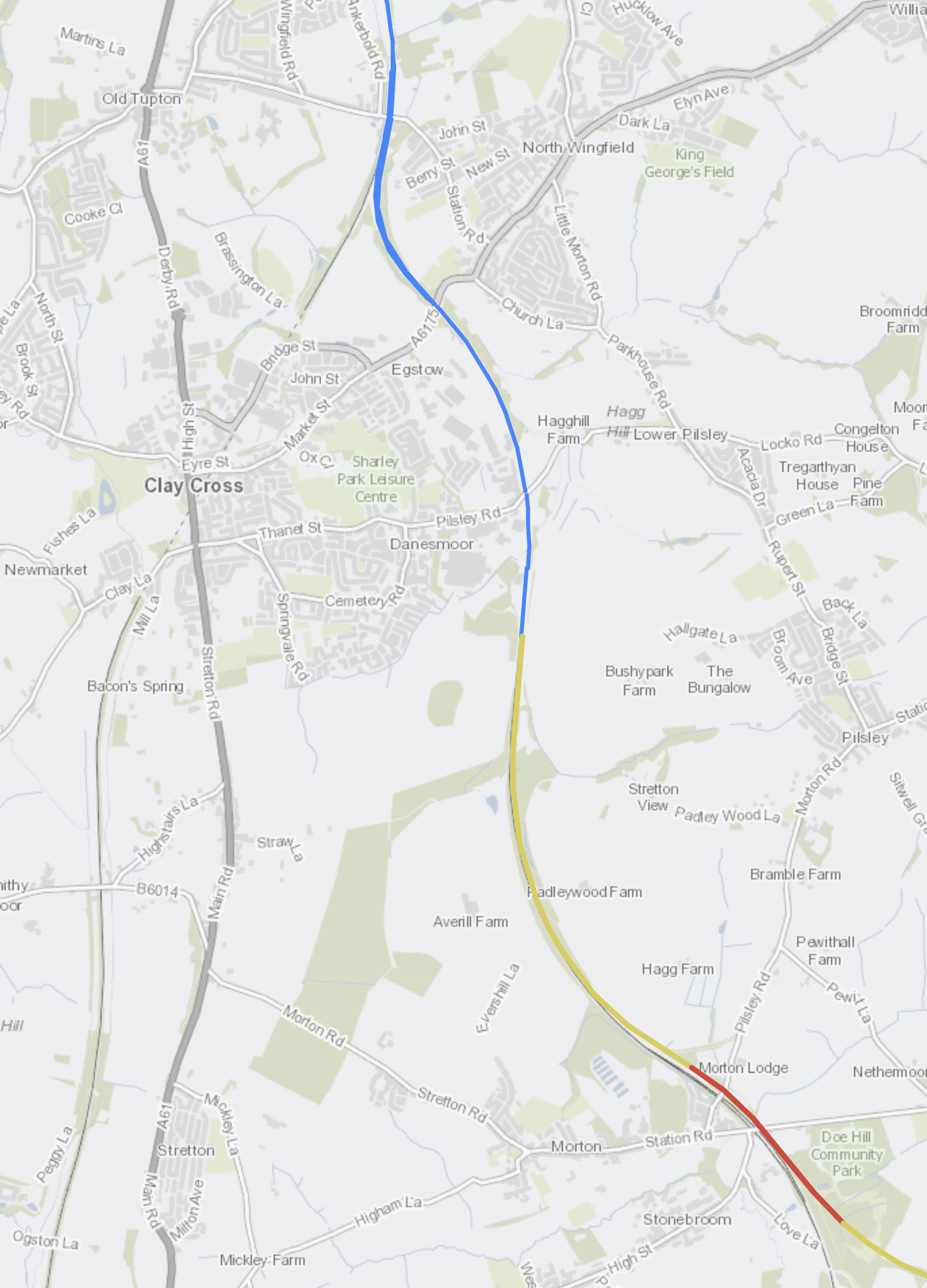
Note
- Doe Hill Country Park is in the South-East corner of the map.
- The dark line running North-South is the A61.
- Running to the West of the A61 is the Midland Main Line, which currently joins the Erewash Valley Line at Clay Cross North junction.
High Speed Two and the Midland Main Line will share a route and/or tracks from Clay Cross North junction to Sheffield.
This fourth map, shows where the combined route joins the Hope Valley Line to Manchester to the South West of Sheffield.
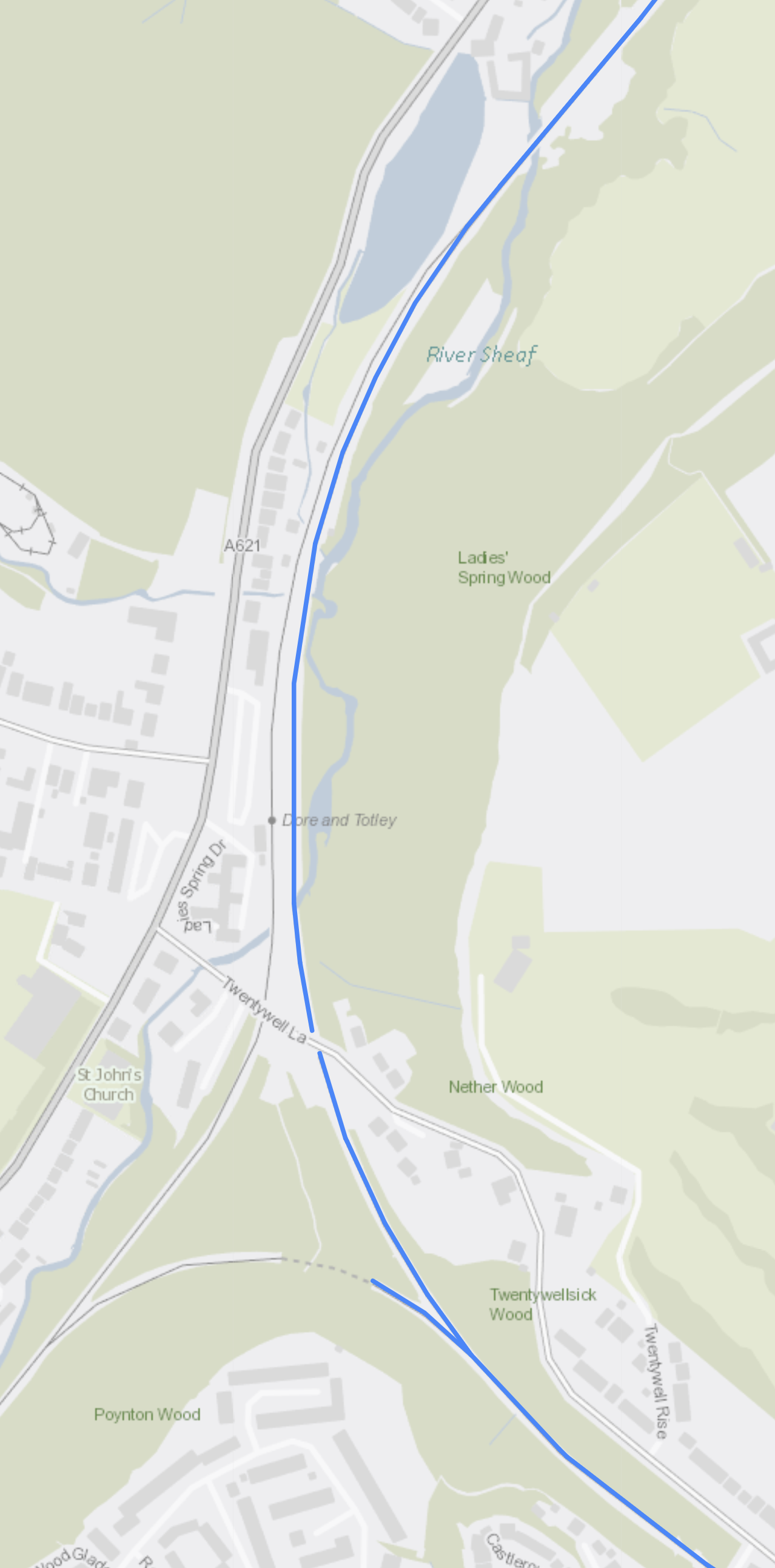
Note.
- Sheffield is to the North East.
- Chesterfield is to the South East,
- Totley junction is a large triangular junction, that connects to the Hope Valley Line.
These are some timings for various sections of the route.
- Clay Cross North Junction and Chesterfield (current) – 4 minutes
- Clay Cross North Junction and Sheffield (current) – 17 minutes
- Chesterfield and Sheffield (current) – 13 minutes
- Chesterfield and Sheffield (High Speed Two) – 13 minutes
- East Midlands Hub and Chesterfield (High Speed Two) – 16 minutes
- East Midlands Hub and Sheffield (High Speed Two) – 27 minutes
As Class Cross North Junction and Sheffield are 15.5 miles, this means the section is run at an average speed of 53 mph.
Can I draw any conclusions from the maps and timings?
- There would appear to be similar current and High Speed Two timings between Chesterfield and Sheffield.
- The various junctions appear to be built for speed.
The Midland Main Line will be electrified between Clay Cross North Junction and Sheffield, so that High Speed Two trains can use the route.
What will be the characteristics of the tracks between Clay Cross North Junction and Sheffield?
- Will it be just two tracks as it mainly is now or will it be a multi-track railway to separate the freight trains from the high speed trains?
- Will it have a high enough maximum speed, so that East Midland Railway’s new Class 810 trains can go at their maximum speed of 140 mph?
- Will it be capable of handling a frequency of 18 tph, which is the maximum frequency of High Speed Two?
Surely, it will be built to a full High Speed Two standard to future-proof the line.
Current Passenger Services Between Clay Cross North Junction And Sheffield Station
These trains use all or part of the route between Cross North Junction And Sheffield stations.
- CrossCountry – Plymouth and Edinburgh via Derby, Chesterfield, Sheffield and Leeds – 1 tph
- East Midlands Railway – London St. Pancras and Sheffield via Derby and Chesterfield – 2 tph
- East Midlands Railway – Liverpool Lime Street and Norwich via Stockport, The Hope Valley Line, Sheffield and Chesterfield – 1 tph
- Northern Trains – Manchester Piccadilly and Sheffield via the Hope Valley Line – 1 tph
- Northern Trains – Leeds and Nottingham via Meadowhall, Sheffield and Chesterfield – 1 tph
- TransPennine Express – Manchester Airport and Cleethorpes via Stockport, the Hope Valley Line and Sheffield – 1 tph
Note.
- tph is trains per hour.
- High Speed Two is currently planning to run two tph to Sheffield, which will run between Cross North junction and Sheffield stations.
- The services on the Hope Valley Line run on electrified tracks at the Manchester end.
These services can be aggregated to show the number of trains on each section of track.
- Hope Valley Line between Manchester and Totley junction – 3 tph
- Totley junction and Sheffield station – 7 tph
- Totley junction and Clay Cross North junction via Chesterfield – 4 tph
Adding in the High Speed Two services gives these numbers.
- Hope Valley Line between Manchester and Totley junction – 3 tph
- Totley junction and Sheffield station – 9 tph
- Totley junction and Clay Cross North junction via Chesterfield – 6 tph
This report on the Transport for the North web site, is entitled At A Glance – Northern Powerhouse Rail. It states that Transport for the North’s aspirations for Manchester and Sheffield are four tph with a journey time of forty minutes.
Adding in the extra train gives these numbers.
- Hope Valley Line between Manchester and Totley junction – 4 tph
- Totley junction and Sheffield station – 10 tph
- Totley junction and Clay Cross North junction via Chesterfield – 6 tph
This level of services can be accommodated on a twin-track railway designed to the right high speed standards.
Freight Services Between Clay Cross North Junction And Sheffield Station
The route is used by freight trains, with up to two tph on each of the three routes from Totley junction.
And these are likely to increase.
Tracks Between Clay Cross North Junction And Sheffield Station
I am absolutely certain, that two tracks between Clay Cross North junction And Sheffield station will not be enough, even if they are built to High Speed Two standards to allow at least 140 mph running under digital signalling.
Battery Electric Trains
The only battery-electric train with a partly-revealed specification is Hitachi’s Regional Battery Train, which is described in this Hitachi infographic.

Note.
- The train is a 100 mph unit.
- Ninety kilometres is fifty-six miles.
I would expect that battery-electric trains from other manufacturers like Alstom, CAF and Siemens would have similar performance on battery power.
In Thoughts On CAF’s Battery-Electric Class 331 Trains, I concluded CAF’s approach could give the following ranges.
- Three-car battery-electric train with one battery pack – 46.7 miles
- Four-car battery-electric train with one battery pack – 35 miles
- Four-car battery-electric train with two battery packs – 70 miles
I was impressed.
These are my thoughts on battery-electric trains on the routes from an electrified Sheffield.
Adwick
Sheffield and Adwick is 22.7 miles without electrification
I am sure that battery-electric trains can handle this route.
If the battery range is sufficient, there may not need to be charging at Adwick.
Bridlington
Sheffield and Bridlington is 90.5 miles without electrification, except for a short section through Doncaster, where trains could top up batteries.
I am sure that battery-electric trains can handle this route.
But there would need to be a charging system at Hull, where the trains reverse.
An alternative would be to electrify Hull and Brough, which is just 10.4 miles and takes about twelve minutes.
Derby Via The Midland Main Line
Clay Cross North junction and Derby is 20.9 miles without electrification.
I am sure that battery-electric trains can handle this route.
Gainsborough Central
Sheffield and Gainsborough Central is 33.6 miles without electrification
I am sure that battery-electric trains can handle this route.
But there will need to be a charging system at Gainsborough Central.
Huddersfield Via The Penistone Line
This is a distance of 36.4 miles with electrification at both ends, after the electrification between Huddersfield and Westtown is completed.
I am sure that battery-electric trains can handle this route.
Hull
Sheffield and Hull is 59.4 miles without electrification, except for a short section through Doncaster, where trains could top up batteries.
I am sure that battery-electric trains can handle this route.
But there will probably need to be a charging system at Hull.
An alternative would be to electrify Hull and Brough, which is just 10.4 miles and takes about twelve minutes.
Leeds Via The Hallam Or Wakefield Lines
This is a distance of 40-45 miles with electrification at both ends.
I am sure that battery-electric trains can handle this route.
Lincoln
Sheffield and Lincoln Central is 48.5 miles without electrification
I am sure that battery-electric trains can handle this route.
But there will probably need to be a charging system at Lincoln Central.
Manchester Via The Hope Valley Line
This is a distance of forty-two miles with electrification at both ends.
I am sure that battery-electric trains can handle this route.
Nottingham
Clay Cross North junction and Nottingham is 25.1 miles without electrification
I am sure that battery-electric trains can handle this route.
But there may need to be a charging system at Nottingham.
York
This is a distance of 46.4 miles with electrification at both ends.
I am sure that battery-electric trains can handle this route.
Is London St. Pancras And Sheffield Within Range Of Battery-Electric Trains?
In the previous section, I showed that it would be possible to easily reach Derby, as Clay Cross North junction and Derby is 20.9 miles without electrification.
- Current plans include electrifying the Midland Main Line as far North as Market Harborough.
- Market Harborough is 82.8 miles from London St. Pancras
- Derby is 128.3 miles from London St. Pancras
So what would be the best way to cover the 45.5 miles in the middle?
One of the best ways would surely be to electrify between Derby and East Midlands Parkway stations.
- Derby and East Midlands Parkway stations are just 10.2 miles apart.
- Current services take around twelve-fourteen minutes to travel between the two stations, so it would be more than enough time to charge a battery-electric train.
- Power for the electrification should not be a problem, as Radcliffe-on-Soar power station is by East Midlands Parkway station. Although the coal-fired power station will soon be closed, it must have a high class connection to the electricity grid.
- The East Midlands Hub station of High Speed Two will be built at Toton between Derby and Nottingham and will have connections to the Midland Main Line.
- An electrified spur could connect to Nottingham station.
I have flown my virtual helicopter along the route and found the following.
- Three overbridges that are not modern and built for large containers and electrification.
- Two level crossings.
- One short tunnel.
- Two intermediate stations.
- Perhaps half-a-dozen modern footbridges designed to clear electrification.
I’ve certainly seen routes that would be much more challenging to electrify.
I wonder if gauge clearance has already been performed on this key section of the Midland Main Line.
If this section were to be electrified, the sections of the Midland Main Line between London St. Pancras and Sheffield would be as follows.
- London St. Pancras and Market Harborough – Electrified – 82.8 miles
- Market Harborough and East Midlands Parkway – Not Electrified – 35.3 miles
- East Midlands Parkway and Derby – Electrified – 10.2 miles
- Derby and Clay Cross North junction – Not Electrified – 20.9 miles
- Clay Cross North junction and Sheffield – Electrified – 15.5 miles
Note.
- The World Heritage Site of the Derwent Valley Mills is not electrified, which could ease the planning.
- Leicester station with its low bridge, which could be difficult to electrify, has not been electrified.
- Under thirty miles of electrification will allow battery-electric trains to run between London St. Pancras and Sheffield, provided they had a range on batteries of around forty miles.
Probably, the best way to electrify between East Midlands Parkway and Derby might be to develop a joint project with High Speed Two, that combines all the power and other early works for East Midlands Hub station, with the electrification between the two stations.
Will The Class 810 Trains Be Converted To Battery-Electric Operation?
Hitachi’s Class 8xx trains tend to be different, when it comes to power. These figures relate to five-car trains.
- Class 800 train – 3 x 560 kW diesel engines
- Class 801 train – 1 x 560 kW diesel engine
- Class 802 train – 3 x 700 kW diesel engines
- Class 803 train – All electric – No diesel and an emergency battery
- Class 805 train – 3 x 700 kW diesel engines (?)
- Class 807 train – All electric – No diesel or emergency battery
- Class 810 train – 4 x 700 kW diesel engines (?)
Note.
- These figures relate to five-car trains.
- Class 807 train are seven-car trains.
- Where there is a question mark (?), the power has not been disclosed.
- Hitachi use two sizes of diesel engine; 560 kW and 700 kW.
It was generally thought with the Class 810 train to be used on the Midland Main Line, will be fitted with four engines to be able to run at 125 mph on diesel.
But are they 560 kW or 700 kW engines?
- A Class 802 train has an operating speed of 110 mph on diesel, with 2100 kW of installed power.
- To increase speed, the power will probably be related to something like the square of the speed.
So crudely the power required for 125 mph would be 2100*125*125/110/110, which works out at 2712 kW.
Could this explain why four engines are fitted? And why they are 700 kW versions?
Interestingly, I suspect, Hitachi’s five-car trains have two more or less identical driver cars, except for the passenger interiors, for the efficiency of manufacturing and servicing.
So does that mean, that a fifth engine could be fitted if required?
There probably wouldn’t be a need for five diesel engines, but as I also believe that the Hyperdrive Innovation battery packs for these trains are plug-compatible with the diesel engines, does that mean that Hitachi’s trains can be fitted with five batteries?
Suppose you wanted to run a Class 810 train at 125 mph to clear an electrification gap of forty miles would mean the following.
- It would take 0.32 hours or 19.2 minutes to cross the gap.
- In that time 2800 kW of diesel engines would generate 896 kWh.
- So to do the same on batteries would need a total battery capacity of 896 kWh.
- If all diesel engines were replaced, each battery would need to be 224 kWh
A battery of this size is not impractical and probably weighs less than the at least four tonnes of the diesel engine it replaces.
Conclusions
Electrification between Clay Cross North Junction and Sheffield station is an important project that enables the following.
- A high proportion of diesel services to and from Sheffield to be converted to battery-electric power.
- With electrification between Derby and East Midlands Parkway, it enables 125 mph battery-electric trains to run between London St. Pancras and Sheffield.
- It prepares Sheffield for High Speed Two.
It should be carried out as soon as possible.
Tideway – Blackfriars Bridge Foreshore – 4th September 2021
I passed Tideway’s Blackfriars Bridge Foreshore site on the way home and took these pictures.






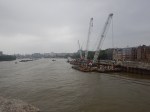

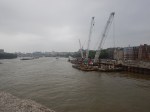

This page on the Tideway web site, gives a visualisation of the project.
Denmark Hill Station – 4th September 2021
The article on Rail Technology Magazine is entitled Denmark Hill Station First To Use Innovative Solar Technology In Europe.
The first two paragraphs describe the technology.
Denmark Hill station has become the first train station in Europe to have BIPVco’s Flextron thin film technology installed, on top of other upgrades, following a £7.5m extension.
The sophisticated and flexible solar panels are different from traditional ‘glass like’ panels, requiring no additional weight support, and will be used across other stations going forward.
Note.
- In the application of the technology at Denmark Hill station, a surplus of electricity is returned to the grid.
- BIPVco is a company based in South Wales, that evolved from research by Tata Steel and Swansea University, with the backing of the Welsh Government.
- The panels are lightweight, flexible, durable and self-cleaning.
Many years ago, I put up a barn based on timber beams, which had a sheet steel roof. These panels would be ideal for many agricultural buildings, like the one I commissioned.
These are pictures I took at Denmark Hill station, this morning.


Note.
- The original station was designed by Charles Henry Driver.
- The new entrance displays a high degree of craftsmanship, especially in the brickwork.
- The coffee and gluten-free cake I had in FCB Coffee were excellent.
- The station has its own pub; The Phoenix.
According to Network Rail, it has already been nominated for two architectural awards.
Northern line Extension’s Opening Date Announced
The title of this post, is the same as that of this article on Ian Visits.
Services will start on Monday, September 20th.
This sentence from Ian describes the service levels.
There will be an initial peak time service of six trains per hour on the extension, increasing to 12 trains per hour by mid-2022. There will be five trains per hour during off-peak times, doubling to 10 trains per hour next year.
I shall certainly try it when it opens, but I doubt I’ll be a regular user, as the Charing Cross Branch of the Northern Line can be difficult to access from Dalston. My best way is probably to use a 73 bus to Goodge Street station.
How Do I Use The Northern Line to Go Between The new Battersea Power Station Station and Bank or Moorgate Stations?
This map from cartometro.com shows, the track layout of the extension.
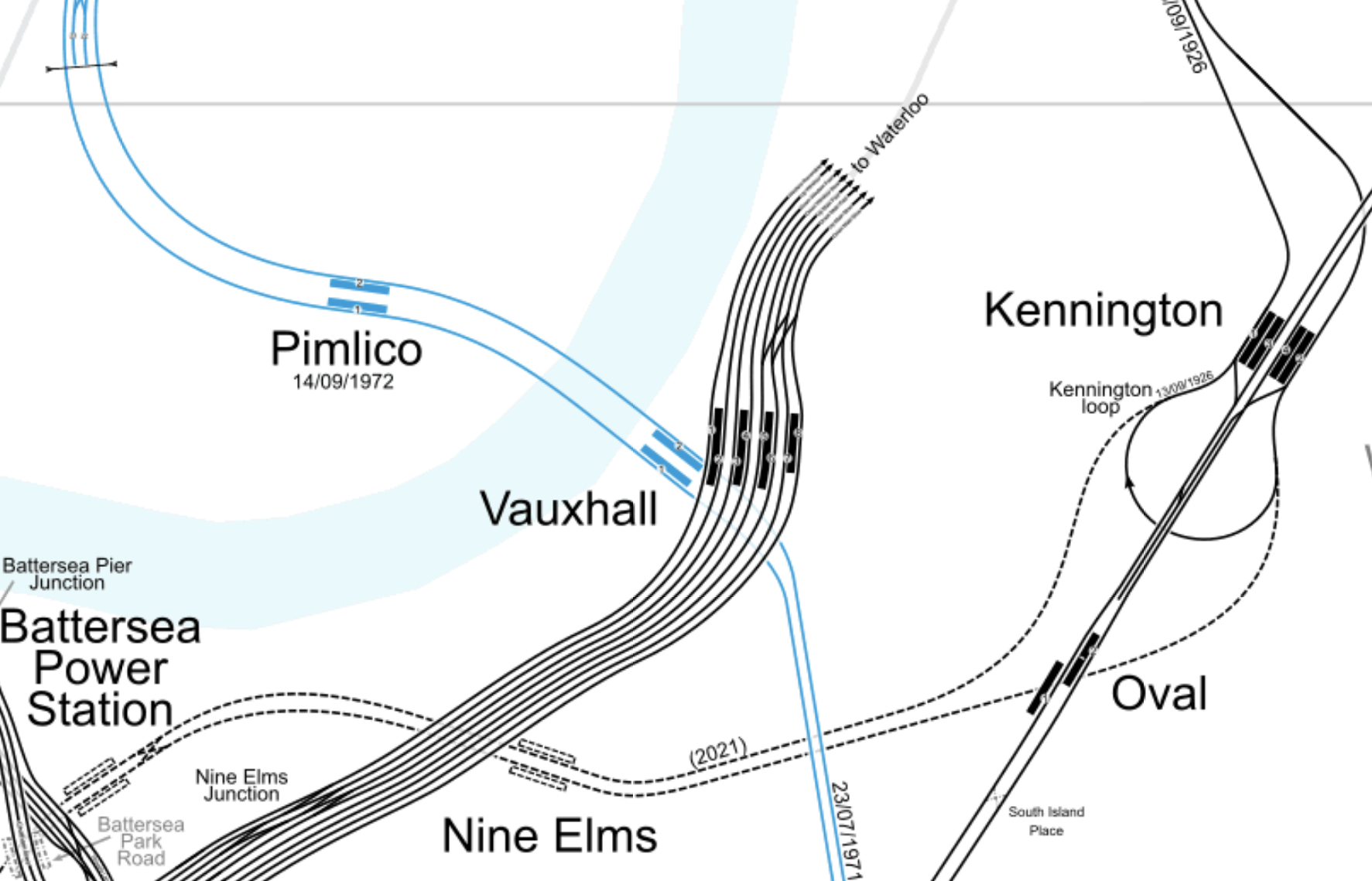
Note.
- The extension to Battersea links to the loop that turns trains that have come South through London on the Charing Cross Branch of the Northern Line, which runs North-Westerly from Kennington station.
- The Bank Branch of the Northern Line is the pair of tracks that runs North-Easterly from Kennington station.
- The Victorian builders of the Northern Line didn’t dig the tunnels and add the track, so that the loop could turn trains coming South through London on the Bank Branch of the Northern Line.
So passengers will have to change, with these possible routes.
- For London Bridge, Bank, Moorgate and Old Street change at Kennington for the Bank Branch of the Northern Line.
- For Piccadilly Circus, Oxford Circus and Paddington change at Waterloo for the Bakerloo Line.
- For Canary Wharf, London Bridge, Westminster, Green Park, Bond Street, Baker Street and Paddington change at Waterloo for the Jubilee Line.
- For Tower Hill, Monument, Westminster, Victoria and South Kensington change at Embankment for the Circle or District Lines.
- For Holborn and Kings Cross St. Pancras and Harrods change at Leicester Square for the Piccadilly Line.
- For Liverpool Street, Bank, St. Paul’s, Holborn, Bond Street and Marble Arch change at Tottenham Court Road for the Central Line.
- For Canary Wharf, Liverpool Street, Moorgate, , Bond Street, Paddington and Heathrow change at Tottenham Court Road for Crossrail.
Note.
- These are a selection of the possible routes available.
- I have included some of the possible routes to London’s important transport, tourism and business hubs.
- I suspect many will change at Tottenham Court Road station for the City, as the station has been completely rebuilt for Crossrail with full step-free access.
Residents and visitors to the large amounts of new residential properties around Battersea Power Station and Nine Elms stations, will probably find their best routes fairly quickly, but there are a large number of routes to try to most important hubs.
Will Battersea Become An Area, Where Visitors To London Stay?
Consider.
- The Northern Line Extension has connections to to Central London’s important transport, tourism and business hubs.
- The Thames Clippers give access to the Thames.
- There appears to be several good hotels open in the area.
- For Gatwick Airport, it’s Gatwick Express and a taxi from Victoria station, at around a tenner.
- For Heathrow Airport, it’s an easy journey from Heathrow on Crossrail with a change at Tottenham Court Road.
- For City Airport, it’s a direct journey on a Thames Clipper from Royal Wharf to Battersea Power Station pier.
- For Eurostar, it’s probably a £25 taxi from St. Pancras, but if you know the Underground there are several one-change routes via Euston, Kennington, Leicester Square and Warren Street.
I feel that if they get the hotels and the hospitality right, that the area could become an important one for visitors to London.
Battery-Electric Trains And The TransPennine Upgrade
In Is There Going To Be Full Electrification Between Leeds And Huddersfield?, I showed this map of the TransPennine Upgrade between Huddersfield and Westtown near Dewsbury.
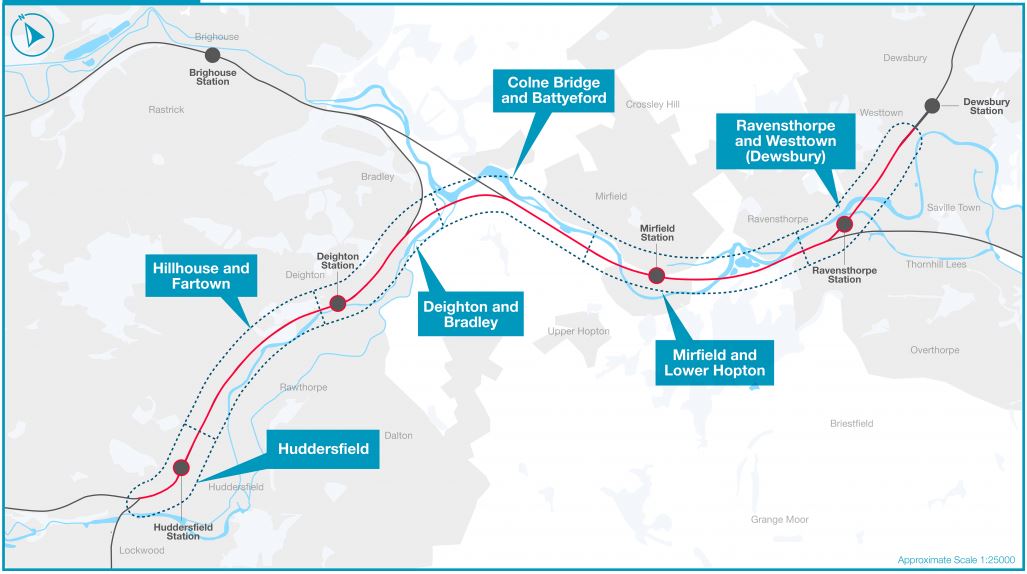
Note.
- There will be electrification between Dewsbury and Huddersfield.
- Tracks will be doubled from two to four.
- Ravensthorpe, Mirfield, Deighton and Huddersfield stations will be electrified and probably upgraded.
- Dewsbury and Huddersfield stations are eight miles apart.
This page on the Network Rail website gives more information.
Click on Huddersfield and Westtown (Dewsbury) and you get this information.
On 31 March 2021, we submitted a Transport and Works Act Order (TWAO) application to the Secretary of State for Transport for the Huddersfield to Westtown (Dewsbury) scheme.
Throughout this eight-mile section of the route, we’re proposing to double the number of tracks from two-to-four, electrify from Huddersfield to Dewsbury and make big improvements to the four stations in this section – Huddersfield, Deighton, Mirfield and Ravensthorpe; where we also need to separate the lines going to/from Leeds from the lines going to/from Wakefield, with either a bridge or a tunnel.
It is a much larger scheme than the one between Bolton and Wigan, which I wrote about in Bolton-Wigan £78m Rail Electrification Project Announced.
- Huddersfield-Westtown is eight miles, whereas Bolton-Wigan is 6.5 miles.
- Both involve upgrading four stations.
- Both involve full electrification.
- Huddersfield-Westtown involves doubling the number of tracks, whereas Bolton-Wigan needs little work to the track.
- Huddersfield-Westtown will need a bridge or a tunnel, whereas Bolton-Wigan might need minor work to a couple of flat junctions.
- Huddersfield station is Grade 1 Listed, whereas Wigan Wallgate station has some good features.
- The Huddersfield-Westtown scheme is costed at £2.9 billion, whereas Bolton-Wigan is just £78 million.
The Huddersfield-Westtown scheme is thirty-seven times larger in terms of money.
What Passenger Services Use The Route Between Huddersfield And Dewsbury?
These services use the route, all or in part.
- Northern Trains – Wigan Wallgate and Leeds via Manchester Victoria, Hebden Bridge, Brighouse, Mirfield, Ravensthorpe and Dewsbury – 1 tph
- Northern Trains – Huddersfield and Castleford via Deighton, Mirfield and Wakefield Kirkgate – 1 tph
- TransPennine Express – Liverpool Lime Street and Scarborough via Manchester Victoria, Stalybridge, Huddersfield and Leeds – 1 tph
- TransPennine Express – Manchester Airport and Redcar Central via Manchester Victoria, Stalybridge, Huddersfield, Dewsbury and Leeds – 1 tph
- TransPennine Express – Liverpool Lime Street and Edinburgh via Manchester Victoria, Huddersfield and Leeds – 1 tph
- TransPennine Express – Manchester Airport and Newcastle via Manchester Victoria, Huddersfield, Dewsbury and Leeds – 1 tph
- TransPennine Express – Manchester Piccadilly and Hull via Stalybridge, Huddersfield and Leeds – 1 tph
- TransPennine Express – Huddersfield and Leeds via Deighton, Mirfield, Ravensthorpe and Dewsbury – 1 tph
Note.
- All trains are one train per hour (tph)
- Three tph run non-stop between Huddersfield and Leeds.
- Two tph stop at Deighton station, Mirfield and Ravensthorpe.
After completion of the Huddersfield and Westtown upgrade, there will be electrification at the following places.
- West of Manchester Victoria station
- Between Huddersfield and Westtown
- Between Leeds and York – Currently being electrified between York and Church Fenton.
And these routes will not be electrified.
- Dewsbury and Leeds – 9.2 miles
- Leeds and Hull – 51.5 miles
- Mirfield and Castleford – 16 miles
- Manchester Piccadilly and Stalybridge – Could be electrified – 7.5 miles
- Manchester Victoria and Heaton Lodge Junction via Hebden Bridge – 47.4 miles
- Manchester Victoria and Stalybridge – Could be electrified – 7.7 miles
- Redcar Central and Northallerton – 28.1 miles
- Stalybridge and Huddersfield – 18 miles
- York and Scarborough – 42.1 miles
Note that all routes except Mirfield and Castleford and Leeds and Hull have electrification at both ends.
Which Routes Between Huddersfield And Westtown Could Be Handled By Battery-Electric Trains?
I will assume that operators will have a battery-electric train capable of running 56 miles on batter ypower. This distance comes from Hitachi’s specification for the Hitachi Regional Battery Train, which is shown in this Hitachi infographic.
These are the routes and my answers.
Northern Trains – Wigan Wallgate and Leeds
The longest section without electrification is Manchester Victoria and Heaton Lodge Junction via Hebden Bridge, which is 47.4 miles.
I am sure this route is possible with battery-electric trains.
Northern Trains – Huddersfield and Castleford
The longest section without electrification is Mirfield and Castleford, which is 16 miles.
But it must be handled on both an out and back basis. So the train will cover 32 miles on battery power.
I am sure this route is possible with battery-electric trains.
TransPennine Express – Liverpool Lime Street and Scarborough
The longest section without electrification to the West of Leeds, is Manchester Victoria and Huddersfield, which is 25.7 miles.
At the Eastern end, as York and Scarborough is 42.1 miles without electrification, there would need to be some electrification or a charging system at Scarborough station.
I am sure this route is possible with battery-electric trains.
TransPennine Express – Manchester Airport and Redcar Central
The longest section without electrification to the West of Leeds,is Manchester Victoria and Huddersfield, which is 25.7 miles.
At the Eastern end, as Northallerton and Redcar Central is 28.1 miles without electrification, there may need to be some electrification or a charging system at Redcar Central station.
I am sure this route is possible with battery-electric trains.
TransPennine Express – Liverpool Lime Street and Edinburgh
The longest section without electrification is Manchester Victoria and Huddersfield, which is 25.7 miles.
Leeds and Edinburgh is fully electrified.
I am sure this route is possible with battery-electric trains.
TransPennine Express – Manchester Airport and Newcastle
The longest section without electrification is Manchester Victoria and Huddersfield, which is 25.7 miles.
Leeds and Newcastle is fully electrified.
I am sure this route is possible with battery-electric trains.
TransPennine Express – Manchester Piccadilly and Hull
The longest section without electrification to the West of Leeds, is Manchester Victoria and Huddersfield, which is 25.5 miles.
At the Eastern end, as Leeds and Hull is 51.5 miles, there would need to be some electrification or a charging system at Hull station.
I am sure this route is possible with battery-electric trains.
TransPennine Express – Huddersfield and Leeds
The longest section without electrification is Dewsbury and Leeds, which is 9.2 miles.
I am sure this route is possible with battery-electric trains.
Handling The Eastern Ends
At Hull, Redcar Central and Scarborough stations, there will need to be some means to recharge the trains, so they can get back to the electrification on the East Coast Main Line.
There could either be a short length of 25 KVAC overhead electrification or a special-purpose charging station.
There would need to be an allowance in the turnback, of perhaps 10-15 minutes to make sure trains started back with full batteries.
Will Huddersfield And Westtown Be Long Enough To Charge A Battery-Electric Train?
I have looked at train times between Huddersfield And Westtown and typically trains take around 11-12 minutes to go between Huddersfield and Dewsbury stations.
That should probably be enough, especially, as the trains will probably be using regenerative braking to batteries at any station stops.
Conclusion
I am absolutely certain that by completing the TransPennine Upgrade with full electrification between Huddersfield and Westtown, that all passenger services through the section could be run by battery-electric trains with a range of ninety kilometres or fifty-six miles.
There would probably need to be some electrification or a charging system at Hull, Redcar Central and Scarborough stations.
A Thought On Short Sections Of Electrification
As with the Bolton-Wigan scheme to the West of the Pennines, a length of electrified track that is less than ten miles, allows several services to be run by battery-electric trains and decarbonised.
How many other sections of less than ten miles of electrification can transform train services and reduce the use of diesel around the UK, by the introduction of fleets of battery-electric trains?
Skeleton To Supply Ultracapacitors To CAF
The title of this post, is the same as that of this article on Electrive.
These two sentences are in the last paragraph.
In its German plant in Großröhrsdorf, Skeleton Technologies is working on so-called hybrid energy storage systems. In short, the advantages of lithium-ion batteries (high energy density) are to be combined with the advantages of ultracapacitors (high performance, long service life) in such hybrid storage systems
But I suggest you read the article as it indicates how supercapacitors could be used on battery-trams and trains.
If CAF use supercapacitors on their trains it will not be their first application on heavy rail in the UK. In Brush Traction Signs Contract With Skeleton Technologies For Modules For Class 769 Trains, I describe how supercapacitors are used to start the engines.
Thoughts On CAF’s Battery-Electric Class 331 Trains
I first wrote about CAF’s battery-electric trains in Northern’s Battery Plans, where I describe how CAF and Northern are planning to convert a number of three-car Class 331 trains into four-car battery-electric trains.
- The fourth car would contain batteries.
- Batteries would also be added to the PTS (pantograph) car.
I suspect that the battery range could be arranged so that all Northern’s routes suitable for battery-electric operation could be handled.
These are my thoughts.
How Much Would The Conversion Cost?
I will first make rough estimate of what the extra car would cost.
Northern placed a £500 million order for the following trains.
- 31 x three-car Class 331 trains
- 12 x four-car Class 331 trains
- 25 x two-car Class 195 trains
- 33 x three-car Class 195 trains
This is a total of 290 trains.
So on a rough estimate, each car will cost around £1.72 million.
As batteries would also be added to the pantograph car, the cost of updating a three-car train to a four-car battery-electric train would probably be around two million.
Why Are CAF Proposing A Four-Car Train With Two Battery Cars?
When I first read about CAF’s and Northern’s plans, I wondered, why CAF were also putting batteries in the pantograph car, as surely, with their extensive experience with battery-powered trains, CAF could fit enough batteries into one battery-car for a reasonable range, as Bombardier did seven years ago.
Having done all the calculations around Wigan and Bolton in Bolton-Wigan £78m Rail Electrification Project Announced, I suspect that CAF and Northern want a trans-Pennine range, so they can compete with TransPennine Express.
Two cars with batteries is probably needed for that.
Could The Three-Car Trains Be Converted To Three-Car Battery-Electric Trains?
But there is a collateral benefit of putting batteries in the pantograph car.
I suspect that in a four-car Class 331 trains have a trans-Pennine range, which between Manchester Victoria and Leeds stations is 50.2 miles and between Carlisle and Newcastle stations is 61.5 miles. So let’s say that the four-car Class 331 train with two battery packs has a range of 70 miles.
So what would be the range of a three-car train with one battery pack.
One battery pack would only take a four-car train 35 miles, so a single battery pack would contain 140 car-miles of electricity.
If a single-battery were to be fitted to the pantograph car of a three-car train, 140 car-miles would give a range of 46.7 miles.
My conclusion about the Bolton and Wigan electrification in Bolton-Wigan £78m Rail Electrification Project Announced, was as follows.
This electrification of just 6.5 miles of double-track between Lostock junction and Wigan Wallgate station seems to be one of the smaller electrification projects.
But on closer examination, when linked to a fleet of battery-electric trains with a range of perhaps forty miles, the electrification enables battery-electric trains to run these services.
- Southport And Alderley Edge
- Southport And Stalybridge
- Kirkby And Manchester Victoria
With a charging station in Blackburn station, then the Wigan Wallgate And Blackburn service can be added.
All these four services could be run by three-car battery-electric Class 331 trains. And if the services are to be run by six-car trains, a pair can be coupled up.
What Would Be The Range Of A Four-Car Battery-Electric Train With Only One Battery?
If I’m right that a four-car battery-electric Class with two batteries has a range of seventy miles across the Pennines, then a train with one battery should be able to manage 35 miles.
Conclusion
It sounds like the Spanish might have come up with a cunning plan, that might be able to convert both three- and four-car Class 331 trains to battery-electric operation.
By adding a battery to the pantograph car, this enables a four-car battery-electric train with a trans-Pennine range.
Summing up the various options gives the following ranges.
- Three-car battery-electric train with one battery pack – 46.7 miles
- Four-car battery-electric train with one battery pack – 35 miles
- Four-car battery-electric train with two battery packs – 70 miles
I’m impressed.
 The Anonymous Widower