SSE Goes Global To Reap The Wind
The title of this article on This Is Money is Renewable Energy Giant SSE Launches Plan To Become Britain’s First Global Windfarm Business As it Invests Up To £15bn Over Next Decade.
The title is a good summary of their plans to build wind farms in Continental Europe, Denmark, Japan and the US, in addition to the UK and Ireland.
I can also see the company developing more integrated energy clusters using the following technologies.
- Wind farms that generate hydrogen rather than electricity using integrated electrolysers and wind turbines, developed by companies like ITM Power and Ørsted.
- Reusing of worked out gasfields and redundant gas pipelines.
- Zero-carbon CCGT power stations running on Hydrogen.
- Lots of Energy storage.
I talked about this type of integration in Batteries Could Save £195m Annually By Providing Reserve Finds National Grid ESO Trial.
In the related post, I talked about the Keadby cluster of gas-fired power stations, which are in large part owned by SSE.
Conclusion
I think that SSE could be going the way of Equinor and Ørsted and becoming a global energy company.
It is also interesting the BP and Shell are investing in renewable energy to match the two Scandinavian companies.
Big Oil seems to be transforming itself into Big Wind.
All these companies seem to lack grid-scale energy storage, although hydrogen can be generated and stored in worked-out gas fields.
So I would expect that some of the up-and-coming energy storage companies like Gravitricity, Highview Power and RheEnergise could soon have connections with some of these Big Wind companies.
Think Britain To Belfast Is A Bridge Too Far? Try Tunnelling Across Instead
The title of this post, is the same as that of this article in The Sunday Times.
It is a well-written article, with good graphics and maps, which fills out the descriptive title.
This paragraph sums up the overall objective.
For the rail industry, it is part of a long-term ambition to reduce journeys by rail between London and Glasgow and Edinburgh to below three hours, which it is also advocating in the review. Trains to Belfast would turn west near Carlisle, around the Scottish border, and lorries bound for Ireland could be loaded there.
The article also predicts London and Belfast in four hours, with Dublin in six.
In a A Glimpse Of 2035, I looked into the future and left London at eight in the morning on the first train between London and Dublin and arrived at 13:30.
My predictions were thirty minutes less than The Times.
But I also predicted, that eventually, times will be three hours to Belfast and four to Dublin.
A Deep Water Port At Shannon And Its Consequences
One thing not mentioned in the Times article, is that the Irish Government and the EU have a plan to develop a deep water port at Shannon.
It would have a rail link to any rail link to the UK and would speed goods between Germany and North America, avoiding the increasingly congested ports of Rotterdam and Hamburg. Time savings of as much as a day are predicted.
I should say, that I part-grew up in Felixstowe in the 1950s and 1960s and I can remember a sleepy little dock with a giant crane to lift seaplanes out of the water, before the massive container port we know today. There are now something like forty container trains per day, going along the sleepy branch line to Ipswich and then to the rest of the UK mainland. If anybody had predicted that in 1960, they’d have been laughed at.
If the Shannon Port is built, I can see twenty high-speed freight trains per day between Shannon and the Channel Tunnel. There will probably need to be massive improvements to the freight network in the South East of England, to get all those freight trains through or around London.
Standard Or Irish Gauge
If the EU develops the deep water port at Shannon, this would surely be rail connected to the new tunnel.
But the EU only likes to build standard gauge railways, so everybody can use them. I would expect that all new tracks in the Republic of Ireland would be standard gauge.
If you look at Spain, all their high-speed railways are standard gauge and they have both narrow and Spanish gauge railways as well.
Some of the awkward squad in Ireland will object to the standard gauge railways, but he who pays the piper calls the tune.
As the UK will be paying from London to the place where the tunnel emerges and the EU from South of the Irish border, it would be much cheaper to make all the route standard gauge. But some diehards would be against it!
Nine Elms Gateways By Projects Office
I first heard of this project in September last year, in this article on Ian Visits, which is entitled Nine Elms Railway Arch To Be Opened As Pedestrian Tunnel.
Ian introduces the problem like this.
A blocked off railway arch under the tracks in Nine Elms could be opened up as a new pedestrian tunnel. What is officially plain Arch 42 would create a walking link that starts just outside the back of the future Nine Elms station on the Northern line and the cluster of new blocks of flats and the US Embassy on the north side of the mainline railway.
I would appear to be a shorter walking route.
This Google Map shows the area.

Note.
- The substantial box-like structure with all the buttresses in the South-East corner of the map is the future Nine Elms station.
- Arch 42 is one of the arches, that pass under the railway crossing the North West corner of the map.
It would appear that the proposal to turn the arch into a tunnel could be a good idea.
This article on SWLondoner is entitled Nine Elms Viaduct To Get “Tunnel Vision” Makeover and gives a few details of the project.
This page on the Projects Office web site shows a visualisation of the tunnel.
Have a look and see what you think!
Note.
- In the visualisation, there is a signal gantry across the track, which is also shown in the map above.
- What will be the building material? Brick, steel or even recycled plastic?
I used to know a free-style bricklayer, who would have created an interesting portal.
I like the design and can’t wait to see it in reality!
You certainly won’t miss it, if you’re looking for it to get to the US Embassy or another building on the other side of the tracks.
Conclusion
Could Projects Office have come up with a distinctive way of making tunnels under railways and roads more welcoming?
First Planning Applications Due On Northumberland Line
The title of this post, is the same as that of this article on the News Post Leader.
I described the Northumberland Line projevt in Trains: £34m For Revival Of 50-Year-Old North-East Railway Line, which I wrote a fortnight ago.
This paragraph from the News Post Leader article, describes the scope of the project.
The project will upgrade 18 miles of track, open six new stations, three new footbridges and new signal locations.
And this paragraph, describes the initial work.
Planning applications are set to be submitted to the council for new stations at Ashington and Northumberland Park in North Tyneside, along with a new footbridge at Chase Meadows in Bebside.
It is aimed to open the passenger service in 2024.
Chase Meadows Footbridge, Bebside
This Google Map shows the location of the new footbridge at Chase Meadows in Bebside.

Note.
- The A189 dual-carriageway running North-South.
- The single-track Northumberland Line curving in a similar direction
- Blyth Academy looks to be an important school.
- Chase Meadows runs from the Academy to the railway.
I have no clue, as to where Bebside station is to be built, but it would seem logical for this to happen on the sizeable plot between the road and the railway. This currently appears to be a small farm, with horses in the fields.
This second Google Map shows where the railway crosses the road.

Note, the path going alongside the road to Asda.
Will the bridge be built on the North-East or South-West side of the railway?
I will assume it will be step-free with either ramps or lifts.
This picture shows Horden station.
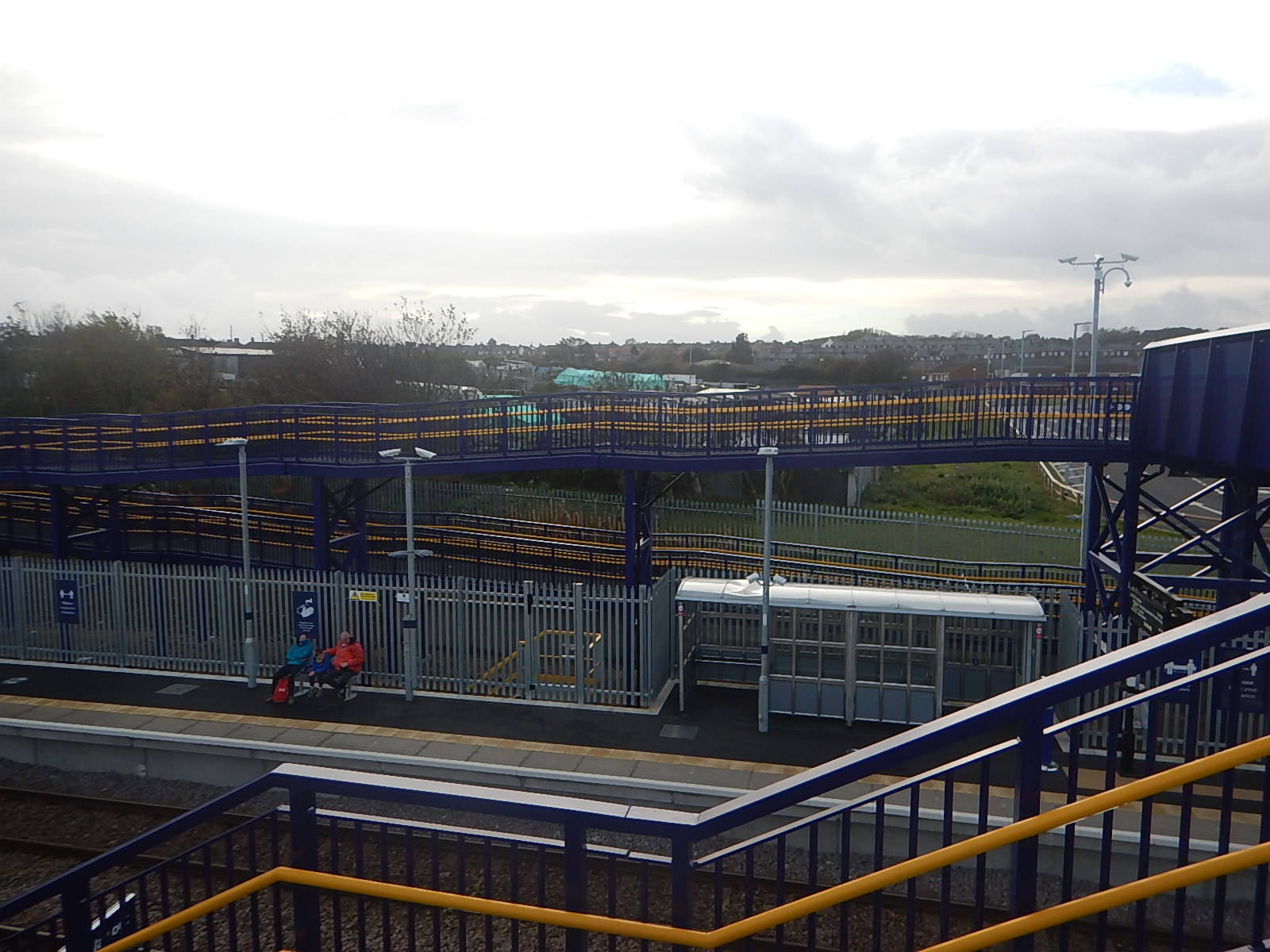
This station is South of Newcastle and only has ramps, so will something similar be built here?
Batteries Could Save £195m Annually By Providing Reserve Finds National Grid ESO Trial
The title of this post, is the same as that of this article on Current News.
The title gives the findings of the Arenko-led trial.
What Is The National Grid Reserve Service?
It’s all about providing capacity for the National Grid Reserve Service, which is described in this Wikipedia entry. This is the introductory paragraph.
To balance the supply and demand of electricity on short timescales, the UK National Grid has contracts in place with generators and large energy users to provide temporary extra power, or reduction in demand. These reserve services are needed if a power station fails for example, or if forecast demand differs from actual demand. National Grid has several classes of reserve services, which in descending order of response time are: Balancing Mechanism (BM) Start-Up, Short-Term Operating Reserve, Demand Management and Fast Reserve.
The Wikipedia entry is very comprehensive.
A Collateral Benefit
This is a paragraph from the article.
Additionally, unlike CCGT plants, batteries do not need to be producing power in order to provide Reserve as they can charge when there is abundant renewable energy on the grid, and then wait to react when needed. As CCGT’s need to be producing power to provide this service, it can led to renewables switched off in favour of the more carbon intensive fossil fuel generation, to ensure Reserve is available if needed.
The article concludes that Reserve from Storage could help National Grid ESO’s reach their target of net-zero operation by 2025.
Could We Replace CCGT Plants With Batteries?
CCGT or combined cycle gas-turbine power plants are efficient ways to turn natural gas into electricity.
- Typical sizes are around 800 MW.
- They are reasonably quick and easy to build.
- As their fuel comes by a pipeline, they don’t need to be connected to the rail network, unlike biomass and coal power plants.
Because they burn methane, they still emit a certain amount of carbon dioxide, although levels much less than an equivalent coal-fired power station.
In Energy In North-East Lincolnshire, I described the three Keadby power stations.
- Keadby – In operation – 734 MW
- Keadby 2 – Under construction – 840 MW
- Keadby 3 – In planning – 910 MW
In total, these three power stations will have a capacity of 2484 MW.
By comparison, Hinckley Point C will have a capacity of 3200 MW.
Add Keadby 4 and the four CCGTs would provide more electricity, than Hinckley Point C.
I think it would be very difficult to replace a cluster of CCGT gas-fired power stations or a big nuclear power plant with the sort of batteries being deployed today. 2.5 to 3 GW is just so much electricity!
I do believe though, that instead of building a 3200 MW nuclear power plant, you could build a cluster of four 800 MW CCGTs.
But What About The Carbon Dioxide?
Using the Keadby cluster of CCGTs as an example.
- Keadby 2 and Keadby 3 are being built to be upgraded with carbon-capture technology.
- The HumberZero gas network will take the carbon dioxide away for storage in worked-out gas fields in the North Sea.
- Some carbon dioxide will be fed to salad vegetables and soft fruits in greenhouses, to promote growth.
- Keadby 2 and Keadby 3 are being built to be able to run on hydrogen.
- The HumberZero network will also be able to deliver hydrogen to fuel the power stations.
I’m certain we’ll see some of the next generation of wind turbines delivering their energy from hundreds of miles offshore, in the form of hydrogen by means of a pipe.
The technology is being developed by ITM Power and Ørsted, with the backing of the UK government.
- Redundant gas pipelines can be used, to bring the hydrogen to the shore
- The engineering of piping hydrogen to the shore is well-understood.
- Redundant gas pipelines can be used if they already exist.
- Gas networks can be designed, so that depleted gas fields can be used to store the gas offshore, in times when it is not needed.
But above all gas pipelines cost less than DC electricity links, normally used to connect turbines to the shore.
I can see very complicated, but extremely efficient networks of wind turbines, redundant gas fields and efficient CCGT power stations connected together by gas pipelines, which distribute natural gas, hydrogen and carbon dioxide as appropriate.
Could Offshore Hydrogen Storage And CCGTs Provide The Reserve Power
Consider.
- Using a CCGT power station to provide Reserve Power is well understood.
- Suppose there is a large worked out gasfield, near to the power station, which has been repurposed to be used for hydrogen storage.
- The hydrogen storage is filled using hydrogen created by offshore wind turbines, that have built in electrolysers, like those being developed by ITM Power and Ørsted.
- One of more CCGTs could run as needed using hydrogen from the storage as fuel.
- A CCGT power station running on hydrogen is a zero-carbon power station.
Effectively, there would be a giant battery, that stored offshore wind energy as hydrogen.
I can see why the UK government is helping to fund this development by ITM Power and Ørsted.
Could We See Cradle-To-Grave Design Of Gas Fields?
I suspect that when a gas field is found and the infrastructured is designed it is all about what is best in the short term.
Suppose a gas field is found reasonably close to the shore or in an area like the Humber, Mersey or Tees Estuaries, where a lot of carbon dioxide is produced by industries like steel, glass and chemicals!
Should these assessments be done before any decisions are made about how to bring the gas ashore?
- After being worked out could the gas field be used to store carbon dioxide?
- After being worked out could the gas field be used to store natural gas or hydrogen?
- Is the area round the gas field suitable for building a wind farm?
Only then could a long-term plan be devised for the gas-field and the infrastructure can be designed accordingly.
I suspect that the right design could save a lot of money, as infrastructure was converted for the next phase of its life.
Conclusion
It does appear that a lot of money can be saved.
But my rambling through the calculations shows the following.
Wind Turbines Generating Hydrogen Give Advantages
These are some of the advantages.
- Hydrogen can be transported at less cost.
- Hydrogen is easily stored if you have have a handy worked-out gas field.
- The technology is well-known.
Hydrogen can then be converted back to electricity in a CCGT power station
The CCGT Power Station Operates In A Net-Zero Carbon Manner
There are two ways, the CCGT station can be run.
- On natural gas, with the carbon-dioxide captured for use or storage.
- On hydrogen.
No carbon-dioxide is released to the atmosphere in either mode.
The Hydrogen Storage And The CCGT Power Station Or Stations Is Just A Giant Battery
This may be true, but it’s all proven technology, that can be used as the Power Reserve.
Power Networks Will Get More Complicated
This will be inevitable, but giant batteries from various technologies will make it more reliable.
The Recovery Trial And Coeliac Disease
The Recovery Trial appears to have been a success, with another drug announced to have positive benefits in fighting Covid-19 today.
As a coeliac on a long-term gluten-free diet like up to one-in-100 or even 1-in-50, in the UK, I wonder what they have found out about my susceptibility to Covid-19 and how my disease would affect my treatment!
I just typed “coeliac” into the Recovery Trial and I found nothing.
Using Google directly, I didn’t get any matches either.
So I suspect that they know nothing about how coeliacs are affected by Covid-19.
Since 1997, after I was diagnosed at Addenbrooke’s Hospital, I’ve been on a strict long-term gluten-free diet, my health has improved dramatically from what it was for the previous fifty years.
My only major health issue, since 1997, has been a serious stroke in 2010, from which I have made an almost full recovery.
But one cardiologist has told me, that the stroke could have been caused by fifty years of unhealthy eating, that damaged my heart muscle to cause atrial fibrillation.
I have only found one serious peer-reviewed study on coeliac disease and Covid-19 on the Internet.
This paper on the US National Library of Medicine, is from the University of Padua in Italy.
The University followed a group of 138 patients with coeliac disease, who had been on a gluten-free diet for at least six years, through the first wave of the Covid-19 pandemic in Padua.
This sentence, sums up the study.
In this analysis we report a real life “snapshot” of a cohort of CeD patients during the SARS-CoV-2 outbreak in Italy, all followed in one tertiary centre in a red area of Northern Italy. Our data show, in accordance with Emmi et al., the absolute absence of COVID-19 diagnosis in our population, although 18 subjects experienced flu-like symptoms with only one having undergone naso-pharyngeal swab.
It says that no test subject caught Covid-19, in an admittedly smallish number of patients.
But it reinforces my call for more research into whether if you are a diagnosed coeliac on a long-term gluten-free diet, you have an immune system, that gives you a degree of protection from the Covids.
How Many Patients In The Recovery Trial Are Coeliac?
The Wikipedia entry for The Recovery Trial says this about the numbers of patients.
The trial began in March 2020 and has an estimated duration through June 2021. As of December 2020, the trial had enrolled more than 20,000 COVID-19 participants admitted to hospitals in the UK.
A figure of 1-in-100 is accepted, as an at least figure of the number of coeliacs in the UK population. Some doctors rate it as high as 1-in-50.
So that should mean that somewhere between 200 and 400 of those on the trial were coeliac. But that figure would include those who were both diagnosed and undiagnosed.
I would love to have an answer to my question. But I suspect, that the data is not available.
Another Answer
There could of course be another answer – Diagnosed coeliacs on a long-term gluten-free diet don’t get the virus serious enough to go into hospital.
Afruca: Highview Power Raises $70million For Renewable Energy Storage
The title of this post, is the same as that of this article on Afrik21.
This is the introductory paragraph.
Highview Power, a company specialising in electricity storage, has just raised 70 million dollars to distribute its solutions in Africa. The funds were raised from Janus Capital, the subsidiary of Janus Continental Group (JCG); Sumitomo Heavy Industries (SHI) and the Spanish group TSK.
It then says that Highview Power is launching the conquest of Africa. In Spanish Govt Approves Energy Storage Strategy, Sees 20 GW In 2030, I said this.
Highview Power’s liquid air systems would be another possibility, but I doubt, they’d perform as well in the heat of Spain, as a system based on hot rocks.
It would appear that Highview Power believe their system can work in the heat of Africa.
- Air is reasonably plentiful in Africa.
- Perhaps, the sun is an ideal low-grade heat source needed to warm up the liquid air, when the power is recovered.
- Highview’s CRYOBattery doesn’t seem to use many exotic difficult-to-source materials.
So it looks like I was wrong to doubt their performance in hot countries.
These last two paragraph say more about Highview’s plans.
According to the company, its system is capable of storing from 20 MW/80 MWh to more than 200 MW/1.2 GWh of electricity generated from renewable sources. This is a real asset for clean energy plants whose operation depends on variations in climatic conditions. JCG believes that its investment will enable the deployment of this solution on the African continent, particularly in the Great Lakes region where large solar and wind energy projects are currently being developed.
“JCG believes in a diversified energy solution for Africa, and technology such as Highview Power’s will facilitate increased use of renewable energy, reducing regional dependence on fossil fuels and bringing accessible energy to underserved communities,” says the conglomerate of companies investing in the energy, hospitality and real estate sectors.
Hopefully by the next time, I get to Manchester, there will be something to see of the 50 MW/250 MWh plant at Carrington.
ORR Rejects Grand Union’s London Paddington To Cardiff Train Service Bid
The title of this post, is the same as that of this article on Rail Advent.
I wrote about this service in Grand Union Seeks ’91s’ To Cardiff and this was my conclusion.
I like this proposal.
-
- The important Paddington and Cardiff route gets a fifty percent increase in train frequency.
- There could be genuine competition on the route.
- Grand Union would be using five of the thirty InterCity225 sets, which are in good condition, judging by my recent journeys.
- Could we see a customer service and catering war between the two operators?
If Grand Union Railway runs to Cardiff, I’ll give it a go.
I can see a revised proposal being successful.
Spanish Govt Approves Energy Storage Strategy, Sees 20 GW In 2030
The title of this post, is the same as that of this article on Renewables Now!
This is the introductory paragraph.
The Spanish government on Tuesday approved the energy storage strategy, targeting some 20 GW of storage capacity in 2030 and reaching 30 GW by 2050 from today’s 8.3 GW.
How will Spain increase their storage capacity?
Pumped Storage Systems
Spain already has a couple of large pumped storage systems.
The La Muela II Pumped Storage Power Station
The La Muela II Pumped Storage power station is based on the Cortes-La Muela Reservoir
This Google Map shows the dam.
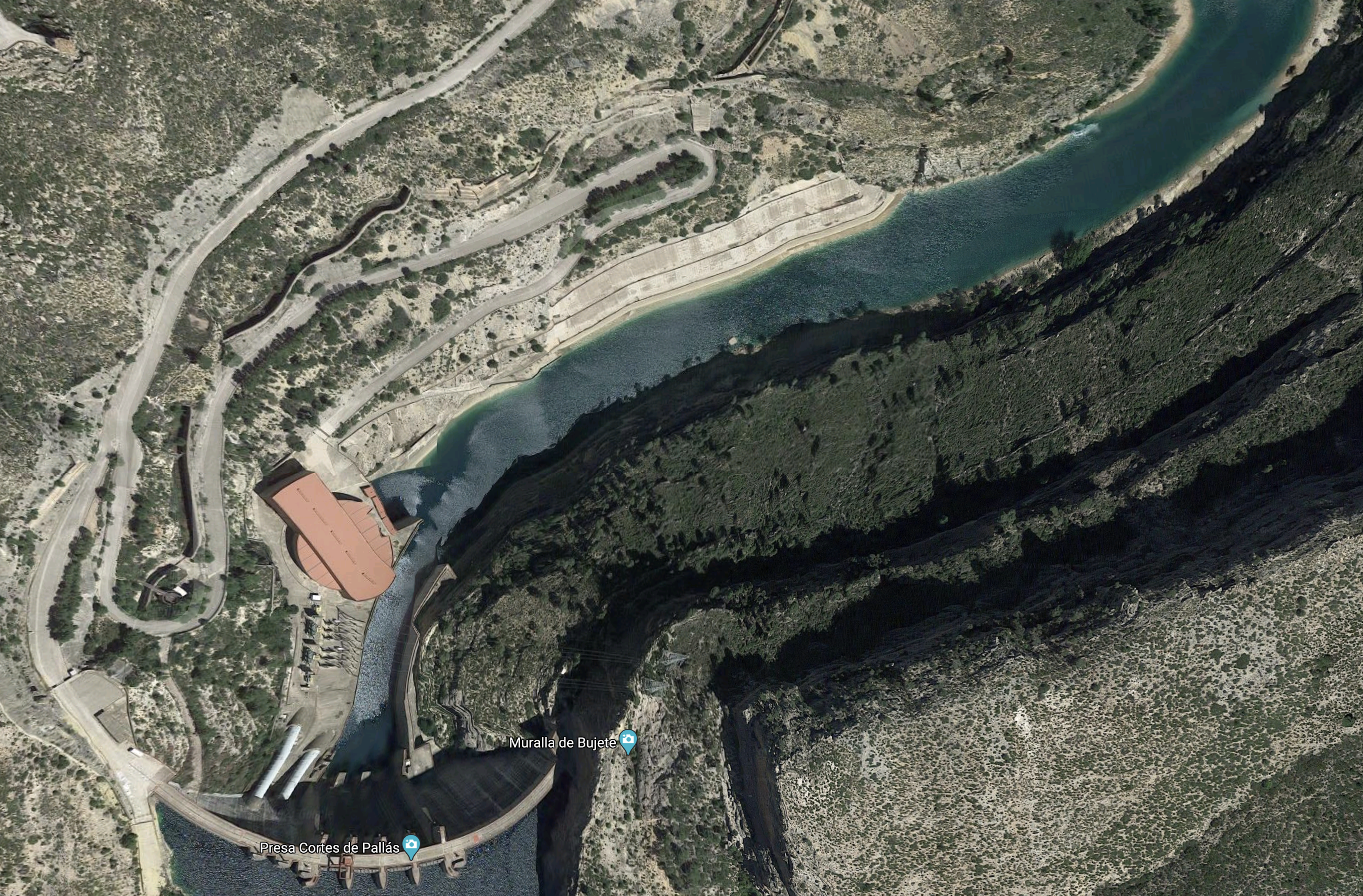
In terms of generating capacity, it is about the same size as Dinorwig power station in Snowdonia., which is the UK’s largest pumped storage power station.
The Aldeadávila Dam
The Aldeadávila Dam is a 1243 MW hydro-electric power station with a pumped storage addition on the River Douro between Spain and Portugal.
This Google Map shows the dam.
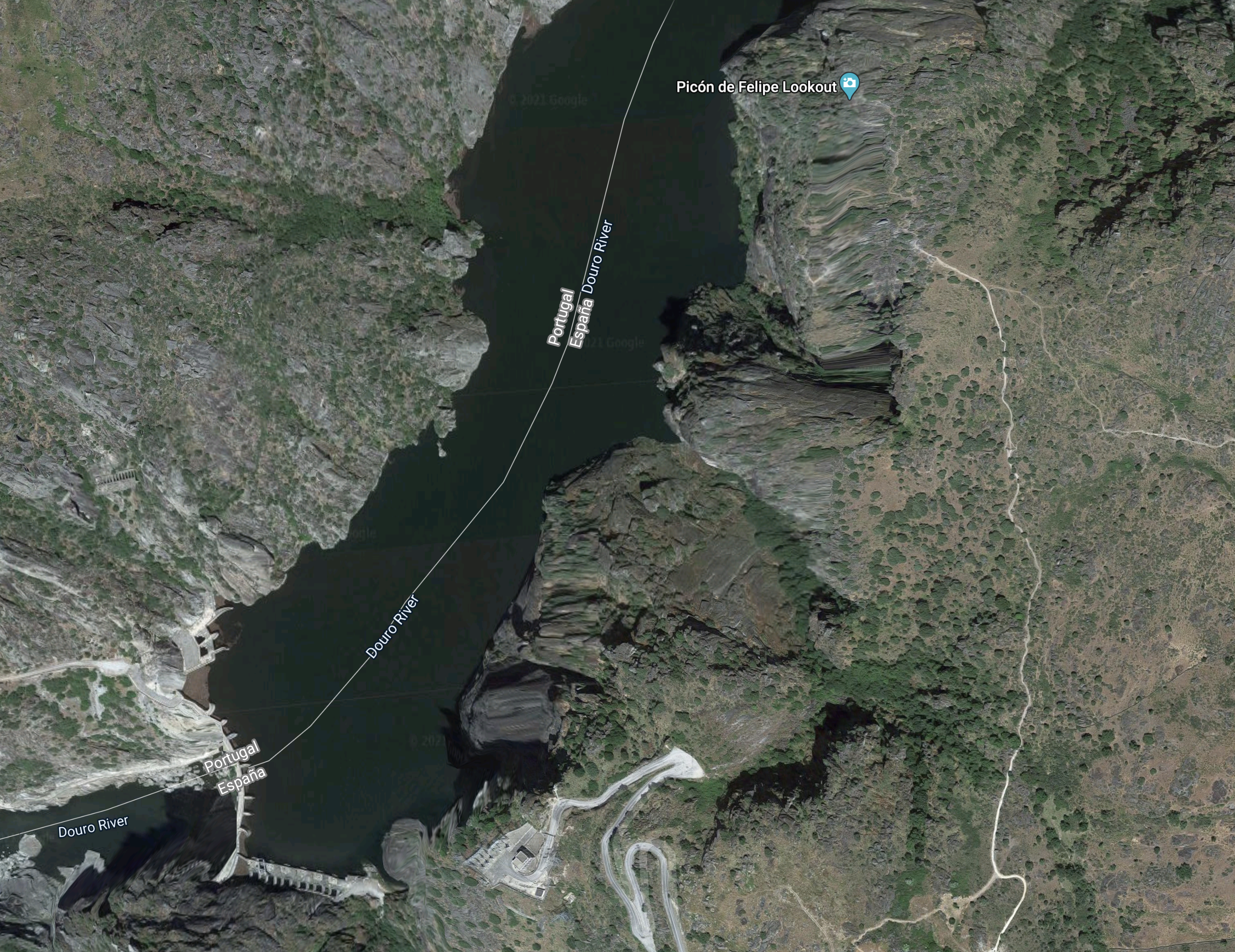
It certainly looks like a place to visit.
Both these pumped storage station seem to have been converted from earlier hydro-electric power stations.
I wouldn’t be surprised to learn, that the Spaniards, were going to increase their number of pumped storage power stations.
- Spain certainly has the mountains, with big rivers running through!
- Bolarque dam already uses pumped-storage techniques.
Are there any other existing hydro-electric power stations in Spain, that can be converted to pumped storage or be upgraded?
Concentrated Solar Power
Spain has around thirty concentrated solar power or CSP power stations, either in operation, under construction or planned.
Some also store electricity as heat.
Spain is not short of sun.
Spain is considered a world leader in this technology.
This Google Map shows the Andasol solar power station.
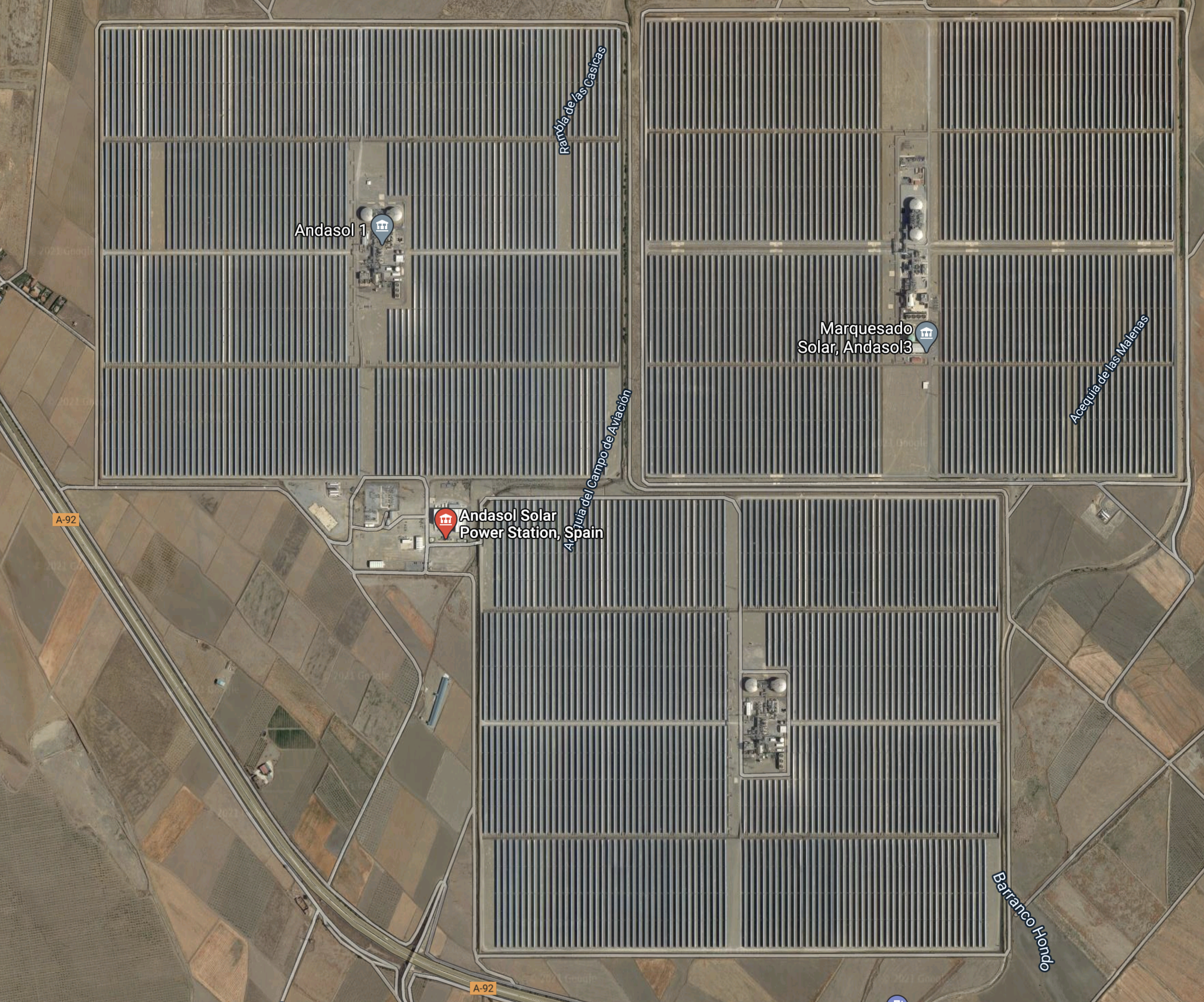
The specification includes.
- It uses technology called a parabolic trough.
- A nameplate capacity of 149.7 MW
- A capacity factor of 37.7 %
- Annual net output of 495 GWh
- a storage capacity of 1.123 GWh
- The energy storage is based on a mixture of potassium and sodium nitrates.
- The power station takes up an area of six square kilometres.
Will Spain build more of these CSP power stations or add energy storage to some of the existing stations?
Batteries
The article has this sentence.
the government wants to add large-scale batteries, behind-the-metre batteries — minimum 400 MW in 2030 — and make the most of the vehicle-to-grid technology, according to the document.
It should be noted that Spain has installed capacity of over 25 GW of wind power, according to this article on Wikipedia, which is entitled Wind Power In Spain.
These are some points from the article.
- Spain has a lot of indigenous wind turbine manufacture.
- The Spanish wind-power industry employs upwards of 60,000 people.
- A central control centre for Spanish wind power needs to be developed.
- There is little opposition to onshore wind, although perhaps somewhat surprisingly, there is some opposition to offshore wind.
After reading what Wikipedia had to say, it appears to me, that Spain needs a ;pt of batteries to support all these wind turbines.
The world’s second largest wind-turbine manufacturer is Siemens Gamesa, who are Spanish-based.
Siemens Gamesa have an innovation storage battery based on hot volcanic rock, which I wrote about in Siemens Gamesa Begins Operation Of Its Innovative Electrothermal Energy Storage System.
This gives a brief description of the pilot plant.
The heat storage facility, which was ceremonially opened today in Hamburg-Altenwerder, contains around 1,000 tonnes of volcanic rock as an energy storage medium. It is fed with electrical energy converted into hot air by means of a resistance heater and a blower that heats the rock to 750°C. When demand peaks, ETES uses a steam turbine for the re-electrification of the stored energy. The ETES pilot plant can thus store up to 130 MWh of thermal energy for a week. In addition, the storage capacity of the system remains constant throughout the charging cycles.
It was taken from this press release from Siemens Gamesa.
This page on the Siemens web site gives the nominal output of the system as 30 MW.
So it would need just over a dozen systems like these to perhaps be strategically-placed near large wind farms to meet Spain’s target of 400 MW of energy storage.
Highview Power’s liquid air systems would be another possibility, but I doubt, they’d perform as well in the heat of Spain, as a system based on hot rocks.
Conclusion
Spain’s plan seems achievable and could create a lot of employment.
It also seems to me, that their natural resources of mountains, big rivers and lots of sun are a great help.
 The Anonymous Widower