Denmark Launches World’s First Power-to-X Tender
The title of this post, is the same as that of this article on offshoreWIND.biz.
This is the sub-heading.
The Danish Energy Agency (DEA) has invited bids to build and operate Power-to-X projects with a deadline for applications set to 1 September. Through the tender – the first of this kind in both Denmark and the world – the country has made available DKK 1.25 billion (approximately EUR 167.7 million) in state support for the production of Power-to-X in the form of green hydrogen.
This paragraph outlines the deal.
The tender is being held to procure hydrogen produced by using renewable energy sources and is part of Denmark’s goal to reach between 4 and 6 GW of electrolysis capacity by 2030 and its Power-to-X strategy, released in 2021, according to which the country’s offshore wind resources provide good conditions for the production of green hydrogen, which requires large amounts of green electricity.
These are the conditions.
- Only hydrogen that is produced from renewable energy sources and meets the EU’s documentation requirements for green PtX fuels is eligible for support.
- The winning bidder(s) must have the project(s) built to full capacity and start green hydrogen production within four years of signing the contract with the Danish Energy Agency.
The tender has been approved for state aid by the European Commission.
I can see all the large electrolyser builders getting their bids ready for what will be tough competition.
Overview – Siemens Energy Electrolyser Deal Dwarfs Rest In Q1 2023
The title of this post is the same as that of this article on Renewables Now.
This is the first paragraph.
The global electrolyser market concluded the first quarter of 2023 with a variety of equipment supply deals, partnerships, framework agreements and even some firm contracts. Siemens Energy stood out with the news of its selection to equip a “world-scale” eFuels facility in Texas with a total capacity of 1,800 MW.
The article is a good summary of the electrolyser market.
Mingyang Building Fish Farm-Equipped Offshore Wind Jacket Foundation
The title of this post, is the same as that of this article on offshoreWIND.biz.
This is the sub-heading.
Chinese wind turbine manufacturer Mingyang Smart Energy revealed on 17 April that it started the construction of a jacket foundation that also features a net cage system for fish farming, which will be installed at the Mingyang Qingzhou 4 offshore wind farm in the South China Sea later this year.
The picture in the article, looks like something out of Baldrick’s book of cunning plans.
This paragraph gives more details.
The jacket is typhoon-resistant and the aquaculture system, which will raise up to 150,000 fish in 5,000 cubic metres of water, will have remote functions such as automated feeding, monitoring, detection, and collection, according to Mingyang.
Mingyang also state that the Qingzhou 4 offshore wind farm will also produce hydrogen.
Does that mean that in the next phase of the development, they’ll be putting a fish and chip shop on top?
Meet HiiROC, The Startup Making Low-Cost Hydrogen Free From Emissions
The title of this post, is the same as that of this article on UKTN.
This article explains the technology behind, what I feel is one of the most promising start-ups, I’ve seen.
It is certainly a must read.
This paragraph explains how they plan to lease the machines.
It plans to bring in revenue by leasing its machines to companies charging on the output of hydrogen and carbon.
That is almost how we sold the Artemis project management software, I wrote over forty years ago.
- Our bank manager liked it, as we were leasing to companies like BP, Chevron and Shell.
- His bosses liked it, as leasing companies don’t normally have that dodgy word; innovation.
- Our in-house accountant liked it, as we had an easy to predict cash flow.
- Our customers liked it, as all they had to provide was a 13-amp socket and paper for the printer.
It was a model that served us well.
Conclusion
The more I learn of HiiROC, the more I like the company.
Effects Of The ULEZ In West London
This page on the Transport for London web site is entitled ULEZ Expansion 2023.
This is the first paragraph.
To help clear London’s air and improve health, the Ultra Low Emission Zone (ULEZ) is expanding across all London boroughs from 29 August 2023.
These are some points from the rest of the page.
- Poor air quality is impacting the health of Londoners, and it’s mainly caused by polluting vehicles.
- Air pollution even contributes to the premature death of thousands of Londoners every year.
- 9 out of 10 cars seen driving in outer London already meet the ULEZ emissions standards.
- If you drive anywhere within the ULEZ and your vehicle does not meet the emissions standards, you could face a daily charge of £12.50.
- Residents of the ULEZ are not exempt from the charge.
- Any money received from the scheme is reinvested into running and improving London’s transport network, such as expanding bus routes in outer London.
There is no reference to trucks or HGVs.
These are my thoughts.
Objections To The ULEZ
If you type ULEZ into Google and look at the News page, you get a lot of stories that don’t show the ULEZ in a good light.
Here are a few headlines.
- BBC – ULEZ: Labour MPs Seek Support For Non-Londoners
- BBC – Firms In Essex Could Close Due To ULEZ, Warns Business Leader
- Big Issue – London’s Ulez Plans Could Hit Disabled People, Charities And Small Businesses The Hardest
- Daily Mail – Sadiq Khan Claims That Nazis Have Infiltrated Anti-Ulez Protests
- Guardian – EU Motorist Fined Almost £11,000 After Falling Foul Of London Ulez Rule
- Guardian – London’s Mayor Faces High Court Challenge Over Ulez Expansion
- Kent Live – Anti-ULEZ Campaign Group Support Soars As Kent Drivers ‘Unfairly Targeted’
- LBC – No More Ulez? Sadiq Khan Considers Scrapping Controversial Scheme And Replacing It With ‘Pay-As-You-Drive’ System
- Slough Observer – Ulez Faces High Court Challenge
- Which? – Why It Could Cost £17.50 To Drop A Loved One At Heathrow This Summer
It looks like Sadiq Khan has fallen into a hole.
And he hasn’t stopped digging!
To make it worse, he has suggested a Pay-As-You-Drive System. I seem to remember, that a Dutch Prime Minister, who tried it, lost the next election.
But then Sadiq Khan likes tolls as the new Silvertown Tunnel and the Blackwall Tunnel will be tolled in a few years.
Heathrow Airport
Heathrow Airport is one of the world’s busiest airports and 76,000 people work at the airport, with many more employed nearby.
The airport handled 61.6 million passengers in 2022, which is a few short of 170,000 per day.
If you consider that those that work at the airport do two trips per day and passengers generally do one, that means there are 322,000 trips per day to or from the airport.
But as it now so easy to get to the Airport using the Elizabeth Line will more people use the new line to meet and greet and say goodbye to loved ones or business associates. Since the Elizabeth Line opened, I’ve met a couple of friends at Heathrow, who were passing through.
I wonder, if that daily journey total of 322,000 could be nearer to 350,000 or even 400,000.
If the ULEZ charge makes some passengers and staff switch from their car to using a bus or train, this probably means that public transport to and from the airport, will need to be boosted by a substantial amount.
But improving public transport to Heathrow wouldn’t be easy.
- The Elizabeth Line seems to have put a big hole in the finances of Heathrow Express.
- How many more trains can be squeezed into the Heathrow Tunnel?
- The Western Rail Link to Heathrow would probably need to be built. But that seems to be in limbo.
- New trains for the Piccadilly Line are a few years away.
It might have been better to build a different scheme for Western access to Heathrow like the Heathrow Southern Railway.
I suspect that there will be a lot more passengers on the Elizabeth Line to and from Heathrow.
A ULEZ For Heathrow
This article on fleetworld, from four years ago, is entitled Heathrow To Introduce Charging ULEZ In 2022.
It hasn’t happened, but that doesn’t mean it won’t be implemented in the future.
If it did happen, there would be more passengers for the Elizabeth Line.
The Elizabeth Line
I have written three posts about how busy the Western section of the Elizabeth Line can get.
- Very Busy Lizzie
- Elizabeth Line: Commuters Say Service ‘Not What Was Promised’
- So Many Cases On A Train!
Is there sufficient capacity to accommodate all the ULEZ-dodgers on the trains to and from Heathrow?
To make matters worse, there is a large Asian population from the Indian sub-continent living along the Elizabeth Line between Ealing Broadway and Reading.
- They seem to be enthusiastic users of the line.
- Having ridden several times on crowded Indian trains, perhaps using trains is very much part of South Asian culture.
- I also suspect that a lot of Indian families have spread themselves along the line, just like my mother’s close family spread themselves along the 107 bus route.
In Very Busy Lizzie, I said this.
Reading needs four tph to Central London.
The ULEZ will make this even more essential.
The Piccadilly Line
The Piccadilly Line may be getting new trains, but it is not a line that is blessed with lots of step-free stations.
The West London Orbital Railway
It does appear that the West London Orbital Railway may be more likely to be built, than a few months ago.
In Is There Progress On The West London Orbital Railway?, I wrote about a report, that consultants were being chosen.
This railway could ease pressure on the railways in West London.
Cutting Pollution In London From Trucks
London like all big cities has a lot of trucks.
As the average truck has a much larger engine than the average car, I would suspect it gives out more pollution.
One way to cut pollution from large vehicles would be to run them on hydrogen.
But unlike some cities in the UK, London has no hydrogen policy and filling stations to fill them up.
The Mayor could at least get a workable hydrogen policy.
Conclusion
I suspect the next Mayor of London will have to have a rethink on the ULEZ and implement a hydrogen policy.
East-West Rail: Bedford’s Mayoral Candidates Split On Rail Project
The title of this post, is the same as that of this article on the BBC.
This is the first sentence.
Part of the route of the controversial East-West Rail project will not be decided before we know the winner of Bedford’s mayoral elections.
Unfortunately, the four candidates for Mayor all seem to have different ideas for East-West Railway through the town.
I have a few thoughts and observations.
Thameslink
Thameslink has the following connections to the East West Railway.
- Four tph at Bedford.
- Three tph at Cambridge.
Note.
- tph is trains per hour.
- All Bedford trains terminate at Bedford.
- The half-hourly Luton Airport Express between London St. Pancras and Corby stops at Luton Airport Parkway, Luton, Bedford, Wellingborough and Kettering.
- Cambridge trains may extend to Cambridge North station.
- Cambridge has additional through services between London King’s Cross and Ely and/or King’s Lynn.
Both Bedford and Cambridge will be busy stations.
Extra Tracks At Bedford
Bedford station has four tracks; two which are generally used by Thameslink services and two main lines used by through trains.
- The fast lines must accommodate the following trains.
- East Midlands Railway – 6 tph in both directions. Two tph stop in Bedford station.
- Freight Trains – 2 tph in both directions.
- East West Railway – 2 tph in both directions. All trains will stop in Bedford station.
It strikes me, that the station may need at least one and possibly two extra tracks.
If there are extra tracks, there will need to be some demolition of houses.
Freight Trains
In Roaming Around East Anglia – Newmarket Station, I wrote this about the plans of the East West Rail Consortium in the area.
In this document on the East-West Rail Consortium web site, this is said.
Note that doubling of Warren Hill Tunnel at Newmarket and
redoubling between Coldham Lane Junction and Chippenham Junction is included
in the infrastructure requirements. It is assumed that most freight would operate
via Newmarket, with a new north chord at Coldham Lane Junction, rather than
pursuing further doubling of the route via Soham.
So would it be possible to create a double-track railway through Newmarket station?
In the related post, I came to this conclusion.
Newmarket can benefit from East West Rail, but the two parties must agree objectives that don’t cause problems for the other.
But I do think, that Newmarket will not welcome the building of a double-track railway through the town.
I do wonder, if the East West Rail Consortium plan to run freight trains between Felixstowe and South Wales and the West of England through Bedford and Oxford.
Four freight tph, through Bedford would certainly need extra tracks and the demolition of houses in the centre of Bedford.
Electrification
Two of the candidates for Bedford’s mayor, think that the line needs to be electrified.
As the route is full or partially-electrified at Didcot, Bletchley, Bedford and Cambridge, I believe that battery-electric trains could handle the route.
But then there are no plans to purchase any passenger trains of this type.
Freight trains would still need to be diesel hauled, unless more progress is made fairly quickly in the development of hydrogen-powered freight locomotives.
The Cambridge Effect
Cambridge is one of the most important cities in the world, because of its strength in innovation in high technology industries.
But Cambridge is bursting at the seams and needs more space for laboratories, advanced manufacturing and housing.
A fully-developed double-track and electrified East West Railway would open up Bletchley, Milton Keynes, Bedford, Newmarket, Bury St. Edmunds and Ipswich to act as satellites to help Cambridge build a shared and successful future.
The Felixstowe Effect
If Cambridge will stimulate the growth of passenger traffic, then Felixstowe will promote the growth of East-West freight traffic.
Conclusion
It may not be initially built that way, but probably by 2040, the East West Railway will be a fully-electrified double-track railway between Didcot and Felixstowe.
Extra tracks will also be needed through Bedford. This will mean demolition of houses.
Hoerbiger And HD Hyundai Infracore Cooperate On Hydrogen-Powered Combustion Engine
The title of this post, is the same as that of this article on Hydrogen Central.
These two paragraphs outline the story.
This year’s ConExpo in Las Vegas was full of surprises and amazing news. Among the stars of the exhibition was the hydrogen-powered internal combustion engine (ICE) from HD Hyundai Infracore equipped with H2PFI injectors made by HOERBIGER.
This hydrogen-powered ICE can produce a power output of 300 kW (402 HP) and will see mass production in 2025. It will be installed on buses, trucks and construction equipment. While meeting Zero CO2 and Zero Impact Emission requirements it is also 25-30% more economical than battery packs or fuel cells when vehicle price and maintenance costs are considered. One fueling of 10 minutes allows the vehicle to drive for a distance of up to 500 km (310.6 miles).
The more of these stories I read about hydrogen internal combustion engines, the more they convince me, that this is the way to go.
These advantages keep repeating themselves.
- Large range.
- Quick refuelling times.
- Understandable technology.
- Suitable for heavy applications.
- Similar manufacturing to current diesel and petrol engines.
- Less exotic rare earths and metals.
- Lower environmental footprint.
- Can be converted from existing diesels.
The one thing they all need is different lean-burn fuel injection. Hence Hyundai’s tie-up with HOERBIGER.
3GW Green Hydrogen Project To Power Heavy Industry With Surplus Scottish Wind Energy
The title of this post, is the same as that of this article on the Institute of Mechanical Engineers web site.
I have covered the Kintore Electrolyser before, but this is a professional description of the project from a respected institution, who should know what they are talking about.
I can see several other giant electrolysers being built, in places like Humberside, Merseyside, Teesside, where there are large amounts of wind power and heavy energy users in the cement, chemicals and steel industries.
There could also be one in Norfolk or Suffolk to use the masses of offshore wind power being developed.
Could The Bombardier Voyagers Be Converted To Hydrogen Power?
Avanti West Coast, CrossCountry and East Midlands Trains all run versions of Bombardier Voyager trains.
- There are 103 sets in service.
- Lengths are four, five and seven cars.
- They are 125 mph trains.
- They are powered by one Cummins QSK19 diesel engine in each car.
Given Cummins’s enthusiasm for hydrogen could these diesel engines be converted to hydrogen power, so the trains could run long distance routes on zero-carbon power?
If there is no need for them in the UK, there are probably lots of places in the world that would like them!
Centrica Plan Green Energy Hub At Former Gas Power Plant
The title of this post, is the same as that of this news item from Centrica.
These three paragraphs outline the project.
A former gas fired power plant in North Yorkshire is to be turned in to a green energy hub under ambitious plans by Centrica.
The energy company has acquired the four-acre former Knapton Generating Station from Third Energy and plans to develop a 28MW battery on the site.
In addition, Centrica is exploring how Knapton could be used for off-grid hydrogen production, as well as the possibility for solar energy in the surrounding area.
Over the last few months, I’ve written about other small projects from Centrica.
- Centrica Business Solutions Begins Work On 20MW Hydrogen-Ready Peaker In Redditch
- Centrica And HiiROC To Inject Hydrogen At Brigg Gas-Fired Power Station In UK First Project
The company has also announced links with other companies.
- Centrica Announces Hydrogen Ready Combined Heat And Power Partnership With 2G
- Lhyfe And Centrica To Develop Offshore Renewable Green Hydrogen In The UK
- Centrica And Ryze Agree To Develop Hydrogen Pathway
Note, that the first concerns generators and the others concern hydrogen.
The Centrica news item about the Knapton generating station has this fourth paragraph.
The multi-million pound deal is part of Centrica Business Solutions strategic plan to create a 900MW portfolio of solar and battery assets by 2026.
It seems obvious to me that the Brigg, Knapton and Redditch projects fit this Centrica Business Solutions strategic plan, with sizes as follows.
- Brigg – 49 MW
- Knapton – 41.5 MW
- Redditch – 20 MW
I would expect to see Centrica behind several more of these smaller energy projects.
For that reason I have tagged all articles dealing with these projects as Centrica Small Energy Projects.
These are my thoughts about the Knapton generating station.
Third Energy
Third energy’s web site defines Third Energy as an unusual fossil energy company.
- The History page says that Knapton Generating Station was producing electricity using gas from the Vale of Pickering for over 25 years.
- The Net Zero Rise page describes their involvement in the Net Zero RISE consortium with Durham, Leicester and Oxford Universities.
- The Plug & Abandon and Geothermal pages are very much worth a read.
According to the Centrica news item, Third Energy will retain the ownership of the 12 well-sites and associated gas pipeline network.
I shall be watching this company and their developing relationship with Centrica.
The Net Zero RISE Consortium
The Net Zero RISE Consortium has a home page on the Newcastle University web site.
The page has this sub-heading.
Research Infrastructure for Subsurface Energy: an academic-industry partnership to deliver the UK’s first deep test sites.
This is said under a heading of Our Ambition.
This is the most cost-effective way of developing the UK’s first deep test site onshore.
Repurposing wells leverages previous capital investment. Using an onshore site with existing wells and geophysical data:
- eliminates the major cost of drilling and engineering
- reduces uncertainty by drawing on knowledge of the well and surrounding geological conditions
- is safer and easier access than offshore locations
We propose developing three test sites: CO2 storage; H2 storage and geothermal.
This seems to be a very sensible research collaboration and I wouldn’t be surprised to see more companies and universities join.
The Battery
The Centrica news item says this about the battery.
The first project at the site near Malton will be a 56MWh battery which will utilise some of the 41.5MW export capability of the existing grid connection. It’s anticipated the battery would be able to power around 14,000 homes for two hours.
This paragraph would indicate that the battery is supplying just 2 kWh per hour.
A common figure on the Internet is that the average house uses 8 kWh per day, which is 0.33 kWh per hour.
I have a feeling that the figures need correcting somewhere.
Solar Power
The third paragraph of the Centrica news item mentions solar energy.
In addition, Centrica is exploring how Knapton could be used for off-grid hydrogen production, as well as the possibility for solar energy in the surrounding area.
This Google Map shows the site.
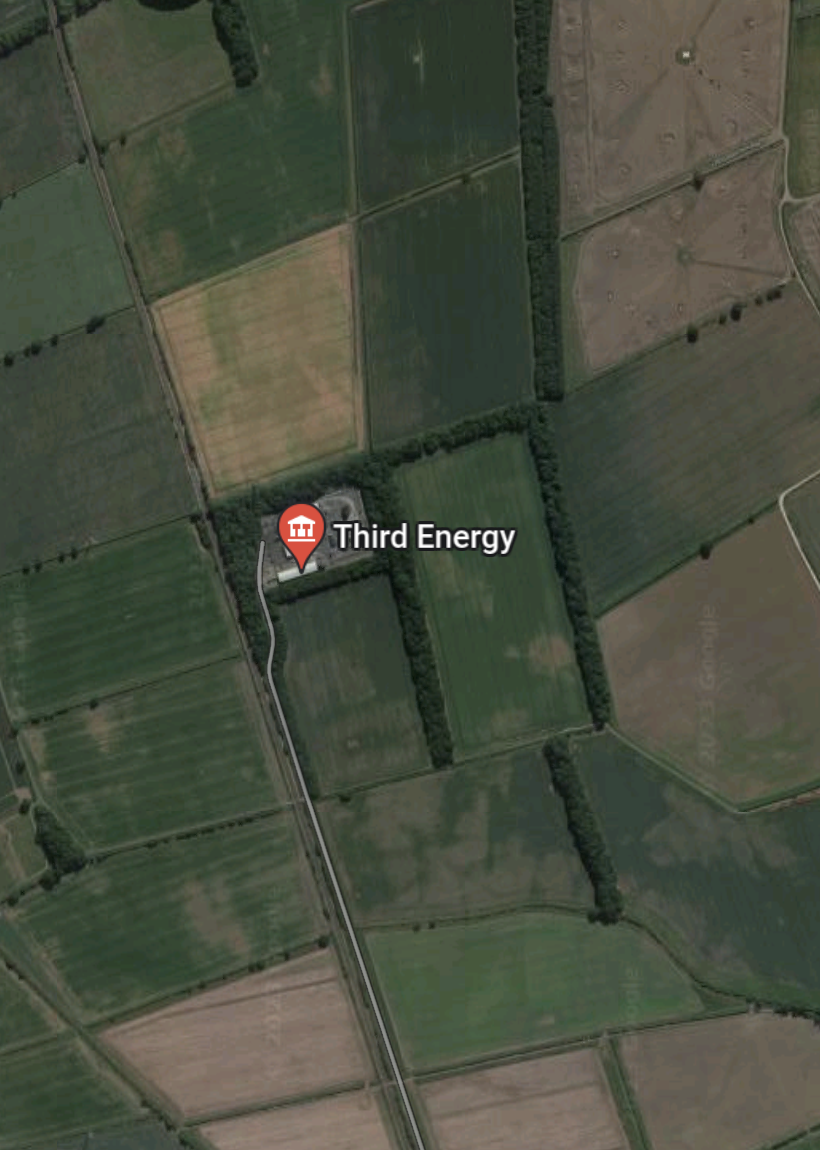
It appears to be several hundred metres to the nearest house.
I have read a very simple rule, that says a hectare, which is about the size of a full-size football pitch can accommodate a MW of panels. Obviously Centrica will have accurate calculations.
Off-Grid Hydrogen Production
The third paragraph of the Centrica news item mentions off-grid hydrogen production.
In addition, Centrica is exploring how Knapton could be used for off-grid hydrogen production, as well as the possibility for solar energy in the surrounding area.
Consider these points about the Knapton site.
- It has been handling gas for at least twenty-five years.
- It is connected to the electricity and gas grids.
- It has connections to a dozen gas wells.
- There would be space for a smaller electrolyser.
- Hydrogen could be exported from the site, by blending into the natural gas grid.
If Third Energy and the Net Zero RISE Consortium develop Knapton as a site for their H2 Storage test well, Centrica and an off-grid hydrogen production facility would be ideal partners.
Centrica could even use the site to try out new ideas.
This appears to be one of those engineering projects, that has been thought through whilst drinking several pints of real ale in a welcoming hostelry nearby.
Geothermal Engineering
This site could be used for experiments with geothermal engineering, but there doesn’t seem many places nearby, that would need a good supply of hot water.
Conclusion
There’s more to this deal, than meets the eye.

