Crown Estate’s Auction Of Seabed For Wind Farms Attracts Sky-High Bids
The title of this post, is the same as that of this article on The Times.
This is the opening paragraph.
An auction of seabed rights to build offshore wind farms around England and Wales has attracted frenzied bidding that could be worth hundreds of millions of pounds a year to the Treasury and the Queen.
I don’t find this surprising.
Bigger Seems Better Offshore
Wind turbine technology is getting better and much larger. It also seems that the new larger floating turbines are much more efficient and generate power for a greater proportion of the day.
- Hywind Scotland is the world’s first commercial wind farm using floating wind turbines.
- It is situated off Peterhead.
- It consists of five 6 MW turbines.
- Wikipedia says it has a capacity factor of over 50 %.
My project management software helped to harvest North Sea Oil and I have been told by many in the industry, that North Sea Oil really took off when platforms and the equipment like cranes used to build them got truly enormous.
I feel, we could be seeing the same size effect happening as we harvest the wind!
Hydrogen And Wind Power
The latest development is not to generate electricity, but to use it in the turbine to generate hydrogen, which is then piped to the shore.
- The UK Government is funding this technology in part with a grant to ITM Power.
- I wrote about the technology in ITM Power and Ørsted: Wind Turbine Electrolyser Integration.
- Existing gas networks can be reconfigured to bring the hydrogen to the shore.
- Piping hydrogen costs less than cabling electricity.
- Hydrogen networks are being built at several places in the UK, to fuel homes, power stations and industry like steel-making and petrochemicals.
Could all this explain Big Oil’s involvement?
Do they want to exchange fossil fuels for green hydrogen?
They certainly know how to distribute it.
Energy Storage
For my own investments, I’m looking at energy storage, where the UK has at least three promising new ideas, all of whom have had Government grants.
- Gravitricity
- Highview Power
- ReEnergise
The Government has also indirectly-backed Cornish Lithium
Hydrogen Ambitions For The Port Of Hamburg
The title of this post, is the same as that of this article on Seatrade Maritime News.
This is the introductory paragraph.
In January Hamburg announced that Vattenfall, Shell, Mitsubishi Heavy Industries (MHI) and municipal heat supplier Warme Hamburg had signed a Letter of Intent to develop a 100MW electrolyser to produce green hydrogen in the port area.
A few points from the article.
- Hamburg believes that ships will be running on green hydrogen.
- Buses and trucks will need the hydrogen.
- They may build a terminal to import green hydrogen, as the Japanese are doing at Kobe.
- The green hydrogen might be produced in places like Africa and Morocco.
100 MW strikes me as a large electrolyser.
Roger Ford’s Cunning Plan
In the February 2020 of Modern Railways, there is an article called LNER Procurement, which has been written by Roger Ford.
It is Roger’s reply to an article in the December 2020 Edition of Modern Railways, which was entitled LNER Seeks 10 More Bi-Modes.
He starts by describing the requirement and then says this.
Would any fleet engineer in his or her right mind want to add a unique sub-fleet of 10 high speed trains to an existing successful fleet, even if they were hydrogen-electric tri-modes from the respected Kim Chong t’ae Electric Locomotive Works?
In my analysis of the December 2020 article, I wrote this post with the same name, where I said this, under a heading of More Azumas?
Surely, It would require a very innovative train at perhaps a rock-bottom price from another manufacturer, for LNER to not acquire extra Azumas.
So it would appear that Roger and myself are vaguely in agreement on the subject of more Azumas.
The last section of the article has a title of Cunning.
Roger puts forward, the view that the procurement process, as well as being compatible with EU law, could be a warning to Hitachi, to make sure that LNER get a good deal.
It certainly could be, and I remember a similar maneuver by ICI around 1970.
The company was buying a lot of expensive IBM 360 computers.
ICI needed a new computer to do scientific calculations at their Central Instrument Research Establishment (CIRL) at Pangbourne in Berkshire.
- English Electric had just released a clone of an IBM 360 and were keen to sell it to ICI.
- As it would do everything that ICI wanted, they bought one.
- It worked well and did everything that CIRL wanted at a cheaper price.
IBM’s reaction was supposedly quick and dramatic. The salesman who dealt with ICI, was immediately fired!
But as ICI had about a dozen large IBM computers, there wasn’t much they could do to one of the most important and largest UK companies.
IBM also made sure, that ICI got their next computer at a good price.
I’m with Roger that all the shenanigans are a warning to Hitachi.
Roger finishes the article with these two paragraphs.
A genuine bluff would have been to seek bids for the long-term deployment of remanufactured IC225s. Which in these straitened times could still turn out to be a more viable option.
I rather fancy the idea of a hydrogen-electric Class 91. Owner Eversholt Rail might even have played along on the understanding that it funded the inevitable hybrid Azumas.
Note that IC225s are InterCity 225 trains.
- The 31 trains, were built for British Rail in the 1980s.
- They are hauled by a 4.83 MW Class 91 locomotive, which is usually at the Northern end of the train.
- Nine Mark 4 coaches and a driving van trailer complete the train.
- As with the Hitachi Azumas (Class 800 and Class 801 trains), they are capable of operating at 140 mph on lines where digital in-cab ERTMS signalling has been installed.
I just wonder, if a Class 91 locomotive could be to the world’s first 140 mph hydrogen-electric locomotive.
Consider the following.
Dynamics
The wheels, bogies and traction system were designed by British Rail Engineering Ltd, who were the masters of dynamics. This is a sentence from the locomotive’s Wikipedia entry.
Unusually, the motors are body mounted and drive bogie-mounted gearboxes via cardan shafts. This reduces the unsprung mass and hence track wear at high speeds.
That is a rather unique layout. But it obviously works, as otherwise these locomotives would have been scrapped decades ago.
I believe the quality dynamics are because BREL owned a PACE 231R for a start, which was an analogue computer, that was good enough for NASA to use two computers like this to calculate how to put a man on the moon.

London and Edinburgh is a slightly shorter distance, run at a somewhat slower speed.
Space
This picture shows a Class 91 locomotive.
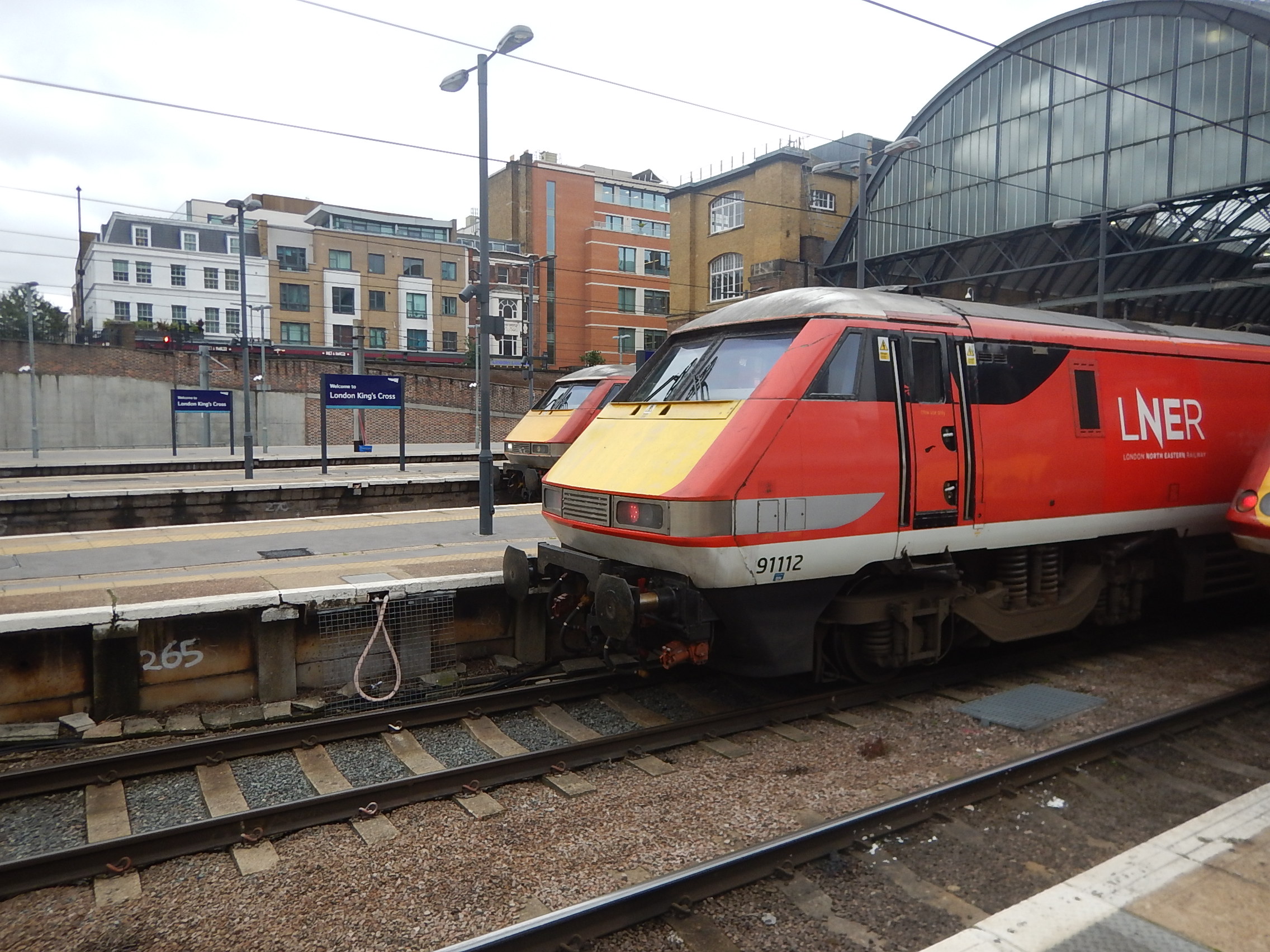
What is in the space in the rear end of the nearly twenty metre-long locomotive?
This sentence from the Wikipedia entry for the locomotive gives a clue.
The locomotive also features an underslung transformer, so that the body is relatively empty compared to contemporary electric locomotives.
It also states that much of the layout came from the APT-P, which was a version of the tilting Advanced Passenger Train.
Would the space be large enough for a tank of hydrogen and some form of generator that used the hydrogen as fuel?
It should be noted that one version of the APT used a gas-turbine engine, so was the locomotive designed for future use as a bi-mode?
Fuel Cells
I’ve ignored fuel cells, as to get the amount of power needed, the fuel cells could be too large for the locomotive.
Class 91 Locomotive Performance
The performance of a Class 91 locomotive is as follows.
- Power output – 4.83 MW
- Operating speed – 140 mph
- Record Speed – 161 mph
Not bad for a 1980s locomotive.
Required Performance Using Hydrogen Fuel
If the locomotives were only needed to use hydrogen to the North of the electrification from London, the locomotive would need to be able to haul a rake of coaches twice on the following routes.
- Aberdeen and Edinburgh Haymarket – 130 miles
- Inverness and Stirling – 146 miles
A range of three hundred miles would be sufficient.
The locomotive would need refuelling at Aberdeen and Inverness.
The operating speed of both routes is nowhere near 140 mph and I suspect that a maximum speed of 100 mph on hydrogen, pulling or pushing a full-size train, would probably be sufficient.
When you consider that a nine-car Class 800 train has five 560 kW diesel engines, that give a total power of 2.8 MW, can carry 611 passengers and an InterCity 225 can only carry 535, I don’t think that the power required under hydrogen will be as high as that needed under electricity.
Rolls-Royce
Rolls-Royce have developed a 2.5 MW generator, that is the size of a beer keg. I wrote about it in Our Sustainability Journey.
Could one of these incredibly-powerful generators provide enough power to speed an InterCity 225 train, through the Highlands of Scotland to Aberdeen and Inverness, at speeds of up to 100 mph.
I would give it a high chance of being a possible dream.
Application Of Modern Technology
I do wonder, if the locomotive’s cardan shaft drive could be improved by modern technology.
These pictures show Joseph Bazalgette’s magnificent Abbey Mills Pumping station in East London.
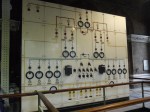
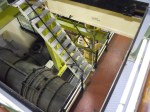


A few years ago, Thames Water had a problem. Under the pumping station are Victorian centrifugal pumps that pump raw sewage to Beckton works for treatment. These are connected to 1930s electric motors in Dalek-like structures on the ground floor, using heavy steel shafts. The motors are controlled from the control panel in the first image.
The shafts were showing signs of their age and needed replacement.
So Thames Water turned to the experts in high-power transmission at high speed – Formula One.
The pumps are now connected to the electric motors, using high-strength, lower-weight carbon-fibre shafts.
Could this and other modern technology be used to update the cardan shafts and other parts of these locomotives?
Could The Locomotives Use Regenerative Braking To Batteries?
I’ll start by calculating the kinetic energy of a full InterCity 225 train.
- The Class 91 locomotive weighs 81.5 tonnes
- Nine Mark 4 coaches weigh a total of 378 tonnes
- A driving van trailer weighs 43.7 tonnes.
- This gives a total weight of 503.2 tonnes.
Assuming that each of the 535 passengers, weighs 90 Kg with babies, baggage, bikes and buggies, this gives a passenger weight of 48.15 tonnes or a total train weight of 551.35 tonnes.
Using Omni’s Kinetic Energy Calculator, gives the following values at different speeds.
- 100 mph – 153 kWh
- 125 mph – 239 kWh
- 140 mph – 300 kWh
I think, that a 300 kWh battery could be fitted into the back of the locomotive, along with the generator and the fuel tank.
With new traction motors, that could handle regenerative braking, this would improve the energy efficiency of the trains.
Sustainable Aviation Fuel
Sustainable aviation fuel produced by companies like Altalto would surely be an alternative to hydrogen.
- It has been tested by many aerospace companies in large numbers of gas turbines.
- As it has similar properties to standard aviation fuel, the handling rules are well-known.
When produced from something like household waste, by Altalto, sustainable aviation fuel is carbon-neutral and landfill-negative.
ERTMS Signalling And Other Upgrades
Full ERTMS digital signalling will needed to be fitted to the trains to enable 140 mph running.
Conclusion
I believe it is possible to convert a Class 91 locomotive into a hydrogen-electric locomotive with the following specification.
- 4.83 MW power on electricity.
- 140 mph on electrification
- 2.5 MW on hydrogen power.
- 100 mph on hydrogen
- Regenerative braking to battery.
If it were easier to use sustainable aviation fuel, that may be a viable alternative to hydrogen, as it is easier to handle.
Cummins Provides 20MW PEM Electrolyzer To Air Liquide For Green Hydrogen Production
The title of this post, is the same as that of this article on Green Car Congress.
It will produce 3,000 tonnes of green hydrogen annually from renewable energy.
Shell Withdraws From Waste To Jet Fuel Plant Project
The title of this post, is the same as that, of this article on Insider Media.
This is the introductory paragraph.
Oil giant Shell has withdrawn from the joint development agreement for a proposed facility for the conversion of waste into aviation fuel.
It would appear that the Altalto project will continue and has no likelihood of folding in the near future.
I like the idea behind Altalto, which will take household and industrial waste and turn it into sustainable aviation fuel and biodiesel.
But I also like Shell’s Blue Hydrogen Process, which takes methane and effectively removes the carbon to create carbon-neutral hydrogen.
Conclusion
I feel the world is a big enough place for both technologies.
Germany Tasks TÜV With Finding Standards For H2 Trains
The title of this post, is the same as that of this article on Electrive.
This is the introductory paragraph.
TÜV Rheinland InterTraffic has been commissioned to develop a standard for hydrogen applications in rail vehicles. Until now, authorities have had to rely on technical regulations and standards from the automotive industry for conformity assessments.
As hydrogen trains have entered service in Germany and have been trialled on rail networks in Austria, Italy, The Netherlands and the UK, this is probably about time, especially as Spain and Switzerland will soon be joining the club.
As most of Europe has the same loading gauge, it looks to me that the German standard will be a de-facto European standard, that could also be used for countries like Australia, Canada and the United States.
But in the UK, we have a smaller loading gauge, so will the German standard be application to the UK?
As some German S-bahn trains are not much bigger than say a Siemens-built Class 700 train, I suspect that the Germans could write a dual standard, that covered the following.
- Standard UK-sized trains.
- Standard EU-sized trains.
- Standard German S-bajm-sized trains.
After all, if it could be arranged, one world-wide standard would probably be a good idea.
Alstom Calls For Hydrogen Rail Fleets In The UK
The title of this post, is the same as that of this article on H2View.
These are the first three paragraphs.
Alstom has called for a £10bn investment programme in UK rail and mass transit systems, through which it would like fleets of clean, zero emission hydrogen trains to replace pouting diesel alternatives.
Titled: The UK’s New Green Age; A Step Change in Transport Decarbonisation, the report states that 300-400 hydrogen trains could be launched simply with a like for like replacement of diesels and would deliver huge environmental benefits.
The report was released after recent research revealed that the UK is lagging behind surrounding countries in comparable infrastructure. For example, France has over double the number of mass transit systems as the UK, whilst Germany has four.
There is a rapidly developing argument between the proposers of hydrogen and battery trains.
Consider.
- Both types of train can ve a straight replacement for diesel trains, often with very little modification to stations.
- As both hydrogen and battery trains have electric traction, they could have improved performance, so tracks and signalling might need upgrades to make full use of that performance to provide a better service for passengers.
- Hydrogen trains will need a refuelling strategy.
- Hydrogen trains need to carry a large tank of hydrogen.
- Battery trains may well need charging systems or extra lengths of electrification for charging.
- The UK will have plenty of green hydrogen and zero carbon electricity.
I also believe that hydrogen and battery trains designed from scratch will be much better than conversions of existing stock.
Conclusion
I think the environment will win this argument.
I can see cost and local circumstances deciding, whether to use battery or hydrogen trains.
For instance, Ipswich and Norwich, where there are an electrified main lines, might become battery train hubs, whereas Middlesbrough, where there is a plentiful supply of hydrogen, might use hydrogen trains for local services.
TechnipFMC To Build And Trial Offshore Green Hydrogen Production Project
The title of this post, is the same as that of this article on Hydrogen Fuel News.
This is the introductory paragraph.
TechnipFMC has announced that it is leading a consortium composed of some of the largest renewables players, in order to build and test a new offshore green hydrogen production system.
This is a second consortium going down the same route, after the Orsted consortium, That I wrote about in EU Backs Orsted Team On Green Hydrogen Initiative.
I obviously haven’t done the costings, but as two consortia are developing the technology to create hydrogen offshore, perhaps it is the more economic route.
EU Backs Orsted Team On Green Hydrogen Initiative
The title of this post, is the same as that as that of this article on renews.biz.
This is the sub-title of the article.
European Commission Funding For The Oyster Project That Also Includes Siemens Gamesa, Element Energy and ITM Power
There is a press release on ITM Power’s web site.
This paragraph sums up the project.
ITM Power, Ørsted, Siemens Gamesa Renewable Energy, and Element Energy have been awarded EUR 5 million in funding from The Fuel Cells and Hydrogen Joint Undertaking (FCH2-JU) under the European Commission to demonstrate and investigate a combined wind turbine and electrolyser system designed for operation in marine environments.
This is said about the design of the electrolyser.
The electrolyser system will be designed to be compact, to allow it to be integrated with a single offshore wind turbine, and to follow the turbine’s production profile. Furthermore, the electrolyser system will integrate desalination and water treatment processes, making it possible to use seawater as a feedstock for the electrolysis process.
It looks like it will be a standalone turbine, that instead of producing electricity it will produce hydrogen.
This paragraph gives the objective of the project.
The OYSTER project partners share a vision of hydrogen being produced from offshore wind at a cost that is competitive with natural gas (with a realistic carbon tax), thus unlocking bulk markets for green hydrogen making a meaningful impact on CO2 emissions, and facilitating the transition to a fully renewable energy system in Europe.
The project will run from 2021 to 2024.
When I first heard about creating hydrogen offshore with a combined wind-turbine and electrolyser, I thought this could be the way to go.
It’s certainly a way to produce large quantities of green hydrogen.
But I also feel, the process has a serious rival in Shell’s Blue Hydrogen Process, which uses a catalyst to split methane into hydrogen and carbon dioxide.
Shell will need uses for the carbon dioxide or worked-out gas fields to store it.
Hyundai Introduces New Brand To Represent Its Hydrogen Fuel-Cell Business
The title of this post is the same as that of this article on Creamer Media’s Engineering News.
The first paragraph says it all.
The Hyundai Motor Group has introduced HTWO as a new brand to represent the group’s hydrogen fuel-cell system.
It looks to be a good name, but I can’t find the web site.
 The Anonymous Widower