The New Clock At London Bridge Station
These pictures show the new clock at London Bridge station.





This story on the Network Rail web site, which is entitled A New Timepiece For The Railway, gives more details.
Rail Line To Reopen After 60 Years In £120m Project
The title of this post, is the same as that of this article on the BBC.
This is the sub-heading.
An Oxford railway line closed to passengers since 1963 is being reopened.
These three paragraphs add detail to the story.
The Cowley Branch Line is currently only used by freight going to and from the BMW Mini Plant, but new stations will be opened in Cowley and Littlemore in south-east Oxford.
The government has pledged £120m in funding, part of a £500m investment in infrastructure to link up Oxford and Cambridge and turn the region into the “European Silicon Valley”.
Anneliese Dodds, MP for East Oxford, said the Cowley Branch Line was “finally going to become a reality”.
Have the Government finally got the message that reopened branch lines are good for growth, like I believe the Dartmoor and Northumberland Lines have been?
The Wycombe Railway
The Cowley Branch Line was originally the Wycombe Railway and ran all the way via Thame, Princes Risborough, Saunderton, West Wycombe, High Wycombe, Marlow and Bourne End to Maidenhead station, as detailed by a map in its Wikipedia entry.
It looks to me, that this was a railway, that could have been developed, rather than closed.
Eurostar Orders First Double-Decker Trains
The title of this post, is the same as that of this article on the BBC.
This is the sub-heading.
Eurostar has revealed plans to run double-decker trains through the Channel Tunnel for the first time.
These three paragraphs add more details.
The cross-channel rail operator has confirmed it will order up to 50 trains from manufacturer Alstom, eventually increasing the size of its fleet by nearly a third.
The expansion plans would include investing heavily in a crucial London depot, it said.
But questions remain over whether the facility has enough space for both Eurostar and potential rival operators to use it.
This my solution to the problem outlined in the last paragraph.
Note, that I wrote the software that planned the building of the Channel Tunnel and the rail links to London and was also friends with the project manager of the 1960s attempt to build a Channel Tunnel.
We need more terminal platforms and depot space in the UK to handle Eurostar’s extra trains and the other companies who want to run to London.
We should split services into two groups.
Group 1 would terminate as now in an updated St. Pancras with more passenger handling capacity, which could probably be built over the tracks at the Northern end of the station. Trains would still be stabled at Temple Mills.
Group 2 would terminate at Ebbsfleet International, which would have extra platforms, a new depot, masses of car parking and a coach terminal.
Some trains from both groups could also stop at Ashford International.
To access Ebbsfleet from Central London and also create a Heathrow link to the Channel Tunnel, the Lizzie Line would be extended to Northfleet, where there is space to handle up to eight trains per hour in new platforms built in two disused sidings.
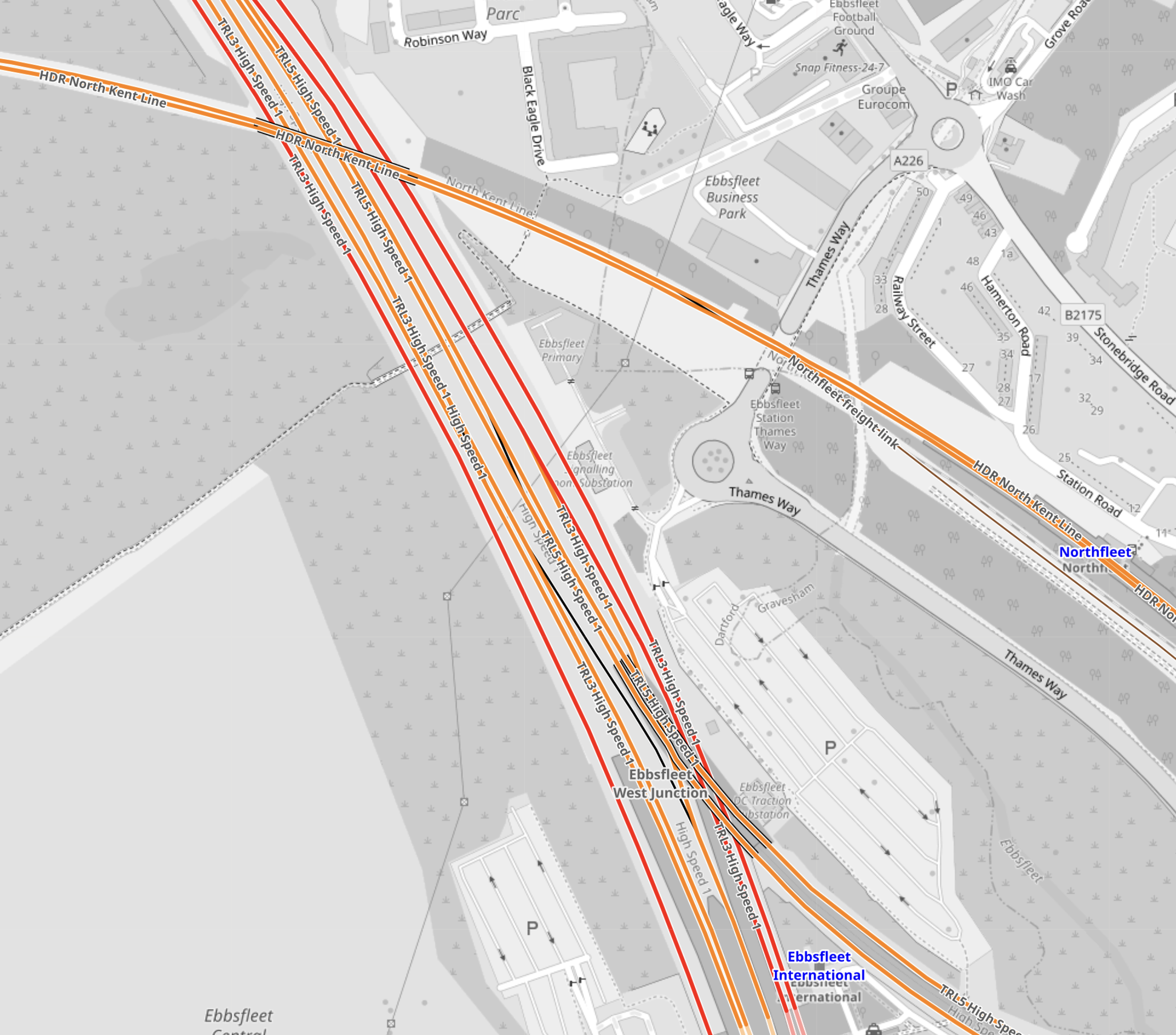
This OpenRailwayMap shows the location of Northfleet and Ebbsfleet stations.
Note.
- Ebbsfleet International station at the bottom of the map.
- The red tracks are High Speed One.
- The orange tracks are third-rail electrified lines.
- The orange tracks going across the map is the North Kent Line.
- Northfleet station is at the right edge of the map on the North Kent Line.
- Northfleet and Ebbsfleet stations are less than a kilometer apart.
- Ebbsfleet has a lot of car parking spaces.
I believe a spectacular cable-car or other link would connect Northfleet and Ebbsfleet stations.
These are some other thoughts.
Ebbsfleet International Station Has Good Motorway Access
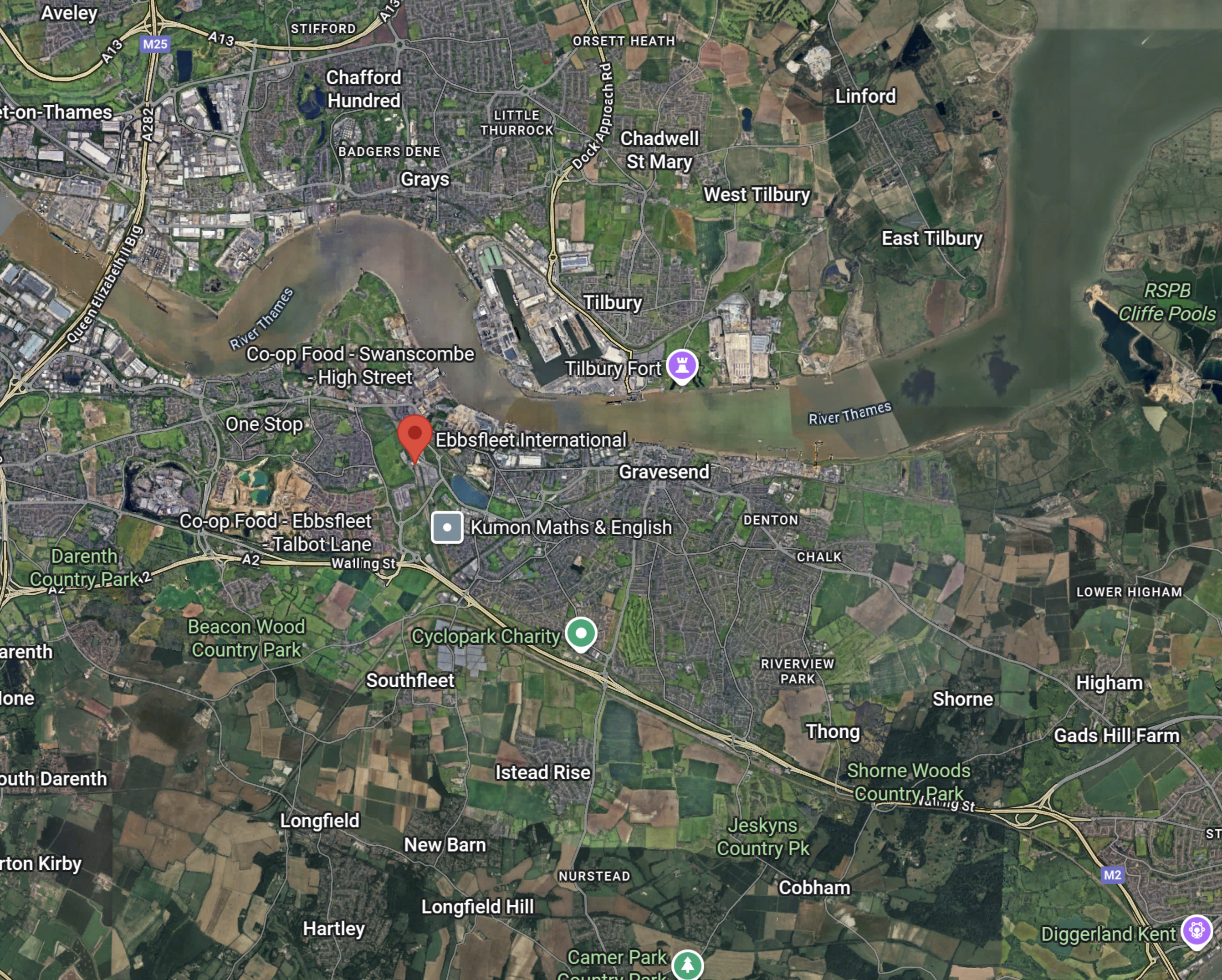
This Google Map shows the location of Ebbsfleet International station in relation to the motorways.
Note.
- The A2/M2 road runs across the bottom half of the map.
- The red arrow marks the position of Ebbsfleet International station.
- The Dartford Crossing is a few miles West of the station.
In my last few years, as an Ipswich season ticket holder, I regularly had a lift to Ebbsfleet International from a friend and the route to the station from the M25 and the A2/M2 wasn’t bad.
But it will be getting better.
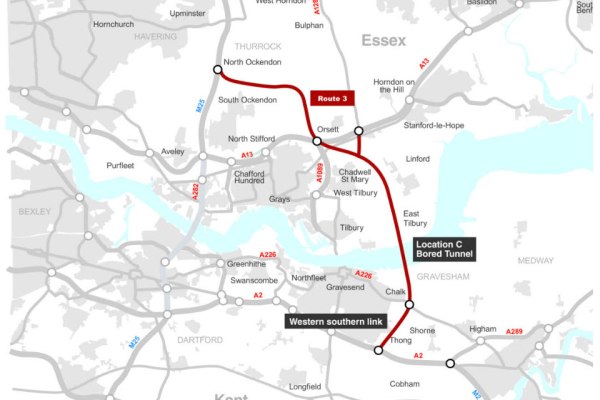
This map from the Government’s consultation on the Lower Thames Crossing, shows the road layout in a few years.
Note.
- The Lower Thames Crossing is shown in red.
- Ebbsfleet International station is about a mile South of Northfleet
- The new crossing will connect to the A2, a few miles East of the link road to the station.
Travellers from much of the East of and Middle England could use the new crossing to get to Ebbsfleet International station.
These are current times from Google.
- Birmingham – 2 hours and 41 minutes
- Cambridge – 1 hour and 17 minutes
- Edinburgh – 7 hours and 44 minutes
- Fishguard – 5 hours and 29 minutes
- Glasgow – 7 hours and 6 minutes
- Holyhead – 5 hours and 29 minutes
- Hull – 4 hours and 1 minute
- Ipswich – 1 hour and 29 minutes
- Leeds – 3 hours and 55 minutes
- Liverpool – 4 hours and 40 minutes
- Manchester – 4 hours and 28 minutes
- Milton Keynes – 1 hour and 37 minutes
- Newcastle 5 hours and 25 minutes
- Norwich – 2 hours 23 minutes
- Nottingham – 2 hours and 55 minutes
- Peterborough – 1 hour and 54 minutes
- Sheffield – 3 hours and 35 minutes
- Stoke-on-Trent – 3 hours and 25 minutes
- York – 4 hours and 16 minutes
Note.
- I would suspect that the opening of the Lower Thames Crossing will knock 10-15 minutes off these times.
- Edinburgh, Glasgow, Hull, Leeds, Newcastle, Nottingham, Peterborough, Sheffield and York would probably be quicker to Europe with a change to Continental train services at St. Pancras, rather than Ebbsfleet International.
- With improvements to rail services, more of these journeys will be quicker by train.
- High Speed Two should connect Birmingham, Liverpool, Manchester and Stoke-on-Trent to London, by the mid 2030s.
But there are some, who always feel their car is safer in a car park!
Ebbsfleet International Station Has A Large Amount Of Car Parking
This map shows the car parks at Ebbsfleet International station.

Note.
- Some of the parking areas are marked with a P.
- It is easy to pick-up and drop passengers.
- The car parks could be double-decked to add more spaces if needed.
- According to the Ebbsfleet International web site, the station currently has 5225 parking spaces, 68 accessible car parking spaces.
For those that have a lot of luggage or a large family, taking the car to Ebbsfleet International may be the best option.
Ebbsfleet International Station Should Have A Coach Station
Consider.
- In the next few years, hydrogen-powered coaches with a thousand kilometre range will come to dominate the long distance coach market.
- Mercedes and Wrightbus are know to be developing long-distance hydrogen-powered coaches.
- Hydrogen-powered coaches will be able to reach all of England and Wales and a large part of Scotland from Ebbsfleet International.
- Ebbsfleet International is closely connected to the UK motorway network.
- Continental coaches using the Channel Tunnel, could use Ebbsfleet as a coach interchange with the UK.
- Ebbsfleet International could also handle customs services for Continental coach services, which would take the pressure off the Channel Tunnel and the ferries.
- Ebbsfleet International could also have a coach link to Gatwick Airport.
These and other reasons make me feel, that a coach terminal at Ebbsfleet International is essential.
A Green Connection Between The Two Halves Of The European Union For the Gretas Of This World
Consider.
- There is no zero-carbon route between the island of Ireland and Continental Europe.
- Eurostar is all-electric between London and Continental Europe, but only serves a limited number of destinations.
- Low- or zero-carbon ferries are being designed, that run on hydrogen.
- Trains between London and the Irish ferries are diesel-powered.
- The simplest solution would surely be to run hydrogen-powered coaches between Ebbsfleet International and Fishguard and/or Holyhead. Both journeys would take three and a half hours.
Hydrogen-powered coaches are under development by Wrightbus.
I also asked Google AI if anybody is planning zero-carbon ferries between the UK and ireland and received this answer.
Yes, there are plans for zero-carbon ferries between the UK and Ireland, with a specific “Green Corridor” feasibility study underway for the Holyhead to Dublin route, and a separate, separate commuter service project planned between Belfast and Bangor. The Belfast Maritime Consortium is developing the zero-carbon commuter service, and a separate “Green Corridor” feasibility study is assessing potential low-carbon pathways between Holyhead and Dublin
I believe the green connection is feasible, provided the following happens.
- Ebbsfleet International is reopened and developed as a station for Continental Europe.
- The zero-carbon ferries are developed.
- The busmasters from Ballymena deliver the ultimate hydrogen-powered coach.
- Hydrogen and other fuels are made available, where they is needed.
This could do wonders for the economy of the island of Ireland.
Out of curiosity, I did ask Google AI, what is the longest coach route in the UK and received this answer.
The longest scheduled coach journey in the UK is the Scottish Citylink route from Glasgow to Uig on the Isle of Skye (route 915 or 916), which is about 230 miles and takes around 7 hours and 50 minutes. Historically, there have been much longer international bus routes, such as the Penn Overland tour from London to Ceylon, but these were not regular, scheduled services.
So my proposal at five hours and 29 minutes is only a short hop.
I also believe that with good project management that the additional infrastructure could be built by 2030, with little or no disruption to existing services.
New Chiltern Railways Trains Set To Unlock 10,000 More Seats A Day
The title of this post is the same as that of this press release from Chiltern Railways.
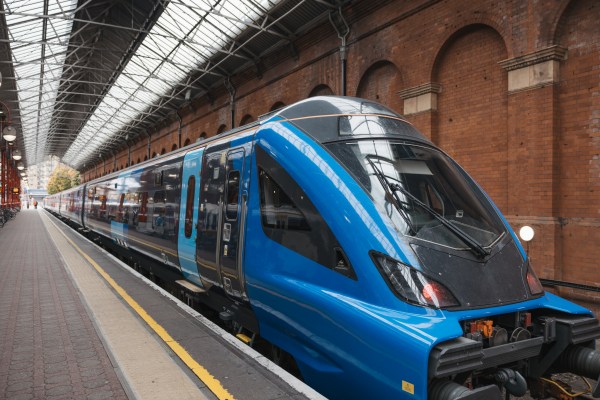
This picture from Chiltern Railways shows the train at Marylebone.
These three paragraphs are from the press release and add more details.
Chiltern Railways today (Tuesday 14 October) showcased for the first time its newest (Mark 5A) trains, set to add 10,000 more seats for customers each weekday from December 2026.
The trains, to be introduced between London to West Midlands from early 2026, will enable Chiltern to deliver more capacity across each of its West Midlands, Aylesbury, and Oxford routes as part of the operator’s efforts to deliver better journeys for customers.
The newest fleet will consist of 13 modern trains set to transform customer journeys during 2026. The trains will replace Chiltern’s oldest carriages, which are nearly 50 years old, with state-of-the-art equivalents, and provide a significant improvement to the on-board experience.
Today, I also received an update from Modern Railways, which was entitled Chiltern Railways Mk 5As To Enter Traffic Early Next Year, and included this delivery schedule.
From December 2026 there will be ten Mk 5A sets in traffic each day, with one ‘hot spare’ and one undergoing maintenance. That leaves one extra set which, CR has suggested, could eventually be pressed into traffic.
I have a few thoughts.
How Do The Trains Compare Physically?
These are basic figures for the two different types of train sets.
- The current Mark 3 are five-car sets of 23 metres coaches, that weigh about 36 tonnes. The driving van trailer is 18.83 metres and 43.7 tonnes
- The future Mark 5A are four-car sets of 22.2 metres coaches, that weigh about 43 tonnes. The driving trailer is 22.37 metres and 43 tonnes.
Lengths and weights of various sets will be as follows.
- Mark 3 – five-car and driving van trailer – 133.83 metres and 223.7 tonnes.
- Mark 5A – four-car and driving trailer – 111.17 metres and 215 tonnes
- Mark 5A – five-car and driving trailer – 155.57 metres and 258 tonnes
Note.
- Chiltern Railways and TransPennine Express use the same Class 68 locomotives.
- The five-car Mark 3 and the four-car Mark 5A sets are quite similar in length and weight
- This could mean that both sets would perform similarly with the same locomotives on the same route.
- I wouldn’t be surprised that the new Platform 4 at Birmingham |Snow Hill station will be able to handle all configurations.
I almost feel that when CAF designed the Mark 5A sets for TransPennine Express, they also had Chiltern in mind as another possible sale.
How Many Trains Would Be Needed To Run Between London Marylebone And Birmingham?
Consider.
- Trains currently run half-hourly on the route between 06:00 to 23:30, which is up to 36 services per day.
- When Platform 4 is operational at Birmingham Snow Hill station, all services could probably stop at both Birmingham Moor Street and Birmingham Snow Hill stations.
- A round trip between London Marylebone and Birmingham Snow Hill stations currently takes about five hours.
I’m fairly certain that to run a half-hourly core service would need ten trains.
Could Chiltern Develop Another Network On The Other Side Of Birmingham?
Consider.
- Trains could run twice an hour from 06:00 to 23:30, which is up to 36 services per day.
- When Platform 4 is operational at Birmingham Snow Hill station, all services could probably stop at both Birmingham Moor Street and Birmingham Snow Hill stations.
- Chiltern Railways already run several services a day to Stourbridge Junction.
- Chiltern Railways have run services to Kidderminster station in the past.
- Wrexham & Shropshire used to run locomotive-hauled Mark 3 four-car sets with driving van trailers, as far as Wrexham via Shrewsbury.
It looks to me, that with the right rolling stock configurations, Chiltern’s network can be developed on the other side of Birmingham.
- Destinations could include Stourbridge Junction, Kidderminster, Shrewsbury, Wolverhampton, Chirk, Ruabon and Wrexham General.
- Some services would need longer trains.
Obviously services would only be run if they were viable.
Would It Help Growth In A Town Or Area, If It Had A Rail Connection To London And/Or The Nearest Major City?
I know Lincoln is on the other side of the country, but I asked Google AI if Lincoln’s rail link to London has brought growth to the city and received this answer.
Yes, Lincoln’s rail link to London has brought significant growth by improving tourism, business travel, and student mobility, and is expected to spur further economic benefits through faster journey times and increased services. The direct link has made Lincoln more accessible for visitors and is a key part of the city’s long-term strategy for economic growth and development.
That was fairly definite.
How would that apply to an extended Chiltern Main Line.
- Politicians are always saying growth is important.
- An extended Chiltern Main Line servicewould improve connections of a lot of places to London and Birmingham.
- Shrewsbury is the easiest connection for West Wales.
- Surely a rail connection to a major city, might tempt someone to open a branch or a new factory.
Would a rail service make people feel more included?
Stopping The Irresponsible Parking Of Hire Bikes
This sort of parking of bicycles is becoming a real curse in London.

I have problems outside my house and this morning a hire bike was blocking my entrance for my Ocado delivery.
I believe that as each hire of a bike is known in detail by the hire companies, so they can charge riders, illegal parking of these bikes could be easily enforced.
We would need a law that could be enforced.
Each bike would need to have a clearly-marked serial number and/or QR-Code.
If you see a bike illegally parked, anybody can take a photograph and note the bike’s serial number, which they can then send to a central office by text message, e-mail or even an app.
The central office would then assess if any offence had been committed and if it had, would inform the hire company.
The hire company would charge the hirer, if an offence had been committed and charge them a fee.
The fee could even be split three ways to the hire company, the local authority and the person, who reported the offence.
Is It illegal To Read Your Phone While Cycling In London
I was just trying to cross the road and saw a young lady about twenty, riding towards me on a bicycle reading her mobile phone which was held in one hand and balanced on the handlebars. She was wearing a helmet and steering with one hand.
I asked Google AI, the question in the title of this post and received this answer.
No, it’s not explicitly illegal to read your phone while cycling in London, as the specific law prohibiting phone use while driving doesn’t apply to bicycles. However, it is very dangerous and you can still be prosecuted for the offense of careless cycling if your actions endanger yourself or others, with potential fines of up to £2,500.
In the past, I’ve used mobile phones, in ways that might become illegal.
- Several times, I’ve exercised a horse with a Nokia 6310i phone in my pocket, so that, if I fell off, I could call for help. I must admit, that I have received and made a few calls from the back of a horse. But in all cases, it was a well-behaved horse, that would stand quietly in a safe place.
- I once with prior arrangement of UK Air Traffic Control requested an Airways Join on a mobile phone at Ipswich Airport. But my second pilot that day, was a fully-qualified airline pilot.
I used to enjoy flying light aircraft and I do wonder sometimes, if I could still do it, after a gap of thirty years and a serious stroke? Obviously, I’d make it legal with an instructor in the right-hand seat.
45 schools Benefit From Rail Safety Resources Supported By Lumo And Hull Trains
The title of this post, is the same as that of this article on The Shields Gazette.
This is the sub-heading.
The UK’s leading open access rail operators, Lumo and Hull Trains, are celebrating supporting the delivery of vital rail safety resources to 45 schools across the UK over the past year.
These three paragraphs add more detail.
In association with the Rail Safe Friendly Programme, the operators’ involvement has led to a social value impact of over £724,000, directly educating thousands of young people.
The programme is dedicated to spreading the vital message of rail safety among young people, educators and parents in schools across the UK. Lumo and Hull Trains have supported the important initiative for the past two years, with their support renewed for a third.
As part of the partnership, Lumo took over the Metrocentre’s ‘mini express train’ to highlight the issue of rail safety to families and children visiting the shopping centre during the school holidays in 2024. The project secured industry recognition at the recent Corporate Engagement Awards.
It’s not just in the UK, that this type of excellent engagement is being setup.
This train is the world’s first hydrogen-powered train to enter passenger service, between Hamburg and Cuxhaven in Germany.
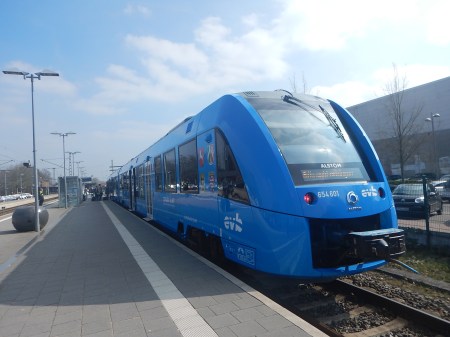
When I rode the train, a German schoolboy told me, that their school had given them safety lessons about hydrogen.
Mega Airport Costing £24billion In Europe To Rival Heathrow And Dubai
The title of this post is the same as that of this article in the Daily Express.
A new mega airport is being built in Europe, and it is set to rival the likes of Dubai and London Heathrow in terms of size and capacity for passengers and planes alike
These three paragraphs add more details.
A plush new airport could be touching down in Europe, set to rival London’s Heathrow and even the esteemed Dubai International, as it aims to link the entire continent in unprecedented ways.
The Centralny Port Komunikacyjny, a proposed $32.5 billion project, is a fresh aviation gateway in Warsaw that carries the burden of Poland’s ambitious mega airport aspirations. However, the concept is swiftly progressing, with the official approval and handover of the passenger terminal design marking a significant leap forward.
This suggests the colossal airport is officially moving into its next phase of development. The question remains, will this new progression challenge the supremacy of the Middle East, home to both the world’s largest airport, King Fahd International Airport in Saudi Arabia, and the busiest, Dubai International Airport?
Note.
- In English, Centralny Port Komunikacyjny means Central Communications Port.
- CPK’s forecasted passenger capacity makes it a formidable contender as the new hub for Europe.
- Dubai is on course to handle 100 million passengers by the end of next year, thanks to its strategic geographical position with other continents, while the Polish project will eventually accommodate up to 44 million.
- n 2024, Heathrow Airport welcomed a record 83.9 million passengers, a 6% increase from the previous year.
Even the busiest airports in Europe handle far fewer passengers than Dubai.
Central Communications Port has a Wikipedia entry, which has this first paragraph.
The Central Transport Hub is a planned major infrastructure project in Poland aimed at the construction of a new international airport and the development of a nationwide integrated transport network. The airport is planned to be located approximately 40 kilometres (25 mi) southwest of Warsaw, connected to a new high-speed rail network and controlled-access highway system linking it with much of the rest of the country.
Note.
- The airport will be designed by Foster + Partners in collaboration with Buro Happold.
- Initially the airport is planned to have two runways, but will eventually be expanded to four.
- The combined airport and railway station is planned to serve 40 million passengers per year, double the size of Berlin Brandenburg Airport.
- The long-term goal is about 100 million passengers per year.
These are my thoughts.
The Airport’s Location
The Wikipedia entry for the airport has a section called Location, which has this first paragraph.
The airport’s planned site is about 40 km west of Warsaw, next to the village Stanisławów which is part of Gmina Baranów in Grodzisk Mazowiecki County. The Baranow commune occupies a significant part of the Grodzisk County and, despite its rural character, has an extensive road infrastructure. The A2 autostrada and railway lines run in the immediate vicinity of the potential construction site, and Wrocław (Expressway S8) and Poznań (National road 92) is nearby.
It sounds to me, that a British equivalent airport, would be a four-runway airport at Birmingham Airport with connections to the M1, M6, HS2 and the West Coast Main Line.
Rail Connections
The Wikipedia entry says this about rail connections.
Planned train connections from the CPK will take 15 minutes to Warsaw Central railway station, 25 minutes to Łódź Fabryczna railway station, and 2 hours to most other major Polish cities, such as Kraków, Wrocław, Poznań and Gdańsk. The construction of a high-speed train to Frankfurt (Oder) is also planned, which is to shorten the travel time on the Berlin-CPK route to under 3.5 hours
I suspect that Rail Baltica’s trains between Berlin and Helsinki via Warsaw, Kaunus, Riga, Bialystok and Tallinn will also stop at the airport.
The Airport Will Become A Gateway To North-East Europe
I wouldn’t be surprised to see Central Communications Port become a low-cost gateway to the surrounding countries., like Belarus, Estonia, Finland, Latvia, Lithuania and hopefully Ukraine.
Polish Hospitality
Consider.
- Most Poles speak English better, than what I does!
- There are several large Polish cities that are worth a visit.
- The food is excellent, as the local basic ingredients are of high quality.
- I have spent about a month in Poland and I’ve stayed in all levels of accommodation from the lowest to the highest and have never felt need to complain.
- They handle my gluten-free diet with no problem.
My experience of Belarus was also similar.
I Shall Be Going To The Opening Of Blyth Bebside Station On Sunday, the 19th October
In Railway Station Opening Date Announced, I said that Blyth Bebside station will open on October 19th.
I intend to go and add my travel times, when I book tickets.
Unlocking Efficiency With Cryogenic Cooling Of GaN Traction Inverters
The title of this post, is the same as this insight on the Ricardo web site.
This is the introduction.
As the mobility sector accelerates toward zero-carbon propulsion, hydrogen fuel cell systems (HFCS) are emerging as a cornerstone technology for aviation, marine, and long-haul road transport. Among the most promising innovations in this space is the use of liquid hydrogen (LH₂) not only as a fuel source but also as a cryogenic coolant for electric powertrains. This dual-purpose approach offers transformative potential in system efficiency, packaging, and weight reduction—especially when paired with Gallium Nitride (GaN) semiconductors.
It is a very simple concept, but it appears to give worthwhile efficiency gains.
This was the article’s conclusion.
Ricardo’s cryogenic GaN inverter concept represents a bold leap toward ultra-efficient, lightweight, and integrated hydrogen propulsion systems. While challenges remain in materials, packaging, and reliability, the experimental results are compelling. With efficiencies nearing 99.8% and mass reductions over 50%, cryogenic cooling could redefine the future of electric mobility.
As the hydrogen economy matures, innovations like this will be pivotal in delivering clean, scalable, and high-performance solutions across all mobility sectors.
I very much suggest, that you take the time to read the whole insight.
Using The Concept In a Liquid Hydrogen Carrier
This Wikipedia entry describes the design and operation of an ocean-going liquid hydrogen carrier.
This is a paragraph.
Similar to an LNG carrier the boil off gas can be used for propulsion of the ship.
Ricardo’s concept would appear to be advantageous in the design of liquid hydrogen carriers and I would expect, it could also be applied to the design of LNG carriers.
I would not be surprised to see liquid hydrogen and LNG carriers were the first application of Ricardo’s concept.
This Wikipedia entry describes the Suiso Frontier, which is the world’s only liquid hydrogen carrier.
I believe that Ricardo’s concept could lead to the construction of a more of these ships. Will they mean that liquid hydrogen carriers will deliver hydrogen from sunny climes to places like Europe, Japan, Korea and Canada.
The concept would also enable efficient small liquid hydrogen carriers, that could deliver hydrogen on routes like the North of Scotland to Germany.
Using The Concept In A Railway Locomotive
I could see freight locomotives being designed as a large liquid hydrogen tank with appropriately-sized fuel cells and added electrical gubbins.
- They would be self-powered and would not require any electrification.
- They would be much quieter than current diesels.
- They could pull the heaviest freight trains, between Europe and Asia.
- They could even pull passenger trains, if an electrical hotel supply were to be arranged.
- They could be designed with very long ranges.
But above all they would be zero-carbon.
Note that I’ve written about long freight routes before.
- China, Russia And The EU’s Intermarium Bloc
- How To Move 100,000 Containers A Year Between Germany And China
- Georgia, Azerbaijan and Iran Discuss New Freight Corridor To link India And Europe
- Finland And Norway To Explore Building Arctic Rail Link
- A New Gateway To China: Europe Prepares For The Launch Of Baku–Tbilisi–Kars Railway
I believe that a long-distance liquid-hydrogen locomotive, that was based on the Ricardo concept, would be ideal for some of these routes.
A Specialised Hydrogen Delivery Train
In April 2022, I wrote The TruckTrain, where this is a simple description of the concept.
The Basic Design Concept
The leaflet on their web site describes the concept.
This visualisation at the bottom of the leaflet shows four TruckTrains forming a train carrying twelve intermodal containers, each of which I suspect are 20 feet long.

I believe that the TruckTrain concept could be converted into a hydrogen delivery train.
- It would be an appropriate length.
- It would be powered by the on-board hydrogen.
- The hydrogen would be stored as liquid hydrogen.
It would be able to go most places on the UK rail network.
Conclusion
Ricardo’s concept could revolutionise the use of hydrogen.
 The Anonymous Widower