Plans To Reopen The Brentford To Southall Railway
The title of this post, is the same as that of this article on Ian Visits.
I have posted on the Brentford Branch Line several times previously and Ian says this about Hounslow Council’s thinking.
The council has been working on a scheme for some years to resurrect the line, with a new station built in Brentford and passenger services restored to Southall. A key factor for the plans is that Southall will then be on the Elizabeth line, which they hope will drive a lot more traffic on the spur down to Brentford.
In order to part-fund the 4-mile railway, Hounslow Council has now agreed to undertake a full business case to look at introducing a Workplace Parking Levy (WPL) within the Great West Corridor (GWC).
In my trips to document the updating of Syon Lane station with a new step-free footbridge, I have talked to several people, who would find a rail link to Southall useful.
Ian also says this about the latest situation.
As part of the proposal, the council has also commissioned Network Rail to begin a detailed study (known as ‘GRIP 4’) on building the new train link from Brentford to Southall, following encouraging early studies into the feasibility of such a link.
At least, this will give the Hounslow a list of all the problems and a cost estimate.
A few of my thoughts.
What Should Be The Frequency Of The Service?
The current truncated Brentford Branch Line is mainly single track, but from my helicopter, it appears that there would be space to add an additional track for as much of the route as required.
Preferably, there should be a service on the branch of at least two trains per hour (tph). Although, ideally four tph is much better, as it attracts passengers in large numbers.
It should be noted that from December 2019, there will be four tph on Crossrail calling at at Southall station all day. Connections should surely be well-arranged.
Four tph would be possible between two single platforms at Southall and Brentford, but would require selective doubling or passing loops to accommodate the service and the freight trains going to Brentford.
This Google Map shows the various sites clustered around the branch.
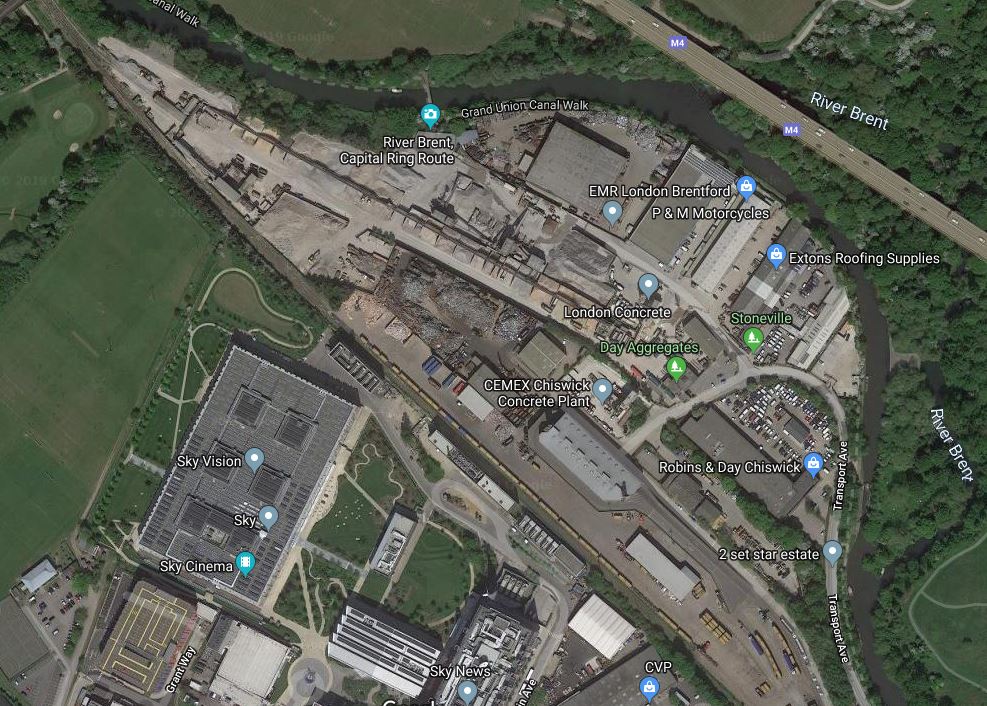
The branch runs from the North-West to the South-East across the map.
- The Great West Road is a couple of hundred metres to the South.
- To the East of the branch, there are a collection of waste and scrap metal transfer sites, aggregate and concrete sites and others that hide away in big cities.
- To the West is the massive Sky Studios complex.
I do wonder, if Sky would like a station? If they did, this would surely mean that a four tph service would be required.
What Is The Future Of The Industrial Site?
Because of London’s thirst for land for housing and office developments, sites like this inevitably get developed.
With its position between the River Brent and parkland, and the Brentford Branch Line, I believe that if new sites can be found for the various tenants, that this site could be a high quality housing development.
An intermediate station would surely be required.
Could An Intermediate Station Serve Both The Brentford Branch Line And The Piccadilly Line?
This Google Map shows where the two lines cross.
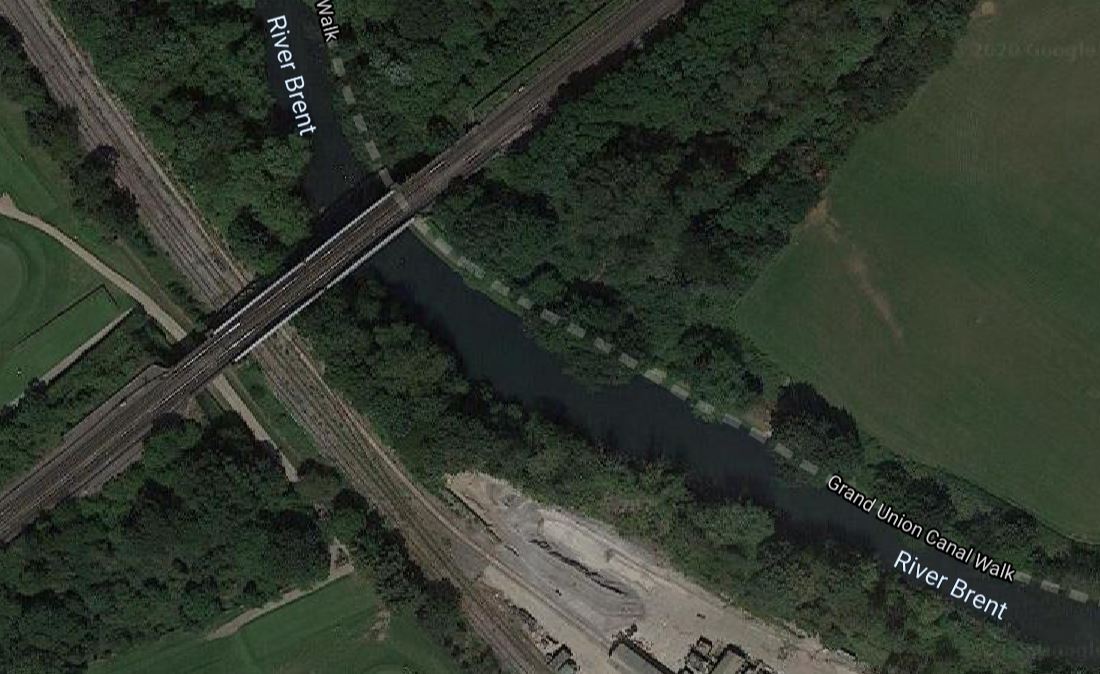
Note.
- The Northern tip of the industrial site is just visible.
- The Brentford Branch Line has three tracks under the Piccadilly Line,
- There is no pedestrian bridge over the River Brent.
I think it would be possible, if the industrial site were to be developed for housing or perhaps a hotel, for a simple interchange station to be built here.
- There would be an island platform on the Brentford Branch Line.
- There would be two side platforms on the Piccadilly Line,
- There would be lifts and stairs between the three platforms.
- There could be a second entrance on the Eastern bank of the River Brent.
I feel that a decent architect could make this a very nice place to live. After all, it’s only six intermediate stops between Boston Manor and Heathrow.
What Should Be The Terminus Of The Branch?
I believe that the branch should terminate as close to the River as is possible.
- There is a lot of new housing being constructed in Brentford.
- I believe that Thames Clippers will eventually extend their river-boat services to Brentford and Kew.
But the problem would be that this would need an expensive bridge over the Great West Road.
These pictures show the Great West Road, where the current Brentford Branch Line finishes.
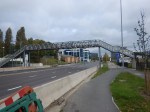
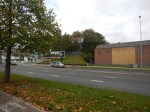

The tracks finish about a hundred metres North of the road, as shown on this Google Map.
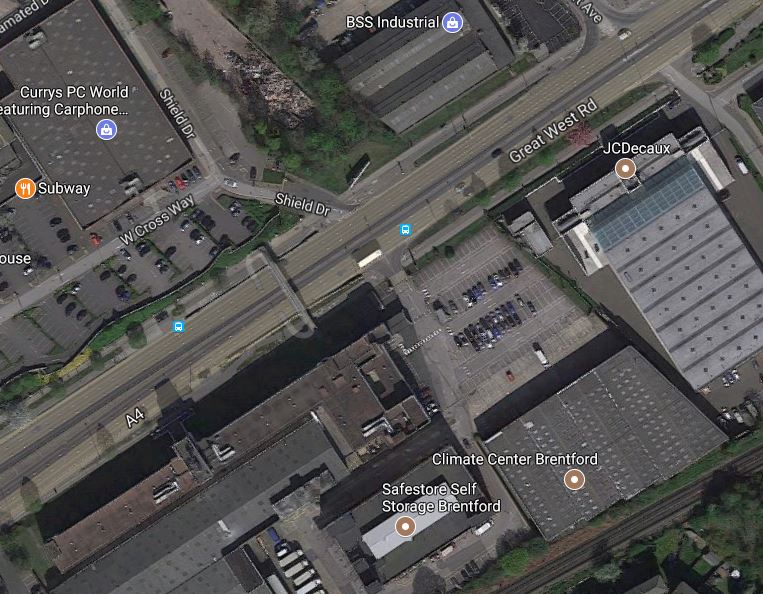
The rusty footbridge over the busy road can be clearly seen.
Initially, I believe that the passenger service should terminate at the Great West Road.
If I was designing the station, I would build it much like the Deptford Bridge DLR station.
- It would be on a bridge above the Great West Road.
- It would be suspended from step-free towers on either side of the road.
- Would it only need to be a single platform station?
- The pavements on either side of the Great West Road would be improved to create a better walking environment.
- If possible a walking and cycling route to Brentford and the River would be provided.
- The design would leave provision to extend the railway South.
I also think, that it could be designed to enhance the collection of Art Deco and modern buildings in the area.
Could The Service Go Further Than The Great West Road?
This Google Map shows the former route of Brentford Branch Line, from just North of the Great West Road to the centre of Brentford.
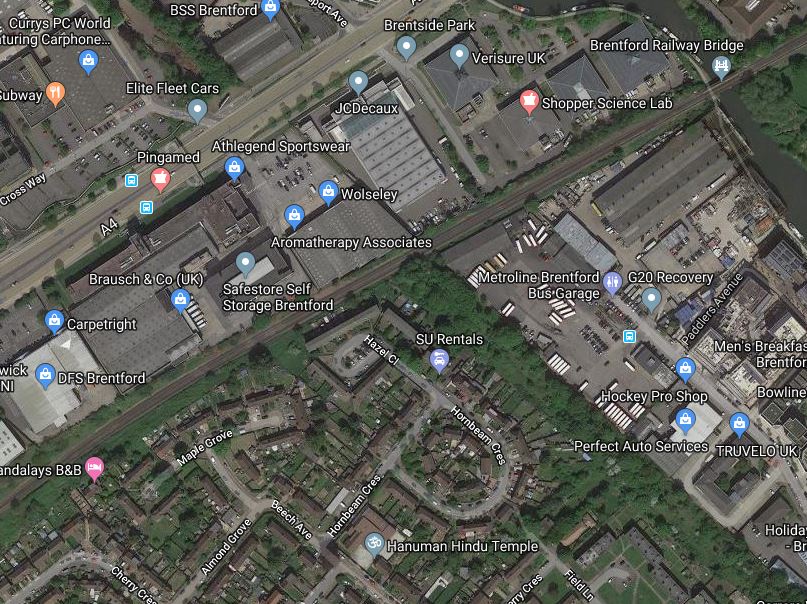
Note.
- The former route is very green on the map.
- The Hounslow Loop Line crossing parallel and a few hundred metres South of the Great West Road.
- The only building on the route is some retail sheds between the Great West Road and the Hounslow Loop Line.
- To the \east of the Brentford Branch Line is a large and semi-derilict bus garage.
I’m sure that the railway could be extended through this area, as it is developed with housing and offices or parkland.
Could The Service Go Further Than Southall?
There is a section in the Wikipedia entry for the Brentford Branch Line, which is entitled Proposed Reopening, where this is said.
In April 2017, it was proposed that the line could reopen to allow a new link between Southall to Hounslow and possibly down to the planned Old Oak Common station with a new station in Brentford called Brentford Golden Mile. The proposals suggest the service could be operated by Great Western Railway and could be open by 2020 with a new service from Southall to Hounslow and possible later to Old Oak Common
It sounds a good idea, but it would mean trains would surely have to reverse direction and cross over to the North side.
It must be better to provide full step-free access at Southall station, which should be finished fairly soon.
Crossrail will also be providing at least four tph to and from Old Oak Common.
How Many Trains Would Be Needed?
I am pretty sure, that several train types could do a Southall and Brentford round trip in under thirty minutes.
This would mean the following.
- For a two tph service, one train would be needed.
- For a four tph service, two trains would be needed.
I suspect too, that a spare train would be added to the fleet.
Would The Branch Be Electrified?
I doubt it!
- The branch is only four miles long.
- A 100 kWh battery would probably provide enough power for a four-car train.
- It is unlikely electric haulage will be needed for the freight trains o the branch.
- There is 25 KVAC electrification at the Southall end of the branch to charge trains with batteries.
- The branch is probably short enough to not need a charging point at Brentford.
In my mind, it is a classic route to run using battery power.
What Trains Could Be Used?
I feel the trains need to have the following specification.
- Abiility to use 25 KVAC overhead electrification.
- A out and back battery range of at least eight miles.
- Three or four cars.
- 60 mph operating speed.
There are several proposed trains that meet this specification.
Class 710 Train
The Class 710 train would be an obvious choice, if London Overground were to run the service.
But it would need the 25 KVAC electrification be added to Platform 5 at Southall station.
Class 230 Train
The Class 230 train could be a lower cost option and would only require one of Vivarail’s clever charging systems at Southall.
Class 387 Train
A modified Class 387 train would surely be a choice, If Great Western Railway were to run the service.
But as with the Class 710 train, it would need Platform 5 at Southall station to be electrified.
Class 399 Tram-Train
A Class 399 tram-train to the South Wales Metro specification is also a possibility.
But as with the Class 710 train, it would need Platform 5 at Southall station to be electrified.
However, the lighter weight vehicle with a tight turning circle might allow the route to be extended further South.
Conclusion
I am led to these conclusions.
- Battery power is capable of working the Brentford Branch Line.
- At least two tph is needed between Southall and Brentford.
- The operator will choose the trains.
IBut as they are a lower-cost and simpler option, this route could be run by Class 230 trains.
University Of Birmingham Leases HST For Alternative Fuel Tests
The title of this post is the same as that of this article on Rail Magazine.
This is the first paragraph.
A High Speed Train is being leased by the University of Birmingham to help analyse and test what alternative fuel could be used to power long-distance passenger or freight trains.
It will be interesting to see what results from the research.
A few of my thoughts.
Suitability Of A HST For Research
It must be suitable for research purposes, otherwise the University wouldn’t have obtained the train.
If you look at the Birmingham Centre for Railway Research and Education web site, they list the Research Areas.
- Railway Control and Operations Simulation
- Data Integration and Cybersecurity
- Condition Monitoring and Sensing
- Centre of Excellence in Digital Systems
- Power Systems and Energy Use
- Aerodynamics
- Climate Change and Weather Impact
There must be a lot of scope for the use of a real train, especially one which has a lot of free space in the engine, where test equipment can be mounted.
Porterbrook’s Interest
I can think of several reasons, why Porterbrook might need to partner with the Research Centre, for sound commercial reasons.
Most will probably seem small in the eyes of the general public, but might be based on Porterbrook’s feedback from customers about their extensive fleet.
Understanding The HST’s Success
The HST or InterCity 125 has been an undoubted success with passengers, drivers, staff and train companies for forty years and understanding the reasons could be invaluable in improving rail transport in the future.
Education
I suspect too that the train will be used to educate students, especially those, who want to work in train or railway design.
When I left Liverpool University with my Control Engineering degree in 1968, I was one of the few, who’d worked on bg heavy machinery in a factory environment.
These days, with Heath and Safety rules much tighter, I doubt, today’s students can gewt the same experience.
Conclusion
I do hope that Porterbrook and the Research Centre, when they look back in a few years, feel that this venture has been a success.
Toyota Fuel Cell Buses Expected To Be Big Seller Of Hydrogen At 2020 Tokyo Olympics
The title of this post is the same as that of this article on Hydrogen Fuel News.
This is the first paragraph.
Toyota fuel cell buses are likely to be the clean transportation to take center stage at the upcoming Summer Olympic Games in Tokyo. The Japanese automaker intends to roll out 100 of these buses at the event to shuttle visitors between venues.
It would appear to be an exercise to publicise their technology.
If you read the Wikipedia entry for hydrogen fuel cell buses, no-one has yet built and deployed a fleet as large as Toyota’s for the Olympics.
The UK has two major deployments of hydrogen fuel cell double deck buses, under development, that I wrote about in the following posts.
- London To Have World-First Hydrogen-Powered Double-Decker Buses
- New Facility To Power Liverpool’s Buses With Hydrogen
In 2012, I went to a lecture about the New Routemaster Bus at the Institute of Mechanical Engineers, which I wrote about in The Development of the New Bus for London.
Wrightbus had obviously done their research and I got the impression, that designers can put heavy and bulky components all over the place in a modern double-decker bus.
On the New Routemaster components are placedas follows.
- The single traction motor is under the floor.
- The battery is under the front stairs.
- The Cummins diesel engine is half-way up the back stairs.
As the New Routemaster is based on a specially-designed chassis and not a standard one from Volvo or Mercedes, I wonder if to be successful, a hydrogen-powered bus needs a custom-designed chassis, to properly accommodate the various components.
- Traction motor
- Hydrogen tank
- Hydrogen fuel cell
- Battery
It certainly looks like Toyota have gone down this route. But then they can afford to for the Tokyo Olympics.
Could A White LEVC TX Electric Taxi Be A 21st Century Wedding Car?
I took these pictures of a white LEVC TX electric taxi at St. Pancras station.

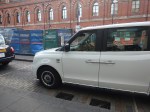


A few minutes later, I got into a more common black one and asked the driver.
He said, he was very pleased with his new vehicle and he suspected some had been used as wedding cars.
Progress At Syon Lane Station – 18th September 2019
The builders are now digging on both platforms at Syon Lane station.


The posters at the station give the impression that brick towers might be built.
But it looks to my untrained eye, that the foundations being dug don’t appear to be deep enough.
Waiting at the station for my train, I wondered, if they are going to put a set of stairs and a life on both platforms to give step-free access to the existing road bridge.
- The towers would be shorter and height costs money.
- There would be no need to build and lift in an additional bridge, as pedestrians would use the existing pavement.
- It might be possible to do all the work without closing the railway.
- This would meet all the step-free regulations.
There certainly seems to be no work going on further down the platform, where it appeared some trees were cleared.
It’ll all come clear in a few weeks and I suspect it will meet the generally high standards of Network Rail.
Amazon Will Order 100,000 Electric Vans To Hit Carbon-Neutral Pledge
The title of this post is the same as that of this article on The Times.
A few points from the article.
- The vans will be from a start-up company called Rivian, in which Ford has invested half a billion dollars.
- Delivery will be within five years.
- Amazon aims to be carbon-neutral by 20140.
- Some of the vans will be used in the UK.
Apparently, Jeff Bezos made the announcement close to the White House.
Hopefully, this excellent policy will cause a few ripples.
- Will it encourage other van users to look at using electric vans?
- Will it push other vehicle manufacturers to develop zero-carbon vans?
- Will it help to reduce pollution in cities?
Because major companies are a bit like sheep, the announcement of Amazon and Rivian could start a major change.
Did We Lose The Plot On Electric Delivery Vehicles?
When I was growing up, milk was delivered daily in an electric milk float.
I am also old enough to remember the Harrods electric delivery vehicles, which were actually built by the store in the basement.
This page on the National Motor Museum gives a picture and a few details.
Amazon seem to be going back to the future!
Who will be next?
South Wales Metro: Lack Of Toilets Tram-Trains ‘Dehumanising’
The title of this post is the same as that on this article on the BBC.
This is the first two paragraphs.
he lack of toilets on new tram-trains that will serve the south Wales valleys has been branded “dehumanising”.
Trams proposed for the new £738m south Wales rail network upgrade, planned for 2022, will not have toilets on board.
This toilet issue was raised with Crossrail and I wrote about it in 2015, in Do Crossrail Trains Need Toilets?.
Now that the Crossrail trains have been running for some time, toilet issues don’t seem to be raised.
Could Merseyrail’s Class 777 Trains Run As Tram-Trains On The Manchester Metrolink?
Look at the main dimensions of the Stadler Class 777 train destined for Merseyrail and the current M5000 tram of the Manchester Metrolink. I have also added the dimensions of the Stadler Class 399 tram-train, that is running on the Sheffield Supertram network.
Class 777 train
- Width – 2.82 metres
- Height – 3.82 metres
- Floor Height – 0.96 metres
- Overall Length – 64.98 metres
- Capacity – 190 seats and 302 standing – 492 total
- Operating Speed – 75 mph
M5000
- Width – 2.65 metres
- Height – 3.67 metres
- Floor Height – 0.90 metres
- Overall Length – 28.4 metres
- Double Length – 56.8 ,metres
- Capacity – 60 or 66 seats and 146 standing – 206 or 212 total
- Operating Speed – 50 mph
Class 399 tram-train
- Width – 2.65 metres
- Height – 3.72 metres
- Floor Height – 0.425 metres
- Overall Length – 37.2 metres
- Capacity – 96 seats and 140 standing – 236 total
- Operating Speed – 62 mph
Note.
- Vehicle width and height could probably be incorporated on the same track
- The floor heights of the Class 777 train and the M5000 are surprisingly close,
- The floor height of the low-floor Class 399 tram-train is lower and wouldn’t allow step-free access from platform to tram on the Metrolink network.
- A double M5000 and a Class 777 train have similar lengths.
- A double M5000 has 86% of the capacity of a Class 777 train.
A Class 777 train looks to be able to go anywhere that a double M5000 tram can go and be able to give the same quality of passenger access.
Can double M5000 trams use the whole of the Metrolink network?
Power Supply
Around Manchester and Liverpool there are the following types of electrification.
- 25 KVAC overhead – Connecting major cities and on the West Coast Main Line.
- 750 VDC overhead – Manchester Metrolink
- 750 VDC third-rail – Merseyrail
In the future it is intended that Class 777 trains will be able to handle.
- 25 KVAC overhead
- 750 VDC third-rail
It should also be noted that Class 399 tram-trains, which are also built by Stadler can handle.
- 25 KVAC overhead
- 750 VDC overhead
I wouldn’t be surprised to find, that Stadler can produce a Class 777 train, that could handle these voltages.
- 25 KVAC overhead
- 750 VDC overhead
- 750 VDC third-rail
It’s all about the electrical systems on the train, but Stadler probably have the solutions in their boxes of tricks.
I very much feel it would possible for a version of a Class 777 train with an additional battery to do the following.
- Run as a train on the Merseyrail network. using 750 VDC third-rail.
- Run as a train between Otmskirk and Preston using a mixture of battery power and 25 KVAC overhead.
- Run as a train between Kirkby and Wigan using the battery.
- Run as a double tram on the Manchester Metrolink using 750 VDC overhead.
- Run as a tram-train to extend the Manchester Metrolink using a mixture of battery power and 25 KVAC overhead.
Class 777 trains might even be able to run on the Sheffield Supertram network. But they might be too long and would not be able to provide step-free access from platform to tram, without modification of trains and/or platforms.
Poasible Routes
Just about anywhere a Manchester Metrolink M5000 tram or a four-car electric or diesel multiple unit can run.
Thjis article on Railway Gazette is entitled Battery Trial Planned For New EMU Fleet.
This is the first sentence.
The sixth of the 52 four-car 750 V DC third rail electric multiple-units which Stadler is to supply for Merseyrail services around Liverpool is to be fitted with a 5 tonne battery to test the business case for energy storage.
A five tonne battery will soon be able to have a capacity of 500 kWh, which should be able to give the train a range of fifty miles on battery power.
This would more than cover the thirty miles without electrification between Altrincham and Chester, where the battery could be recharged.
Conclusion
I am in no doubt that Merseyrail’s Class 777 trains, could run as tram-trains on the Manchester Metrolink.
But then, Stadler don’t do ordinary and obvious!.
Why should they?
There must also be an advantage to Manchester Metrolink and Merseyrail, if they were using the same or similar vehicles for their public transport networks.
Isle of Wight Line’s Future Secured With £26m Investment
The title of this post, is the same as that of this article on the Railway Gazette.
This is the first paragraph.
Investment of £26m to secure the future of the 13·7 km line between Ryde and Shanklin on the Isle of Wight was announced on September 16. This includes infrastructure modernisation and replacement of the life-expired fleet of small profile ex-London Underground trains which date back to 1938.
A few more details.
Infrastructure
Improvements will include.
- The track will be renewed and the electrical systems will be modernised to improve reliability and ride.
- A passing loop will be installed at Brading.
- South Western Railway will improve the important stations.
The track improvements will allow a half-hourly service to link up with the ferries to the mainland.
Rolling Stock
These Class 483 trains will be replaced.
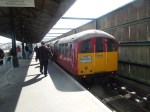
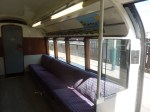
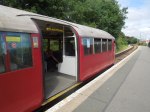

They will be replayed by trains similar to these.
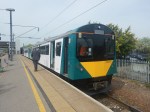
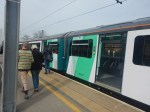
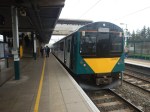
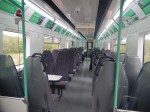
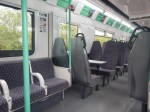
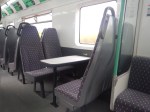
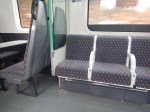
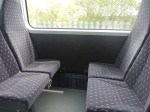
The pictures show Class 230 trains, which are diesel-electric versions of the electric Class 484 trains that will be used on the Island Line.
- Both trains are two car sets, which will work in pairs.
- The new trains will have a capacity of 172 seats, as opposed to the 84 seats of the current stock.
- The speed of the new trains is 60 mph, as opposed to the 45 mph of the current stock.
- It would appear that the new fleet includes a spare train, which should improve reliability.
The extra speed and the passing loop at Brading will enable the half-hourly timetable.
In Battery Class 230 Train Demonstration At Bo’ness And Kinneil Railway, I describe a ride in a battery/electric version of the Class 230 train.
The noise levels were very low and I suspect the Class 484 train will be a quiet ride.
Conclusion
There may be better and much more expensive solutions, but this is a practical one, that is affordable, with little risk.
I also think that £26million to secure the island Line for upwards of a dozen years, is not a bad investment.
New Railway Station Between Hinckley And Nuneaton Receives Backing
The title of this post is the same as that of this article on Rail Technology Magazine.
This is the first paragraph of the article.
Plans for a new railway station between Hinckley and Nuneaton looks set to go ahead following backing from councillors.
The station will be called Nuneaton Parkway.
This page on Coventry Live gives some more information.
There is also a proposed station, to be called Nuneaton Parkway, situated off the A5 between Hinckley and Nuneaton.
This Google Map shows the area where the A5 crosses the Birmingham-Peterborough Line, that runs between Hinckley and Nuneaton..
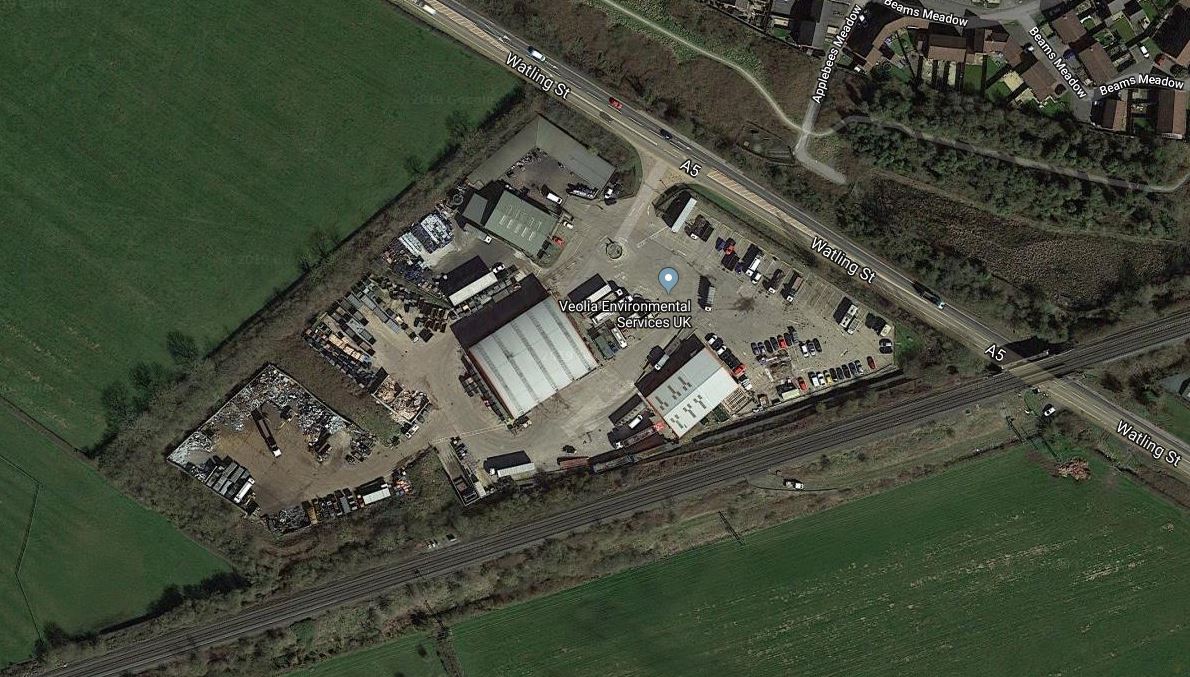
This must surely be one of the best sites to build a new Parkway station in the UK.
- The triangular site is a waste transfer station operated by Veolia Environmental Services UK.
- It has a direct connection to the A5, which could be easily improved, with perhaps a roundabout.
- Doing a crude estimate from the Google Map, I calculate that the site is about sixteen hactares, which is surely a good size for a Parkway station.
- There’s even quite a lot of new housing within walking and cycling distance.
It would also appear that the station could be built on this site without major disruption to either road or rail traffic.
Train Services
Currently the train service passing the proposed site of Nuneaton Parkway, which stops at both Hinckley and Nuneaton stations is as follows.
- An hourly CrossCountry service between Birmingham New Street and Leicester.
- In addition there are four trains per day between Birmingham New Street and Stansted Airport and/or Cambridge.
- All trains take seven minutes between Nuneaton and Hinckley.
But just under forty trains per day is not enough.
In my view, there should be a train at least every half-hour and preferably four trains per hour (tph) between Birmingham New Street and Leicester.
What About Coventry and Birmingham International?
Services between Nuneaton and Birmingham go via Coleshill Parkway and don’t call at Coventry and Birmingham International for the Airport, High Speed Two and the National Exhibition Centre.
So could there be a Birmingham New Street and Leicester service via Birmingham International, Coventry, Coventry Arena, Nuneaton, Nuneaton Parkway and Hinckley?
London, Liverpool and Manchester Via Nuneaton
Currently, the Nuneaton and London service is hourly and timed badly for connections at Nuneaton.
If it is intended that passengers will park at Nuneaton Parkway station and go to and from London, Liverpool or Manchester, the following must be arranged.
- At least four tph calling at Nuneaton, Nuneaton Parkway and Hinckley.
- At least two tph from West Midland Trains going between London Euston and Crewe calling at Nuneaton.
- Perhaps one tph from Virgin Trains calling at Nuneaton.
- A big improvement in cafes and waiting rooms at Nuneaton.
Note that times between Nuneaton and London Euston are as follows.
- West Midlands Trains – 78 minutes
- Virgin Trains – 69 minutes
Perhaps West Midlands Trains should be running trains with the same performance as Virgin?
Could Battery-Electric Trains Be Used Between Birmingham New Street And Leicester?
The route between Birmingham New Street and Leicester is not electrified, but two important stations; Birmingham New Street and Nuneaton are both wired, as is the route between Coventry and Birmingham New Street via Birmingham International.
Distances between Nuneaton and other stations, where independent power would be needed are.
- Birmingham New Street via Coleshill Parkway – 21 miles.
- Leicester – 19 miles or 38 miles return.
- Coventry – 10 miles
These distances are all feasible for battery operation.
In Porterbrook Makes Case For Battery/Electric Bi-Mode Conversion, I talked about Porterbrook’s plan to convert redundant Class 350 trains into battery-electric trains.
- They are four-car electric trains.
- They were built within the last ten years.
- They are currently used by West Midlands Trains.
In the related post, I estimated that these converted trains would have the following battery ranges for the power usages shown, if they were to be fitted with 400 kWh of batteries. I chose 400 kWh as this is the battery capacity of a Three-car Class 230 train.
- 5 kWh per vehicle mile – 20 miles
- 4 kWh per vehicle mile – 25 miles
- 3 kWh per vehicle mile – 33.3 miles
- 2 kWh per vehicle mile – 50 miles
In How Much Power Is Needed To Run A Train At 125 mph?, I calculated that.
- A Class 801 train needs 3.42 kWh per vehicle mile to maintain 125 mph.
- An IOnterCity125 train needs 2.83 kWh per vehicle mile to maintain 125 mph.
- A Class 222 train needs 4.83 kWh per vehicle mile to maintain 125 mph.
- A Class 170 train needs 3.15 kWh per vehicle mile to maintain 100 mph.
Looking at the last figure for the Class 170 train, I feel that a modern electric train must surely be as or more efficient and I’m justified to assume that a well-designed battery-electric train based on a Class 350 train, should be capable of a power usage of 3 k|Wh per vehicle mile, which would give a 33.3 mile range.
If more range was needed to handle Nuneaton and Leicester, the following could be done.
- Install a bigger battery in the trains.
- Install a charging station at Leicester.
- Extend the electrificationfrom Nuneaton for a few miles.
I very much believe that within a few years, the technology exists to have 100 mph battery electric trains running between Birmingham and Leicester, getting a quick charge en route at Nuneaton.
Conclusion
My logical thinking leads me to the conclusion, that a high-frequency service between Birmingham New Street and Leicester could grow into a Crossrail-style service.
- Six tph between Birmingham New Street and :Leicester.
- Services split between Birmingham New Street and Nuneaton, with some trains going via Coleshill and others via Coventry and Birmingham International.
- There could be extensions from Coventry to Leamington and Birmingham to Wolverhampton and Bromsgrove.
- Centred on Nuneaton Parkway.
- Possibly run by battery-electric trains.
Although the Crossrail branding is possibly overused these days.
 The Anonymous Widower