Fast Train Washer Is Client For Centre Of Rail Excellence
The title of this post, is the same as that of a small article in Rail Magazine.
This is the first paragraph.
The Orange Train Wash (OTW), which aims to clean a train carriage every 22 seconds while using just 1 % of the water of conventional equipment is one of the first commercial clients at the new £400 million Global Centre Of Rail Excellence in South Wales.
Note.
- This is the home page of the company’s web site.
- It has impeccable environmental credentials.
I also think, it has other applications.
Key Mainline Testing Undertaken In Bi Modal Hydrogen Train Project
The title of this post, is the same as that of this article on Rail Technology Magazine.
This is a key paragraph.
In the test, lithium-titanate batteries and the hydrogen fuel cells have been retro-fitted to a CAF Civia Class 463 commuter electric unit train. This then has the ability to create a hybrid powertrain which can run on electrified lines alongside standard lines.
This paragraph describes some of the testing.
The new power system has been integrated into the existing vehicle’s traction system and the current tests on the mainline follow closed track testing and static testing at CAF’s plant in Zaragoza. The mainline testing has taken place across lines in Zaragoza, Madrid and Galicia but the crucial test run for the new unit was on the Zaragoza-Canfranc line where it ran in both electric mode on the electrified line before switching to hybrid mode, combining the fuel from hydrogen fuel cells and batteries where needed.
It sounds like this is a better specified hydrogen-powered train than Alstom’s iLint.
Could Hull Station Be Electrified?
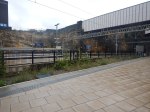
I took these pictures, as I passed through Hull station yesterday.
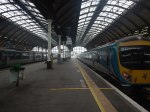
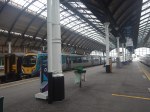
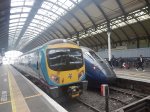
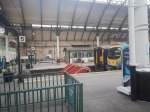
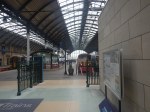


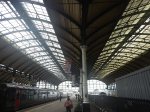
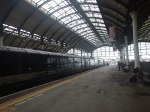
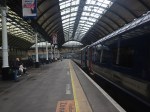

It appears that Hull station has a similar Victorian roof to Liverpool Lime Street and London Paddington, so I suspect the answer is yes.
These pictures show the platforms and overhead electrification at Liverpool Lime Street station, since the recent remodelling.


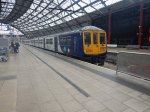
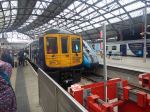
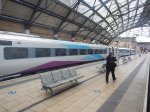

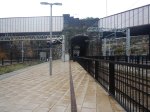

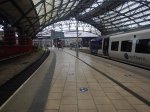

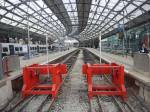
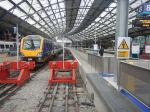

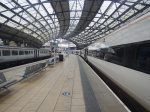

The electrification seems to be very traditional, with lots of steel gantries over the tracks.
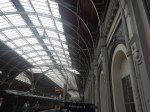
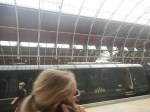
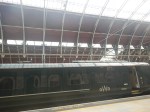
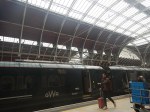
These pictures show the platforms and overhead electrification at London Paddington station.
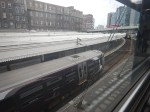
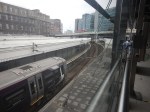
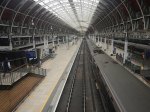
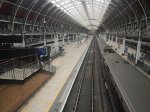
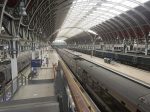
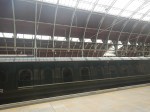
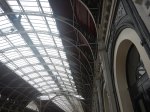

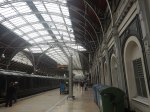
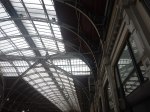
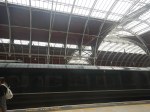
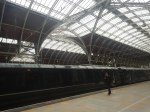
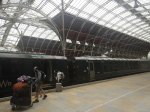
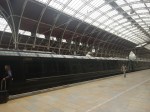
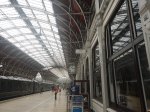
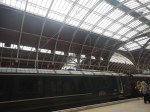
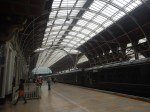
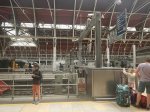
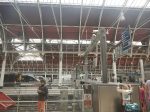
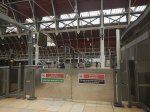
Note.
- The roof seems to have extra tie-bars reaching across.
- The wires seem to be hung from the roof.
- At the end of the platform they are fixed to large arch supports.
- Because Liverpool Lime Street’s electrification is newer than Paddington’s, it seems to have much more professional look.
After looking at the electrification in Liverpool Lime Street and Paddington, I believe that Hull station could be successfully electrified.
This map from OpenRailwayMap shows the platform layout at Hull station.
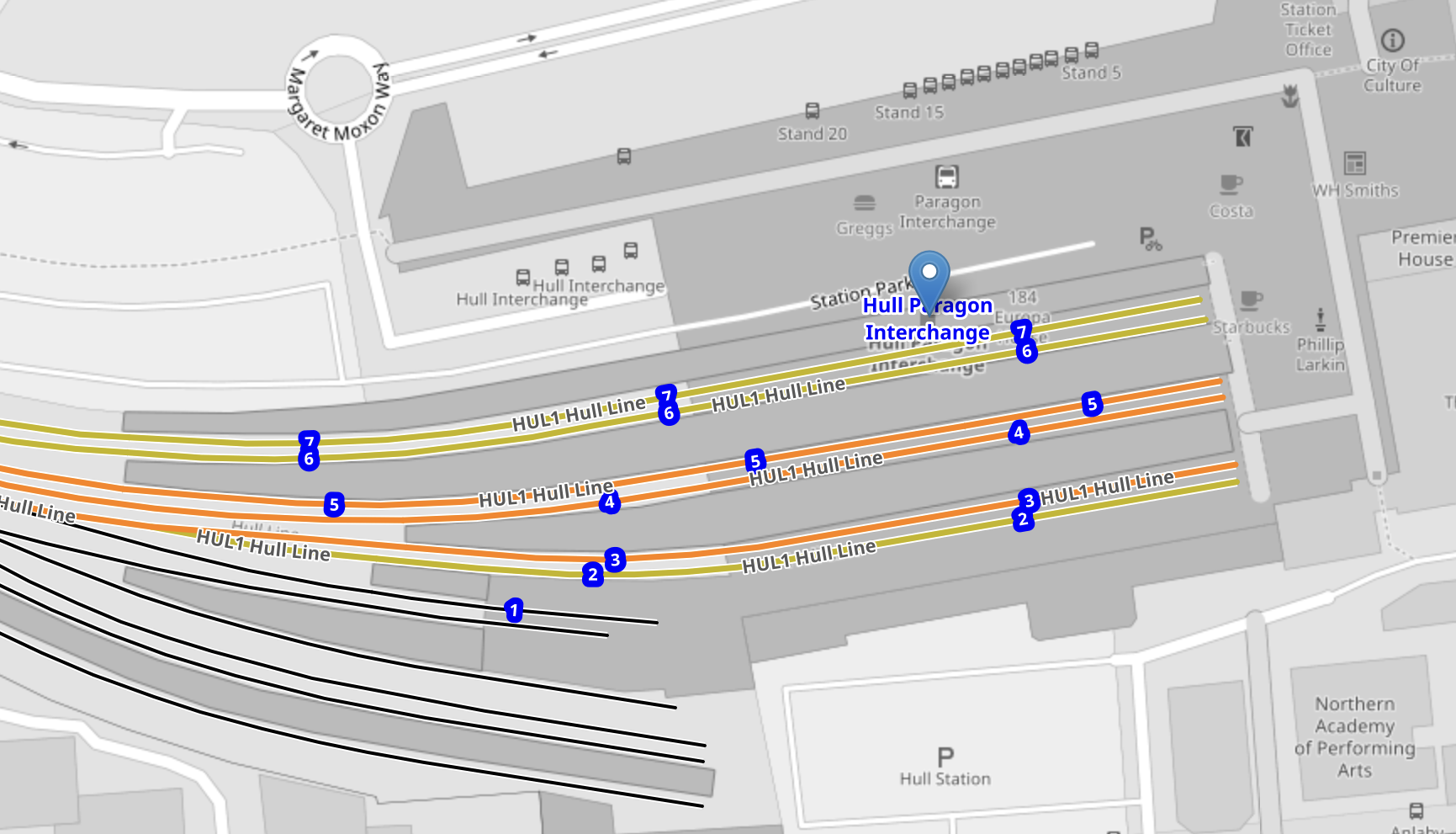
Note.
- Yesterday, my trains arrived in and left from Platform 7, which is the Northern-most platform.
- Other pictures in this blog show Hull Trains’s London service in Platform 7.
- Yesterday all Class 802 trains to and from London run by Hull Trains and LNER used Platform 7.
- I have been told by station staff, that Platform 7 can take a nine-car LNER Azuma.
- In Ten-Car Hull Trains, I talk about ten-car Class 802 trains running to and from Hull.
- Platform 7 or another platform at Hull station must be able to handle a ten-car train, which means that Hull station can handle a train, that is 260 metres long.
Looking at the station map, I believe that Hull station’s capacity for long express trains, is on a par with that of Liverpool Lime Street station.
I could see both stations handling two trains per hour (tph) across the Pennines and to and from London, with if necessary trains being formed of a pair of five-car trains.
How Many Services From Hull Station Can Be Run With Battery Trains?
Hull Trains service between London and Beverley travels for 44.5 miles on unelectrified track between Temple Hirst junction and Beverley.
Typically Hull Trains services wait in Hull station for the following times.
- Going between London King’s Cross and Beverley – Between ten and fifteen minutes.
- Returning to London King’s Cross – Upwards of twenty-five minutes.
I believe these waits in Hull station would mean that.
- A train going North to Beverley will have a battery containing enough electricity to get the train to Beverley and back, which is a distance of 16.7 miles.
- A train going South from Hull will have a battery containing enough electricity to get the train to Temple Hirst junction, which is a distance of 36.1 miles.
I believe that Hull Trains are currently working a timetable, that has been designed for operation by trains with a range on batteries of around fifty miles, provided there is electrification in at least one platform at Hull station to charge the trains.
It is also interesting to look at LNER’s two services that serve Hull.
- The 0700 to London, is scheduled to arrive at Hull station at 0635 from stabling at Doncaster and waits up to twenty-five minutes before leaving for London.
- The 2004 from London, is scheduled to arrive at Hull station at 2004 and waits up to twenty-five minutes before going South to overnight stabling in Doncaster.
It looks like LNER’s two trains follow Hull Trains rules.
- They use Platform 7 in Hull station.
- Trains going South have up to twenty-five minutes in the station.
It appears to me, that both Hull Trains and LNER are running a timetable, that would allow their services to be run using trains with a battery that had a range of around fifty miles, that could be fully-charged at Hull station before going South.
TransPennine Express run an hourly service to Liverpool Lime Street via Leeds and Manchester Victoria.
According to OpenRailwayMap’s map of electrification, when the TransPennine Upgrade is complete, the only section of the route without electrification will be the 42.1 miles between Hull and Micklefield.
As TransPennineExpress have some of the same Class 802 trains as Hull Trains, if there were at least two electrified platforms in Hull station, then Hull and Liverpool services could be run by battery-electric trains, with a similar specification to those of Hull Trains.
Northern Trains run an hourly service to Halifax via Leeds.
According to OpenRailwayMap’s map of electrification, , the only sections of the route without electrification will be the 42.1 miles between Hull and Micklefield and the 17.5 miles between Leeds and Halifax.
As Leeds and Micklefield is timetabled for seventeen minutes, I suspect this would be enough time to fully charge a battery-electric version of CAF’s Class 331 train and with charging in Hull station, then this route could be electrified.
Northern Trains also run other services, but because the Goole swing bridge is closed, I can’t get all the distances without electrification from Hull.
Ones I can find are.
- Beverley – 16.7 miles for return trip.
- Bridlington – 31.1 miles
- Doncaster – 40.8 miles
- Micklefield – 42.1 miles
- Scarborough – 53.8 miles
- Sheffield – 59.4 miles
- Temple Hirst – 36.1 miles
- York – 41.1 miles – Hull and Church Fenton
Note.
- York and Doncaster are electrified.
- Bridlington and Scarborough have suitable platforms where 25 KVAC overhead electrification could be installed to charge trains.
- Sheffield and Doncaster is only 18.6 miles and this may be the way to electrify between Sheffield and Hull.
- In The Data Sheet For Hitachi Battery Electric Trains, I state that Hitachi’s battery-electric trains have a range of 43.5 miles
It looks if enough platforms are electrified at Hull, all current services from the city could be run by battery-electric trains.
Conclusion
I believe that by electrifying Hull station, that Hull could have a station consistent with the HumberZero philosophy, with battery-electric trains running hither and thither, handling all rail traffic to and from the City.
Did I See The UK’s Hydrogen-Powered Future In Hull Today?
I went from London to Hull today on Hull Trains for £50.80 return (with my Senior Railcard) to see SSE’s presentation for their Aldbrough Pathfinder Hydrogen project, which will feature a 35 MW green hydrogen electrolyser and 320 GWh of hydrogen storage in the thick layers of salt under East Yorkshire.
- Green electricity would come mainly from the part-SSE owned 8 GW Dogger Bank wind farm complex.
- According to their web site, Meld Energy are planning a 100 MW electrolyser, which would produce 13,400 tonnes of hydrogen per year.
Every large helps!
- It should be noted that the thick layers of salt stretch all the way to Germany, and as drilling and storage technology improves, the amount of hydrogen storage available will increase.
- I was also impressed by the ambition, competence and enthusiasm, of the SSE engineers that I met.
- As has been pointed out, HiiROC, who have backing from Centrica, Hyundai, Kia and others, are also in Hull!
I believe, that I saw our hydrogen-powered future in Hull today!
We need more hydrogen mega-projects like these! Perhaps in Aberdeen, Clydeside, Freeport East, Isle of Grain, Merseyside, Milford Haven and Teesside?
Government Agrees To Fund £200m Cambridge South Station
The title of this post, is the same as that of this article on the BBC.
This is the sub-heading.
The government has agreed to fully fund a new £200m railway station.
These are a few points.
- Work has already started.
- The station is next to the city’s Biomedical Campus and Addenbrooke’s Hospital.
- Cambridge South station will be on the East West Railway.
It is expected to be open within two years.
I have a few thoughts.
Services At Cambridge South Station
In a typical hour, it seems the following trains go through the proposed site of Cambridge South station.
- 2 tph – Greater Anglia – Liverpool Street and Cambridge North via Tottenham Hale, Cheshunt, Broxbourne, Roydon (1tph), Harlow Town, Harlow Mill (1tph), Sawbridgeworth (1tph), Bishop’s Stortford, Stansted Mountfitchet (1tph), Elsenham (1tph), Newport (1tph), Audley End, Great Chesterford (1tph), Whittlesford Parkway, Shelford (1tph) and Cambridge.
- 1 tph – Greater Anglia -Norwich and Stansted Airport via Wymondham, Spooner Row (1tpd), Attleborough, Eccles Road (1tpd), Harling Road (1tpd), Thetford, Brandon, Shippea Hill (1tpd), Ely, Cambridge North, Cambridge, Whittlesford Parkway and Audley End
- 1 tph – Great Northern – King’s Cross and Ely via Cambridge, Cambridge North and Waterbeach.
- 1 tph – Great Northern – King’s Cross and King’s Lynn via Cambridge, Cambridge North, Waterbeach, Ely, Littleport, Downham Market and Watlington.
- 1 tph – Great Northern – King’s Cross and Cambridge via Finsbury Park, Alexandra Palace, Potters Bar, Hatfield, Welwyn Garden City, Welwyn North, Knebworth, Stevenage, Hitchin, Letchworth Garden City, Baldock, Royston, Meldreth, Shepreth and Foxton.
- 2 tph – Thameslink – Cambridge and Brighton via Royston, Ashwell & Morden, Baldock, Letchworth Garden City, Hitchin, Stevenage, Finsbury Park, St Pancras International, Farringdon, City Thameslink, London Blackfriars, London Bridge, East Croydon, Gatwick Airport, Three Bridges, Haywards Heath and Burgess Hill
- 1 tp2h – CrossCountry – Birmingham New Street and Stansted Airport via Coleshill Parkway, Nuneaton, Leicester, Melton Mowbray, Oakham, Stamford, Peterborough, March, Ely and Cambridge.
Note.
- tph is trains per hour.
- tp2h is trains per two hours.
This gives a base frequency through Cambridge South, Cambridge and Cambridge North of 8.5 tph.
Could some services be extended to Cambridge South or Stansted Airport?
- 1 tph – Greater Anglia – Ipswich and Cambridge via Needham Market, Stowmarket, Elmswell, Thurston, Bury St Edmunds, Kennett (1tp2h), Newmarket and Dullingham (1tp2h).
- 1 tp2h – CrossCountry – Birmingham New Street and Cambridge via Coleshill Parkway, Nuneaton, Leicester, Melton Mowbray, Oakham, Stamford, Peterborough, March and Ely.
These two trains would gives frequencies of.
- Cambridge South – 10 tph
- Cambridge – 10 tph
- Cambridge North – 9 tph
I have assumed these services would terminate at Cambridge South.
There could also be some new services.
1 tph – Greater Anglia – Wisbech and Cambridge via March, Ely and Waterbeach, Cambridge North and Cambridge.
1 tph – East West Railway – Oxford and Great Yarmouth via Oxford Parkway, Bicester Village, Winsford, Bletchley, Bedford, Tempsford, Cambourne, Cambridge, Cambridge North, Ely, Brandon, Thetford, Attleborough, Wymondham and Norwich.
1 tph – East West Railway – Oxford and Manningtree via Oxford Parkway, Bicester Village, Winsford, Bletchley, Bedford, Tempsford, Cambourne, Cambridge, Newmarket, Bury St. Edmunds, Stowmarket, Needham Market and Ipswich.
These three trains would gives frequencies of.
- Cambridge South – 13 tph
- Cambridge – 13 tph
- Cambridge North – 11 tph
I have assumed these services would terminate at Cambridge South.
The A14 Parkway Station
The A14 Parkway station is a proposal from the East West Railway.
- It would be just to the East of Chippenham junction and would be served by both Greater Anglia’s services between Ipswich and Cambridge and Ipswich and Peterborough.
- It would also be close to the major road junction, where the A11 and the A14 meet.
- It would be a Park-and-Ride station.
I believe it could be a major factor in cutting road mileage in East Anglia, as drivers going to Cambridge from Ipswich, Norwich, a large area of North-East East Anglia and North Essex could find that using the A14 Parkway station an easier and faster route. But the A14 Parkway would need a frequent service to the soon-to-be-three main Cambridge stations.
A Soham and Cambridge service could reverse at the A14 Parkway station or by careful timetabling, passengers would be able to change trains in a minute or two.
A Soham and Cambridge service, that terminated at Cambridge South, would give an extra train between Cambridge South and Newmarket and these frequencies at the three Cambridge stations.
- Cambridge South – 13 tph
- Cambridge – 14 tph
- Cambridge North – 12 tph
There would be a minimum interval of no more than five minutes between trains, if you wanted to hop between any of the three Cambridge stations.
Frequencies between Cambridge station and other main stations in the area would be as follows.
- A14 Parkway – 2 tph
- Attleborough – 2 tph
- Bishop’s Stortford – 2 tph
- Bletchley – 2 tph
- Bury St. Edmunds – 2 tph
- Ely – 6 tph
- Great Yarmouth – 1 tph
- Harlow Town – 2 tph
- Hitchin – 3 tph
- Ipswich – 2 tph
- King’s Lynn – 1 tph
- Letchworth Garden City – 3 tph
- Manningtree – 1 tph
- March – 1 tph
- Needham Market – 2 tph
- Newmarket – 2 tph
- Norwich – 2 tph
- Peterborough – 1 tph
- Royston – 3 tph
- Soham – 1 tph
- Stansted Airport – 2 tph
- Stevenage – 3 tph
- Stowmarket – 2 tph
- Thetford – 2 tph
- Wisbech – 1 tph
- Wymondham – 2 tph
Looking at this list, I think that the timetable needs reinforcing, to perhaps Colchester, Haverhill, March, Peterborough, Soham and Sudbury.
But these services will help.
- 1 tph – Greater Anglia – Ipswich and Peterborough via Stowmarket, Bury St Edmunds, Soham, Ely, Manea, March and Whittlesea.
- 1 tph – East Midlands Railway – Liverpool and Norwich via Liverpool South Parkway, Widnes, Warrington Central, Manchester Oxford Road, Manchester Piccadilly, Stockport, Sheffield, Chesterfield, Alfreton, Nottingham, Grantham, Peterborough, Ely and Thetford
But I can’t help feeling that the Stour Valley Railway needs to be reopened.
Aylesbury Vale Parkway Station – 4th June 2023
I went to Aylesbury and Aylesbury Vale Parkway stations today, to check out if my recent posts about the East West Railway are correct and take some pictures of the two stations.
This Google Map shows the layout of Aylesbury Vale Parkway station.

Note.
- The station only has a single bay platform.
- It appears that there is a step-free walk between the car park and the platform.
- There is no bridge or need for one.
- There is a single through line at the station on the opposite side to the car park, which is mainly used by trains going to the landfill at Calvert.
It looks from this map, that if the single platform were widened to an island platform, that both terminating and through trains could call in the station.
These are my pictures of the station.


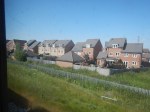


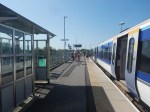

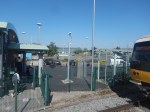


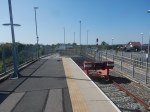
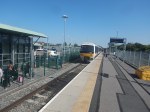
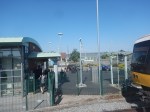
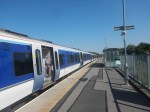
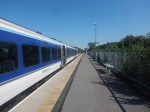
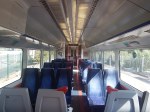
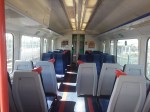
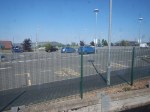

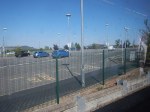
Note.
- The second track can be seen in the eighth picture.
- I believe an island platform could be created between the two tracks.
- There is a substantial amount of car parking for 501 vehicles.
- There is a step-free connection between the platform and the car parking.
- There appears to be a good grid connection.
I believe that Aylesbury Vale Parkway station could be modified to be a single platform station on the Aylesbury Spur of the East West Railway, that I wrote about in East-West Rail: Aylesbury Spur.
This Google Map shows the area around the station.
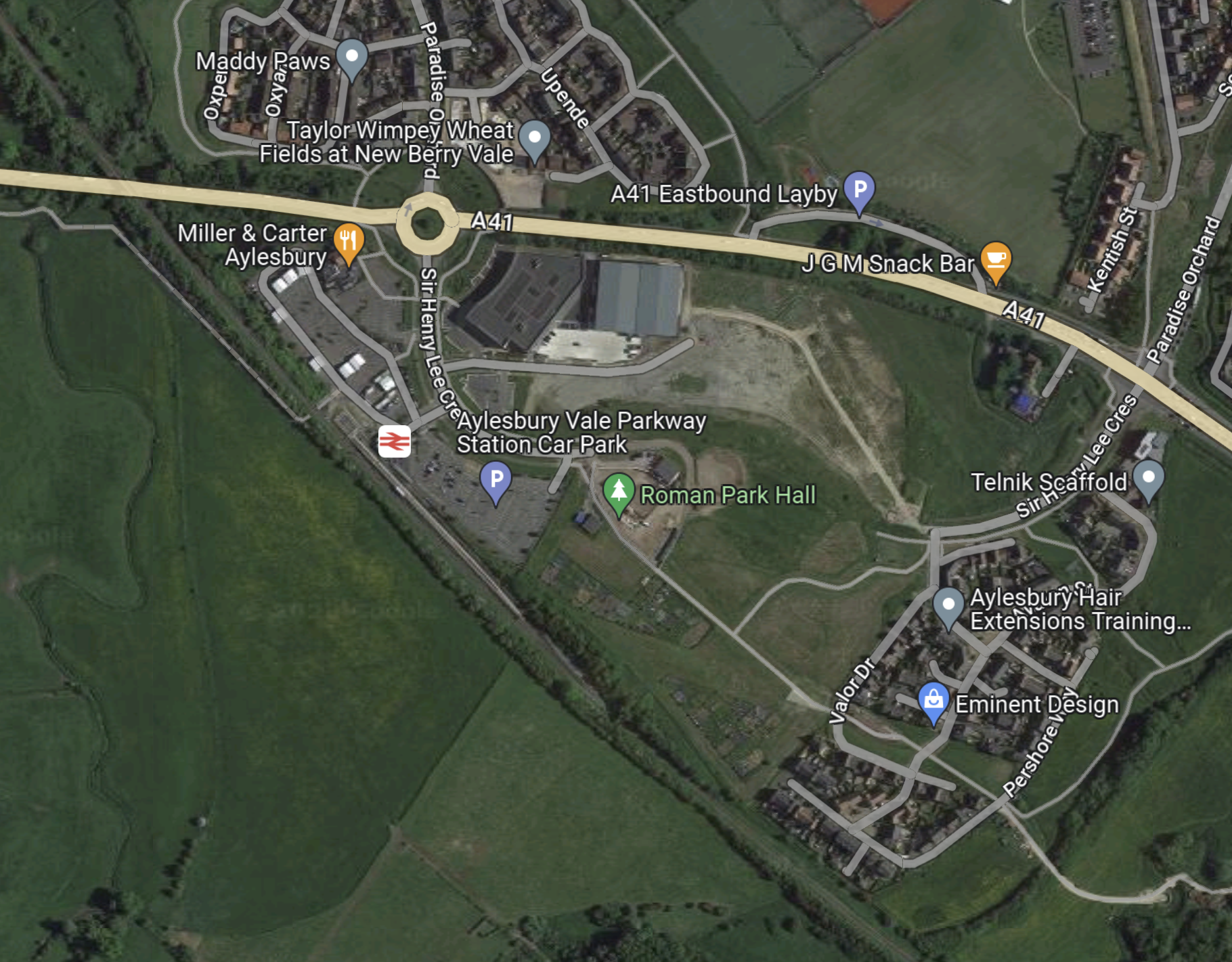
It shows how a parkway station can provoke development on an area.
East-West Rail: Electrification
The first paragraph of the Wikipedia entry for the East West Railway, says this about electrification.
As of March 2020, electrification of the line is not planned, but the 2019 decision (to rule it out) is under review.
But I don’t think it’s a simple decision of electrify or not!
These observations are guiding my thoughts.
Milton Keynes Central Station
This OpenRailwayMap shows the platforms and whether they are electrified in Milton Keynes Central station.
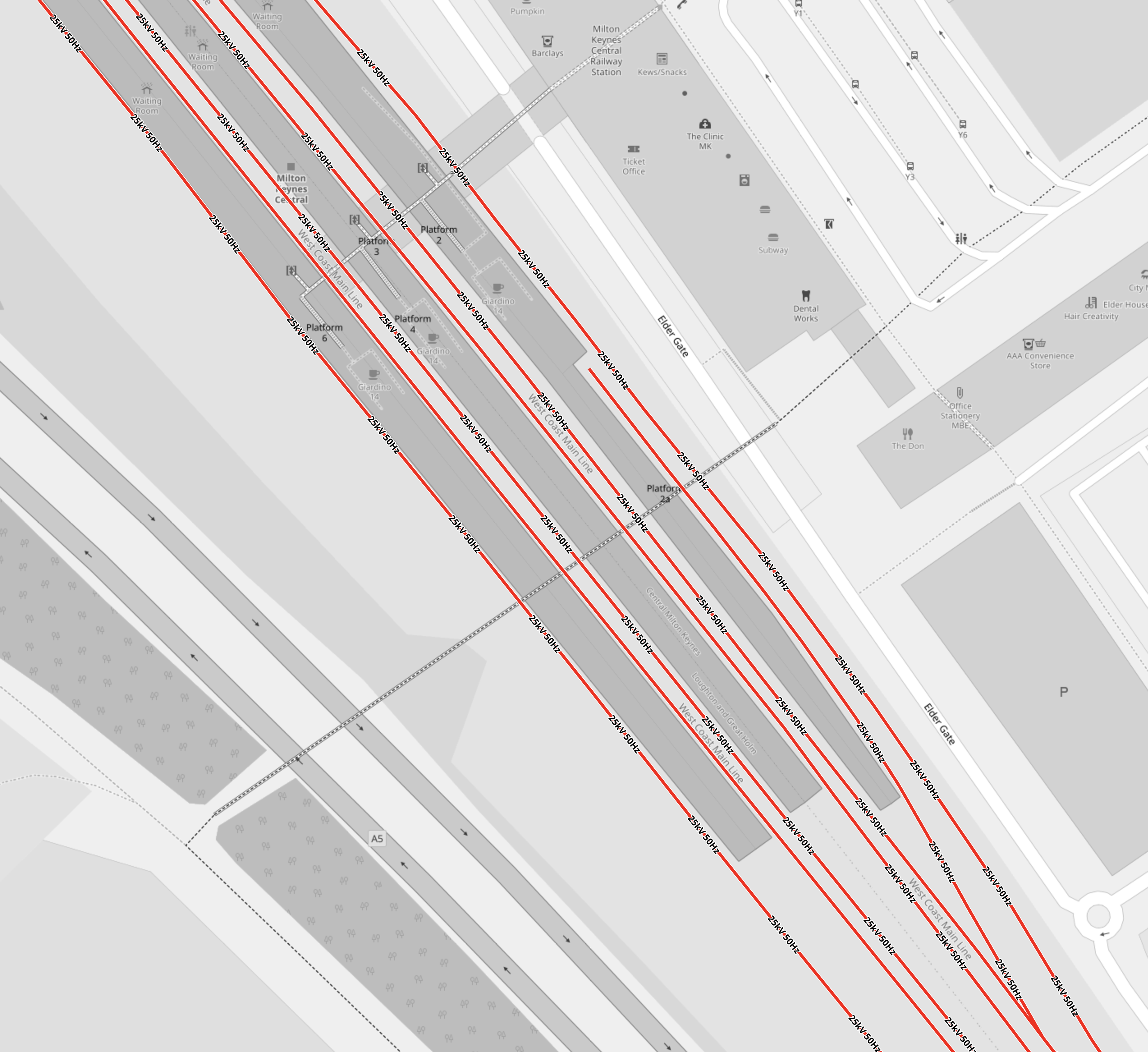
Note.
- Lines shown in red are electrified with 25 KVAC overhead wires.
- The short platform is Platform 2A, which can take a five-car train and was built recently to terminate the Marston Vale Line service.
- Could Platform 2A be ideal for handling and charging, battery-electric trains, that terminate in Milton Keynes station?
The Wikipedia entry for Milton KeynesCentral station, has a section called Platforms and Layout, which gives full details.
Bletchley Station
This OpenRailwayMap shows the platforms and whether they are electrified in Bletchley station.
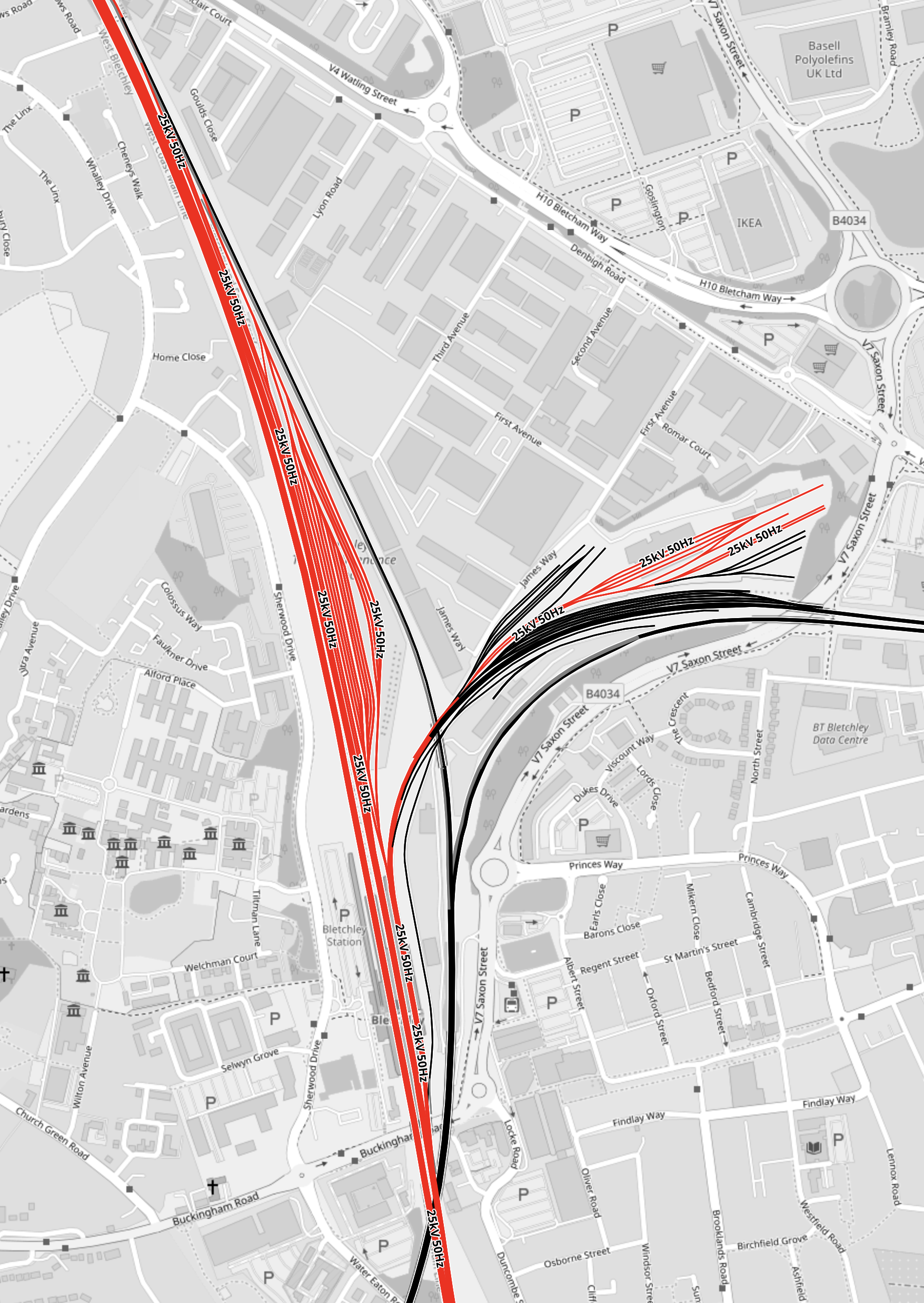
Note.
- Lines shown in red are electrified with 25 KVAC overhead wires.
- The wide swath of red going North is the West Coast Main Line.
- The smaller patch of red to the East of the West Coast Main Line are electrified sidings.
- All low-level platforms at Bletchley station are electrified.
- The viaduct platforms, are shown in black as they are not electrified.
- A non-electrified line leads North-West from the viaduct towards Milton Keynes Central.
- The Milton Keynes end of the line between Milton Keynes Central station and the viaduct is electrified.
- A non-electrified line leads North-East from the viaduct towards Fenny Stratford and Bedford.
The Google Map shows a 3D visualisation of Bletchley station.
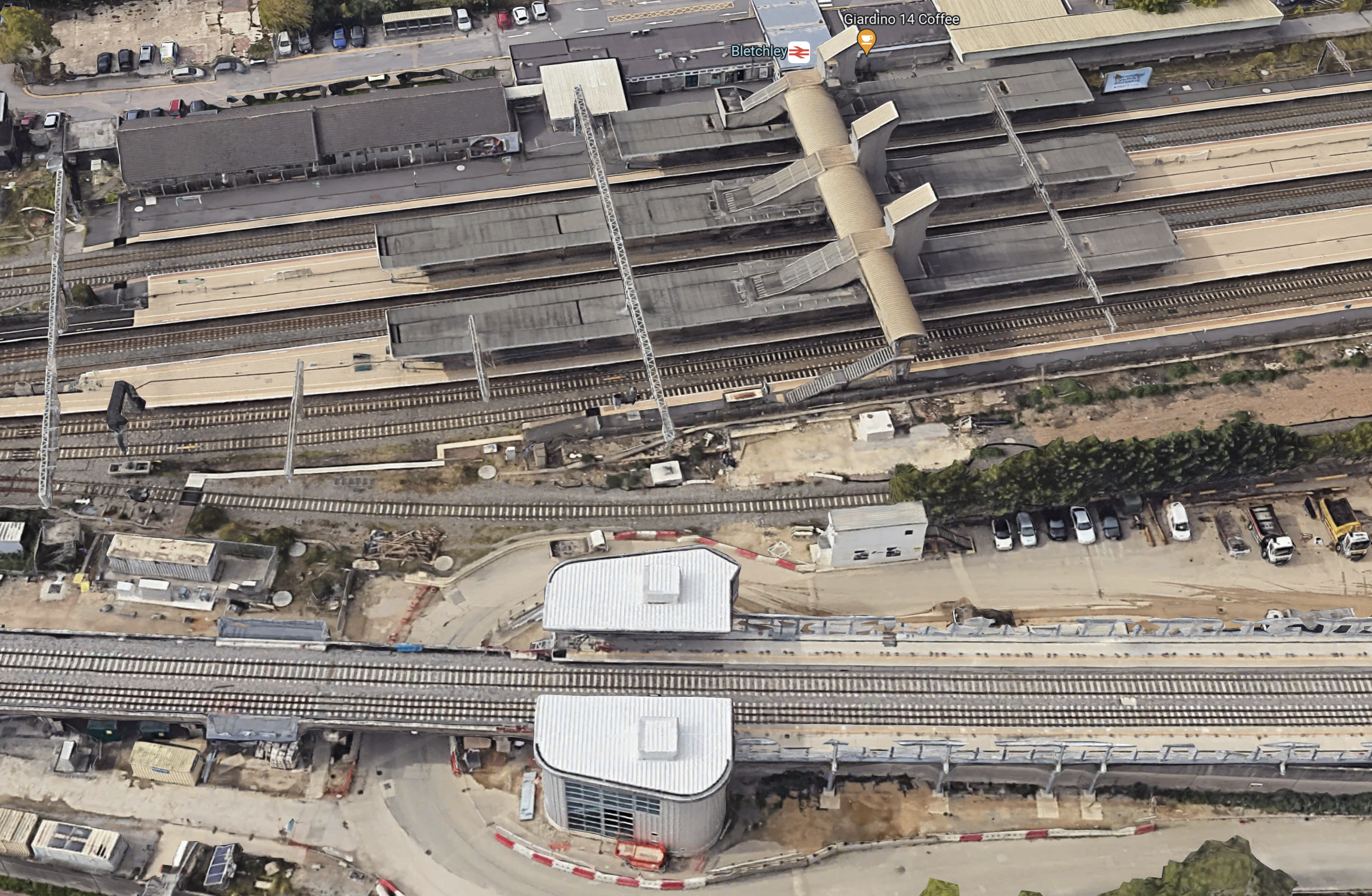
I can’t see much sign of any electrification.
Bedford Station
This OpenRailwayMap shows the platforms and the electrification around Bedford station.
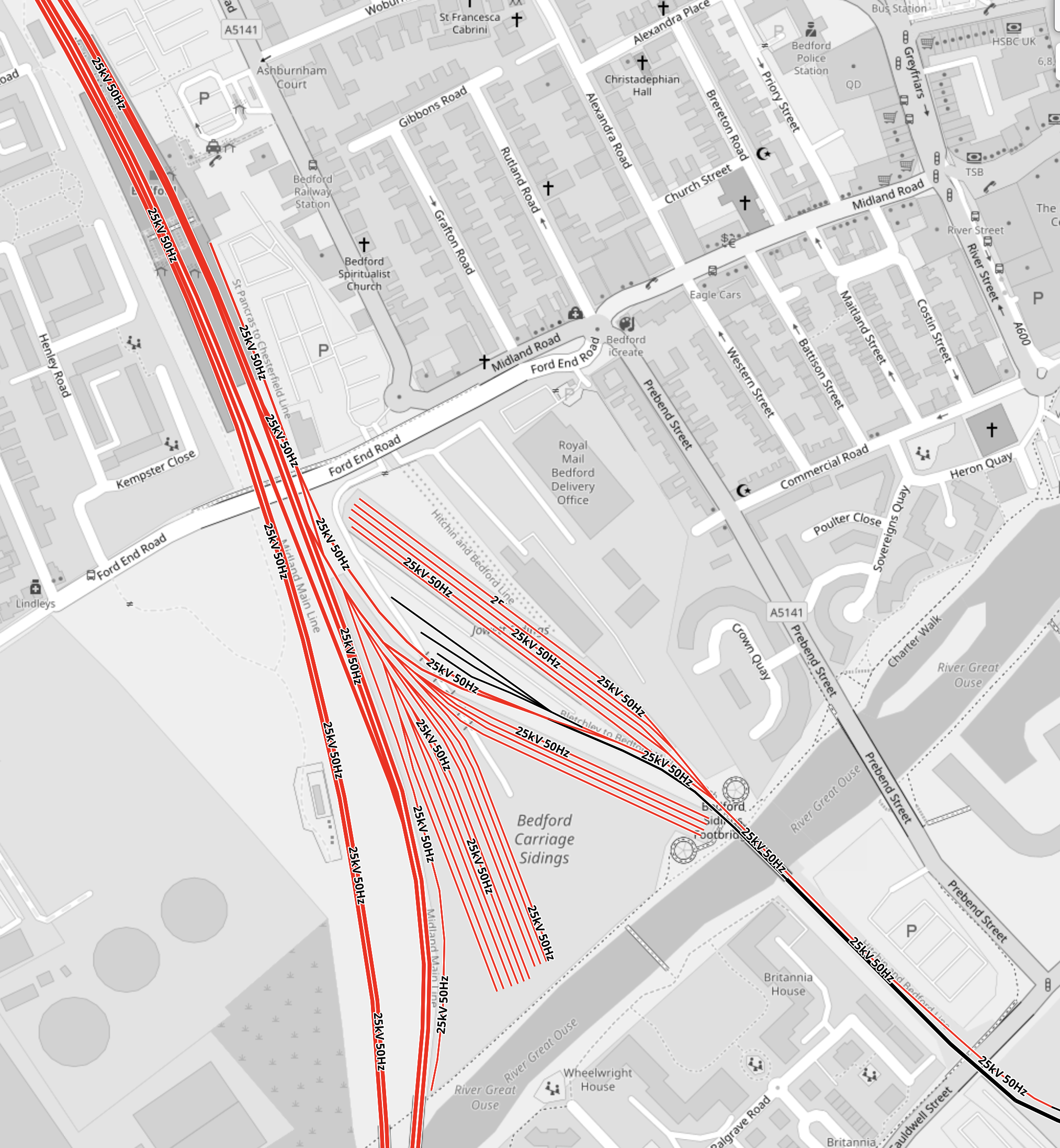
Note.
- All platforms at Bedford station are electrified.
- The lines to the West of the station are the electrified Midland Main Line.
- The Marston Vale Line services terminate in the short Platform 1A, which is the South-East corner of the station.
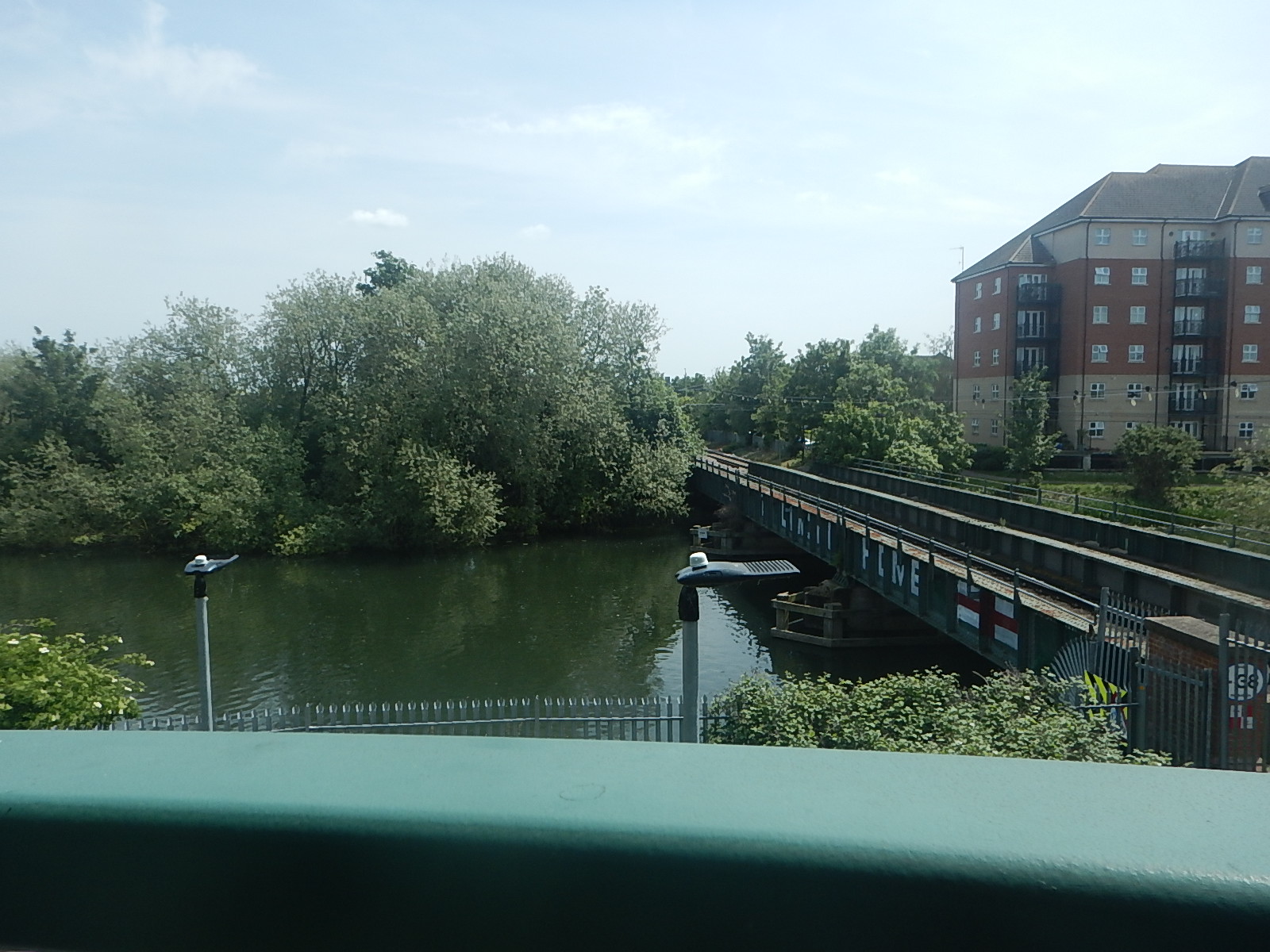
- The track into Platform 1A is electrified for about two hundred metres, through the sidings South of the station.
This picture shows the electrified track as it crosses over the river.
Could Platform 1A be ideal for handling and charging, battery-electric trains, that terminate in Bedford station?
It’s odd that there is the same platform layout at both ends of the Marston Vale Line.
Is it just a coincidence or does Engineer Baldrick have a cunning Plan?
Oxford Station
This OpenRailwayMap shows the platforms and the electrification around Oxford station.
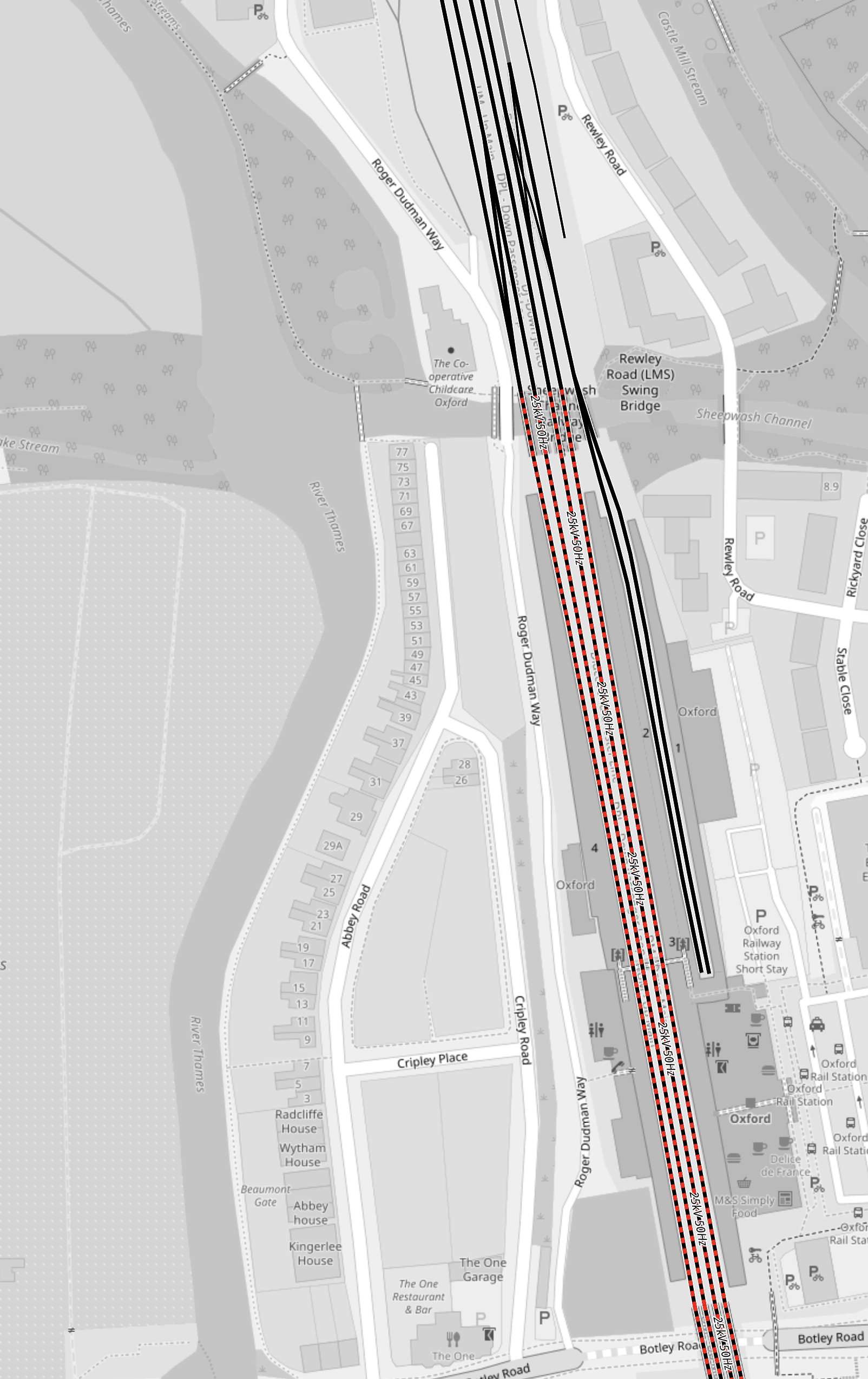
Note.
- The dotted red and black tracks, indicate electrification is planned.
- The planned electrification will connect Oxford station to Didcot Junction station.
- The two bay platforms at the North of the station are not electrified and Platform 2 is now used by Chiltern’s London services.
- Platform 1 could be used by trains on the East West Railway that terminate at Oxford.
When Oxford station is electrified, it wouldn’t be the largest project to add 25 KVAC overhead electrification to the two bay platforms.
Aylesbury Station
This OpenRailwayMap shows the platforms and the lack of electrification around Aylesbury station.
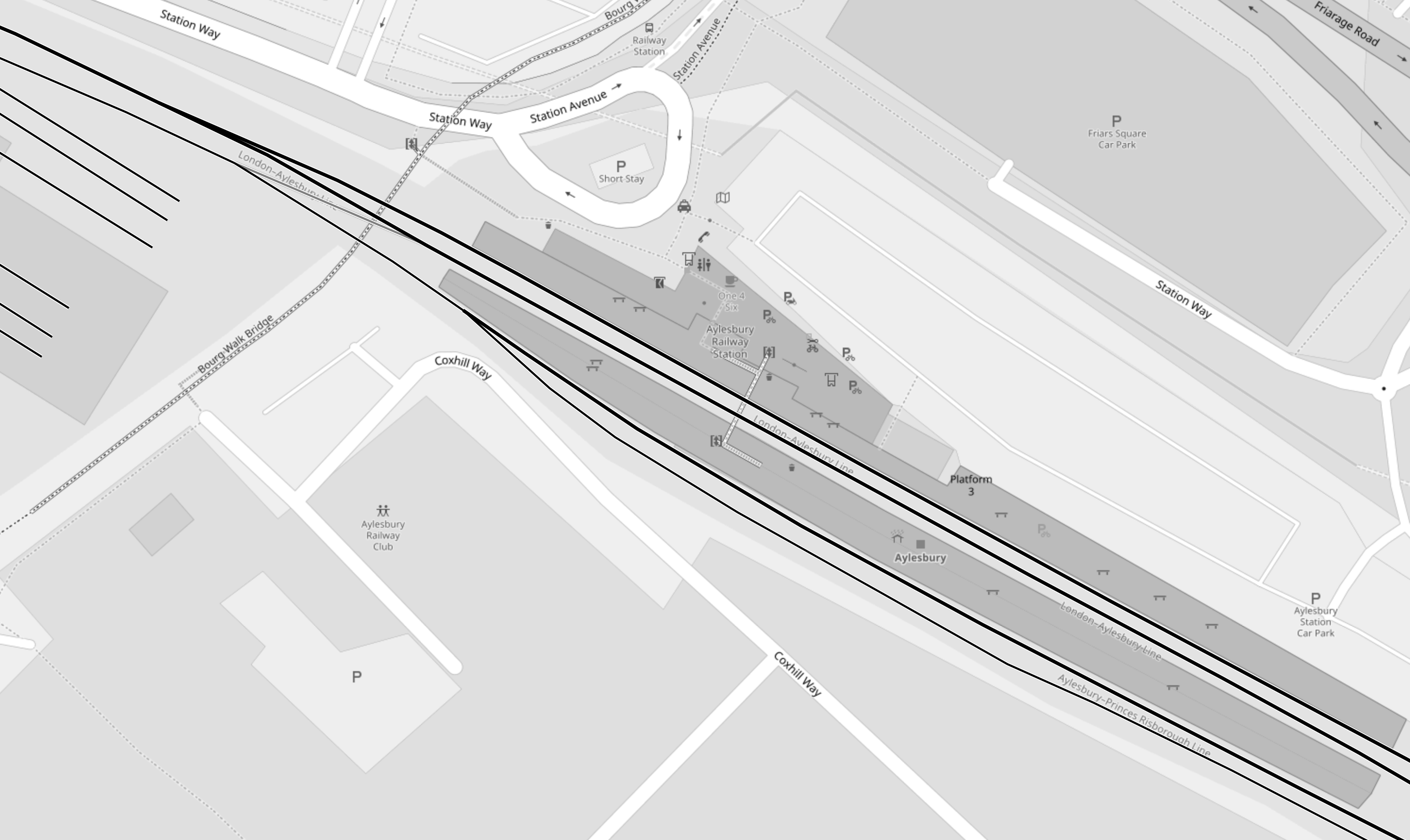
Note.
- No tracks are electrified.
- Platforms are numbered 3, 2, 1 from the top, so 2 and 3 are paired in the middle.
- All freight trains go through Platform 2 and most seem to go via Princes Risborough and High Wycombe.
- Chiltern services use Platforms 1 and 3.
Putting a charging system in Aylesbury station could be tricky.
I wonder if the simplest system for East West Railway would be to electrify between Aylesbury and Aylesbury Vale Parkway stations.
Chiltern Railway’s time between the two stations is as much as seven minutes.
Some trains to Aylesbury take over twenty minutes to do the short journey to Aylesbury Vale Parkway and return, which is more than enough to fully-charge a battery-electric train.
You can even have Chiltern’s hourly Aylesbury Parkway service, sharing the same stretch of electrification with East West Railway’s Aylesbury service, as there is a loop, which creates double-track for some of the way.
It should be noted that between Marylebone and Aylesbury Vale Parkway stations is only 41.1 miles, so some battery-electric trains could do that with a full charge at one end.
East West Railway Distances
In Trains Needed For The East West Railway, I calculated some of these distances.
- Oxford and Bedford – 46.8 miles
- Oxford and Milton Keynes – 33.4 miles
- Aylesbury and Milton Keynes – 25.9 miles
With charging at both ends, all of these routes are possible using modern battery-electric trains, where even a Class 777 IPEMU, designed for extending Merseyrail’s suburban network has done 84 miles on one charge.
On To Cambridge
In this document on the East-West Rail Consortium web site, these services are suggested, for when the East West Railway is complete.
- An hourly train via Norwich terminating at Great Yarmouth.
- An hourly train via Ipswich terminating at Manningtree.
These are distances on these routes that are not electrified, that are to the East of Cambridge.
- Ely and Norwich – 53.7 miles
- Norwich and Great Yarmouth – 18.3 miles
- Cambridge and Haughley Junction – 40.3 miles
Note.
- The Manningtree service would be able to charge its batteries after passing Haughley junction going East and it would be nearly an hour before it needed to use the battery for traction.
- If the Yarmouth service could handle the full route on batteries, then it could return to Cambridge with an efficient charger at Great Yarmouth, which for 25 KVAC overhead electrification trains is an off the shelf item.
- But it does look to me that the trains must leave Cambridge with full batteries, so they can reach electrification at Bedford, Haughley or Norwich.
This map shows the route of the East West Railway between Bedford and Cambridge.
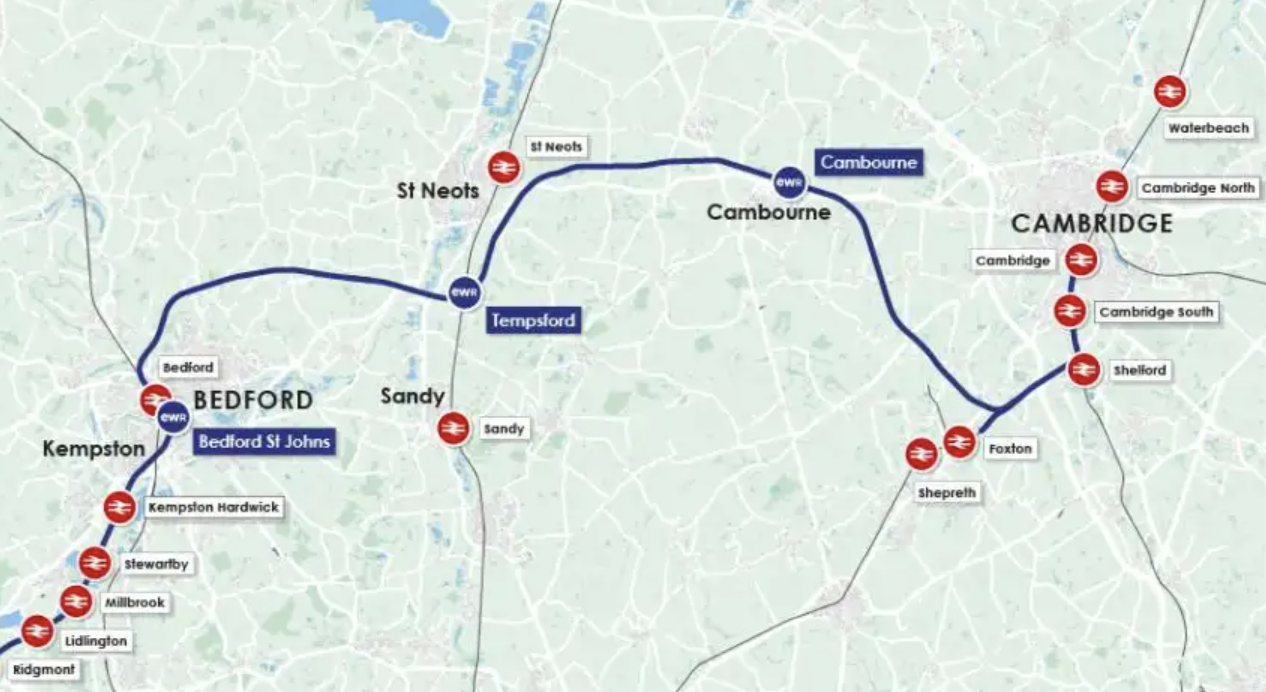
Note.
- Bedford is on the electrified Midland Main Line to London.
- Tempsford is on the electrified East Coast Main Line to London.
- Cambridge has two electrified main lines to London.
- These connections should ensure a good power supply to the East of Bedford for electrification.
I suspect the easiest option will be to add some more electrification at one or more of these places.
- At the Eastern end of the Bedford and Cambridge section.
- To the West of Haughley junction, when it is rebuilt.
- To the North of Ely, when the railways in that area are improved.
Although, as it will be a new route, it might be best to build Bedford and Cambridge as an electrified railway.
East-West Rail: Along The Marston Vale Line
For the initial phase of the East West Railway, it doesn’t appear that the Marston Vale Line will be improved.
As I write this, I have not heard of any improvements between Bedford and Bletchley.
Perhaps, with all the arguments about the section of the East West Railway between Bedford and Cambridge, the Government, Network Rail and the East West Railway feel that the best approach, is to do what they can with the existing track layout and the rebuilt viaduct at Bletchley.
These are my thoughts.
The Capacity Of The Marston Vale Line
In the Wikipedia entry for the Marston Vale Line, this is said about the infrastructure of the line.
Apart from a short length of single track at both ends, the line is double track, and is not electrified. It has a loading gauge of W8 and a line speed of 60 miles per hour (97 km/h). The line’s signalling centre is at Ridgmont.
The line has a length of only 16.5 miles.
I believe with modern signalling and well-trained drivers, that the line could accommodate at least two trains per hour (tph) in both directions.
At its simplest every half hour, a train would leave both end stations and the two trains would pass each other on the long double-track section in the middle.
Proposed Train Services
Train services on the East West Railway will be as follows, when it opens between Oxford and Milton Keynes and Bedford, are proposed to be as follows.
- 2 tph – East West Railway – Oxford and Milton Keynes Central via Oxford Parkway, Bicester Village, Winslow and Bletchley
- 1 tph – East West Railway – Oxford and Bedford via Oxford Parkway, Bicester Village, Winslow, Bletchley, Woburn Sands and Ridgmont
- 1 tph – West Midlands Trains – Bletchley and Bedford via Fenny Stratford, Bow Brickhill, Woburn Sands, Aspley Guise, Ridgmont, Lidlington, Millbrook, Stewartby, Kempston Hardwick and Bedford St Johns
If the East West Railway uses the Marston Vale Line between Bletchley and Bedford, then there will be two tph along the Marston Vale Line.
I believe that if the Marston Vale Line is not improved until later, then the proposed initial train service pattern can be achieved.
The New Bletchley Viaduct
The tracks appear to have been laid on the Bletchley Viaduct.
This Google Map shows the tracks on the viaduct.
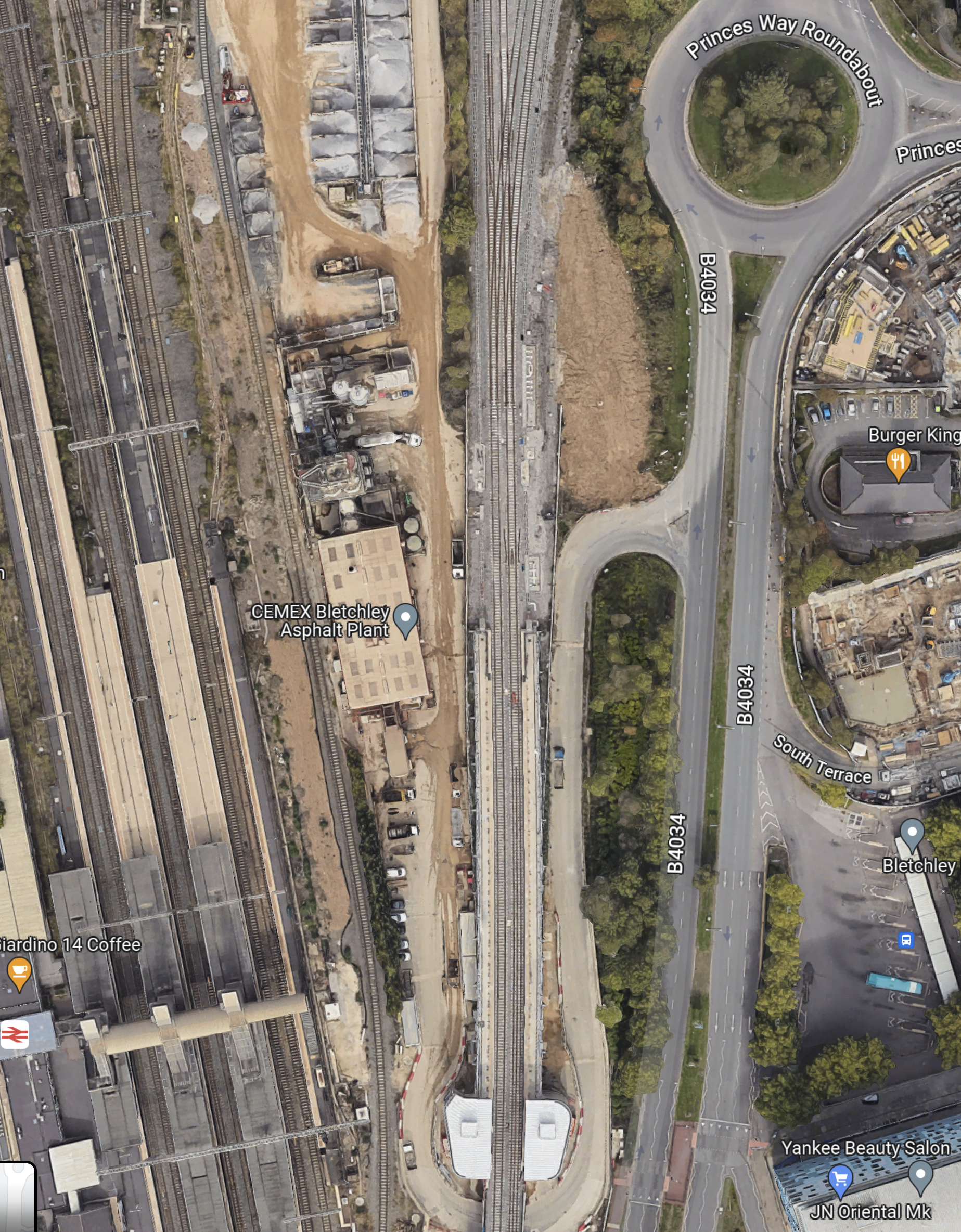
Note.
- The double-track viaduct runs North-South in the middle of the map.
- The two platforms appear to be substantially complete.
- The two lift and stair towers are at the Southern end of the platforms.
This second Google Map shows the section of the viaduct by the roundabout.
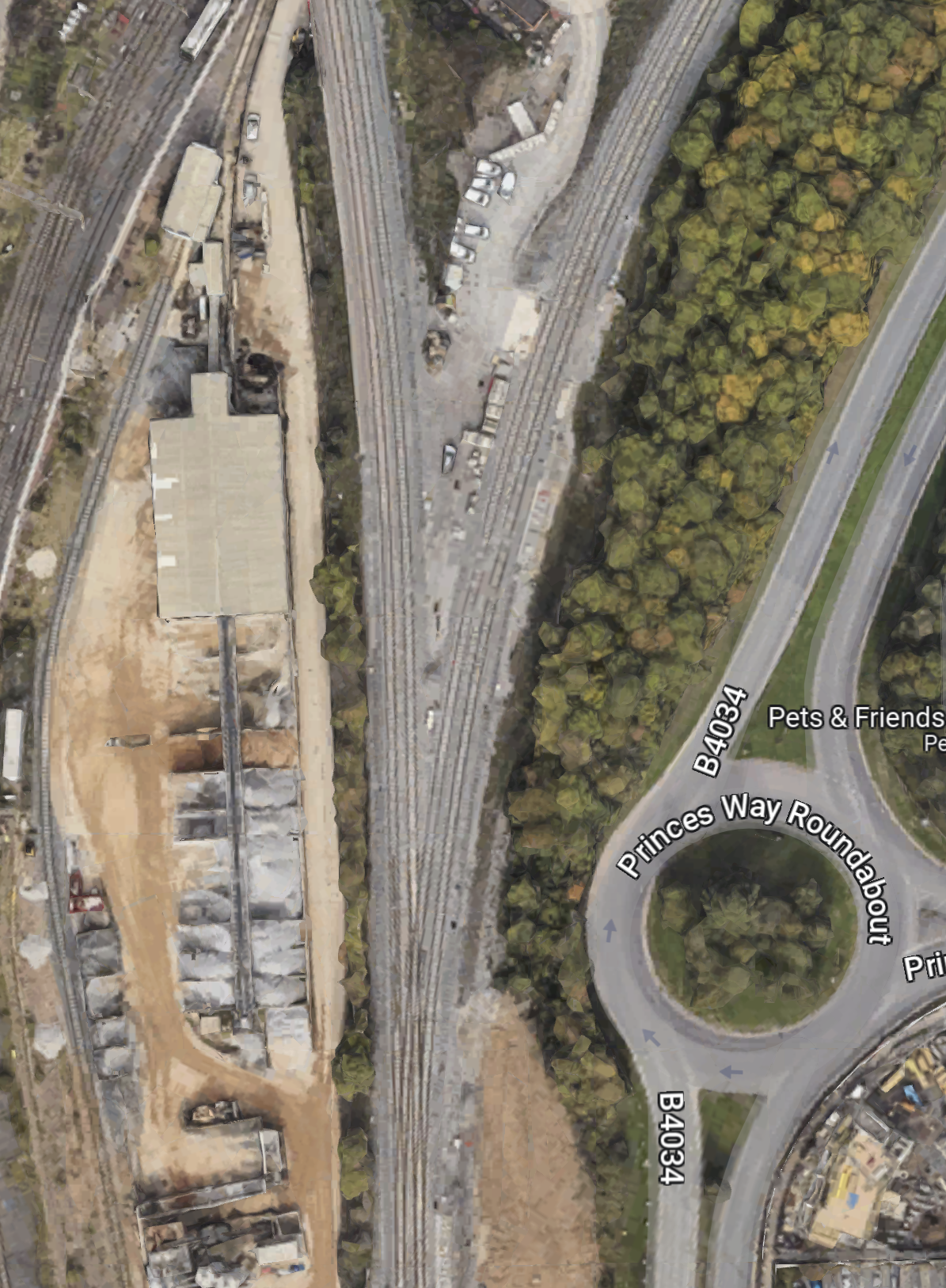
Note.
- The viaduct splits with two tracks going North-West to Milton Keynes Central and two tracks going North-East to Bedford.
- There is a complicated junction, which appears to allow a lot of flexibility for train operations.
I have followed the Milton Keynes tracks and there are cross-overs, so that trains can go between Platform 2A at Milton Keynes Central station and either of the viaduct platforms at Bletchley station, which they will need to do to run services between Oxford and Aylesbury, and Milton Keynes Central.
This Google Map shows the tracks between the viaduct and Fenny Stratford, which is the first station towards Bedford.
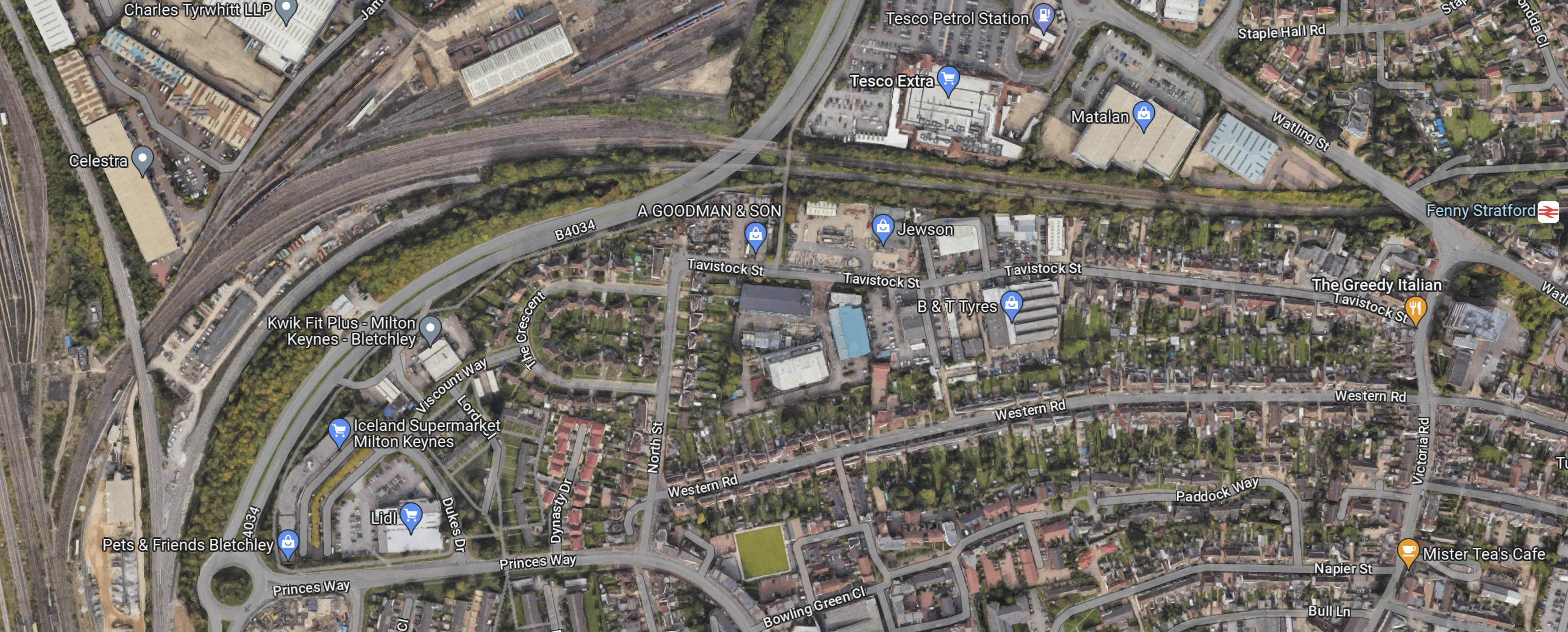
Note.
- The Princes Way roundabout in the West of the map.
- The Milton Keynes and Bedford tracks divide close to the roundabout.
- Fenny Stratford station in the East of the map.
- The tracks gradually combine from West to East, so there is only one track for the single platform at Fenny Stratford station.
This Google Map shows the Western section of the tracks between the viaduct and Fenny Stratford.
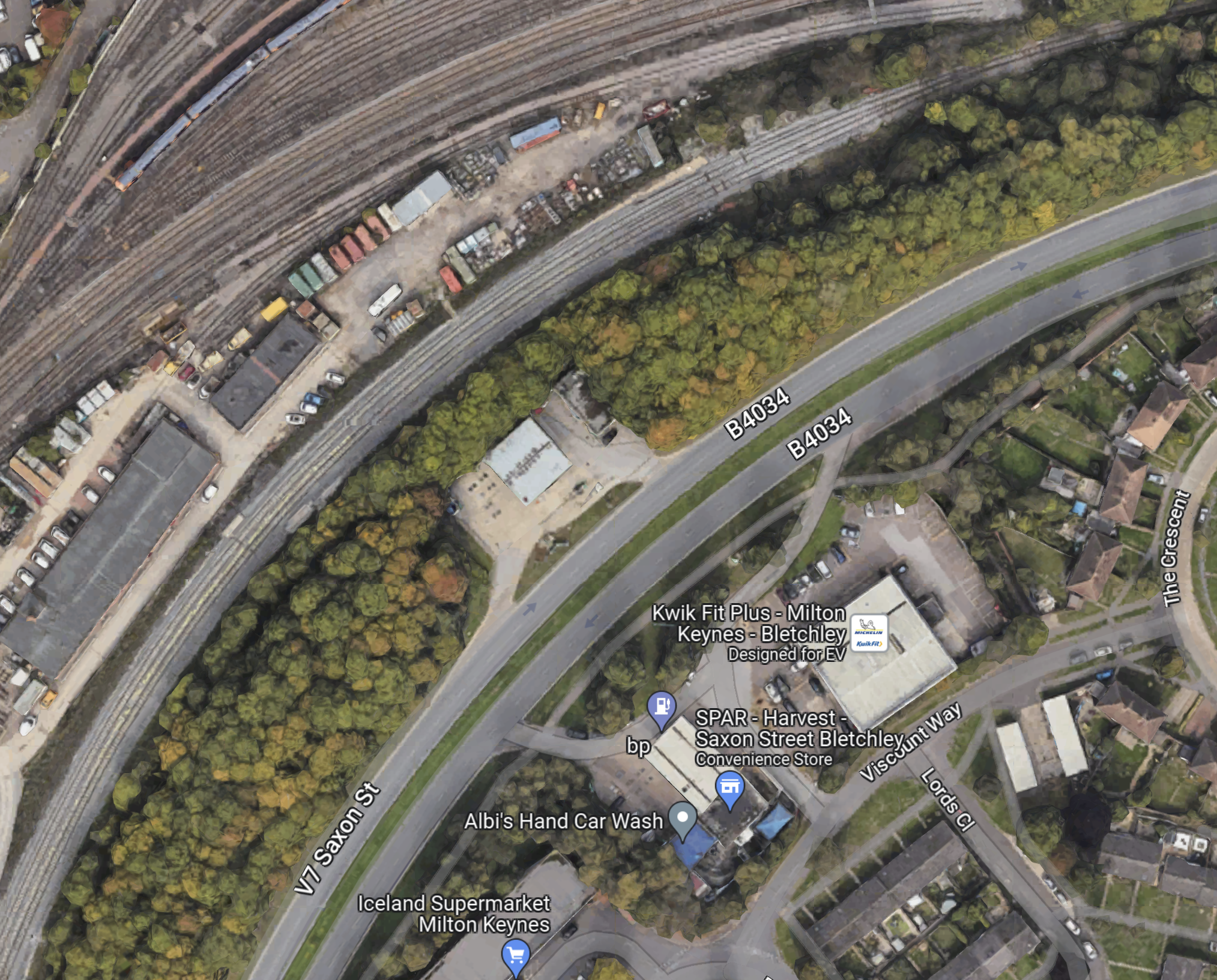
Note, how the two tracks on the viaduct join into one for going towards Fenny Stratford in the North-East corner of the map..
I’m certain, that this track layout, allows a train to go between the single platform at Fenny Stratford station and either of the viaduct platforms at Bletchley station.
A Milton Keynes Central And Bedford Service
In the Wikipedia entry for the Marston Vale Line, there is a section, which is entitled Extension to Milton Keynes Central, where this is said.
In June 2005, the then franchisee, Silverlink Trains announced an intention to extend the Marston Vale service via the West Coast Main Line to Milton Keynes Central, where a new platform and track would be built alongside the up slow track. Work began on 4 December 2006 at the station to prepare for a service connection. The platform was ready for use in January 2009 but the service did not materialise and there are no longer any published plans for it to do so. A firm service pattern on East West Rail remains to be announced but the illustrative pattern has no Bedford–Milton Keynes Central service; passengers will continue to have to change at Bletchley. There is no east-to-north chord between this line and the WCML: As of December 2020, the route the chord might take is occupied by trade outlets and a warehouse.
But.
Supposing a Milton Keynes to Bedford train did this.
- It ran from Platform 2A at Milton Keynes Central to the Northbound platform on the Bletchley viaduct.
- It would then reverse and run to Bedford along the Marston Vale Line.
- It would terminate in Platform 1A at Bedford station.
And supposing a Bedford to Milton Keynes train did this.
- It ran from Platform 1A at Bedford to the Northbound platform on the Bletchley viaduct.
- It would then reverse and run to Milton Keynes Central along the tracks alongside the West Coast Main Line.
- It would terminate in Platform 2A at Milton Keynes Central station.
Note.
- There would be some bi-directional running.
- Trains would only reverse on the Northbound platform on the Bletchley viaduct.
- Platform 2A at Milton Keynes Central would handle 4 tph.
- Platform 1A at Bedford station would handle 2 tph.
As the only reversing happens on the Northbound platform on the Bletchley viaduct, would it be sensible for a new driver to step-up, so that the reverse was fast?
I believe that with some innovative running, that a Milton Keynes and Bedford service is possible, because of the comprehensive track layout that has been installed.
East-West Rail: Aylesbury Spur
This map from East West Rail shows the complete route of the East West Railway between Oxford and Cambridge.

Note the spur to Aylesbury, which is shown dotted, which the legend says means it is a Potential Future Section of the EWR.
The papers in the area have different views.
- This article on Bucks Herald is entitled Aylesbury Spur Excluded From Government’s Latest East West Rail Route Outline.
- This article on Buckinghamshire Live is entitled East West Rail Aylesbury ‘Spur’ Plans Remain On The Table As Route Announced For £5bn Project.
So what do I feel about the Aylesbury Spur?
Train Services
In the Wikipedia entry for the East West Railway, it is stated that there will be an hourly service between Aylesbury and Milton Keynes Central stations, that would call at Aylesbury Vale Parkway, Winslow and Bletchley.
Wikipedia also states that there will be no Marylebone and Milton Keynes or Aylesbury and Manchester Piccadilly services.
I am surprised that a Marylebone and Milton Keynes service is ruled out, for these reasons.
- A Marylebone and Milton Keynes service would give Winslow a direct service to London.
- Aylesbury Vale Parkway has an hourly service from Marylebone, which could be extended to Milton Keynes Central to create the service.
- Aylesbury Vale Parkway and Marylebone have as many as three trains per hour (tph) in the Peak. Does this make timetabling of an hourly Marylebone and Milton Keynes service difficult?
The Wikipedia entry for Aylesbury Vale Parkway, says this about a Marylebone and Aylesbury Vale Parkway service.
It was proposed that, if services are extended to the north, trains between Milton Keynes Central and Marylebone would run via High Wycombe and not Amersham.
This dates from 2012.
But.
- There may be troubles with the timings of a Marylebone and Milton Keynes service between Aylesbury Vale Parkway and Milton Keynes.
- A separate Aylesbury and Milton Keynes service would give a half-hourly service between Aylesbury Vale Parkway and Aylesbury, whereas an extended service only gives the current hourly service.
This Google Map shows Aylesbury Vale Parkway station.
Note.
- The station only has a single bay platform.
- It appears that there is a step-free walk between the car park and the platform.
- There is no bridge or need for one.
- There is a single through line at the station on the opposite side to the car park, which is mainly used by trains going to the landfill at Calvert.
It looks from this map, that if the single platform were widened to an island platform, that both terminating and through trains could call in the station.
Perhaps though the modifications at Aylesbury Vale Parkway are too complicated or expensive?
The ruling out of the Aylesbury and Manchester Piccadilly service is probably easier to understand.
Consider.
- Milton Keynes Central will have a two tph service to Oxford and was planned to have an hourly service from Aylesbury.
- Milton Keynes Central has an hourly Avanti West Coast service to Manchester Piccadilly via Rugby, Stoke-on-Trent, Macclesfield and Stockport.
- Milton Keynes Central has an hourly Avanti West Coast service to Liverpool Lime Street via Crewe and Runcorn.
- Milton Keynes Central has a two-hourly Avanti West Coast service to Edinburgh Waverley via Rugby, Coventry, Birmingham International, Birmingham New Street, Sandwell and Dudley, Wolverhampton, Stafford, Crewe, Warrington Bank Quay, Wigan North Western, Preston, Lancaster, Oxenholme Lake District, Penrith, Carlisle, Haymarket
- Milton Keynes Central has a two-hourly Avanti West Coast service to Preston via Rugby, Coventry, Birmingham International, Birmingham New Street, Sandwell and Dudley, Wolverhampton, Stafford, Crewe, Warrington Bank Quay and Wigan North Western. Five trains per day (tpd) are extended to Glasgow and two tpd are extended to Blackpool North.
Note.
- A train running between Aylesbury and Manchester Piccadilly would probably need to be a 125 mph electric train, which would mean electrifying the East West Railway.
- A change at Milton Keynes Central would give access to trains for nearly all North-West England and Southern Scotland.
But because of all the connectivity at Milton Keynes Central, it surely puts pressure on providing an Aylesbury and Milton Keynes Central service.
The Track
It is possible to follow the track North from Aylesbury Vale Parkway until it joins the East West Railway to the West of Winsford station.
This Google Map shows the junction, just North of the hamlet of Calvert..
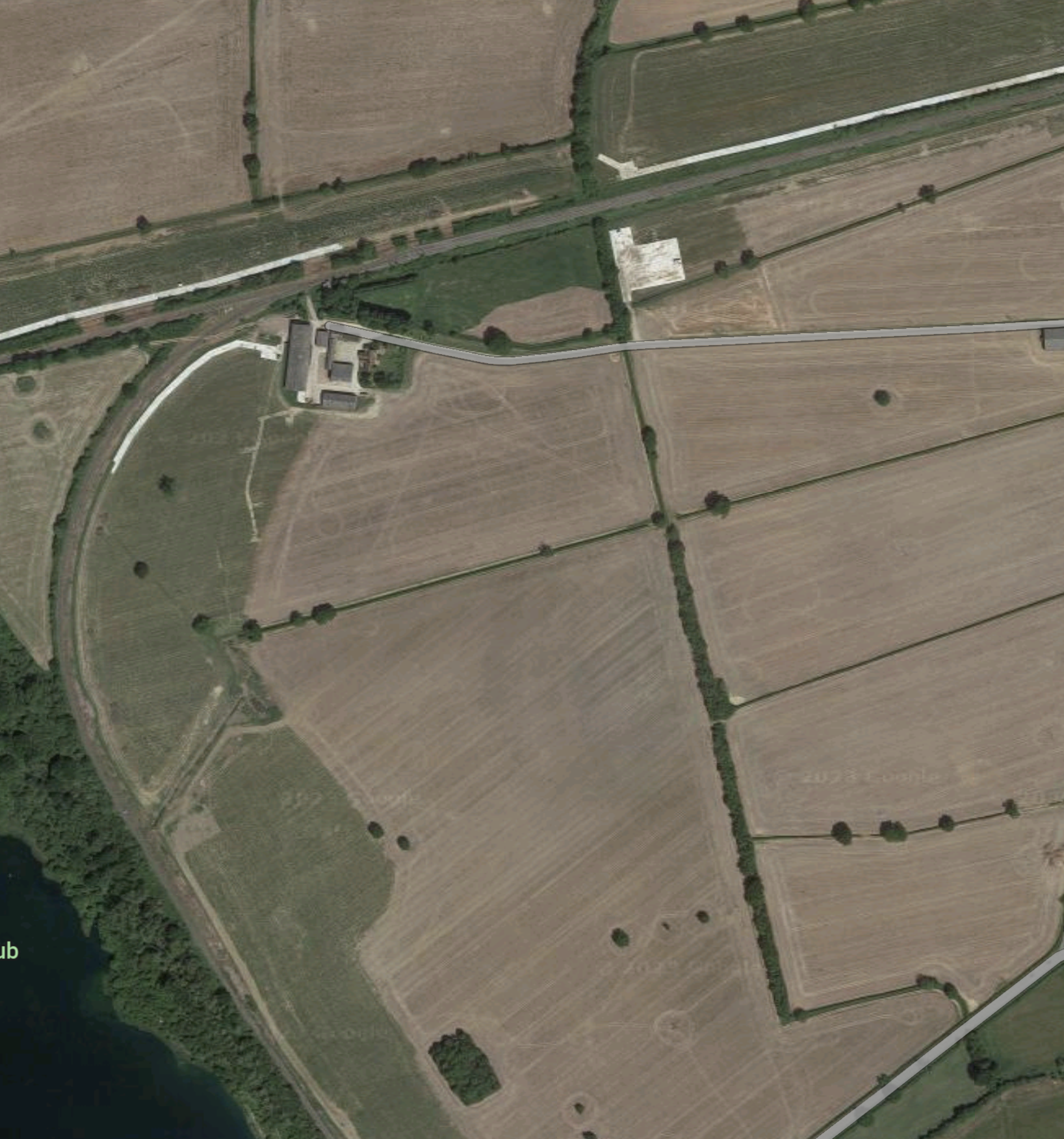
Note.
- The East West Railway going across the top of the map.
- The single track railway to Aylesbury Vale Parkway coming North and then turning East to join the East West Railway.
- The railway from Aylesbury Vale Parkway is still used by trains taking landfill.
The Wikipedia entry for Calvert, says this about the landfill site.
Another of the clay pits is now a landfill site. Waste is collected from Bristol, Bath and London each day and transported using rail via Aylesbury to Calvert. The site has a power station capable of producing 14 MWe of electricity from landfill gas, coming from the decomposition of organic matter to convert it into renewable electricity MW.
Looking at the map and the traffic on Real Time Trains, it would appear that there would be enough capacity for both the freight and an hourly passenger train between Aylesbury and Milton Keynes.
There is also the slight problem, that High Speed Two will be going through the area, as this map shows.
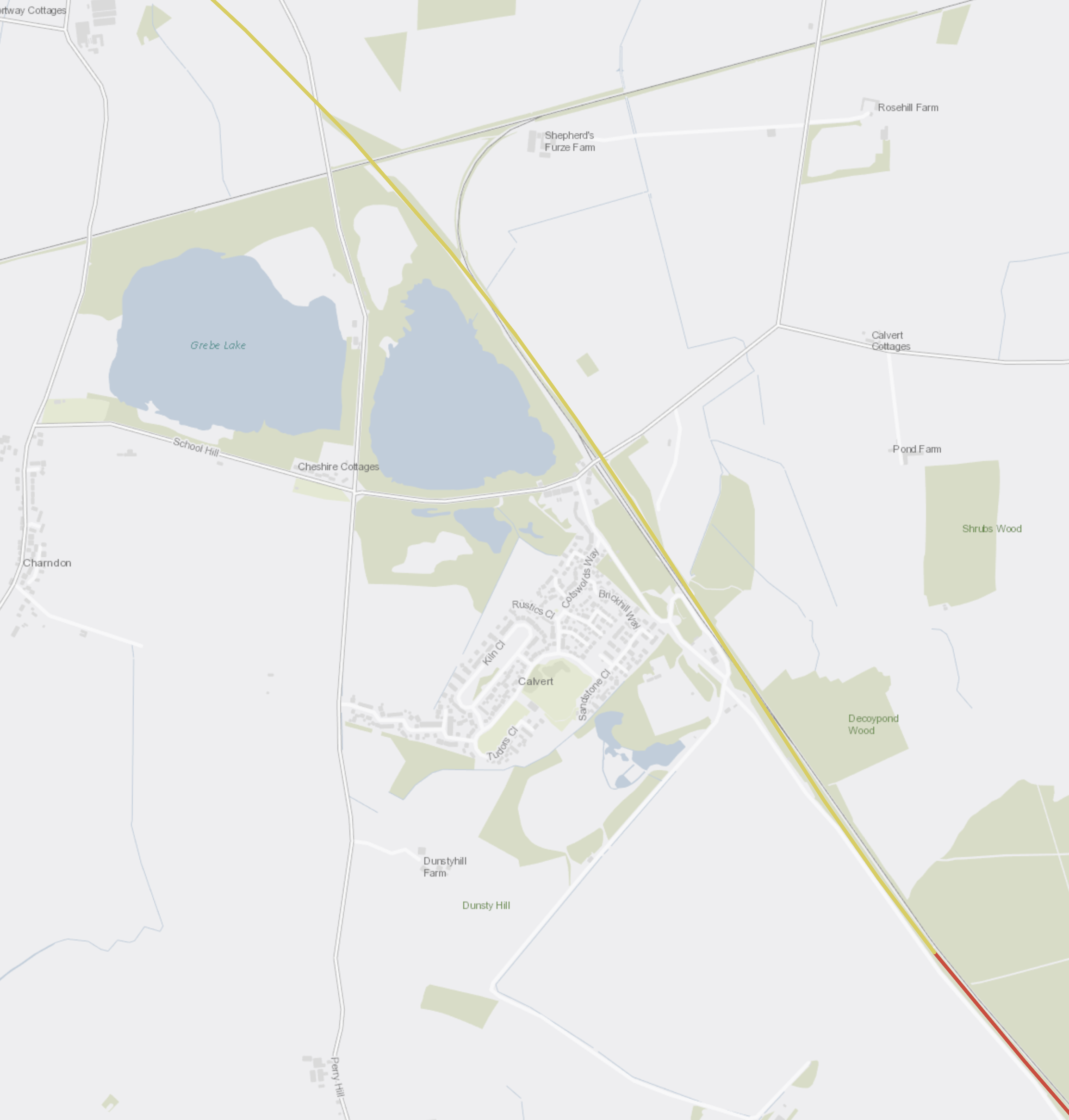
Note.
- High Speed Two is shown in yellow (cutting) and embankment (red).
- High Speed Two appears to run either on the same route or alongside the route to Aylesbury.
- The East West Railway goes across the top of thye map.
- The chord that connects the Aylesbury Spur to the East West Railway can clearly be seen.
- The Aylesbury Spur will run along the same route as High Speed Two.
- Aylesbury Vale Parkway will be just off the South-East corner of the map.
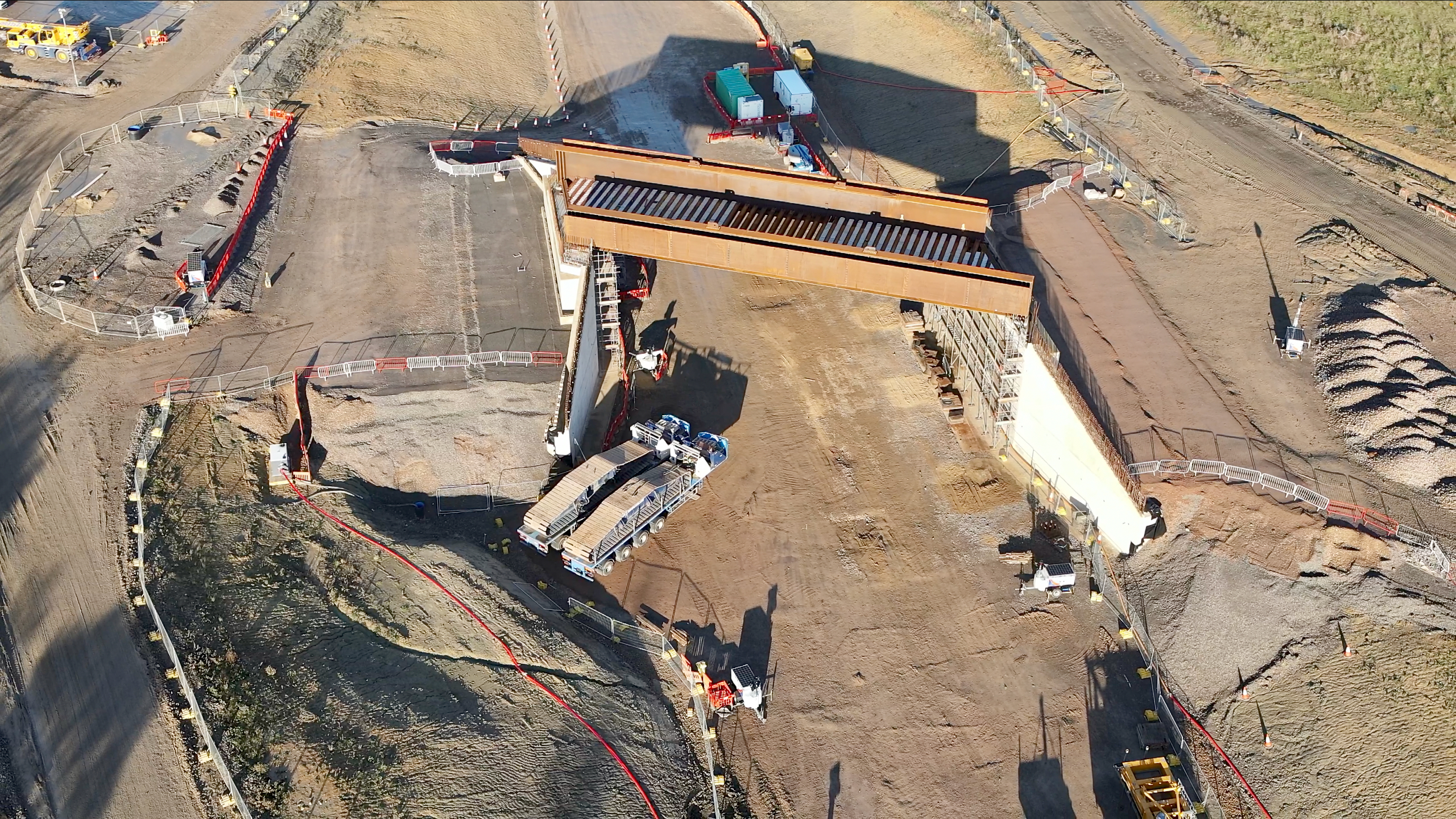
This page on the High Speed Two web site is entitled Boost for Oxford-Cambridge Connections As HS2 Builds Key East West Rail Bridge, describes the installation of a bridge to take the East West Railway goes over High Speed Two.
This picture is from High Speed Two.
As the landfill at Calvert will still need to be filled, I suspect that High Speed Two will leave the route between Aylesbury Vale Parkway and the East West Railway as a fully-serviceable railway, when they tidy up and leave this section of their route.
It looks to me, that once these tasks are complete.
- High Speed Two relay all the tracks between Aylesbury Vale Parkway and the East West Railway.
- The junction between the Aylesbury Spur and the East West Railway is completed.
- Aylesbury Vale Parkway station is updated.
The Aylesbury Spur as needed by the East West Railway to run passenger services between Aylesbury and Milton Keynes Central could be complete.
And all because of High Speed Two and a landfill site.
Conclusion
I am drawn to the conclusion, that the Aylesbury Spur would not be a difficult railway to build and because it links to the important interchange station at Milton Keynes Central, it could be delivered soon after High Speed Two are finished in the area.
It also appears that Avanti West Coast have already aligned their services with the East West Railway.
Electra.aero
I have signed up to FutureFlight‘s weekly newsletter and this week it gave two articles about a new nine-seat airliner called an Electra.aero.
It must be the first airliner named after its web site or vice-versa.
The first article is entitled Electra.aero Gives A Glimpse If Its eSTOL Technology Development Aircraft.
It says this about the aircraft and the company.
As it works on plans for a nine-passenger eSTOL blown-wing aircraft, Electra.aero has posted a short video teasing followers with a glimpse of what it describes as a technology demonstrator. The video shows what appears to be a subscale model of the larger hybrid-electric design, but the Virginia-based company is giving very little away for now.
This week, the U.S. start-up announced the appointment of former Boeing Commercial Airplanes president and CEO James Albaugh to its board of advisors, along with the former Airbus America CEO and FAA Administrator Allan McArtor, and aircraft finance expert Kristen Bartok Touw.
You can also watch a video.
The second article is entitled Electra.aero Uses Truck To Test Gives A Glimpse If Its eSTOL Aircraft Propulsion System And Wing.
It says about more the aircraft.
Electra.aero’s planned nine-passenger eSTOL aircraft is expected to be able to operate from landing strips as short as 300 feet. The company’s blown-wing design and hybrid-electric propulsion system will be key factors in achieving this breakthrough performance for regional air services. At its base in Manassas Regional Airport in Virginia, the company is using a technology demonstrator and a truck to conduct ground testing key systems in preparation for anticipated test flights later this year.
You can also watch a video.
The home page also shows a visualisation of a flight between Washington DC and New York.
Note.
- Blown-wing and blown flaps have been used before on aircraft like the Lockheed F-104 Starfighter, the Boeing C-17 Globemaster and the Blackburn Buccaneer.
- Blown flaps’ use on the Electra.aero, seems to be the first application on a small propeller-driver airliner.
- Electra.aero seems well-connected, which helps in the aviation industry.
- Power seems to come from a hybrid-electric design.
- Being able to operate from landing strips as short as a football field is a unique characteristic.
- Pictures on the web site show the aircraft has eight propellers, with those close to the fuselage being larger.
- A 400 nautical mile range with a 45 minute reserve, a cruise speed of 175 knots and a quiet take-off are claimed.
As someone, who has over a thousand hours in command of a twin-engined Cessna 340A, this aircraft could be the real deal.
- The field performance is sensational.
- The range is excellent.
- Except for the number of electric engines, it looks like an aircraft and won’t put off the passengers.
- It could fly between Washington DC and New York or London and Paris.
According to their web site, they already have a $3 billion order-book.
 The Anonymous Widower