Liverpool Lime Street Station And St. George’s Hall
When you arrive in a town or city by train, I believe that you should be welcomed by a wide spacious area, where you can get your bearings and meet friends.
I took these pictures outside Liverpool Lime Street station.












Note.
- The three main buildings on the pictures, are one Grade I and two Grade II Listed buildings.
- St. George’s Hall is a Grade I neoclassical building.
- A liver bird told me, that the magnificent floor with its 30,000 Minton tiles, will be open this summer.
- Lime Street station is now one of the best terminal stations in the world, both in terms of architecture and operation.
- The hotel on the left of the station, is now a Radisson Red hotel, after a very chequered history during the last ninety years.
- Not many stations welcome you to a city like Liverpool does.
In London, King’s Cross and Liverpool Street make an effort, but some stations like Paddington just deliver you to crowded, anonymous, dingy streets.
A First Ride In A Five-Car Class 710 Train – 30th January 2023
These pictures are from a few weeks back, when I had a first ride in one of the new five-car Class 710 trains.








I only went between Euston and Queen’s Park stations.
Wales’ First Floating Offshore Wind Farm Gets Marine License
The title of this post, is the same as that of this article on offshoreWIND.biz.
This is the sub-heading.
Blue Gem Wind, a joint venture between TotalEnergies and Simply Blue Group, has secured a marine license for the 100 MW Erebus floating offshore wind project in Wales.
These are some other points from the article.
- The project will use seven next-generation 14 MW turbines.
- They will be mounted on WindFloats, which are a proven technology.
- The wind farm will provide enough renewable energy to power 93,000 homes.
- It is aimed that the project will be commissioned in 2026.
The project has a web site, which is in English and Welsh. The home page has a good visualisation of three wind turbines on their WindFloats. Underneath is this mission statement.
Independent studies have suggested there could be as much as 50GW of electricity capacity available in the Celtic Sea waters of the UK and Ireland. This renewable energy resource could play a key role in the UK meeting the 2050 Net-Zero target required to mitigate climate change. Erebus, the first floating offshore wind project in the Celtic Sea will provide new low carbon supply chain opportunities, support coastal communities and create long-term benefits for the region.
Wales will be powered by sea dragons!
Preparing For Take-Off: Aviation Embraces Clean Hydrogen
The title of this post, is the same as that, of this article on Ryse Hydrogen.
These three paragraphs introduce the article.
Aviation’s clean hydrogen revolution is coming from all directions.
Taking a bottom-up approach, start-ups such as ZeroAvia are developing technology to convert small aircraft to hydrogen fuel, while at the other end of the spectrum, industry giants such as Airbus and Rolls-Royce are exploring how they can carry hundreds of passengers 1,000s of miles across the world.
The timescales for these projects are very different but progress is visible for both approaches.
The last two paragraphs are optimistic.
Hydrogen fuel could make up 32% of the market by 2050 if it becomes commercially available by 2035, according to a study from climate think-tank Energy Transition Commission.
It would seem that it’s only a matter of time before truly clean air travel is cleared for take-off and hydrogen-powered aircraft are carrying passengers and cargo across the skies.
The article is a good summary of the state of zero-carbon hydrogen-powered aircraft. Read it!
Gravitricity And Czech Firm DIAMO Announce Plans To Cooperate On Full Scale Gravity Energy Store
The title of this post, is the same as that of this article on The Engineer.
This is the sub-heading.
A former coal mine in the Czech Republic could become the first full scale gravity energy store in Europe, according to UK energy storage specialist Gravitricity
This paragraph describes the project.
The agreement will see the two companies seek funding to transform the former decommissioned Darkov deep mine – which is located in the Moravian-Silesian region of the Czech Republic – into a 4MW / 2MWh energy store, capable of powering more than 16,000 homes. According to Gravitricity the system will store energy by lowering and raising a single massive weight suspended in the Darkov mine shaft. The company has also signed a memorandum with VSB Technical University of Ostrava, whose specialist mining expertise will support the implementation of the technology.
Hopefully, the finance won’t be too difficult to find, with perhaps some help from the EU.
The article also describes the potential of Gravitricity, where it says.
- There could be up 14,000 suitable mines around the world.
- The Coal Authority believes there could be a hundred suitable shafts in the UK.
It appears Gravitricity may be on its way.
Diversifying A US$200 billion Market: The Alternatives To Li-ion Batteries For Grid-Scale Energy Storage
The title of this post, is the same as that of this article on Energy Storage News.
This is the introductory paragraph.
The global need for grid-scale energy storage will rise rapidly in the coming years as the transition away from fossil fuels accelerates. Energy storage can help meet the need for reliability and resilience on the grid, but lithium-ion is not the only option, writes Oliver Warren of climate and ESG-focused investment bank and advisory group DAI Magister.
Oliver starts by saying we need to ramp up capacity.
According to the International Energy Agency (IEA), to decarbonise electricity globally the world’s energy storage capacity must increase by a factor of 40x+ by 2030, reaching a total of 700 GW, or around 25% of global electricity usage (23,000TWh per annum). For comparison, this would be like swelling the size of the UK’s land to that of the USA.
Similar to how “nobody ever gets fired for buying IBM”, lithium-ion holds a similar place in grid scale electrical storage today.
And just as IBM did in the last decades of the last century, the builders of lithium-ion will fight back.
He then lists the problems of grid-scale lithium-ion batteries.
- Shortage of cobalt.
- Toxic and polluting extraction of some much needed metals and rare earths from unstable countries.
- Lack of capacity to load follow.
- Limited lifespan.
He does suggest vehicle-to-grid can provide 7TWh of storage by 2030, but it has similar problems to lithium-ion grid scale batteries.
Finally, he covers these what he considers several viable methods of energy storage in detail.
He introduces them with this paragraph.
No single killer application or technology exists to get the job done. Diversification is key with success dependent on the wide-scale adoption of multiple grid-scale energy storage solutions.
- Energy Dome – Italy – Stylish Use of CO2
- Augwind Energy – Israel – Stores Energy As Compressed Air Underground
- Cheesecake Energy – UK – Stores Energy As Heat And Compressed Air
- Highview Power – UK – Stores Energy As Liquefied Air
- Ocean Grazer – Netherlands – Ocean Battery
- RheEnergise – UK – High Density Hydro
- Lumenion – Germany/Japan – Stores Energy As Heat
- Energy Vault – Switzerland – Raising And Lowering Of Weights
Note.
- All systems are environmentally-friendly and use readily-available materials like air, water, sea-water, steel and concrete for their systems.
- The most exotic materials used are probably in the control computers.
- Some systems use readily-available proven turbo-machinery.
- Most systems appear to be scalable.
- All systems would appear to have a working life measured in decades.
- I would expect that most well-educated teenagers could understand how these systems worked.
Only Augwind Energy and Lumenion are new to me.
He finally sums up the economics and the market potential.
Our ability to expand energy storage capacity is one of the most pressing issues that will determine whether this defining ‘transitional’ decade is a success. But we’ll need to invest wisely into the right technologies that get the greatest bang for the buck (in terms of GWh capacity and return on capital) given the limited lifespan of Li-Ion and the decarbonisation of the grid.
At a current capital cost of US$2,000 per kW quoted by the US National Renewable Energy Laboratory (NREL) for 6-hour Li-ion battery storage, the 700GW of capacity needed by 2030 equates to around a US$1.5 trillion market over the coming decade, making it worth nearly US$200 billion a year.
The Energy Storage News article is a comprehensive must read for anyone, who is considering purchasing or investing in energy storage.
I have some further thoughts.
From My Experience Would I Add Any Other Systems?
I would add the following.
- Form Energy, because its iron-air battery is well-backed financially.
- Gravitricity, because it can use disused mine shafts to store energy and the world has lots of those.
- STORE Consortium, because its 3D-printed concrete hemispheres, that store energy using pressurised sea-water can be placed within a wind farm.
I also suspect that someone will come up with an energy storage system based on tidal range.
Finance
When we started Metier Management Systems, finance to breakout from the first initial sales was a problem. We solved the problem with good financial planning and an innovative bank manager who believed us all the way.
David, was a rogue, but he was a rogue on the side of the angels. Long after Metier, he even came to my fiftieth birthday party.
David would have found a way to fund any of these systems, as they tick all the boxes of demonstrated, environmentally-friendly, safe and understandable. They are also likely to be bought by companies, governments and organisations with a high net value, a very respectable reputation and/or large amounts of money.
I also think, that just as we did with the original Artemis project management system, some of these systems can be leased to the operators.
Second-Use Of Systems
Several of these systems could be moved on to a new location, if say they were supporting an industry that failed.
That would surely help the financing of systems.
Racing Towards A Green Future
The title of this post, is the same as that of this article on Ricardo.
This is the first paragraph.
While Formula E and its sibling electric race series, Extreme E and RX2e, are burnishing battery-powered vehicles credentials, motorsport from Formula 1 down is actively pursuing how traditional internal combustion engine (ICE) race and rally cars can be made more environmentally acceptable.
The article, which is a must-read, then describes the various routes and options, that motorsport is taking towards zero-carbon.
The article finishes with this paragraph.
While motorsport technology can, and does, transfer to production cars, especially in the higher echelons, whether the path it is beating on AS fuels will convince legislators that battery electric vehicles are only an answer rather than the answer remains to be seen.
I believe that when an affordable small hatchback powered by hydrogen hits the road as it inevitably will, it will have Ricardo’s fingerprints all over it.
Floating Offshore Wind Could Reach Full Commercialisation By 2035, Research Says
The title of this post, is the same as that of this article on offshoreWIND.biz.
This is the sub-heading.
Floating offshore wind could reach full commercialisation by 2035, said 60 per cent of respondents in the latest research that was done by DNV, with 25 per cent believing it will be as early as 2030.
I’ll go along with that, but as a serial disruptive innovator, I believe full commercialisation could be earlier than 2027.
It will be for these reasons.
Capacity Factor
There is reason to believe from the figures from existing floating wind turbines, that the capacity factor is very good and could be higher than those of turbines with fixed foundations.
Wikipedia says this about the world’s first commercial floating offshore windfarm; Hywind Scotland.
In its first 5 years of operation it averaged a capacity factor of 54%, sometimes in 10 meter waves.
If other floating technologies show as good capacities as this, then the technology may well find it easier to attract finance.
Design
We have only seen a couple of designs deployed; Hywind and WindFloat.
There will be plenty more to come.
This visualisation shows five D-Floaters being transported on a ship.
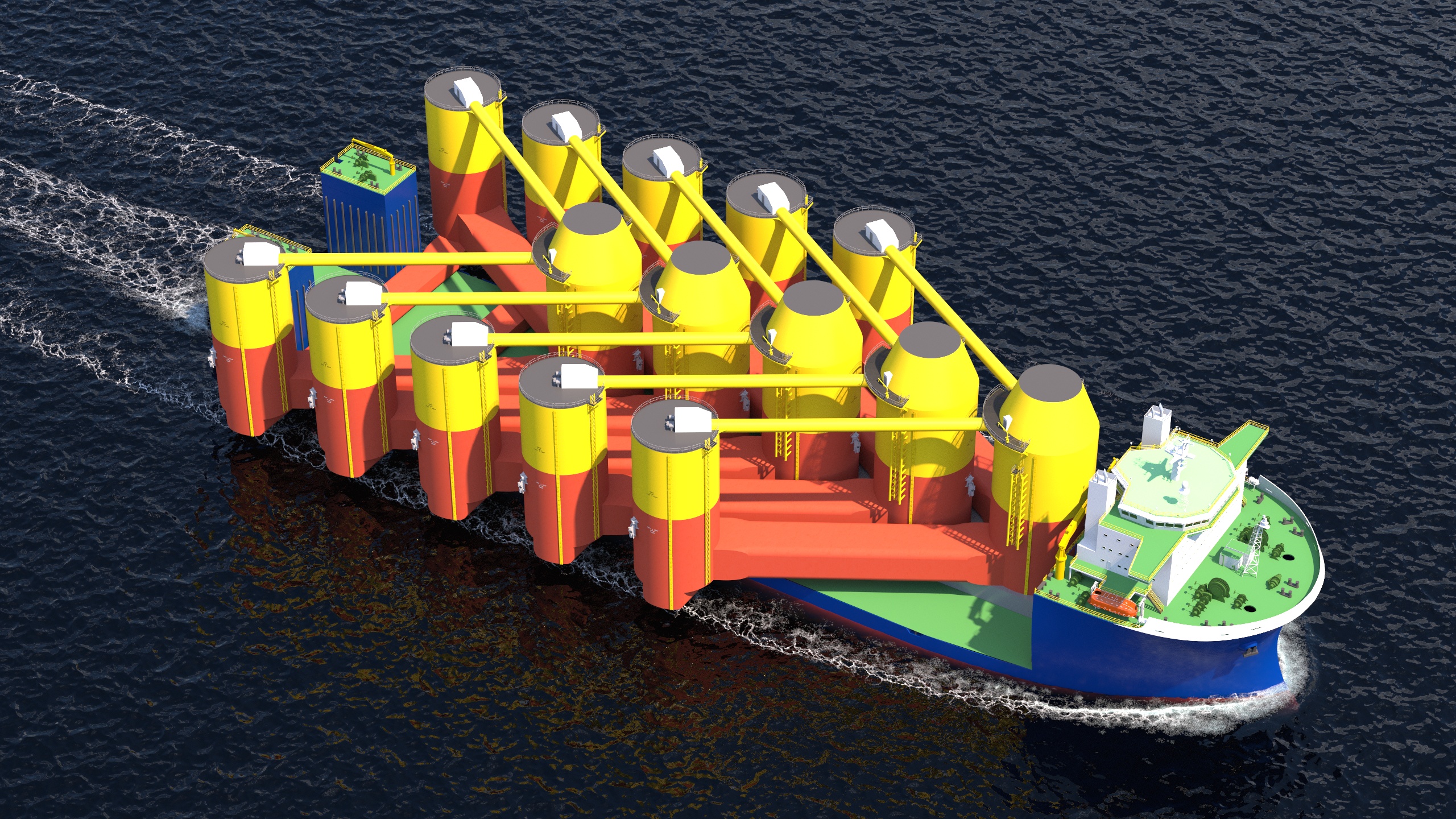
Note.
- D-Floaters are being developed by Bassoe Technology.
- As many floats will be manufactured, a long way from their final mooring, why not make them easy to transport.
- Other companies are developing floats that can be bolted or welded together from standard components.
I wouldn’t be surprised if one design came to dominate the market.
This might be a good thing, as it would surely speed up deployment of floating wind farms.
Construction And Installation
This video shows the construction and installation if Principle Power‘s, Windfloat prototype.
Note.
- All the construction and assembly is done in a dock with a suitable crane.
- This is much easier than doing it the assembly out at sea, as has to be done with turbines with fixed foundations.
- I suspect that with the best design of float and turbine, high rates of turbine assembly can be achieved.
- Health and Safety will prefer this type of assembly.
I suspect other floating wind turbines will be similarly assembled.
Suppose you were assembling 15 MW floating turbines at a rate of one per day, that would be a production rate of over 5 GW of turbines per year from just one dock.
Early Delivery Of Power
I suspect that to build a floating wind farm, one of the first things to be towed out would be the substation to which all the turbines will be connected.
- This could even be floating.
- I’ve seen floating sub station designs, that incorporate energy storage and hydrogen production.
Once the substation is fully-installed and tested, floating turbines could be towed out, anchored, connected to the substation and immediately start to produce electricity.
I have built a lot of cash-flow models in my time and I believe that one for say a 2 GW floating wind farm would be very friendly to proposers, investors and operators.
There’s A Lot Of Sea Out There!
And after nearly sixty years of offshore semi-submersible platforms in UK water, we now how to work in the conditions.
In ScotWind Offshore Wind Leasing Delivers Major Boost To Scotland’s Net Zero Aspirations, I said this, about the total capacity, that will be developed under the ScotWind leasing round.
- Adding up these fixed foundation wind farms gives a capacity of 9.7 GW in 3042 km² or about 3.2 MW per km².
- Adding up the floating wind farms gives a capacity of 14.6 GW in 4193 km² or about 3.5 MW per km².
Note.
- You appear to get ten percent more capacity in a given area of sea with floating wind farms.
- The energy density of floating wind farms is 3.5 MW per km².
I suspect investors will prefer the floating wind farms.
Lower Visibility
Floating wind farms will generally be further out to sea and less likely to be objected to, than installations nearer to land.
Maintenance And Updating
Floating wind farms can be towed into port for servicing and updating, which must ease the process.
Project Management
I believe that floating wind farms, are projects, that would benefit highly from good project management.
Sometimes, I wish I was still writing project management software and I am always open to offers to give my opinion and test anybody’s software in that area!
Finance
I can see that floating wind farms could offer better cash flows to investors and this will make them invest in floating wind farms at the expense of those with fixed foundations.
Conclusion
For all these reasons, but with my instinct telling me that floating wind farms could offer a better return to investors, I wouldn’t be surprised if floating wind farms came to dominate the market.
Silvertown Tunnel Works – 21st February 2023
I took these pictures of the Silvertown Tunnel works on the North Bank of the Thames today.


























The first set of pictures were taken travelling to West Silvertown station, where I returned.
Another Door Opens At Bank Station
I took these pictures at Bank station this morning in the Southernmost tunnel between the Northern Line platforms.




You can just about see the lift doors through the windows in the steel fire doors.
It can’t be long now before the Cannon Street Entrance to Bank station opens.
 The Anonymous Widower