Elizabeth Line: More Than 100 Million Journeys On Elizabeth Line, Says YouGov
The title of this post, is the same as that of this article on the BBC.
These three paragraphs introduce the article.
More than 100 million journeys have been made on London Underground’s new Elizabeth Line since it opened last May, according to a survey.
The YouGov poll suggested 45% of the capital’s residents had also used the line from Reading, Berkshire, to Abbey Wood and Shenfield in Essex.
Transport for London (TfL) said on 1 February it had completed about 600,000 daily journeys.
That is all well and good, but to me, this is the most significant paragraph.
TfL said the railway was “on track to break even” based on operating costs by the end of the 2023/24 financial year.
So it looks like that the planners got the modelling of the operation of the railway correct.
From my experience of project management, I believe that the Elizabeth Line project could have been considered as five main projects.
- The boring of the Central Tunnel
- The updating of the existing branches to Abbey Wood, Heathrow, Reading and Shenfield
- The building of the Class 345 trains
- The signalling
- The fitting out of the stations in the Central Tunnel
Delivery though was a bit patchy!
These are my thoughts on each sub-project.
The Boring Of The Central Tunnel
I was told, that early on, it was realised by the contractors that they didn’t have enough workers, who were certified to work underground.
So the Tunneling and Underground Construction Academy or TUCA in Ilford, was built to train more workers.
This helped the Central Tunnel to be completed on time.
Since then, two more tunnels; the Thames Tideway and the London Power Tunnel have been successfully completed on time and on budget, thus vindicating the building of TUCA.
The Updating Of The Existing Branches To Abbey Wood, Heathrow, Reading and Shenfield
There were a few hiccups, but generally the branches were updated and were operating into Paddington and Shenfield before the line opened.
The Building Of The Class 345 Trains
This wasn’t perfect and Bombardier’s financial state didn’t help, but the trains had good tests running out of Liverpool Street and Paddington.
The Signalling
A lot of commentators have said the signalling was too complicated. But eventually, it all seems to be working.
Was enough testing done away from the Elizabeth Line?
My feeling is that a new UK test track should have been built in the early 2010s, so that some testing could have been done professionally away from London.
The Fitting Out Of The Stations In The Central Tunnel
This was certainly a cause of late handover of stations like Bond Street, Farringdon, Whitechapel and others.
I heard tales, where other projects in London, were offering more money, so consequently workers were moving with the money, thus delaying the completion of stations.
I certainly heard a tale, where all the electricians on one station project moved en masse to complete the new Tottenham Hotspur stadium.
Some of the projects were office projects, paid for by sovereign wealth funds with bottomless projects, so they could make sure their project finished on time.
There were also the problems caused by Brexit, the pandemic and major projects running late in Germany and Europe.
It is my view that Elizabeth Line should have been given more priority, by delaying commercial projects, so that the pool of available labour wasn’t exhausted.
Some of the forest of projects around Elizabeth Line stations, should have been given planning permission, that meant they couldn’t start until Elizabeth Line was finished.
In the 1960s, there was certainly a similar labour problem in Aberdeen. I was told, that the oil majors, who nearly all used the project management system; Artemis, that I had written, talked to each other to make sure the situation didn’t get any worse.
I wonder, if someone was watching the labour shortage problems in City Hall?
Conclusion
I believe that if Elizabeth Line had been given the priority it should have been, that it would have been opened earlier and just as it is now, it would be showing a sensible cash flow.
Now it is a question of catching up financially.
Coal Sales Could Lose Tens Of Millions For Consumers
The title of this post, is the same as that of this article on The Times.
These two paragraphs outline the story.
A huge stockpile of coal bought for emergency use in power stations this winter is due to be resold at a loss of tens of millions of pounds to consumers.
National Grid funded the procurement of hundreds of thousands of tonnes of coal as part of a deal to keep open five coal-fired units this winter. The estimated £368 million cost of the “winter contingency contracts”, which includes an undisclosed sum for the coal purchases, is being recouped via energy bills.
Note.
- None of the coal has been burned, as the weather was warmer than expected,
- It is now sitting in various places around the country.
- It will probably sell at a loss and there will be transport costs.
I will look at the mathematics of disposal.
Burning Fossil Fuels
On the Internet, I have found these figures.
- If you burn a kilogram of natural gas you create 15.5 KWh of electricity and 2.75 kilograms of carbon dioxide.
- If you burn a kilogram of coal you create 2.46 KWh of electricity and 2.38 kilograms of carbon dioxide.
This means that natural gas and coal create 0.18 and 0.97 kilograms of carbon dioxide respectively for every KWh generated.
I believe these figures say, that if we have to use a fossil fuel, gas will be much better than coal for climate change reasons.
The Size Of The Problem
We are talking about 130,000 tonnes of coal for EDF and 400,000 for Drax. Uniper’s figure is not stated. Let’s say they make the coal pile up to 600,000 tonnes.
Burning this pile will generate 1,476,000 KWh or 1.476 GWh of electricity and create 1428,000 tonnes of carbon dioxide.
Effect On Total UK Carbon Dioxide Emissions
According to government figures on the Internet in 2021 we emitted 107.5 million tonnes of carbon dioxide.
Burning all that coal in a year, would add less than 1.5 % to our carbon dioxide emissions. Perhaps we should burn it strategically over a number of years, when there are energy supply problems, as it is after all a crude form of energy storage.
What Would I Do With The Savings?
The money saved on the transport and making loss-making sales could be spent on other ways to save carbon emissions, like converting surplus wind energy into hydrogen and blending it with the gas.
I discussed the mathematics of hydrogen blending in UK – Hydrogen To Be Added To Britain’s Gas Supply By 2025.
If we put 2 % hydrogen in our natural gas, this would save nearly 2.5 million tonnes of carbon dioxide emissions in a year. This figure is much bigger than the 1428,000 tonnes of carbon dioxide, that would be created by burning all the coal.
At a level of 2 %, most appliances, boilers and industrial processes would work without change. But a good service would help.
Is Old Street Roundabout A ‘Too Many Cooks’ Project?
The remodelling of Old Street station and the roundabout on top was the lead item on BBC London news this morning.
The project is certainly not going well and seems to be proceeding at a snail’s pace.
Progress On The 24th February 2023
I took these pictures a few days after I wrote the original post.











Compare these pictures with those in Old Street Station – 9th September 2022, which were the last ones I took.
Conclusion
I do wonder, if this project is suffering from too many politicians trying to manage the project at the top.
I suspect Hackney and Islington Councils, the City of London, the Greater London Authority, Transport for London and the Mayor of London are all having a say.
And I suspect other interested parties like Moorfields Hospital, the various bus companies, and many disgruntled passengers are all adding their four pennyworth.
What is needed is for someone with authority to take charge!
Unfortunately for the project, the guy with the authority; Sadiq Khan won’t be interested, as it’s a North London project.
But please someone, get a grip on this important project!
The Luck Of The Genes
There’s an article in The Times, which is entitled When It Comes To Success, Luck Can Trump Intelligence.
It got me thinking about my life.
I have been pretty successful in life, and I put it down to winning the gene lottery, with a part-Jewish father and a part-Huguenot mother, who taught me hard work and everything they knew. So were my genes forged by religious persecution in the harsh conditions of the ghettoes of Europe?
But luck has always played a great part in my success. On the way, three or four successful men have chosen me for projects and I’ve repaid them by succeeding. I’ve been at the heart of the creation of two world-changing companies.
But the luck turned bad, a dozen years ago. My wife and our youngest son died from cancer and I had a serious stroke.
But the genetic lottery of being coeliac and therefore having B12 injections, has meant, I’ve made a good recovery from the stroke. The B12 injections is a stroke recovery method from the States, but is considered quackery over here. I believe it saved my life.
And then during the pandemic, those coeliac genes and the gluten-free diet I need for health, seem to have protected me from a severe dose of the covids. I’ve yet to find a fellow coeliac, who has had one either. Scientific research from Italy and Sweden, is also backing up my observations.
Lady luck has smiled on me. Or does the devil, look after her own?
UK – Hydrogen To Be Added To Britain’s Gas Supply By 2025
The title of this post, is the same as that of this article on Hydrogen Central.
These are the first three paragraphs.
Hydrogen to be added to Britain’s gas supply by 2025.
Hydrogen is to be pumped into Britain’s main gas pipeline by 2025 as part of a scramble to ditch fossil fuels and move to net zero.
Between 2% and 5% of the fuel flowing through the country’s transmission network will be hydrogen in two years under plans drawn up by National Gas, which owns the pipelines.
Note.
- The article says that.on a winter’s day, you’ve got seven times more energy going through the gas network than the electricity network.
- Between 2% and 5% of hydrogen, would be unlikely to mean that appliances, boilers and industrial processes would need to be changed.
- I suspect that domestic appliances and boilers would just need a good service.
- HyDeploy has shown that 20 % of hydrogen could be possible.
- The hydrogen could be added, where the natural gas enters the UK gas network.
The exercise would save a lot of carbon emissions.
How Much Electricity Would Be Needed To Create The Hydrogen?
In The Mathematics Of Blending Twenty Percent Of Hydrogen Into The UK Gas Grid, I calculated the amount of hydrogen that would be needed for 20 %, how much electricity it would need and how much carbon dioxide would not be emitted.
How Much Hydrogen Needs To Be Added?
This page on worldodometer says this about UK gas consumption.
The United Kingdom consumes 2,795,569 million cubic feet (MMcf) of natural gas per year as of the year 2017.
I will now calculate the weight of hydrogen needed to be added.
- 2,795,569 million cubic feet converts to 79161.69851 million cubic metres.
- I will round that to 79161.7 million cubic metres.
- Twenty percent is 15832.34 million cubic metres.
- A cubic metre of hydrogen weighs 0.082 Kg, which gives that in a year 1,298.25188 million kilograms will need to be added to the UK gas supply.
This is 1,298,251.88 tonnes per year, 3,556.85 tonnes per day or 148.2 tonnes per hour.
How Much Electricity Is Needed To Create This Amount Of Hydrogen?
In Can The UK Have A Capacity To Create Five GW Of Green Hydrogen?, I said the following.
Ryze Hydrogen are building the Herne Bay electrolyser.
- It will consume 23 MW of solar and wind power.
- It will produce ten tonnes of hydrogen per day.
The electrolyser will consume 552 MWh to produce ten tonnes of hydrogen, so creating one tonne of hydrogen needs 55.2 MWh of electricity.
To create 148.2 tonnes per hour of hydrogen would need 8,180.64 MW of electricity or just under 8.2 GW.
How Much Carbon Dioxide Would Be Saved?
This page on the Engineering Toolbox is entitled Combustion Of Fuels – Carbon Dioxide Emission and it gives a list of how much carbon dioxide is emitted, when a fuel is burned.
For each Kg of these fuels, the following Kg of carbon dioxide will be released on combustion.
- Methane – 2.75
- Gasoline – 3.30
- Kerosene – 3.00
- Diesel – 3.15
- Bituminous coal – 2.38
- Lignite 1.10
- Wood – 1.83
Engineering Toolbox seems a very useful web site.
I will now calculate how much carbon dioxide would be saved.
- In 2017, UK methane consumption was 79161.7 million cubic metres.
- One cubic metre of methane weighs 0.554 Kg.
- The total weight of methane used is 43,855,581.8 tonnes.
- Multiplying by 2.75 shows that 120,602,849.95 tonnes of carbon dioxide will be produced.
As twenty percent will be replaced by hydrogen, carbon dioxide emission savings will be 6,030,142.498 tonnes.
That seems a good saving, from a small country like the UK.
The UK would also reduce natural gas consumption by twenty percent or 15832.34 million cubic metres per year.
How Much Electricity Would Be Needed To Create The Hydrogen for a 5 % Blend?
I’ll now repeat the calculation for a 5 % blend,
How Much Hydrogen Needs To Be Added?
I will now calculate the weight of hydrogen needed to be added.
- UK gas consumption rounds to 79161.7 million cubic metres.
- Five percent is 3958.085 million cubic metres.
- A cubic metre of hydrogen weighs 0.082 Kg, which gives that in a year 324.56297 million kilograms will need to be added to the UK gas supply.
This is 324,563 tonnes per year, 889.21 tonnes per day or 37 tonnes per hour.
How Much Electricity Is Needed To Create This Amount Of Hydrogen?
Earlier I said this.
The electrolyser will consume 552 MWh to produce ten tonnes of hydrogen, so creating one tonne of hydrogen needs 55.2 MWh of electricity.
To create 37 tonnes per hour of hydrogen would need 2,045.16 MW of electricity or just over 2 GW.
How Much Carbon Dioxide Would Be Saved?
Earlier, I found that a Kg of methane will produce 2.75 Kg of carbon dioxide on combustion.
I will now calculate how much carbon dioxide would be saved.
- In 2017, UK methane consumption was 79161.7 million cubic metres.
- One cubic metre of methane weighs 0.554 Kg.
- The total weight of methane used is 43,855,581.8 tonnes.
- Multiplying by 2.75 shows that 120,602,849.95 tonnes of carbon dioxide will be produced.
As five percent will be replaced by hydrogen, carbon dioxide emission savings will be 6030,142.4975 tonnes.
The UK would also reduce natural gas consumption by five percent or 3958.085 million cubic metres per year.
How Much Electricity Would Be Needed To Create The Hydrogen for a 2 % Blend?
I’ll now repeat the calculation for a 2 % blend,
How Much Hydrogen Needs To Be Added?
I will now calculate the weight of hydrogen needed to be added.
- UK gas consumption rounds to 79161.7 million cubic metres.
- Two percent is 1,583.234 million cubic metres.
- A cubic metre of hydrogen weighs 0.082 Kg, which gives that in a year 129.825 million kilograms will need to be added to the UK gas supply.
This is 129,825 tonnes per year, 355.68 tonnes per day or 14.8 tonnes per hour.
How Much Electricity Is Needed To Create This Amount Of Hydrogen?
Earlier I said this.
The electrolyser will consume 552 MWh to produce ten tonnes of hydrogen, so creating one tonne of hydrogen needs 55.2 MWh of electricity.
To create 14.8 tonnes per hour of hydrogen would need 817 MW of electricity or not even a GW.
How Much Carbon Dioxide Would Be Saved?
Earlier, I found that a Kg of methane will produce 2.75 Kg of carbon dioxide on combustion.
I will now calculate how much carbon dioxide would be saved.
- In 2017, UK methane consumption was 79161.7 million cubic metres.
- One cubic metre of methane weighs 0.554 Kg.
- The total weight of methane used is 43,855,581.8 tonnes.
- Multiplying by 2.75 shows that 120,602,849.95 tonnes of carbon dioxide will be produced.
As two percent will be replaced by hydrogen, carbon dioxide emission savings will be 2,412,057 tonnes.
The UK would also reduce natural gas consumption by two percent or 1,583.234 million cubic metres per year.
Summary Of Savings And Electricity Needed
2 %
- Hydrogen To Add – 14.8 tonnes per hour
- Electricity Needed – 817 MW per year
- Carbon Dioxide Savings – 2,412,057 tonnes per year
- Natural Gas Reduction – 1,583.234 million cubic metres per year
5 %
- Hydrogen To Add – 37 tonnes per hour
- Electricity Needed – 2,045.16 MW per year
- Carbon Dioxide Savings – 6,030,142.498 tonnes per year
- Natural Gas Reduction – 3,958.085 million cubic metres per year
20 %
- Hydrogen To Add – 148.2 tonnes per hour
- Electricity Needed – 8,180.64 MW per year
- Carbon Dioxide Savings – 24,120,569.99 tonnes per year
- Natural Gas Reduction – 1,5832.34 million cubic metres per year
Birmingham Plays The Green Card
This article in The Times today is entitled Birmingham Airport Set For Hydrogen Take-Off.
These two paragraphs introduce the article.
Birmingham Airport aims to become the first in Britain to operate commercial zero-emission hydrogen-fuelled flights — and by as early as 2025.
The ambitious goal follows the signing of a partnership with the British start-up ZeroAvia whose first trial flight of a 19-seater passenger aircraft powered by hydrogen fuel cells took place last month.
Other points from the article include.
- ZeroAvia is also working with Rotterdam Airport.
- Initially, it is likely that the hydrogen-powered aircraft will be used for cargo.
- The government wants all UK domestic flights to be zero-carbon by 2040.
- Birmingham wants to be zero-carbon by 2033.
- ZeroAvia has received upwards of £20 million of matched-taxpayer funding.
- It has some big backers and well-known airlines, who have placed orders.
These are my thoughts.
ZeroAvia’s Airliners
This paragraph from The Times article describes their first two aircraft.
ZeroAvia is retrofitting turboprops, 19-seater Dornier and in future 80-seater De Havilland Canada Dash 8-400s, with tanks of hydrogen which is converted by fuel cell stacks to energy taken to electric motors that power the propellers. The only emission is water. It is talking to potential new-entrant airframe makers to build all-new hydrogen aircraft of the future.
Note.
- The Dornier 228 is a 19-seater airliner of which over three hundred have been built.
- The de Havilland Canada Dash 8-400 is an 80-seater airliner of which over six hundred have been ordered and over 1200 of all marques of Dash 8s have been built.
Both are workhorses of the smaller airlines all over the world.
As the paragraph from The Times indicates the power system is not conventional, but then most of this new breed of small electric/hydrogen/hybrid airliners have electric propulsion. I suspect that there’s been a marked improvement in the design and efficiency of electric motors.
Electric propulsion should have a substantial noise advantage over turboprops.
ZeroAvia are also retrofitting their two chosen airliners.
This offers advantages in the certifying of the airliners. Providing the changes made to the airframe are not significant, the various certifying authorities in the UK, US and EU will allow previous certification to be carried over.
This means that ZeroAvia only have to thoroughly test and certify the powerplant and its integration into the aircraft.
One of their competitors, the Eviation Alice is a completely new airframe with battery-electric power, so I suspect this aircraft will take longer to certify.
I think ZeroAvia have used this shorter certification time to aim to get their airliners in service first.
Those that don’t win, don’t get the same fame.
Hydrogen At Birmingham Airport
Hydrogen will be needed at Birmingham Airport to refuel ZeroAvia’s airliners.
But will hydrogen also be used on the airside to power some of the heavy vehicles you see on airports.
Look at this page on the Hawaii Technology Development Corporation, which shows a Hydrogen Fuel Cell U-30 Aircraft Tow Tractor. The specification indicates, that it can tow a C-17 or a Boeing 747.
I wouldn’t be surprised to see Birmingham Airport build their own electrolyser nearby both to supply hydrogen-powered aircraft and decarbonise the airside.
To And From Birmingham Airport
Consider.
- Birmingham Airport is connected to Birmingham International station by a free AirRail Link.
- Birmingham International station has an impressive number of services, many of which are electric.
- There will be a people mover to connect to Birmingham Interchange for High Speed Two.
- Birmingham Interchange will have five trains per hour (tph) to and from London, taking under forty minutes.
- There are plans to extend the West Midlands Metro to the airport, with journeys taking thirty minutes from the City Centre.
- Birmingham Airport is at the centre of the UK’s motorway network.
Most public transport to Birmingham Airport will be zero-carbon and the percentage that is will increase.
A Green Air Bridge To Ireland
Currently the fastest services between London and Birmingham International station take a few minutes over the hour.
But after High Speed Two opens, the service will improve.
- High Speed Two will take under forty minutes.
- There will be five tph.
- High Speed Two will connect to the Elizabeth Line and the London Overground at Old Oak Common station.
- Euston station will have better connectivity to the Underground.
This diagram shows High Speed Two services.
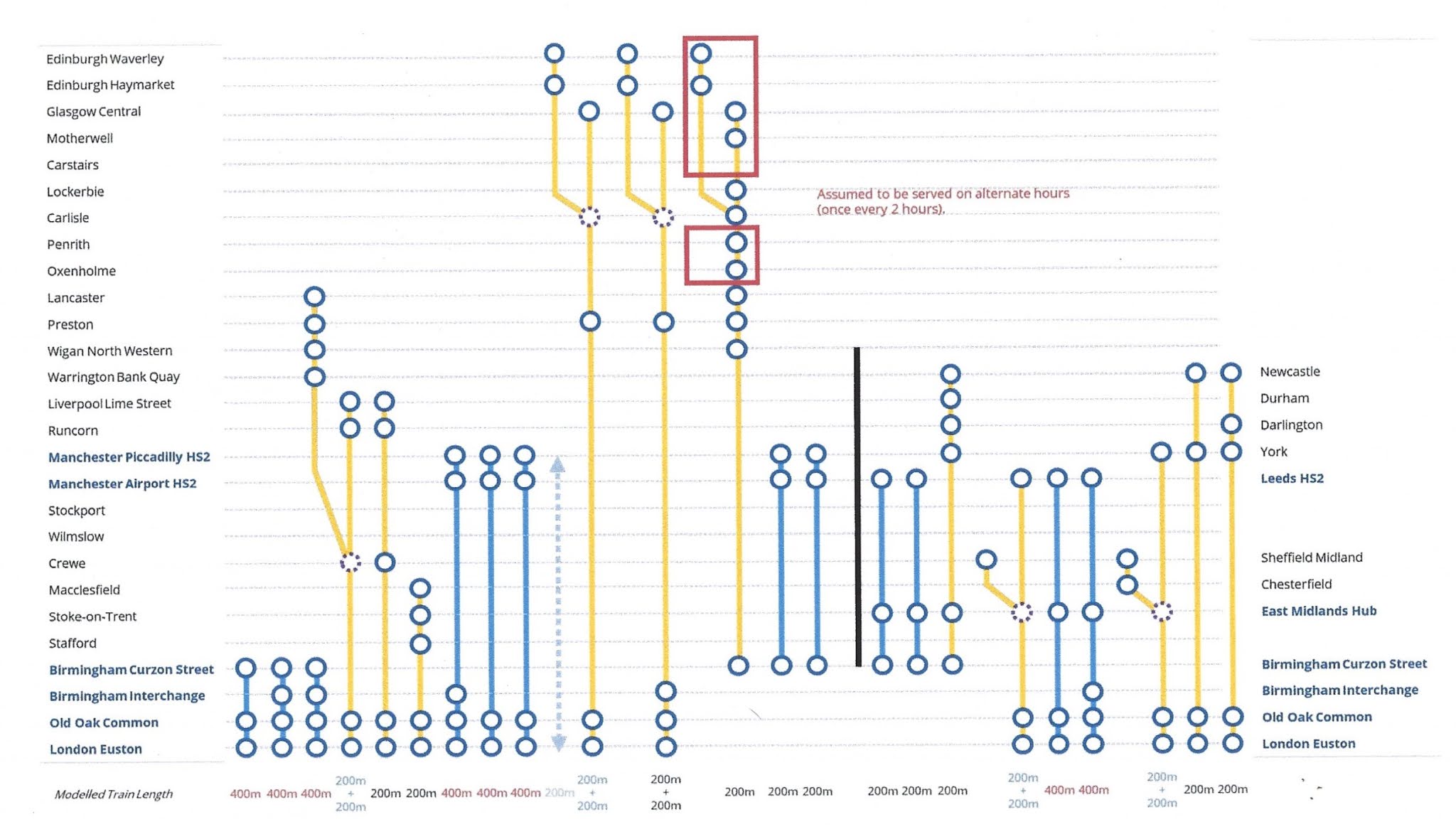
Consider.
- Birmingham Interchange has good connections in the North.
- I can see that Birmingham Airport could start to attract lots of passengers going between the islands of Great Britain and Ireland.
- And don’t forget Cardiff, Swansea, Exeter, Isle of Man and New Quay.
- Could Birmingham-Dublin and Birmingham-Belfast be run as frequent shuttles?
- Will there be AirRail tickets between Euston and Belfast and Dublin?
I also wonder if zero-carbon travel will attract passengers?
Zero-Carbon Air Cargo At Birmingham Airport
This article on Railway Gazette is entitled Varamis Rail Launches Regular Express Light Freight Service.
These three paragraphs outline the service from Varamis Rail.
Varamis Rail has launched a 160 km/h express freight service between Glasgow and Birmingham International using a converted electric multiple-unit.
The service is targeted at express parcels and third-party delivery companies seeking next day delivery of consumer goods.
Consignments arriving at the Glasgow hub by 17.30 from Monday to Friday can reach Birmingham at 23.00, with northbound freight arriving at the Birmingham site by 23.00 reaching Glasgow at 05.30 the next morning.
I think this service would interface well with cargo planes operating overnight from Birmingham Airport.
It seems to me, that Spokes at Speke could be reborn at Birmingham.
Conclusion
Birmingham Airport seems to be positioning itself to take advantage of aviation’s new breed of planes.
East London Is A Duckers And Divers Paradise
This is the East End Tube Map, which I clipped off the full tube map.
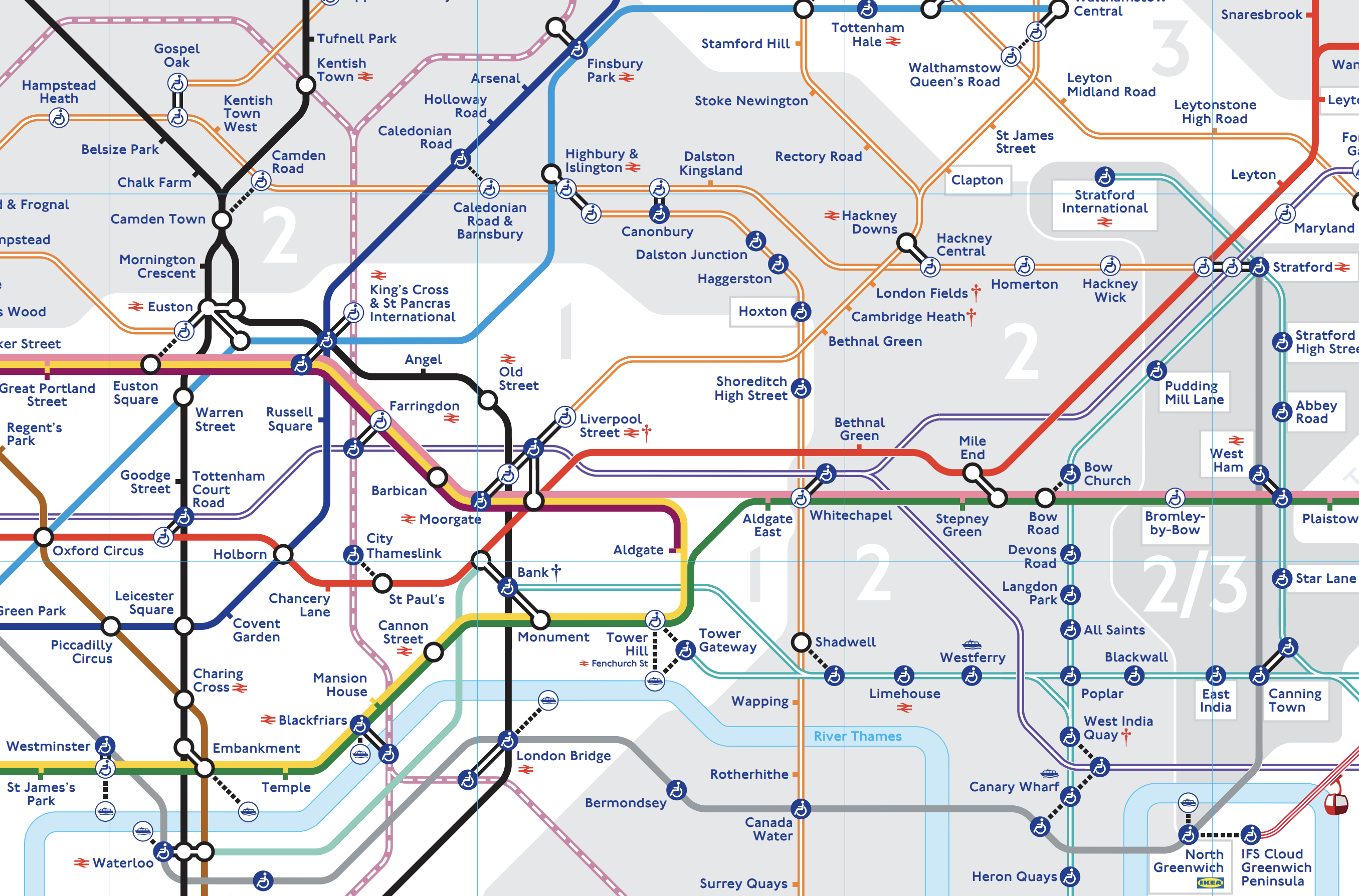
I live just South of the East London Line between Canonbury and Dalston Junction stations.
Today started just after nine, as many others do by braving the nightmare on the buses to take a 141 bus to Moorgate.
- At Moorgate, I had breakfast as I do regularly in the Leon, by Moorgate station.
- After breakfast, it was one stop South on the Northern Line to Bank, to see if the new entrance had opened.
- It was then a trip on the new moving walkway to the Central Line.
- I took the Central Line to Stratford to do my main shopping at the start of the week, in the large Marks and Spencer in Eastfield, by the station entrance.
- It was then on to the North London Line to go back home.
- I didn’t go all the way home on the Overground, but got off the train at Hackney Central and using the new Graham Road entrance, I crossed to get a 38 bus, which would take me home.
- But two 38s passed as I tried to cross the road and in the end I took a 277 bus to Dalston Junction station.
- From the Junction, I got a 56 bus home.
I got home about eleven.
At least now, I’ve got food until Thursday!
Very Busy Lizzie
Yesterday, I took the Elizabeth Line, back from Reading to Moorgate.
- When, I got on at Reading, there were perhaps fifty empty seats and I was able to have three seats to myself.
- But by Slough, It was standing room only!
- It cleared a bit at Paddington, but by Moorgate there were only a few seats left.
Currently, there are two trains per hour (tph) between Abbey Wood and Reading stations.
As other passengers said it’s always busy, I suspect that Transport for London need to tweak the signalling, so that four tph run to Reading.
This section called Planned Service in the Wikipedia entry for the Elizabeth Line says this.
In May 2023, it is planned to allow trains to run from both eastern branches to west of Paddington. This will allow both more flexible, and higher frequency, services: 24 tph peak, 20 tph off-peak, and direct services between Shenfield and Heathrow. In the longer term, when Old Oak Common opens, all trains will serve Old Oak Common, with those not serving the Reading or Heathrow branches reversing there.
The service changes for May 2023 were confirmed in February 2023. The peak timetable will increase to 24 trains per hour. Off-peak service level will remain at 16 trains per hour, with two Shenfield–Paddington trains extended to Heathrow Airport Terminal 5 and two Abbey Wood–Terminal 5 trains switching to Terminal 4.
This will give an Off Peak schedule as follows.
- Reading and Abbey Wood – 2 tph
- Maidenhead and Abbey Wood – 2 tph
- Heathrow Terminal 4 and Abbey Wood – 4 tph
- Heathrow Terminal 5 and Abbey Wood – 0 tph
- Heathrow Terminal 5 and Shenfield – 2 tph
- Paddington and Shenfield – 6 tph
I don’t believe it is good enough.
- There is no direct Heathrow Terminal 5 and Abbey Wood service.
- Reading needs four tph to Central London.
- See Elizabeth Line: Commuters Say Service ‘Not What Was Promised’
- See So Many Cases On A Train!
I suspect passenger congestion and reaction will force a rethink by the Mayor and Transport for London.
The Case For Pumped Hydro Storage
The Coire Glas Project
Note that Coire Glas is a pumped storage hydroelectric scheme being developed by SSE Renewables.
- It is rated at 1.5 GW.
- It can store 30 GWh of electricity.
- It is being built in the Highlands of Scotland above Loch Lochy.
- The estimated construction time will be five to six years.
- It should be operational for more than 50 years.
- There is more about the project on this page on the Coire Glas web site.
Exploratory works have started.
The Case For Pumped Hydro Storage
The title of this post, as the same as that of this page on the Coire Glas web site.
This is the sub-heading.
A study by independent researchers from Imperial College London found that investing in 4.5GW of pumped hydro storage, with 90GWh of storage could save up to £690m per year in energy system costs by 2050, as the UK transitions to a net-zero carbon emission system.
And this is the first paragraph.
The report focused on the benefits of new long-duration pumped hydro storage in Scotland, as the current most established long-duration energy storage technology. The benefit of long duration storage compared to short duration batteries is being able to continuously charge up the storage with excess renewables and also discharge power to the grid for several hours or days when wind and solar output is low.
So Coire Glas will provide 1.5GW/30GW, so where will we get the other 3 GW/60GW?
Loch Earba Pumped Hydro
In Gilkes Reveals 900MW Scottish Pumped Storage Plan, I introduced Loch Earba Pumped Hydro.
- It is rated at 900 MW
- It can store 33 GWh of electricity.
- It is being built in the Highlands of Scotland to the East of Fort William.
- The estimated construction time will be three to four years.
- It should be operational for more than 50 years.
- There is more about the project on the Earba Storage web site.
It would appear we could be edging towards the Imperial College target in lumps of about 1GW/30 GWh.
Other Schemes In Scotland
These are other proposed or planned schemes in Scotland.
Balliemeanoch Pumped Hydro
Balliemeanoch Pumped Hydro now has a web site.
The proposed Balliemeanoch pumped hydro scheme will have these characteristics.
- Output of the power station will be 1.5 GW
- Available storage could be 45 GWh.
This medium-sized station has a lot of storage.
Corrievarkie Pumped Hydro
Corrievarkie Pumped Hydro now has a web site.
The proposed Corrievarkie pumped hydro scheme will have these characteristics.
- Output of the power station will be 600 MW
- Available storage could be 14.5 GWh.
This medium-sized station has a moderate amount of storage.
Loch Kemp Pumped Hydro
I wrote about Loch Kemp Pumped Hydro in Loch Kemp Pumped Hydro, where I said this.
The proposed Loch Kemp pumped hydro scheme will have these characteristics.
- Loch Kemp will be the upper reservoir.
- Loch Ness will be the lower reservoir.
- The power station will be on the banks of Loch Ness.
- The power station will be designed to fit into the environment.
- Eight dams will be built to enlarge Loch Kemp.
- Trees will be planted.
- Output of the power station will be 300 MW
- Available storage could be 9 GWh.
The medium-sized station will have almost as much storage capacity as Electric Mountain, but that power station has an output of 1.8 GW.
Red John Pumped Hydro
I wrote about Red John Pumped Hydro in Red John Pumped Storage Hydro Project, where I said this.
I have also found a web site for the project, which is part of the ILI Group web site.
- The scheme has an output of 450 MW.
- The storage capacity is 2,800 MWh or 2.8 GWh.
- The scheme has planning consent.
- The project is budgeted to cost £550 million.
- The construction program indicates that the scheme will be completed by the end of 2025.
Not a large scheme, but every little helps.
Proposed Pumped Hydro In Scotland
I have listed these schemes.
- Balliemeanoch – 1.5GW/45 GWh
- Coire Glas – 1.5 GW/30 GWh
- Corrievarkie – 600 MW/14.5 GWh
- Loch Earba – 900 MW/33 GWh
- Loch Kemp – 300 MW/9 GWh
- Loch Na Cathrach/Red John – 450 MW/2.8 GWh
Note.
- The scheme’s name is linked to their web site.
- The two figures are output and storage capacity.
There is a total output of 5.25 GW and a total storage capacity of 134.3 GWh.
Conclusion
If all these schemes are built, Imperial’s targets of an output of 4.5 GW and a storage capacity of 90 GWh will be comfortably exceeded.
The Hook Landslip
This page on the South Western Railway web site is called Landslip Near Hook.
This is the operator’s explanation about what happened and their solution.
Over the weekend of Saturday 14 and Sunday 15 January, heavy rain caused part of a railway embankment to collapse between Hook and Winchfield stations on the South West Main Line, which connects London Waterloo with Basingstoke.
The landslip took place on a very busy part of our route. On a normal weekday morning, around 13 trains per hour run through this section, with services between London Waterloo and Basingstoke, Exeter St Davids, Portsmouth Harbour (via Eastleigh), Salisbury, Southampton Central, Winchester and Weymouth.
The landslip left a 44-metre stretch of track suspended in mid-air and only one of the four tracks available for trains to run on. This severely restricted the number of services we could run between Basingstoke and Woking.
Initial repairs by Network Rail on Saturday 21 and Sunday 22 increased the number of trains that we could run to six per hour, however they were still unable to call at Hook from the direction of London.
Network Rail intend to fully complete their repairs by Friday 24 February, and restore services to Hook in the direction of Basingstoke from Monday 13 February.
To do this, engineers will require more access to the railway between Farnborough and Basingstoke overnight. Normally the last service to run between these stations is at around 0100, but to give engineers the time they need, services will now have to end by 2220.
I passes the site today and took these pictures.
















Note.
- Network Rail had to build quite a long roadway to access the site.
- Judging by the site full of portacabins, there were a lot of people working on the site.
- There was even someone working on a Sunday.
- The information board was in the subway at Basingstoke station.
- The pictures would have better, if the sun had been in a different direction.
Network Rail have to manage a lot of embankments like this.
 The Anonymous Widower