Banksy’s New Statue In Waterloo Place
This was unveiled yesterday, so I had to go and see it today.
I walked down to Waterloo Place from Piccadilly Circus, so it was a rather easy downhill walk.
I then took these pictures.

















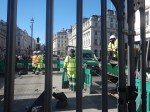










Note.
- The tall column in Waterloo Place and one of these pictures, is the Duke of York Column, which features a bronze statue of Prince Frederick, Duke of York and Albany.
- The guy on the horse is King Edward VII.
- The gilded statue is of Athena on the front of the Athenaeum Club.
- The guys from Conways seem to be on hand with plastic security fencing, so that if anybody falls over they will fall on something a bit soft and the Council won’t get sued.
But two questions must be answered.
- Who does the statue depict?
- Will the City of Westminster, let Banksy’s feral art occupy a place, where a lesser politician or member of the Royal Family could be placed?
I have heard a very creditable rumour, that answers the first!
Europe: New Fund To Upgrade Solar And Wind Assets With Battery Storage
The title of this post, is the same as that of this article on Review Energy.
This is the sub-heading.
The Aream Group has launched a new European investment vehicle targeting the renewable energy sector, with a strategy that combines power generation, storage and electricity marketing.
These three paragraphs add more details to the story.
The Clean Energy Future Fund II (CEFF II) will focus on integrating renewable generation assets with battery storage systems to improve the use of grid connections, which are increasingly scarce across European markets. According to Markus W. Voigt, Executive Chairman of aream Group, the hybrid model is designed to respond to growing volatility in electricity markets.
“With this hybrid approach, we are leveraging the changes and increased volatility in the European electricity markets for the benefit of our investors,” Voigt said.
The fund will primarily invest in Europe, with a particular focus on Germany, and will build on an existing portfolio of operational assets. A central element of the strategy is the addition of battery storage to solar and wind farms, allowing them to evolve from pure generation assets into providers of grid services.
I have a Google Alert which looks for “Energy Storage Fund” and this story was one of nine substantial stories.
This story talks about €400 million and two others talk about €300 million and AU $ 1.4 billion, respectively.
So hopefully, this money will help to mop up some of the energy wasted, when wind farms are curtailed.
Certainly, these funds don’t seem to have difficulty finding money to invest.
Delta And Centrica Launch Scalable Off-Grid Fuel Cell Power Solution
The title of this post, is the same as that of this news item from Centrica.
The news item is accompanied by this picture.
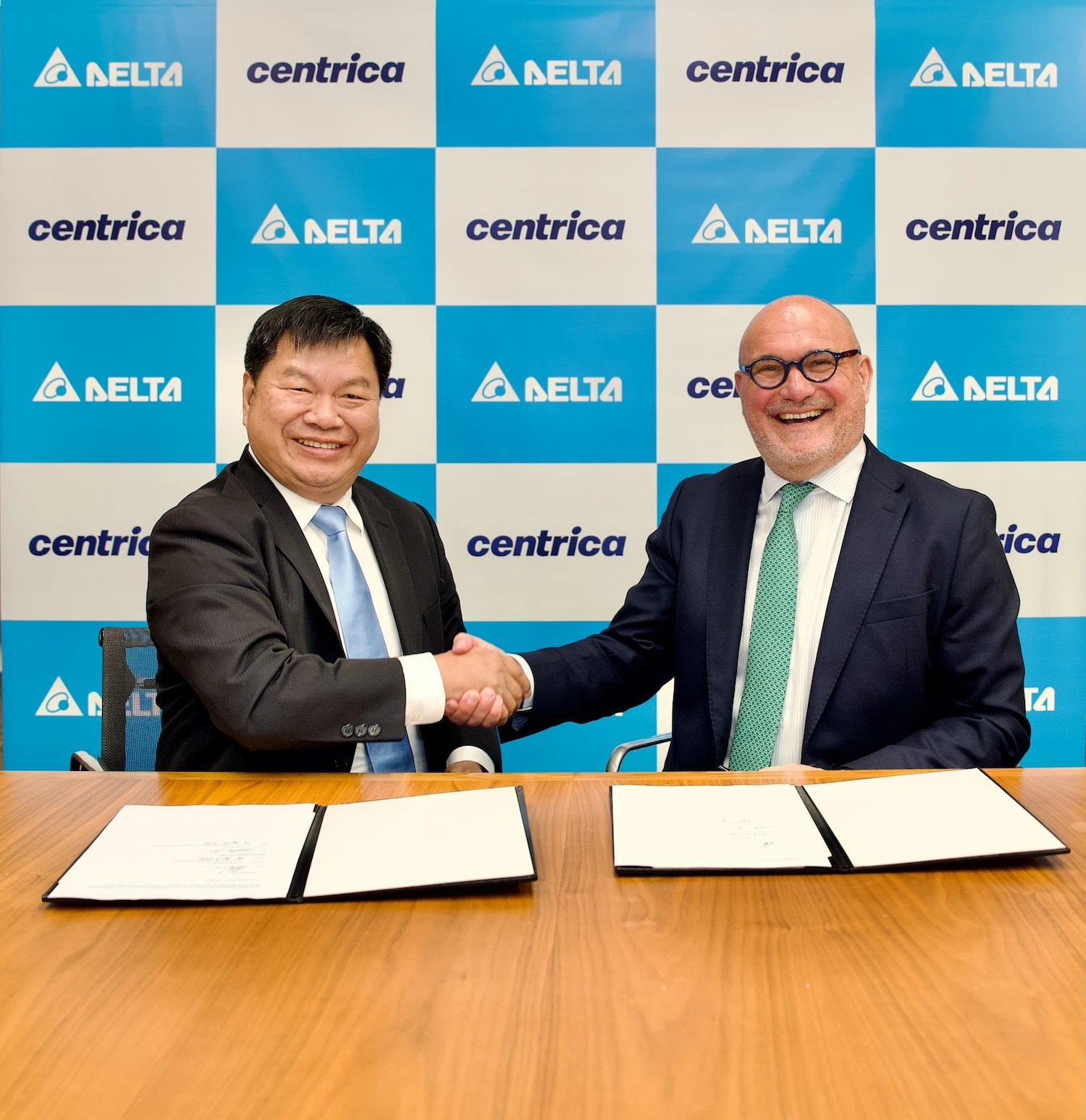
So who is the happy oriental-looking guy sitting with the equally-happy Robert Booker, who is Chief Strategy and Transformation Officer at Centrica?
He is Charles Tsai, General Manager of Hydrogen Energy BD at Delta Electronics Inc.
Google AI produces this answer to “Who Are Delta Electronics Inc.”
Delta Electronics, Inc. is a Taiwan-based global leader in power and thermal management solutions, founded in 1971. Renowned as the world’s top provider of switching power supplies and DC brushless fans, they focus on energy-efficient, IoT-based smart solutions for industrial automation, EV charging, data centers, and renewable energy.
Core Business Areas
Power Electronics: A global leader in switching power supplies, thermal management, and components for cloud computing and electric vehicles (EVs).
Automation: Offers industrial and building automation systems to enhance manufacturing efficiency.
Infrastructure: Provides data center infrastructure, EV charging solutions, and telecom power systems.
Key Facts and Highlights
Market Position: Often cited as the world’s largest provider of computer power supplies, with significant market share in server power units.
Sustainability Focus: Dedicated to “innovative, clean and efficient energy solutions” with a strong ESG (Environmental, Social, and Governance) focus.
Global Presence: Operates manufacturing plants and R&D centers worldwide, including Taiwan, China, Thailand, Mexico, India, and Europe.
Financials: Publicly listed on the Taiwan Stock Exchange (code: 2308).
Delta Electronics serves industries looking for energy-efficient, AI-ready, and sustainable technology solutions.
Delta Electronics has had an R & D facility in East Kilbride in Scotland for nearly ten years.
This is the sub-heading of Centrica’s news item.
Centrica and Delta Electronics, Inc. today announced an infrastructure partnership to serve the data centre market and energy intensive industries in the UK and Europe, launching with Solid Oxide Fuel Cells (SOFCs) for off-grid energy generation.
These two paragraphs add more detail to the partnership.
This partnership creates a pathway for offering customers competitively priced, on-site power generation, significantly reducing exposure to wholesale electricity market volatility and grid capacity constraints. The partners plan to establish a demonstration site in the UK within the next 12 months, with a medium-term goal of delivering MW-scale, rapidly deployable ‘gas-to-power’ solutions within the next three to five years.
Delta’s SOFCs, licensed by British solid oxide technology leader Ceres, provide stable, low-carbon energy fuelled by natural gas and reach 60% electrical efficiency – significantly higher than the open-cycle gas turbines typically used for on-site and back up generation (35%-42%). These cells are designed to meet the growing power demands of data-intensive digital infrastructure in the UK and Europe which underpin economic growth, digital sovereignty and the energy transition.
This partnership appears to be a partnership of three world-leading companies doing what they do best, to efficiently satisfy the enormous power need for data centres and energy intensive industries.
- Centrica will make sure, that there is enough natural gas. They have a strong reputation for trading gas and source it from all over the world.
- Ceres will provide the Solid Oxide Fuel Cells (SOFCs), that will efficiently convert this natural gas into electricity. Ceres’s SOFCs are fifty percent more efficient than open-cycle gas turbines, which is a large improvement.
- Delta Elctronics then work their high power electronic wizardry to supply the electricity.
Nothing is said about what happens to all the carbon dioxide. It will certainly be captured and will probably be of food grade, but this could be the next piece of the jigsaw that Centrica are putting together.
Record Public Transport Growth To The Lake District As Keswick Added To National Rail Network
The title of this post is the same as that of this article on Rail Technology Magazine.
This is the sub-heading.
Record numbers of visitors are travelling to the Lake District by public transport after Avanti West Coast introduced a “virtual railway station” at Keswick, according to newly released figures.
These two paragraphs add more detail.
By adding Keswick to national rail journey planners, passengers can now purchase a single, fully integrated ticket covering both train and bus travel. From today (27 April), the ticket will be available year‑round following a successful two‑summer trial.
The initiative allows passengers to travel on Avanti West Coast or TransPennine Express services to Penrith – the gateway to the North Lakes – before continuing to Keswick on Stagecoach’s X4 and X5 bus services, all using one ticket.
This paragraph describes the impact of the initiative.
The impact has been significant. Over the past year, Avanti West Coast, TransPennine Express and Stagecoach have all reported record-breaking passenger growth, underlining growing demand for seamless, car‑free travel to one of the UK’s most popular visitor destinations.
That looks like a good result all round.
I have some thoughts.
Buying A Ticket
I have just tried to book a ticket between Euston and Keswick for tomorrow, using my normal ticket retailer.
- The destination was Keswick Bus.
- It was just like buying a ticket between Euston and Liverpool Lime Street.
- I could have entered my Senior Railcard.
- The only thing that is needed would be to ask if you have a bus pass and adjust the ticket price accordingly.
I think one day in the summer, if I’m at a loss for something to do, I might visit Keswick.
I also found Keswick Bus on this ticket machine at Kings Cross.
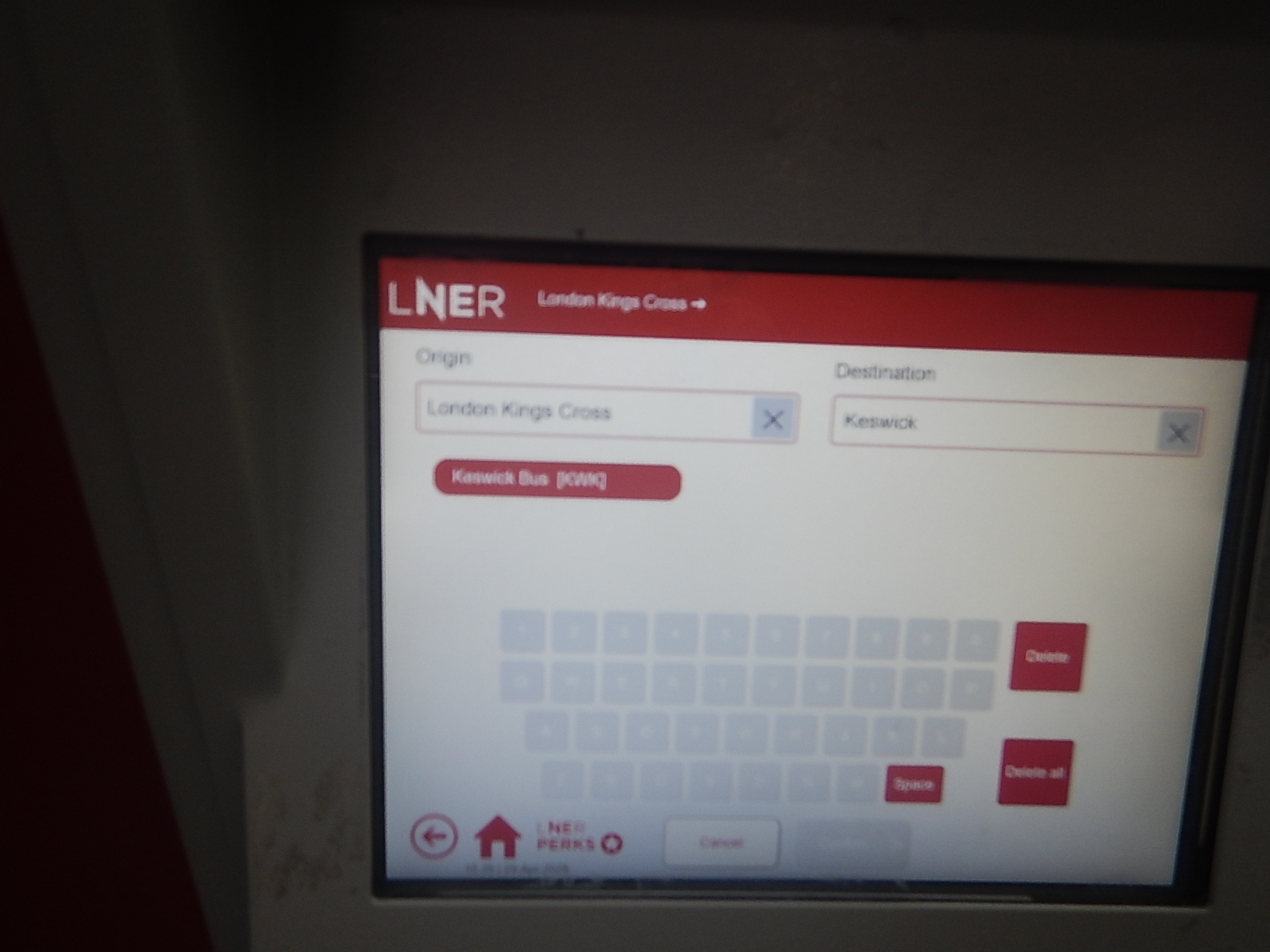
Someone is getting the Ticketing Act together.
Getting To Events
In 2011 I visited all 92 English League Clubs in alphabetical order and some were difficult to get to from the nearest station.
Perhaps if a club has a bus between the local station and the ground, a virtual station could be added, which might be called say York Football.
There would be details instructions at the exit to the station about where to catch the bus or how to walk there if it were close.
It would obviously work for other sports and what about events like Glastonbury, Glyndebourne, The Suffolk Show and racing of both horses and horsepower.
Testing The Viability Of Possible Stations
It is very difficult to test the viability of a new station before a large sum of money can be allocated to build the station.
But supposing Merseyrail wanted to test the viability of a new station at Skelmersdale.
- Skelmersdale Bus would be added to the Rail Ticketing System.
- A bus route would be created probably between the new station at Headbolt Lane and Skelmersdale.
Done properly, it could give a reasonable estimate of the viability of the new route.
Conclusion
I can see this being a very popular and successful development.
Could HS2 Trains Continue To Wales?
The title of this post is the same as that of this article on New Civil Engineer.
This is the sub-heading.
North Wales business group Growth Track 360 has recently renewed its calls for electrification of the North Wales Main Line to accommodate HS2 trains.
These two paragraphs add some more detail.
The group is pushing for electrification of the North Wales Main Line to Crewe and Warrington, which would allow HS2 trains to run directly from London and Birmingham to Chester and beyond.
It has also commissioned a series of conceptual artworks to help the public visualise the proposed improvements. Produced by Nataliia Marchuk, a Ukrainian Fine Arts undergraduate at the University of Chester, the first shows an HS2 train passing Conwy Castle on an electrified North Wales Main Line.
The article dates from May 2022, so it is a bit old now, but transport in Wales is moving on.
On the Growth Track 360 web site, I found this mission statement.
Growth Track 360 has been launched to secure £1bn of rail improvements, which would transform the North Wales and Cheshire regional economy and deliver 70,000 new jobs over 20 years.
It’s being led by a cross-border alliance of business, political and public sector leaders.
If successful, it would lead to a massive boost to the North Wales, Cheshire and Wirral economies, linking them with the planned HS2 line between London and the North of England.
This OpenRailwayMap shows the railways in the area.
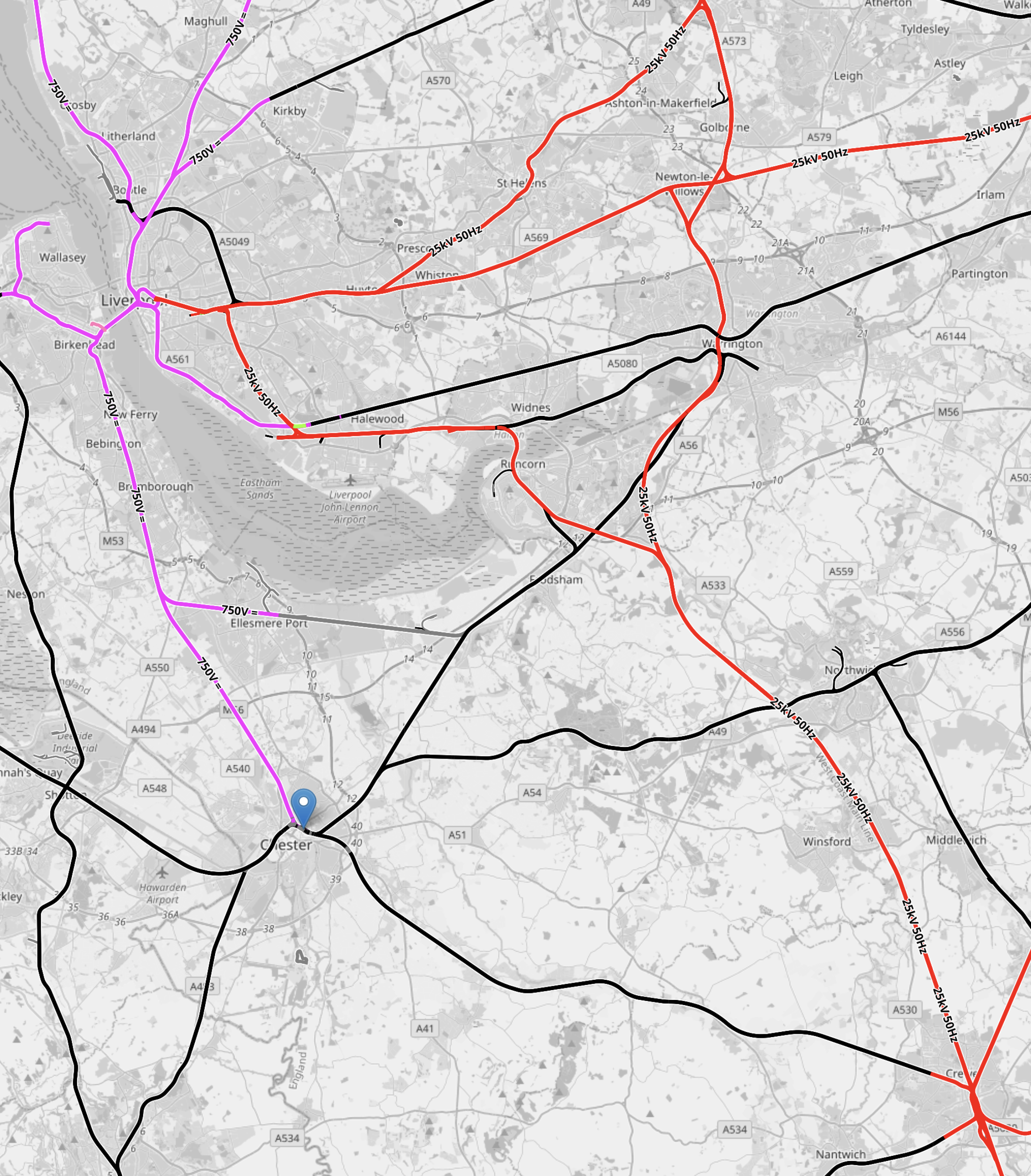
Note.
- The lilac tracks are Merseyrail’s third rail network.
- The lilac knot in the North-West corner of the map is the city of Liverpool.
- The red tracks are electrified with 25 KVAC overhead and connect Liverpool to Manchester in the East and Crewe in the South-East corner of the map.
- The black tracks are not electrified.
- The blue arrow marks the position of Chester.
- The lilac line going North from Chester is the Borderlands Line to Liverpool.
- Chester and Crewe are a distance of just over twenty-one miles.
Looking at the route on Google maps, I don’t think to electrify between Crewe and Chester will be the most difficult of projects.
The Advantage Of Electrifying Between Crewe and Chester
In How Far Will A Class 897 Train Travel Without Using The Electrification?, I showed that that these new tri-mode trains have a range of 120 miles.
In The Data Sheet For Hitachi Battery Electric Trains, I look at the data sheet, that Hitachi published in late 2023.
These were my conclusions about the data sheet.
These are my conclusions about Hitachi’s battery packs for Class 80x trains, which were written in November 2023.
- The battery pack has a capacity of 750 kWh.
- A five-car train needs three battery-packs to travel 100 miles.
- A nine-car train needs five battery-packs to travel 100 miles.
- The maximum range of a five-car train with three batteries is 117 miles.
- The maximum range of a nine-car train with five batteries is 121 miles.
As battery technology gets better, these distances will increase.
Hitachi have seen my figures.
They also told me, that they were in line with their figures, but new and better batteries would increase range.
It looks like Great British Railways will have at least two 125 mph, 120 mile range express trains away from the wires.
These are distances from Chester.
- Holyhead – 84.4 miles
- Bangor – 59.7 miles
- Llandudno Junction – 44.7 miles
It would appear that electrifying between Crewe and Chester will be an insurance policy to make sure, that battery-electric trains can serve Holyhead.
Electrifying between Crewe and Chester, will also ensure, that any battery-electric train leaves Chester with a full battery.
Are There Any Battery-Electric High Speed Trains?
I asked Google AI, this question and received this answer.
Yes, battery-electric high-speed and intercity trains are entering service, primarily in Europe. While many battery trains are designed for regional speeds, Hitachi Rail offers intercity battery trains capable of high speeds and over 70 km ranges. In 2026, the UK’s Great Western Railway (GWR) launched a record-breaking, fast-charging battery train with a 200-mile range.
Key Developments in Battery Trains:
Hitachi Rail Intercity Battery Trains: These trains can operate at intercity speeds, designed for both electrified and non-electrified routes, enhancing sustainability without sacrificing performance.
GWR Class 230 Battery Train: This UK-based, three-car train achieved a world record of over 200 miles on a single charge in 2025.
Rapid Charging Technology: The GWR train uses a 2,000kW fast charger, allowing it to recharge in just over three minutes while stopped at a station, making it suitable for extending electrical service without full, expensive track electrification.
Regional Battery Trains: Beyond the UK, Hitachi’s battery trains (Full battery, Hybrid, Tri-brid) are part of a broader shift in Europe toward lowering emissions. In Argentina, battery-electric units are also used for regional services, designed to operate with solar-powered charging.
These developments show a move towards using battery technology to reduce reliance on diesel trains on partially electrified lines.
How Long Will HS2 Take To Go Between London Euston And Holyhead?
Consider.
- Sources like the House of Commons Library give HS2 times of 56 minutes between London Euston snd Crewe.
- Avanti West Coast’s Class 805 trains take two hours and two minutes between Crewe and Holyhead.
I don’t think that a sub-three hour journey is unreasonable.
Is A Green Route Between London And Dublin Possible?
As we’re more likely to see a zero-carbon ferry, than a zero-carbon airliner. Yes!
Making The Most Of What Is Left Of High Speed Two
High Speed Two is in a bit of a mess.
In the original design for HS2, this was the service pattern.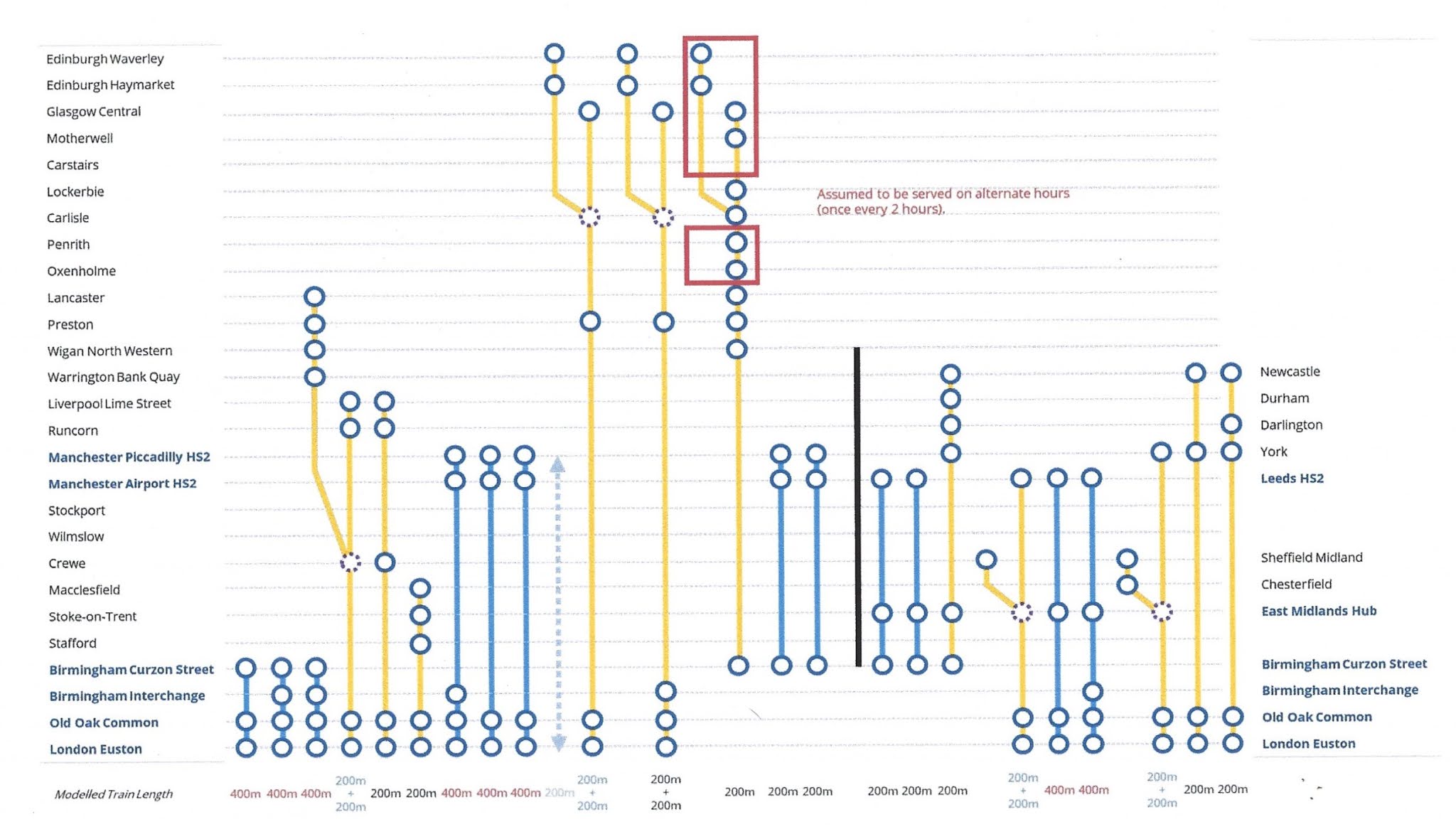
Note.
- Trains to the left of the vertical black line are Phase 1 and those to the right are Phase 2.
- Full-Size trains are shown in blue.
- Classic-Compatible trains are shown in yellow.
- The dotted circles are stations, where trains split and join.
- In the red boxes routes alternate every hour.
Click on the diagram to enlarge it.
The Eastern Leg Has Been Cancelled
This means that these trains have been cancelled.
- Train 15 – 200 m HS2 FS – Birmingham Curzon Street and Leeds via East Midlands Hub
- Train 16 – 200 m HS2 FS – Birmingham Curzon Street and Leeds via East Midlands Hub
- Train 17 – 200 m HS2 CC – Birmingham Curzon Street and Newcastle via East Midlands Hub, York, Darlington and Durham
- Train 18a – 200 m HS2 CC – London Euston and Sheffield via Old Oak Common, East Midlands Hub
- Train 18b – 200 m HS2 CC – London Euston and Leeds via Old Oak Common and East Midlands Hub
- Train 19 – 400 m HS2 FS – London Euston and Leeds via Old Oak Common and East Midlands Hub
- Train 20 – 400 m HS2 FS – London Euston and Leeds via Old Oak Common, Birmingham Interchange and East Midlands Hub
- Train 21a – 200 m HS2 CC – London Euston and Sheffield via Old Oak Common, East Midlands Hub and Chesterfield
- Train 21b – 200 m HS2 CC – London Euston and York via Old Oak Common and East Midlands Hub
- Train 22 – 200 m HS2 CC – London Euston and Newcastle via Old Oak Common and York
- Train 23 – 200 m HS2 CC – London Euston and Newcastle via Old Oak Common, York, Darlington and Durham
Note.
- All trains are one train per hour (tph)
- Train 18 splits and joins at East Midlands Hub, so runs as a 400 m train between London Euston and East Midlands Hub.
- Train 21 splits and joins at East Midlands Hub, so runs as a 400 m train between London Euston and East Midlands Hub.
- There are now no Birmingham and Leeds services.
- There are six spare HS2 paths between London Euston and Birmingham.
In my opinion, the big losers are travelers between Leeds and Birmingham, as travelers between London and Leeds can use the East Coast Main Line, which caters for several destinations in Yorkshire and the North-East.
Services Between London Euston and Birmingham
Services between London Euston and the Birmingham area are as follows.
- Train 1 – 400 m HS2 FS – London Euston and Birmingham Curzon Street via Old Oak Common
- Train 2 – 400 m HS2 FS – London Euston and Birmingham Curzon Street via Old Oak Common and Birmingham Interchange
- Train 3 – 400 m HS2 FS – London Euston and Birmingham Curzon Street via Old Oak Common and Birmingham Interchange
- Train 7 – 400 m HS2 FS – London Euston and Manchester Piccadilly via Old Oak Common, Birmingham Interchange and Manchester Airport
- Train 11a – 200 m HS2 CC – London Euston and Edinburgh Waverley via Old Oak Common, Birmingham Interchange , Preston, Carlisle and Edinburgh Haymarket
- Train 11b – 200 m HS2 CC – London Euston and Glasgow Central via Old Oak Common, Birmingham Interchange , Preston and Carlisle
- Train 12 – 200 m HS2 CC – Birmingham Curzon Street and Edinburgh Waverley/Glasgow Central via Wigan North Western, Preston, Lancaster, Oxenholme, Penrith, Carlisle, Lockerbie, Carstairs and Edinburgh Haymarket/Motherwell
Note.
- All trains are one train per hour (tph)
- Train 11 splits and joins at Carlisle, so runs as a 400 m train on the Trent Valley Line.
- Train 12 runs alternatively to Edinburgh Haymarket and Edinburgh Waverley/Motherwell and Glasgow Central.
- All these services will join the Trent Valley Line at Handsacre junction.
There are 5 x 400 metre trains and 1 x 200 metre train.
Services Between London Euston and Manchester
Services between London Euston and the Manchester area are as follows.
- Train 6 – 200 m. HS2 CC – London Euston and Macclesfield via Old Oak Common, Stafford and Stoke-on-Trent
- Train 7 – 400 m HS2 FS – London Euston and Manchester Piccadilly via Old Oak Common, Birmingham Interchange and Manchester Airport
- Train 8 – 400 m HS2 FS – London Euston and Manchester Piccadilly via Old Oak Common and Manchester Airport
- Train 9 – 400 m HS2 FS – London Euston and Manchester Piccadilly via Old Oak Common and Manchester Airport
- Train 13 – 200 m HS2 FS – Birmingham Curzon Street and Manchester Piccadilly via Manchester Airport
- Train 14 – 200 m HS2 FS – Birmingham Curzon Street and Manchester Piccadilly via Manchester Airport
Note.
- All trains are one train per hour (tph)
- Macclesfield should be able to handle one 200 m. HS2 Classic-Compatible train per hour, as it is shorter and has less passengers than an 11-car Pendolino.
- All Manchester Piccadilly services call at Manchester Airport.
- All these services will join the Trent Valley Line at Handsacre junction.
There are 3 x 400 metre trains and 3 x 200 metre train.
Services Between London Euston and Liverpool, Lancaster and Scotland
Services between London Euston and Liverpool, Lancaster and Scotland are as follows.
- Train 4a – 200 m. HS2 CC – London Euston and Lancaster via Old Oak Common, Crewe, Warrington Bank Quay, Wigan North Western and Preston
- Train 4b – 200 m. HS2 CC – London Euston and Liverpool via Old Oak Common, Crewe and Runcorn
- Train 5 – 200 m. HS2 CC – London Euston and Liverpool via Old Oak Common, Crewe and Runcorn
- Train 10a – 200 m HS2 CC – London Euston and Edinburgh Waverley via Old Oak Common, Preston, Carlisle and Edinburgh Haymarket
- Train 10b – 200 m HS2 CC – London Euston and Glasgow Central via Old Oak Common, Preston and Carlisle
- Train 11a – 200 m HS2 CC – London Euston and Edinburgh Waverley via Old Oak Common, Birmingham Interchange , Preston, Carlisle and Edinburgh Haymarket
- Train 11b – 200 m HS2 CC – London Euston and Glasgow Central via Old Oak Common, Birmingham Interchange , Preston and Carlisle
- Train 12 – 200 m HS2 CC – Birmingham Curzon Street and Edinburgh Waverley/Glasgow Central via Wigan North Western, Preston, Lancaster, Oxenholme, Penrith, Carlisle, Lockerbie, Carstairs and Edinburgh Haymarket/Motherwell
Note.
- All trains are one train per hour (tph)
- Train 4 splits and joins at Crewe, so runs as a 400 m train on the Trent Valley Line.
- Train 10 splits and joins at Carlisle, so runs as a 400 m train on the Trent Valley Line.
- Train 11 splits and joins at Carlisle, so runs as a 400 m train on the Trent Valley Line.
- Train 12 runs alternatively to Edinburgh Haymarket and Edinburgh Waverley/Motherwell and Glasgow Central.
- All these services will join the Trent Valley Line at Handsacre junction.
There are 3 x 400 metre trains and 2 x 200 metre train.
How Many Services Ran Between London And Lancashire, Liverpool and Manchester In The Proposed Timetable?
- Train 4a – 200 m. HS2 CC – London Euston and Lancaster
- Train 4b – 200 m. HS2 CC – London Euston and Liverpool
- Train 5 – 200 m. HS2 CC – London Euston and Liverpool
- Train 6 – 200 m. HS2 CC – London Euston and Macclesfield
- Train 7 – 400 m HS2 FS – London Euston and Manchester Piccadilly
- Train 8 – 400 m HS2 FS – London Euston and Manchester Piccadilly
- Train 9 – 400 m HS2 FS – London Euston and Manchester Piccadilly
Note.
Macclesfield may be in Cheshire, but for my purposes in this calculation, it’s also in South Manchester.
There are 4 x 400 metre trains and 2 x 200 metre train.
But as I stated in Manchester Piccadilly Station Platform Layout, until the track and the tunnel to Manchester Airport and Manchester Piccadilly is built, 400 m HS2 Full-Size will have to be replaced by 200 m HS2 Classic Compatible trains, as no other train will fit the existing Manchester Piccadilly station.
This would mean that 6 x 200 m HS2 Classic Compatible trains will run.
I can turn these two schedules into seats per hour.
Consider.
- The current service is 3 x 11-car Pendolinos per hour, which is 607 seats per train or a total of 1821 seats per hour.
- A 200 metre HS2 Full-Size and a 200 metre HS2 Classic Compatible train, both have 504 seats.
This means that the proposed timetable has 5040 seats, but only 3528 seats, if HS2 FS trains can’t be used and have to be replaced by 200 metre HS2 Classic Compatible train.
I can build this table.
- Current – Pendolinos – 1821 seats per hour.
- Interim – Using 200 metre HS2 Classic Compatible trains – 3528 seats per hour – This is a 94 % increase over the current figure.
- Full – Using 200 metre HS2 Full Size trains in tunnels to Manchester Piccadilly – 5040 seats per hour – This is a 177 % increase over the current figure.
Note.
In Manchester Piccadilly Station Platform Layout, I stated that it is my belief, that an Interim timetable can be achieved by replacing all 11-car Pendolinos by 200 metre HS2 Classic Compatible trains.
Could More Capacity Be Added By Adding A Blackpool Service?
In Blackpool North Station Platform Layout, I looked at the possibilities of adding a Blackpool service to HS2.
This was my conclusion.
I believe Blackpool North station could handle as least one pair of 200 metre HS2 Classic-Compatible Trains to and from London Euston every hour.
It might be able to handle two such trains in every hour.
Adding two pairs of 200 metre HS2 Classic-Compatible Trains between London Euston and Blackpool every hour, would add 1008 seats.
If it is possible to add two pairs of 200 metre HS2 Classic-Compatible Trains, my table would be as follows.
- Current – Pendolinos – 1821 seats per hour.
- Interim – Using 200 metre HS2 Classic Compatible trains – 5544 seats per hour – This is a 204 % increase over the current figure.
- Full – Using 200 metre HS2 Full Size trains in tunnels – 7056 seats per hour – This is a 287 % increase over the current figure.
I must admit, the percentage increases have surprised me, but I have checked and checked them.
Is The Interim Solution Plus Two Trains Between London Euston And Blackpool North The Solution?
Consider.
- Crewe, Warrington Bank Quay, Wigan North Western and Preston, get two extra services to London Euston, Old Oak Common and Birmingham Interchange.
- All trains will be 200 metre HS2 Classic Compatible trains.
- Crewe, Warrington Bank Quay, Wigan North Western and Preston, Manchester Piccadilly will not need major upgrades.
- Manchester Airport would not be served initially, but a tunnel connecting Crewe, Manchester Airport and Manchester Piccadilly could be added later.
- There is no connection between Birmingham and Leeds and the East Midlands.
Could HS2 Serve Holyhead?
In Could HS2 Trains Continue To Wales?, I show that if Crewe And Chester Is Electrified, then a HS2 Classic Compatible train fitted with batteries should be able to go between London Euston and Holyhead in a couple of minutes under three hours.
It could be a good start!
Blackpool North Station Platform Layout
In this post, I will look at the current platform layout at Blackpool North station and see if it needs to be updated for High Speed Two.
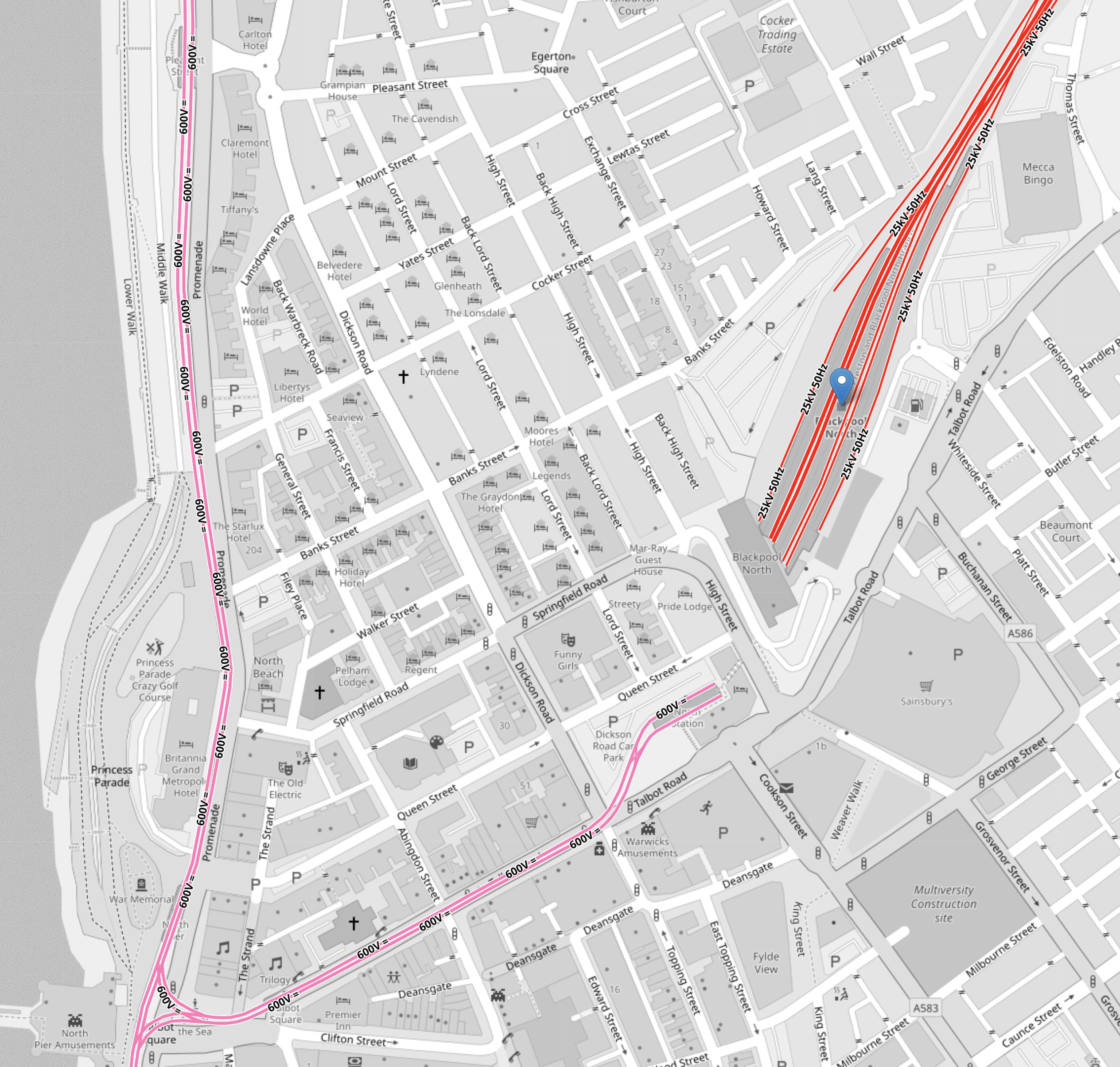
This OpenRailwayMap shows the current platform layout at the station.
Note.
- The pink tracks are the Blackpool Tramway.
- The Tramway station has two terminating platforms and a crossover and together with the delta junction on the seafront, trams can go North or South.
- I wouldn’t be surprised to see the Tramway upgraded.
- The red tracks are the Blackpool Branch to Blackpool North station.
- Blackpool North station has six platforms and their lengths are 277, 277, 205, 203, 203 and 205 metres.
- The two longer platforms are on the South side of the station and can take an 11-car Pendolino or an HS2 200 m. Classic-Compatible train.
It appears to be a compact interchange between the trams and the trains.
I have some further thoughts.
Do Trains Spend The Night Parked In Blackpool North Station?
The Wikipedia entry for Blackpool North station says this about work done whilst the station was being electrified.
A major rebuild and upgrade of the nearby carriage servicing depot was carried out at the same time.
I asked Google AI, the question in the title of this section and received this reply.
Yes, trains can and do spend the night parked in the sidings and platforms at Blackpool North station. While many trains return to depots for maintenance, some units are stabled overnight at the station to facilitate the first early morning services of the day, as the facility is a key terminus for Northern Trains.
Overnight Stabling: Trains often occupy the 6 platforms or nearby sidings to start service early in the morning.
Station Activity: While passenger facilities close around midnight, the site itself remains secure for overnight parking.
Blackpool North station appears to be almost an efficient cross between terminal station and depot.
Stabling a train at Blackpool North station could be the easy way for Avanti West Coast or HS2 to run an early train to London.
Could A Late Train From London Bring Up All The Stragglers And Take Back All The Early-Risers?
The only transport, I’ve ever scheduled in anger were container ships, but it seems the following could be possible.
- A late train runs from London Euston to Blackpool North, stopping at stations where it is thought necessary.
- The train gets an overnight service and a wash-and-brush-up in Blackpool North station, from staff in the local depot.
- An early train runs from Blackpool to London Euston, stopping at stations where it is thought necessary.
It would be efficient use of equipment and staff. It would also help those in Crewe, Warrington, Wigan, Preston and the Fylde, who wanted to spend a long day in London or the South.
Could Blackpool North Handle A 400 Metre HS2 Classic-Compatible Train To And From London?
Consider.
- Avanti West Coast’s London Euston and Blackpool North train calls at Crewe, Warrington Bank Quay, Wigan North Western and Preston.
- The Specification of the HS2 Classic-Compatible Train says that they should be able to split and join, with all the speed and competence of a sex act, at one of Epstein’s parties.
- Blackpool North has two platforms that are 277 metres long, which can both handle 200 metre HS2 Classic-Compatible Trains.
- Preston station has a platform, that is one of the longest in England at 362 metres.
- Wigan North Western station has a platform that is 274 metres long.
- Warrington Bank Quay station has main line platforms that are 250-260 metres long.
- Crewe station has a platform that is 390 metres long.
- The provisional timetable for HS2 shows pairs of 200 metre HS2 Classic-Compatible Trains, stopping at Preston and Crewe stations.
- When built, HS2 stations at London Euston, Old Oak Common and Birmingham Interchange will be able to handle pairs of 200 metre HS2 Classic-Compatible Trains.
I am fairly sure that a 400 metre HS2 Classic-Compatible Train could run between London Euston and Blackpool North stations
- The train could call at Old Oak Common, Birmingham Interchange, Crewe, Warrington Bank Quay, Wigan North Western and Preston stations.
- The frequency could be as passenger numbers needed.
- HS2 stations at London Euston, Old Oak Common and Birmingham Interchange will be able to handle pairs of 200 metre HS2 Classic-Compatible Trains.
- Crewe, Warrington Bank Quay, Wigan North Western and Preston stations should be able to handle pairs of 200 metre HS2 Classic-Compatible Trains by using selective door opening.
- Each 200 metre HS2 Classic-Compatible Train, would use one of Platform 1 or 2 at Blackpool North station.
The two 200 metre HS2 Classic-Compatible Trains would either split and join at Preston station or by some shunting in Blackpool North station.
Conclusion
I believe Blackpool North station could handle as least one pair of 200 metre HS2 Classic-Compatible Trains to and from London Euston every hour.
It might be able to handle two such trains in every hour.
How Will HS2 Classic Compatible Trains Be Tested?
As there has been some scare stories on this, I thought I had better ask Google AI for a second opinion.
This was the reply I received.
HS2 classic compatible trains (Class 895) will undergo rigorous, phased testing starting in 2027, including static checks in climate chambers and low-speed facilities, followed by dynamic testing on a 50-mile section of the new HS2 line. These tests, conducted at up to 360 km/h (225 mph), ensure compatibility with new high-speed infrastructure and existing network interfaces.
Key Testing Stages & Locations:
Static Testing: Initial tests conducted at production sites in Derby, involving climate chambers to test systems in extreme temperatures and at low-speed test tracks.
Dynamic Testing (Mainline): High-speed tests will occur on a ~50-mile (~80 km) section of the new high-speed line between Washwood Heath in Birmingham and the north portal of the Wendover green tunnel, focusing on braking, power, and signalling systems.
Infrastructure Compatibility: Testing includes extensive checks at the Rail Innovation & Development Centres (RIDC) and validation of the train-track interface, especially for “good vehicle-track interaction”.
International Testing: Specialized tests, such as those at the Velim test centre in the Czech Republic, will be utilized.
Existing Network Testing: Because these trains must run on the existing West Coast Main Line (WCML), they will be tested for interoperability on traditional tracks.
Focus Areas:
Performance: Validating that trains can handle speeds of 360 km/h and high acceleration.
Integration: Testing of signaling, power, and communication systems together.
Safety: Verification of braking systems and emergency systems.
Accessibility & Design: Physical mock-ups have been used for user group testing regarding cabin layout.
These tests are critical as the Class 895 trains are a joint project between Hitachi and Alstom, designed to run both on new high-speed lines and older, conventional lines (Classic Compatible).
These are some of my observations.
Where Is The North Portal Of The Wendover Green Tunnel?
This Google Map shows its location.
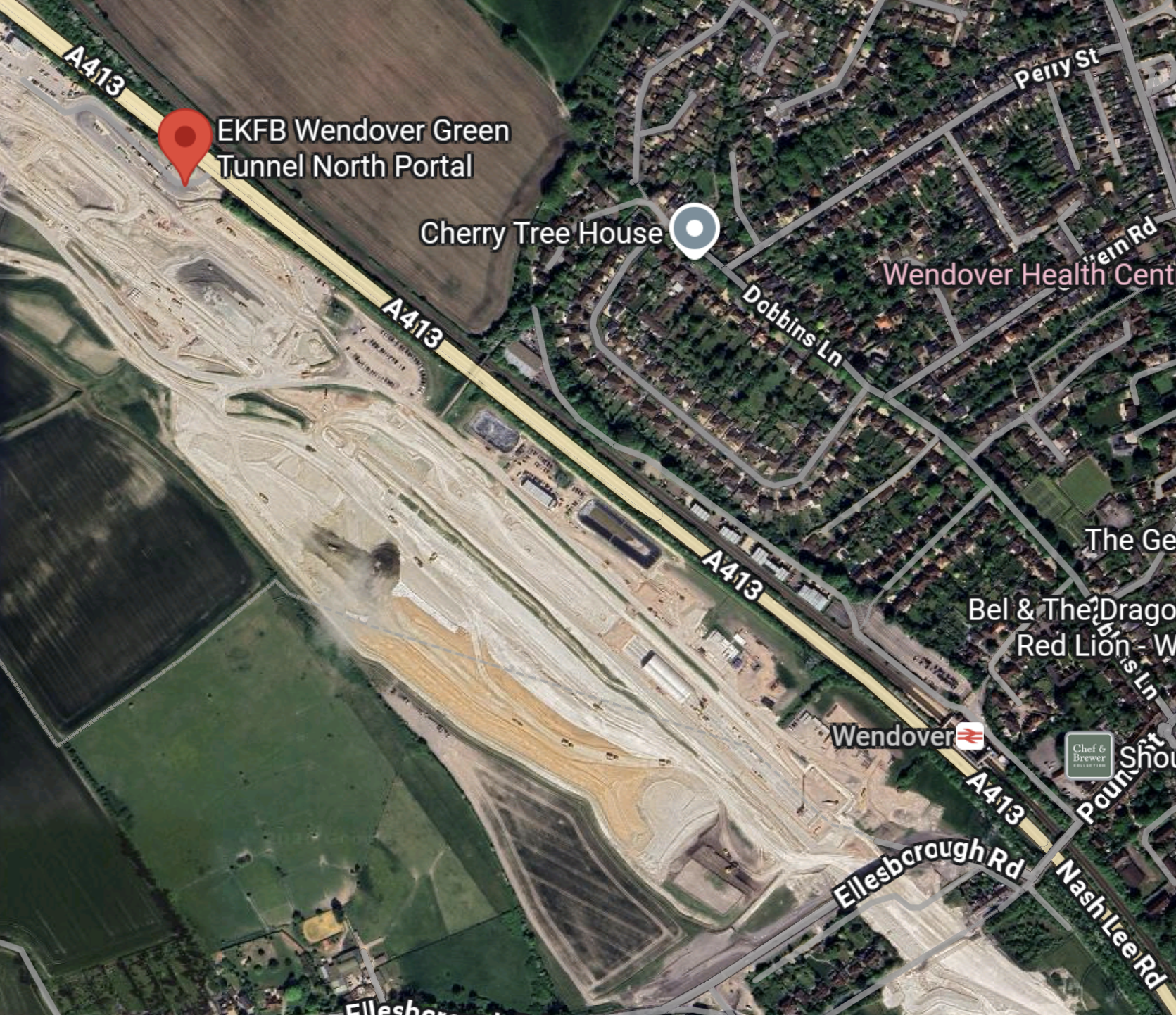
It would appear that North Portal of the Wendover Green Tunnel, is conveniently close to Wendover station.
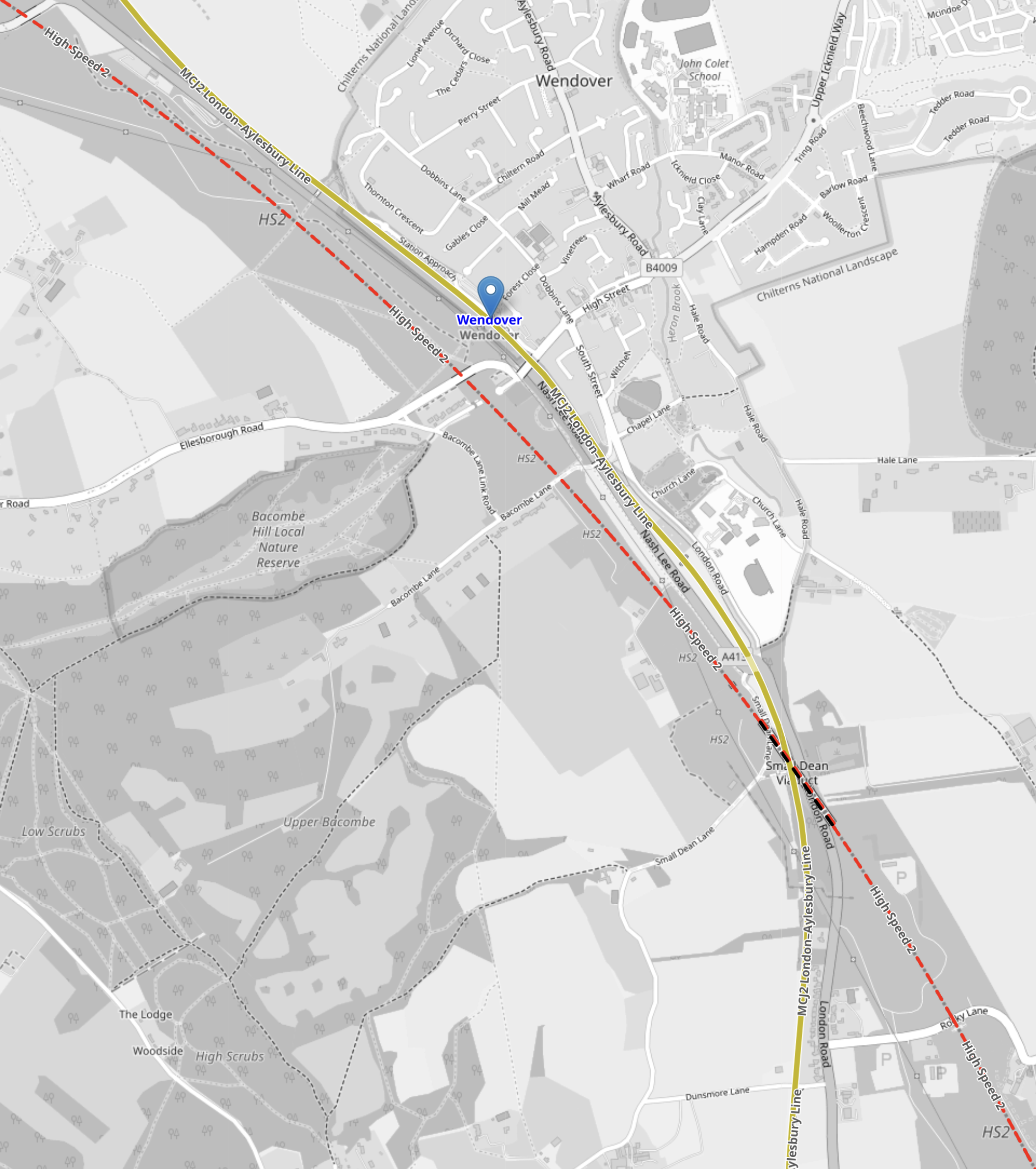
This OpenRailway Map gives a larger view.
Note.
- HS2 is shown as dotted red tracks.
- Chiltern is shown in yellow.
- Wendover station is indicated by a blue arrow.
I suspect the portal is near the top of the map.
But looking at the roads and the station, it could be an interesting place to get close to HS2 infrastructure and trains under test.
Manchester Piccadilly Station Platform Layout
In this post, I will look at the current platform layout at Manchester Piccadilly station and see if it could be updated for High Speed Two.
This OpenRailwayMap shows the current platform layout at the station.
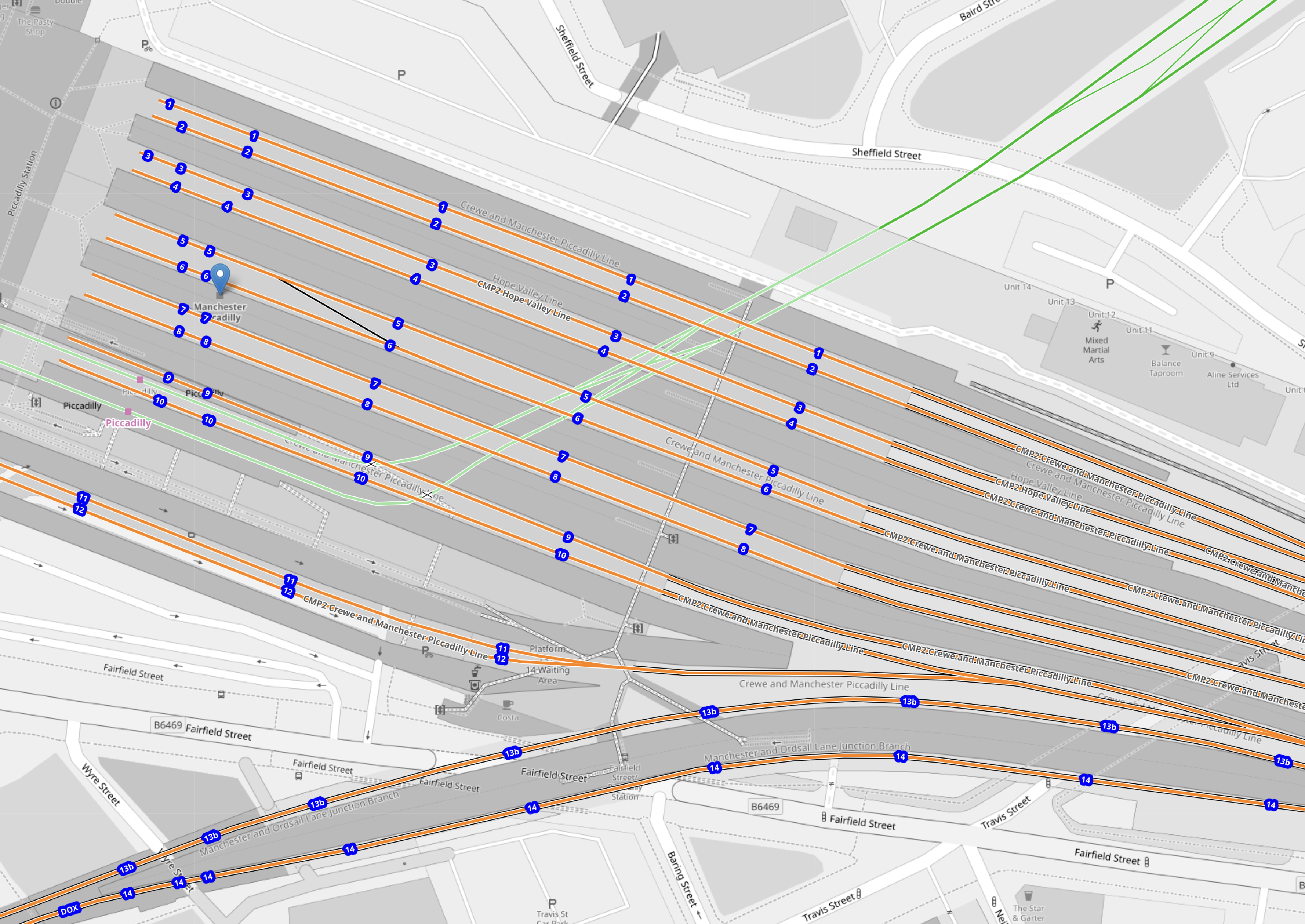
Note.
- There are twelve platforms in the main station, which are numbered 1 to 12 from North to South.
- There are also two platforms to the South of the main station, which are on the Castlefield Corridor and numbered 13 and 14.
- The current Avanti West Coast services use Platforms 5 to 8.
- Platforms 1 to 8 seem well-spaced.
- The Internet gives the length of Platform 1 as 238 metres, so it can be used as a ruler on all the platforms.
- The green tracks are for the Manchester Metrolink, which runs under the station.
I will now take a detailed look at the four platforms used by Avanti West Coast services, which are 5 to 8.
- The platforms are 340, 277, 277 and 340 metres long respectively.
- All four platforms can handle 11-car Pendolino Class 390 trains, which are 265.3 metres long.
- All four platforms will also handle 8-car HS2 Classic-Compatible trains, which will be 200 metres long.
- The platforms also seem to have a straight run-in to the buffers, which is about 260 metres long.
- This straight section is long enough to accommodate an 11-car Pendolino or an 8-car HS2 Classic-Compatible train.
I would think it reasonable that an 8-car HS2 Classic-Compatible train could take over the service of an 11-car Pendolino, but running on HS2 infrastructure, where it exists.
The current Avanti West Coast service to Manchester Piccadilly is as follows.
- 1 tph – 9-car or 11-car – London Euston and Manchester Piccadilly via Milton Keynes Central, Rugby, Stoke-on-Trent, Macclesfield and Stockport
- 1 tph – 9-car or 11-car – London Euston and Manchester Piccadilly via Nuneaton, Stoke-on-Trent and Stockport
- 1 tph – 9-car or 11-car – London Euston and Manchester Piccadilly via Stafford, Crewe, Wilmslow and Stockport
In the original design for HS2, this was the service pattern.
Note.
- Trains to the left of the vertical black line are Phase 1 and those to the right are Phase 2.
- Full-Size trains are shown in blue.
- Classic-Compatible trains are shown in yellow.
- The dotted circles are where trains split and join.
- In the red boxes routes alternate every hour.
Click on the diagram to enlarge it.
Services to Manchester Piccadilly and the Manchester area are as follows.
- Train 6 – 200 m. HS2 CC – London Euston and Macclesfield via Old Oak Common, Stafford and Stoke-on-Trent
- Train 7 – 400 m HS2 FS – London Euston and Manchester Piccadilly via Old Oak Common, Birmingham Interchange and Manchester Airport
- Train 8 – 400 m HS2 FS – London Euston and Manchester Piccadilly via Old Oak Common and Manchester Airport
- Train 9 – 400 m HS2 FS – London Euston and Manchester Piccadilly via Old Oak Common and Manchester Airport
- Train 13 – 200 m HS2 FS – Birmingham Curzon Street and Manchester Piccadilly via Manchester Airport
- Train 14 – 200 m HS2 FS – Birmingham Curzon Street and Manchester Piccadilly via Manchester Airport
Note.
- All trains are one train per hour (tph)
- Macclesfield should be able to handle one 200 m. HS2 Classic-Compatible train per hour, as it is shorter and has less passengers than an 11-car Pendolino.
- All Manchester Piccadilly services call at Manchester Airport.
I believe this allows two possible solutions.
- A largely tunneled solution, that gives access to enough 400 m platforms underneath or alongside Manchester Piccadilly station.
- An interim solution, that replaces 11-car Pendolinos with 200 m. HS2 Classic-Compatible trains.
I will answer this question first.
Will HS2 Use A Tunnel Between Manchester Airport And Manchester Piccadilly Station?
I asked Google AI and received this answer.
Yes, in the original HS2 proposals, a 7.5-mile twin-bore tunnel was planned to run between Manchester Airport and the Ardwick area, surfacing near Manchester Piccadilly. This tunnel was designed to carry the high-speed line underneath the built-up areas of south Manchester and into the terminal station.
Key Details of the Proposed Tunnel:
Purpose: To connect the new Manchester Airport High Speed Station with Manchester Piccadilly station.
Structure: A 7.5-mile (approx. 12km) twin tunnel.
Route: Following the airport, the line would enter the tunnel, traveling towards Piccadilly station.
Location: The tunnel handles the approach to Manchester city centre, allowing the high-speed tracks to bypass surface-level congestion in the south Manchester suburbs.
Note: While this was the planned route for Phase 2b, the future of the northern leg of HS2 has been subject to change and government reviews, which may impact these designs
The Full Solution
This will entail the following.
- A two-platform underground station at Manchester Airport, that is capable of handling 400 m. HS2 Full-Size trains.
- A large enough extension to Manchester Piccadilly station that is capable of terminating enough 400 m. HS2 Full-Size trains.
- The extension to Manchester Piccadilly station could be underneath or alongside, the current station.
- A 7.5 mile twin-bore tunnel between the two stations.
I also believe the full solution will need the completion of the high speed line between Handsacre junction and Crewe.
That would be an expensive and difficult solution, so we will need an interim solution.
The Interim Solution
This will entail the following.
- All HS2 services into Manchester Piccadilly will be run by 8-car 200 m. HS2 Classic-Compatible trains.
- They will use Platforms 5 to 8 in Manchester Piccadilly station, which are 340, 277, 277 and 340 metres long respectively.
- The Manchester Piccadilly services will not call at Manchester Airport.
- The Macclesfield service will run to serve Stafford and Stoke-on-Trent.
- I also believe the interim solution will not need the completion of the high speed line between Handsacre junction and Crewe.
My project management experience leads me to believe, that after HS2 is completed to Handsacre junction, Manchester Piccadilly station could be served by 8-car 200 m. HS2 Classic-Compatible trains.
How Many Trains Will The Interim Solution Run Through The Trent Valley Line?
If the interim solution is to work, then HS2 trains for North of Handsacre Junction will have to take their chances on the Trent Valley Line.
This OpenRailwayMap shows the route of the Trent Valley Line between Handsacre Junction and Crewe.
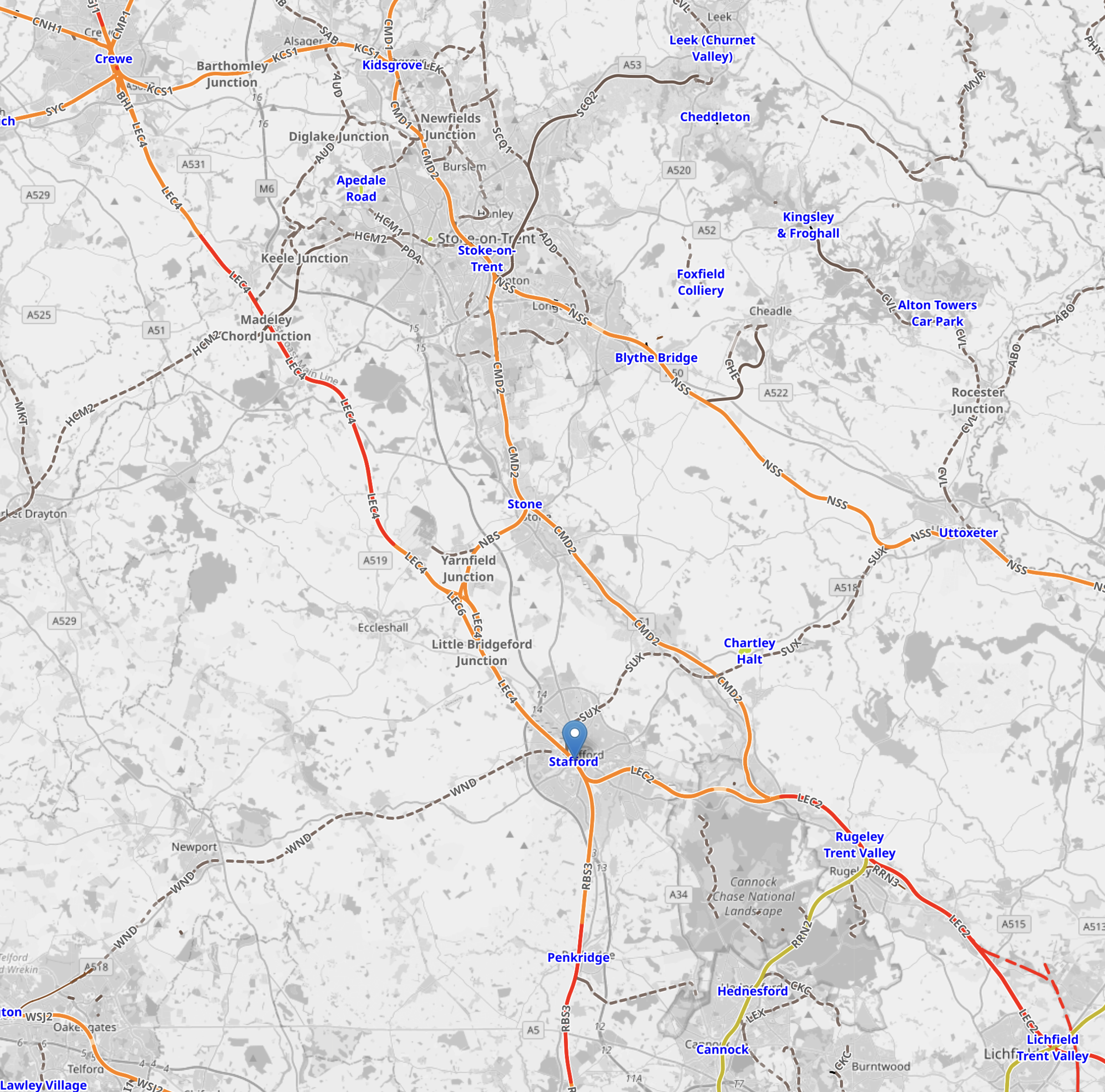
Note.
- Stafford station is marked with a blue arrow.
- Crewe station is in the North-West corner of the map.
- Lichfield Trent Valley station is in the South-East corner of the map.
- The Northern end of HS2 is should dotted around Lichfield Trent Valley station
- Rugeley Trent Valley station is to the North-West of Lichfield Trent Valley station.
- Crewe, Stafford, Rugeley Trent Valley and Lichfield Trent Valley stations are all on the Trent Valley Line, which runs North-West and South-East across the map.
- Handsacre junction is to the North of Lichfield Trent Valley station and links the North end of HS2 to the the Trent Valley Line.
This second OpenRailwayMap shows Handsacre junction in more detail.
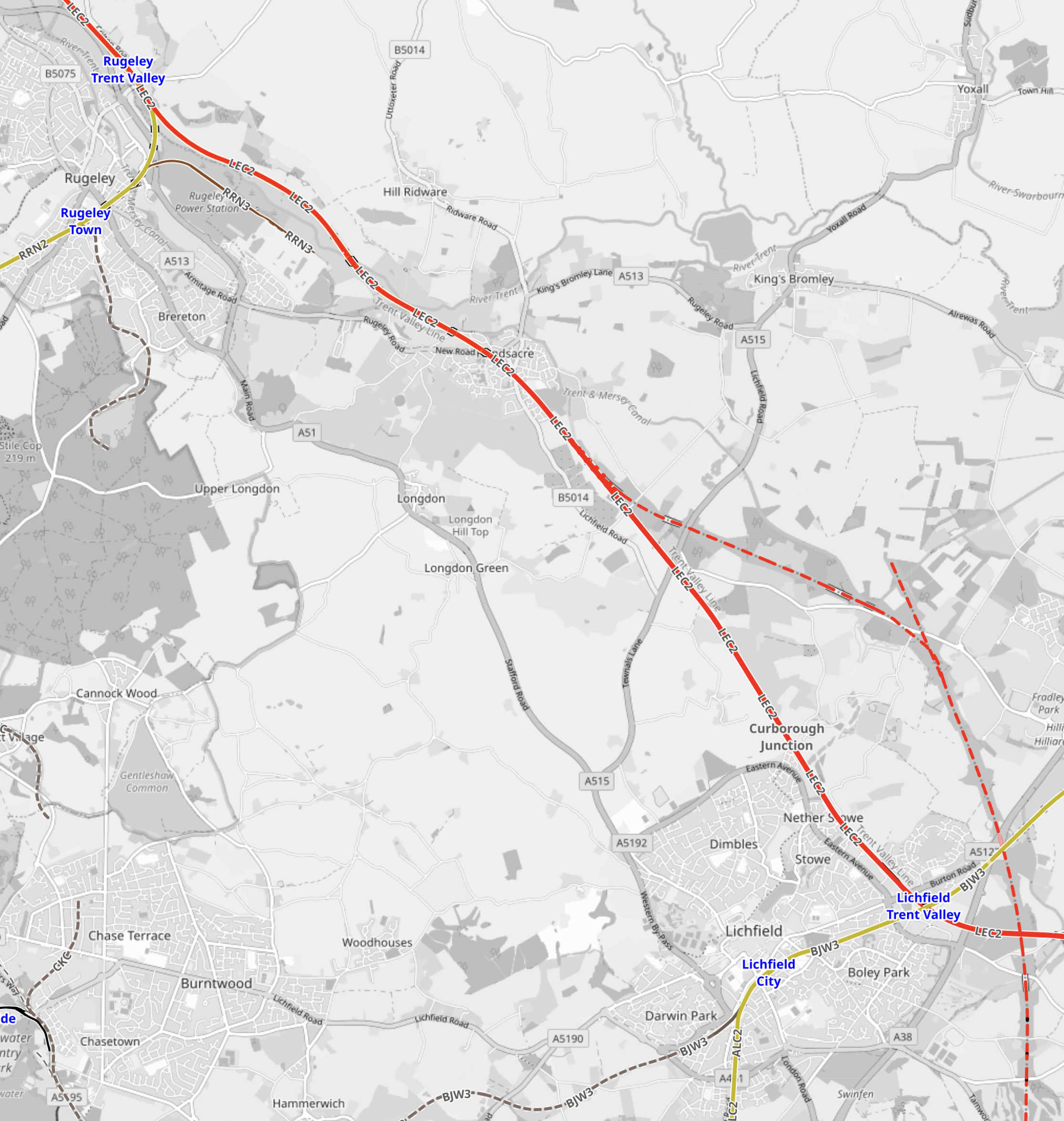
Note.
- Rugeley Trent Valley station is in the North-West corner of the map.
- Lichfield Trent Valley station is in the South-East corner of the map.
- The Trent Valley Line runs diagonally across the map between the two stations.
- The route of HS2 is shown as a dotted red line in the South-East corner of the map.
- HS2 and the Trent Valley Line will join at Handsacre junction.
The stub of HS2 in the North-East corner of the map, will eventually link to Crewe.
The following services will join the Trent Valley Line at Handsacre junction.
- Train 4a – 200 m. HS2 CC – London Euston and Lancaster via Old Oak Common, Crewe, Warrington Bank Quay, Wigan North Western and Preston
- Train 4b – 200 m. HS2 CC – London Euston and Liverpool via Old Oak Common, Crewe and Runcorn
- Train 5 – 200 m. HS2 CC – London Euston and Liverpool via Old Oak Common, Crewe and Runcorn
- Train 6 – 200 m. HS2 CC – London Euston and Macclesfield via Old Oak Common, Stafford and Stoke-on-Trent
- Train 7 – 200 m HS2 CC – London Euston and Manchester Piccadilly via Old Oak Common and Birmingham Interchange
- Train 8 – 200 m HS2 CC – London Euston and Manchester Piccadilly via Old Oak Common
- Train 9 – 200 m HS2 CC – London Euston and Manchester Piccadilly via Old Oak Common
- Train 10a – 200 m HS2 CC – London Euston and Edinburgh Waverley via Old Oak Common, Preston, Carlisle and Edinburgh Haymarket
- Train 10b – 200 m HS2 CC – London Euston and Glasgow Central via Old Oak Common, Preston and Carlisle
- Train 11a – 200 m HS2 CC – London Euston and Edinburgh Waverley via Old Oak Common, Birmingham International, Preston, Carlisle and Edinburgh Haymarket
- Train 11b – 200 m HS2 CC – London Euston and Glasgow Central via Old Oak Common, Birmingham International, Preston and Carlisle
- Train 12 – 200 m HS2 CC – Birmingham Curzon Street and Edinburgh Waverley/Glasgow Central via Wigan North Western, Preston, Lancaster, Oxenholme, Penrith, Carlisle, Lockerbie, Carstairs and Edinburgh Haymarket/Motherwell
- Train 13 – 200 m HS2 CC – Birmingham Curzon Street and Manchester Piccadilly
- Train 14 – 200 m HS2 CC – Birmingham Curzon Street and Manchester Piccadilly
Note.
- All trains are one train per hour (tph)
- Train 4 splits and joins at Crewe, so runs as a 400 m train on the Trent Valley Line.
- Train 10 splits and joins at Carlisle, so runs as a 400 m train on the Trent Valley Line.
- Train 11 splits and joins at Carlisle, so runs as a 400 m train on the Trent Valley Line.
- Train 12 runs alternatively to Edinburgh Haymarket and Edinburgh Waverley/Motherwell and Glasgow Central.
In any hour, it looks like eight single trains and three pairs will run along the Trent Valley Line.
How Close In Minutes Can Trains Run On The Trent Valley Line?
I asked Google AI and received this answer.
On the modernised Trent Valley Line (part of the West Coast Main Line), trains can run at high frequencies, often with fast, long-distance services operating with headway (spacing) of approximately 3 to 5 minutes, though typically, a 2-4 train per hour per direction service pattern is standard, equating to 15–30 minute intervals between similar services.
Capacity: The line is a four-track railway between Rugby and Stafford, allowing fast, long-distance express trains (up to 125 mph) to overtake slower, local, and freight trains.
Service Frequency: High-frequency, high-speed travel is standard.
Constraints: While the infrastructure supports close spacing, schedules are constrained by capacity at major bottlenecks and the requirement for consistent track maintenance.
It’s probably tight, but not impossibly so. Especially, as Train 6 to Macclesfield cuts off through Stoke-on-Tent after Stafford.
What Is The Capacity Of Each Train Timetable Between London Euston And Manchester Piccadilly/Macclesfield?
Consider.
- An 11-car Pendolino has 607 seats.
- I’m assuming all Pendolinos are 11-car trains.
- An 8-car HS2 Classic-Compatible train has 504 seats.
- I’m assuming that HS2 Full Size trains have the same capacity as the Classic Compatible trains.
These are figures for each timetable.
Current Timetable
3 x 11-car Pendolino = 1,821 seats. per hour
Interim Timetable
4 x 8-car 200 m. HS2 Classic-Compatible trains = 2,016 seats per hour, which is a 10.7 % increase over today.
Full Timetable
7 x 8-car 200 m. HS2 Classic-Compatible trains = 3,538 seats per hour, which is a 93.7 % increase over today.
How Many Trains Run On Each Section Of HS2?
Current Timetable
None
Interim Timetable
These are my estimates of trains per hour on each section.
- London Euston and Birmingham – 11 tph
- Birmingham and Stafford – 11 tph
- Stafford and Crewe – 10 tph
- Stafford and Macclesfield – 1 tph
- Crewe and Liverpool – 2 tph
- Crewe and Manchester Piccadilly – 5 tph
- Crewe and Preston – 4 tph
- Preston and Lancaster – 4 tph
- Lancaster and Carlisle – 3 tph
- Carlisle and Edinburgh Waverley – 2.5 tph
- Carlisle and Glasgow Central – 2.5 tph
There would appear to be spare capacity for up to six trains per hour, South of Crewe.
Full Timetable
These are my estimates of trains per hour on each section.
- London Euston and Birmingham – 11 tph
- Birmingham and Stafford – 11 tph
- Stafford and Crewe – 10 tph
- Stafford and Macclesfield – 1 tph
- Crewe and Liverpool – 2 tph
- Crewe and Manchester Airport- 5 tph
- Manchester Airport and Manchester Piccadilly – 5 tph
- Crewe and Preston – 4 tph
- Preston and Lancaster – 4 tph
- Lancaster and Carlisle – 3 tph
- Carlisle and Edinburgh Waverley – 2.5 tph
- Carlisle and Glasgow Central – 2.5 tph
There would still appear to be spare capacity for up to six trains per hour, South of Crewe.
Conclusions
Theses are my conclusions.
- There Are At Least Six Free Train Paths In Every Hour Between London And Crewe
This is partly because the Eastern leg was cancelled. But it does seem silly to waste them.
I believe Blackpool would be a good place to serve and I said so in Could High Speed Two Serve Blackpool North?
Other possible places would be Chester, Holyhead and Scotland.
2. There Will Need To Be A Tunnel To Connect Manchester Piccadilly And Manchester Airport
This is because you can’t knock all the houses down to build the link.
The Channel Tunnel Rail Link is tunnelled under Dalston in East London for the same reason.
3. Manchester Piccadilly and Manchester Airport services will be five Trains Per Hour
Two of these five trains will go to Birmingham Curzon Street and three to London Euston.
I would expect that the Manchester Tunnel will be an important project for the finances of Manchester Airport.
4. When The Manchester Tunnel Is Built, This Will Double Seat Capacity Between London And Manchester Piccadilly
This is because it will allow 400 metre trains between London Euston and Manchester Piccadilly.
5. HS2 Can Run To Manchester Without Building The Manchester Tunnel Or A High Speed Line Between Crewe And Birmingham
This surprised me at first, but it appears, that it’s because HS2 Classic-Compatible trains are shorter than 11-car Pendolinos.
6. HS2 Can’t Run To Manchester Airport Without Building the Manchester Tunnel.
It’s all because of the houses in between.
7. Single 200 m. HS2 Classic Compatible trains, Can Use The Unmodified Manchester Piccadilly.
This is because they are shorter than 11-car Pendolinos. But pairs can’t, as they are too long!
8. Stockport Gets A Raw Deal From HS2
Currently, Stockport, gets three 11-car Pendolino services between London Euston and Manchester Piccadilly.
Under the Interim Solution, these services will continue as HS2 Classic-Compatible trains are shorter than 11-car Pendolinos.
But under the Full Solution, HS2 trains will be in the Manchester Tunnel between Manchester Airport and Manchester Piccadilly.
9. The Interim Solution Will Work
I am more and more convinced, that a proposed solution which entails the following will work.
- A new service from London Euston to Macclesfield via Old Oak Common, Stafford and Stoke-on-Trent is introduced.
- 11-car Pendolinos are replaced by 8-car HS2 Classic-Compatible trains, which are shorter.
- The Trent Valley Line is updated, so that it can handle 11 trains per hour, that will eventually be transferred to the new HS2 line between Handsacre junction and Crewe.
- London Euston and Manchester Piccadilly will get three trains per hour via HS2 to Handsacre junction the Trent Valley Line.
- There will be no major work to be done at Manchester Piccadilly.
- Three trains per hour between London Euston and Manchester Piccadilly could still call at Stockport.
I also believe that this solution can be easily built, as it is mainly improving the existing route between Handsacre junction and Manchester Piccadilly via Crewe and Stockport.

