There Are Lies, Damned Lies And Trumpkopf’s Medical Statistics
With apologies to Benjamin Disraeli and/or Mark Twain
How Will The East Coast Main Line Timetable Change Affect Sheffield?
This article in the October 2025 Edition of Modern Railways is entitled Industry Gears Up For December ECML Timetable Change.
This is the first paragraph.
Major changes are planned to trains along the East Coast main line from 14 December as the long-heralded timetable takes effect.
In this post, I will see how the changes detailed in the article in Modern Railways will affect Sheffield and Doncaster.
Aberdeen-Edinburgh
This is said about Aberdeen and Edinburgh services.
Monday-Saturday services will not change between Aberdeen and Edinburgh, with all intermediate stations served at similar times.
The LNER service to and from King’s Cross will call additionally at Doncaster, Newark Northgate and Peterborough; the last LNER Monday-Friday departure from Aberdeen will terminate at Doncaster instead of Leeds, and the first LNER Monday-Saturday train to Aberdeen will start from King’s Cross at 05:48 instead of Leeds.
Note.
- An hourly fast train between Edinburgh and King’s Cross will have a journey time of 4 hours and 10 minutes, which is a saving of at least 12 minutes.
- There is an Aberdeen-Manchester air service, but no Edinburgh-Manchester or Leeds-Scotland air services.
- In Could London And Central Scotland Air Passengers Be Persuaded To Use The Trains?, I speculated about how air passengers could be tempted to use the trains between London and Central Scotland.
- It looks to me, that LNER are strengthening their services between Doncaster and Scotland.
- Will that 05:48 King’s Cross departure for Aberdeen, enable a working day in Aberdeen and return?
Is LNER’s aim to get travellers to use the trains between Doncaster and Scotland, as an alternative to driving or trains from Leeds?
Alnmouth and Berwick
This is said about Alnmouth services.
Quicker LNER journey times are promised to stations South of York, with King’s Cross-Alnmouth journey times up to 15 minutes quicker.
More TPE trains will run between Newcastle, Morpeth, Alnmouth, Berwick, Reston, Dunbar, East Linton and Edinburgh Waverley.
The number of trains calling at Durham on weekdays will fall from 18 to 13 Southbound and from 15 to 10 Northbound.
This is said about Berwick services.
LNER trains will call every two hours during the middle of the day, and the number of weekday trains to King’s Cross falls from 15 to 11 Southbound with a 13 to nine fall Northbound. More TPE trains will call.
Note.
- Lumo serves Newcastle, Morpeth and Edinburgh.
- Reston and East Linton are new stations.
- The stations between Newcastle and Edinburgh need adequate parking to attract commuters.
It looks to me, that LNER are timing the trains to attract day trips along the East Coast Main Line.
Bradford Forster Square/Interchange
This is said about Bradford Forster Square services.
The number of weekday trains will remain as per May 2025, but on Sundays, the number of trains serving Forster Square increases from two to six each way on a two-hourly interval. LNER stopping patterns change, with fewer trains calling at Peterborough and none at Grantham or Retford.
Trains currently stop at Peterborough, Doncaster, Wakefield Westgate, Leeds and Shipley, but surely a more regular six trains per day (tpd) is preferable.
This is said about Bradford Interchange services.
At Interchange, Grand Central Trains will run at different times to the May 2025 timetable, with King’s Cross journeys up to 20 minutes quicker. One GC each way will call at Peterborough, while some will stop at Pontefract Monkhill on Sundays for the first time.
Note.
- Trains currently stop at Peterborough, Doncaster, Pontefract Monkhill, Wakefield Kirkgate, Mirfield, Brighouse, Halifax and Low Moor
- Is the twenty minutes time saving due to the new digital signalling to the South of Doncaster?
- Is this another open access operator being allowed to do what they do best?
This looks to be a very useful service, which serves several stations, with no other service to London.
Doncaster
This is said about Doncaster services.
Additional trains calling at destinations including Birmingham New Street, Sheffield, York, Newark and Berwick-upon-Tweed. LNER Aberdeen/Inverness trains will call at Doncaster. EMR trains will be retimed at Doncaster to provide better connections with LNER’s revised timetables, but journeys from Doncaster to Sleaford and Spalding will require a change at Lincoln. This change has been made to “enable improved connections” at Peterborough, Sleaford, Lincoln and Doncaster. The number of trains calling at Stevenage falls from 24 to 19 Southbound and 24 to 21 Northbound, with Grantham stops dropping by seven trains to 28 Southbound and 4 to 29 Northbound.
If CrossCountry Trains were to switch their trains to Hitachi InterCity Battery trains, I believe that a version of these trains could handle routes like Plymouth and Aberdeen.
- This would speed up services.
- Trains would run close together and thus increase capacity.
- Services could even be faster.
So expect a replacement order for CrossCountry Trains diesel multiple units soon.
Glasgow
LNER gave up serving Glasgow Central from King’s Cross in the December 2024 timetable change.
In Lumo Will Extend Its King’s Cross And Edinburgh Service To Glasgow, I talked about Lumo extending their King’s Cross and Edinburgh service to Glasgow Central station.
Hull
This is said about Hull services.
On Mondays-Fridays, Hull Trains will provide an extra train from London.
The LNER Monday-Friday Hull-Doncaster train will be withdrawn;
Northern will operate a 20:25 departure to Doncaster; calling at Brough and Selby.
Note.
- It looks like Great British Railways have surrendered Hull and Beverley to Hull Trains.
- Hull Trains are converting their Class 802 trains to battery-electric power.
- It is likely that Hull Trains upgraded trains will be able to use the Great Northern and Great Eastern Joint Line via Lincoln on battery power.
The new timetable appears to be ready for the future of Hull Trains.
Leeds
This is said about Leeds services.
LNER services will depart to King’s Cross at xx.10 and xx.40.
Northern will introduce an extra mostly hourly service between Leeds and Sheffield calling at Wakefield Westgate. They will depart about 30 minutes earlier or later than the CrossCountry service.
Note.
- I would expect the two King’s Cross and Leeds services which would both stop at Doncaster and Wakefield Westgate would set the timings between Doncaster and Leeds.
- Currently, of the four trains that run to and from Leeds every two hours, two are planned to terminate at Leeds, one at Harrogate and one at Bradford Forster Square.
- There is also a daily service between King’s Cross and Skipton via Leeds.
- I can envisage another service between King’s Cross and Ilkley via Leeds, Kirkstall Forge, Guiseley, Burley-in-Wharfedale and Ben Rhydding.
- I can envisage another service between King’s Cross and Huddersfield, via Leeds, White Rose, Morley, Batley, Dewsbury, Ravensthorpe, Mirfield and Deighton.
- I can envisage another service between King’s Cross and Hebden Bridge, via Leeds, White Rose, Morley, Batley, Dewsbury, Ravensthorpe, Mirfield, Sowerby Bridge, Mytholmroyd and Brighouse.
- An alternative to Hebden Bridge would be Rochdale, which already has four platforms and is on the Manchester Metrolink
- It appears that Bradford Forster Square, Harrogate, Huddersfield, Leeds and Skipton stations can turn nine or ten-car trains and Ilkley can turn five-car trains.
- I also believe that one of Hitachi’s InterCity Battery trains could use battery power to take the spectacular Settle and Carlisle Line to Carlisle or even Glasgow Central.
- If needed pairs of five-car trains could split and join at Leeds, with one train waiting at Leeds and the other train going on to another destination.
- The CrossCountry and Northern Trains services on the Sheffield and Leeds route via Doncaster and Wakefield Westgate would probably need to be modern battery-electric trains to maximise the capacity on the route.
There certainly seem to be opportunities to give a number of stations in Yorkshire an all-electric service to King’s Cross with a two-hourly frequency, in a time of a few minutes over two hours.
Lincoln
This is said about Lincoln services.
One more LNER train from King’s Cross will run, with the first train arriving earlier and the last train later. There will no longer be an LNER train serving Stevenage with passengers having to change at Newark Northgate or Peterborough. An improved service will run to and from Nottingham, with an increase from one to two trains per hour on Mondays-Saturdays. An hourly service will run to Crewe, and a new Matlock-Nottingham-Lincoln-Cleethorpes service will run. EMR will cease all bar morning peak direct trains to/from Leicester. Newark Northgate-Lincoln trains will be reduced from five to four on Mondays-Fridays, eight to four on Saturdays and ten to eight on Sundays.
Note.
- Travellers between Lincoln/Nottingham and the North/Scotland will have two trains per hour to Newark Northgate, where there will be two tph to the North/Scotland.
- The hourly Crewe service will give access to Liverpool Manchester and the West Coast Main Line.
- Will there still be a Liverpool and Norwich service or will this be replaced by East-West Rail?
There seems to be a big sort out to EMR services.
Newcastle
This is said about Newcastle services.
The number of trains serving King’s Cross increases from 35 to 53 Southbound on weekdays and from 36 to 52 Northbound. One train every hour will run non-stop to York. More TPE trains will run Northbound (see Alnmouth and Berwick), while Northern is retiming services on the Northumberland Line in anticipation of Northumberland Park and Bedlington stations opening in early 2026. A semi-fast hourly service between Newcastle and Middlesbrough will run on Mondays-Saturdays and there will be an hourly stopping service between them.
Note.
- There will be a big increase in services between King’s Cross and Newcastle.
- Is the aim to persuade travellers to use trains rather than airlines?
- LNER also runs one train per day (tpd) between King’s Cross and Middlesbrough.
- Grand Central Trains will be running at a frequency of six tpd between King’s Cross and Sunderland via Thirsk, Northallerton, Eaglescliffe, Hartlepool and Seaham.
Hull appears to have been left to Hull Trains and Glasgow to Lumo, and Sunderland appears to be left for Grand Central Trains.
Conclusions
I am coming to some conclusions about services on the East Coast Main Line, with respect to Sheffield.
Doncaster Is A Well-Equipped Station
Doncaster is the nearest station to Sheffield on the East Coast Main Line.
- Over the last few years, Doncaster station has been improved.
- It has a subway with a more than adequate number of lifts.
- The station has nearly 600 parking spaces.
- There is a taxi rank.
- There is no Marks & Spencer’s food store, which is important for a coeliac like me.
- There are thirty bus stands close to Doncaster station.
- Doncaster station is well-equipped with cafes, a pub and coffee stalls.
- All trains to Aberdeen, Bradford Forster Square, Bradford Interchange, Edinburgh, Hull, King’s Cross, Leeds, Sheffield and Wakefield seem to stop at the station.
- There are several local trains per hour.
- Changing trains is not a strenuous exercise.
Doncaster is one of the UK’s better regional stations.
Doncaster Needs A Connection To The Sheffield Supertram
One of the first things, I do when I arrive in a strange town or city is look for the local public transport network.
In 2019, Sheffield published an ambitious plan for their tram network, which I wrote about in Sheffield Region Transport Plan 2019 – Doncaster Sheffield Airport.
The post contained this map, of Sheffield’s plans for the trams.
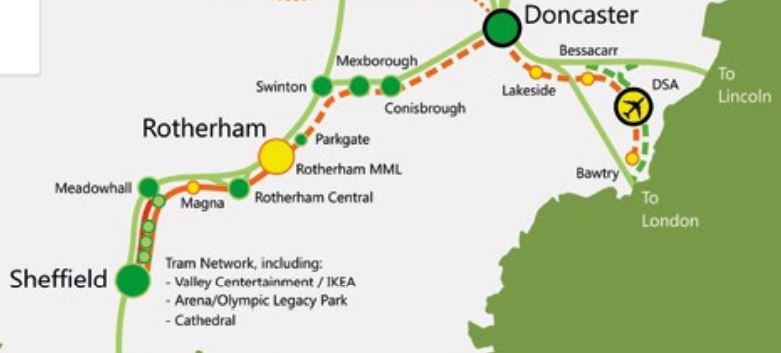
Doncaster and Doncaster Sheffield Airport are connected to the current end of the tram-train route at Rotherham Parkgate.
This OpenRailwayMap shows the rail lines between Rotherham Parkgate and Doncaster.
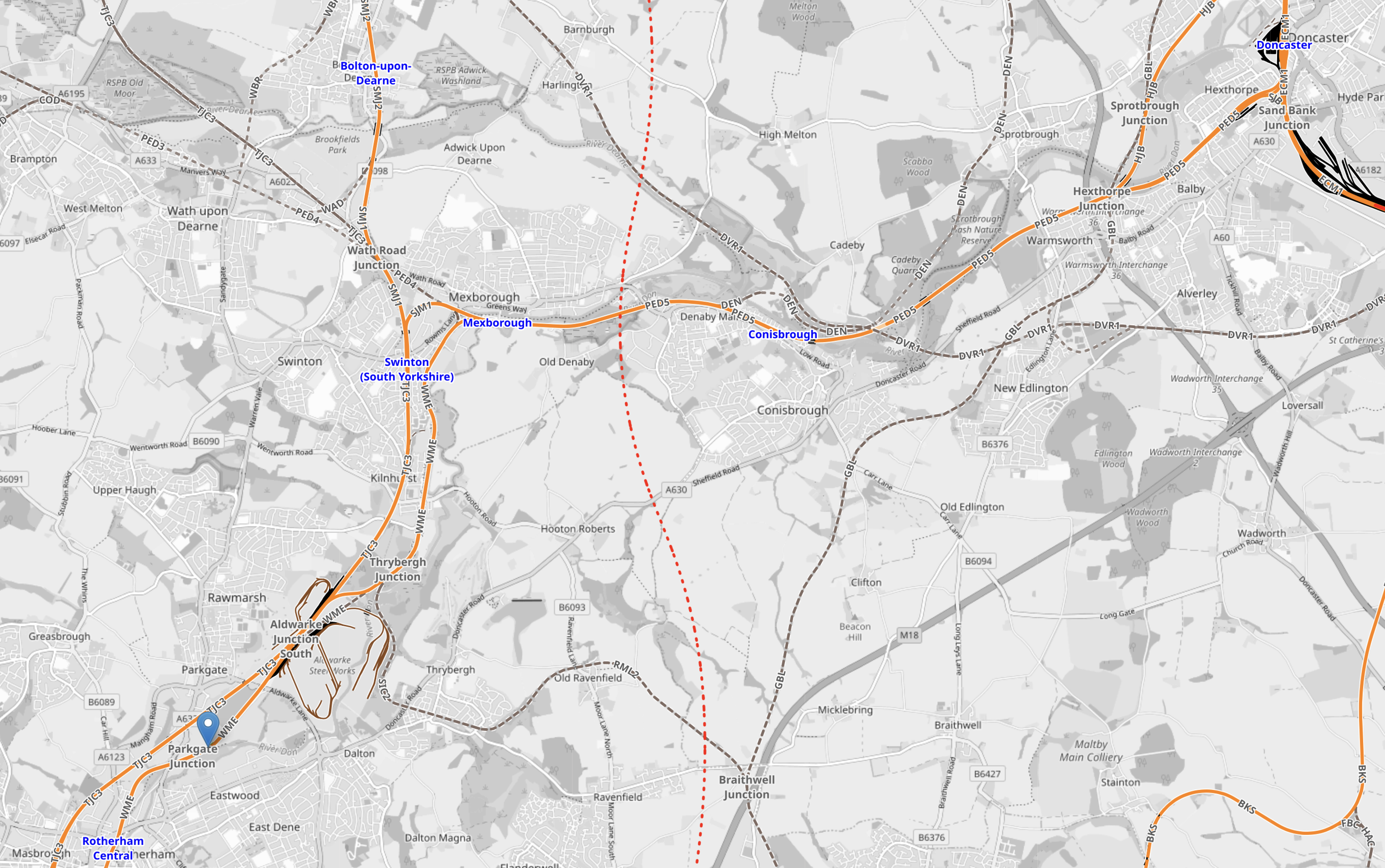
Note.
- Doncaster station is in the North-East corner of the map.
- Rotherham Central station is in the South-West corner of the map.
- The blue arrow in the South-West corner indicates Rotherham Parkgate tram stop.
- Swinton, Mexborough and Conisbrough stations can be picked out.
- The dotted red line running North-South across the map is the route of the ill-fated Eastern Leg of High Speed Two.
It is a simple application of tram-train technology to connect Doncaster station and Doncaster Sheffield Airport to the Sheffield Supertram.
With all the comings and goings on the East Coast Main Line at Doncaster station, I believe that the tram-train connection to Sheffield and Rotherham is essential.
The Cities Of Bradford, Doncaster, Leeds, Sheffield and Wakefield Can Have a High-Frequency Rail Connection
Consider.
- Four stations are all step-free with a bridge or subway served by lifts.
- Bradford Forster Square station has level access to the platforms from the street.
- The rail lines between the five stations are electrified, with the exception of Sheffield and Doncaster.
- Services between the cities are run by CrossCountry Trains, Grand Central Trains, Hull Trains, LNER and Northern Trains.
- Most maximum speeds are not unduly slow.
Consequently the five cities can have a high-frequency rail connection in excess of four tph.
Could this be the basis of a Five-Cities Metro?
Open Access Services
There are six open access services running on the East Coast Main Line.
- Grand Central Trains – King’s Cross-Bradford Interchange via Peterborough, Doncaster, Pontefract Monkhill, Wakefield Kirkgate, Mirfield, Brighouse, Halifax and Low Moor – 4 tpd
- Grand Central Trains – King’s Cross-Sunderland via Peterborough, York, Thirsk, Northallerton, Eaglescliffe and Hartlepool – 6 tpd
- Hull Trains – King’s Cross-Hull via Stevenage, Grantham, Retford, Doncaster, Selby, Howden, Brough – 4 tpd
- Hull Trains – King’s Cross-Beverley via Stevenage, Grantham, Retford, Doncaster, Selby, Howden, Brough, Hull and Cottingham – 2 tpd
- Lumo – King’s Cross-Edinbugh via Stevenage, Newcastle and Morpeth – 5 tpd
- Lumo – King’s Cross-Glasgow Queen Street via Stevenage, Newcastle, Morpeth, Edinburgh and Falkirk High – 2 tpd
Note.
- tpd is trains per day.
- All seem to serve an exclusive area, except Lumo.
- In a couple of years, all could be using Hitachi trains.
- I suspect some services will swap their diesel generators for batteries.
Battery-power would allow some services to be zero-carbon, even when using the GNGE diversion.
Gatwick Second Runway Plan Approved By Transport Secretary
The title of this post is the same as that of this article on the BBC.
This is the sub-heading.
Transport Secretary Heidi Alexander has approved plans for a second runway at London Gatwick Airport, as the government looks for economic growth opportunities.
These four introductory paragraphs add some detail.
The £2.2bn privately-financed project involves in effect moving the current Northern Runway 12 metres to bring it into regular use, as well as other developments, including extending the size of terminals.
The airport says its plans will bring jobs and boost the local economy. But there has long been opposition from campaigners and groups worried about the impact on the surrounding area.
Gatwick currently handles about 280,000 flights a year. It says the plan would enable that number to rise to around 389,000 by the late 2030s.
A government source has described the plans as a “no-brainer for growth,” adding that “it is possible that planes could be taking off from a new full runway at Gatwick before the next general election.”
Over the last fifty years, I’ve been involved in many large projects, as I used to write project management software and at one period in the 1980s, half of all the world’s major projects, were being managed by the Artemis software, that I wrote in a Suffolk attic.
I am starting this post by asking Google AI, when Gatwick’s Northern Runway was built. This was the answer I received.
Gatwick’s Northern Runway was built in 1979 by widening an existing taxiway to serve as an emergency runway. While the main runway is known as 08R/26L, the standby or emergency runway is designated as 08L/26R and is located just to the north of the main runway.
Note.
- 08 means that the runway is aligned at 080 degrees, which is almost due East.
- 26 means that the runway is aligned at 260 degrees, which is almost due West.
- Normally, when landing and taking off at Gatwick, your aircraft will use the Southern runway, which points to the West or Runway 26L.
This Google Map shows the layout of the airport.

Note.
- The longer Southern 08R/26L runway.
- The shorter Northern 08L/26R runway.
- The station in the North-East corner of the map is Horley.
- The station to the East of the runways is Gatwick Airport station.
- Both stations are on the Brighton Main Line, which runs North-South past the Airport.
- As when it was built, the Airport envisaged that the Northern runway would be turned into a runway that would meet all standards, I doubt there will be any problems rebuilding the Northern Runway, the required twelve metres to the North.
It was a cunning plan, when it was executed in the late 1970s and worthy of Baldrick at his best.
I do wonder, if it had been developed using Artemis!
Wakefield Westgate Station – 18th September 2025
To get to Knottingley and the consultation about Ferrybridge hydrogen-fired power station, I had to change trains at Wakefield Westgate station.
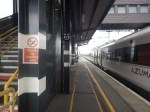
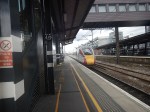












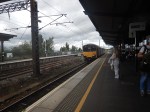
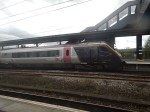
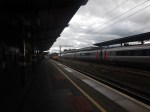
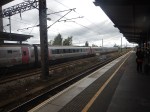




Note.
- It is an impressive station.
- It has been rebuilt since the turn of the century.
- It is fully step-free.
- Entrance is level from the square outside the station to the Southbound platform.
- There are toilets on the Southbound platform.
- There are six trains per hour (tph) between Wakefield Westgate and Leeds.
Certainty, in the time I was changing trains and waiting for my train to Knottingley, there were a lot of trains going to and from Leeds.
The timetables are changing on December 14, 2025 and the October 2025 Edition of Modern Railways gives this summary for Wakefield.
On Mondays-Saturdays, the CrossCountry train calling at Westgate at 18:17 will no longer stop at Wakefield. Northern will introduce an additional hourly fast train seven days a week between Leeds and Sheffield, and on Saturdays there will be extra later last trains between Sheffield and Westgate via Rotherham and Sheffield and Kirkgate via Barnsley.
With the development of the Leeds Metro, I can see more services being added on the route between Doncaster and Bradford via Wakefield Westgate and Leeds.
- Bradford is getting a new through station.
- From December 14, 2025, Sunday services to Bradford Forster Square will be increased for two to six each way per day.
- It also looks like from December 14, 2025, the new Northern service between Leeds and Sheffield via Wakefield Westgate, will form a two trains per hour with the CrossCountry service.
It certainly looks like the train companies have been co-operating to create a high-class Trans-West Yorkshire service.
National Grid And Emerald AI Announce Strategic Partnership To Demonstrate AI Power Flexibility In The UK
The title of this post, is the same as that of this press release from National Grid.
This is the sub-heading.
National Grid and Emerald AI are partnering to show how AI data centres can support a smarter, more flexible grid.
A UK-first live trial is planned for late 2025 on a grid connected data centre using Emerald AI’s platform.
Targeted for late 2025, the demonstration will use cutting-edge NVIDIA GPUs, to dynamically adjust energy consumption
Increased flexibility of data centre consumption can unlock capacity and accelerate connections to the electricity network.
These three introductory paragraphs indicate how the strategy partnership will work.
National Grid and Emerald AI today announced a strategic partnership to demonstrate how AI data centres can work with the transmission network to adjust their energy use in real time, making better use of existing capacity to support the UK’s growing digital needs.
The partners will deliver a live demonstration in the United Kingdom showcasing Emerald Conductor, an AI-powered system that acts as a smart mediator between the grid and a data centre, supporting flexible management of energy demand. Targeted for late 2025, the demonstration will use cutting-edge NVIDIA GPUs, dynamically adjust energy consumption, and support grid stability.
The electricity transmission network is designed with built-in redundancy to deliver world-class reliability and keep the lights on for customers. Capacity is typically available outside of peak events like hot summer days or cold winter storms, when there’s high demand for cooling and heating. That means, in many cases, there’s room on the existing grid to connect new data centres, if they can temporarily dial down energy usage during periods of peak demand.
Yesterday, there was an article in The Times which was entitled Octopus Energy Prepares Kraken Software Arm for Potential IPO.
I asked Google AI what Octopus Energy’s Kraken software does and received this answer.
Launched as part of the Octopus Energy Group in 2016, Kraken now serves 70 million household and business energy accounts worldwide through an operating system that processes 15 billion new data points each day. The software underpins Octopus Energy’s customer management and increasingly sophisticated smart tariffs.
I wouldn’t be surprised that similar methodology is used by both Emerald IT and Kraken.
As I have written at least four scheduling algorithms to best allocate available resources to tasks that need to be done for project management and other similar fields, I would have my ideas about the methods used by the two companies.
I am also sure, that the generic algorithm, that I have used in the past, could step up to the plate one more time, if anybody were to be interested.
Is Last Energy The Artemis Of Energy?
In Raft Of US-UK Nuclear Deals Ahead Of Trump Visit, I quoted from this article on World Nuclear News.
The article also contains, these two paragraphs, with talk about an MoU between Last Energy and DP World.
An MoU has also been signed between US-based micro-nuclear technology developer Last Energy and DP World, a global leader in logistics and trade, to establish the world’s first port-centric micro nuclear power plant at London Gateway. A proposed PWR-20 microreactor – to begin operations in 2030 – would supply London Gateway with 20 MWe of electricity to power the logistics hub, with additional capacity exported to the grid.
“The initiative represents a GBP80 million (USD109 million), subsidy-free investment for the development of Last Energy’s first unit, unlocking clean power supply for DP World’s ongoing GBP1 billion expansion of London Gateway,” Last Energy said. “The partnership is closely aligned with both UK and US ambitions to increase nuclear capacity and strengthen long-term energy security.”
Note.
- Last Energy are proposing a micro-reactor of just 20 MW.
- DP World own and/or operate sixty ports in over forty countries, so should know their energy requirements well.
- It appears that DP World are investing £80 million in Last Energy’s first unit.
- Thurrock Storage is a 300 MW/600 MWh battery close to London Gateway and the Port of Tilbury.
This Google Map shows London Gateway and the Port of Tilbury.
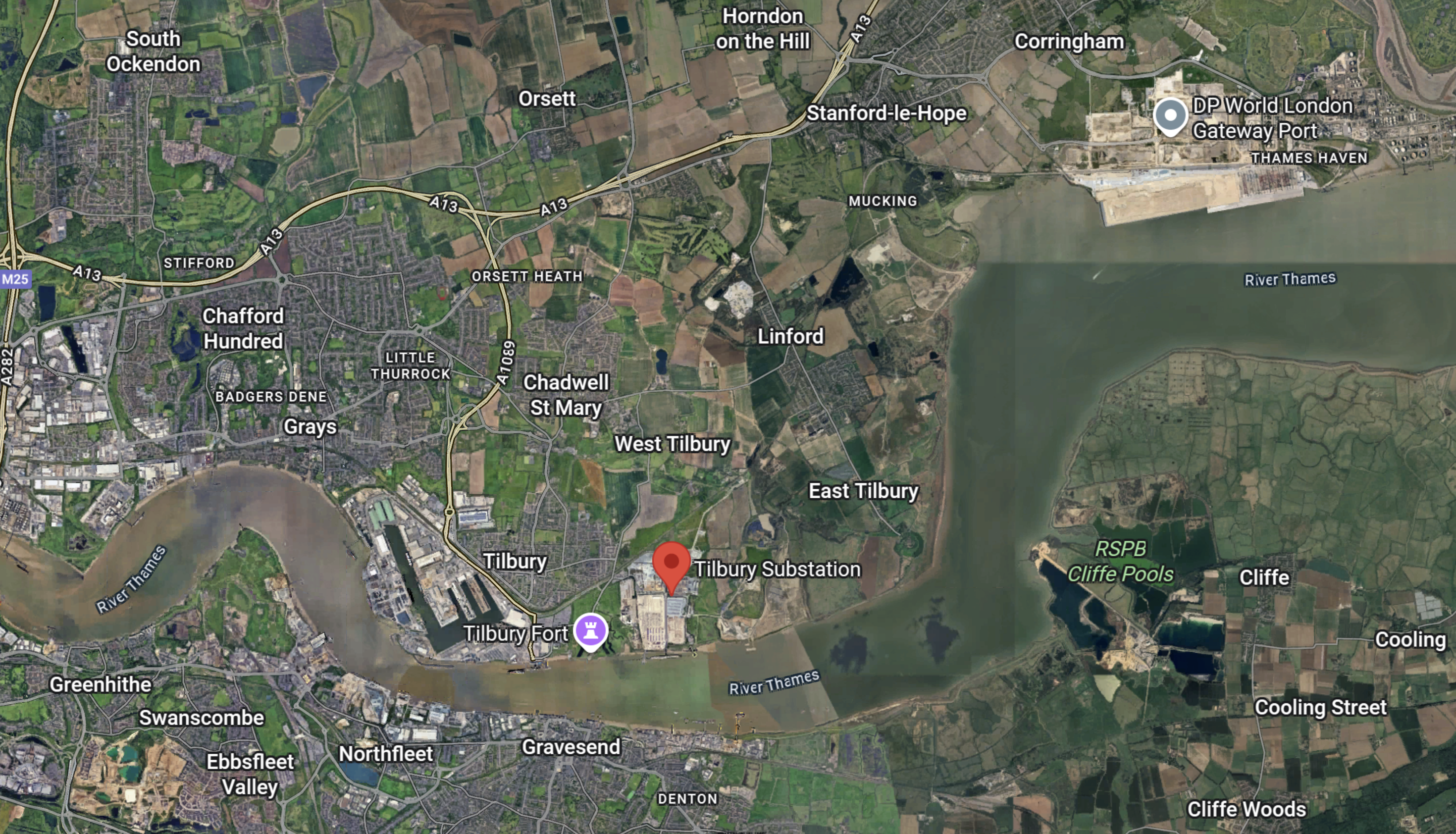
Note.
- DP World London Gateway is in the North-East corner of the map.
- The A13 road runs across the North-West corner of the map and links the area to London and the M25.
- Thurrock Storage is next to the Tilbury substation, which is marked by the red arrow.
- The Port of Tilbury is to the West of the substation.
I wonder if DP World London Gateway have had power supply problems.
The Design Of The First Artemis Project Management Software System
Before Artemis, project management was usually done on a large mainframe computer like an IBM-360-50, that I’d used extensively for solving simultaneous differential equations in a previous job at ICI.
Mainframe computers worked on complex problems, but to put it mildly, they were slow and needed a team to operate them and a big air-conditioned room to keep them happy.
When the four of us decided to create Artemis, our vision was something simpler.
- A processor – something like a PDP-11, which I judged would be big-enough for the computing.
- A visual display unit.
- A printer.
- A standard-size desk to hold the hardware.
- Ability to run from a 13-amp socket.
When it came to writing the software, I took few risks.
- Much of the data decoding software, I’d developed when I left ICI to write a program to solve up to a thousand simultaneous differential equations.
- The scheduling software was generic and I’d first used it for different purposes in two programs at ICI.
- The aggregation software had been devised, whilst I was a consultant at Lloyds Bank over several bottles of wine with their Chief Management Accountant, who was a wizard with numbers. I suspect, but can’t prove it, that if the idiots that programmed the Horizon system for the Post Office had used that algorithm, the problems there would have been much smaller.
- I also spent a lot of time reading old papers from the 1950s in IBM’s library on the South Bank, looking for better algorithms.
- I also made sure, I chose the best hardware and I believe HP did us proud.
- I used HP’s operating system and proprietary database to cut down, what could go wrong.
- Almost all of the first system was written by one person – me!
But we also put the right features into how we supported, delivered and trained users of the system.
I certainly, think we made few mistakes in the design of that first system.
Have Last Energy Used A Similar Cut Back Approach?
Reading their web site, I think they have.
They have obviously chosen, the 20 MW unit size with care.
But from worldwide experience with wind turbines, linking smaller power sources together, is not as difficult as it once was.
These are some of the statements on their web site’s introductory screens.
- Fully Modular, Factory Made
- A Scalable Solution
- <24 Month Delivery
- 100+ Supply Chain Partners
- 300+ Pressurised Water Reactors Operating Globally
- 0.3 acre – Plant Footprint Fits Within A Football Field
But a chain is only as strong as its weakest link.
It should be noted, that I have been over several nuclear power stations.
Three were a tour to show me how Artemis was being used to track and sign off, the problems identified after the Three Mile Island incident.
The other was a trip over Sizewell A, a couple of years before it was decommissioned.
Comparing these experiences with some of the chemical plants, that I’ve worked on, I would prefer to be close to a nuclear power plant.
Raft Of US-UK Nuclear Deals Ahead Of Trump Visit
The title of this post, is the same as that of this article on World Nuclear News.The article is a good summary of all the deals done between the US and UK governments concerning next-generation nuclear power.
This is the introduction.
Several agreements have been signed between UK and US companies to advance the deployment of small modular reactors and advanced reactors in both countries. The deals were signed ahead of the state visit of President Donald Trump to the UK later this week.
The whole article is a must-read.
These are my posts, that are related to the main agreement.
- Centrica And X-energy Agree To Deploy UK’s First Advanced Modular Reactors
- Nuclear Plan For Decommissioned Coal Power Station
- Rolls-Royce Welcomes Action From UK And US Governments To Usher In New ‘Golden Age’ Of Nuclear Energy
I shall finish it later.
Rolls-Royce Welcomes Action From UK And US Governments To Usher In New ‘Golden Age’ Of Nuclear Energy
The title of this post, is the same as that of this press release from Rolls-Royce.
These three paragraphs introduce the press release.
The agreement between the UK and US Governments to deepen cooperation in advanced nuclear technologies and make it quicker for companies to build new nuclear power stations sets the stage for a significant step forward in the energy security and resilience of the two nations. The Atlantic Partnership for Advanced Nuclear Energy will help ensure the accelerated development and deployment of advanced nuclear reactor technologies in the US and UK. Building a bridge between the world’s first and world’s largest civil nuclear power markets.
The global market for advanced nuclear technologies is estimated to be worth many trillions up to 2050. Secure, scalable and reliable power across civil, defence, industrial and maritime sectors is needed to meet growing demands in digital and AI. In the US alone, demand for nuclear power is forecast to grow from 100GWe to 400GWe by 2050.
Rolls-Royce stands ready to seize the opportunity to further innovate and partner in the development of advanced nuclear technologies which will deliver thousands of skilled jobs, attract investment and support the economic growth of both the US and the UK.
Note.
- Rolls-Royce have several partners for the SMR, who include Siemens and a couple of American companies.
- Rolls-Royce are involved with US company; BWXT, in one of the consortia developing a micro-reactor for the US Department of Defense, which I wrote about in Rolls-Royce To Play Key Role In US Department Of Defense Nuclear Microreactor Program.
- Rolls-Royce also has a large design, development and manufacturing presence in the United States.
- The new engines for the B-52s are from Rolls-Royce.
Rolls-Royce has a very strong footprint in the United States.
Gwynt Glas And South Wales Ports Combine Strength In Preparation For Multi-Billion Floating Wind Industry
The title of this post, is the same as that of this news item from the Gwynt Glas wind farm.
The news item starts with a spectacular image of a port, that is assembling floating wind turbines and these three paragraphs.
Gwynt Glas Offshore Wind Farm has signed a Memorandum of Understanding (MoU) with the UK’s largest port operator, Associated British Ports, and Wales’ largest energy port, the Port of Milford Haven, to ready the ports for the future needs of floating offshore wind in the Celtic Sea.
Gwynt Glas is a joint venture partnership between EDF Renewables UK and DP Energy. The proposed floating offshore wind farm would generate 1GW of low carbon green energy in the Celtic Sea.
Under the MoU, information and industry knowledge will be shared to investigate the potential opportunities for manufacture, assembly, load-out and servicing for the Gwynt Glas project from the key South Wales Ports of Port Talbot and Milford Haven. This collaborative approach demonstrates a major commitment to supporting economic growth, investment and maximising social value in the region.
UK Port Unveils GBP 150 Million Offshore Wind Expansion Plan
The title of this post, is the same as that of this article on offshoreWIND.biz.
This is the sub-heading.
The Port of Tyne, located in the northeast of England, has unveiled its plans to add 400 metres of deep-water quayside to support offshore renewables, clean energy, and advanced manufacturing.
These two paragraphs add details.
The Port of Tyne is investing GBP 150 million (approximately EUR 173 million) to transform 230 acres into the Tyne Clean Energy Park, a move that could create up to 12,000 jobs, deliver GBP 5.6 billion (about EUR 6.5 billion) to the economy, and establish the North East as a hub for the UK’s green energy revolution, according to an independent study by WSP.
The plan for Tyne Clean Energy Park includes a kilometre of both new and redeveloped deep-water, heavy-lift quay to facilitate the use of a 230-acre footprint located within an Industrial Strategy Zone.
The Wikipedia entry for the Port of Tyne has this opening paragraph.
The Port of Tyne comprises the commercial docks on and around the River Tyne in Tyne and Wear in the northeast of England.
This Google Map shows the River Tyne Through Newcastle.
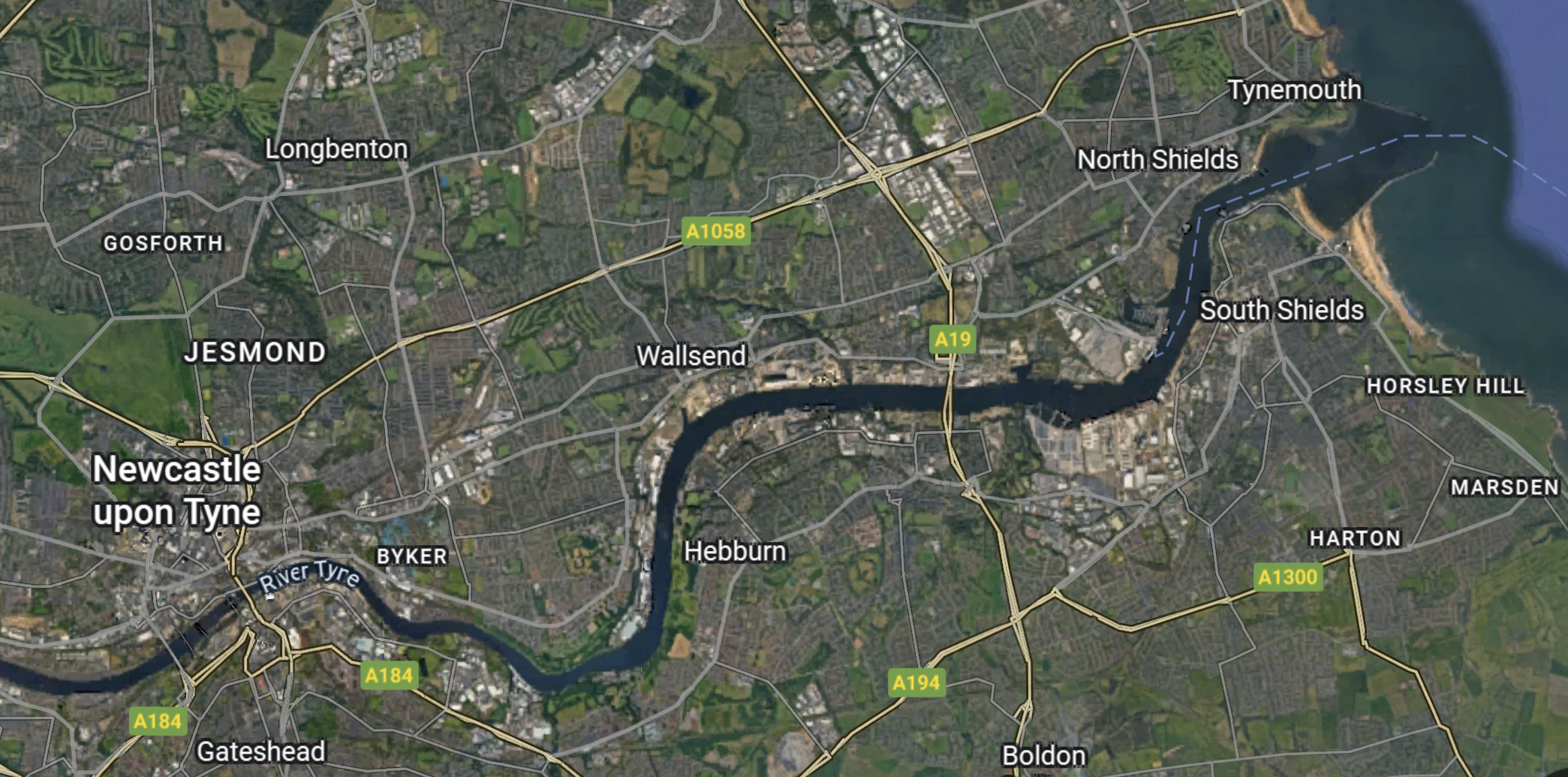
I estimate that this map is around twenty kilometres from East to West.
This news item from the Port of Tyne is entitled Port of Tyne Unviels 230 Acre Green Development Terminal and gives full details.
This summary is given.
The Port of Tyne is investing £150 million to transform 230 acres into the Tyne Clean Energy Park, adding 400 metres of deep-water quayside to support offshore renewables, clean energy, and advanced manufacturing. The redevelopment could create up to 12,000 jobs, deliver £5.6 billion to the economy, and establish the North East as a hub for the UK’s green energy revolution.
This is not a small development.
In future I shall tag developments like this with a tag of UK Port Development.
.
 The Anonymous Widower