Energy Dome Secures Funding, Partner For New CO2 Energy Storage Projects
The title of this post is the same as that of this article on Renewables Now.
This is the first paragraph.
Energy Dome SpA announced on Tuesday that it has closed a funding round securing USD 11 million (EUR 9.7m) to finalise the construction of a demonstration 2.5-MW/4-MWh carbon dioxide (CO2) battery storage project in Sardinia and to speed up business growth.
Note.
- It appears that Energy Dome has weaponised carbon dioxide against climate change.
- Providing 2.5 MW for over an hour and a half is an impressive performance.
- I think this project has the style we associate with Italy and Italians.
I have found their website at energydome.com and behind their energy storage system is unusual technology.
Their web site says this about their choice of storage medium.
CO2 is the perfect fluid to store energy cost effectively in a closed thermodynamic process as it is one of the few gases that can be condensed and stored as a liquid under pressure at ambient temperature. This allows for high density energy storage without the need to go at extreme cryogenic temperatures.
That is breathtakingly simple!
The main tank for the gaseous carbon dioxide is an inflatable dome and the liquid carbon dioxide is stored in steel tanks.
A turbine -compressor moves the carbon dioxide between gaseous and liquid states storing it appropriately.
It is very impressive! And I suspect extremely affordable!
TfL May Need To Close An Entire Tube Line Due To Funding Crunch
The title of this post, is the same as that of this article on Ian’s Visits.
This is the first paragraph.
The Mayor of London, Sadiq Khan, has issued a warning that an entire Tube line could close if the Government does not grant TfL the emergency and long-term funding it needs to maintain the capital’s transport services.
Ian, then speculates about which line would close.
I questioned his fare freeze before he was elected in Has Sadiq Khan Got His Sums Right? and very much feel that the politicians handling of Crossrail has caused its late opening.
Khan should realise you reap what you sow!
First In-flight 100% Sustainable-Fuels Emissions Study Of Passenger Jet Shows Early Promise
The title of this post, is the same as that of this press release from Rolls-Royce.
This is the introductory paragraph.
Initial findings from a world-first study of the impact of 100% sustainable aviation fuel (SAF) on both engines of a commercial jet have provided promising early results.
The study was performed using an Airbus A350, which is powered by Rolls-Royce Trent XWB engines.
This paragraph describes the tests.
In April, the A350 flew three flights over the Mediterranean Sea pursued by a DLR Falcon chaser plane to compare in-flight emissions of both kerosene and Neste’s hydro-processed esters and fatty acids (HEFA) sustainable fuel. The team also carried out compliance tests using 100% SAF and no operational issues were experienced.
I was surprised, when I first read this, that they used a chase plane to measure emissions, as I thought they’d simulate that in a test cell on the ground.
But this is probably, the best way to test the engines, whilst running on sustainable aviation fuel, in real-world conditions.
Conclusion
I believe that sustainable aviation fuel (SAF) will be the interim solution to flying until hydrogen-powered aircraft are developed.
Alstom And Liebherr Sign A Collaboration Agreement, In Order To Optimise Hydrogen Fuel Cells
The title of this post, is the same as that of this press release from Alstom.
The press release starts with these points.
-
Liebherr is developing air management technology that is particularly well suited to hydrogen fuel cells.
-
Alstom’s hydrogen strategy is part of its ambition to innovate by pioneering smarter and greener mobility solutions for all.
This paragraph then gives the basic outline of the agreement.
Alstom has signed a collaboration agreement with Liebherr – Aerospace & Transportation SAS, a France-based company specialising in the manufacture of compressors for fuel cells. This agreement is aimed at optimising hydrogen systems, including improving the reliability and durability of fuel cells, increasing their power density and reducing the cost of such solutions.
The press release gives a lot more details about Alstom’s hydrogen collaborations with other companies
Alstom seem very serious about hydrogen-powered trains.
Nuggets From The Union Connectivity Review
The Union Connectivity Review has now been published and it can be read online.
This paragraph outlines the objective of the Review.
The UK Government asked Sir Peter Hendy CBE to undertake a detailed review into how transport connectivity across the UK can support economic growth and quality of life in England, Scotland, Wales and Northern Ireland.
Sir Peter was also asked to make recommendations as to whether and how best to improve transport connectivity between the nations of the UK.
Sir Peter Hendy is the Chairman of Network Rail.
In no particular order, these are some nuggets from the review.
The Case For UKNET – A Strategic Transport Network For The Whole United Kingdom
This paragraph introduces the case for UKNET.
Having identified the importance of good connections across internal borders and the challenges that currently prevent a pan-UK strategic vision or investment strategy, the Review recommends that the UK Government develop UKNET – a strategic transport network for the whole United Kingdom which would connect all the nations of the
UK, with appropriate funding and coordination with the devolved administrations to deliver it.
The creation only follows best practice from the European Union and large countries like the United States.
These three paragraphs sum up how UKNET would work and how it would bring benefits to the whole of the UK.
UKNET would provide a network into which transport investment would be made on a pan-UK basis to support economic growth, jobs, housing and social cohesion, across the nations of the UK, for the benefit of the whole country.
It would allow transport appraisals for schemes on the network to be undertaken on a UK-wide basis with all costs and benefits being fully accounted for. This would limit the risk of cross-border schemes being deprioritised.
The development of such a network would provide additional certainty for businesses and the private sector, allowing them to plan complementary investments in specific regions and to invest in the supply chain across the country.
I think overall that UKNET is sound thinking, but my only feeling is that it should also look at transport links to and from the whole island of Ireland.
The Case for Faster Rail Journey Times Between England And Scotland
These three paragraphs probably apply to most rail journeys in the world, that compete against air and road travel.
Both the UK and Scottish Governments have previously agreed to develop options which could support a rail journey time between London and Scotland of three hours. A journey time improvement of this size, even when compared to expected journey times once HS2 opens, would dramatically increase the number of people travelling by rail.
There is a correlation between journey times and how many people choose to travel by rail over air. If it takes the same amount of time to travel by rail or by air, the evidence shows that people choose to travel by rail. Rail is typically favoured when the journey time is around three hours between city centres.
Work undertaken by Network Rail and HS2 Ltd on behalf of the Review has demonstrated the potential for increased trips by rail if journey times are reduced. For assurance purposes, two forecasting models were used to assess savings of 20, 35 and 50 mins on the journey times forecast for HS2 Phase 2b. The outcomes for both models were broadly similar and the approach built upon the changes in mode share observed between rail and aviation following previous UK and European rail investments.
Three hours between London and Scotland could be a tough ask.
Note these points about the East Coast Main Line.
- An InterCity 225 ran between London and Edinburgh on the 26th September 1191 in three hours and 29 minutes.
- Full digital in-cab signalling will allow running at 140 mph.
- There are improvements to come on the East Coast Main Line.
- As now, the review says two tph will run between London and Edinburgh.
- London Kings Cross and Edinburgh is 393 miles
- On the East Coast Main Line a non-stop train between would need to average 131 mph.
Three hours is tough but not impossible.
And these points about the West Coast Main Line.
- Trains will run on High Speed Two between London Euston and Crewe.
- High Speed Two are claiming fifty-six minutes between London Euston and Crewe.
- Full digital in-cab signalling will allow running at 140 mph.
- Crewe and Glasgow Central is 243.4 miles.
- Current fastest time between Crewe and Glasgow Central is three hours and five minutes.
- Between Crewe and Glasgow Central, a non-stop train would need to average 118 mph.
A well-driven InterCity 125, with a clear track, could average that speed between Crewe and Glasgow Central.
Three hours is tough but very possible.
This paragraph sums up the mode shift expected between air and road to rail.
These initial estimates indicated that a three-hour journey time was forecast to increase the number of passengers by around four million a year and increase rail mode share from the 2019 level of 29% to around 75%. It was also forecasted that journey times in the region of three hours would generate considerable transport user benefits and revenues over the lifetime of the scheme.
People travelling from the Midlands and North West England to and from Scotland would also get substantial reductions in journey times.
Linking High Speed Two With The WCML
The review says this about linking High Speed Two with the West Coast Main Line.
The UK Government has already acknowledged some of the issues identified by the Review. The ‘Golborne Link’—the current proposed connection between HS2 and the WCML—is expected to deliver quicker journey times and more capacity between England and Scotland and resolve some of the constraints between Crewe and Preston.
However, the ‘Golborne Link’ does not resolve all of the identified issues. The suitability of alternative connections between HS2 and the WCML have been considered by the Review. The emerging evidence suggests that an alternative connection to the WCML, for example at some point south of Preston, could offer more benefits and an opportunity to reduce journey times by two to three minutes more than the ‘Golborne Link’. However, more work is required to better understand the case for and against such options.
These benefits could also include additional operational flexibility when timing freight services and less disruption to the WCML than major upgrades as most construction could take place away from the railway.
An infrastructure philosophy is also detailed.
- Replacing and enhancing track, signalling and power supply.
- Possible new sections of line north of Preston.
- Maximising of line speed.
My feeling is that for good project management reasons and to give faster journey times with the existing trains, that a lot of these improvements should be started as soon as possible.
Borders Railway
The Review says this about the Borders Railway.
Communities in the Scottish Borders region are enthusiastic about the economic and social benefits they see resulting from an extension of the Borders Railway south, across the border, to Carlisle.
The Review also welcomes the £5 million in funding that the UK Government has made available for the development of a possible extension to the Borders Railway which would support improved connections to and from Scotland and with the WCML at Carlisle.
I would build this early, as when the West Coast Main Line is being upgraded between Carlisle and Glasgow, this would be available as a diversion route.
Perhaps too, the Glasgow South Western Line should be improved and electrified as well.
Air Passenger Duty
The Review has a sizeable session on Air Passenger Duty, where it concentrates on the problems of its application to domestic flights.
The Review makes this recommendation.
Where journeys are too long to be reasonably taken by road or rail, the UK Government should reduce the rate of domestic aviation tax.
I believe that before the end of this decade, there will be smaller zero-carbon airliners, that will be ideal for domestic routes, which could totally change the regime of domestic Air Passenger Duty.
Decarbonisation And The Future Of Flight
This is a section in the Review, where this is the first paragraph.
In July 2021, the Department for Transport published the Jet Zero Consultation: a consultation on our strategy for net zero aviation127, alongside the Transport Decarbonisation Plan. This includes the ambition to have zero-emission routes connecting different parts of the UK by 2030 and a commitment to assess the feasibility of serving PSO routes with low carbon aviation. The Review welcomes the commitments made in both publications to accelerate the uptake of sustainable aviation fuels (SAFs) and develop low and zero-emission aircraft.
The Review goes on to make two recommendations.
- Drive the uptake of sustainable fuels and zero emission technologies on domestic aviation through a combination of incentives, tax benefits and subsidies to make the UK a world leader in developing these fuels and technologies.
- Support the development of sustainable aviation fuel plants in parts of the United Kingdom that are particularly reliant on aviation for domestic connectivity.
Note.
- PSO means Public Service Obligation.
- One of the world leaders in the field of sustainable aviation fuels is Velocys, which is a spin out from Oxford University.
- The Review also suggests building a sustainable aviation fuel plant in Northern Ireland.
The Review gives the impression it is keen on the use of sustainable aviation fuel
Conclusion
There are some good nuggets in the sections I have read in detail.
This post is not finished and there will be additions to the list.
BP Plans To Turn Teesside Into First Green Hydrogen Hub
The title of this post, is the same as that of this article in The Times.
This is the first paragraph.
BP plans to build Britain’s biggest “green hydrogen” facility on Teesside to produce the clean fuel for use in new hydrogen-powered lorries and other transport.
Note.
The plans appear to be ambitious starting with a £100 million investment to build a 60 MW electrolyser by 2025, which would rise to as much as 500 MW by 2030.
The electrolyser will be paired with an upwards of a billion pound one gigawatt facility called H2Teesside, that will produce blue hydrogen.
I think there could be more to this than meets the eye.
Using The Carbon Dioxide Rather than Storing It!
I followed the carbon dioxide pipe from the CF fertiliser plant on Teesside using Google maps after seeing a film about it on the BBC. It goes to the Quorn factory and a massive greenhouse. I do wonder, if BP is talking to other companies, who also have a need for large quantities of good quality carbon dioxide.
One could be an Australian company, called Mineral Carbonation International, who have developed a process to convert carbon dioxide into building products like blocks and plasterboard. MCI won a prize at COP26, so could BP be looking at integrating one of these plants into their complex on Teesside?
The Electrolysers
Will BP be purchasing their electrolysers for green hydrogen from ITM Power in Sheffield?
This press release from ITM Power is entitled 12MW Electrolyser Sale.
The customer is not named, but could this be a starter kit for BP?
Alstom’s Hydrogen Aventras
In Alstom And Eversholt Rail Sign An Agreement For The UK’s First Ever Brand-New Hydrogen Train Fleet, I came to this conclusion.
This modern hydrogen train from Alstom is what is needed.
I also felt there could be three similar trains; electric, battery-electric and hydrogen, which would help operators hedge their bets on what type of traction to use.
Teesside must be one of the more likelier places where the Hydrogen Aventras will be carrying passengers.
I wrote about this possibility in Alstom Hydrogen Aventras And Teesside.
A deal between BP and Alstom would surely be in the interest of both companies.
- Alstom would get a local hydrogen supply.
- BP would get a first sale.
- BP would get excellent publicity and a local demonstration of the possibilities of hydrogen.
It might even be possible to supply the hydrogen by pipeline.
Southeastern’s Class 707 Trains
A few days ago, I had my first ride in one of Southeastern‘s Class 707 trains.





Other than a change of colour, they seemed little different to when they were working for South Western Railway.
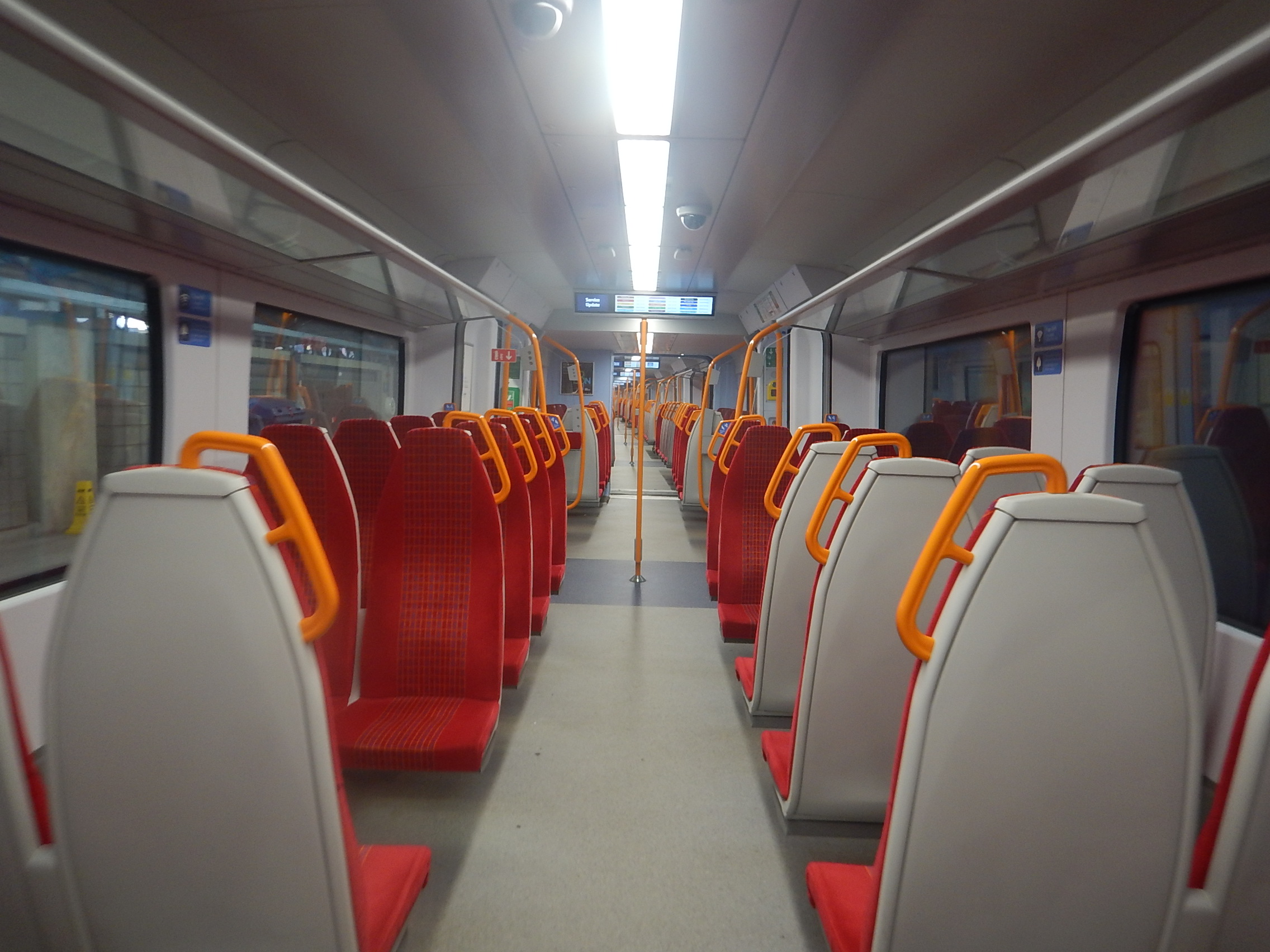
Note that the orange grab-handles have been retained.
Singapore-Based Enterprize To Build $10bn Wind Farm Off Irish Coast
The title of this post, is the same as that of this article on the Irish Times.
This is the first paragraph.
A Singapore-based offshore wind developer has signed an agreement to build a huge $10 billion (€8.88 billion) wind farm off the coast of Ireland to power a green hydrogen facility.
This is certainly a large investment.
- The windfarm will have a capacity of 4 GW.
- Hydrogen will be produced for the Irish market and some will be converted to ammonia for export.
- The hydrogen will be produced at the Green Marlin hydrogen facility at Bantry Bay.
- I’ve not heard of Enterprize before, but the company is also developing a 3.4 gigawatt offshore wind farm in Vietnam and is looking at Brazil.
Enterprize Energy are obviously very ambitious.
This article on Fuel Cell Works, which is entitled Zenith Energy And EI-H2 Announce Joint Venture For Green Facility At Bantry Bay, gives more details of the Green Marlin project.
Conclusion
There are some big companies investing billions of pounds, dollars and euros in hydrogen.
Omicron I Can Understand, But Arwen Is Surely A Funny Name For A Storm!
This article on the Birmingham Mail is entitled Storm Arwen: What Does The Name Arwen Mean And Who Chooses Storm Names?.
It says this about Arwen.
The name Arwen is believed to be of ancient Welsh origin and means “fair” or “good”. It is most commonly a female name.
Arwen was made famous by J.R.R Tolkein’s Lord of the Rings book series, which sees the name translated to “noble maiden” in Sindarin.
I’ve never read any of Tolkein’s books or seen any of the films, but I have played real tennis several times with one of his cousins.
He is or was a man who was involved with high-vacuum scientific equipment. He had some interesting tales about selling the equipment to the Soviet Bloc. He said that he always had a few of his cousin’s books handy, as they made excellent presents to oil the wheels of Soviet bureaucracy.
I hope everybody reading this, has been untroubled by the wrath of Arwen.
I
 The Anonymous Widower