Technology Company Announces Deal That Could Produce Nearly 30 million Gallons Of Aviation Fuel In Mississippi
The title of this post, is the same as that of this article on magnoliastatelive.
This is the first two paragraphs.
A technology company that has developed technology to turn household waste and forest waste into aviation fuel says it has signed an agreement that will help it produce 30 million gallons of fuel in Mississippi every year.
Velocys officials announced this week that they have signed a framework agreement with Koch Project Solutions to develop their biorefinery project which produces standard aviation fuel, in Natchez.
That all sounds good for the spin-out of Oxford University,
Is This The Shape Of Freight To Come?
This article on Rail Advent is entitled Eversholt Rail Unveils First Swift Express Freight Train In Doncaster.
It is a full report on the first of a new breed of freight trains based on redundant 100 mph electric multiple units.
Three Rail Problems
The rail industry, its financiers and customers have a lot of problems, they’d like to solve, but these three seem to be coming together to create a whole new industry.
Rolling Stock Leasing Companies Have A Surplus Of Redundant Rolling Stock
Most of the released rolling stock has been made redundant because of the arrival of new trains.
- Some trains and locomotives, like Greater Anglia’s Class 379 trains and Class 90 locomotives will probably be passed on to other operators.
- Some trains like Greater Anglia’s Class 315 trains and Govia Thameslink Railway‘s Class 313 trains and Merseyrail‘s Class 507 trains and Class 508 trains will probably only be fit for scrapping.
- Climate change ambitions will probably finish off anything which is elderly and diesel-powered.
What will be left will be a an assortment, which will contain a lot of trains with these characteristics.
- Four cars
- Can run in formations of 4, 8 and 12 cars
- Electrically-powered.
- Some trains are even dual voltage.
- 100 mph operating speed.
- Good reliability.
- Easy maintenance and modification if needed.
Many were even built over thirty years ago by British Rail Engineering Ltd.
As someone, who used to part-own a company that leased trucks to operators, I know that to maximise cash-flow and ultimately profits, you don’t want them sitting in a yard or a siding.
Conversion to zero carbon is one option.
- Porterbrook have said they will convert the Class 350 trains, that they own to battery-electric operation.
- Porterbrook have also converted some Class 319 trains to electro-diesel Class 769 trains.
- Porterbrook have also converted a Class 319 train to hydrogen operation.
- Eversholt Rail Group and Alstom are converting Class 321 trains to hydrogen operation.
I also believe that the redundant Class 379 trains will also be converted to battery-electric operation.
But there will still be a substantial number of quality trains, that need a second life.
The Growth Of Parcel Freight
Parcel freight traffic driven by on-line shopping, has boomed in the pandemic.
This type of traffic often originates from outside of the UK and enters the country at places like London Gateway or East Midlands Airport.
Much of it is currently distributed to large cities by truck, which in this day and age is not a green option, or even an option at all.
Rail Operations Group have leased ten Class 769 trains and 9 Class 319 trains with the intention of running parcel services under the Orion brand. I wrote about this proposal in A Freight Shuttle For Liverpool Street Station Planned.
Road Congestion
Road congestion is getting worse and there is bir much point in having product stuck on the motorway, when it can be running along at a 100 mph on an electrified rail line.
The Need For Just-In-Time Deliveries
Many factories these days work on the Just-In-Time principle, with product delivered just as its needed.
As an example Toyota build their cars at Burnaston near Derby, but the engines are built in North Wales. I suspect that they go across the country by truck.
Looking at maps, the engine plant could be rail connected and I feel one could be arranged at Burnaston.
Do they keep a good stock of engines at Burnaston?
I can see several situations like this needing a regular company train.
Fast Food
Because of Brexit we will need to be growing more of our own food.
Traditionally, the Class 43 power cars of InterCity 125 trains carried flowers and fish up from Cornwall.
So will we see rail provide an alternative.
Conclusion
Put these problems together and you can see a fair number of four-car electric multiple units being converted to short 100 mph electric freight trains.
Eversholt Rail Group‘s Swift Express Freight Train is very much a demonstrator for their ideas and it has some expected and unexpected features.
Based On A Class 321 train
The train is based on a four-car Class 321 train.

I rode one recently and I timed it at over 90 mph on the way to Southend.
Trolley Cages
Pictures in the Rail Advent article show a stripped-bare interior with a steel floor, with another picture showing three supermarket trolley cages arranged across the train.
One estimate in the article says that each coach can handle over fifty of these cages and up to nine-and-a-half tonnes of cargo.
Four Seats And A Toilet
Eversholt feel that some of the trains could be used in a Travelling Post Office mode and there may be a need for sorting en route, so two first-class seats, two second-class seats and a toilet are provided.
This train would enable an Anglo-Scottish parcel service.
- It might stop several times en route.
- At each stop parcels would be rolled out and in, perhaps with the help of a Harrington Hump.
- The on-train staff would sort the incoming parcels and put them in the required trolley for offloading.
I don’t think though, they’ll be delivering postal orders.
A Last Mile Capability
The article also disclosed that Eversholt were thinking of fitting a Last-Mile capability to the Swift Express Freight Train.
Batteries were mentioned and they would obviously work.
But one development recently is Porterbrook’s HydroFlex train, which has converted a Class 319 train to hydrogen power.
- The conversion was done by Birmingham University.
- It appears that all the hydrogen gubbins is underneath the floor, so cargo capacity would not be reduced.
I suspect underfloor hydrogen power could be very viable in an express freight train.
Fleet Size
The article talks of a fleet size of twenty and also says that the first train has been leased to an unnamed parcel distributor in the UK.
Wrightbus Presents Their First Battery-Electric Bus
The title of this post, is the same as that of this article on Electrive.
This is the first paragraph.
The Northern Irish bus manufacturer Wrightbus presents its first battery-electric vehicle in its portfolio: a double-decker bus called StreetDeck Electroliner. Until now, the Northern Irish manufacturer has been known primarily for its hydrogen-powered buses.
In My First Ride In A Hydrogen-Powered Double-Deck Bus, I rode in a Wrightbus StreetDeck Hydroliner FCEV, so these pictures of that bus, will at least show the external style of the StreetDeck Electroliner BEV.




These two links show the web page for each product on the Wrightbus web site.
Electric – Wrightbus StreetDeck Electroliner BEV
Hydrogen – Wrightbus StreetDeck Hydroliner FCEV
Wrightbus on their web page announce the Electroliner with a headline of The Electric Bus Perfected.
This is the first paragraph of the web page.
Meet the electric bus from the future of environmentally friendly transport. Our StreetDeck Electroliner is built with features to inspire the next wave of electric transport including best in class range to cover most duty cycles, modern passenger-focused amenities, best in class charge time, and many more. Making every kilometer a new sustainability milestone.
These are some features of the bus, gleaned from Wrightbus web page and the electrive article.
Battery Power
The Wrightbus web page says this about the batteries.
StreetDeck Electroliner’s maximum power from a 454kW zero-emission battery electric powertrain is the highest battery capacity for a UK Double Deck bus. It powers it to a leading range of up to 200 miles and a fast charge time of just 2.5 hours ensures longer journeys with fewer refueling breaks. Our commitment to greener transport is also strengthened with an optional 8-year battery warranty.
Note.
- On the Wrightbus web page, a cutaway drawing appears to show batteries everywhere.
- Reading the Wrightbus web page, the specification says that there are two battery sizes available; 340 kWh and 454 kWh.
They certainly seem to have all angles covered with batteries.
According to the electrive article, the StreetDeck Electroliner uses slim batteries from French company; Forsee Power.
On their web site, there is a paragraph, which is entitled Wrightbus Will Integrate ZEN SLIM Batteries, where this is said.
As part of its exclusive supplier partnership with Wrightbus, Forsee Power will supply Wrightbus with the new ZEN SLIM batteries, whose extra flat format allows easy integration into the chassis of vehicles (standard or double-decker buses).
Each bus will be equipped with three battery systems up to 340 kWh and an extension including a fourth system will also be possible, providing exceptional capacity of 432 kWh and a battery range of more than 350 kilometers.
The figure of 432 kWh does not fit with the Wrightbus specification and is not 340*4/3, so I suspect the Forsee web site is a couple of figures out of date.
The Forsee brochure for the ZEN SLIM batteries gives an energy density of 166 Wh per Kg. This means that the weight of the 454 kWh battery is around 3.7 tonnes.
I do like the modularity of the batteries, as it means must mean greater flexibility for bus operators, especially in a large city, where there is a varied mix of routes.
Intriguingly the batteries appear to be water cooled. Is the heat generated by the batteries, used to warm the bus in winter? Now that would be kool!
Battery Charging
In the specification on the Wrightbus web site, under a heading of EV Charging, this is said.
CCS2.0 Compliant Combo2 Socket
150kW or 300kW fast charge
And under a heading of EV Charge Time, this is said.
340kWh – 2 ½ hours @ 150kW
454kWh – 3 hours @ 150Kw
Up to 420kW Opportunity Charging / Pantograph Charging
I find the pantograph charging interesting.
I have been following a battery train charging device called a Railbaar since 2016, when I wrote How To Charge A Battery Train.
The device is now available for buses as a Busbaar and this page on the opbrid web site talks about opportunity charging for buses.
Opportunity Charging would entail charging the buses at suitable points along the route, using an overhead charging point and a speciality designed pantograph on the roof of the bus.
Wrightbus claims a charging rate of 420 kW for their system. With a claimed range of 200 miles, these buses should be able to handle at least 90 % of the bus routes in the UK.
Note that Opbrid are part of Furrer + Frey, the Swiss supplier of railway overhead electrification, who have a quality pedigree and are Network Rail’s supplier of choice for overhead electrification.
Co-location Of Bus And Railway Stations
Bus stations with charging for battery buses and electrified railway lines will both need a high grade connection to the electricity grid.
As an Electrical Engineer, I think it would be prudent to co-locate bus and railway stations so that all heavy users and the parked electric vehicles nearby could share the grid connection.
Both The Hydroliner And The Electroliner Appear To Share A Chassis
Looking at the cutaways on the two web pages for the buses, the chassis of both buses appear to be very similar.
The cutaway for the Electroliner shows some of the batteries low down between the wheels with more stacked up at the back of bus.
On the Hydroliner much of the equipment seems to be stacked up at the back of the bus.
The similar chassis and body designs must surely help production and allow a lot of components to be shared between the two buses.
Drive System
This article on electrive is entitled Voith To Deliver Electric Drives For Wrightbus and this is the first paragraph.
Northern Irish bus manufacturer Wrightbus has selected Voith as its exclusive partner to supply the electric drive system for the second generation of its battery-electric and fuel cell buses for Europe.
The second paragraph, says that Wrightbus has an order for eighty Electroliners for Translink in Northern Ireland to be delivered after August 2021.
This electrive article also described Voith’s electric drive system (VEDS).
The German supplier says it has developed the VDES specifically for the requirements of public transport. The 340 kW electric motor is said to be able to drive even double-decker buses, heavy articulated buses and trucks over long distances. The system also includes a water-cooled converter system, a drive management unit (called DMU), further converters for auxiliary units and the on-board charging management system including the cabling. Voith expects this to result in the highest possible efficiency, as all components are coordinated with each other.
Note the water-cooled converter system.
Running Gear
No vehicle is complete without a good set of wheels and suspension. The first electrive article says this.
Other features of the StreetDeck Electroliner, Wrightbus says, include a ZF rear axle system (AV133) and an independent front suspension system (RL 82 EC), also from ZF.
Few would question the choice of ZF as a supplier.
Conclusion
It looks to me, that Wrightbus have designed two buses, from the best components they can find and fitted them into their own purpose-built chassis and bodywork.
It’s almost as how the great Colin Chapman of Lotus fame would have designed a bus.
I
How Long-Duration Energy Storage Will Accelerate The Renewable Energy Transition
The title of this post, is the same as that of this article on Renew Economy, which is an Australian publication.
It is very much a must-read and although it was part-written by the President of Hydrostor, who are a Canadian long duration energy storage company, who store energy by compressing air in underground caverns.
The article gives some details on how investment is flowing into long duration energy storage.
We’re also seeing significant and sustained levels of investment in long-duration energy storage happen beyond Australia’s borders.
For example; Saudi Aramco Energy Ventures invested in Energy Vault to accelerate its global deployment of its energy storage solution; Bill Gates and Jeff Bezos invested in iron-flow batteries via Breakthrough Energy Ventures; Sumitomo Corporation invested in UK-start up Highview Power and their cryogenic liquified air storage system; and our team at Hydrostor closed a financing round including a strategic partnership with infrastructure investor Meridiam.
Big players like these, generally don’t back losers. Or at least they pour in more money and expertise, to make sure they succeed.
This paragraph also describes Hydrostor’s sale to Australia.
In 2020, Hydrostor’s 200 MW and 8 hours (or 1,600 MWh) A-CAES system was selected by New South Wales’ Transmission Network Service Provider, TransGrid, as the preferred option in its RIT-T process for reliable supply for Broken Hill.
They are also developing a large system in California.
With Highview Power having sold perhaps ten systems around the world, it does appear that long duration energy storage is taking off for Highview and Hydrostor, who both use that most eco-friendly of storage mediums – air.
The article is fairly scathing about developing more of the most common form of long duration energy storage – pumped storage using water. Especially in Australia, where water can be scarce. But with the world getting warmer, I don’t think we need to design systems, where all our stored energy can evaporate.
Conclusion
I agree very much with the writers of the article, that more long duration energy storage is needed, but that pumped storage is not the long term answer.
Wallingford Station: Historic Railway Canopy Finds New Home
The title of this post, is the same as that of this article on the BBC.
These are the first three paragraphs.
A historic canopy over a railway station platform that was in danger of being junked has found a new home.
The structure at Maidenhead in Berkshire had to be taken down because of electrification works needed for the Crossrail scheme.
It was painstakingly relocated to Wallingford Station in Oxfordshire and restored over seven years.
Judging by the comments in the article, it sounds like a job well done!
These paragraphs give the comments of TV historian; Tim Dunn.
TV historian Tim Dunn, who was present at the unveiling, called the canopy “one of a kind”.
“The fact that it’s been brought up bit by bit and rebuilt finally gives this railway a portal to the rest of the town,” he added.
“This is a brand new entrance to Wallingford.”
Does Tim Dunn imply anything more by the final statement?
Is There A Possibility Of The Restoration Of A Passenger Service Between Cholsey And Wallingford?
Consider these factors.
Great Western Railway Seem To Have a Policy Of Developing Their Branch Lines
In GWR To Test Battery Train On Branch Line, I said this.
The title of this post, is the same as that of this article on Rail Business UK.
This is the first paragraph.
Great Western Railway has invited expressions of interest in trialling a battery powered train on the 4 km non-electrified branch line from West Ealing to Greenford in west London.
The article says that Vivarail have made a previous proposal, but other companies are also likely to declare their interest.
Later in the related article, Mark Hopwood, who is Managing Director of Great Western Railway, indicated that they were looking for a modern zero-carbon solution for all of the branch lines, which they doubt would ever be electrified.
If GWR had a fleet of battery trains, then they could probably handle the two-and-a-half miles of the Cholsey and Wallingford Railway, provided the traffic was there, to make the service worthwhile.
Wallingford
Wallingford is a town of nearly twelve thousand inhabitants and many smaller towns and villages in England, have a regular rail service.
Cholsey Station
Cholsey station has two trains per hour (tph) between Paddington and Didcot Parkway stations, with extra services between Oxford and Reading stations in the Peaks.
This Google Map shows Cholsey station.

Note.
- Four through platforms for Great Western Railway services.
- Platforms 1 and 2 for the fast services are on the Western side.
- Platforms 3 and 4 for the slow services are on the Eastern side.
- Bay Platform 5 is tucked in the North-East corner of the station and is the terminus for services on the Cholsey And Wallingford Railway.
- There are only 55 parking spaces.
Is the number of parking spaces sufficient for the station, if a lot of passengers drive from Wallingford?
Could Battery-Electric Trains Handle The Service Between Cholsey And Wallingford?
As GWR has decided to look for battery-electric trains for their branch lines and this is only a five mile round trip, I think we can assume, that the battery-electric trains of the type, that Great Western Railway chooses, will be able to work this branch.
Intriguingly, the Greenford Branch Line is also 2.5 miles long and a round trip takes under thirty minutes, although the service is only hourly.
I feel that a well-driven single battery-electric train can provide two tph on the branch.
Charging would probably be needed at only one end of the branch line.
As all the through lines at Cholsey station are electrified with 25 KVAC overhead wires, I suspect that charging would be provided at that station.
Conclusion
I think it would be possible to provide a two tph service on the Cholsey and Wallingford branch line, using a battery-electric train.
The Complex Web At Sunderland
This article on the BBC is entitled Nissan Announces Major UK Electric Car Expansion.
This is the first few paragraphs.
Nissan has announced a major expansion of electric vehicle production at its car plant in Sunderland which will create 1,650 new jobs.
The Japanese carmaker will build its new-generation all-electric model at the site as part of a £1bn investment that will also support thousands of jobs in the supply chain.
And Nissan’s partner, Envision AESC, will build an electric battery plant.
I think there is more to this than meets the eye!
We wait several years for a battery gigafactory to come along and then two come along in a month or two; Blyth and Sunderland. On television today, a BBC reporter talked of eight possible battery gigafactories in the UK.
Lithium Supply
Where do they all think the lithium will come from, as some say there’s a world-wide shortage?
The only explanation, is that the UK government and the gigafactory owners have bought into a secure source of lithium, that is convenient for or easily transported to the North-East.
I am very suspicious that Cornish Lithium or British Lithium have found something bigger than anybody expected.
The numbers don’t add up otherwise!
Lithium Refining
On the other hand, it appears that lithium needs a lot of electricity to extract the metal from the ores, as electrolysis is used.
But with all the windpower being developed off the North-East Coast, there could be more than enough to refine the lithium.
Remember too, that lithium has applications in defence and aerospace applications, when alloyed with magnesium and aluminium.
So could a substantial lithium refining capability be built in the North-East?
The Chinese View
In The Times, Lei Zhang, who is chief executive of Envision also said he liked our masses of offshore wind power, so perhaps the Chinese want to produce green batteries in Sunderland after refining the lithium in the North-East?
Conclusion
We probably need battery-electric cars built from green steel, fitted with green batteries and charged with green electricity.
Is the Gigawatts of offshore wind electricity in the North-East luring the battery and car makes to the area.
Could we also see green steel manufacturing on Teesside?
The Power Of Solar With A Large Battery
This post is based on this press release from Highview Power, which is entitled Highview Enlasa Developing 50MW/500MWh Liquid Air Energy Storage Facility In The Atacama Region Of Chile.
This is the first paragraph.
Highview Enlasa, the 50/50 joint venture between Highview Power, a global leader in long duration energy storage solutions, and Energía Latina S.A.-Enlasa, the largest backup power generation provider in Chile, is pleased to announce that it is developing the first liquid air long duration energy storage project in Chile. This 50MW/500MWh (10 hours) CRYOBattery™, which represents an estimated investment of USD $150 million, will be located in Diego de Almagro in the Atacama Region.
Ican deduce these points from this paragraph.
The power output of 50 MW appears to be standard for all of Highview Power’s CRYOBatteries, which is not surprising as the centre of each system appears to be a standard turbomachinery solution from MAN Energy Solutions, as I wrote about in MAN Energy Partners With Highview Power On Liquid-Air Energy-Storage Project.
But whereas the first system at Carrington, near Manchester, can only store 250 MWh, this plant in Chile is twice the size and can provide 50 MW of electricity for ten hours. The Chile plant will just have twice the number of storage tanks for liquid air.
I can no reason, why if Carrington needed to store more electricity, that more tanks couldn’t be added.
This Google Map shows the area around the city of Diego de Almagro.
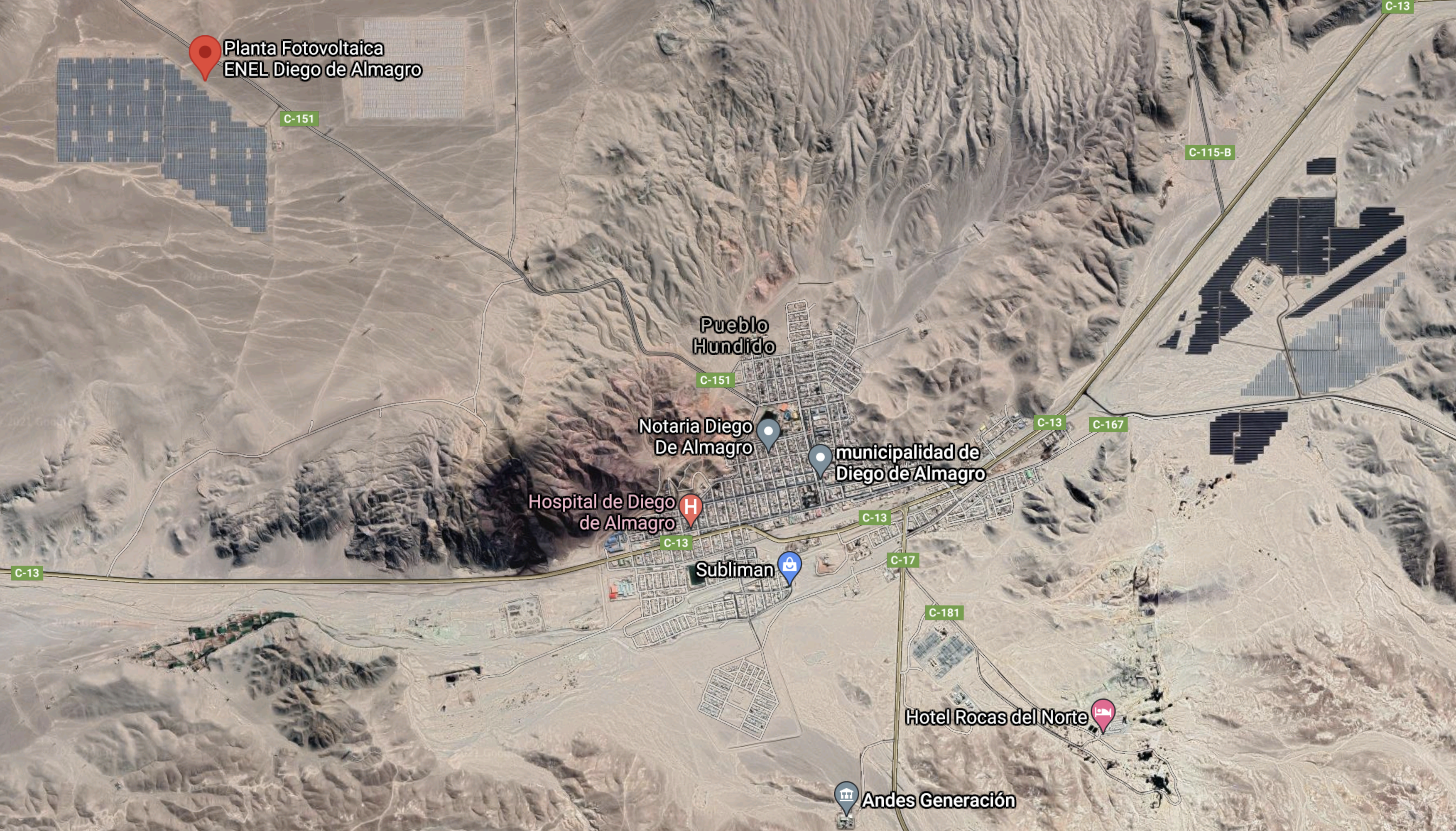
Note.
- The city of Diego de Almagro is in the centre of the map.
- In the North-Western corner is the Planta Fotovoltaica ENEL Diego de Almagro, which even my rudimentary Spanish, identifies as a solar power plant.
- In the North-Eastern corner of the map, is appears that a second solar power plant is under construction.
The city is surrounded by the large Atacama Desert.
This second Google Map shows the location of Diego de Almagro, with respect to the Chilean Coast.

Note.
- The red arrow indicates the solar powerplant at Diego de Almagro.
- La Paz in Bolivia is in the North-East corner of the map.
- The sandy-beige colour indicates the Atacama Desert.
The area would appear not to lack sun.
This extract is from the press release.
With one of the highest solar irradiations in the world, the Atacama Region has the potential to generate all the country’s electricity. By pairing solar with cryogenic energy storage, Chile can benefit from 24/7, 100% renewable energy.
The Wiukipedia entry for Solar Power In Chile, is not as optimistic as the press release, but does show the rapid growth in the amount of solar power.
Conclusion
Solar power installed with large batteries, will transform the electricity supply in countries like Australia, Chile and India and those in Africa and other places, where there are large hot deserts.
In Europe, Spain is investing heavily in solar power and is a big innovator in solar technology.
The German View On England’s Win
This article on Die Welt is Germany’s view of last night’s football
Network Rail Completes Key Step To Reopen Northumberland Line
The title of this post, is the same as that of this article on Rail Technology Magazine.
It may only be the renewal of 600 yards and competry at Newsham, but it least it gets the project on the rails.
I find it heartening, that this project and the similar Beeching Reversal one at Okehampton seemed to have made quick starts.
 The Anonymous Widower