Northern Could Introduce Class 769 Trains At The Time-Table Change
In the June 2021 Edition of Modern Railways, there is an article which is entitled Northern Looks To The Future.
This is a paragraph.
After a series of delays, the May timetable change was due to see introduce the first of its eight Class 769 bi-modes into service. Converted from Class 319 EMUs by Brush Traction for owner Porterbrook, the Class 769 ‘Flex’ units are capable of overhead electric and diesel operation and will be deployed on Southport to Alderley Edge/Stalybridge services.Northern After a series of delays, the May timetable change was due to see Northern introduce the first of its eight Class 769 bi-modes into service. Converted from Class 319 EMUs by Brush Traction for owner Porterbrook, the Class 769 ‘Flex’ units are capable of overhead electric and diesel operation and will be deployed on Southport to Alderley Edge/Stalybridge services.
I have just checked on Real Time Trains and the Class 769 trains appear to be running.
How Siemens Gamesa Could Give Coal Plants a Second Life
This article on Greentech Media is a must-read as it makes you think. This is the sub-title.
The ETES thermal battery can offer coal plants a new life as heat and power storage hubs. The first customer for a full-size version could be on-board as early as next year.
It talks about the philosophy of reusing coal-fired power station sites and some of their equipment like turbines.
It is an idea much more applicable to countries like the US and Germany rather than the UK, as they still have lots of operational coal-fired power stations and and we only have a few.
I first came across this idea, when Highview Power were talking about their 50/MW/400 MWh installation in Vermont, which was to be built on the site of a demolished coal-fired power station. The utility company and Highview were in that case just reusing the grid connection.
But then I’ve heard of other energy storage systems using old power station sites.
And not to forget that Highview Power’s installation at Carrington is close to a gas-fired power station.
Bang Goes My Holiday!
There are various things I want to visit in Germany and I felt that the best thing to do would be go for a few days,
But the BBC are reporting these facts about travel to Germany.
- From Sunday, people travelling from the UK will not be allowed to enter Germany
- The decision is down to a rise in cases of the Indian variant in the UK
- German citizens and residents, plus people with an exceptional reason, can still enter – but face a two-week quarantine
So bang goes my holiday!
I particularly wanted to go to Hamburg to take a few pictures of the Siemens Gamesa ETES trial installation in the city.
However I’ve been able to locate the installation on Google Maps.
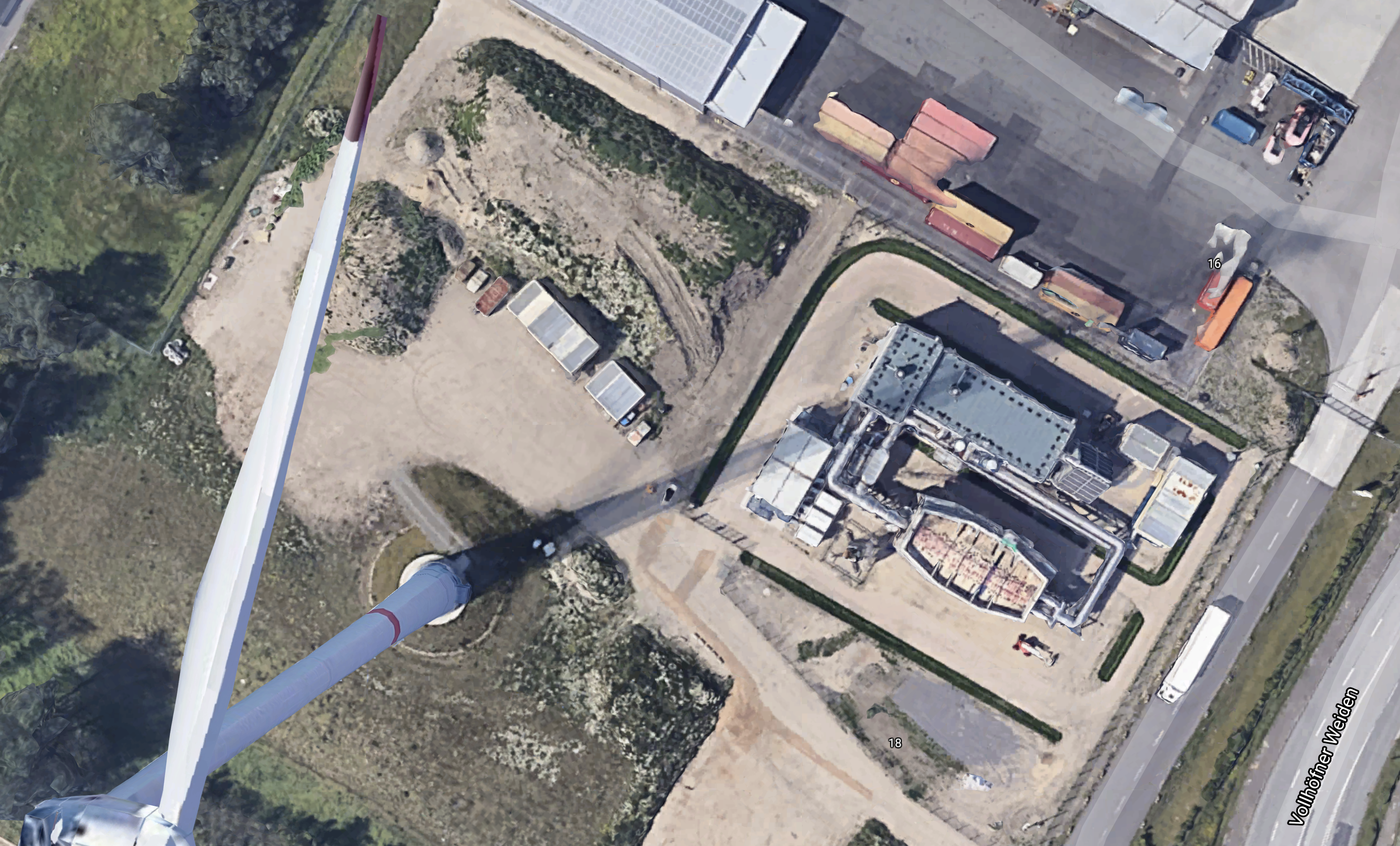
Note.
- The wind-turbine towards the South-West corner of the map.
- Siemens Gamesa ETES trial installation is the prominent odd shaped building towards the South-East corner of the map, just below the shadow of the turbine.
- The installation seems to have lots of pipes connected to it.
This second map shows the installation from an angle.
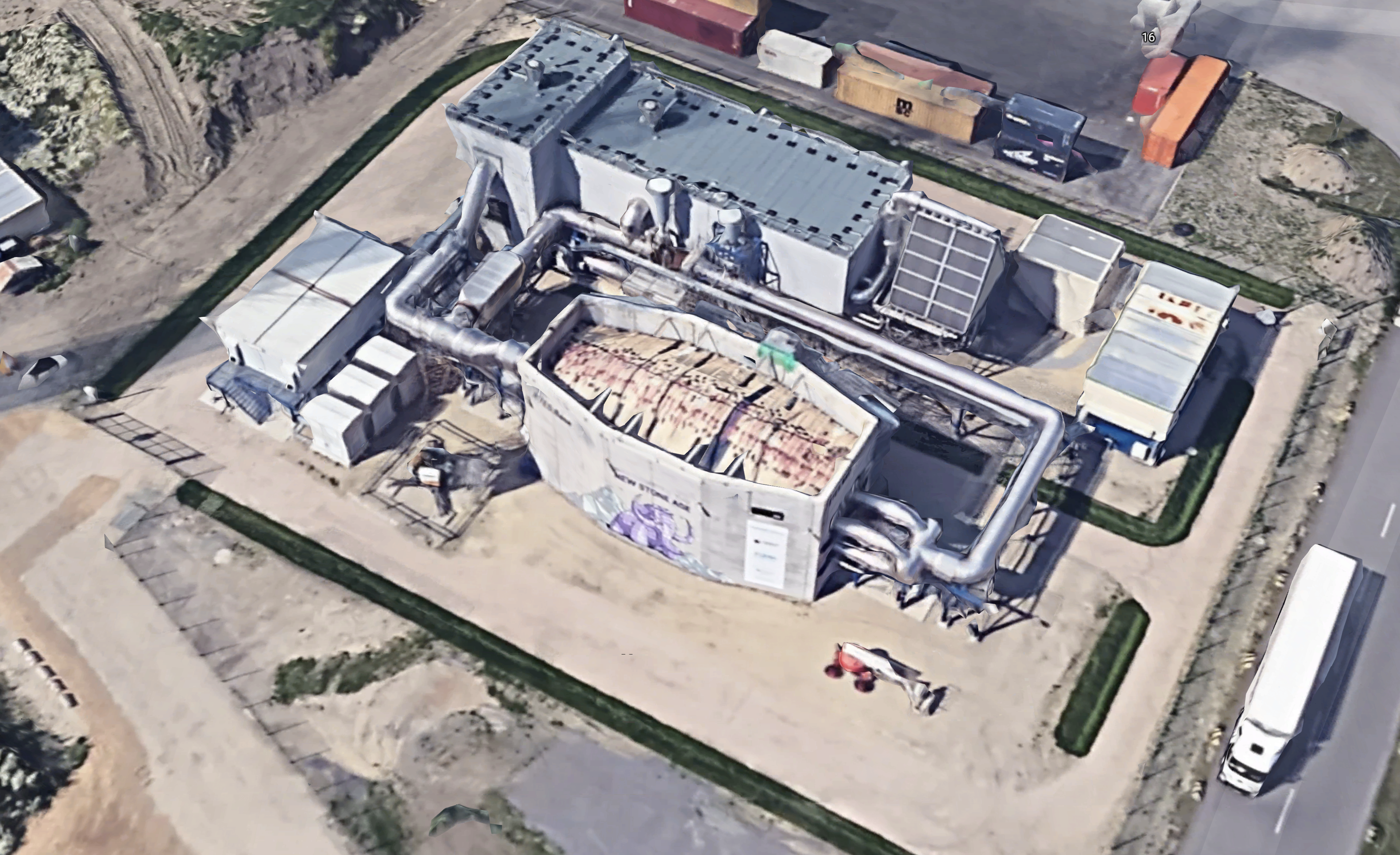
This document on the Siemens Gamesa web site describes the installation.
- The nominal power is 30 MW.
- The capacity is 130 MWh.
- 80 % of the technology is off the shelf.
The picture on the front says “Welcome To The New Stone Age”.
If anybody should find themselves in Hamburg with some time to waste, I’d be very grateful for a copyright-free image.
The installation appears to be just off the VollHöfner Weiden.
JCB Finds Cheap Way To Run Digger Using Hydrogen
The title of this post, is the same as that of this article on The Times.
This is the first two paragraphs.
An operational hydrogen combustion engine developed in Derbyshire could speed up the shift towards zero-emissions transport.
JCB, the construction equipment manufacturer, said that the engine would be capable of powering heavy machinery and vehicles without producing any carbon dioxide.
As they have just modified one of their own production diesel engines to run on hydrogen, this sounds like a major breakthrough of the largest kind!
The caption on the picture says this.
JCB says that the technology could be applied in trucks, vans, trains, buses and even large cars.
What about small cars?
Or perhaps, that market will be left to Aquarius Engines, which I wrote about in New Hydrogen Engine Design Unveiled To Overcome Reliance On Fuel Cells.
You wait months for a major breakthrough in hydrogen propulsion to come along and then two ideas come along in one day.
The article gets better as you read it fully, which I suggest you do.
- It appears, that development only started last July.
- The engines are based on their current JCB diesel engines.
- Emissions include water, no CO2 and practically zero levels of NOx.
The article says this about costs.
It is thought that the hydrogen engines will cost about £10,000 each; costs will be kept down by using the same production lines and many of the same components as diesel engines. By comparison a prototype hydrogen fuel cell system, which is being adapted for a 20-tonne excavator as part of another JCB trial, will cost about £100,000. Batteries needed to power such a machine would probably cost in the region of £160,000, the company said.
When you consider that family member; Joe Bamford owns Wrightbus, I would expect that you’ll see a development of these engines coming to a bus route near you!
Conclusion
I have made money backing developments based on the properties of fluid flow at the small end of gaseous flow.
There are some weird effects there, which are not taught in A-level physics.
Have JCB found how to apply them to create the ultimate zero-carbon power unit?
I’m certainly not ruling it out!
Through Settle And Carlisle Service Under Consideration
The title of this post, is the same as that of an article in the June 2021 Edition of Modern Railways.
This is the first paragraph.
Plans for a new Leeds to Glasgow through service via the Settle and Carlisle line are being developed, with CrossCountry and the Department for Transport starting to look at the possible scheme.
It sounds like a sensible idea to me.
The article also suggests the following.
- CrossCountry is a possible operator.
- CrossCountry are keen to improve services between Leeds and Glasgow
- The trains could be InterCity 125s, freed up, by a the arrival of Class 221 trains from Avanti West Coast, when they receive their new Class 805 trains.
- Maintenance of the trains wouldn’t be a problem, as this could be done at Neville Hill in Leeds or Craigentinny in Edinburgh.
- Services could start in December 2023.
I have a few thoughts of my own!
The Route
The route between Leeds and Carlisle is obvious, but there are two routes between Carlisle and Glasgow.
Trains would probably choose a route and call at stations to maximise passenger numbers.
These stations are on the various routes.
- Settle and Carlisle – Shipley, Bingley, Keighley, Skipton, Gargrave, Hellifield, Long Preston, Settle, Horton in Ribblesdale, Ribblehead, Dent, Garsdale, Kirkby Stephen, Appleby, Langwathby, Lazonby & Kirkoswald and Armathwaite
- Glasgow South Western – Dunlop, Stewarton, Kilmaurs, Kilmarnock, Auchinleck, New Cumnock, Kirkconnel, Sanquhar, Dumfries, Annan and Gretna Green
- West Coast Main – Motherwell, Carstairs and Lockerbie
There are certainly a lot of possibilities.
Upgrading The InterCity 125 Trains
CrossCountry appear to have enough InterCity 125 trains to muster five in a two Class 43 power car and seven Mark 3 coach formation.
They may not be fully in-line with the latest regulations and there may be a need for a certain degree of refurbishment.


These pictures show some details of a refurbished Great Western Railway Castle, which has been fitted with sliding doors.
Will The InterCity 125 Trains Be Shortened?
Scotrail’s Inter7City trains and Great Western Railway’s Castle trains have all been shortened to four or five coaches.
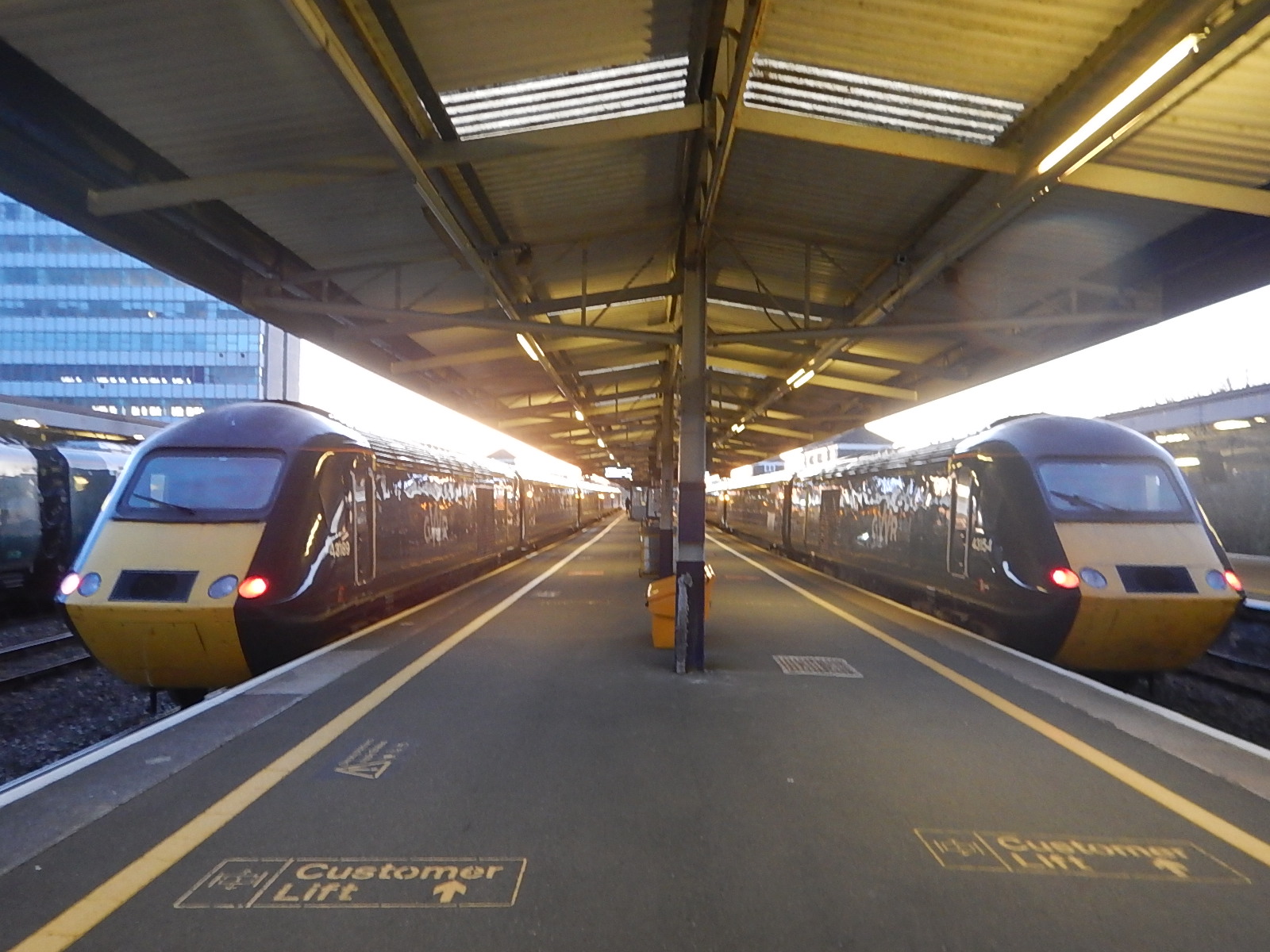
This picture shows a pair of Castles.
Journey Times, Timetable And Frequency
The current journey time between Leeds and Glasgow Central stations via the East Coast Main Line is four hours and eight minutes with nine stops.
The Modern Railways article says this about the current service.
The new service would be targeted at business and leisure travellers, with through journey times competitive with road and faster than the current direct CrossCountry Leeds to Glasgow services via the East Coast main line.
I would expect that CrossCountry are looking for a time of around four hours including the turn round.
- Stops could be removed to achieve the timing.
- The trains could run at 125 mph on the West Coast Main Line.
This could enable a train to have the following diagram.
- 0800 – Depart Leeds
- 1200 – Depart Glasgow Central
- 1600 – Depart Leeds
- 2000 – Depart Glasgow Central
- Before 2400 – Arrive Leeds
Note.
- A second train could start in Glasgow and perform the mirrored timetable.
- Timings would probably be ideal for train catering.
- Trains would leave both termini at 0800, 1200, 1600 and 2000.
- The timetable would need just two trains.
I also think, if a second pair of trains were to be worked into the timetable, there could be one train every two hours on the route, if the demand was there.
I certainly believe there could be a timetable, that would meet the objectives of attracting business and leisure passengers away from the roads.
Tourism And Leisure Potential
The Settle and Carlisle Line is known as one of the most scenic railway lines in England, if not the whole of the UK.
There are important tourist sites all along the route between Leeds and Glasgow
- Leeds – The station is well-connected in the City Centre.
- Saltaire – For the World Heritage Site and Salt’s Mill
- Keighley – For the Keighley and Worth Heritage Railway
- Settle – The town of Settle is worth a visit.
- Ribblehead – For the famous Ribblehead Viaduct
- Appleby – For the Horse Fair.
- Carlisle – The station is well-connected in the City Centre.
- Glasgow – Glasgow Central station is well-connected in the City Centre.
Many of the stations are used by walkers and others interested in country pursuits.
I believe that it is a route that needs a quality rail service.
Travel Between London and Towns Along The Settle And Carlisle Line
In Thoughts On Digital Signalling On The East Coast Main Line, I said this.
I think it is highly likely that in the future, there will be at least one train per hour (tph) between London Kings Cross and Leeds, that does the trip in two hours.
It may seem fast compared to today, but I do believe it is possible.
With a timely connection at Leeds station, will this encourage passengers to places along the Settle and Carlisle line to use the train?
What About the Carbon Emissions?
The one problem with using InterCity 125 trains on this route, is that they are diesel-powered, using a pair of Class 43 locomotives.
But then there are over a hundred of these diesel-electric locomotives in service, nearly all of which are now powered by modern MTU diesel engines, which were fitted in the first decade of this century.
Consider.
- The locomotives and the coaches they haul have an iconic status.
- Great Western Railway and Scotrail have recently developed shorter versions of the trains for important routes.
- There are over a hundred of the locomotives in service.
- Companies like ULEMCo are developing technology to create diesel-powered vehicles that can run on diesel or hydrogen.
- There is plenty of space in the back of the locomotives for extra equipment.
- MTU have a very large number of diesel engines in service. It must be in the company’s interest to find an easy way to cut carbon emissions.
- I believe that the modern MTU diesel engines could run on biodiesel to reduce their carbon footprint.
And we shouldn’t forget JCB’s technology, which I wrote about in JCB Finds Cheap Way To Run Digger Using Hydrogen.
If they could develop a 2 MW hydrogen engine, it could be a shoe-in.
I believe that for these and other reasons, a solution will be found to reduce the carbon emissions of these locomotives to acceptable levels.
Conclusion
In this quick look, it appears to me that a Glasgow and Leeds service using InterCity 125 trains could be a very good idea.
New Hydrogen Engine Design Unveiled To Overcome Reliance On Fuel Cells
The title of this post, is the same as that of this article on Hydrogen Fuel News.
The article describes an innovative hydrogen-powered engine developed by an Israeli company called Aquarius Engines.
This is the sub-heading, that gives a little bit more information.
Aquarius Engines has developed a small 10kg emission-free unit operating entirely on H2.
It appears to be based on the company’s patented single-piston-linear-engine.
This page on the Aquarius web site describes the combustion technology in a short video.
Wikipedia also has an entry on the free-piston engine.
The power output of the Aquarius engine is not given.
Conclusion
I have a hunch, that Aquarius Engines might be on to something!
Light weight is so important in many applications.
Gravitricity Adds Hydrogen To Energy Storage Mix
The title of this post, is the same as that of this press release on the Gravitricity web site.
These are the first two paragraphs of the press release.
Energy storage specialists Gravitricity have revealed plans to add hydrogen and heat storage to their underground gravity energy system.
The Edinburgh innovators have submitted a global patent to turn purpose-built shafts into pressurised energy stores, capable of safely accumulating significant quantities of the gas.
These are my observations.
- I believe the original concept of storing energy will work, which is why I have invested.
- Other companies are proposing to store hydrogen under pressure below ground.
- Heat is being extracted from the London Underground and used for heating buildings.
- Using one hole for three purposes must be more cost-efficient.
These processes might be easier with a regular clean purpose-built shaft!
£3m Hackney Overground Station Upgrade To Begin In June
The title of this post, is the same as that of this article on the Hackney Gazette.
Selfishly, this is the improvement, that I’m waiting for.
I live to the West of Dalston Junction station on the 38 bus route. The second entrance will make getting to and from Stratford and the various attractions there much easier.
Highview Power Unveils $1bn Of Liquid-Air Energy Storage Projects In Spain
The title of this post, is the same as that of this article on Recharge Magazine.
The article is based on this press release from Highview Power, which is entitled Highview Power Developing 2 GWh of Liquid Air Long Duration Energy Storage Projects in Spain.
This is the introductory paragraph from the press release.
Highview Power, a global leader in long duration energy storage solutions, announced today it is developing up to 2 GWh of long duration, liquid air energy storage projects across Spain for an estimated investment of around $1 billion. These projects will enable several Spanish regions to move towards their net zero emissions target.
The press release also says this about location and size.
Highview Power is planning to develop up to seven CRYOBattery™ projects ranging from 50 MW/300 MWh in Asturias, Cantabria, Castilla y Leon, and the Canary Islands.
Three of these areas are in Northern Spain and the other is a group of islands.
As Spain has at least two large pumped storage systems, perhaps geography rules this proven technology out in these areas.
System Modularity
According to the Wikipedia entry for Highview Power, the two current CRYOBatteries under development are sized as follows.
- Carrington, Manchester, UK – 50 MW/250 MWh – Under construction
- Vermont, USA – 50 MW/400 MWh – Under development
Do the figures indicate that several systems will share the same 50 MW core power system, with a number of liquid air tanks to give the appropriate capacity?
I have extensively modelled chemical plants in my past to see, how different sizes work and I am fairly certain, that Highview Power have developed a design, that is extremely flexible.
It looks like if initial calculations show that a system capable of supplying 50 MW for five hours is needed, but operation proves that a capacity of six hours would be better, that all Highview Power need to do is add another 50 MWh tank.
This is surely an operator’s dream, as if say a developer builds a thousand dwellings and/or a windfarm nearby and more energy storage is needed, an appropriate number of extra tanks can be added.
Sourcing The 50 MW Core Power System
I talked about how the first system at Carrington will use a system from MAN Energy Solutions in MAN Energy Partners With Highview Power On Liquid-Air Energy-Storage Project.
This surely is an approach that minimises risk.
Sourcing The Storage Tanks
I have been searching the Internet for manufacturers of cryogenic gas tanks and I’ve found them in countries like Australia, Brazil, Germany, India, South Africa, Spain, the UK and the US.
But then most hospitals have one for their liquid oxygen.
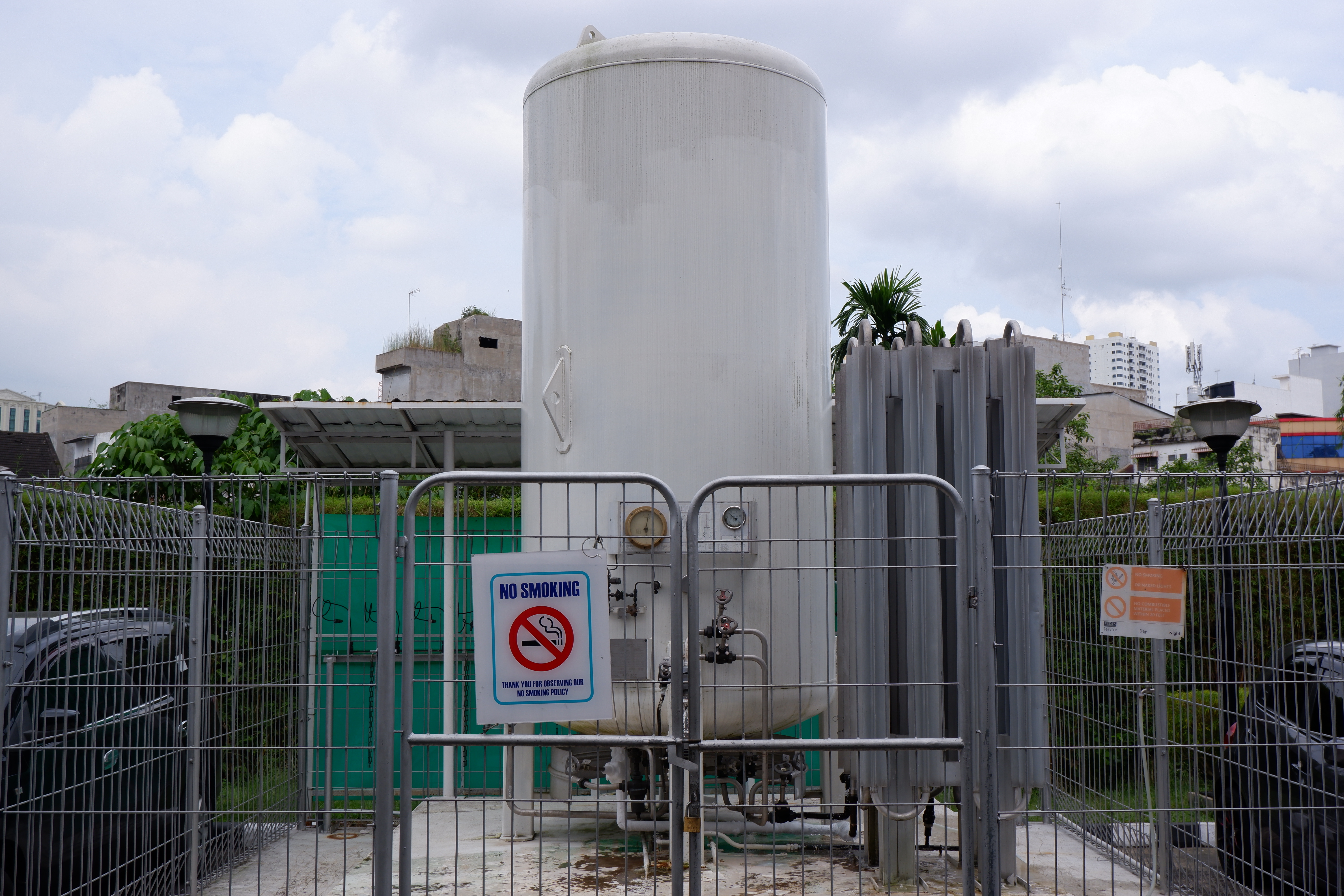
This image was from shutterstock.
They are not difficult to find.
Spain And Renewable Energy
Spain is a large producer of renewable energy and also a leader in wind and solar power technology.
See Renewable Energy in Spain on Wikipedia for more details.
Siemens Gamesa, which was created by a merger of a German and a Spanish company and is headquartered at Zamudio in Spain, have also developed the Siemens Gamesa ETES, which is a volcanic rock-based energy storage system about the same size of Highview Power’s CRYOBattery.
Conclusion
It looks to me, that Highview Power have closed a good sale.
A Trip To Corby
I took these pictures on a trip to Corby this morning.
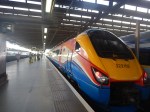

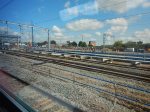

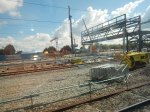



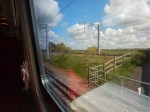
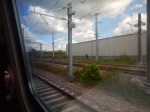
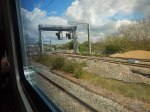



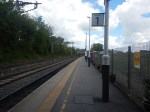

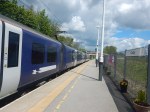
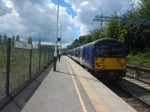


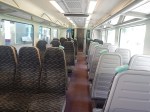
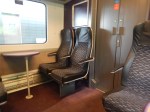


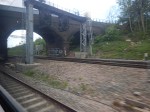
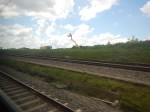




These are my thoughts.
Trains To And From Corby
I got a Class 222 train to Corby and an eight-car Class 360 train back.
Brent Cross West Station
There was a lot of constructruction activity at the new Brent Cross West station.
Luton Airport Parkway Station
The extensions to Luton Airport Parkway station look to be comprehensive, with several escalators.
The Luton DART connection to Luton Airport appears to be under test, so should open in 2022.
But will there be any air passengers to use it?
I last used it in 2008, when I went to see England play in Belarus.
Electrification North Of Bedford
The electrification North of Bedford station is obviously complete on the slow lines, but on the fast lines, as the pictures show, the gantries are all erected, but there are still wires to be installed.
But as the Class 810 trains won’t be in service until 2023, there’s still a bit of time.
The gantries certainly look sturdy, as this picture shows.
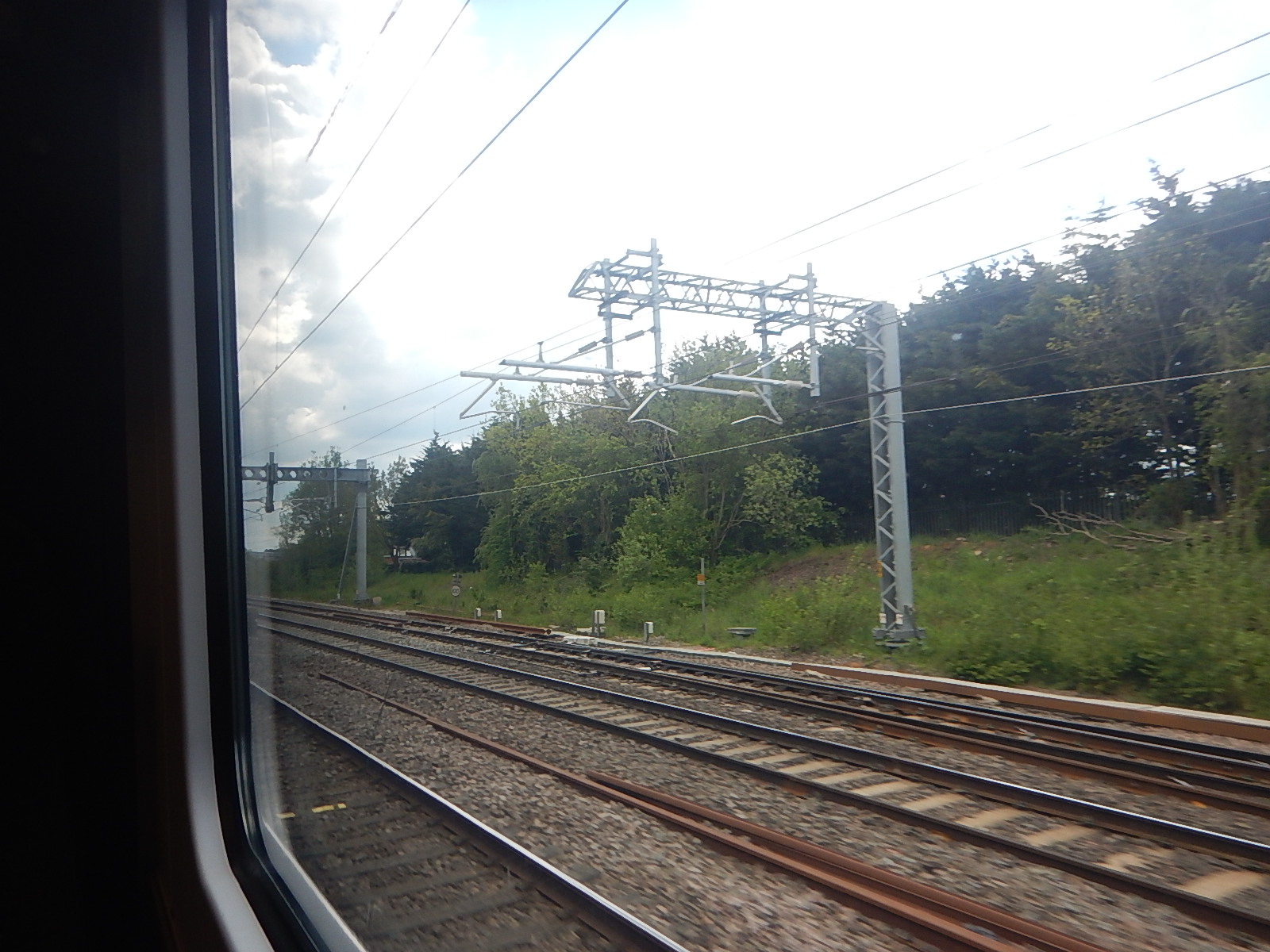
They’re certainly built for 125 mph, but as the Class 810 trains will be capable of 140 mph with full digital in-cab signalling, I would hope that the electrification has been installed to that standard. Or at least to a standard, that can be easily upgraded!
Corby Station
Corby station has been finished to a single-platform station, which is able to accept a twelve-car Class 360 train.
This should be adequate for the current half-hourly service, as a single platform can handle a least four trains per hour (tph) and several around the country regularly do.
Both tracks through the station are electrified and I suspect with a second platform bridge, both could be used by electric trains to create a two-platform station.
But there would appear to be no need at the moment.
Even, if it were to be decided to extend one tph to Oakham and Melton Mowbray stations, this could probably be accommodated on the single-platform.
Network Rail seem to have already installed a crossover South of Corby station, so that trains can use the single platform.
Serving Oakham And Melton Mowbray
I discussed this extension in detail in Abellio’s Plans For London And Melton Mowbray Via Corby And Oakham.
In the related post, I said this.
This page on the Department for Transport web site is an interactive map of the Abellio’s promises for East Midlands Railway.
These are mentioned for services to Oakham and Melton Mowbray.
-
- After electrification of the Corby route there will continue to be direct service each way between London and Oakham and Melton Mowbray once each weekday, via Corby.
- This will be operated with brand new 125mph trains when these are introduced from April 2022.
This seems to be a very acceptable minimum position.
When my Class 222 train arrived in Corby at 1154, it waited a couple of minutes then took off to the North.
I then took the next train to London, which was an eight-car Class 360 train which formed the 1211 service back to St. Pancras.
Meanwhile the Class 222 train, that I’d arrived on did a reverse in the Corby North Run Around Loop finally arriving back in Corby at 1345. The train had taken one hour and forty-nine minutes to return to Corby.
It might be just coincidence, but are East Midlands Railway doing timing tests to see if services can be extended to Oakham And Melton Mowbray?
It should be noted that service times North of Corby are as follows.
- Corby and Oakham – 19 mins – 14.3 miles
- Corby and Melton Mowbray – 31 mins – 25.7 miles
- Melton Mowbray and Leicester – 17 mins – 12.8 miles (estimate) – CrossCountry service
My logic goes like this.
- It looks to me that it would not be unreasonable that a Class 222 train could run between Corby and Leicester in forty-eight minutes.
- Double that and you get one hour and thirty eight minutes, for a journey from Corby to Leicester and back.
- Subtract that time from the one hour and forty-nine minutes that my train took to reverse and there is eleven minutes for a turnback at Leicester station.
- Eleven minutes would certainly be long enough to tidy a train and for the crew to change ends.
I also believe that the 35.8 miles would be possible for a Class 810 train fitted with one or more battery power-packs instead of a similar number of the four diesel engines.
So are East Midlands Railway doing tests to find the most efficient way to serve Oakham And Melton Mowbray?
On The Corby Branch
I travelled North on a Class 222 diesel train and South on an electric Class 360 train.
On the Corby branch, I was monitoring the train speed on an app on my phone and both trains travelled at around 90 mph for most of the way.
There were sections at up to 100 mph and the track was generally smooth.
I was left with the impression, that trains might be able to go faster on the branch.
Average speeds for the 2.5 miles of the branch were as follows according to these timings from realtimetrains.
- Class 222 train – Arriving – 5.25 mins – 28.6 mph
- Class 222 train – Leaving – 5 mins – 30 mph
- Class 360 train – Arriving – 7.5 mins – 20 mph
- Class 360 train – Leaving – 5 mins – 30 mph
It doesn’t appear that there are much difference in the timings, although it might be said, that the electric approach is more cautious.
The Class 360 Trains
The Class 360 trains have not been refurbished yet although as my pictures show, some have been given a new livery.
In Are Class 360 Trains Suitable For St. Pancras And Corby?, I said this about the train refurbishment.
This page on the Department for Transport web site is an interactive map of the Abellio’s promises for East Midlands Railway.
These features are mentioned for Midland Main Line services to Corby.
-
- Increased capacity
- Twelve-car trains in the Peak.
- More reliable service
- Improved comfort
- Passenger information system
- Free on-board Wi-Fi
- At-seat power sockets
- USB points
- Air conditioning
- Tables at all seats
- Increased luggage space
- On-board cycle storage
What more could passengers want?
It certainly hasn’t happened in full.
I did ask a steward, when the new interiors will be installed and he said they were running late because of the pandemic.
Performance Of The Class 360 Trains
I used my app to follow the speed of the Class 360 train, that brought me back to London.
- The train hit a maximum speed of about 105 mph.
- The train arrived in London a minute late.
I feel that as the drivers get used to their new charges, they will match the timetable.
Conclusion
I have a feeling that in a couple of years, these trains will fulfil Abellio’s promises.
 The Anonymous Widower