Snam, ITM Power To Develop Green Hydrogen Projects
The title of this post, is the same as that of this article on Renewables Now.
Points from the article.
- Snam will pump £30 million into ITM Power.
- Snam are planning up to 100 MW of green hydrogen projects.
In Joint Venture With Linde AG And £38M Strategic Investment, I asked “How Much Hydrogen Would A 5 MW Electrolyser Create In A Day?”
- I gave the answer as 2.182 tonnes of hydrogen, so multiplying up by twenty gives 43.6 tonnes of hydrogen.
- In a Wikipedia entry called Renewable Energy in Italy, it is stated that Italy produced 51.5 GW of renewable energy in 2015.
- The UK produced 30 GW of renewable energy in 2015, but our capacity is growing fast.
I suspect Italy will have plenty enough renewable electricity to supply 100 MW for hydrogen.
As iTM Power are building a factory to manufacture one GW of electrolysers per year, I suspect they can provide their part of the hasrdware for the Italian job.
Renewable Hydrogen Will Replace Natural Gas In Millions Of Australian Households
The title of this post, is the same as that of this article on Hydrogen Fuel News.
This is the introductory paragraph.
Under a new Australian government-backed initiative, millions of households across the country will be supplied with renewable hydrogen in the place of natural gas.
The project will start in a small way by adding 10 % of hydrogen to the natural gas networks by the end of 2022.
Eventually, hydrogen will completely replace natural gas.
According to one of the comments to the article, ITM Power will supply the electrolysers.
That could be a nice little order.
My Second (And Cold) Christmas Dinner
As I wrote in Cooking My Christmas Dinner, I had a lot of food left over from Friday, as this picture showed.
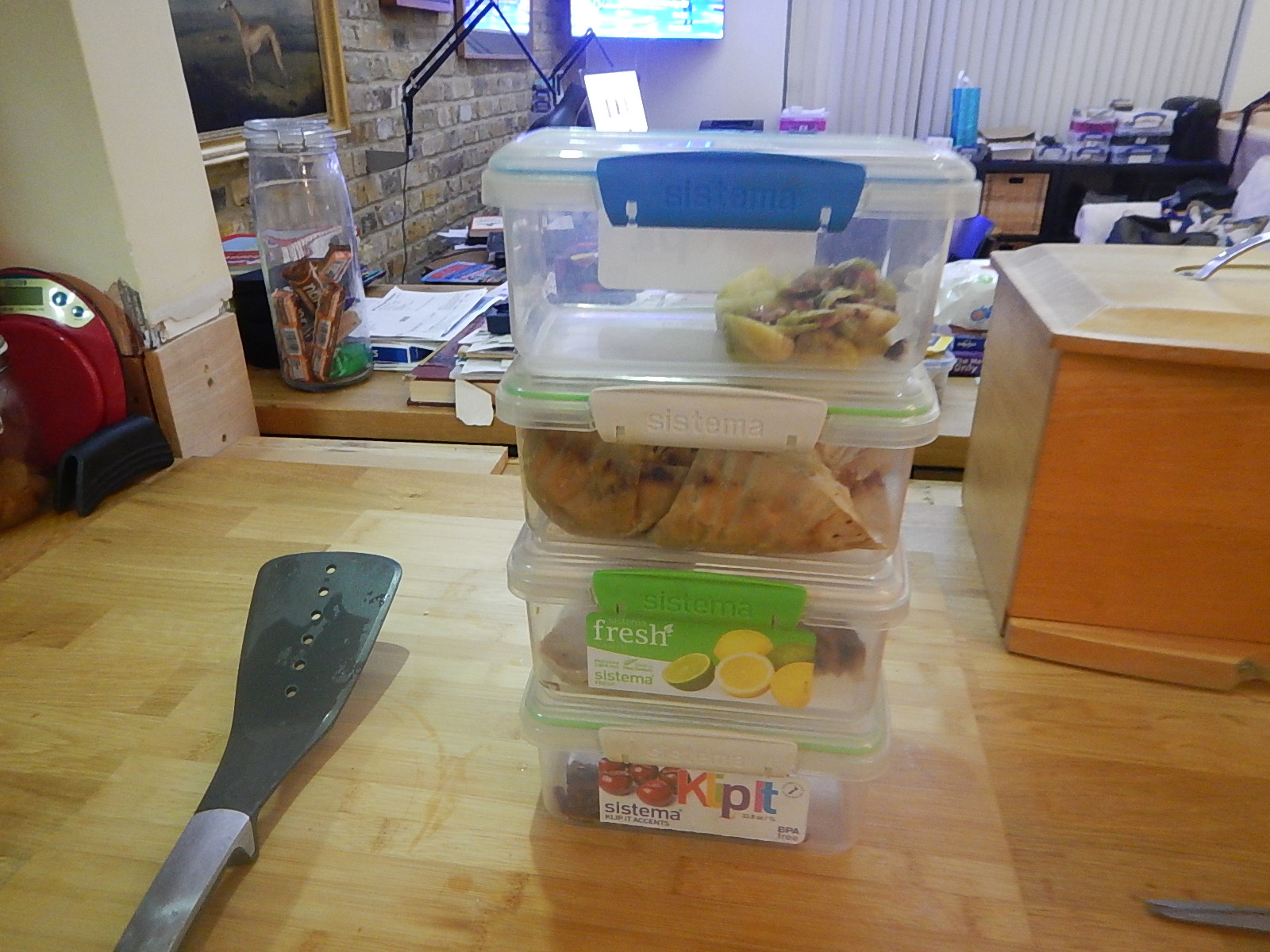
So on Sunday, I had a cold lunch based on what was left.

I’ve still got some of the delicious cauliflower cheese for lunch today or tomorrow!
I think I can say, that this Christmas Feast from Roasted by Jack and Scott has been an unqualified success!
- The delivery turned up, when they said it would.
- The cooking time of just forty minutes was amazing.
- The vegetables were superb!
- I ate all the Christmas pudding, which is rare.
- The amount of washing up was small.
- There is no remains of a large bird to deal with!
I have said to my son, that if we get together next year, I’ll look seriously at using Jack and Scott again. I think I could just about cook for four on my small cooker.
Charging The Batteries On An Intercity Tri-Mode Battery Train
There are several ways the batteries on an Intercity Tri-Mode Battery Train could be charged.
- On an electrified main line like the Great Western or East Coast Main Lines, the electrification can be used in normal electrified running.
- A short length of electrification at the terminal or through stations can be used.
- The diesel engines could be used, at stations, where this is acceptable.
Alternatively, a custom design of charger can be used like Vivarail’s Fast Charge system.
In Vivarail’s Plans For Zero-Emission Trains, I said this.
Vivarail Now Has Permission To Charge Any Train
Mr. Shooter said this about Vivarail’s Fast Charge system.
The system has now been given preliminary approval to be installed as the UK’s standard charging system for any make of train.
I may have got the word’s slightly wrong, but I believe the overall message is correct.
In the November 2020 Edition of Modern Railways, there is a transcript of what Mr. Shooter said.
‘Network Rail has granted interim approval for the fast charge system and wants it to be the UK’s standard battery charging system’ says Mr. Shooter. ‘We believe it could have worldwide implications.’
I hope Mr. Shooter knows some affordable lawyers, as in my experience, those working in IPR are not cheap.
I think it’s very likely, that Vivarail’s Fast Charge system could be installed at terminals to charge Hitachi’s Intercity Tri-Mode Battery Trains.
-
- The Fast Charge systems can be powered by renewable energy.
- The trains would need to be fitted with third rail shoes modified to accept the high currents involved.
- They can also be installed at intermediate stations on unelectrified lines.
Vivarail is likely to install a Fast Charge system at a UK station in the next few months.
These are my thoughts about charging trains at various stations.
Penzance station
This Google Map shows Penzance station.
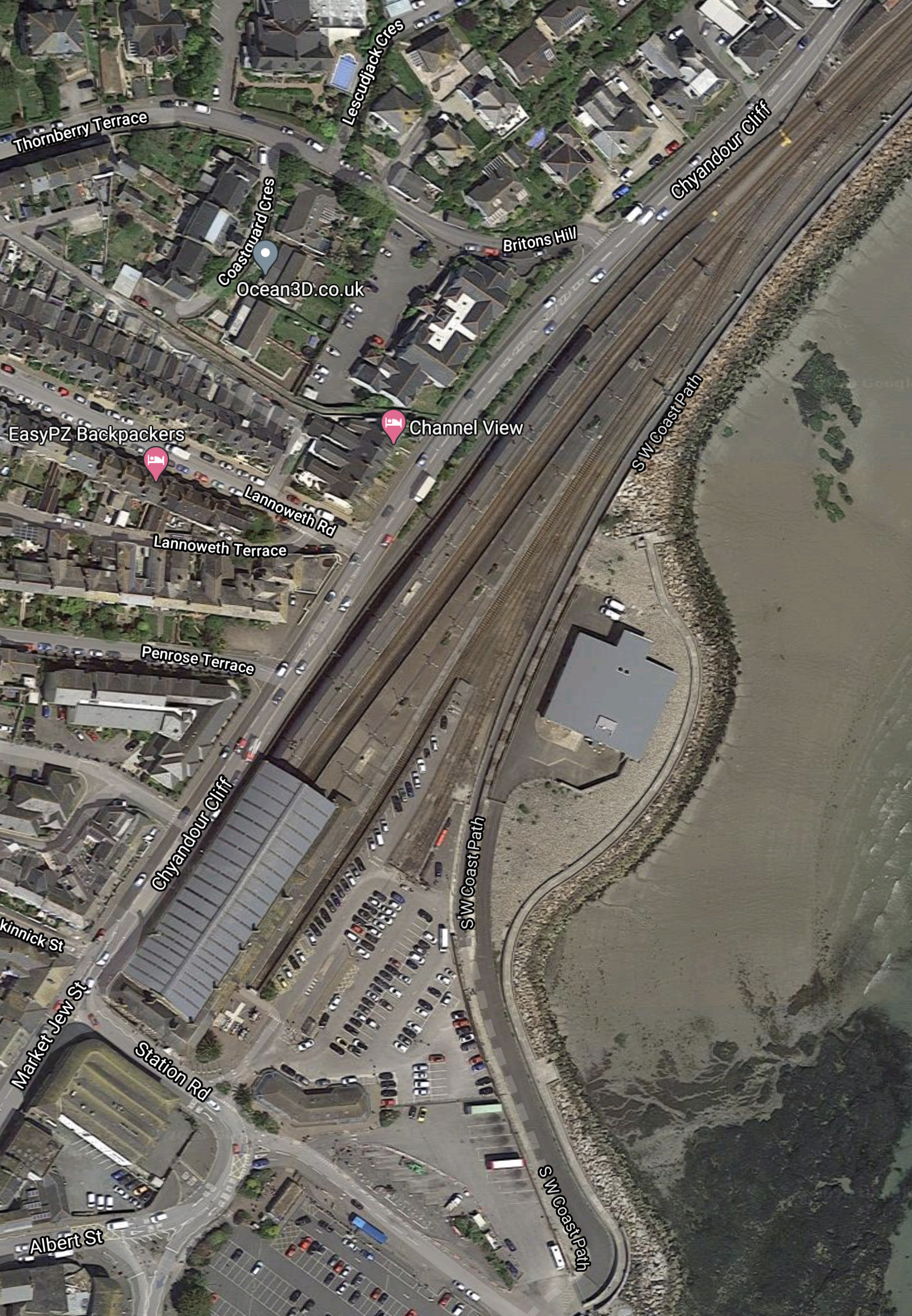
Penzance would be an ideal station to fully charge the trains, before they ran East.
- The station has four long platforms.
- There appears to be plenty of space just to the East of the station.
- Penzance TMD is nearby.
This picture shows Platform 4, which is on the seaward side of the station. The train in the platform is one of GWR’s Castles.
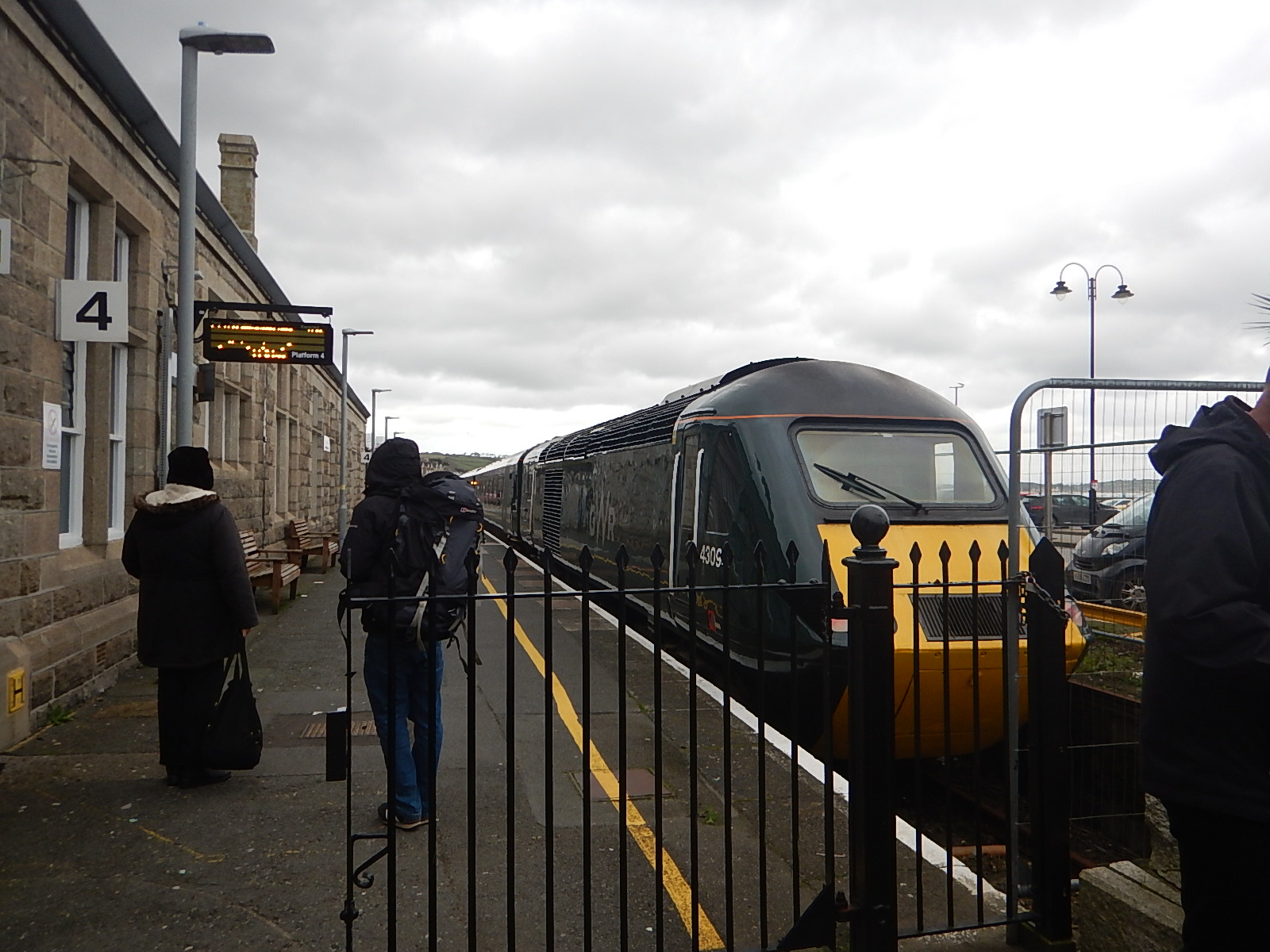
It is partly outside the main station, so might be very suitable to charge a train.
If trials were being performed to Penzance, it appears that the station would be a superb choice to charge trains.
My only worry, is would the location have enough power to charge the trains?
Plymouth Station
This Google Map shows Plymouth station.

It is another spacious station with six platforms.
Chargers could be installed as needed for both expresses and local trains.
A Zero-Carbon Devon and Cornwall
If the battery trains perform as expected, I can see the Devon and Cornwall area becoming a low if not zero carbon railway by the end of this decade.
- The Castles would be retired.
- They would be replaced by battery electric trains.
- Charging would be available on all platforms at Penzance, Plymouth and possible some other intermediate stations and those on some branch lines.
It certainly wouldn’t hurt tourism.
Thoughts On Batteries In East Midland Railway’s Class 810 Trains
Since Hitachi announced the Regional Battery Train in July 2020, which I wrote about in Hyperdrive Innovation And Hitachi Rail To Develop Battery Tech For Trains, I suspect things have moved on.
This is Hitachi’s infographic for the Regional Battery Train.

Note.
- The train has a range of 90 km/56 miles on battery power.
- Speed is given at between 144 kph/90 mph and 162 kph/100 mph
- The performance using electrification is not given, but it is probably the same as similar trains, such as Class 801 or Class 385 trains.
- Hitachi has identified its fleets of 275 trains as potential early recipients.
It is also not stated how many of the three diesel engines in a Class 800 or Class 802 trains will be replaced by batteries.
I suspect if the batteries can be easily changed for diesel engines, operators will be able to swap diesel engines and battery packs according to the routes.
Batteries In Class 803 Trains
I first wrote about the Class 803 trains for East Coast Trains in Trains Ordered For 2021 Launch Of ‘High-Quality, Low Fare’ London – Edinburgh Service, which I posted in March 2019.
This sentence from Wikipedia, describes a big difference between Class 803 and Class 801 trains.
Unlike the Class 801, another non-bi-mode AT300 variant which despite being designed only for electrified routes carries a diesel engine per unit for emergency use, the new units will not be fitted with any, and so would not be able to propel themselves in the event of a power failure. They will however be fitted with batteries to enable the train’s on-board services to be maintained, in case the primary electrical supplies would face a failure.
Nothing is said about how the battery is charged. It will probably be charged from the overhead power, when it is working.
The Intercity Tri-Mode Battery Train
Hitachi announced the Intercity Tri-Mode Battery Train in this press release in December 2020.
This is Hitachi’s infographic for the Intercity Tri-Mode Battery Train.

Note.
- The train is battery-powered in stations and whilst accelerating away.
- It says that only one engine will be replaced by batteries.
- Fuel and carbon savings of 20 % are claimed.
Nothing has been said in anything, I’ve read about these trains, as to whether there is regenerative braking to batteries. I would be very surprised if fuel and carbon savings of 20 % could be attained without regenerative braking to batteries.
In Do Class 800/801/802 Trains Use Batteries For Regenerative Braking?, I discussed the question in the title.
This is a shortened version of what I said in that post.
If you type “Class 800 regenerative braking” into Google, you will find this document on the Hitachi Rail web site, which is entitled Development of Class 800/801 High-speed Rolling Stock for UK Intercity Express Programme.
If you search for brake in the document, you find this paragraph.
In addition to the GU, other components installed under the floor of drive cars include the traction converter, fuel tank, fire protection system, and brake system.
Note that GU stands for generator unit.
The document provides this schematic of the traction system.

Note that BC which is described as battery charger.
Is that for a future traction battery or a smaller one used for hotel power as in the Class 803 train?
As a Control and Electrical Engineer, it strikes me that it wouldn’t be the most difficult problem to add a traction battery to the system.
From what Hitachi have indicated in videos, it appears that they are aiming for the battery packs to be a direct replacement for the generator unit.
Generator Unit Arrangement In Class 810 Trains
When I wrote Rock Rail Wins Again!, which was about the ordering of these trains, the reason for four engines wasn’t known.
It now appears, that the extra power is needed to get the same 125 mph performance on diesel.
The formation of a five-car Class 802 train is as follows.
DPTS-MS-MS-MC-DPTF
Note.
- The three generator units are in the three middle cars.
- The three middle cars are motored.
- The two driver cars are trailer cars.
How are Hitachi going to put four generator units into the three middle cars?
- I wonder if, the engines can be paired, with some auxiliaries like fuel-tanks and radiators shared between the generators.
- A well-designed pair might take up less space than two singles.
- A pair could go in the centre car and singles either side.
It will be interesting to see what the arrangement is, when it is disclosed.
Is there the possibility, that some of the mathematics for the Intercity Tri-Mode Battery Train has indicated that a combination of generator units and battery packs can give the required 125 mph performance?
- Battery packs could need less space than diesel generators.
- Regenerative braking could be used to charge the batteries.
- How far would the train be able to travel without electrification?
- Trains would not run the diesel engines in the station.
- Could the fuel and carbon savings of 20 %, that are promised for the Intercity Tri-Mode Battery Train, be realised?
There may be a train buried in the mathematics, that with some discontinuous electrification could handle the East Midlands Railway Intercity services, that generates only a small amount of carbon!
Would A Mix Of Diesel Generators And Battery Packs Enable 125 mph Running?
Consider.
- The trial Intercity Tri-Mode Battery Train intended for the London Paddington and Penzance route, will probably have two diesel generators and a battery pack according to what Hitachi have said in their infographic for the Intercity Tri-Mode Battery Train.
- East of Plymouth some of the stretches of the route are challenging, which resulted in the development and ordering of Class 802 trains, that are more powerful, than the Class 800 trains used on easier routes.
- An Intercity Tri-Mode Battery Train with two diesel generators and a battery pack, needs to be as powerful as a Class 802 train with three diesel generators.
- So effectively does that mean that in the right installation with top class controlling software, that in fast running, a battery pack can be considered equivalent to a diesel generator?
I don’t know, but if it’s possible, it does bring other advantages.
- Fuel and carbon savings of 20 %
- No diesel running in stations or whilst accelerating away.
- Better passenger environment.
Configurations of 3-plus-1 and 2-plus 2 might be possible.
All I wanted For Christmas Was A Short-Sleeved Dressing Gown
If it is one thing that annoys me, is a dressing gown, with long voluminous sleeves.
So I asked my son and son-in-law to get me one with short sleeves.

I have worn it to do the washing up and I’m wearing it, whilst writing this post.
My Christmas Pudding
These pictures show my Christmas pudding, which I had tonight.




Note.
- I just put it in the oven for fifteen minutes.
- It was excellent!
I’d certainly have another one!
Cooking My Christmas Dinner
These pictures show how I cooked my Christmas Feast for One from Roasted by Jack and Scott.

















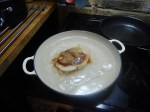




Note.
- It took under forty minutes from when the oven had warmed up and the water was simmering to cook the meal.
- The only utensils I used were a pair of scissors and a slice to get the bags out of the hot water.
- Washing up was minimal and nothing needed a heavy scrub, which is always a good thing.
- Vegetables were over generous for someone like me, who only weighs 63 kilos.
Anybody, who can put together some IKEA flatpack furniture and who knows how to boil water, stick a ready meal in the oven, should be able to cook this meal.
I have to wonder how many people could cook a delicious meal like this this from scratch in forty minutes.
The package included Christmas pudding. I’ll cook that tomorrow!
I can also remember several fraught Christmas mornings, when C was cooking Christmas Dinner. Usually, they involved my mother-in-law! This meal would certainly avoid, the too many cooks problem, as one person could cook a meal for four in well under an hour.
If I have to spend Christmas by myself again or I am entertaining a small number of people, I’ll seriously think about going back to Jack and Scott.
Dangerous Innovation
I had to put a link to this article on the Romford Recorder, which is entitled Heritage: Sootigine, Dagfert and Baxtrol.
It is a tale of dangerous products mainly developed in East London.
It has to be read, as no precis of mine can do it justice.
I will add a story, that was told by the guy whose bottom fell out in this post.
The guy in the story had at one time been the Complaints Manger for Ford in Dagenham.
This was one of his tales.
Ford received a complaint via the main dealer in East London.
- The engine had failed in a car about six months old.
- So he arranged a time to meet the owner at the garage.
- When they arrived, he asked, the garage manager to start the car.
- He said that he’d never heard such a noise. All big-ends and the small-ends were making a lot of noise and it was the worst engine he’d ever heard.
- So he asked the manager to put the car on a lift and drop the sump to have a look.
- When the sump was dropped, the manager showed him the sump, which looked like it was full with a waxy solid.
So they asked the owner, who was of Mediterranean origin, what oil he was using in his car.
They got the immortal reply!
“Good enough for my fried fish! Good enough for my car!”
Don’t Worry! – I’m Not Drinking To Oblivion
It’s approaching three o’clock on Christmas Day and the empties are accumulating.

But as I say, there is no worry, as if I drink the fourth bottle, that will only be one unit of alcohol, but four units of taste.
 The Anonymous Widower