Could High Speed Two Trains Serve Chester And North Wales?
This may seem a slightly outrageous proposal to run High Speed Two trains to Chester.
- The city is a major tourist destination.
- Despite its closeness to Crewe it is a major rail hub, with services across Wales to Cardiff, Holyhead and Llandudno and along the border between England and Wales to Shrewsbury and Newport.
- Merseyrail serves the city and the station can be considered to be part of Liverpool’s extensive commuting area. This service is likely to be more reliable and faster with the delivery of new Class 777 trains.
- For parts of Merseyside, travelling to London or Manchester Airport, is easier via Chester than Liverpool Lime Street or Liverpool South Parkway.
If the promoters of High Speed Two are serious about creating a railway for the whole country, then I feel that running trains direct to and from Chester could be very beneficial for the towns and cities, that can be served by the current network at Chester.
Current And Possible Timings
Currently, trains take two minutes over two hours between Euston and Chester.
When Avanti West Coast introduces the new Hitachi AT-300 trains on the route, the following times will be possible.
- Euston and Crewe via West Coast Main Line – 90 minutes – Fastest Pendelino
- Crewe and Chester – 24 minutes – Current timing
This would give a time of one hour and 54 minutes, which is a saving of 8 minutes. But a lot of carbon would not be emitted between Euston and Crewe.
I estimate, that with High Speed Two Phase 2a completed, the following timings will be possible.
- Euston to Crewe via HS2 – 55 minutes – HS2 website
- Crewe and Chester – 24 minutes – Current timing
This would give a time of one hour and 19 minutes, which is a saving of 43 minutes.
Infrastructure Needed
There will need to be some infrastructure changes.
Platform Lengthening At Chester Station
The station would probably be served by two-hundred metre long High Speed Two Classic-Compatible trains, which might need some platform lengthening.
This Google Map shows the station.
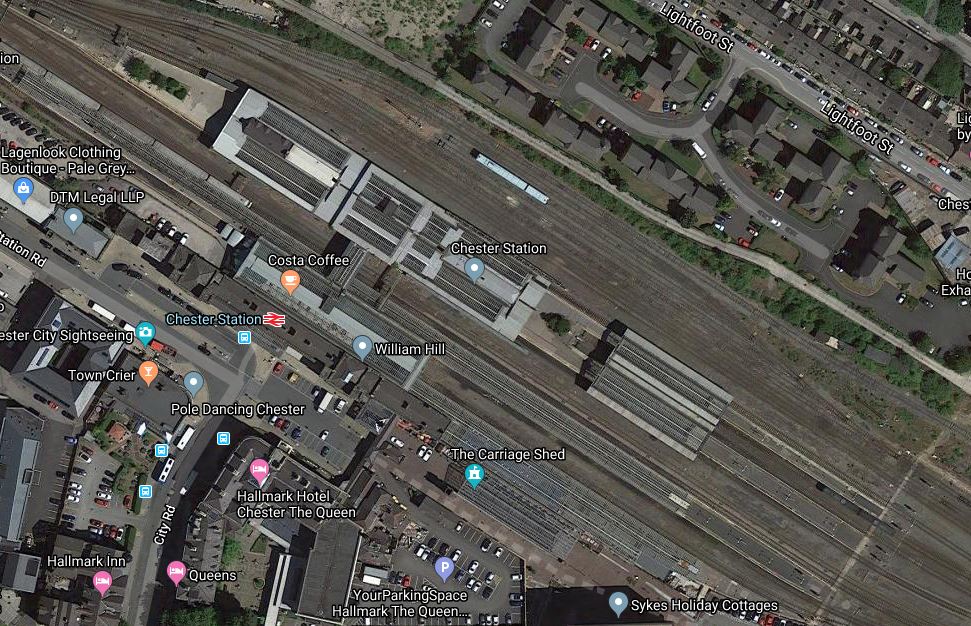
It looks to me, that there is plenty of space.
Will Chester And Crewe Be Electrified?
We know little about the capabilities of the trains proposed by the various manufacturers.
But, I wouldn’t be surprised that one or more of the proposals use batteries for one of the following purposes.
- Regenerate braking.
- Emergency power.
- Range extension for up to perhaps sixty miles.
As Chester and Crewe stations are only twenty-one miles apart with no intermediate stations, which will be run at an average speed of only 52 mph I don’t think it will be impossible to extend the service to Chester on battery power.
If electrification is required I wrote about it in Hitachi Trains For Avanti.
As it is only just over twenty miles, I don’t think it will be the most challenging of projects, although there does seem to be a lot of bridges.
Electrification would also allow Avanti West Coast’s Hitachi trains to run on electricity to Chester.
What About Holyhead?
Holyhead could become a more important destination in the next few years.
It is probably the best alternative to avoid flying and driving between Great Britain and the Island of Ireland.
And who can accurately predict, what effect Brexit and thinking about global warming will have?
I have a feeling that after electrification to Chester, using on-board energy storage could be used West of Chester.
It is very difficult to predict battery ranges in the future, but I can see a two hundred metre long High Speed Two Classic-Compatible train being able to reach Holyhead on battery power, with or without some limited extra electrification.
Alternatively, the UK and Welsh governments, might bite the bullet and just electrify the whole route between Crewe and Holyhead.
I have found a train on Real Time Trains, that covered the 105.5 miles between Holyhead and Crewe in two hours and 11 minutes at an average speed of 48 mph. The train took then a total of three hours and forty-five minutes to get to Euston
I estimate that with electrification and some track improvements, that it will be possible to travel between Euston and Holyhead in under three hours before High Speed Two.
Conclusion
It looks to me, that when High Speed Two, think about adding extra destinations, Chester and Holyhead could be on the list.
I also suspect that even without electrification and High Speed Two services, but with the new Class 805 trains, the route could be a valuable one for Avanti West Coast.
Should Phase One Of High Speed Two Go To Birmingham Or Crewe?
The important Crewe station is currently planned to be reached from London in Phase 2a of High Speed Two, with the first train scheduled for 2027, according to Wikipedia.
There have been changes over the years and the delivery of the line at Crewe was brought forward by a few years, so that now it is just twelve months after the line opened to Birmingham.
So is it better that Phase 1 of High Speed Two goes to Birmingham or Crewe?
The Route Of High Speed Two Between Birmingham And Crewe
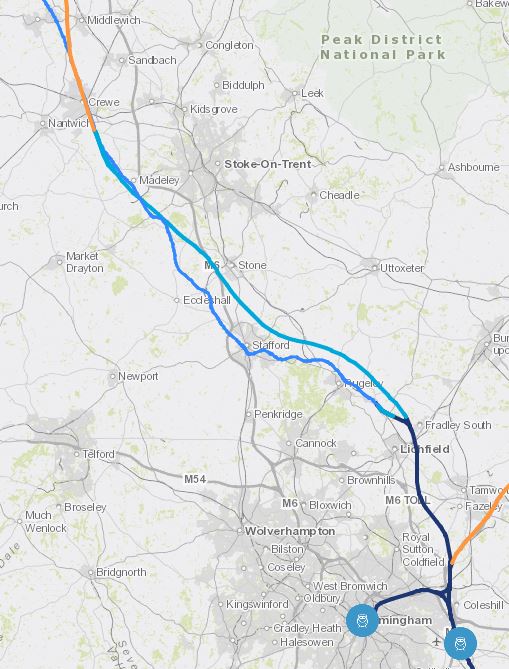
This map clipped from the High Speed Two web site, shows the route between Birmingham and Crewe.
Note.
- Phase 1 is shown in dark blue
- Phase 2a is shown in a lighter blue.
- Phase 2b is shown in orange.
- Crewe is in the North-West corner of the map.
- Of the two routes in the middle Phase 2a is to the East with the West Coast Main Line to the West.
- Birmingham is in the South-East Corner of the map, where two stations are shown; Birmingham Curzon Street in the West and Birmingham Interchange slightly to the South.
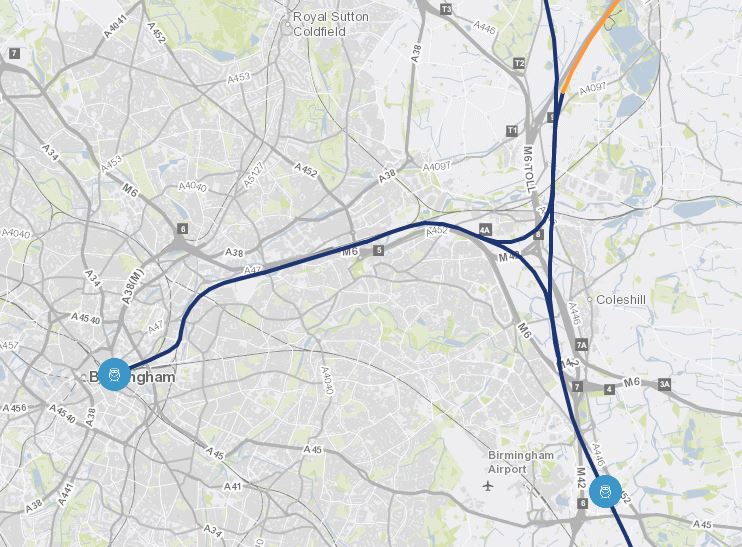
This second map, shows High Speed Two to the East of Birmingham.
Note.
- The colours are the same.
- The Eastern leg to Nottingham and Leeds, which is shown in orange, goes off to the North-East.
This third map shows the route around Lichfield.

Note.
- Phase 1 is shown in dark blue
- Phase 2a to Crewe is the branch going North and is shown in a lighter blue.
- The other branch going to the North West is the existing West Coast Main Line.
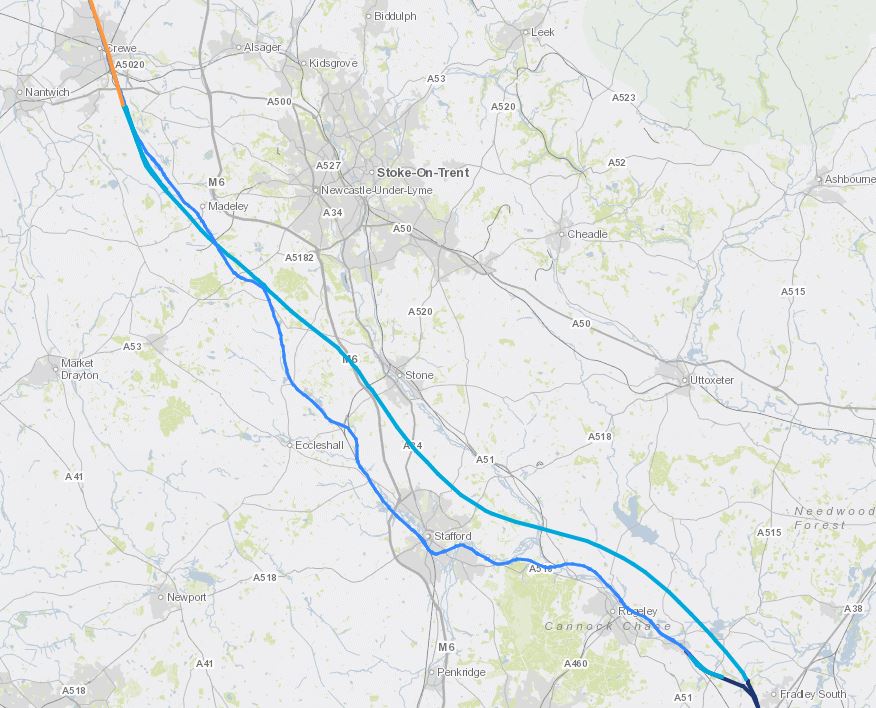
This fourth map shows the routes between Lichfield and Crewe
Note
- The colours are the same.
- Phase 2a of High Speed Two is the straighter route to the East.
- The more curvy route is the existing West Coast Main Line.
This fifth map shows the section of the route through Crewe.

Note.
- At the North of the map, the blue line is the West Coast Main Line and the orange line is the High Speed Two route to Manchester.
- Through Crewe the two lines share a route and may even share tracks.
- At the South of the map the High Speed Two route is on the East, with the West Coast Main Line to the West.
Click here to access High Speed Two’s interactive map, that I used to obtain these maps.
Phase One Services
Currently the following services are planned for Phase One of High Speed Two.
- Three trains per hour (tph) – Birmingham Curzon Street, via Old Oak Common (OOC) and Birmingham Interchange.
- Three tph – Birmingham Interchange via OOC.
- Two tph – Liverpool Lime Street via OOC, Stafford (1tph), Crewe (1tph) and Runcorn
- Three tph – Manchester Piccadilly via OOC, Wilmslow (1tph) and Stockport
- One tph – Preston via OOC, Crewe, Warrington Bank Quay and Wigan North Western
- One tph – Glasgow Central via OOC and Preston
Summing these up, the following totals are calculated.
- 6 tph – Birmingham Interchange
- 2 tph – Crewe
- 2 tph – Preston
Most other stations get two tph or less.
Birmingham Or Crewe?
In the following sections I will discuss various points.
Service Between Euston And Stafford
There is an interesting point shown up by the maps and the proposed services for Phase One.
Trains using High Speed Two won’t be able to call at Stafford unless they take a diversion along the West Coast Main Line. So after Phase 2a has been built between Lichfield and Crewe, Stafford could lose its High Speed Two service, unless they use the classic route.
Birmingham Interchange Station
Birmingham Interchange station will be unaffected by the decision of the terminus of Phase 1 of High Speed Two.
- It will be a Parkway station, with probably lots of parking.
- It will be connected to the National Exhibition Centre, Birmingham International station and Birmingham Airport by means of a people mover.
- All High Speed Two services go through the station and six tph are proposed to stop in Phase 1.
- The West Midlands Metro could serve the station.
- It will be thirty-eight minutes from London. Stansted Airport is fifty and Gatwick is around thirty!
I suspect that the time to and from London and a four-hundred metre long train every ten minutes, will mean that this will be a very busy station.
- Will Londoners treat Birmingham Airport, as a London Airport?
- Motorways to the East of Birmingham could mean the West Midlands treats the station as a Park-and-Ride station for London.
- Birmingham International station is a well-connected station with five platforms.
This station could become the busiest in the UK.
Birmingham Curzon Street Station
Birmingham Curzon Street station will be an unusual station for the UK, in that will be a city-centre terminal station running East-West, with services going both North and South, using a junction with the main High Speed Two.
- It will have seven platforms.
- It will be a short walk to Birmingham Moor Street station.
- It will have a stop on the West Midlands Metro line between Digbeth and Grand Central
Birmingham are hoping the station will be a catalyst for redevelopment of the area around the station.
After Phase 2 of High Speed Two services to the South are planned to include.
- Three tph – Euston via Birmingham Interchange and OOC.
- One tph – Birmingham Interchange direct
The hourly shuttle between the two stations makes up the service between them to a Turn-Up-And-Go frequency of four tph.
After Phase 2 of High Speed Two services to the North are planned to include.
- One tph – Stafford or Crewe direct
- One tph – Manchester Piccadilly via Crewe and Manchester Interchange
- Two trains per day – Preston via Crewe, Manchester Interchange and Wigan North Western
- Two trains per day – Carlisle via Manchester Interchange, Wigan North Western and Preston.
- One tph – Glasgow via Warrington Bank Quay, Wigan North Western, Preston and Carlisle.
- One tph – Edinburgh via Crewe, Warrington Bank Quay, Wigan North Western, Preston and Carlisle.
- One tph – Leeds via East Midlands Hub
- One tph – York via East Midlands Hub and Sheffield
- One tph – Newcastle via York
Summing up four tph go via the Western leg and Crewe to the North and three tph go via the Eastern leg and East Midlands Hub.
I suspect it is all about balancing the services between the three legs of High Speed Two.
- London and Birmingham
- Birmingham and North West England and Scotland
- Birmingham and North East England.
High Speed Two has been designed for fifteen tph running into Euston, so if all parts of the route can handle that number of trains, there must be a lot of scope to add extra services.
Birmingham Curzon Street with its seven platforms would balance all the services and probably help to sort things out in times of disruption.
Between Birmingham International Station And Lichfield
The maps show that this section must be built to connect High Speed Two to the West Coast Main Line just to the North of Lichfield Trent Valley station on the Trent Valley Line, as there is no other possible connection between the two routes.
This map clipped from the High Speed Two map, shows where the two lines join.
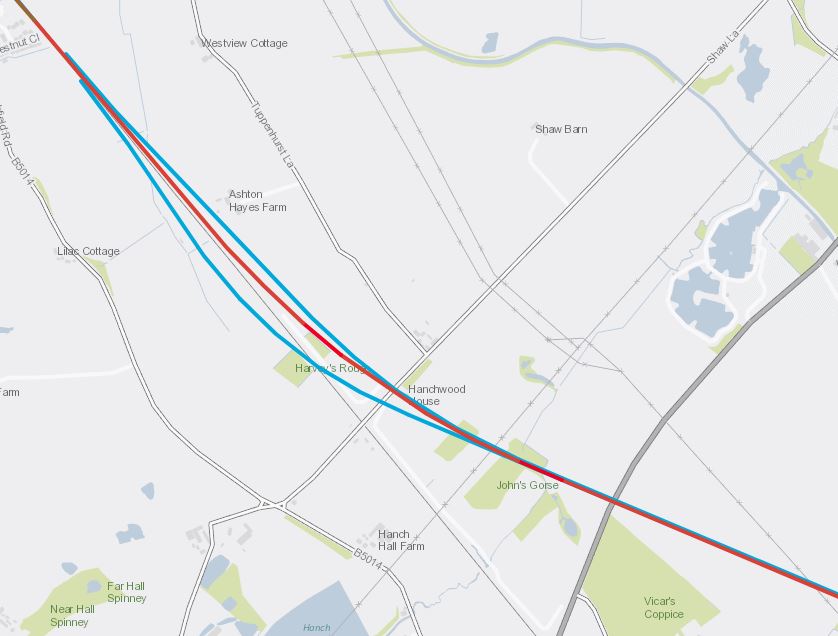
It is obviously designed for speed.
I estimate that the distance between Birmingham Interchange and this junction is not far short of twenty miles.
Between Lichfield And Crewe Station
Along the West Coast Main Line, the distance is around forty-two miles, but the straighter route proposed for High Speed Two could be a few miles shorter and several minutes faster.
If Phase 1 of High Speed Two were not to be built, trains would have to share the West Coast Main Line through Stafford station.
Currently, Stafford station can have as many as fifteen tph through the station.
Phase 1 of High Speed Two will have these trains going North of Birmingham Interchange station.
- Two tph – Liverpool Lime Street
- Three tph – Manchester Piccadilly
- One tph – Preston
- One tph – Glasgow Central
Which is a total of seven tph, with one tph stopping at Stafford.
I doubt they could all be squeezed through Stafford.
There would certainly be no space for any trains starting at Birmingham Curzon Street.
This is a very simple example of the capacity problems on the West Coast Main Line, which can only be solved by extra tracks to the North.
Crewe Station
Consider these points about Crewe station.
- It is not of a design that reflects its status.
- Currently, it handles 23 tph, that go all over the North West and much further.
- Phase 1 of High Speed Two would add another seven tph
- New services are planned.
- A rebuilding of the station would surely improve both capacity and operational efficiency.
- Looking at the fifth of the maps, it appears that the West Coast Main Line and High Speed Two share a corridor , if not tracks, through Crewe station.
For all these reasons, I am convinced that if High Speed Two passes through, then the station will need a rebuild.
So it looks like whether High Speed Two goes ahead or not, Crewe station will need an expensive rebuild.
Extra High Speed Two Services Through Crewe
Once Phase 2a has been completed, this will allow some extra Phase 2 services to be run along the route from Euston.
- Two tph from one tph – Glasgow Central via OOC, Birmingham Interchange (1tph), Preston and Carstairs
- Two tph – Edinburgh via OOC, Birmingham Interchange (1tph), Preston, Carstairs and Edinburgh Haymarket
I suspect these might run as a pair of trains as far as Carstairs and split and join there.
There will also be extra services between Birmingham Curzon Street, Crewe and Stafford to Edinburgh, Glasgow, Liverpool Lime Street, Manchester Piccadilly and Preston.
It is worth noting, that when all the services going North from Birmingham are summarised, you get the following.
- Four tph – Manchester Piccadilly
- Three tph – Liverpool Lime Street
- One tph – Preston
- Four tph – Glasgow/Edinburgh
- One tph – Stafford or Crewe
It looks a bit complicated North of Crewe, but it will create a frequent service between Crewe and Scotland.
High Speed To Chester
It should also be noted, that if between Crewe and Chester were to electrified, High Speed Two trains could serve Chester.
- Chester is a major rail interchange for the Border areas between England and Wales, North Wales and the Wirral.
- It is also connected to Merseyrail.
- Chester is an important tourist destination, with the city centre close to the station.
Electrification might also allow battery-electric versions of Avanti’s new Hitachi trains to serve some of their routes, without using diesel.
This simple example of Chester, says to me that opening High Speed Two to Crewe could allow extra services to be developed.
Conclusion
It appears from this analysis, that the only advantage of not building Phase 2a is that about forty miles of line between Lichfield and Crewe can be pushed back for a few years.
Lying Not Flying, As Nightjet Sleeper Train Reaches Brussels
The title of this post, is the same as that of this article on Railway Gazette.
This is the first sentence.
Under the slogan ‘lying not flying’, Austrian Federal Railways launched its twice-weekly Wien – Brussels Nightjet overnight train on January 19.
These are some of the details of the service.
Two trains per week in both directions.
- Brussels to Vienna on Mondays and Thursdays, leaving at 18:04 and arriving at 08:27
- Vienna to Brussels on Sundays and Wednesdays, leaving at 20:38 and arriving at 10:55
- The timings are such that you could leave London on the 12:58 Eurostar and have nearly two hours to get the sleeper.
- Coming back, you would probably arrive in London at 14:05
I shall have to try this service.
Delivering Hydrogen For Vehicles
In Friday’s copy of The Times, there is an article entitled Hydrogen Lifts Off: An Old Fuel Showing New Promise.
The article talks about Shell’s plans to create a network of filling stations for hydrogen-powered vehicles.
This is a paragraph.
A potential alternative is electrolysis, the method that Shell’s partner ITM Power is using to produce hydrogen at the Gatwick site. There, in a yard behind the refuelling pump, temporary buildings house equipment that purify tap water and convert AC electricity from the grid to DC current. This is used to split the water through electrolysis into hydrogen and harmless waste oxygen, which is vented out.
Note.
- Electrolysis is an alternative to the use of steam reforming of methane, which produces a lot of carbon dioxide.
- If the electricity is from renewables like solar, wind or tidal, then the hydrogen produced can be considered green.
- They is also a quote from Shell, which says that as renewable power gets cheaper and electrolysis more efficient, this will be the standard way to produce hydrogen.
It does seem to me that we could see hydrogen stations all over the place, as each is stand-alone and only needs tap water, an electricity feed and customers.
Who is iTM Power?
iTM Power are a company based in Sheffield.
Read more about them on their Wikipedia entry or their web site.
They claim to have the world’s largest PEM electrolyser factory.
They are also developing a network of hydrogen filling stations.
Currently opened include.
- Beaconsfield Services Hydrogen Station
- Gatwick Refuelling Station
- Rainham Solar Hydrogen Station, Essex
- Rotherham Wind Hydrogen Station
- Shell Cobham Services Hydrogen Station
- Swindon Hydrogen Station
- Teddington Hydrogen Station
And these are currently planned.
- Birmingham Bus
- Birmingham Passenger Vehicle
- Pau Bus, France
Note.
- Some as you can see are to support hydrogen buses.
- Some are powered directly by renewable electricity.
- Birmingham’s two stations are co-located.
- Two; Beaconsfield and Cobham are at motorway service areas.
- Pau is probably to support the hydrogen-powered busway that is being created in the town. There is more on that in this article on rfi, which is entitled Amid Transport Chaos, France Rolls Out World-First Hydrogen Bus Fleet.
It’s looks to me that iTM are working to a sensible plan.
- They can supply a system for a range of purposes.
- They can be placed on fairly small sites.
- They don’t need connection to a hydrogen grid.
- Is it sensible to put one in for a fleet of buses, trucks or vans first?
- Systems for buses and other vehicles can be co-located.
I can see in a few years, that everyone will be within sensible reach of a hydrogen filling station.
As the range of a hydrogen-powered car is in the hundreds of miles. it looks to me that the range anxiety of battery vehicles will be overcome.
I don’t drive or have a car, but if I needed one, I’d buy hydrogen over battery, when there was a filling station in my part of London.
The New Warrington West Station
These pictures show the new Warrington West station.
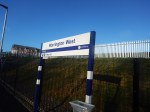











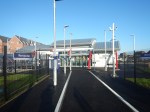



The station looks to have a similar layout to Maghull North station, which I described in Maghull North Station – 29th June 2018.
The two stations have a lot in common.
- The cutting and the contours of the land are used to create a simpler station.
- Provision for car-parking.
- Links to the bus network.
- Enough car-parking. Warrington West has 387 spaces, with 156 spaces at Maghull North.
- Fully step-free.
- A separate amenity building, with a booking office, waiting area and toilets.
Surprisingly, the two stations were designed by different architectural practices.
The Major Problem
The major problem is that Warrington West station only has two trains per hour (tph), in the Off Peak.
- The route connects Liverpool Lime Street to Manchester Airport and Manchester Oxford Road stations alternately.
- Manchester Airport services also call at Manchester Piccadilly station.
- All services call at Deansgate station for the Manchester Metrolink.
- There are links to Merseyrail’s Wirral Line at Liverpool Lime Street.
- There are links to Merseyrail’s Northern Line at Liverpool South Parkway and Hunts Cross.
- Liverpool South Parkway, Warrington West and Birchwood stations are already step-free.
- Hunts Cross, Irlam, and Manchester Oxford Road stations are in the queue for step-free access.
- Most of the services on Liverpool’s Merseyrail network have four tph.
- There is a lot of housing and other development on this route,
I’m sure that four tph and full step-free access will be needed on this route before too long.
Possible Electrification
It could be argued that this route between Liverpool Lime Street and Manchester Oxford Road stations, should be fully-electrified.
Currently, just over twenty-eight miles of the route between Manchester Oxford Road and Liverpool South Parkway stations is not electrified.
- Between Liverpool South Parkway and Liverpool Lime Street stations has 25 KVAC overhead electrification.
- Between Hunt’s Cross and Liverpool Central station is part of Merseyrail’s Northern Line and has 750 VDC third-rail electrification.
- Manchester Oxford Road station has 25 KVAC overhead electrification.
- The bay platform at Manchester Oxford Road station could be electrified or fitted with a fast charging station for battery trains.
- Battery trains can easily do forty miles after a charge of perhaps ten minutes, as I wrote in Retired London Underground Train Travels Forty Miles Solely On Battery Power.
I think, that the route between Manchester and Liverpool via Warrington is a very suitable route for running using battery-electric trains.
- It is electrified at both ends.
- The section without electrification is less than thirty miles.
- Charging can be performed using the existing electrification or with a charging station at Manchester Oxford Road station.
- Northern’s Class 331 trains, which are being built by CAF. I suspect that battery-electric versions are possible as CAF have successfully built battery-electric Urbos trams for Luxembourg, Seville and the West Midlands.
- Merseyrail’s new Class 777 trains, can be converted to battery-electric operation.
- The route is not busy.
- There aren’t many freight trains on the route.
Using battery-electric trains would probably cause a lot less disruption, than full electrification of the route.
Possible ways to increase trains on the route include.
- Merseyrail could extend Northern Line trains from Hunt’s Cross to Manchester Oxford Road.
- The Manchester Metrolink could even be connected to the route at somewhere near Pomona and run tram-trains to Liverpool.
- Northern could run battery-electric trains on the route.
There must also be the possibility of running hydrogen-powered trains on the route.
Negotiations between Liverpool and Manchester over who provides the extra services will be tough.
Conclusion
It is a neat new station, that will attract passengers.
The station could be an important link in improved rail services between Liverpool and Manchester via Warrington.
- This route could probably handle at least six tph in both directions.
- Would turning back four tph in the bay platform at Manchester Oxford Road station, ease the pressure on the Castlefield corridor.
- It serves the important stations of Liverpool Lime Street, Liverpool South Parkway, Manchester Oxford Road, Manchester Piccadilly and Manchester Airport.
- It connects Merseyrail’s to Northern and Wirral Lines and the Manchester Metrolink.
- An increasing number of stations on the route are step-free.
I suspect too, that it could be an important feeder line for High Speed Two.
How Good Is ‘Freezing Air’ The Solution For Electricity?
The title of this post is the same as that for this article on Energy News 24.
The article discusses Highview Power’s proposed 400 MWh installation in Vermont, where they are installing lots of renewable power sources and need a way to store the energy, which is partly wasted.
Read the article and especially the last sentence.
Vice President Jason Burwen Energy Storage Association said the capacity of the plant would be “on par with today’s largest grid energy storage projects under construction.” He said it would be the equivalent electricity needed “to power maybe 50,000 homes for eight hours.”
Are the British coming?
The Highview Power system to me is a blindingly obvious simple idea, based on proven technology, that has been used for many decades. Add in clever computing technology to control it and blend it with renewable energy and every wind or solar farm, tidal power station and sizeable town or city should have one, where there is a site the size of a football pitch.
Should Everybody Aim For NoDrive Months?
Over the last few years, we have had vegan and alcohol-free months.
So why shouldn’t people try to organise months, when they don’t drive?
I suspect people would perhaps start with one summer month in a particular year.
Could Modern Energy Systems Have A Secondary Role?
Close to where I live is a small heat and power system, that I wrote about in The Bunhill Energy Centre.
I first went over the centre during Open House.
Several of these modern systems are very good demonstrations of the principles of maths, physics and engineering.
So do these innovative energy systems do their bit in educating the next generation of scientists and engineers?
Some of the modern systems, that are in development like Highview Power’s energy storage using liquid air would be ideal for a secondary education role!
Most too, are very safe, as there are no dangerous processes or substances.
And in the next few years, there will be more systems all over the country and many in the hearts of towns and cities. Some schools, colleges and especially universities, will have their own innovative energy sources.
Liverpool University already has a system, which is described here.
Prowling for Solutions To Unleash Renewable Energy
The title of this post, is the same as this article on Toolbox.
It is a good summary of the best methods of storing renewable energy without using chemical batteries.
Gravitricity, Energy Vault and Highview Power are all mentioned.
This last paragraph, explains some of the philosophy behind Vermont looking seriously at Highview Power.
Vermont may well be tempted by liquid air energy storage because of its flexibility — simply requiring a two-acre site anywhere. One possible location could be near an abandoned power station. That’s a beautiful solution because the transmission lines that once transported the electricity from the plant are built and ready to use in the renewable era.
Note that a two-acre site is slightly smaller than a football pitch.
It is rather elegant to replace a coal- or gas-fired power-station with an environmentally-friendly energy storage system on the same site, which effectively does the same job of providing energy.
The article doesn’t mention employment, but surely many of the existing workforce can be easily retrained for the new technology.
 The Anonymous Widower