Eurostar Orders First Double-Decker Trains
The title of this post, is the same as that of this article on the BBC.
This is the sub-heading.
Eurostar has revealed plans to run double-decker trains through the Channel Tunnel for the first time.
These three paragraphs add more details.
The cross-channel rail operator has confirmed it will order up to 50 trains from manufacturer Alstom, eventually increasing the size of its fleet by nearly a third.
The expansion plans would include investing heavily in a crucial London depot, it said.
But questions remain over whether the facility has enough space for both Eurostar and potential rival operators to use it.
This my solution to the problem outlined in the last paragraph.
Note, that I wrote the software that planned the building of the Channel Tunnel and the rail links to London and was also friends with the project manager of the 1960s attempt to build a Channel Tunnel.
We need more terminal platforms and depot space in the UK to handle Eurostar’s extra trains and the other companies who want to run to London.
We should split services into two groups.
Group 1 would terminate as now in an updated St. Pancras with more passenger handling capacity, which could probably be built over the tracks at the Northern end of the station. Trains would still be stabled at Temple Mills.
Group 2 would terminate at Ebbsfleet International, which would have extra platforms, a new depot, masses of car parking and a coach terminal.
Some trains from both groups could also stop at Ashford International.
To access Ebbsfleet from Central London and also create a Heathrow link to the Channel Tunnel, the Lizzie Line would be extended to Northfleet, where there is space to handle up to eight trains per hour in new platforms built in two disused sidings.
This OpenRailwayMap shows the location of Northfleet and Ebbsfleet stations.
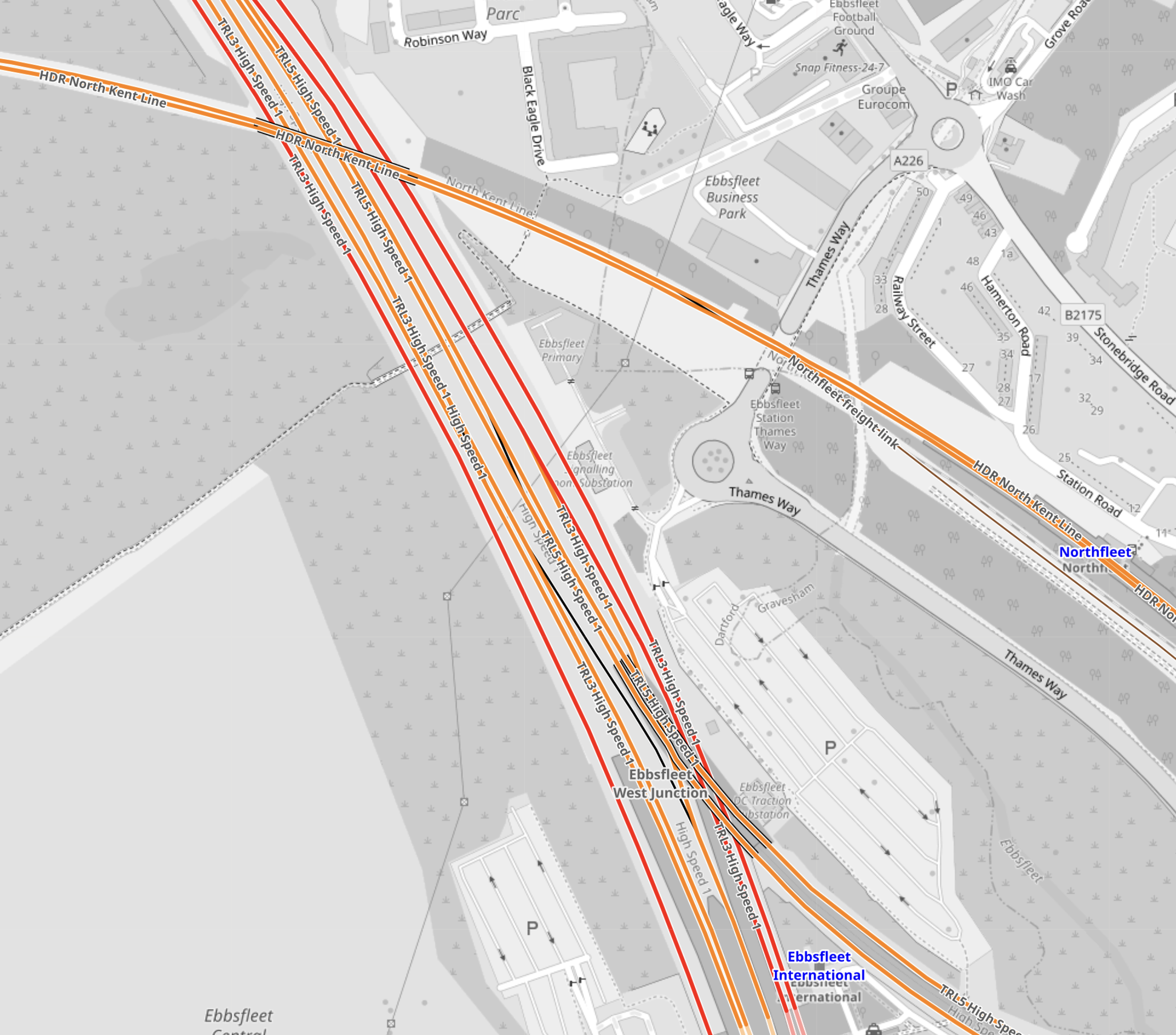
Note.
- Ebbsfleet International station at the bottom of the map.
- The red tracks are High Speed One.
- The orange tracks are third-rail electrified lines.
- The orange tracks going across the map is the North Kent Line.
- Northfleet station is at the right edge of the map on the North Kent Line.
- Northfleet and Ebbsfleet stations are less than a kilometer apart.
- Ebbsfleet has a lot of car parking spaces.
I believe a spectacular cable-car or other link would connect Northfleet and Ebbsfleet stations.
These are some other thoughts.
Ebbsfleet International Station Has Good Motorway Access
This Google Map shows the location of Ebbsfleet International station in relation to the motorways.
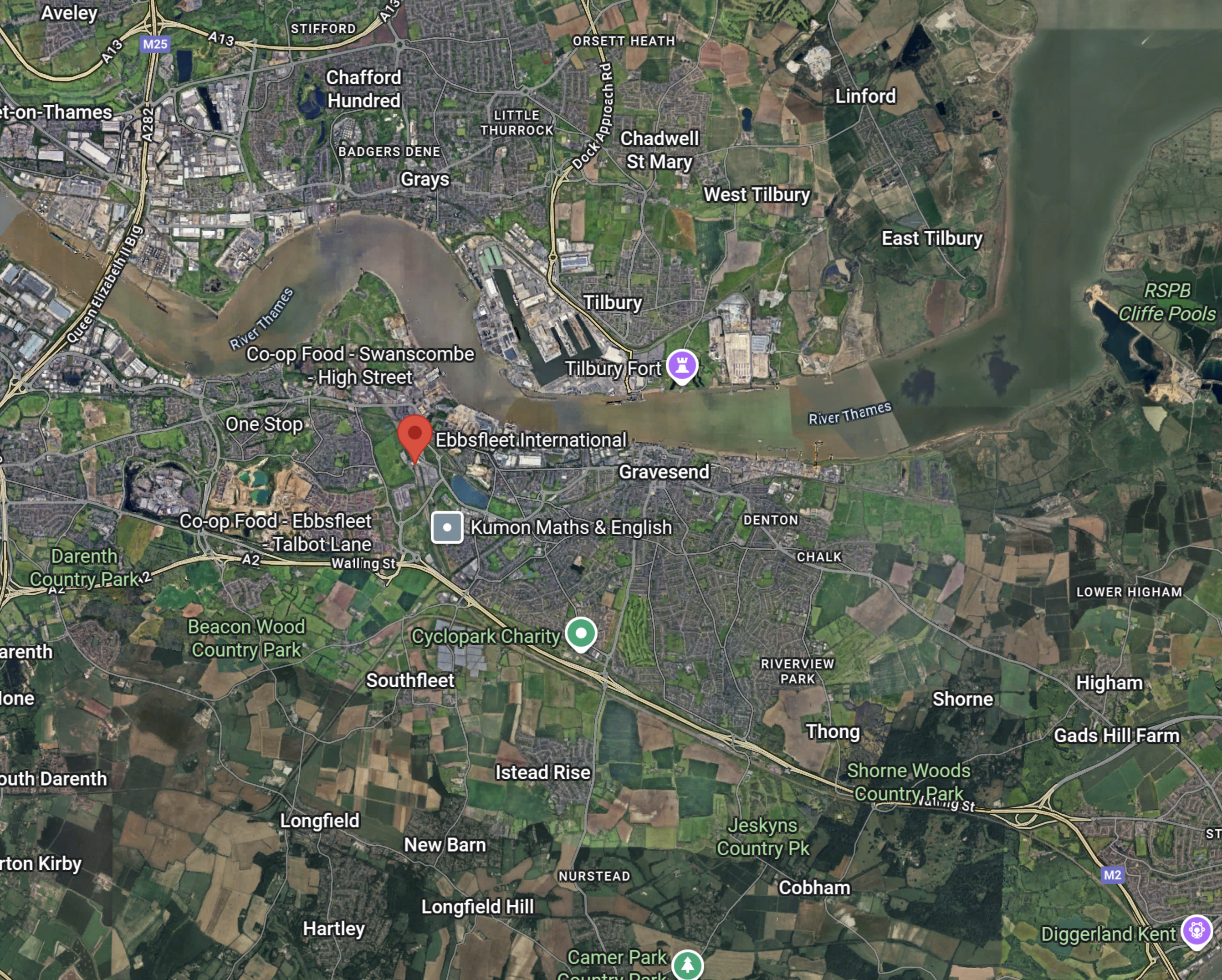
Note.
- The A2/M2 road runs across the bottom half of the map.
- The red arrow marks the position of Ebbsfleet International station.
- The Dartford Crossing is a few miles West of the station.
In my last few years, as an Ipswich season ticket holder, I regularly had a lift to Ebbsfleet International from a friend and the route to the station from the M25 and the A2/M2 wasn’t bad.
But it will be getting better.
This map from the Government’s consultation on the Lower Thames Crossing, shows the road layout in a few years.
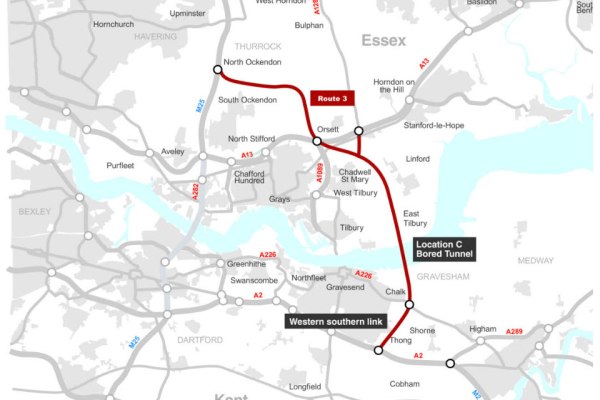
Note.
- The Lower Thames Crossing is shown in red.
- Ebbsfleet International station is about a mile South of Northfleet
- The new crossing will connect to the A2, a few miles East of the link road to the station.
Travellers from much of the East of and Middle England could use the new crossing to get to Ebbsfleet International station.
These are current times from Google.
- Birmingham – 2 hours and 41 minutes
- Cambridge – 1 hour and 17 minutes
- Edinburgh – 7 hours and 44 minutes
- Fishguard – 5 hours and 29 minutes
- Glasgow – 7 hours and 6 minutes
- Holyhead – 5 hours and 29 minutes
- Hull – 4 hours and 1 minute
- Ipswich – 1 hour and 29 minutes
- Leeds – 3 hours and 55 minutes
- Liverpool – 4 hours and 40 minutes
- Manchester – 4 hours and 28 minutes
- Milton Keynes – 1 hour and 37 minutes
- Newcastle 5 hours and 25 minutes
- Norwich – 2 hours 23 minutes
- Nottingham – 2 hours and 55 minutes
- Peterborough – 1 hour and 54 minutes
- Sheffield – 3 hours and 35 minutes
- Stoke-on-Trent – 3 hours and 25 minutes
- York – 4 hours and 16 minutes
Note.
- I would suspect that the opening of the Lower Thames Crossing will knock 10-15 minutes off these times.
- Edinburgh, Glasgow, Hull, Leeds, Newcastle, Nottingham, Peterborough, Sheffield and York would probably be quicker to Europe with a change to Continental train services at St. Pancras, rather than Ebbsfleet International.
- With improvements to rail services, more of these journeys will be quicker by train.
- High Speed Two should connect Birmingham, Liverpool, Manchester and Stoke-on-Trent to London, by the mid 2030s.
But there are some, who always feel their car is safer in a car park!
Ebbsfleet International Station Has A Large Amount Of Car Parking
This map shows the car parks at Ebbsfleet International station.
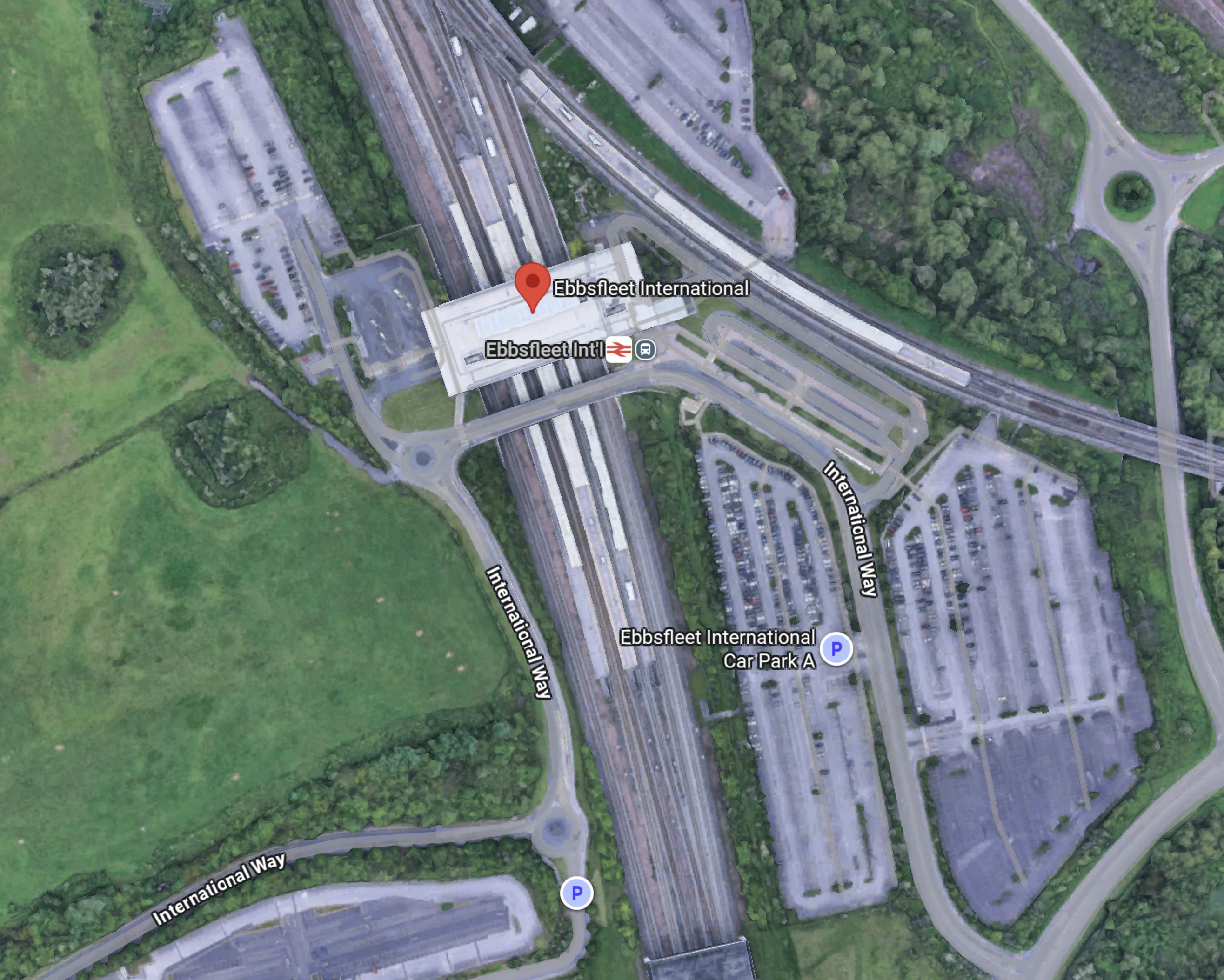
Note.
- Some of the parking areas are marked with a P.
- It is easy to pick-up and drop passengers.
- The car parks could be double-decked to add more spaces if needed.
- According to the Ebbsfleet International web site, the station currently has 5225 parking spaces, 68 accessible car parking spaces.
For those that have a lot of luggage or a large family, taking the car to Ebbsfleet International may be the best option.
Ebbsfleet International Station Should Have A Coach Station
Consider.
- In the next few years, hydrogen-powered coaches with a thousand kilometre range will come to dominate the long distance coach market.
- Mercedes and Wrightbus are know to be developing long-distance hydrogen-powered coaches.
- Hydrogen-powered coaches will be able to reach all of England and Wales and a large part of Scotland from Ebbsfleet International.
- Ebbsfleet International is closely connected to the UK motorway network.
- Continental coaches using the Channel Tunnel, could use Ebbsfleet as a coach interchange with the UK.
- Ebbsfleet International could also handle customs services for Continental coach services, which would take the pressure off the Channel Tunnel and the ferries.
- Ebbsfleet International could also have a coach link to Gatwick Airport.
These and other reasons make me feel, that a coach terminal at Ebbsfleet International is essential.
A Green Connection Between The Two Halves Of The European Union For the Gretas Of This World
Consider.
- There is no zero-carbon route between the island of Ireland and Continental Europe.
- Eurostar is all-electric between London and Continental Europe, but only serves a limited number of destinations.
- Low- or zero-carbon ferries are being designed, that run on hydrogen.
- Trains between London and the Irish ferries are diesel-powered.
- The simplest solution would surely be to run hydrogen-powered coaches between Ebbsfleet International and Fishguard and/or Holyhead. Both journeys would take three and a half hours.
Hydrogen-powered coaches are under development by Wrightbus.
I also asked Google AI if anybody is planning zero-carbon ferries between the UK and ireland and received this answer.
Yes, there are plans for zero-carbon ferries between the UK and Ireland, with a specific “Green Corridor” feasibility study underway for the Holyhead to Dublin route, and a separate, separate commuter service project planned between Belfast and Bangor. The Belfast Maritime Consortium is developing the zero-carbon commuter service, and a separate “Green Corridor” feasibility study is assessing potential low-carbon pathways between Holyhead and Dublin
I believe the green connection is feasible, provided the following happens.
- Ebbsfleet International is reopened and developed as a station for Continental Europe.
- The zero-carbon ferries are developed.
- The busmasters from Ballymena deliver the ultimate hydrogen-powered coach.
- Hydrogen and other fuels are made available, where they is needed.
This could do wonders for the economy of the island of Ireland.
Out of curiosity, I did ask Google AI, what is the longest coach route in the UK and received this answer.
The longest scheduled coach journey in the UK is the Scottish Citylink route from Glasgow to Uig on the Isle of Skye (route 915 or 916), which is about 230 miles and takes around 7 hours and 50 minutes. Historically, there have been much longer international bus routes, such as the Penn Overland tour from London to Ceylon, but these were not regular, scheduled services.
So my proposal at five hours and 29 minutes is only a short hop.
I also believe that with good project management that the additional infrastructure could be built by 2030, with little or no disruption to existing services.
Connecting Reading And The West To Gatwick Airport And Eurostar
I have just checked the electrification between Reading and Ashford International using OpenRailwayMap.
- Between Cardiff and Reading the electrification is 25 KVAC overhead.
- Between Reading and Wokingham the electrification is 750 VDC third-rail.
- Between Wokingham and Reigate is not electrified.
- Between Reigate and Gatwick Airport the electrification is 750 VDC third-rail.
- Between Gatwick Airport and Ashford International the electrification is 750 VDC third-rail.
Only 37.7 miles is not electrified.
Hitachi’s Intercity Battery Trains, have a range on battery power of seventy kilometres or forty-five miles, so these trains could go between Reading or any station to the West to any station on the North Downs Line, including Guildford, Redhill, Gatwick Airport, Tonbridge and Ashford International stations.
The trains would need to be dual voltage and I’m fairly sure, that no new infrastructure would be needed.
A Green No-Fly Route Between Europe And Ireland
Consider.
- The Great Western Main Line is electrified to Cardiff.
- There is no electrification to the West of Cardiff.
- Cardiff and Fishguard Hsrbour is 115.6 miles.
- There is a ferry between Fishguard and Rosslare.
I suspect Hitachi could configure one of their Intercity Battery Trains, that could connect Ashford International and Fishguard Harbour stations.
Could An Open Access Operator Develop A Train Service Along The South Coast of The UK Between Kent and Fishguard?
Before I go into detail, I will answer a question that explains the terminology and the why’s and wherefores’ of the title of this post.
What Is An Open Access Operator?
This is the first paragraph of the Wikipedia entry of an Open Access Operator.
In rail transport, an open-access operator is an operator that takes full commercial risk, running on infrastructure owned by a third party and buying paths on a chosen route and, in countries where rail services run under franchises, are not subject to franchising.
In the UK, these are all open access operators, that are running services.
Note.
- Other groups are developing services.
- Regional, High Speed, International, Local and Sleeper services seem to be offered by various open access operators.
- Grand Central is a subsidiary of Deutsche Bahn,
- Hull Trains and Lumo are both subsidiaries of FirstGroup.
Open Access operators seem to operate in most European Union countries.
Why Run Between Kent and Fishguard?
- The main purpose of the train service would be to provide a low-cost rail connection between the island of Ireland and particularly the Republic of Ireland, with the Southern part of England and the European Union.
- At both ends of the route the train service would connect to ferries.
- At the Eastern end, the train service would also connect to Eurostar services through the Channel Tunnel.
- The Port of Dover could be efficiently connected to Dover Priory Station.
- Dover Priory Station could be the Eastern terminus.
- The service could stop at Folkestone Central station, if ferries call at the Port of Folkestone in the future.
- The service could stop at Ashford International station for Eurostar services.
- Fishguard Harbour station has been built as a train terminus for the Port of Fishguard.
- Fishguard Harbour station could be the Western terminus.
This could be a busy service.
Where Would The Trains Call?
Intermediate stations would depend on passenger umbers, but could start as Folkestone Central, Ashford International, Hastings, Eastbourne, Brighton, Portsmouth & Southsea, Southampton Central, Romsey, Salisbury, Warminster, Westbury, Trowbridge, Bradford-on-Avon, Bath Spa, Bristol Temple Meads, Bristol Parkway, Newport, Cardiff Central, Gowerton, Llanelli and Carmarthen.
How Long Would The Journey Be?
The journey would be around 377 miles and I suspect could take about three and a half hours with modern digital signalling.
Surprisingly, the route is fully-electrified except for the following.
- Ashford International and Ore – 27.9 miles
- Southampton Central and Bristol Parkway – 82 miles
- Cardiff Central and Fishguard Harbour – 115.6 miles
All gaps should be able to be bridged using battery power.
I suspect trains would be Hitachi high speed battery-electric trains.
Would Any European Funding Be Available?
This is an interesting question, as the service does join up two separate sections of the European Union.
National Express Owner Plans To Launch Eurostar Rival
The title of this post, is the same as that of this article on the Financial Times.
I have documented a few attempts to start a competitor to Eurostar.
- Express London-Amsterdam Eurostar Service Being Explored
- Getlink Pushes Budget Train Service Between London And Paris To Rival Eurostar
- RENFE Aims To Compete With Eurostar On Paris – London Route
- Transmanche Metro
- The Wikipedia entry for Eurostar details German and Italian attempts to start a service.
Note.
- None of the proposals seem to have got past being announced.
- The only useful fact given in the article, is that the service will be called Evolyn.
Searches of the Internet reveal virtually no more facts, rehashes of the FT article and a lot of waffle.
These are my thoughts.
Would Eurostar Give Up And Slots At St. Pancras International?
I use slots deliberately, as British Airways don’t seem keen to ever give up slots at Heathrow or Gatwick.
And I suspect Eurostar would be the same!
St. Pancras International Doesn’t Have Enough Space
This article on Kent & Surrey Bylines, which is entitled Why Are There Such Queues At St Pancras For Eurostar?, is typical of many you can find on the Internet.
This is the sub-heading.
Eurostar no longer stops at Ebbsfleet or Ashford International, and the queues at St Pancras are becoming intolerable
This is the first paragraph.
Passengers are complaining. The queues at St Pancras are now intolerable. The lines stretch back into the main hall. It is like an airport with the slow shuffle towards the security kiosks. Then, once you are through that, you go to the departure lounge. However, there is not enough seating for the waiting passengers (see picture above taken this month). Because you have to check in 90 minutes before the train starts, one can be stuck standing in this waiting room for an hour. Unless, that is, one is white-haired and venerable, in which case one is usually offered a seat by someone younger and fitter.
It was written on the 9th of last month. But the problems have been bad for some years, as St. Pancras station is too small.
Could Ashford International Station Be Used As A Terminal?
The station has platforms on High Speed One, but the Financial Times says the service will be run between London and Paris.
I doubt even Ryanair would stretch it to say that Ashford was in London.
Could Ebbsfleet International Station Be Used As A Terminal?
It might be possible to say that Ebbsfleet was in London, but then it is not well-connected to Central London.
Does That leave Just Stratford International?
In Platforms 1 And 4 At Stratford International Station, I came to this conclusion.
I have come to these conclusions about Platforms 1 And 4 at Stratford International station.
- The platforms are designed to take the longest Eurostar trains.
- The access to Platforms 1 And 4, doesn’t appear to be designed for continuous heavy use.
- The diamond crossover at the Eastern end of the station would allow Stratford International station to be used as an emergency terminus.
The track layout at the London end of High Speed One appears to have been designed for all eventualities.
But I suspect that Stratford International station will need a lot of money spent to provide Customs and Immigration facilities.
Could Victoria Station Be Used As A Terminal?
National Express is primarily a coach company, so could they be planning a service to connect the long distance coach networks of London and Paris?
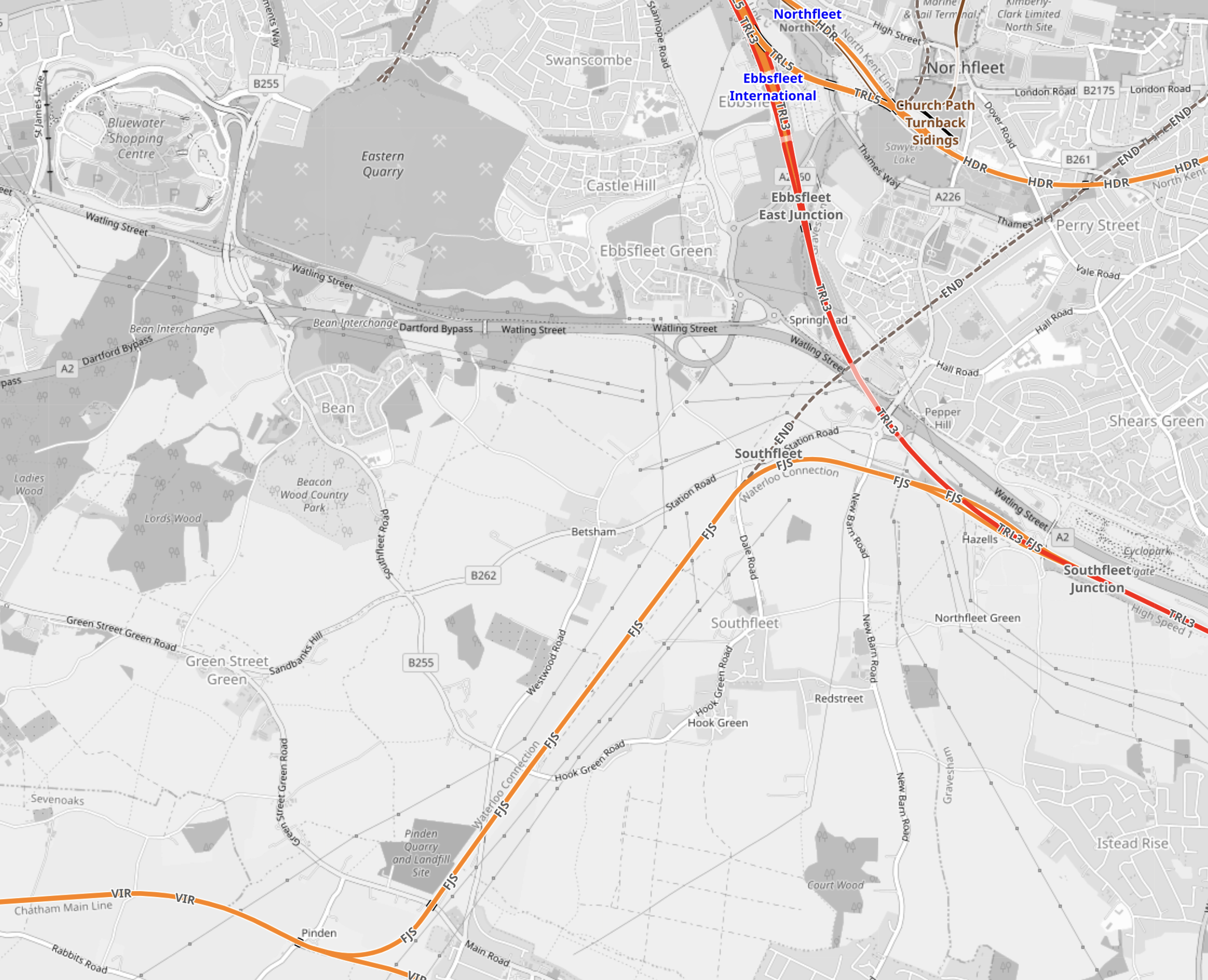
This OpenRailwayMap shows the link between High Speed One and the Chatham Main Line.
Note.
- Ebbsfleet International and Northfleet stations are at the top of the map.
- High Speed One is the red line going through Ebbsfleet International station.
- The orange line going across the South-West corner of the map is the Chatham Main Line between Victoria station and Chatham.
- The Chatham Main Line is connected to High Speed One, by the Waterloo Connection or the Fawkham Junction Link.
This route was the original route for Eurostar to Waterloo.
But it could just as easily go into Victoria.
- Southeastern’s Victoria and Dover service takes this route.
- The distance between Victoria and Fawkham junction is 22.6 miles.
- Trains take 28 minutes with a stop at Bromley.
- I wrote some more about the Fawkham Junction Link in Kent On The Cusp Of Change – Fawkham Junction Link.
- I also wrote some more about Victoria as a High Speed terminal in Kent On The Cusp Of Change – Victoria As A Highspeed Terminal.
Note that the two Kent On The Cusp Of Change posts were based on an article in the July 2017 Edition of Modern Railways.
I am convinced that Victoria could be used as a terminal for Continental trains.
Where Would The Service Terminate In France?
Everything I said about congestion also applies to Gare Du Nord, so would it be better to use Marne-la-Vallée–Chessy station that serves Disneyland Paris and Charles de Gaulle Airport, which used to be used by Eurostar.
There are certainly possibilities to do something different.
What Trains Would Be Needed?
The FT article says that the consortium have talked to Alstom, who build the Class 373 trains.
The trains would probably need a specification like this.
- Maximum speed of at least 200 mph, like Eurostar’s Class 374 trains.
- Ability to run on tracks with a UK loading gauge.
- Ability to use both 750 VDC third rail and 25 KVAC overhead electrification.
- Less than 240 metres long, which are the platform lengths at Victoria.
Would a High Speed Two Classic-Compatible Train be suitable?
- The trains will have a maximum speed of 224 mph.
- It has been designed for a UK loading gauge.
- The two partners in these trains; Alstom and Hitachi, have both built high speed trains capable of running at slower speeds using third rail electrification.
- The standard length of the trains are 200 metres.
I suspect they would do nicely.
Conclusion
I suspect that the National Express service could use High Speed Two Classic-Compatible Trains between Victoria and Marne-la-Vallée–Chessy stations.
- The trains would be standard with the ability to use third rail electrification
- They would use a single International platform at Victoria and Marne-la-Vallée–Chessy.
- Victoria station is well-connected to the Underground.
- Marne-la-Vallée–Chessy station is connected to Charles de Gaulle airport and Disneyland Paris.
I feel that there is a feasible service that can be designed.
Battery EMUs Envisaged In Southeastern Fleet Procurement
The title of this post, is the same as that of this article on Railway Gazette.
This is the first paragraph.
Southeastern has invited expressions of interest for the supply of new electric multiple-units with an optional battery capability for operation away from the 750 V DC third-rail network.
This article on bidstats is entitled Supply Of And Maintenance Support For New Rolling Stock For Southeastern, and gives more details.
These are my thoughts.
Southeastern HighSpeed Services
There would appear to be no changes in this contract to the Class 395 trains, that work on High Speed One, as this is said in the bidstats article.
Full compatibility with Southeastern infrastructure (excluding High Speed 1 infrastructure)
which appears to rule out running on High Speed One.
In addition, this article on Rail Magazine is entitled Southeastern’s Class 395 Javelin Train Sets Are To Receive A £27 million Facelift.
Southeastern Have Both 75 and 100 mph Trains
In addition to their Class 395 trains, Southeastern have the following trains in their fleet.
- Class 375 trains – 100 mph – 10 x 3 cars
- Class 375 trains – 100 mph – 102 x 4 cars
- Class 376 trains – 75 mph – 36 x 5 cars
- Class 465 trains – 75 mph – 129 x 4 cars
- Class 466 trains – 75 mph – 36 x 2 cars
- Class 707 trains – 100 mph – 18 x 5 cars
Note.
- Running a mixed fleet of 75 and 100 mph trains can’t be very efficient.
- The Class 465 and 466 trains are the oldest trains and date from 1991-1994.
- They are often to be seen in ten-car formations of 2 x 465 trains and a Class 466 train.
- Another twelve Class 707 trains are planned to join Southeastern.
I would expect the Class 465 and Class 466 trains to be replaced first.
What Length Will The New Trains Be?
If you look at the new suburban electric trains, they have the following lengths.
- c2c – Class 720 trains – 5 cars
- Greater Anglia – Class 720 trains – 5 cars
- Northern – Class 331 trains – 3 and 4 cars
- Southeastern – Class 707 trains – 5 cars
- South Western Railway – Class 701 trains – 5 and 10 cars
- West Midlands Trains – Class 730 trains – 3 and 5 cars
Note.
- Southeastern already run five-car trains as pairs.
- A significant proportion of existing suburban trains are five-car trains.
- Great Western, Hull Trains, LNER, Lumo and TransPennine Express run five-car Hitachi trains, with more companies to follow.
- A pair of five-car trains make a pair of a convenient length for most platforms.
I would be fairly confident, that the new trains will be five-car trains, with the ability to run as pairs.
What Will Be The Operating Speed Of The New Trains?
To match the speed of the Class 375 and Class 707 trains, I would expect them to be 100 mph trains.
The Quietness Of Battery-Electric Trains
All of the battery-electric trains I have ridden, have been mouse-quiet, with none of the clunking you get for a lot of electric trains.
This is said in the bidstats article says this about the interiors
Interiors suitable for metro & mainline operation.
I wouldn’t be surprised to see a lot of these trains on commuter routes to attract passengers.
Battery Power
This is said in the bidstats article about battery power.
Inclusion of options for traction batteries with capability for operation in depots and sidings without the need for external power supply, and with the capability to operate on the main line where power supply is not available due to isolations or incidents, or for non-electrified line sections of up to 20 miles.
Although Merseyrail’s new Class 777 trains are not in service yet, I find it interesting that the proposed Southeastern trains will be similarly-fitted with a small battery for depot and siding operation.
The twenty mile battery range is specific and I wonder if it will be used innovatively. I suspect it could be a bit longer in the future, as battery technology improves.
Possible Electrified Routes Using Battery Power
These are a few possibilities.
The Hoo Branch
In Effort To Contain Costs For Hoo Reopening, I discussed running electric trains to a proposed Hoo station.
I made these two points.
- Hoo junction to Hoo station is no more than five or six miles.
- There are also half-a-dozen level crossings on the route, which I doubt the anti-third rail brigade would not want to be electrified.
It would appear that a battery-electric train with a range of twenty miles would handle this route easily.
- Charging would be on the nearly thirty miles between Hoo junction and Charing Cross station.
- No charging would be needed at Hoo station.
There may be other possibilities for new routes locally to open up new housing developments.
The Sheerness Line
The Sheerness Line has the following characteristics.
- It is double-track
- It is electrified
- It is less than eight miles long.
- For most of the day, the service is one train per hour (tph)
- There are two tph in the Peak.
- Would two tph attract more passengers to the line?
- Does the power supply on the Sheerness Line limit the size and power of trains that can be run on the line?
- Is there a need for one train per day to London in the morning and a return in the evening?
- Could the Sheerness Line be run more economically with battery trains. providing a two tph service all day?
The Isle of Sheppey needs levelling up, perhaps 100 mph trains to London using battery power on the Sheerness Line, might just make a difference.
The Medway Valley Line
The Medway Valley Line has the following characteristics.
- It is double-track
- It is electrified
- It is less than twenty-six and a half miles long.
- For most of the day, the service is two tph.
- In the Peak there are HighSpeed services between Maidstone West and St.Pancras International stations.
If electrification was removed between Paddock Wood and Maidstone West stations, the HighSpeed services could still be run and battery-electric trains with a twenty mile range could still run the Tonbridge and Strood service.
The Marshlink Line
The Marshlink Line has the following characteristics.
- It is mainly single-track with a passing loop at Rye station.
- It is not electrified
- It is 25.4 miles between the electrified Ashford International and Ore stations.
- Services are irregular and less than one tph.
If the proposed battery-electric train had a range of thirty miles, it should be able to handle the Marshlink Line.
The service between Eastbourne and Ashford International stations would need to be moved between the Southern and Southeastern operations.
The Uckfield Branch
The Uckfield Branch has the following characteristics.
- It is a mixture of single- and double-track.
- It is not electrified South of Hurst Green Junction.
- It is 24.7 miles between the electrified Hurst Green Junction and Uckfield station
- Services are one tph.
If the proposed battery-electric train had a range of thirty-miles, it should be able to handle the Uckfield Branch, with a charging system at Uckfield station.
Will Battery-Electric Trains Allow Some Lines To Have Their Electrification Removed?
There are several reasons, why electrification might be removed.
- It is on a line, where the electrification needs upgrading.
- It is on a line, where there are lots of trespassers.
- Possibly at a level-crossing or a stretch of track with several.
- Possibly in a tunnel, with a large inflow if water.
- It is a depot or siding, where safety is important to protect the workforce.
Obviously, the electrification would not be removed unless battery-electric trains can handle all possible services.
These are surely some possibilities for electrification removal.
The Hayes Line
The Hayes Line has the following characteristics.
- It is double-track
- It is electrified
- It is less than eight miles to Ladywell Junction, where the branch joins the main line at Lewisham.
- It is currently run by Class 465 and Class 466 trains, which will likely be changed for the new trains with a battery capability.
- Services are four tph.
If the proposed battery-electric train had a range of twenty-miles, it would be able to handle the route between Ladywell junction and Hayes station.
Erith Loop, Crayford Spur and Slade Green Depot
This map from Cartometro.com shows the Erith Loop, the Crayford Spur and the Slade Green Depot.

Note.
Not many trains take the Erith Loop or the Crayford Spur.
- The distance between Slade Green and Barnehurst is less than a mile-and-a-half.
- Dartford station is off the South-East corner of the map.
- The distance between Barnehurst and Dartford is less than three miles.
- The distance between Slade Green and Crayford is less than two miles-and-a-half.
- The distance between Crayford and Dartford is less than two miles.
- The main line through Slade Green would need to remain electrified, as electric freight trains use the line.
I suspect, that quite a lot of electrification could be removed here, much to the disgust of the copper thieves.
It might even be possible to build on top of the depot.
Is This A Plan For The Marshlink Line?
Uckfield Third Rail Is NR Priority is based on an article in the April 2022 Edition of Modern Railways, with the same name.
The Modern Railways article also has this to say about the Marshlink Line.
By contrast, the shorter trains in use on the Marshlink Line between Ashford and Hastings made bi-modes with batteries a realistic option there.
The Marshlink Line is electrified at both ends at Ashford International and Ore stations.
- In between there are four small stations and one large one Rye in the middle.
- Ashford and Rye are 15.3 miles apart.
- Rye and Ore are 10.1 miles apart.
- As it runs across the Romney Marsh, there probably aren’t too many gradients.
It would appear that with a fast charge system at Rye, battery-electric operation should be possible.
In an article in the October 2017 Edition of Modern Railways, which is entitled Celling England By The Pound, Ian Walmsley says this in relation to trains running on the Uckfield Branch, which is not very challenging.
A modern EMU needs between 3 and 5 kWh per vehicle mile for this sort of service.
For different lengths of trains, battery sizes can be calculated based on a distance of sixteen miles.
- A five-car train would need a battery capacity of between 240 and 400 kWh.
- A four-car train would need a battery capacity of between 192 and 320 kWh.
- A three-car train would need a battery capacity of between 144 and 240 kWh.
In Uckfield Third Rail Is NR Priority, I estimated that the Uckfield branch could be served using five-car trains with batteries between 180 and 300 kWh.
It does look that a five-car battery-electric train could be developed that would handle both the Uckfield Branch and the Marshlink Line.
Gatwick Rail Service Could Link Far Reaches Of The South East
The title of this post, is the same as that of this article on Surrey Live.
Despite being reported on Surrey Live and the fact that Gatwick is in Sussex, the plan has been proposed by Kent County Council’s Rail Project Manager.
The plan would extend the existing Great Western railway line – which runs from Reading to Gatwick via Redhill – to mid and east Kent.
The article suggests the service could go between Reading and Canterbury West stations.
This table sums up the connectivity.
- Reading – West and South West England, Wales, Oxford, Hereford and Worcester and the West Midlands – Future – East West Rail
- Guildford – Portsmouth Direct Line
- Dorking – Mole Valley Line
- Redhill – Brighton Main Line
- Gatwick Airport – Brighton Main Line
- Tonbridge – South Eastern Main Line
- Ashford International – Amsterdam, Brussels and Paris – Future – Bordeaux, Cologne, Frankfurt and Geneva
I have a few thoughts.
The Terminal Stations
The suitability of the two proposed terminals can be summed up.
- Reading has been designed as a terminal station, with five bay platforms, three of which can be used by Gatwick services.
- Canterbury West has not been designed as a terminal station and has no bay platforms.
Perhaps Ashford International station would be a better Eastern terminal?
- It has Eurostar services.
- Trains can terminate in Platform 1 and go to Tonbridge.
- It has lots of car parking.
Dover Priority and Ramsgate could also be possibilities as they have terminal platforms.
Connecting At Gatwick Airport
It looks like a combined service might get complicated in the Redhill/Gatwick area.
- Trains between Reading and Gatwick go via Redhill station, where they reverse.
- There is no direct route between Tonbridge and Gatwick, so trains will probably have to reverse at Redhill, to go between Tonbridge and Gatwick.
Would a service between Reading and Ashford, that reversed twice at Redhill and once at Gatwick, be rather tricky to operate? Or even unpopular with passengers?
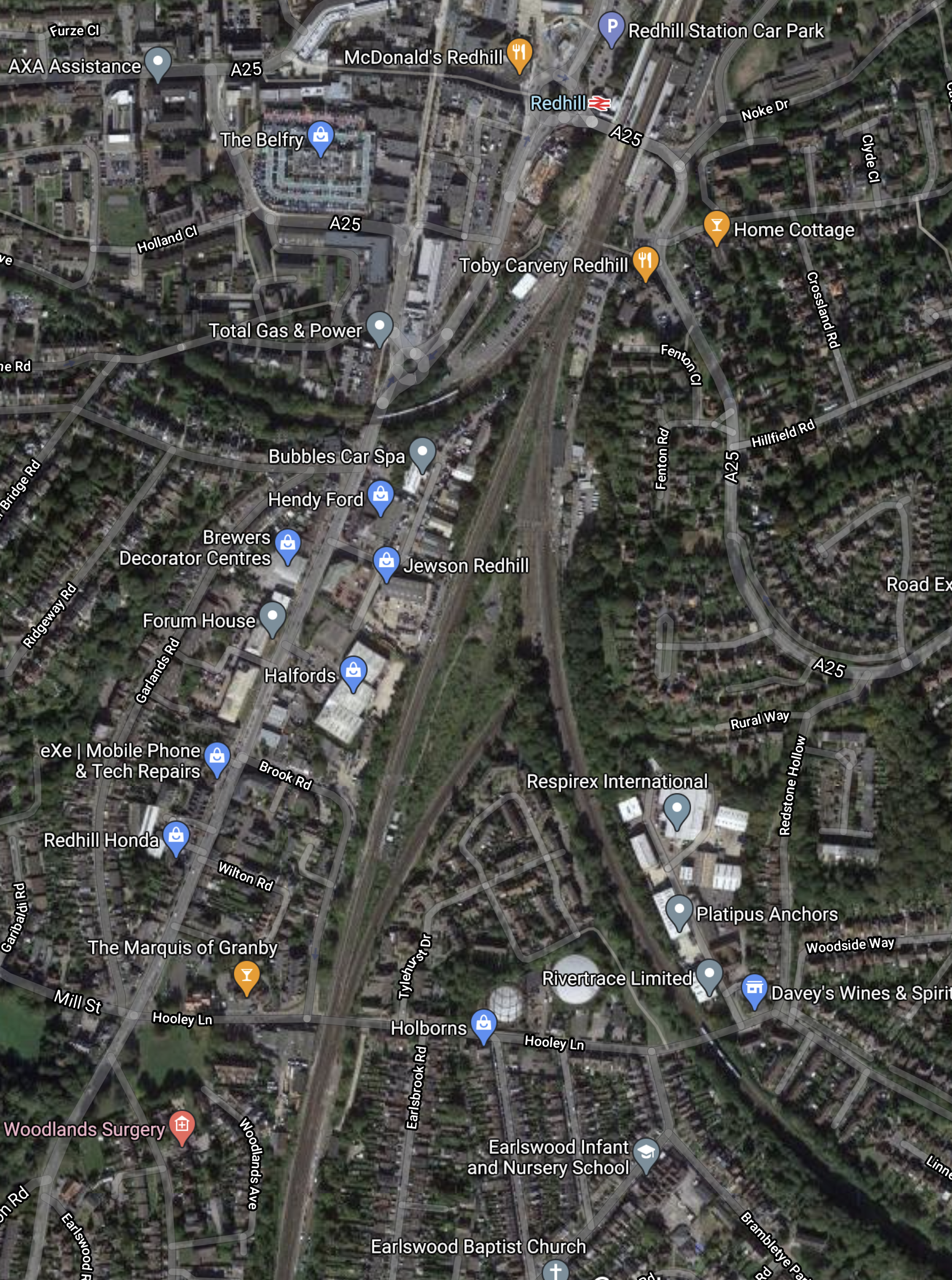
This Google Map shows Redhill station and the lines leading South from the station.
Note.
- Redhill station at the top of the map.
- The Brighton Main Line running North-South in the middle of the map.
- The North Downs Line to Guildford and Reading curving West from the station.
- The Redhill and Tonbridge Line to Tonbridge and Ashford leaving the map in the South-East corner.
I suspect that adding extra tracks in a very crowded area will be very difficult.
What Do The Timings Show?
A quick calculation, which is based on current timings, can give a journey time for between Ashford and Gatwick Airport.
- Ashford and Tonbridge – Southeastern timing – 38 minutes
- Tonbridge and Redhill – Southern timing – 35 minutes
- Reverse at Redhill – GWR timing – 4 minutes
- Redhill and Gatwick – GWR timing – 8 minutes
This gives a total of eighty-five minutes.
- Google says that you can drive it in sixty-three minutes.
- If you took the train today, between Ashford International and Gatwick Airport stations, the fastest rail journey is around 110 minutes with a change at St. Pancras International.
It does look though that a faster train between Kent and Gatwick Airport could be competitive, as going via London certainly isn’t!
Could Simplification And Automation Provide A Solution?
Consider.
- The Ashford International and Tonbridge timing, that I have used includes five stops.
- The Tonbridge and Redhill timing, that I have used includes five stops.
- How much time would be saved by only stopping at Tonbridge between Ashford International and Gatwick?
- Could automation handle a fast reverse at Redhill, where passengers couldn’t board or leave the train?
- Would a driver in each cab, allow the reverses to be done faster?
Trains going between Reading and Ashford International, would call at the following stations between Guildford and Tonbridge.
- Dorking Deepdene
- Reigate
- Redhill
- Gatwick Airport
- Redhill – A quick Touch-And-Go.
- Tonbridge
- Paddock Wood
If two minutes a stop could be saved at each of the nine omitted stops and at each reverse, this would save twenty minutes East of Gatwick, which would give the following timings.
- Gatwick and Tonbridge – 27 minutes
- Gatwick and Ashford International – 65 minutes
Timings would be compatible with driving.
West of Gatwick, the service would be as the current GWR service.
- After arriving at Gatwick from Ashford, the train would reverse.
- En route it would reverse at Redhill, to continue to Reading.
Passengers wanting to go between say Tonbridge and Redhill, would use this reverse at Redhill to join and leave the train.
It would be an unusual way to operate a train service, but I feel it could be made to work, especially with the right automation and/or a second driver.
Trains For The Service
The service can be split into various legs between Ashford and Reading.
- Ashford and Tonbridge – Electrified – 26.5 miles – 38 minutes
- Tonbridge and Redhill – Electrified – 20 miles – 35 minutes
- Redhill and Gatwick – Electrified – 7 miles – 8 minutes
- Gatwick and Redhill – Electrified – 7 miles – 8 minutes
- Redhill and Reigate – Electrified – 2 miles – 4 minutes
- Reigate and Shalford Junction – Not Electrified – 17 miles – 20 minutes
- Shalford Junction and North Camp – Electrified – 9 miles – 11 minutes
- North Camp and Wokingham – Not Electrified – 11 miles – 14 minutes
- Wokingham and Reading – Electrified – 7 miles and 9 minutes
Note.
- Ashford, Tonbridge, Redhill, Gatwick, Guildford, Wokingham and Reading are all fully-electrified main line stations.
- Most of the route and the two ends are electrified.
- All electrification is 750 VDC third rail.
- All sections without electrification are less than twenty miles.
This route would surely be ideal for a battery electric train.
As both the Heathrow and Gatwick Express services are run using Class 387 trains and the Stansted Express has used Class 379 trains for the last few years, similar trains to these might be an ideal choice, if they could be fitted with battery power and the ability to use 750 VDC third-rail electrification.
The facts seem to be on the side of this service.
- There are spare Class 387 trains and some more will be released by c2c in the next few years.
- Greater Anglia will be replacing their Class 379 trains with new Class 745 trains.
- A Class 379 train was used to test the concept of battery electric trains.
- Both class of trains could be fitted with third-rail gear.
Either of these trains could be used for the service.
As they are 100 or 110 mph trains with good acceleration, they might even save a few minutes on the journey.
Infrastructure Changes
I suspect they could be minimal, once it was worked out how to handle the three reverses in the Gatwick and Redhill area.
Conclusion
I think it would be a feasible plan to run an Ashford and Reading service via Gatwick.
I would also decarbonise the route at the same time, as it must be one of the easiest routes in the country to run using battery electric trains.
- There is electrification at both ends and in the middle.
- The longest stretch of track without electrification is just seventeen miles.
- All charging could be done using existing electrification.
- There are platforms at both ends, where trains can get a full charge.
- There are trains available, that are suitable for conversion to battery trains for the route.
- No extra infrastructure would be needed.
- Battery electric trains would allow extension of the route to Oxford in the West.
How many extra passengers would be persuaded to take the train to Gatwick, by the novelty of a battery electric Aurport Express?
Marketing men and women would love the last point!
HS4Air Between Gatwick Airport And Ashford
This map clipped from the Expedition Engineering web site, shows the route of HS4Air between Gatwick Airport and Ashford International station.
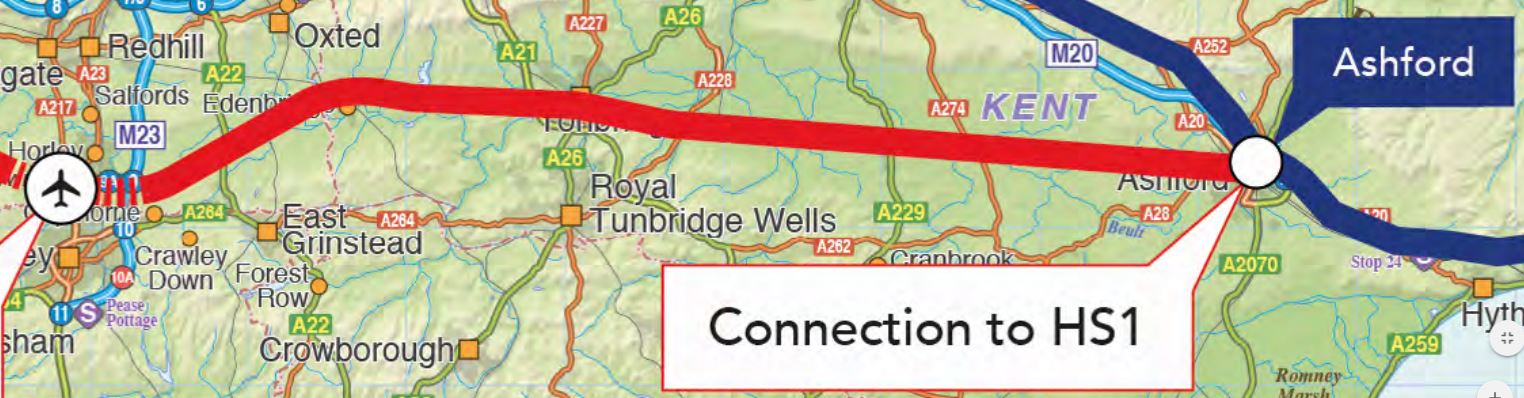
The route reuses the existing railway between Ashford International and Edenbridge (Kent) stations.
From Gatwick Airport To Edenbridge
This Google Map shows the countryside between Gatwick and Edenbridge.
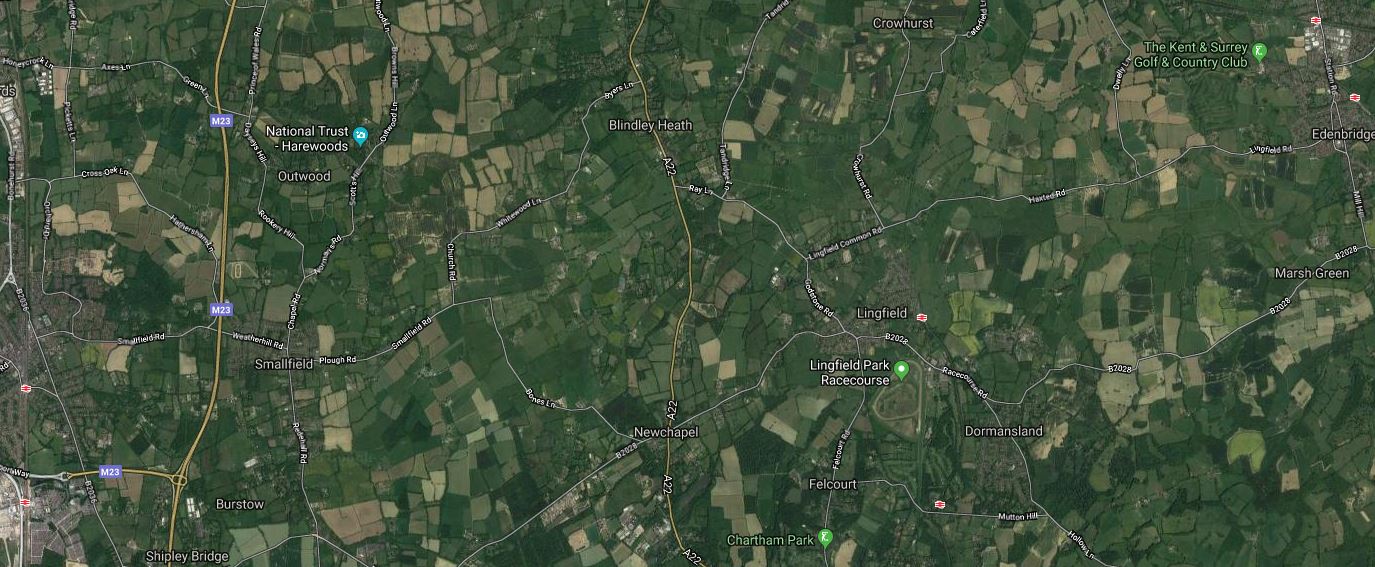
According to the first map, the Gatwick Tunnel emerges to the East of the M23 Motorway, which runs North-South down the left side of the map.
It probably emerges South of the Airport spur from the M23 and then it would travel on the surface to Edenbridge (Kent) station, which is in the North East corner of the map.
It looks to be a very challenging route, although there are several industrial sites scattered between the M23 and Lingfield, which is perhaps halfway between the motorway and Edenbridge.
This Google Map shows Edenbridge (Kent) station with the Redhill-Tonbridge Line passing through.
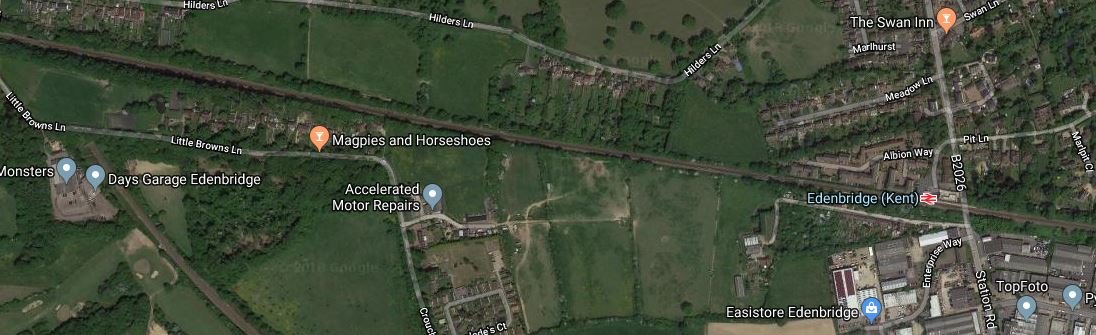
It would appear that the engineering could be reasonably attainable, but getting the natives on-side might not be so easy.
It’s not as though the residents between Edenbridge and Gatwick will get much benefit from HS4Air.
From Edenbridge To Ashford
This line has the following characteristics.
- It is around forty miles long.
- It is almost straight.
- It is double track.
- There are several stops.
- There is a maximum speed of 100 mph
It doesn’t appear to have many more than about four trains per hour (tph) in both directions.
Very little has been said about how HS4Air will transform the line, except that it will be upgraded to a high speed line.
The only information of value is that Ashford to Gatwick will take 25 minutes.
How far would a train go in that time at various speeds?
- 100 mph – 42 miles
- 125 mph – 52 miles
- 140 mph – 58 miles
As the route between Edenbridge and Gatwick is probably around a dozen miles, it would appear that a well-designed 125 mph route could enable the time quoted by HS4Air.
Local Stations On The High Speed Line
I’ll take Penshurst station as an example.
This Google Map shows the station.

Note that it is very simple with a platform on each line.
Currently, it gets a single tph in both directions.
HS4Air would probably mean that at least another four tph, passed through the station at 125 mph.
It could be argued that this could cause safety problems.
On the other hand, there are many stations in the UK, where local trains stop and expresses go through at 125 mph.
Platform-edge doors would be a difficult and expensive solution, but why not make access to the platform only possible, when a train is stopping?
Looking at Penshurst station, this station also needs some more facilities, like a fully accessible footbridge.
Conclusion
The Gatwick to Ashford section can be converted into a 125 mph route, which would give a time of 25 minutes between the two stations.
However, I do think there will have to be a lot of political leverage to get it built.
Ashford Spurs On Track
The title of this post is the same as an article in the December 2017 Edition of Modern Railways.
I wrote about the Ashford Spurs in Kent On The Cusp Of Change – Ashford Spurs.
The Modern Railways article starts with this paragraph.
The launch of Eurostar e320 services from Ashford International has been pencilled in for 3 April 2018, foillowing progress with the Ashford Spurs project.
Surely, a result of their completion will be that more services will stop at Ashford International station.
Gibb Report – Ashford – Hastings Route Should Be Transferred To The New Southeastern Franchise
The Gibb Report, says that the Ashford – Hastings route should be transferred to the new Southeastern franchise.
The Gibb Report says this about the operation of the route.
The Ashford – Hastings route is currently a service operated by 12 Class 171 diesel units, running as through services from Ashford / Hastings to Eastbourne and Brighton. The trains run empty to and from GTR’s Selhurst depot for maintenance. GTR’s 2018 Timetable consultation has proposed reducing the service back to Ashford / Hastings, and concentrating the fleet there to provide more capacity to relieve current overcrowding.
In my opinion this service in its new form, in December, 2018, should transfer to the new South Eastern franchise.Bidders for that franchise should be asked to include it, and identify the most efficient way to run the revised service, and maintain the trains in Kent or East Sussex rather than Selhurst. Other possibilities exist that bidders should explore, such as bi-mode trains and electrification.
Bidders will already be obliged to review arrangements for train maintenance and stabling as part of providing additional train capacity on South Eastern for the future. There are potential under utilised and rail connected depot facilities at Ashford and St Leonards, Hastings, that bidders will no doubt consider as part of their wider depot strategy.
It looks to me that this is not an efficient way to provide a service.
In Highspeed To Hastings, I outlined how Southeastern Highspeed services from St. Pancras would reach Hastings and Eastbourne. The most likely method seems to be by using a train with onboard energy storage, as bi-mode trains would have problems running with diesel in the tanks under London.
It should also be born in mind, that with the completion of the Ashford Spurs, that Ashford would become a more important stop for services going to and from the Continent.
So I suspect, there could be a strong case for a South Coast Express between Ashford and Bournemouth via Hastings, Eastbourne, Brighton, Portsmouth and Southampton.
This service could be a nightmare to organise, as it involves three franchise areas.
- Southeastern.
- Southern
- South Western Railway.
Bur several of my friends on the South Coast would benefit from such a service.
- The guy in Southampton, who regularly goes to Paris and Brussels.
- The guy near Chichester, who likes to visit his old school-friends in Brighton.
- People in Brighton, who would move to Hastings to take advantage of lower house prices and continue to work in Brighton.
Often people have to drive and they spend a long time on the South Coast’s incomplete road network.
Conclusion
Chris Gibb may be right, as regards Govia Thameslink Railway, but he is ignoring the wider picture.
 The Anonymous Widower