Ozzy Puts The Bull Into New Street Station
I went to Birmingham New Street station today to see Ozzy, the Birmingham Bull in his new home.
























I don’t think we’ve seen such a camera frenzy in the UK, since the days of Princess Diana.
In The Birmingham Bull – 5th August 2022, there are pictures of the Bull a year ago. Ozzy has changed, but a year ago, he wasn’t intended to be permanent.
This picture is from last year.
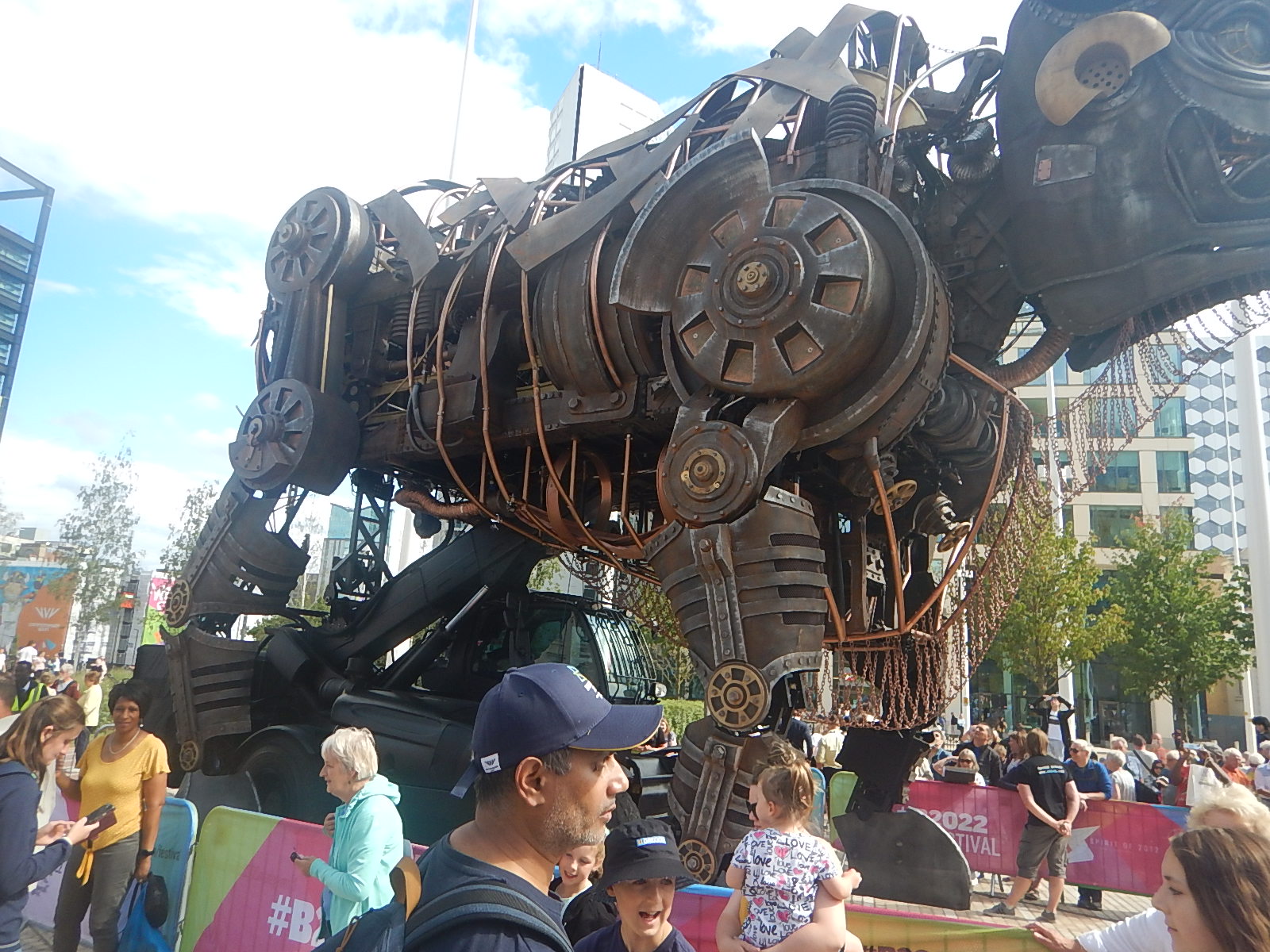
There are differences. Note the loader underneath to give the artwork movement.
A year ago, I said this in the post.
This wonderful work of engineering art, is far too good and is now too well-loved to be scrapped.
As it needs to go inside, why not bring it inside High Speed Two’s new Curzon Street station, to greet passengers visiting Birmingham?
Ozzy has found a new permanent home in Birmingham New Street station, but I wouldn’t rule out a move to Curzon Street station, for several decades.
West Midlands Metro – Eastside Extension – 26th July 2023
These pictures show the current state of the Eastside Extension of the West Midlands Metro.


























Note.
There is a triangular junction, where the lines split to the South of the Bull Street tram stop.
The Eastside Extension will run past Curzon Street station and then on to somewhere around Digbeth Coach station.
There is a triangular junction, where the lines split to the South of the Bull Street tram stop.
A Walk Around High Speed Two Works In Birmingham – 19th July 2023
The plan was simple.
I intended to go to Birmingham Moor Street station and see what I could see of the High Speed Two works in a circular walk from the station.
I took these pictures.
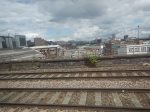


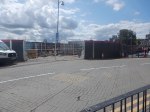
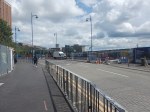

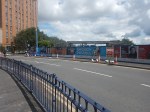
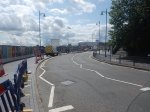






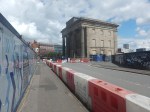
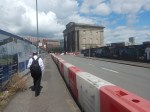
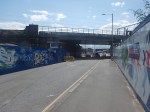

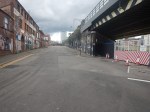
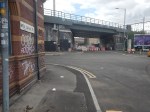
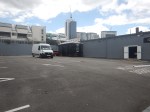


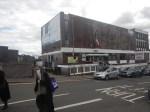
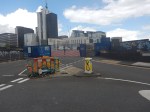

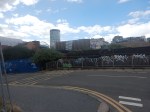
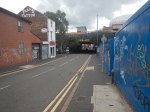
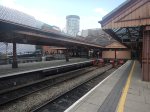
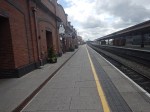
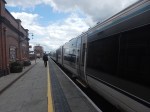
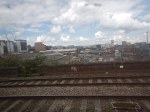



Note.
- At the beginning and end of this gallery, there are some pictures taken from the train, that was entering or leaving Birmingham Moor Street station.
- The boxy building is the Grade I Listed Birmingham Curzon Street station, that will be incorporated into the High Speed Two station.
- I didn’t expect to see a memorial to the Katyn massacre.
I can see a very large amount of development happening in this area.
Thoughts On High Speed Two
These are a few thoughts about High Speed Two, after the reports of major changes today.
This article on the BBC is entitled HS2 Line Between Birmingham And Crewe Delayed By Two Years.
This is the sub-heading.
The Birmingham to Crewe leg of high speed railway HS2 will be delayed by two years to cut costs.
These are the three opening paragraphs.
Some of the design teams working on the Euston end of the line are also understood to be affected.
Transport secretary Mark Harper blamed soaring prices and said it was “committed” to the line linking London, the Midlands and North of England.
HS2 has been beset by delays and cost rises. In 2010, it was expected to cost £33bn but is now expected to be £71bn.
Delivering The Benefits Of High Speed Two Early
It is my belief that with a large project taking a decade or more , it is not a bad idea to deliver some worthwhile benefits early on.
The Elizabeth Line opened in stages.
- The new Class 345 trains started replacing scrapyard specials in 2017.
- The rebuilt Abbey Wood station opened in 2017.
- Paddington local services were transferred to the Elizabeth Line in 2019.
- Outer stations reopened regularly after refurbishment from 2018.
- The through line opened in May 2022.
There’s still more to come.
Some projects wait until everything is ready and everybody gets fed up and annoyed.
Are there any parts of High Speed Two, that could be completed early, so that existing services will benefit?
In 2020, the refurbishment of Liverpool Lime Street station and the tracks leading to the station was completed and I wrote about the station in It’s A Privilege To Work Here!, where this was my conclusion.
Wikipedia says this about Liverpool Lime Street station.
Opened in August 1836, it is the oldest still-operating grand terminus mainline station in the world.
I’ve used Lime Street station for fifty-five years and finally, it is the station, the city needs and deserves.
I’ve been to grand termini all over the world and Lime Street may be the oldest, but now it is one of the best.
Are there any stations, that will be served by High Speed Two, that should be upgraded as soon as possible to give early benefits to passengers, staff and operators?
Avanti West Cost have solved the problem of the short platforms at Liverpool South Parkway station, by ordering shorter Class 807 trains. Will High Speed Two lengthen the platforms at this station?
A good project manager will need to get all the smaller sub-projects in a row and work out what is the best time to do each.
Digital Signalling
I would assume, as this will be needed for High Speed Two services in the West Coast Main Line to the North of Crewe, this is surely a must for installing as early as possible.
If the existing trains could run for a hundred miles at 140 mph, rather than the current 125 mph, that would save five worthwhile minutes.
Trains could run closer together and there is the possibility of organising services in flights, where a number of trains run together a safe number of minutes apart.
Remove Bottlenecks On Classic Lines, That Could Be Used By High Speed Two
I don’t know the bottlenecks on the West Coast Main Line, but there are two on the East Coast Main Line, that I have talked about in the past.
Could ERTMS And ETCS Solve The Newark Crossing Problem?
Improving The North Throat Of York Station Including Skelton Bridge Junction
Hopefully, the digital signalling will solve them.
Any bottlenecks on lines that will be part of High Speed Two, should be upgraded as soon as possible.
Birmingham And Crewe
I will start by looking at the leg between Birmingham and Crewe.
This section of the HS2 map shows High Speed Two between Birmingham and Lichfield.
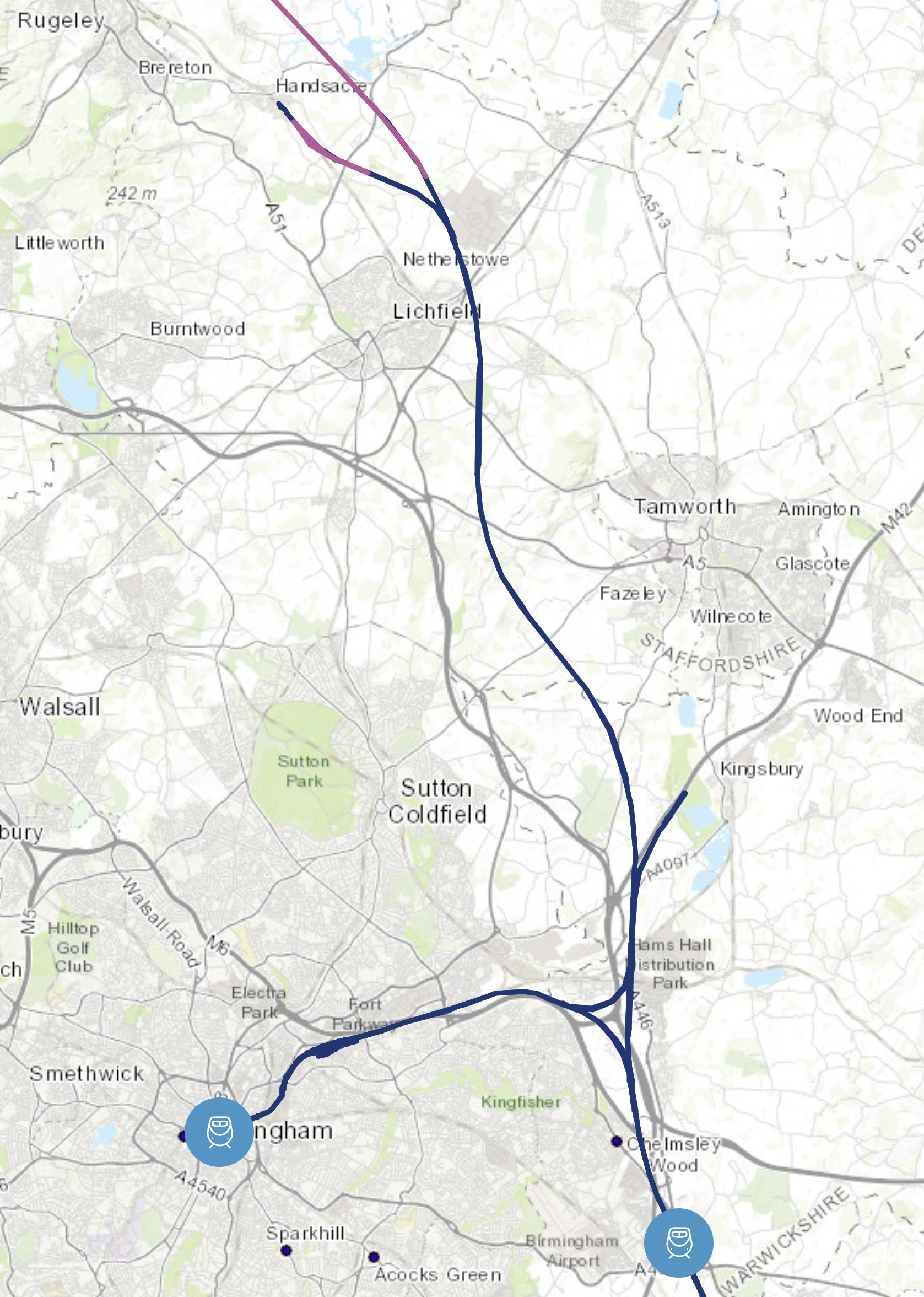
Note.
- The blue circle on the left at the bottom of the map is Birmingham Curzon Street station.
- The blue circle on the right at the bottom of the map is Birmingham Interchange station.
- The High Speed Two to and from London passes through Birmingham Interchange station.
- The branch to Birmingham Curzon Street station connects to the main High Speed Two at a triangular junction.
- North of the triangular junction, High Speed Two splits.
- The Eastern branch goes to East Midlands Parkway station.
- The Northern branch goes to Crewe, Liverpool Lime Street, Manchester Piccadilly, Preston and Scotland.
At the top of the map, the Northern branch splits and lines are shown on this map.

Note.
- The junction where the Northern and Eastern branches divide is in the South-East corner of the map.
- To the North of Lichfield, the route divides again.
- The Northern purple line is the direct line to Crewe.
- The shorter Southern branch is a spur that connects High Speed Two to the Trent Valley Line, which is the current route taken by trains between London Euston and Crewe, Liverpool Lime Street, Manchester Piccadilly, Preston and Scotland.
- Crewe station is in the North-West corner of the map.
The route between the junction to the North of Lichfield and Crewe is essentially two double-track railways.
- High Speed Two with a routine operating speed of 205 mph.
- The Trent Valley Line with a routine operating speed of 140 mph.
- High Speed Two Classic-Compatible trains can run on all tracks.
- High Speed Two Full-Size trains may be able to run on the Trent Valley Line at reduced speed.
- Eighteen trains per hour (tph) is the maximum frequency of High Speed Two.
I feel in an emergency, trains will be able to use the other route.
Will This Track Layout Allow An Innovative Build?
Suppose the link to the Trent Valley Line was built first, so that High Speed Two trains from London for Crewe, Liverpool Lime Street, Manchester Piccadilly, Preston and Scotland, could transfer to the Trent Valley Line as they do now.
- All lines used by High Speed Two services North of the junction, where High Speed Two joins the Trent Valley Line would be updated with digital signalling and 140 mph running. This will benefit current services on the line. For instance Euston and Liverpool/Manchester services could be under two hours.
- The current services would be replaced by High Speed Two services run by High Speed Two Classic-Compatible trains.
- The direct High Speed Two route between Lichfield and Crewe would now be built.
- When this section of High Speed Two is complete, High Speed Two services would use it between Lichfield and Crewe.
- As the direct route would be built later, this would delay the building of the Birmingham and Crewe high-speed route.
Currently, trains run the 41.8 miles between Lichfield and Crewe in 28 minutes, which is an average speed of 89.6 mph.
I can build a table of average speeds and times for Lichfield and Crewe.
- 100 mph – 25.1 minutes – 2.9 minutes saving
- 110 mph – 22.8 minutes – 5.2 minutes saving
- 120 mph – 20.9 minutes – 7.1 minutes saving
- 125 mph – 20.1 minutes – 7.9 minutes saving
- 130 mph – 19.3 minutes – 8.7 minutes saving
- 140 mph – 17.9 minutes – 10.1 minutes saving
- 160 mph – 15.7 minutes – 12.3 minutes saving
- 180 mph – 13.9 minutes – 14.1 minutes saving
- 200 mph – 12.5 minutes – 15.5 minutes saving
Note.
- Even a slight increase in average speed creates several minutes saving.
- Times apply for both routes.
I believe that a 125 mph average should be possible on the Trent Valley route, which may be enough for Euston and Liverpool/Manchester services to be under two hours.
Improving Classic Lines Used By High Speed Two North Of Lichfield
Real Time Trains shows these figures for a Glasgow Central to Euston service.
- Glasgow and Lichfield Trent Valley is 298.2 miles.
- Glasgow and Lichfield Trent Valley takes five hours.
This is an average speed of 59.6 mph.
Note.
- The average speed is low considering the trains are capable of cruising at 125 mph and 140 mph with digital signalling.
- High Speed Two services between Euston and Glasgow will use the classic network, to the North of Lichfield.
I can build a table of average speeds and times for Glasgow and Lichfield.
- 100 mph – 179 minutes – 121 minutes saving
- 110 mph – 163 minutes – 157 minutes saving
- 120 mph – 149 minutes – 151 minutes saving
- 125 mph – 143 minutes – 157 minutes saving
- 130 mph – 138 minutes – 162 minutes saving
- 140 mph – 128 minutes – 172 minutes saving
This table illustrates why it is important to improve all or as many as possible of classic lines used by High Speed Two to enable 140 mph running, with full digital signalling. Obviously, if 140 mph is not feasible, the speed should be increased to the highest possible.
Routes that could be updated include.
- London Euston and Glasgow Central
- London Euston and Liverpool Lime Street
- London Euston and Manchester Piccadilly (all routes)
- London Euston and Blackpool
- London Euston and Holyhead
- London Euston and Shrewsbury
Not all these routes will be served by High Speed Two, but they could be served by 140 mph trains.
What Times Would Be Possible?
The InterCity 225 was British Rail’s ultimate electric train and these two paragraphs from its Wikipedia entry, describe its performance.
The InterCity 225 was designed to achieve a peak service speed of 140 mph (225 km/h); during a test run in 1989 on Stoke Bank between Peterborough and Grantham, an InterCity 225 was recorded at a speed of 162 mph (260.7 km/h). Its high speed capabilities were again demonstrated via a 3hr 29mins non-stop run between London and Edinburgh on 26 September 1991. British regulations have since required in-cab signalling on any train running at speeds above 125 mph (201 km/h) preventing such speeds from being legally attained in regular service. Thus, except on High Speed 1, which is equipped with cab signalling, British signalling does not allow any train, including the InterCity 225, to exceed 125 mph (201 km/h) in regular service, due to the impracticality of correctly observing lineside signals at high speed.
The InterCity 225 has also operated on the West Coast Main Line (WCML). In April 1992, one trainset achieved a new speed record of two hours, eight minutes between Manchester and London Euston, shaving 11 minutes off the 1966 record. During 1993, trials were operated to Liverpool and Manchester in connection with the InterCity 250 project.
- The fastest London Euston and Manchester Piccadilly services appear to be two hours and six minutes tomorrow, with stops at Nuneaton and Stoke-on-Trent.
- The fastest London King’s Cross and Edinburgh service is four hours seventeen minutes tomorrow.
It does appear that British Rail’s 1980s-vintage InterCity 225 train did very well.
Trains that would be able to run at 140 mph with updated signalling include.
- Alstom Class 390
- Hitachi Class 800, 801, 802, 803, 805, 807 and 810
- British Rail InterCity 225
- High Speed Two Classic-Compatible.
All are electric trains.
Could High Speed Two, West Coast Main Line and East Coast Main Line Services Be Run By High Speed Two Classic-Compatible Trains?
I don’t see why not!
- They would be able to use short stretches of High Speed Line like Lichfield and Crewe.
- LNER and CrossCountry could also use the trains.
- High Speed Two is providing the framework and it’s there to be used, provided the paths are available.
This graphic shows the preliminary schedule.
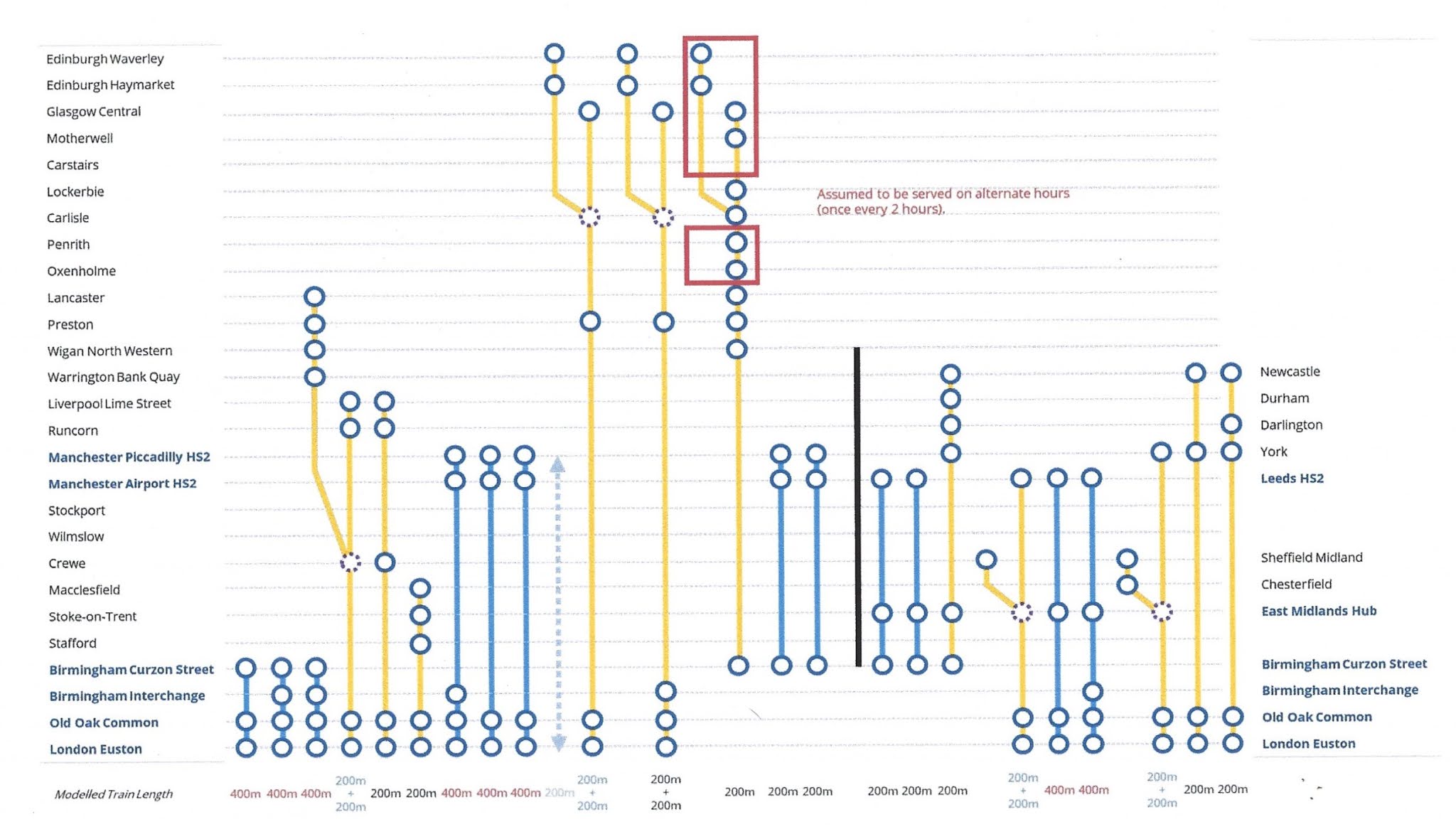
It only shows ten trains going through Crewe, so there could be up to eight spare high speed paths between Birmingham and Crewe.
Could High Speed Two Classic-Compatible Trains Be Used To Advantage On The East Coast Main Line?
I published this extract from the Wikipedia entry for the InterCity 225 earlier.
The InterCity 225 was designed to achieve a peak service speed of 140 mph (225 km/h); during a test run in 1989 on Stoke Bank between Peterborough and Grantham, an InterCity 225 was recorded at a speed of 162 mph (260.7 km/h). Its high speed capabilities were again demonstrated via a 3hr 29mins non-stop run between London and Edinburgh on 26 September 1991.
The London and Edinburgh run was at an average speed of around 112 mph.
I wonder what time, one of LNER’s Class 801 trains, that are all-electric could do, once the new digital signalling has been fully installed on the route? I suspect it would be close to three hours, but it would depend on how long the trains could run at 140 mph.
It should be noted that the Selby Diversion was designed for 160 mph, when it was built by British Rail in the 1980s.
In Are Short Lengths Of High Speed Line A Good Idea?, I look at the mathematics of putting in short lengths of new railway, which have higher speeds, where this was part of my conclusion.
I very much feel there is scope to create some new high speed sections on the current UK network, with only building very little outside of the current land used by the network.
I would love to know what some of Network Rail’s track experts feel is the fastest time possible between London and Edinburgh that can be achieved, by selective upgrading of the route.
If some of the trains were High Speed Two Classic-Compatible Trains, with a top speed of 205 mph, provided the track allowed it, there could be some interesting mathematics balancing the costs of track upgrades, new trains with what passengers and operators need in terms of journey times.
Could High Speed Two Classic-Compatible Trains Be Used To Advantage On The West Coast Main Line?
Much of what I said about the East Coast Main Line would apply to the West Coast Main Line.
But in addition, the West Coast Main Line will be a superb place to test the new High Speed Two Classic-Compatible Trains.
I believe, that before High Speed Two opens, we’ll see High Speed Two Classic-Compatible Trains, carrying passengers between Euston and Avanti West Coast’s destinations.
Could High Speed Two Be Split Into Two?
Consider.
- Under earlier plans, the East Coast Main Line to the North of York, will be used by High Speed Two.
- With digital signalling the East Coast Main Line will support continuous running at 140 mph for long sections of the route.
- The East Coast Main Line has a recently-rebuilt large Southern terminal at King’s Cross with eleven platforms and good suburban services and excellent connections to the London Underground.
- The East Coast Main Line has a very large Northern terminal at Edinburgh Waverley with twenty platforms and good local train connections.
- There are large intermediate stations on the East Coast Main Line at Doncaster, Leeds, Newcastle, Peterborough and York. All these stations have good local train connections.
- The East Coast Main Line has important branches to Cambridge, Harrogate, Huddersfield, Hull King’s Lynn, Lincoln, Middlesbrough, Nottingham, Scarborough, Sheffield, Skegness and Sunderland.
We are talking about an asset, that needs improving rather than sidelining.
Could High Speed Two Be A One-Nation Project?
Over three years ago, I wrote Could High Speed Two Be A One-Nation Project? and tried to answer the question in the title.
But now the core network is better defined, perhaps it is time to look at extending the High Speed network again.
The next few sections look at possible extensions.
Serving Chester And North Wales
I looked at this in Could High Speed Two Trains Serve Chester And North Wales?, which I have updated recently.
This was my conclusion.
It looks to me, that when High Speed Two, think about adding extra destinations, Chester and Holyhead could be on the list.
I also suspect that even without electrification and High Speed Two services, but with the new Class 805 trains, the route could be a valuable one for Avanti West Coast.
These are current and promised times for the two legs to Holyhead.
- Euston and Crewe – 90 minutes – Fastest Class 390 train
- Euston and Crewe – 55 minutes – High Speed Two Classic-Compatible train from Wikipedia
- Crewe and Holyhead – 131 minutes – Fastest Class 221 train
- Crewe and Holyhead – 70 minutes – 90 mph average speed
- Crewe and Holyhead – 63 minutes – 100 mph average speed
- Crewe and Holyhead – 57 minutes – 110 mph average speed
- Crewe and Holyhead – 53 minutes – 120 mph average speed
- Crewe and Holyhead – 45 minutes – 140 mph average speed
Note.
- I have assumed that Crewe and Holyhead is 105.5 miles.
- The operating speed of the North Wales Coast Line is 90 mph.
- In the following estimates, I have assumed a change of train at Crewe, takes 6 minutes.
I think there are several options to run fast services to Chester and North Wales.
Pre-HS2 – Class 805 all the way
I believe this train will match the following.
- The fastest Class 390 train between Euston and Crewe.
- The fastest Class 221 train between Crewe and Holyhead.
This would give a time of 3 hours 41 minutes.
Pre-HS2 – Class 805 all the way, but with perhaps less stops and some track improvement
I believe this train will match the following.
- The fastest Class 390 train between Euston and Crewe.
- 110 mph train Crewe and Holyhead.
This would give a time of 2 hours 27 minutes.
Pre-HS2 – Class 805 all the way, but with perhaps less stops and Crewe and Holyhead uprated largely to 125 mph
I believe this train will match the following.
- The fastest Class 390 train between Euston and Crewe.
- 120 mph train Crewe and Holyhead.
This would give a time of 2 hours 23 minutes.
Pre-HS2 – Class 805 all the way, but with perhaps less stops and Crewe and Holyhead Crewe and Holyhead electrified and uprated to 140 mph
I believe this train will match the following.
- The fastest Class 390 train between Euston and Crewe.
- 140 mph train Crewe and Holyhead.
This would give a time of 2 hours 15 minutes.
After-HS2 – High Speed Two Classic-Compatible train to Crewe, the Class 805 train to Holyhead
I believe this train will match the following.
- The fastest High Speed Two Classic-Compatible train between Euston and Crewe.
- The fastest Class 221 train between Crewe and Holyhead.
This would give a time of 3 hours 12 minutes.
After-HS2 – High Speed Two Classic-Compatible train to Crewe, the Class 805 train to Holyhead, but with perhaps less stops and some track improvement
I believe this train will match the following.
- The fastest High Speed Two Classic-Compatible train between Euston and Crewe.
- 110 mph train Crewe and Holyhead.
This would give a time of 1 hours 58 minutes.
After-HS2 – High Speed Two Classic-Compatible train to Crewe, the Class 805 train to Holyhead, but with perhaps less stops and Crewe and Holyhead uprated largely to 125 mph
I believe this train will match the following.
- The fastest High Speed Two Classic-Compatible train between Euston and Crewe.
- 120 mph train Crewe and Holyhead.
This would give a time of 1 hours 54 minutes.
After-HS2 – High Speed Two Classic-Compatible train to Crewe, Class 805 train to Holyhead, but with perhaps less stops and Crewe and Holyhead electrified and uprated to 140 mph
I believe this train will match the following.
- The fastest High Speed Two Classic-Compatible train between Euston and Crewe.
- 140 mph train Crewe and Holyhead.
This would give a time of 1 hours 46 minutes.
After-HS2 – High Speed Two Classic-Compatible train all the way, but with perhaps less stops and Crewe and Holyhead electrified and uprated to 140 mph
I believe this train will match the following.
- The fastest High Speed Two Classic-Compatible train between Euston and Crewe.
- 140 mph train Crewe and Holyhead.
This would give a time of 1 hours 40 minutes.
From these estimates, I have come to these conclusions.
- A sub-two and a half-hour service can be attained with the new Class 805 trains and some improvements to the tracks along the North Wales Coast Line.
- A sub-two hour service can be attained with a High Speed Two Classic-Compatible train to Crewe and a Class 805 train to Hplyhead along a 140 mph electrified North Wales Coast Line.
- If the North Wales Coast Line is electrified, the journey from London Euston, Birmingham Interchange, Crewe, Chester, Liverpool and Manchester would be zero-carbon.
We should be looking to building a zero-carbon fast passenger ferry for sailing between Holyhead and Dublin.
- The current fastest ferries appear to take three hours and 15 minutes, which means that a six-hour low-carbon journey between London Euston and Dublin, should be possible with the new Class 805 trains, prior to the opening of High Speed Two.
- A five-hour journey after the opening of High Speed Two to Crewe and electrification of the North Wales Coast Line should be possible.
If the advanced zero-carbon ferry could knock an hour off the journey, four hours between London and Dublin along a spectacular coastal railway with a fast sea voyage, would be a route that would attract passengers.
- High Speed Two would need to be opened to Crewe.
- The North Wales Coast Line would need to be upgraded to a 140 mph digitally-signalled line.
- The North Wales Coast Line would need to be electrified.
- Full electrification may not be needed, as discontinuous electrification will have advanced to provide zero-carbon running, in a more affordable and less disruptive manner.
- Trains could either be High Speed Two Classic-Compatible trains all the way from London or there could be a change at Crewe to Class 805 trains.
- The ferry would use the best zero-carbon and operational technology.
The improvement and electrification of the North Wales Coast Line could be planned to take place in a relaxed manner, so that journey times continuously got quicker.
I would start the improvement of the North Wales Coast Line, as soon as possible, as all these improvement will be used to advantage by the new Class 805 trains.
Serving West And South West England And South Wales
Suppose you want to go between Glasgow and Cardiff by train, after High Speed Two has opened.
- You will take one of the half-hourly High Speed Two Classic-Compatible trains between Glasgow Central and London.
- Three and a half-hours later, you will get off the train in one of the below ground platforms at Old Oak Common station.
- A short ride in an escalator or lift and you will be in the Great Western Railway station at ground level.
- From here, fifty minutes later, you will be in Cardiff.
The journey will have taken four hours and twenty minutes.
This may seem a long time but currently Glasgow and Cardiff by train takes over seven hours by train.
- Glasgow and Bristol Temple Meads takes eight hours, but using High Speed Two and GWR will take 5 hours.
- Glasgow and Cheltenham Spa takes six hours, but using High Speed Two and GWR will take 5 hours and 30 minutes.
- Glasgow and Penzance takes twelve hours, but using High Speed Two and GWR will take 8 hours and 33 minutes.
- Glasgow and Swansea takes nearly nine hours, but using High Speed Two and GWR will take 6 hours and 9 minutes.
The High Speed Two route only has one simple change, whereas some routes now have up to four changes.
Conclusion
The Birmingham Bull – 5th August 2022
The non-human star of the Opening Ceremony of the 2022 Commonwealth Games in Birmingham was a mechanical bull.
This article on the BBC is entitled Commonwealth Games: Scots Creator Reveals Secrets Of Metal Bull.
These three introductory paragraphs give an overview of the design.
The secrets of the mechanical bull that wowed audiences during the opening ceremony of the Commonwealth Games have been revealed by its Scottish creator.
The 10m high scrap metal sculpture was one of the stars of the celebration in Birmingham’s Alexander Stadium.
Michael Dollar, of creative model makers Artem, said it took six people to operate the giant structure.
The BBC also revealed today, that the bull would be parked for a few days in Centenary Square outside the Library of Birmingham.
So as my day had fallen apart, I got on a Chiltern train to Birmingham and took these pictures.




























Note.
- The first picture has the The Library Of Birmingham in the background, with its lattice frontage and gold dome.
- The Bull seems to have been built on a loader chassis.
- There were a large crowd in Centenary Square looking at the Bull.
I have never seen a public work of art surrounded by such a crowd, most of whom were taking selfies or traditional pictures.
This article on the BBC is entitled Birmingham Commonwealth Games: Ceremony Bull To Stay.
The BBC article says this about the future of the bull.
A giant mechanical bull that became the star of the Birmingham Commonwealth Games opening ceremony it set to stay in the city.
The 10m sculpture is on display in Centenary Square after its debut last week, although its future has been less clear.
Largely made of foam, it was due to be dismantled at the end of the Games, sparking public outcry.
But Birmingham City Council has confirmed the bull has won a reprieve.
It will stay in the square until the end of September before being moved indoors.
This wonderful work of engineering art, is far too good and is now too well-loved to be scrapped.
As it needs to go inside, why not bring it inside High Speed Two’s new Curzon Street station, to greet passengers visiting Birmingham?
How Feasible Is A High Speed Line Between Birmingham And Nottingham?
In Red Wall Commuters To Get Rail Revolution, I indicated that the Department of Transport is considering creating three new high speed lines in the Midlands and the North of England.
One is proposed between Birmingham and East Midlands Parkway, which is described in the original article in The Sunday Times like this.
A 42-mile line from Birmingham to East Midlands Parkway, just south of Nottingham. This is expected to cut journey times between the two cities from 72 minutes to 27 minutes.
There is a currently, a CrossCountry service between Nottingham and Birmingham New Street stations.
- The frequency is two trains per hour (tph)
- Trains are generally three- or four-car formations of Class 170 diesel trains.
- All trains stop at Tamworth, Burton-on-Trent and Derby.
- Some trains stop at Wilnecote, Willington, Spondon, Long Eaton and Beeston
- The services take upwards of seventy-one minutes.
Note.
- The frequency between Birmingham New Street and Derby is four tph.
- Trains reverse at Derby which takes seven minutes.
- Three tph stop at Burton-on-Trent.
I feel that the current service is very much a compromise, which is trying to handle three services.
- A fast train between Birmingham and Nottingham.
- A fast train between Birmingham and Derby.
- A local service between Nottingham and Derby.
High Speed Two will be providing a non-stop service between Birmingham Curzon Street and East Midlands Hub stations.
- The frequency will be three tph.
- There will also be an hourly train between Birmingham Interchange and East Midlands Hub station.
- The services will take twenty minutes or slightly less from Interchange.
The services will only get you to East Midlands Hub station.
In addition after High Speed Two opens Midlands Connect are planning to run a direct service between Nottingham and Birmingham Curzon Street stations.
- The frequency will be one tph.
- The service will use High Speed Two Classic Compatible trains.
- The only stop will be East Midlands Hub station.
- The service will take thirty-three minutes.
So how does a new high speed line connect Birmingham and Nottingham in twenty-seven minutes?
Consider.
- The route between Birmingham New Street and North Stafford Junction is 35.9 miles
- At North Stafford junction a double-track freight line leads to the East.
- The freight line passes to the North of East Midlands Airport and South of Long Eaton station before joining the Midland Main Line at Trent junction to the North of East Midlands Parkway station.
- Trains can pass straight into Nottingham via Beeston.
- Nottingham is just 6.7 miles to the East of Trent junction and East Midlands Parkway is just a mile South of Trent junction.
- South Stafford junction to Trent junction is probably about seven miles.
I believe that this is the route that will be upgraded to create a high speed line between Birmingham and Nottingham.
- Part of the route between Tamworth and Burton-on-Trent was upgraded to 125 mph running by British Rail.
- Between Birmingham New Street and North Stafford Junction is used by CrossCountry services between Birmingham and Derby and Nottingham.
- I believe that the route can be fully electrified and upgraded, so that most of the route could be suitable for 125 mph running.
- The Midland Main Line is already capable of handling trains at 125 mph.
This should make it possible for services to run between Birmingham New Street and Nottingham in the required twenty-seven minutes.
I will answer a few questions.
Could The Trains Serve Birmingham Curzon Street In Birmingham?
In Birmingham Airport Connectivity, I said this
But look at this map clipped from the High Speed Two web site.
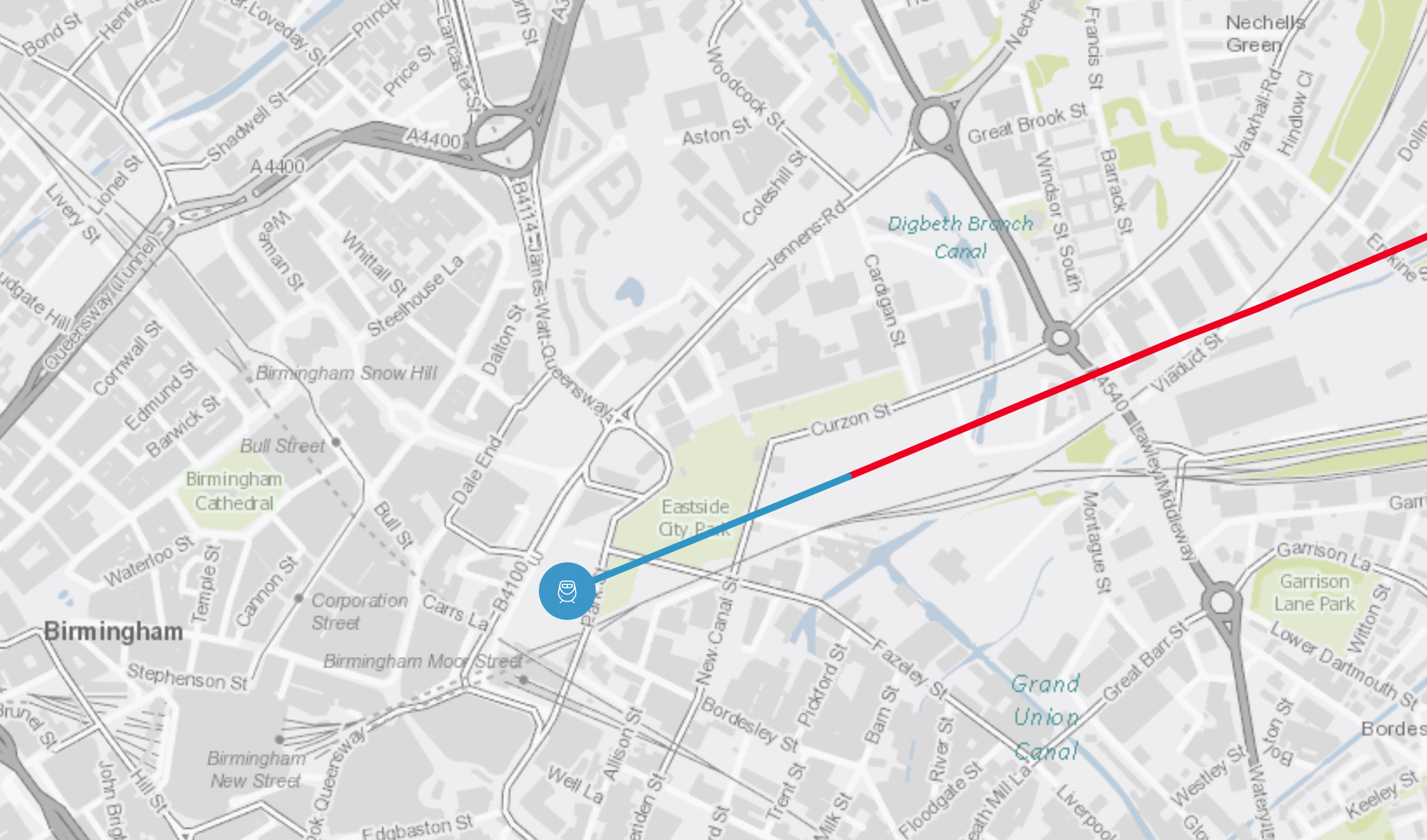
Note.
- The blue dot shows the location of Curzon Street station.
The West Coast Main Line running into New Street station, is just to the South of Curzon Street station.
New Street station can be picked out to the West of Curzon Street station.
This Google Map shows a close-up of the current Curzon Street station site.
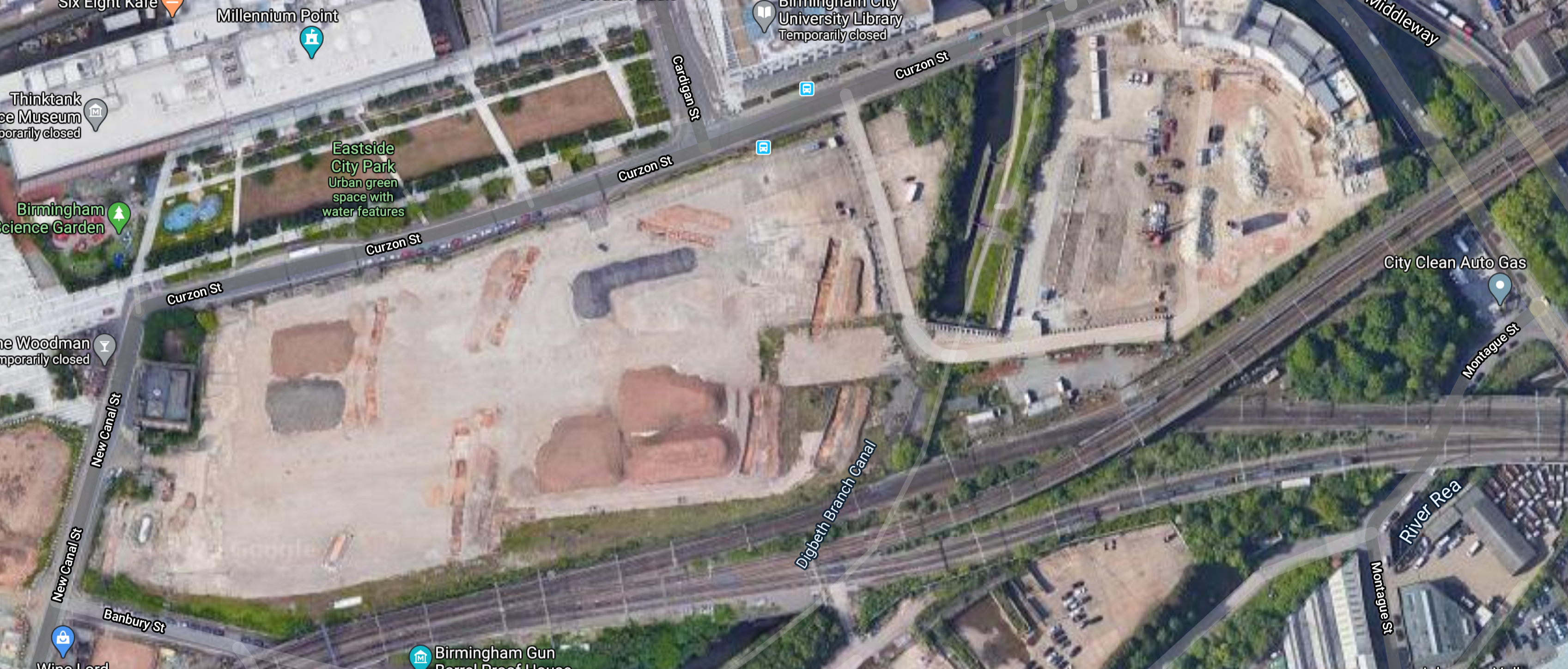
The same pattern of rail lines going past the Curzon Street site into New Street station can be picked out.
Surely, a connection could be made to allow trains from a couple of platforms in Curzon Street station to terminate trains from the West Coast Main Line.
Possible services could include.
- London Euston and Birmingham Curzon Street via Watford Junction, Milton Keynes, Rugby and Coventry
- Cardiff and Birmingham Curzon Street via Bristol Parkway, Swindon, Oxford and Milton Keynes.
- Cambridge and Birmingham Curzon Street via Bristol Parkway, Bedford and Milton Keynes.
There are a lot of possibilities to give High Speed Two much bigger coverage.
I also suspect that the proposed Nottingham and Birmingham service could terminate in Birmingham Curzon Street.
Could High Speed Two Classic Compatible Trains Run Between Birmingham And Nottingham?
As High Speed Two Classic Compatible Trains would have the same loading gauge as current trains, I don’t see why not.
Could A London Euston And Nottingham Service Be Run With A Reverse At Birmingham Curzon Street?
These are prospective times for High Speed Two.
- London Euston and Birmingham Curzon Street – 45 minutes
- London Euston and East Midlands Hub – 52 minutes
Note that East Midlands Hub and Nottingham could take at least twenty minutes.
And this is a current timing.
- London St. Pancras And Nottingham – 95 minutes
It is possible calculate the time for London Euston to Nottingham with a reverse at Birmingham.
- London Euston and Birmingham Curzon Street – 45 minutes
- Reverse at Birmingham Curzon Street – 3 minutes
- Birmingham Curzon Street and Nottingham – 27 minutes
This would give a time of 75 minutes between London Euston and Nottingham.
It does look to me, that the fastest route between London and Nottingham, will be to to go via Birmingham and the proposed new high speed route.
So the answer to the question in the title of this section is a Yes!
Could A London Euston And Sheffield Service Be Run With A Reverse At Birmingham Curzon Street?
These are prospective times for High Speed Two.
- London Euston and Birmingham Curzon Street – 45 minutes
- London Euston and East Midlands Hub – 52 minutes
- London Euston and Sheffield – 87 minutes
And these are current timings.
- London St. Pancras And Derby- 85 minutes
- London St. Pancras And Sheffield- 118 minutes
- Birmingham New Street And Derby- 33 minutes
- Birmingham New Street And Sheffield- 75 minutes
It is possible calculate the time for London Euston to Sheffield with a reverse at Birmingham.
- London Euston and Birmingham Curzon Street – 45 minutes
- Reverse at Birmingham Curzon Street – 3 minutes
- Birmingham Curzon Street and Sheffield – 75 minutes
This would give a time of 123 minutes between London Euston and Sheffield.
I wonder what time could be achieved between London Euston and Sheffield could be achieved with improvements to the following lines.
- The CrossCountry Route between North Stafford junction and Derby station.
- The Midland Main Line between Derby and Sheffield.
I would expect that the improvement to these routes would include.
- At least almost full electrification.
- Removal of level crossings.
- Full digital signalling.
- Upgrading to 140 mph running.
I could see the following service improvements.
- A substantial reduction of the times between Birmingham and Sheffield.
- Derby and Burton-on-Trent would get a fast service to London Euston via High Speed Two.
- Derby and Burton-on-Trent would get a fast service to Birmingham probably with a frequency of 4 tph.
- CrossCountry services between Birmingham and Sheffield would be faster.
Derby and Burton-on-Trent would get a much better train service.
Could Burton-on-Trent, Derby, Nottingham And Sheffield Be served By Trains Splitting And Reversing At Birmingham Curzon Street?
These are prospective frequencies for High Speed Two.
- Burton-on-Trent – No trains
- Chesterfield 1 tph
- Derby – No trains
- East Midland Hub – 7 tph
- Nottingham – 0 tph
- Sheffield – 2 tph
Suppose there were two tph between London and Birmingham Curzon Street, that split into two trains in Birmingham.
- One train could go to Nottingham and call at Tamworth and Burton-on-Trent.
- The other train could go to Sheffield and call at Tamworth, Burton-on-Trent, Derby and Chesterfield.
This would give the following frequencies from London on High Speed Two.
- Burton-on-Trent – 2 tph
- Chesterfield – 2 tph
- Derby – 2 tph
- Nottingham – 2 tph
- Sheffield – 2 tph
Note that I am ignoring the Eastern Leg of High Speed Two in this analysis.
Could We Go For The Full Burton?
In the previous sections, I suggested serving Nottingham and Sheffield from Euston using High Speed Two with a reverse at Birmingham Curzon Street, where the train would split into two trains, with one train going to Sheffield and the other going to Nottingham.
But could the split be at a rebuilt Burton station?
Consider.
- Burton station could become an Eastern terminus of Birmingham’s Cross-City Line.
- Burton station could become the Western terminus of the Ivanhoe Line to Leicester.
- If the Cross Country Route is upgraded, Burton station would have fast connections to Birmingham, Derby, Chesterfield, Sheffield and Leeds,
- If the new Birmingham and Nottingham route is created, this would mean fast connections to Nottingham and possibly Lincoln.
Burton-on-Trent could become the passenger rail hub for the Mid Midlands.
I
Could Services To The North On High Speed Two Reverse At Birmingham Curzon Street?
When I first went to Nice by TGV, which I wrote about in Cambridge to Nice by Train, the train reversed in Marseille. They still do!
So would it be possible to run services between London and the North of England and Scotland via Birmingham Curzon Street?
- Birmingham Curzon Street can handle trains to and from London Euston, Leeds, Liverpool, Manchester and Scotland.
- It could offer timetabling advantages.
- It might be possible to use London Euston station more efficiently.
- There will be plenty of capacity between Birmingham Curzon Street and Manchester and Leeds, if the Eastern Leg is built.
Drivers would probably step-up to perform a fast stop at Birmingham Curzon Street.
I could envisage a service, that went between London Euston and Hull.
- It would call at Birmingham Curzon Street, Manchester, Huddersfield, Bradford and Leeds.
- There might be a stop at Crewe for interchange to other services on the West Coast Main Line.
- The train would reverse in Birmingham Curzon Street.
- The service could be an extension of the core London and Birmingham Curzon Street service.
- It could have a frequency of two trains per hour (tph)
Note.
- If Northern Powerhouse Rail were to be upgraded to handle High Speed Two’s Full-Size trains, these could be used on the route.
- The service would make better use of the underused section of High Speed Two between Birmingham and Manchester.
- This service would reduce the urgency to build the Eastern Leg of High Speed Two.
- Hull gets a High Speed Two service from London Euston and Birmingham Curzon Street.
Scottish and other services could also reverse at Birmingham Curzon Street.
How Long Would A Reverse At Birmingham Curzon Street Take?
Consider
- CrossCountry services take about ten minutes to reverse at Reading.
- Typical stops of Southeastern Highspeed services at Ebbsfleet take less than two minutes.
- Most stops with Hitachi 80x trains appear to take about a minute.
- Better operating procedures and automation could make the reverse faster.
- It looks like High Speed Two trains are designed for speedy boarding.
I suspect that the reverse can be achieved in perhaps two or three minutes.
Update – In Dwell Time On High Speed Two Trains, I found out the dwell time is two minutes.
London Euston and Manchester Piccadilly With A Reverse At Birmingham Curzon Street
If I look at London Euston and Manchester Piccadilly, I get the following times.
- London Euston and Birmingham Curzon Street – Forty-five minutes
- Reverse at Birmingham Curzon Street – two minutes,
- Birmingham Curzon Street Could See Six tph – Forty-one minutes
That would be eighty-eight minutes, which compares with seventy-one minutes by going direct.
Current proposals give the following frequencies between the three stations.
- London Euston and Birmingham Curzon Street – 3 tph
- Birmingham Curzon Street and Manchester Piccadilly – 2 tph
- London Euston and Manchester Piccadilly – 3 tph
There would be six tph running to and from London Euston.
But the pattern could be.
- London Euston and Birmingham Curzon Street – 2 tph
- London Euston and Manchester Piccadilly – 2 tph
- London Euston and Manchester Piccadilly via Birmingham Curzon Street – 2 tph
in addition one of each pair of services would call at Birmingham Interchange.
Note.
- There would still be six tph running to and from London Euston.
- Birmingham Curzon Street, Manchester Airport and Manchester Piccadilly get four tph to and from London Euston.
- Birmingham Interchange still has two tph to and from Birmingham Curzon Street.
- Birmingham Interchange now has two tph to and from Manchester.Airport and Manchester Piccadilly.
It could be a worthwhile improvement for passengers and train operators.
Reversing in Birmingham Curzon Street Could Increase Frequency To And From London Euston
I showed in the previous section, that with a reverse in Birmingham Curzon Street, it is possible to increase services between London Euston and Birmingham Curzon Street, Manchester Airport and Manchester Piccadilly from three to four tph.
Suppose, one of each of the two Liverpool and Glasgow/Edinburgh services were to reverse in Birmingham Curzon Street, this would increase the frequency of trains between London Euston and Birmingham Curzon Street to six tph or a train every ten minutes.
Now that would be a Turn-Up-And-Go service. Especially, if customer-friendly contactless ticketing were to be used.
Conclusion
Reversing services at Birmingham Curzon Street has possibilities.
A Big Advantage Of Only Ten Platforms For High Speed Two At Euston Station
Many of us have been involved in the start-up and handover of a new project, even it is just buying a new house to live in from a builder.
All projects have one thing in common. Something will go wrong, even if it is just the lock on the toilet door.
Harold Macmillan expressed it memorably as “Events, Dear Boy! Events!”
This article on Ian Visits is entitled Call For A Rethink Of HS2’s Euston Station Plans.
These two paragraphs describe the current plan for Euston station.
The current plans for the HS2 station at Euston will see it delivered in two phases, with six platforms opened first to carry HS2 trains on the first stage of the railway up to the West Midlands. The second phase of the Euston station would open later, with an additional 5 platforms to manage demand when HS2 is extended to Crewe, Manchester and Leeds.
Phase one was scheduled for completion in 2026, and phase two in 2033.
This paragraph describes the latest idea from the Department for Transport.
However, the Oakervee review from last year called for a redesign of the station scaling back the station and increasing the amount of oversite development to fund it. Earlier this year it was revealed that the Department for Transport has instructed HS2 to refine the development to build it in one phase, but with just 10 platforms instead of 11 platforms.
There are now two camps arguing as to whether the station should be built with ten or eleven platforms.
The eleven platform station project will involve.
- Two-phase construction
- Five platforms by 2026
- Eleven platforms by 2033
On the other hand, the ten platform station project will involve.
- Single-phase construction
- Ten platforms on opening.
- More oversite development.
Note.
- There will be eleven trains per hour (tph) in Phase 1 of High Speed Two from London Euston.
- , Trains will serve Birmingham, Carlisle, Lancaster, Liverpool, Macclesfield, Manchester. Preston, Stafford, Stoke-on-Trent and Scotland.
- Full-size trains will be able to run to Birmingham Curzon Street and Crewe, but not to the two Manchester stations, as the trains don’t fit the infrastructure.
I suspect that Speed Two Classic-Compatible Trains will be running to Manchester.
The Big Advantage Of A Two-Phase Project With Ten Platforms
In the two-phase project with eleven platforms to rebuild Euston station, there will be five platforms, when the station opens, but in the single-phase project with ten platforms, there will be ten platforms.
If there are ten platforms, the station must be easier to operate, especially during the tricky phase of opening the new station.
With ten platforms, there will be more space to sort out those unexpected events!
Liverpool’s Forgotten Tunnel
The Wapping Tunnel in Liverpool was designed by George Stephenson and was the first tunnel in the world to be bored under a city.
It used to take goods trains between Liverpool Docks and the Liverpool and Manchester Line.
During the 1970s preparations were made to connect the Wapping Tunnel to Merseyrail’s Northern Line, so that trains could run between the Northern Line and the City Line, which would have connected the North and East of the City.
But the project was never completed.
It now appears, the project is on the agenda again.
This article on TransportExtra is entitled Liverpool CR Develops Plan To Boost City Centre Rail Capacity.
The plan outlined is as follows.
- At present, as many as two thirds of trains on the Northern Line turn back as Liverpool Central station.
- Between four and eight trains per hour (tph) could be diverted into the Wapping Tunnel to serve places like St. Helens, Warrington Central and Wigan.
- This would free up platforms in Liverpool Lime Street station for Inter-City and Inter-Regional services.
It is also pointed out, that a 2016 study, didn’t find any serious technical problems with the project.
I do have my thoughts on this project.
Services That Could Be Connected
Local services running from Liverpool Lime Street station include.
Manchester Oxford Road Via Warrington Central
This service is run by Northern.
- It has a frequency of two tph.
- One service calls at Edge Hill, Mossley Hill, West Allerton, Liverpool South Parkway, Hunts Cross, Halewood, Hough Green, Widnes, Sankey For Penketh, Warrington West, Warrington Central, Birchwood, Irlam, Urmston and Deansgate.
- The other service calls at Mossley Hill, West Allerton, Liverpool South Parkway, Hough Green, Widnes, Warrington Central, Padgate, Birchwood, Glazebrook, Irlam, Flixton, Chassen Road (1tp2h), Urmston, Humphrey Park, Trafford Park and Deansgate
- Both trains appear to take the same route.
- Some stations like Liverpool South Parkway, Warrington West and Deansgate have lifts, but disabled access is patchy.
- The service has a dedicated terminal at Manchester Oxford Road, which is without doubt Manchester’s worst central station for location, access to the Metrolink, onward travel and step-free access.
- It takes seventy-two minutes. which is an inconvenient time for train operators.
- The route is electrified with 25 KVAC overhead electrification at both ends.
I’ve used this route several times and usually pick it up from Deansgate, as it has a convenient interchange to the Metrolink.
I am fairly certain that Merseyrail’s new Class 777 trains running on battery power in the middle could handle this route.
- They would charge the batteries at the electrified ends of the route.
- They would join the route at Edge Hill station.
- They would offer step-free access between train and platform.
- These trains are built for fast stops, so could all services call at all stations?
- On Merseyrail’s principles, the service would probably be at least two tph, if not four tph.
I estimate that these trains are fast enough to do the return trip between the Wapping Tunnel portal at Edge Hill and Manchester Oxford Road in under two hours.
- A two-four tph stopping service between Liverpool and Manchester City Centres, that took less than an hour, would be very convenient for passengers.
- The service would be well-connected to local tram, train and bus services in both City Centres.
- The service would also very easy for train schedulers to integrate with other services.
Liverpool and Manchester would have the world’s first battery-powered inter-city railway.
Other than the connection of the Wapping Tunnel no extra infrastructure works would be needed.
Wigan North Western Via St. Helens Central
This service is run by Northern.
- It has a frequency of two tph.
- The service calls at Edge Hill, Wavertree Technology Park, Broad Green, Roby, Huyton, Prescot, Eccleston Park, Thatto Heath, St Helens Central, Garswood and Bryn
- The route is fully-electrified with 25 KVAC overhead.
- It takes fifty-one minutes. which is a very convenient time for train operators.
Merseyrail’s new Class 777 trains could handle this route, if fitted with pantographs for 25 KVAC overhead electrification.
- They would join the route at Edge Hill station.
- They would offer step-free access between train and platform.
- On Merseyrail’s principles, the service would probably be at least two tph, if not four tph.
I estimate that these trains are fast enough to do the return trip between the Wapping Tunnel portal at Edge Hill and Wigan North Western in under two hours.
- A two-four tph stopping service between Liverpool and Wigan, that took less than an hour, would be very convenient for passengers.
- Wigan North Western has good connections using the West Coast Main Line.
- The service would also very easy for train schedulers to integrate with other services.
Other than the connection of the Wapping Tunnel no extra infrastructure works would be needed.
Blackpool North
This service is run by Northern.
- It has an hourly frequency.
- The service calls at Huyton, St Helens Central, Wigan North Western, Euxton Balshaw Lane, Leyland, Preston, Kirkham & Wesham and Poulton-le-Fylde
- The route is fully-electrified with 25 KVAC overhead.
- It takes seventy-seven minutes. which is a reasonable time for train operators.
This is a service that could continue as now, but would probably be timed to fit well with four Merseyrail trains between the Wapping Tunnel and Wigan North Western.
Manchester Airport Via Warrington Central And Manchester Piccadilly
This service is run by Northern.
- It has an hourly frequency.
- The service calls at Liverpool South Parkway, Warrington West, Warrington Central, Birchwood, Manchester Oxford Road, Manchester Piccadilly and Mauldeth Road
- The route is partially-electrified with 25 KVAC overhead.
- The service is operated by diesel trains.
- The service uses the overcrowded Castlefield Corridor.
- It takes sixty-nine minutes, which is an inconvenient time for train operators.
This is one of those services, which I think will eventually be partially replaced by other much better services.
- Northern Powerhouse Rail is planning six tph between Liverpool Lime Street and Manchester Piccadilly via Warrington South Parkway and Manchester Airport, which will take just twenty-six minutes.
- Two-four tph on the route between Liverpool Lime Street and Manchester Oxford Road via Warrington Central would be a better service for the smaller stations. Passengers going to and from Manchester Airport would change at Liverpool Lime Street, Deansgate or Manchester Oxford Road.
Continuing as now, would definitely be possible.
Crewe And Manchester Airport Via Newton-le-Willows And Manchester Piccadilly
This service is run by Northern.
- It has an hourly frequency.
- The service calls at Edge Hill, Wavertree Technology Park, Broad Green, Roby, Huyton, Whiston, Rainhill, Lea Green, St Helens Junction, Earlestown, Newton-le-Willows, Patricroft, Eccles, Deansgate, Manchester Oxford Road, Manchester Piccadilly, Mauldeth Road, Burnage, East Didsbury, Gatley and Heald Green.
- The route is fully-electrified with 25 KVAC overhead.
- The service uses the overcrowded Castlefield Corridor
- It takes eighty-five minutes, which is an inconvenient time for train operators.
This is one of those services, which I think will eventually be partially replaced by other much better services.
- Northern Powerhouse Rail is planning six tph between Liverpool Lime Street and Manchester Piccadilly via Warrington South Parkway and Manchester Airport, which will take just twenty-six minutes.
- Two-four tph on the route between Liverpool Lime Street and Wigan North Western would be a better service for the smaller stations. Passengers going to and from Manchester Airport and Crewe would change at Liverpool Lime Street or Wigan North Western.
Continuing as now, would definitely be possible.
Warrington Bank Quay Via Earlstown
This service is run by Northern.
- It has an hourly frequency.
- The service calls at Edge Hill, Wavertree Technology Park, Broad Green, Roby, Huyton, Whiston, Rainhill, Lea Green, St Helens Junction and Earlestown.
- The route is fully-electrified with 25 KVAC overhead.
- The service takes forty-three minute, which is a convenient time for train operators.
Merseyrail’s new Class 777 trains could handle this route, if fitted with pantographs for 25 KVAC overhead electrification.
- They would join the route at Edge Hill station.
- They would offer step-free access between train and platform.
- On Merseyrail’s principles, the service would probably be at least two tph, if not four tph.
Other than the connection of the Wapping Tunnel no extra infrastructure works would be needed.
Three Possible Routes Through Wapping
Summing up this section, these are possible routes that could be replaced by services through the Wapping Tunnel.
- Two tph – Manchester Oxford Road
- Two tph – Warrington Bank Quay
- One tph – Wigan North Western
Increasing the Wigan North Western service to two tph, would increase the frequency between Edge Hill and Huyton to a very passenger-friendly four tph.
If eight tph could be accommodated in the Wapping Tunnel, the frequency could also be doubled to Manchester Oxford Road.
This would give the following services through the Wapping Tunnel.
- Four tph – Manchester Oxford Road
- Two tph – Warrington Bank Quay
- Two tph – Wigan North Western
The only local services that would need to run into Liverpool Lime Street would be.
- One tph – Northern – Blackpool North via Wigan North Western.
- One tph – Northern – Manchester Airport and Crewe via St. Helens and Newton-le-Willows.
- One tph – Northern – Manchester Airport via Warrington Central.
- One tph – Trains for Wales – Chester via Runcorn
I can understand, why so many seem to be enthusiastic about using the Wapping Tunnel to connect the Northern and City Lines.
Echoes Of The Brunels’ Thames Tunnel
George Stephenson’s Wapping Tunnel may be the first tunnel under a city, but the Brunels’ Thames Tunnel was the first under a navigable river.
The Brunels’ tunnel was built for horses and carts, but today it is an important rail artery of the London Overground, handling sixteen tph between Wapping and Rotherhithe.
I would expect that the Wapping Tunnel could do for Liverpool, what the Thames Tunnel has done for East London.
Modern signalling techniques probably mean that the theoretical capacity of the Wapping Tunnel is way in excess of the planned maximum frequency of eight tph.
High Speed Two Between Liverpool And London
The latest High Speed Two plans as laid out in the June 2020 Edition of Modern Railways, say that there will be two tph between Liverpool Lime Street and London Euston.
- Both trains will call at Old Oak Common, Crewe and Runcorn.
- Both trains will be 200 metres long classic-compatible High Speed Two trains.
- One train will split and join with a similar service between London Euston and Lancaster.
Will these High Speed Two services replace the current Avanti West Coast services?
Northern Powerhouse Rail Between Liverpool And Manchester
In Changes Signalled For HS2 Route In North, I looked at Transport for the North’s report, which is entitled At A Glance – Northern Powerhouse Rail.
This report says that Northern Powerhouse Rail between Liverpool and Manchester Piccadilly will be as follows.
- Services will go via Manchester Airport.
- There could be a new Warrington South Parkway station.
- Six tph between Liverpool and Manchester via Manchester Airport and Warrington are planned.
- Journey times will be 26 minutes.
I would assume that several of the six tph will continue across the Pennines to Huddersfield, Bradford, Leeds, York and Hull.
Will these Northern Powerhouse Rail services replace the current TransPennine and some of the Northern services?
Northern Powerhouse Rail Trains
Nothing has been said about the trains for Northern Powerhouse Rail.
I suspect they will be versions of the 200 metre long classic-compatible High Speed Two trains.
I do wonder, if Avanti West Coast have already ordered a prototype fleet of these trains,
Look at the specification of the Class 807 trains, they have ordered to boost services on the West Coast Main Line.
- 7 x 26 metre cars.
- 182 metres long. Shorter than an eleven-car Class 390 train.
- All-electric, with no diesel engines or traction batteries. Are they lightweight trains with sparkling acceleration?
- 125 mph operating speed. All Class 80x trains can do this.
- 140 mph operating speed with ERTMS digital signalling. All Class 80x trains can do this.
- Ability to work in pairs. All Class 80x trains can do this, up to a maximum length of twelve cars in normal mode and twenty-four cars in emergency mode. I doubt fourteen cars would be a problem!
To be classic-compatible High Speed Two trains, they would need to be able to cruise at 205 mph, whilst working on High Speed Two. I suspect that Hitachi have got some higher-capacity electrical gear and traction motors with lots more grunt in their extensive parts bin!
If these are a prototype fleet of classic-compatible High Speed Two trains, they will certainly get a lot of in-service testing even before the order is placed for the trains for High Speed Two.
Northern Powerhouse Rail will need trains with a slightly different specification.
- As they won’t generally work on high speed lines, for most trains an operating speed of 140 mph will be sufficient.
- For serving some destinations like Cleethorpes, Harrogate, Hull, Middlesbrough and Redcar an independently-powered capability would be desirable. Sixty miles on batteries would probably be sufficient!
Nothing would appear to be out of Hitachi’s current capabilities.
Liverpool Lime Street Station After Remodelling
Liverpool Lime Street station has two groups of platforms.
- Platforms 1-5 on the Western side
- Platforms 6-10 on the Eastern side.
These pictures show some views of the platforms at Liverpool Lime Street station after the remodelling of 2017-2019.
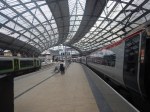
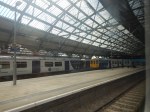
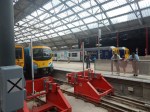
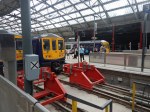



Note,
- The platforms are not narrow!
- It appears that the five platforms in the Eastern group are all long enough to take an eleven-car Class 390 train, which is 265.3 metres long.
- TransPennine Express trains can use the Western group.
I have looked at a whole day’s traffic on Real Time Trains and it appears that the new track layout allows almost all services to use any available platform.
This flexibility must make operation of the station much easily than it was!
Liverpool Lime Street Station As A High Speed Station
It would appear that the Eastern Group of Platforms 6-10 will all be capable of the following.
- Handling a 182 metre long Avanti West Coast Class 807 train.
- Handling a 200 metres long classic-compatible High Speed Two train.
- Handling a 130 metre long TransPennine Express Class 802 train.
- In the future, handling a Northern Powerhouse Rail train, which will probably be less than 200 metres long.
But they won’t be able to handle High Speed Two’s full-size trains.
Currently, these services capable of over 125 mph are running or are planned from Liverpool Lime Street station.
- 2 tph – Avanti West Coast – Liverpool Lime Street and London Euston
- 1 tph – TransPennine Express – Liverpool Lime Street and Newcastle
- 1 tph – TransPennine Express – Liverpool Lime Street and Scarborough
- 3 trains per day(tpd) – TransPennine Express – Liverpool Lime Street and Glasgow
This totals to four tph.
High Speed Two will add two classic-compatible High Speed Two trains.
Will these replace the two Avanti West Coast services?
- They will be run by the same company.
- They will take different routes.
- The current service takes 134 minutes.
- The High Speed Two train will take 94 minutes.
I can see Avanti West Coast running a one tph slower train via stations with difficult connections to Liverpool Lime Street. Think Watford Junction, Milton Keynes, Rugby, Stafford and Stoke-on-Trent.
This would bring the total to five tph.
Northern Powerhouse Rail will run six high speed trains to Manchester and beyond.
If they replaced the two TransPennine Express services, that would bring the maximum number of 200 metre long high speed trains to nine tph.
Could Liverpool Lime Street station handle nine high-speed tph?
Comparison With Birmingham Curzon Street Station
Birmingham Curzon Street station on High Speed Two will handle high speed trains from three directions, as will Liverpool Lime Street station.
The Birmingham station will handle nine tph on seven platforms.
As Liverpool Lime Street station will have ten platforms and also need to handle nine tph, I think it will be able to handle the trains.
Will There Be A Station In The Wapping Tunnel?
Just as London has its clay, which makes excavating for the Underground easy, the Centre of Liverpool has its sandstone, which has been honeycombed with tunnels. In addition to the Wapping Tunnel, there are two other tunnels from Edge Hill station to the Docks; the Waterloo Tunnel and the Victoria Tunnel.
Liverpool has plans for a Knowledge Quarter based on the Universities on Brownlow Hill.
As part of the development, it is intended to develop an area called Paddington Village.
Wikipedia says this about the village.
Paddington Village is a site at the eastern gateway to the city centre and has been earmarked as 1.8m sq ft of science, technology, education and health space.
This is also another paragraph.
Liverpool Mayor Joe Anderson announced that the council were looking into a new Merseyrail station to serve the site. A mention of a station is made in the October 2017 Liverpool City Region Combined Authority update to the Long Term Rail Strategy. Merseytravel commissioned a feasibility report into re-opening the Wapping Tunnel in May 2016 which found that it was a valid proposal which would allow for a new station to be built that could serve the Knowledge Quarter.
Someone has thought up a proposal for a Lime Line, which would be a tram or bus system, linking the Knowledge Quarter and the City Centre.
This map shows how their proposal fits in with all the other rail systems in Liverpool City.
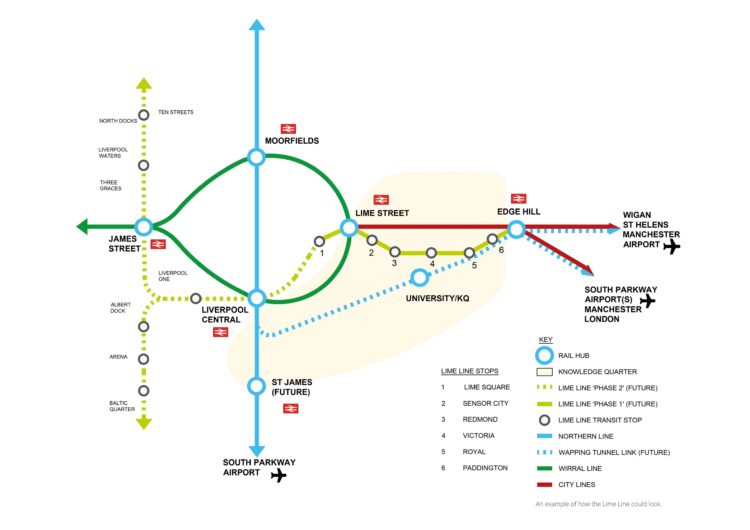
Note the Wapping Tunnel is shown on the map, as a dotted blue line.
- It connects to the Northern Line to the South of Liverpool Central station.
- It connects to the City Line to the West of Edge Hill station.
- A station named University/KQ is shown.
A new St. James station is also shown
Conclusion
Using the Wapping Tunnel to increase capacity in Liverpool City Centre could be used if required to improve capacity for the high speed network in the city, by removing local trains from Liverpool Lime Street station.
Midlands Rail Hub
On the Midlands Connect web site, they have a page, which is entitled Midlands Rail Hub.
This is the introductory paragraph.
The Midlands Rail Hub – our flagship project – is the biggest upgrade of our rail network for a generation.
The page contains this helpful map.

There is also a table of journeys and the improvements to be made.
- Birmingham – Nottingham – +1 tph – 72 minutes – 59 minutes
- Birmingham – Leicester – +2 tph – 66 minutes – 42 minutes
- Birmingham – Hereford – +1 tph – 85 minutes – 65 minutes
- Bitmingham – Worcester – +1 tph – 40 minutes – 35 minutes
- Birmingham – Derby – +2 tph – 38 minutes – 38 minutes
- Coventry – Leicester – +2 tph – 57 minutes – 38 minutes
- Coventry – Nottingham -+2 tph – 99 minutes – 63 minutes
- Birmingham – Bristol – +1 tph – 85 minutes – 80 minutes
- Birmingham – Cardiff – +1 tph – 117 minutes – 112 minutes
- Birmingham – Kings Norton – +2 tph – 18 minutes – 14 minutes
Note that the data by each route is the increase in frequency in trains per hour (tph), the current journey time and the future journey time.
I’ll now look at each route in more detail.
Birmingham And Bristol
Consider.
- Birmingham New Street and Bristol Temple Meads stations are 90 miles apart.
- Current service is two tph, which is provided by CrossCountry and goes via Worcestershire Parkway, Cheltenham Spa and Bristol Parkway.
- There is to be an increase of one tph.
- Current journey time is 85 minutes
- Future journey time is 80 minutes
As CrossCrountry’s Birmingham and Bristol service goes through to Edinburgh, Glasgow or Manchester Piccadilly, would it not be convenient, if the service could use High Speed Two to the North of Birmingham?
Birmingham And Cardiff
Consider.
- Birmingham New Street and Cardiff Central stations are 108 miles apart.
- Current service is two tph, which is provided by CrossCountry and goes via Worcestershire Parkway, Cheltenham Spa. Gloucester and Newport.
- There is to be an increase of one tph.
- Current journey time is 85 minutes
- Future journey time is 80 minutes
As CrossCrountry’s Birmingham and Cardiff service goes through to Nottingham, would it not be convenient, if the service could use High Speed Two between Birmingham and Nottingham?
It would appear that both Bristol and Cardiff services could benefit from a High Speed Two connection.
This map from High Speed Two shows the line’s route through the Water Orton area.
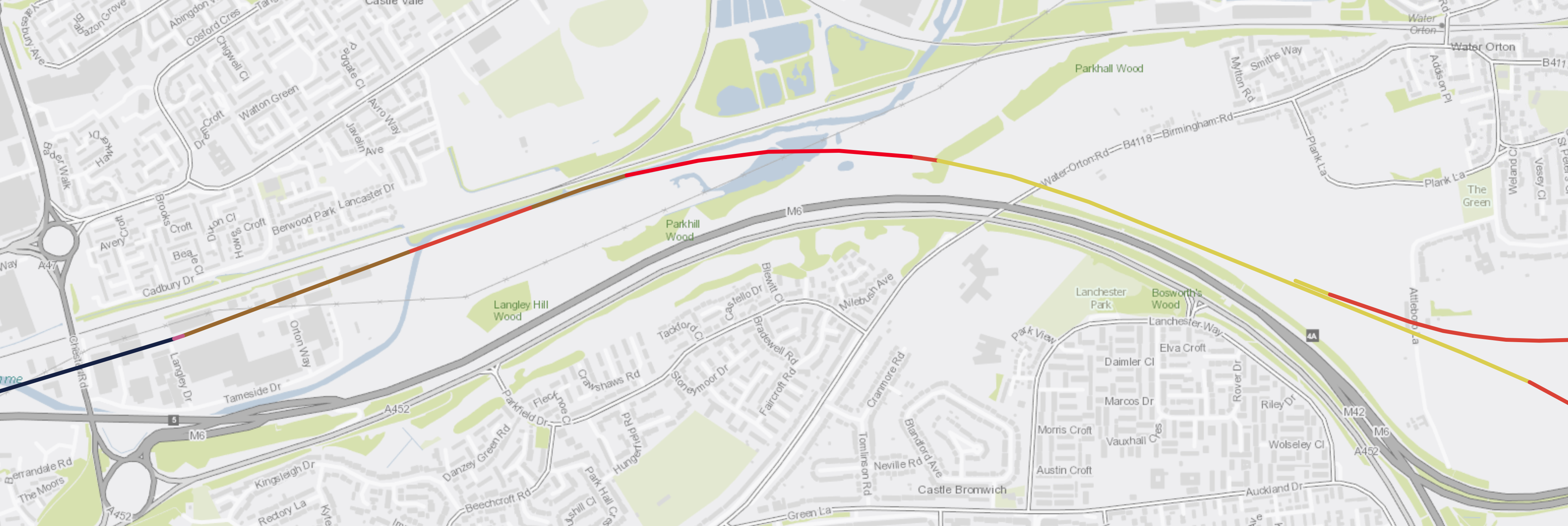
Note.
- High Speed Two is shown in various colours.
- High Speed Two splits at the Eastern edge of the map, with the Northern link going to Northern destinations and the Southern link going to Birmingham Interchange and London.
- Curving across the map beneath it, is the M6 motorway, with Spaghetti Junction off the map to the West.
- Water Orton station is in the North East corner of the map.
- The Birmingham and Peterborough Line, which connects Leicester and Birmingham New Street stations via Water Orton runs just tom the North of the route of High Speed Two shown on the map.
This Google Map shows the area.
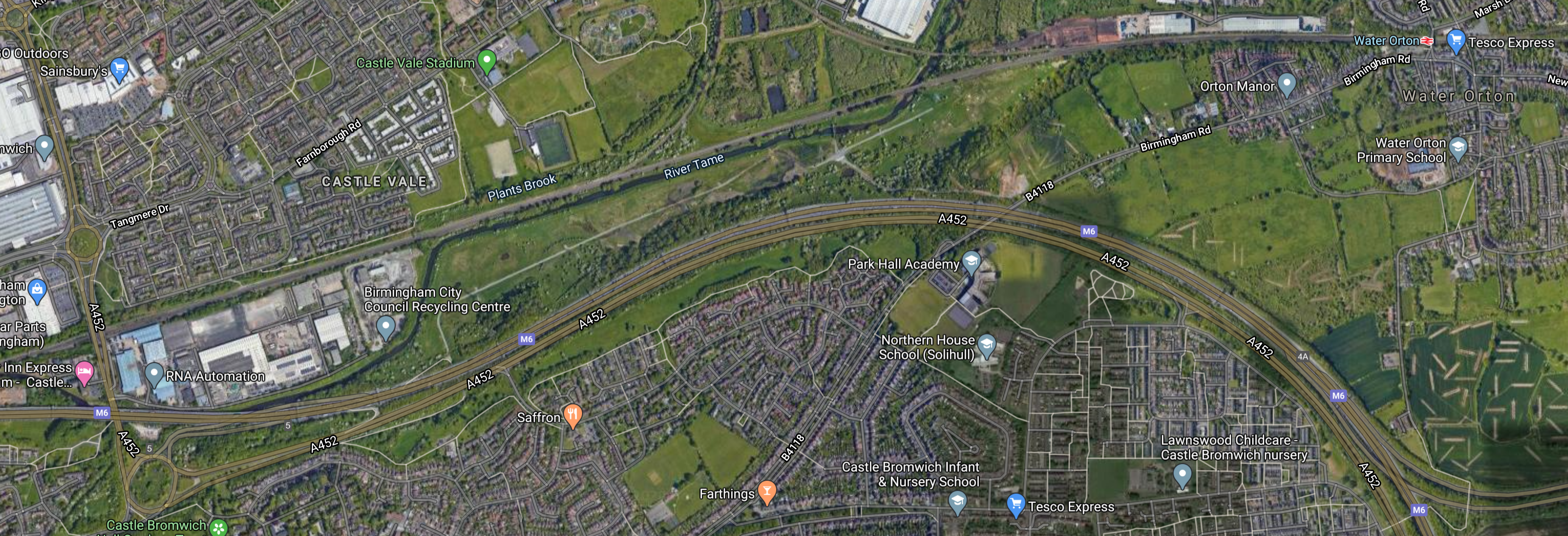
I wonder if it would be possible to provide links so that the following would be possible.
- Trains running East from New Street station could join High Speed Two to run to East Midlands Hub, Edinburgh, Glasgow, Leeds, Liverpool, Manchester, Newcastle, Sheffield and York.
- Trains from the North could run into New Street station and then continue to Bristol, Cardiff and Cheltenham.
The trains would have to be classic-compatible High Speed Two trains. These would fit into New Street station, as they are shorter than Class 390 trains and will have a aimilar height and width.
Time savings could be as follows.
- Bristol/Cardiff and Edinburgh – 110 minutes
- Bristol/Cardiff and Manchester Piccadilly- 50 minutes
- Bristol/Cardiff and Newcastle – 80 minutes
- Bristol/Cardiff and Nottingham – 45 minutes
All trains would be direct.
Birmingham And Derby
Consider.
- Birmingham New Street and Derby stations are 41 miles apart.
- Current service is two tph, which is provided by CrossCountry and goes via Wilnecote, Tamworth and Burton-on-Trent
- There is to be an increase of two tph.
- Current journey time is 38 minutes
- Future journey time is 38 minutes
- High Speed Two will run three tph between Birmingham Curzon Street and East Midlands Hub station in 20 minutes.
- Midlands Connect will run one tph between Birmingham Curzon Street and Nottingham Station in 30 minutes. See Classic-Compatible High Speed Two Trains At East Midlands Hub Station
Will passengers between Birmingham and Derby use High Speed Two services, which will be four tph or the current ones?
Birmingham And Hereford Via Worcester
Consider.
- Birmingham New Street and Hereford stations are 55 miles apart.
- Current service is one tph, which is provided by West Midlands Trains, and goes via Bromsgrove, Malvern Link and Great Malvern.
- There is to be an increase of one tph.
- Current journey time is 85 minutes
- Future journey time is 65 minutes
- The track between Bromsgrove and Birmingham is electrified.
- Hereford and Bromsgrove are 41 miles apart.
- Worcester and Bromsgrove are 13 miles apart.
With charging facilities at Worcester, this route would be an ideal one for battery electric trains.
Birmingham And Leicester
Consider.
- Birmingham New Street and Leicester stations are 40 miles apart.
- Current service is two tph, which is provided by CrossCountry and goes via Water Orton, Coleshill Parkway, Nuneaton, Hinckley and Narborough.
- There is to be an increase of two tph.
- Current journey time is 66 minutes
- Future journey time is 42 minutes
Birmingham – Nottingham
Consider.
- Birmingham New Street and Nottingham stations are 57 miles apart.
- Current service is two tph, which is provided by CrossCountry and goes via Tamworth, Burton-on-Trent and Derby.
- There is to be an increase of one tph.
- Current journey time is 72 minutes
- Future journey time is 59 minutes
- High Speed Two will run three tph between Birmingham Curzon Street and East Midlands Hub station in 20 minutes.
- Midlands Connect will run one tph between Birmingham Curzon Street and Nottingham Station in 30 minutes. See Classic-Compatible High Speed Two Trains At East Midlands Hub Station
Will passengers between Birmingham and Nottingham use High Speed Two services, which will be four tph or the current ones?
Coventry And Leicester
Consider.
- Coventry and Leicester are 28 miles apart.
- There is currently no direct train and a change is needed at Nuneaton
- There is to be an increase of two tph.
- Current journey time is 57 minutes
- Future journey time is 38 minutes
I suspect that a direct Coventry and Leicester service is being provided that does one of the following.
- Reverses in Nuneaton station.
- Takes a new flyover to cross the West Coast Main Line.
Would the Southern terminus of the route be Coventry, Leamington Spa or Stratford-on-Avon?
Coventry And Nottingham
Consider.
- Coventry and Nottingham are 55 miles apart.
- There is currently no direct train and a change is needed at Birmingham New Street or at both Nuneaton and Leicester.
- There is to be an increase of two tph.
- Current journey time is 99 minutes
- Future journey time is 63 minutes
Would this service be an extension of the Coventry and Leicester service?
As Leicester and Nottingham takes around thirty minutes, this could be the case.
Birmingham And Kings Norton Via The Camp Hill Line
The Midlands Rail Hub page, says this about the Bordesley Chords, which will connect Birmingham Moor Street station to the Camp Hill Line.
Construction of the Bordesley Chords, two viaducts creating new paths to the East Midlands and South West from Birmingham Moor Street Station.
This Google Map shows where they will be built.
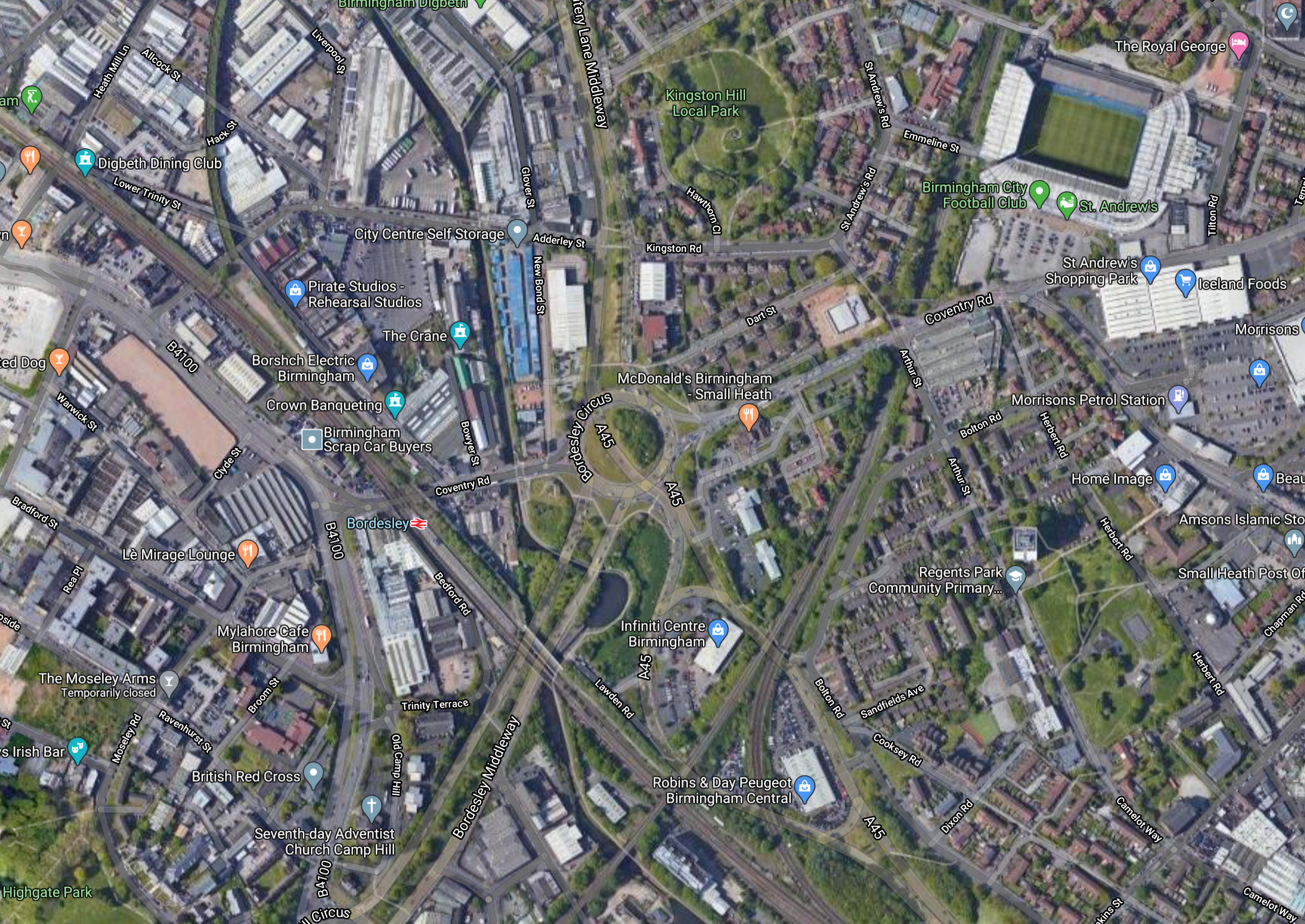
Note.
- The Football ground in the North-East corner of the map is St. Andrew’s, which is Birmingham City’s home ground.
- The rail line going North South across the map and passing to the West side of the ground is the Camp Hill Line, which leads to Water Orton station in the North and Kings Norton station in the South.
- The station in the middle of the map is Bordesley station.
- The rail line going NW-SE across the map through the station is the Chiltern Main Line into Birmingham Moor Street station, which is a couple of miles to the North-West.
The two Bordesley chords will be double-track chords linking the following routes.
- Moor Street station to the Camp Hill Line going South to Kings Norton via new stations at Moseley, Kings Heath and Hazelwell.
- Moor Street station to the Camp Hill Line going North to Water Orton station.
The initial service would appear to be two tph between Moor Street and Kings Norton stations.
CrossCountry Trains and Moor Street Station
Consider.
- Birmingham New Street station is very busy.
- Some CrossCountry trains take a Water Orton-Birmingham New Street-Kings Norton route across the city.
Could these trains go between Water Orton and Kings Norton, with a reverse in Moor Street station?
- Plymouth and Edinburgh Waverley
- Cardiff Central and Nottingham
And could these services terminate at Moor Street station?
- Birmingham New Street and Nottingham
- Birmingham New Street and Stansted Airport via Leicester
- Birmingham New Street and Leicester
It would seem there must be scope improve the operation of New Street station, by using Moor Street station and the Bordesley chords.
If all these trains used Moor Street station it would be a very busy station.
In an hour it would handle these trains via the Bordesley chords.
- CrossCountry – 1 tph – Cardiff Central
- CrossCountry – 1 tph – Edinburgh Waverley
- West Midlands Railway – 2 tph – Kings Norton
- CrossCountry – 2 tph – Leicester
- CrossCountry – 2 tph – Nottingham
- CrossCountry – 1 tph – Plymouth
- CrossCountry – 1 tph – Stansted Airport
That is a balanced five tph to the North and five tph to the South.
There would also be the existing services.
- Chiltern Trains – 2 tph – London Marylebone and Birmingham
- West Midlands Railway – 6 tph – Dorridge/Stratford-upon-Avon/Whittocks End and Stourbridge Junction
There would also be the proposed Moor Street and Oxford service.
Battery Electric Trains
If we assume that a battery electric train has a battery range equal to or longer than Hitachi’s quoted figure of 56 miles, these routes are possibilities for battery electric trains.
- Birmingham and Leicester with either electrification or charging at Leicester.
- Birmingham and Hereford with charging at Hereford
- Birmingham and Kings Norton
- Birmingham and Oxford with charging at Oxford and Banbury
- Coventry and Leicester
If the Midland Main Line is electrified in the Nottingham Area, then all services to Nottingham could be added.
CrossCountry And High Speed Two
Consider.
- There are up to half-a-dozen spare hourly paths on both the Northern legs of High Speed Two.
- Using High Speed Two tracks to the North of Birmingham can speed up services considerably.
- CrossCountry needs a new fleet of trains.
- Services could be run using classic-compatible High Speed Two trains.
- The trains might be shorter and would certainly have independent power sources.
It could be a large improvement in quality and journey times, with all current destinations served.
The only extra infrastructure needed would be a connecting junction near Water Orton station. A junction there would work, whether services used Moor Street or New Street station in Birmingham.
Cnnclusion
The concept of a Midlands Rail Hub is very sound.

