Can We Move The Equilibrium Point Of The Energy Market?
Equilibrium In Systems
As a Control Engineer, I believe that most systems eventually end up in a state of equilibrium.
How many football batches have you watched between two evenly-matched teams that have ended, where the statistics are even and the match has ended in a nil-nil draw or a win by one goal.
Now suppose one manager makes an inspired substitution, one important player gets injured or one player gets sent off.
One team will have an advantage, the statistics will no longer be even and one team will probably win.
The equilibrium point will have been shifted.
Zopa’s Stable Peer-to-Peer Lending System
I used Zopa’s peer-to-peer lending system for several years and found it a very stable system, that over the years paid a steady return of between four and five percent before tax.
I even developed a method to maximise my savings income, which I wrote about in The Concept Of Hybrid Banking.
It was a sad day for me, when Zopa closed its ground-breaking peer-to-peer lending system.
As a Control Engineer, I believe that Zopa’s strength was a well-written computerised algorithm, that matched lenders and borrowers and spread the risk.
- There was no bias in the system, introduced by personal prejudices.
- The algorithm was agnostic and judged all borrowers on their profiles and credit ratings alone.
- Money was allocated under fair rules for borrowers.
- I never borrowed from Zopa, but from my experience of owning half of a finance company, their terms were the most customer-friendly I’ve ever seen.
Someone will go back to the basics of peer-to-peer lending and it can’t be soon enough for both savers and borrowers.
Zopa In Troubled Times
Over the years that I invested in Zopa, my returns stayed very much the same, as the algorithm seemed to be able to maintain sufficient difference between lenders’ returns and borrowers’ rates. I also suspect the dynamics of savvy lenders and borrowers helped to stabilise both the system and the difference between rates.
It even worked through the Banking Crisis of 2008 and other mini-hiccups along the way.
My Conclusion About Zopa
As someone, who knows computing well, I would rate Zopa, one of the best computer systems, I’ve ever seen.
But it showed how a large transactional system can work well.
One of the keys to its success and smooth operation was that the computer was totally in control and it took all transaction decisions without direct human intervention.
The Energy Market
The energy market is a network of energy providers and users.
It is controlled by complicated rules and it has settled into an equilibrium, which involves.
- Importation of energy, which I suspect is not at a low price
- Some high priced energy generators, based on gas, which has a high-price, due to Putin’s war.
- Waste of wind energy due to lack of energy storage.
- The intermittency of renewable sources.
- A lack of gas storage, means that we probably get the wrong end of fluctuations in the gas price.
This results in a high price to consumers.
Can We Move The Equilibrium Point Of The Energy Market?
And we also need to move it quickly to a more favourable place, which benefits everybody!
As a Control Engineer, I believe that there are five ways to move the equilibrium point.
- Stop Putin’s war.
- Increase gas storage.
- Generate more low-cost electricity.
- Increase electricity storage.
- Improve the control algorithm.
I will now look at each in more detail.
Stopping Putin’s War
Giving in to Putin’s ambitions, would be an easy way to solve our energy crisis. But at what cost?
My parents generation, watched as Nazi Germany took over Austria and Czechoslovakia, whilst the world did nothing.
- We mustn’t repeat that mistake.
- We must not flinch in our support of the Ukraine.
- We must be ready to support Moldova, Finland and the Baltic States if Putin expands his ambitions.
I do wonder, if Boris will turn up with Churchillian-style anti-Putin rhetoric all over Eastern Europe.
Increasing Gas Storage
The major gas storage facility is Rough, which is handily close to the Easington gas terminal.
The facility needs maintenance and this paragraph from the Wikipedia entry gives the current status.
In May 2022, the Secretary of State for Business, Energy and Industrial Strategy, Kwasi Kwarteng, began talks with the site’s owners with a view to reopening the site to help ease the ongoing cost-of-living crisis in the United Kingdom. In June 2022, owners Centrica submitted an application to the North Sea Transition Authority (NSTA), the licencing authority for the UK Government, to reopen the facility. Approval was granted in July. Subsequently, Centrica indicated that they are working hard to restore storage operations at Rough which would depend on securing subsidies from the British government. Centrica was aiming to have some capacity available for the winter of 2022/23 against an overall plan to increase storage capacity gradually over time.
Note.
- Rough can store around 2832 million cubic metres of gas.
- This article on Energy Live News is entitled Reopening Of Rough Storage Gets The All-Clear.
Less well-known is SSE and Equinor’s Aldborough Gas Storage.
These three paragraphs from SSE web site, describe the gas storage.
The Aldbrough Gas Storage facility, in East Yorkshire, officially opened in June 2011. The last of the nine caverns entered commercial operation in November 2012.
The facility, which is a joint venture between SSE Thermal (66%) and Equinor, has the capacity to store around 330 million cubic metres (mcm) of gas.
SSE Thermal and Equinor have consent to increase the storage capacity at the Aldbrough site (Aldbrough Phase 2) and during the last couple of years have been working to involve the local community where appropriate to refine aspects of this project, which has not been progressed to date due to market conditions.
Future plans for the facility, may include converting it to one of the world’s largest hydrogen stores.
In the grand scheme of things, Rough and Aldborough, when you consider that the UK uses 211 million cubic metres of gas every day, will only keep us going for a few days.
But it should be noted, that the Easington gas terminal is connected to the Norwegian gas fields, by the Langeled pipeline.
So Yorkshire and Humberside will be alright.
Generating More Low-Cost Electricity
The only low-cost electricity of any size to come on stream will be wind-power.
This article on Renewables Now is entitled UK Hits 25.5 GW Of Wind Power Capacity.
These wind farms seem to be coming on stream soon or have been commissioned recently.
- Dogger Bank A – 1200 MW – Commissioning 2023 expected
- Dogger Bank B – 1200 MW – Commissioning 2024/25 expected
- Dogger Bank C – 1200 MW – Commissioning 2024/25 expected
- Hornsea Two – 1386 MW – Commissioned 2022
- Moray East – 950 MW – Commissioning 2022 expected
- Neart Na Gaoithe – 450 MW – Commissioning 2024 expected
- Seagreen – 1075 MW – Commissioning 2023 expected
- Triton Knoll – 857 MW – Commissioning 2022 expected
That is expected to be over 5 GW of offshore wind by the end of 2023.
In case there is some double counting, I’ll only say that wind power capacity could be near to 30 GW by December 2023, with perhaps another 3 GW by December 2024.
Other large wind farms in the future include.
- Berwick Bank – 4100 MW – Commissioning 2028 expected
- East Anglia Two – 900 MW – Commissioning 2026 expected
- East Anglia Three – 1400 MW – Commissioning 2027 expected
- Inch Cape Phase 1 – 1080 MW – Commissioning 2027 expected
- Hornsea Three – 2800 MW – Commissioning 2027 expected
- Moray West – 294 MW – Commissioning 2027 expected
- Morgan and Mona – 3000 MW – Commissioning for 2028 expected
- Morven – 2900 MW – Commissioning for 2028 expected
- Norfolk Boreas – 1400 MW – Commissioning 2027 expected
- Norfolk Vanguard – 1400 MW – Construction start planned for 2023
- Sofia – 1400 MW – Commissioning 2026 expected
That is over 14 GW of wind power.
I should also take note of solar and onshore wind power detailed in this document from the Department of Business, Industry and Industrial Strategy that lists all the Contracts for Difference Allocation Round 4 results for the supply of zero-carbon electricity.
It gives these figures and dates.
- Solar – 251 MW – Commissioning 2023/24 expected
- Solar – 1958 MW – Commissioning 2024/25 expected
- Onshore Wind – 888 MW – Commissioning 2024/25 expected
I can now build a yearly table of renewables likely to be commissioned in each year.
- 2022 – 3193 MW
- 2023 – 2275 MW
- 2024 – 701 MW
- 2025 – 5246 MW
- 2026 – 2300 MW
- 2027 – 6974 MW
- 2028 – 11400 MW
Note.
- Where a double date has been given, I’m taking the latter date.
- I have assumed that Norfolk Vanguard will be commissioned in 2028.
- I have ignored Hinckley Point C, which should add 3.26 GW in mid-2027.
- I have only taken into account one of the Scotwind wind farms in Scotland, some of which could be commissioned by 2028.
- I have assumed that BP’s Mona, Morgan and Morven will all be commissioned by 2028.
This is a total of 32 GW or an average of nearly 5 GW per year.
Increasing Electricity Storage
Big schemes like the 1.5 GW/ 30 GWh Coire Glas and 600 MW Cruachan 2 will help, but with 32 GW of renewable energy to be installed before 2028 and energy prices rocketing, we need substantial energy storage in the next couple of years.
One feasible plan that has been put forward is that of Highview Power’s CEO; Rupert Pearce,, that I wrote about in Highview Power’s Plan To Add Energy Storage To The UK Power Network.
The plan is to build twenty of Highview Power’s CRYOBatteries around the country.
- Each CRYOBattery will be able to store 30 GWh.
- Each CRYOBattery will be one of the largest batteries in the world.
- They will have three times the storage of the pumped storage hydroelectric power station at Dinorwig.
- They will be able to supply 2.5 GW for twelve hours, which is more output than Sizewell B nuclear power station.
Note.
- The first 30 GWh CRYOBattery is planned to be operational by late 2024.
- 600 GWh distributed around the country would probably be sufficient.
I believe that as these batteries are made from standard proven components, they could be built fairly quickly.
Paying For The Energy Storage
This press release from Highview Power is entitled New Analysis Reveals Extent Of UK Renewable Energy Waste, which makes these three bullet points.
- Enough renewable energy to power 500,000 homes a day wasted since the energy crisis began.
- 8 out of 10 Britons want more investment in boosting Britain’s energy resilience.
- UK spent £390 million turning off wind farms and using gas since September 2021.
Note.
- As the press release was published in July 2022, was the £390 million for ten months.
- Will this level of spend continue, as we’re not creating any electricity storage or building any factories that will start in a year or so, that will need large amounts of electricity?
- The Germans are at least building the NeuConnect interconnector between the Isle of Grain and Wilhelmshaven.
- As we’re adding up to 5 GW per year to our renewable energy systems, this problem will surely get worse and we’ll spend more money switching off wind turbines.
We have the money to build a very large amount of energy storage.
Improving The Control Algorithm
A better control algorithm would always help and politicians should only be allowed to set objectives.
Conclusion
There is a chance we’ll have an oversupply of electricity, but this will have effects in the UK.
- Gas-fired power-stations will be retired from front-line service to produce electricity.
- Some will question the need for nuclear power.
- Gas may even be used selectively to provide carbon dioxide for agricultural, scientific and industrial processes.
- Industries that need a lot of electricity may build factories in the UK.
- We will have a large supply of green hydrogen.
But it should bring the price of electricity down.
BP To Charge Up Vehicle Battery Research
The title of this post is the same as that of this article in The Times.
This is the title on a stock picture at the top of the page.
BP, whose profits benefited from soaring oil and gas prices, plans to invest heavily in research to develop solutions to help to decarbonise the transport sector.
I’m unsure about the picture, but it could be a number of buses or trucks connected to a large battery.
This press release on the BP web site, is the original source for The Times article and it is entitled BP To Invest Up To £50 million In New Global Battery Research And Development Centre In Britain.
The press release starts with these bullet points.
- bp continuing to invest in the UK, with new investment of up to £50 million for new electric vehicle battery testing centre and analytical laboratory in Pangbourne.
- Aims to advance development of engineering, battery technology and fluid technology and engineering into new applications such as electric vehicles, charging and data centres.
- New facilities at its Castrol headquarters and technology centre expected to open in 2024, supporting the technology, engineering and science jobs housed there today.
I find these sentences interesting.
new applications such as electric vehicles, charging and data centres
This sentence is a bit of a mess as electric vehicles are not new, charging is well established and what have data centres got to do with batteries.
I have a friend, who runs a large fleet of electric buses and charging is a problem, as getting the required number of MWhs to the garage can be a problem in a crowded city.
But could it be, that BP are thinking of a battery-based solution, that trickle-charges when electricity is affordable and then charges buses or other vehicles as required, throughout the day?
I believe that a battery based on process engineering like Highview Power’s CRYOBattery could be ideal in this situation.
- Effectively, the bus garage or transport parking would have its own high capacity battery-powered charging network.
- The storage capacity of the battery would be geared to the daily charge load of the vehicles.
- It would reduce the cost of electricity to the operator.
Such a battery might also be ideal to power a battery charging station.
I don’t know much about data centres, except that they need a lot of electricity.
Would driving data centres from a battery, that was trickle-charged overnight mean that the cost of electricity was reduced?
bp today unveiled plans to invest up to £50 million (around $60 million) in a new, state-of-the-art electric vehicle (EV) battery testing centre and analytical laboratory in the UK
There are a lot of battery ideas in the pipeline, so will one of the tasks be to find the best batteries for BP’s needs?
The site already undertakes research and development of fuels, lubricants and EV fluids and aims to become a leading hub for fluid technologies and engineering in the UK
You don’t think of lubricants being associated with electric vehicles, but obviously BP thinks it’s a serious enough topic to do some research.
The new facilities will help advance the development of leading fluid technologies and engineering for hybrid and fully battery electric vehicles, aiming to bring the industry closer to achieving the key tipping points for mainstream electric vehicle (EV) adoption.
This is self-explanatory.
Castrol ON advanced e-fluids manage temperatures within the battery which enables ultra-fast charging and improves efficiency, which help EVs to go further on a single charge and extend the life of the drivetrain system
Lubrication helps the world go round.
In addition, the advanced e-fluid technologies and engineering can be applied to other industries such as thermal management fluids for data centres where demand is rising exponentially
This is an interesting application and it will become increasingly important.
The growth of EV fluids is a huge opportunity, and we aim to be the market leader in this sector
I didn’t realise that EV fluids were so important.
The press release says this about the current status.
Two thirds of the world’s major car manufacturers use Castrol ON EV fluids as a part of their factory fill and we also supply Castrol ON EV fluids to the Jaguar TCS Racing Formula E team.
This press release on the Castrol web site is entitled CASTROL ON: Range Of Advanced E-Fluids For Mobility On Land, Sea And In Space.
This is the Castrol ON E-Fluids home page.
Where Will BP Need Batteries?
I can see the following applications are in BP’s sight from this press release.
- Charging fleets of buses and trucks at their garage.
- Powering battery-charging stations at filling stations.
- Providing uninterruptable electricity feeds.
- Powering data centres.
I will give a simple example.
Suppose a bus company wants to electrify the buses in a town.
- They will have thirty double-deck buses each with a 500 kWh battery.
- Wrightbus electric buses charge at 150 kW.
- Charging all buses at the same time would need 4.5 MW
- Each bus will need to be charged overnight and once during the day.
- This means the bus company will need 30 MWh of power per day.
- The largest wind turbines today are around 12 MW and have a capacity factor of 30 %.
- A single turbine could be expected to generate 86 MWh per day.
It looks to me, that a battery in the garage which could provide an output of 5 MW and had a capacity of 100 MWh would link everything together and support the following.
- A fleet of thirty buses.
- All buses charged overnight and at one other time.
- A 12 MW wind turbine.
- Power for the offices and other facilities.
- The battery would provide backup, when there is no wind.
- There would also be a mains connection to the battery for use, when the wind turbine failed.
The size of the battery and the turbine would depend on the number of vehicles and how often, they were to be charged.
BP could replace diesel sales to the bus or transport company, with leasing of a zero-carbon charging system.
Simple systems based on one or two wind turbines, solar panels and a battery would have several applications.
- Charging fleets of buses and trucks at their garage.
- Powering battery-charging stations at filling stations.
- Providing uninterruptable electricity feeds.
- Powering data centres
- Powering farms
- Powering new housing estates
- Powering factories
I can see this becoming a big market, that big energy companies will target.
Are BP planning to develop systems like this, as many of those, who might buy a system, are already their customers?
Choosing the best batteries and designing the system architecture would appear to be within the remit of the new Research Centre at Pangbourne.
Supporting Wind Farms
BP could certainly use a 2.5 GW/30 GWh battery at each of the three large wind farms; Mona, Morgan and Morven, that they are developing in the Irish Sea and off Aberdeen. These wind farms total 5.9 GW and a battery at each one, perhaps co-located with the offshore sub-station could mean that 5.9 GW was much more continuous.
The wind farms would be like virtual nuclear power stations, without any nuclear fuel or waste.
It would also mean that if the wind farm wasn’t needed and was told to switch off, the electricity generated could be stored in BP’s battery.
How many of BP’s other developments around the world could be improved with a co-located battery?
Process Technology
I am very keen on Highview Power’s CRYOBattery, but I do think that some parts of the design could benifit from the sort of technology that BP has used offshore and in the oil industry.
So will BP’s new battery research include offering advice to promising start-ups?
Boris Baldrick’s Cunning Plan
This written statement to Parliament on the UK Government web site, is entitled Transport Update: Transpennine Route Upgrade.
It has been published by Grant Shapps and this is the sub-title.
Additional funding has been made available for the Transpennine route upgrade.
This is the complete statement.
Today 19 July 2022, the government has made available £959 million of additional funding to continue to progress the delivery of the ambitious Transpennine route upgrade.
This funding is a significant milestone and another step towards upgrading the key east-west rail artery across the north of England, to further this government’s levelling up and decarbonisation objectives.
In addition to progressing the design of aspects of the upgrade, this funding will enable further on-the-ground delivery of electrification and journey time improvement works, mostly west of Leeds.
One of the first tangible benefits will be enabling electric trains to run between Manchester and Stalybridge by the middle of the decade. We are also developing scope that will enable the Transpennine route upgrade to become the first phase of Northern Powerhouse Rail, including plans to unlock freight flows and take thousands of lorries off our roads.
We are also more than trebling the investment in the Transpennine route upgrade from £2.9 billion to between £9.0 billion and £11.5 billion.
This additional investment will enable the roll out of digital signalling technology, electrification of the full route and the provision of additional tracks for commercial and freight services, giving rail users more reliable, more punctual, more comfortable and greener rail journeys.
I have some thoughts.
It’s Not A Wish List, But A Reality
The last paragraph reads like a wish list.
This additional investment will enable the roll out of digital signalling technology, electrification of the full route and the provision of additional tracks for commercial and freight services, giving rail users more reliable, more punctual, more comfortable and greener rail journeys.
But it’s not a wish list, it’s what is to be done.
Where Will The Government Get Between Nine and Eleven-And-A-Half Billion Pounds?
It’s not the sort of small change that you have in a sock draw.
This document on the UK government web site, is entitled PM Opening Remarks At Press Conference With German Chancellor Olaf Scholz: 8 April 2022, where this is these three paragraphs.
We will also agree on the importance of weaning ourselves off dependence on Russian gas and oil, and ensuring that our energy security cannot be threatened by a rogue state.
This is not easy for any of us, and I applaud the seismic decisions taken by Olaf’s government to move Germany away from Russian hydrocarbons.
Today we have agreed to maximise the potential of the North Sea and collaborate on energy security and on renewables, where Germany and the UK lead the way in new technology.
So did Boris and Olaf sign the world’s first Green Alliance based on zero-carbon energy?
- They may not have signed an Alliance, but they have agreed on common actions.
- Over the last year or so, German money and technology has started to be more visible in our offshore wind farms.
- BP have been backed by German utility; enBW in some of their huge wind farms.
- Siemens Gamesa are providing a lot of wind turbines.
- Will German shipyards build the floats for floating wind farms?
- An interconnector between the Isle of Grain and Wilhelmshaven is planned.
- Rolls-Royce and its German subsidiary MTU are charging into battle against climate change.
- The Germans have taken a liking to ITM Power’s electrolysers to produce hydrogen.
I can see the North Sea or the German Ocean becoming Europe’s power station, with by 2030, a large amount of the energy not needed by the UK, being exported to the Continent, either as electricity or hydrogen.
The Germans could become our magische Geldbäume.
But unlike gas and oil, wind power in the North Sea won’t run out, as it’s renewable.
In How Britannia With Help From Her Friends Can Rule The Waves And The Wind, this was my conclusion.
Boris’s vision of the UK becoming a Saudi Arabia of wind is no fantasy of a man with massive dreams.
Standard floating wind turbines, with the possibility of also harvesting wave power could be assembled in ports along the coasts, towed into position and then connected up.
Several GW of wind-power capacity could probably be added each year to what would become the largest zero-carbon power station in the world.
By harvesting the power of the winds and waves in the seas around the British Isles it is an engineering and mathematical possibility, that could have been developed by any of those great visionary Victorian engineers like Armstrong, Bazalgette, Brunel and Reynolds, if they had had access to our modern technology.
Up Yours! Putin!
This energy and the money it provides will finance our infrastructure and our tax cuts.
Vast Australian Renewable Energy Site Powers BP’s Ambitions
The title of this post, is the same as that of this article on The Times.
These are the first two paragraphs.
BP is to lead the development of a $36 billion wind, solar and hydrogen project in Western Australia in its latest foray into green energy.
The oil company has bought a 40.5 per cent stake in the Asian Renewable Energy Hub in the eastern Pilbara region and will become operator of the project, one of the biggest such developments globally.
The Wikipedia entry for the Asian Renewable Energy Hub, starts like this.
The Asian Renewable Energy Hub (AREH) is a proposal to create one of the world’s largest renewable energy plant in the Pilbara region of Western Australia. It was first proposed in 2014, with plans for the project concept changing several times since then. As of November 2020, the project developers Intercontinental Energy, CWP Global, Vestas and Pathway Investments were planning to build a mixture of wind power and solar energy power generators which would generate up to 26 gigawatts of power.
Up to 1,743 wind turbines of 290 metres (950 ft) in height would be accommodated in 668,100 hectares (1,651,000 acres) of land, and 18 arrays of solar panels each generating 600 megawatts would cover 1,418 hectares (3,500 acres). It is to be located in the Shire of East Pilbara, about 30 km (19 mi) inland from 80 Mile Beach, with the nearest settlement on the map being Mandora Station. The total size of the scheme would be about 666,030 ha (1,645,800 acres).
It is a gigantic project and this Google Map of Western Australia shows its location.
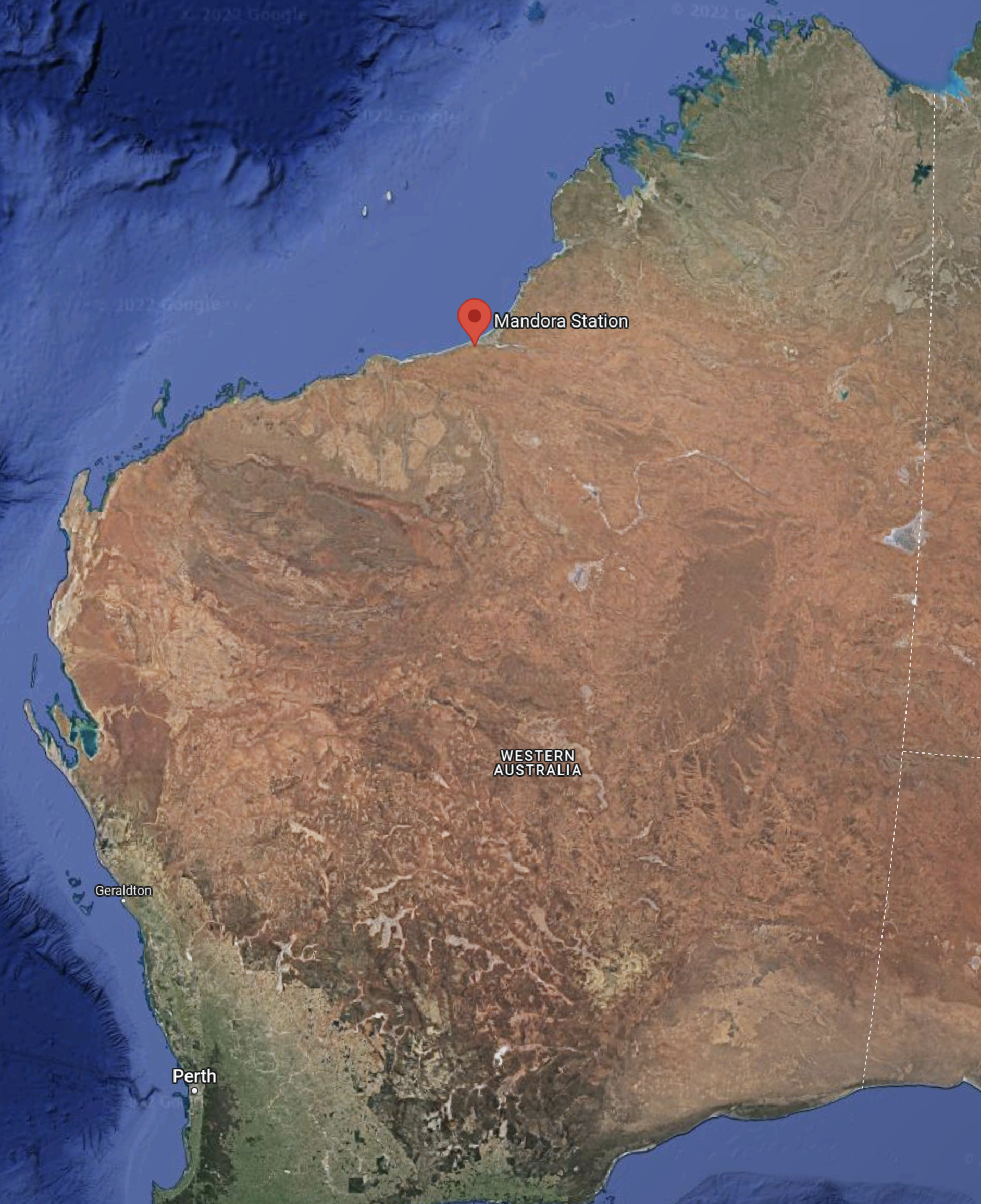
It is no more than a pimple on the huge area of Western Australia.
I have my thoughts about BP getting involved with this project.
The Power Of Research
Around 1970, I spent four years in ICI applying mathematical methods to some of their processes, that were in research or development. I also worked for a time on their hydrogen plants. Some of the projects I heard about, were pretty wacky and some of these appear to have never been commercialised.
When I left ICI, I built a few mathematical models for other research organisations.
So I do wonder, if BP have found something, that will enable the process of making hydrogen from water a lot more efficient. There is an American startup called Bloom Energy, who have teamed up with Westinghouse to use steam from the nuclear reactor to do electrolysis more efficiently at a high temperature.
I wrote about this partnership in Westinghouse And Bloom Energy To Team Up For Pink Hydrogen, where Bloom Energy Vice President of Hydrogen Business Rick Beuttel, is quoted as saying this.
We are proud Westinghouse has turned to Bloom and our solid oxide technology to supercharge the clean hydrogen economy. Solid oxide technology is well suited for nuclear applications, efficiently harnessing steam to further improve the economics of hydrogen production. High temperature electrolysis is already garnering attention and accolades as a cost-effective and viable solution to create low-cost, clean hydrogen, which is critical to meeting aggressive decarbonization goals.
It sounds that by integrating the nuclear power station and the electrolyser, there are cost savings to be made.
Why not use solar power to create steam, which is called solar thermal energy and is used in various hot places in the world and then use high temperature electrolysis?
I suspect that BP are up to something, that is very similar to Fortescue Future Industries in the Australian company’s back yard.
So will they be selling the hydrogen to FFI, so they can market it together all over the world?
This BP deal is one to watch.
NeuConnect Awards Two Major Contracts
This page on the NeuConnect web site is entitled NeuConnect Awards Over £1.5 billion Of Major Contracts As First Ever UK-German Energy Link Moves An Important Step Closer.
NeuConnect is a proposed interconnector between England and Germany.
- It will have a capacity of 1.4 GW.
- The interconnector will be around 450 miles long.
- It will be HVDC, like many similar undersea power cables.
- As the title says, it will be the first-ever UK-German energy link.
Wikipedia describes the route like this.
The cable will run between the Greystones substation on the Isle of Grain, in Kent in England to the new Fedderwarden substation in Wilhelmshaven in the Lower Saxony region of Germany. Landfall will be next to Grain Coastal Park, in Kent, and at Hooksiel, near Wilhemshaven in Germany.
Two contracts have been awarded.
- The contract to design, manufacture, install, test and commission the 725km interconnector has been awarded to Prysmian Group.
- The contract to design and build two converter stations in the UK and Germany has been awarded to Siemens Energy.
This sounds like a very simple plan to add an important interconnector between the UK and Germany.
I have some observations and thoughts.
The Isle Of Grain
The Isle of Grain is described in Wikipedia like this.
Isle of Grain (Old English Greon, meaning gravel) is a village and the easternmost point of the Hoo Peninsula within the district of Medway in Kent, south-east England. No longer an island and now forming part of the peninsula, the area is almost all marshland and is a major habitat for diverse wetland birds. The village constitutes a civil parish, which at the 2011 census had a population of 1,648, a net decrease of 83 people in 10 years.
Apart for the birds, over the last few decades it has been home to the following.
- Until 1982, it was the location of a BP oil refinery.
- In the 1990s, the isle was used to make the segments for the lining of the Channel Tunnel.
- Following completion of the Channel Tunnel, the site is now part-occupied by Thamesport, the UK’s third largest container port.
- Next to the former BP site is Grain Power Station, built in the 1970s, which previously burnt oil.
- This power station was demolished in the 2015 and replaced with a 1.275 GW gas-fired power station.
- Another major installation is a new Grain Liquefied Natural Gas (LNG) import facility, which takes heat from the gas-fired power station.
- The Isle of Grain is the landing point for the BritNed undersea power cable between The Netherlands and the UK.
The Google Map shows the Isle of Grain.
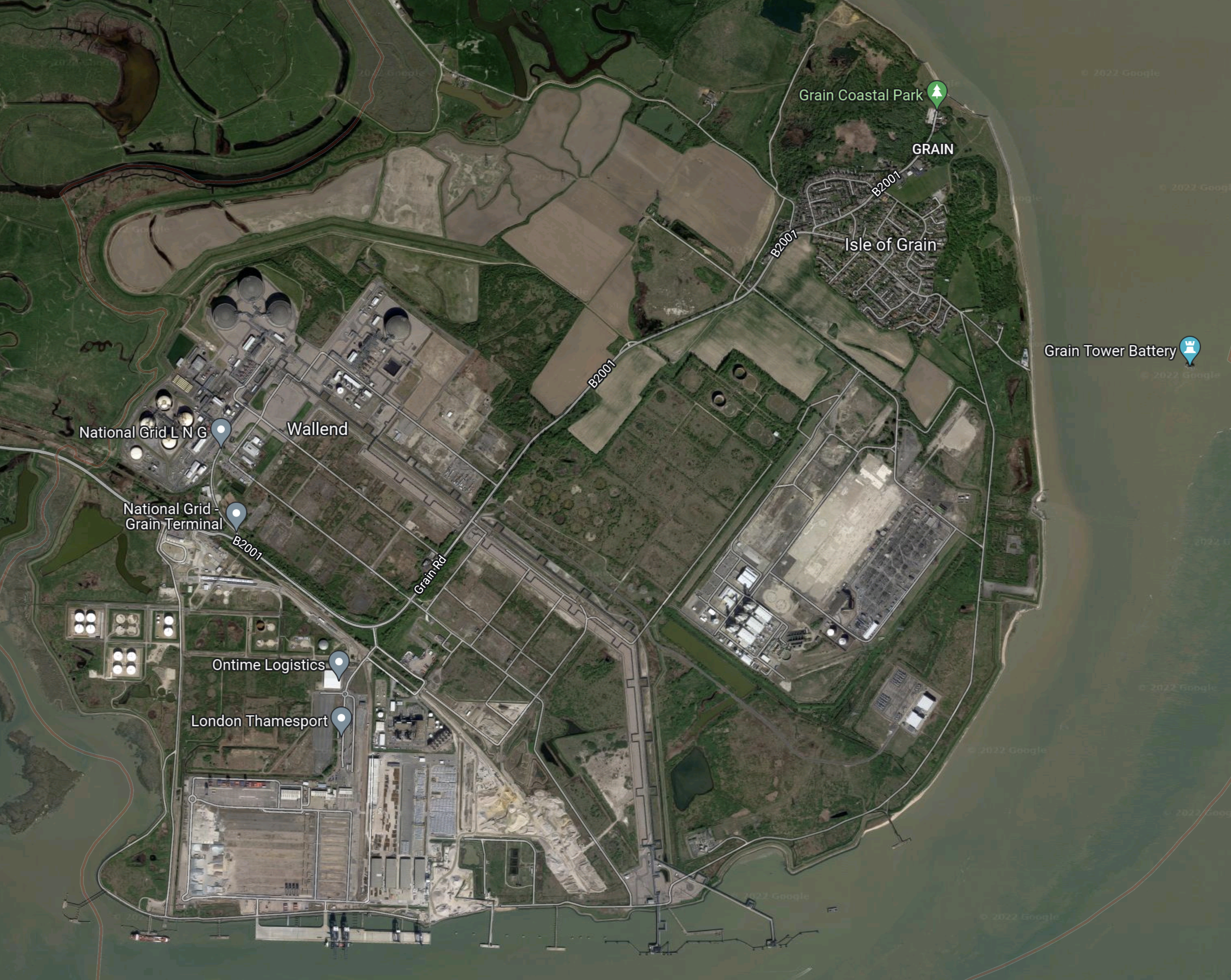
Note.
- Thamesport is in the South-West corner
- To its North is the LNG import facility.
- To the North-East of Thamesport is the 735 MW Medway power station.
- There is a rail connection to Hoo Junction on the North Kent Line.
This second Google Map shows the Eastern side of the Isle.
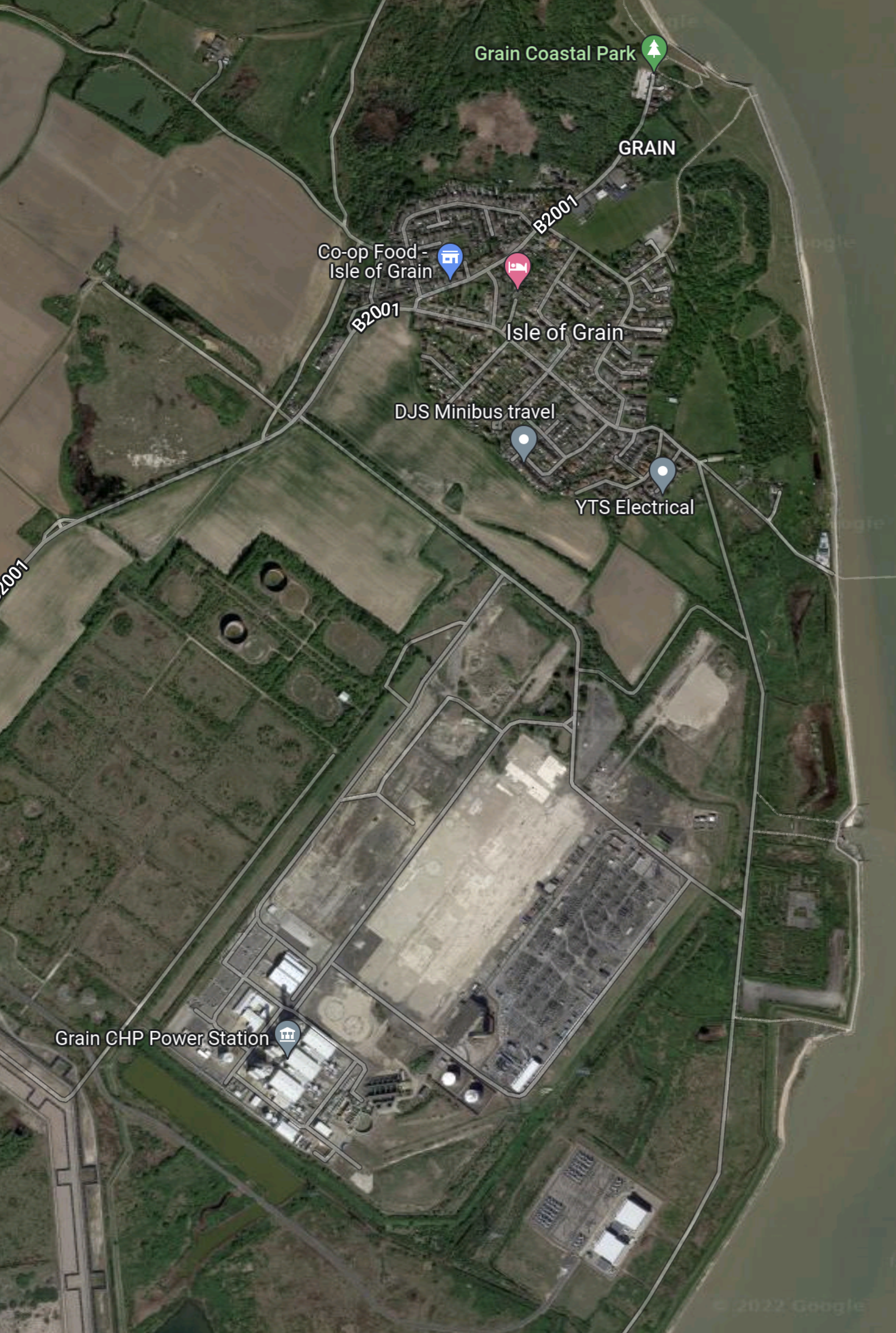
Note.
- Grain Coastal Park, where NeuConnect will make landfall, is marked by the green arrow at the top of the map.
- Towards the South-Eastern corner of the map is the 1.275 GW Grain gas-fired power station.
- To the East of the power station, there is more switchgear than you see in a bad Frankenstein film.
- The smaller square at the bottom with the two white squares could be the converter station for the BritNed interconnector.
I am sure there is space on the island for a connection for NeuConnect.
There is also a total of 2.01 GW of gas-fired power stations on the Isle of Grain.
Wind Power In The Thames Estuary
This Google Map shows the Thames Estuary.
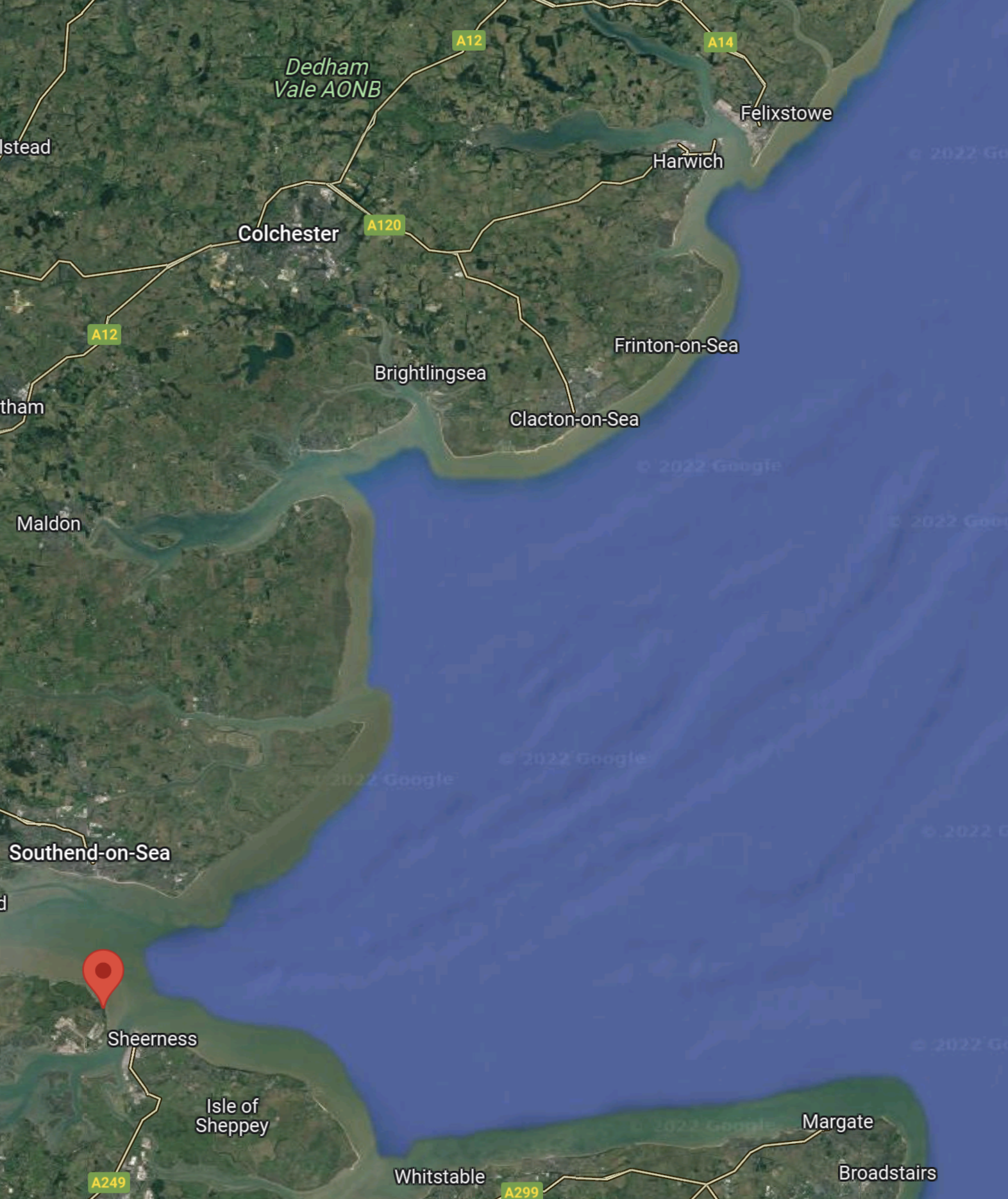
Note that the red arrow indicates the Isle of Grain.
This map from Wikipedia shows the wind farms in the area.
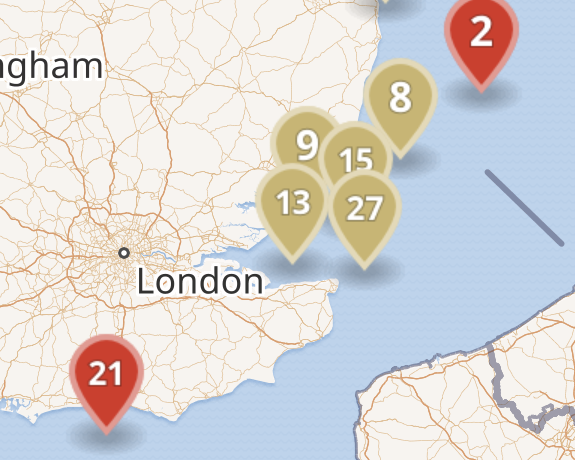
These are the ones that are operational.
- 2 – East Anglia Array – 714 MW
- 8 – Greater Gabbard – 504 MW
- 9 – Gunfleet Sands – 184 MW
- 13 – Kentish Flats – 140 MW
- 15 – London Array – 630 MW
- 27 – Thanet – 300 MW
Note.
- The Isle of Grain is just above the second o in London.
- I have ignored the Ramplion wind farm (21!), as it is too far from the Isle of Grain.
- This is a total of nearly 2.5 GW.
Planned extensions in the area include.
- East Anglia Array – 3.1 GW – Completion date of 2026
But the Wikipedia entry for the East Anglia Array says this about the wind farm.
The target capacity for the entire East Anglia Zone is 7200 MW which could require up to 1200 turbines.
Could we see one of the following?
- A connector from the East Anglia Array to the Isle of Grain.
- One or more new wind farms in the Thames Estuary connected to the Isle of Grain.
- German investment in a wind farm or farms connected to the Isle of Grain.
The Isle of Grain could become an island of energy providing power for London, the South-East of England, Germany and The Netherlands.
An Electrolyser On The Isle Of Grain
Consider.
- There will be plenty of renewable electricity.
- As there is a liquified natural gas terminal, there is plenty of gas storage.
- One or both of the gas-fired power stations can be converted to run on hydrogen.
- As more and more trucks are converted to hydrogen, there will be a large demand for hydrogen for heavy transport.
This must surely make a large electrolyser on the Isle of Grain a possibility.
The BritNed Interconnector
The BritNed interconnector is described like this in Wikipedia.
BritNed is a 1,000 MW high-voltage direct-current (HVDC) submarine power cable between the Isle of Grain in Kent, the United Kingdom; and Maasvlakte in Rotterdam, the Netherlands.
The BritNed interconnector would serve as a link for the foreseeable European super grid project.
Up to now, most of the electricity flow has been to the UK.
But surely, as more wind farms are developed power will flow the other way.
Wilhelmshaven Will Be A German Hub For Green Hydrogen
In Uniper To Make Wilhelmshaven German Hub For Green Hydrogen; Green Ammonia Import Terminal, I described plans by the Germans for a hydrogen hub at Wilhelmshaven.
The original story came from an article with the same name on Green Car Congress.
This is the first two paragraphs.
Under the name “Green Wilhelmshaven,” Germany-based international energy company Uniper plans to establish a German national hub for hydrogen in Wilhelmshaven and is working on a corresponding feasibility study.
Plans include an import terminal for green ammonia. The terminal will be equipped with an ammonia cracker for producing green hydrogen and will also be connected to the planned hydrogen network. A 410-megawatt electrolysis plant is also planned, which—in combination with the import terminal—would be capable of supplying around 295,000 metric tons or 10% of the demand expected for the whole of Germany in 2030.
As I said in the original post, I’m not happy about green ammonia, but the 1.4 GW NeuConnect interconnector has more than enough power to run a 410 MW electrolyser plant at full capacity.
It could even run three electrolysers of this size.
Hooksiel And Wilhelmshaven
NeuConnect will make landfall at Hooksiel.
This Google Map shows Hooksiel and Wilhelmshaven.
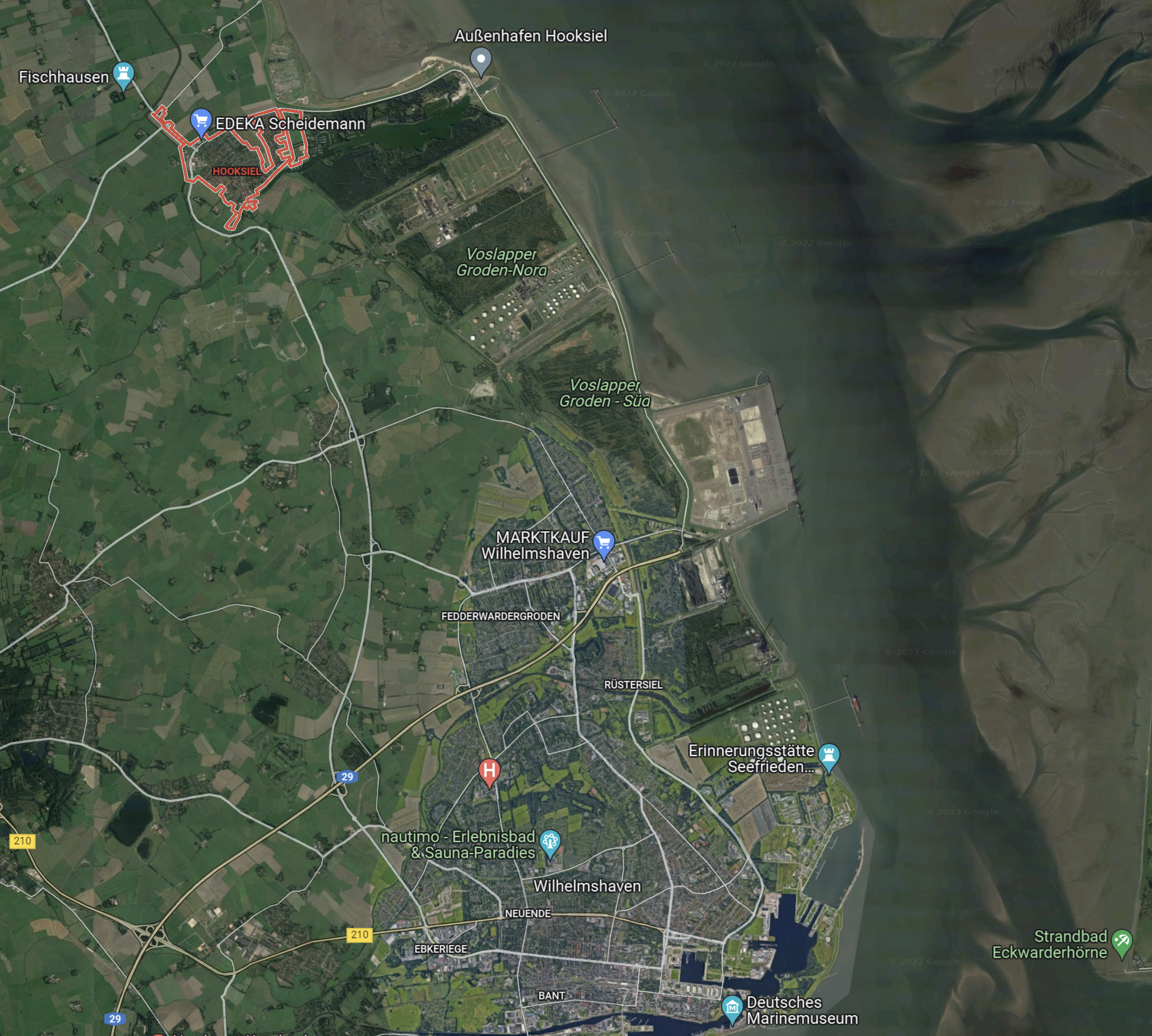
Note.
- Hooksiel is the village outlined in red.
- The water to the right of the map is the Jade Bight.
- The square block sticking out into the bight appears to be a container port.
- There appears to be chemical works or oil refineries North of the port.
- Wilhelmshaven is the town to the South of the port.
There would appear to be plenty of space for Uniper to construct Green Wilhelmshaven.
German And UK Wind Power Production
According to this page on Wikipedia, which is entitled Wind Power By Country, in 2020, these were installed wind power in various countries.
- Germany – 62,184 MW
- Spain – 27,089 MW
- UK – 24,665 MW
- France – 17,382 MW
- Italy – 10,389 MW
- Netherlands – 6,600 MW
In 2020 we were 37.5 GW behind Germany.
It looks like we’ll commission 3.3 GW this year and 6.1 in 2023, with Wikipedia saying that 12.9 GW is under development, which should close the gap to a certain extent.
In ScotWind Offshore Wind Leasing Delivers Major Boost To Scotland’s Net Zero Aspirations, I described how Scotland will add 15.1 GW of floating and 9.7 GW of fixed foundation offshore wind.
It looks like initially, we’ll be buying German wind-generated electricity, but in the future the direction could easily change around.
Boris And Olaf
There were mumblings from Boris, that energy was talked about in their meeting in Downing Street last week.
It does appear there is a lot of ways that the UK and Germany can co-operate in the future with respect to energy.
- German finance can be used to build wind farms in UK waters.
- German companies can build the turbines and the interconnectors we need to develop vast offshore wind farms.
- We can supply surplus energy to Germany through the NeuConnect interconnector.
I wouldn’t be surprised if Boris and Olaf had signed a very comprehensive energy co-operation agreement.
ScotWind Offshore Wind Leasing Delivers Major Boost To Scotland’s Net Zero Aspirations
The title of this post, is the same as that of this press release on the Crown Estate Scotland web site.
This is the first two paragraphs.
Crown Estate Scotland has today announced the outcome of its application process for ScotWind Leasing, the first Scottish offshore wind leasing round in over a decade and the first ever since the management of offshore wind rights were devolved to Scotland.
The results coming just months after Glasgow hosted the global COP26 climate conference show the huge opportunity that Scotland has to transform its energy market and move towards a net zero economy.
Some highlights are then listed.
- 17 projects have been selected out of a total of 74 applications.
- A total of just under £700m will be paid by the successful applicants in option fees and passed to the Scottish Government for public spending.
- The area of seabed covered by the 17 projects is just over 7,000km2.
- Initial indications suggest a multi-billion pound supply chain investment in Scotland
- The potential power generated will move Scotland towards net-zero.
This map shows the position of each wind farm.

Note, that the numbers are Scotwind’s lease number in their documents.
Fixed Foundation Wind Farms
These are the six fixed foundation wind farms.
- 1 – BP Alternative Energy Investments – 859 km² – 2.9 GW
- 6 – DEME – 187 km² – 1.0 GW
- 9 – Ocean Winds – 429 km² – 1.0 GW
- 13 – Offshore Wind Power – 657 km² – 2.0 GW
- 16 – Northland Power – 161 km² – 0.8 GW
- 17 – Scottish Power Renewables – 754 km² – 2.0 GW
Adding up these fixed foundation wind farms gives a capacity of 9.7 GW in 3042 km² or about 3.2 MW per km².
Floating Wind Farms
These are the ten floating wind farms.
- 2- SSE Renewables – 859 km² – 2.6 GW
- 3 – Falck Renewables Wind – 280 km² – 1.2 GW
- 4 – Shell – 860 km² – 2.0 GW
- 5 – Vattenfall – 200 km² – 0.8 GW
- 7 – DEME Concessions Wind – 200 km² – 1.0 GW
- 8 – Falck Renewables Wind – 256 km² – 1.0 GW
- 10 – Falck Renewables Wind – 134 km² – 0.5 GW
- 11 – Scottish Power Renewables – 684 km² – 3.0 GW
- 12 – BayWa r.e. UK – 330 km² – 1.0 GW
- 14 – Northland Power – 390 km² – 1.5 GW
Adding up the floating wind farms gives a capacity of 14.6 GW in 4193 km² or about 3.5 MW per km².
Mixed Wind Farms
This is the single wind farm, that has mixed foundations.
15 – Magnora – 103 km² – 0.5 GW
This wind farm appears to be using floating wind turbines.
I have a few general thoughts.
Are Floating Wind Farms Further Out?
There does appear to be a pattern, where the wind farms that are further from the land tend to be floating wind farms and those closer to the land appear to be fixed.
Consider.
- As the water gets deeper, fixed wind turbines will surely get more expensive.
- Floating wind turbines are the newer and more unproven technology, so only those bidders, who have done their research and are happy with it, will have bid.
Falck Renewables Wind Seem To Be Working With BlueFloat Energy
In the three Falck Renewables successes with leases 3, 8 and 10, BlueFloat Energy is a partner in the lease.
According to their web site, BlueFloat Energy were very much involved in WindFloat Atlantic, where this is said.
Top members of our team were key contributors to the development and construction of the WindFloat Atlantic project from concept to Final Investment Decision to commissioning. This 25 megawatt (MW) floating offshore wind project in Portugal marked a turning point in the offshore wind industry as it was the first floating offshore wind project to secure bank financing. With 3 x MVOW’s 8.4 MW turbines, the WindFloat Atlantic project was the world’s first semi-submersible floating wind project and continental Europe’s first floating wind project.
So do Falck Renewables intend to use WindFloat technology in their areas, which are to produce a total of 2.7 GW?
Perhaps a fleet of two hundred floating wind turbines based on WindFloat technology each with a capacity of 14 MW would be ideal.
- Wind turbines would be interchangeable between all three farms.
- There could be a few standby turbines to allow for maintenance.
- It would be possible to borrow a turbine to explore a new site.
All it would need is technology to be able to position and connect a turbine into the wind farm and disconnect and remove a turbine from the wind farm, with simple procedures.
Did BP Avoid the Floating Wind Farms?
BP, who are relatively new to offshore wind, only had one success, for a large fixed wind farm. So did they avoid the floating wind farms?
Do Shell and Scottish Power Have A Bigger Plan?
Shell and Scottish Power were successful with leases 4 and 11, which are reasonably close together.
They also won lease 17, which I wrote about in MacHairWind Wind Farm, where I concluded this.
The MacHairWind wind farm seems a well-positioned wind farm.
- It is close to Glasgow.
- It can be used in tandem with the Cruachan pumped hydro power station.
- It will have access to the Western HVDC Link to send power to the North-West of England.
Is Scotland replacing the 1.2 GW Hunterston B nuclear power station with a 2 GW wind farm, with help from Cruachan and other proposed pumped storage hydro schemes to the North of Glasgow?
So did Shell and Scottish Power get the pick of the bunch and will build two large floating wind farms close together?
Shell and Scottish Power seem to be using French company; Eolfi’s floating wind technology.
Why Do Floating Wind Farms Have A Higher Density?
The floating wind farms have an average energy density of 3.5 MW per sq. km, whereas the fixed wind farms only manage 3.2 MW per sq. km.
It may be only ten percent, but does that help the economics? It certainly, wouldn’t make them worse.
I do wonder though, if the reason for the higher density is simply that a floating turbine can be bigger, than a corresponding fixed turbine.
I also have a few more specific thoughts about individual farms.
Lease 15 – The Odd Bid Out
In any design competition, there is usually at least one design, that is not look like any of the others.
In the successful bids for the ScotWind leases, the bid from Magnora ASA stands out.
- The company has an unusual home page on its offshore wind web site.
- This page on their web site outlines their project.
- It will be technology agnostic, with 15MW turbines and a total capacity of 500MW
- It will use floating offshore wind with a concrete floater
- It is estimated, that it will have a capacity factor of 56 %.
- The water depth will be an astonishing 106-125m
- The construction and operation will use local facilities at Stornoway and Kishorn Ports.
- The floater will have local and Scottish content.
- The project will use UK operated vessels.
- Hydrogen is mentioned.
- Consent is planned for 2026, with construction starting in 2028 and completion in 2030.
This project could serve as a model for wind farms all round the world with a 500 MW power station, hydrogen production and local involvement and construction.
I discuss this project in more detail in ScotWind N3 Offshore Wind Farm.
A Conclusion About Floating Wind
The various successful bids in this round of Scottish wind farm leases can be split by capacity into two groups.
- Floating + Mixed – 15.1 GW – 61 %
- Fixed – 9.7 GW – 39 %
Note that I have included Magnora’s successful mixed bid with the successful floating bids, as it uses floating wind turbines to generate electricity.
The over 60 % of successful bids involving floating wind farms, indicates to me, that the day of floating wind farms has arrived.
EDF Renewables Eyes 50MW Solar Farm To Power Green Hydrogen Development In Teesside
The title of this post, is the same as that of this article on Solar Power Portal.
These are the first two paragraphs.
EDF Renewables is looking to develop a 49.9MW solar farm to power a new green hydrogen production facility in Teesside.
Working together with Hynamics, a subsidiary of the EDF Group specialising in hydrogen, the companies are planning to develop a 30-50MW electrolyser, which will subsequently be scaled to over 500MW in line with emerging demand.
They are working with PD Ports and British Steel.
Teesside is certainly getting the green hydrogen it needs, as there is also a 400 MW hydrogen project on Teesside, that I wrote about in BP Plans To Turn Teesside Into First Green Hydrogen Hub.
Aberdeen City Council And BP Sign Joint Venture Agreement To Develop City Hydrogen Hub
The title of this post, is the same as this article on Renewable Energy Magazine.
The title is a good description of the project and these are a few details.
- Production will start in 2024.
- The hub will produce 800 kilograms of green hydrogen per day.
- That will be enough for 25 buses and 25 other vehicles.
- Further investment would provide hydrogen for rail, freight and marine uses.
I don’t think this is a small project, as they are talking about potentially exporting the hydrogen.
These are a few thoughts.
Electricity Supply
In Can The UK Have A Capacity To Create Five GW Of Green Hydrogen?, I said the following.
Ryze Hydrogen are building the Herne Bay electrolyser.
- It will consume 23 MW of solar and wind power.
- It will produce ten tonnes of hydrogen per day.
The electrolyser will consume 552 MWh to produce ten tonnes of hydrogen, so creating one tonne of hydrogen needs 55.2 MWh of electricity.
Scaling those figures mean that to create 800 kilograms of hydrogen will need 44.16 MWh of electricity or if it is a 24/7 operation, the electrolyser will need a feed of 1.84 MW.
Currently, there are two offshore wind farms close to Aberdeen.
- European Offshore Wind Development Centre – 93 MW
- Hywind Scotland – 30 MW
That would provide enough electricity to provide a starter of under 2 MW.
I can see a lot more wind farms off the coasts around Aberdeen, as on all my visits to the city it has been windy and there is a lot of empty sea.
I don’t think providing enough renewable electricity for a very large electrolyser in Aberdeen will be a problem.
Hydrogen Exports
I would expect, that the hydrogen would go to Germany, as the Germans are backing BP in their wind farm ambitions and they are building a large hydrogen import terminal at Wilhelmshaven on the North-West German coast. The distance for a ship is under 500 miles.
BP’s Future Hydrogen Plans
This is a quote from Louise Kingham CBE, BP’s UK head of country and senior vice president for Europe.
Partnering with cities and corporates as they shape their paths to net zero is a core part of BP’s strategy. BP expects to partner with 10-15 cities globally by 2030 to provide innovative, integrated, and decarbonized energy solutions at scale to help them achieve their goals of net zero emissions. BP also aims to capture 10% of the low carbon hydrogen market in key geographies by 2030.
BP is investing across all the energy transition growth areas in the UK. In fact, we have committed to spend £2 in the UK for every £1 generated here out to the middle of this decade.
“Today’s announcement is evidence of that commitment in action and is supported by other ambitious plans to produce clean energy from UK offshore wind, develop carbon capture in Teesside and grow the country’s electric vehicle charging network.
BP would be in part using their expertise in providing oil and gas to the production and delivery of hydrogen to end users, be they large or small.
I can also see BP repurposing a few gas and oil production platforms into offshore hydrogen production hubs, as this could be a better financial route, rather than demolishing the platforms.
Conclusion
Birmingham is building a hydrogen hub at Tyseley Energy Park to fuel hydrogen buses and other vehicles.
Where is the plan for London’s hydrogen hubs?
BP Snaps Up 30 Per Cent Stake In Green Biofuels Ltd
The title of this post, is the same as that of this article on Business Green.
So why would BP take a stake in Green Biofuels?
This paragraph in the Wikipedia entry for BP, outlines the company’s future philosophy.
From 1988 to 2015, BP was responsible for 1.53% of global industrial greenhouse gas emissions. BP has set a goal to cut its greenhouse gas emissions to net-zero by 2050. BP plans to increase its investments in renewables 10 times and reduce oil production by 40% from current levels by 2030.
BP is doing things like developing wind and solar farms to achieve these aims.
BP also seems to be investing in both blue and green hydrogen.
But possibly, the two hardest products to decarbonise are diesel for heavy transport and aviation fuel.
Looking at Green Biofuels web site, the Wikipedia entry for Hydrotreated Vegetable Oil (HVO) and other sources, Green Biofuels product; GD+ seems to make a good fist of reducing carbon emissions and pollution, if it replaces diesel.
DB Cargo UK and HVO
DB Cargo UK have a fleet of nearly two hundred large diesel locomotives in the UK.
DB Cargo UK have been experimenting with HVO, as I wrote about in Powered By HVO.
The company has issued a press release on these trials of HVO, from which this is an extract.
DB Cargo UK’s Head of Asset Management and Maintenance Steve Wilkinson said the company was collaborating with one of the UK’s leading suppliers of HVO fuel which already worked with high-profile brands like Caterpillar, John Deere, Volvo and Mercedes-Benz.
“We are very pleased with the initial performance of the HVO fuel which we could use instead of or alongside traditional red diesel. The fact it is compatible with our existing diesel means investment in new storage and fuelling facilities would also be kept to a minimum,” he added.
“On top of that, it performs well at low temperatures, has a longer lifespan and is biodegradable,” he added.
DB Cargo UK currently operates 228 diesel and electric locomotives that transport in the region of 37 million tonnes of freight each year across the UK and into Europe.
It uses approximately 45 million litres of red diesel a year.
Was one of the UK’s leading suppliers of HVO fuel, a company called Green Biofuels?
Note that DB Cargo UK’s spokesman makes these points about the fuel.
- They are very pleased with initial performance.
- It is a straight swap for red diesel and it appears locomotives can run on either. He doesn’t say it but can it run on one fuel contaminated with the other? I suspect it’s a possibility.
- Current storage can be used for HVO.
- I get the impression that swapping from red diesel to HVO wouldn’t be the most challenging of operations.
- It performs well at low temperatures. One train-driver told me, that one of the worse parts of the job, is picking up a train from a depot high in the Pennines on a cold day in the winter. That must apply to locomotives.
- It has a longer lifespan.
- It is biodegradable. I haven’t walked through an engine shed, since I used to bunk them as a child to get engine numbers, but they were filthy places, with oil and diesel all over the floor.
That sounds to me, like DB Cargo UK have decided that HVO is an excellent fuel and for them to swap to HVO, would be no more difficult than to swap between red diesel from BP to red diesel from Shell.
This is an extract from the Business Green article.
Founded in 2013, Green Biofuels is the UK’s largest provider of HVO, having delivered over 55 million litres of HVO products to the UK market over the past two years.
If DB Cargo UK wanted to swap from red diesel to HVO, they would need nearly all of Green Biofuels current production.
So have Green Biofuels run to BP and said can you help us out?
Red Diesel Replacement
This document on the Government web site is entitled Reform Of Red Diesel And Other Rebated Fuels Entitlement.
There is a section, which is entitled Policy Objective, where this is said.
In June 2019, the UK became the first major economy in the world to pass laws guaranteeing an end to its contribution to global warming by 2050. The target will require the UK to bring all greenhouse gas emissions to net zero by 2050, compared with the previous target of at least an 80% reduction from 1990 levels. The government also launched in 2019 an ambitious new strategy to clean up the air and save lives, given air pollution is one of the biggest continuing threats to public health in the UK.
Red diesel is diesel used mainly for off-road purposes, such as to power bulldozers and cranes used in the construction industry, or to power drills for oil extraction. It accounts for around 15% of all the diesel used in the UK and is responsible for the production of nearly 14 million tonnes of carbon dioxide a year. Red diesel used in the construction and infrastructure building sectors was also estimated to have caused 7% of nitrogen oxide emissions and 8% of PM10 emissions (a type of particulate matter) in London in 2018.
At Budget 2020, the government therefore announced that it would remove the entitlement to use red diesel and rebated biodiesel from most sectors from April 2022 to help meet its climate change and air quality targets. The tax changes will ensure that most users of red diesel use fuel taxed at the standard rate for diesel from April 2022, like motorists, which more fairly reflects the harmful impact of the emissions they produce. Removing most red diesel entitlements will also help to ensure that the tax system incentivises users of polluting fuels like diesel to improve the energy efficiency of their vehicles and machinery, invest in cleaner alternatives, or just use less fuel.
It doesn’t say, but I have found references to the fact that HVO pays the same tax rate as diesel, despite the evidence, that it appears to be more environmentally friendly.
If I was the Chancellor, I would certainly adjust the tax system, so that red diesel users who changed to HVO and other fuels, paid tax in proportion to the emissions and pollution they caused.
So have BP decided that Green Biofuels is the best interim solution to reduce emissions from diesel fuel and taking a stake, is the best way to get the required access to the product?
Could BP be thinking about replacing red diesel with a better green diesel?
- Red diesel and GD+ could be acceptable to all diesel vehicles and equipment. So farmers for rxample, could run tractors and combines on the same fuel as their truck or Range Rover.
- Businesses, like farmers, who often have tanks for both red diesel and normal diesel, would only need one tank.
- Businesses with a green profile, would surely like it for their vehicles.
- Organic farmers would like it for their tractors.
- The availability of a green diesel would enable red diesel users to change to hydrogen or battery operation, at the optimal time.
I can see Prince Charles handing out green stars all round.
Aviva To Eject Company Directors If Climate Goals Are Not Met
The title of this post is the same as that of this article in The Sunday Times.
Increasingly, I am seeing company boards taking decisions, that will cut their company’s carbon footprint.
Only yesterday, I wrote Suppliers Sought For New Bi-Mode Locomotives For TransPennine Express And Great Western Railway, which was about First Group’s moves to decarbonise some of their locomotive-hauled trains.
I have also written about BHP, BP, Fortescue, Go-Ahead and Rio-Tinto taking action to decarbonise.
It does seem that some company boards are following Aviva’s guidance, but then it is in the directors own interest.
Many directors of large companies own shares and in a big public company, these are publicly traded.
I would suspect, that if a company board, do the right thing in terms of decarbonisation, that the share price will rise.
So by following the accepted climate science, they are actually helping themselves.
If they don’t believe that, then aggressive shareholders from Norwich will punish them.
 The Anonymous Widower