3 GW Dogger Bank South Offshore Wind Farms Reach New Development Stage
The title of this post, is the same as that of this article on offshoreWIND.biz.
This is the sub-heading.
The UK Planning Inspectorate has accepted into the examination phase the Development Consent Order (DCO) application for the Dogger Bank South (DBS) Offshore Wind Farms developed by RWE and Masdar.
The first two paragraphs give a brief description of the wind Farm.
The DBS East and DBS West offshore wind farms, which could provide electricity for up to three million typical UK homes, are located in shallow waters on the Dogger Bank over 100 kilometres off the northeast coast of England. The acceptance of the DCO application moves the projects into the pre-examination phase, which will become subject to a public examination later in 2024.
Together, the projects will have up to 200 turbines with a combined estimated capacity of 3 GW. Investment by RWE and Masdar during development and construction is predicted to deliver an economic contribution (Gross Value Added) to the UK of almost GBP 1 billion, including GBP 400 million in the Humber region.
There is a detailed map in the article on offshoreWIND.biz.
The Next Steps
These are given in the article.
The next steps for the projects, following a successful Development Consent Order, would be to secure Contracts for Difference (CfD), followed by financing and construction, the developers said.
It certainly looks like the 3 GW Dogger South Bank Wind Farm is on its way.
These are my thoughts about the project.
The Turbines To Be Used
The article says this about the turbines.
Together, the projects will have up to 200 turbines with a combined estimated capacity of 3 GW.
This means that the turbines will be 15 MW.
In RWE Orders 15 MW Nordseecluster Offshore Wind Turbines At Vestas, I said this.
Does this mean that the Vestas V236-15.0 MW offshore wind turbine, is now RWE’s standard offshore turbine?
This would surely have manufacturing, installation, operation and maintenance advantages.
There would surely be advantages for all parties to use a standard turbine.
It’s A Long Way Between Yorkshire And The Dogger Bank
The article says it’s a hundred kilometres between the wind farm and the coast of Yorkshire.
Welcome To The Age Of Hydrogen
This is the title of this page of the RWE web site.
The page starts with this paragraph.
RWE is actively involved in the development of innovative hydrogen projects. The H2 molecule is considered to be an important future building block of a successful energy transition. RWE is a partner in over 30 H2 projects and is working on solutions for decarbonising the industry with associations and corporations like Shell, BASF and OGE. Hydrogen projects are comprehensively supported in the separate Hydrogen department of the subsidiary RWE Generation.
AquaVentus
I also suggest, that you read this page on the RWE web site called AquaVentus.
The page starts with this RWE graphic.
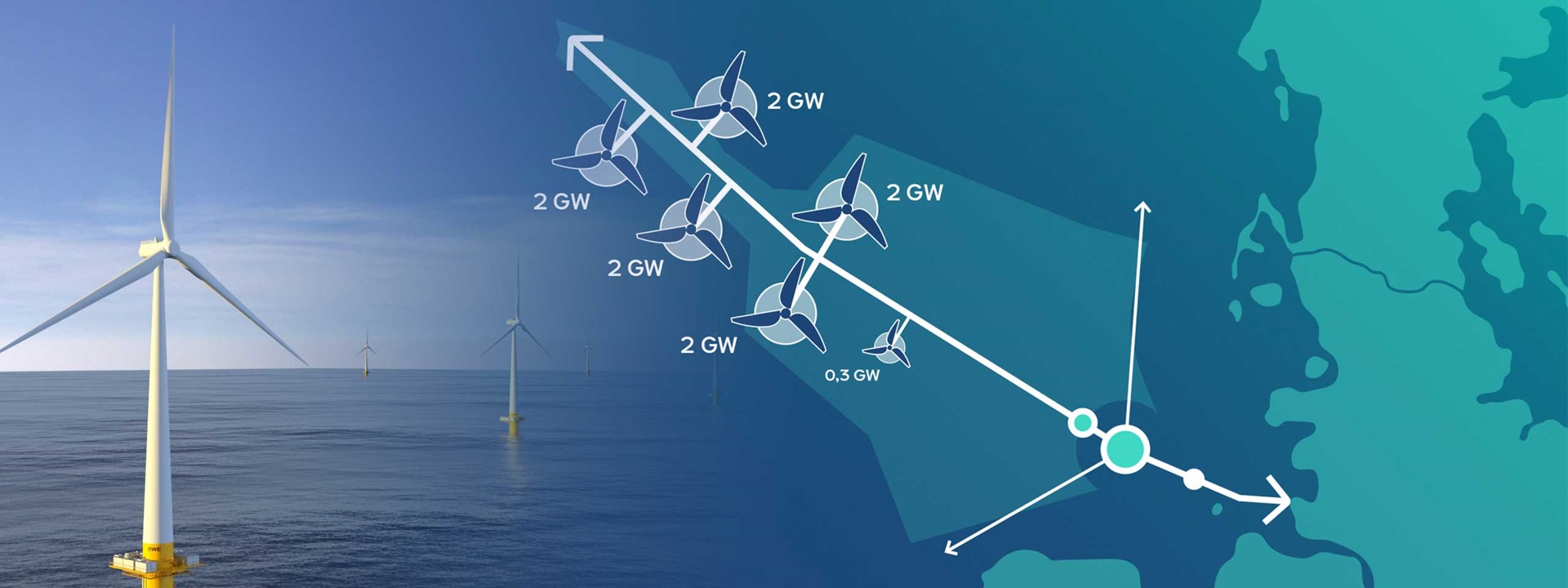
It appears that 10.3 GW of hydrogen will be created by wind farms and piped to North-West Germany.
These two paragraphs outline the AquaVentus initiative .
Hydrogen is considered the great hope of decarbonisation in all sectors that cannot be electrified, e.g. industrial manufacturing, aviation and shipping. Massive investments in the expansion of renewable energy are needed to enable carbon-neutral hydrogen production. After all, wind, solar and hydroelectric power form the basis of climate-friendly hydrogen.
In its quest for climate-friendly hydrogen production, the AquaVentus initiative has set its sights on one renewable energy generation technology: offshore wind. The initiative aims to use electricity from offshore wind farms to operate electrolysers also installed at sea on an industrial scale. Plans envisage setting up electrolysis units in the North Sea with a total capacity of 10 gigawatts, enough to produce 1 million metric tons of green hydrogen.
The page also gives these numbers.
- Total Capacity – 10 GW
- Tonnes Of Green Hydrogen – 1 million
- Members – 100 +
The web site says this about commissioning.
Commissioning is currently scheduled for early/mid 2030s.
The Germans can’t be accused of lacking ambition.
AquaVentus And The UK
This video shows the structure of AquaVentus.
I clipped this map from the video.

Note.
- There is a link to Denmark.
- There appears to be a undeveloped link to Norway.
- There appears to be a link to Peterhead in Scotland.
- There appears to be a link to just North of the Humber in England.
- Just North of the Humber are the two massive gas storage sites of Aldbrough owned by SSE and Brough owned by Centrica.
- There appear to be small ships sailing up and down the East Coast of the UK. Are these small coastal tankers distributing the hydrogen to where it is needed?
In the last century, the oil industry, built a substantial oil and gas network in the North Sea. It appears now the Germans are leading the building of a substantial hydrogen network.
AquaVentus And Aldbrough And Rough Gas Storage
Consider.
- In The Massive Hydrogen Project, That Appears To Be Under The Radar, I describe the Aldbrough Gas Storage.
- In Wood To Optimise Hydrogen Storage For Centrica’s Rough Field, I describe Centrica’s plans to turn Rough Gas Storage into the world’s largest hydrogen store.
- There is a small amount of hydrogen storage at Wilhelmshaven.
It looks like the East Riding Hydrogen Bank, will be playing a large part in ensuring the continuity and reliability of AquaVentus.
Dogger Bank South And AquaVentus
This Google Map shows the North Sea South of Sunderland and the Danish/German border.
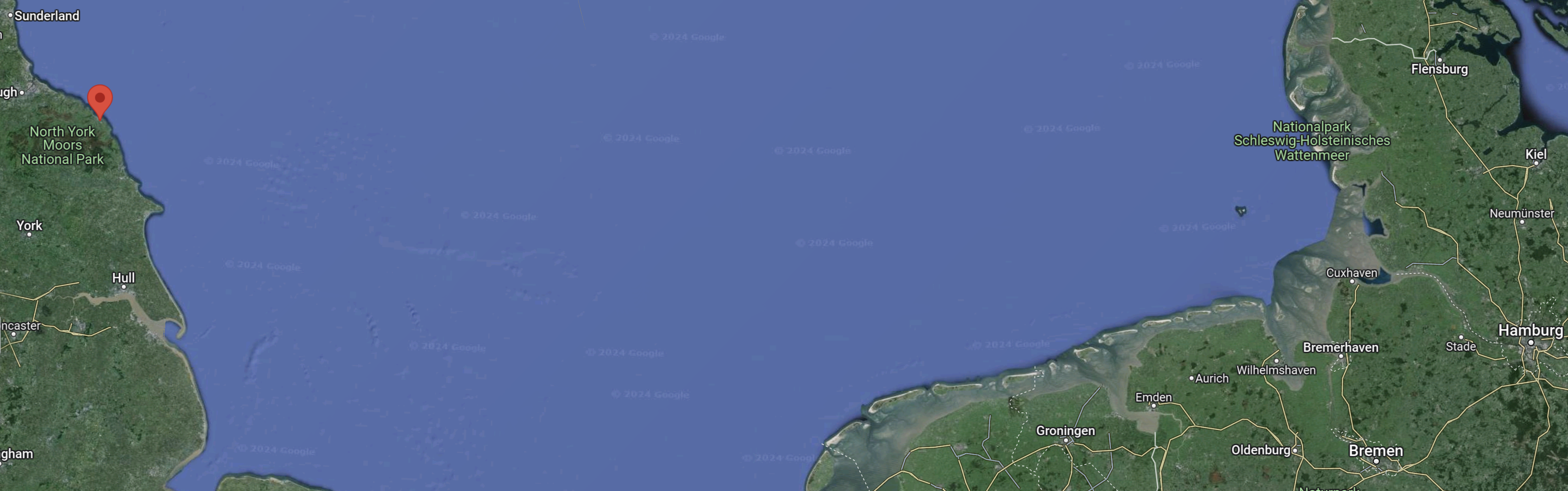
Note.
- Sunderland is in the top-left hand corner of the map.
- A white line in the top-right corner of the map is the Danish/German border.
- Hamburg and Bremen are in the bottom-right hand corner of the map.
If you lay the AquaVentus map over this map, I believe that Dogger Bank South wind farm could be one of the three 2 GW wind farms on the South-Western side of the AquaVentus main pipeline.
- Two GW would be converted to hydrogen and fed into the AquaVentus main pipeline.
- One GW of electricity would be sent to the UK.
But this is only one of many possibilities.
Hopefully, everything will be a bit clearer, when RWE publish more details.
Conclusion
I believe, that some or all of the Dogger Bank South electricity, will be converted to hydrogen and fed into the AquaVentus main pipeline.
I also believe, that the hydrogen stores in the East Riding of Yorkshire, will form an important part of AquaVentus.
Wood To Optimise Hydrogen Storage For Centrica’s Rough Field
The title of this post, is the same as that of this press release from Wood plc.
These are the first three paragraphs.
Wood, a global leader in consulting and engineering, has been awarded a contract by Centrica Energy Storage (CES) for the redevelopment of the UK’s Rough field in readiness for future hydrogen storage.
The Rough reservoir, located in the Southern North Sea, has been used to store natural gas safely for over thirty years and has the potential to provide over half of the UK’s hydrogen storage requirements.
The front-end engineering design (FEED) contract, awarded to Wood, entails new pipelines, a new unmanned installation, as well as onshore injection facilities at the Easington Gas Terminal, is the first step in making the field hydrogen ready.
Offshore Magazine has this article about the deal, which is entitled Wood Assessing Hydrogen Storage Needs For North Sea Rough Reservoir.
This is a paragraph from the Offshore Magazine article.
Centrica aims to position the Rough Field as the world’s largest long-duration hydrogen storage facility, although FID on the redevelopment project would depend on government support.
It would be a very important project.
Why would Centrica be planning for this massive increase in hydrogen storage?
There could only be one reason.
There is going to be a massive increase in hydrogen production and use.
In Where’s The Plan, Rishi?, I laid out what I believe will happen in the next few years.
- In RWE Goes For An Additional 10 GW Of Offshore Wind In UK Waters In 2030, I detailed how RWE intended to add an extra 10 GW of offshore wind to the seas around the UK.
- As our current offshore wind capacity is around 15 GW, so another 10 GW would surely be very welcome.
- The Germans will develop H2ercules, which is their massive project to create a hydrogen network to bring hydrogen to Southern Germany.
- A hydrogen hub at Wilhelmshaven is being built by Uniper to feed H2ercules with green hydrogen from around the world.
But would it not be better, if instead of feeding H2ercules with hydrogen from around the world, some came from the UK, a few hundred miles across the North Sea?
- RWE are developing the 3 GW Dogger Bank South wind farm, which is not in the best place for a cable to the UK. So could this wind farm have an offshore electrolyser and send the hydrogen to Wilhelmshaven, by pipeline or coastal tanker?
- RWE are also developing the 4.2 GW Norfolk cluster of wind farms to the North-East of Great Yarmouth. It might be better, if the output of these wind farms took a hydrogen route to Wilhelmshaven.
- I also believe that a third offshore electrolyser might be situated North of the Wash to bring more hydrogen to Germany.
- Hydrogen could also be sent from the Rough facility to Wilhelmshaven.
The coastal tanker route gives flexibility, so green hydrogen could be sent as required to the UK mainland.
Rishi Sunak’s Manifesto Speech – June 11
I also reported on Rishi Sunak’s Manifesto Speech, which he made on June 11th. This is an extract
This document on the Policy Mogul web site is entitled Rishi Sunak – Conservative Party Manifesto Speech – Jun 11.
These are three paragraphs from the speech.
We don’t just need military and border security. As Putin’s invasion of Ukraine has shown, we need energy security too. It is only by having reliable, home-grown sources of energy that we can deny dictators the ability to send our bills soaring. So, in our approach to energy policy we will put security and your family finances ahead of unaffordable eco zealotry.
Unlike Labour we don’t believe that we will achieve that energy security via a state-controlled energy company that doesn’t in fact produce any energy. That will only increase costs, and as Penny said on Friday there’s only one thing that GB in Starmer and Miliband’s GB Energy stands for, and that’s giant bills.
Our clear plan is to achieve energy security through new gas-powered stations, trebling our offshore wind capacity and by having new fleets of small modular reactors. These will make the UK a net exporter of electricity, giving us greater energy independence and security from the aggressive actions of dictators . Now let me just reiterate that, with our plan, we will produce enough electricity to both meet our domestic needs and export to our neighbours. Look at that. A clear, Conservative plan not only generating security, but also prosperity for our country.
It is now nineteen days since Rishi made that speech and I can’t remember any reports about an energy security policy, which he outlined in the last paragraph of my extract from his speech.
He particularly mentioned.
- New gas-powered stations
- Trebling our offshore wind capacity
- Having new fleets of small modular reactors.
He also said we would have sufficient electricity to export to our neighbours. As I said earlier some of this energy will be in the form of hydrogen, which has been created by offshore electrolysers.
If we are exporting electricity and hydrogen to Europe, this is likely to have three effects.
- An improvement in Europe’s energy security.
- H2ercules will improve and decarbonise German industry, using UK hydrogen.
- The finances of UK plc will improve.
It looks like there will be winners all round.
Conclusion
Centrica’s plan for a massive hydrogen store at Rough, close to SSE’s existing gas storage in the salt caverns at Aldbrough, would appear to make sense, if the UK’s excess of offshore wind is converted into green hydrogen, which is then stored and distributed as needed.
Centrica Business Solutions And Highview Power
Centrica Business Solutions is one of Centrica’s business units.
It has its own web page, with this sub heading.
Helping Organisations Balance Planet And Profit
This is followed by this mission statement.
Centrica Business Solutions helps organisations to balance the demands of planet and profit, by delivering integrated energy solutions that help you save money and become a sustainable business.
Several pictures show some of the solutions, that Centrica Business Solutions can provide.
Centrica Business Solutions In Numbers
These numbers are given about the customers of Centrica Business Solutions.
- Customer Sites Globally – 7000
- Solar PV Installations Delivered Worldwide – 16,380+
- Solar PV Installations Delivered Power – 240 MW
- CHP Units Operated And Maintained Globally – 700 MW+
- Energy Data Points Collected Each Month Globally – 29 billion
Theses are large numbers.
How Would Centrica Business Solutions Use Highview Power’s Batteries?
The obvious use of Highview Power’s batteries is to connect them between a solar or wind farm and the grid, for when the sun isn’t shining or when the wind isn’t blowing.
Currently, there are three sizes of Highview Power batteries, either working on under development.
5MW/15 MWh
This is the demonstration system, which is described on this page of the Highview web site.
Surely, if a system of this size is very useful for Viridor, there may be other applications and customers out there.
This system will provide 5 MW for three hours.
50MW/300MWh
This is the Carrington system, which is described on this page of the Highview web site.
The Highview web site says this about output potential and connectivity.
The facility will store enough clean, renewable energy to serve the needs of 480,000 homes, as well as providing essential grid stabilisation services. The site will use existing substation and transmission infrastructure.
This system will provide 50 MW for six hours.
200MW/2.5GWh
This is the larger system for Scotland and the North East, which is under development and described on this page of the Highview web site.
The Highview web site says this about output their use.
These will be located on the national transmission network where the wind is being generated and therefore will enable these regions to unleash their untapped renewable energy potential and store excess wind power at scale.
This system will provide 200 MW for 12.5 hours.
In Rio Tinto Punts On British Start-Up To Plug Renewables Gap, I said this.
In Britain, Highview hopes to be putting four 2.5-gigawatt assets into planning this year – one in Scotland, three with Orsted in England.
This sentence was originally published in this article on the Australian Financial Review.
I believe that Centrica could find applications for all three sizes of Highview’s batteries.
Suppose, though Centrica find that an application needs say a 100 MW/1 GWh battery.
From the mathematics, I did at ICI in the 1970s, when looking at the scaling of chemical plants, I believe that Highview’s battery design could be scalable, by just using appropriately-sized turbomachinery, matched to the right number of tanks.
So the customer would get the battery size they needed!
How Much Electricity Could One Of Highview’s Batteries Store?
This image shows large LNG tanks at Milford Haven.
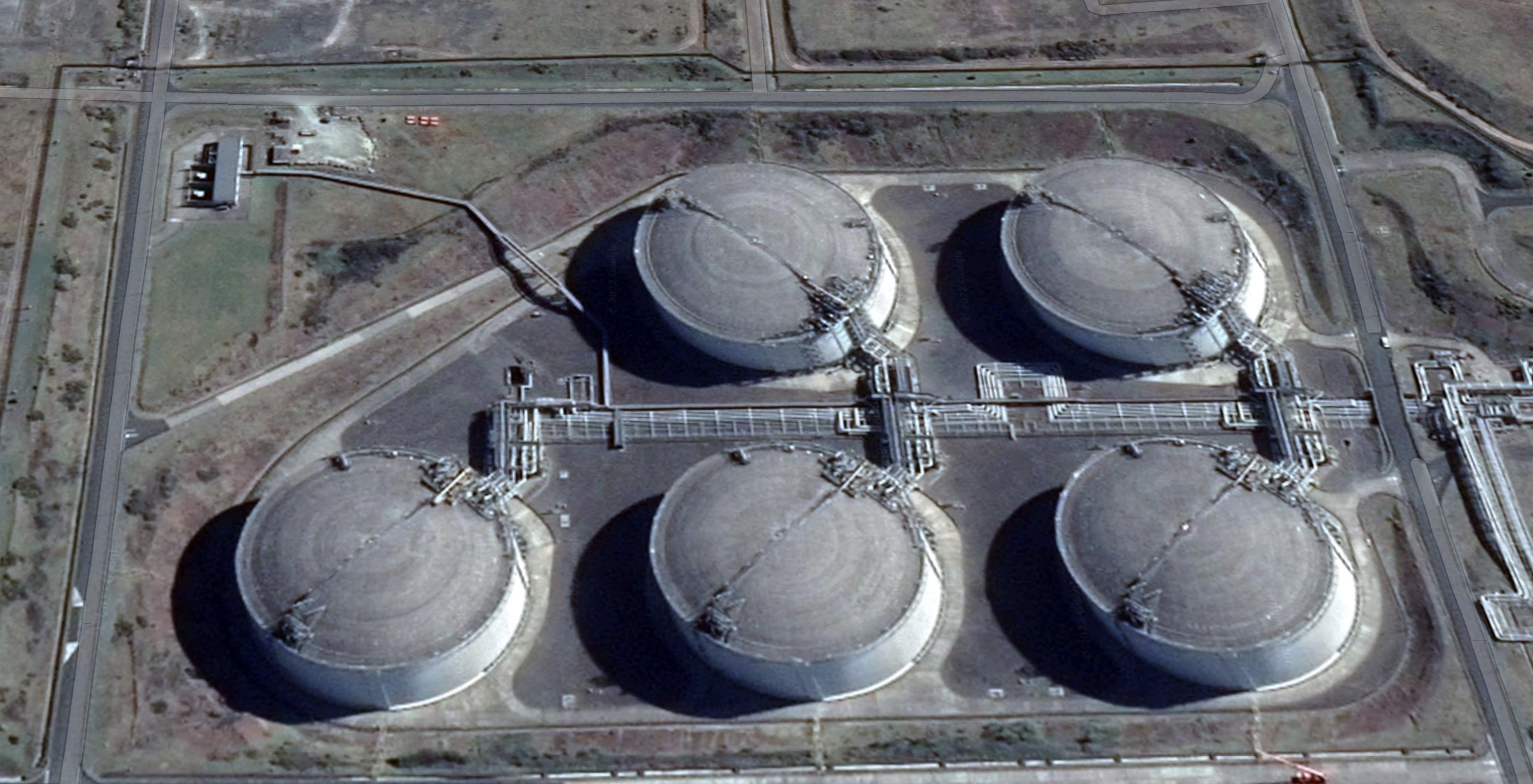
In Could A Highview Power CRYOBattery Use A LNG Tank For Liquid Air Storage?, I did a rough calculation and found that the largest LNG tanks could hold enough liquid air, that would be the equivalent of around one GWh.
So the image above could be a 5 GWh battery.
This image clipped from Highview’s web site, shows large tanks for liquified gas storage.
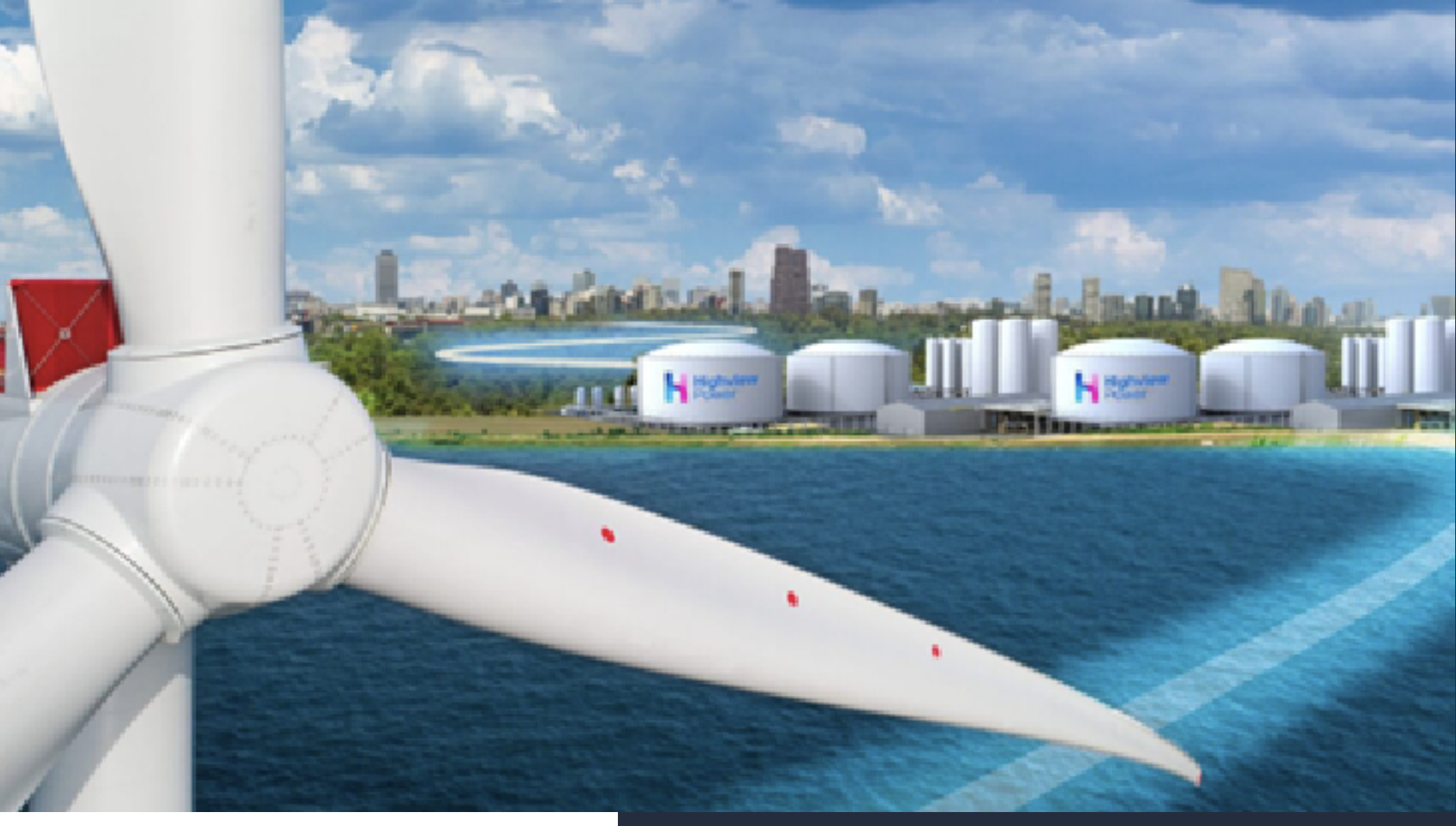
With tanks like these, Highview could be building batteries with storage to rival the smaller pumped storage hydroelectric power stations.
In Grid Powers Up With One Of Europe’s Biggest Battery Storage Sites, I talked about how Ørsted were planning the Swardeston BESS, where the 2852 MW Hornsea Three wind farm connects to the grid.
The chosen battery will be from Tessla with an output of 300 MW and a capacity of 600 MWh.
I suspect Ørsted couldn’t wait for Highview, but circumstances might have changed now, with the financing deal for the Carrington battery!
Are Combined Heat And Power Units And Highview’s Batteries Interchangeable And Complementary Technologies?
According to the Centrica Business Systems web site, they have deployed over 700 MW of CHP systems globally.
I wonder how many of these systems could have used a standard Highview battery?
Perhaps, Centrica Business Systems have done a survey and found that it could be quite a few.
So, perhaps if Centrica Business Systems had access to Highview’s technology, it would increase their sales.
In addition how many of Centrica Business Systems existing CHP systems, would be improved with the addition of a Highview battery?
It appears to me, that if Centrica Business Systems were to develop a series of standard solutions based on Highview’s technology, they could substantially increase their sales.
What Could Centrica Business Systems Do For Highview Power?
Centrica Business Systems could probably develop several standard applications with Hoghview’s technology, which would be to the benefit of both companies.
But, I believe that as Centrica Business Systems are supporting large number of systems globally, that they are in a good place to help develop and possibly run Highview Power’s support network.
Conclusion
I can see Centrica Business Systems and Highview Power having a long and profitable relationship.
Centrica Invests In Renewable Energy Storage Capabilities To Boost UK’s Energy Security And Accelerate Transition To Net Zero
The title of this post, is the same as that of this press release from Centrica.
These two paragraphs are effectively headings.
Centrica plc announces a strategic partnership and £70 million investment in Highview Power and its first clean energy storage project in Carrington, Manchester.
Centrica’s investment will be a key part of a £300 million funding package to develop the first commercial-scale Liquid Air Energy Storage plant in the UK, which will boost the UK’s energy security and accelerate the transition to net zero.
These four paragraphs give more details on the deal.
The investment, which forms part of our plans to invest between £600m – £800m a year until 2028, will be structured as £25m of convertible debt at Highview Enterprises Limited, being the Highview Power holding company and £45m of debt funding at the Carrington Liquid Air Energy Storage project, phased over the project construction. The investment delivers several benefits to Centrica:
Robust standalone returns aligned with Centrica’s capital allocation framework and returns thresholds
Aligned to our green-focused investment programme targeting assets which complement our existing capabilities, provide balance to the portfolio, and align to the needs of the energy transition
Includes rights to equity participation and energy optimisation from future projects in Highview’s £9 billion project pipeline.
At a first look, it appears to give Centrica robust returns and some security for their £70 million investment.
But it is the last paragraph that I like. Does it mean that Centrica can cherry-pick, the projects that it likes and fit its own objectives and expertise from Highview’s £9 billion project pipeline and take-up some equity?
Whatever it means, It looks like it will be good for Centrica.
Do the other partners have similar rights to equity?
Suppose Goldman Sachs have a long-term client in the Mid-West of the United States, who are an electricity generator, with perhaps half-a-dozen coal-fired power stations.
As the client needs to decarbonise and it is believed that Highview’s long duration batteries can replace small coal-fired power stations, it is likely that a Highview solution will at least be examined.
If the client goes down the Highview route, Goldman Sachs might like to continue their long-term relationship, by taking a share in the equity.
Are Goldman Sachs Stitching Together A Large Deal On Energy Storage?
In UK Infrastructure Bank, Centrica & Partners Invest £300M in Highview Power Clean Energy Storage Programme To Boost UK’s Energy Security, I talked about a deal to invest £300 million into energy storage company; Highview Power.
These three paragraphs are from the Highview Power news item, on which I based my post.
Highview Power has secured the backing of the UK Infrastructure Bank and the energy industry leader Centrica with a £300 million investment for the first commercial-scale liquid air energy storage (LAES) plant in the UK.
The £300 million funding round was led by the UK Infrastructure Bank (UKIB) and the British multinational energy and services company Centrica, alongside a syndicate of investors including Rio Tinto, Goldman Sachs, KIRKBI and Mosaic Capital.
The investment will enable the construction of one of the world’s largest long duration energy storage (LDES) facilities in Carrington, Manchester, using Highview Power’s proprietary LAES technology. Once complete, it will have a storage capacity of 300 MWh and an output power of 50 MWs per hour for six hours. Construction will begin on the site immediately, with the facility operational in early 2026, supporting over 700 jobs in construction and the supply chain.
Note.
- The UK Infrastructure Bank is a is a British state-owned development bank.
- Centrica plc is an international energy and services company.
- Rio Tinto is a leading global mining group that focuses on finding, mining and processing the Earth’s mineral resources.
- The Goldman Sachs Group, Inc. is a leading global investment banking, securities and investment management firm.
- KIRKBI is the Kirk Kristiansen family’s private holding and investment company founded to build a sustainable future for the family ownership of the LEGO Group.
- Mosaic Capital are an American investment firm.
With six partners, that is just £50 million per partner.
As that sum is very much small change for the likes of these guys and the question of taking an equity stake is not mentioned in Highview Power’s news item, it looks like this deal could be a try-before-you-buy deal with some of the partners or a simple investment with others.
Consider.
- Gresham House, Gore Street and others have proven that investing in lithium-ion batteries give a good return on investment.
- The Carrington long duration energy storage facility will be located near to the 884 MW gas-fired Carrington power station. I suspect that Centrica and Rio Tinto will be interested to see how the hybrid power-station performs.
- Could the Lego Group owners be looking at using solar power, wind power and a LDES to reduce the carbon footprint of their stores?
I would assume, that all the investors would get full details on the performance of the batteries.
Someone To Build The LDES
In Bilfinger Drives Highview Power’s Innovative Storage Project, Accelerating The Energy Transition, I describe how German company will build the Carrington LDES.
The Advantages Of An LDES over a BESS
This is only a short list, of the advantages I see.
- An LDES is easily recyclable.
- The LDES has less exotic materials.
- An LDES can be built from zero-carbon steel.
- Highview are claiming a 40-year life for their LDES.
- Highview is already talking about 200MW/2.5GWh LDES systems.
- Two 200MW/2.5GWh systems working together with a wind or solar farm, can replace a 400 MW gas- or coal-fired station.
- I suspect one of Highview’s LDES systems could be placed offshore, if needed.
I also believe that Highview’s LDES systems could be incorporated into complex chemical plants to increase the efficiency.
Are Goldman Sachs Stitching Together A Large Deal On Energy Storage?
Everything now seems to be in place to build these LDES one after the other, to accelerate the energy transition.
With a good supply of orders and enough money to build each system, I cab see no reason, why several systems a month cannot be built and installed.
I have worked with companies like Goldman Sachs in the past, and I wouldn’t be surprised to find, that they have created the consortium, so that all members get the returns and recognition, they disserve.
Adding Lego Group To The Consortium Could Be A Masterstroke
The Lego Group has lots of stores and theme parks worldwide and a reputation for good design and environmental standards.
Last year, I wrote Bedford Depot’s Massive Solar Roof Helps Thameslink On Way To Net Zero. This was putting a solar roof on a rail depot, but surely buildings like this would be suitable for a Highview LDES.
UK Infrastructure Bank, Centrica & Partners Invest £300M in Highview Power Clean Energy Storage Programme To Boost UK’s Energy Security
The title of this post, is the same as that of this news item from Highview Power.
This is the sub-heading.
Highview Power kickstarts its multi-billion pound renewable energy programme to accelerate the UK’s transition to net zero in Carrington, Manchester.
These three paragraphs outline the investment.
Highview Power has secured the backing of the UK Infrastructure Bank and the energy industry leader Centrica with a £300 million investment for the first commercial-scale liquid air energy storage (LAES) plant in the UK.
The £300 million funding round was led by the UK Infrastructure Bank (UKIB) and the British multinational energy and services company Centrica, alongside a syndicate of investors including Rio Tinto, Goldman Sachs, KIRKBI and Mosaic Capital.
The investment will enable the construction of one of the world’s largest long duration energy storage (LDES) facilities in Carrington, Manchester, using Highview Power’s proprietary LAES technology. Once complete, it will have a storage capacity of 300 MWh and an output power of 50 MWs per hour for six hours. Construction will begin on the site immediately, with the facility operational in early 2026, supporting over 700 jobs in construction and the supply chain.
Note.
- The backers are of a high quality.
- The Carrington LDES appears to be a 50 MW/300 MWh battery.
It finally looks like Highview Power is on its way.
These are my thoughts on the rest of news item.
Centrica’s Involvement
This paragraph talks about Centrica’s involvement.
Energy leader Centrica comes on board as Highview Power’s strategic partner and a key player in the UK’s energy transition, supporting Carrington and the accelerated roll-out of the technology in the UK through a £70 million investment. The programme will set the bar for storage energy systems around the world, positioning the UK as the global leader in energy storage and flexibility.
I suspect that Centrica have an application in mind.
In Centrica Business Solutions Begins Work On 20MW Hydrogen-Ready Peaker In Redditch, I talk about how Centrica is updating an old peaker plant.
In the related post I refer to this news item from Centrica Business Systems.
This paragraph in the Centrica Business Systems news item, outlines Centrica’s plans.
The Redditch peaking plant is part of Centrica’s plans to deliver around 1GW of flexible energy assets, that includes the redevelopment of several legacy-owned power stations, including the transformation of the former Brigg Power Station in Lincolnshire into a battery storage asset and the first plant in the UK to be part fuelled by hydrogen.
As Redditch power station is only 20 MW, Centrica could be thinking of around fifty assets of a similar size.
It seems to me, that some of these assets could be Highview Power’s LDES batteries of an appropriate size. They may even be paired with a wind or solar farm.
Larger Systems
Highview Power’s news item, also has this paragraph.
Highview Power will now also commence planning on the next four larger scale 2.5 GWh facilities (with a total anticipated investment of £3 billion). Located at strategic sites across the UK, these will ensure a fast roll-out of the technology to align with UK LDES support mechanisms and enable the ESO’s Future Energy Scenario Plans.
Elsewhere on their web site, Highview Power say this about their 2.5 GWh facilities.
Highview Power’s next projects will be located in Scotland and the North East and each will be 200MW/2.5GWh capacity. These will be located on the national transmission network where the wind is being generated and therefore will enable these regions to unleash their untapped renewable energy potential and store excess wind power at scale.
So will the four larger systems have a 200MW/2.5GWh capacity?
They could, but 200 MW may not be an appropriate output for the location. Or a longer duration may be needed.
Highview Power’s design gives the flexibility to design a system, that meets each application.
Working With National Grid
Highview Power’s news item, also has this sentence.
Highview Power’s technology will also provide stability services to the National Grid, which will allow for the long-term replacement of fossil fuel-based power plants for system support.
Highview Power’s technology is also an alternative to Battery Energy Storage Systems (BESS) of a similar capacity.
How does Highview Power’s technology compare with the best lithium-ion systems on price, performance and reliability?
Curtailment Of Wind Farms
Highview Power’s news item, also has these two paragraphs.
This storage will help reduce curtailment costs – which is significant as Britain spent £800m in 2023 to turn off wind farms.
Highview Power aims to accelerate the roll-out of its larger facilities across the UK by 2035 in line with one of National Grid’s target scenario forecasts of a 2 GW requirement from LAES, which would represent nearly 20% of the UK’s long duration energy storage needs. By capturing and storing excess renewable energy, which is now the cheapest form of electricity, storage can help keep energy costs from spiralling, and power Britain’s homes with 24/7 renewable clean energy.
I can see several wind farms, that are regularly curtailed would have a Highview Power battery installed at their onshore substation.
Receently, I wrote Grid Powers Up With One Of Europe’s Biggest Battery Storage Sites, which described how Ørsted are installing a 300 MW/600 MWh Battery Energy Storage Systems (BESS) at Swardeston substation, where Hornsea Three connects to the grid.
I would suspect that the purpose of the battery is to avoid turning off the wind farm.
Would a Highview Power battery be better value?
What’s In It For Rio Tinto?
I can understand, why most companies are investing, but Rio Tinto are a mining company. My only thought is that they have a lot of redundant holes in the ground, that cost them a lot of money and by the use of Highview Power’s technology, they can be turned into productive assets.
Collateral Benefits
Highview Power’s news item, also has this paragraph.
Beyond contributing to the UK’s energy security by reducing the intermittency of renewables, Highview Power’s infrastructure programme will make a major contribution to the UK economy, requiring in excess of £9 billion investment in energy storage infrastructure over the next 10 years – with the potential to support over 6,000 jobs and generate billions of pounds in value add to the economy. It will also contribute materially to increasing utilisation of green energy generation, reducing energy bills for consumers and providing significantly improved energy stability and security.
If Highview Power can do that for the UK, what can it do for other countries?
No wonder companies of the quality of Centrica, Rio Tinto and Goldman Sachs are investing.
Recurrent Energy’s Middle Road Project Sold To Centrica
The title of this post, is the same as that pf this article on Solar Power Portal.
These are the first two paragraphs.
Recurrent Energy, a global solar and energy storage developer and a subsidiary of Canadian Solar, announced the sale of its 49.9 MWp Middle Road solar project in Harbury, Warwickshire, to Centrica Business Solutions. The subsidy-free project, slated for construction this summer, will commence operations in 2025.
The Middle Road project is just one piece of Recurrent Energy’s expanding UK pipeline, which boasts over 2.6 GWp of solar PV and 6.7 GWh of battery storage projects. This mirrors the broader trend of increased investment in UK solar. Indeed, Recurrent announced €1.3 billion of financing for EU and UK solar projects earlier this week.
This 49.9 MW solar project shows three ways to make money from a solar project.
The Developer
Recurrent Energy would appear to have developed the expertise to put together these solar farms and do all the legals and administration to connect them to the National Grid.
They obviously can show their financial backers, the cash flow, that the farms generates.
So if you’re good at building solar farms, I suspect you can develop a substantial pipeline of projects, each with their own case flow.
The Operator
Initially in the early days, Recurrent Energy will probably be the operator, so they can sort out any teething problems and build the financial profile of the site.
The Owner
But as at Middle Road, they may decide to cash in their investment.
Centrica have now taken over the ownership and they can operate the farm themselves or pay, Recurrent Energy a fee.
Note.
- Developer, operator and owner all have ways of making money from this solar farm.
- Developer and owner can use the solar farm, as an asset on which to raise money.
- Similar cash flows and inside probably apply to batteries and wind farms.
By buying, selling and updating the various assets, a financial operator, can use their assets to make money.
As Centrica are also an electricity supplier, they can probably suggest to developers, where a solar farm or battery-electric storage system is needed.
Are Centrica Developing A Pipeline Of Projects?
In Centrica Set For Solar Boost With Acquisition Of Two Projects In South-West England, I talked about how Centrica had acquired two projects in South-West England.
The Middle Road project is the third project that Centrica has purchased this year.
As a Control and Electrical Engineer, I know, that by careful management of the assets, Centrica can achieve the following.
- Delivery of electricity to their customers at a competitive price.
- If a battery is included in the local grid, higher supply reliability can be achieved.
- Batteries also allow the local network to carry out other tasks, like frequency stabilisation.
The flexibility of the local network should allow other assets to be added.
Korean Hydrogen Bus Adoption Emerging To Block Low-Priced Electric Buses From China
The title of this post, is the same as that of this article on BusinessKorea.
These are the first two paragraphs.
Major Korean business groups such as Samsung, SK, Hyundai Motor, and POSCO are expanding the introduction of hydrogen buses. They are more efficient than electric buses, and can run 635 kilometers on a single charge, making them suitable for long-distance commuting. Expanding hydrogen mobility, including buses, is considered the first step in building an entire hydrogen ecosystem.
SK Group is one of the most active companies in expanding hydrogen buses. According to SK Group on May 26, SK siltron has decided to replace its commuter buses for employees of its Gumi plant in North Gyeongsang Province with hydrogen buses. Additional deployments are under consideration after a pilot run in the first half of the year. In early May, SK hynix introduced three of the Universe model, Hyundai’s hydrogen bus for commuting. SK E&S recently completed the world’s largest liquefied hydrogen plant in Incheon and plans to soon expand its hydrogen refueling stations nationwide to 20.
The Korean bus seem to have developed a strategy to protect themselves from the Chinese.
I have a few thoughts.
Korea And HiiROC
Hyundai and Kia have joined Centrica in taking stakes in Hull-based startup HiiROC, which I wrote about in Meet HiiROC, The Startup Making Low-Cost Hydrogen Free From Emissions.
London’s Future Bus Fleet
There are rumours on the Internet that Sadiq Khan, will replace all London’s buses with new Chinese buses.
How will I get around, as I don’t ride in anything that was made in China?
Conclusion
We live in interesting times.
Developing A Rural Hydrogen Network
On my last stud farm, we had three regular fuel deliveries.
- Propane to heat the house and offices.
- Red diesel to power the tractor and farm machinery.
- Road diesel to power the horse box and a couple of diesel cars, that went on the roads.
Note.
- Like most farms in the UK, we didn’t have mains gas.
- The local low-life of whom you never speak their name, used to regularly steal the diesel.
- Stealing of diesel in rural areas of the UK is a big industry.
- The police did nothing to stop the thefts as the culprits are untouchable.
- We had two boilers, that both ran on the propane.
- Modern boilers can be converted from propane to use hydrogen.
- All cars, trucks, farm vehicles and machinery on the stud farm could in the future use hydrogen.
Propane and diesel would be replaced by clean hydrogen.
Delivering The Fuel
Consider.
- Propane and diesel are currently delivered in rural areas by truck.
- Hydrogen will be delivered the same way and stored in a tank designed for hydrogen, which could be similar in appearance to current propane tanks.
- Boilers would be directly piped to the hydrogen tank.
- The technology exists to fill hydrogen-powered vehicles and equipment from hydrogen tanks.
- I believe that a thief-proof hydrogen tank would be possible.
- The hydrogen will be delivered as needed in a hydrogen-powered truck.
I believe companies like Centrica, will develop the technology so that farms and businesses could have their own hydrogen system.
Supplying The Hydrogen
Electrolysers would be needed around the country.
Some could be based on nuclear sites, where others could be powered by offshore wind.
Hydrogen Safety
Hydrogen safety has its own Wikipedia entry.
The entry starts with a description of the Hindenberg Disaster, which has a detailed Wikipedia entry of its own.
I’ve spoken to someone, who was there; Dory Previn, who later wrote a song about it.
The Hydrogen safety Wikipedia entry has this paragraph.
There are many codes and standards regarding hydrogen safety in storage, transport, and use. These range from federal regulations, ANSI/AIAA, NFPA, and ISO standards. The Canadian Hydrogen Safety Program concluded that hydrogen fueling is as safe as, or safer than, compressed natural gas (CNG) fueling,
I’ve also talked to German schoolchildren about their hydrogen trains and as you are educated about hydrogen, the fear decreases and the safety increases.
Hydrogen-Powered Lawnmowers And Garden Tractors
Everybody likes a lush, green lawn.
Surely, yours is better, if your lawnmower emits no carbon dioxide!
Electric will work, but if you have a hydrogen-powered lawnmower, that can be filled from your central heating tank, that is better.
Collateral Benefits
These would be collateral benefits.
- One set of tankers would be replaced by a single zero-carbon hydrogen tanker, thus reducing road traffic.
- I believe there would be less fuel theft.
- Rural businesses, that needed gas like blacksmiths could be supplied.
- A lot of buildings with a propane-fuelled boiler could be converted to hydrogen.
It would be a path to decarbonisation of the rural economy.
How Big Is The Off-Grid Energy Market?
A document on the House of Commons web site says this.
An estimated 4.4 million households across Great Britain were not connected to the gas grid in 2021. This was 15.1% of domestic properties.
If the average gas bill is £100/month, then that is £1200/year, which works out at £5,280,000,000.
When you add in off-grid businesses, that would need fuel and hydrogen fuel for vehicles and agricultural equipment, the market can’t be much short of £10 billion.
Conclusion
As it is a multi-billion pound marketplace. someone will develop it.
Sizewell C And Hydrogen
The Sizewell C web site has a page with a title of Hydrogen and SZC.
The page asks this question.
Why Does Sizewell C Want To Produce Hydrogen?
It gives this answer.
Nuclear is a great way of producing hydrogen as it generates huge amounts of reliable, low-carbon energy. Nuclear and hydrogen are also two clean technologies that can help us make big reductions in carbon emissions. While both technologies are vital on their own, at Sizewell C we have an exciting vision to bring them together.
The page is worth a read about how they will use the hydrogen, which will include.
- Providing Wrightbus hydrogen-powered buses to link the main construction site with Park-and-Ride sites on the A 12 at Darsham and Wickham Market.
- Powering vehicles and machinery on the main construction site.
- Supplying hydrogen to Freeport East.
- Refuelling hydrogen vehicles.
I have a few thoughts.
Supplying Hydrogen To Users
On my last stud farm, we had three fuel deliveries.
- Propane to heat the house.
- Red diesel to power the farm machinery.
- Road diesel to power the horse box and a couple of diesel cars, that went on the roads.
Note.
- Like most farms in East Anglia, we didn’t have mains gas.
- The local low-life of whom you never speak their name, used to regularly steal the diesel.
- We had two boilers, that ran on the propane.
- All farm vehicles and machinery will in the future use hydrogen.
- Propane and diesel would be replaced by clean hydrogen.
I believe companies like Centrica, will develop the technology so that farms and businesses could have their own hydrogen system, that would be topped-up accordingly, by road tankers, which themselves would be fuelled by hydrogen.
One set of tankers would be replaced by another zero-carbon set.
Sizewell sits on the Suffolk Coast and it appears, there will be a new road link to the A 12, which connects to Suffolk’s main road system.
This map shows Sizewell C and East Suffolk.

Note.
- The Sizewell site is outlined in pink on the coast, about halfway up the map.
- The A 12 road and the East Suffolk Line run almost parallel to the coast between Ipswich in the South and Lowestoft and Yarmouth in the North.
Energy use in East Suffolk would be transformed and all because there will be a plentiful supply of zero-carbon hydrogen.
Hydrogen And The Arts
Suffolk has been an artistic county for hundreds of years and some works of art, like casting bronzes, firing pottery or working with glass or wrought iron need a lot of energy. Local hydrogen networks supplied by tanker, as propane is now could help to decarbonise one of the most difficult of professions.
Pink Hydrogen
This page on the National Grid web site explains the various hydrogen colours.
It describes pink hydrogen like this.
Pink hydrogen is generated through electrolysis powered by nuclear energy. Nuclear-produced hydrogen can also be referred to as purple hydrogen or red hydrogen.
In addition, the very high temperatures from nuclear reactors could be used in other hydrogen productions by producing steam for more efficient electrolysis or fossil gas-based steam methane reforming.
I also call it Barbie hydrogen.
Sizewell C would be an ideal place to create pink hydrogen.
Before Sizewell C is up and running, the electrolyser at Sizewell could be powered by Sizewell B or even offshore wind.
 The Anonymous Widower