Could The High Speed Two Link Between Lichfield And Crewe Still Be Built?
The original plan for High Speed Two included two routes between Lichfield and Crewe.
This map clipped from the High Speed Two web site, shows the two routes.
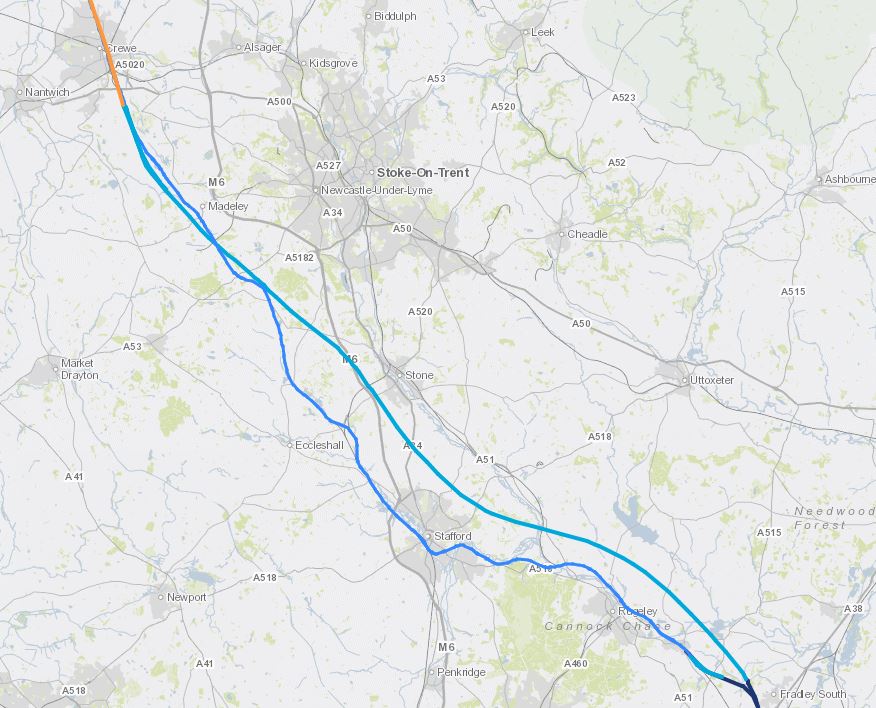
Note.
- High Speed Two Phase 2a is shown in blue.
- High Speed Two Phase 2b is shown in orange.
- Crewe is in the North-West corner of the map, at the Southern end of the orange section.
- The junction at Lichfield is in the South-East corner of the map.
- The lighter blue route to the East, between the Lichfield junction and Crewe is the proposed new tracks of High Speed Two.
- The darker blue route to the West, between the Lichfield junction and Crewe is the existing route of the Trent Valley Line and the West Coast Main Line.
- The Trent Valley Line joins the West Coast Main Line at Stafford.
This second map clipped from the High Speed Two web site, shows the junction North of Lichfield, where High Speed Two connects to the Trent Valley Line through Stafford.

Note.
- High Speed Two runs North-South across the map.
- After the Junction by Fradley South, High Speed Two to Crewe and the North, is the branch to the East.
- The other branch connects to the Trent Valley Line at Handsacre junction.
- Trent Valley Line can be picked out North of Lichfield, where it passes through Lichfield Trent Valley station.
The Trent Valley Line is no Victorian double-track slow-speed bottleneck.
- The route between Rugby and Crewe is generally three or four tracks, with only one short stretch of double track, through Shugborough tunnel.
- The speed limit is generally 110 mph, with 90 mph at Shugborough.
- I wouldn’t be surprised to see Avanti West Coast’s Class 390 and Class 807 trains could be running at up to 140 mph on the route, if digital signalling were to be installed.
- This speed would probably be attained by High Speed Two trains.
London Euston and Stafford would only have under twenty miles of slower line and that could be 140 mph, so High Speed Two times on the route could be very fast.
Trains Between London And Stafford Before And After High Speed Two To Lichfield
Currently, Avanti West Coast trains take around one hour and seventeen minutes between London and Stafford.
The Wikipedia entry for High Speed Two gives these times between London and Stafford.
- Fastest time before High Speed Two – one hour and seventeen minutes.
- Time after Phase 2a of High Speed Two opens – fifty-five minutes.
Note.
- That is a time saving of twenty-two minutes.
- High Speed Two Trains will use the link between the junction at Lichfield and the Trent Valley Line.
- High Speed Two will also add eighteen trains per hour (tph) to the capacity between London and Lichfield.
This would seem to mean that any trains going to or through Stafford will be twenty-two minutes faster, if they use High Speed Two between London and Lichfield.
Trains Between London And Crewe Before And After High Speed Two To Crewe
Currently, Avanti West Coast trains take around one hour and thirty minutes between London and Crewe.
The Wikipedia entry for High Speed Two gives these times between London and Crewe.
- Fastest time before High Speed Two – one hour and thirty minutes.
- Time after Phase 2a of High Speed Two opens – fifty-six minutes.
Note.
- That is a time saving of thirty-four minutes.
- High Speed Two Trains will use the direct line between Lichfield and Crewe.
- High Speed Two will also add eighteen tph to the capacity between London and Crewe.
This would seem to mean that any trains going to or through Crewe will be thirty-four minutes faster, if they use High Speed Two between London and Crewe.
High Speed Two Between Lichfield And Crewe Only Saves An Extra Twelve Minutes
It appears that extending High Speed Two to Crewe only saves an extra twelve minutes.
But it will also have these benefits.
High Speed Two Full-Size trains will be able to run to Crewe.
High Speed Two will also add eighteen tph to the capacity between London and Crewe.
Savings From Scrapping High Speed Two Between Lichfield And Crewe
In addition to the savings of the scrapping of the line, I suspect that any modifications to Crewe station will be much simpler.
I wonder how much will be saved by not building High Speed Two to Crewe.
Could The High Speed Two Link Between Lichfield And Crewe Still Be Built?
This is the question I asked in the title.
We know the benefits of building High Speed Two and as time progresses we’ll know the costs and the disruption the building will cause with an increasing accuracy.
I also believe that even High Speed Two Lite will be a rip-roaring success, and other places will want their own High Speed Two service, which will need an increase in capacity North of Lichfield.
So there will come a point, when there is an overwhelming case to build the High Speed Two Link Between Lichfield and Crewe.
Because of that we must make sure, that any sales of land or properties, doesn’t compromise building the High Speed Two Link Between Lichfield and Crewe.
Conclusion
There will come a point, when the amount of traffic, will mean that it is worth building the High Speed Two Link Between Lichfield and Crewe.
My other conclusion is important and the route of the originally proposed High Speed Two Link Between Lichfield and Crewe, must not be compromised.
High Speed Two To Stoke-on-Trent
Some of you out there might be a bit worried after Rishi Sunak’s speech today, when he announced he’d cancelled High Speed Two, as you might be losing a future high speed service.
Currently, Stoke-on-Trent is served by two trains per hour (tph), that run between London and Manchester Piccadilly.
- One train calls at Milton Keynes Central, Rugby, Macclesfield and Stockport, and takes about 1:33 to Stoke and 2:12 to Manchester Piccadilly.
- The other calls at Nuneaton and Stockport, and takes about 1:30 to Stoke and 2:06 to Manchester Piccadilly.
- Trains are both 9-car and 11-car Class 390 trains or Pendolinos.
- All trains go via Colwich.
This map shows the Colwich, Stafford and Stoke-on-Trent.
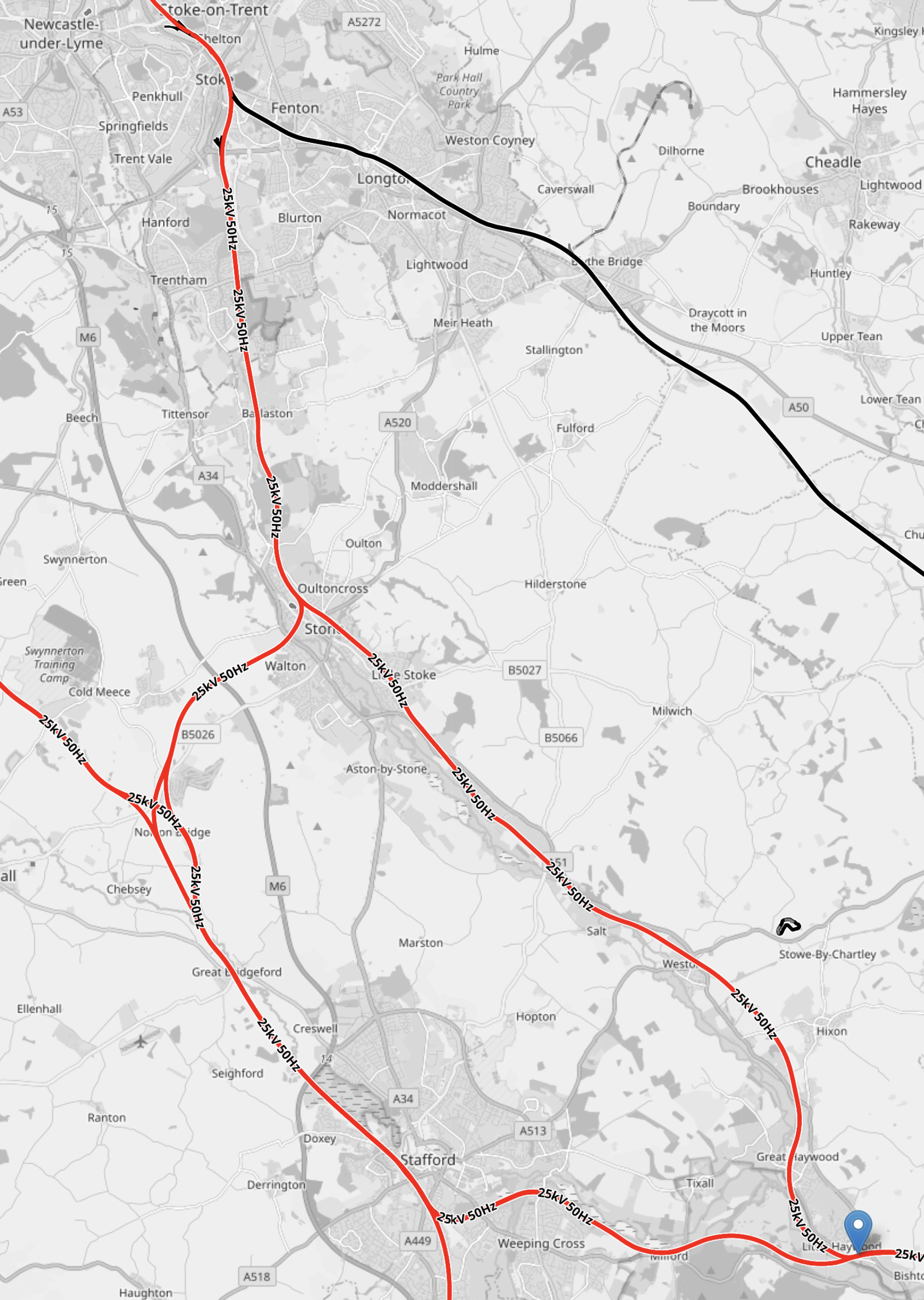
Note.
- Electrified lines are shown in red.
- The line across the South-West corner of the map is the West Coast Main Line.
- Stafford is the Northern end of the Trent Valley Line, which runs East along the bottom of the map.
- The Trent Valley Line, which is a by-pass of the West Coast Main Line, rejoins that line at Rugby.
- Stoke-on-Trent is in the North-West corner of the map.
- Colwich is in the South-East corner of the map and is marked by a blue arrow.
- There are two routes between Stone-on-Trent and Colwich; the more-direct Northern route and a Southern route via Stafford.
The current services between London and Stoke-on-Trent use the more-direct Northern route, although they can take the Southern route via Stafford.
This must mean that as Stoke-on-Trent services take the Northern route, there are more paths through Stafford for West Coast Main Line services to and from Liverpool, Manchester and Scotland.
This graphic shows High Speed Two services after Phase 2b is completed.
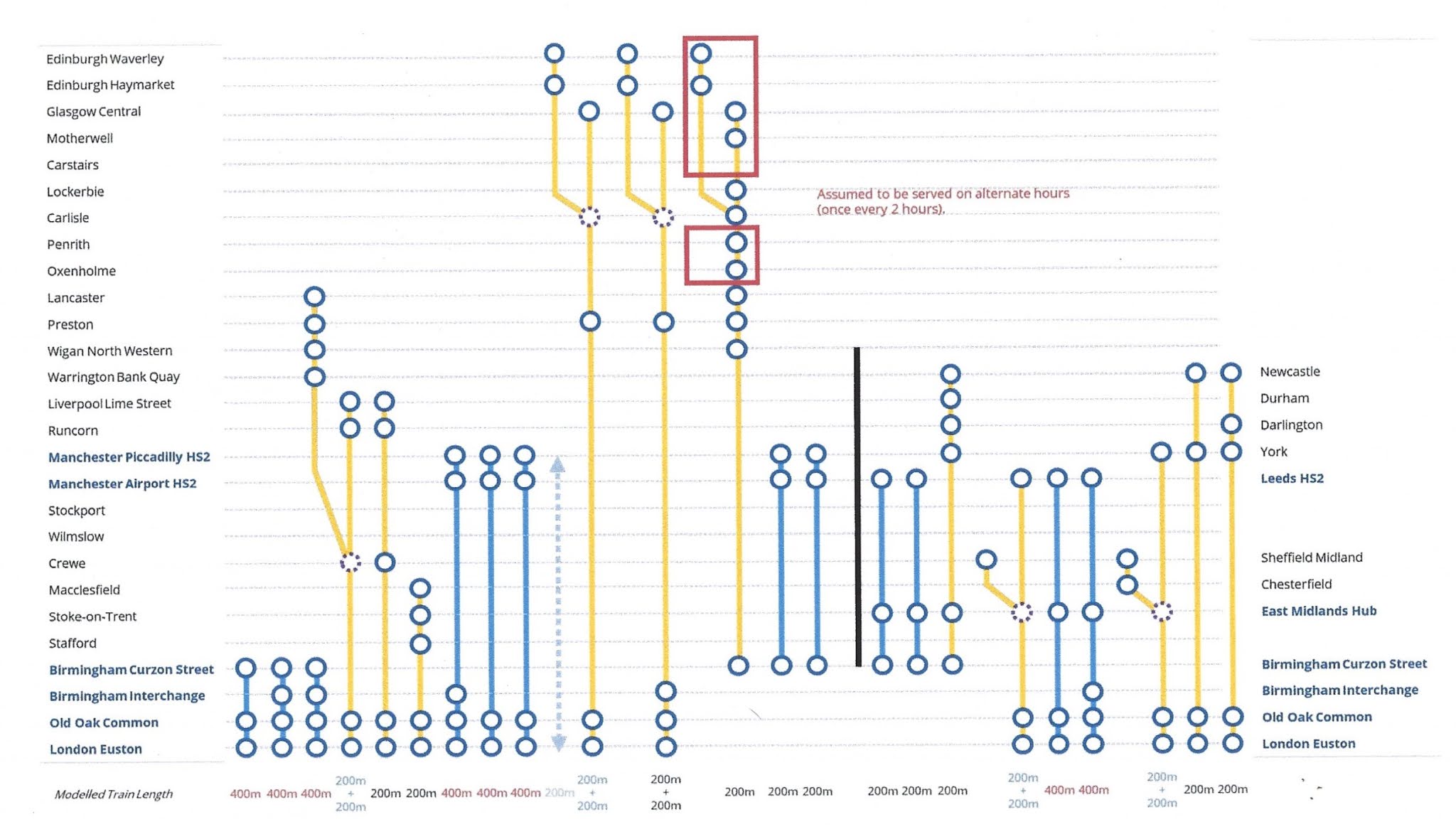
Note.
- Services shown in blue are run by High Speed Two Full Size trains.
- Services shown in yellow are run by High Speed Two Classic-Compatible trains.
- Each of these trains will have a frequency of one tph.
The third High Speed Two Classic-Compatible train from the left is a London and Macclesfield service, which will stop at Stafford and Stoke-on-Trent, has the following timings from London.
- Stafford – 0:55 – 22 minutes faster
- Stoke-on-Trent – 1:10 – 14 minutes faster
- Macclesfield – 1:30 – 11 minutes faster
I have a few thoughts and questions.
How Does This High Speed Two Service Get To And From London?
The service goes through Stafford and then takes the Trent Valley Line to the South.
This map clipped from the HS2 site, shows the original layout of HS2 to the North and East of Lichfield.
Note.
- High Speed Two runs North-South across the map.
- After the Junction by Fradley South, the now-scrapped High Speed Two to Crewe and the North, is the branch to the East.
- The other branch connects to the Trent Valley Line, which can be picked out North of Lichfield, where it passes through Lichfield Trent Valley station.
- The Trent Valley Line goes North-West through Colwich to Stafford, where the line rejoins the West Coast Main Line.
As the Eastern branch North from the junction has been scrapped, all trains between London and North would go via this link between High Speed Two at Lichfield and Trent Valley Line through Stafford.
Can The Current Trains and the High Speed Two Classic-Compatible Trains Share Tracks?
The answer will be yes, as the High Speed Two Classic-Compatible trains have been designed to share tracks with existing trains.
Full digital signalling may be needed to enable 140 mph running and more paths on the classic lines.
Will There Be A Second High Speed Two Service To Stoke-On-Trent And Stafford?
One of the problems with High Speed Two is that it won’t call at stations in the Midlands that are currently served by Avanti West Coast.
- Currently, stations with an Avanti call are Milton Keynes Central, Nuneaton and Rugby.
- Avanti’s second Liverpool service will call at Tamworth and Lichfield Trent Valley.
- In the June 2023 Edition of Modern Railways, Avanti’s Managing Director; Andy Mellors talks about the benefits the company accrues from stopping in the Midlands.
I believe that after High Speed Two opens, that a semi-fast service could run between London and Manchester.
- It would be run by a Class 390 train or Pendolino.
- It would use the route currently used by Manchester services via Stoke-on-Trent.
- At the Southern end, it would terminate in London Euston.
- It could call at Watford Junction, Milton Keynes Central, Rugby, Nuneaton, Lichfield Trent Valley, Stoke-on-Trent, Macclesfield and Stockport.
- ,Station stops would be arranged as to need.
- A one stop service to London takes 90 minutes from Stoke-on-Trent, with a two-stopper taking 93 minutes, so does each stop with a Pendolino add three minutes to the journey time?
Such a service could be developed to give stations like Stoke-on-Trent a second service to London.
The Lines Around Stafford
This map from OpenRailwayMap shows the lines around Stafford.
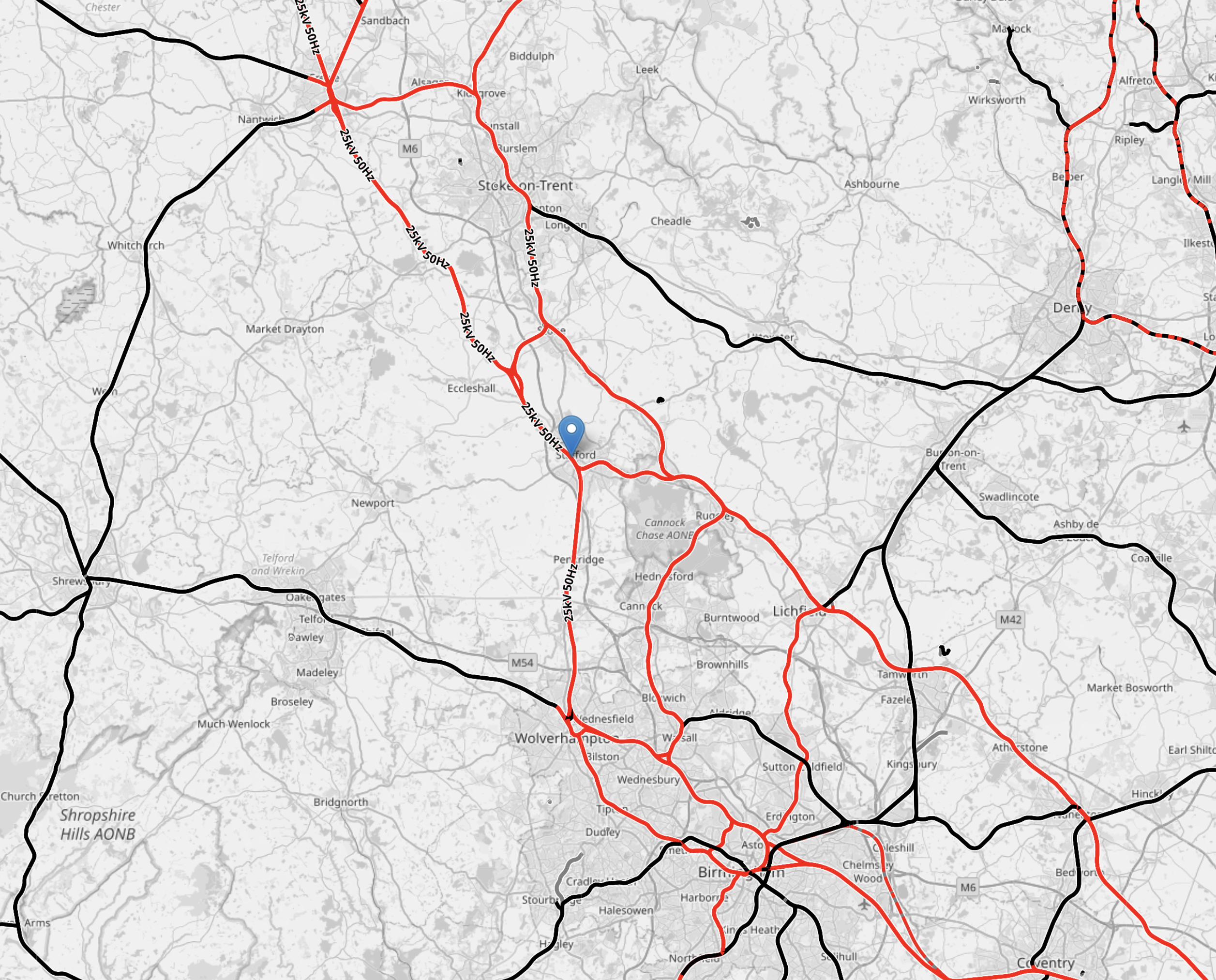
Note.
- Red lines are electrified.
- Black Lines are not.
- Stafford is marked by the blue arrow.
Selective electrification could probably improve connectivity by a large margin.
This Google map shows Stafford station.
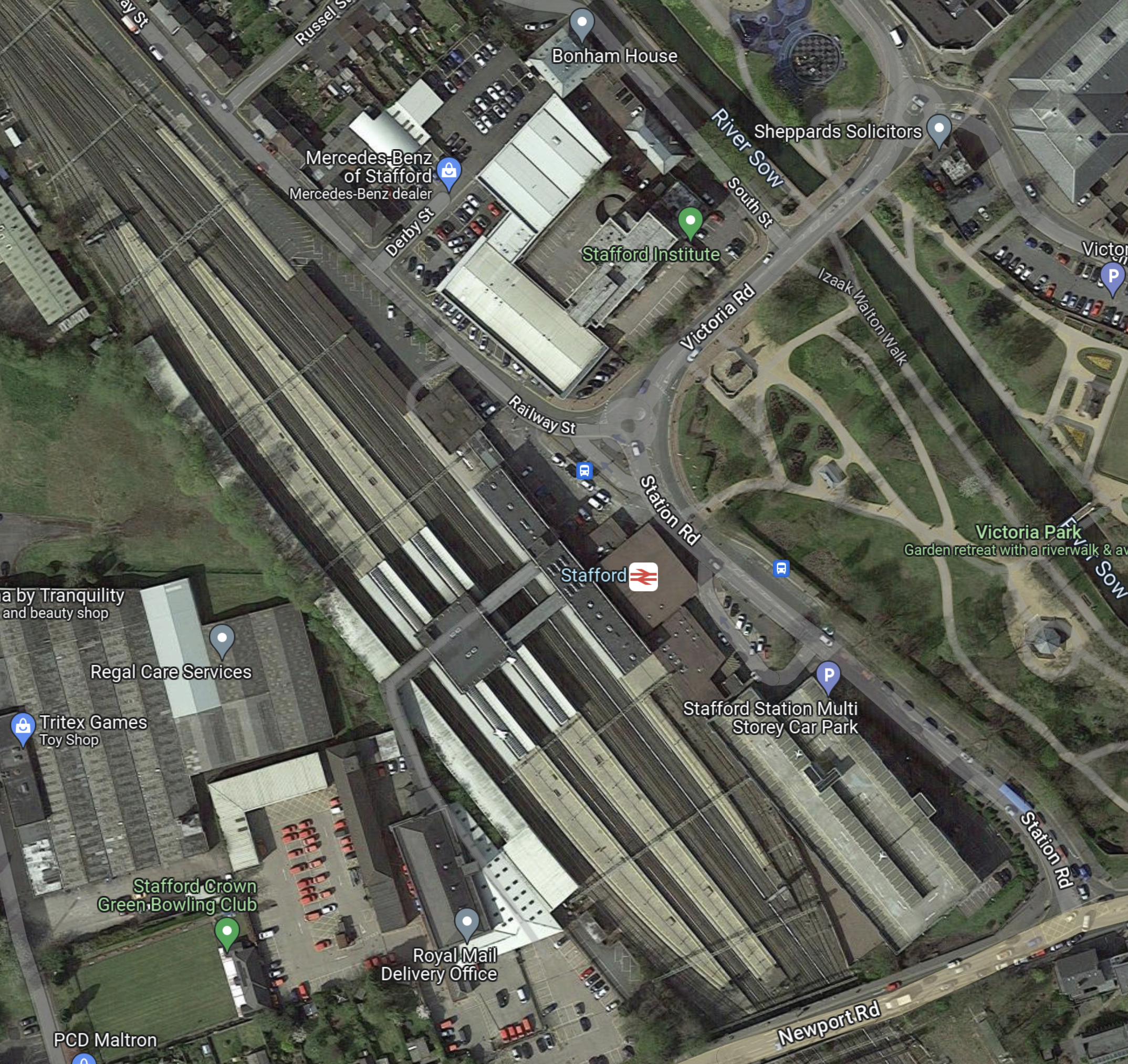
I feel that Stafford station could be developed into a major interchange between High Speed Two and local services.
Conclusion
It looks to me that Stoke-on-Trent will be well-served by High Speed Two.
See Also
Could High Speed Two Finish At Lichfield?
Could High Speed Two Finish At Lichfield?
I wrote this post before Rishi Sunak made his speech.
I went to Manchester and Liverpool yesterday by train.
I took the 10:33 from Euston and this a summary of my journey.
- The train left Euston half a minute early.
- It arrived at Stafford (133.5 miles) at 11:50 and left at 11:52.
- It arrived at Crewe (158.0 miles) at 12:08 and left at 12.10.
- It arrived at Wilmslow (176.9 miles) at 12:25 and left at 12:27.
- It arrived at Stockport (183.0 miles) at 12:35 and left at 12:37.
- It arrived in Manchester Piccadilly (188.9 miles) at 12:46.
- It was two minutes late into Manchester and more or less on time at the other stops.
Note.
- The route was via the Trent Valley Line and the train passed through Nuneaton, Tamworth, Lichfield Trent Valley, Colwich and Stafford.
- Euston and Manchester had been timetabled at two hours and eleven minutes.
- This is an average speed of 86.5 mph.
- The Wikipedia entry for High Speed Two gives the fastest time before High Speed Two opens as one hour and fifty-four minutes.
- This will be an average speed of 99.4 mph.
Coming home, I took the 18:48 from Liverpool Lime Street and this a summary of my journey.
- The train left Liverpool on time.
- It arrived at Runcorn (13.2 miles) at 18:58 and left at 19:02.
- It arrived at Crewe (35.8 miles) at 19:26 and left at 19:28.
- It arrived at Milton Keynes (143.8 miles) at 20:27 and left at 20:29.
- It arrived in Euston (183.6 miles) at 21:00.
- It was five minutes late into Crewe and two minutes early at Euston.
Note.
- The route was via the Trent Valley Line and the train passed through Stafford, Colwich, Lichfield Trent Valley, Tamworth and Nuneaton.
- Liverpool and Euston had been timetabled at two hours and twenty minutes.
- This is an average speed of 78.7 mph.
- The Wikipedia entry for High Speed Two gives the fastest time before High Speed Two opens as two hours and three minutes.
- This will be an average speed of 89.6 mph.
This map clipped from the High Speed Two web site, shows the junction North of Lichfield, where High Speed Two connects to the Trent Valley Line through Stafford.
Note.
- High Speed Two runs North-South across the map.
- After the Junction by Fradley South, High Speed Two to Crewe and the North, is the branch to the East.
- The other branch connects to the Trent Valley Line at Handsacre junction.
- Trent Valley Line can be picked out North of Lichfield, where it passes through Lichfield Trent Valley station.
The Trent Valley Line is no Victorian double-track slow-speed bottleneck.
- The route between Rugby and Crewe is generally three or four tracks, with only one short stretch of double track, through Shugborough tunnel.
- The speed limit is generally 110 mph, with 90 mph at Shugborough.
- I wouldn’t be surprised to see Avanti West Coast’s Class 390 and Class 807 trains could be running at up to 140 mph on the route, if digital signalling were to be installed.
- This speed would probably be attained by High Speed Two trains.
London Euston and Stafford would only have under twenty miles of slower line and that could be 140 mph, so High Speed Two times on the route could be very fast.
This second map clipped from the High Speed Two web site, shows between High Speed Two’s two Birmingham stations and Lichfield.
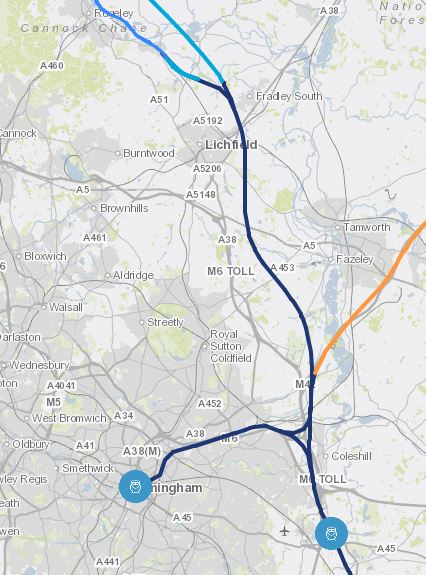
Note.
- High Speed Two Phases 1 and 2a are shown in blue.
- High Speed Two Phase 2b is shown in orange.
- At the top of the map, can be seen the junction, where High Speed Two to the North splits, that was shown in the previous map.
- The large blue dot in the West at the bottom of the map, is Birmingham Curzon Street station.
- The other large blue dot is Birmingham International station.
- The three sections of High Speed Two to London, Birmingham Curzon Street and the North meet at a triangular junction between the two Birmingham stations.
- High Speed Two to the East Midlands, branches off to the East North of the triangular junction.
This third map clipped from the High Speed Two web site, shows between Lichfield and Crewe.
Note.
- High Speed Two Phase 2a is shown in blue.
- High Speed Two Phase 2b is shown in orange.
- Crewe is in the North-West corner of the map, where at the South end of the orange section.
- The junction at Lichfield is in the South-East corner of the map.
- The lighter blue route to the East, between the Lichfield junction and Crewe is the new tracks of High Speed Two.
- The darker blue route to the West, between the Lichfield junction and Crewe is the existing route of the Trent Valley Line and the West Coast Main Line.
- The Trent Valley Line joins the West Coast Main Line at Stafford.
These are a few thoughts and questions.
How Will Trains Go Between Birmingham Curzon Street And London?
Trains will use the triangular junction shown in the second map to go between the two Birmingham stations and then head South,
How Will Trains Go Between Birmingham Curzon Street And The North?
Trains will use the triangular junction shown in the second map to turn North and then take one of the two routes to the North; High Speed Two or Trent Valley Line/West Coast Main Line.
How Will Trains Go Between Birmingham Curzon Street And The North If High Speed Two Between Birmingham And The North Is Scrapped?
If High Speed Two is scrapped from the Northern point of the triangular junction to the North, there will be no way that trains could go North from Birmingham Curzon Street.
- The overcrowded Birmingham New Street station will still be the link to the North of England and Scotland for Birmingham.
- How would trains connect to the future branch to East Midlands Parkway, which connects just North of the triangular junction?
I suspect that a short stub will be built North of the triangular junction to connect to the Trent Valley Line, which is currently, the main route of trains between London and the North through the West Midlands, for trains that don’t go through Birmingham.
Trains Between London And Stafford
Currently, Avanti West Coast trains take around one hour and seventeen minutes between London and Stafford.
The Wikipedia entry for High Speed Two gives these times between London and Stafford.
- Fastest time before High Speed Two – one hour and seventeen minutes.
- Time after Phase 2a of High Speed Two opens – fifty-five minutes.
Note.
That is a time saving of twenty-two minutes.
High Speed Two Trains will use the link between the junction at Lichfield and the Trent Valley Line.
How Many Avanti West Coast Services Use The Trent Valley Line?
These trains use the Trent Valley Line.
- London and Holyhead – 8 tpd
- London and Liverpool Lime Street – 1 tph, which is planned to increase to 2 tph
- London and Manchester Piccadilly – 2 tph
- London and Blackpool North – 1 tpd
- London and Glasgow – 1 tph
Note.
- tpd is trains per day
- tph is trains per hour
This is roughly six tph.
Would It Be Possible To Finish High Speed Two At The Lichfield Junction And Connect It To The Trent Valley Line?
This is a repeat of the first map.
Note.
- High Speed Two runs North-South across the map.
- After the Junction by Fradley South, High Speed Two to Crewe and the North, is the branch to the East.
- The other branch connects to the Trent Valley Line at Handsacre junction.
- Trent Valley Line can be picked out North of Lichfield, where it passes through Lichfield Trent Valley station.
If the Eastern branch North from the junction were to be scrapped, all trains between London and North would go via Stafford.
As all these tracks are planned and must be at an advanced stage, that is ready for construction, I feel the route would be feasible.
It would have these benefits.
- Birmingham Curzon Street services and the North-West of England and the West of Scotland would be possible.
- Services between London and Stafford will be twenty-two minutes faster, than they are now.
- Time savings will also apply to services from London to Liverpool, Macclesfield, Manchester, Stoke-on-Trent and all stations between Crewe and Glasgow.
The capacity of the Trent Valley Line would be the limiting factor.
Time Savings Between Crewe And Preston
According to the Wikipedia entry for High Speed Two, after Phase 2a of High Speed Two opens, these will be the fastest times to Crewe and Preston.
- Crewe – 0:56
- Preston 1:18
Note.
- The fastest Preston service runs non-stop between Euston and Preston.
- Crewe and Preston are 51 miles apart.
A time of 22 minutes between Crewe and Preston, means the average speed is 139 mph.
Does this mean that High Speed Two will improve between Crewe and Preston to allow 140 mph non-stop running?
But 22 minutes is certainly an improvement on the current time between Crewe and Preston for Scottish trains of 40 minutes.
Time Savings Between Crewe And Liverpool
The upgrading of the line between might save another couple of minutes between Crewe and Weaver junction.
What Times Would Be Possible Via High Speed Two And The Trent Valley Line?
These times are based on the following.
- The twenty-two minute saving to Stafford, as all High Speed Two services to the North-West of England and the West of Scotland will go via Phase 1 of High Speed Two and Stafford.
- A saving of eighteen minutes will be applied to Scottish services because of savings between Crewe and Preston.
This would give these times in hours:minutes.
- Blackpool – 2:10
- Carlisle – 2:35
- Chester – 1:28
- Crewe – 1:08
- Glasgow – 3:50
- Holyhead – 3:10
- Lancaster – 2:03
- Liverpool Lime Street – 1:41
- Llandudno Junction – 2:24
- Macclesfield – 1:30
- Manchester Piccadilly via Crewe – 1:52
- Oxenholme – 1:54
- Preston – 1:46
- Runcorn 1:31
- Stafford – 0:55
- Stockport – 1:35
- Stoke-on-Trent – 1:10
- Warrington – 1:22
- Wigan 1:33
- Wilmslow – 1:25
I have calculated extra services to Blackpool and North Wales.
Adding The Lichfield And Crewe Section
Consider.
- My calculations indicate that London and Crewe will take 1:08.
- The Wikipedia entry for High Speed Two, after Phase 2a of High Speed Two opens, gives the fastest time to Crewe as 0:56.
This indicates that adding the section of High Speed Two between Lichfield and Crewe will save a further twelve minutes.
Conclusion
I strongly believe that an upgraded Trent Valley Line linked to a shortened High Speed Two at Lichfield could improve journey times between London, Birmingham and the North.
There are certainly savings to be made.
See Also
High Speed Two To Crewe
There has been a lot of speculation about the Northern end of High Speed Two, so I might as well add sort out a few facts and add a bit of speculation of my own.
Sample Times Between London And Crewe
These are selected times from the 27th September 2023.
- 07:30 – Glasgow Non-Stop – 1:29
- 07:33 – Manchester Piccadilly – 1:37 – Stops at Stafford
- 07:43 – Liverpool Lime Street – 1:40 – Stops at Milton Keynes
- 08:30 – Glasgow Non-Stop – 1:29
- 08:33 – Manchester Piccadilly – 1:37 – Stops at Stafford
- 08:43 – Liverpool Lime Street – 1:40 – Stops at Milton Keynes
- 09:02 – Holyhead – 1:40 – Stop at Stafford
- 15:02 – Chester – 1:40 – Stops at Tamworth, Lichfield Trent Valley and Stafford
Note.
- The 07:30 and 08:30 Glasgow services appears to be pathed for one of the Class 390 Pendolino electric trains and were run by Pendolinos.
- The 07:33 and 08:33 Manchester services appears to be pathed for one of the Pendolino electric trains and were run by Pendolinos.
- The 07:43 and 08:43 Liverpool services appears to be pathed for one of the new Class 807 electric trains, but were run by Pendolinos.
- The 15:02 Chester service appears to be pathed for one of the new Class 805 bi-mode trains.
- All services except the Glasgow services stop at Crewe.
- As London Euston and Crewe is 158 miles, the non-stop Glasgow services average 107 mph, the one-stop Manchester service averages 98 mph and the one-stop Liverpool service averages 95 mph.
I have some further thoughts.
How Long Does A Stop Take?
I’ve looked at some stops of Glasgow, Liverpool and Manchester services
Crewe
Looking at timings between Weaver Junction and Norton Bridge, I have found the following times.
- Glasgow-Euston – 23 minutes
- Liverpool-Euston – 28 minutes
Note.
- Manchester services don’t go through Weaver Junction.
- Weaver Junction and Norton Bridge are respectively North and South of Crewe.
- The Liverpool service stops at Crewe, where it has a dwell time of two minutes.
- The Glasgow service goes straight through Crewe.
The Crewe stop takes a total of 5 minutes of which 3 minutes are deceleration and acceleration to and from linespeed.
Stafford
Looking at timings between Norton Bridge and Colwich, I have found the following times.
- Glasgow-Euston – 7½ minutes
- Liverpool-Euston – 7½ minutes
- Manchester -Euston – 14 minutes
Note.
- Norton Bridge and Colwich are respectively North and South of Stafford.
- The Manchester service stops at Stafford, where it has a dwell time of two minutes.
- The Glasgow and Liverpool services go straight through Stafford.
The Stafford stop takes a total of 6½ minutes of which 4½ minutes are deceleration and acceleration to and from linespeed.
Milton Keynes
Looking at timings between Weedon and Bletchley, I have found the following times.
- Glasgow-Euston – 11½ minutes
- Liverpool-Euston – 16 minutes
- Manchester -Euston – 12½ minutes
Note.
- Weedon and Bletchley are respectively North and South of Milton Keynes.
- The Liverpool service stops at Milton Keynes, where it has a dwell time of one minute.
- The Glasgow and Manchester services go straight through Milton Keynes.
The Milton Keynes stop takes a total of 4 minutes of which 3 minutes are deceleration and acceleration to and from linespeed.
Average Speeds Between Crewe And London
London Ruston and Crewe is 158 miles according to Real Time Trains.
So what would times would various average speeds deliver?
- 100 mph – 95 minutes
- 110 mph – 86 minutes
- 120 mph – 79 minutes
- 125 mph – 76 minutes
- 130 mph – 73 minutes
- 140 mph – 68 minutes
Obviously, any average speed with over 125 mph running, will need full digital signalling.
Liverpool And London In Two Hours
Tucked away beside the Grand Union Sets Out Stirling Ambitions article in the December 2022 Edition of Modern Railways is a report on Avanti West Coast’s application for a second service between Euston and Liverpool.
This is said.
Avanti West Coast has applied for access rights for its second hourly Euston to Liverpool service, starting from December 2023, although a phased introduction of the new service is likely. This would make use of Avanti’s new fleet of 10×7-car Class 807 Hitachi EMUs, which are expected to enter service from Autumn 2023. The ‘807s’ would be deployed on the current hourly Liverpool service, on which a call at Liverpool South Parkway would be added. (provision is made for this in the December 2022 timetable.).
Pendolinos would then operate the second service each hour, calling at Lichfield Trent Valley and Tamworth.
A linespeed project is in progress to raise the permissible speed for non-tilting trains on the West Coast Main Line, and Avanti’s new Hitachi trains will take advantage of this.
I’ll take a quick look at the Crewe and Runcorn section.
- It is 22.5 miles.
- It takes 19 minutes.
- That is an average speed of 71 mph.
- Crewe and Weaver Junction has a speed limit of at least 110 mph
- Runcorn and Weaver Junction has a speed limit of at least 90 mph for most of the way.
- If with their superior performance, the new Class 807 trains could average 90 mph between Crewe and Runcorn, they would take 15 minutes.
- Achieving the 90 mph average may need a bit of track realignment and some signaling changes.
The four minutes saved would be enough to handle the extra stop at Liverpool South Parkway.
Consider.
- Currently, Pendolino trains do Liverpool and Crewe in 38 minutes, which includes the stop at Runcorn.
- My calculation with the Class 807 trains, shows that with a bit of extra signalling, the new trains could do Liverpool and Crewe in 38 minutes with the two stops.
- The stop at Crewe will subtract 5 minutes from the base journey time.
- The stop at Milton Keynes will subtract 4 minutes from the base journey time.
This means the base journey time between Crewe and London will be 73 minutes.
This would indicate that the trains would be running at 130 mph to achieve the two hours.
But there are five accelerations and five decelerations on a journey between London and Liverpool and the new Class 807 trains are the Lotuses of Hitachi’s family of AT-300 trains; lightweight and powerful.
Suppose they could save thirty seconds for each acceleration and deceleration.
The base journey time between Crewe and London will be 78 minutes.
This would indicate that the trains would be running at over 120 mph to achieve the two hours.
I certainly feel, that Liverpool and London in two hours is certainly possible using the new Class 807 trains.
London and Crewe with two stops would be times at one hour and twelve minutes.
But what about the Pendolinos?
- My last return trip from Liverpool did a practice call at Liverpool South Parkway and still arrived in London a few minutes early.
- The Pendolinos will still benefit from any improvements, between Crewe and Runcorn, which could reduce the Liverpool and Crewe time from 38 minutes to 34 minutes.
- The stop at Crewe will subtract 5 minutes from the base journey time.
- The stops at Lichfield Trent Valley and Tamworth will both subtract 4 minutes from the base journey time.
This means the base journey time between Crewe and London will be 73 minutes, which is the same as for the Class 807 trains.
This would indicate that the trains would be running at 130 mph to achieve the two hours.
Could this average speed be achieved by the selective application of full digital signalling, perhaps on the Trent Valley Line?
But it does appear to me, that the Pendolinos can get very close to two hours between London and Liverpool.
London and Crewe with three stops would be times at one hour and sixteen minutes.
Crewe And London Non-Stop
Consider.
- Pendolinos between London and Glasgow, go non-stop between London and Crewe.
- I have calculated that Pendolinos between London and Liverpool, will take one hour and sixteen minutes with three stops between London and Crewe.
- The three stops take a total of thirteen minutes.
I wouldn’t be surprised to see London and Glasgow Pendolinos take one hour and three minutes between London and Crewe.
This would knock twenty-six minutes off journey times between London and Glasgow.
Conclusion
I believe that with relatively minor improvements on the West Coast Main Line and the Liverpool branch, the following can be achieved.
- Liverpool and London can be around two hours with new Class 807 trains or Pendolinos.
- Liverpool and London services can increase their calls in the Midlands.
- London and Glasgow services can be nearly half-an-hour faster.
- The fastest London and Crewe services could be just over an hour using Pendolinos.
I also believe that the only serious infrastructure needed is some track realignment and some updated signalling.
See Also
Could High Speed Two Finish At Lichfield?
High Speed Two To Manchester
There has been a lot of speculation about the Northern end of High Speed Two, so I might as well add sort out a few facts and add a bit of speculation of my own.
The Current Manchester Piccadilly Services
Currently, there are three trains per hour (tph) between London Euston and Manchester Piccadilly.
The services stop as follows.
- Milton Keynes Central, Rugby, Stoke-on-Trent, Macclesfield and Stockport
- Nuneaton, Stoke-on-Trent and Stockport
- Stafford, Crewe, Wilmslow and Stockport
Note.
- One service goes via Crewe.
- Two services go via Stoke-on-Trent.
- All services go via Stockport.
- A London and Manchester Piccadilly train could go via Milton Keynes Central, Nuneaton, Rugby, Stafford, Stoke-on-Trent, Macclesfield and Stockport.
- A London and Manchester Piccadilly train could go via Crewe, Wilmslow and Stockport.
The two trains detailed would mean that Manchester wouldn’t lose any connectivity.
I would expect that Manchester Piccadilly needs at least three tph to and from London.
This graphic shows High Speed Two services after Phase 2b is completed.
Note.
- Services shown in blue are run by High Speed Two Full Size trains.
- Services shown in yellow are run by High Speed Two Classic-Compatible trains.
- Full Size Services will only run to Manchester Airport and Manchester Piccadilly after Phase 2b is completed to Manchester Piccadilly.
- Classic-Compatible Services will be able to run to to Manchester Piccadilly after Phase 2a is completed.
- Two London and Manchester Piccadilly trains will call at just Old Oak Common and Manchester Airport.
- A third London and Manchester Piccadilly train will call at Old Oak Common, Birmingham International and Manchester Airport.
- Two Birmingham Curzon Street and Manchester Piccadilly trains will call at just Manchester Airport.
- Despite Wilmslow and Stockport being shown in the list of stations on the left hand side of the graphic, no High Speed Two services appear to call at the two stations.
The graphic of High Speed Two services also shows these Full-Size services to Manchester Piccadilly.
- Three tph to London Euston
- Two tph to Birmingham Curzon Street
Some or all of these services will surely be run by High Speed Two Classic-Compatible trains.
What services will run to Manchester between the opening of Phase 2a and the opening of Phase 2b?
I will now give some possibilities for services.
London and Manchester Piccadilly Via Crewe, Wilmslow And Stockport
I shall look at the 07:33 train to Manchester Piccadilly on the 20th September 2023.
- It was a service via Stafford, Crewe, Wilmslow and Stockport
- It was a nine-car Class 390 train or Pendolino, which left on time.
- Euston and Manchester Piccadilly are 188.9 miles apart.
- The train called at Crewe at 09:08 and left at 09:10.
- The average speed between London Euston and Crewe is 70.7 mph.
- The train arrived in Manchester Piccadilly on time at 09:44.
- The journey took two hours and 11 minutes
- The average speed was 86.5 mph.
- The Crewe and Manchester Piccadilly section is 30.9 miles and the train is scheduled to take 34 minutes.
- The average speed between Crewe and Manchester Piccadilly is 54.5 mph.
- The example train slows past Crewe because of two stops at Wilmslow and Stockport.
When Phase 2a of High Speed Two opens a replacement for this service via Crewe, could operate as follows.
- It could use High Speed Two between and Crewe.
- It could use the current route between Crewe and Manchester Piccadilly.
- It would probably use a 200 metre long High Speed Two Classic-Compatible trains.
- I wouldn’t be surprised, that the current Pendolino service between Euston and Manchester Piccadilly via Crewe, Wilmslow and Stockport was retired.
- The new High Speed Two service could take over the path currently used by the current Pendolino service, between Crewe and Manchester Piccadilly.
- The train could stop at Crewe, Wilmslow and Stockport as required.
- If it stopped at Crewe, Wilmslow and Stockport, it would restore some of the connectivity to smaller places.
According to the Wikipedia entry for High Speed Two, these will be the timings.
- London Euston and Crewe – 56 minutes
- London Euston and Manchester Piccadilly Phase 2a – One hour and 30 minutes
- London Euston and Manchester Piccadilly Phase 2b – One hour and 11 minutes
From these figures and the times of the 07:33, I can deduce these journey times for trains via Crewe, Wilmslow and Stockport.
- Currently, Crewe and Manchester Piccadilly takes 34 minutes.
- High Speed Two after Phase 2a will also take 34 minutes.
I am surprised that sectional timings on this section of the West Coast Main Line are the same as current timings. Digital signalling and the faster acceleration and deceleration of the new trains, are quite likely to decrease times.
Because they are both 34 minutes, does that mean that services will stop at Crewe, Wilmslow and Stockport?
London and Macclesfield Via Stafford And Stoke-on-Trent
This map of High Speed Two in North West England was captured from the interactive map on the High Speed Two web site.

Note.
- The map dates from around October 2020.
- The current West Coast Main Line (WCML) and Phase 2a of High Speed Two are shown in blue.
- Phase 2b of High Speed Two is shown in orange.
- The main North-South route, which is shown in blue, is the WCML passing through Crewe, Warrington Bank Quay and Wigan North Western as it goes North.
- The Western Branch, which is shown in blue, is the Liverpool Branch of the WCML, which serves Runcorn and Liverpool.
- High Speed Two, which is shown in orange, takes a faster route between Crewe and Wigan North Western.
- The Eastern Branch, which is shown in orange, is the Manchester Branch of High Speed Two, which serves Manchester Airport and Manchester Piccadilly.
- The route in the East, which is shown in blue, is the Macclesfield Branch of High Speed Two, which serves Stafford, Stoke-on-Trent and Macclesfield.
The route of Northern Powerhouse Rail between Manchester Airport and Liverpool has still to be finalised.
The London and Macclesfield service is as follows.
- There will be one tph
- There are intermediate stops at Stafford and Stoke-on-Trent.
- Macclesfield has a long electrified bay platform, which looks like it will take a 200 m High Speed Two Classic-Compatible train.
- Macclesfield Station And High Speed Two has pictures of the station.
- Four tph operate between Stoke-on-Trent and Manchester Piccadilly via Macclesfield.
- Timings from London would be 55 minutes to Stafford, 70 minutes to Stoke-on-Trent and 90 minutes to Macclesfield.
In some ways, I was surprised about this High Speed Two service.
But it does give an easy connection to Stafford and Stoke-on-Trent.
London and Manchester Piccadilly via Macclesfield, Stafford And Stoke-on-Trent
Currently, Avanti West Coast run a service between London and Manchester which runs as follows.
- It calls at Milton Keynes Central, Rugby, Stoke-on-Trent, Macclesfield and Stockport
- It also passes through Watford Junction, Nuneaton, Tamworth and Lichfield Trent Valley.
- It could pass through Stafford.
- It would mean that Stafford and Stoke-on-Trent were served by 2 tph.
- It is run by a Pendolino.
- It has a frequency of 1 tph.
- The current service takes two hours and 6 minutes.
- A few minutes would be added for each extra stop.
I believe it could be a very useful service.
I wonder if it could be run as a complimentary service to High Speed Two to serve more places on the route.
A Second High Speed Two Service Between London and Manchester Piccadilly Via Crewe, Wilmslow And Stockport
So far, I have mapped out three possible services.
- High Speed Two – London and Manchester Piccadilly Via Crewe, Wilmslow And Stockport – One hour and thirty minutes
- High Speed Two – London and Macclesfield Via Stafford and Stoke – One hour and thirty minutes
- Pendolino – London and Manchester Piccadilly Via Milton Keynes Central, Rugby, Nuneaton, Tamworth, Lichfield Trent Valley, Stafford, Stoke-on-Trent, Macclesfield and Stockport – Two hours and 6 minutes plus 4 minutes for each extra stop.
I suspect that four tph could be a good frequency.
The simplest extra service would probably be another High Speed Two London and Manchester Piccadilly Via Crewe, Wilmslow And Stockport.
But it could be another Pendolino service to serve more places.
I believe a service pattern could be arranged with these features.
- Major cities and towns between London and Manchester have at least two tph.
- A larger number of towns and cities have at least one tph.
Note that many stations on the route already have Pendolino services.
Phase 2b Would Be The Ultimate Solution
Phase 2b which will involve a tunnel via Manchester Airport to new platforms in Manchester Piccadilly could be the ultimate solution.
Phase 2b is also needed so that full-size High Speed Two trains can be run to Manchester Piccadilly.
But it will be difficult, expensive and disruptive to build.
Conclusion
I believe it could be easy to plan four services between London and Manchester Piccadilly or Macclesfield.
- High Speed Two Full-Size train – London and Manchester Piccadilly Via Crewe, Wilmslow And Stockport – One hour and eleven minutes
- High Speed Two Classic-Compatible train – London and Macclesfield Via Stafford and Stoke – One hour and thirty minutes
- High Speed Two Full-Size train – London and Manchester Piccadilly Via Crewe, Wilmslow And Stockport – One hour and eleven minutes
- Pendolino – London and Manchester Piccadilly Via Milton Keynes Central, Rugby, Nuneaton, Tamworth, Lichfield Trent Valley, Stafford, Stoke-on-Trent, Macclesfield and Stockport – Two hours and 6 minutes plus 4 minutes for each extra stop.
Note.
Services 1 and 3 are identical, but don’t need to be.
Service 4 could be run by a High Speed Two Classic-Compatible train.
See Also
Could High Speed Two Finish At Lichfield?
High Speed Two To Wigan
There has been a lot of speculation about the Northern end of High Speed Two, so I might as well add sort out a few facts and add a bit of speculation of my own.
The Current Wigan North Western Service
I shall look at the 08:30 train to Glasgow on the 20th September 2023.
- It was an eleven-car Class 390 train or Pendolino, which left on time.
- Euston and Wigan North Western are 193.8 miles apart.
- Trains call at only Warrington Bank Quay
- The train passed Crewe at 09:59
- The train called at Warrington Bank Quay at 10:14 and left at 10:15.
- The train arrived at Wigan North Western at 10:25 on time.
- The journey took one hour and 55 minutes
- The average speed was 101.1 mph.
- The Crewe and Wigan North Western section is 35.8 miles and the train is scheduled to take 26 minutes.
- The average speed between Crewe and Wigan North Western is 82.6 mph.
The train slows past Crewe because of the stop at Warrington Bank Quay.
London Euston And Wigan North Western After Phase 2a Of High Speed Two Opens
According to the Wikipedia entry for High Speed Two, these are the timings.
- London Euston and Crewe – 56 minutes
- London Euston and Warrington Bank Quay – One hour and 20 minutes
- London Euston and Wigan North Western – One hour and 34 minutes
From these figures and the times of the 08:30, I can deduce these journey times.
- Currently, Crewe and Warrington Bank Quay takes 16 minutes and High Speed Two will take 24 minutes
- Currently, Warrington Bank Quay and Wigan North Western takes 10 minutes and High Speed Two will take 14 minutes
- Currently, Crewe and Wigan North Western takes 26 minutes and High Speed Two will take 38 minutes
I am surprised that sectional timings on this short section of the West Coast Main Line are slower than current timings. Digital signalling and the faster acceleration and deceleration of the new trains, are more likely to decrease times, than increase them.
London Euston And Preston After Phase 2a Of High Speed Two Opens
According to the Wikipedia entry for High Speed Two, these are the timings.
- London Euston and Crewe – 56 minutes
- London Euston and Warrington Bank Quay – One hour and 20 minutes
- London Euston and Wigan North Western – One hour and 34 minutes
- London Euston and Preston – One hour and 18 minutes
This graphic shows High Speed Two services.
Note that Preston gets two non-stop services to and from London and another with stops at Warrington Bank Quay and Wigan North Western, and a train split/join at Crewe.
The one hour and 18 minutes surely applies to one or both of the non-stop services.
140 Mph Running Between Crewe And Preston
Consider.
- London Euston and Crewe is 56 minutes
- One hour and 18 minutes to Preston infers a time of 22 minutes between Crewe and Preston.
- Crewe and Preston is 51 miles.
This implies an average speed of 139 mph.
As the West Coast Main Line was built for 140 mph, when digital signalling was installed, this would appear to be feasible, once the signalling is upgraded.
It may also mean, that faster times are possible in services to Warrington Bank Quay and Wigan North Western.
Consider.
- Crewe and Wigan North Western is 35.8 miles
- High Speed Two will take 38 minutes
- The average speed between Crewe and Wigan North Western will be just 56.5 mph.
But if it could run at 140 mph mph between Crewe and Wigan North Western, the base time would be just over 15 minutes.
To this time must be added two full station stops and the time it takes to split or join.
With the superior acceleration and deceleration of the High Speed Two trains and their level of automation, these operations will not take 23 minutes.
I believe that this means that minutes can be saved on services to Lancaster, Liverpool Lime Street, Warrington Bank Quay and Wigan North Western.
London Euston And Wigan North Western After Phase 2b Of High Speed Two Opens
There will be no changes as the full-size High Speed Two trains are not planned to run to the North of Crewe.
See Also
High Speed Two To Liverpool
There has been a lot of speculation about the Northern end of High Speed Two, so I might as well add sort out a few facts and add a bit of speculation of my own.
The Current Liverpool Service
I shall look at the 08:43 train on the 18th September 2023.
- It was a nine-car Class 390 train or Pendolino, which left on time.
- Euston and Liverpool Lime Street are 193.7 miles apart.
- The train called at Milton Keynes Central, Crewe and Runcorn
- The train arrived at Crewe at 10:24 and left at 10:26.
- The train arrived at Runcorn at 10:43 and left at 10:44.
- The train arrived at Liverpool Lime Street at 11:04 on time.
- The journey took two hours and 21 minutes
- The average speed was 82.4 mph.
- The Crewe and Liverpool Lime Street section is 39.7 miles and the train is scheduled to take forty minutes.
- The average speed between Crewe and Liverpool Lime Street is almost exactly 60 mph.
- The slower average speed is because the train is slowing for a gradual stop in Liverpool and the only fast section is the 110 mph section between Crewe and Weaver Junction, where the Liverpool Branch leaves the West Coast Main Line.
- There is one train per hour (tph).
There are probably only limited ways that time can be saved between Crewe and Liverpool Lime Street.
- The West Coast Main Line between Crewe and Weaver Junction takes twelve minutes and has an operating speed of 110 mph, so saving a few minutes might be possible, by upgrading the speed on this line with digital signalling to allow 140 mph running.
- It might be possible to save a couple of minutes at the Runcorn stop by using the superior performance of the new Class 807 or High Speed Two trains.
- The slowing down into and accelerating out of Liverpool might be improved by digital signalling and trains with better performance.
It should be noted that Liverpool Lime Street station was recently remodelled to improve operation of the station and the tracks connecting it to Runcorn.
I would be fairly sure that Network Rail and Avanti West Coast have got Crewe and Liverpool Lime Street times to a minimum. As this route will become part of High Speed Two, I suspect that Network Rail/Avanti have done extensive computer simulations of the route, to make sure they get it as quick and efficient as possible.
The New Class 807 Trains
The Class 807 trains, which enter service this year or early next, are the Lotuses in Hitachi’s AT 300 family of high speed trains.
- They are electric only and have no heavy diesel engines or traction batteries.
- They don’t even have emergency batteries for when the catenary fails.
- They have a redesigned nose. Is it more aerodynamic?
- As with all the other Hitachi high speed trains, they are capable of 125 mph, or 140 mph if the signalling permits.
These trains will undoubtedly have faster acceleration and deceleration and could probably knock minutes off the timings at all the stops.
A Second Hourly Train To Liverpool
Tucked away beside the Grand Union Sets Out Stirling Ambitions article in the December 2022 Edition of Modern Railways is a report on Avanti West Coast’s application for a second service between Euston and Liverpool.
This is said.
Avanti West Coast has applied for access rights for its second hourly Euston to Liverpool service, starting from December 2023, although a phased introduction of the new service is likely. This would make use of Avanti’s new fleet of 10×7-car Class 807 Hitachi EMUs, which are expected to enter service from Autumn 2023. The ‘807s’ would be deployed on the current hourly Liverpool service, on which a call at Liverpool South Parkway would be added. (provision is made for this in the December 2022 timetable.).
Pendolinos would then operate the second service each hour, calling at Lichfield Trent Valley and Tamworth.
A linespeed project is in progress to raise the permissible speed for non-tilting trains on the West Coast Main Line, and Avanti’s new Hitachi trains will take advantage of this.
Note.
- The current Liverpool service stops at Milton Keynes Central, Crewe and Runcorn.
- Liverpool South Parkway station is too short for the longest Pendolinos or Class 390/1 trains.
- When the second service is implemented will it stop at Milton Keynes Central, Crewe, Runcorn and Liverpool South Parkway?
- Will the Pendolinos only stop at Lichfield Trent Valley and Tamworth?
Will Avanti West Coast use the trains to take advantage of their strengths?
- The new lighter Class 807 trains will use their superior acceleration and deceleration to execute fast stops at more stations.
- The shorter Class 807 trains will call at Liverpool South Parkway.
- The current Pendolinos will use their tilt to run as fast as possible between London Euston and Liverpool.
I also suspect that Avanti West Coast will adjust the stopping pattern to attract passengers. I read somewhere, that a stop at Nuneaton to connect to Leicester, Peterborough, Cambridge and Stansted Airport, was a possibility.
More Details Of A Second Hourly Train To Liverpool – 30th September 2023.
Real Time Trains is now showing the details of the second service between London Euston and Liverpool.
These are the future timings of the 09:13 train from Liverpool.
- Liverpool – Leave at 09:13
- Runcorn – Arrive at 09:28 and leave at 09:29½
- Crewe – Arrive at 09:49 and leave at 09:56
- Stafford – Arrive at 10:14½ and leave at 10:16½
- Lichfield Trent Valley – Arrive at 10:29½ and leave at 10:31½
- Tamworth – Arrive at 10:36½ and leave at 10:38½
- Nuneaton – Arrive at 10:49 and leave at 10:51
- Milton Keynes Central – Arrive at 11:21 and leave at 11:23
- Euston – Arrive at 11.59
Note.
- This service has not been activated yet.
- It is pathed for a Class 80x train.
- There are seven stops.
- It will take two hours and 46 minutes.
- Liverpool and Crewe will take 36 minutes.
- There are two other inactivated services like this running through Birmingham and Northampton.
Could these services have been timetabled to test connectivity?
High Speed Two Classic Compatible Trains
These High Speed Two Classic Compatible trains are to be built for High Speed Two.
- They will be able to run on both High Speed Two and current high speed lines like the East Coast Main Line and the West Coast Main Line.
- They will have an operating speed of 205 mph on High Speed Two.
- They will be able to operate at appropriate speeds on existing high speed lines. Typically, that is 125 mph, but with full digital signalling that is 140 mph.
- They are two hundred metres long and are sixty metres shorter than an eleven-car Pendolino.
- They are being built by a Hitachi-Alstom joint venture.
This document on the Government web site is the Train Technical Specification for High Speed Two Classic-Compatible Trains.
Introducing The High Speed Two Classic Compatible Trains Into Service
Consider.
- London Euston and Liverpool Lime Street services can be run by eleven-car Pendolinos.
- It looks like after the introduction of the second service between London Euston and Liverpool Lime Street is introduced, it will be run by Pendolinos and it could be a two-stop service.
- The High Speed Two Classic Compatible trains should be able to run any service currently run by an eleven-car Pendolino.
So will Avanti West Coast use this second hourly London Euston and Liverpool Lime Street service to introduce the new High Speed Two Classic Compatible trains into public service?
- It would make sure the trains and existing track and signals were fully debugged.
- It would inform the public that High Speed Two is on its way.
- It would be good marketing for High Speed Two.
- They might shave a few minutes off journey times.
- It could use all the existing infrastructure.
- It will provide work for Alstom in Derby.
I feel Avanti West Coast just might!
London Euston And Liverpool Lime Street Before Phase 2a Of High Speed Two Opens
According to the Wikipedia entry for High Speed Two, these are the fastest timings.
- London Euston and Crewe – One hour and 30 minutes
- London Euston and Runcorn – One hour and 53 minutes
- London Euston and Liverpool Lime Street – Two hours and 3 minutes
Currently, the fastest London and Liverpool Lime Street trains take two hours and 21 minutes, so are the Class 807 trains going to be eighteen minutes faster?
From these figures and the times of the 0843, I can deduce these journey times.
- Currently, Crewe and Runcorn takes 17 minutes and the Class 807 train will take 23 minutes
- Currently, Runcorn and Liverpool Lime Street takes 20 minutes and the Class 807 train will take 10 minutes
- Currently, Crewe and Liverpool Lime Street takes 38 minutes and the Class 807 train will take 33 minutes
It looks like there may be slight problems with Wikipedia’s figures. But they were published before Avanti West Coast had run a Class 807 train between Crewe and Liverpool Lime Street. I think we’ll have to wait and see what turns up on Saturday, the 9th of December 2023, when the timetables change.
But I do feel now that the Class 807 trains will achieve London Euston and Liverpool Lime Street in two hours and three minutes.
London Euston And Liverpool Lime Street After Phase 2a Of High Speed Two Opens
According to the Wikipedia entry for High Speed Two, these are the timings.
- London Euston and Crewe – 56 minutes
- London Euston and Runcorn – One hour and 14 minutes
- London Euston and Liverpool Lime Street – One hour and 32 minutes
From these figures and the times of the 0843, I can deduce these journey times.
- Currently, Crewe and Runcorn takes 17 minutes and High Speed Two will take 18 minutes
- Currently, Runcorn and Liverpool Lime Street takes 20 minutes and High Speed Two will take 18 minutes
- Currently, Crewe and Liverpool Lime Street takes 38 minutes and High Speed Two will take 36 minutes
There doesn’t seem to be much of a saving between today’s Pendolino and High Speed Two between Crewe and Liverpool Lime Street.
Could it be that the work to improve Liverpool Lime Street station and its approaches a few years ago sorted out a lot of problems and Crewe and Liverpool Lime Street is now almost to the standard needed for High Speed Two?
If savings are made anywhere by High Speed Two, it could be between Runcorn and Liverpool Lime Street.
Looking at the operating speeds on OpenRailwayMap, there appears to be a 30 mph section of track for a couple of miles out of Liverpool Lime Street, which includes a sharp curve.
This Google Map shows the approaches to Lime Street station.
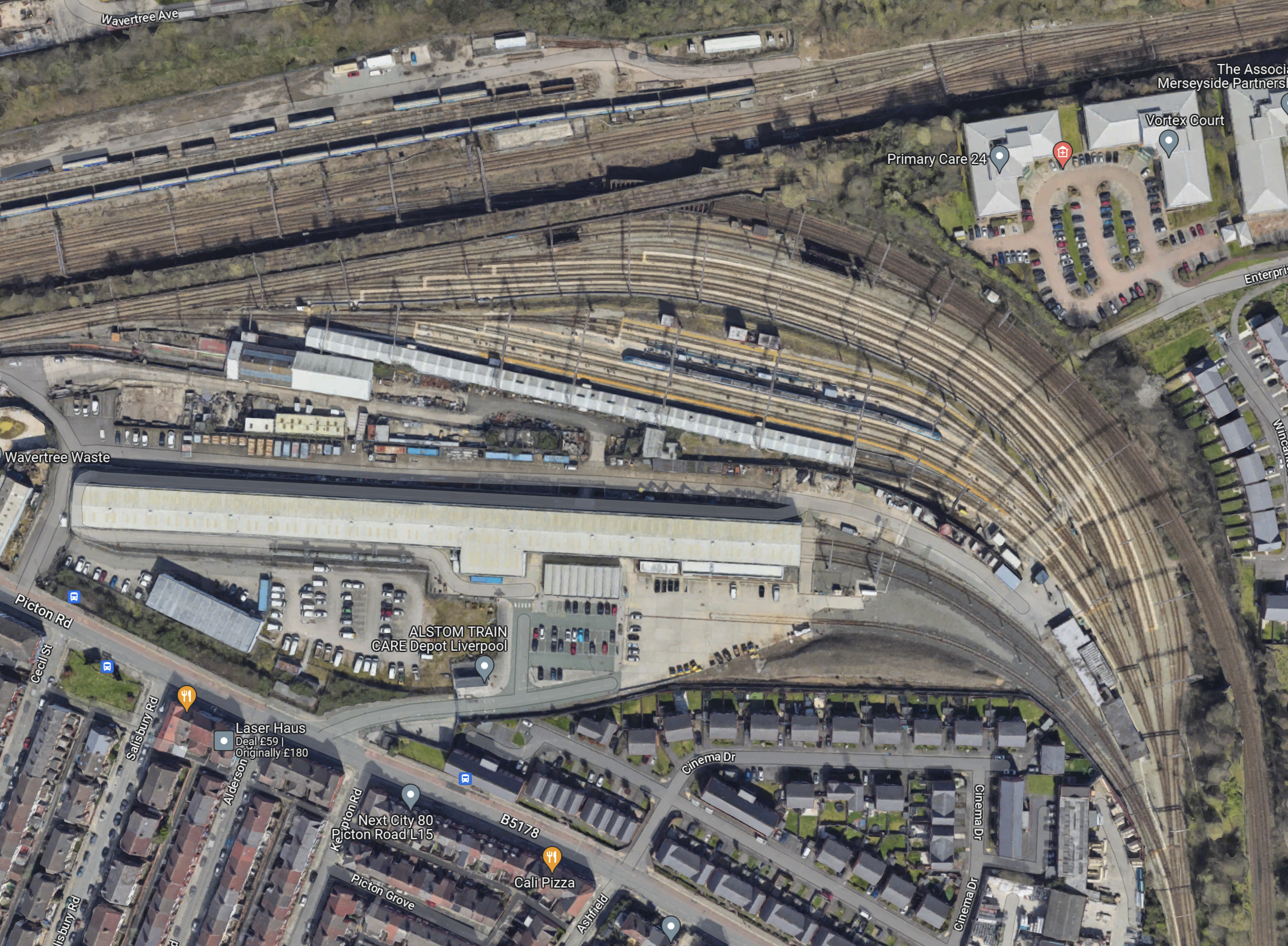
Note.
- The tracks across the top of the map are the main electrified Liverpool and Manchester tracks.
- The building in the middle is Alstom Traincare’s Liverpool Depot.
- The line to Runcorn enters the map in the South-East corner and curves around the depot to join the tracks into Lime Street station.
- The operating speed gradually reduces from 30 mph on this map to less than 15 mph in Lime Street station.
Perhaps, this 30 mph section is to be improved to gain the couple of minutes.
I also think, that savings could be possible at Runcorn station.
If when the second service starts, the Pendolinos don’t stop at Runcorn, that would save a few minutes.
The Class 807 and the High Speed Two Classic Compatible trains with their superior acceleration and deceleration could save a couple of minutes in the stop at Runcorn.
I very much feel that as the Pendolinos manage to achieve Crewe and Liverpool Lime Street in 38 minutes, that Pendolinos on the second service, Class 807 and the High Speed Two Classic Compatible trains, will all manage 36 minutes or less on the route.
London Euston And Liverpool Lime Street After Phase 2b Of High Speed Two Opens
There will be no changes as the full-size High Speed Two trains are not planned to run into Liverpool Lime Street.
Conclusion
It looks to me, that the Crewe and Liverpool Lime Street leg of High Speed Two is more or less complete.
Times between London and Liverpool will be as follows.
- Before High Speed Two Phase 2a – 2 hours and 3 minutes
- After High Speed Two Phase 2a – 1 hour and 32 minutes
- After High Speed Two Phase 2b – 1 hour and 32 minutes
I believe that for many this will be fast enough, especially as it’s nearly complete.
See Also
Could High Speed Two Finish At Lichfield?
Thoughts On High Speed Two
These are a few thoughts about High Speed Two, after the reports of major changes today.
This article on the BBC is entitled HS2 Line Between Birmingham And Crewe Delayed By Two Years.
This is the sub-heading.
The Birmingham to Crewe leg of high speed railway HS2 will be delayed by two years to cut costs.
These are the three opening paragraphs.
Some of the design teams working on the Euston end of the line are also understood to be affected.
Transport secretary Mark Harper blamed soaring prices and said it was “committed” to the line linking London, the Midlands and North of England.
HS2 has been beset by delays and cost rises. In 2010, it was expected to cost £33bn but is now expected to be £71bn.
Delivering The Benefits Of High Speed Two Early
It is my belief that with a large project taking a decade or more , it is not a bad idea to deliver some worthwhile benefits early on.
The Elizabeth Line opened in stages.
- The new Class 345 trains started replacing scrapyard specials in 2017.
- The rebuilt Abbey Wood station opened in 2017.
- Paddington local services were transferred to the Elizabeth Line in 2019.
- Outer stations reopened regularly after refurbishment from 2018.
- The through line opened in May 2022.
There’s still more to come.
Some projects wait until everything is ready and everybody gets fed up and annoyed.
Are there any parts of High Speed Two, that could be completed early, so that existing services will benefit?
In 2020, the refurbishment of Liverpool Lime Street station and the tracks leading to the station was completed and I wrote about the station in It’s A Privilege To Work Here!, where this was my conclusion.
Wikipedia says this about Liverpool Lime Street station.
Opened in August 1836, it is the oldest still-operating grand terminus mainline station in the world.
I’ve used Lime Street station for fifty-five years and finally, it is the station, the city needs and deserves.
I’ve been to grand termini all over the world and Lime Street may be the oldest, but now it is one of the best.
Are there any stations, that will be served by High Speed Two, that should be upgraded as soon as possible to give early benefits to passengers, staff and operators?
Avanti West Cost have solved the problem of the short platforms at Liverpool South Parkway station, by ordering shorter Class 807 trains. Will High Speed Two lengthen the platforms at this station?
A good project manager will need to get all the smaller sub-projects in a row and work out what is the best time to do each.
Digital Signalling
I would assume, as this will be needed for High Speed Two services in the West Coast Main Line to the North of Crewe, this is surely a must for installing as early as possible.
If the existing trains could run for a hundred miles at 140 mph, rather than the current 125 mph, that would save five worthwhile minutes.
Trains could run closer together and there is the possibility of organising services in flights, where a number of trains run together a safe number of minutes apart.
Remove Bottlenecks On Classic Lines, That Could Be Used By High Speed Two
I don’t know the bottlenecks on the West Coast Main Line, but there are two on the East Coast Main Line, that I have talked about in the past.
Could ERTMS And ETCS Solve The Newark Crossing Problem?
Improving The North Throat Of York Station Including Skelton Bridge Junction
Hopefully, the digital signalling will solve them.
Any bottlenecks on lines that will be part of High Speed Two, should be upgraded as soon as possible.
Birmingham And Crewe
I will start by looking at the leg between Birmingham and Crewe.
This section of the HS2 map shows High Speed Two between Birmingham and Lichfield.
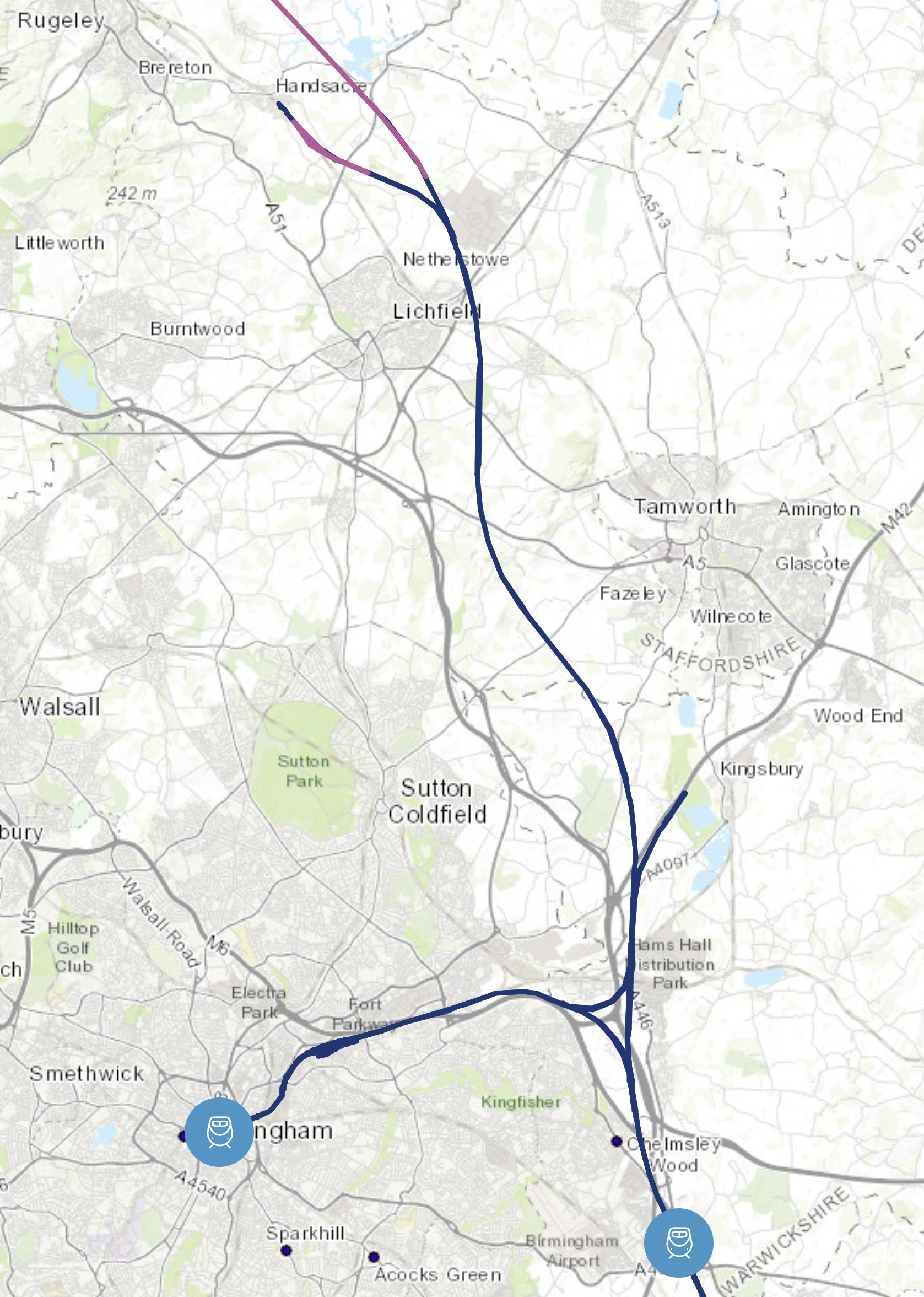
Note.
- The blue circle on the left at the bottom of the map is Birmingham Curzon Street station.
- The blue circle on the right at the bottom of the map is Birmingham Interchange station.
- The High Speed Two to and from London passes through Birmingham Interchange station.
- The branch to Birmingham Curzon Street station connects to the main High Speed Two at a triangular junction.
- North of the triangular junction, High Speed Two splits.
- The Eastern branch goes to East Midlands Parkway station.
- The Northern branch goes to Crewe, Liverpool Lime Street, Manchester Piccadilly, Preston and Scotland.
At the top of the map, the Northern branch splits and lines are shown on this map.

Note.
- The junction where the Northern and Eastern branches divide is in the South-East corner of the map.
- To the North of Lichfield, the route divides again.
- The Northern purple line is the direct line to Crewe.
- The shorter Southern branch is a spur that connects High Speed Two to the Trent Valley Line, which is the current route taken by trains between London Euston and Crewe, Liverpool Lime Street, Manchester Piccadilly, Preston and Scotland.
- Crewe station is in the North-West corner of the map.
The route between the junction to the North of Lichfield and Crewe is essentially two double-track railways.
- High Speed Two with a routine operating speed of 205 mph.
- The Trent Valley Line with a routine operating speed of 140 mph.
- High Speed Two Classic-Compatible trains can run on all tracks.
- High Speed Two Full-Size trains may be able to run on the Trent Valley Line at reduced speed.
- Eighteen trains per hour (tph) is the maximum frequency of High Speed Two.
I feel in an emergency, trains will be able to use the other route.
Will This Track Layout Allow An Innovative Build?
Suppose the link to the Trent Valley Line was built first, so that High Speed Two trains from London for Crewe, Liverpool Lime Street, Manchester Piccadilly, Preston and Scotland, could transfer to the Trent Valley Line as they do now.
- All lines used by High Speed Two services North of the junction, where High Speed Two joins the Trent Valley Line would be updated with digital signalling and 140 mph running. This will benefit current services on the line. For instance Euston and Liverpool/Manchester services could be under two hours.
- The current services would be replaced by High Speed Two services run by High Speed Two Classic-Compatible trains.
- The direct High Speed Two route between Lichfield and Crewe would now be built.
- When this section of High Speed Two is complete, High Speed Two services would use it between Lichfield and Crewe.
- As the direct route would be built later, this would delay the building of the Birmingham and Crewe high-speed route.
Currently, trains run the 41.8 miles between Lichfield and Crewe in 28 minutes, which is an average speed of 89.6 mph.
I can build a table of average speeds and times for Lichfield and Crewe.
- 100 mph – 25.1 minutes – 2.9 minutes saving
- 110 mph – 22.8 minutes – 5.2 minutes saving
- 120 mph – 20.9 minutes – 7.1 minutes saving
- 125 mph – 20.1 minutes – 7.9 minutes saving
- 130 mph – 19.3 minutes – 8.7 minutes saving
- 140 mph – 17.9 minutes – 10.1 minutes saving
- 160 mph – 15.7 minutes – 12.3 minutes saving
- 180 mph – 13.9 minutes – 14.1 minutes saving
- 200 mph – 12.5 minutes – 15.5 minutes saving
Note.
- Even a slight increase in average speed creates several minutes saving.
- Times apply for both routes.
I believe that a 125 mph average should be possible on the Trent Valley route, which may be enough for Euston and Liverpool/Manchester services to be under two hours.
Improving Classic Lines Used By High Speed Two North Of Lichfield
Real Time Trains shows these figures for a Glasgow Central to Euston service.
- Glasgow and Lichfield Trent Valley is 298.2 miles.
- Glasgow and Lichfield Trent Valley takes five hours.
This is an average speed of 59.6 mph.
Note.
- The average speed is low considering the trains are capable of cruising at 125 mph and 140 mph with digital signalling.
- High Speed Two services between Euston and Glasgow will use the classic network, to the North of Lichfield.
I can build a table of average speeds and times for Glasgow and Lichfield.
- 100 mph – 179 minutes – 121 minutes saving
- 110 mph – 163 minutes – 157 minutes saving
- 120 mph – 149 minutes – 151 minutes saving
- 125 mph – 143 minutes – 157 minutes saving
- 130 mph – 138 minutes – 162 minutes saving
- 140 mph – 128 minutes – 172 minutes saving
This table illustrates why it is important to improve all or as many as possible of classic lines used by High Speed Two to enable 140 mph running, with full digital signalling. Obviously, if 140 mph is not feasible, the speed should be increased to the highest possible.
Routes that could be updated include.
- London Euston and Glasgow Central
- London Euston and Liverpool Lime Street
- London Euston and Manchester Piccadilly (all routes)
- London Euston and Blackpool
- London Euston and Holyhead
- London Euston and Shrewsbury
Not all these routes will be served by High Speed Two, but they could be served by 140 mph trains.
What Times Would Be Possible?
The InterCity 225 was British Rail’s ultimate electric train and these two paragraphs from its Wikipedia entry, describe its performance.
The InterCity 225 was designed to achieve a peak service speed of 140 mph (225 km/h); during a test run in 1989 on Stoke Bank between Peterborough and Grantham, an InterCity 225 was recorded at a speed of 162 mph (260.7 km/h). Its high speed capabilities were again demonstrated via a 3hr 29mins non-stop run between London and Edinburgh on 26 September 1991. British regulations have since required in-cab signalling on any train running at speeds above 125 mph (201 km/h) preventing such speeds from being legally attained in regular service. Thus, except on High Speed 1, which is equipped with cab signalling, British signalling does not allow any train, including the InterCity 225, to exceed 125 mph (201 km/h) in regular service, due to the impracticality of correctly observing lineside signals at high speed.
The InterCity 225 has also operated on the West Coast Main Line (WCML). In April 1992, one trainset achieved a new speed record of two hours, eight minutes between Manchester and London Euston, shaving 11 minutes off the 1966 record. During 1993, trials were operated to Liverpool and Manchester in connection with the InterCity 250 project.
- The fastest London Euston and Manchester Piccadilly services appear to be two hours and six minutes tomorrow, with stops at Nuneaton and Stoke-on-Trent.
- The fastest London King’s Cross and Edinburgh service is four hours seventeen minutes tomorrow.
It does appear that British Rail’s 1980s-vintage InterCity 225 train did very well.
Trains that would be able to run at 140 mph with updated signalling include.
- Alstom Class 390
- Hitachi Class 800, 801, 802, 803, 805, 807 and 810
- British Rail InterCity 225
- High Speed Two Classic-Compatible.
All are electric trains.
Could High Speed Two, West Coast Main Line and East Coast Main Line Services Be Run By High Speed Two Classic-Compatible Trains?
I don’t see why not!
- They would be able to use short stretches of High Speed Line like Lichfield and Crewe.
- LNER and CrossCountry could also use the trains.
- High Speed Two is providing the framework and it’s there to be used, provided the paths are available.
This graphic shows the preliminary schedule.
It only shows ten trains going through Crewe, so there could be up to eight spare high speed paths between Birmingham and Crewe.
Could High Speed Two Classic-Compatible Trains Be Used To Advantage On The East Coast Main Line?
I published this extract from the Wikipedia entry for the InterCity 225 earlier.
The InterCity 225 was designed to achieve a peak service speed of 140 mph (225 km/h); during a test run in 1989 on Stoke Bank between Peterborough and Grantham, an InterCity 225 was recorded at a speed of 162 mph (260.7 km/h). Its high speed capabilities were again demonstrated via a 3hr 29mins non-stop run between London and Edinburgh on 26 September 1991.
The London and Edinburgh run was at an average speed of around 112 mph.
I wonder what time, one of LNER’s Class 801 trains, that are all-electric could do, once the new digital signalling has been fully installed on the route? I suspect it would be close to three hours, but it would depend on how long the trains could run at 140 mph.
It should be noted that the Selby Diversion was designed for 160 mph, when it was built by British Rail in the 1980s.
In Are Short Lengths Of High Speed Line A Good Idea?, I look at the mathematics of putting in short lengths of new railway, which have higher speeds, where this was part of my conclusion.
I very much feel there is scope to create some new high speed sections on the current UK network, with only building very little outside of the current land used by the network.
I would love to know what some of Network Rail’s track experts feel is the fastest time possible between London and Edinburgh that can be achieved, by selective upgrading of the route.
If some of the trains were High Speed Two Classic-Compatible Trains, with a top speed of 205 mph, provided the track allowed it, there could be some interesting mathematics balancing the costs of track upgrades, new trains with what passengers and operators need in terms of journey times.
Could High Speed Two Classic-Compatible Trains Be Used To Advantage On The West Coast Main Line?
Much of what I said about the East Coast Main Line would apply to the West Coast Main Line.
But in addition, the West Coast Main Line will be a superb place to test the new High Speed Two Classic-Compatible Trains.
I believe, that before High Speed Two opens, we’ll see High Speed Two Classic-Compatible Trains, carrying passengers between Euston and Avanti West Coast’s destinations.
Could High Speed Two Be Split Into Two?
Consider.
- Under earlier plans, the East Coast Main Line to the North of York, will be used by High Speed Two.
- With digital signalling the East Coast Main Line will support continuous running at 140 mph for long sections of the route.
- The East Coast Main Line has a recently-rebuilt large Southern terminal at King’s Cross with eleven platforms and good suburban services and excellent connections to the London Underground.
- The East Coast Main Line has a very large Northern terminal at Edinburgh Waverley with twenty platforms and good local train connections.
- There are large intermediate stations on the East Coast Main Line at Doncaster, Leeds, Newcastle, Peterborough and York. All these stations have good local train connections.
- The East Coast Main Line has important branches to Cambridge, Harrogate, Huddersfield, Hull King’s Lynn, Lincoln, Middlesbrough, Nottingham, Scarborough, Sheffield, Skegness and Sunderland.
We are talking about an asset, that needs improving rather than sidelining.
Could High Speed Two Be A One-Nation Project?
Over three years ago, I wrote Could High Speed Two Be A One-Nation Project? and tried to answer the question in the title.
But now the core network is better defined, perhaps it is time to look at extending the High Speed network again.
The next few sections look at possible extensions.
Serving Chester And North Wales
I looked at this in Could High Speed Two Trains Serve Chester And North Wales?, which I have updated recently.
This was my conclusion.
It looks to me, that when High Speed Two, think about adding extra destinations, Chester and Holyhead could be on the list.
I also suspect that even without electrification and High Speed Two services, but with the new Class 805 trains, the route could be a valuable one for Avanti West Coast.
These are current and promised times for the two legs to Holyhead.
- Euston and Crewe – 90 minutes – Fastest Class 390 train
- Euston and Crewe – 55 minutes – High Speed Two Classic-Compatible train from Wikipedia
- Crewe and Holyhead – 131 minutes – Fastest Class 221 train
- Crewe and Holyhead – 70 minutes – 90 mph average speed
- Crewe and Holyhead – 63 minutes – 100 mph average speed
- Crewe and Holyhead – 57 minutes – 110 mph average speed
- Crewe and Holyhead – 53 minutes – 120 mph average speed
- Crewe and Holyhead – 45 minutes – 140 mph average speed
Note.
- I have assumed that Crewe and Holyhead is 105.5 miles.
- The operating speed of the North Wales Coast Line is 90 mph.
- In the following estimates, I have assumed a change of train at Crewe, takes 6 minutes.
I think there are several options to run fast services to Chester and North Wales.
Pre-HS2 – Class 805 all the way
I believe this train will match the following.
- The fastest Class 390 train between Euston and Crewe.
- The fastest Class 221 train between Crewe and Holyhead.
This would give a time of 3 hours 41 minutes.
Pre-HS2 – Class 805 all the way, but with perhaps less stops and some track improvement
I believe this train will match the following.
- The fastest Class 390 train between Euston and Crewe.
- 110 mph train Crewe and Holyhead.
This would give a time of 2 hours 27 minutes.
Pre-HS2 – Class 805 all the way, but with perhaps less stops and Crewe and Holyhead uprated largely to 125 mph
I believe this train will match the following.
- The fastest Class 390 train between Euston and Crewe.
- 120 mph train Crewe and Holyhead.
This would give a time of 2 hours 23 minutes.
Pre-HS2 – Class 805 all the way, but with perhaps less stops and Crewe and Holyhead Crewe and Holyhead electrified and uprated to 140 mph
I believe this train will match the following.
- The fastest Class 390 train between Euston and Crewe.
- 140 mph train Crewe and Holyhead.
This would give a time of 2 hours 15 minutes.
After-HS2 – High Speed Two Classic-Compatible train to Crewe, the Class 805 train to Holyhead
I believe this train will match the following.
- The fastest High Speed Two Classic-Compatible train between Euston and Crewe.
- The fastest Class 221 train between Crewe and Holyhead.
This would give a time of 3 hours 12 minutes.
After-HS2 – High Speed Two Classic-Compatible train to Crewe, the Class 805 train to Holyhead, but with perhaps less stops and some track improvement
I believe this train will match the following.
- The fastest High Speed Two Classic-Compatible train between Euston and Crewe.
- 110 mph train Crewe and Holyhead.
This would give a time of 1 hours 58 minutes.
After-HS2 – High Speed Two Classic-Compatible train to Crewe, the Class 805 train to Holyhead, but with perhaps less stops and Crewe and Holyhead uprated largely to 125 mph
I believe this train will match the following.
- The fastest High Speed Two Classic-Compatible train between Euston and Crewe.
- 120 mph train Crewe and Holyhead.
This would give a time of 1 hours 54 minutes.
After-HS2 – High Speed Two Classic-Compatible train to Crewe, Class 805 train to Holyhead, but with perhaps less stops and Crewe and Holyhead electrified and uprated to 140 mph
I believe this train will match the following.
- The fastest High Speed Two Classic-Compatible train between Euston and Crewe.
- 140 mph train Crewe and Holyhead.
This would give a time of 1 hours 46 minutes.
After-HS2 – High Speed Two Classic-Compatible train all the way, but with perhaps less stops and Crewe and Holyhead electrified and uprated to 140 mph
I believe this train will match the following.
- The fastest High Speed Two Classic-Compatible train between Euston and Crewe.
- 140 mph train Crewe and Holyhead.
This would give a time of 1 hours 40 minutes.
From these estimates, I have come to these conclusions.
- A sub-two and a half-hour service can be attained with the new Class 805 trains and some improvements to the tracks along the North Wales Coast Line.
- A sub-two hour service can be attained with a High Speed Two Classic-Compatible train to Crewe and a Class 805 train to Hplyhead along a 140 mph electrified North Wales Coast Line.
- If the North Wales Coast Line is electrified, the journey from London Euston, Birmingham Interchange, Crewe, Chester, Liverpool and Manchester would be zero-carbon.
We should be looking to building a zero-carbon fast passenger ferry for sailing between Holyhead and Dublin.
- The current fastest ferries appear to take three hours and 15 minutes, which means that a six-hour low-carbon journey between London Euston and Dublin, should be possible with the new Class 805 trains, prior to the opening of High Speed Two.
- A five-hour journey after the opening of High Speed Two to Crewe and electrification of the North Wales Coast Line should be possible.
If the advanced zero-carbon ferry could knock an hour off the journey, four hours between London and Dublin along a spectacular coastal railway with a fast sea voyage, would be a route that would attract passengers.
- High Speed Two would need to be opened to Crewe.
- The North Wales Coast Line would need to be upgraded to a 140 mph digitally-signalled line.
- The North Wales Coast Line would need to be electrified.
- Full electrification may not be needed, as discontinuous electrification will have advanced to provide zero-carbon running, in a more affordable and less disruptive manner.
- Trains could either be High Speed Two Classic-Compatible trains all the way from London or there could be a change at Crewe to Class 805 trains.
- The ferry would use the best zero-carbon and operational technology.
The improvement and electrification of the North Wales Coast Line could be planned to take place in a relaxed manner, so that journey times continuously got quicker.
I would start the improvement of the North Wales Coast Line, as soon as possible, as all these improvement will be used to advantage by the new Class 805 trains.
Serving West And South West England And South Wales
Suppose you want to go between Glasgow and Cardiff by train, after High Speed Two has opened.
- You will take one of the half-hourly High Speed Two Classic-Compatible trains between Glasgow Central and London.
- Three and a half-hours later, you will get off the train in one of the below ground platforms at Old Oak Common station.
- A short ride in an escalator or lift and you will be in the Great Western Railway station at ground level.
- From here, fifty minutes later, you will be in Cardiff.
The journey will have taken four hours and twenty minutes.
This may seem a long time but currently Glasgow and Cardiff by train takes over seven hours by train.
- Glasgow and Bristol Temple Meads takes eight hours, but using High Speed Two and GWR will take 5 hours.
- Glasgow and Cheltenham Spa takes six hours, but using High Speed Two and GWR will take 5 hours and 30 minutes.
- Glasgow and Penzance takes twelve hours, but using High Speed Two and GWR will take 8 hours and 33 minutes.
- Glasgow and Swansea takes nearly nine hours, but using High Speed Two and GWR will take 6 hours and 9 minutes.
The High Speed Two route only has one simple change, whereas some routes now have up to four changes.
Conclusion
Is Liverpool Going To Get High Speed One-Point-Five?
Some of the best train journeys, I’ve ever had were not on high speed trains on specially-built tracks.
- The Thunder of Three-Thousand Three-Hundred Horses is from the early 1970s and describes a trip back from Darlington behind a Class 55 locomotive or Deltic.
- Norwich-In-Ninety Is A Lot More Than Passengers Think! describes a trip from London to Norwich and back, in the early days of the Norwich-in-Ninety timetable behind a Class 90 locomotive.
- I could add a journey on an InterCity 125 from London to Plymouth, which was running nearly thirty minutes late at Newbury, but was on time at Exeter.
The connection between these stories, was that all had a superb biological control system in the cab, who with help from the signallers was able to keep to a difficult schedule or make up time.
Last year, I made several journeys between Euston and Liverpool Lime Street. A couple of the journeys were unusual in that we arrived at our destination around six or more minutes early.
I suspect, that Avanti West Coast were experimenting to make sure that they get the new two trains per hour (tph) for the route perfect.
In Avanti West Coast Looks To Recover, I said this about Euston and Liverpool Lime Street services.
A paragraph talks about the second hourly service between London and Liverpool.
Avanti still has ambitions to introduce a second hourly service between Euston and Liverpool, but when this will come in will depend on demand recovery.
Consider.
- If would be desirable if some or all trains running on the route could achieve a timing of two hours between London and Liverpool.
- It is felt that the second service should stop at Liverpool South Parkway station, where the platforms are too short for eleven-car Class 390 trains.
- Avanti have stated they would like more stops in the Trent Valley, especially at Nuneaton, where they would connect to services to the East Midlands.
- Nuneaton is almost exactly halfway between London and Liverpool.
- Running two tph with Class 807 trains would need nine trains and Avanti have only ordered ten in total.
I believe that a practical timetable like this could work.
- Class 390 train – one tph – Non-stop or perhaps a single stop in the Midlands – Under two hours
- Class 807 train – one tph – Stopping at Nuneaton, Stafford, Crewe, Runcorn and Liverpool South Parkway – Current time or better
An hourly service between London and Liverpool in under two hours would surely be a passenger magnet.
So what is possible?
I found this service on Real Time Trains, which ran on the 16th February 2023.
- Scheduled to leave Liverpool Lime Street at 0943, but left at 1012 or 29 minutes late.
- Train did a ninety second unadvertised stop at Liverpool South Parkway. Now running 26 minutes late.
- There was a two minute stop at Runcorn and a four-minute stop at Crewe. Now running 25 minutes late
- There was a one-minute stop at Milton Keynes. Now running 20 minutes late.
- The train arrived in London Euston at 1220 or 16 minutes late.
Note.
- Liverpool Lime Street and London Euston took 2 hours and 8 minutes.
- As Liverpool Lime Street and London Euston is a distance of 193.6, a 128 minute journey is an average speed of 90.7 mph
- Liverpool Lime Street and Crewe took 32 minutes with two stops.
- Crewe and London Euston took 1 hour and 32 minutes with one stop.
- In West Coast Main Line Electro-Diesels On Test, I found that a Glasgow and London train took 1 hour and 28 minutes between Crewe and London Euston.
- All services last week had the unadvertised stop at Liverpool South Parkway
What can be deduced from these figures?
- If the Crewe stop were to be cut out, two hours and four minutes could certainly be possible between Liverpool Lime Street and London Euston with a Class 390 train.
- I also suspect that if the train were to be run non-stop, that the other four minutes could be saved.
So will Avanti West Coast run the current service using new Class 807 trains, with the extra stop at Liverpool South Parkway and perhaps other stations and the additional hourly train with a non-stop nine-car Class 390 train?
This way of delivering a two tph service would mean.
- Runcorn, Crewe and Milton Keynes would not lose any of their current fast services to and from Liverpool Lime Street and London Euston.
- Liverpool South Parkway station is probably a more convenient location for some passengers going to and from the South. It would gain an hourly service to London Euston.
- There will be an additional 77% of seats between Liverpool Lime Street and London Euston.
- Passengers who don’t like tilting trains could use the Class 807 trains.
- One tph would be timed for two hours or under and would be a marketing man’s dream.
No train would be slower than the current services.
Improvements To The Non-Stop Class 390 Train Service
I earlier said.
As Liverpool Lime Street and London Euston is a distance of 193.6, a 128 minute journey is an average speed of 90.7 mph.
An average speed of 90.7 mph, doesn’t seem fast for a Class 390 train with an operating speed of 125 mph or 140 mph under full ERTMS digital signalling.
These are some times for a selection of average speeds between Liverpool Lime Street and London Euston.
- 90 mph – 2 hours 9 minutes
- 100 mph – 1 hour 56 minutes
- 110 mph – 1 hour 46 minutes
- 120 mph – 1 hour 37 minutes
- 125 mph – 1 hour 33 minutes
- 130 mph – 1 hour 29 minutes
- 135 mph – 1 hour 26 minutes
- 140 mph – 1 hour 23 minutes
Note.
- Average speeds of upwards of 130 mph are unlikely, but I’ve added them to show that the train speed is less important than the speed of the track.
- High Speed Two’s planned time between Liverpool Lime Street and London Euston is 1 hour and 32 minutes.
But I do think times of around 1 hour and 35 minutes should be possible for non-stop Class 390 trains between Liverpool Lime Street and London Euston with an improved track and full ERTMS digital signalling.
Improvements To The Stopping Class 807 Train Service
As the track of the West Coast Main Line is improved with better track and full ERTMS digital signalling, this will also benefit the times of the stopping service run by the new Class 807 trains.
The Class 807 train with its lighter weight will have better acceleration than the current Class 390 trains. This will mean, that they will not be slowed as much, when they stop.
It may be possible to add extra stops at places like Watford Junction, Nuneaton and Stafford and still time the train for a few minutes over two hours.
Avanti West Coast Looks To Recover, is a post, that I wrote based on an interview in Modern Railways with Phil Whittingham, who is MD of Avanti West Coast.
There is a lot of talk in the article about.
- Using Nuneaton to connect the North West and the East Midlands.
- The acceleration of the Class 807 trains.
- Improving the Customer Service.
I think that Liverpool will find it is connected to more of the country on services with just a single change.
Conclusion
Liverpool is getting greater connectivity to the Midlands and the South-East of England, with times, that could be improved to be comparable with High Speed Two.
West Coast Main Line Electro-Diesels On Test
The title of this post, is the same as that of this article on Railway Gazette.
This is the first paragraph.
The first two of 13 Hitachi Class 805 electro-diesel trainsets ordered for Avanti West Coast services are undergoing testing on the West Coast Main Line ahead of entry into service later this year.
These Class 805 trains will go to places like Chester, Bangor and Holyhead via Crewe.
It is interesting to look at various Crewe to London Euston services this morning.
- 0740 – Class 390 train – From Liverpool – One Stop – 1 hour 40 minutes
- 0755 – Class 221 train – From Holyhead – One Stop – 1 hour 40 minutes
- 0832 – Class 390 train – From Manchester – One Stop – 1 hour 37 minutes
- 0844 – Class 390 train – From Glasgow – 1 hour 28 minutes
Note.
- The first field is the four-figure time that the train left Crewe.
- The last field is the journey time between Crewe to London Euston.
- The Class 390 and 805 trains will use electricity to run between Crewe and London Euston, whereas the Class 221 train will use diesel.
- Crewe and London Euston is 158 miles.
- The Glasgow train covers the 158 miles at an average speed of 107.7 mph.
I have some thoughts.
What Will Be The Time For A Class 805 Train Between Crewe And London Euston?
Consider.
- From Crewe, the Class 805 train will be using the electrification to London Euston.
- The Class 390 train can tilt, whereas the Class 805 train can’t!
- The Class 805 train is at least three tonnes lighter per car, than the Class 390 train.
- The lighter weight and possibly more power of the Class 805 trains, will give better acceleration.
- There is twenty-one years of difference in the build dates of the two trains. In that time, I also suspect that Network Rail have improved the track between Crewe and London Euston.
- Norton Bridge junction has been improved to avoid conflicts.
- It would be very convenient for Avanti West Coast and Network Rail, if the performance under electrification of the two trains were similar.
For these reasons, I believe that the performance of a non-stop Crewe And London Euston service using a Class 805 train will be such that it can match that of a Class 390 train.
I would also expect that with a similar stopping pattern between Crewe And London Euston, there would be little to choose between the two trains.
I can see with its better acceleration and lighter weight that the time between Crewe and London Euston will be perhaps a dozen minutes faster than the current time.
Using the electrification will also save a lot of diesel fuel with all its emissions.
Along The North Wales Coast Line
Consider.
- Crewe and Holyhead is 105.5 miles and takes two hours and two minutes in a typical service.
- These figures give an average speed of 52 mph.
- There are six stops, which are scheduled to take a total of ten minutes.
- About half the North Wales Coast Line has a maximum operating speed of 90 mph, but through Chester, Llandudno Junction and West of Bangor, the operating speed is 75 mph or less.
I am fairly sure, that with both the current Class 221 trains and the new Class 805 trains, it will be the track, rather than the train that determines the average speed.
It would therefore appear that if the average speed can be raised by track improvements these time savings could be achieved.
- 60 mph – 105.5 mins – 16.5 mins
- 70 mph – 90 mins – 32.5 mins
- 80 mph – 79 mins – 43 mins
- 90 mph – 70 mins – 52 mins
- 100 mph – 63 mins – 59 mins
- 110 mph – 58 mins – 64 mins
- 120 mph – 53 mins – 69 mins
- 130 mph – 49 mins – 73 mins
- 140 mph – 45 mins – 77 mins
Note.
- The first column is the average speed.
- The second column is the time between Holyhead and Crewe.
- The third column is the saving.
- I suspect that 90 or 100 mph would be the highest possible practical average speed.
- Trains average 100 mph on several long sections of the Great Eastern Main Line.
- I put in the higher speeds to show what is possible, if the North Wales Coast Line were to be converted into a 140 mph electrified line with digital signalling.
Even at these relatively slow speeds compared to High Speed Two, there are considerable time savings to be made, just by improving the tracks.
Incidentally, High Speed Two is quoted in Wikipedia as aiming for a Crewe and London Euston time of 56 minutes, so by averaging 100 mph between Crewe and Holyhead, London Euston and Holyhead could be under two hours.
Batteries And Class 805 Trains
I wouldn’t be surprised that soon after the Class 805 trains are delivered, they could be converted to a version of Hitachi’s Intercity Tri-Mode Battery Train, the specification of which is shown in this Hitachi infographic.

Note.
- I suspect that the batteries will be used to handle regenerative braking on lines without electrification, which will save diesel fuel and carbon emissions.
- The trains accelerate faster, than those they replace.
- The claimed fuel and carbon saving is twenty percent.
- It is intended that these trains will be introduced in 2023.
But Hitachi have not given any predictions of the range of these trains on battery power alone.
However, they do claim a battery range of 56 miles for the Hitachi Regional Battery Train, which is based on similar technology.
These trains could help in speeding the stops between Crewe and Holyhead.
- Batteries would be charged at Holyhead and on the electrification to the South of Crewe.
- At each stop, trains would use a proportion of the power in the battery to accelerate faster and save fuel and cut emissions.
- Battery power would be used in stations for train hotel power.
- Westbound trains would arrive in Holyhead and Southbound trains would arrive in Crewe, with not much power in the battery.
I suspect that, whether diesel or battery power is used, will be controlled by a sophisticated computerised control system.
Electrification Along The North Wales Coast Line
I think this will eventually happen to allow High Speed Two Classic-Compatible trains to run to Chester and along the North Wales Coast Line to Llandudno, Bangor and Holyhead.
But there is no benefit to be gained in electrifying until higher speeds are possible, after track improvements.
I believe these times will be possible with track improvements and the opening of High Speed Two.
- Holyhead and Crewe – Class 805 train and 80 mph average – 79 mins
- Holyhead and Crewe – Class 805 train and 90 mph average – 70 mins
- Holyhead and Crewe – High Speed Two Classic-Compatible train, electrification and 100 mph average – 63 mins
- Crewe and London Euston – Class 805 train – 80 mins
- Crewe and London Euston – High Speed Two Classic-Compatible train – 56 mins
Note, electrification will be needed, to run High Speed Two Classic-Compatible trains along the North Wales Coast Line.
I am confident that these times will be possible.
- Holyhead and London Euston – Class 805 train and 90 mph average along the coast – 2 hours 30 mins
- Holyhead and London Euston – High Speed Two Classic-Compatible train and 100 mph average along the coast – 2 hours
The current time between Holyhead and London Euston is over three hours 45 minutes.
Conclusion
These trains will certainly speed up trains to North Wales.

