10 Exciting New Train Journeys Coming To The UK In 2026
The title of this post, is the same as that of this article in The Telegraph.
The journeys are.
South Wales Metro (The ‘Welsh Tube’)
Effectively, what the Welsh have done is turn the railways radiating from Cardiff into the sort of metro that Birmingham, Glasgow, Liverpool and Tyne-Tees have created over the last few decades.
- They are replacing a large proportion of the rolling stock, with new electric or hybrid-electric trains and tram-trains.
- Some of the lines are notably scenic.
- Some new stations have been added.
- There are attractions to visit.
- A Day Ranger ticket is available.
A few times in the past few years, when I feel I need some fresh air, I’ve taken a train to Cardiff, bought a Day Ranger and climbed a few hills in a train, as in my seventies, I’m too old to walk up.
I wouldn’t be surprised that the forthcoming Leeds Metro borrows heavily from ideas developed on the South Wales Metro.
London To Stirling
Stirling is one of those towns and cities, like Barrow-in-Furness, Blackpool, Shrewsbury and a few others, that Virgin and Avanti West Coast seem reluctant to serve.
I feel by choosing Stirling for a service, Lumo have just done the obvious.
- The route is fully-electrified.
- Stops will be Milton Keynes, Nuneaton, Crewe, Preston, Carlisle, Lockerbie, Motherwell, Whifflet, Greenfaulds, and Larbert.
- There will be four trains per day.
- The initial trains will be Class 222 trains.
- The electric Class 803 trains are on order.
- Hitachi are developing battery-electric trains for Lumo on the East Coast to be able to use the diversion via Lincoln, which would probably reach Perth.
- Car-hire companies will do well in Stirling.
- Stirling has onward train connections to Aberdeen, Dundee, Inverness, Montrose, Perth and Stonehaven.
- I wouldn’t be surprised to see FirstGroup, who are Lumo’s parent or another coach company, creating a hydrogen-powered coach network for the North of Scotland.
- The service will start in May 2026.
That really shows how railways can be used to boost growth. But will the SNP get the message?
I will use this service to have a few days in Stirling and explore the Southern part of the Scottish Highlands by train.
Caledonian Sleeper from Birmingham
This looks to be obvious addition to the Caledonian Sleeper.
The Telegraph says this.
The joys of the Caledonian Sleeper to Scotland, well known to travellers from London, are to be extended for the first time to those wanting to alight at Birmingham International. This change – the biggest in the Caledonian Sleeper schedule for 30 years – will mean that greeting the dawn approaching places as far flung as Fort William, Aberdeen and Inverness will be a far more realistic prospect for fans of this form of travel who live in the Midlands.
Note.
- The Birmingham stop will be at International not New Street.
- The service starts on January 16.
- Only the Highlander will stop at Birmingham International.
It seems to be a well-thought out simple addition to the service.
Newquay And Falmouth
The Telegraph says this.
Exciting news for fans of Cornwall where a new direct service linking the north and south coasts this year will make travelling by train between the key towns of Newquay and Falmouth considerably easier. The improvement to the current journey, frequently involving multiple changes and lasting two and half hours, will start with an increase in services between Newquay and Par in the spring and, by the end of the year, the commencement of the direct link all the way through to Falmouth.
Note.
The project is named the Mid Cornwall Metro.
The project has cost £57 million.
The route will be Newquay and Falmouth Docks via Quintrell Down, St. Columb Road, Roche, Bugle, Luxulyan, Par, St. Austell, Truro, Perranwell, Penryn, Penmere and Falmouth Town.
For more information, see midcornwallmetro.com
The journey time between Newquay and Falmouth will be cut by forty-five minutes.
I am sure that there are other rail systems in the UK, Ireland and in the wider world, that could benefit from a
High Speed Sonnet (Weardale To Stratford-upon-Avon)
The Telegraph says this.
And now for something completely different: a one-off charter train from the dales of County Durham to Stratford-upon-Avon, the heart of Shakespeare country. This journey, dubbed the “High Speed Sonnet”, comes as part of the 50th anniversary celebrations of the introduction of the legendary InterCity 125 high speed trains, one of which will be deployed on the run from Stanhope to the birthplace of the bard.
This train journey, although it is probably very nice is not really my scene.
- I don’t have a partner.
- I don’t live near to Weardale or Stratford-on-Avon.
- As I’m coeliac and low alcohol, I’m not really keen on gourmet dining events.
But the train is an Intercity 125, so some might like to take a ride.
For more details see excursionsbyrail.co.uk
West Highland Line, Scotland
The Telegraph says this.
A journey along the West Highland line, the most scenic stretch of track in Britain, and a visit to the Royal waiting room used by Queen Victoria during visits to Balmoral are two of the highlights of a new tour for 2026, offered by small group Scotland and UK specialists McKinlay Kidd.
Similar comments to the previous journey apply, except that it is West Scotland.
But the train is steam-hauled over the Glenfinnan Viaduct of Harry Potter fame, so some might like to take a ride.
For more details see mckinlaykidd.com
Mid Wales Explorer
The Telegraph says this.
Another new tour for 2026, this one run by The Railway Touring Company, has as its focus the central part of Wales. Highlights include a journey along the Welsh Highland line on the “Harbourmaster”, shorter trips on the celebrated little railways of Llangollen, Bala Lake, Talyllyn, Vale of Rheidol and Welshpool, and a narrowboat ride across world heritage Pontcysyllte Aqueduct located 38 metres above the River Dee. Tidy.
I might go on this one if the date of June 10th fits.
For more details see railwaytouring.net
Newcastle And Brighton
The Telegraph says this.
How about this for a tantalising prospect – a direct service between Newcastle and Brighton calling at York, Sheffield, Birmingham New Street, Oxford, Reading, and Gatwick Airport – with no need to change trains in London? This is the new route proposed by open-access operator Grand Central (part of Arriva UK Trains) and currently awaiting approval from the Office of Rail and Road.
All going well, services – five trains each way daily – should start by the end of the year. A potential game changer and, following the commencement of the direct link between Seaham and London in December 2025, a further example of Grand Central’s drive to connect underserved communities.
For more details see grandcentralrail.com
London And Cleethorpes
The Telegraph says this.
Another Grand Central proposal that whets the appetite is the application to run direct services (for the first time since 1992) between London and the Lincolnshire seaside town of Cleethorpes. While not without its critics, Cleethorpes is an old-school British resort with pier, promenade and the Cleethorpes Coast Light (miniature) Railway service. If approved, four services a day would be up and running by the end of 2026; additional stops would include Doncaster, Scunthorpe, Grimsby, Thorne South, Crowle and Althorpe.
For more details see grandcentralrail.com
Note.
Althorpe is not to be confused with the burial place of Princess Di.
In Lunch On The Pier In Cleethorpes, I wrote about excellent gluten-free fish and chips on the pier.
Champagne Moments On The Northern Belle
The Telegraph says this.
The late Queen Mother famously enjoyed G&Ts while seated in carriages which now form part of the the Northern Belle. This in mind, she would likely have approved of the latest innovation on one of Britain’s plushest trains: the addition of a “Krug class”, which includes one bottle of Krug Grande Cuvée Champagne per couple, to enjoy over a multi-course meal and seating in Duart (formerly a carriage on The Royal Train) or Glamis, named after the Queen Mother’s childhood home.
The train operates a number of day trips on scenic routes to landmark cities such as York, Edinburgh and Bath, and to colourful events such as the RHS Chelsea Flower Show.
For more details see 95pp; northernbelle.co.uk
Could Anglia Railways’ London Crosslink Be Recreated As Part Of The London Overground?
This is the first paragraph of the Wikipedia entry for the original London Crosslink.
London Crosslink was a passenger train service operated by Anglia Railways between Norwich and Basingstoke, using the North London Line to bypass central London. Class 170 Turbostar diesel multiple units were used, and the service operated between 22 May 2000 and 28 September 2002, supported by funding from the Strategic Rail Authority through its Rail Passenger Partnership fund.
Note.
- The service called at Diss, Stowmarket, Ipswich, Colchester, Whitham, Chelmsford, Ingatestone, Romford, Stratford, Highbury & Islington, Camden Road, Willesden Junction, West Hampstead Thameslink, Brentford, Feltham, Staines, Woking, and Farnborough (Main)
- It ran six times on Monday to Friday and five times on Sunday.
- Feltham and Woking stations have a coach link to Heathrow.
- Journeys took around 3 hours and 44 minutes.
Over the years, attractions and other rail lines and stations served by the route have changed. improved and been added.
- In 2006, the Arsenal’s Emirates Stadium opened within walking distance of Highbury & Islington station.
- In 2012, the Olympic Stadium opened at Stratford and is now used by West Ham United.
- In 2020, Brentford Stadium opened within walking distance of Brentford station.
- There are long-term plans for a station at Brentford stadium.
- In 2022, Romford and Stratford stations were connected to the Elizabeth Line.
- In 2025, Beaulieu Park station was added to the Greater Anglia Main Line.
- In 2026, both ends of the route came under the control of Great British Railways.
At some point in the future, Old Oak Common Lane station will open to link the route to High Speed Two, the Great Western Main Line and the Elizabeth Line.
In Can The Signalling Of The London Overground Be Improved?, I looked in detail at the signalling of the London Overground and if it could handle more trains.
My conclusion was that on the East and North London Lines, another three trains per hour (tph) could probably be accommodated, which over an average day was probably around sixty trains.
As a restored London Crosslink would need just six paths per day, I would suspect the service could be restored, if it were thought to be a good idea.
I certainly feel that capacity would not be a problem.
These are a few other thoughts.
Will There Be Political Problems?
Providing the London Mayor approves, I can’s see any problem with Labour and I can’t see other parties objecting if passengers like it.
Would It Be Sensible To Use Lumo Branding And Trains?
Consider.
- Lumo is trusted branding.
- A five-car Lumo Class 803 train is 132 metres long and a pair of four-car London Overground Class 710 trains is 166 metres long, so I suspect platform length problems will be minimal.
- I doubt there will be problems on the Greater Anglia network.
- Stratford and Norwich is mainly a 100 mph network.
- Not all parts of the route have 25 KVAC overhead electrification, but batteries can be fitted to the Class 803 trains, that will cover any gaps.
- My calculations show that the modern trains will be twenty-two minutes quicker, than Anglia Railways Class 170 diesel trains.
- At one point Anglia Railways was owned by First Group, so FirstGroup may have knowledge of the problems of the route.
I believe it would be sensible to use Lumo branding and trains.
Could The Route Be Extended?
Consider.
- It could probably be extended to Winchester, Southampton and Bournemouth in the South.
- If offshore hydrogen takes off at Great Yarmouth, it might be worth extending with a reverse to Yarmouth in the North.
- Yarmouth has had a direct service from London in the past.
The service could also develop days out by the sea.
FIRST TO THE FUTURE: Lumo Owner Bids To Turbo-Charge UK Rail With New Routes
The title of this post, is the same as that of this press release from First Group.
These first three paragraphs introduce FirstGroup’s application for the first phase of three separate applications to the Office of Rail and Road (ORR) for new and extended open access rail services.
FirstGroup plc plans to expand its open access rail operations through its successful Lumo business, boosting connectivity, improving UK productivity and passenger choice across the UK.
The expansion aims to replicate the success of Lumo’s Edinburgh to London service in driving material growth on the East Coast Main Line. Lumo operates without government subsidy and contributes more per train mile to infrastructure investment than any other long-distance operator – delivering growth on the railway and connectivity to local communities, at a substantial benefit to the taxpayer.
FirstGroup has submitted the first phase of three separate applications to the Office of Rail and Road (ORR) for new and extended open access rail services, which are described in these bullet points.
- A revised application to run new services between Rochdale and London Euston via Manchester Victoria from December 2028;
- An extension to Lumo’s current Stirling to London Euston track access agreement to operate services beyond 2030;
- A new route between Cardiff and York via Birmingham, Derby, and Sheffield from December 2028; and
- Purchase of new trains meaning continued investment in UK manufacturing of c.£300 million, and long-term jobs.
This paragraph from the press release describes the philosophy of the rolling stock.
Should these applications be successful, FirstGroup will make use of its option to commit further investment in new Hitachi trains built in County Durham. This investment will include five battery electric trains for the Stirling route and three battery electric trains for Rochdale, supporting jobs at Hitachi’s Newton Aycliffe plant. For the services between Cardiff and York, it will deploy refurbished Class 222s.
Note.
- The Class 222 trains will run the Euston and Stirling service until the future Hitachi trains are delivered in 2028.
- The Class 222 trains will run the Cardiff and York service from 2028.
- The Class 222 trains have a maximum speed of 125 mph
- Avanti West Coast’s Class 390 trains have a maximum speed of 125 mph.
- Avanti West Coast’s Class 805 trains have a maximum speed of 125 mph on electrification.
- Avanti West Coast’s Class 807 trains have a maximum speed of 125 mph.
- Grand Central Trains’s future Hitachi trains have a maximum speed of 125 mph.
- Hull Trains’s Class 802 trains have a maximum speed of 125 mph.
- Lumo’s current Class 803 trains have a maximum speed of 125 mph.
- LNER’s current Class 800 and 801 trains have a maximum speed of 125 mph.
- LNER’s current InterCity 225 trains have a maximum speed of 125 mph.
- LNER’s future Class 897 trains have a maximum speed of 125 mph.
- All of the trains, with the exception of the Class 222 trains are electric and have been designed for 140 mph running and can do this if there is appropriate 140 mph signalling.
If the Class 222 trains don’t run on the East and West Coast Main Lines, then these lines could introduce 140 mph running in stages to speed up rail travel between London and the North of England and Scotland.
Rochdale And London
These three paragraphs from the press release describe the proposed Rochdale and London service.
The new Lumo service will operate the first direct service since 2000 between Rochdale and London. Services will call at Manchester Victoria, Eccles, Newton-le-Willows and Warrington Bank Quay. Eccles station connects other parts of the city of Salford, including the fast-growing MediaCity area, via the nearby interchange with Metrolink. Services to Newton-le-Willows will deliver greater rail connectivity for St Helens.
There will be three new return services on weekdays and Sundays, and four return services on Saturdays, which will provide 1.6 million people in the north-west with a convenient and competitively priced direct rail service to London, encouraging people to switch from cars to train as well as providing additional rail capacity. It will also deliver material economic benefits for the communities along the route, including regeneration areas such as Atom Valley and the Liverpool City Region Freeport scheme.
The application has been revised to address the ORR’s concerns about network capacity set out in its letter of July 2025 rejecting FirstGroup’s original application. Supported by extensive modelling, the company has identified sufficient space on the network to accommodate the proposed services. Services will also make use of the Government’s recent investment in power supply for the West Coast Mainline (WCML).
In FirstGroup’s Lumo Seeks To Launch Rochdale – London Open Access Service, I gave my thoughts for Lumo’s application last year.
Differences between the two applications include.
- The service will be run by Lumo’s standard battery-electric Hitachi trains.
- The original application was for six return journeys per day, whereas the new application is for three return services on weekdays and Sundays, and four return services on Saturdays.
Note.
- The battery-electric trains will be able bridge the 10.4 mile gap between Manchester Victoria and Rochdale, and return after charging on the West Coast Main Line.
- The battery-electric trains could be useful during engineering works or other disruptions.
- The trains would be ready for 140 mph running on the West Coast Main Line, when the digital signalling is installed.
- Is the extra return service on a Saturday to cater for football and rugby fans?
I still feel, that with Lumo’s battery-electric trains one or more services could extend across the Pennines to Hebden Bridge, Bradford Interchange or Leeds. Trains would be recharged for return at Leeds.
Stirling And London
This paragraph from the press release describes the proposed Stirling and London service.
Stirling has a wide catchment area, with an estimated three million people living within an hour’s drive. Extending the current track access agreement for the Stirling route from May 2030 will support the shift from car to rail, and investment in the city, as well as in the service’s intermediate stations which include Larbert, Greenfaulds and Whifflet, thanks to greater connectivity to London. The four return services weekdays and Saturdays, and three on Sundays, on the new route are expected to start early in the company’s 2027 financial year.
In Lumo To Expand Scotland’s Rail Network With New London-Stirling Rail Route From Spring 2026, I gave my thoughts for Lumo’s application in June 2025.
Differences between the two applications include.
- The service will only be run initially by Class 222 trains.
- The service will be run by Lumo’s standard battery-electric Hitachi trains after 2028.
- The original application was for five return journeys per day, whereas the new application is for four return services on weekdays and Saturdays, and three return services on Sundays.
- In the original application, Lumo’s new route was to link London Euston directly to Stirling, also calling at Milton Keynes, Nuneaton, Crewe, Preston, Carlisle, Lockerbie, Motherwell, Whifflet (serving Coatbridge), Greenfaulds (serving Cumbernauld) and Larbert.
Note.
- The battery-electric trains could be useful during engineering works or other disruptions.
- The trains would be ready for 140 mph running on the West Coast Main Line, when the digital signalling is installed.
- Is the extra return service on a Saturday to cater for football and rugby fans?
It should be noted that there are always more return services per day going to Stirling, than Rochdale.
Could The Rochdale and Stirling Services Share A Path?
Consider.
- The two services use the West Coast Main Line South of Warrington Bank Quay station.
- Pairs of Class 803 trains can split and join.
- A pair of Class 803 trains are shorter than an 11-car Class 390 train.
- An 11-car Class 390 train can call in Warrington Bank Quay or Crewe stations.
I believe that the Rochdale and Stiring services could share a path.
- One Weekday service per day would be a single train.
- Going South, the trains would join at Warrington Bank Quay or Crewe stations.
- Going North, the trains would split at Warrington Bank Quay or Crewe stations.
- The pair of trains would share a platform at Euston station.
Operating like this would increase the connectivity and attractiveness of the services, and probably increase the ridership and profitability.
Cardiff And York via Birmingham, Derby And Sheffield
These four paragraphs from the press release describe the proposed Cardiff and York service.
Lumo’s new route between Cardiff and York will join up the entire Great British Railway network, connecting all four main lines from the Great Western Main Line to the East Coast Main Line. The plans will also deliver more capacity and drive passenger demand on a previously underserved corridor.
The application proposes six return services each weekday – a significant increase from the current single weekly service.
Bringing Lumo’s popular low-cost model to the corridor will support local communities between Cardiff, Birmingham, Derby, Sheffield, and York. These cities alone have a combined population of more than 2.5 million people. The new services will give local communities access to jobs and services along the route, in support of significant investment that has already been committed by the Government and private sector. This investment includes the Cardiff Capital Regional Investment Zone, the £140million proposed refurbishment at Cardiff Central station, the West Midlands Investment Zone which is expected to create £5.5 billion of growth and 30,000 new jobs, as well as investment plans in Derby, Sheffield and York.
The ORR will now carry out a consultation exercise as well as discuss the applications with Network Rail to secure the required approvals.
Note.
- Only minimal details are given of the route.
- The TransPennine Upgrade will create a new electrified route across the Pennines between York and Huddersfield via Church Fenton, Leeds and Dewsbury.
- The Penistone Line is being upgraded, so that it will handle two trains per hour.
- In the 1980s, the Penistone Line took InterCity 125s to Barnsley.
- The connection with the Penistone Line at Huddersfield has been upgraded.
I am reasonably certain, that FirstGroup intend to route the York and Cardiff service over this partially electrified route.
Sections of the route will be as follows.
- Cardiff and Westerleigh junction – 38 miles – Electrified
- Westerleigh junction and Bromsgrove – 65.2 miles – Not Electrified
- Bromsgrove and Proof House junction – 15 miles – Electrified
- Proof House junction and Derby – 40.6 miles – Not Electrified
- Derby and Sheffield – 36.4 miles – Not Electrified
- Sheffield and Huddersfield – 36.4 miles – Not Electrified
- Huddersfield and York – 41.9 miles – Electrified
There are only two sections of track, that is not electrified.
- Westerleigh junction and Bromsgrove – 65.2 miles
- Proof House junction and Huddersfield – 113.4 miles
Out of a total of 273.5 miles, I believe in a few years, with a small amount of extra electrification or more powerful batteries, Hitachi’s battery-electric high-speed trains will have this route cracked and the Class 222 trains can be sent elsewhere to develop another route.
Do Hitachi Battery Electric InterCity Trains Have Problems?
I asked Google the question in the title of this post and got this answer.
While Hitachi’s battery-powered intercity trains have shown promising results in trials, particularly regarding fuel savings and emissions reduction, there are some potential challenges and considerations. These include safety concerns related to lithium battery fires, especially in the event of a crash or derailment, as well as range limitations for longer journeys. However, the technology is continuously evolving, and Hitachi is actively working to address these issues.
That seems fairly positive.
There is also this article on the BBC, which everybody should read, which is entitled Will New Battery-Powered Trains Replace Diesel, And Are They Safe?.
In The Data Sheet For Hitachi Battery Electric Trains, I look at the data sheet, that Hitachi published in late 2023.
These were my conclusions about the data sheet.
These are my conclusions about Hitachi’s battery packs for Class 80x trains, which were written in November 2023.
- The battery pack has a capacity of 750 kWh.
- A five-car train needs three battery-packs to travel 100 miles.
- A nine-car train needs five battery-packs to travel 100 miles.
- The maximum range of a five-car train with three batteries is 117 miles.
- The maximum range of a nine-car train with five batteries is 121 miles.
As battery technology gets better, these distances will increase.
Hitachi have seen my figures.
They also told me, that they were in line with their figures, but new and better batteries would increase range.
125 mph trains with a 120 mile range on batteries, would revolutionise UK train travel.
LNER’s Class 897 Trains
In the Wikipedia entry for LNER, this is said about LNER’s new ten CAF tri-mode trains.
In November 2023, LNER placed an order for 10 ten-car tri-mode (electric, diesel and battery power) Civity trains from CAF. In August 2024, it was announced that the units will be designated Class 897 under TOPS.
According to their Wikipedia entry, it appears the Class 897 trains will be delivered from 2027.
Can I Build A Schedule For The Introduction Of New Trains, Services and Batteries?
I think that I can from the information that is out there.
- East Coast Main Line – December 2025 – Introduction of Lumo between London King’s Cross and Glasgow
- West Coast Main Line – Spring 2026 – Introduction of Lumo between London Euston and Stirling
- Midland Main Line – 2026-2027 – Introduction of EMR Class 810 trains between London St. Pancras and Leicester, Derby, Nottingham and Sheffield.
- East Coast Main Line – From 2027 – Introduction of LNER Class 897 trains between London King’s Cross and Yorkshire.
Note.
- The two Lumo services use trains already in service.
- The Class 810 trains for EMR are being debugged and introduced at the present time.
- The only new trains are the Class 897 trains for LNER.
- The introduction of the Class 897 trains will allow LNER to withdraw some trains for refurbishment and fitting of batteries.
This would mean that before the next general election, almost the full timetable between London and the North of England and Scotland would have been implemented using diesel-electric technology.
Is it a low-risk start to the full electrification of services to the North?
The second-phase would see battery-electric trains introduced.
I believe that Grand Central’s new trains would be brought into service first.
- The new trains are scheduled to be introduced in 2028.
- Grand Central will still have the diesel trains for backup.
- Their new trains would be similar to the other Hitachi trains.
- It looks like they could be doing some splitting and joining.
After the Grand Central trains had been introduced successfully, the trains for the other Hitachi operators would have batteries fitted.
I suspect short routes like Lincoln would be electrified with battery-electric trains first.
There would also need to be short lengths of electrification erected, so that trains could be charged to send them on their way.
Other routes could also be electrified in the same way.
- Basingstoke and Exeter
- Birmingham and Aberystwyth
- Bristol and Penzance
- Cardiff and Swansea
- Crewe and Holyhead
- Edinburgh and Aberdeen
- Edinburgh and Inverness
- Reading and Taunton
- Swindon and Gloucester
If this technique could work for main lines, surely a scaled down version with smaller trains would work for branch lines.
Conclusion
Consider.
- It looks to me, that someone has planned this thoroughly.
- It all fits together extremely well.
It could be the first phase of a cunning plan to use battery-electric trains to electrify the UK’s railways.
Passengers will also see benefits, from when Lumo runs its first train into Glasgow Queen Street station.
I don’t think Hitachi’s trains have any problems, but there is enough float in this plan to make sure, it can be implemented on time and on budget.
Could London And Central Scotland Air Passengers Be Persuaded To Use The Trains?
How Many Passengers Fly Between London And Edinburgh?
Wikipedia gives these figures for 2024 for passengers from Edinburgh to London
- London City – 334,873
- London Gatwick – 476,152
- London Heathrow – 1,148,634
- London Luton – 338, 729
- London Stansted – 693,953
This gives a total of 2,992,341.
As Wikipedia doesn’t give complete figures for from London to Edinburgh, for the purpose of this analysis, I’ll assume they are the same.
How Many Passengers Fly Between London And Glasgow?
Wikipedia gives these figures for 2024 for passengers from Glasgow to London
- London City – 208,405
- London Gatwick – 456,002
- London Heathrow – 954,027
- London Luton – 255,095
- London Stansted – 225,110
This gives a total of 2,098,639.
As Wikipedia doesn’t give complete figures for from London to Glasgow, for the purpose of this analysis, I’ll assume they are the same.
How Many Passengers Fly Between London And Scotland’s Central Belt?
Adding the two figures gives 5,090,980. in both directions.
Which is an average of 97,903 per week or 13,948 per day.
How Many Train Seats Run Between London And Scotland’s Central Belt?
These figures are for Friday the 1st of August.
- Aventi West Coast – London Euston and Glasgow Central – 5 x 9-car Class 390 train – 2,345 seats
- Aventi West Coast – London Euston and Glasgow Central – 16 x 11-car Class 390 train – 6,677 seats
- LNER – London King’s Cross and Edinburgh – 26 x 9-car Class 801 train – 15,886 seats
- Lumo – London King’s Cross and Edinburgh – 5 x 5-car Class 803 train – 2,010 seats
Note.
- All services are all-electric.
- All services are fairly new or have recently been refurbished,
This gives a total of 26,918 train seats.
Adding Lumo’s Service To Glasgow
In Lumo Will Extend Its King’s Cross And Edinburgh Service To Glasgow, I suggested that the Glasgow service would be run as follows from December 2025.
- Two existing Lumo services will leave London as pairs of five-car trains.
- The pairs will split at Edinburgh.
- The leading train will go on to Glasgow Queen Street calling at Edinburgh Haymarket and Falkirk High stations.
- The trailing train will return to London King’s Cross.
- At the end of the day, the two trains in Glasgow will do a fast run back to London King’s Cross as a pair of 5-car trains.
This will add 804 seats per day between London and Glasgow Queen Street in both directions.
The daily total would now total 27,722 train seats, which compares with a daily average of 13,948 passengers per day, who travel by air.
Adding Lumo’s Service To Stirling
In Lumo To Expand Scotland’s Rail Network With New London-Stirling Rail Route From Spring 2026, I talk about Lumo’s new service to Stirling.
- There will be five trains per day (tpd) in each direction.
- Lumo’s new route will link London Euston directly to Stirling, also calling at Milton Keynes, Nuneaton, Crewe, Preston, Carlisle, Lockerbie, Motherwell, Whifflet (serving Coatbridge), Greenfaulds (serving Cumbernauld) and Larbert.
- The service will use 6-car Class 222 trains, which in the linked post, I estimate will have a similar one-class capacity to the Class 803 trains between London King’s Cross and Edinburgh.
- If the capacity of the two train types is similar, this should give operational advantages and allow some more Class 803 trains to run the Euston and Stirling route.
This second Scottish route will add 2010 train seats per day between London Euston and Stirling in both directions.
The daily total would now total 29,732 train seats, which compares with a daily average of 13,948 passengers per day, who travel by air.
Could More Capacity Be Added Between London And Scotland’s Central Belt?
I believe some of the Lumo services between London King’s Cross and Edinburgh could be doubled up to a pair of trains.
There would have to be no platform length issues at London King’s Cross, Stevenage, Newcastle and Morpeth stations.
If three trains could be doubled up, that would add 1,206 train seats per day between London and Edinburgh in both directions.
The daily total would now total 30,938 train seats, which compares with a daily average of 13,948 passengers per day, who travel by air.
I also suspect, that some of the Stirling services could be doubled up.
Connectivity Of England’s Northern Airports To London And Central Scotland
Birmingham Airport
Consider.
- There are easyJet flights to Edinburgh and Glasgow
- There are 1.5 trains per hour (tph) between Birmingham New Street and Edinburgh.
- There are 6 tpd between Birmingham New Street and Glasgow.
You would make your choice and pay the money.
East Midlands Airport
There are no flights or trains to Edinburgh and Glasgow.
Leeds Airport
Consider.
- There are no flights to Edinburgh or Glasgow.
- There is one tph between Leeds and Edinburgh
- There is one tpd between Leeds and Glasgow
Could Leeds and Glasgow get better connectivity?
Liverpool Airport
Consider.
- There are no flights to Edinburgh or Glasgow.
- There is one tph between Liverpool Lime Street and Edinburgh
- There is three tpd between Liverpool Lime Street and Glasgow
The Liverpool area is well connected to Crewe, Warrington Bank Quay, Wigan North Western and Preston stations on the West Coast Main Line for alternative services to Glasgow.
Manchester Airport
Consider.
- There are no flights to Edinburgh or Glasgow.
- There is one tph between Manchester Airport and Scotland via Manchester Piccadilly and Manchester Oxford Road, which alternates between Edinburgh and Glasgow.
The Manchester area is well connected to Crewe, Warrington Bank Quay, Wigan North Western and Preston stations on the West Coast Main Line for alternative services to Glasgow.
Omio gives this summary of flights between Heathrow and Manchester airports.
Flights from Manchester Airport to London Heathrow Airport depart on average 8 times per day, taking around 1h 6m. Cheap flight tickets for this journey start at £63 but you can travel from only £16 by coach.
Wrightbus and others will be producing mouse-quiet hydrogen-powered coaches in a couple of years. I suspect these will give short flights a good kicking.
Newcastle Airport
Consider.
- There are no flights to Edinburgh or Glasgow.
- There is three tph between Newcastle and Edinburgh with an additional 5 tpd from Lumo.
- There is two tpd between Newcastle and Glasgow.
- There is one tpd between Newcastle and Stirling.
- From December 2025, Lumo will add two tpd from Newcastle to Glasgow and one tpd from Glasgow to Newcastle.
- In Lumo Will Extend Its King’s Cross And Edinburgh Service To Glasgow, I stated that I believe that Lumo’s Glasgow to Newcastle service will be a late evening ten-car train, so travellers can have a long day in Glasgow, Edinburgh and Newcastle and still return to London.
Lumo would appear to fill in the gap between Newcastle and Glasgow.
Google AI gives this summary of flights between Heathrow and Newcastle airports.
There are usually 5-6 direct flights per day between Newcastle and Heathrow airports. These flights are operated by British Airways. The average flight time is around 1 hour and 10 minutes.
Note.
- In 2024, 497, 469 passengers flew between between Heathrow and Newcastle airports, which is an average of 681 passengers in each direction every day.
- This was an increase of 13.6 % on 2023.
- From December Lumo will be running extra London King’s Cross and Newcastle services, with each train having 402 seats.
- The improvements in rail services in and around Newcastle in recent months, will surely bring more passengers to use trains from Newcastle station.
- Will Lumo also target adverts at airline passengers?
London and Newcastle could be another route for mouse-quiet hydrogen-powered coaches.
Conclusion
These numbers summarise my calculations.
- Currently an average of 13,948 passengers per day fly between London and Central Scotland.
- Currently, there are 26,918 train seats available per day between London and Central Scotland.
- In December 2025, Lumo will add another 804 low-cost train seats between London King’s Cross and Glasgow Queen Street.
- In Spring 2026, Lumo will add 2010 low-cost train seats between London Euston and Stirling.
- From Spring 2026, there will be 29,732 train seats available per day between London and Central Scotland.
- This represents a 10 % increase of seats on the trains between London and Central Scotland.
How many passengers, who normally fly, will switch to using the train?
- Lumo may only offer one class, but you get a trolley and can order food from M & S and others to be delivered to your seat.
- Both LNER and Lumo accept dogs. I don’t know about Avanti.
- All services will be all-electric, when Lumo gets its new electric trains for Stirling, in a few years.
- It looks to me like Lumo could be offering a late train back to London from Edinburgh and Glasgow.
- Digital signalling on the East Coast Main Line should speed up services.
If Lumo to Glasgow and Stirling works out, it could also cut the total carbon footprint of travel between London and Central Scotland.
Lumo Will Extend Its King’s Cross And Edinburgh Service To Glasgow
This article on the BBC is entitled New Train Services Approved On East Coast Main Line.
This is the sub-heading.
Additional train services will run on the East Coast Main Line from December, the rail regulator has said.
This will be the additional services for Lumo according to this document from the Office of Road and Rail.
- Lumo (Newcastle): one additional return service between London King’s Cross and Newcastle on weekdays and one additional service in opposing directions on a Saturday and Sunday.
- Lumo (Glasgow extensions): the extension of existing London King’s Cross-Edinburgh services so that Lumo can provide two northbound services and one southbound service between London King’s Cross and Glasgow on weekdays and one in each direction on Sundays.
I have some thoughts.
Train Lengths
The Office of Road and Rail document doesn’t mention train lengths.
- Hull Trains have been running most services as five-car trains, with some running as ten-car trains.
- In Ten-Car Hull Trains, I talked about Hull Trains and their mixing of 5- and 10-car trains and how it increased the number of seats on the route by 16.7 %.
I suspect that Lumo will use pairs of trains on some services to increase and also balance the number of seats.
A Possible Timetable
Consider.
- Currently, there are five Northbound trains every day with five Southbound trains on Monday to Saturday and four on Sunday.
- Lumo seem to run a reliable service.
- Would it be a safe and sensible idea to base the new timetable on the current timetable?
- Perhaps, the Glasgow services could be add-ons to the current timetable.
So it looks to me, that the extra trains will be scheduled using an innovative timetable.
- I wouldn’t be surprised if the Glasgow to London King’s Cross train was a pair of trains in the evening to balance the service and get two trains to London King’s Cross for the start of the next day’s services.
- This would also give travellers as long a day as possible in Glasgow.
- Would the two London King’s Cross to Glasgow trains, start as a pair of trains at London King’s Cross that split at Edinburgh, with one train returning to London King’s Cross and the other going on to Glasgow?
- Glasgow gets ten cars per day from London King’s Cross and sends ten cars back to London King’s Cross.
- Could the Sunday services both be a pair of trains?
The only new paths needed for the service, would be.
- Two between Edinburgh and Glasgow.
- One Southbound between Glasgow and London King’s Cross at the end of the day.
Otherwise the main timetable is as it is now.
How Long Will London King’s Cross and Glasgow Take?
Consider.
- The fastest Lumo trains take around 4 hours and 23 minutes between London and Edinburgh.
- The fastest ScotRail trains take around 50 minutes between Edinburgh and Glasgow Queen Street stations.
I would expect a time of around 5 hours and 13 minutes is possible.
This is slower than the typical 4 hours and 31 minutes of Avanti West Coast between Euston and Glasgow Central stations, but improvements to the signalling may reduce the time that Lumo takes between London and Edinburgh.
What Time Are The Last Train From Glasgow and Edinburgh To London?
These would appear to be the last trains from Glasgow and Edinburgh to London.
- The last Avanti West Coast train would appear to be the 18:40 from Glasgow Central, which gets in to London Euston at 23:40.
- The Caledonian Sleeper leaves at 23:40 from Glasgow Central, which gets in to London Euston at 07:00.
- The last LNER train for London King’s Cross, would appear to be the 19:37 from Edinburgh, which gets in to London King’s Cross at 01:14.
- The last LNER train for Leeds, would appear to be the 21:00 from Edinburgh, which gets in to Leeds at 00:42.
- The last LNER train for Newcastle, would appear to be the 22:00 from Edinburgh, which gets in to Newcastle at 01:14.
- The Caledonian Sleeper leaves at 23:40 from Edinburgh, which gets in to London Euston at 07:00.
Note.
- The timetable seems to assume, that if you are spending a day in Edinburgh or Glasgow and need to return to London, you will use the Caledonian Sleeper.
- Unless you use the Sleeper, you can’t see an evening football match and easily go home to anywhere South of Edinburgh.
- One of the last trains to arrive in London King’s Cross station is the 19:58 Lumo service from Edinburgh, which arrives at 01:00 in London King’s Cross station.
- Surprisingly, London King’s Cross station seems to have several trains moving in and out all night.
There’s certainly a large gap in the evening, where an extra service could run between Glasgow and London King’s Cross.
I wonder how late Lumo could bring a train into King’s Cross station?
- I came in once to King’s Cross at about 01:30 and still got a taxi home.
- There are also lots of 24-hour buses.
- There is little or no car parking.
I still think Lumo will operate a train as late as Network Rail will allow them.
Could Passengers Sleep In Lumo’s Seats?
I’ve certainly managed it. But then I’ve never had a problem falling asleep.
Does The Extended Service To Glasgow Pass The Granny’s Birthday Test?
Suppose it’s your granny’s birthday and you want to go to her family party, which is in the afternoon.
You should be able to take a morning train up to Glasgow and then take the late train back afterwards.
Conclusion
Lumo have spotted a gap in the timetable and they intend to fill it.
FirstGroup Applies To Run Rail Services Between Hereford And London via Cwmbran
The title of this post, is the same as that of this news item from FirstGroup.
These first two paragraphs, add more detail to the title.
FirstGroup plc has submitted the first phase of an application for a new open access rail service between Hereford and London to the Office of Rail and Road (ORR).
FirstGroup plans to expand its open access rail operations as part of its successful Lumo business, building on Lumo’s existing service which has transformed long-distance connectivity between London and Edinburgh. This has helped materially grow rail demand on the East Coast Mainline in recent years, through a new and enhanced choice for customers and providing more trains to more destinations.
These are some more points from the press release.
Route and Frequency
The news item says this about route and frequency.
FirstGroup’s proposal is for two return journeys a day (one on Sundays) between London Paddington and Hereford, calling at Bristol Parkway and Severn Tunnel Junction as well as providing direct London services at Cwmbran, Pontypool & New Inn and Abergavenny.
This OpenRailwayMap shows the route between Bristol Parkway and Pontypool & New Inn stations.
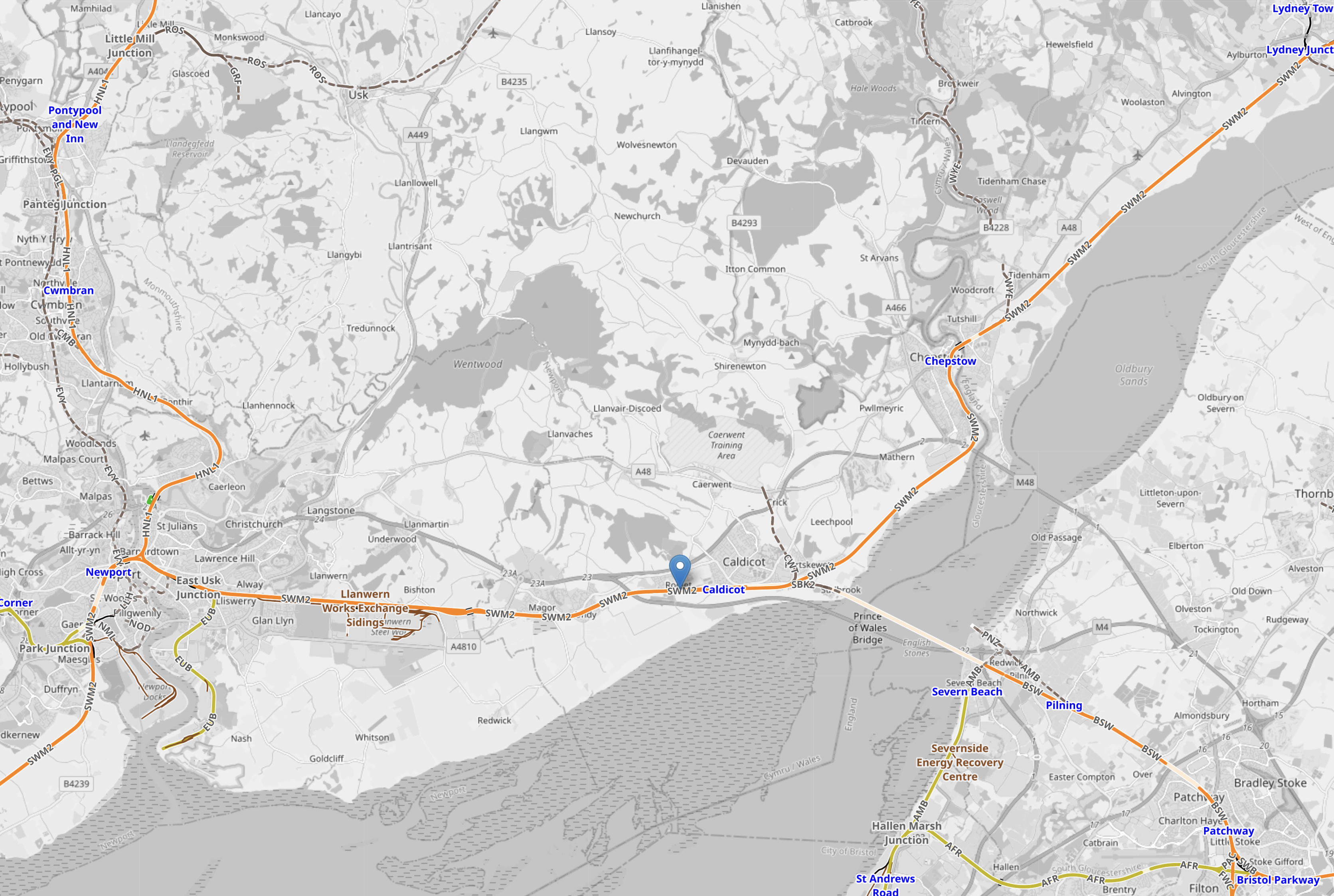
Note.
- Bristol Parkway station is in the South-East corner of the map.
- Severn Tunnel Junction station is marked by the blue arrow in the middle of the map.
- The electrified South Wales Main Line connects Bristol Parkway and Severn Tunnel Junction stations.
- From Bristol Parkway, the electrified Great Western Main Line goes to London Paddington via Swindon and Reading.
- From Severn Tunnel Junction station the South Wales Main Line goes West to Newport, which is on this map and then to Cardiff, Swansea and West Wales.
- Pontypool & New Inn station is in the North-West corner of the map on the Welsh Marches Line between Newport and Crewe stations.
- Welsh Marches Line is connected to the South Wales Main Line at Maindee triangular junction, which is a few miles East of Newport station.
- Cwmbran station is on the Welsh Marches Line between Newport and Pontypool & New Inn stations.
After a quick look on Wikipedia and Real Time Trains, it appears that few if any trains run in either direction between Cwmbran and Severn Tunnel Junction stations using the North-East side of Maindee junction.
Lumo’s trains would use this route to go between Bristol Park and Pontypool & New Inn stations via Severn Tunnel Junction, and Cwmbran.
This second OpenRailwayMap shows the Northern part of the route between Pontypool & New Inn and Hereford stations.
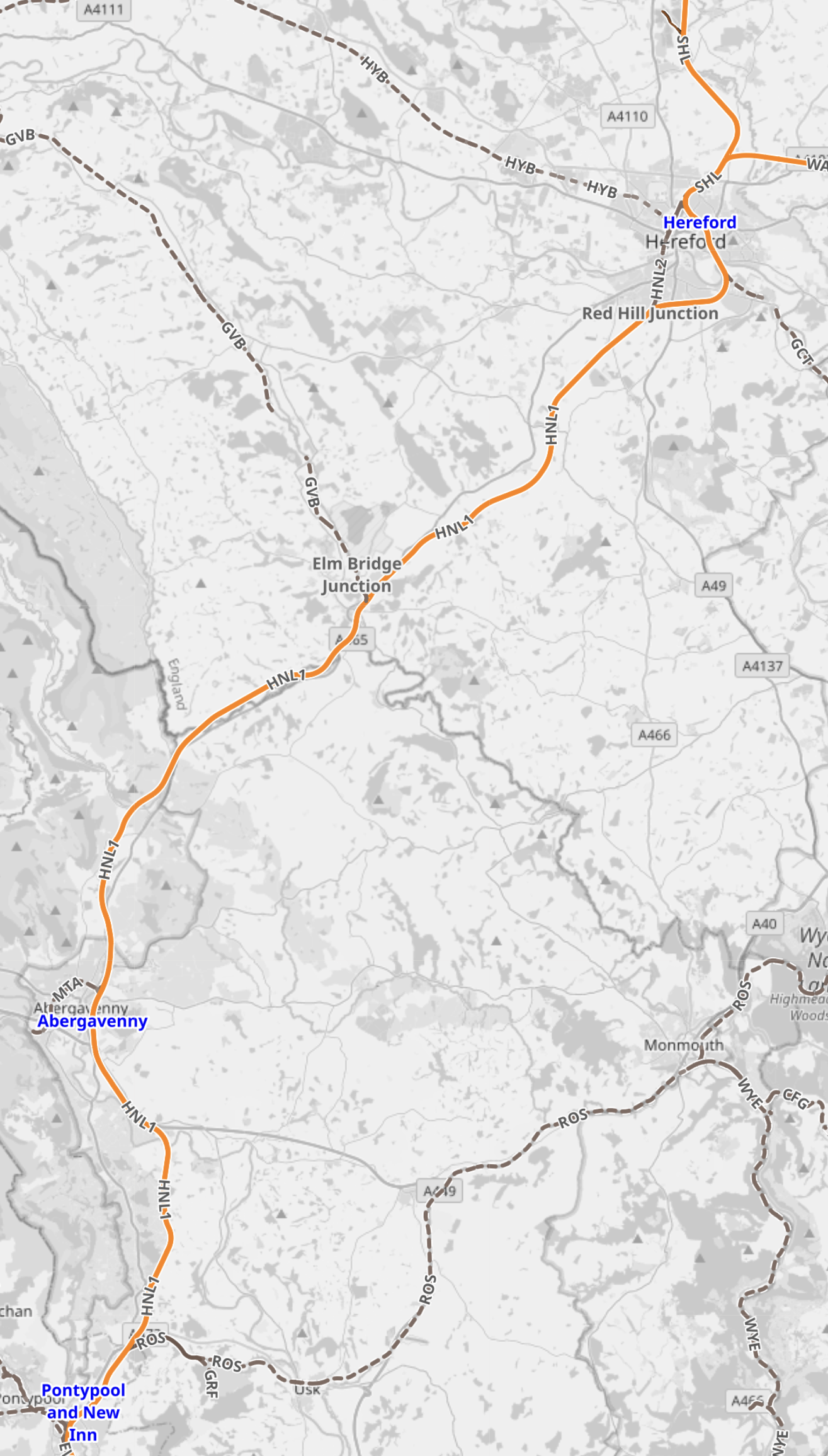
Note.
- The orange track is the Welsh Marshes Line between Newport and Crewe.
- Pontypool & New Inn station is in the South-West corner of the map.
- Abergavenny station is on the West side of the map.
- Hereford station is in the North-East corner of the map.
Looking at the route as a whole, it is a very simple route.
- Trains go as fast as traffic allows, non-stop to Bristol Parkway station.
- Trains then take the South Wales Main Line with a single stop at Severn Tunnel Junction station to Maindee Junction, just to the East of Newport.
- Trains then take the Welsh Marches Line to Hereford stopping at Cwmbran, Pontypool & New Inn and Abergavenny stations.
It is an innovative route, that has these advantages.
- It uses a little-used leg of Maindee Junction.
- London Paddington and Maindee Junction is electrified.
- The fastest Hitachi trains seem to take about one hour and forty minutes between London Paddington and Maindee Junction.
As direct trains between Newport and Hereford take around fifty minutes, a time of two-and-a-half hours between London Paddington and Hereford could be possible.
This would compare with current Great Western Railway services, which take upwards of two hour and forty-five minutes, which often have a change of train.
Lumo Trains Should Be Faster Between London Paddington And Bristol Parkway
This may seem surprising, but most if not all current services stop between London Paddington and Bristol Parkway, stop at Swindon and Reading.
Cutting out a stop saves a few minutes on the journey.
New Trains
The news item says this about new trains.
The new Hereford service would support further investment in new trains. In December 2024 FirstGroup placed a £500m order for 14 trains from Hitachi Rail in County Durham. The Group has an option for a potential second order of similar size and the Hereford fleet would form part of this option.
Yesterday, I went to North Wales and used Avanti West Coast from Euston. The trains both ways were new Class 805 trains, which are bi-mode versions of Lumo’s Class 803 trains. These Class 805 trains travel all the way between Crewe and Holyhead on their diesel engines, so the much shorter leg between Maindee Junction and Hereford will definitely be in range.
But Hitachi are developing battery-electric versions of these trains and as there-and-back between Maindee Junction and Hereford is only 88 miles, I wouldn’t be surprised in a couple of years that Cwmbran, Pontypool & New Inn, Abergavenny and Hereford stations have a direct electric service from London.
Services At Hereford
The news item says this about services at Hereford station.
For Hereford, the two direct London paths each weekday would increase services on this flow from four today, to six. The new services would help mitigate the current large gaps in the timetable with additional daytime and evening arrivals into London, giving Hereford more regular connectivity. The new services would also provide the stations on the route with new direct journey opportunities to Bristol Parkway.
I also believe it would be a faster, fully electric service.
Services At Abergavenny
The Wikipedia entry for Abergavenny station says this about services at the station.
With a few exceptions, the weekday daytime service pattern typically sees one train per hour in each direction between Manchester Piccadilly and Cardiff Central, with most trains continuing beyond Cardiff to Swansea and West Wales. There is also a two-hourly service between Cardiff and the North Wales Coast Line to Holyhead via Wrexham General. These services are all operated by Transport for Wales. The northbound Premier service from Cardiff to Holyhead calls here on Monday to Fridays but the southbound service does not call here.
Note.
- The station has partial step-free access
- The station has 74 parking spaces.
Two trains in each direction would improve the services at Abergavenny station.
Services At Pontypool & New Inn
The Wikipedia entry for Pontypool & New Inn station says this about services at the station.
On weekdays and Saturdays, there is generally a two hourly service between Holyhead and Cardiff in the middle of the day, with additional peak time services southbound in the mornings and northbound in the evenings for commuters to Newport and Cardiff. These include services between Manchester Piccadilly and West Wales via Crewe and Swansea. From December 2013 the evening northbound Arriva “Premier” service train began to call at Pontypool for the first time. The southbound service in the morning does not call here. On Sundays, an irregular service operates, with 8 trains calling southbound and 10 northbound. These mainly run between Manchester and Cardiff.
Note.
- The station is step-free with lifts.
- The station has 150 parking spaces.
Two trains in each direction would improve the services at Pontypool and New Inn station.
Services At Cwmbran
The Wikipedia entry for Cwmbran station says this about services at the station.
Services that stop at Cwmbran in both directions are all operated by Transport for Wales and include the hourly service between Manchester Piccadilly, Cardiff Central and West Wales and the two hourly service between Holyhead and Cardiff Central. Most Sunday services only run on the former route (there are only two services each way to/from Holyhead).
Note.
- The station is being made step-free with lifts.
- The station has 76 parking spaces.
Two trains in each direction would improve the services at Pontypool and New Inn station.
The Heads Of The Valleys Road
The A465 or Heads of the Valleys Road could be considered the South Wlaes equivalent of the North of England’s M62 Motorway.
This description is from the first paragraph of the Wikipedia entry.
Approximately following the southern boundary of the Bannau Brycheiniog National Park, the Ordnance Survey Pathfinder guide describes it as the unofficial border between rural and industrial South Wales. The A465 provides an alternative route between England and the counties in South West Wales and to the ferries to Ireland.
This Google Map shows its route between Merthyr Tydfil and Abergavenny.
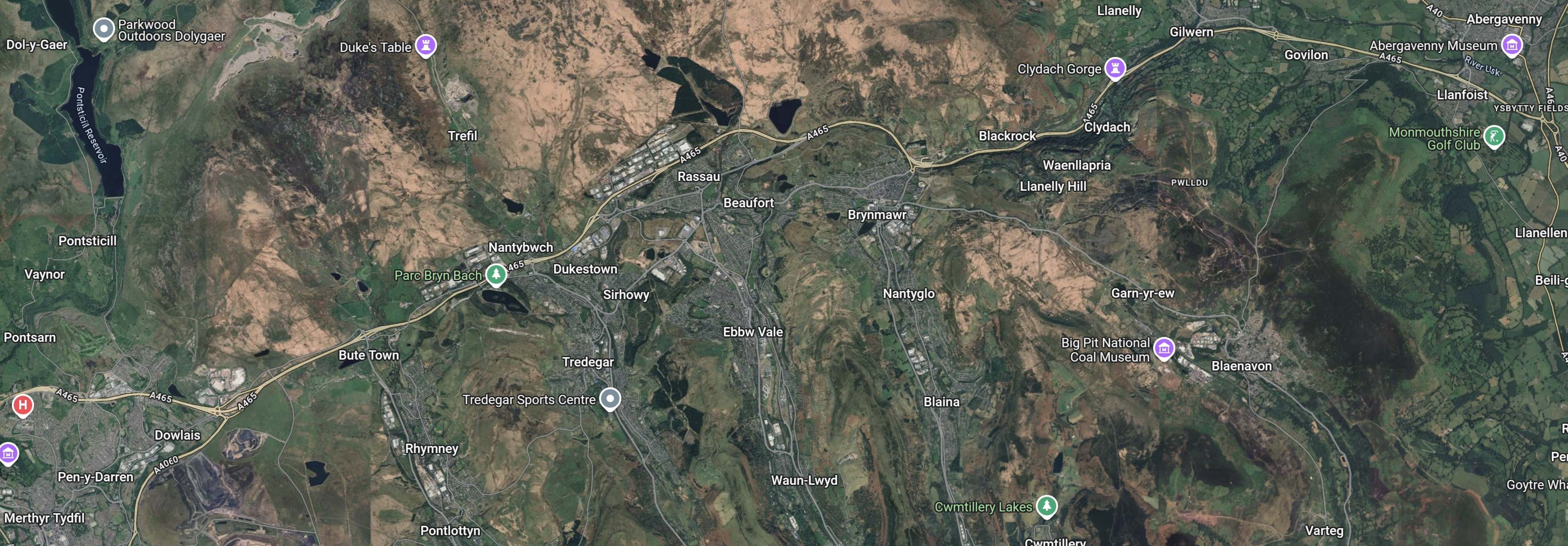
Note.
- Merthyr Tydfil is in the South-West corner of the map.
- Abergavenny is in the North-East corner of the map.
- The full length of the road is just under seventy miles.
- The Heads of the Valleys Road connects to all the towns, that are the Northern termini of the South Wales Metro.
- At it’s Western end, the A 465 connects to the M4 near Swansea.
The news item says this about the tourism benefits of the service.
The new service is expected to have positive economic and social benefits for the communities it serves. Both of FirstGroup’s open access services Lumo and Hull Trains are on track to deliver more than £1.4bn in economic benefits along their routes and FirstGroup hopes to have a similar positive effect for the South Wales and Herefordshire communities.
The service should also provide a convenient link for visitors travelling to the Brecon Beacons/ Bannau Brycheiniog National Park; Blaenavon World Heritage Site and cathedral city of Hereford, driving growth and supporting jobs in the area’s tourism sector.
I do wonder if other tourism related services will be developed at Pontypool & New Inn, Abergavenny and Hereford?
Monmouthshire
This paragraph from the Wikipedia entry for Monmouthshire gives a flavour of the Welsh county.
The county is rural, although adjacent to the city of Newport and the urbanised South Wales Valleys; it has an area of 330 square miles (850 km2) and a population of 93,000. After Abergavenny (population, 12,515), the largest towns are Chepstow (12,350), Monmouth (10,508), and Caldicot (9,813).
I was surprised that the population of the county, was as high as 93,000.
This second paragraph, lists the railway stations.
Monmouthshire is served by four railway stations: in the south are the Severn Tunnel Junction railway station at Rogiet on the South Wales Main Line, which connects South Wales to London; and Chepstow railway station and Caldicot railway station on the Gloucester–Newport line; and in the north, Abergavenny railway station on the Welsh Marches line.
Severn Tunnel Junction and Abergavenny stations will be served by Lumo’s new service.
From my experience of using parkway stations in East Anglia with connections to London, I suspect residents of several towns outside of Monmouthshire will use these two stations for trips to the capital.
Are plans in place for extra parking and bus services?
Travelling To And From Heathrow Airport
I wouldn’t be surprised if Lumo picks up quite a few passengers, who are going to and from Heathrow.
Consider.
- I suspect Severn Tunnel Junction to London Paddington will take about one hour and forty minutes, with just the single stop at Bristol Parkway.
- The Elizabeth Line to the Airport will take 28 minutes and cost £13.90, according to Transport for London.
- The Elizabeth Line is an easy step-free change from National Rail at Paddington.
- Elizabeth Line trains between Paddington and Heathrow are every six minutes.
- It’s not a very long walk at Heathrow between the Elizabeth Line and the terminals.
- Driving from say Monmouth to Heathrow will take about two-and-a-quarter hours and cost you to cross the Severn Bridge and for parking.
If your local Great Western Main Line station is between say Chippenham and Cardiff, you might be surprised at how fast and affordable it can be to go to and from Heathrow by Great Western Railway and Elizabeth Line.
When Lumo starts running to Heathrow, I am sure it will be faster, as the trains will not stop East of Bristol Parkway station.
Running In Conjunction With Services Between London Paddington And Carmarthen
The news item says this about running services in conjunction with Lumo’s services to Carmarthen.
The service would operate in conjunction with the planned service from London to Carmarthen which is due to launch in December 2027, and it is anticipated it could begin at the same time.
Consider.
- Both routes are identical between London Paddington and Maindee Junction.
- Both routes could share depots.
- Hitachi’s trains can split and join with alacrity.
- Class 800, 801, 802 and 803 trains have twenty-six metre cars, which mean a five-car train is 130 metres long.
- Bristol Parkway station has 280 metre long platforms. Pairs of trains could split and join here.
- Seven Tunnel Junction has three 171 metre long platforms. Pairs of trains could not use this station, unless the platforms were lengthened.
- Newport station has three platforms longer than 278 metres. Pairs of trains could split and join here, if the Hereford trains reversed direction.
I suspect if trains split and joined, it would be at Bristol Parkway station.
Note that Bristol Parkway station has 1,800 car park spaces, so Lumo could target passengers wanting to park and take the train to London, Cardiff, Newport and other Welsh destinations.
Co-operation With Great Western Railway
In Does Innovation Get Mr. Ed Miliband Better Prices To Doncaster?, I talked about the ticketing on the East Coast Main Line.
It appears to me, that if you put more seats on a popular route, like King’s Cross and Doncaster, then the availability drives down prices.
I also believe that if the tickets are all available through a common walk-up system, then this fills the seats.
The system has now been applied to the West Coast Main Line and I believe that if Great Western Railway and Lumo collaborated on ticketing, this would improve competition between London Paddington, Bristol Parkway and Cardiff.
There is also the issue of train rescue.
Supposing a pair of five-car Hitachi trains broke down with a fault, that allowed the train to be towed to the nearest station, so that passengers could be disembarked.
Hitachi trains are designed, so that up to twenty-four trains can be joined together in rescue mode.
That would certainly be an impressive sight.
Lumo To Expand Scotland’s Rail Network With New London-Stirling Rail Route From Spring 2026
The title of this post is the same as this news item from Lumo.
These three bullet points act as sub-headings.
- Lumo has secured a new route connecting Stirling with London Euston, launching as early as Spring 2026, offering passengers five daily affordable services.
- The announcement comes as Lumo hosted a special event at Holyrood attended by MSPs and Scotland’s MPs, spotlighting Lumo’s contribution to enhancing rail connectivity for previously underserved communities in Scotland.
- The route will provide first-ever direct services to London for Whifflet, Greenfaulds, and Larbert, further boosting economic opportunities and travel options in Scotland.
This first paragraph adds some more details.
Lumo, the UK’s leading Open Access rail operator, today announced it has secured five Class 222 six-car trains for its forthcoming route between London Euston and Stirling, beginning as early as Spring 2026. This expansion aims to enhance travel choice and connectivity for passengers along the central belt of Scotland both to England and to Stirling, offering five daily services with the operator renowned for affordability and efficiency.
I have some thoughts.
What Is The Complete Route?
This is the complete route.
Lumo’s new route will link London Euston directly to Stirling, also calling at Milton Keynes, Nuneaton, Crewe, Preston, Carlisle, Lockerbie, Motherwell, Whifflet (serving Coatbridge), Greenfaulds (serving Cumbernauld) and Larbert.
It is fully-electrified and can support 125 mph running most, if not all, of the way.
There Are No Six-Car Class 222 Trains
Consider.
- Currently, five-car Class 222 trains seat 192 in Standard Class and 50 in First Class.
- Currently, seven-car Class 222 trains seat 236 in Standard Class and 106 in First Class.
- Lumo’s five-car Class 803 trains set 402 in Standard Class.
- Lumo’s trains have no First Class.
I estimate that a six-car Class 222 train, with all Standard Class seating would accommodate not far off the 402 seats of one of Lumo’s bog-standard Class 803 trains.
Having identical numbers of passengers on the two fleets, must surely bring operational advantages.
- A six-car Class 222 train could replace a five-car Class 803 train or vice-versa, if Lumo were short of trains.
- Class 222 trains are able to take the Great Northern and Great Eastern Joint Line and other diversions during times of engineering works.
- The Class 222 trains would be able to run between Euston and Rochdale.
- The Class 222 trains might be useful for developing services on routes without electrification.
In the future, a six-car Class 222 train could be directly replaced in Lumo’s fleet by a five-car battery-electric Class 803 train.
The Class 222 Trains Are Diesel-Powered
All the noise and vibration could be a problem, but if I am right about the interchangeability of the two fleets, then this gives some advantages too.
- Earlier delivery of Class 222 trains, than new Class 803 trains, may enable Lumo to start services between Euston and Stirling at an earlier date.
- Earlier delivery of Class 222 trains, may allow selective withdrawal of Class 803 trains for updating.
- A mixed fleet of diesel and electric trains may be able to run more services during engineering works, by using diversion routes without electrification.
- Short route extensions to Dundee or Perth could be tried to assess demand.
There could be some good reasons to get the Class 222 trains into service sooner rather than later.
Will The Diesel Class 222 Trains Be Replaced By Battery-Electric Class 803 Trains?
Although London And Edinburgh By Lumo Using the Joint Line Diversion, was also about Lumo’s proposed Euston and Rochdale service, it was mainly about using battery power to use the Great Northern and Great Eastern Joint Line to avoid engineering works or wiring problems.
Both train types have the following abilities.
- Ability to go between Stirling and Euston via the West Coast Main Line.
- Ability to go between Rochdale and Euston via the West Coast Main Line.
- Ability to go between Stirling and King’s Cross via the East Coast Main Line.
- Ability to go between Edinburgh and King’s Cross via the East Coast Main Line.
- Ability to handle the Great Northern and Great Eastern Joint Line on their own power.
- Ability to handle diversions of up to around a hundred miles on their own power.
As Lumo’s new battery-electric Class 803 trains are delivered, Lumo’s two Anglo-Scottish routes and the one to Rochdale can go all-electric.
Can Lumo Trains Run As Pairs?
I’ve not seen or heard if Lumo have done this, but as I wrote in Ten-Car Hull Trains, I’ve seen Lumo’s sister company Hull Trains run ten-car trains.
As Wikipedia says that both Class 222 and Class 803 trains can run in multiple formations with other trains from the same class, I have to assume it is possible, providing the Fat Controller agrees to the practice.
Has Heidi Alexander Really Said Yes?
After the launch at Holyrood, in front of MSPs and Scottish MPs, it would now be difficult to say No!
But then there’s a by-election to the Scottish Parliament in Hamilton, Larkhall and Stonehouse on Thursday.
Is Lumo’s new route an easy drive from the constituency? A Scot, who has worked in the area said Yes!
Conclusion
I like FirstGroup’s plan to create a diesel fleet to introduce new services and back up their current ones, until the new battery-electric Class 803 trains are delivered.
Is FirstGroup’s Order For Fourteen Trains For Lumo And Hull Trains More Identical Than Is Generally Assumed?
Currently, Hull Trains operate Class 802 trains and Lumo operate Class 803 trains.
Both trains are five-car Hitachi A-Trains and appear to be similar in size, although there are other differences.
- Hull Trains have a two-class layout, whereas on Lumo everybody sits in the same class.
- Hull Trains are a true bi-mode with the 700 kW Rolls-Royce mtu diesel generators.
- Lumo only have a battery for emergency hotel power.
- Hull Trains currently operate a route, where up to a hundred miles in each round trip can be on diesel.
- Lumo’s current route is all electric.
However, the differences in train specification doesn’t stop the two operators using each other’s trains.
This is from an article in the November 2023 Edition of Modern Railways, that is entitled Extra Luggage Racks For Lumo.
The co-operation between sister East Coast mail line open access operators Lumo and Hull Trains continues, with one recent move, being the use of a Hull Trains ‘802’ on Lumo services to cover for a shortage of the dedicated ‘803s’ while one unit was out of action for repairs following a fatality. Although the two types are similar, there are notable differences, most obviously that the Hull Trains units are bi-modes while the Lumo sets are straight EMUs and a training conversion course is required for Lumo drivers on the ‘802s’. There are also challenges from a passenger-facing perspective – The Hull Trains units have around 20 % fewer seats and a First Class area.
A future Chief Executive of FirstGroup might at some future date decide to convert all trains to the same specification.
Drive Systems Of The Five-Car Class 80x Trains
I’m writing them down for all the five-car Class 80x trains to make it easier to understand.
- Class 800 train – DPTS–MS-MS-MC–DPTF – (LNER) 3 x 560 kW or (GWR) 3 x 700 kW diesel generators.
- Class 801 train – DPTS–MS-MS-MC–DPTF – 1 x 560 kW diesel generators
- Class 802 train – DPTS–MS-MS-MC–DPTF – (LNER) 3 x 700 kW diesel generators.
- Class 803 train – DPTS–MS-MS-MS–DPTF
- Class 805 train – DPTS–MS-MS-MC–DPTF – 3 x 700 kW diesel generators.
- Class 810 train – DPTS–MS-MS-MC–DPTF – 4 x 735 kW diesel generators.
Note.
- All these five-car trains have the same drive configuration.
- Traction motors are on cars 2 and 4.
- Trains with one diesel generators have them under car 3.
- Trains with three diesel generators have them under cars 2/3/4.
- Trains with four diesel generators have them under cars 1/2/4/5.
- The traction battery in the Class 802 battery-electric test train was 750 kW, according to The Data Sheet For Hitachi Battery Electric Trains.
It is all a very balanced design.
A Standard Basic Train For Hull Trains And Lumo
This may be possible and could be the following.
- A Class 802 or Class 803 train to the latest specification.
- Five cars.
- Interior to the customers specification.
- Ability to work in pairs.
- A standard size traction battery in car 3.
The battery could be changed according to route.
- Carmarthen – 75.3 miles – See Thoughts On Lumo’s Proposed Paddington And Carmarthen Service.
- Edinburgh – 100 miles – To cover the Lincolnshire Diversion.
- Hull – 100 miles – To cover the Lincolnshire Diversion.
- Paignton – 128.2 miles – See Thoughts On Lumo’s Proposed Paddington And Paignton Service.
- Rochdale – 100 miles to cover reverse at Rochdale.
- Sheffield – 100 miles – To cover Retford and Sheffield both ways.
- Stirling – Possibly no batteries required.
I can see a battery range of 100 miles covering most routes.
There could be two or three batteries close together in cars 2, 3 and 4, driving the traction motors in cars 2 and 4 and being charged by them.
These are my thoughts on individual Hull Trains and Lumo routes.
Beverley And Hull
In Could Hull Station Be Electrified?, I put forward my view that if Hull station were to be electrified, it opens up various possibilities of running battery-electric trains to Hull and Beverley.
Hull Trains services would charge the battery, every time they went through Hull station.
Distances needed on battery power to electrification would be.
- Beverley – 16.7 miles for return trip.
- Bridlington – 31.1 miles
- Doncaster – 40.8 miles
- Scarborough – 53.8 miles
- Temple Hirst – 36.1 miles
Except for Scarborough, a single battery would probably suffice.
Beverley and Hull are handled without a battery at present, but Hull Trains might like to carry sufficient power in batteries to be able to handle the Lincoln Diversion.
Carmarthen
Cardiff and Carmarthen via Gowerton is 75.3 miles, which probably means two batteries would be needed.
See Thoughts On Lumo’s Proposed Paddington And Carmarthen Service, for more details.
Edinburgh
Edinburgh is handled without a battery at present, but Lumo might like to carry sufficient power in batteries to be able to handle the Lincoln Diversion.
Paignton
Paignton is the longest route at 128.2 miles and I doubt, it would be talked about if it wasn’t technically possibly.
See Thoughts On Lumo’s Proposed Paddington And Paignton Service, for more details.
Rochdale
Sheffield
Stirling
Stirling could be handled without a battery, but Lumo might like to carry sufficient power in batteries to be able to handle a small diversion.
Scotland To Get New Intercity Fleet
The title of this post is the same as that of this press release from Transport Scotland.
These eight paragraphs make up the body of the press release.
The Scottish Government announced today that procurement will begin to replace the trains in its Intercity fleet.
The procurement will seek a replacement for the High Speed Train (HST) fleet of 25 trains which operates on its InterCity routes between Glasgow, Edinburgh, Aberdeen, and Inverness.
Cabinet Secretary for Transport, Fiona Hyslop said:
“Resilient, reliable ScotRail services are key to encouraging more people to choose to travel by train for work, leisure and learning.
“Over 4 million passengers travelled on InterCity trains between our key cities in the last year – we want to encourage even more people to do so. This procurement will enable us to replace the current Intercity fleet with trains which provide improved facilities and accessibility.
“Any replacement fleet is expected to be more energy efficient and therefore will significantly reduce emissions, reduce operating costs and be more in line with current passenger expectations, including for accessibility. The procurement process ensures Scottish suppliers will be able to offer to provide their services to potential bidders.
“This latest milestone in our rolling programme of decarbonisation will ensure the reliability of our Intercity routes for the long-term, making Scotland’s railway a more attractive and greener travel choice.”
Further details on this announcement will be shared when the contract is awarded in 2025. It is also expected that the refreshed Decarbonisation Action Plan will be published in Spring 2025, and this will detail updated targets for replacing ScotRail’s existing diesel fleets.
It is a press release full of good intentions, but very few facts.
Is this what Scots get from their political party?
I have a few questions.
Will The Trains Be Built In The UK?
This must surely give some advantages, but will it get the best trains at the best price?
What Will Be The Number And Capacity Of The Trains?
Transport Scotland could go for a like for like number and capacity replacement.
- But there have been capacity problems in Scotland, which have meant using diesel Class 153 trains as baggage cars.
- They might also want to add extra services.
- Will they replace the train lost at Stonehaven?
They could add a few options.
Other Companies May Need Similar Trains
Consider.
- GWR will need to replace their similar Castles.
- CrossCountry will need new trains.
- Grand Central will need new trains.
- South Western Railway may need new trains for services between Cardiff and Devon.
- Transport for Wales may need new trains.
Hull Trains and Lumo have recently ordered a selection of new Hitachi Class 802 and 803 trains, which I wrote about in Fourteen New Trains To Drive First Rail Open Access Growth.
I can see an argument for buying more Hitachi Class 80x trains, as it will surely save Great British Railways costs in the long time.
Should The New Trains Be A Forever Solution?
When British Rail electrified to Brighton, Crewe, Edinburgh, Glasgow, Leeds, Liverpool, Manchester, Newcastle, Norwich, Portsmouth, Southampton, Weymouth and many other places from London, they saw it as a mode of traction, that would be used forever.
As the trains wore out or got outdated, they would be replaced with trains, which at least could run using the same mode of traction.
Generally, on electrified routes, when British Rail’s electric trains have been replaced, they have been replaced by more modern new electric trains.
The one major exception was on the East Coast Main Line where some InterCity 225 trains were replaced with Hitachi Class 800 and Class 802 diesel bi-mode trains.
But as the Class 800 and Class 802 diesel bi-mode trains were also replacing InterCity125 trains, they were a pragmatic replacement.
The Hitachi trains can be considered a Forever Solution, as bi-mode trains will always be able to work some routes that will never get electrified.
But Hitachi are developing the successor to their diesel bi-mode train, which is the tri-mode train, capable of running on electrification, diesel or battery power.
- Diesel power-packs can be swapped for battery packs.
- The battery packs have the same weight and power as a diesel power-pack.
- Existing diesel bi-mode trains can be converted to tri-mode or battery-electric bi-mode trains.
- A range of over forty miles on a single battery pack has been demonstrated.
Could Hitachi tri-mode trains be The replacements for the Inter7City trains?
Will Some Trains Have A Battery Electric Capability?
I very much believe so, as some routes in Scotland could be decarbonised by battery-electric trains.
What Top Speed Would The Trains Have?
Most of the routes in Scotland, where new modern quality rolling stock is needed, has a top speed of less than 100 mph, but in places the top speed is 125 mph.
I suspect, if trains can run at 125 mph in the places, where it is allowed, could probably save a few minutes on journey times.
Take the Borders Railway.
- The electrification runs out at Brunstane. Batteries would be charged between Edinburgh and Brunstane using the existing electrification.
- To go from Brunstane to Tweedbank and return to Brunstane is 63 miles.
- To work the Borders Railway would need a battery range of 63 miles.
I suspect every route in Scotland could have an electrification strategy for use with battery-electric trains. Some of which would have short lengths of extra electrification.
What Lengths Would The Trains Be?
In my example I used the Borders Railway.
A typical service is run by a three-car Class 170 train or two such trains running as a pair.
Perhaps, a single four- or five-car train could work the service all day and still provide enough capacity?
Conclusion
I believe, that Scotrail services could be electrified line-by-line.
Some lines would need more or longer trains and an update to the electrification.
 The Anonymous Widower