Rolls-Royce And Duisport Launch CO2-Neutral, Self-Sufficient Energy System For New Port Terminal
The title of this port is the same as that of this press release from Rolls-Royce.
These two bullet points act as sub-headings.
- First mtu hydrogen CHP units, battery storage systems and fuel cell systems from Rolls-Royce in operation.
- Benchmark for sustainable energy supply in logistics centers worldwide.
These three paragraphs give more details of the project.
Rolls-Royce and Duisburger Hafen AG have opened a CO2-neutral and self-sufficient energy system for the new Duisburg Gateway Terminal, located in the Rhine-Ruhr industrial region of Germany. The core components are two mtu combined heat and power units designed for operation with 100 percent hydrogen, which are being used here for the first time worldwide. The system is supplemented by an mtu battery storage system, mtu fuel cell systems and a photovoltaic system integrated via an intelligent energy management system.
The Enerport II flagship project, funded by the German Federal Ministry for Economic Affairs and Energy, is setting new standards for sustainable energy supply in large logistics centers and is considered a model for other ports, infrastructure projects and industrial facilities. Project partners include the Fraunhofer Institute UMSICHT, Westenergie Netzservice GmbH, Netze Duisburg GmbH, Stadtwerke Duisburg AG, and Stadtwerke Duisburg Energiehandel GmbH.
“The launch of this carbon-neutral energy system at the Duisburg Gateway Terminal is a big step toward a more climate-friendly, resilient energy supply. Together with our partner duisport, we’re showing how scalable technologies from Rolls-Royce can really help transform critical infrastructure – and help make the energy transition happen,” said Dr. Jörg Stratmann, CEO of Rolls-Royce Power Systems.
Note.
- It is carbon-neutral.
- The system uses both hydrogen and solar power.
- What has been created at the Port of Duisburg is considered by the German Federal Ministry for Economic Affairs and Energy to be a model for other ports, infrastructure projects and industrial facilities.
- It surely must help sales, that the flagship project is up and running.
In November 2021, I wrote about this project in Rolls-Royce Makes Duisburg Container Terminal Climate Neutral With MTU Hydrogen Technology, which included this graphic.

It seems that Heathrow Airport could have a use for this technology.
I have one important thought.
Where Will The Port Of Duisburg Get The Hydrogen It Needs?
In the graphic an Electrolyser and H2 Storage are clearly shown, as are the two H2 Combined Heat and Power Units.
So it looks like the Port of Duisburg will be generating their own green hydrogen.
Alternatively in April 2021, I wrote Uniper To Make Wilhelmshaven German Hub For Green Hydrogen; Green Ammonia Import Terminal.
Uniper’s plans for the Wilhelmshaven hydrogen hub include a 410 MW hydrogen electrolyser.
The Germans are also developing a project called AquaVentus to bring green hydrogen to Germany from the North Sea.
I asked Google AI, where AquaVentus would make landfall in Germany and got this answer.
The AquaVentus project’s planned offshore hydrogen pipeline, AquaDuctus, is intended to make landfall in the greater Wilhelmshaven or Büsum area in Germany, according to the AquaDuctus website. This pipeline is part of a larger plan to transport green hydrogen produced from offshore wind farms in the North Sea to the German mainland for distribution and use.
Wilhelmshaven and Duisburg is 194 miles.
Hydrogen could be delivered onward from Ludwigshaven to Southern Germany by a pipeline network called H2ercules.
I asked Google AI if the H2ercules hydrogen pipeline will connect to Duisburg and got this answer.
Yes, the H2ercules hydrogen network will connect to Duisburg. Specifically, a new 40-kilometer pipeline will be constructed from Dorsten to Duisburg-Walsum, connecting to the steelworks there, as part of the GET H2 pipeline extension according to thyssenkrupp Steel. This connection is part of the larger H2ercules project, which aims to create a hydrogen infrastructure backbone for Germany and beyond. The pipeline is scheduled to be operational in 2027, with thyssenkrupp Steel being connected in 2028.
It would appear that at some date in the not too distant future that the Port of Duisburg could be powered by green hydrogen from the North Sea, imported into Germany at Wilhelmshaven.
The German plans for hydrogen are extensive and it appears that the Port of Duisburg could have two sources for the hydrogen it needs.
mtu Engines From Rolls-Royce Provide Emergency Power On Offshore Wind Platforms In The UK
The title of this post, is the same as that of this press release from Rolls-Royce.
These two bullet points act as sub-headings.
- Four engines from the mtu Series 4000 provide emergency power for two converter platforms
- Norfolk wind farm will generate electricity for demand from more than four million households
This opening paragraph adds more detail.
Rolls-Royce has received a second order from Eureka Pumps AS to supply mtu Series 4000 engines to power emergency power generators for the Norfolk Offshore Wind Farm on the east coast of the United Kingdom. Rolls-Royce will thus supply a total of four mtu engines for the first and second phases of the large wind farm, which is operated by energy supplier RWE. The engines will be installed on two converter platforms at sea and onshore, which are the heart of the offshore grid connection: they ensure that the electricity generated at sea can be fed into the power grid. With a total capacity of 4.2 GW, the wind farm is expected to generate electricity for more than four million households during the course of this decade. It is located 50 to 80 kilometers off the east coast of the UK.
In some ways I find it strange, that a diesel generator is used to provide the necessary emergency power.
But when I asked Google if mtu 4000 generators can operate on hydrogen. I got this answer.
Yes, mtu Series 4000 engines, specifically the gas variants, can be adapted to run on hydrogen fuel. Rolls-Royce has successfully tested a 12-cylinder mtu Series 4000 L64 engine with 100% hydrogen fuel and reported positive results. Furthermore, mtu gas engines are designed to be “H2-ready,” meaning they can be converted to operate with hydrogen, either as a blend or with 100% hydrogen fuel.
That seems very much to be a definite affirmative answer.
So will these mtu Series 4000 engines for the Norfolk wind farms be “H2 ready”? The hydrogen needed, could be generated on the platform, using some form of electrolyser and some megawatts of electricity from the wind farms.
Will The Norfolk Wind Farms Generate Hydrogen For Germany?
Consider.
- Germany needs to replace Russian gas and their own coal, with a zero-carbon fuel.
- Germany is developing H2ercules to distribute hydrogen to Southern Germany.
- Germany is developing AquaVentus to collect 10 GW of hydrogen from wind-powered offshore electrolysers in the North Sea.
- The AquaVentus web site shows connections in the UK to Humberside and Peterhead, both of which are areas, where large hydrogen electrolysers are bing built.
- In addition Humberside has two of the world’s largest hydrogen stores and is building a 1.8 GW hydrogen-fired powerstation.
- The Norfolk wind farms with a capacity of 4.2 GW, are not far from the border between British and German waters.
- To the North of the Norfolk wind farm, RWE are developing the 3 GW Dogger Bank South wind farm.
- 7.2 GW of British hydrogen would make a large proportion of the hydrogen Germany needs.
I clipped this map from a video about Aquaventus.

Note.
- The thick white line running North-West/South-East is the spine of AquaVentus, that will deliver hydrogen to Germany.
- There is a link to Esbjerg in Denmark, that is marked DK.
- There appears to be an undeveloped link to Norway, which goes North,
- There appears to be an undeveloped link to Peterhead in Scotland, that is marked UK.
- There appears to be a link to just North of the Humber in England, that is marked UK.
- Just North of the Humber are the two massive gas storage sites of Aldbrough owned by SSE and Brough owned by Centrica.
- Aldbrough and Rough gas storage sites are being converted into two of the largest hydrogen storage sites in the world!
- There appear to be small ships sailing up and down the East Coast of the UK. Are these small coastal tankers, that are distributing the hydrogen to where it is needed?
When it is completed, AquaVentus will be a very comprehensive hydrogen network.
It will also be a massive Magic Money Tree for the UK Treasury.
So why is this vast hydrogen system never mentioned?
It was negotiated by Clair Coutinho and Robert Habeck, back in the days, when Boris was Prime Minister.
Centrica And Equinor Agree Major New Deal To Bolster UK Energy Security
The title of this post, is the same as that as this news item from Centrica.
This is the sub-heading.
Centrica and Equinor have today announced a £20 billion plus agreement to deliver gas to the UK. The new deal will see Centrica take delivery of five billion cubic meters (bcm) of gas per year to 2035.
These three paragraphs add more detail to the deal.
The expansive ten-year deal continues a long-term relationship with Equinor that dates back to 2005 bringing gas from Norway to the UK.
In 2024, the UK imported almost two-thirds (66.2%) of its gas demand, with 50.2% of the total imports coming from Norway1. This is an increase from the UK importing around a third of its gas requirements from Norway in 20222 and underlines the strategic importance of the Norwegian relationship to UK energy and price security.
The contract also allows for natural gas sales to be replaced with hydrogen in the future, providing further support to the UK’s hydrogen economy.
I believe there is more to this deal than, is stated in the news item.
These are my thoughts.
Where Does AquaVentus Fit In?
The AquaVentus web site has a sub heading of Hydrogen Production In The North Sea.
This video on the web site shows the structure of the project.
I clipped this map from the video.
Note.
- The thick white line running North-West/South-East is the spine of AquaVentus, that will deliver hydrogen to Germany.
- There is a link to Esbjerg in Denmark, that is marked DK.
- There appears to be an undeveloped link to Norway, which goes North,
- There appears to be an undeveloped link to Peterhead in Scotland, that is marked UK.
- There appears to be a link to just North of the Humber in England, that is marked UK.
- There appears to be an extra link, that would create a hydrogen link between Norway and Humberside.
- Just North of the Humber are the two massive gas storage sites of Aldbrough owned by SSE and Brough owned by Centrica.
- Aldbrough and Rough gas storage sites are being converted into two of the largest hydrogen storage sites in the world!
- There appear to be small ships sailing up and down the East Coast of the UK. Are these small coastal tankers, that are distributing the hydrogen to where it is needed?
When it is completed, AquaVentus will be a very comprehensive hydrogen network.
RWE
I should add that AquaVentus is a project of German energy company; RWE.
It should be noted that RWE are the largest generator of electricity in the UK.
They will soon be even larger as they are developing these offshore wind farms in British waters.
- Dogger Bank South – 3 GW
- Norfolk Boreas – 1.4 GW
- Norfolk Vanguard East – 1.4 GW
- Norfolk Vanguard West – 1.4 GW
Note.
- This is 7.2 GW of electricity.
- The three Norfolk wind farms wwere possibly acquired at a bargain price from Vattenfall.
- None of these wind farms have Contracts for Difference.
- RWE are developing large offshore electrolysers.
- East Anglia is in revolt over pylons marching across the landscape.
I wonder, if RWE will convert the electricity to hydrogen and bring it ashore using AquaVentus, coastal tankers or pipelines to existing gas terminals like Bacton.
The revenue from all this hydrogen going to Germany could explain the rise in Government spending, as it could be a Magic Money Tree like no other.
HiiROC
HiiROC is a Hull-based start-up company backed by Centrica, that can turn any hydrocarbon gas, like chemical plant waste gas, biomethane or natural gas into turquoise hydrogen and carbon black.
I asked Google about the size of Norway’s chemical industry and got this reply.
Norway’s chemical industry, including oil refining and pharmaceuticals, is a significant part of the country’s economy. In 2023, this sector generated sales of NOK 175 billion (approximately €15.2 billion), with 83% of those sales being exports. The industry employed 13,800 full-time equivalents and added NOK 454 billion (approximately €3.9 billion) in value.
Isn’t AI wonderful!
So will Norway use HiiROC or something similar to convert their natural gas and chemical off-gas into valuable hydrogen?
If AquaVentus were to be extended to Norway, then the hydrogen could be sold to both the UK and Germany.
A scenario like this would explain the option to switch to hydrogen in the contract.
Aldbrough And Brough
Earlier, I said that just North of the Humber are the two massive gas storage sites of Aldbrough owned by SSE and Brough owned by Centrica.
I have read somewhere, that Germany is short of hydrogen storage, but I’m sure Centrica and SSE will help them out for a suitable fee. Centrica are also thought to be experts at buying energy at one price and selling it later at a profit.
Conclusion
I have felt for some time, that selling hydrogen to the Germans was going to be the Conservative government’s Magic Money Tree.
Has this Labour government decided to bring it back to life?
A New Era For Train Travel – FlixTrain Has Ordered 65 New European High-Speed Trains
The title of this post, is the same as that of this press release from Flix.
These four bullet points act as sub-headings.
- FlixTrain has ordered 65 new European high-speed trains, produced by Spanish train manufacturer Talgo, with locomotives supplied by Siemens
- The contract volume amounts up to EUR 2.4 bn, including certain maintenance services
- Flix sees enormous market potential for FlixTrain in Germany and Europe
- CEO André Schwämmlein: “We will start a new era of train travel”
These three paragraphs add more details.
FlixTrain, a subsidiary of the global travel–tech company Flix SE, today announced that it has ordered 65 new European high-speed trains. Talgo will provide the respective trainsets and certain maintenance services, while Siemens will provide the locomotives. The contract volume amounts up to EUR 2.4 bn, of which more than EUR 1 bn is already firmly committed.
With this strategic move, FlixTrain is responding to the growing demand for fast and affordable rail travel. The company intends to use the new high-speed trains to leverage the enormous market potential in Germany and Europe. The high-speed rail market in Germany is expected to grow by 45% by 2030, compared to 2021 volume. Across Europe, the market potential is even greater – around EUR 27 bn in 2023 with an expected annual growth of 4 – 5%.¹ In 2024 alone, FlixTrain expanded its offering by 40%, and recorded significant passenger growth, building on the strong results of 2023.
“We are pursuing a long-term strategy with FlixTrain and we will significantly expand our services in the coming years,” says André Schwämmlein, CEO and co-founder of Flix. “With the tremendous expansion of our train fleet, we will start a new era of train travel in Germany and Europe.” FlixTrain’s overall goal is to bring more people to sustainable travel by train: “We plan not only to increase our market share, but also to significantly grow the market itself”.
It looks like they’re creating a Lumo in Germany.
I have some thoughts.
The Politics
The press release says this about the German government’s view.
On the political side, the newly formed German government has acknowledged the immense potential of long-distance rail by committing to long-term investments in rail infrastructure and a reform of the track access system in Germany. These plans could unlock more private investment in Germany’s rail sector, fostering innovation for a broader range of services. Ultimately, this would lead to more competition and a better offer for customers.
I don’t think, they would be allowed to set up in the UK, as they take revenue from Great British Railways.
I can also see FlixTrain appealing to a future Reform UK government.
Passenger Service
The press release says this.
At the same time, FlixTrain works closely with the European Commission to foster European train travel and to provide a better overall offer for passengers.
I can see FlixTrain providing a better value service in Europe, than that provided in the UK by Great British Railways.
FlixTrain Is A European Product
The press release says this.
Currently, thanks to a comprehensive cooperation with regional transport, around 650 destinations are bookable via FlixTrain; 50 cities are directly connected to the vast FlixTrain network. Together with around 300 FlixBus stops in Germany alone, Flix provides a unique intermodal long-distance travel offer of international bus services and high-speed train connections. The new trains are intended to drive expansion in Germany and other European countries. “We see FlixTrain as a European product. Starting from our home market, we also want to make the service available in other countries” adds Schwämmlein.
I regularly see Flixbuses in London on their way to where?
Conclusion
If FlixTrain is allowed to setup in the UK, Great British Railways is finished for long distance services.
So of course, it won’t be allowed to setup in the UK or even come through the Channel Tunnel.
Technology Behind Siemens Mobility’s British Battery Trains Hits The Tracks
This title of this post is the same as that of this news item from Siemens, which was published in December 2024.
These three bullet points introduce the news item.
- The Mireo Plus B battery train is rolled out in the East Brandenburg network, Germany, using the same technology as the British Desiro Verve project.
- The Desiro Verve would save £3.5 billion and 12 million tonnes in CO2 emissions for Britain’s railways over 35 years.
- The development marks the latest step of this technology’s journey to Britain’s railways.
No-one, including me, seemed to have spotted this news item, especially, since it is significant to both the UK and Germany.
But then parts of Siemens’s home country; Germany and Yorkshire, where they are building, a train factory to build London’s new Piccadilly Line trains have something big in common – There is a distinct shortage of electric trains and the overhead wires to power them.
So did German engineers, egged on by pints of British real ale, realise that their battery-electric technology for the Mireo Plus B battery-electric train, would turn a Desiro City multiple unit, like the Class 700, 707 or 717 into battery-electric trains.
These are three paragraphs from the Siemens news item.
The innovative technology behind Siemens Mobility’s British battery trains has been rolled out in the East Brandenburg network in Germany.
31 of the company’s Mireo Plus B trains are being phased in to the Berlin Brandenburg metropolitan region, beginning on Sunday (15 December) and is the latest proof point of the technology that underpins the Desiro Verve project in Britain. This follows the debut of this technology on 27 new trains in the Ortenau region of Germany in April, with more set to arrive in Denmark in 2025.
The British Desiro Verve trains would be assembled at Siemens Mobility’s new Train Manufacturing Facility in Goole, East Riding of Yorkshire, formally opened by the Transport Secretary and Mayor of London in October.
I’d always wondered, what Siemens would do with this factory, when it had finished making the Piccadilly Line trains.
It also should be noted, that the boss of Siemens UK, when the Goole factory was planned was Jürgen Maier, who according to his Wikipedia entry has Austrian, British and German citizenship and is now the boss of Great British Energy.
I believe that Siemens have big plans for the Goole factory.
One thing it has, that at the present time could be a problem in Germany, is large amounts of renewable electricity and hydrogen, so will energy-intensive components for trains be made at Goole?
It will be interesting to see how the Goole factory develops.
The Desiro Verve Train For The UK and Ireland
In the Siemens news item, their Joint CEO for the UK and Ireland; Sambit Banerjee, says this.
The Desiro Verve would be assembled at our state-of-the-art Goole Rail Village in Yorkshire and offers an integrated solution to replace Britain’s aging diesel trains without having to electrify hundreds of miles of track, saving the country £3.5 billion over 35 years and providing a practical path to decarbonising British railways.”
In June, Siemens Mobility identified how the Desiro Verve could save Britain’s railways £3.5 billion over 35 years compared with using diesel-battery-electric ‘tri-mode’ trains. This would support the Government’s aim of removing diesel-only trains from Britain’s railways by 2040.
The British trains would be powered by overhead wires on already electrified routes, then switch to battery power where there are no wires. That means only small sections of the routes and/or particular stations have to be electrified with overhead line equipment (OLE), making it much quicker and less disruptive to replace diesel trains compared to full electrification.
I agree with his philosophy.
The Rail Charging Converter
When I wrote Cameron Bridge Station – 15th May 2025, I described how a short length of overhead electrification could be erected at the station to charge passing trains, using their pantographs.
Cameron Bridge station is lucky in that there is already a 132,000 KVAC electricity connection to the distillery next door.
But at other places, where there is no connection, you could wait as long as seven years to be connected to the grid.
So Siemens have come up with the Rail Charging Converter, that provides a local electricity supply to support the charger.
It is described in this paragraph from the news item.
This OLE can also be installed much more quickly using Siemens Mobility’s innovative Rail Charging Converter (RCC), which makes it possible to plug directly into the domestic grid – potentially cutting delivery times for OLE from seven years to as little as 18 months.
This Siemens visualisation shows a Verve train and an RCC.
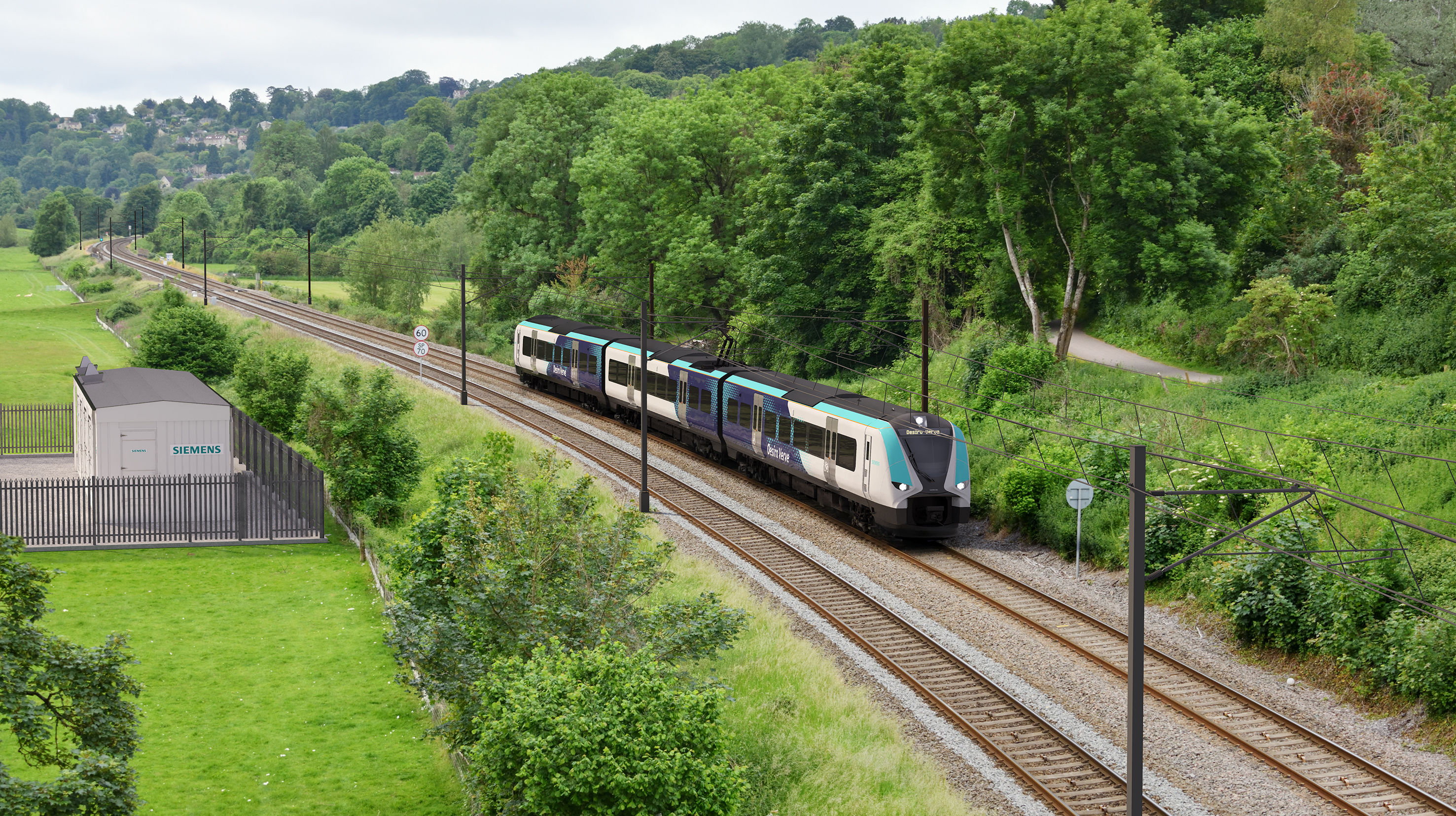
This arrangement could be used in sensitive countryside or close to historic buildings.
Modern Railways – June 2025
There is an article about the Siemens technology in the June 2025 Edition of Modern Railways.
It is called The Battery Revolution Starts In Long Marston for which this is part of the sub-heading.
New technology being installed by Siemens Mobility at Porterbrook’s test facility paves the way for widespread use of battery trains in the UK.
The article is a must-read.
Conclusion
Siemens appear to have the technology with their Rail Charging Converter and battery-electric trains like the Verve and the Mireo Plus B, to be able to decarbonise lines without electrification all over the world.
Would larger gauge trains be delivered from Germany and smaller gauge ones from Goole?
I wouldn’t be surprised that a version for a German S-Bahn could share more characteristics, with a small British train, than a large German one.
I can also see an underground railway, that was built without power in the tunnels. So if you were building the Waterloo and City Line today, would it be battery-electric and charged at each end of the line using a pantograph?
Ørsted Pulls Plug On 2.4 GW Hornsea 4 Offshore Wind Project In UK
The title of this post, is the same as that of this article on offshoreWIND.biz.
This is the sub-heading.
Ørsted has discontinued the development of the UK’s Hornsea 4 offshore wind farm in its current form. The developer said the 2.4 GW project has faced rising supply chain costs, higher interest rates, and increased construction and delivery risks since the Contract for Difference (CfD) award in Allocation Round 6 (AR6) in September 2024.
This introductory paragraph adds more detail.
In combination, these developments have increased the execution risk and deteriorated the value creation of the project, which led to Ørsted stopping further spending on the project at this time and terminating the project’s supply chain contracts, according to the Danish company. This means that the firm will not deliver Hornsea 4 under the CfD awarded in AR6.
Consider.
- Hornsea 4 will be connected to the grid at a new Wanless Beck substation, which will also include a battery and solar farm, which will be South West of the current Creyke Beck substation. Are Ørsted frightened of opposition from the Nimbies to their plans?
- I also wonder if political uncertainty in the UK, and the possibility of a Reform UK government, led by Nigel Farage is worrying companies like Ørsted.
So will factors like these prompt companies like Ørsted to move investment to countries, where they welcome wind turbines like Denmark, Germany and The Netherlands.
Could Ørsted Be Looking At An Alternative?
This is a map of wind farms in the North Sea in the Dogger Bank and Hornsea wind farms, that I clipped from Wikipedia..
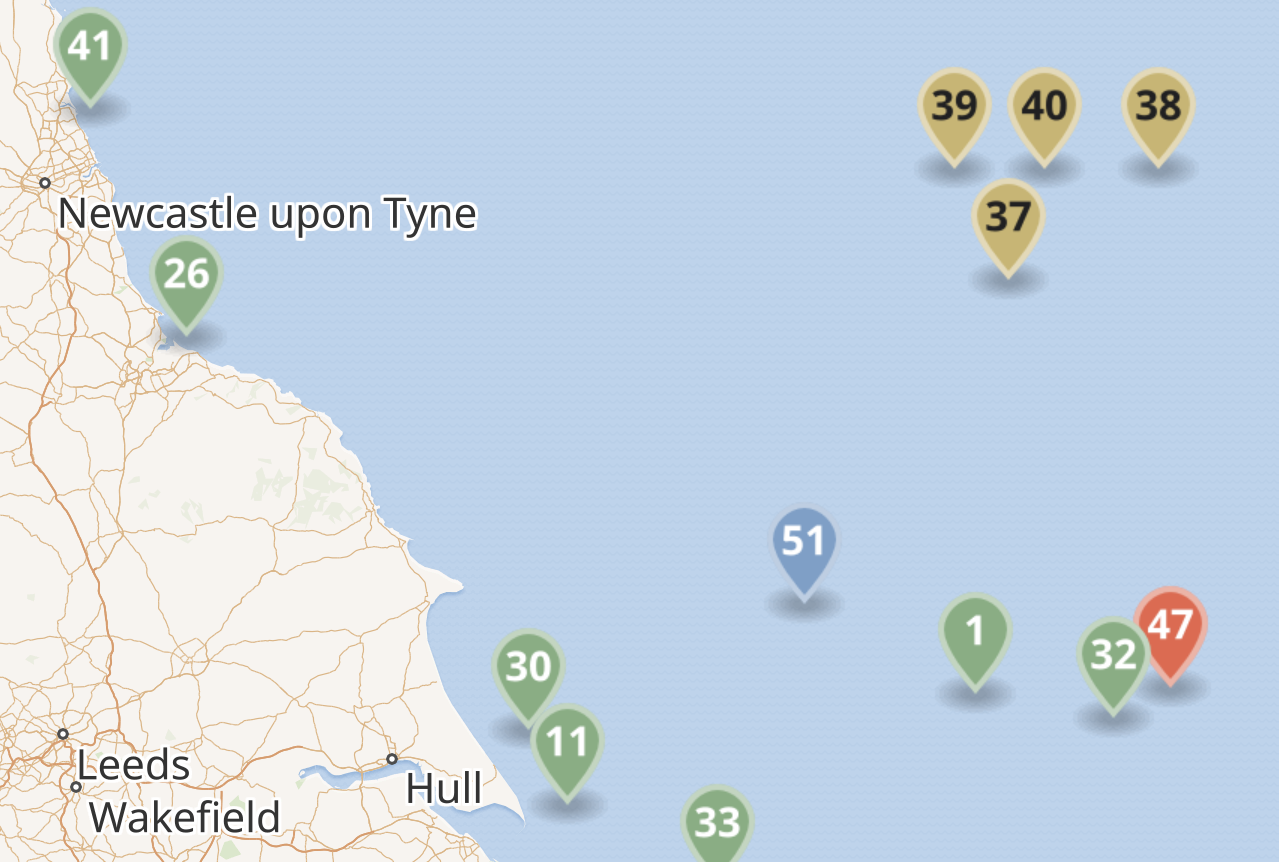
These are the Dogger Bank and Hornsea wind farms and their developers and size
- 37 – Dogger Bank A – SSE Renewables/Equinor – 1,235 MW
- 39 – Dogger Bank B – SSE Renewables/Equinor – 1,235 MW
- 38 – Dogger Bank C – SSE Renewables/Equinor – 1,218 MW
- 40 – Sofia – RWE – 1,400 MW
- 1 – Hornsea 1 – Ørsted/Global Infrstructure Partners – 1,218 MW
- 32 – Hornsea 2 – Ørsted/Global Infrstructure Partners – 1,386 MW
- 47 – Hornsea 3 – Ørsted – 2,852 MW
- 51 – Hornsea 4 – Ørsted – 2,400 MW
Note.
- That is a total of 12, 944 MW, which is probably enough electricity to power all of England and a large part of Wales.
- Wikipedia’s List of offshore wind farms in the United Kingdom, also lists a 3,000 MW wind farm, that is being developed by German company ; RWE called Dogger Bank South,
- The Dogger Bank South wind farm is not shown on the map, but would surely be South of wind farms 37 to 40 and East of 51.
- The Dogger Bank South wind farm will raise the total of electricity in the Dogger Bank and Hornsea wind farms to just short of 16 GW.
Connecting 16 GW of new electricity into the grid, carrying it away to where it is needed and backing it up, so that power is provided, when the wind doesn’t blow, will not be a nightmare, it will be impossible.
An alternative plan is needed!
AquaVentus To The Rescue!
AquaVentus is a German plan to bring 10 GW of green hydrogen to the German mainland from the North Sea, so they can decarbonise German industry and retire their coal-fired power stations.
- I introduce AquaVentus in AquaVentus, which I suggest you read.
- AquaVentus is being developed by RWE.
- AquaVentus connects to a German hydrogen network called H2ercules to actually distribute the hydrogen.
This video shows the structure of AquaVentus.
I clipped this map from the video.
Note.
- The thick white line running North-West/South-East is the spine of AquaVentus, that will deliver hydrogen to Germany.
- There is a link to Esbjerg in Denmark, that is marked DK.
- There appears to be an undeveloped link to Norway, which goes North,
- There appears to be an undeveloped link to Peterhead in Scotland, that is marked UK.
- There appears to be a link to just North of the Humber in England, that is marked UK.
- Just North of the Humber are the two massive gas storage sites of Aldbrough owned by SSE and Brough owned by Centrica.
- Aldbrough and Rough gas storage sites are being converted into two of the largest hydrogen storage sites in the world!
- There appear to be small ships sailing up and down the East Coast of the UK. Are these small coastal tankers, that are distributing the hydrogen to where it is needed?
When it is completed, AquaVentus will be a very comprehensive hydrogen network.
I believe that offshore electrolysers could be built in the area of the Hornsea 4 and Dogger Bank South wind farms and the hydrogen generated would be taken by AquaVentus to either Germany or the UK.
- Both countries get the hydrogen they need.
- Excess hydrogen would be stored in Aldbrough and Rough.
- British Steel gets decarbonised.
- A 1.8 GW hydrogen-fired powerstation at Keadby gets the hydrogen it needs to backup the wind farms.
Germany and the UK get security in the supply of hydrogen.
These may be my best guesses, but they are based on published plans.
Wrightbus Delivers More Hydrogen Buses To Germany Bringing Total To 43 – Around 130 Are Due To Be On The Roads By The End Of 2025
The title of this post, is the same as that of this article on the Belfast Newsletter.
This is the sub-heading.
The Ballymena bus manufacturer has also opened a European service centre and spare parts warehouse in Brühl, near Cologne
These three paragraphs add detail to the story.
Northern Ireland zero-emission bus manufacturer Wrightbus has delivered 12 new hydrogen vehicles to German operator WestVerkehr GmbH.
The latest order completion of Kite Hydroliner single decks means there are now 43 hydrogen-powered buses on the streets of Germany – with around 130 due to be on the roads by the end of 2025.
WestVerkehr GmbH is based in the westernmost district of Germany, on the border with the Netherlands, and will operate the Kite Hydroliners between Heinsberg, Hückelhoven, and Erkelenz.
I always think, that if you can sell anything vehicles to the Germans, there can’t be much wrong with them.
This picture shows one of the new Wrightbus electric buses, that I ride regularly around Finsbury in London.
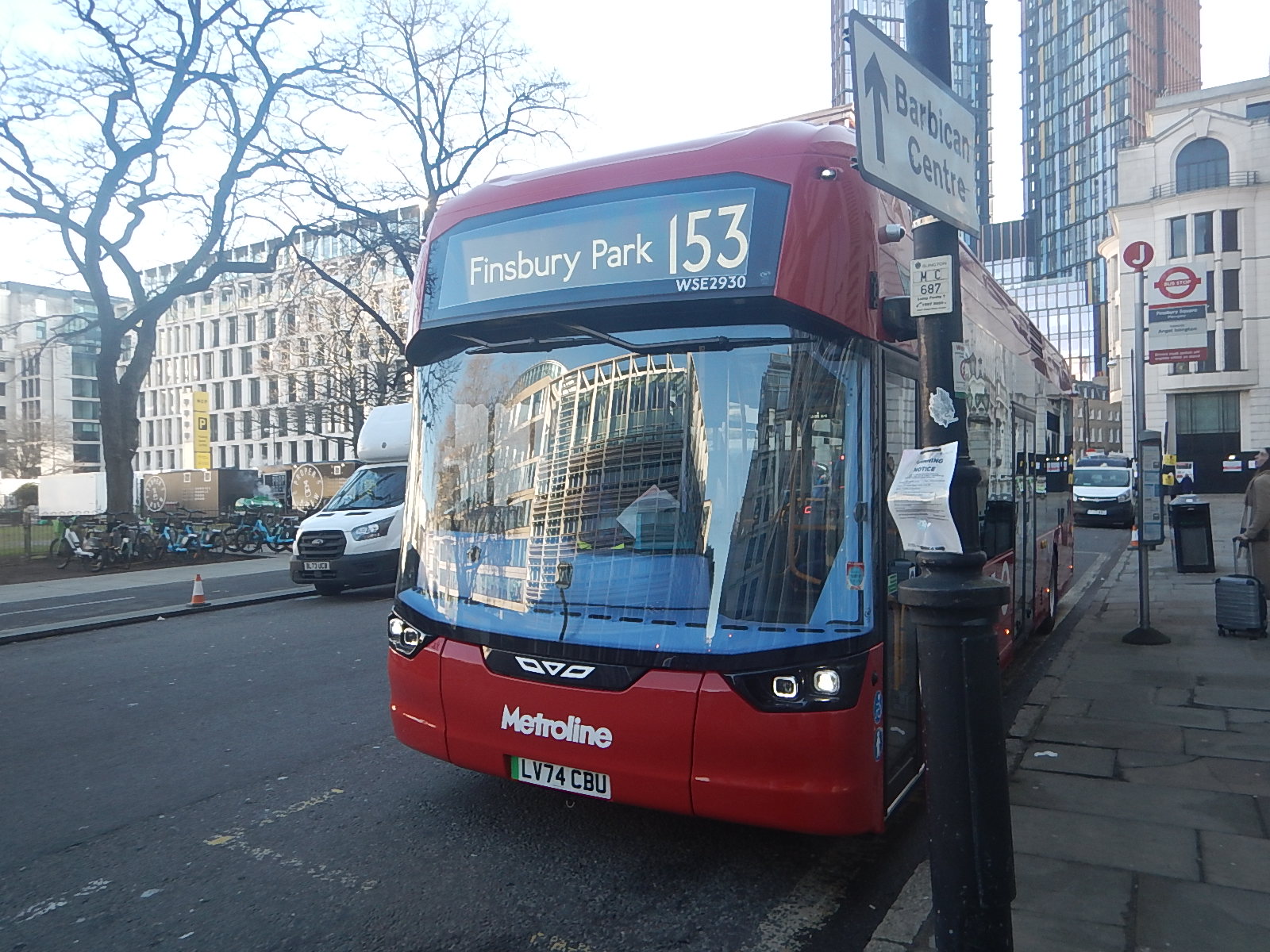
I was on a Chinese electric bus yesterday and there’s no doubt, that the ride in the Wrightbus product is smoother, than that of the Chinese one. Especially, when standing. The Chinese bus doesn’t even come close for ride with a New Routemaster.
London would do better, if it converted the thousand New Routemaster to zero-carbon power, rather than import a thousand Chinese buses.
In Equipmake Hybrid To Battery Powered LT11, I describe how one New Routemaster had a transmission transplant in Norfolk.
As it is possible, are Wrightbus NewPower working on it?
Ministers Will Relax Rules To Build Small Nuclear Reactors
The title of this post is the same as that of this article in The Times.
This is the sub-heading.
Britain’s five nuclear power stations, which generate about 6GW in total, powering 13 million homes, are all nearing the end of their lives
These first three paragraphs indicate the reasons why, the government wants to relax the rules.
Ministers are preparing to relax planning rules to make it easier to build mini nuclear power plants in more parts of the country in order to hit green energy targets and boost the industry.
They are also examining whether it is possible to streamline the process for approving the safety of new nuclear power plants as a way to reduce construction delays.
At present rules state that only the government may designate sites for potential nuclear power stations, of which there are eight, severely limiting where they can be built.
The article includes a vote and surprisingly to me, the vote embedded in the article, shows 92 % in favour of relaxing the rules and only 8 % against.
I must admit these figures surprise me, as I’d have thought more would have been against.
Certain Words Frighten The Public
It is because nuclear is one of those words, that I felt that the vote in favour would have been much lower.
Regular readers of this blog will know, that in the 1960s,, I worked for ICI doing itinerant computing and instrumentation tasks, in my first job after leaving Liverpool University with a degree in Control Engineering.
I can now classify the experience as a superb apprenticeship, where I learned a lot that has been useful to me in later life.
For a time, I was working on nuclear magnefic resonance or NMR scans. ICI Mond Division in Runcorn had one of the best installations for analysing chemicals using this technique, which is described in this Wikipedia entry, which starts with these sentences.
Nuclear magnetic resonance (NMR) is a physical phenomenon in which nuclei in a strong constant magnetic field are disturbed by a weak oscillating magnetic field (in the near field) and respond by producing an electromagnetic signal with a frequency characteristic of the magnetic field at the nucleus. This process occurs near resonance, when the oscillation frequency matches the intrinsic frequency of the nuclei, which depends on the strength of the static magnetic field, the chemical environment, and the magnetic properties of the isotope involved; in practical applications with static magnetic fields up to ca. 20 tesla, the frequency is similar to VHF and UHF television broadcasts (60–1000 MHz).
One day, the Senior Scientist, who ran the machine came in to work and announced that the property of nuclear magnetic resonance would be replacing X-rays, as the technology had just been used to give a three-dimensional image of something like the tail of a mouse.
Now fifty-five years later, many if not most of us have had MRi scans.
The Wikipedia entry for Magnetic Resonance Imaging or MRi, explains, what happened to the dreaded N-word.
MRI was originally called NMRI (nuclear magnetic resonance imaging), but “nuclear” was dropped to avoid negative associations.
Perhaps, it would be easier to build nuclear power stations, if the level of science teaching in the UK was better.
The Three Paragraphs In Detail
Earlier, I copied three paragraphs from The Times, into this post.
I shall now look at each in detail.
Paragraph 1
Ministers are preparing to relax planning rules to make it easier to build mini nuclear power plants in more parts of the country in order to hit green energy targets and boost the industry.
I was in Suffolk, when the planning of Sizewell B was undertaken.
There appeared to be little strong opposition, but the general feeling was what there was from second home owners, who were worried that the value of their holiday home would decline.
Employment and commerce created by Sizewell B was certainly good for the area in lots of ways.
At the time, my late wife; C was practicing as a family barrister in chambers in Ipswich. She believed that the building of Sizewell B had had a good effect on the area, as it had injected work and money, which had created the finance to allow a couple to end a marriage, that had long since died. She stated a couple of times, that Sizewell B was good for her practice.
Paragraph 2
They are also examining whether it is possible to streamline the process for approving the safety of new nuclear power plants as a way to reduce construction delays.
My worry about streamlining the process for approving safety, is that we approve nuclear power stations so rarely, do we have the qualified personnel to replace elapsed time with people. I would suggest that we don’t.
But we could have.
- We have some excellent universities, where Nuclear Engineering can be studied.
- How many personnel leave the Royal Navy each year, who could be trained as nuclear safety inspectors?
- If say Rolls-Royce and/or Hitachi are building several small modular nuclear reactors a year in the UK, then nuclear engineering will become fashionable, as electronics was for my generation of engineers and it will attract the brightest students.
Perhaps an established university, with access to the needed skills should be funded to set up a Nuclear Safety Institute
Paragraph 3
At present rules state that only the government may designate sites for potential nuclear power stations, of which there are eight, severely limiting where they can be built.
I can envisage new small modular nuclear reactors being built in the UK, where there is a need for lots of electricity to support developments like.
- Offshore wind farms
- Data centres
- Green steelmaking
- Metal refining
- Hydrogen production.
Rolls-Royce have said that their small reactors will be around 470 MW, so I could imagine power stations of this size being placed on disused coal-fired power station sites to boost power in an area. I have already suggested building some on Drax in The Future Of Drax Power Station.
In some locations, the choice could be between a small modular nuclear reactor and some form of energy storage.
Powering Germany
But there is one controversial area, where we can take advantage.
- The Germans are very short of electricity because of their reliance on coal and Russian gas that needs to be replaced.
- The 1.4 GW NeuConnect interconnector is being built by European and Japanese money between the Isle of Grain and Wilhelmshaven.
- The AquaVentus hydrogen system could be extended to Humberside to link with UK hydrogen production and storage.
- A couple of small modular nuclear reactors could be built on Humberside to back up hydrogen production, when the wind isn’t blowing.
But Rolls-Royce and other companies have been putting small nuclear reactors close to the sea bed safely for decades, so why no design an offshore reactor that can be placed at a safe distance offshore?
We would need to solve the Putin and friends problem first, but I can see the UK exporting a lot of electricity and hydrogen produced by nuclear energy.
German Far-Right Vows To Tear Down Wind Turbines
The title of this post, is the same as that of this article on oilprice.com.
These two paragraphs add detail to the story.
Germany’s far-right Alternative für Deutschland (AfD) party has vowed to dismantle wind parks and wind turbines should it win power in the upcoming presidential elections in February, aligning itself with similar sentiments by U.S. President-elect Donald Trump. AfD asserts in its election platform that it “rejects the further expansion of wind energy” and has called for cuts to renewable subsidies.
German offshore-wind group BWO has hit back at AfD’s anti-wind policy, saying Putin would be the biggest beneficiary of such a move. AfD chairwoman Alice Weidel has also tried to walk back that position, saying her earlier anti-wind comments referred to a local matter in the state of Hesse.
This could be good for the UK.
This is the first two paragraphs of the Wikipedia entry for Wind Power in Germany.
Wind power in Germany is a growing industry. The installed capacity was 55.6 gigawatts (GW) at the end of 2017, with 5.2 GW from offshore installations. In 2020, 23.3% of the country’s total electricity was generated through wind power, up from 6.2% in 2010 and 1.6% in 2000.
More than 26,772 wind turbines were located in the German federal area by year end 2015, and the country has plans for further expansion. As of the end of 2015, Germany was the third largest producer of wind power in the world by installations, behind China and the United States. Germany also has a number of turbine manufacturers, like Enercon, Nordex and Senvion.
By the end of June 2022, Germany had a total of 30,000 installed wind turbines, with a capacity in excess of over 64 GW.
Large numbers of second-hand wind turbines to plant all over Starmer, Reeves and Miliband’s vision of the UK would go down just fine in the cash-strapped Treasury, but would the British public like them?
So as Starmer and Reeves will talk to anybody to save their skins, are they talking to the AfD?
UK Gov’t Says Offshore Wind Backbone Of 2030 Clean Power System, Plans To Procure 12 GW More In Next Few Allocation Rounds
The title of this post, is the same as that of this article on offshoreWIND.biz.
This is the sub-heading.
Electricity generated by renewable sources and nuclear power will be the foundation of the UK’s electricity system by 2030, according to a new action plan the UK government issued in December 2024. Offshore wind, which now accounts for some 17 per cent of the country’s electricity generation, has “a particularly important role as the backbone of the clean power system”, the government said, revealing plans to make part of the path to building offshore wind farms easier as soon as before the Contract for Difference (CfD) round planned for the summer.
These two paragraphs add a few more details to the plan.
The action plan, issued by the Department for Energy Security and Net Zero (DESNZ), was presented by the UK Energy Secretary Ed Miliband on 13 December and is said to be a “major milestone to deliver on the Prime Minister’s Plan for Change which aims to drive economic growth and rebuild Britain with mission-driven government”.
Clean Power 2030 Action Plan is a roadmap to an (almost) fully clean power system in the UK by 2030, with clean sources making up 95 per cent of Great Britain’s electricity generation with gas being used for no more than 5 per cent of total generation.
This Wikipedia entry is a List of Operational Wind Farms in the UK.
Operational Offshore Wind Farms
In October 2023, there were offshore wind farms consisting of 2,695 turbines with a combined capacity of 14,703 megawatts. Strike price based on £/MWh at 2012 prices.
Wind Farms Under Construction
Offshore wind farms currently under construction (offshore), with a combined capacity in December 2024 of 7,792 MW. Strike price based on £/MWh at 2012 prices.
Pre-Construction Wind Farms
Wind farms that have started onshore construction and have been awarded contracts under the UK Government’s Contracts for Difference Round 3 (2019)/Round 4 (2022). Total capacity of 3,932 MW. Strike price based on £/MWh at 2012 prices. These projects re-bid some capacity in Round 6 (2024) with a higher strike price.
Proposed Wind Farms – Contracts For Difference Round 4
Wind farms proposed under the Round 4 (2022) CFD auction,[88] with a combined capacity of 1,428 MW . Strike price based on £/MWh at 2012 prices.
Proposed Wind Farms – Contracts For Difference Round 6
Wind farms proposed under the Round 6 (2024) CFD auction,[88] with a combined capacity of 3,763 MW . Strike price based on £/MWh at 2012 prices.
Proposed Wind Farms – Previously Awarded In The CfD Round 3
This wind farm was proposed under the UK Government’s Contracts for Difference Round 3 (2019), which it decided to withdraw from. It will likely bid in AR6 with a changed specification from the original submission
Proposed Wind Farms – Early Planning
Wind farms that are in an exploratory phase and have not yet secured a Contract for Difference at auction.
Total capacities: England: 18,423 MW – Wales: 700 MW – Scotland: 30,326 MW
Current Totals
- Operational Offshore Wind Farms – 14,703 MW
- Wind Farms Under Construction – 7,792 MW
- Pre-Construction Wind Farms – 3,932 MW
- Contracts For Difference Round 4 – 1,428 MW
- Contracts For Difference Round 6 – 3,763 MW
- Previously Awarded In The CfD Round 3 – 0 MW
- Earlp Planning – England: 18,423 MW
- Early Planning – Wales: 700 MW
- Early Planning – Scotland: 30,326 MW
Adding up these totals gives 81.067 MW
As I’m typing this, the UK is generating and importing a total of 29,330 MW of electricity.
Conclusion
Another 12 GW of new offshore wind will mean that we will have 81,067 + 12,000 – 29330 MW of electricity to put in store or sell to the Germans and other Europeans.
Perhaps we should be investing in industries, that use large quantities of electricity like hydrogen steel-making or zero-carbon cement making.
 The Anonymous Widower