Offshore Wind Could Help Create ‘Electric Shipping Highway’ Across Europe, Study Says
The title of this post, is the same as that of this article on offshoreWIND.biz.
This is the sub-heading.
Offshore wind farms, energy islands, ports and proposed “Offshore Power Zones” could together form the foundation of an integrated maritime energy system capable of supporting large-scale vessel electrification across Northern Europe, according to a study by Maersk’s Stillstrom, Baltic Energy Island and the Port of Roenne.
This is a map from the report.
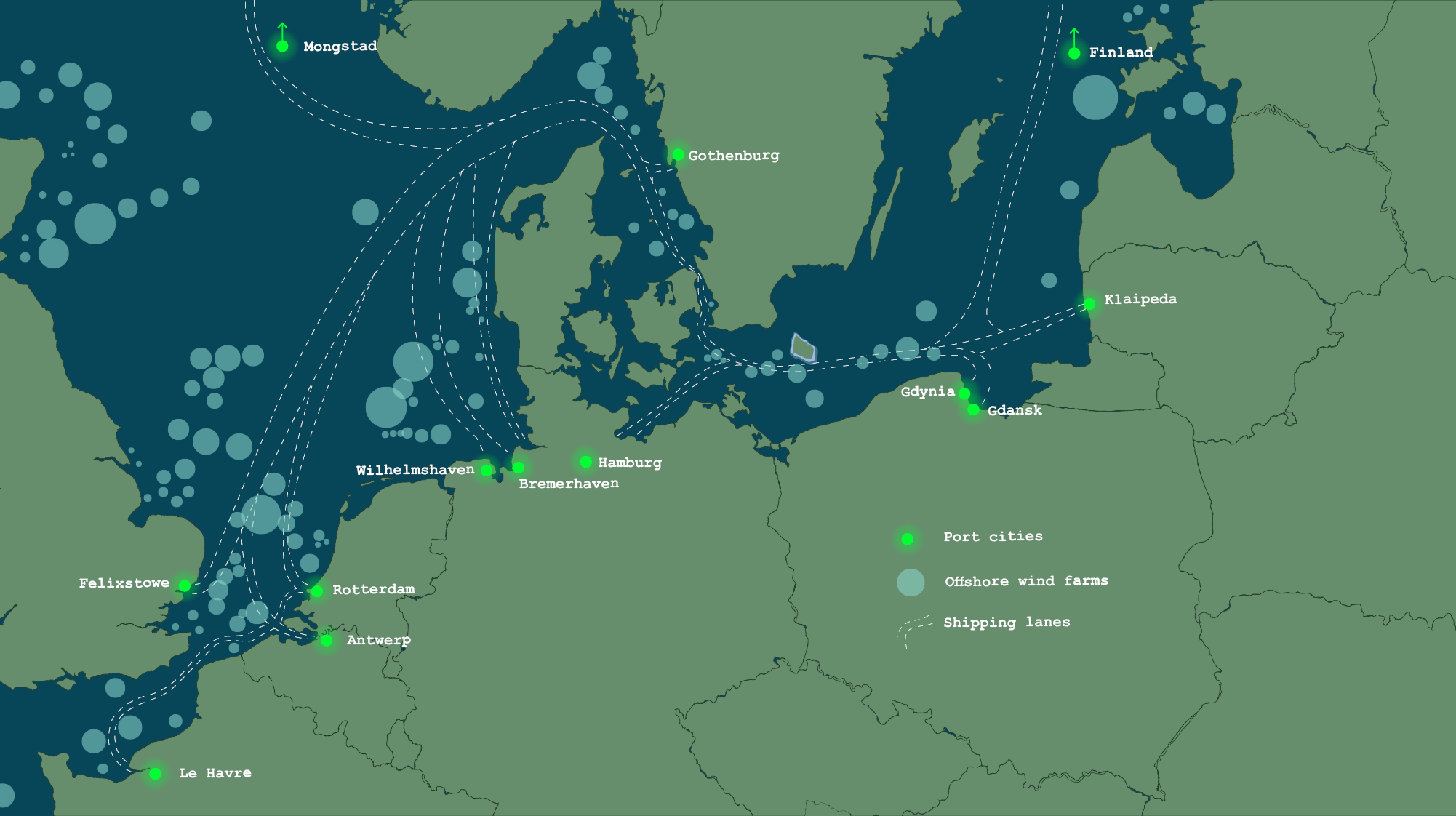
Note.
- In Investment in Grain LNG, I talked about Centrica and Grain LNG Terminal, Centrica’s plans for the terminal, which include bunkering.
- London Gateway and Immingham are two substantial ports on the East side of England.
Are English ports, except for the notable exception of Felixstowe, not shown on the map, because of Brexit?
These two paragraphs add some detail.
According to the findings, it is estimated that around 37,000 cargo vessels pass Bornholm each year, consuming approximately 3 million tonnes of marine fuel and emitting around 10 million tonnes of CO₂ annually. Full electrification of this traffic is estimated to require about 17 TWh of electricity per year, potentially replacing roughly EUR 2 billion in fossil fuel imports with domestically generated renewable power.
The whitepaper also introduces the concept of Offshore Power Zones (OPZs), developed by Stillstrom, which involves vessels accessing offshore wind-generated electricity at sea for battery charging or hotel loads. The report sees these zones linked with electrified ports to form an “electric shipping highway” stretching from the English Channel through the North Sea into the Baltic Sea.
Note that Bornholm is between Sweden and Germany.
GWEC Calls For Faster Offshore Wind Deployment As Global Capacity Nears 100 GW
The title of this post, is the same as that of this article on offshoreWIND.biz.
This is the sub-heading.
The Global Wind Energy Council (GWEC) has called on governments worldwide to accelerate offshore wind deployment and treat offshore wind projects as critical energy infrastructure, warning that a faster build-out is necessary to strengthen energy security and reduce exposure to future energy market shocks
These two paragraphs add some more detail.
The industry is approaching a major milestone of 100 GW of installed offshore wind capacity globally, according to GWEC’s 2026 Global Offshore Wind Report, released on 9 June at the APAC Wind Energy Summit in Hanoi, Vietnam.
The report shows that 9.3 GW of new offshore wind capacity was grid-connected worldwide in 2025, a 16 per cent increase compared to the previous year and the third-highest annual total on record. Global installed offshore wind capacity reached 92.5 GW by the end of 2025.
These are some points from the article.
- China remained the world’s largest offshore wind market in 2025, commissioning 6.6 GW of new capacity and increasing its total installed offshore wind capacity to 48.4 GW.
- Europe added nearly 2 GW across the UK, Germany and France, with the UK accounting for just over 1 GW of new installations.
- Despite the positive outlook, GWEC said project development continues to be hindered by permitting delays, grid constraints, supply chain bottlenecks and shortcomings in auction design.
- The average size of offshore wind turbines installed in 2025 exceeded 10 MW for the first time, reaching 10.3 MW.
It certainly looks like offshore wind power is going well.
Europe: New Fund To Upgrade Solar And Wind Assets With Battery Storage
The title of this post, is the same as that of this article on Review Energy.
This is the sub-heading.
The Aream Group has launched a new European investment vehicle targeting the renewable energy sector, with a strategy that combines power generation, storage and electricity marketing.
These three paragraphs add more details to the story.
The Clean Energy Future Fund II (CEFF II) will focus on integrating renewable generation assets with battery storage systems to improve the use of grid connections, which are increasingly scarce across European markets. According to Markus W. Voigt, Executive Chairman of aream Group, the hybrid model is designed to respond to growing volatility in electricity markets.
“With this hybrid approach, we are leveraging the changes and increased volatility in the European electricity markets for the benefit of our investors,” Voigt said.
The fund will primarily invest in Europe, with a particular focus on Germany, and will build on an existing portfolio of operational assets. A central element of the strategy is the addition of battery storage to solar and wind farms, allowing them to evolve from pure generation assets into providers of grid services.
I have a Google Alert which looks for “Energy Storage Fund” and this story was one of nine substantial stories.
This story talks about €400 million and two others talk about €300 million and AU $ 1.4 billion, respectively.
So hopefully, this money will help to mop up some of the energy wasted, when wind farms are curtailed.
Certainly, these funds don’t seem to have difficulty finding money to invest.
How Do Alstom Fuel Their Hydrogen Trains?
I have not seen this question answered, so out of curiosity, I asked Google AI and received this answer.
Alstom fuels their hydrogen trains, specifically the Coradia iLint, using high-pressure gaseous hydrogen stored in tanks on the roof. The hydrogen combines with oxygen via fuel cells to generate electricity, which powers the electric traction motor, with only water and heat emitted. The trains refuel at specialized hydrogen stations in roughly 15 minutes.
Key Aspects of Alstom’s Hydrogen Fueling System:
Fueling Station: The trains are powered by specialized hydrogen filling stations, such as the Linde station in Bremervörde, Germany, which supplies gaseous hydrogen.
Refueling Process: The process is designed to be a “drop-in” replacement for diesel, with a filling time similar to that of diesel trains, providing a range of over 1,000 km.
Fuel Cell Technology: Inside the train, a fuel cell module (typically located on the roof) separates hydrogen molecules into protons and electrons, creating a flow of electricity.
Energy Storage: The system uses lithium-ion batteries to store excess energy from the fuel cells and energy recovered from braking.
Hydrogen Source: While some hydrogen is currently produced through conventional methods (steam reforming), there is a strong shift towards using green hydrogen produced from renewable energy on-site.
The Coradia iLint has a top speed of 140 km/h and serves non-electrified lines as a zero-emission alternative to diesel.
Alstom And Cummins Make A Deal On Hydrogen Rail Technology
I asked Google AI about this deal and receive this reply.
On April 2, 2026, Alstom announced the acquisition of Cummins’ hydrogen fuel cell activities specifically dedicated to the rail sector. This strategic move brings the technology and manufacturing capabilities for Alstom’s Coradia iLint hydrogen trains in-house, following a period where Cummins looked to wind down its wider hydrogen business amid losses in its Accelera energy transition segment.
Here are the key details of the deal:
Scope of the Acquisition
Fuel Cell Technology In-House: Alstom acquired the engineering, product, and support capabilities for the fuel cells used in its existing hydrogen train fleets, specifically the Coradia iLint.
Manufacturing Facilities: The deal includes the transfer of Cummins’ fuel cell manufacturing and assembly site in Herten, Germany, which has been producing for Alstom since 2021.
Targeted Support: The acquisition allows Alstom to strengthen its ability to maintain, improve, and provide support for existing hydrogen fleets in Germany, Italy, and France.
Context and Strategy
Securing Supply Chain: After facing maintenance issues with the fuel cells, which previously required sourcing parts from North America, this move gives Alstom direct control over its key technology.
Strategic Pivot: While Cummins moves to pivot away from the wider hydrogen market following losses in its Accelera unit, Alstom continues to focus on hydrogen as a critical solution for replacing diesel trains on non-electrified, long-haul lines.
Commitment to Hydrogen: Despite a 2025 announcement by Alstom that it would pause “further development” of new hydrogen technology due to funding cuts, this acquisition proves that the company remains committed to supporting and enhancing its current, contracted hydrogen train programs.
Future Impact
Reliability Improvements: Alstom plans to leverage this acquisition to accelerate development work, improve the energy management, durability, and reliability of the Coradia iLint fleet, and ensure the success of projects in Germany, Italy, and France.
Market Position: This acquisition solidifies Alstom’s position as a leader in sustainable rail alternatives, even as battery technology has advanced.
I would agree strongly with the future impact.
My First Ride In An Alstom Coradia iLint
In March 2019 in My First Ride In An Alstom Coradia iLint, I said this.
I’m finally, riding in a hydrogen-powered Alstom Coradia iLint train through the German countryside.

Not as quiet as the two battery trains, I’ve ridden, but that’s because It feels to me that the traction motors are crudely under the passengers and cardan shafts are used to drive the wheels!
Battery electric trains with regenerative braking should be virtually free of any mechanical noise. Both the Class 379 and Class 230 battery demonstrators were almost silent. As electricity generated from hydrogen doesn’t appear to generate much noise, then a hydrogen-powered train can also be almost silent.
From talking to fellow passengers on my German trip, it would appear that the train has been very reliable in service.
Conclusion
Alstom are proving hydrogen would work well in a train designed for that purpose, but updating a DMU with a noisy mechanical transmission, possibly isn’t the best to go.
I now believe that Alstom have everything they need to create a 125 mph tri-mode multiple unit.
Adding in today’s article about hydrogen, I have written enough about Bombardier, which is now Alstom, and their future plans, so that they can build an Alstom 125 mph tri-mode Aventra, with with electric, battery or hydrogen power.
It could be the ultimate train.
The Bombardier Aventra And Brexit
The Batteries for Bombardier Electrostar
Parallel Thinking From Bombardier
Bombardier’s Battery Technology
Have Bombardier Got A Cunning Plan For Voyagers?
Bombardier Bi-Mode Aventra To Feature Battery Power
Stadler Flirt And Bombardier Aventra Tri-Modes Compared
Bombardier’s Plug-and-Play Train
Bombardier’s 125 Mph Electric Train With Batteries
Do Bombardier Aventras Have Remote Wake-Up?
Condor Celebrates Inaugural Flight Of New Frankfurt–London Gatwick Route
The title of this post is the same as that of this press release from Condor.
This is the sub-heading.
Condor today launched its new city connection between Frankfurt am Main (FRA) and London Gatwick (LGW). With the inaugural flight, the British capital is now officially part of Condor’s city network. The route will be operated three times daily with a schedule designed to appeal equally to business travellers and city tourists. Flights are operated using Condor’s Airbus A320 aircraft, offering capacity for 180 passengers in a two-class configuration, including Business Class and Economy Class with the standard 3-3 seating layout. In addition, Condor cooperates with partner airlines on this route.
These three paragraphs add more details.
With this new connection, Condor is expanding its city network to include one of Europe’s most important metropolitan hubs, thereby strategically strengthening its presence in the European market. To mark the inaugural flight from London Gatwick, departing passengers on the fully booked service were welcomed with a small reception and gifts before the flight departed punctually for Frankfurt am Main.
David Carlisle, Director Network and Partnerships at Condor, said: “Today’s inaugural flight to London Gatwick marks another important milestone in the expansion of our European route network. London is one of Europe’s most sought-after destinations, both for business travellers and short city breaks. We are delighted to offer our guests up to three daily frequencies, providing maximum flexibility as well as convenient access to our long-haul network to Africa and Asia.”
Jonny Macneal, Head of Aviation Development at London Gatwick, added: “We are delighted to welcome Condor to London Gatwick and to offer our passengers even greater choice with this new, frequently operated service to Frankfurt. Whether travelling for business, leisure or to visit friends and family, the route provides excellent flexibility and connectivity. Condor’s arrival marks another important milestone during a period of significant growth for the airport.”
The press release also has these two last paragraphs, which give more information about the airline.
London is one of Europe’s leading economic and financial centres and also one of the most popular destinations for city travel. The new connection offers business travellers excellent access to the Greater London area as well as flexible options for day trips. Leisure travellers benefit from convenient flight times for weekend getaways.
In addition to the launch of London Gatwick, Condor continues to expand its network. From May, Barcelona, Budapest and Venice will be added as new destinations, bringing the total number of city destinations in the Condor network to 13. With these additions, Condor is further strengthening its presence in high growth markets and continuing to expand its European route network. Flights can be booked online at http://www.condor.com, via telephone or through travel agencies.
It is certainly one of the best-written and information-rich press releases, that I have seen.
If the attention to detail is as good in the way the airline is run is half as good, Condor will be worth giving a try.
This page is their TripAdvisor reviews.
Gatwick Airport Is Expanding
I picked up the news of Condor Airlines new service from one of my Google Alerts about Gatwick Airport’s proposed new runway.
These were the titles of the news articles in the alert.
- Simple Flying – Unbelievable! The UK’s 2nd-Busiest Airport Welcomes 5th New Airline In 11 Days
- MSN – London Gatwick confirms 9th new airline in massive 2026 shakeup
- Aviation A2Z – Condor Begins First UK Route with 3 New Daily Flights to This Airport
- Yahoo News UK – Airline launches first-ever UK route from Gatwick Airport to popular European city
- AviationSource News – Condor Launches New Frankfurt to London Gatwick Route
- Aviation24.be – Condor launches Frankfurt–London Gatwick route with three daily flights, marking UK debut
- Travel Wires – Condor launches first UK route with Gatwick–Frankfurt service
- Travel And Tour World – Frankfurt & London: New Condor Flights Spark Hope and Joy at London Gatwick Airport, UK
There is also this headline about Air France.
- Aviation24.be – Air France returns to London Gatwick with new twice-daily Paris CDG service
Gatwick seems to be doing well to be welcoming nine new airlines in 2026 and five in the last eleven days.
Perhaps, some honest accounting have convinced those nine airlines, that Gatwick’s new runway, won’t raise charges as much as Heathrow’s.
TenneT, National Grid Ink Joint Development Agreement For LionLink Offshore Wind Interconnector
The title of this post, is the same as that of this article on offshoreWIND.biz.
This is the sub-heading.
Transmission system operators (TSOs) TenneT and National Grid Ventures (NGV) have signed a Joint Development Agreement (JDA) to advance LionLink, a hybrid interconnector linking the UK and the Netherlands via a future offshore wind farm in the Dutch North Sea.
These three paragraphs add more details.
The agreement sets out how the two partners will jointly develop LionLink towards a final investment decision (FID), including arrangements on procurement, governance, and planning, while also aiming to increase transparency on project costs ahead of construction.
LionLink is designed to integrate cross-border electricity interconnection with offshore wind by establishing a direct connection between the two countries through a grid link to the planned Nederwiek 3 offshore wind farm. According to the developers, this approach will maximise the use of offshore wind, provide additional system flexibility, and reduce the overall amount of required offshore infrastructure.
The LionLink project was launched in April 2023, when the Netherlands and the UK unveiled their plan to build the interconnector, a first-of-its-kind electricity link to connect offshore wind between the two countries via interconnections.
The same article also said these two paragraphs about the operation of the BritNed interconnector.
While the companies move forward with LionLink, their existing BritNed interconnector is marking 15 years of operation. Since entering service in 2011, the 1 GW subsea link has enabled nearly 93 TWh of electricity trading between Great Britain and the Netherlands.
Over the past five years, BritNed has exchanged enough electricity annually to power around 1.4 million households. The 260-kilometre interconnector remains a key part of both countries’ energy systems and has generated around EUR 1 billion in auction revenues on the Dutch side during its operational lifetime, TenneT said in a press release on 1 April.
It looks like BritNed has been a good investment for all stakeholders.
Note.
- LionLink will be a 2 GW interconnector.
- LionLink will land at Walberswick in Suffolk.
- LionLink has a web site.
- BritNed is a 1 GW interconnector.
- BritNed lands at the Isle of Grain in Kent.
- BritNed has a web site.
- NemoLink is an interconnector between Kent and Belgium.
- NeuConnect will be a 1.4 GW interconnector between the Isle of Grain and Wilhelmshaven, which will be operational by 2028.
- There are two actual and two proposed interconnectors between the UK and France.
The List of high-voltage transmission links in the United Kingdom in Wikipedia is growing.
The Wikipedia entry says this about the Rise of UK Interconnection.
The Department for Energy Security and Net Zero’s Digest of UK Energy Statistics reports that the UK was a net importer of electricity in 2024, with net imports of 33.4 TWh, up 40% from 2023.
Interconnectors allow the trade of electricity between countries with excess generation (for example, intermittent renewable) and those with high demand. Interconnectors play a key part in balancing variable renewable generation, for example the 1.4 GW North Sea Link allows the UK to export excess power to Norway during windy periods to conserve Norwegian hydro stocks, and import Norwegian hydro power on less windy days.
During the 2022 energy crisis, the UK exported record amounts of power to mainland Europe, helping to alleviate the effects of the Russian invasion of Ukraine on European security of supply.
As of 12 November 2024, Great Britain had nine operational international electricity interconnectors.
The UK is becoming an offshore energy substation on Europe’s North-West coast.
New Baltic Sea Interconnector On Horizon As Lithuania, Latvia, and Germany Plan Cross-Border Link
The title of this post, is the same as that of this article on offshoreWIND.biz.
This is the sub-heading.
Lithuania, Latvia, and Germany are planning a joint offshore interconnector that would enable electricity trading between the Baltic countries and Germany and allow for the integration of up to 2 GW of offshore wind capacity in Lithuania and Latvia
These first two paragraphs add more detail to the article.
The energy ministers of the three countries signed a joint declaration of intent on 18 February, paving the way for the development of the Baltic-German PowerLink interconnector, which would, in addition to electricity trading and offshore wind capacity integration, also enable the expansion of onshore renewable energy capacity.
The Lithuanian, Latvian, and German transmission system operators (TSOs) – Litgrid, Augstsprieguma tīkls and 50Hertz – agreed to assess the feasibility of the hybrid electricity interconnection.
As Germany, has the following connections under development in the West.
- AquaVentus to Aberdeen, Humberside, Denmark, Norway and The Netherlands.
- NeuConnect to the Isle of Grain In England.
- GriffinLink, which is an offshore link to England.
The Germans seem to be putting themselves at the centre of an energy distribution system, that has the capability to stabilise European and UK electricity for thousands of years. Especially, if the network grows to include more countries.
This paragraph says this about the Baltic-German PowerLink project.
The Baltic-German PowerLink project concept developed by Litgrid, Augstsprieguma tīkls, and 50Hertz includes a 2 GW, approximately 600 kilometres long hybrid offshore connection, with the connection point in the Baltic States planned to be on the border between Lithuania and Latvia. The exact location is to be determined after technical studies.
Note.
- The interconnectors may be long, but they are not longer than anything built successfully before in European waters.
- The UK and the Island of Ireland are well-linked.
- There would appear to be no need for challenging projects like the Morocco-UK Power Project
I suspect that Germany will get the energy it needs and the British Isles will get a nice little earner.
If Europe is generating large amounts of wind and solar energy with its variable output it will need lots of energy storage.
What Countries Have The Terrain For Pumped Storage Hydro In Europe?
I asked Google AI and received this answer.
Key countries with ideal, high-elevation terrain and significant existing or planned capacity include:
Alpine Region (The Heart of European Pumped Storage):
Switzerland: Extremely high capacity due to steep, mountainous landscapes and significant water sources, hosting the world’s oldest working pumped storage plant.
Austria: Heavily mountainous, it is a major player in PSH expansion and modernization.
France: Home to one of Europe’s largest, the Grand Maison hydroelectric power station.
Italy: Holds high capacity with numerous planned projects.
Germany: Strong existing infrastructure.
Southern Europe:
Spain: Features some of Europe’s largest plants (e.g., La Muela/Cortes-La Muela).
Portugal: Significant recent investment in large-scale projects like the Tâmega complex.
Other Potential Areas:
Norway: High potential due to its mountainous, water-rich terrain.
United Kingdom: High project volume currently under construction.
Balkans & Central Europe:
Countries like Bulgaria, Romania, and the Czech Republic have suitable terrain for further development.
These countries benefit from significant hydraulic head (steep drop) and natural or artificial reservoir potential, making them ideal for storing energy for peak consumption hours.
Note.
- As expected, the Alpine region is Top of the League.
- The UK is holding its own despite its small mountains.
- There is a lot of potential to be developed.
But then Electric Mountain in Snowdonia is certainly at the top table of pumped storage systems despite being built in the 1980s.
What Countries Have The Terrain For Hydrogen Storage In Europe?
I asked Google AI and received this answer.
Key European countries with suitable geological terrain—specifically salt caverns and depleted gas fields—for large-scale, underground hydrogen storage include Germany, the Netherlands, Denmark, the United Kingdom, and France. Other significant regions for storage potential include Spain, Hungary, and Austria, which are developing porous storage facilities.
Key Regions & Terrain Types:
Salt Caverns (North-Western Europe): Germany, the Netherlands, Denmark, France, and the UK have substantial salt deposits suitable for creating caverns, identified as cost-efficient for large-scale storage.
Depleted Gas Fields (Porous Rock): The Netherlands, Germany, and parts of Central/Southern Europe (Spain, Hungary) have significant capacity in existing porous storage, particularly in the North Sea region.
Specific Projects: Germany (Uniper’s Krummhörn project), Netherlands (HyStock), and France (HYPSTER at Etrez) are active, with Spain and Denmark emerging as major hydrogen hubs.
Capacity Potential: The Netherlands, for instance, holds massive potential (35-60 TWh) due to its offshore and onshore depleted fields.
Salt cavern projects, which offer high-deliverability storage, are heavily concentrated in the North-Western European industrial corridor.
I was lucky enough have a tour of ICI’s salt mine in Cheshire, when I worked there in the 1960s and I remember these facts from those days.
- There was enough salt in the ground under Cheshire to last several thousand years.
- Most salt was extracted from boreholes, for making chlorine using electrolysis and the Castner-Kellner process.
- Hydrogen was a by-product and much of it was mixed with coal gas to raise steam for the works.
The same technique used to make boreholes to extract the salt, is used to hollow caverns in the salt to store gases like hydrogen.
Once, when they were digging salt out of the salt mine at Winsford, a worker broke into an unmarked borehole and ICI nearly lost the mine because of the water rushing in.
Two stories stand out from the rescue of the mine.
- There was a need for dry clothes for all the workers, so ICI took a truck to Marks & Spencer in Northwich and emptied it of anything they might need. I was told the story enriched with plagues of locusts.
- A Ford Transit was found to have travelled a few thousand miles underground in axle deep salt slurry. Rather, than scrap it and buy another, it was offered back to Ford, who were delighted to swap it for a new one. I heard that Ford said, that the accelerated corrosion research would have taken many years, if done on the roads.
Always think out of the box.
Global Investor Joining RWE On Two Norfolk Vanguard Offshore Wind Projects, FID Expected in Summer
The title of this post, is the same as that of this article on offshoreWIND.biz.
This is the sub-heading.
Global investment firm KKR and RWE have signed an agreement under which KKR acquire a 50 per cent stake in each of RWE’s Norfolk Vanguard East and Norfolk Vanguard West offshore wind projects, totalling 3.1 GW in installed capacity. The wind farms were just awarded Contracts for Difference (CfDs) in the UK’s seventh CfD allocation round (AR7).
These three paragraphs add a few more details.
The two Norfolk Vanguard projects, which RWE bought from Vattenfall in March 2024, have already secured seabed rights, grid connections, development consent orders (DCOs) and all other key permits.
On 14 January, RWE said it launched the process to raise non-recourse project finance debt for the projects and that it expects the closing of the partnership transaction and the project financing, as well as the final investment decision (FID), in the summer of 2026.
Located 50 to 80 kilometres off the coast of Norfolk, the two offshore wind farms are planned to be commissioned in 2029 (Norfolk Vanguard West) and 2030 (Norfolk Vanguard East).
RWE do seem to be lining up everything ready for that final investment decision in the summer of 2026.
- I suspect that with KKR on board, that they have got the money ready and I wouldn’t be surprised to see these two projects quickly progress to a completion.
- I also think it was significant that we have Goldman Sachs involved in Highview Power, who may have a solution to affordable energy storage and now we have KKR getting involved with one of the most professional offshore wind power developers in the world.
- Are Goldman Sachs and KKR placing bets against Trump’s anti wind power stance?
The Germans will certainly need a lot of energy and British offshore wind power, would appear the only place, where it is available easily in quantity to the Germans.
I await the next few months with a lot of interest.
Do British And German Offshore Wind Farm Generate Maximum Power At Different Times
In National Grid, TenneT Germany Launch GriffinLink, A First Of A Find Project To Maximise Offshore Wind, I discussed GriffinLink, which will be an offshore link between British and German offshore wind farms.
Somebody has asked me if wind farms are in phase with each other, as obviously this would effect how they perform and are are controlled.
So I asked Google AI, the question in the title of this post and received this reply.
Yes, British and German offshore wind farms often generate their maximum power at different times, although they are both located in the North Sea and share similar peak seasons. The variations in generation are driven by localized weather patterns, specifically the movement of low-pressure systems.
Key Differences in Generation Times:
Regional Weather Patterns: While North Sea wind farms are often closely correlated, significant differences arise when weather systems move from west to east. Wind often hits the UK’s North Sea sites first, meaning they may hit maximum generation capacity hours before German or Danish sites, which are further east.
Time of Day (Diurnal Differences): Because UK wind farms are located in the Irish Sea, the Scottish coast, and the North Sea, they can exhibit different diurnal (daily) peak times compared to German sites in the North Sea and Baltic Sea.
Seasonal Peaks: Both countries experience the highest output during winter months (e.g., December). However, during specific, localized, long-lasting high-pressure systems (“Dunkelflaute”), one country might experience a complete drop in wind while the other continues to produce, or vice versa.
Why They Differ:
Geography: The UK’s extensive, spread-out coastline (Irish Sea, Atlantic coast, North Sea) offers a different wind profile than the more concentrated German offshore projects in the North Sea and Baltic Sea.
Correlation Challenges: Research shows that while North Sea countries have similar wind profiles, there is not 100% correlation. Meteorological differences in how wind speeds behave across the North Sea allow for complementary production.
This difference is highly advantageous for European energy security, as it allows for the balancing of intermittent wind power across the region.
The conclusion from Google AI, is almost predicting that GriffinLink will be developed. From my experience of mathematical modelling the cost and financial benefits should be fairly easy to predict.
Will The UK And The Republic Of Ireland Link Their Offshore Wind Farms To Improve Efficiency?
This may seem an obvious idea, especially as UK and Republic of Ireland are heavily interconnected.
So I asked Google AI, the question in the title of this section and received this reply.
Yes, the United Kingdom and the Republic of Ireland are taking significant, active steps to link their offshore wind farms and electricity grids to improve efficiency, increase renewable energy production, and enhance energy security. Following a Memorandum of Understanding (MoU) signed in September 2023, the two countries are collaborating on developing subsea energy infrastructure in the Irish and Celtic Seas.
Here are the key details regarding this cooperation:
Deepened Collaboration: As of March 2025, the UK and Ireland are working on a new data-sharing arrangement to lay the groundwork for directly connecting offshore wind farms to each other’s national energy networks.
Offshore Hybrid Assets (OHAs): The plans include developing offshore hybrid assets, which are subsea cables that directly link offshore wind farms to both countries’ grids, reducing infrastructure costs and maximizing efficiency.
Subsea Mapping & Interconnection: Both nations are mapping the Celtic Sea to identify optimal locations for interconnectors and to improve the interoperability of their grids.
Existing & New Projects: While Ireland’s current interconnection to the UK is limited (approx. 500MW), capacity is planned to increase significantly. Specific projects like Mares Connect (linking North Wales and Ireland) are being developed to provide750MW of additional capacity.
Regional Cooperation: Ireland is also participating in the “Hamburg Declaration” (signed Jan 2026), joining the UK and other North Sea countries to commit to 300GW of offshore wind by 2050 through shared, regional infrastructure.
This cooperation aims to allow Ireland to export its surplus renewable energy during high generation, while benefiting from the UK’s robust grid during lower wind conditions.
Will The UK AndNorway Link Their Offshore Wind Farms To Improve Efficiency?
As we have interconnectors with Norway, I asked Google AI, the question in the title of this section and received this reply.
Yes, the UK and Norway are actively planning and implementing initiatives to link their offshore wind farms and electricity grids to improve efficiency, energy security, and grid balancing. Following a series of agreements, including a major pact in January 2026, the two countries are collaborating on “hybrid” projects that connect offshore wind sites directly to multiple countries.
It does look like that the co-operations between the UK and Germany, Norway and the Republic of Ireland are setting examples that should be copied all over the world.
But then, you should always follow the mathematics.
But somehow, I can’t see President Trump signing any windmill co-operation with his neighbours.

