Does Innovation Get Mr. Ed Miliband Better Prices To Doncaster?
The East Coast Main Line has ticketing unlike any other in the UK.
Turn up at any LNER station to go to any station that is served by trains from that station and you will be given a choice of the best prices at the ticket machines or at the booking office.
Effectively, you are sold your choice of the cheapest Advance tickets for your journey, at the time of booking.
In the last few months, I have taken three trips from London to Doncaster. All were priced between £20 and £25, with one trip on each of Grand Central, Hull Trains and LNER.
Some might argue it is because of the three Open Access operators on the route, that good value is available. But I would argue that it is down to the fact that because of the Open Access operators there is more seats on the route.
This ticketing model should be adopted on the West Coast Main Line and the Midland Main Line.
The ticketing has certainly modified my behaviour.
If I want to go to Sheffield, I go to Doncaster, as it’s a lot cheaper, then get a local train between Doncaster and Sheffield.
Ed Miliband Is A Doncaster MP
When he is going between his Doncaster North constituency and London, does he use last minute ticketing?
Arriva Group Invests In New Battery Hybrid Train Fleet In Boost To UK Rail Industry
The title of this post, is the same as that of this news item from Arriva Group.
These four bullet points act as sub-headings.
- Order worth around £300 million for fleet of new trains, which will increase seats by 20 per cent, improving capacity and connectivity.
- 45 rail cars to be manufactured at Hitachi Rail in the North East and financed by Angel Trains, helping secure highly skilled jobs and unlocking a new advanced manufacturing opportunity for rail.
- State-of-the-art ‘tri-mode’ train technology has proven its ability to cut emissions and fuel costs by around 30 per cent to support UK Government’s decarbonisation agenda.
- Announcement is made from Hitachi’s Newton Aycliffe factory and attended by the Secretary of State for Transport, Heidi Alexander MP.
These three paragraphs give more details.
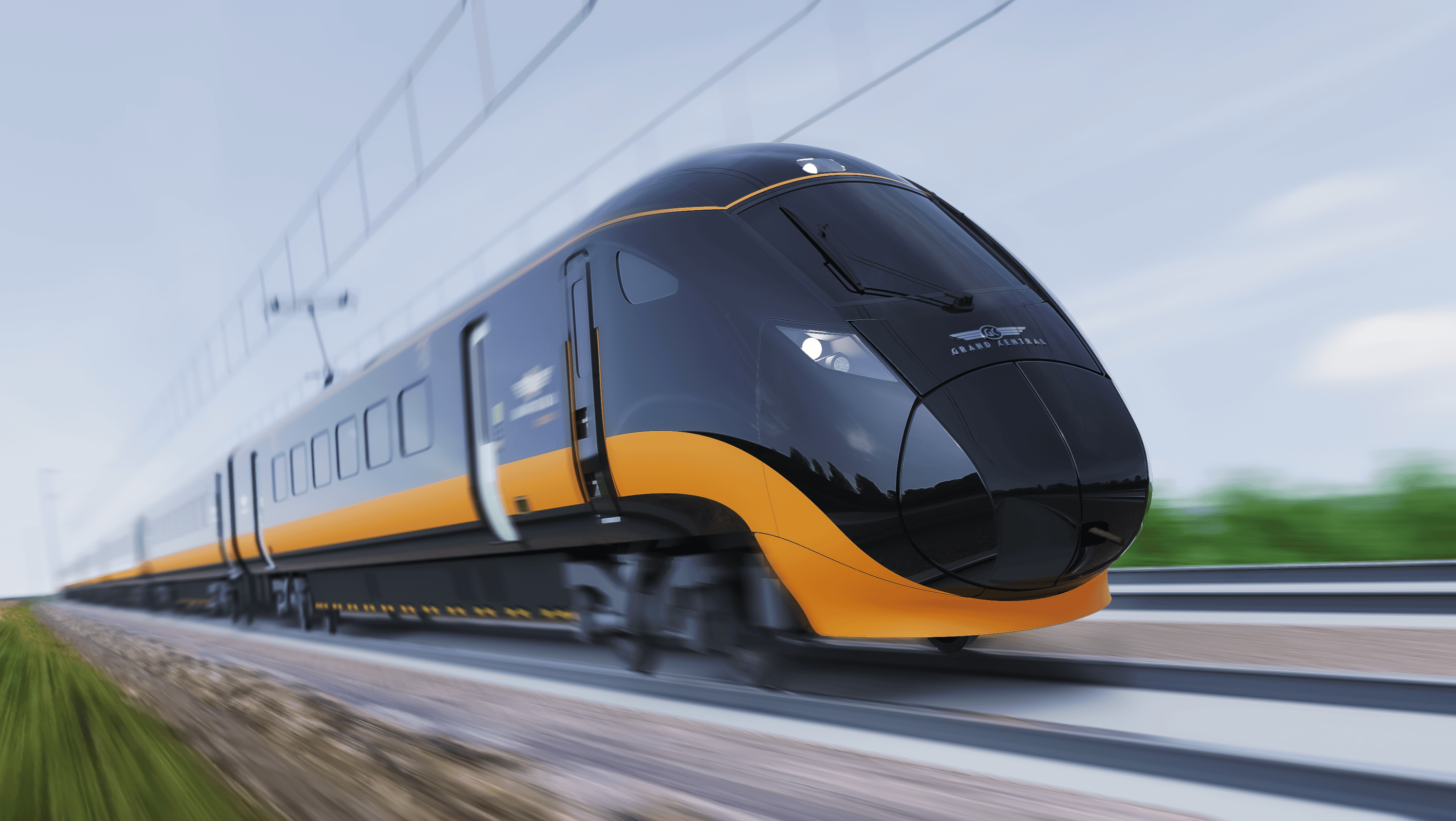
Arriva Group announced today an order for nine cutting-edge battery hybrid trains to replace its entire Grand Central fleet, providing a major boost to regional economies and offering passengers more comfortable, greener travel options.
The order for 45 Hitachi Rail ‘tri-mode’ cars, which have the flexibility to run on electrified and non-electrified tracks, along with a 10-year maintenance contract, represents an investment of around £300 million. Tri-mode means the trains can be powered using electricity, battery or diesel.
It follows approval by the rail regulator for extended track access rights for Grand Central’s existing services through to 2038, with the investment underpinning Arriva’s long-term commitment to UK rail and to delivering sustainable public transport solutions to communities up and down the country and across Europe.
The trains will be built by Hitachi at Newton Aycliffe.
I have some further thoughts and questions.
What Distances Will The Trains Run Away From Electrification?
The distances that the various services will run away from electrification are as follows.
- King’s Cross and Bradford Interchange – Doncaster and Bradford Interchange – 52.1 miles.
- King’s Cross and Cleethorpes – Doncaster and Cleethorpes – 52.1 miles.
- King’s Cross and Sunderland – Longlands junction and Sunderland – 48.5 miles.
It would appear that a train with a range away from electrification of 55 miles would be enough, if there were to be charging at all the destinations.
Will The Trains Be Able To Take The Great Northern And Great Eastern Joint Line (GNGE) Diversion Via Lincoln On The East Coast Main Line?
I discussed using this diversion in detail in London And Edinburgh By Lumo Using the Joint Line Diversion.
In that post, I said this.
The January 2024 Edition of Modern Railways says that the diversion is approximately 90 miles or 145 kilometers.
If the trains have a 90 mile capability on batteries and/or diesel, they will be able to use the diversion.
As Hull Trains, LNER and Lumo all need this ability to take the GNGE Diversion, I suspect, it will be a tick-box on the order form for the trains.
When Will The Trains Be In Service?
The news item says this.
The trains will be delivered in 2028 under a 10-year leasing arrangement, in partnership and financed by Angel Trains.
Will The New Trains Be Faster?
They might save a couple of minutes, if Doncaster is the first stop.
Will The New Trains Be Quieter?
The news item says this about noise and emissions.
State-of-the-art ‘tri-mode’ train technology has proven its ability to cut emissions and fuel costs by around 30 per cent to support UK Government’s decarbonisation agenda.
Hitachi have said that the diesel engines will not run in stations.
Could The Trains Run Grand Central’s Routes Carbon-Free?
In The Data Sheet For Hitachi Battery Electric Trains, I came to these conclusions
- The battery pack has a capacity of 750 kWh.
- A five-car train needs three battery-packs to travel 100 miles.
- A nine-car train needs five battery-packs to travel 100 miles.
- The maximum range of a five-car train with three batteries is 117 miles.
- The maximum range of a nine-car train with five batteries is 121 miles.
As battery technology gets better, these distances will increase.
If I was choosing the trains for Grand Central, the trains would be able to operate these routes without using diesel.
- Doncaster and Bradford Interchange and return.
- Doncaster and Cleethorpes and return.
- Longlands junction and Sunderland and return.
Passengers might not like to have noisy passengers.
Probably, the best insurance policy to avoid running out of battery power, would be to have perhaps fifty metres of electrification at terminal stations. Hitachi claim they can offer a nice line in short lengths of electrification.
Quiet Trains Should Attract Passengers
I’ve seen it before and also with buses.
The Number Of Trains Ordered
The basic order is for nine trains, but Railway Gazette says this.
Arriva welcomed the ‘swift decision-making’ by ORR and the backing of the Department for Transport and Network Rail. It has also submitted applications to run more trains to Bradford and introduce services to Cleethorpes, and has an option to buy more trains if these are approved.
I’ve read somewhere that the option is for three extra trains.
So that’s a total of twelve, which would replace the ten Class 180 trains and two Class 221 trains, that Grand Central Trains currently run.
What About Chiltern Railways And CrossCountry?
Train operating companies Chiltern Railways, CrossCountry and Grand Central Trains are all wholly owned subsidiaries of Arriva Trains UK, who are described like this in the first paragraph of their Wikipedia entry.
Arriva UK Trains Limited is the company that oversees Arriva’s train operating companies in the United Kingdom. It gained its first franchises in February 2000. These were later lost, though several others were gained. In January 2010, with the take-over of Arriva by Deutsche Bahn, Arriva UK Trains also took over the running of those formerly overseen by DB Regio UK Limited
Arriva is ultimately owned by American infrastructure investment company; I Squared Capital.
Both Chiltern Railways and CrossCountry have trains, that are coming to the date, when they will need to be replaced and similar trains to those ordered by Grand Central could be suitable. to replace some.
Chiltern Railways have six rakes of Mark 3 coaches, that are hauled by diesel locomotives between London Marylebone and Birmingham Moor Street stations, These rakes of coaches could be replaced by Hitachi tri-mode trains, of perhaps five or six cars.
Chiltern Railways also have about sixty assorted diesel multiple units totalling up to about 150 carriages.
CrossCountry Trains have twenty-nine two- or three-car Class 170 trains and sixty-one four- or five car Class 220 or 221 trains. All these ninety trains were built this century and are diesel-powered.
The Government’s policy of net-zero by 2050, would probably mean a significant number of these smaller diesel multiple units need to be replaced by 2030.
If the Grand Central Trains new Hitachi trains are a success, then changing the longer four-, five- and six-car trains for similar Hitachi trains, would be a low-risk replacement strategy for I Squared Capital, that could be applied at Chiltern Railways and CrossCountry.
I can also see a need for a two-, three- or four-car tri-mode train for Chiltern Railways and CrossCountry.
Was The Date Of The Announcement Significant?
In October 2020, I wrote Hitachi Targets Export Opportunities From Newton Aycliffe and I believe that tri-mode trains like these that Grand Central have ordered could have export opportunities.
One country for exports has possibilities and that is the United States.
- Hitachi AT-300 trains like these don’t need expensive high-speed tracks and there are probably many lines in the United States, where these trains could fit existing tracks.
- This page on the Hitachi Rail web site is entitled Hitachi Rail in the USA and Canada.
- In the UK, companies like GWR, LNER, Southeastern and TransPennine Express effectively use theHitachi trains as fast commuter trains on some routes.
- Trump’s tariffs would only be 10 % on these trains.
- The Grand Central version looks very stylish!
- Hitachi’s battery technology is owned by Turntide Technology, who are a US company.
- For some routes, the trains would probably only need to be battery-electric.
Has the experience of running Chiltern Railways, CrossCountry and Grand Central Trains convinced I Squared Capital, that running railways is a good investment?
Have I Squared Capital identified some railroads in the United States, that could follow a similar upgrade path to Chiltern Railways?
Was it significant that the order was announced the day after Trump’s tariffs?
.
The Train Trip Where I Arrived Before My Train
Yesterday, I went to Sheffield on Grand Central Trains. But owing to a small mix-up at Peterborough station, I ended up getting to Doncaster on an LNER train, before my Grand Central Train arrived.
This was the sequence of events.
- I bought a ticket from a machine at King’s Cross for Doncaster for the keen single price of £25.70 with my Senior Railcard.
- I had managed to assign myself a forward facing window seat.
- The aisle seat was occupied by a large man before I took my seat.
- But I was able to squeeze past.
- I did tell my travelling companion that I was going to Doncaster., as I have been known to fall asleep on trains and didn’t want to end up in Bradford.
- My train left for Doncaster at 10:52.
- I then found thyself waking up, with the train stopped in a station, which I didn’t recognise.
- So I asked my companion, where we were and he said. “Doncaster!”
- I then squeezed past him again and left the train, only to find, that I had got out at Peterborough.
- Luckily, by the time I realised I was at the wrong station, an LNER train had arrived that was also going to Doncaster.
- So a helpful member of LNER’s station staff told me to get on the LNER train.
- Another helpful member of LNER’s train staff approved my ticket, so I didn’t have to buy another.
- As my new train, passed Retford, we passed the Grand Central Train at rest in Retford station.
- I arrived in Doncaster at 12:45.
Looking at Real Time Trains, I find this is said.
This service was cancelled between Retford and Bradford Interchange due to the train striking a bird (V8)
As it was a V8 bird, I assume it was a large one.
Cleethorpes Station – 25th March 2025
When I got to Cleethorpes station, I took these pictures.

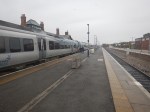
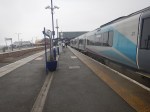
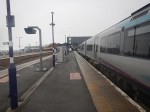
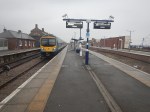
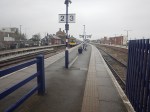
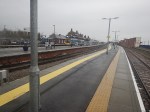
Note.
- The weather wasn’t up to much.
- The restaurant, where I had intended to have lunch appeared closed.
- So I just turned round and went back to Doncaster.
- The station appears to have four long platforms and a siding, where trains could be cleaned during a short or possibly overnight stay.
I do have a few thoughts about Cleethorpes station.
The Platform Lengths At Cleethorpes Station
In
Grand Central To Submit Application For Direct Services Between Lincolnshire And London
The title of this post, is the same as that of this news item from Grand Central.
These three bullet points act as sub-headings.
- Grand Central has today launched an application process for direct services between Cleethorpes, Grimsby, Habrough, Scunthorpe and London – plans to bring significant benefits to underserved areas.
- The application will be welcomed by communities, businesses, and organisations, who have been actively campaigning for the introduction of direct rail links to London.
- If approved, the new services could unlock £30.1 million annually for the region.
These three paragraphs add more details.
Grand Central has today notified Network Rail of its plans to operate new direct services between Lincolnshire and London that, if approved by the rail regulator (the ORR), will bring significant benefits to underserved areas across Lincolnshire and the wider region.
Under the proposals, direct services to London will be provided from Cleethorpes, Grimsby, Habrough, and Scunthorpe, with Grand Central planning to operate the services from as early as December 2026.
The plan makes best use of capacity on the rail network by running trains from the proposed new stops before connecting into existing Grand Central services at Doncaster.
The service seems very similar to the proposed King’s Cross and Cleethorpes service described in the this section of the Grand Central Wikipedia entry, where this is said.
In December 2017, Grand Central announced plans to bid for a service from London King’s Cross to Cleethorpes in early 2018 for a date in 2020. It would involve the existing Bradford Interchange service extended to ten coaches from London to Doncaster then dividing with five coaches going to Cleethorpes via Scunthorpe, Barnetby, Habrough and Grimsby. The other five coaches would be the existing service to Bradford Interchange. This proposal would require permission for a split of trains as it has not been used on the East Coast Main Line before. In February 2018, Grand Central announced plans for an additional call at Crow The company planned to operate four trains per day from 2020. However, in July 2018, the Office of Rail and Road announced new access charges which would affect the business case for the new service, leading to Grand Central announcing that it would delay bidding until 2019.
Note.
- It appears that the service is not calling at Crow.
- By splitting and joining at Doncaster, Grand Central will be getting more coaches and passengers, up and down a single path between King’s Cross and Doncaster stations.
- Grand Central run four trains per day (tpd) between King’s Cross and Bradford Interchange, so as four tpd will be running between King’s Cross and Doncaster stations, it appears Grand Central will be running a full service.
It appears that open access applications come to those who wait eight years.
I have some further thoughts.
What Class Of Trains Do Grand Central Currently Use?
According to Real Time Trains on Friday the 21st of March 2025, two Class 180 trains and two Class 221 trains each ran a service between King’s Cross and Bradford Interchange stations.
Both type of train appear to be able to run as a pair of trains.
As Bradford is the UK City of Culture in 2025, that could prove useful.
What Trains Will Grand Central Use For The New Service?
It would appear that either type of train type could run the service,
So it would probably come down to factors like reliability, comfort and what is available.
I Was Mildly Surprised When I Saw This Application Had Gone In
But, circumstances change.
- Grand Central now run two Class 221 trains, in addition to the Class 180 trains.
- There are more Class 221 trains in store, if needed.
- The UK has had several changes of government since the original application in 2017 and track-access charges may have been reduced.
- Cleethorpes station has been refurbished.
Cleethorpes Station – 28th June 2023 shows the station in 2023.
But a new problem has arisen. The new Transport Secretary doesn’t seem keen on open access services, from some of the things she’s said.
Perhaps, she has had a change of heart or as she looks to be a good doer, someone has bought her a decent meal of fish and chips in Cleethorpes? My meal in the town is described in Lunch On The Pier In Cleethorpes.
But would Grand Central put in an application, if they knew they were wasting their money?
Or could this be an application funded by all the open access operators to get a definitive view on the government’s policy?
Could The Cleethorpes Service Be Run By Battery-Electric Trains?
Consider.
- Doncaster and Cleethorpes are 52.1 miles apart.
- Surprisingly Doncaster and Bradford Interchange are 52.1 miles apart.
- King’s Cross and Doncaster are 155.9 miles apart and fully-electrified.
- A battery that had enough capacity to do the return trips from Doncaster to either Cleethorpes or Bradford Interchange, would be easily recharged on the way to and from London.
With careful calculation of the battery size and good capacity management, I also suspect a battery-electric train could be able to take the GNGE Diversion via Lincoln.
Could The Cleethorpes Service Be Run By Hydrogen-Electric Trains?
Consider the daily services will be made up of these runs.
- Eight runs between London and Bradford Interchange each consisting of 155.9 miles on wires and 52.1 miles on hydrogen.
- Eight runs between London and Cleethorpes each consisting of 155.9 miles on wires and 52.1 miles on hydrogen.
Which means there are 833.6 miles per day run on hydrogen.
If there are four trains running the service as now, that is 208.4 miles per train per day on hydrogen.
A hydrogen-powered train with this daily range is very much a possibility.
The German Dimension To Grand Central Trains
Consider.
- Grand Central are owned by Arriva.
- Arriva are owned by Deutche Bahn.
- Siemens have a train factory at Goole close to Doncaster.
- Siemens have built quite a few electric multiple units for various UK railways.
- Siemens have designs for battery-electric and hydrogen-electric multiple units, that would be suitable for Grand Central Trains.
- Jürgen Maier was senior in Siemens UK, when the train factory at Goole was built and is now chair of Great British Energy.
I believe that Siemens at Goole could build trains, that would do nicely for Grand Central Trains.
- It would surely be handy for Grand Central Trains to have their fleet stabled in easy reach of the factory.
- In addition, hydrogen will soon be readily-available in the Doncaster area.
Grand Central trains could do a lot worse than buy trains built or assembled at Siemen’s factory at Goole.
DfT Objects To Eight Open Access Applications
The title of this post is the same as that of an article in the March 2025 Edition of Modern Railways.
Surprise! Suprise! There are no prizes for innovation and risk, to be given out by Starmer’s Government Of All The Lawyers.
- Alliance Rail – Cardiff and Edinburgh – opposed
- Grand Central – London and York – opposed
- Hull Trains – London and Hull – opposed
- Hull Trains – London and Sheffield – opposed
- Lumo – London and Glasgow – opposed
- Lumo – London and Rochdale – opposed
- Virgin Trains – London and Liverpool – opposed
- Virgin Trains – London and Glasgow – opposed
Wrexham, Shropshire and Midlands Railway – London and Wrexham – supported.
Splitting And Joining Of Trains
Several of the objections, seem to be on grounds of capacity.
So why not pair up some services and split and join at a convenient station?
Hull Trains – A Hull and a Sheffield service could start together in London and split in Retford.
Lumo – A Newcastle and an Edinburgh service could start together in London and split in Newcastle.
Lumo – An Edinburgh and a Glasgow service could start together in London and split in Edinburgh.
Virgin Trains – A Liverpool and a Glasgow service would start together in London and split in Crewe.
A Bad Decision
I believe the Government’s decision is a very bad one.
At the weekend I wrote Sutton Station To Gatwick Airport By Hydrogen-Powered Bus, about my trip in a hydrogen-powered bus to Gatwick-Airport.
- The quality, performance and roadholding of this new zero-carbon bus was superb.
- I can’t wait to try out Wrightbus’s new hydrogen-powered coach in the next twelve months.
- In the future, I can see high speed hydrogen coaches steaming along the motorways of the UK and Ireland.
Hydrogen-powered coaches will do for cheap travel on the roads of these islands, what Ryanair and easyJet for did above our heads.
Could An Open Access Operator Develop A Train Service Along The South Coast of The UK Between Kent and Fishguard?
Before I go into detail, I will answer a question that explains the terminology and the why’s and wherefores’ of the title of this post.
What Is An Open Access Operator?
This is the first paragraph of the Wikipedia entry of an Open Access Operator.
In rail transport, an open-access operator is an operator that takes full commercial risk, running on infrastructure owned by a third party and buying paths on a chosen route and, in countries where rail services run under franchises, are not subject to franchising.
In the UK, these are all open access operators, that are running services.
Note.
- Other groups are developing services.
- Regional, High Speed, International, Local and Sleeper services seem to be offered by various open access operators.
- Grand Central is a subsidiary of Deutsche Bahn,
- Hull Trains and Lumo are both subsidiaries of FirstGroup.
Open Access operators seem to operate in most European Union countries.
Why Run Between Kent and Fishguard?
- The main purpose of the train service would be to provide a low-cost rail connection between the island of Ireland and particularly the Republic of Ireland, with the Southern part of England and the European Union.
- At both ends of the route the train service would connect to ferries.
- At the Eastern end, the train service would also connect to Eurostar services through the Channel Tunnel.
- The Port of Dover could be efficiently connected to Dover Priory Station.
- Dover Priory Station could be the Eastern terminus.
- The service could stop at Folkestone Central station, if ferries call at the Port of Folkestone in the future.
- The service could stop at Ashford International station for Eurostar services.
- Fishguard Harbour station has been built as a train terminus for the Port of Fishguard.
- Fishguard Harbour station could be the Western terminus.
This could be a busy service.
Where Would The Trains Call?
Intermediate stations would depend on passenger umbers, but could start as Folkestone Central, Ashford International, Hastings, Eastbourne, Brighton, Portsmouth & Southsea, Southampton Central, Romsey, Salisbury, Warminster, Westbury, Trowbridge, Bradford-on-Avon, Bath Spa, Bristol Temple Meads, Bristol Parkway, Newport, Cardiff Central, Gowerton, Llanelli and Carmarthen.
How Long Would The Journey Be?
The journey would be around 377 miles and I suspect could take about three and a half hours with modern digital signalling.
Surprisingly, the route is fully-electrified except for the following.
- Ashford International and Ore – 27.9 miles
- Southampton Central and Bristol Parkway – 82 miles
- Cardiff Central and Fishguard Harbour – 115.6 miles
All gaps should be able to be bridged using battery power.
I suspect trains would be Hitachi high speed battery-electric trains.
Would Any European Funding Be Available?
This is an interesting question, as the service does join up two separate sections of the European Union.
Arriva’s Grand Central Applies For Extended Track Access Rights
The title of this post, is the same as that of this news item from Arriva.
These three bullet points, act as sub-headings.
- Grand Central to submit application to the rail regulator for extended track access up to 2038.
- Proposals for a new, greener fleet are outlined as part of the application.
- Application signals Arriva’s long-term commitment to UK rail.
These three paragraphs add more detail to the application.
Arriva Group’s UK open access train operating company, Grand Central, has today announced it is seeking to extend its existing track access rights until 2038, securing its services for the next 15 years and unlocking Arriva’s intentions to invest in new, state-of-the-art trains.
Grand Central has been operating services on the East Coast mainline since 2007 as an open access operator, which means it receives no government funding or subsidy. It directly links 15 destinations, including cities in Yorkshire and the North East with London’s Kings Cross.
The application represents a significant commitment to long-term services and supports its plans to expand services with improved connectivity and increased frequency, as outlined in a previous application, submitted to the Office of Rail and Road in May this year.
These are my observations and thoughts.
Grand Central’s Current Services
Grand Central currently runs two separate services.
- King’s Cross and Sunderland via Peterborough,York, Thirsk, Northallerton, Eaglescliffe and Hartlepool – six tpd
- King’s Cross and Bradford Interchange via Peterborough, Doncaster, Pontefract Monkhill, Wakefield Kirkgate, Mirfield, Brighouse, Halifax and Low Moor – four tpd
Note.
- tpd is trains per day.
- Weekend services are reduced.
- Peterborough is served by one train in each direction.
Grand Central have applied to run more services.
Distances Without Electrification On Current Services
Only the Northern ends of both routes are not electrified.
- King’s Cross and Sunderland – Longlands junction and Sunderland – 48.5 miles
- King’s Cross and Bradford Interchange – Doncaster and Bradford Interchange – 52.1 miles
Note.
- Going North, any train batteries could be charged on the East Coast Main Line.
- Before returning South, train batteries could need to be charged at the two terminals.
- Battery-electric trains would need infrastructure changes at the two terminals.
The two terminals; Bradford Interchange and Sunderland are not particular spacious.
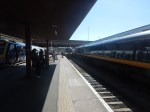
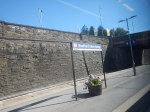
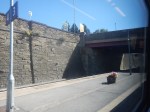
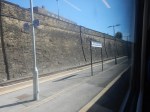
These pictures show Bradford Interchange station.
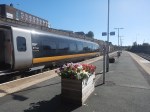
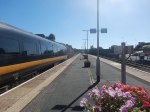
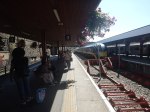
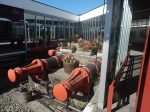
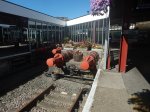
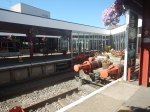
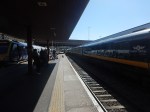
And these pictures show Sunderland station, which is underground.
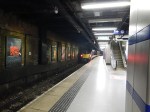
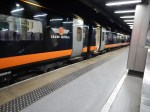
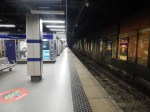
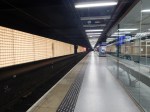
Putting even a short length of catenary to charge battery-electric trains might not be that easy at either station.
Grand Central’s New Trains
Arriva’s news item, gives these details on the new trains.
- Increased capacity: The new trains would feature approximately 20 per cent more seats than the current Class 180 units, providing additional capacity to meet growing passenger demand.
- Modernised fleet: The new Bi-Mode trains would replace the existing 24-year-old Class 180 units bringing new customer focussed features and a more comfortable experience for passengers.
- Greener services: The Bi-mode trains would cut carbon emissions and provide smoother journeys for passengers. They can operate on electric and non-electric tracks, so they can serve long into the future as track electrification gathers pace across the UK.
Note.
- A five-car Class 802 train has approximately twenty percent more seats than a four-car Class 180 train.
- Hull Trains, LNER, Lumo and TransPennine Express all run Hitachi Class 80x trains on the East Coast Main Line, which could ease operations, if all trains were similar.
- Bi-mode trains are specified. Grand Central will change mode once on each trip.
- LNER have specified CAF Tri-mode trains for their new fleet. Will these have an extra level of complication, that Grand Central don’t need?
I suspect that rand Central will opt for the Hitachi trains.
Using The Joint Line Between Peterborough and Doncaster via Lincoln
The diesel Class 180 trains can use this line, in times of incidents or engineering works.
Class 800 and Class 802 trains can also use this diversion, so it might be sensible to be able to use the line in time of trouble.
Chiltern Trains’ London And Birmingham Services
Both Arriva and Chiltern Trains are subsidiaries of Deutsche Bahn.
Currently, Chiltern run six-car rakes of Mark 3 coaches, with a Class 68 locomotive at one end and a driving van trailer at the other, between London and Birmingham.
They are nice trains, but they are not zero-carbon.
Could these be replaced by an eight-car Class 802 train?
- Chiltern have said that they are looking for new trains.
- An eight-car Class 802 train could be a similar length to the current trains.
- London Marylebone and Birmingham Moor Street is only 111.7 miles.
- The Hitachi trains would offer an increase in capacity.
- They might save a few minutes.
But the trains will still be not zero-carbon.
This page on the Hitachi web site is entitled Intercity Battery Trains.
The trains for London Marylebone and Birmingham Moor Street would be built as conventional eight-car Hitachi trains, with perhaps four diesel engines.
- Over the years, the Chiltern Main Line would be partially electrified, starting perhaps in the middle around Banbury.
- One by one, the diesel engines would be replaced by batteries, so that the trains could run on battery power between the electrified sections.
- Eventually, the London Marylebone and Birmingham Moor Street service would be fully battery-electric.
- As Kidderminster is only twenty miles past Birmingham Moor Street, there must surely be possibility for extension of the service.
I believe that Hitachi’s Intercity Battery Train, is going to play a large part in the decarbonisation of UK railways.
Chiltern Trains’ London And Oxford Services
If eight-car Hitachi Intercity Battery Trains can handle London Marylebone and Birmingham Moor Street services, then I am fairly sure that five-car Hitachi Intercity Battery Trains could handle London Marylebone and Oxford services.
They would also have more capacity, than the current trains, that serve Oxford and Bicester Village.
Conclusion
It may be advantageous for Deutsche Bahn to put the two orders together.
The Data Sheet For Hitachi Battery Electric Trains
Was I just slow to spot this data sheet or has it only just been released?
You can download a copy from this page on the Hitachi web site.
In a section on the page, which is entitled Intercity Battery Trains, this is said.
A quick and easy application of battery technology is to install it on existing or future Hitachi intercity trains. Adding just one battery reduces emissions by more than 20% and offers cost savings of 20-30%.
Our intercity battery powered trains can cover 70km on non-electrified routes, operating at intercity speeds at the same or increased performance. Hitachi Rail’s modular design means this can be done without the need to re-engineer or rebuild the train and return them to service as quickly as possible for passengers.
These are my initial thoughts.
Plug-and-Play
It looks like the train is plug-and-play.
A diesel engine will be swapped for a battery-pack and the train’s computer controls the power sources accordingly.
Hitachi’s Battery Philosophy Explained
This is said on the data sheet.
Battery technology has the potential to play a significant role in the future of sustainable rail mobility, setting
the rail industry on the path to full intercity decarbonisation by 2050.
Installing batteries on intercity trains can complement electrification and provide a low emission alternative
to domestic air travel.Our retrofit solution for intercity trains offers phased replacement of diesel engines at the time that they would
have been due for their regular heavy maintenance overhaul, replacing each engine in turn until trains are fully battery electric. The solution delivers fuel cost savings and lowers CO2 emissions by at least 20% for every engine replaced, and a 20% reduction in whole life maintenance costs – well within the battery’s life span of 8-10 years.
Performance On Battery Power
The data sheet gives these bullet points.
- 750kW peak power
- Weight neutral.
- At least 20% lower CO2 emissions
- 70km on non-electrified routes
- 20% reduction in whole life maintenance costs
- Up to 30% fuel cost savings
- Zero emissions in and out of stations
- Charge on the move
- 10 year life span
Note.
- 750 kW peak power, is around the power of the diesel-engine, that will be replaced.
- I wouldn’t be surprised that powerwise, the battery pack looks like a diesel engine.
- Weight neutral means that acceleration, performance and handling will be unchanged.
- Batteries are easier to maintain than diesels.
- It is stated that a train can be fully-decarbonised.
I have a feeling these trains are no ordinary battery-electric trains.
Seventy Kilometre Range On Battery
Seventy kilometres is 43.5 miles.
This may not seem much, but the data sheet says this.
Our battery hybrid trains can cover 70km on non-electrified routes, operating at intercity speeds at the same
or increased performance. By identifying the routes with short non-electrified sections of 70km or less, we could
see the replacement of existing diesel trains with fully battery-operated trains on those routes within a year.
And, using battery power to avoid electrifying the hardest and most expensive areas, such as tunnels and bridges,
enables flexibility on electrification, minimising passenger disruption during upgrades.
Note.
- It looks like the trains can operate at 125 mph on battery power, where the track allows it. But then the rolling restistance of steel wheel on steel rail, is much lower, than that of rubber tyres on tarmac.
- Hitachi seem to have developed a philosophy on how the trains will be used.
- Hitachi’s pantographs, go up and down with all the alacrity of a whore’s drawers. They will be ideal for a short length of electrification.
I think these LNER routes could be immediately decarbonised.
- LNER – London and Harrogate , where only 18.3 miles is unelectrified. Trains may not need charging, as a full battery could handle both ways.
- LNER – London and Hull, where 36.1 miles is unelectrified. A short length of electrification to charge trains would be needed at Hull.
- LNER – London and Lincoln, where only 16.7 miles is unelectrified. Trains would not need charging, as a full battery could handle both ways.
- LNER – London and Middlesbrough, where only 20.3 miles is unelectrified. Trains would not need charging, as a full battery could handle both ways.
Note.
- It looks like some services could start fairly soon, once batteries are available.
- Hull Trains could use the 70 km batteries and charging at Hull, as it passed through. This would decarbonise Hull Trains passenger operations.
- Services to Aberdeen, Cleethorpes and Inverness would be out of range of the initial Hitachi trains.
Could the last point, partially explain the purchase of the CAF tri-mode trains, which I wrote about in First Tri-Mode Long Distance Trains For The East Coast Main Line?
We shall see what we shall see.
But having a choice of battery-electric or tri-mode trains will enable route development and decarbonisation.
What Is The Size Of The Battery Pack?
In How Much Power Is Needed To Run A Train At 125 Or 100 mph?, I estimated that to maintain 125 mph, a Class 801 train has a usage figure of 3.42 kWh per vehicle mile.
If a five-car Class 800 can run 70 km or 43.5 miles at 125 mph, as indicated by Hitachi, then the battery size can be calculated.
3.42 * 5 * 43.5 = 743.85 kWh
As the battery pack can supply 750 kW according to the data sheet, this looks like this will run the train for an hour.
Is that coincidence or a design criteria?
What Battery Capacity Would Be Needed For A Hundred Miles?
For a five-car train, this is the energy needed for a hundred miles.
3.42 *5 * 100 = 1710 kWh or three batteries.
For a nine-car train, this is the energy needed for a hundred miles.
3.42 *9 * 100 = 3078 kWh or five batteries.
It looks like all diesel engines will be replaced by batteries.
Will Class 801 Trains Swap Their Single Diesel Engine For a Battery Power Pack?
Consider.
- Class 801 trains have a single diesel engine for emergency power.
- Lumo’s Class 803 trains, are all-electric with a battery-pack for emergency hotel power only.
- Hitachi must have full details on the performance of Lumo’s trains.
- The East Coast Main Line is notorious for the wires to come tumbling down.
- The diesel engine and the battery pack appear to weigh the same.
- Batteries cost less to maintain than diesels.
I can’t see why the single diesel engine can’t be replaced by a standard battery pack, without loosing any functionality.
What Would Be The Range Of A Fully Battery-Electric Train?
This is a paragraph from a data sheet.
Our retrofit solution for intercity trains offers phased replacement of diesel engines at the time that they would
have been due for their regular heavy maintenance overhaul, replacing each engine in turn until trains are fully battery electric. The solution delivers fuel cost savings and lowers CO2 emissions by at least 20% for every engine replaced, and a 20% reduction in whole life maintenance costs – well within the battery’s life span of 8-10 years.
Note.
- It looks like Hitachi are expecting operators to replace engines in turn.
- Replacing engines with batteries saves the operators money.
As a five-car Class 800 train has three diesel engines and a nine-car train has five engines, does this mean that the range of fully-batteried Class 800 train is 70 km or 210 km?
- A fully-batteried Class 800 train will weigh the same as the current diesel.
- One battery can drive the train for 70 km at 125 mph according to Hitachi.
- There are no branches of electrified lines that are 125 mph lines without electrification.
- I would assume that the train can use regenerative braking to recharge the batteries.
- 210 kilometres is 130 miles.
I don’t know much about the electrical systems of Hitachi’s trains, but it is likely that there will be an electrical bus to distribute power from one end of the train to the other.
So a five-car Class 800 train with three fully-charged battery packs could have over 2 MWh of electricity on board, that could be used for traction.
- Applying the usage figure of 3.42 kWh per vehicle mile, gives a range for the five-car train of at least 117 miles.
- The equivalent figure for a nine-car train will be at least 121 miles.
These distances would open up routes like these on the East Coast Main Line.
- LNER – London King’s Cross and Aberdeen – 91.4 miles – Charge before return.
- LNER/Hull Trains – London King’s Cross and Beverley via Temple Hirst junction – 44.3 miles – No Charging needed before return.
- Grand Central – London King’s Cross and Bradford Interchange via Shaftholme junction – 47.8 miles – No Charging needed before return.
- LNER – London King’s Cross and Cleethorpes via Newark and Lincoln – 63.9 miles – Charge before return.
- LNER – London King’s Cross and Harrogate via Leeds – 18.3 miles – No Charging needed before return.
- LNER – London King’s Cross and Inverness– 146.2 miles – Charge before return.
- LNER/Hull Trains – London King’s Cross and Hull via Temple Hirst junction – 36.1 miles – No Charging needed before return.
- LNER – London King’s Cross and Middlesbrough via Northallerton – 20.3 miles – No Charging needed before return.
- LNER – London King’s Cross and Scarborough via York – 42.1 miles – No Charging needed before return.
- LNER/Grand Central – London King’s Cross and Sunderland via Northallerton – 47.4 miles – No Charging needed before return.
Note.
- The miles are the longest continuous distance without electrification.
- Only Aberdeen, Cleethorpes and Inverness would need to charge trains before return.
- Inverness may be too far. But is it in range of LNER’s new CAF tri-mode trains?
The battery range would also allow LNER to use the Lincoln diversion on the Joint Line.
Why Didn’t LNER Buy More Azumas?
This puzzles me and I suspect it puzzles other people too.
Surely, an all Azuma fleet will be easier to manage.
But in this article on Modern Railways, which is entitled LNER Orders CAF Tri-mode Sets, this is said.
Modern Railways understands the new fleet will be maintained at Neville Hill depot in Leeds and, like the ‘225’ sets, will be used predominantly on services between London and Yorkshire, although unlike the ‘225s’ the tri-modes, with their self-power capability, will be able to serve destinations away from the electrified network such as Harrogate and Hull.
Note.
- Hull would possibly need work to provide some form of charging for battery-electric Azumas, but Harrogate is close enough to be served by a one-battery Azuma.
- The CAF Tri-mode sets would certainly handle routes like Cleethorpes, Middlesbrough and Sunderland, but would they really need a ten-car train.
- Ten-car trains would also be busy on the Leeds route.
- The UK is going to need more 125 mph trains for Cross Country, Grand Central, Grand Union, TransPennine Express and possibly other train companies.
- Has Hitachi got the capacity to build the trains in the UK?
So has the Government given the order to CAF to create a level of competition?
Conclusions
These are my conclusions about Hitachi’s battery packs for Class 80x trains, which were written in November 2023.
- The battery pack has a capacity of 750 kWh.
- A five-car train needs three battery-packs to travel 100 miles.
- A nine-car train needs five battery-packs to travel 100 miles.
- The maximum range of a five-car train with three batteries is 117 miles.
- The maximum range of a nine-car train with five batteries is 121 miles.
As battery technology gets better, these distances will increase.
Hitachi have seen my figures.
They also told me, that they were in line with their figures, but new and better batteries would increase range.
In July 2025, I wrote Batteries Ordered For Grand Central Inter-City Trains, which mentions the following.
- Grand Central’s trains will be electric-diesel-battery hybrid inter-city trainsets.
- The trains will have lithium ion phosphate batteries.
- The trains will be delivered in 2028.
- The batteries will be smaller and more powerful, than current batteries.
This is also said about safety, hazards and cybersecurity.
The Safety Integrity Level 2 and IEC 61508 compliant battery management system will detect and mitigate hazards and meet the IEC 62243 cybersecurity standard.
These batteries would appear to give Hitachi and Grand Central Trains everything they want and need.
It looks like the new battery chemistry, will give Hitachi extra range.
Grand Central Trains And CAF’s Tri-Mode Trains
In First Tri-Mode Long Distance Trains For The East Coast Main Line, I wrote about LNER’s purchase of a new fleet of ten CAF tri-mode trains to work services between London and Yorkshire.
In this press release from LNER, which is entitled First Tri-Mode Long Distance Trains For The East Coast Main Line, this is a paragraph.
This new fleet of trains will keep LNER on track to reduce its emissions by 67 per cent by 2035 and be net zero by 2045. LNER has already reduced carbon emissions by 50 per cent compared with 2018/19. Per mile, LNER trains produce 15 times less carbon emissions than a domestic flight.
I believe that as they compete over similar routes with LNER, that Grand Central Trains will have to implement a similar decarbonisation strategy or their business will suffer.
The new trains for Grand Central Trains, will need to have the following conditions.
Train Length
Consider.
- The train must be able to fit all the platforms it will use.
- Ten-cars may be too long for some of the platforms.
- Train length should also be long enough to capture as much of the market as possible.
But as adjusting the length of trains is an easy process, I suspect all manufacturers will be happy to supply extra carriages.
Distances Without Electrification
These are the distances on Grand Central Trains’s services without electrification.
- Doncaster and Bradford Interchange – 52.1 miles
- Northallerton and Sunderland – 47.4 miles
A battery-electric train with a battery range of 110 miles would probably be able to reach Sunderland and return, after charging on the main line.
But a CAF tri-mode train, which ran on diesel or a suitable sustainable fuel like biodiesel or HVO wouldn’t give the driver, operator or passengers any worries.
Possible Time Savings To Bradford
Digital signalling is being installed on the East Coast Main Line between Woolmer Green and Dalton-on-Tees, which will allow running on the line up to 140 mph.
- Woolmer Green is 132.1 miles South of Doncaster.
- A typical train time by Grand Central Trains is 75 minutes.
- This is an average speed of 110 mph.
- Trains take typically three hours and eight minutes between London and Bradford Interchange.
I can build a table of timings and savings at various average speeds.
- 120 mph – 66 minutes – 9 minutes
- 125 mph – 63 minutes – 12 minutes
- 130 mph – 61 minutes – 14 minutes
- 140 mph – 57 minutes – 18 minutes
Several times, I have timed an Hitachi train running at 125 mph on routes like the East Coast Main Line, Great Western Main Line, Midland Main Line and West Coast Main Line, so I have no doubt, that London and Bradford Interchange services can be less than three hours.
These journey time savings will be available to any train able to use the digital electrified railway to the South of Doncaster.
Possible Time Savings To Sunderland
Dalton-on-Tees, where the first phase of the digitally signalling will end, is North of Northallerton, so once the Sunderland train is on the East Coast Main Line, it will be a digital electrified railway all the way to Woolmer Green.
- Woolmer Green is 194.6 miles South of Northallerton.
- A typical train time by Grand Central Trains is 151 minutes.
- This is an average speed of 77.3 mph.
- Trains take typically three hours and twenty-eight minutes between London and Sunderland.
I can build a table of timings and savings at various average speeds.
- 120 mph – 97 minutes – 54 minutes
- 125 mph – 93 minutes – 58 minutes
- 130 mph – 89 minutes – 62 minutes
- 140 mph – 83 minutes – 68 minutes
It looks like times of two hours and thirty minutes will be possible between between London and Sunderland.
Will The Trains Need A 140 mph Capability?
Trains will need to average 125 mph on the digital electrified East Coast Main Line to get under three hours for Bradford Interchange and 2½ hours for Sunderland, so I feel a 140 mph capability is required between Northallerton and London.
Could The Trains Split And Join At Doncaster?
High speed paths on the digitally signalled and electrified East Coast Main Line might be at a premium, so running pairs of five-car trains to two destinations could be commonplace working.
- It could be a way of increasing frequency to Bradford Interchange and Sunderland, by perhaps running pairs of five-car trains that split at Doncaster.
- Grand Union Trains have proposed in the past to use splitting and joining to run services to Cleethorpes.
As Hitachi trains can split and join, I suspect that the CAF tri-mode trains will be at least able to be retrofitted with the ability.
Conclusion
These are my conclusions.
- The digital signalling certainly gives good time saving to Yorkshire and the North-East
- New trains for Grand Union Trains would give them faster services on their existing routes.
- Trains with a 140 mph capability would be needed.
- CAF tri-mode trains wouldn’t need any new infrastructure, but battery-electric trains may need chargers at the destinations.
- Because of the lower infrastructure requirements, I think the CAF trains will get the nod.
 The Anonymous Widower