Scotland To Get New Intercity Fleet
The title of this post is the same as that of this press release from Transport Scotland.
These eight paragraphs make up the body of the press release.
The Scottish Government announced today that procurement will begin to replace the trains in its Intercity fleet.
The procurement will seek a replacement for the High Speed Train (HST) fleet of 25 trains which operates on its InterCity routes between Glasgow, Edinburgh, Aberdeen, and Inverness.
Cabinet Secretary for Transport, Fiona Hyslop said:
“Resilient, reliable ScotRail services are key to encouraging more people to choose to travel by train for work, leisure and learning.
“Over 4 million passengers travelled on InterCity trains between our key cities in the last year – we want to encourage even more people to do so. This procurement will enable us to replace the current Intercity fleet with trains which provide improved facilities and accessibility.
“Any replacement fleet is expected to be more energy efficient and therefore will significantly reduce emissions, reduce operating costs and be more in line with current passenger expectations, including for accessibility. The procurement process ensures Scottish suppliers will be able to offer to provide their services to potential bidders.
“This latest milestone in our rolling programme of decarbonisation will ensure the reliability of our Intercity routes for the long-term, making Scotland’s railway a more attractive and greener travel choice.”
Further details on this announcement will be shared when the contract is awarded in 2025. It is also expected that the refreshed Decarbonisation Action Plan will be published in Spring 2025, and this will detail updated targets for replacing ScotRail’s existing diesel fleets.
It is a press release full of good intentions, but very few facts.
Is this what Scots get from their political party?
I have a few questions.
Will The Trains Be Built In The UK?
This must surely give some advantages, but will it get the best trains at the best price?
What Will Be The Number And Capacity Of The Trains?
Transport Scotland could go for a like for like number and capacity replacement.
- But there have been capacity problems in Scotland, which have meant using diesel Class 153 trains as baggage cars.
- They might also want to add extra services.
- Will they replace the train lost at Stonehaven?
They could add a few options.
Other Companies May Need Similar Trains
Consider.
- GWR will need to replace their similar Castles.
- CrossCountry will need new trains.
- Grand Central will need new trains.
- South Western Railway may need new trains for services between Cardiff and Devon.
- Transport for Wales may need new trains.
Hull Trains and Lumo have recently ordered a selection of new Hitachi Class 802 and 803 trains, which I wrote about in Fourteen New Trains To Drive First Rail Open Access Growth.
I can see an argument for buying more Hitachi Class 80x trains, as it will surely save Great British Railways costs in the long time.
Should The New Trains Be A Forever Solution?
When British Rail electrified to Brighton, Crewe, Edinburgh, Glasgow, Leeds, Liverpool, Manchester, Newcastle, Norwich, Portsmouth, Southampton, Weymouth and many other places from London, they saw it as a mode of traction, that would be used forever.
As the trains wore out or got outdated, they would be replaced with trains, which at least could run using the same mode of traction.
Generally, on electrified routes, when British Rail’s electric trains have been replaced, they have been replaced by more modern new electric trains.
The one major exception was on the East Coast Main Line where some InterCity 225 trains were replaced with Hitachi Class 800 and Class 802 diesel bi-mode trains.
But as the Class 800 and Class 802 diesel bi-mode trains were also replacing InterCity125 trains, they were a pragmatic replacement.
The Hitachi trains can be considered a Forever Solution, as bi-mode trains will always be able to work some routes that will never get electrified.
But Hitachi are developing the successor to their diesel bi-mode train, which is the tri-mode train, capable of running on electrification, diesel or battery power.
- Diesel power-packs can be swapped for battery packs.
- The battery packs have the same weight and power as a diesel power-pack.
- Existing diesel bi-mode trains can be converted to tri-mode or battery-electric bi-mode trains.
- A range of over forty miles on a single battery pack has been demonstrated.
Could Hitachi tri-mode trains be The replacements for the Inter7City trains?
Will Some Trains Have A Battery Electric Capability?
I very much believe so, as some routes in Scotland could be decarbonised by battery-electric trains.
What Top Speed Would The Trains Have?
Most of the routes in Scotland, where new modern quality rolling stock is needed, has a top speed of less than 100 mph, but in places the top speed is 125 mph.
I suspect, if trains can run at 125 mph in the places, where it is allowed, could probably save a few minutes on journey times.
Take the Borders Railway.
- The electrification runs out at Brunstane. Batteries would be charged between Edinburgh and Brunstane using the existing electrification.
- To go from Brunstane to Tweedbank and return to Brunstane is 63 miles.
- To work the Borders Railway would need a battery range of 63 miles.
I suspect every route in Scotland could have an electrification strategy for use with battery-electric trains. Some of which would have short lengths of extra electrification.
What Lengths Would The Trains Be?
In my example I used the Borders Railway.
A typical service is run by a three-car Class 170 train or two such trains running as a pair.
Perhaps, a single four- or five-car train could work the service all day and still provide enough capacity?
Conclusion
I believe, that Scotrail services could be electrified line-by-line.
Some lines would need more or longer trains and an update to the electrification.
Are Scotrail Going To Replace The Inter7City Trains With Hydrogen-Powered Trains?
This article in The Times is entitled The Caley Is Ready To Roll With New Venture Building Trains.
I feel that this is one of the most significant paragraphs in the article.
ScotRail has indicated that it wants to replace nearly two thirds of its fleet with new, low-carbon rolling stock between 2027 and 2035, comprising about 675 carriages in total, with an initial core order of 64 four and five-car units. A spokesman confirmed: “We are working on a business case that will go to the Scottish government for the procurement of a new suburban train fleet.”
The current Scotrail fleet includes.
- 25 Inter7City trains which comprise 52 Class 43 power cars and 120 Mark 3 carriages – Diesel – 120 cars – 1975
- 5 Class 153 trains – Diesel – 5 cars – 1987
- 42 Class 156 trains – Diesel – 84 cars – 1987
- 40 Class 158 trains – Diesel – 80 cars – 1987
- 30 Class 170 trains – Diesel – 90 cars – 1998
- 21 Class 318 trains – Electric – 63 cars – 1985
- 34 Class 320 trains – Electric – 66 cars – 1990
- 40 Class 334 trains – Electric – 120 cars – 1999
- 38 Class 380 trains – Electric – 140 cars – 2009
- 70 Class 385 trains – Electric – 234 cars – 2015
Note the last three fields are the traction type, total number of cars and the build year of the first train.
I will split these trains into four groups.
- Inter7City – Diesel – 25 trains – 120 cars
- BR Diesel – Diesel – 117 trains – 259 cars
- BR Electric – Electric – 55 trains – 129 cars
- Modern Electric – Electric – 148 trains – 494 cars
Note.
- This is a grand total of 345 trains and 1002 cars.
- Ignoring the modern electric trains and the total is 197 trains and 508 cars.
- The total for diesel trains is 142 trains and 359 cars.
- As Great Western Railway have withdrawn their similar GWR Castles, there must be reasons for Scotrail to do the same.
I will now look at replacement strategies, based on this statement from Scotrail.
ScotRail has indicated that it wants to replace nearly two thirds of its fleet with new, low-carbon rolling stock between 2027 and 2035, comprising about 675 carriages in total, with an initial core order of 64 four and five-car units.
I would expect 675 carriages would be about 232 trains, if the current average train length of just under three cars is carried over.
The Effect Of 675 New Carriages
Assuming that no modern electric trains were replaced, this would create a fleet size of at least 1169 carriages.
This would be a sixteen percent increase in carriages, which would be welcome news for some rail users.
The Initial Core Order Of 64 Four And Five-Car Units
All we know of this order, is the number of trains and that they will be new and low-carbon, according to indications from Scotrail.
Low-carbon would mean one of these traction options.
- Electric trains with full electrification.
- Battery-electric trains with partial-electrification.
- Hydrogen-powered trains.
Note.
- The heritage Taliban would object violently to full electrification of some historic routes.
- UNESCO would probably remove the World Heritable Site status to the Forth Bridge if it were to be electrified.
- Scotland is developing a hydrogen infrastructure.
- Hydrogen-powered trains have long ranges in the order of a thousand kilometres.
- Hydrogen-powered trains are essentially electric trains with a hydrogen fuel-cell to provide electricity as needed.
- Hydrogen-powered trains would need very little new infrastructure, except for a network of refuelling points across Scotland.
- Well-designed battery-electric and hydrogen-electric trains, should be very quiet and comfortable for passengers.
As an engineer, I would choose hydrogen-power for the initial core order.
Where would the initial core order be deployed?
Twenty-five would be used to replace the carbon-emitting elderly Inter7City trains.
These routes could probably handle the other forty.
- Aberdeen and Inverness
- Edinburgh/Glasgow and Aberdeen.
- Edinburgh/Glasgow and Inverness.
- Glasgow and South Western Line
- West Highland Line.
Note.
- A lot of diesel trains would be retired.
- Trains could be designed, for tourists with proper cycle spaces.
- The West Highland Line would get the five-car trains it needs.
This would be a good start.
Conclusion
It looks to me, that the Inter7City trains will be going and will be replaced by new trains.
But will Scotland take the great leap forward and power the new trains by Scottish hydrogen?
What Will Be The Power Unit In LNER’s New CAF Tri-Mode Trains?
There is a short article in the January 2024 Edition of Modern Railways, that is entitled New LNER Fleet To Have Joint Line Capability.
This is said about the diesel engines in the new CAF tri-mode trains.
CAF will supply 10×10-car trains with overhead electric, battery and diesel capability, financed by Porterbrook. The inclusion of diesel engines as part of the winning bid, rather than a straightforward battery-electric unit, has surprised some observers, but LNER’s specification was that the fleet should have sufficient self-powered capability to cover the length of the joint line, which is approximately 90 miles. This is currently to be considered to be beyond the scope of battery-power alone, although as the technology evolves diesel engines could be replaced by batteries. The configuration of diesel engines and batteries within the sets has yet to be decided.
As the paragraph says that the diesel engines can be replaced by batteries and the trains are from CAF’s modular Civity family, it sounds like CAF are using a modular power system.
The CAF Class 195, 196 and 197 diesel multiple units, that are used in the UK, use mtu Railcar Power Packs, which are shown on this web page.
mtu are a Rolls-Royce subsidiary.
mtu also make a Hybrid Power Pack, which is shown on this web page.
This is the sub-title on the web page.
Individual hybrid drive with a modular design
Underneath is this sub-heading.
It takes revolutionary thinking to develop a smart rail drive system like the Hybrid PowerPack. Find out what makes mtu different, and why our Hybrid PowerPack brings added value to operators while benefiting passengers and the environment alike.
These paragraphs describe the mtu Hybrid PowerPack.
The Hybrid PowerPack was developed from the successful mtu underfloor drives: Tried and tested mtu PowerPacks were modified and equipped with additional components and functionalities in order to integrate hybrid technology. The mtu hybrid concept consists of a modular kit with a variety of drive elements. It satisfies all existing railway standards and can be arranged according to customer specifications.
Thanks to its compact design and the use of power-dense electrical machines, the Hybrid PowerPack can be easily integrated in the existing installation space under the floor, both in new rail vehicles or for repowering. mtu EnergyPacks – the energy storage – can be positioned at various places in the vehicle: on the roof or underfloor. The modular design creates great flexibility for operators who are planning new diesel hybrid vehicles or want to convert existing vehicles.
Based on specifications for the hybrid train and the profile of the planned routes, mtu can simulate the lifecycle costs (capital, maintenance and operating costs) of specific projects. This means that a variety of drive options can be defined even before the design stage. Together with you, we then determine an optimal concept based on your needs.
Note.
- mtu Hybrid PowerPacks can be used in new rail vehicles or for repowering.
- It looks to me, that the total of 161 of Class 195, 196 and 197 trains, that will soon be all in service in the UK may well have been designed to be converted to hybrid power using mtu Hybrid PowerPacks.
- In Would You Buy A Battery Energy Storage System From Rolls-Royce?, I talk about how mtu EnergyPacks are also used for battery storage.
- In fact, mtu EnergyPacks could be the secret ingredient to both systems.
This looks like a typical Rolls-Royce product, that pushes the design to the full.
I will be very surprised if LNER’s new CAF tri-mode trains are not powered by mtu Hybrid PowerPacks.
I have a few thoughts.
CAF Are Going For A Proven Solution
CAF are going for a proven power solution, that they will also need for 161 trains in the UK.
Integration of systems like these can be difficult but CAF are using another company to combine diesel, electric and battery power in an efficient way.
I also feel that mtu Hybrid PowerPacks have a big future and Rolls Royce mtu will do what it takes to make sure they dominate the market.
Decarbonising The Trains
I suspect given Rolls-Royce’s philosophy, that the diesel engines will run on sustainable fuels from delivery.
But as the extract from the Modern Railways article says, the space used by diesel engines can be used for batteries.
Follow The Money
Consider.
- Porterbrook and Rolls-Royce are both based in Derby.
- Porterbrook are a rolling stock leasing company, who own a lot of rolling stock, that could be converted to hybrid trains, using mtu Hybrid PowerPacks.
- Porterbrook are financing LNER’s new CAF tri-mode trains.
I wouldn’t be surprised if Porterbrook and Rolls-Royce have done a lot of due diligence on these trains.
Other Train Operators Will Follow
LNER’s new CAF tri-mode trains may be a bespoke design for LNER, but other train operators will need a similar train.
- CrossCountry need a replacement low-carbon fleet.
- ScotRail need a replacement fleet for their Inter7City services.
- Great Western Railway need a replacement fleet for their GWR Castles.
- Grand Central need a replacement low-carbon fleet.
- TransPennine Express need new trains.
- Open Access Operator Grand Union Trains will need trains.
I think CAF are gong to be busy.
Conclusion
The more I read about Rolls-Royce and its engineering, the more I’m impressed.
First Tri-Mode Long Distance Trains For The East Coast Main Line
The title of this post, is the same as that of this press release from LNER.
This is the sub-heading.
London North Eastern Railway (LNER) is pleased to confirm that CAF has been named as the successful bidder to deliver a fleet of 10 new tri-mode trains for LNER. Porterbrook has been chosen as the financier of the new fleet. The trains will be able to operate in electric, battery or diesel mode.
These are the first two paragraphs.
Benefits of tri-mode trains range from a reduction in emissions, particulates, noise and vibration pollution, lower maintenance and operating costs and upgradeable technology, with an expected increase in range and performance as technology develops further. Battery power reduces the need to use diesel traction in areas where overhead powerlines are not available.
Complementing the modern Azuma fleet of 65 trains, the new ten-coach trains will help LNER achieve its vision of becoming the most loved, progressive and trusted train operator in the UK, delivering an exceptional service for the customers and communities served along its 956-mile network.
I have a few thoughts.
Will The Trains Have Rolls-Royce mtu Diesel Engines?
Consider.
- CAF’s Class 195, 196 and 197 Civity trains for the UK all have Rolls-Royce mtu diesel engines.
- Porterbrook are headquartered in Derby.
- Rolls-Royce are headquartered in Derby.
- In Rolls-Royce And Porterbrook Agreement Will Drive Rail Decarbonisation, I talked about how the two companies were planning to decarbonise trains using techniques like mtu Hybrid PowerPacks and hydrogen fuel cells.
I would think it very likely that the new trains will have Rolls-Royce mtu engines.
Will The Trains Have Rolls-Royce mtu Hybrid PowerPacks?
It was in 2018, that I first wrote about mtu Hybrid PowerPacks in Rolls-Royce And Porterbrook Launch First Hybrid Rail Project In The UK With MTU Hybrid PowerPacks.
- Examples of these power packs are now running in Germany, Ireland and the UK.
- The mtu Hybrid PowerPack how has its own web site.
- There is also this YouTube video.
- If CAF use off-the-shelf mtu Hybrid PowerPacks in their Civity trains, there is one big massive plus – They don’t have to develop the complicated control software to get a combination of diesel engines and batteries to perform as immaculately as Busby Berkeley’s dancers or a Brigade of Guards.
- The mtu Hybrid PowerPacks also have a big plus for operators – The batteries don’t need separate charging infrastructure.
- In Rolls-Royce Releases mtu Rail Engines For Sustainable Fuels, I talk about how mtu engines can run on sustainable fuels, such as biodiesel or HVO.
I think it is extremely likely that CAF’s new trains for LNER will be powered by mtu Hybrid PowerPacks.
Class 800 And Class 397 Trains Compared
The Class 800 train is LNER’s workhorse to Scotland from London.
The Class 397 train used by TransPennine Express, is a 125 mph Civity train.
Differences include.
- The Class 800 train can run at 140 mph, where the signalling allows, but is the Class 397 train only capable of 125 mph?
- The Class 397 train accelerate at 0.92 m/s², whereas the Class 800 train can only manage 0.7 m/s².
- The Hitachi train has 14 % more seats, 36 First and 290 Standard as opposed to 22 First and 264 Standard in five-car trains.
I will add to this list.
Will The New Trains Be Capable Of 140 mph Running?
As the East Coast Main Line is being fully digitally signalled to allow 140 mph running of the numerous Hitachi expresses on the route, I wouldn’t be surprised to see, that the new CAF trains will be capable of 140 mph.
In this article on Modern Railways, which is entitled LNER Orders CAF Tri-mode Sets, this is said.
The new fleet will be equipped with CAF Signalling’s European Rail Traffic Management System digital signalling. This will align with the East Coast Digital Programme, which aims to introduce European Train Control System (ETCS) on the southern stretch of the East Coast main line from King’s Cross to Stoke Tunnel by 2029.
Later in the article this is said.
LNER has retained 12 ‘91s’ hauling eight rakes of Mk 4s, and the rollout of ETCS is another reason the operator has sought to order the replacement fleet. LNER’s passenger numbers have rebounded more quickly than other operators post-Covid, which has helped make the case for confirming the order.
This does seem sensible.
What Will Be The Range Of The CAF Trains Without Electrification?
The longest LNER route without electrification is the Northern section of the Inverness service between Inverness and Dunblane, which is 146.1 miles. There are also eight stops and some hills.
In Edinburgh to Inverness in the Cab of an HST, there’s a video of the route.
I’m sure that even, if they don’t normally run the new trains to Inverness, being able to do so, could be useful at some point.
It should be noted that the Guinness World Record for battery-electric trains is 139 miles, which is held by a Stadler Akku.
I am left with the conclusion that London and Inverness needs a tri-mode train or lots of electrification. Did this rule out Hitachi?
The Number Of Trains Ordered
The Modern Railways article says this about the number of trains.
The contract includes an eight-year maintenance services agreement with an option to extend; CAF says the order value, including maintenance, exceeds €500 million. When the tender was published the intention was to include an option for five additional sets; LNER confirmed to Modern Railways there is an option to purchase additional sets on top of the base order of 10.
Can we assume this means that other trains will be ordered, if the trains are a success?
Can These New CAF Trains Be Made Net Zero?
This is a paragraph, in the LNER press release.
This new fleet of trains will keep LNER on track to reduce its emissions by 67 per cent by 2035 and be net zero by 2045. LNER has already reduced carbon emissions by 50 per cent compared with 2018/19. Per mile, LNER trains produce 15 times less carbon emissions than a domestic flight.
As the new CAF trains will probably have a service life of at least forty years, there must be some way, that these new trains can be made net zero.
Consider.
- I am absolutely certain, that the new CAF trains will have Rolls-Royce mtu diesel engines.
- LNER’s existing Class 800 and 801 trains have Rolls-Royce mtu diesel engines.
Rolls-Royce mtu according to some of Rolls-Royce’s press releases appear to be developing net zero solutions based on hydrogen or net zero fuels.
This press release from Rolls-Royce is entitled Rolls-Royce Successfully Tests mtu Engines With Pure Hydrogen, suggests that Rolls-Royce mtu are working on a solution.
Routes They Will Serve
The Modern Railways article says this about the routes to be served.
Modern Railways understands the new fleet will be maintained at Neville Hill depot in Leeds and, like the ‘225’ sets, will be used predominantly on services between London and Yorkshire, although unlike the ‘225s’ the tri-modes, with their self-power capability, will be able to serve destinations away from the electrified network such as Harrogate and Hull.
Note.
- This surprised me, as I’d always expected the Yorkshire routes will be served by Hitachi battery-electric trains.
- But it does look that both Harrogate and Hull stations, have long enough platforms to hold a ten-car train.
- With their tri-mode technology, it also looks like the CAF trains won’t be needed to be charged before returning to London.
The last point would enable them to try out new routes.
These are distances from the electrification of the East Coast Main Line of the destinations that LNER served, where there is not full electrification.
- Aberdeen via Ladybank – 91.4 miles
- Carlisle via Skipton – 86.8 miles
- Cleethorpes via Newark and Lincoln – 63.9 miles
- Harrogate via Leeds – 18.3 miles
- Huddersfield via Leeds – 17.2 miles
- Hull via Temple Hirst junction – 36.1 miles
- Inverness via Dunblane – 146.1 miles
- Lincoln via Newark – 16.7 miles
- Middlesbrough via Northallerton – 22.2 miles
- Scarborough via York – 42.1 miles
- Sunderland via Northallerton – 47.4 miles
Note.
- The first place after the ‘via’ is where the electrification ends.
- Carlisle could be a possibility during High Speed Two upgrading of the West Coast Main Line or for an enthusiasts’ special or tourist train.
- Cleethorpes is a possible new service for LNER. I wrote about this in LNER To Serve Cleethorpes.
- Scarborough must be a possible new service for LNER.
- All stations can take ten-car trains, with the possible exception of Middlesbrough, which is currently being upgraded.
- Huddersfield and Leeds is being electrified under the TransPennine Upgrade.
This would appear to show that LNER need enough bi-mode or tri-mode trains to run services to Aberdeen, Cleethorpes, Harrogate, Hull, Inverness, Lincoln, Middlesbrough and Sunderland.
But.
- It would appear that the initial batch of trains, will not be serving the North of Scotland.
- Aberdeen and Inverness could be served, when there is enough electrification at the Southern end.
I am also fairly sure, that no significant infrastructure is required.
Do Hitachi Have A Problem?
I am starting to wonder, if Hitachi are having trouble with the designing and building of their battery packs.
- It’s not like Hitachi to allow someone to run off with a €500 million contract from under their nose.
- Are they short of capacity to build the trains at Newton Aycliffe?
But then they’re probably up to their elbows in work on the High Speed Two Classic-Compatible trains.
Are There Any Other Routes, Where The New CAF Trains Could Be Employed?
The trains would certainly be suitable for these routes.
- Chiltern – InterCity services.
- CrossCountry Trains – Fleet replacement
- Grand Central Trains – Fleet replacement
- Grand Union Trains – For Carmarthen and Stirling open access services.
- Great Western Railway – Replacing Castles in the South West.
- ScotRail – Replacing Inter7City trains.
- South Western Railway – Basingstoke and Exeter St. Davids and other routes.
Note.
- CAF could sell a lot of trains.
- I estimate that fleet replacement for Grand Central Trans would cost around €350 million
- The specification would vary according to the route.
Could CAF have got the LNER order, because they have the capacity in the Newport factory?
Conclusion
It looks like CAF have done a good job in designing the trains.
I’m also fairly sure that CAF are using Rolls-Royce mtu PowerPacks.
TransPennine Express To Stop Using Loco-Hauled Push-Pull Trains In December
The title of this post, is the same as that of this article on Railway Gazette.
This is the sub-heading.
TransPennine Express has confirmed that it will cease using its push-pull sets of Class 68 locomotives and MkVa coaches, previously designated Nova 3 sets, from the December 2023 timetable change.
These are my thoughts.
The Nova 3 Trains
Currently, the Nova 3 trains are made up from the following.
- 14 – Class 68 locomotives
- 52 – Mark 5a coaches
- 14 – Driving Van Trailers
Note.
- There have been complaints about the noise of the Class 68 locomotives at Scarborough and also at Marylebone with Chiltern Railways.
- The Class 68 locomotives could be switched to freight duties.
- The coaches are capable of 125 mph.
- A maximum of thirteen sets can be created.
- I suspect CAF wouldn’t object to being asked to build some more Mark 5a coaches and driving van trailers.
- The current fleet has a spare locomotive and a spare driving van trailer to allow for servicing.
All locomotives and coaches are a maximum of seven years old, so will have plenty of life left.
The Class 93 Locomotive
Rail Operations Group have ordered ten Class 93 locomotives, with twenty options, which have an impressive specification.
- Built by Stadler in Valencia.
- Same family as a Class 68 and 88 locomotive.
- Electric, diesel and battery power
- 110 mph operating speed
- Ability to pull passenger and freight trains.
- Delivery scheduled for 2023.
I believe that if the Class 68 diesel locomotive of a Nova 3 train, were to be replaced with a Class 93 locomotive, a very useful train would be created.
- It would be ten mph faster, than a Nova 3 train.
- It could use the diesel engine and the batteries to bridge gaps in electrification.
- By adding extra carriages it could be tailored to the needs of a route.
- In Vegetable Oil Fuelling Chiltern Railways Trains In UK First, I discuss how it might be possible to run all these locomotives on HVO to cut emissions.
- It could be quieter.
Could it be a simple way to reduce carbon emissions on a route?
The Successor To The Class 93 Locomotive
Stadler keep innovating in their designs for locomotives and are already building hydrogen-powered multiple units.
I can see Stadler coming up with a hydrogen-powered locomotive, with the following specification.
- In the same family as Class 68, 88 and 93 locomotives.
- Ability to do everything that Class 68, 88 and 93 locomotives can do.
- Ability to use 25 KVAC overhead electrification, where it exists.
- Ability to be able to be fitted with third-rail equipment, so it can use 750 VDC third-rail electrification, where it exists.
- At least a 110 mph operating speed.
- Range of at least 200 miles on hydrogen.
Stadler would sell a lot of these locomotives to decarbonise railways all over the world.
Possible Routes
These are possible routes for a rake of Mark 5a coaches hauled by a Class 93 locomotive or its zero-carbon successor.
Hull Trains
Consider.
- Hull Trains is an open access operator.
- Hull Trains currently have a fleet of five Class 802 trains, each of which have five-cars.
- A Class 93 locomotive has a power of 900 kW on diesel, whereas the Class 802 train has 2100 kW.
- The Class 802 train has nearly ten percent more capacity.
- In Ten-Car Hull Trains, I saw two Class 802 trains working as a pair. Does this indicate they have a capacity problem?
- Between Hull and the East Coast Main Line is only 36.1 miles and isn’t very challenging and I suspect could probably be easily handled by a Class 93-hauled rake of Mark 5a coaches.
- Adding extra coaches would not be difficult and would probably be less costly than with the more complex Class 802 trains.
- Hull Trains need to have a plan to decarbonise.
- HVO could be used to cut down emissions.
A Class 93-hauled rake of Mark 5a coaches could be an intermediate step to full decarbonisation with a hydrogen locomotive.
Would other operators of Class 802 trains like to increase their fleets, by adding Hull Trains’s five Class 802 trains?
TransPennine Express
Consider.
- TransPennine Express currently have four different fleets of trains, so it must cause problems with the allocation of drivers.
- The Class 397 trains are confined to the West Coast Main Line.
- So that leaves the bi-mode Class 802 trains and the diesel Class 185 trains to work the TransPennine routes.
The Wikipedia entry for the Class 802 train, gives more details of the plans for the Class 802 trains.
During October 2021, it was announced that TransPennine Express, Hitachi, and Angel Trains had agreed to convert one of the former’s Nova 1 trainsets into a battery hybrid train on a trial basis with the aim of supporting the technology’s further development. If successful, Hitachi and Angel Trains have proposed the retrofitting of the entire fleet. In January 2022, reports emerged that the Nova 1 fleet was operating under diesel power even when operating on entirely electrified sections of the East Coast Main Line on account of the insufficient power supplies present along the line; national railway infrastructure owner Network Rail is reportedly set to complete upgrades to the power supplies within two years.
The fleet is also set to benefit from the rollout of electrification under the Transpennine route upgrade scheme. The company’s management has noted that, in the event of largescale electrification being funded and implemented, the Class 802s could have some of their engines removed to reduce roughly 15% of their weight and thus raise their efficiency. Furthermore, Leo Goodwin, TPE’s managing director, has observed that while the Class 802s have an initial maximum speed of 125 mph (201 km/h), they have the capability of being modified for operating at 140 mph (230 km/h) if infrastructure upgrades were to permit such speeds at a future date.
Could an augmented fleet of battery-electric Class 802 trains handle the bulk of the TransPennine routes, with the shorter and unelectrified ones still being handled by the Class 185 trains?
These shorter routes are.
- Leeds and Huddersfield
- Manchester Piccadilly and Huddersfield
- York and Scarborough
Plans only exist to electrify Leeds and Huddersfield.
I suspect a few more battery-electric Class 802 trains would be needed.
Great Western Railway
Could a Class 93-hauled rake of Mark 5a coaches be used as a replacement for the GWR Castles or short-formation InterCity125s?
- They both have four passenger coaches.
- They are both 125 mph trains.
- A Class 68 locomotive could be used on routes without electrification.
- HVO could be used to cut down emissions.
- The Mark 5a coaches would probably be quieter, as they only have one diesel engine.
A Class 93-hauled rake of Mark 5a coaches could be an intermediate step to full decarbonisation with a hydrogen locomotive.
Alternatively, five-car Class 802 trains could be used as replacements for GWR Castles.
Great Western Railway also have the problem of decarbonising services between Bristol/Gloucester and Weymouth/Southampton/Portsmouth.
Great Western Railway look like they’re needing some innovative thinking.
I also suspect a few more battery-electric Class 802 trains would be needed for other routes.
Transport For Wales Rail
Transport for Wales Rail run a Premier Service between Holyhead and Cardiff using Class 67 locomotives and Mark 4 coaches.
According to the Wikipedia entry for Transport for Wales Rail, they have seven sets of 4/5 coaches to run this service.
If Transport for Wales Rail wanted to decarbonise this route, they would need to replace the locomotives for a zero-carbon unit.
Perhaps, their best solution, would be to wait until a suitable hydrogen-powered locomotive is available and buy seven rakes of new coaches with driving van trailers.
Grand Union
Grand Union has a detailed Wikipedia entry, where this is the first paragraph.
Grand Union is a prospective open access operator who are proposing to operate train services in the United Kingdom from England to Wales and Scotland. Grand Union is headed by Ian Yeowart, who founded previous open access operators Alliance Rail Holdings and Grand Central before selling both to Arriva.
That seems a sound foundation.
- They have permission to run trains between Paddington and Carmarthen starting in December 2024.
- They have also applied to run trains between Euston and Stirling.
- They are now backed by Spanish companies; Serena Industrial Partners and Renfe.
- They are proposing to use nine Mark 4 coaches hauled by Class 93 locomotives.
Consider.
- CAF has a factory in Wales.
- CAF has sold trains to Transport for Wales.
- The Mark 5a coaches will definitely be available by December 2024.
- Mark 5a coaches could easily be arranged as a rake of eight coaches and a driving van trailer.
- Grand Union is backed by Spanish companies.
I wouldn’t be surprised if Grand Union were to use sets of CAF-built Mark 5a coaches for their Carmarthen service. And later for their Stirling service.
A Class 93-hauled rake of Mark 5a coaches could be an intermediate step to full decarbonisation with a hydrogen locomotive.
Grand Central
Consider.
- Grand Central is another open access operator.
- Grand Central has a mixed fleet of twelve five-car diesel trains.
- These trains run under electrification on the East Coast Main Line.
- According to the Wikipedia entry for Grand Central trains, they have plans for expansion across the North and to and from London.
- Grand Central need to have a plan to decarbonise.
- HVO could be used to cut down emissions.
A Class 93-hauled rake of Mark 5a coaches could be an intermediate step to full decarbonisation with a hydrogen locomotive.
South Western Railway
South Western Railway have an excellent fleet of new or nearly new trains, with the exception of the diesel Class 158 and Class 159 trains, that work services between Waterloo and Exeter trains via Basingstoke and Salisbury.
- Waterloo and Exeter is 172 miles.
- Only the 47.7 miles between Waterloo and Basingstoke is electrified with 750 VDC third-rail electrification.
- Train lengths vary between five and eight cars.
- The current trains date from around 1990 and must need replacing soon.
I wouldn’t be surprised that if after a rebranding with new trains, this could be a popular route.
A version of Hitachi’s ubiquitous bi-mode Class 802 could be used.
But.
- They would need to be ordered and built.
- The third-rail gear, would need to be developed and tested.
- Passengers would be travelling for over two and a half hours with underfloor diesel engines.
An alternative could be a Class 68-hauled rake of Mark 5a coaches.
- These trains would be available after release from TransPennine Express.
- They would run in TransPennine Express formation.
- Length could be adjusted by adding or removing coaches, if required.
- The noise is all in the locomotive, which is isolated from the passengers.
At some point in the future, the route could be decarbonised by swapping the locomotive for a hydrogen-electric locomotive with the ability to handle third-rail electrification.
ScotRail
ScotRail have a similar problem to Great Western Railway with their short-formation InterCity125s.
- They have 52 Class 43 locomotives and 120 Mark 3 coaches, which is probably enough for 24 trains.
- Scotland has substantial amounts of electrification.
- I feel that a Class 68-hauled rake of Mark 5a coaches would be a more than adequate replacement.
- Class 93 locomotives could be used where routes are partially electrified.
- Scotland is not going to be short of green hydrogen.
When a suitable hydrogen-electric locomotive is available, these trains can be decarbonised.
CrossCountry
CrossCountry have a fleet consisting of the following trains.
- 5 – 2+7 InterCity125 trains
- 7 – two-car Class 170 trains
- 22 – three-car Class 170 trains
- 34 – four-car Class 220 trains
- 4 – four-car Class 221 trains
- 20 – five-car Class 221 trains
Note.
- The fleet is all diesel.
- I’ll ignore the Class 170 trains in this analysis.
- The Class 220 and 221 trains often work in pairs to provide the required capacity.
So how could these trains be decarbonised?
- The InterCity125s and the Class 220 and 221 trains could be replaced by a locomotive-hauled rake of Mark 5a coaches of an appropriate length.
- Motive power could be provided by an appropriate Class 68 or 93 locomotive.
When a suitable hydrogen-electric locomotive is available, these trains can be fully decarbonised.
Decarbonisation Of UK Main Line Services
It is generally assumed that the railways of the UK will need to fully decarbonise if the UK and the constituent nations are going to meet their decarbonisation targets.
I believe that my analysis shows that decarbonisation of main line passenger services can be achieved by the purchase of two types of trains.
- Five-car bi-mode Class 802 trains or similar.
- Locomotive-hauled rakes of Mark 5a coaches of an appropriate length.
Note.
- The Class 802 trains would be mainly to augment existing Hitachi fleets.
- Some Class 802 trains would be fitted with batteries instead of diesel generators to handle gaps in the electrification.
- The rakes of coaches would be powered by an appropriate locomotive.
- The lengths of the rakes of coaches would be adjusted to meet the demand of each service.
Initially, the following locomotives would be used.
- Class 68 locomotives would be used on unelectrified lines.
- Class 93 locomotives would be used on full or partially electrified lines.
When the hydrogen-electric locomotives become available, these would take over the routes, which couldn’t be decarbonised by full electrification or by using a Class 93 locomotive.
Marsh Barton Station Will Open On Tuesday, 4th July 2023
This is said on this page on the Great Western Railway web site.
The station is due to open on Tuesday 4 July 2023.
This Google map shows Marsh Barton station under construction.
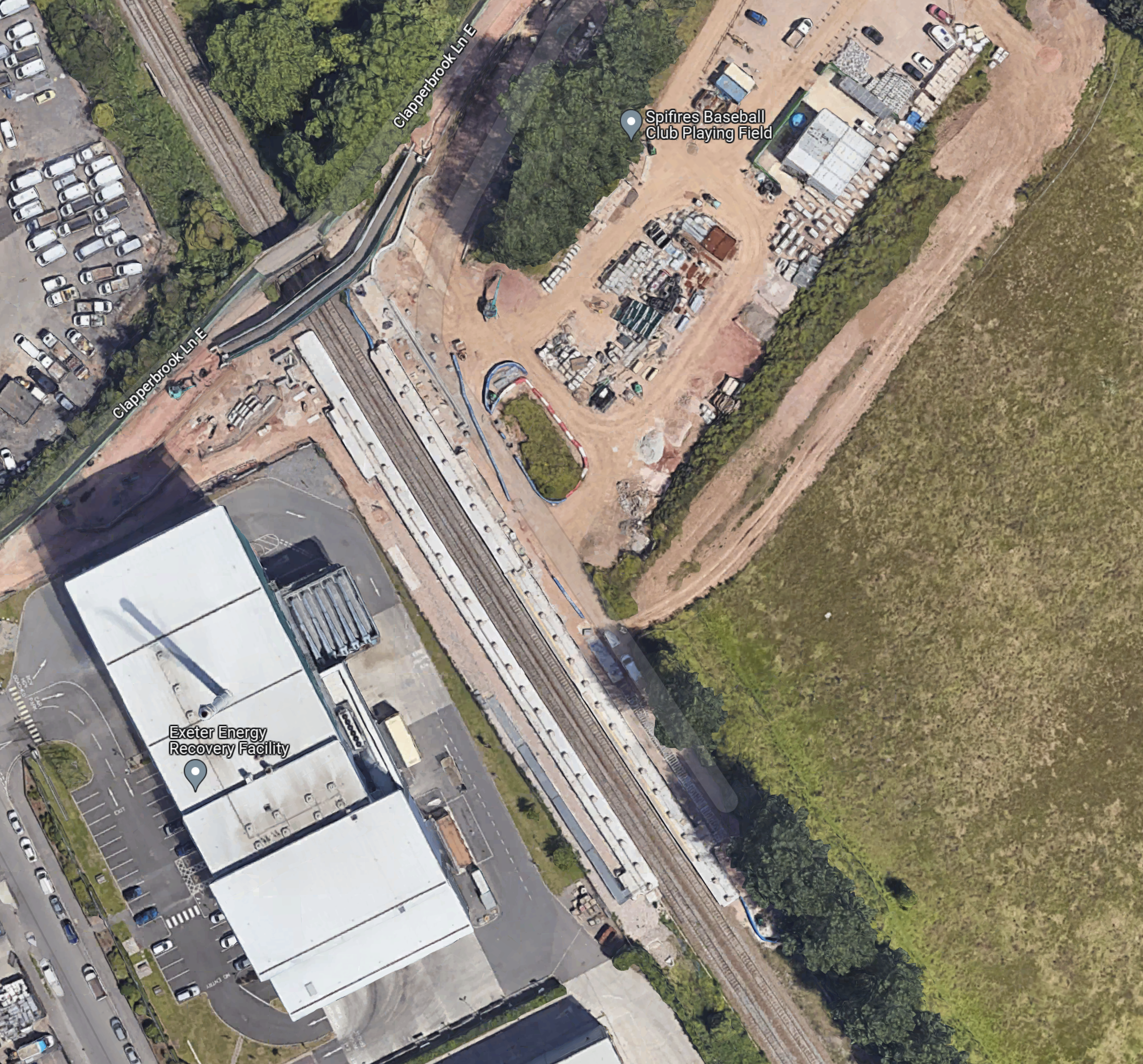
Note.
- The two five-car platforms.
- The pedestrian and cycle bridge over the tracks at the Northern end of the station.
- I would assume, that the bridges have been made high enough over the tracks for electrification.
The page on the Great Western Railway web site also has a couple of videos showing construction of the station.
Services
The page on the Great Western Railway web site also says this about services at the station.
Marsh Barton will be served by our local services between Paignton and Exmouth which run through the heart of Exeter.
We aim to provide hourly off-peak services to the station with additional trains stopping at peak times.
Currently, there is an hourly train that stops at all stations between Exmouth and Paignton, which will probably be the main service.
In addition five long distance services will pass through Marsh Barton station.
- Two trains per day (tpd) – London Paddington and Paignton via Reading, Newbury, Hungerford, Pewsey, Westbury, Castle Cary, Taunton, Tiverton Parkway, Exeter St. Davids, Dawlish, Teignmouth, Newton Abbot, Torre and Torquay
- Three tpd – London Paddington and Plymouth via Reading, Newbury, Hungerford, Pewsey, Westbury, Castle Cary, Taunton, Tiverton Parkway, Exeter St. Davids, Dawlish, Teignmouth, Newton Abbot, Totnes and Ivybridge
- One train per two hours (tp2h) – London Paddington and Plymouth via Reading, Taunton, Tiverton Parkway, Exeter St Davids, Newton Abbot and Totnes.
- One tp2h – London Paddington and Penzance via Reading, Taunton, Tiverton Parkway, Exeter St Davids, Newton Abbot, Totnes, Plymouth, Liskeard, Bodmin Parkway, Par, St Austell, Truro, Redruth, Camborne and St Erth.
- One tp2h – Cardiff Central and Penzance via Newport, Severn Tunnel Junction, Patchway, Filton Abbey Wood, Bristol Temple Meads, Nailsea & Backwell, Yatton, Worle, Weston-super-Mare, Highbridge & Burnham, Bridgwater, Taunton, Tiverton Parkway, Exeter St Davids, Dawlish, Teignmouth, Newton Abbot, Totnes, Ivybridge, Plymouth, Devonport, Dockyard, Keyham, St Budeaux Ferry Road, Saltash, St Germans, Menheniot, Liskeard, Bodmin Parkway, Lostwithiel, Par, St Austell, Truro, Redruth, Camborne, Hayle and St. Erth
Note.
- The fifth train is definitely what you would call a stopping train.
- All the through expresses stop at Taunton, Tiverton Parkway, Exeter St Davids and Newton Abbot.
- The stopping service, the Paignton trains and some Plymouth trains stop at Dawlish and Teignmouth.
- All trains stopping at Plymouth, stop at Totnes.
- The Paignton and Plymouth services are run using Class 802 trains.
- The fifth stopping service is run by a GWR Castle.
- Marsh Barton station has been built for five-car Class 802 trains.
As the GWR Castles are being retired and will probably be replaced by more Class 802 trains, we are very likely to see more Hitachi trains working between Taunton and Penzance via Tiverton Parkway, Exeter St Davids, Dawlish, Teignmouth, Newton Abbot, Totnes, Plymouth, Liskeard, Bodmin Parkway, St Austell, Truro, Redruth, Camborne and Hayle.
The Ways First Group, Hitachi, Hyperdrive Innovation and Turntide Technologies Can Enable Electric Trains To Run Between Basingstoke And Exeter
Who Are Turntide Technologies?
The Wikipedia entry for the company starts with this paragraph.
Turntide Technologies is a US-based business that makes intelligent, sustainable motor systems. Turntide applies its Technology for Sustainable Operations across buildings, agriculture, and transportation segments. It maintains operations in the USA, Canada, the United Kingdom, and India.
These three paragraphs from the Technology section of the Wikipedia entry outline their technology.
Turntide’s core product is its Technology for Sustainable Operations, a cloud-based open platform that monitors and automates building and vehicle systems. The platform is powered by its Smart Motor System, a connected hardware-software machine built around a high rotor pole switched reluctance motor.
Southern California Edison utility certified in 2018 that the V01 Smart Motor System reduced energy consumption by 23%-57% compared with a standard AC induction motor, and 11% compared with an induction motor controlled by a variable frequency drive.
In 2019, National Renewable Energy Laboratory certified that Turntide’s motor reduced energy consumption in refrigerator condenser fans by 29%-71%.
Note.
- Turntide’s efficiencies, which appear to have been verified by reputable organisations, if they can be reproduced in traction systems for battery-powered transport could improve range substantially.
- There are also other more efficient electric motors being developed.
- I wrote about Norfolk-based advanced traction motor company; Equipmake in Equipmake Hybrid To Battery Powered LT11.
- Motors like these, are the engineer’s cure for range anxiety.
I have to ask, if Hitachi (, and Stadler) are using more efficient motors to stretch the range of their battery-electric trains.
Initially, Hitachi asked Hyperdrive Innovation to design battery packs for Class 802 and other similar trains.
These three posts give some details about the battery project involving the two companies.
- Hitachi And Eversholt Rail To Develop GWR Intercity Battery Hybrid Train – Offering Fuel Savings Of More Than 20%
- Hitachi Rail And Angel Trains To Create Intercity Battery Hybrid Train On TransPennine Express
- More On Batteries On Class 802 Trains
Consider.
- In June 2021, Turntide acquired Hyperdrive Innovation.
- So did this effectively invite Turntide to the project?
- According to the Internet, Hitachi are one of the largest manufacturers of electric motors.
- Turntide are very-well funded by the likes of Bill Gates, Robert Downey Junior and some big funds.
Has there been some intense design meetings, which have been beneficial to all parties?
In my experience, these groupings don’t often work out how they should!
But this relationship seems to be doing fine.
One of Hitachi’s managers from the battery-train project even appears in the video on Turntide’s home page.
Electrifying Basingstoke And Exeter
Consider these facts about the route.
- Basingstoke and Salisbury is 35.8 miles.
- Salisbury and Exeter is 88.5 miles.
- Basingstoke and Exeter is 124.3 miles.
- There is no electrification.
- There are 14 stops between Salisbury and Exeter.
- There are 4 stops between Basingstoke and Salisbury.
- Trains are up to nine car Class 159 trains.
- Average speeds are not much better than 50 mph.
- Maximum speeds vary between 75 and 90 mph.
To get an estimate of how much energy, a Basingstoke and Exeter train will use, I’ll start with a figure from How Much Power Is Needed To Run A Train At 125 Or 100 mph?.
At 125 mph, a Class 801 train has a usage figure of 3.42 kWh per vehicle mile.
As drag is proportional to the square of the speed, which gives
- At 100 mph, a Class 801 train has a usage figure of 2.19 kWh per vehicle mile.
- At 80 mph, a Class 801 train has a usage figure of 1.40 kWh per vehicle mile.
For this calculation I’ll take the 80 mph figure of 1.40 kWh per vehicle mile.
Assuming a five-car train travelling between Basingstoke and Exeter, which is 124.3 miles gives a figure of 870 kWh.
But this is only one use of energy on the train.
- Every time, the train accelerates it will need power, but it will charge itself using regenerative braking.
- An all-electric Class 803 train has a mass of 228.5 tonnes and carries 400 passengers.
- If I assume that each passenger is 80 Kg including baggage, bikes and buggies, that gives a mass of 32 tonnes or a total mass of 260.5 tonnes.
- Putting these figures into Omni’s Kinetic Energy calculator gives a figure of 46.3 kWh at 80 mph.
As there are eighteen stops along the route and at each stop it could lose up to twenty percent of its energy, this means that the eighteen stops will cost 166.7 KWh.
Adding this to the 870 KWh it takes to maintain speed, it looks like a trip between Basingstoke and Exeter will take 1036.7 kWh.
Could this be a 200 kWh battery in each coach?
Obviously, this is only a rough calculation and with the better figures Hitachi would have, I would suspect much better answers.
But I do believe that it would be possible to run between Basingstoke and Exeter on battery power, if the train was efficient.
Charging The Train
The train would be charged on the third-rail electrification between Waterloo and Basingstoke.
But what would happen at Exeter?
The trains could be bi-modes like Hitachi’s Class 395 trains for Southeastern,
One of Vivarail’s third-rail charging systems, that First Group, acquired from the Receiver of Vivarail could be used.
Getting The Order Right
Would between Basingstoke and Exeter, be a sensible route to convert to battery-electric trains early, as it would release a useful fleet of diesel trains, that might be able to fill in for a couple of years by replacing the Castles!
‘Castle’ HSTs To Be Withdrawn By Great Western Railway
The title of this post, is the same as that of this article on Rail Advent.
This quote from a GWR spokesman, sums up the action that will be taken.
The Castles were always designed to be a temporary measure on the Cardiff to Penzance route. We expect to replace the Castle Class trains on a phased basis over the next couple of years, bringing customers the benefit of more modern trains that will reduce both cost and carbon emissions across the route.
These are my thoughts.
Could The Engines In The Power Cars Be Replaced With Modern Carbon-Neutral Engines?
This would be an alternative way to solve the decarbonisation problem.
It would also mean that other applications of the Class 43 power cars, like ScotRail’s Inter7City trains, Cross Country’s HSTs and Network Rail’s New Measurement Train would have a decarbonisation route,
In Rolls-Royce Releases mtu Rail Engines For Sustainable Fuels, Rolls-Royce mtu outline their route to decarbonise rail engines using sustainable fuels.
This was the first paragraph of my conclusion in the linked article.
Rolls-Royce and Cummins seem to be doing a thoroughly professional job in decarbonising the diesel engines they have made in recent years.
The Class 43 power cars have Rolls-Royce mtu Series 4000 engines, which will soon be available to run on sustainable fuel.
I think as a possible fall-back, one Class 43 power car should be converted to carbon neutral.
Could The Engines In The Power Cars Be Replaced With Modern Hydrogen Engines?
I looked at this in Will We See Class 43 Power Cars Converted To Hydrogen?.
I came to the conclusion, that this might be possible and said this.
It would be the ultimate Roller.
But then Rolls-Royce know about winning battles with large internal combustion engines.
The Option Of New Trains
This quote from a GWR spokesman was fairly definite about new trains, when they said.
The Castles were always designed to be a temporary measure on the Cardiff to Penzance route. We expect to replace the Castle Class trains on a phased basis over the next couple of years, bringing customers the benefit of more modern trains that will reduce both cost and carbon emissions across the route.
What trains could replace the Castles?
- The Cardiff and Penzance route is just short of 250 miles or roughly 400 kilometres.
- Only about 30 miles at the Cardiff end is electrified.
- Trains would need to be able to handle 25 KVAC overhead electrification.
- 125 mph trains will be needed at the Cardiff end.
- Four or five passenger cars will be needed.
- Currently, there are twelve Castles, so I will assume twelve new trains.
As these trains will be lasting up to forty years, they must be zero-carbon, which must mean battery-electric or hydrogen.
Charging Battery-Electric Trains
Consider
- Bristol Temple Meads, Exeter St. Davis and Plymouth are large stations with several platforms. I suspect that a number of Furrer + Frey’s charging stations can be installed along the route.
- The timetable would be adjusted to allow trains to be charged as they stopped to set down and pick up passengers.
- Trains would dwell in the station and then use their 125 mph performance to regain the time.
- I’ve also found a Penzance to Cardiff service, that stopped at Plymouth for fourteen minutes, which is more than enough to charge the batteries.
- Regenerative braking to the batteries would further eke out the range.
- There might also be some extra electrification around Bristol or Exeter.
- Some form of charging would be needed at Penzance.
Note.
- Putting up electrification may mean that it will delay the new trains for a few years.
- Charging stations along the route could probably be installed to a tight timetable.
I believe that with some top-class work, by battery and charger manufacturers, that a battery-electric train could be developed that could run between Cardiff and Penzance.
Thoughts On Hydrogen
Consider.
- The Alstom Coradia iLint train has a range of about 1,000 km. on hydrogen.
- Companies like Airbus, Boeing and a host of rocket makers will improve the storage and safety of hydrogen.
- A range of a 1,000 km. would allow refuelling at one end of the route.
- Trains could be multiple units or a hydrogen-electric locomotive pulling a rake of coaches with a driving van trailer.
I feel that hydrogen would be very feasible as a power source.
Alstom Could Offer A Hydrogen Aventra
Consider.
- Alstom are developing a hydrogen-powered Aventra.
- Bombardier were offering a 125 mph Aventra.
- A typical Aventra like a Class 720 train seats a hundred passengers a car.
A hydrogen Aventra would be feasible.
Hitachi Could Offer A Battery-Electric Or Hybrid AT-300
In 2021, in Hitachi And Eversholt Rail To Develop GWR Intercity Battery Hybrid Train – Offering Fuel Savings Of More Than 20%, I wrote about the announcement of the Hitachi Intercity Tri-Mode Battery Hybrid Train, which is shown in this Hitachi infographic.

Note.
- Batteries replacing an engine to cut fuel usage and reduce carbon emissions.
- First time a modern UK intercity train, in passenger service, will use alternative fuel.
- These Hitachi trains use mtu engines, so I suspect they will be switched to sustainable fuel like HVO.
- The trains are 125 mph and 140 mph with the latest digital signalling.
- Great Western Railway already have 58 five-car Class 800/802 trains and 35 nine-car 800/802 trains.
- They would not need any changing stations or other infrastructure changes.
- Staff retraining would be minimal.
Testing of the prototype of these trains must be getting very close or even underway.
Stadler Could Offer A Battery-Electric Flirt Akku
Consider
- Stadler have run a Flirt Akku on batteries for 243 km.
- Flirt Akkus will go into service soon.
- Flirts have been designed for 125 mph running.
With charging at Cardiff, Bristol, Exeter, Plymouth and Penzance, I believe a Flirt Akku could handle the route.
Are Hitachi Home And Hosed?
I have a feeling that the announcement has been made about retiring the Castles as the prototype Hitachi Intercity Tri-Mode Battery Hybrid Train is under test and is performing well.
So I wouldn’t be surprised to see an order for twelve more Class 802 trains soon.
Thales Supports Rollout Of UK Digital Railway Programme
The title of this post, is the same as that of this press release from Porterbrook.
The press release starts with these bullet points.
- Thales wins the fitment and supply of European Train Control System (ETCS) onboard units for Class 43 high-speed train retrofit.
- Implementation will benefit passengers and freight operators by delivering additional capacity, improving performance, enhancing safety and reducing the costs of operating the national railway.
Which is followed by this explanation.
As a key player in delivering this digital transformation, Thales has today been awarded the contract for the Class 43 First in Class (FiC) design and fitment project that will use Network Rail’s new measurement train power cars in the Infrastructure Measurement fleet. The FiC project will culminate in a Type approval from the Office of Road and Rail to enable subsequent Class 43 ETCS fleet fitments.
The new Thales onboard system will be integrated as part of the Digital Railway train control system, and will enable rolling stock to operate on ETCS-equipped infrastructure. The onboard equipment is an evolution of Thales’s level 1 ETCS system that has been successfully deployed worldwide.
This could be a smart move.
- Type Approval will mean that the Class 43 power cars of ScotRail’s Inter7Cities, Great Western Railway’s Castles and those of other operators can be retrofitted.
- Will the New Measurement Train also be used to test the digital signalling, as it covers all the tracks in Great Britain in a four-weekly cycle?
- Fitting of these iconic 1970’s designed power cars with the latest modern signalling could be a design exercise, that helps in the fitting of ETCS to other older and unusual locomotives.
I still think, that because of the iconic nature of the InterCity125, that we may see a conversion of Class 43 power cars to more sustainable operation.
- All power cars now have modern MTU diesel engines, which probably could be fuelled by hydrogen.
- The simplest way would be to run them on HVO, as I wrote about in Powered By HVO.
- Some operations like the short format trains in Scotland and South-West England might be more suitable for battery-electric operation.
- Given that there are 167 in operation or in store, it would be a good-sized order for the company converting the power cars.
I also believe that zero-carbon InterCity 125s could be an unusual tourist attraction.
Conclusion
The fitting of digital signalling to Class 43 power cars is a good move, but is it the start of a wider plan to bring these iconic trains up to modern standards.
Over 10,000 People Use Reopened Dartmoor Line In First Two Weeks
The title of this post, is the same as that of this press release from the Dartmoor Line.
These are the first three paragraphs of the press release.
More than 10,000 people have travelled on the Dartmoor Line in the first two weeks since its reopening.
The line reopened for regular year-round, all-week passenger services on Saturday 20 November and demand for the trains linking Okehampton and Exeter has continued to remain high.
The reopening of the Dartmoor Line is the first of the Government’s Restoring Your Railway schemes, made possible thanks to over £40 million Government investment.
All concerned must be very pleased, especially as it was delivered £10 million under budget and within nine months, ahead of time.
I described my first use of the new route to Okehampton in A Few Hours In Okehampton, where I came to this conclusion.
Exeter and Okehampton is a well-thought out reopening, that will be welcomed in the South West of England.
It would appear the passenger numbers confirm my conclusion.
Since my visit to Okehampton, I have wondered, whether the apparent success of the Okehampton reopening, would have any other effects.
In the December 2021 Edition of Modern Railways, there is an article, which is entitled South West Seeks More Reopenings, with a sub-title of Okehampton Service Could Be A Precursor.
The article details a number of projects.
Marsh Barton Station
A new Marsh Barton station is under construction and has a December 2022 opening date.
Edginswell Station
A new Edginswell station is being planned to serve Torbay Hospital on the Riviera Line, with a possible opening of 2025.
Collumpton And Wellington Stations
The last budget chipped in five million, so that preferred options and a full business case can be developed for these two new stations.
- Collumpton station will probably be developed at the site of the old station, which is close to Collumpton Services on the M5.
- Wellington station will probably be on a new site at Longworth Farm, where five hundred houses are being developed.
The Modern Railways article also says this about housing.
Thousands of houses are expected to be built in both towns in the next decade, making provision of railway stations highly desirable to avoid soaring road congestion.
Network Rail and Great Western Railway also seem to be experimenting with different service patterns through the two stations.
- Both hourly and two-hourly services have been tested.
- In the December 2021 timetable there is now a two-hourly GWR Castle service over the Taunton and Exeter stretch, that will call at the two new stations, when they open.
- To have an hourly service there will also be a Taunton and Exeter shuttle.
This service would provide access to education and employment in Exeter, Taunton and Bristol.
The cost benefit ratio is above the Government’s limit for backing of two.
Opening of the two new stations is pencilled in for 2025.
Barnstaple And Axminster
The Modern Railways article also says this.
As part of the Devon Metro concept, Devon County Council aspires to extend further eastwards the hourly Barnstaple services that currently terminate at Exeter Central, perhaps as far as Axminster.
This would need track improvements East of Pinhoe station.
The current timings of the two sections are as follows.
- Exeter Central and Axminster – 37 minutes
- Exeter Central and Barnstaple – 74 minutes
These timings probably mean that a round trip between Axminster and Barnstaple can be done in a convenient four hours, so an hourly service would need four trains.
From sometime next year, when the frequency of the Exeter Central and Okehampton service becomes hourly, the services along the route will be as follows.
- Exeter St. Davids and Axminster – Hourly
- Exeter Central and Barnstaple – Hourly
- Exeter Central and Okehampton – Hourly
There is also a service, that runs every thirty minutes between Exmouth and Paignton via Exeter Central and Exeter St. Davids, Newton Abbot and Torquay.
The frequencies on the various sections would be as follows.
- Barnstaple and Crediton – One tph
- Okehampton and Crediton – One tph
- Crediton and Exeter St. Davids – Two tph
- Paignton and Exeter St. Davids – At least two tph
- Exeter St. Davids and Exeter Central – Five tph
- Exeter Central and Axminster – One tph
- Exeter Central and Exmouth – Two tph
Note.
- tph is trains per hour.
- Other services run between Exeter St. Davids and Paignton stations.
- In recent years a new station at Cranbrook has opened between Exeter Central and Axminster.
Extending the Barnstaple and Exeter Central service to Axminster would double the frequency on the Exeter Central and Axminster section.
Axminster station is shown in this Google Map.
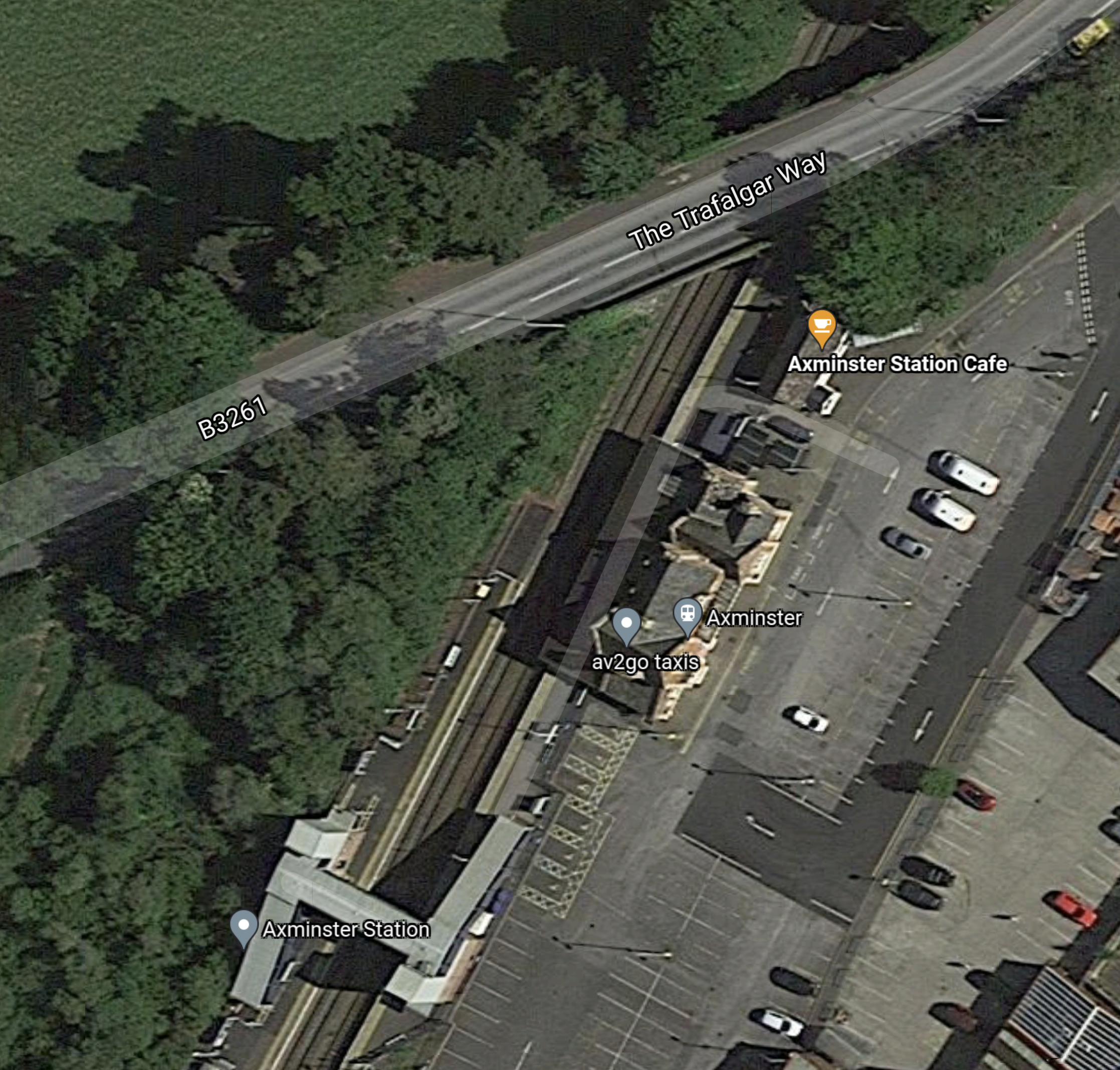
Note.
- The station has two platforms.
- The station appears to have a bridge with lifts.
- The station has a good road connection and the parking could probably be extended.
Axminster station could certainly handle a fast train between London and Exeter, a stopping train to Barnstaple and all the passengers.
Devon Metro
It does appear that the services of the Devon Metro are coming together.
- Paignton and Exmouth is already running.
- Barnstaple and Exeter Central is already running.
- Okehampton and Exeter Central has just started.
- Exeter St. Davids and Taunton via new stations at Collumpton and Wellington is being planned.
- Barnstaple and Exeter Central needs to be extended to Axminster.
How many other cities in the UK could benefit from a metro of this quality?
Bere Alston And Tavistock
The Modern Railways article also says this.
Meanwhile, further west on the former Southern network, restoration of services from Bere Alston to Tavistock has long been proposed, giving Tavistock a rail link to Plymouth. Christian Irwin, Network Rail’s Industry Programme Manager (South West), who oversaw the Okehampton reopening that came in early and underbudget, says he is keen to repeat the trick on the Tavistock route.
It is probably more difficult than at Okehampton.
- The trackbed is mainly intact, but the track has been lifted.
- The track to be laid is shorter than at Okehampton.
- Two structures at the Southern end need to be replaced.
- A new station needs to be built at Tavistock.
Devon County Council seems to be in control of the land needed.
Proposed services seem to be as follows.
- Plymouth and Gunnislake via Bere Alston – One train per two hours (tp2h)
- Plymouth and Tavistock via Bere Alston – One tph
Overall it looks like the Tavistock project will be more expensive than that at Okehampton, but there would appear to be more contributions from developers.
Devon County Council are hoping that the Tavistock link could be build in the next decade.
Tavistock And Okehampton
After the reconnection of Tavistock to the National Rail network, the council would hope to complete the link between Tavistock and Okehampton.
This would give the following benefits.
- Improved public transport connectivity in West Devon and North Cornwall.
- Improve revenue potential at Okehampton and Tavistock stations.
- Create an easier freight route.
- Create an alternative route, if the coastal route is closed.
It is a challenging project, but I feel it will be possible by perhaps 2035.
 The Anonymous Widower