UK’s Largest Solar Park Cleve Hill Granted Development Consent
The title of this post, is the same as that of this article on Solar Power Portal.
These are the two introductory paragraphs.
Cleve Hill Solar Park, set to be the largest in the UK, has been granted development consent by the energy secretary.
The colossal 350MW project will include 880,000 panels along with battery storage, and sit just one mile northeast of Faversham, in Kent, situated close to the village of Graveney.
Other points from the article.
- Cleeve Hill Solar Park is a £450million project.
- It is the first solar project to be considered a Nationally Significant Infrastructure Project.
- It is being developed as a joint venture between Hive Energy and Wirsol.
- It is due to be operational by 2022.
- To complete the project 700 MWh of energy storage will be added later.
The article also contains this quote from Solar Trade Associations chief executive Chris Hewett.
Solar has a significant role to play in boosting the economy in the wake of the coronavirus crisis. With the right policies we can expect to see an 8GW pipeline of solar projects unlocked and rapidly deployed, swiftly creating a wealth of skilled jobs and setting us on the path towards a green recovery.
8 GW of intermittent energy will need a lot of storage.
As Cleeve Hill’s developers are planning to provide 700 MWh of storage for 700 MW of solar panels, it would appear that 8 GW of solar panels could need up to 16 GWh of energy storage.
As our largest energy storage system is the pumped storage Electric Mountain in Snowdonia with a capacity of 9.1 GWh and most of the large solar developments are towards the South of England, the UK needs to develop a lot more energy storage, where the solar is generated and much of the energy is used.
I can see the following environmentally-friendly developments prospering.
- Highview Power‘s CRYOBattery, which uses liquid air to store energy. Systems have a small footprint and up to a GWh could be possible.
- Electrothermal energy storage like this system from Siemens.
- Using electrolysers from companies like ITM Power to convert excess energy into hydrogen for transport, steelmaking and injecting into the gas main.
- Zinc8‘s zinc-air battery could be the outsider, that comes from nowhere.
Developers could opt for conservative decision of lithium-ion batteries, but I don’t like the environmental profile and these batteries should be reserved for portable and mobile applications.
Floatovoltaics
One concept, I came across whilst writing was floatovoltaics.
The best article about the subject was this one on Renewable Energy World, which is entitled Running Out of Precious Land? Floating Solar PV Systems May Be a Solution.
A French company call Ciel et Terre International seem to be leading the development.
Their web site has this video.
Perhaps, some floatovoltaics, should be installed on the large reservoirs in the South of England.
- The Renewable Energy World article says that panels over water can be more efficient due to the cooling effect of the water.
- Would they cut evaporative losses by acting as sunshades?
- As the French are great pecheurs, I suspect that they have the answers if anglers should object.
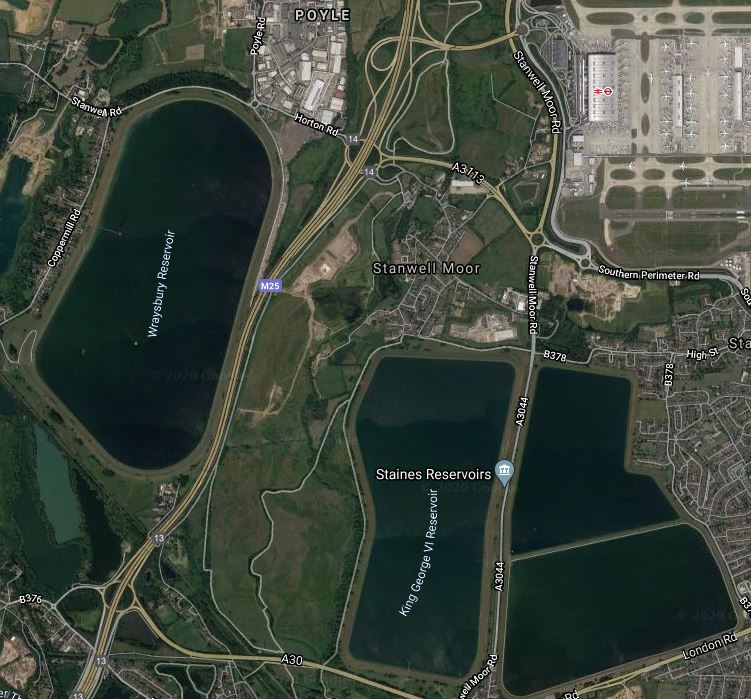
This Google Map shows the reservoirs to the West of Heathrow.
Note.
- Wraysbury Reservoir has an area of two square kilometres.
- King George VI Reservoir has an area of one-and-a-half square kilometres.
- Using the size and capacity of Owl’s Hatch Solar Farm, it appears that around 65 MW of solar panels can be assembled in a square kilometre.
- All these reservoirs are Sites of Special Scientific Interest because of all the bird life.
- Heathrow is not an airport, that is immune to bird-strikes.
Could floatovoltaics be used to guide birds away from the flightpaths?
Incidentally, I remember a report from Tomorrow’s World, probably from the 1960s, about a porous concrete that had been invented.
- One of the uses would have been to fill reservoirs.
- The capacity of the reservoir would only have been marginally reduced, as the water would be in the voids in the concrete like water in a sponge.
- Soil would be placed at the surface and the land used for growing crops.
I wonder what happened to that idea from fifty years ago!
Thoughts On East Coast Trains
According to an article and a picture, the second new Class 803 train for Open Access Operator; East Coast Trains, has arrived in the UK to be fitted out at Newton Aycliffe.
These are my thoughts on the service.
The Trains
The Class 803 trains are similar to the other Hitachi A-trains running in the UK, but with two big differences.
- They will have a one class interior and they will be fitted with a battery, instead of a diesel engine.
- The battery is not for traction and is to provide hotel power in stations and in the event of a dewiring. The latter has been surprisingly common on the East Coast Main Line in recent years.
Normally, these five-car trains are fitted with a single MTU 12V 1600 R80L diesel engine, which is described in this datasheet on the MTU web site.
The mass of the engine is given as 6750 Kg, when it is ready to run.
It would seem logical to replace the diesel engine with a battery of the same weight. I’ll use seven tonnes, as the fuel tank won’t be needed either.
This page on the Clean Energy institute at the University of Washington is entitled Lithium-Ion Battery.
This is a sentence from the page.
Compared to the other high-quality rechargeable battery technologies (nickel-cadmium or nickel-metal-hydride), Li-ion batteries have a number of advantages. They have one of the highest energy densities of any battery technology today (100-265 Wh/kg or 250-670 Wh/L).
Using these figures, a seven-tonne battery would be between 700 and 1855 kWh in capacity.
Incidentally, the power output of an MTU 12V 1600 R80L is 700 kW.
In Sparking A Revolution I gave Hitachi’s possible specification of a battery-electric train.
- Range – 55-65 miles
- Performance – 90-100 mph
- Recharge – 10 minutes when static
- Routes – Suburban near electrified lines
- Battery Life – 8-10 years
These figures are credited to Hitachi.
Doing a quick calculation, it would appear that.
- A 700 kWh battery could supply the same power as the diesel engine for an hour.
- A 1855 kWh battery could supply the same power as the diesel engine for two hours and thirty-nine minutes.
I am drawn to the conclusion, that although Hitachi say the battery is not for traction purposes in a Class 803 train, that a battery the same weight as the current diesel engine, would be a very adequate replacement.
If say, you put a 300-500 kWh battery in a Class 803 train, it would probable give enough hotel power until the train was able to move again. but it would also reduce the weight of the train and thus improve the acceleration in normal running.
A Battery Module
I wouldn’t be surprised if Hitachi are developing a battery module, that can replace the MTU 12V 1600 R80L diesel engine.
- The module would be used for both traction and hotel services on the train.
- It would be charged from the electrification or by regenerative braking.
- It would act as emergency power.
- To the driver and the train’s computer, it would have similar performance to the diesel engine.
The diesel engine and the battery module would be plug-compatible and could be exchanged as required.
I can do a quick calculation for a 1000 kWh battery, which would weigh under four tonnes.
- A 1000 kWh battery would provide 700 kW for 86 minutes.
- At 90 mph, the train would travel for 129 miles.
- At 100 mph, the train would travel for 143 miles.
That would be a very handy extended range.
As East Coast Trains will only run on a fully-electrified route, they have no need for the traction capability.
- But it would fit well with the routes of Avanti West Coast, East Midlands Railway, Great Western Railway, Hull Trains, LNER and TransPennine Express.
- All except East Midlands Railway and LNER, share part or full ownership with East Coast Trains.
It does look to me, that Hitachi is using East Coast Trains and their fully electrified route to give the battery module for the trains, a thorough work-out, on a route, where it will not normally be needed.
The Proposed Service
From various sources we know the following.
- There will be five trains per day in both directions between London Kings Cross and Edinburgh. – See Wikipedia
- East Coast Trains have ordered five trains. – See Wikipedia.
- There will be stops at Stevenage, Durham, Newcastle and Morpeth. – See Wikipedia
- The first Northbound service will arrive in Edinburgh before 10:00. – See Rail Advent.
- Fares will be low-cost at around £25 – See Wikipedia.
It is also likely that East Coast Trains will want a journey time of under four hours, which is being planned for the route anyway under the L2E4 project.
As the record time between London and Edinburgh was set in 1991 by an InterCity 225 train at a minute under three-and-a-half hours, could a time of around three hours and forty-five minutes be possible, including the turnaround of the train?
10:00 Arrival In Edinburgh
This is obviously a good idea, but with a four hour journey time, it would mean leaving London before six.
- Perhaps to make the most of clear tracks in the morning the train would leave early.
- Currently, the first two trains from Kings Cross are the 06:15 to Edinburgh, which arrives at 11:08 and the 06:33 to Leeds.
- How early could the train leave?
I suspect that the first train to Edinburgh would leave Kings Cross around 05:30 and arrive in Edinburgh and be ready to return before 10:00.
10:00 Arrival In London
If arriving in Edinburgh before ten is a good idea, then surely arriving in London by the same time is worthwhile.
- Currently, the first train from Edinburgh to London is the 05:48, which arrives at 10:40.
As with the Northbound service, I suspect the first train to Kings Cross would leave Edinburgh around 05:30 and arrive in Kings Cross and be ready to return before 10:00.
Five Services Per Day
If the first Edinburgh and Kings Cross services left at 05:30 and after unloading and loading, were ready to return before 10:00, that would be the first service.
The simplest way to handle the rest of the day would be to split the time into four and run the trains continuously.
Suppose, the last train got to its destination at one in the morning, that would mean that fifteen hours were available for four trains or three hours and forty-five minutes for each trip between London and Edinburgh and the turnaround.
The train starting from Kings Cross would run the following services.
- Kings Cross to Edinburgh – Leaves 05:30 – Arrives before 10:00
- Edinburgh to Kings Cross – Leaves 10:00
- Kings Cross to Edinburgh – Leaves 13:45
- Edinburgh to Kings Cross- Leaves 17:30
- Kings Cross to Edinburgh – Leaves 21:15 – Arrives 01:00 on the next day.
The train starting from Edinburgh would run the following services.
- Edinburgh to Kings Cross – Leaves 05:30 – Arrives before 10:00
- Kings Cross to Edinburgh – Leaves 10:00
- Edinburgh to Kings Cross – Leaves 13:45
- Kings Cross to Edinburgh – Leaves 17:30
- Edinburgh to Kings Cross – Leaves 21:15 – Arrives 01:00 on the next day.
There would be two very tired trains at the end of every day, that would be looking forward to some well-deserved tender loving care.
This has been my best guess at what the timetable will be! But!
- Travellers can catch an early train, do a full days work in the other capital and return at the end of the day.
- There are three services during the day; one each in the morning, the afternoon and the early evening, for those who want affordable, slightly less frenetic travelling.
- I suspect the intermediate stops have been chosen with care.
- Improvements at Stevenage station could make the station, the preferred interchange for many between East Coast, LNER and local services for Cambridgeshire, Hertfordshire and North London. Car parking is probably easier than Kings Cross!
- Is Durham station an alternative station on the other side of the Tyne from Newcastle, with better parking?
- Could Durham City Centre be the terminal of a Leamside Line extension of the Tyne and Wear Metro?
- Newcastle station is very well-connected to all over the North East.
- Morpeth station could attract a large number of travellers from over the Border. It also looks to have space to expand the parking!
It looks a well-designed route and timetable.
How Many Trains Would Be Needed?
Consider.
- Each train could be two five-car trains working together as a ten-car train.
- This would maximise the use of paths on the East Coast Main Line.
- Four trains would be needed for the full five trains per day ten-car service.
As there is going to be a fleet of five trains, the fifth train would either be in maintenance or waiting to enter the action as a substitute.
Improving Efficiency
It looks to me, that the efficiency of this service could be improved by good old-fashioned time and motion study.
- Will drivers use stepping-up to speed the reverse of trains?
- Would cleaning teams board at Morpeth and Stevenage stations and clean the train on the last leg?
- Will the buffet be designed for fast replenishment?
- Will drivers be given all possible aids to go faster?
Every little will help!
Conclusion
I like this system and the competition will keep LNER on its toes!
Would a similar system work on the West Coast Main Line?
- Grand Union have proposed a service between Euston and Stirling stations.
- There will be stops at Milton Keynes Central, Nuneaton, Crewe, Preston, Carlisle, Lockerbie, Motherwell, Whifflet, Greenfaulds and Larbert.
- Trains will be InterCity 225s.
The service could start in 2021.
New Zinc-Air Battery Outperforms Lithium-Ion Battery On All Levels
The title of this post, is the same as that of this article on Interesting Engineering.
This is the introductory paragraph.
There’s a new battery in town and it’s a game-changer. The novel battery, is cheaper, safer and significantly longer laster-lasting, than lithium-ion batteries reports Recharge.
It does seem that Zinc8 is getting noticed.
I wonder, if the web-site gets read in Cambridge, where I was once told that use of the word Interesting, is very much to be discouraged.
New Zinc-Air Battery Is ‘Cheaper, Safer And Far Longer-Lasting Than Lithium-Ion’
The title of this post, is the same as that of this article on Recharge.
These are the first two paragraphs.
A new type of battery is coming onto the market that can store multiple days’ worth of energy, that doesn’t degrade, can’t possibly explode and is up to five times cheaper than lithium-ion, claimed its developer as it prepares to pilot the technology in New York state.
The zinc-air hybrid flow battery developed by Canadian company Zinc8 has the potential to disrupt the entire energy-storage market — making wind and solar farms baseload and even replacing the need for transmission grid upgrades in many places.
The article then gives an in depth review of Zinc8, its technology and its future prospects.
- The Chief Executive is a former Canadian MP. Political connections help!
- The company has $100million of funding.
- Zinc8 energy storage systems are made larger by fitting and bigger storage tank and adding more electrolyte.
- The capital cost of an eight-hour Zinc8 storage system is about $250/KWh, but this falls to $100/KWh for a 32-hour system and $60/KWh for a hundred-hour system.
- Lithium-ion systems ttpically cost $300/KWh for any duration over eight hours.
- The cost of Zinc8 systems is expected to fall as manufacturing increases.
The article finishes with a detailed description of how the technology works.
It also details the company’s growth strategy.
Conclusion
This technology looks like it will give lithiujm-ion batteries a good run for its money in grid storage applications and it could be one of those technologies that help the world to embrace renewable energy, like wind, solar and wave power.
It has various advantages.
- Lower cost of installation.
- Falling manufacturing cost.
- Easily scalable.
- No exotic or hazardous materials, just zinc, water and air, which are recycled.
My only worry, is that Zinc8, sounds too good to be true! But having met researchers at ICI, who were concerned in the birth of polythene, this could be a normal cynical reaction.
UK’s First Car Battery ‘Gigafactory’ To Be Built By Two Startups
The title of this post, is the same as that of this article on The Guardian.
This is the first two paragraphs.
Two British startups have announced plans to invest as much as £4bn in building the UK’s first large-scale battery factory, in a move that could prove a major boost to the country’s struggling car industry.
AMTE Power and Britishvolt have signed a memorandum of understanding saying they will work together on plans for a plant to make lithium ion batteries, the key component in electric cars as well as energy storage products.
So who are AMTE Power And Britishvolt?
AMTE Power
The AMTE Power web site, has this mission statement.
The cell market demands flexibility in design and chemistry, AMTE has focused on supporting niche customers who want to develop and build solutions where standard cell options fail to deliver against their business design objectives.
The forecast demand for cells production, will see delivery shortages as Automotive and Energy storage markets develop. AMTE can supply its customers with bespoke solutions eliminating the need to accept second best in cell choice.
Give the customers, what they want is rarely a bad philosophy.
Britishvolt
The Britishvolt web site, has this mission statement.
We have identified the United Kingdom as the potential location to build our first Gigaplant. Britishvolt is looking to produce high performance batteries better than anyone else, establishing the country as the leading force in battery technology and the center of sustainable energy storage. We are ready for the World 2023.
Having read both companies web sites, I think the two companies have more than a little in common.
So why not team up and move forward.
Thirsty High-Rollers … Mining’s Heavy Haulers Prime Candidates For Hydrogen Conversion
The title of this post, is the same as that of this article on ecogeneration.
You understand, what the author means about mining’s heavy haulers, when you open the article.
This paragraph describes their carbon emissions.
One large scale dump truck, depending on the haul road it is using, will use between 100 and 140 litres of diesel per 100km. These vehicles operate all day every day except for maintenance down time. That’s between 260kg and 360kg of CO2 per 100km per truck.
Large open pit mines have tens of these vehicles operating continuously, so the numbers build up very quickly.
The author then goes on to say why, that converting these vehicles to green hydrogen makes a lot of sense.
The dump trucks are already diesel/electric, which means that the diesel generator can be replaced with a hydrogen fuel cell and a battery.
Mining giant; Anglo-American will be introducing a prototype hydrogen-powered dump truck at a platinum mine in South Africa this year.
These paragraphs describe the transmission.
The vehicle, which is called a fuel cell electric vehicle (FCEV) haul truck, will be powered by a hydrogen fuel cell module paired with Williams Advanced Engineering’s scalable high-power modular lithium-ion battery system. Williams provides batteries for FIA’s E-Formula motorsport.
This arrangement will replace the existing vehicle’s diesel engine, delivering in excess of 1MWh of energy storage. The battery system will be capable of recovering energy through regenerative braking as the haul truck travels downhill.
Note that the truck has more energy storage than is proposed for a four-car battery-electric train, like the Class 756 train, which has only 600 kWh.
The author finishes with this concluding paragraph.
With the major mining companies focusing on making significant strides in decarbonisation by 2030 expect there to be more announcements such as this focusing this “low hanging fruit” for the mining industry’s to materially reduce its carbon foot print.
Reading this, I can’t help feeling that replacement of a Class 66 locomotive with a zero-carbon hydrogen-battery-electric hybrid unit could be possible.
First Order For Mireo Plus B Battery EMUs
The title of this post is the same as that of this article on Railway Gazette.
This is the introductory paragraph.
The Land of Baden-Württemberg’s rolling stock body SFBW has ordered 20 battery-equipped Mireo Plus B electric multiple-units from Siemens Mobility, which will then be responsible for their availability over a 29½-year operating life.
The Siemens Mireo Plus B Battery EMUs appear to have the following specification.
- Ability to use overhead electrification.
- Ability to use battery power for a range of eighty kilometres.
- Two underfloor lithium-ion battery packs.
- Batteries handle regenerative braking.
- 160 kph operating speed.
Delivery is by December 2023.
Highview Power’s Advantages
I have said before that I like Highview Power’s system for storing energy by liquifying air.
This article on CleanTechnica is entitled Shell Signs PPA With Largest Storage Battery In Europe.
But it also has a section entitled Other Storage Plans For UK Are In The Works, which gives more details on Highview Power.
Replacement Of Decommissioned Power Plants
Highview are proposing that their systems can replace an existing fossil-fuel power plant, by using the existing site and grid connections. Connecting a power station to the grid, is often an expensive process, but if you can use an existing one, it must be more affordable.
Cost Versus Lithium-Ion
Highview are claiming that they can provide power at $143 per MWh, which compares with a cost of $187 per MWh, as quoted by Bloomberg.
That is nearly 24 % more affordable.
Are Hitachi Designing the Ultimate Battery Train?
In Sparking A Revolution, a post based on an article of the same name in Issue 898 of Rail Magazine, I repeated this about the specification of Hitachi UK Battery Train Specification.
- Range – 55-65 miles
- Performance – 90-100 mph
- Recharge – 10 minutes when static
- Routes – Suburban near electrified lines
- Battery Life – 8-10 years
Does this mean that the train can do 55-65 miles cruising at 90-100 mph?
How Much Energy Is Needed To Accelerate A Five-Car Class 800 Train To Operating Speed?
I will do my standard calculation.
- Empty train weight – 243 tonnes (Wikipedia for Class 800 train!)
- Passenger weight – 302 x 90 Kg (Includes baggage, bikes and buggies!)
- Train weight – 270.18 tonnes
Using Omni’s Kinetic Energy Calculator, the kinetic energy at various speeds are.
- 60 mph – 27 kWh
- 80 mph – 48 kWh
- 90 mph – 61 kWh
- 100 mph – 75 kWh
- 125 mph – 117 kWh – Normal cruise on electrified lines.
- 140 mph – 147 kWh – Maximum cruise on electrified lines.
Because the kinetic energy of a train is only proportional to the weight of the train, but proportional to the square of the speed, note how the energy of the train increases markedly after 100 mph.
Are these kinetic energy figures a reason, why Hitachi have stated their battery train will have an operating speed of between 90 and 100 mph?
A 100 mph cruise would also be very convenient for a lot of main lines, that don’t have electrification in the UK.
What Battery Size Would Be Needed?
In How Much Power Is Needed To Run A Train At 125 mph?, I calculated that a five-car Class 801 electric train, needed 3.42 kWh per vehicle-mile to maintain 125 mph.
For comparison, an InterCity 125 train, had a figure of 2.83 kWh per vehicle-mile.
Hitachi are redesigning the nose of the train for the new Class 810 train and I suspect that these trains can achieve somewhere between 1.5 and 3 kWh per vehicle-mile, if they are cruising at 100 mph.
Doing the calculation for various consumption levels gives the following battery capacity for a five-car train to cruise 65 miles at 100 mph
- 1.5 kWh per vehicle-mile – 487 kWh
- 2 kWh per vehicle-mile – 650 kWh
- 2.5 kWh per vehicle-mile – 812.5 kWh
- 3 kWh per vehicle-mile – 975 kWh
These figures don’t include any energy for acceleration to line speed from the previous stop or station, but they would cope with a deceleration and subsequent acceleration, after say a delay caused by a slow train or other operational delay, by using regenerative braking to the battery.
The energy needed to accelerate to operating speed, will be as I calculated earlier.
- 90 mph – 61 kWh
- 100 mph – 75 kWh
As the battery must have space to store the regenerative braking energy and it would probably be prudent to have a ten percent range reserve, I can see a battery size for a train with an energy consumption of 2 kWh per vehicle-mile, that needed to cruise at 100 mph being calculated as follows.
- Energy for the cruise – 650 kWh
- 10% reserve for cruise – 65 kWh
- Braking energy from 100 mph – 75 kWh
This gives a total battery size of 790 kWh, which could mean that 800 kWh would be convenient.
Note that each of the three MTU 12V 1600 diesel engines, fitted to a Class 800 train, each weigh around two tonnes.
In Innolith Claims It’s On Path To 1,000 Wh/kg Battery Energy Density, I came to these conclusions.
- Tesla already has an energy density of 250 Wh/Kg.
- Tesla will increase this figure.
- By 2025, the energy density of lithium-ion batteries will be much closer to 1 KWh/Kg.
- Innolith might achieve this figure. But they are only one of several companies aiming to meet this magic figure.
Suppose two of the MTU 12V 1600 diesel engines were each to be replaced by a two tonne battery, using Tesla’s current energy density, this would mean the following.
- Each battery would have a capacity of 500 kWh.
- The train would have one MWh of installed battery power.
- This is more than my rough estimate of power required for a 65 mile trip.
- The train would have little or no weight increase.
- I also wouldn’t be surprised to find that the exchange of a diesel engine for a battery was Plug-and-Play.
Hitachi would have an electric/battery/diesel tri-mode train capable of the following.
- Range – 55-65 miles
- Out and Back Range – about 20-30 miles
- Performance – 90-100 mph
- Recharge – 10 minutes when static
- Emergency diesel engine.
I feel it would be a very useful train.
Trains That Could Be Fitted With Batteries
The original article in Rail Magazine says this.
For the battery project, positive discussions are taking place with a number of interested parties for a trial, with both Class 385s and Class 800s being candidates for conversion.
So this means that the following operators will be able to use Hitachi’s battery technology o their trains.
- Avanti West Coast – Class 80x trains
- First East Coast Trains – Class 80x trains
- East Midlands Railway – Class 80x trains
- GWR – Class 80x trains
- Hull Trains – Class 80x trains
- LNER – Class 80x trains
- ScotRail – Class 385 trains
- TransPennine Express – Class 80x trains
Although, I based my calculations on Class 80x trains, I suspect that the methods can be applied to the smaller Class 385 trains.
Possible Out-And-Back Journeys
These are possible Out-And-Back journeys, that I believe Hitachi’s proposed battery-electric trains could handle.
- Edinburgh and Tweedbank – 30 miles from Newcraighall
- London Paddington and Bedwyn – 30 miles from Reading
- London Euston and Blackburn – 12 miles from Preston
- London Kings Cross and Bradford – < 27 miles from Leeds
- London Euston and Chester – 21 miles from Crewe
- London Kings Cross and Harrogate – <18 miles from Leeds
- London Kings Cross and Huddersfield – 17 miles from Leeds
- London St. Pancras and Leicester – 16 miles from Market Harborough
- London Kings Cross and Lincoln – 17 miles from Newark
- London St. Pancras and Melton Mowbray – 26 miles from Corby
- London Kings Cross and Middlesbrough – 20 miles from Northallerton
- London Kings Cross and Nottingham – 20 miles from Newark
- London Paddington and Oxford – 10 miles from Didcot
- London Kings Cross and Redcar – 29 miles from Northallerton
- London Kings Cross and Rotherham- 14 miles from Doncaster
- London Kings Cross and Sheffield – 20 miles from Doncaster
- London and Weston-super-Mare – 19 miles from Bristol
Note.
- Provided that the Out-And-Back journey is less than about sixty miles, I would hope that these stations are comfortably in range.
- Leicester is the interesting destination, which would be reachable in an Out-And-Back journey. But trains from the North stopping at Leicester would probably need to charge at Leicester.
- I have included Blackburn as it could be a destination for Avanti West Coast.
- I have included Melton Mowbray as it could be a destination for East Midlands Railway.
- I have included Nottingham, Rotherham and Sheffield as they could be destinations for LNER. These services could prove useful if the Midland Main Line needed to be closed for construction works.
- I’m also fairly certain, that no new electrification would be needed, although every extra mile would help.
- No charging stations would be needed.
I suspect, I’ve missed a few possible routes.
Possible Journeys Between Two Electrified Lines
These are possible journeys between two electrified lines, that I believe Hitachi’s proposed battery-electric trains could handle.
- London St. Pancras and Eastbourne via Hastings – 25 miles between Ashford and Ore.
- Leeds and York via Garforth – 20 miles between Neville Hall and Colton Junction
- London Kings Cross and Norwich via Cambridge – 54 miles between Ely and Norwich.
- Manchester Victoria and Leeds via Huddersfield – 43 miles between Manchester Victoria and Leeds.
- Preston and Leeds via Hebden Bridge – 62 miles between Preston and Leeds.
- Newcastle and Edinburgh – Would battery-electric trains get round the well-publicised power supply problems on this route?
Note.
- I am assuming that a range of 65 miles is possible.
- If the trains have a diesel-generator set, then this could be used to partially-charge the battery in places on the journey.
- Leeds and York via Garforth has been scheduled for electrification for years.
- Preston and Leeds via Hebden Bridge would probably need some diesel assistance.
- London Kings Cross and Norwich via Cambridge is a cheeky one, that Greater Anglia wouldn’t like, unless they ran it.
- As before no new electrification or a charging station would be needed.
I suspect, I’ve missed a few possible routes.
Possible Out-And-Back Journeys With A Charge At The Destination
These are possible Out-And-Back journeys, that I believe Hitachi’s proposed battery-electric trains could handle, if the batteries were fully charged at the destination.
- Doncaster and Cleethorpes – 52 miles from Doncaster.
- London Paddington and Cheltenham – 42 miles from Swindon
- London Kings Cross and Cleethorpes via Lincoln – 64 miles from Newark
- London Euston and Gobowen – 46 miles from Crewe
- London Euston and Wrexham – 33 miles from Crewe
- London Kings Cross and Hull – 45 miles from Selby
- London Kings Cross and Shrewsbury – 30 miles from Wolverhampton
- London Kings Cross and Sunderland 41 miles from Northallerton
- London Paddington and Swansea – 46 miles from Cardiff
- London Paddington and Worcester – 67 miles from Didcot Parkway
- London St. Pancras and Derby – 46 miles from Market Harborough
- London St. Pancras and Nottingham – 43 miles from Market Harborough
Note.
- I am assuming that a range of 65 miles is possible.
- If the trains have a diesel-generator set, then this could be used to partially-charge the battery in places on the journey.
- I am assuming some form of charging is provided at the destination station.
- As before no new electrification would be needed.
I suspect, I’ve missed a few possible routes.
Midland Main Line
The Midland Main Line could possibly be run between London St. Pancras and Derby, Nottingham and Sheffield without the use of diesel.
Consider.
- The route will be electrified between London St. Pancras and Market Harborough.
- In connection with High Speed Two, the Midland Main Line and High Seed Two will share an electrified route between Sheffield and Clay Cross North Junction.
- London St. Pancras and Derby can be run with a charging station at Derby, as Market Harborough and Derby is only 46 miles.
- London St. Pancras and Nottingham can be run with a charging station at Nottingham, as Market Harborough and Nottingham is only 43 miles.
- The distance between Clay Cross North Junction and Market Harborough is 67 miles.
- The distance between Sheffield and Leeds is 38 miles.
It looks to me that the range of East Midlands Railway’s new Class 810 trains, will be a few miles short to bridge the gap on batteries, between Clay Cross North Junction and Market Harborough station, but Leeds and Sheffield appears possible, once Sheffield has been electrified.
There are several possible solutions to the Clay Cross North and Market Harborough electrification gap.
- Fit higher capacity batteries to the trains.
- Extend the electrification for a few miles North of Market Harborough station.
- Extend the electrification for a few miles South of Clay Cross North Junction.
- Stop at Derby for a few minutes to charge the batteries.
The route between Market Harborough and Leicester appears to have been gauge-cleared for electrification, but will be difficult to electrify close to Leicester station. However, it looks like a few miles can be taken off the electrification gap.
Between Chesterfield and Alfriston, the route appears difficult to electrify with tunnels and passig through a World Heritage Site.
So perhaps options 1 and 2 together will give the trains sufficient range to bridge the electrification gap.
Conclusion On The Midland Main Line
I think that Hitachi, who know their trains well, must have a solution for diesel-free operation of all Midland Main Line services.
It also looks like little extra electrification is needed, other than that currently planned for the Midland Main Line and High Speed Two.
North Wales Coast Line
If you look at distance along the North Wales Coast Line, from the electrification at Crewe, you get these values.
- Chester – 21 miles
- Rhyl – 51 miles
- Colwyn Bay – 61 miles
- Llandudno Junction – 65 miles
- Bangor – 80 miles
- Holyhead – 106 miles
It would appear that Avanti West Coast’s new AT-300 trains, if fitted with batteries could reach Llandudno Junction station, without using diesel.
Electrification Between Crewe And Chester
It seems to me that the sensible thing to do for a start is to electrify the twenty-one miles between Crewe and Chester, which has been given a high priority for this work.
With this electrification, distances from Chester are as follows.
- Rhyl – 30 miles
- Colwyn Bay – 40 miles
- Llandudno Junction – 44 miles
- Bangor – 59 miles
- Holyhead – 85 miles
Electrification between Crewe and Chester may also open up possibilities for more electric and battery-electric train services.
But some way will be needed to charge the trains to the West of Chester.
Chagring The Batteries At Llandudno Junction Station
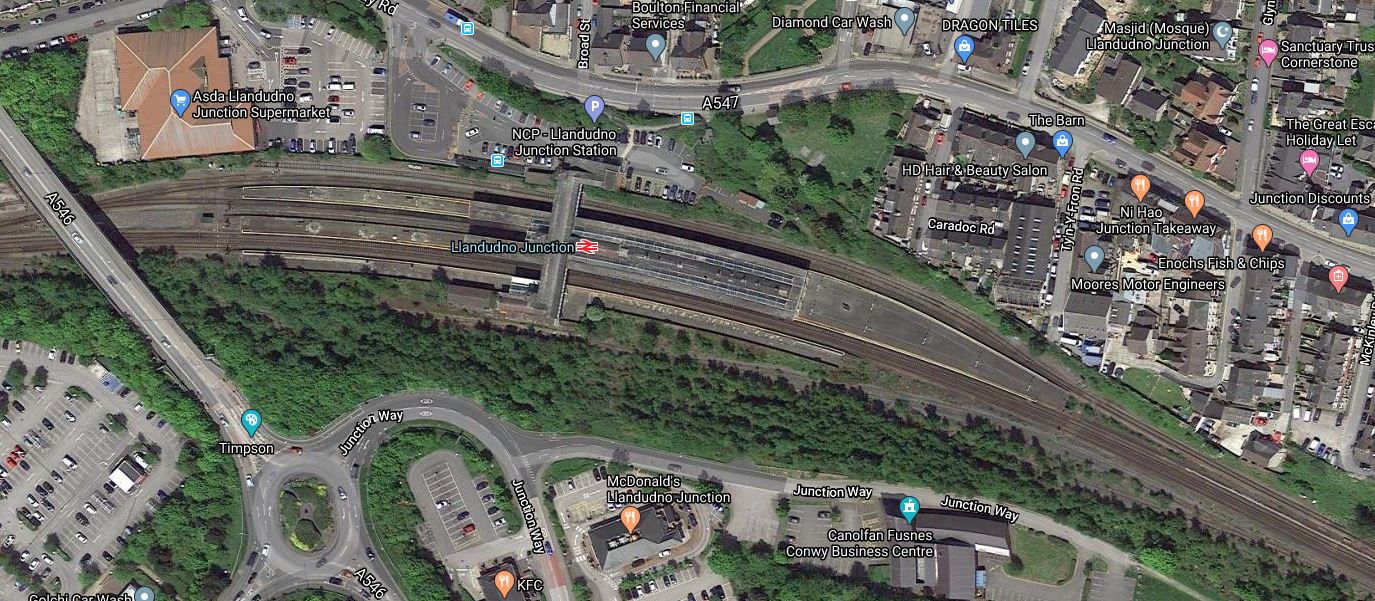
This Google Map shows Llandudno Junction station.
Note.
- It is a large station site.
- The Conwy Valley Line, which will be run by battery Class 230 trains in the future connects at this station.
- The Class 230 train will probably use some of Vivarail’s Fast Charging systems, which use third-rail technology, either at the ends of the branch or in Llandudno Junction station.
The simplest way to charge the London Euston and Holyhead train, would be to build a charging station at Llandudno Junction, which could be based on Vivarail’s Fast Charging technology or a short length of 25 KVAC overhead wire.
But this would add ten minutes to the timetable.
Could 25 KVAC overhead electrification be erected for a certain distance through the station, so that the train has ten minutes in contact with the wires?
Looking at the timetable of a train between London Euston and Holyhead, it arrives at Colwyn Bay station at 1152 and leaves Llandudno Junction station at 1200.
So would it be possible to electrify between the two stations and perhaps a bit further?
This Google Map shows Colwyn Bay Station,
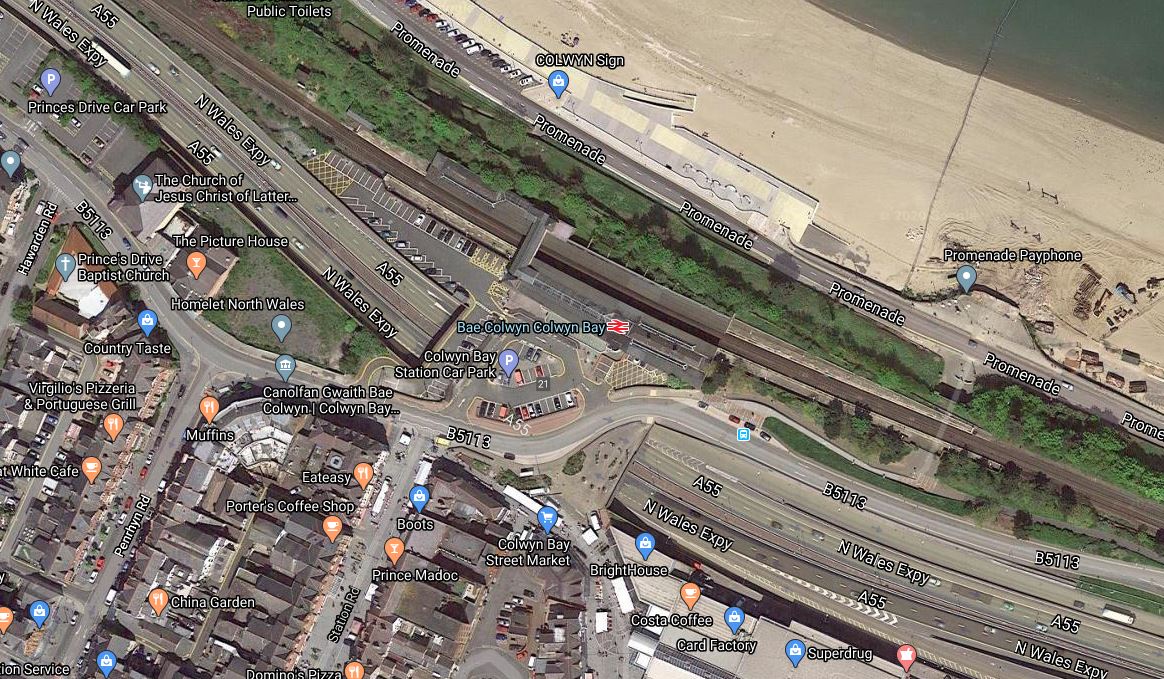
Note how the double-track railway is squeezed between the dual-carriageway of the A55 North Wales Expressway and the sea.
The two routes follow each other close to the sea, as far as Abegele & Pensarn station, where the Expressway moves further from the sea.
Further on, after passing through more caravans than I’ve ever seen, there is Rhyl station.
- The time between arriving at Rhyl station and leaving Llandudno Junction station is nineteen minutes.
- The distance between the two stations is fourteen miles.
- Rhyl and Crewe is fifty-one miles.
- Llandudno Junction and Holyhead is forty-one miles.
It would appear that if the North Wales Coast Line between Rhyl and Llandudno Junction is electrified, that Hitachi’s proposed battery trains can reach Holyhead.
The trains could even changeover between electrification and battery power in Rhyl and Llandudno Junction stations.
I am sure that electrifying this section would not be the most difficult in the world, although the severe weather sometimes encountered, may need some very resilient or innovative engineering.
It may be heretical to say so, but would it be better if this section were to be electrified using proven third-rail technology.
West of Llandudno Junction station, the electrification would be very difficult, as this Google Map of the crossing of the River Conwy shows.
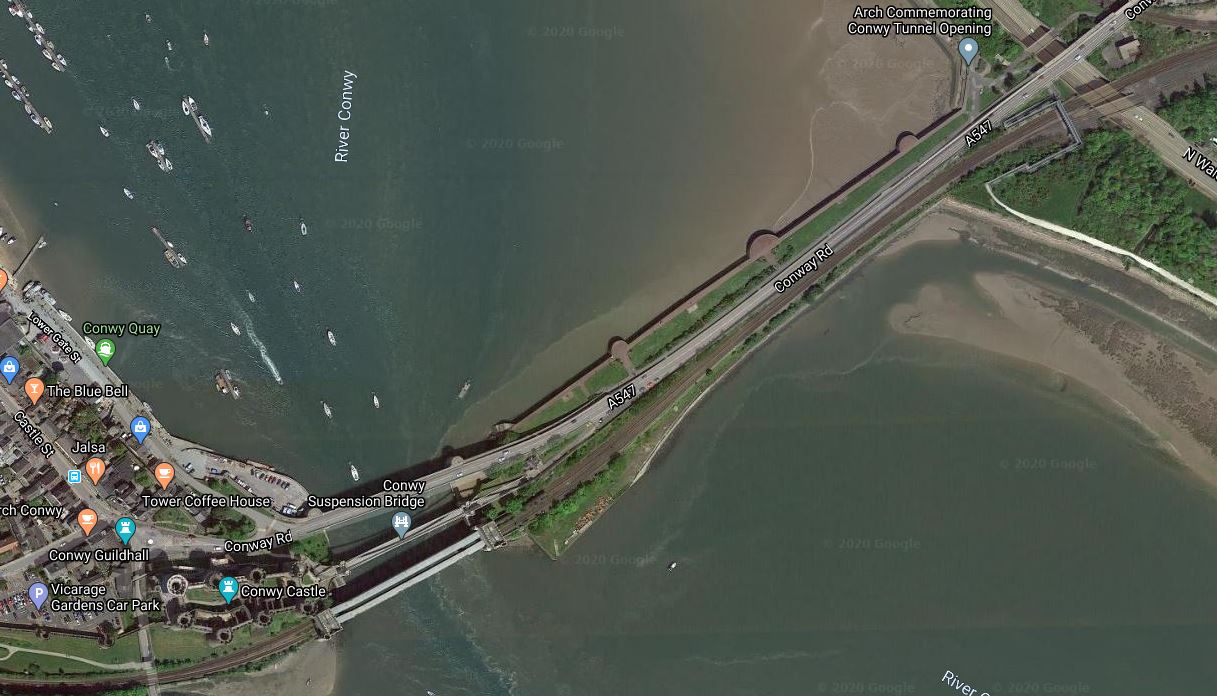
I don’t think anybody would want to see electrification around the famous castle.
Electrification Across Anglesey
Llanfairpwll station marks the divide between the single-track section of the North Wales Coast Line over the Britannia Bridge and the double-track section across Anglesey.
From my virtual helicopter, the route looks as if, it could be fairly easy to electrify, but would it be necessary?
- Llandudno Junction and Holyhead is forty-one miles, which is well within battery range.
- There is surely space at Holyhead station to install some form of fast-charging system.
One problem is that trains seem to turn round in only a few minutes, which may not be enough to charge the trains.
So perhaps some of the twenty-one miles between Llanfairpwll and Holyhead should be electrified.
London Euston And Holyhead Journey Times
Currently, trains take three hours and forty-three minutes to go between London Euston and Holyhead, with these sectional timings.
- London Euston and Crewe – One hour and thirty-nine minutes.
- Crewe and Holyhead – Two hours and four minutes.
The big change would come, if the London Euston and Crewe leg, were to be run on High Speed Two, which will take just fifty-five m,inutes.
This should reduce the London Euston and Holyhead time to just under three hours.
Freight On The North Wales Coast Line
Will more freight be seen on the North Wales Coast Line in the future?
The new tri-mode freight locomotives like the Class 93 locomotive, will be able to take advantage of any electrification to charge their batteries, but they would probably be on diesel for much of the route.
Conclusion On The North Wales Coast Line
Short lengths of electrification, will enable Avanti West Coast’s AT-300 trains, after retrofitting with batteries, to run between Crewe and Holyhead, without using any diesel.
I would electrify.
- Crewe and Chester – 21 miles
- Rhyl and Llandudno Junction – 14 miles
- Llanfairpwll and Holyhead – 21 miles
But to run battery-electric trains between London Euston and Holyhead, only Rhyl and Llandudno Junction needs to be electrified.
All gaps in the electrification will be handled on battery power.
A Selection Of Possible Battery-Electric Services
In this section, I’ll look at routes, where battery-electric services would be very appropriate and could easily be run by Hitachi’s proposed battery-electric trains.
London Paddington And Swansea
Many were disappointed when Chris Grayling cancelled the electrification between Cardiff and Swansea.
I went along with what was done, as by the time of the cancellation, I’d already ridden in a battery train and believed in their potential.
The distance between Cardiff and Swansea is 46 miles without electrification.
Swansea has these services to the West.
- Carmarthen – 32 miles
- Fishguard – 73 miles
- Milford Haven 71 miles
- Pembroke Dock – 73 miles
It looks like, three services could be too long for perhaps a three car battery-electric version of a Hitachi Class 385 train, assuming it has a maximum range of 65 miles.
But these three services all reverse in Carmarthen station.
So perhaps, whilst the driver walks between the cabs, the train can connect automatically to a fast charging system and give the batteries perhaps a four minute top-up.
Vivarail’s Fast Charging system based on third-rail technology would be ideal, as it connects automatically and it can charge a train in only a few minutes.
I would also electrify the branch between Swansea and the South Wales Main Line.
This would form part of a fast-charging system for battery-trains at Swansea, where turnround times can be quite short.
I can see a network of battery-electric services developing around Swansea, that would boost tourism to the area.
Edinburgh And Tweedbank
The Borders Railway is electrified as far as Newcraighall station and the section between there and Tweedbank is thirty miles long.
I think that a four-car battery-electric Class 385 train could work this route.
It may or may not need a top up at Tweedbank.
The Fife Circle
The Fife Circle service from Edinburgh will always be difficult to electrify, as it goes over the Forth Rail Bridge.
- The Fife Circle is about sixty miles long.
- Plans exist for a short branch to Leven.
- The line between Edinburgh and the Forth Rail Bridge is partly electrified.
I believe that battery-electric Class 385 train could work this route.
London Kings Cross and Grimsby/Cleethorpes via Lincoln
The Cleethorpes/Grimsby area is becoming something of a renewable energy powerhouse and I feel that battery trains to the area, might be a significant and ultimately profitable statement.
LNER recently opened a six trains per day service to Lincoln.
Distances from Newark are as follows.
- Lincoln – 17 miles
- Grimsby – 61 miles
- Cleethorpes – 64 miles
A round trip to Lincoln can probably be achieved on battery alone with a degree of ease, but Cleethorpes and Grimsby would need a recharge at the coast.
Note that to get to the Cleethorpes/Grimsby area, travellers usually need to change at Doncaster.
But LNER are ambitious and I wouldn’t be surprised to see them dip a toe in the Cleethorpes/Grimsby market.
The LNER service would also be complimented by a TransPennine Express service from Manchester Airport via Sheffield and Doncaster, which could in the future be another service run by a Hitachi battery train.
There is also a local service to Barton-on-Humber, which could be up for improvement.
London Waterloo And Exeter
This service needs to go electric, if South Western Railway is going to fully decarbonise.
But third-rail electrification is only installed between Waterloo and Basingstoke.
Could battery-electric trains be used on this nearly two hundred mile route to avoid the need for electrification.
A possible strategy could be.
- Use existing electrification, as far as Basingstoke – 48 miles
- Use battery power to Salisbury – 83 miles
- Trains can take several minutes at Salisbury as they often split and join and change train crew, so the train could be fast-charged.
- Use battery power to the Tisbury/Gillingham/Yeovil/Crewkerne area, where trains would be charged – 130 miles
- Use battery power to Exeter- 172 miles
Note.
- The miles are the distance from London.
- The charging at Salisbury could be based on Vivarail’s Fast-Charging technology.
- The charging around Yrovil could be based on perhaps twenty miles of third-rail electrification, that would only be switched on, when a train is present.
I estimate that there could be time savings of up to fifteen minutes on the route.
To Be Continued…
Innolith Claims It’s On Path To 1,000 Wh/kg Battery Energy Density
The title of this post is the same as that of this article on InsideEVS.
This is the introductory paragraph.
Innolith, the Switzerland-based company with labs in Germany, announced that it is developing the world’s first rechargeable battery with an energy density of 1,000 Wh/kg (or simply 1 kWh per kg of weight). Such high energy would easily enable the production of electric cars with a range of 1,000 km (620 miles).
If they achieve their aim, a one MWh battery will weigh a tonne.
I am sceptical but read this second article on CleanTechnica, which is entitled Swiss Startup Innolith Claims 1000 Wh/kg Battery.
Innolith has a working battery at Haggerstown, Virginia, but say full production is probably 3 to 5 years away.
The CleanTechnica article, also says this about Tesla’s batteries.
Let’s put that into perspective. It is widely believed that Tesla’s latest 2170 lithium ion battery cells produced at its factory in Nevada can store about 250 Wh/kg. The company plans to increase that to 330 Wh/kg as it pursues its goal of being a world leader in battery technology. 1000 Wh/kg batteries would theoretically allow an electric car to travel 600 miles or more on a single charge.
So it would appear that Tesla already has an power density of 250 Wh/Kg.
Conclusion
I am led to believe these statements are true.
- Tesla already has an energy density of 250 Wh/Kg.
- Tesla will increase this figure.
- By 2025, the energy density of lithium-ion batteries will be much closer to 1 KWh/Kg.
- Innolith might achieve this figure. But they are only one of several companies aiming to meet this magic figure.
These figures will revolutionise the use of lithium-ion batteries.
 The Anonymous Widower