LNER’s Cheaper Advanced Tickets Can Be Bought Just Before You Travel
Yesterday, I had a ticket on the 15:47 train, back from Doncaster to London Kings Cross. I had bought it on-line a few days ago for £23.50.
But, I was unable to complete what I wanted to do, so found myself at Doncaster station, with three hours to wait for my train.
Usually, I buy open returns, but LNER have stopped that because of the covids!
So rather than wait, I decided to buy another ticket.
A new Off Peak Single with my Railcard would have been £60, but I found the machine could sell me an Advance Single Ticket for £31.
So I got home in time for the cricket. My ticket also got me two seats, including a window.
LNER seem to be getting their act together.
!40 mph Electric Trains At Kings Cross Station
This picture shows LNER’s old and new 140 mph electric trains at Kings Cross station.
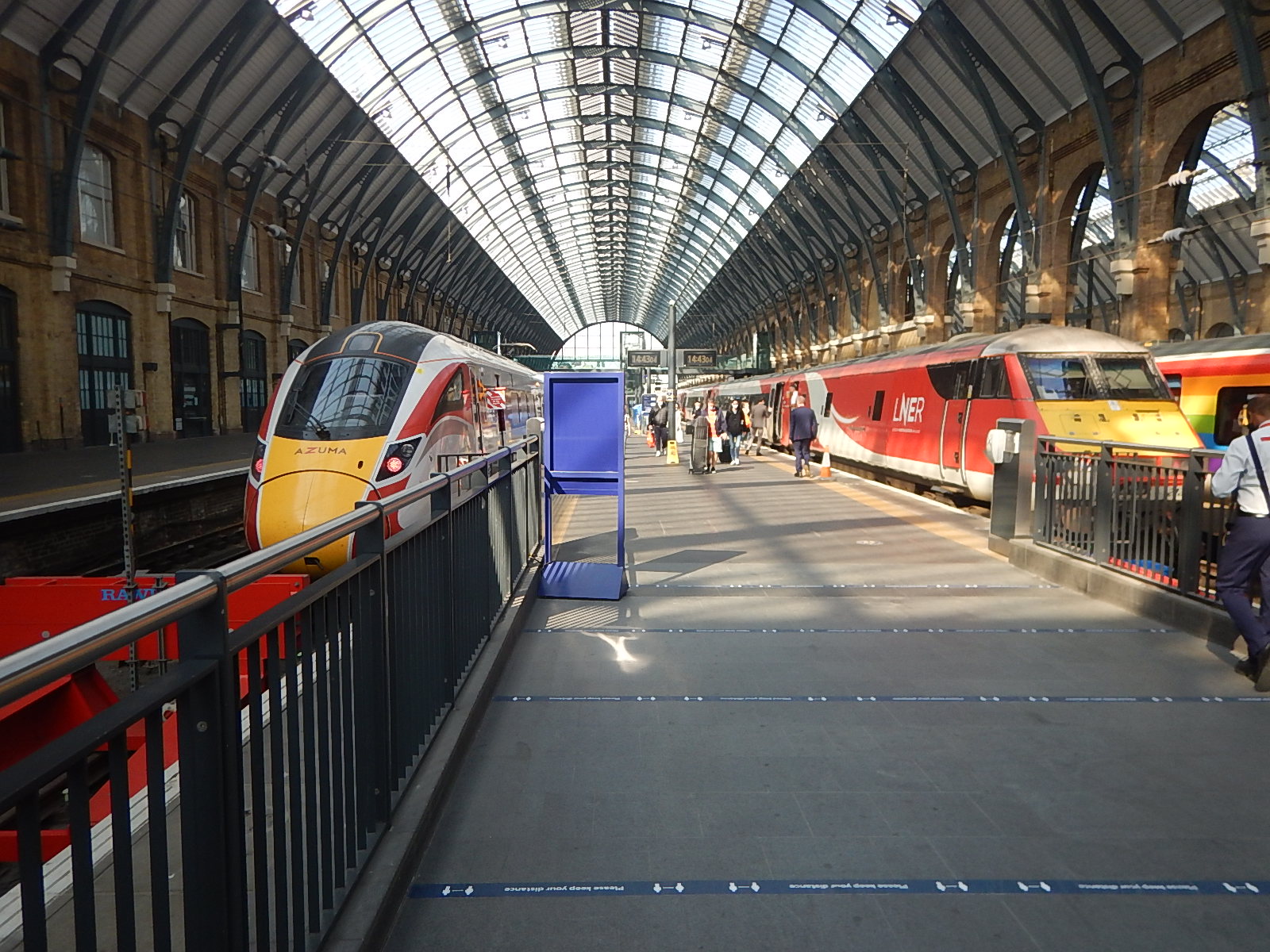
On the left is a nine-car Class 801 train.
- Introduced into service in 2019
- 234 metres long
- Capacity – 510 Standard and 101 First
- One diesel engine for emergency power.
On the right is an InterCity 225.
- Introduced into service in 1988-1991.
- Nine Mark 4 coaches
- 245 metres long
- Capacity 406 Standard and 129 First
- No emergency power
- As I wrote in Overhauls for LNER’s Remaining Class 91s And Mk 4s, the InterCity 225s are being updated to offer electric services between London Kings Cross and Bradford, Leeds, Skipton and York.
Both trains are designed for 140 mph and will be able to attain this speed, when in-cab digital signalling is available.
It looks like LNER will have the following full-size electric fleet.
- Thirty Class 801 trains
- Seven InterCity 225 trains and spare coaches, driving van trailers and locomotives.
Both trains will be able to work any route with full electrification.
Changes In The Future To LNER Services
I predict that the following will happen.
140 mph Running Between Woolmer Green And Doncaster
This will happen and the following trains will take advantage.
- LNER’s Class 800 and Class 801 trains
- Hull Train’s Class 802 trains
- East Coast Trains’s Class 803 trains
The odd ones out will be Grand Central’s Class 180 trains, which are diesel and only capable of 125 mph.
How long will the other train operating companies accept slow trains on the 140 mph railway?
Digital In-Cab Signalling And 140 mph Running Will Speed Up Services
In Thoughts On Digital Signalling On The East Coast Main Line, I said that following train times would be possible., in addition to a London Kings Cross and Leeds time of two hours.
- London Kings Cross and Bradford Forster Square – two hours and thirty minutes
- London Kings Cross and Harrogate – two hours and thirty minutes
- London Kings Cross and Huddersfield – two hours and twenty minutes
- London Kings Cross and Hull – two hours and thirty minutes
- London Kings Cross and Middlesbrough – two hours and thirty minutes
- London Kings Cross and Scarborough – two hours and thirty minutes
- London Kings Cross and Skipton – two hours and thirty minutes
- London Kings Cross and York – two hours
Note.
- All timings would be possible with Hitachi Class 80x trains.
- Timings on Fully-electrified routes would be possible with InterCity 225 trains.
It appears that Grand Central will be stuck in the slow lane.
Grand Central Will Acquire Hitachi Trains Or Give Up
Grand Central‘s destinations of Bradford Interchange and Sunderland can’t be reached by all-electric trains, so will either have to follow Hull Trains and purchase Hitachi bi-mode trains or give up their routes.
The Diesel Engines In The Class 801 Trains Will Be Replaced By Batteries
East Coast Trains’ Class 803 trains have a slightly different powertrain to LNER’s Class 801 trains, which is explained like this in Wikipedia.
Unlike the Class 801, another non-bi-mode AT300 variant which despite being designed only for electrified routes carries a diesel engine per unit for emergency use, the new units will not be fitted with any, and so would not be able to propel themselves in the event of a power failure. They will however be fitted with batteries to enable the train’s on-board services to be maintained, in case the primary electrical supplies would face a failure.
I wouldn’t be surprised to see a similar battery system fitted to the Class 801 trains.
The Diesel Engines In Hull Trains Class 802 Trains Will Be Replaced By Batteries
In Hull Issues New Plea For Electrification, I showed how Hitachi’s Class 802 trains with batteries instead of diesel engines could work long-distance services to and from Hull.
This will happen, as electric trains to London, would be a dream for a marketing man or woman.
Will The InterCity 225 Trains Lose Some First Class Seats?
This may happen, so that the seating layout in both trains is almost identical.
I’m certain, that it could be arranged, that seat numbers in both trains could have a similar position.
This would mean that if an InterCity 225 train replaced a Class 801 train, there wouldn’t need to be a seat reallocation.
Could InterCity 225 Trains Be Fitted With Emergency Batteries?
If LNER thought they were needed, I’m sure that this would be possible and Hyperdrive Innovation would oblige!
Conclusion
British Rail last hurrah, is giving Hitachi’s latest trains, a run for their money!
Thoughts On Digital Signalling On The East Coast Main Line
I came up to Doncaster yesterday on a new Hull Trains Class 802 train.
According to my pocket dynamometer car, the train seemed to be at or nearly at 125 mph, most of the time I looked from possibly around Stevenage to just South of Doncaster.
I came back today on an LNER Class 801 train and the train’s performance seemed very similar.
I also noted the following.
- The two stops at Newark and Peterborough, took seven and nine minutes respectively from the start of slowing for the station until back up to speed.
- Between Peterborough and Stevenage the train kept below a maximum of 110 mph.
- The train went through the two tunnels before Welwyn North station and the station itself at 75 mph.
- I timed the train at 100 mph over the Digswell Viaduct, when it reached the South side after accelerating on the viaduct.
- 90 mph was maintained between Potters Bar and New Southgate stations.
- Speed gradually reduced from New Southgate into Kings Cross.
Note.
- 125 mph is the maximum allowable speed of the train.
- The 110 mph running was probably to be compatible with the Class 387 trains.
- I will do the trip again and get some accurate figures.
It appears to me, that the driver was obeying a simple but fast plan.
The Wikipedia entry for the East Coast Main Line, says this about the opiating speed of the line, with the new trains.
Increasing maximum speeds on the fast lines between Woolmer Green and Dalton-on-Tees up to 140 mph (225 km/h) in conjunction with the introduction of the Intercity Express Programme, level crossing closures, ETRMS fitments, OLE rewiring and the OLE PSU – est. to cost £1.3 billion (2014). This project is referred to as “L2E4” or London to Edinburgh (in) 4 Hours. L2E4 examined the operation of the IEP at 140 mph on the ECML and the sections of track which can be upgraded to permit this, together with the engineering and operational costs
It also says this about the implementation of digital signalling.
A new Rail operating centre (ROC), with training facilities, opened in early 2014 at the “Engineer’s Triangle” in York. The ROC will enable signalling and day-to-day operations of the route to be undertaken in a single location. Signalling control/traffic management using ERTMS is scheduled to be introduced from 2020 on the ECML between London King’s Cross and Doncaster – managed from the York ROC.
The signalling could probably work in one of two ways.
- The signalling tells the driver the required speed and they drive the train accordingly.
- The signalling drives the train and the driver monitors what is happening.
Both methods are used in the UK.
A Possible London Kings Cross and Leeds Service
The combined affect of both track and signalling improvements is illustrated by this simple calculation.
- As Dalton-on-Tees is North of Doncaster, the route between Woolmer Green and Doncaster should be possible to be run at 140 mph
- Woolmer Green and Doncaster stations are 132.1 miles apart.
- Non-stop York and London Kings Cross trains are currently timed at 70 minutes between Doncaster and Woolmer Green stations.
- This is an average speed of 113.2 mph.
If 140 mph could be maintained between Doncaster and Woolmer Green, the section of the journey would take 56.6 minutes, which is a saving of 13.4 minutes.
Consider.
- The fastest current trains between London Kings Cross and Leeds take between two hours and twelve minutes and two hours and fifteen minutes.
- I suspect that the extra tracks into Kings Cross, that are currently being built will save a few minutes.
- There must be some savings to be made between Doncaster and Leeds
- There must be some savings to be made between London Kings Cross and Woolmer Green.
- There could be a rearrangement of stops.
I think it is highly likely that in the future, there will be at least one train per hour (tph) between London Kings Cross and Leeds, that does the trip in two hours.
- There is no reason why all London Kings Cross and Leeds trains could not take two hours.
- London Kings Cross and Doncaster could be several minutes under an-hour-and-a-half.
- High Speed Two is predicting one hour and twenty-one minutes for their future service between London Euston and Leeds, which is a saving of 38 minutes.
- London and Leeds in two hours will attract passengers.
There will be serious competition between London and Leeds.
Other Timing Improvements
I also think these times would be possible
- London Kings Cross and Bradford Forster Square – two hours and thirty minutes
- London Kings Cross and Harrogate – two hours and thirty minutes
- London Kings Cross and Huddersfield – two hours and twenty minutes
- London Kings Cross and Hull – two hours and thirty minutes
- London Kings Cross and Middlesbrough – two hours and thirty minutes
- London Kings Cross and Scarborough – two hours and thirty minutes
- London Kings Cross and Sheffield – two hours
- London Kings Cross and Skipton – two hours and thirty minutes
- London Kings Cross and York – two hours
I would be fairly certain that London Kings Cross and Huddersfield could be slowed by ten minutes, which would give the London Kings Cross and Yorkshire a certain symmetry.
- London Kings Cross and Leeds and York would take two hours.
- London Kings Cross and all the others would take two hours and thirty minutes.
It would probably make arrangement of a fast timetable easier.
Hull Issues New Plea For Electrification
The title of this post, is the same as that of this article on Rail Magazine.
This is the introductory paragraph.
Residents and businesses in Hull are being urged to support electrification of the railway to Selby and Sheffield.
This paragraph is about the difficulty of electrifying the route.
“Unlike elsewhere on the trans-Pennine routes, work here can start straightaway and would be a quick win. Our plans involve few extra land purchases, no tunnel widening, and no re-routing,” said Daren Hale, Hull City Council and Hull’s representative on the Transport for the North board.
Services to Hull station are as follows.
- Hull Trains – London Kings Cross and Hull via Selby, Howden and Brough.
- Hull Trains – Beverley and Hull via Cuttingham
- LNER – London Kings Cross and Hull via Selby and Brough
- Northern Trains – Halifax and Hull via Bradford Interchange, New Pudsey, Bramley, Leeds, Cross Gates, Garforth, East Garforth, Micklefield, South Milford, Selby and Brough
- Northern Trains – Sheffield and Hull via Meadowhall, Rotherham Central, Swinton, Mexborough, Conisbrough, Doncaster, Kirk Sandall, Hatfield & Stainforth, Thorne North, Goole, Saltmarshe, Gilberdyke, Broomfleet, Brough, Ferriby and Hessle,
- Northern Trains – Bridlington and Hull via Nafferton, Driffield, Hutton Cranswick, Arram, Beverley and Cottingham.
- Northern Trains – Scarborough and Hull via Seamer, Filey, Hunmanby, Bempton, Bridlington, Nafferton, Driffield, Hutton Cranswick, Arram, Beverley and Cottingham.
- Northern Trains – York and Hull via Selby, Howden, Gilberdyke and Brough.
- TransPennine Express – Manchester Piccadilly and Hull via Stalybridge, Huddersfield, Leeds, Selby, Brough
Note.
- Some services are joined back-to-back with a reverse at Hull station.
- I have simplified some of the lists of intermediate stations.
- Services run by Hull Trains, LNER or TransPennine Express use bi-mode Class 800 or Class 802 trains.
- All routes to Hull station and the platforms are not electrified.
Trains approach Hull by three routes.
- Selby and Brough
- Goole and Brough
- Beverley and Cottingham
Could these three routes be electrified?
I have just flown my helicopter along all of them.
I’ve also had a lift in the cab of a Class 185 train between Hull and Leeds, courtesy of Don Coffey.
Hull And Selby via Brough
There is the following infrastructure.
- Several major road overbridges, which all seem to have been built with clearance for overhead wires.
- There are also some lower stone arch bridges, which may need to be given increased clearance.
- No tunnels
- The historic Selby Swing Bridge.
- Four farm crossings.
- Fourteen level crossings.
Hull And Goole via Brough
There is the following infrastructure.
- Several major road overbridges, which all seem to have been built with clearance for overhead wires.
- No tunnels
- A swing bridge over the River Ouse.
- A couple of farm crossings
- Six level crossings
Hull And Beverley via Cottingham
There is the following infrastructure.
- A couple of major road overbridges, which all seem to have been built with clearance for overhead wires.
- No tunnels
- A couple of farm crossings
- Six level crossings
All of the routes would appear to be.
- At least double track.
- Not in deep cuttings.
- Mainly in open countryside.
- Built with lots of level crossings
I feel that compared to some routes, they would be easy to electrify, but could cause a lot of disruption, whilst the level crossings and the two swing bridges were electrified.
Speeding Up Services To And From Hull
What Are The Desired Timings?
The Rail Magazine article says this about the desired timings.
Should the plans be approved, it is expected that Hull-Leeds journey times would be cut from 57 minutes to 38, while Hull-Sheffield would drop from 86 minutes to 50 minutes.
These timings are in line with those given in this report on the Transport for the North web site, which is entitled At A Glance – Northern Powerhouse Rail,
The frequency of both routes is given in the report as two trains per hour (tph)
The Performance Of An Electric Class 802 Train
As Hull Trains, LNER and TransPennine Express will be using these trains or similar to serve Hull, I will use these trains for my calculations.
The maximum speed of a Class 802 train is 125 mph or 140 mph with digital in-cab signalling.
This page on the Eversholt Rail web site, has a data sheet for a Class 802 train.
The data sheet shows the following for a five-car Class 802 train.
It can accelerate to 100 mph and then decelerate to a stop in 200 seconds in electric mode.
The time to 125 mph and back is 350 seconds.
Thoughts On Hull And Leeds
Consider.
- The Hull and Leeds route is 52 miles long, is timed for a 75 mph train and has an average speed of 55 mph
- There are three intermediate stops for fast services, which means that in a Hull and Leeds journey, there are four accelerate-decelerate cycles.
- A 38 minute journey between Hull and Leeds would be an average speed of 82 mph
- A train travelling at 100 mph would take 31 minutes to go between Hull and Leeds.
- A train travelling at 125 mph would take 25 minutes to go between Hull and Leeds.
I also have one question.
What is the speed limit on the Selby Swing Bridge?
I have just been told it’s 25 mph. As it is close to Selby station, it could probably be considered that the stop at Selby is a little bit longer.
These could be rough timings.
- A train travelling at 100 mph would take 31 minutes to go between Hull and Leeds plus what it takes for the four stops. at 200 seconds a stop, which adds up to 43 minutes.
- A train travelling at 125 mph would take 25 minutes to go between Hull and Leeds plus what it takes for the four stops. at 350 seconds a stop, which adds up to 48 minutes.
Note how the longer stopping time of the faster train slows the service.
I think it would be possible to attain the required 38 minute journey, running at 100 mph.
Thoughts On Hull And Sheffield
Consider.
- The Hull and Sheffield route is 61 miles long, is timed for a 90 mph train and has an average speed of 43 mph
- There are five intermediate stops, which means that in a Hull and Sheffield journey, there are six accelerate-decelerate cycles.
- A 50 minute journey between Hull and Leeds would be an average speed of 73 mph.
- A train travelling at 100 mph would take 36 minutes to go between Hull and Sheffield.
- A train travelling at 125 mph would take 29 minutes to go between Hull and Sheffield.
I also have one question.
What is the speed limit on the swing bridge over the River Ouse?
As there is no nearby station, I suspect it counts as another stop, if it only has a 25 mph limit.
These could be rough timings.
- A train travelling at 100 mph would take 36 minutes to go between Hull and Sheffield plus what it takes for the six stops. at 200 seconds a stop, which adds up to 56 minutes.
- A train travelling at 125 mph would take 29 minutes to go between Hull and Sheffield plus what it takes for the six stops. at 350 seconds a stop, which adds up to 64 minutes.
Note how the longer stopping time of the faster train slows the service.
I think it would be possible to attain the required 50 minute journey, running at 100 mph.
Conclusions From My Rough Timings
Looking at my rough timings, I can conclude the following.
- The trains will have to have the ability to make a station stop in a very short time. Trains using electric traction are faster at station stops.
- The trains will need to cruise at a minimum of 100 mph on both routes.
- The operating speed of both routes must be at least 100 mph, with perhaps 125 mph allowed in places.
- I feel the Hull and Leeds route is the more difficult.
I also think, that having a line running at 100 mph or over, with the large number of level crossings, there are at present, would not be a good idea.
What Does Hull Want?
Hull wants what Northern Powerhouse Rail is promising.
- Two tph between Hull and Leeds in 38 minutes and Hull and Sheffield in 50 minutes.
They’d probably also like faster electric services between Hull and Bridlington, London Kings Cross, Manchester, Scarborough and York.
When Do They Want It?
They want it now!
Is There An Alternative Solution, That Can Be Delivered Early?
This may seem to be the impossible, as electrifying between Hull and Leeds and Hull and Sheffield is not an instant project, although full electrification could be an ultimate objective.
Consider.
- Hull and Brough are 10.5 miles apart.
- Brough and Leeds are 41 miles apart.
- Brough and Doncaster are 30 miles apart and Doncaster and Sheffield are 20 miles apart.
- Brough and Temple Hirst Junction are 26 miles apart.
- Brough and York are 42 miles apart.
- Hull and Beverley are 8 miles apart.
- Beverley and Bridlington are 23 miles apart.
- Beverley and Seamer are 42 miles apart.
Note that Doncaster, Leeds and Temple Hirst Junction are all electrified.
Hitachi’s Regional Battery Train
Hitachi have just launched the Regional Battery Train, which is described in this Hitachi infograpic.

It has a range of 56 miles and an operating speed of 100 mph.
Class 800 and Class 802 trains could be converted into Regional Battery Trains.
- The three diesel engines would be exchanged for battery packs.
- The trains would still be capable of 125 mph on fully-electrified routes like the East Coast Main Line.
- They would be capable of 100 mph on routes like the 100 mph routes from Hull.
- The trains would have full regenerative braking to batteries, which saves energy.
- Below 125 mph, their acceleration and deceleration on battery power would probably be the same as when using electrification. It could even be better due to the simplicity and low impedance of batteries.
But they would need some means of charging the batteries at Hull.
A Start To Electrification
If the ultimate aim is to electrify all the lines, then why not start by electrifying.
- Hull station.
- Hull and Brough
- Hull and Beverley
It would only be 18.5 miles of electrification and it doesn’t go anywhere near the swing bridges or about six level crossings.
Battery Electric Services From Hull
I will now look at how the various services could operate.
Note in the following.
- When I say Regional Battery Train, I mean Hitachi’s proposed train or any other battery electric train with a similar performance.
- I have tried to arrange all power changeovers in a station.
- Pantograph operation can happen at line-speed or when the train is stationary.
I have assumed a range of 56 miles on a full battery and an operating speed of 100 mph on a track that allows it.
Hull And London Kings Cross
The legs of the service are as follows.
- Hull and Brough – 10.5 miles – Electrified
- Brough and Temple Hirst Junction – 26 miles – Not Electrified
- Temple Hirst Junction and London Kings Cross – 169 miles – Electrified
Note.
- Hull and Brough takes about 11 minutes, so added to the time spent in Hull station, this must be enough time to fully-charge the batteries.
- Regional Battery Trains will be able to do 56 miles on a full battery so 26 miles should be easy.
- One changeover between power sources will be done in Brough station.
- The other changeover will be done at line speed at Temple Hirst Junction, as it is now!
Hull Trains and LNER would be able to offer an all-electric service to London.
A few minutes might be saved, but they would be small compared to time savings, that will be made because of the introduction of full ERTMS in-cab signalling South of Doncaster, which will allow 140 mph running.
Hull And Leeds
The legs of the service are as follows.
- Hull and Brough – 10.5 miles – Electrified
- Brough and Leeds – 41 miles – Not Electrified.
Note.
- Hull and Brough takes about 11 minutes, so added to the time spent in Hull station, this must be enough time to fully-charge the batteries.
- Regional Battery Trains will be able to do 56 miles on a full battery so 41 miles should be easy.
- One changeover between power sources will be done in Brough station, with the other in Leeds station.
If Leeds and Huddersfield were to be electrified, TransPennine Express will be able to run an all-electric service between Manchester and Hull, using battery power in the gaps.
Hull And Sheffield
The legs of the service are as follows.
- Hull and Brough – 10.5 miles – Electrified
- Brough and Doncaster – 30 miles – Not Electrified
- Doncaster and Sheffield – 20 miles – Not Electrified
Note.
- Hull and Brough takes about 11 minutes, so added to the time spent in Hull station, this must be enough time to fully-charge the battery.
- Regional Battery Trains will be able to do 56 miles on a full battery so 30 miles should be easy.
- Trains would charge using the electrification at Doncaster.
- Doncaster and Sheffield both ways should be possible after a full charge at Doncaster station.
- One changeover between power sources will be done in Brough station, with the others in Doncaster station.
An easier alternative for the Doncaster and Sheffield part of the route, might be to electrify between the two stations.
Hull And York
The legs of the service are as follows.
- Hull and Brough – 10.5 miles – Electrified
- Brough and York- 42 miles – Not electrified
Note.
- Hull and Brough takes about 11 minutes, so added to the time spent in Hull station, this must be enough time to fully-charge the batteries.
- Regional Battery Trains will be able to do 56 miles on a full battery so 42 miles should be easy.
- One changeover between power sources will be done in Brough station, with the other in York station.
- Trains would be fully charged for the return in York station.
This journey will also be effected by the York to Church Fenton Improvement Scheme, which is described on this page on the Network Rail web site. According to the web page this involves.
- Replace old track, sleepers, and ballast (The stones which support the track)
- Install new signalling gantries, lights, and cabling
- Fully electrify the route from York to Church Fenton – extending the already electrified railway from York.
There will be another five miles of electrification., which will mean the legs of the Hull and York service will be as follows.
- Hull and Brough – 10.5 miles – Electrified
- Brough and Church Fenton – 31.5 miles – Not Electrified
- Church Fenton and York – 10.5 miles – Electrified
It is a classic route for a battery electric train.
Note.
- Church Fenton and York takes about 19 minutes, so added to the time spent in York station, this must be enough time to fully-charge the batteries.
- There will be a changeover between power sources in Church Fenton station.
This appears to me to be a very sensible addition to the electrification.
If you look at a Leeds and York, after the electrification it will have two legs.
- Leeds and Church Fenton – 13 miles – Not Electrified
- Church Fenton and York – 10.5 miles – Electrified
It is another classic route for a battery electric train.
Hull And Bridlington
The legs of the service are as follows.
- Hull and Beverley – 13 miles – Electrified
- Beverley and Bridlington – 23 miles – Not Electrified
Note.
- Hull and Beverley takes about 13 minutes, so added to the time spent in Hull station, this must be enough time to fully-charge the batteries.
- Regional Battery Trains will be able to do 56 miles on a full battery so 46 miles to Bridlington and back to Beverley, should be possible.
- The changeovers between power sources would be in Beverley station.
If necessary, there is a bay platform at Bridlington, that could be fitted with simple electrification to charge the trains before returning.
Hull And Scarborough
The legs of the service are as follows.
- Hull and Beverley – 13 miles – Electrified
- Beverley and Seamer- 42 miles – Not Electrified
- Seamer and Scarborough – 3 miles – Not Electrified
Note.
- Hull and Beverley takes about 13 minutes, so added to the time spent in Hull station, this must be enough time to fully-charge the batteries.
- Regional Battery Trains will be able to do 56 miles on a full battery so 45 miles to Scarborough should be easy.
- The changeovers between power sources would be in Beverley station.
There would need to be charging at Scarborough, so why not electrify between Scarborough and Seamer?
- Power changeover would be in Seamer station.
- The electrification could also charge battery electric trains running between York and Scarborough.
- Seamer and York are 39 miles apart.
- All Northern Trains and TransPennine Express services appear to stop in Seamer station.
This could be three very useful miles of electrification.
Could This Plan Based On Battery Trains Be Delivered Early?
The project could be divided into sub-projects.
Necessary Electrification
Only these double-track routes would need to electrified.
- Hull and Brough
- Hull and Beverley
- Seamer and Scarborough
- Doncaster and Sheffield might be sensible but optional.
This also install electrification at Hull and Scarborough stations to charge terminating trains.
In total it would be under twenty-five double-track miles of electrification.
Note.
- There are no swing bridges on the routes to be electrified.
- There are no tunnels
- Many of the overbridges appear to be modern with adequate clearance for electrification.
- I don’t suspect that providing adequate power will be difficult.
- Hull and Scarborough are larger stations and I believe a full service can be provided, whilst the stations are being electrified.
It would not be a large and complicated electrification project.
Conversion Of Class 800 And Class 802 Trains To Regional Battery Trains
Whilst the electrification was being installed, the existing Class 800 and Class 802 trains needed by Hull Trains, LNER and TransPennine Express could be converted to Regional Battery Trains, by the replacement of some or all of the diesel engines with battery power-packs.
I suspect LNER or GWR could be the lead customer for Hitachi’s proposed conversion of existing trains.
- Both train companies have routes, where these trains could be deployed without any electrification or charging systems. Think London Kings Cross and Harrogate for LNER and Paddington and Oxford for GWR.
- Both train companies have large fleets of five-car trains, that would be suitable for conversion.
- Both train companies have lots of experience with Hitachi’s trains.
It should be noted that GWR, Hull Trains and TransPennine Express are all part of the same company.
What About Northern Trains?
Northern Trains will need some battery electric trains, if this plan goes ahead, to run routes like.
- Hull and Bridlington – 46 miles
- Hull and Leeds – 41 miles
- Hull and Scarborough – 42 miles
- Hull and Sheffield – 40 miles
- Hull and York – 42 miles
- Scarborough and York – 31.5 miles
- The distances are the lengths of the route without electrification.
I suspect they will need a train with this specification.
- Four cars
- Ability to use 25 KVAC overhead electrification.
- Battery range of perhaps 50 miles.
- 100 mph operating speed.
There are already some possibilities.
- CAF are talking about a four-car battery electric version of the Class 331 train.
- Hitachi have mentioned a battery electric Class 385 train.
- Porterbrook have talked about converting Class 350 trains to battery electric operation.
- Bombardier have talked about battery electric Aventras.
There are also numerous four-car electric trains, that are coming off lease that could be converted to battery electric operation.
When Could The Project Be Completed?
There are three parts to the project.
- Under twenty-five double-track miles of electrification.
- Adding batteries to Class 800 and Class 802 trains.
- Battery electric trains for Northern.
As the sub-projects can be progressed independently, I can see the project being completely by the end of 2024.
Across The Pennines In A Regional Battery Train
By providing the ability to run Class 802 trains on battery power to Hull and Scarborough, the ability to run Regional Battery Trains from Liverpool in the West to Hull, Middlesbrough and Scarborough in the East under electric power, could become possible.
Looking at Liverpool and Scarborough, there are these legs.
- Liverpool Lime Street and Manchester Victoria – 32 miles – Electrified
- Manchester Victoria and Stalybridge – 8 miles – Not Electrified
- Stalybridge and Huddersfield – 18 miles – Not Electrified
- Huddersfield and Leeds – 17 miles – Not Electrified
- Leeds and York – 26 miles – Not Electrified
- York and Scarborough – 42 miles – Not Electrified
Note.
- East of Manchester Victoria, there is electrification in Leeds and York stations, which could charge the train fully if it were in the station for perhaps ten minutes.
- Currently, stops at Leeds and York are around 4-5 minutes.
- Manchester Victoria and Stalybridge is being electrified.
- In this post, I have suggested that between Seamer and Scarborough should be electrified to charge the trains.
- I have also noted that between Church Fenton and York is being fully electrified.
This could mean power across the Pennines between Liverpool and Scarborough could be as follows.
- Liverpool Lime Street and Manchester Victoria – 32 miles – Electrification Power and Charging Battery
- Manchester Victoria and Stalybridge – 8 miles – Electrification Power and Charging Battery
- Stalybridge and Huddersfield – 18 miles – Battery Power
- Huddersfield and Leeds – 17 miles – Battery Power
- Leeds station – Electrification Power and Charging Battery
- Leeds and Church Fenton – 13 miles – Battery Power
- Church Fenton and York – 10.5 miles – Electrification Power and Charging Battery
- York and Seamer – 39 miles – Battery Power
- Seamer and Scarborough – 3 miles – Electrification Power and Charging Battery
There are three stretches of the route, where the train will be run on battery power.
- Stalybridge and Leeds – 35 miles
- Leeds and Church Fenton – 13 miles
- York and Seamer – 39 miles
There will be charging at these locations.
- West of Stalybridge
- Through Leeds Station
- Through York Station
- East of Seamer Station
I feel it could be arranged that trains left the charging sections and stations with a full battery, which would enable the train to cover the next section on battery power.
To make things even easier, Network Rail are developing the Huddersfield And Westtown Upgrade, which will add extra tracks and eight miles of new electrification between Huddersfield and Dewsbury.
This would change the power schedule across the Pennines between Liverpool and Scarborough to this.
- Liverpool Lime Street and Manchester Victoria – 32 miles – Electrification Power and Charging Battery
- Manchester Victoria and Stalybridge – 8 miles – Electrification Power and Charging Battery
- Stalybridge and Huddersfield – 18 miles – Battery Power
- Huddersfield and Dewsbury – 8 miles – Electrification Power and Charging Battery
- Fewsbury and Leeds – 9 miles – Battery Power
- Leeds station – Electrification Power and Charging Battery
- Leeds and Church Fenton – 13 miles – Battery Power
- Church Fenton and York – 10.5 miles – Electrification Power and Charging Battery
- York and Seamer – 39 miles – Battery Power
- Seamer and Scarborough – 3 miles – Electrification Power and Charging Battery
There are now four stretches of the route, where the train will be run on battery power.
- Stalybridge and Huddersfield – 18 miles
- Dewsbury and Leeds – 9 miles
- Leeds and Church Fenton – 13 miles
- York and Seamer – 39 miles
I can envisage the electrification being extended.
But battery power on this route gives all the advantages of electric trains, with none of the costs and installation problems of electrification.
Conclusion
I believe a limited electrification of lines for a few miles from the coastal terminals at Hull and Scarborough and battery electric trains can deliver zero-carbon and much faster electric trains to the railways of Yorkshire to the East of Leeds, Sheffield and York.
If this approach is used, the electrification will be much less challenging and if skates were to be worn, the scheme could be fully-implemented in around four years.
The scheme would also deliver the following.
- Faster, all-electric TransPennine services.
- An all-electric Hull and London service.
- A substantial move towards decarbonisation of passenger train services in East Yorkshire.
It is also a scheme, that could be extended South into Lincolnshire, across the Pennines to Lancashire and North to Teesside and Tyneside.
Beeching Reversal – Restoring A South Humber Link
This is one of the Beeching Reversal projects that the Government and Network Rail are proposing to reverse some of the Beeching cuts.
The project is described by these two paragraphs in this article in the Yorkshire Post, which is entitled Government Announce Yorkshire Rail Schemes That Could Receive ‘Reverse Beeching’ Funding.
North Lincolnshire Council have bid for funding to subsidise a new train service that would allow passengers from Barton-on-Humber to travel to Gainsborough, from where they would be able to catch direct services to Sheffield.
This would be achieved by diverting the existing Barton to Grimsby and Cleethorpes trains up a freight-only section used by traffic heading to Immingham docks. There have never been passenger trains using this path before.
This rail map clipped from Wikipedia shows the Barton Line to Barton-on-Humber station.
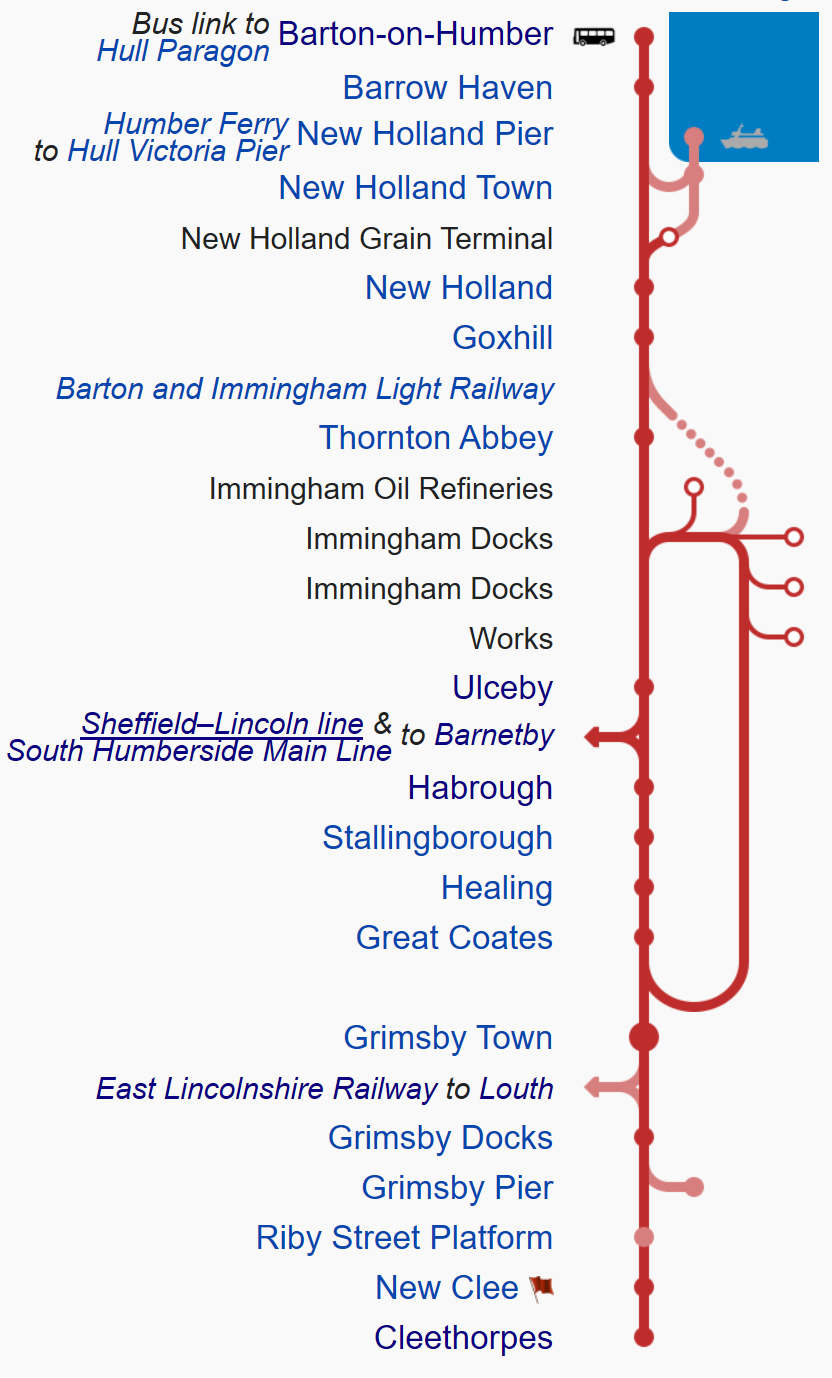
Note.
- Barton-on-Humber station has a bus link to Hull station.
- The loop gives a grand tour of the Port of Immingham on what is now a freight-only line.
- There is a lot of development going on in the area including the AltAlto aviation biofuel, that I wrote about in Grant Shapps Announcement On Friday.
Perhaps all this development is causing a lot of small problems.
- Is it causing congestion on the roads?
- Are workers difficult to find in the Immingham area?
- Is commuting over the Humber Bridge expensive?
- Is parking difficult in the Port?
North Lincolnshire Council could feel that a better rail connection serving the Port of Immingham, would be an asset, that reduces these problems.
I suspect the current two-hourly service between Barton-on-Humber and Cleethorpes stations, will be replaced by an hourly one, between Barton-on-Humber and Gainsborough Lea Road stations, that takes the following route.
- Barton-on-Humber to Ulceby
- At Ulceby station the train will reverse and go clockwise around the loop.
- After calling at Great Coates, Healing, Stallingborough and Habrough stations, the train would go West to Barnetby and Gainsborough Lea Road stations.
- Passengers wanting to go from Barton-on-Humber to Grimsby Town or Cleethorpes, would change at Great Coates station.
It may look a rather round-about route, but I suspect that the plan includes some stations to serve the Port of Immingham and the industrial development.
I suspect that some of these port, oil, chemical and energy companies can afford to pay a contribution.
Gainsborough Lea Road Station
Gainsborough Lea Road station is a mix of architectural styles.
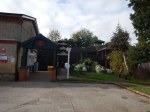
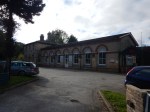
But with the addition of a friendly café and some other facilities, it would be a good interchange between the Immingham area and Sheffield and the county town of Lincoln.
Future Trains
Lincolnshire is an energy-rich county, which partly explains all the industrial development in the North-East of the county around Grimsby, Immingham and Scunthorpe.
- Immingham is a large importer of biomass for power generation.
- There are off-shore and on-shore gas fields connected to Theddlethorpe gas terminal.
- There is the large power station complex at Keadby.
But the energy mix is a-changing.
- Keadby now includes a solar farm.
- Wind turbines are springing up both on land and in the sea.
If I was to make a prediction, it would be that more and more large energy-related businesses will develop in the area.
- In recent months, Altalto’s waste-to-aviation biofuel plant has been given national and local government backing to be built at Immingham.
- ITM Power are involved in a hydrogen development project in the area.
- I wouldn’t be surprised to see hydrogen produced for transport from all this energy.
I think it will be inevitable, that zero-carbon battery electric or hydrogen-powered trains will run in the area.
- Cleethorpes and Doncaster via Scunthorpe 52 miles apart.
- Cleethorpes and Barton-on-Humber are 23 miles apart
- Lincoln and Newark are 16.5 miles apart.
- Lincoln and Doncaster are 37 miles apart.
- Lincoln and Sheffield are 48 miles apart
- Lincoln and the electrification at Peterborough are 54 miles apart.
- Skegness and Sleaford are 41 miles apart.
- Sleaford and Grantham are 18 miles apart.
With charging facilities at Barton-on-Humber, Lincoln, Skegness and Sleaford, the whole of Lincolnshire could be served by zero-carbon battery electric trains.
I suspect LNER could lead the way, as a five-car Class 800 train equipped with batteries, is predicted to have a 56 mile range away from the wires, which would easily handle a return trip between Newark and Lincoln.
There could be a small problem, in that the first train of the day, between Lincoln and London Kings Cross positions from Doncaster Carr IEP Depot, so running Doncaster to Newark via Lincoln might challenge the battery range of the train. I suspect, that the positioning could be performed via Newark with a reverse, prior to the installation of a charging facility at Lincoln Central station.
I estimate that Barton-on-Humber and Gainsborough Lea Road stations are about 35 miles apart, so with today’s battery technology, I suspect that a round trip in a battery electric train would be on the limit. But with charging facilities at Gainsborough, there would be no problems.
I suspect that East Midlands Railway would use several of their forty diesel Class 170 trains on this and other routes in Lincolnshire, so perhaps a good interim solution would be to run the Class 170 trains on Altalto’s biodiesel, that will be produced at Immingham.
There is also the possibility, that some or all of the Class 170 trains will be retrofitted with MTU Hybrid PowerPacks, which would cut their diesel consumption.
Surely, with all Lincolnshire’s energy, hydrogen-powered trains must be a possibility. But they seem to be stuck in a siding!
The MTU Hybrid PowerPack and Altalto’s bio-diesel seems a more affordable and less risky route.
A Direct Connection To London
In the Wikipedia entry for Gainsborough Lea Road station, there is a section called Future Services, where a direct connection to London is mentioned.
Conclusion
Given that the likes of East Midlands Railway, Hull Trains, LNER and TransPennine Express are improving their services to Hull, Lincoln, Cleethorpes and Grimsby, this local North Lincolnshire Metro serving the Port and the industrial development, could well be welcomed by those that live and work in the area.
I doubt that the infrastructure cost will be very high.
Beeching Reversal – Restoration Of A Daily Train Service On The Keighley & Worth Valley Railway
This is one of the Beeching Reversal projects that the Government and Network Rail are proposing to reverse some of the Beeching cuts.
The route starts at Keighley station, which is shown in this Google Map.

Keighley station is effectively a double station.
- The Northern pair of platforms are the electrified Airedale Line, which runs between Leeds and Bradford Forster Square stations in the East to Skipton station in the North-West.
- Curving up from the South is the Keighley and Worth Valley Railway, which runs through the Worth Valley to Oxenhope station.
The basic plan appears to be to run daily passenger services on the heritage railway between Keighley and Oxenhope via Haworth.
But there is a lot more than meets the eye.
Commuter Use
The Wikipedia entry of the Keighley and Worth Valley Railway has a section called Commuter Use, where this is said.
On weekends – in particular Saturday mornings, local residents who live in Oxenhope, Haworth, Oakworth and Ingrow catch the early morning diesel service to Keighley, returning later on steam hauled services. During the weekday outside of the summer months, locals instead use the local bus services.
It then says that studies have been done to investigate the railway’s use as a commuter route.
Heritage Use
There are attractions in the area to attract everybody.
In addition to the major centres of Leeds and Bradford, these stations are worth a visit for the sites they serve.
Haworth for the Brontes
Saltaire for the World Heritage Site of Salts Mill and the Hockneys.
Skipton for the Settle and Carlisle Railway.
LNER To Skipton
LNER run a single daily service to Skipton, that calls at Keighley and Shipley and it is rumoured on Wikipedia, that they would like to run more services.
My feeling, is that the company wants to run pairs of five-car Class 800 or Class 801 trains to Leeds, where they will split and go on to places like Bradford, Harrogate, Huddersfield and Skipton.
Skipton And Colne
This project appears to be a favourite of Governments, as I suspect it solves problems across the North. I last wrote about it in May this year in Colne – Skipton Reopening Moves Closer.
Short Breaks In Yorkshire
Is Yprkshire and Leeds and Bradford in particular, making a bit for the short break market?
It all fits!
What Needs To Be Added To The Keighley And Worth Valley Railway?
If the railway is going to run a regular commuter or tourist service on the route between Keighley and Oxenhope, the following issues must be covered.
Rolling Stock
The railway has an extensive collection of rolling stock, which include a couple of diesel multiple units, that should be able to handle the service.
I would think, that if they wanted something more modern with a heritage feel, that a battery electric version of one of Vivarail’s Class 230 trains would fit the bill. They could run using Vivarail’s Pop-up Metro concept.
Stations
The stations on the railway seem to be in good condition, but I’m sure to handle commuters for Leeds and Bradford, there may be some updating required.
Ticketing
There must be through ticketing.
Conclusion
I don’t feel that this would be the most expensive of schemes, as the major expense of an interchange station between the Keighley and Worth Valley Railway and the Airedale Line is already built.
£35m Station Transformation Launched By Tees Valley Mayor
The title of this post, is the same as that of this article on Rail Technology Magazine.
This is the introductory paragraph.
Tees Valley Mayor Ben Houchen has announced (June 9th) a £35m transformation of Middlesbrough Station to transport more train services to the town, including the first direct rail link to London in decades.
The Rail Technology Magazine article indicates that Platform 2 at Middlesbrough station will be extended to handle Azuma trains. As the current platform looks to be around 150 metres long and this would be long enough for a five-car train, does this mean that in the future nine-car and ten-car Azumas will be able to run services to Middlesbrough?
Currently, LNER run one train per two hours (tp2h) between London and York. Could some or all of these trains be extended to Middlesbrough?
- TransPennines’ trains between York and Middlesbrough take fifty-eight minutes, but they are timed for slower Class 185 trains.
- I would expect faster Class 800 trains could go between York and Middlesbrough and back to York in under a convenient two hours.
- In addition, the lengthened Platform 2 at Middlesbrough would allow longer trains on the service between London and York to turn back at Middlesbrough.
- As the York service, which has a frequency of 1tp2h shares a path with the Lincoln service of a similar frequency, there must be the possibility to run a 1tp2h between Kings Cross and Middlesbrough.
- The same path is also used to run one train per day (tpd) to and from Hull.
- It should also be noted that all Class 800 trains have the ability to split and join together in under two minutes.
There would appear to be a large amount of scope to develop a comprehensive timetable between Kings Cross and Hull, Lincoln and Middlesbrough.
- If the first train left at 07:06 and the last at 22:06, there could be sixteen trains per day on the Kings Cross and Lincoln, Hull, York and Middlesbrough route.
- Each train could be two five-car trains that split and joined en route, which means there would be a total of 32 tpd.
- If five tpd went to both Lincoln and Middlesbrough and perhaps three tpd to Hull, that would leave nineteen tpd trains for other destinations.
- As many trains as possible would need to call at York.
I can certainly see extra destinations built into a intricate pattern in Lincolnshire, Yorkshire and County Durham.
- Nottingham could be served from Newark.
- Grimsby and Cleethorpes could be served by extending services from Lincoln.
- Sheffield, Hull, Scunthorpe, Grimsby and Cleethorpes could be serves from Doncaster.
- Scarborough could be served from York.
- Washington and Newcastle could be served on an alternative route using a reopened Leamside Line.
- Sunderland could be served by extending services from Middlesbrough along the Durham Coast Line.
- Saltburn and Redcar could be served by extending services from Middlesbrough.
Splitting and joining could occur at the following stations.
- Newark for Nottingham and Lincoln, Grimsby and Cleethorpes
- Doncaster for Sheffield, Hull and Scunthorpe, Grimsby and Cleethorpes.
- York for Scarborough and Middlesbrough.
- Middlesbrough for Sunderland and Redcar and Saltburn
Middlesbrough station would need to be able to take two five-car trains for splitting and joining, so the platform extension is required.
Kings Cross and Middlesbrough Could Be A Zero-Carbon Route
In Could Some of Hitachi’s Existing Trains In The UK Be Converted To Battery-Electric Trains?, I indicated that as Middlesbrough station is only 21 miles and 29 minutes from Northallerton and the East Coast Main Line, that a five-car Azuma train converted to battery-electric operation should be able to run between Middlesbrough and Kings Cross, totally on electric power, which would be zero-carbon, if the electricity were to be renewable.
Thoughts On East Coast Trains
According to an article and a picture, the second new Class 803 train for Open Access Operator; East Coast Trains, has arrived in the UK to be fitted out at Newton Aycliffe.
These are my thoughts on the service.
The Trains
The Class 803 trains are similar to the other Hitachi A-trains running in the UK, but with two big differences.
- They will have a one class interior and they will be fitted with a battery, instead of a diesel engine.
- The battery is not for traction and is to provide hotel power in stations and in the event of a dewiring. The latter has been surprisingly common on the East Coast Main Line in recent years.
Normally, these five-car trains are fitted with a single MTU 12V 1600 R80L diesel engine, which is described in this datasheet on the MTU web site.
The mass of the engine is given as 6750 Kg, when it is ready to run.
It would seem logical to replace the diesel engine with a battery of the same weight. I’ll use seven tonnes, as the fuel tank won’t be needed either.
This page on the Clean Energy institute at the University of Washington is entitled Lithium-Ion Battery.
This is a sentence from the page.
Compared to the other high-quality rechargeable battery technologies (nickel-cadmium or nickel-metal-hydride), Li-ion batteries have a number of advantages. They have one of the highest energy densities of any battery technology today (100-265 Wh/kg or 250-670 Wh/L).
Using these figures, a seven-tonne battery would be between 700 and 1855 kWh in capacity.
Incidentally, the power output of an MTU 12V 1600 R80L is 700 kW.
In Sparking A Revolution I gave Hitachi’s possible specification of a battery-electric train.
- Range – 55-65 miles
- Performance – 90-100 mph
- Recharge – 10 minutes when static
- Routes – Suburban near electrified lines
- Battery Life – 8-10 years
These figures are credited to Hitachi.
Doing a quick calculation, it would appear that.
- A 700 kWh battery could supply the same power as the diesel engine for an hour.
- A 1855 kWh battery could supply the same power as the diesel engine for two hours and thirty-nine minutes.
I am drawn to the conclusion, that although Hitachi say the battery is not for traction purposes in a Class 803 train, that a battery the same weight as the current diesel engine, would be a very adequate replacement.
If say, you put a 300-500 kWh battery in a Class 803 train, it would probable give enough hotel power until the train was able to move again. but it would also reduce the weight of the train and thus improve the acceleration in normal running.
A Battery Module
I wouldn’t be surprised if Hitachi are developing a battery module, that can replace the MTU 12V 1600 R80L diesel engine.
- The module would be used for both traction and hotel services on the train.
- It would be charged from the electrification or by regenerative braking.
- It would act as emergency power.
- To the driver and the train’s computer, it would have similar performance to the diesel engine.
The diesel engine and the battery module would be plug-compatible and could be exchanged as required.
I can do a quick calculation for a 1000 kWh battery, which would weigh under four tonnes.
- A 1000 kWh battery would provide 700 kW for 86 minutes.
- At 90 mph, the train would travel for 129 miles.
- At 100 mph, the train would travel for 143 miles.
That would be a very handy extended range.
As East Coast Trains will only run on a fully-electrified route, they have no need for the traction capability.
- But it would fit well with the routes of Avanti West Coast, East Midlands Railway, Great Western Railway, Hull Trains, LNER and TransPennine Express.
- All except East Midlands Railway and LNER, share part or full ownership with East Coast Trains.
It does look to me, that Hitachi is using East Coast Trains and their fully electrified route to give the battery module for the trains, a thorough work-out, on a route, where it will not normally be needed.
The Proposed Service
From various sources we know the following.
- There will be five trains per day in both directions between London Kings Cross and Edinburgh. – See Wikipedia
- East Coast Trains have ordered five trains. – See Wikipedia.
- There will be stops at Stevenage, Durham, Newcastle and Morpeth. – See Wikipedia
- The first Northbound service will arrive in Edinburgh before 10:00. – See Rail Advent.
- Fares will be low-cost at around £25 – See Wikipedia.
It is also likely that East Coast Trains will want a journey time of under four hours, which is being planned for the route anyway under the L2E4 project.
As the record time between London and Edinburgh was set in 1991 by an InterCity 225 train at a minute under three-and-a-half hours, could a time of around three hours and forty-five minutes be possible, including the turnaround of the train?
10:00 Arrival In Edinburgh
This is obviously a good idea, but with a four hour journey time, it would mean leaving London before six.
- Perhaps to make the most of clear tracks in the morning the train would leave early.
- Currently, the first two trains from Kings Cross are the 06:15 to Edinburgh, which arrives at 11:08 and the 06:33 to Leeds.
- How early could the train leave?
I suspect that the first train to Edinburgh would leave Kings Cross around 05:30 and arrive in Edinburgh and be ready to return before 10:00.
10:00 Arrival In London
If arriving in Edinburgh before ten is a good idea, then surely arriving in London by the same time is worthwhile.
- Currently, the first train from Edinburgh to London is the 05:48, which arrives at 10:40.
As with the Northbound service, I suspect the first train to Kings Cross would leave Edinburgh around 05:30 and arrive in Kings Cross and be ready to return before 10:00.
Five Services Per Day
If the first Edinburgh and Kings Cross services left at 05:30 and after unloading and loading, were ready to return before 10:00, that would be the first service.
The simplest way to handle the rest of the day would be to split the time into four and run the trains continuously.
Suppose, the last train got to its destination at one in the morning, that would mean that fifteen hours were available for four trains or three hours and forty-five minutes for each trip between London and Edinburgh and the turnaround.
The train starting from Kings Cross would run the following services.
- Kings Cross to Edinburgh – Leaves 05:30 – Arrives before 10:00
- Edinburgh to Kings Cross – Leaves 10:00
- Kings Cross to Edinburgh – Leaves 13:45
- Edinburgh to Kings Cross- Leaves 17:30
- Kings Cross to Edinburgh – Leaves 21:15 – Arrives 01:00 on the next day.
The train starting from Edinburgh would run the following services.
- Edinburgh to Kings Cross – Leaves 05:30 – Arrives before 10:00
- Kings Cross to Edinburgh – Leaves 10:00
- Edinburgh to Kings Cross – Leaves 13:45
- Kings Cross to Edinburgh – Leaves 17:30
- Edinburgh to Kings Cross – Leaves 21:15 – Arrives 01:00 on the next day.
There would be two very tired trains at the end of every day, that would be looking forward to some well-deserved tender loving care.
This has been my best guess at what the timetable will be! But!
- Travellers can catch an early train, do a full days work in the other capital and return at the end of the day.
- There are three services during the day; one each in the morning, the afternoon and the early evening, for those who want affordable, slightly less frenetic travelling.
- I suspect the intermediate stops have been chosen with care.
- Improvements at Stevenage station could make the station, the preferred interchange for many between East Coast, LNER and local services for Cambridgeshire, Hertfordshire and North London. Car parking is probably easier than Kings Cross!
- Is Durham station an alternative station on the other side of the Tyne from Newcastle, with better parking?
- Could Durham City Centre be the terminal of a Leamside Line extension of the Tyne and Wear Metro?
- Newcastle station is very well-connected to all over the North East.
- Morpeth station could attract a large number of travellers from over the Border. It also looks to have space to expand the parking!
It looks a well-designed route and timetable.
How Many Trains Would Be Needed?
Consider.
- Each train could be two five-car trains working together as a ten-car train.
- This would maximise the use of paths on the East Coast Main Line.
- Four trains would be needed for the full five trains per day ten-car service.
As there is going to be a fleet of five trains, the fifth train would either be in maintenance or waiting to enter the action as a substitute.
Improving Efficiency
It looks to me, that the efficiency of this service could be improved by good old-fashioned time and motion study.
- Will drivers use stepping-up to speed the reverse of trains?
- Would cleaning teams board at Morpeth and Stevenage stations and clean the train on the last leg?
- Will the buffet be designed for fast replenishment?
- Will drivers be given all possible aids to go faster?
Every little will help!
Conclusion
I like this system and the competition will keep LNER on its toes!
Would a similar system work on the West Coast Main Line?
- Grand Union have proposed a service between Euston and Stirling stations.
- There will be stops at Milton Keynes Central, Nuneaton, Crewe, Preston, Carlisle, Lockerbie, Motherwell, Whifflet, Greenfaulds and Larbert.
- Trains will be InterCity 225s.
The service could start in 2021.
Ipswich And Peterborough In A Battery Train
Greater Anglia have a fleet of bi-mode electro-diesel Class 755 trains, that could be converted into tri-mode electro-diesel-battery trains. I reported on this in Battery Power Lined Up For ‘755s’.
If when fitted with batteries these trains had a range of say 55-65 miles on battery power, these Greater Anglia routes could be handled using battery and electric power.
- Ipswich and Cambridge
- Ipswich and Felixstowe
- Ipswich and Lowestoft
- London and Lowestoft
- Marks Tey and Sudbury
- Norwich and Cambridge
- Norwich and Great Yarmouth
- Norwich and Lowestoft
- Norwich and Sheringham
Note.
- Marks Tey and Sudbury is planned to be extended to Colchester Town. Is this to allow a Class 755 train with a battery capability to charge the batteries on the Great Eastern Main Line? No charging facilities would then be needed on the branch.
- I have left out the current Ipswich and Peterborough service.
- There is speculation that Greater Anglia want to run a Cambridge and Wisbech service via Ely and March.
It is also reported that some or all Peterborough and Ipswich services will continue to Colchester.
- There is a convenient bay platform at Colchester to reverse the trains.
- A Colchester and Peterborough service, would give travellers in North Essex easier access to LNER services at Peterborough.
- Frequencies from Colchester and Ipswich across Suffolk would be improved.
If the trains were to run on battery power between Stowmarket and Ely, the batteries could be charged between Colchester and Stowmarket. Note that Stowmarket and Ely is about forty miles, which should be within battery range.
Ely and Peterborough is thirty miles, which again is within battery range. So would the train top up the batteries at Ely in perhaps a five minute stop?
Extra Electrification At Ely
There could be three battery-electric services needing to charge batteries as they pass through Ely.
- Colchester/Ipswich and Peterborough
- Norwich and Stansted Airport
- Cambridge and Wisbech
So would it be sensible to extend the electrification for a few miles towards Peterborough and Norwich to give the battery a quick top-up? It should be noted that the notorious Ely Junction is to be remodelled.
LNER To Keep Class 91s Until 2023
The title of this post is the same as that of this article on Rail Magazine.
This is the two introductory paragraphs.
Class 91s hauling Mk 4s will remain with London North Eastern Railway until 2023.
Ten rakes of coaches and ten ‘91s’ will be used, with two additional spare ‘91s’ and a handful of spare Mk 4s also retained.
It looks like LNER are keeping enough Class 91 locomotives and Mark 4 coaches to guarantee having ten trains in service.
Why 2023?
The answer to this question is probably contained in an article in Issue 901 of Rail Magazine, which is entitled ORR Approves New Hitachi Inter-Car Connector Design, which has these two statements.
- All inter-car connectors will have been updated by Summer 2022.
- Hitachi has deals for a further 61 trains for three operators and all will be in traffic by the end of 2022.
It looks like Hitachi could have production capability from 2023.
The original Rail Magazine article also says this.
The extension is until the end of 2023 while LNER sources brand new trains, which would take a minimum of around two years to build and deliver. The operator has previously told RAIL it needs around six new trains.
It appears the difference between retaining ten InterCity 225 trains and adding six new trains to the fleet, is to cover for the retrofit of the inter-car connectors.
The Performance Of A Class 91 Locomotive And Five Mark 4 Coaches
I have seen in mentioned that Virgin East Coast were intending to run shortened rakes of Mark 4 coaches.
In the Wikipedia entry for the Class 91 locomotive, there is a section called Speed Record, where this is said.
A Class 91, 91010 (now 91110), holds the British locomotive speed record at 161.7 mph (260.2 km/h), set on 17 September 1989,[ just south of Little Bytham on a test run down Stoke Bank with the DVT leading. Although Class 370s, Class 373s and Class 374s have run faster, all are EMUs which means that the Electra is officially the fastest locomotive in Britain. Another loco (91031, now 91131), hauling five Mk4s and a DVT on a test run, ran between London King’s Cross and Edinburgh Waverley in 3 hours, 29 minutes and 30 seconds on 26 September 1991. This is still the current record. The set covered the route in an average speed of 112.5 mph (181.1 km/h) and reached the full 140 mph (225 km/h) several times during the run.
When you consider, this was nearly forty years ago, there can’t be much wrong with British Rail’s train engineering.
What Average Speed Do You Need To Achieve London And Edinburgh In Four Hours?
The rail distance between London and Edinburgh is 393 miles, so four hours needs an average speed of 98 mph.
Consider.
- I have travelled in InterCity 125 and InterCity 225 trains, where I have measured the speed at around 125 mph for perhaps thirty or forty miles.
- In Norwich-In-Ninety Is A Lot More Than Passengers Think!, I travelled to Norwich and back, at around 100 mph most of the way.
- Continuous 125 mph running is just as much about the track as the train.
- I have watched a driver in an InterCity 125 at work and these guys and girls know the route and their charges, like the backs of their hands.
I think it is possible to arrange train pathing, so that trains could run between London and Edinburgh in excess of 100 mph.
I believe, that this would enable London and Edinburgh in under four hours.
Will LNER Run Faster Services With Short Sets?
Virgin East Coast’s original plan, was to run short sets between London and Edinburgh.
Would these short sets have been faster, than full size sets?
- The power-to-weight ratio is higher, so acceleration would be better.
- A five-car train would probably need half the power of a ten-car train to cruise at a given speed.
- It might be possible to save weight to increase performance.
- There would be no intermediate stops.
- They know that the Kings Cross and Edinburgh record is three-and-a-half hours, which was set by a five-car train.
- In-cab digital signalling and other improvements could be fitted.
It should also be noted, that a short set would probably do significantly less damage to the track than a full-size set at 140 mph.
Possible Short InterCity 225 Routes
LNER have only six fully-electrified routes, where they could run short InterCity 225 sets.
- Kings Cross and Leeds
- Kings Cross and Doncaster
- Kings Cross and York
- Kings Cross and Newcastle
- Kings Cross and Edinburgh
- Kings Cross and Stirling
Note.
- All routes are fully-electrified, which is a pre-requisite, as InterCity 225 sets have no self-power capability.
- Kings Cross and Leeds will probably be run by pairs of Class 800 trains, as LNER looks like it will split trains at Leeds and serve two destinations.
- Do Doncaster, York and Newcastle generate enough traffic for a fast service?
- The Edinburgh route will have direct competition from East Coast Trains, who will be running five-car Class 803 trains.
- The Stirling route at over five hours is probably too long.
It looks to me, that the preferred route for InterCity 225 sets,; short or full-size will be Kings Cross and Edinburgh.
How Many Trains Would Be Needed To Run An Edinburgh Service?
A flagship service between London and Edinburgh might have the following timetable.
- One tph perhaps leaving at a fixed time in every hour.
- A timing of under four hours.
- Minimal numbers of intermediate stops.
- The service would not be extended past Edinburgh, as the trains need electrified lines.
Suppose, the trains could do a round trip in eight hours, this would mean that eight trains would be needed to provide a service.
Ten trains would allow one train in maintenance and one ready to be brought into service at a moment’s notice.
Does this explain, why ten InterCity 225 sets are being retained.
Would In-Cab Signalling Be Needed?
I suspect that under current rules, in-cab digital signalling might be needed! But as I observed in Partners On Board For In-Cab Signalling Project On East Coast Main Line, this is on its way!
But, as the average speed needed to do London and Edinburgh in four hours is only 98 mph, I wonder what time could be achieved by one of the top drivers, using the following.
- All their route knowledge and driving skill.
- A five-car train.
- Maximum acceleration.
- A well-thought out pathing structure.
- A clear track
- No hold-ups
- A non-stop run.
If the train were to run at 125 mph all the way without stopping, the journey time would be around three hours and ten minutes.
Wikipedia says this about in-cab digital signalling on the East Coast Main Line.
The line between London King’s Cross and Bawtry, on the approach to Doncaster, will be signalled with Level 2 ERTMS. The target date for operational ERTMS services is December 2018 with completion in 2020.
- I estimate that that this will mean that 145 miles of the route will have full in-cab digital signalling.
- Currently, the fastest London and Doncaster times are around 90 minutes, with many taking 97-98 minutes for the 155 miles.
This means the fast train takes 84 minutes between King’s Cross and Bawtry, at an average speed of 103 mph.
Suppose this fast train could go at 125 mph for all but twenty of the distance between King’s Cross and Bawtry, how much time would this save?
- 125 miles at 125 mph would take 60 minutes.
- 125 miles at 103 mph would take 72 minutes.
This means that just by running at 125 mph continuously for all but twenty miles could save up to twelve minutes.
If 140 mph running could be maintained on this section, another six minutes would be saved.
As they say, every little helps!
Lessons From Norwich-in-Ninety
In Norwich-In-Ninety Is A Lot More Than Passengers Think!, I travelled to Norwich and back, at around 100 mph most of the way.
Liverpool Street and Norwich is 114 miles and a ninety minute journey is an average of just 76 mph, which is 24 mph below the maximum cruise of a Class 90 locomotive and a rake of eight Mark 3 coaches. Compare this with an average speed of 98 mph needed for London and Edinburgh in four hours and the 125 mph maximum certified cruise of an InterCity 225 train, without in-cab digital signalling.
It should also be noted that Greater Anglia, run an additional stopping train after the Norwich-in-Ninety expresses, that call at several important stations and not just Ipswich.
Will LNER use a similar strategy? It was working well and successfully for Greater Anglia, until services were decimated by COVID-19!
Will LNER Increase Frequency Between London And Edinburgh To Three Trains Per Hour?
It would seem that the current two tph service running nine- or ten-car trains, runs with a high level of occupancy, so to replace some of these trains with faster and shorter trains might cause capacity problems.
But to add, a third faster train in the hour might be possible. Especially, if the Norwich-in-Ninety strategy were to be used. The timetable in both directions could be something like.
- XX:00 – Four hour express
- XX:06 – Four-hour plus train to current timing
- XX:30 – Four-hour plus train to current timing
LNER’s Marketing Department would like it.
Could Hitachi Trains Achieve London and Edinburgh In Four Hours?
The all-electric Class 801 trains most certainly have a performance to match an InterCity 225 in terms of acceleration and maximum operating speed without in-cab digital signalling. After all, the Japanese train was designed as a direct replacement for British Rail’s last high performance train!
So I believe that with a well-designed timetable, electric Hitachi trains will be able to run between London and Edinburgh in under four hours, with a small number of stops.
Note that LNER will have a fleet of thirty nine-car and twelve five-car all-electric Class 801 trains.
But East Coast Trains will have a fleet of five five-car all-electric Class 803 trains, which could get near to a four-hour timing, despite their four stops at Stevenage, Durham, Newcastle and Morpeth.
- I have timed a Class 800 train leaving Kings Cross and they get up to 125 mph fairly fast, by about Potters Bar, which is reached in eleven minutes.
- Stops at Stevenage, Durham and Morpeth will probably each add two minutes to the timing, with Newcastle adding five minutes.
- 125 mph all the way from Kings Cross to Edinburgh would be a timing of three hours and ten minutes.
Add up the stationary times at the stops (2+2+2+5) and that gives a journey time of three hours and twenty-one minutes, which leaves thirty-nine minutes for the five decelerations and accelerations between stationary and 125 mph.
This page on the Eversholt Rail web site, has a data sheet for a Class 802 train, which is a Class 800 train with larger engines.
The data sheet shows that a five-car train can accelerate to 125 mph and then decelerate to a stop in six minutes in electric mode. So five accelerations/deceleration cycles to 125 mph would take thirty minutes. This gives a journey time between London and Edinburgh of three hours and fifty-one minutes.
Note that Class 801 trains, which don’t lug diesel engines about will have better acceleration, due to the lower weight, so should have better acceleration and deceleration.
Does this time seem reasonable? First Group with their extensive experience of running Class 800 trains on the Great Western Main Line will know the capabilities of the trains, down to the last mph.
I doubt, they’d have bought the trains for East Coast Trains, if they couldn’t do London and Edinburgh in four hours.
I believe that both InterCity 225 and Class 801/803 trains can do London and Edinburgh in four hours and any train company that doesn’t offer this timing, will come second!
A Possible Hitachi-Based Timetable For LNER
I would be very surprised if a service pattern like this wouldn’t be possible.
- XX:00 – Four hour express – Class 801 train
- XX:06 – Four-hour plus train to current timing – Class 801 train or InterCity 225
- XX:30 – Four-hour plus train to current timing – Class 801 train or InterCity 225
Note.
- As there is only one extra train per hour, ten extra trains would be the addition to the fleet, needed to run this service pattern.
- Class 801 trains could be five-car or nine-car sets as passenger numbers require.
- InterCity 225 trains could be as long as are needed.
InterCity 225 trains would only be doing the job, they’ve done for many years.
Targeting The Airline Market
In Trains Ordered For 2021 Launch Of ‘High-Quality, Low Fare’ London – Edinburgh Service, which described the launch of First East Coast Trains, I said this about their target market.
First East Coast Trains is targeting the two-thirds of passengers, who fly between London and Edinburgh. The company are also targeting business passengers, as the first train arrives in Edinburgh at 10:00. Trains will take around four hours.
Note that currently, LNER’s first train arrives at 11:12. In the future, I would envisage that LNER intend to go for four hour journeys.
It would seem to me, that both train companies will be attempting to take passengers from the airlines.
Conclusion
It looks to me that ten InterCity 225 trains could add a third train in each hour between London and Edinburgh for LNER, that would do the journey in under four hours.
The third train could either be an InterCity 225 or a Class 801 train.
 The Anonymous Widower