ORR: Open Access Services Given Green Light Between London And Stirling
The title of this post is the same as that of this press release from the Office of Rail and Road.
This is the sub-heading.
The latest access decision by the Office of Rail and Road (ORR) provides more services for rail passengers travelling between London and central Scotland.
These five paragraphs detail the ORR’s decision.
ORR has today (7 March) given the go-ahead for Grand Union Trains, an open access operator, to start a new train service between London and the city of Stirling, from June 2025. ORR’s decision will offer more choice to passengers, bring private sector investment to the railway and increase competition.
Grand Union Trains will introduce four new return services per day between London Euston and Stirling stations. These services will also call at Milton Keynes Central, Nuneaton, Crewe (subject to agreement between Grand Union Trains and Network Rail), Preston, Carlisle, Lockerbie, Motherwell, Whifflet, Greenfaulds and Larbert. Larbert, Greenfaulds and Whifflet will receive their first direct services to London.
ORR found that the proposed services would increase choice for passengers, significantly increasing direct journey opportunities to and from London and central and southern Scotland, while making use of existing capacity on the network.
The new services will be the first run by an open access operator on the West Coast Mainline. Open access operators run services independently of government funding as they do not have a franchise agreement with government.
Following ORR’s decision to approve new Grand Union Trains services between Carmarthen in south Wales and London Paddington in 2022, ORR has now approved open access services on three of Britain’s major routes.
Note.
- The Grand Union service appears to be running into London Euston. Earlier plans had it terminating at Queen’s Park station.
- Larbert, Greenfaulds and Whifflet will receive their first direct services to London.
- London Euston and Stirling is electrified all the way.
- The third open access service, that the ORR has approved is the Lumo service between King’s Cross and Edinburgh via the East Coast Main Line.
I have a few thoughts.
Stirling Is An Ideal Place To Explore Central Scotland By Train
In Stirling, I give the reasons, why I spent a couple of days in Stirling, when I wanted to visit several places in Central Scotland.
Note.
- Stirling has direct services to Aberdeen, Dundee, Edinburgh, Glasgow, Inverness and Perth.
- Aberdeen is one hour and 15 minutes away.
- Dundee is just 63 minutes away.
- Edinburgh is just 48 minutes away.
- Glasgow is just 39 minutes away.
- Inverness is two hours and 46 minutes away.
Stirling has about a dozen affordable hotels and guest houses within walking distance of the station, as this map shows.
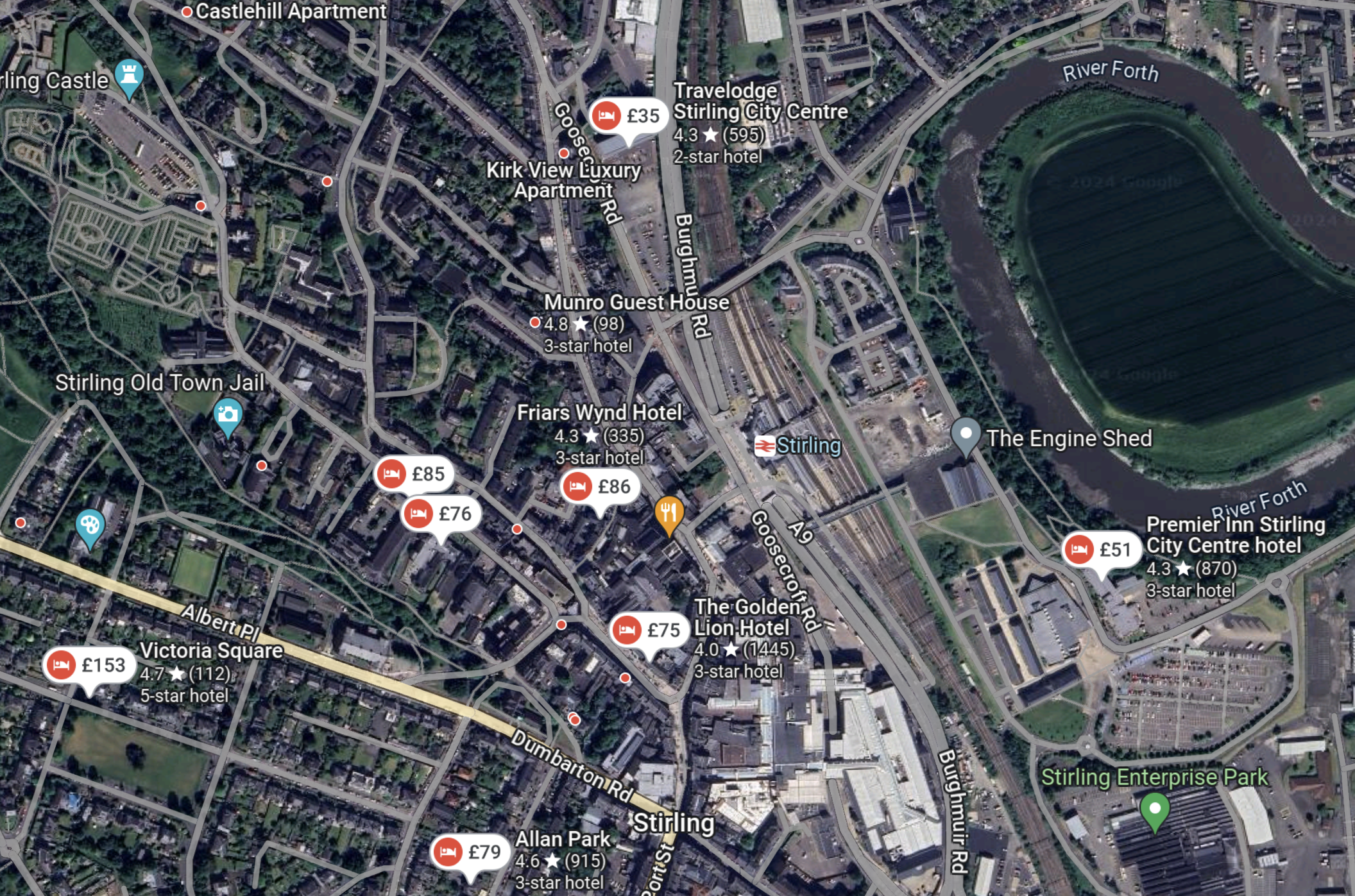
Stirling would appear to have got Central Scotland covered.
Could The Train Serve Gleneagles?
Gleneagles is about twenty minutes North of Stirling and is served by the Caledonian Sleeper from London.
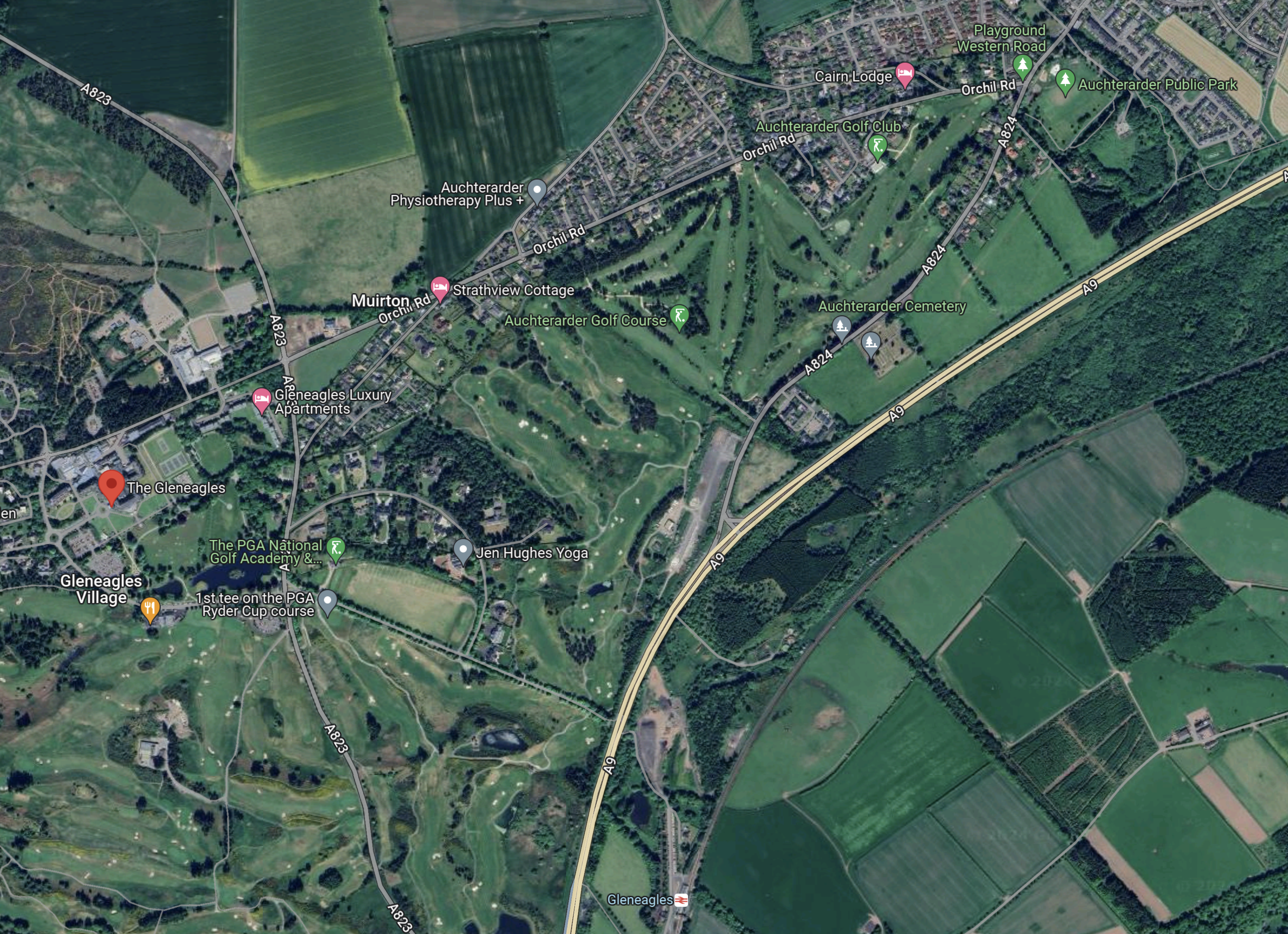
This Google Map shows the area around Gleneagles station.
Note.
- Gleneagles station is at the bottom of the map.
- The red arrow indicates the famous Gleneagles hotel.
- The pink dots are other hotels.
- Airbnb lists several very splendid properties in the varea.
Not everybody, who goes to the Gleneagles area will be exceedingly rich and I could see the Gleneagles area generating substantial business for Grand Union Trains. I suspect the best way to serve Gleneagles would be a zero-emission coach from Stirling.
Along The Motherwell And Cumbernauld Line
Between Motherwell and Stirling, a lot of the route used is on the Motherwell and Cumbernauld Line.
- The line is fully-electrified.
- It is only 28.9 miles between Motherwell and Stirling.
- \cumbernaukd and Motherwell takes 20 minutes.
I do wonder, if extra stops might be worthwhile.
Motherwell Has Good Connections To Edinburgh And Glasgow
As well as Stirling, Motherwell has good connections to both Edinburgh and Glasgow, so some passengers might find their most convenient route involves a change at Motherwell.
Nuneaton And Scotland Would Get A New Service
Nuneaton has been named by Avanti West Coast, as a place that needs more trains, as it connects with the service between Birmingham and Stansted Airport, via Coleshill Parkway, Leicester, Peterborough, March, Ely and Cambridge.
I suspect that, Nuneaton will become an interchange, between East Anglia and, the North West and West Scotland.
Milton Keynes And Scotland Should Get An Improved Service
Consider.
- It appears that all Avanti West Coast services between Milton Keynes and Scotland, go via Birmingham.
- I suspect that Grand Union’s route using the Trent Valley Line could be faster with similar trains.
- Creating a new route between Milton Keynes and Stirling could be a good move, as it gives one-change access to much of Central Scotland.
- Milton Keynes has good local connections to places like Northampton, Rugby, Tring and Watford Junction.
- Milton Keynes will be a stop on the new East-West Railway.
- From many stations, it will be quicker to go via Milton Keynes rather than Euston.
I suspect Milton Keynes could be a nice little earner.
Will Grand Union’s Trains Be Fitted With Digital Signalling?
Consider.
- At some point in the next ten years the West Coast Main Line will be fitted with digital signalling, to enable trains to run at 140 mph on selected parts of the route.
- Digital signalling will allow extra services between London Euston and Motherwell.
- Motherwell and London Euston is 388 miles.
I suspect, that Grand Union’s Trains will need to be fitted with digital signalling, so they can save time on services and possibly add in a few more.
It will add costs, although the faster speed will surely attract passengers.
Will Grand Union’s Trains Be Electric?
There are these train services going between England and Scotland.
- Avanti West Coast – London Euston to Edinburgh Waverley via Birmingham New Street – 7 tpd – Class 390 – Electric
- Avanti West Coast – London Euston to Glasgow Central via Birmingham New Street – 5 tpd – Class 390 – Electric
- Avanti West Coast – London Euston to Glasgow Central via Trent Valley – 1 tph – Class 390 – Electric
- CrossCountry – Plymouth to Edinburgh Waverley – 1 tph – Class 220/221 – Diesel – Uses diesel all the time
- LNER – London King’s Cross/Leeds to Aberdeen – 4 tpd – Class 800 – Bi-mode – Uses diesel North of Edinburgh
- LNER – London King’s Cross to Inverness – 1 tpd – Class 800 – Bi-mode – Uses diesel North of Stirling
- LNER – London King’s Cross to Edinburgh Waverley – 3p2h – Class 800 – Bi-mode or Class 801 – Electric
- LNER – London King’s Cross to Glasgow Central – 1 tpd – Class 801 – Electric
- LNER – London King’s Cross to Stirling – 1 tpd – Class 801 – Electric
- Lumo – London King’s Cross to Edinburgh – 5 tpd – Class 803 – Electric
- TransPennine Express – Newcastle to Edinburgh Waverley – 7 tpd – Class 802 – Bi-mode
- TransPennine Express – Liverpool Lime Street to Glasgow Central – 2 tpd – Class 397 – Electric
- TransPennine Express – Manchester Airport to Edinburgh Waverly – 1 tp2h – Class 397 – Electric
- TransPennine Express – Manchester Airport to Glasgow Central – 1 tp2h – Class 397 – Electric
Note.
- tpd is trains per day.
- tph is trains per hour.
- tp2h is trains per two hours.
- LNER services to Glasgow and Stirling are likely to be dropped.
- Some Lumo services are likely to be extended from Edinburgh to Glasgow.
- Many services South from Stirling to Edinburgh Waverley and Glasgow Queen Street are electric.
The current two tpd direct trains to Stirling are electric and if you change at Edinburgh Waverley or Glasgow, it is likely to be an all-electric service.
For marketing reasons, I would recommend, that Grand Union Trains ran electric trains between London Euston and Stirling, as they are competing against an all-electric service.
Although to meet service dates it might be necessary to run something like a diesel Class 222 train to get the service started.
What Trains Will Grand Union Use?
The Wikipedia entry for Grand Union Trains, says this for their London Euston and Stirling service.
In 2023 Grand Union revised its proposal changing its planned rolling stock to Class 22x units, at the same time the start date for this service was changed to June 2025.
I would suspect they will put in the order for new electric trains fairly sharpish.
The new trains could be.
- A variant of Hitachi’s Class 800 trains.
- A variant of CAF’s Class 397 trains.
Would they have an emergency battery un case of overhead line failure?
How Long Will A Service Take?
The service can be divided into two sections.
- London Euston and Motherwell – 388 miles.
- Motherwell and Stirling – 28.9 miles.
Note.
- The 08:30 train from Euston to Motherwell takes 4 hours and 17 minutes with six stops via Nuneaton.
- The Grand Union Trains service will also have six stops and go via Nuneaton.
I would expect with today’s signalling and electric trains, that Euston and Motherwell would take a maximum of 4 hours and 17 minutes.
- The twenty minute time to Cumbernauld could be added.
- The twenty-five minute time between Cumbernauld and Stirling could be added.
It looks the time would be just over five hours.
I doubt there would be much scope for increasing speed North of Motherwell, but could there be savings made to the South of Motherwell?
Consider.
- London Euston and Motherwell is 388 miles.
- Four hours and 17 minutes is 257 minutes.
- Motherwell is on the main London Euston and Glasgow Central route.
This is an average speed between London Euston and Motherwell of 90.6 mph.
By comparison.
- London King’s Cross and Edinburgh is 392.6 miles.
- Journeys can take four hours and 20 minutes or 260 minutes.
This is an average speed between London King’s Cross and Edinburgh of 90.6 mph.
In the next decade, there will be improvements on both the East and West Coast Main Lines.
- King’s Cross and Edinburgh is currently being digitally signalled.
- London Euston and Glasgow Central is likely to be an early priority for digital signalling after London King’s Cross and Edinburgh is completed.
- When High Speed Two opens to Birmingham and Lichfield, High Speed Two trains between London Euston and Glasgow Central will use the West Coast Main Line to the North of Lichfield.
- I wouldn’t be surprised to see some track realignment and modifications to improve speeds on the West Coast Main Line to the North of Lichfield.
I can build a table of times between London Euston and Motherwell against average speed.
- 90 mph – 4 hours 19 minutes
- 100 mph – 3 hours 53 minutes
- 110 mph – 3 hours 32 minutes
- 120 mph – 3 hours 14 minutes
- 125 mph – 3 hours 6 minutes
- 130 mph – 2 hours 59 minutes
Note.
- Adding 15 minutes gives a London Euston and Glasgow Central time.
- Adding 45 minutes gives a London Euston and Stirling time.
- Averaging 120 mph would give London Euston and Glasgow Central or Stirling times of under four hours.
It strikes me, that to improve Anglo-Scottish relations and to make rail a better alternative to flying, a priority for all West Coast services is to improve the West Coast Main Line and install digital signalling, so that a 120 mph average is possible between London Euston and Motherwell.
What Difference Will High Speed Two Make?
High Speed Two is claiming it will knock thirty minutes off times between London Euston and Glasgow Central, when it opens to Birmingham and Lichfield.
But Grand Union Trains are not expected to use the new line between London Euston and Lichfield, as High Speed Two will, as it will make calling at Milton Keynes and Nuneaton impossible, as they are bypassed by High Speed Two.
Conclusion
This train service is going to be good for Milton Keynes, Nuneaton and Stirling and all the towns in Central Scotland.
But they must make full use of the available electrification.
Lumo In Discussions To Operate Glasgow Services
The title of this post, is the same as that of this press release from FirstGroup.
These four paragraphs give more details.
FirstGroup, the leading private sector transport operator, today announces that its popular open access rail service Lumo is in discussions with Transport Scotland and Network Rail to extend some of its London-Edinburgh trains to and from Glasgow.
Having identified opportunities to extend a number of daily journeys to and from Glasgow in the timetables for 2025 and beyond, work will now continue with Transport Scotland and track infrastructure manager Network Rail to agree final route options and timings ahead of an application for access rights to the Office of Rail and Road (‘ORR’), the industry regulator.
If successful, the new services could be in operation from next summer.
Lumo’s proposed new offering will improve links for customers travelling between Newcastle and Glasgow, giving people a choice of services without needing to change trains. In addition, a significant number of users of Lumo’s current London-Edinburgh trains go on to travel through to Glasgow via other connections, and through this move, Lumo aims to offer a direct through service for these customers.
I have a few thoughts.
There Appears To Be A Need For An Affordable London And Glasgow Service
This is the last sentence of my extract from the press release.
In addition, a significant number of users of Lumo’s current London-Edinburgh trains go on to travel through to Glasgow via other connections, and through this move, Lumo aims to offer a direct through service for these customers.
This looks to be a service, that has been suggested by an analysis of passengers’ tickets.
Which Station Will Lumo Use In Glasgow?
Consider.
- The current LNER service between London King’s Cross and Glasgow, uses Glasgow Central station and it takes 66 minutes between Edinburgh and Glasgow Central stations.
- LNER’s service also calls at Haymarket and Motherwell.
- ScotRail services between Edinburgh and Glasgow Queen Street take about 49-50 minutes.
I suspect, that Lumo will take the faster route.
Newcastle And Glasgow Is A New Route
Currently, all passengers between Glasgow and Newcastle have to change at Edinburgh.
This will be the first direct train in my memory, except for LNER’s single daily service between London and Glasgow Central, which stops at Newcastle.
What About The Football?
Glasgow is very much about football.
Would it be possible to use Lumo to see a match starting at 15:00 on a Saturday afternoon, if you lived in London?
- The 05:48 train from King’s Cross on a Saturday arrives in Edinburgh at 10:07.
- Trains between Edinburgh and Glasgow take fifty minutes, so I feel it would be reasonable to be able to get to Glasgow by 10:57.
This time would be more than early enough to have a few swift halves and see the match if it started at 15:00.
But would it be possible to get back to London after the match?
- The last train leaves Edinburgh at 17:55 and arrives in King’s Cross at 22:26.
- Applying the fifty minute journey time between Edinburgh and Glasgow means it will leave at 17:05.
- It appears that from Ibrox and Celtic Park to Glasgow Central or Glasgow Queen Street station is about twenty minutes.
On the current timetable, it would appear to be possible, but tight.
One alternative would be to take the Caledonian Sleeper back to London. But it doesn’t appear to run on a Saturday night.
Coaches do run and an overnight coach costs around twenty pounds.
It looks like if Lumo ran a service about 18:00 on a Saturday to London, it wouldn’t run empty.
Will Lumo Need More Trains?
In the press release, FirstGroup plc Chief Executive Officer Graham Sutherland, is quoted as saying.
Once preferred route options and timings have been agreed, discussions will continue with Network Rail and the ORR to secure the required approvals. The journeys would be operated within the existing Lumo fleet of all-electric trains and it is anticipated that the additional services could begin in summer 2025.
That looks to me, that they will not be obtaining more trains before next summer.
In Ten-Car Hull Trains, I noted that some of Hull Trains services were now running as ten-car trains.
If the passenger demand is there for ten-car trains to Hull, which is almost exactly half the distance of Edinburgh, I would expect that in the future, Lumo will be running some services as ten-car trains.
In Extra Luggage Racks For Lumo, which is based on an article in the November 2023 Edition of Modern Railways, an alternative view on more trains is taken.
The Modern Railways article finishes with this paragraph.
Lumo celebrated its second birthday in late October and was also set to mark the carriage of its two-millionth passenger. It is understood Lumo is interested in augmenting its fleet, such has been the success of the service; while many operators favour bi-mode units, Lumo is proud of its all-electric credentials so straight EMUs are still preferred, although the possibilities of including batteries which could power the trains may be pursued (the ‘803s’ have on-board batteries, but only to provide power to on-board systems if the electricity supply fails).
I find this development very interesting.
As London King’s Cross and Edinburgh and Glasgow are all electric routes, in normal service batteries should not be needed, but sometimes trains have to use the diversion via Lincoln, which I have estimated is 86.5 miles.
As an electrical engineer, I’ve always believed that the emergency batteries in the Class 803 trains are very similar to the traction batteries that Hitachi are developing for the Class 802 trains.
A traction battery, that was capable of handling the diversion would stop Lumo having to cancel occasional services.
Conclusion
An extension to Glasgow looks like it could be a simple and profitable way to extend the current Lumo service.
But it might need some extra trains in the future.
A Lumo service to Glasgow, might be helped by a seven-day service on the Caledonian Sleeper, so passenger could go North on Lumo and South on the Sleeper to get a full day in Glasgow.
Northumberland Line ‘Phased Reopening’ By Summer
The title of this post, is the same as that as this article on the BBC.
These are the first three paragraphs.
The Northumberland Line will partially reopen this summer days after it was announced it would not be in service until the end of 2024.
Conservative county council leader Glen Sanderson said there had been “challenges” with the project, but when fully reopened the rail line would be a “game changer” for travellers.
The stations due to be open in the summer are Seaton Delaval, Ashington and Newsham.
In my lifetime, the Victoria, Jubilee and Elizabeth Lines in London, have opened on a phased manner.
So why shouldn’t the Northumberland Line?
In fact given the route, it could be opened with a shuttle between Ashington and Newcastle stations, to train drivers and test the concept.
- The intermediate stations could be added over a couple of years.
- I would add a station with lots of parking early.
- If the views live up to the pictures, a lot of passengers will have a day out for the views.
- I’m sure enthusiasts and locals, especially with their kids will be exploring this short railway in droves.
To me, this is definitely a line, that will suffer from London Overground Syndrome.
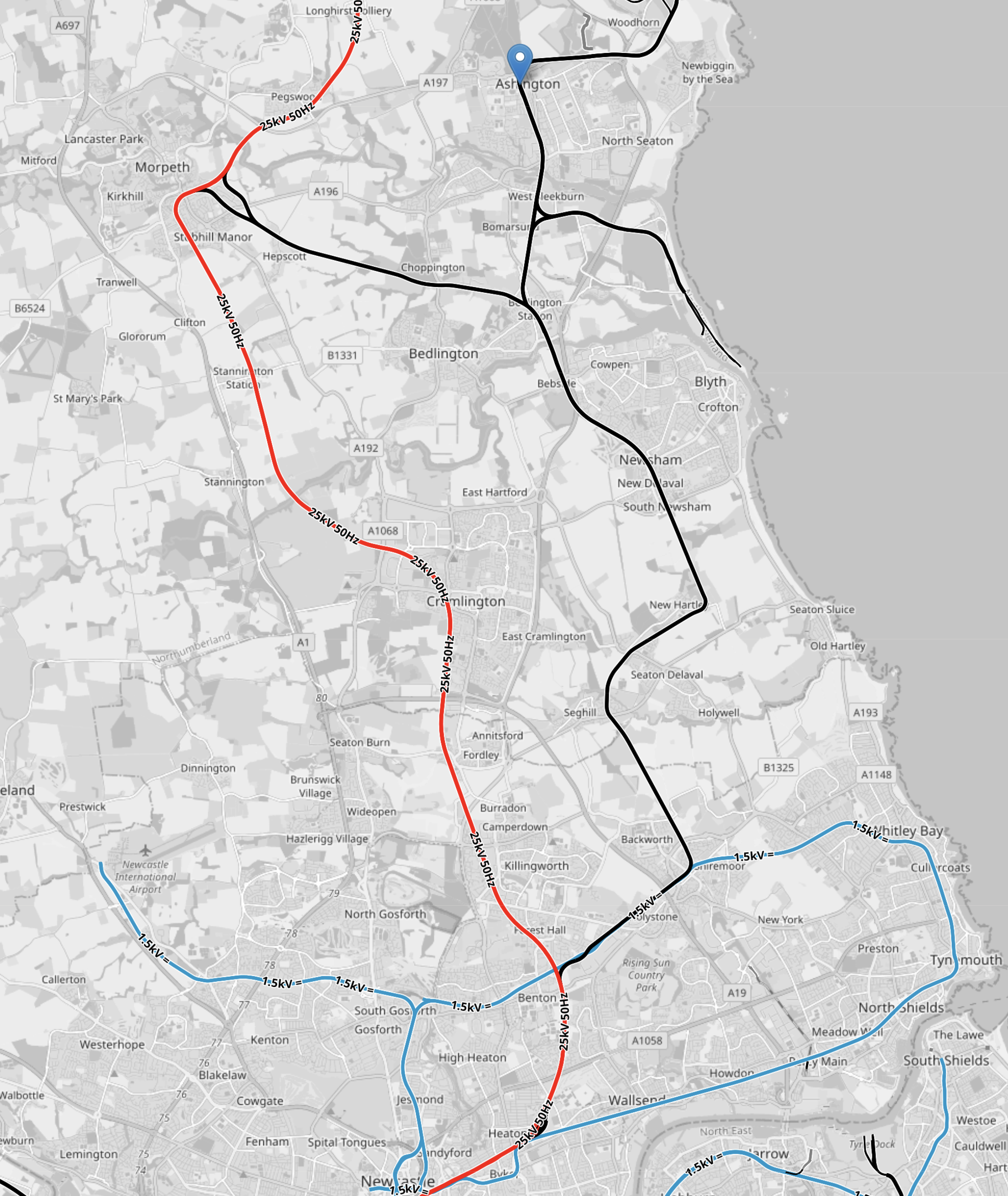
This OpenRailwayMap shows the railways to the North of Newcastle.
Note.
- The red track is the electrified East Coast Main Line.
- Ashington station is at the top of the map and is marked by a blue arrow.
- The blue track is the Tyne and Wear Metro.
- Newcastle station is where the Metro crosses the East Coast Main Line at the bottom of the map.
- The black trackrunning North-South to the East of the East Coast Main Line is the Northumberland Line.
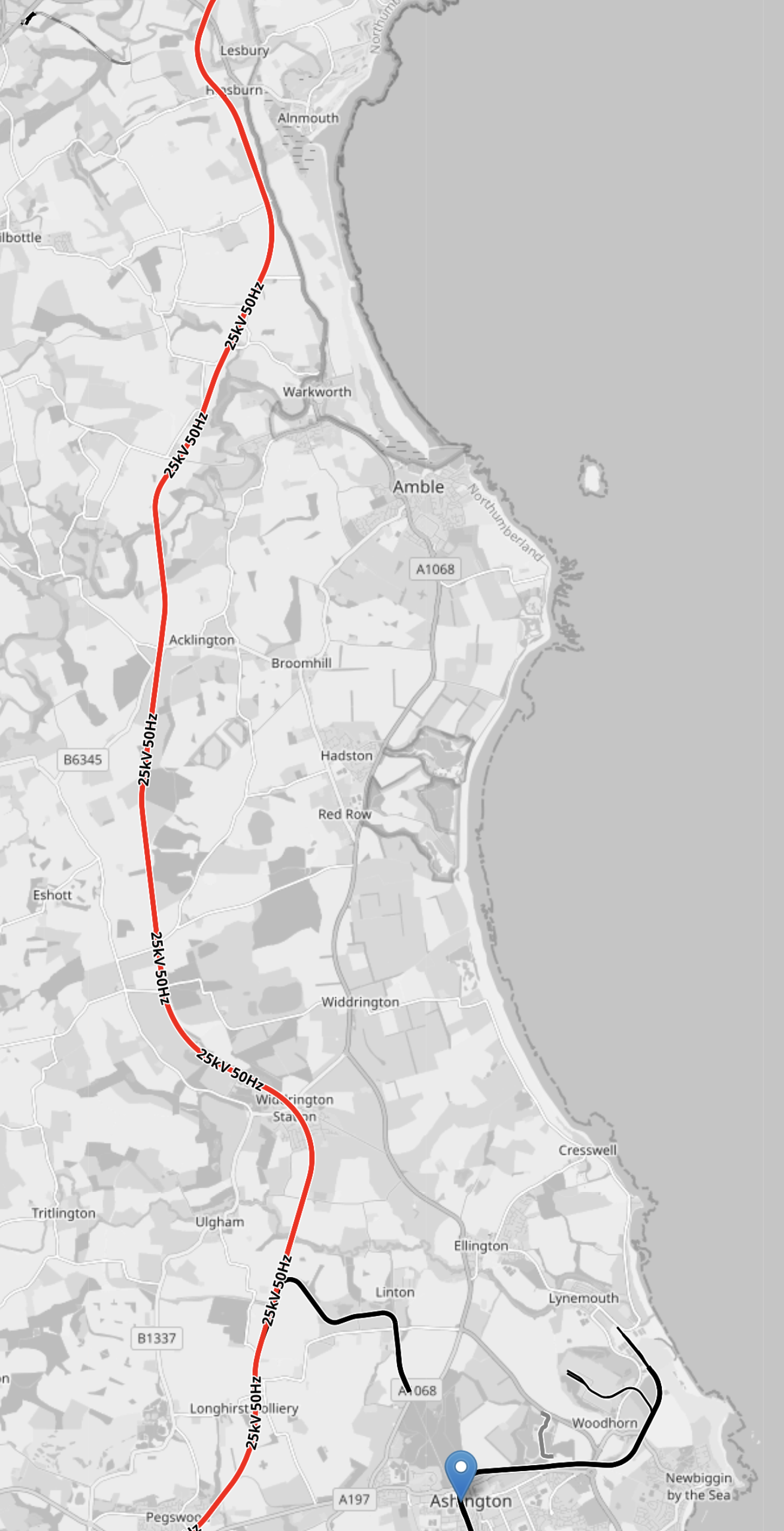
This OpenRailwayMap shows the railways to the North of Ashington.
Note.
- The red track is the electrifed East Coast Main Line.
- Ashington station is at the bottom of the map and is marked by a blue arrow.
- There are a few disused colliery lines to the North of Ashington.
I believe that these railways to the North of Newcastle could and should be developed.
The East Coast Main Line Is Congested
Consider.
- The East Coast Main Line has only two tracks.
- It is one of only two rail routes between England and Scotland.
- It carries local services as well as long distance express services.
- In recent years more services have been added by Lumo and TransPennine Express.
It is my belief that applying digital signalling between Newcastle and Edinburgh via Berwick, should be a high priority project to increase the capacity of the East Coast Main Line.
Local Services Can Be Extended
The Northumberland Line opens up possibilities for extension, where track already exists..
- From Ashington to Newbiggin-on-Sea and Lynemouth.
- From Bedlington to Morpeth and the East Coast Main Line.
- From Bedlington to North Blyth.
It would appear that it might be possible to run a new line North from Ashington to connect with the East Coast Main Line.
Distances Are Short
Consider.
- Ashington and Newcastle is 20.6 miles
- Newcastle and Morpeth is 16.6 miles
- Newcastle and Berwick is electrified.
- In The Data Sheet For Hitachi Battery Electric Trains, I stated that Hitachi’s battery-electric express trains have a range of 43.5 miles on one battery. A slower commuter train would certainly achieve this distance.
I have a feeling that a passenger-friendly network of battery-electric trains can be developed along and around the Northumberland Line and the East Coast Main Line.
New LNER Fleet To Have Joint Line Capability
The title of this post, is the same as that of an article in the January 2024 edition of Modern Railways.
This is the text of the article.
LNER’s new fleet of CAF tri-mode trains, for which an order was confirmed in November, has been specified with the capability to operate via the Joint Line via Spalding and Lincoln in case of closures on the East Coast Main Line between Peterborough and Doncaster.
CAF will supply 10×10-car trains with overhead electric, battery and diesel capability, financed by Porterbrook. The inclusion of diesel engines as part of the winning bid, rather than a straightforward battery-electric unit, has surprised some observers, but LNER’s specification was that the fleet should have sufficient self-powered capability to cover the length of the joint line, which is approximately 90 miles. This is currently to be considered to be beyond the scope of battery-power alone, although as the technology evolves diesel engines could be replaced by batteries. The configuration of diesel engines and batteries within the sets has yet to be decided.
LNER frequently uses the Joint Line as a diversionary route, both during planned engineering work and at times of disruption, but only its bi-mode Azumas are currently able to traverse it under their own power (electric sets have been hauled by a diesel locomotive, but this is now a very rare occurrence). The new CAF fleet will replace the InterCity 225 electric fleet, and the self-power capability will provide valuable resilience to LNER to divert via non-electrified routes.
While the ‘225s’ are currently confined to services between King’s Cross and Leeds/York, if the enhanced December 2024 timetable goes ahead as currently planned (see story above) they will operate north of York once again on some of the hourly services which will terminate at Newcastle. However, LNER is having to limit the use of the sets before the Class 91 locomotives and Mk 4 coaches come due for major overhauls: the decision to retain 12 locos and eight rakes of coaches was based on the intended timescale for replacing the fleet at the time, but confirming the order for the new CAF tri-modes has taken longer than anticipated, largely due to delays in receiving Government approval to place the order.
This article has got me thinking.
The InterCity225 Trains Need Replacing Urgently
The Modern Railways article states that the need to replace the InterCity 225s is getting urgent, as more than the Azumas will be needed for the December 2024 timetable and the InterCity 225s are getting to the end of their economic life.
As LNER have been doing reasonably well lately, a cock-up caused by lack of trains at Christmas 2024 would be the last thing they need.
Currently, LNER have enough Mark 4 coaches for eight trains, so ordering ten new CAF tri-mode trains will allow for a small amount of extra services.
The CAF tri-mode trains were only ordered in November 2023, so getting them delivered for December 2024 would be tight.
As I write this on the 31st December 2023, trains from King’s Cross to Leeds included.
- 5 x InterCity225
- 5 x 10-car Azuma
- 7 x 9-car Azuma
- 2 x 5-car Azuma
So there were InterCity 225s running on that day.
A Few Distances Around Lincolnshire
I believe that because of offshore wind, interconnectors and other renewable energy developments, that Lincolnshire will become an energy powerhouse, supporting the East Midlands and also exporting electricity and hydrogen to Europe through pipelines and interconnectors.
Because of this and other developments, I believe that rail passenger traffic to and around the county will increase significantly.
These are a few selected distances.
- Doncaster and Cleethorpes – 52.1 miles
- Grantham and Skegness – 58.2 miles
- Lincoln and Doncaster – 36.8 miles
- Lincoln and Newark – 16.8 miles
- Lincoln and Peterborough – 54.8 miles
- Lincoln and Cleethorpes – 47.2 miles
Note.
- This means that the length of the Joint Line, which between Werrington Junction and where it rejoins the East Coast Main Line to the South of Doncaster is no more than ninety miles. This ninety mile distance was assumed in the Modern Railways article.
- Peterborough and Cleethorpes via Lincoln is ninety-two miles.
- I estimate that around four miles could be easily electrified at Werrington, which would reduce these two distances by four miles.
- Newark and Cleethorpes via Lincoln is sixty-four miles.
It looks like if a battery-electric train had a range of 92 miles and there was charging at Cleethorpes and Skegness, Lincolnshire could have a first class zero-carbon rail service.
CAF Tri-Mode Trains And The Joint Line
This is the first sentence in the Modern Railways article.
LNER’s new fleet of CAF tri-mode trains, for which an order was confirmed in November, has been specified with the capability to operate via the Joint Line via Spalding and Lincoln in case of closures on the East Coast Main Line between Peterborough and Doncaster.
Note.
- The Modern Railways article states the Joint Line is approximately 90 miles.
- As I stated earlier with some strategically placed electrification at Werrington and South of Doncaster, this distance without electrification can probably be shortened by a few miles.
It looks like any service run by a CAF tri-mode train will be able to use the Joint Line.
Hitachi Class 801 Trains And The Joint Line
Unless the Joint Line is electrified or the all-electric Class 801 trains are fitted with batteries of a sufficient size the Class 801 trains will not be able to use the Joint Line.
Hitachi Class 800/802 Trains And The Joint Line
If currently, the Class 800/802 trains can handle the Joint Line on their diesel engines, they can continue to do this.
Hitachi Class 803 Trains And The Joint Line
Unless the Joint Line is electrified or Class 803 trains are fitted with batteries of a sufficient size the Class 803 trains will not be able to use the Joint Line.
Hitachi Class 80x Trains With Batteries And The Joint Line
Note that Lumo’s Class 803 trains are already fitted with an emergency battery for hotel power. So Hitachi must have information on how their batteries perform in service.
This press release from Hitachi, which is entitled Hitachi And Eversholt Rail To Develop GWR Intercity Battery Hybrid Train – Offering Fuel Savings Of More Than 20% announced the start of Hitachi’s battery-electric program in December 2020.
This is a paragraph.
The projected improvements in battery technology – particularly in power output and charge – create opportunities to replace incrementally more diesel engines on long distance trains. With the ambition to create a fully electric-battery intercity train – that can travel the full journey between London and Penzance – by the late 2040s, in line with the UK’s 2050 net zero emissions target.
Hitachi have now published this page on their web site, which is entitled Intercity Battery Trains.
The page has this sub-heading.
Accelerate the decarbonisation of intercity rail with batteries
These are the first two paragraphs.
A quick and easy application of battery technology is to install it on existing or future Hitachi intercity trains. Hitachi Rail’s modular design means this can be done without the need to re-engineer or rebuild the train and return them to service as quickly as possible for passengers.
Replacing one diesel engine with just one battery reduces emissions by more than 20% and offers cost savings of 20-30%. Our intercity battery powered trains can cover 70km on non-electrified routes, operating at intercity speeds at the same or increased performance.
It appears to be a masterful application of an old electrical or software engineer’s trick.
In the 1960s, I spent time in two summer holidays building transistorised control systems in a rolling mills to replace obsolete control systems that used thermionic valves and relays.
Are Hitachi just replacing a diesel power pack with a battery pack, that has the same power and control functionality?
In The Data Sheet For Hitachi Battery Electric Trains, I looked at Hitachi’s published data sheet, which has these bullet points.
- 750kW peak power
- Weight neutral
- At least 20% lower CO2 emissions
- 70km on non-electrified routes
- 20% reduction in whole life maintenance costs
- Up to 30% fuel cost savings
- Zero emissions in and out of stations
- Charge on the move
- 10 year life span
Note.
- 750 kW peak power, is around the power of the diesel-engine, that will be replaced.
- I wouldn’t be surprised that powerwise, the battery pack looks like a diesel engine.
- Weight neutral means that acceleration and performance will be unchanged. I suspect this means that current timetables can be achieved.
- Batteries are easier to maintain than diesels.
- It is stated that a train can be fully-decarbonised.
I have a feeling these trains are no ordinary battery-electric trains.
This paragraph, that I quoted earlier gives details on battery range.
Replacing one diesel engine with just one battery reduces emissions by more than 20% and offers cost savings of 20-30%. Our intercity battery powered trains can cover 70km on non-electrified routes, operating at intercity speeds at the same or increased performance.
If one battery can give seventy kilometres or 43.5 miles, what distances would be possible in the various Hitachi Class 80x trains on the UK rail network?
- Five-car Class 800 – Three diesel engines
- Nine-car Class 800 – Five diesel engines
- Five-car Class 801 – One diesel engine
- Nine-car Class 801 – One diesel engine
- Five-car Class 802 – Three diesel engines
- Nine-car Class 802 – Five diesel engines
- Five-car Class 803 – One battery
- Five-car Class 805 – Three diesel engines
- Seven-car Class 807 – No diesel engine or battery
- Five-car Class 810 – Four diesel engines
Note.
- The Class 801 trains have one diesel engine for emergency use.
- The Class 803 trains have one battery for emergency use.
- The Class 807 trains appear to be built for top speed and acceleration and have no unnecessary weight.
In The Data Sheet For Hitachi Battery Electric Trains, I came to the conclusion, that if all diesel engine packs are be replaced by batteries, the train has a range of around 117-121 miles.
If my calculation is correct, I believe that Hitachi battery-electric trains will be capable of using the Joint Line, if all diesel engines are replaced by battery packs.
Surely, if a number of Hitachi trains could use the Joint Line in addition to the ten CAF tri-mode trains, this would minimise disruption to passengers and increase revenue on days, when the East Coast Main Line was closed for engineering works or an incident.
Will The Hitachi Class 80x Trains With Batteries Or The CAF Tri-Mode Trains Have The Longer Range Without Electrification?
Consider.
- Cleethorpes could be the problem, as it is 64 miles from Newark and 92 miles from Peterborough and a round trip without charging at Cleethorpes for a battery-electric might be a trip to far.
- But a tri-mode train like that from CAF with an on-board diesel, should have the range.
- More range for a tri-mode train, just needs bigger fuel tanks.
- I also suspect Cleethorpes has the equipment to refuel a diesel train, as all services to the station are diesel powered.
The article also says this.
The inclusion of diesel engines as part of the winning bid, rather than a straightforward battery-electric unit, has surprised some observers, but LNER’s specification was that the fleet should have sufficient self-powered capability to cover the length of the joint line, which is approximately 90 miles. This is currently to be considered to be beyond the scope of battery-power alone, although as the technology evolves diesel engines could be replaced by batteries.
Could it be that some of LNER’s routes like Aberdeen, Cleethorpes and Inverness have longer running without electrification, than Hitachi’s trains with batteries can achieve. Perhaps, this is why they lost the order?
Pairs Of Hitachi Class 80x Trains With Batteries And The Joint Line
I suspect if one five-car train with batteries can handle the Joint Line, then a pair could also handle it, if the train’s control system allowed it.
Will The Joint Line Be Slower Than The East Coast Main Line?
Consider.
- The Joint Line is not the slowest line in the country and large sections of the route, have a top speed of 60 mph or higher.
- It is surprisingly straight.
- There are some slower sections, through Lincoln and Sleaford.
- The average speed between Peterborough and Lincoln of local trains is about 50 mph.
- The average speed between Doncaster and Lincoln of local trains is about 48 mph.
I suspect that the expresses, should be able to achieve 60 mph between Peterborough and Doncaster, with a small amount of track improvement.
This would mean the following times between Doncaster and Peterborough.
- Via the Joint Line – 90 minutes
- Via East Coast Main Line – 50 minutes
It looks like forty minutes will be added to journey times.
Would There Be Any Point In Running Some Services Via The Joint Line?
Consider.
- Lincoln has one train per two hours (tp2h) to and from King’s Cross.
- A King’s Cross and Doncaster service could use the Joint Line and call at Peterborough, Spalding, Sleaford, Lincoln Central, Gainsborough Lea Road and Doncaster.
- If it terminated at Harrogate, Leeds or York, it could ease congestion on the East Coast Main Line between Peterborough and Doncaster.
- Lincoln is making a name for itself as a University town.
- Lincolnshire is getting more important with respect to renewable energy and innovative food production.
- The frequency would be at least one tp2h.
- If needed, Lincoln Central could be electrified to charge passing trains.
- The service could also go via Cambridge to provide East Anglia and its technological powerhouse with better connections to and from the North.
It would all depend on where extra rail services are needed.
Could Cleethorpes And Grimsby Town Have A Service From King’s Cross?
In Azuma Test Train Takes To The Tracks As LNER Trials Possible New Route, I discuss how in June 2023, LNER ran a test train to Cleethorpes and Grimsby Town.
- With all the energy development going on in North-East Lincolnshire, I suspect that a service between King’s Cross and Cleethorpes via Lincoln, Market Rasen, Barnetby and Grimsby Town could be viable.
- I suspect that the energy developments could find recruitment difficult and say a one tp2h service to Peterborough might ease the problem.
- Whether it ran to Lincoln via Newark and the East Coast Main Line or via Spalding and Sleaford would be down to predicted traffic.
- The distance via Newark would be 64 miles or 128 miles return.
- The distance via Peterborough would be 92 miles or 184 miles return.
- These distances would probably mean that a battery-electric train would need charging at Cleethorpes.
So would it be better if the Cleethorpes trains were to be run by CAF tri-mode trains.
Could Cleethorpes Services Be Paired With The York Service?
The current King’s Cross and Lincoln service uses the same path as a York service.
- Both services leave King’s Cross at six minutes past the hour.
- York trains leave at odd hours.
- Lincoln trains leave at even hours.
If the York service used the Joint Line and the Lincoln service were to be extended to Cleethorpes, Lincoln would receive an hourly service.
- One service could go via Newark and the other via Peterborough, Spalding and Sleaford.
- A path on the East Coast Main Line would be saved.
- The service to York could go via Leeds.
- The York service could be extended to Middlesbrough, Scarborough or Sunderland.
- I suspect that timings to Cleethorpes and York could be a similar six-hour round trip.
- CAF tri-mode trains would be needed for the Cleethorpes services.
- Either train type could work the York services.
There are various possibilities to improve the train service been London and Lincolnshire.
What Will Be The Maximum Range Of The CAF Tri-Mode Trains?
When determining this, LNER would probably have taken into account all current and every possible service, that they might run in the future, which was not fully electrified.
These would include.
- London King’s Cross and Aberdeen – 91.4 miles
- London King’s Cross and Bradford Interchange via Shaftholme junction – 47.8 miles
- London King’s Cross and Cleethorpes via Newark and Lincoln – 64 miles
- London King’s Cross and Cleethorpes via Peterborough, Spalding and Lincoln – 92 miles
- London King’s Cross and Harrogate via Leeds – 18.3 miles
- London King’s Cross and Inverness– 151.1 miles
- London King’s Cross and Hull via Temple Hirst junction – 36.1 miles
- London King’s Cross and Lincoln – 16.8 miles
- London King’s Cross and Middlesbrough via Northallerton – 20.3 miles
- London King’s Cross and Scarborough via York – 42.1 miles
- London King’s Cross and Sunderland via Northallerton – 47.4 miles
They would also have taken in possible diversion routes.
- London King’s Cross and Carlisle via Leeds – 86.8 miles
- London and Edinburgh – 400 miles
- London King’s Cross and Newcastle via Northallerton and Durham Coast Line – 59.6 miles
Note.
- The distance is the length without electrification.
- London King’s Cross and Carlisle is a possible diversion route, if between Leeds and Edinburgh is blocked.
- A London King’s Cross and Edinburgh capability might be needed, if there was something like a serious weather problem, bringing down the overhead wires.
- London King’s Cross and Newcastle via Northallerton and Durham Coast Line is a possible diversion route, if between Northallerton and Newcastle is blocked.
LNER’s longest route without electrification is to Inverness and it is 151.1 miles between Stirling and Inverness.
London King’s Cross and Cleethorpes via Peterborough, Spalding and Lincoln could be longer, if it were to be run as a return trip of 184 miles.
LNER will probably have specified the range they need on the longest route they run or might run in the future, as there is no point in buying a fleet of trains and then finding that they can’t handle all your routes. They would also include all possible emergency routes, just as they’ve already included the Joint Line.
Out of curiosity I asked Professor Google how far a diesel train could run on a full tank of diesel and got this answer.
According to the traction manual for 158/159 stock each coach has a 400 gallon tank or 1818 Ltr. £2500 at the filling station.
The manual also says that that is enough fuel to travel Waterloo to Exeter and back twice over. Which is 688 miles exactly. Guess there is spare in there for shunting and idling at terminus. Still an mpg of 1.7.
It looks to me, that if a humble Class 158/159 train has a range of nearly 700 miles, then LNER can probably have virtually any distance they want for their new trains.
These journeys will probably all be possible.
- Between London King’s Cross and Edinburgh – 400 miles
- A round trip between Stirling and Inverness – 302.2 miles
- A round trip between Peterborough and Cleethorpes – 184 miles
Professor Google also gives the diesel range of a Class 800 train as 650 miles.
Conclusion
It looks to me, that LNER, Lumo and FirstGroup have a serious plan to decarbonise their network.
All services, that can be decarbonised by replacing diesel generator units, with electrical battery packs.
LNER’s longer routes will use the new CAF trains.
These will be fully decarbonised at a later date.
The Data Sheet For Hitachi Battery Electric Trains
Was I just slow to spot this data sheet or has it only just been released?
You can download a copy from this page on the Hitachi web site.
In a section on the page, which is entitled Intercity Battery Trains, this is said.
A quick and easy application of battery technology is to install it on existing or future Hitachi intercity trains. Adding just one battery reduces emissions by more than 20% and offers cost savings of 20-30%.
Our intercity battery powered trains can cover 70km on non-electrified routes, operating at intercity speeds at the same or increased performance. Hitachi Rail’s modular design means this can be done without the need to re-engineer or rebuild the train and return them to service as quickly as possible for passengers.
These are my initial thoughts.
Plug-and-Play
It looks like the train is plug-and-play.
A diesel engine will be swapped for a battery-pack and the train’s computer controls the power sources accordingly.
Hitachi’s Battery Philosophy Explained
This is said on the data sheet.
Battery technology has the potential to play a significant role in the future of sustainable rail mobility, setting
the rail industry on the path to full intercity decarbonisation by 2050.
Installing batteries on intercity trains can complement electrification and provide a low emission alternative
to domestic air travel.Our retrofit solution for intercity trains offers phased replacement of diesel engines at the time that they would
have been due for their regular heavy maintenance overhaul, replacing each engine in turn until trains are fully battery electric. The solution delivers fuel cost savings and lowers CO2 emissions by at least 20% for every engine replaced, and a 20% reduction in whole life maintenance costs – well within the battery’s life span of 8-10 years.
Performance On Battery Power
The data sheet gives these bullet points.
- 750kW peak power
- Weight neutral.
- At least 20% lower CO2 emissions
- 70km on non-electrified routes
- 20% reduction in whole life maintenance costs
- Up to 30% fuel cost savings
- Zero emissions in and out of stations
- Charge on the move
- 10 year life span
Note.
- 750 kW peak power, is around the power of the diesel-engine, that will be replaced.
- I wouldn’t be surprised that powerwise, the battery pack looks like a diesel engine.
- Weight neutral means that acceleration, performance and handling will be unchanged.
- Batteries are easier to maintain than diesels.
- It is stated that a train can be fully-decarbonised.
I have a feeling these trains are no ordinary battery-electric trains.
Seventy Kilometre Range On Battery
Seventy kilometres is 43.5 miles.
This may not seem much, but the data sheet says this.
Our battery hybrid trains can cover 70km on non-electrified routes, operating at intercity speeds at the same
or increased performance. By identifying the routes with short non-electrified sections of 70km or less, we could
see the replacement of existing diesel trains with fully battery-operated trains on those routes within a year.
And, using battery power to avoid electrifying the hardest and most expensive areas, such as tunnels and bridges,
enables flexibility on electrification, minimising passenger disruption during upgrades.
Note.
- It looks like the trains can operate at 125 mph on battery power, where the track allows it. But then the rolling restistance of steel wheel on steel rail, is much lower, than that of rubber tyres on tarmac.
- Hitachi seem to have developed a philosophy on how the trains will be used.
- Hitachi’s pantographs, go up and down with all the alacrity of a whore’s drawers. They will be ideal for a short length of electrification.
I think these LNER routes could be immediately decarbonised.
- LNER – London and Harrogate , where only 18.3 miles is unelectrified. Trains may not need charging, as a full battery could handle both ways.
- LNER – London and Hull, where 36.1 miles is unelectrified. A short length of electrification to charge trains would be needed at Hull.
- LNER – London and Lincoln, where only 16.7 miles is unelectrified. Trains would not need charging, as a full battery could handle both ways.
- LNER – London and Middlesbrough, where only 20.3 miles is unelectrified. Trains would not need charging, as a full battery could handle both ways.
Note.
- It looks like some services could start fairly soon, once batteries are available.
- Hull Trains could use the 70 km batteries and charging at Hull, as it passed through. This would decarbonise Hull Trains passenger operations.
- Services to Aberdeen, Cleethorpes and Inverness would be out of range of the initial Hitachi trains.
Could the last point, partially explain the purchase of the CAF tri-mode trains, which I wrote about in First Tri-Mode Long Distance Trains For The East Coast Main Line?
We shall see what we shall see.
But having a choice of battery-electric or tri-mode trains will enable route development and decarbonisation.
What Is The Size Of The Battery Pack?
In How Much Power Is Needed To Run A Train At 125 Or 100 mph?, I estimated that to maintain 125 mph, a Class 801 train has a usage figure of 3.42 kWh per vehicle mile.
If a five-car Class 800 can run 70 km or 43.5 miles at 125 mph, as indicated by Hitachi, then the battery size can be calculated.
3.42 * 5 * 43.5 = 743.85 kWh
As the battery pack can supply 750 kW according to the data sheet, this looks like this will run the train for an hour.
Is that coincidence or a design criteria?
What Battery Capacity Would Be Needed For A Hundred Miles?
For a five-car train, this is the energy needed for a hundred miles.
3.42 *5 * 100 = 1710 kWh or three batteries.
For a nine-car train, this is the energy needed for a hundred miles.
3.42 *9 * 100 = 3078 kWh or five batteries.
It looks like all diesel engines will be replaced by batteries.
Will Class 801 Trains Swap Their Single Diesel Engine For a Battery Power Pack?
Consider.
- Class 801 trains have a single diesel engine for emergency power.
- Lumo’s Class 803 trains, are all-electric with a battery-pack for emergency hotel power only.
- Hitachi must have full details on the performance of Lumo’s trains.
- The East Coast Main Line is notorious for the wires to come tumbling down.
- The diesel engine and the battery pack appear to weigh the same.
- Batteries cost less to maintain than diesels.
I can’t see why the single diesel engine can’t be replaced by a standard battery pack, without loosing any functionality.
What Would Be The Range Of A Fully Battery-Electric Train?
This is a paragraph from a data sheet.
Our retrofit solution for intercity trains offers phased replacement of diesel engines at the time that they would
have been due for their regular heavy maintenance overhaul, replacing each engine in turn until trains are fully battery electric. The solution delivers fuel cost savings and lowers CO2 emissions by at least 20% for every engine replaced, and a 20% reduction in whole life maintenance costs – well within the battery’s life span of 8-10 years.
Note.
- It looks like Hitachi are expecting operators to replace engines in turn.
- Replacing engines with batteries saves the operators money.
As a five-car Class 800 train has three diesel engines and a nine-car train has five engines, does this mean that the range of fully-batteried Class 800 train is 70 km or 210 km?
- A fully-batteried Class 800 train will weigh the same as the current diesel.
- One battery can drive the train for 70 km at 125 mph according to Hitachi.
- There are no branches of electrified lines that are 125 mph lines without electrification.
- I would assume that the train can use regenerative braking to recharge the batteries.
- 210 kilometres is 130 miles.
I don’t know much about the electrical systems of Hitachi’s trains, but it is likely that there will be an electrical bus to distribute power from one end of the train to the other.
So a five-car Class 800 train with three fully-charged battery packs could have over 2 MWh of electricity on board, that could be used for traction.
- Applying the usage figure of 3.42 kWh per vehicle mile, gives a range for the five-car train of at least 117 miles.
- The equivalent figure for a nine-car train will be at least 121 miles.
These distances would open up routes like these on the East Coast Main Line.
- LNER – London King’s Cross and Aberdeen – 91.4 miles – Charge before return.
- LNER/Hull Trains – London King’s Cross and Beverley via Temple Hirst junction – 44.3 miles – No Charging needed before return.
- Grand Central – London King’s Cross and Bradford Interchange via Shaftholme junction – 47.8 miles – No Charging needed before return.
- LNER – London King’s Cross and Cleethorpes via Newark and Lincoln – 63.9 miles – Charge before return.
- LNER – London King’s Cross and Harrogate via Leeds – 18.3 miles – No Charging needed before return.
- LNER – London King’s Cross and Inverness– 146.2 miles – Charge before return.
- LNER/Hull Trains – London King’s Cross and Hull via Temple Hirst junction – 36.1 miles – No Charging needed before return.
- LNER – London King’s Cross and Middlesbrough via Northallerton – 20.3 miles – No Charging needed before return.
- LNER – London King’s Cross and Scarborough via York – 42.1 miles – No Charging needed before return.
- LNER/Grand Central – London King’s Cross and Sunderland via Northallerton – 47.4 miles – No Charging needed before return.
Note.
- The miles are the longest continuous distance without electrification.
- Only Aberdeen, Cleethorpes and Inverness would need to charge trains before return.
- Inverness may be too far. But is it in range of LNER’s new CAF tri-mode trains?
The battery range would also allow LNER to use the Lincoln diversion on the Joint Line.
Why Didn’t LNER Buy More Azumas?
This puzzles me and I suspect it puzzles other people too.
Surely, an all Azuma fleet will be easier to manage.
But in this article on Modern Railways, which is entitled LNER Orders CAF Tri-mode Sets, this is said.
Modern Railways understands the new fleet will be maintained at Neville Hill depot in Leeds and, like the ‘225’ sets, will be used predominantly on services between London and Yorkshire, although unlike the ‘225s’ the tri-modes, with their self-power capability, will be able to serve destinations away from the electrified network such as Harrogate and Hull.
Note.
- Hull would possibly need work to provide some form of charging for battery-electric Azumas, but Harrogate is close enough to be served by a one-battery Azuma.
- The CAF Tri-mode sets would certainly handle routes like Cleethorpes, Middlesbrough and Sunderland, but would they really need a ten-car train.
- Ten-car trains would also be busy on the Leeds route.
- The UK is going to need more 125 mph trains for Cross Country, Grand Central, Grand Union, TransPennine Express and possibly other train companies.
- Has Hitachi got the capacity to build the trains in the UK?
So has the Government given the order to CAF to create a level of competition?
Conclusions
These are my conclusions about Hitachi’s battery packs for Class 80x trains, which were written in November 2023.
- The battery pack has a capacity of 750 kWh.
- A five-car train needs three battery-packs to travel 100 miles.
- A nine-car train needs five battery-packs to travel 100 miles.
- The maximum range of a five-car train with three batteries is 117 miles.
- The maximum range of a nine-car train with five batteries is 121 miles.
As battery technology gets better, these distances will increase.
Hitachi have seen my figures.
They also told me, that they were in line with their figures, but new and better batteries would increase range.
In July 2025, I wrote Batteries Ordered For Grand Central Inter-City Trains, which mentions the following.
- Grand Central’s trains will be electric-diesel-battery hybrid inter-city trainsets.
- The trains will have lithium ion phosphate batteries.
- The trains will be delivered in 2028.
- The batteries will be smaller and more powerful, than current batteries.
This is also said about safety, hazards and cybersecurity.
The Safety Integrity Level 2 and IEC 61508 compliant battery management system will detect and mitigate hazards and meet the IEC 62243 cybersecurity standard.
These batteries would appear to give Hitachi and Grand Central Trains everything they want and need.
It looks like the new battery chemistry, will give Hitachi extra range.
May The Maths Be With You!
It was a bit of a surprise, when in the November 2023 Edition of Modern Railways, in an article, which was entitled Extra Luggage Racks For Lumo, I read this closing paragraph.
Lumo celebrated its second birthday in late October and was also set to mark the carriage of its two-millionth passenger. It is understood Lumo is interested in augmenting its fleet, such has been the success of the service; while many operators favour bi-mode units, Lumo is proud of its all-electric credentials so straight EMUs are still preferred, although the possibilities of including batteries which could power the trains may be pursued (the ‘803s’ have on-board batteries, but only to provide power to on-board systems if the electricity supply fails).
I find this development very interesting.
Surely the obvious way to increase capacity would be to acquire some extra identical trains and run the busiest services as ten-car trains. I talked about Hull Trains running ten-car trains in Ten-Car Hull Trains. Both companies have five trains, so I suspect that this number would allow for occasional ten-car trains.
If not, then add a few identical trains to the fleet, so capacity can be matched to the demand.
- Some services would be ten-car instead of five-car.
- Platforms at Edinburgh, King’s Cross and Newcastle already handle nine and ten-car trains, so infrastructure costs would be minimal.
- No extra paths would be needed, as a ten-car train can run in a path, that normally has five-car trains, as Hull Trains have shown.
A simple spreadsheet should probably predict, when and how many extra trains need to be added to the fleet.
Lumo And Traction Batteries
But why does the Modern Railways’s article talk about traction batteries?
In the two years since Lumo started their service, there have been days, when the East Coast Main Line has been closed for engineering works, bad weather or an incident. I wrote about an incident in Azumas Everywhere!.
Some of these engineering works have been able to be by-passed by using diversions. But not all of these diversion routes are fully-electrified, so are not available for Lumo.
There would appear to be three viable diversions for the East Coast Main Line.
- Werrington Junction and Doncaster via Lincoln – Not Electrified – 85.4 miles
- Doncaster and York via Leeds – Being Electrified – 55.5 miles
- Northallerton and Newcastle – Not Electrified – 56.8 miles
If all or some of Lumo’s five-car trains had a battery-range of a hundred miles, they would be able to divert around some blockades.
Note.
- A traction battery could also provide power to on-board systems if the electricity supply fails.
- A traction battery would allow the train to skip past some catenary problems.
- I would be interested to know how much diversions, bad weather and incidents have cost Lumo in lost sales and refunds.
As an electrical engineer, I believe, that the emergency-only and the traction batteries could be the same design, but with different software and capacity.
The extra cost of the larger capacity traction battery, might deliver a better service and also pay for itself in the long term.
Extending Lumo’s Route
Lumo will want to maximise revenue and profits, so would it be possible to extend the route North of Edinburgh?
Consider.
- Edinburgh and Aberdeen is 131.4 miles
- Ladybank is a station to the North of the Forth Bridge, which is under 40 miles from Edinburgh.
- The line between Edinburgh and Ladybank is being electrified.
- Ladybank is just 91.4 miles South of Aberdeen.
At some point in the next few years, I believe that one of Lumo’s trains fitted with a hundred mile traction battery could reach Aberdeen on electric power.
The train would need to be charged at Aberdeen before returning South.
How would Aberdonians like that?
Unfortunately, Inverness is 146.1 miles from the nearest electrification at Dunblane, so it is probably too far for a hundred mile traction battery.
It does appear to me that if Lumo’s trains were fitted with a hundred mile traction battery, this would enable them to take some non-electrified diversions and provide a service to Aberdeen.
How Useful Would A Hundred Mile Range Battery-Electric Train Be To Other Operators?
I take each operator in turn.
Hull Trains
Consider.
- It appears that Hull Trains change between diesel and electric power at Temple Hirst junction, which is between Doncaster and Selby, on their route between King’s Cross and Hull/Beverley.
- The distance between Temple Hirst junction and Beverley is 44.3 miles.
- It would appear that an out-and-return journey could be possible on a hundred mile traction battery.
- The hundred mile traction battery would also allow Hull Trains to use the Lincoln diversion, either when necessary or by design.
To ensure enough range, a short length of overhead electrification could be erected at Hull station to combat range anxiety.
The Modern Railways article also says this.
The co-operation between sister East Coast Main Line open access operators Lumo and Hull Trains continues, with one recent move being the use of Hull Trains ‘802’ on Lumo services to cover for a shortage of the dedicated ‘803s’ while one was out of action for repairs following a fatality. although the two types are similar, there are notable differences, most obviously that the Hull Trains units are bi-modes while the Lumo sets are straight EMUs, and a training conversion course is required for Lumo drivers on the ‘802s’. There are also challenges from a passenger-facing perspective – the Hull trains units have around 20 % fewer seats and a First Class area.
If Hull Trains used traction batteries rather than diesel engines could the trains be identical to Lumo’s trains from the driver’s perspective?
This would surely appeal to First Group, who are the owner of both Hull Trains and Lumo.
TransPennine Express
These are TransPennine Express services.
- Liverpool Lime Street and Newcastle – Fully Electrified
- Liverpool Lime Street and Hull – Part Electrified – Hull and Micklefield – 42 miles
- Manchester Airport and Saltburn – Part Electrified – Saltburn and Northallerton – 33.6 miles
- Manchester Piccadilly and Newcastle – Fully Electrified
- Manchester Piccadilly and Scarborough – Part Electrified – York and Scarborough – 42.1 miles
- York and Scarborough – Not Electrified – 42.1 miles
- Manchester Piccadilly and Huddersfield – Fully Electrified
- Huddersfield and Leeds – Fully Electrified
- Liverpool Lime Street and Cleethorpes – Part Electrified – Hazel Grove and Cleethorpes – 104.6 miles
Note.
- I am assuming that the TransPennine Upgrade has been completed and Manchester and Leeds is electrified.
- Liverpool Lime Street and Cleethorpes will need some form of charging at Cleethorpes and a slightly larger battery.
All of these TransPennine Rxpress routes would be possible with a battery-electric train with a hundred mile traction battery.
LNER
These are distances from the electrification of the East Coast Main Line.
- Aberdeen via Ladybank – 91.4 miles – Charge before return
- Bradford Forster Square – Electrified
- Carlisle via Skipton – 86.8 miles – Charge before return
- Cleethorpes via Newark and Lincoln – 63.9 miles – Charge before return
- Harrogate via Leeds – 18.3 miles
- Huddersfield via Leeds – 17.2 miles
- Hull via Temple Hirst junction – 36.1 miles
- Lincoln via Newark – 16.7 miles
- Middlesbrough via Northallerton – 22.2 miles
- Scarborough via York – 42.1 miles
- Skipton – Electrified
- Sunderland via Northallerton – 47.4 miles
Note.
- The first place after the ‘via’ is where the electrification ends.
- Carlisle could be a possibility during High Speed Two upgrading of the West Coast Main Line or for an enthusiasts’ special or tourist train.
- Cleethorpes is a possible new service for LNER. I wrote about this in LNER To Serve Cleethorpes.
- Scarborough must be a possible new service for LNER.
- ‘Charge before return’ means the train must be charged before return. Carlisle is electrified, but Cleethorpes is not.
- The only new infrastructure would be the charging at Cleethorpes.
All of these LNER routes would be possible with a battery-electric train with a hundred mile traction battery.
The hundred mile traction battery would also allow LNER to use the Lincoln diversion.
Grand Central
These are distances from the electrification of the East Coast Main Line for Grand Central’s services.
- Bradford Interchange via Shaftholme junction – 47.8 miles
- Cleethorpes via Doncaster – 52.1 miles – Charge before return
- Sunderland via Northallerton – 47.4 miles
Note.
- The first place after the ‘via’ is where the electrification ends.
- Cleethorpes is a possible new service for Grand Central.
- ‘Charge before return’ means the train must be charged before return.
All of these routes would be possible with a battery-electric train with a hundred mile traction battery.
The hundred mile traction battery would also allow Grand Central to use the Lincoln diversion.
Avanti West Coast
These are distances from the electrification of the West Coast Main Line for Avanti West Coast’s services.
- Chester via Crewe – 21.1 miles
- Gobowen via Wolverhampton – 47.7 miles
- Holyhead via Crewe – 105.5 miles – Charge before return
- Shrewsbury via Wolverhampton – 29.7 miles
- Wrexham via Crewe – 33.3 miles
Note.
- The first place after the ‘via’ is where the electrification ends.
- Gobowen is a possible new service for Avanti West Coast.
- ‘Charge before return’ means the train must be charged before return.
All of these routes would be possible with a battery-electric train with a hundred mile traction battery.
Great Western Railway
These are distances from the electrification of the Great Western Main Line for Great Western Railway’s services.
- Bristol Temple Meads via Chippenham – 24.4 miles
- Carmarthen via Cardiff Central – 77.4 miles – Charge before return
- Cheltenham Spa via Swindon – 43.2 miles
- Exeter St. Davids via Newbury – 120.4 miles – Charge before return
- Great Malvern via Didcot East junction – 76.1 miles – Charge before return
- Hereford via Didcot East junction – 96.9 miles – Charge before return
- Oxford via Didcot Parkway – 10.3 miles
- Paignton via Newbury – 148.7 miles – Charge before return
- Pembroke Dock via Cardiff Central – 121.6 miles – Charge before return
- Penzance via Newbury – 172.6 miles – Charge before return
- Plymouth via Newbury – 120.4 miles – Charge before return
- Swansea via Cardiff Central – 53 miles – Charge before return
- Weston-super-Mare via Chippenham – 43.8 miles
- Worcester Foregate Street via Didcot East junction – 68.2 miles – Charge before return
- Worcester Shrub Hill via Didcot East junction – 67.6 miles – Charge before return
Note.
- The first place after the ‘via’ is where the electrification ends.
- ‘Charge before return’ means the train must be charged before return.
- Partial electrification through Hereford, Great Malvern, Worcester Foregate Street and Worcester Shrub Hill, could possibly be used to charge services from Hereford and Worcester.
- Partial electrification through Penzance, Plymouth and Exeter St. Davids, could possibly be used to charge services from the South West.
- Partial electrification West of Swansea, could possibly be used to charge services from West Wales.
All routes, except for Hereford and Worcester, the South-West and West Wales, would be possible with a battery-electric train with a hundred mile traction battery.
I’ll now look at the three groups of services in more detail.
Services To Hereford And Worcester
These are distances from the electrification of the Great Western Main Line for Great Western Railway’s Hereford and Worcester services.
- Great Malvern via Didcot East junction – 76.1 miles
- Hereford via Didcot East junction – 96.9 miles
- Worcester Foregate Street via Didcot East junction – 68.2 miles
- Worcester Shrub Hill via Didcot East junction – 67.6 miles
Note.
- All services join the Great Western Main Line at Didcot East junction.
- Some services will be probably need to have, their batteries charged at the Hereford and Worcester end.
At the present time, the electrification finishes at Didcot East junction, but if it were to be extended to Charlbury station, these would be the distances without electrification.
- Great Malvern via Charlbury – 52.3 miles
- Hereford via Charlbury – 73.1 miles
- Worcester Foregate Street via Charlbury – 44.4 miles
- Worcester Shrub Hill via Charlbury – 43.8 miles
Note.
- Some of the track between Oxford and Charlbury is only single track, which may give advantages, when it is electrified.
- It might be possible with a hundred mile traction battery for all Worcester services to charge their batteries between Charlbury and London Paddington and not need a charge at Worcester to return.
- A larger traction battery or extending the electrification to perhaps Morton-in-Marsh could see Great Malvern in range of battery-electric trains from London Paddington without a charge.
- Hereford would probably be too far to get away without charging at Hereford.
This OpenRailwayMap shows the layout of Hereford station.
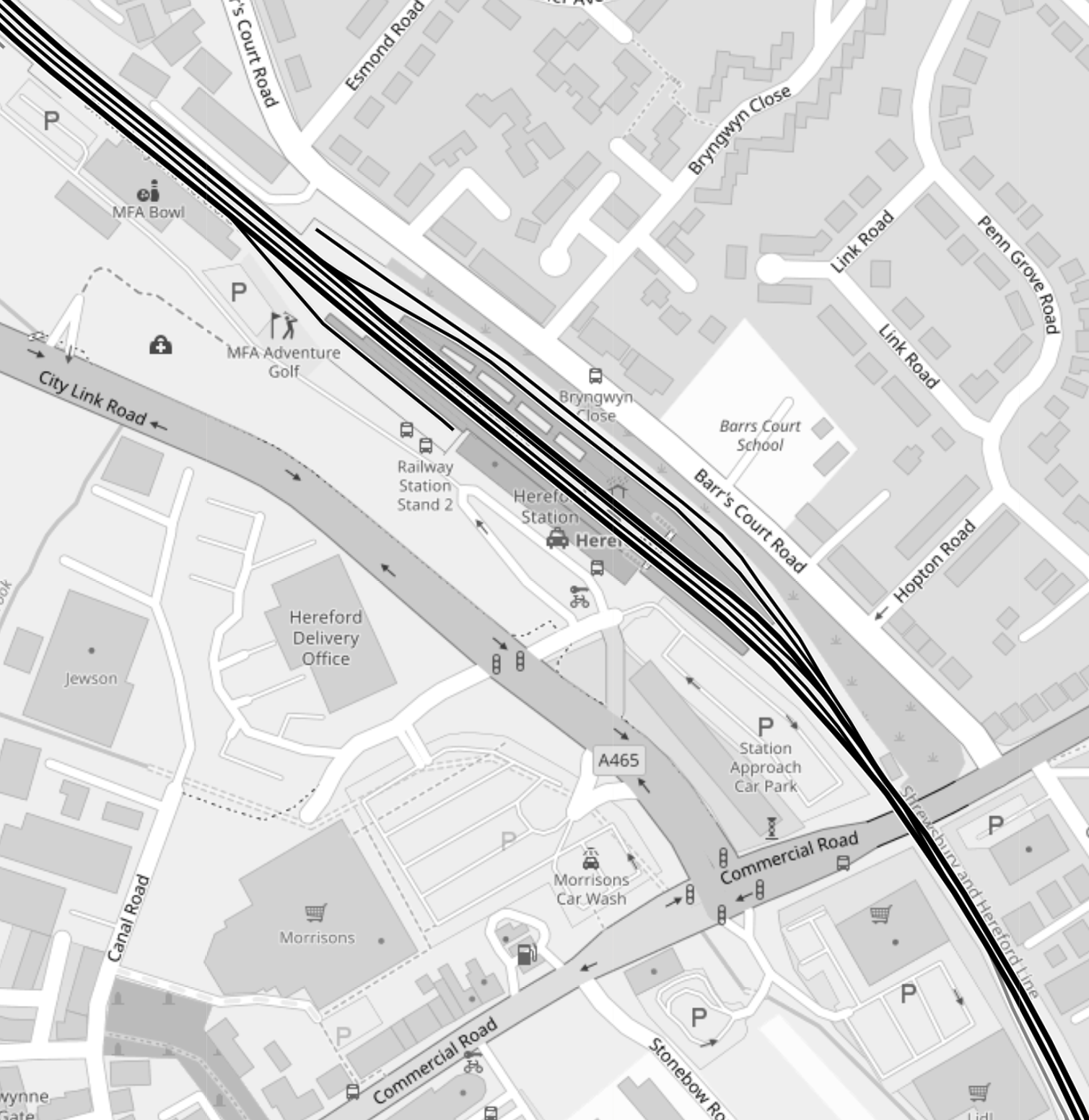
I’m certain that a platform can be found, where there is space for a charger, which could also be used for other trains serving the station.
Services To The South West
In the August 2023 Edition of Modern Railways, there is an article, which is entitled GWR Seeks Opportunities To Grow.
This is the sub-heading.
Managing Director Mark Hopwood tells Philip Sherratt there is plenty of potential to increase rail’s economic contribution.
This is two paragraphs.
The desire to provide electrification to support aggregates traffic from the Mendip quarries could also benefit GWR , says Mr. Hopwood. ‘Having an electric loco would massively help with pathing heavy freight trains through the Thames Valley. If you could electrify from Newbury to East Somerset Junction, a big chunk of the Berks and Hants route would be wired.
Then you can ask how much further you could get on battery power on an IET without running out of juice.’
Newbury to East Somerset Junction would be 53.5 miles of electrification, so I can build this table of services to the South-West
- Exeter St. Davids via Newbury – 120.4 miles – 66.9 miles
- Paignton via Newbury – 148.7 miles – 95.2 miles
- Penzance via Newbury – 251.9 miles – 198.5 miles
- Plymouth via Newbury – 172.6 miles – 119 miles
Note.
- The distance between Penzance and Plymouth is 79.5 miles.
- The first figure in the table is the distance to Newbury.
- The second figure in the table is the distance to East Somerset junction.
A possible way of running these four services to London on battery power is emerging.
- Exeter St. Davids via Newbury – Charge before return – Run on battery for 66.9 miles to East Somerset junction.
- Paignton via Newbury – Charge before return – Run on battery for 95.2 miles to East Somerset junction.
- Penzance via Newbury- Charge before return – Run on battery for 79.5 miles to Plymouth – Charge at Plymouth – Run on battery for 119 miles to East Somerset junction.
- Plymouth via Newbury – Charge before return – Run on battery for 119 miles to East Somerset junction.
Once at East Somerset junction, it’s electrification all the way to Paddington.
This is the corresponding way to run services from London.
- Exeter St. Davids via Newbury – Run on electrification to East Somerset junction, charging the battery on the way – Run on battery for 66.9 miles to Exeter St. Davids.
- Paignton via Newbury – Run on electrification to East Somerset junction, charging the battery on the way – Run on battery for 95.2 miles to Paignton.
- Penzance via Newbury – Run on electrification to East Somerset junction, charging the battery on the way – Run on battery for 119 miles to Plymouth – Charge at Plymouth – Run on battery for 79.5 miles to Penzance.
- Plymouth via Newbury – Run on electrification to East Somerset junction, charging the battery on the way – Run on battery for 119 miles to Plymouth.
More electrification or a larger than a hundred mile traction battery would be needed, as Plymouth and East Somerset junction is 119 miles.
But if a Stadler Akku can do 139 miles on a charge, why shouldn’t a Hitachi battery-electric train?
Services To West Wales
It seems that the current timetable is already setup for battery-electric trains to run to and beyond Swansea.
- Carmarthen and Swansea is almost exactly 32 miles.
- Pembroke Dock and Swansea is 73.4 miles.
- Swansea and Cardiff Central is 45.7 miles.
Note
- All these sections could be run by a battery-electric train, with a fully-charged hundred mile traction battery.
- All trains going to or from Carmarthen or Pembroke Dock reverse at Swansea, where a generous time of more than eleven minutes is allowed for the manoeuvre.
- During the reverse at Swansea, there is sufficient time to charge the batteries, if overhead wires were present.
Battery-electric services could serve Wales Wales with overhead electrification at Carmarthen, Pembroke Dock and Swansea.
Conclusion
We will go a long way, if we embrace battery-electric trains.
Most routes can be handled with a train with a traction battery range of 100 miles.
Exceptions are.
- Hazel Grove and Cleethorpes – 104.6 miles
- Plymouth and East Somerset junction – 119 miles
But if a Stadler Akku can do 139 miles on a charge, why shouldn’t a Hitachi battery-electric train?
Extra Luggage Racks For Lumo
The title of this post, is the same as a small article in the November 2023 Edition of Modern Railways.
Thiese are the first two paragraphs.
Lumo is to remove eight seats from each of its five Class 803 EMUs to make way for additional luggage racks.
Two seats will be removed from four of the five vehicles in each unit to make space for the luggage racks. The move has required a variation of Lumo’s track access agreement, with the Office of Road and Rail, which as originally approved specified that each train must have 400 seats.
The article also states that Lumo has stopped carrying bikes and the bike areas are now used for luggage.
Batteries For Lumo?
The article finishes with this paragraph.
Lumo celebrated its second birthday in late October and was also set to mark the carriage of its two-millionth passenger. It is understood Lumo is interested in augmenting its fleet, such has been the success of the service; while many operators favour bi-mode units, Lumo is proud of its all-electric credentials so straight EMUs are still preferred, although the possibilities of including batteries which could power the trains may be pursued (the ‘803s’ have on-board batteries, but only to provide power to on-board systems if the electricity supply fails).
I find this development very interesting.
As an electrical engineer, I’ve always believed that the emergency batteries in the Class 803 trains are very similar to the traction batteries that Hitachi are developing for the Class 802 trains.
- One design of battery must surely save time and costs in design and testing.
- The difference between the two batteries might be only software and the total capacity of the lithium-ion cells.
- In service testing under real operating conditions can be carried out in Lumo’s Class 803 trains.
- Traction and emergency batteries would be interchangeable, so some operators, who didn’t always need traction but wanted emergency on-board power could be setup as required for the route.
If traction batteries gave the train a range of perhaps 15-20 miles, this might well be enough range, for the train to get through or to the next station, if there was to be an incident like catenary failure or a derailed freight train blocking the line. Obviously, Lumo will have records of all external failures that have affected them.
Consider.
- I have calculated that Peterborough and Doncaster via Lincoln is 88.5 miles.
- I also believe it is likely that in the future, there may be some electrification at Lincoln to charge battery-electric trains.
- Lincolnshire is flat.
Would it be possible for Lumo trains to use a single traction battery to take the Great Northern and Great Eastern Joint Line to get round engineering works on the East Coast Main Line?
What Length Of Trains Could Lumo Run?
In Ten-Car Hull Trains, I talked about Hull Trains running ten-car trains to Hull.
I would expect that all Lumo’s stops are possible with ten-car trains.
As the trains are all Plug-and-Play, Lumo could either run pairs of trains or perhaps lengthen all trains to any size between six and nine cars.
Could Lumo Piggy-Back An Aberdeen Service On An Edinburgh Train?
The line between Edinburgh and Ladybank is being electrified and Ladybank is just 91.4 miles South of Aberdeen.
- A pair of Class 803 trains could leave King’s Cross running as a ten-car formation.
- The leading train would be a Class 803 train equipped with a traction battery.
- The trailing train would be a Class 803 train equipped with the normal emergency battery.
- Aberdeen passengers would get in the leading train.
- The train would run as normal to Edinburgh.
- At Edinburgh the two trains would split with the leading train going on to Aberdeen and the trailing train getting ready to return to London.
The train going to Aberdeen would need sufficient battery range to cover the 91.4 miles to Aberdeen, where it would recharge to make the journey back to Ladybank, Edinburgh and the South.
What About Inverness?
Dunblane is the nearest electrified station to Inverness, but it is 146.2 miles away over a route with lots of steep climbs.
I doubt that a battery-electric train could handle that route.
Conclusions
Luggage seems to be getting more of a problem on trains and buses.
It does appear that a very innovative battery philosophy from Hitachi is emerging.
Lumo Carbon Data Shows Its Trains Are 22 Times Greener Than Flying
The title of this post, is the same as that of this article on Rail Advent.
These paragraphs detail how the figures were obtained.
To mark the second anniversary of its branding as ‘Lumo’, the operator commissioned consultancy firm Arup to provide an independent report about all direct emissions from its operations; emissions from the grid-supplied energy it uses; and other emissions in its supply chain.
Scope 1: Direct emissions from operations that are owned and controlled by Lumo;
Scope 2: Emissions from the use of grid-supplied electricity, heat, steam and/or cooling by Lumo;
Scope 3: All other emissions that occur in the value chain of Lumo.In the last two years, Lumo has carried over two million passengers. The figures reveal that, per passenger, emissions from a London-to-Edinburgh journey are twenty-two times the level for flying (149 kgCO2e) than for using Lumo (6.8kgCO2e).
I have a few thoughts.
Carbon Savings With LNER
LNER’s Class 801 trains are similar to Lumo’s Class 803 trains.
The main difference, is that the LNER have emergency diesel engines, whereas Lumo have emergency batteries to run the trains systems, if the catenary goes down.
So LNER on balance will generate a bit more carbon than Lumo.
But the difference will be marginal.
Carbon Savings With Avanti West Coast
Avanti’s Class 390 trains to Scotland, are all-electric, so there will be a carbon-saving.
Probably about the same as with LNER.
Avanti West Coast’s New Class 807 Trains
If the Class 807 trains were cars, they would be Lotuses.
- They are electric only and have no heavy diesel engines or traction batteries.
- They don’t even have emergency batteries for when the catenary fails.
- They have a redesigned nose. Is it more aerodynamic?
- The heavy tilt mechanism is history.
- As with all the other Hitachi high speed trains, they are capable of 125 mph, or 140 mph if the signalling permits.
These trains will undoubtedly have faster acceleration and deceleration and could probably knock minutes off the timings at all the stops.
Tucked away beside the Grand Union Sets Out Stirling Ambitions article in the December 2022 Edition of Modern Railways is a report on Avanti West Coast’s application for a second service between Euston and Liverpool.
This is said.
Avanti West Coast has applied for access rights for its second hourly Euston to Liverpool service, starting from December 2023, although a phased introduction of the new service is likely. This would make use of Avanti’s new fleet of 10×7-car Class 807 Hitachi EMUs, which are expected to enter service from Autumn 2023. The ‘807s’ would be deployed on the current hourly Liverpool service, on which a call at Liverpool South Parkway would be added. (provision is made for this in the December 2022 timetable.).
Pendolinos would then operate the second service each hour, calling at Lichfield Trent Valley and Tamworth.
A linespeed project is in progress to raise the permissible speed for non-tilting trains on the West Coast Main Line, and Avanti’s new Hitachi trains will take advantage of this.
I can’t wait to go to Liverpool in one of these trains.
Their carbon emissions should be in line with Lumo.
Avanti West Coast’s New Class 805 Trains
These are equivalent to the Class 802 trains, but with probably Class 807 train interiors and looks.
I wonder how long these trains will keep their diesel engines before battery power is the most affordable option.
Once they go battery-electric, their carbon emissions should be in line with Lumo.
Conclusion
I can’t see any other mantra than.
Electric good, diesel bad
Especially, if like most computers, it’s just plug and play.
Rolls-Royce Completes Next Step On Its Journey To Decarbonising Business Aviation
The title of this post, is the same as that of this press release from Rolls-Royce.
This is the sub-heading.
Rolls-Royce today announces the successful completion of a series of tests with 100% Sustainable Aviation Fuel (SAF) on its latest generation of business aviation engines, the Pearl 15 and the Pearl 10X. The Pearl 15, the first member of the Pearl engine family, powers Bombardier’s Global 5500 and 6500 aircraft, while the Pearl 10X will power Dassault’s ultra-long-range flagship aircraft, the Falcon 10X.
These are the websites for the three aircraft, with number of passengers, typical cruise speed and range.
- Bombardier Global 5500 – 16 pax – Mach 0.85 – 5900 nm
- Bombardier Global 6500 – 17 pax – Mach 0.85 – 6600 nm
- Dassault Falcon 10X – 19 pax – Mach 0.925 – 7500 nm
This screenshot from the Dassault Falcon 10X web site shows the range from London.

Note that Buenos Aires, the Falkland Islands, Seattle, Seoul and Tokyo are all within range.
I have a few thoughts and observations.
Jet A-1 And 100% SAF
This paragraph from the press release describes how Rolls-Royce are testing the compatibility of Jet A-1 and 100% SAF.
As well as proving compatibility with 100% SAF another target of the test campaign was to run a back-to-back engine test with both Jet A-1 and SAF on the same Pearl 10X engine. The aim was to confirm further improvements in the environmental footprint when switching to SAF. The results from this first back-to-back engine emission test under standard certification conditions provides important correlations for the evaluation of future SAF within our environmental strategy.
Compatibility and back-to-back running is surely very important, as it could be many years before all airports can supply 100 % SAF for visiting jet aircraft.
The Fuels Used In The Tests And The Benefits
These two paragraphs from the press release describes the fuels used and the benefits..
The HEFA (Hydro-processed Esters and Fatty Acids) SAF was produced from waste-based sustainable feedstocks such as used cooking oils and waste fat. This fuel has the potential to significantly reduce net CO2 lifecycle emissions by about 80% compared to conventional jet fuel.
The back-to-back tests conducted with conventional fossil-based fuel and subsequently SAF also confirmed a cleaner combustion of the sustainable fuel, with significantly lower levels of non-volatile particulate matter (nvPM). In combination with the low NOx combustor technology of the Pearl 10X and its additive manufactured combustor tiles a reduction of all emissions was achieved.
Note.
- An eighty percent reduction in lifecycle emissions is not to be sneezed at.
- Cleaner combustion and low NOx emissions are very much bonuses.
- Additive manufacture is better known as 3D-printing and I’m not surprised that Rolls-Royce have embraced the technology.
As an engineer and retired light aircraft pilot, I suspect the tests have met Rolls-Royce’s objectives.
Moving To 100 % SAF
This is the final paragraph of the press release.
The tests demonstrated once again that Rolls-Royce’s current engine portfolio for large civil and business jet applications can operate with 100% SAF, laying the groundwork for moving this type of fuel towards certification. At present, SAF is only certified for blends of up to 50% with conventional jet fuel. By the end of 2023 Rolls-Royce will have proven that all its in-production Trent and business aviation engines are compatible with 100% SAF.
It must be a good selling point for aircraft equipped with Rolls-Royce engines, that the buyer knows that the aircraft can run on 100% SAF.
100 % SAF As An Airline Marketing Tool
It will be interesting to see how airlines use 100% SAF to sell tickets.
As an example, I can see routes like London and Scotland becoming very competitive.
- Avanti West Coast, LNER and Lumo already run all-electric trains to Edinburgh and Glasgow.
- The technology exists to decarbonise trains to Aberdeen and Inverness..
- Other open access operators could well move in to a lucrative market.
- The only way, that the airlines will be able to compete on emissions, would be to move to 100 % SAF.
There must be hundreds of routes like London and Scotland around the world.
100 % SAF And Business Jets
In A Class 319 Train, But Not As We Know It!, I told this tale.
I am reminded of a tale, that I heard from a former GEC manager.
He was involved in selling one of GEC’s Air Traffic Control radars to a Middle Eastern country.
The only working installation of the radar was at Prestwick in Scotland, so he arranged that the dignitaries and the sales team would be flown to Prestwick in GEC’s HS 125 business jet.
As they disembarked at Prestwick and walked to the terminal, the pilot called the GEC Manager over.
The pilot told him “The Scottish Highlands at this time of the year, are one of the most beautiful places in the world! Would you and your guests like a low-level tour on the way back? I can arrange it, if you say so!”
Despite knowing GEC’s draconian attitude to cost control he said yes.
The sale was clinched!
I also remember an article in Flight International about how JCB sold diggers.
- Dealers in a country like Greece would put together a party of prospective customers.
- The customers would then be flown to East Midlands Airport in JCB’s business jet, which is close to the JCB factory at Rocester.
- After a sales demonstration and a tour of the factory they would be flown home.
I once met a lady who had been one of JCB’s cabin staff and she told me it was a very successful sales technique.
I suspect that a business jet running on 100 % SAF would be an even better sales aid.
There are also increasing protests from the greens about business jets, which are seen as producing pollution and are only the toys of the rich and powerful.
Surely, if they were running on 100 % SAF, this would make business jets more acceptable.
100 % SAF And Niche Airlines
In the web site for the Falcon 10X, there is a section called Mission Flexibility, where this is said.
As large as it is, the Falcon 10X can still access typical airports serving business aviation as well as others with challenging approaches. The Falcon 10X will be London City-capable so that it can fly you straight into the heart of global finance. When you’re ready for rest and relaxation, the 10X can whisk you to out-of-the-way corners of the world.
British Airways used to run a service between London City Airport and New York.
- The route used 32-seat Airbus A-318 airliners.
- The flight stopped at Shannon for refuelling.
- It was business class only.
I suspect someone will think about running a similar London City Airport and New York service using a Falcon 10X.
- It has nineteen seats.
- It could do it in one hop.
- It could run on 100 % SAF.
- British Airways must have all the passenger data from the discontinued service.
- A Falcon 10X flies higher than a Boeing 767, Boeing 787 or an Airbus A350.
I have a feeling that flight time would be comparable or better to a flight between Heathrow and New York.
Conclusion
Rolls-Royce would appear to have the right strategy.
If I was going to New York in business class, I’d use it.
Derby Alstom Train Factory Jobs Fear As Orders Dry Up
The title of this post, is the same as that of this article on the BBC.
This is the sub-heading.
Derby City Council is seeking talks with train builder Alstom over reports it could be about to lay off workers.
These two paragraphs introduce the story.
The firm’s Litchurch Lane site is the only UK train factory able to design, build, engineer and test trains for domestic and export markets.
About 2,000 people work at the factory but the firm says its current order book only runs until early 2024.
This could be another serious problem for High Speed Two.
Could LNER Use High Speed Two Classic-Compatible Trains?
In LNER Seeks 10 More Bi-Modes, I discuss how LNER are needing ten more bi-mode trains to expand their services.
Consider.
- One of LNER’s predecessors used to run Eurostar trains between Kings Cross and Leeds
- A High Speed Two Classic-Compatible trains are 200 metres long, as against the 233.7 metres of a nine-car Class 801 train.
- High Speed Two Classic-Compatible trains will run on the East Coast Main Line, when High Speed Two fully opens.
- London to Doncaster, Edinburgh, Leeds, Newcastle and York are all fully electrified routes.
So if all these fully-electric routes, were to be run using High Speed Two Classic-Compatible trains, this would release a number of Class 800 and Class 801 trains, which could be converted to bi-modes or battery-electric variants.
London and Edinburgh In Three-And-A-Half Hours
This is a paragraph from the Wikipedia entry for the InterCity 225 train.
The InterCity 225 was designed to achieve a peak service speed of 140 mph (225 km/h); during a test run in 1989 on Stoke Bank between Peterborough and Grantham, an InterCity 225 was recorded at a speed of 162 mph (260.7 km/h). Its high speed capabilities were again demonstrated via a 3hr 29mins non-stop run between London and Edinburgh on 26 September 1991. British regulations have since required in-cab signalling on any train running at speeds above 125 mph (201 km/h) preventing such speeds from being legally attained in regular service. Thus, except on High Speed 1, which is equipped with cab signalling, British signalling does not allow any train, including the InterCity 225, to exceed 125 mph (201 km/h) in regular service, due to the impracticality of correctly observing lineside signals at high speed.
If in-cab digital signalling were to be installed between London and Edinburgh, I believe that the three-and-a-half hour timing can be regularly achieved by a High Speed Two Classic-Compatible train.
I also believe that at least one train per hour (tph) between London and Edinburgh could achieve the three-and-a-half hour timing.
High Speed Two are promising a 3:48 time between London and Edinburgh.
It could be a Lumo-squasher!
A one tph service would need eight trains, but would release eight nine-car Class 801 trains.
Euston and Glasgow
This might be another route, where High Speed Two Classic-Compatible trains could be used.
Conclusion
LNER gets some more trains and Derby gets more work.
But the biggest benefits would be that, the trains would get a thorough testing before High Speed Two opens and passengers would get a view of the shape of things to come.

