Accelerating The Delivery Of Offshore Wind Farms
It is one of Kwasi Kwarteng’s ambitions to accelerate the delivery of offshore wind farms.
In The Growth Plan 2022, these groups of wind farms are mentioned.
- Remaining Round 3 Projects
- Round 4 Projects
- Extension Projects
- Scotwind Projects
- INTOG Projects
- Floating Wind Commercialisation Projects
- Celtic Sea Projects
My thinking in this post, will probably apply to all of these groups.
These are my thoughts.
Accelerating Delivery Of A Wind Farm
This will have these positive effects.
- Electricity will be delivered earlier.
- Customers will have a more secure supply of electricity.
- The wind farm owner will start to be paid for their electricity.
- The Crown Estate will start to be paid for their leases. Although, these might start at signing.
- National Grid will be paid for the transmission of the electricity.
- An energy storage company could be paid for storing surplus electricity.
- Construction teams and engineers can move on to the next project.
- Expensive construction hardware like ship-mounted cranes will no longer be needed.
- I also suspect that the government will raise some taxes from the various companies involved.
It looks like it’ll be winners all round.
How Will Delivery Be Accelerated?
These are some thoughts.
Overall Project Time
In How Long Does It Take To Build An Offshore Wind Farm?, I came to these conclusions.
- It will take six years or less from planning consent to commissioning.
- It will take two years or less from the start of construction to commissioning.
I suspect that as we have been building offshore wind farms for some years, that it will be very difficult to reduce these times significantly.
But as some wind farms take quite a few years to progress from the initial proposal to planning consent, I suspect that improvements to the planning process may speed up the overall construction time of a wind farm.
Project And Resource Management
Good project and resource management will always help.
Better Design And Construction Methods
I always remember in the early days of North Sea Oil, being told by a very experienced project manager that construction of production platforms was accelerated by the availability of larger and more powerful cranes.
Are we approaching the design of the ultimate wind farm? I doubt it, as in the last few months, I’ve seen two very radical new designs.
In Hexicon Wins UK’s First Ever CfD Auction For Floating Offshore Wind, I show this image of one of their TwinHub turbine installations being towed into place.
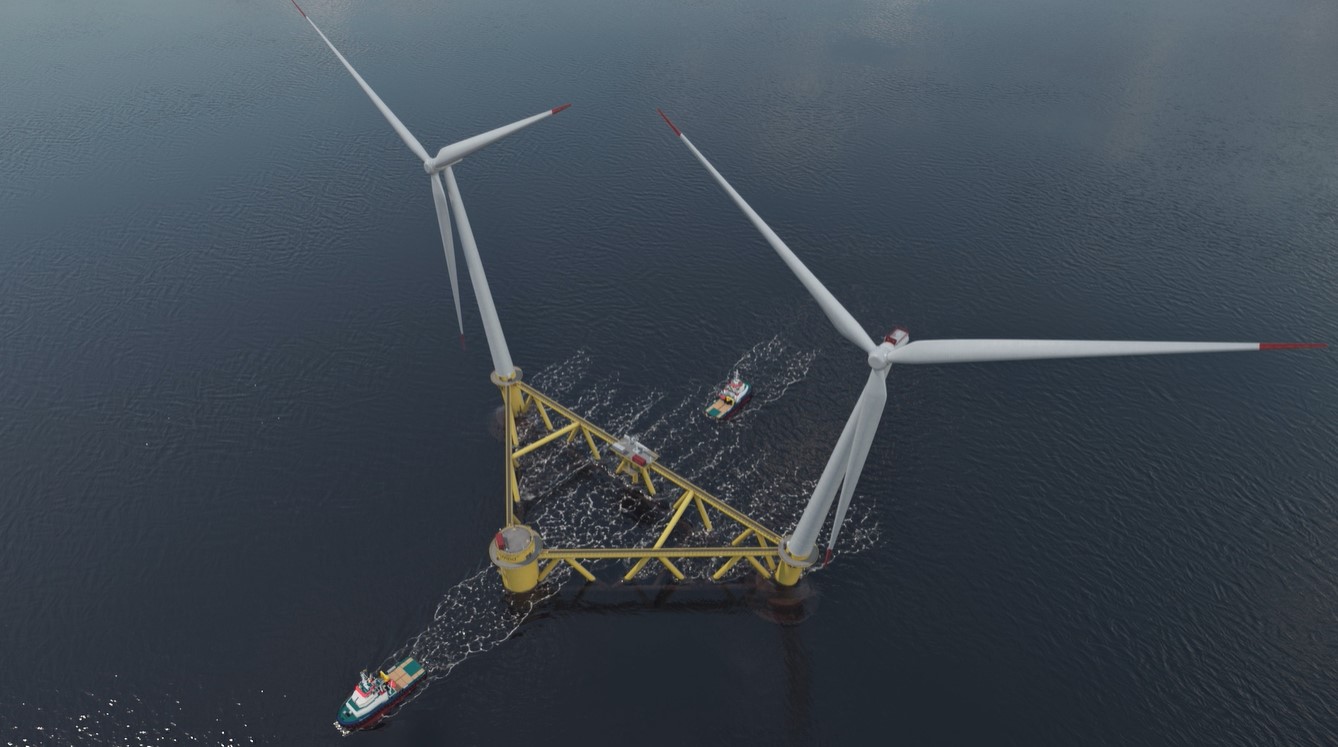
The TwinHub home page has a title of The First Floating Offshore Wind Project in The Celtic Sea.
This is the description on the page.
The TwinHub offshore wind demonstration project intends to prove how Hexicon’s innovative design with two turbines on one floating foundation can further reduce the Levelized Cost of Energy (also referred to as LCoE) before large scale commercialisation. The TwinHub project is a stepping stone to help kick-start floating wind in the Celtic Sea, an area identified as a hotspot for floating wind by the UK Government. It will pave the path for larger and larger projects to help support The Crown Estates’ ambitious target of 4GW of floating wind in the Celtic Sea.
Scroll the page down and there is a fascinating short video of a pair of wind turbines in operation.
- It appears that when there is no wind, it automatically goes into a safe parked mode.
- As the wind rises, one turbine starts up.
- The second turbine starts up and the float turns so they face the wind.
It appears to be a classic example of disruptive innovation.
I have a feeling that this type of installation might have generation, assembly and cost advantages over a single turbine mounted on a single float.
RCAM Technologies are also creating interesting designs for mounting turbines and energy storage using 3D-printed concrete.
What Ts The UK Government Doing To Accelerate Projects?
This article on offshoreWIND.biz, was published in late September 2022 and is entitled BREAKING: UK Puts Massive Amount Of New Offshore Wind Capacity On Fast Track and this is the first paragraph.
The UK will speed up planning and development consent processes for projects from the recently completed, currently ongoing, and upcoming (floating) offshore wind leasing rounds to bring new energy capacity online faster and facilitate economic growth and job creation.
The article is based on what Kwasi Kwateng said on the 23rd of September about speeding up projects in the 2022 Growth Plan.
A Quick Summary Of Our Wind Energy
The article has this paragraph, which summarises our wind energy.
For the UK, which currently has around 14 GW of offshore wind capacity in operation and 8 GW under construction, the projects from the listed auction rounds could bring well beyond the targeted capacity for 2030, which was recently raised to 50 GW.
I can see the target being raised again to at least 60 GW.
Where Are The Magnificent Eighteen?
In the two classic Japanese and American films of the fifties, there were seven saviours, who worked together.
This page on the Highview Power web site talks about their proposed CRYOBattery in Yorkshire, where this is said.
Highview Power’s second commercial renewable energy power station in the UK is a 200MW/2.5GWh facility in Yorkshire. This is the first of 18 sites for UK wide deployment strategically located to benefit from the existing transmission infrastructure.
As the UK’s energy problem is much worse than the problems in the films, perhaps we need more saviours.
In this article on the Telegraph, which is entitled Britain Will Soon Have A Glut Of Cheap Power, And World-Leading Batteries To Store It, Rupert Pearce, who is Highview’s chief executive, is quoted as saying the following.
Highview is well beyond the pilot phase and is developing its first large UK plant in Humberside, today Britain’s top hub for North Sea wind. It will offer 2.5GW for over 12 hours, or 0.5GW for over 60 hours, and so forth, and should be up and running by late 2024.
Further projects will be built at a breakneck speed of two to three a year during the 2020s, with a target of 20 sites able to provide almost 6GW of back-up electricity for four days at a time, or whatever time/power mix is optimal.
Is this Humberside CRYOBattery, the one on the web site described as in Yorkshire? It’s certainly in the old East Riding.
In Highview Power’s Plan To Add Energy Storage To The UK Power Network, I came to the conclusion, that the Humberside CRYOBattery will most likely be built near Creyke Beck substation, which is close to Cottingham.
- Dogger Bank A, Dogger Bank B and Hornsea 4 offshore wind farms will all be connected to the Creyke Beck substation.
- These wind farms have a total capacity of 3.4 GW.
- The Humberside CRYOBattery, now looks to have a maximum output of 2.5 GW.
- It looks like the Humberside CRYOBattery would be a well-matched backup to the three planned wind farms and perhaps even a few more turbines.
Building the Humberside CRYOBattery at Creyke Beck substation would appear to be a sensible decision.
We Only Have Half A Story
It looks like we’ve only got half a story, with a lot of detail missing.
- Will there be eighteen or twenty of Highview Power’s CRYOBatteries?
- Will they have a power output of 400 MW or nearly 6 GW for four hours?
- Will they have a storage capacity of 2.5 GWh or 30 GWh?
- Is the web site or the CEO correct?
- Have Highview Power and National Grid signed a deal for the next few CRYOBatteries?
I am expecting to see a big press statement at some time, perhaps even in the next few days, that will clear everything up.
If it was me, I would invite the new Prime Minister to the opening of the Carrington CRYOBattery and make the statement there.
The joint publicity could be equally valuable to both the Prime Minister and Highview Power.
Form Energy And The UK
This article on the Telegraph, which is entitled Britain Will Soon Have A Glut Of Cheap Power, And World-Leading Batteries To Store It, is proving to be a mine of information about the development of the UK Power Network.
Reliable information about US startup; Form Energy has been hard to find.
But the Telegraph article has these three paragraphs on Form Energy.
Form Energy in Boston – backed by Jeff Bezos and Bill Gates – is working on an iron-air “rust” battery based on the reversible oxidation of iron pellets. It does not require rare and polluting minerals such as vanadium, and will have a 100-hour range.
“The modules will produce electricity for one-tenth the cost of any technology available today for grid storage,” the company told Recharge.
Form Energy has been working with National Grid to map out the economics of UK renewables with storage, and how to cope with future curtailment. And it too praises the UK as a global trailblazer, though its pilot project next year will be in Minnesota.
Note.
- Iron certainly, isn’t an exotic material.
- A hundred hour range is claimed.
- If National Grid have been working with Form Energy, is it reasonable to assume, that they have been working with Highview Power?
- Good to see that Form Energy praises the UK as a global trailblazer. I have noted several times, that the Department for Business, Energy and Industrial Strategy seems to be well-advised.
Will National Grid put in one of Form Energy’s batteries? It would be a prudent thing to do, to make sure you get the best.
Highview Power’s Second Commercial System In Yorkshire
This is all that Highview Power say about their proposed system in Yorkshire, on their web site.
Highview Power’s second commercial renewable energy power station in the UK is a 200MW/2.5GWh facility in Yorkshire. This is the first of 18 sites for UK wide deployment strategically located to benefit from the existing transmission infrastructure.
I have a few thoughts.
How Does The Size Of This System Fit With Other Systems?
According to the Highview Power web site the Manchester system is a 50MW/300MWh facility, but Wikipedia has this system as a 50MW/250MWh.
In this article on the Telegraph, which is entitled Britain Will Soon Have A Glut Of Cheap Power, And World-Leading Batteries To Store It, it is stated that they are planning a battery with this specification, location and timeline.
- 2.5 GW output
- 30 GWh of storage
- Located on Humberside
- Delivery in late 2024.
This CRYOBattery is an absolute monster.
Will The Humberside CRYOBattery Be Built At Creyke Beck Substation?
In Highview Power’s Plan To Add Energy Storage To The UK Power Network, I came to the conclusion, that the Humberside CRYOBattery will most likely be built near Creyke Beck substation, which is close to Cottingham.
- Dogger Bank A, Dogger Bank B and Hornsea 4 offshore wind farms will all be connected to the Creyke Beck substation.
- These wind farms have a total capacity of 3.4 GW.
- The Humberside CRYOBattery, now looks to have a maximum output of 2.5 GW.
- It looks like the Humberside CRYOBattery would be a well-matched backup to the three planned wind farms and perhaps even a few more turbines.
Building the Humberside CRYOBattery at Creyke Beck substation would appear to be a sensible decision.
Is Cottingham In Humberside, Yorkshire Or Both?
The Wikipedia entry for the village is named Cottingham, East Riding of Yorkshire, says this.
A golf course and leisure club on Wood Hill Way, and a major (400/275 kV AC) electricity substation “Creyke Beck”, lie just outside the formal boundaries of the parish, within Skidby civil parish.
Skidby is definitely in Yorkshire.
Where Are The Other Seventeen Sites?
The Yorkshire facility is indicated to be one of 18 sites on the Highview Power web site. Where are the other seventeen?
All we know is that they will be strategically located to benefit from the existing transmission infrastructure.
This is said in the Wikipedia entry, which is entitled High-Voltage Substations In The United Kingdom.
In 2020 there were 179 400 kV substations and 137 275 kV substations.
He who pays the money, makes the choice!
Has The Company Changed Direction?
I wrote Highview Power Names Rupert Pearce Chief Executive Officer on April 12th, 2022.
- Since then, the Vermont and Chile projects have disappeared from the web site and projects in Yorkshire and Australia have been added.
- The web site has also been improved.
- As new CEOs often do, is Rupert Pearce refocussing the company?
Are they also looking in detail at current projects?
Has The Yorkshire Project Grown Substantially?
Consider.
- National Grid are a company that has improved its image and engineering in recent years.
- It has shown it can obtain finance for infrastructure from the City of London and respected financial institutions.
- National Grid probably have extensive computer models of their electricity network.
- National Grid knows it must add energy storage to their electricity network.
- National Grid pays almost a billion pounds a year to wind farm operators to shut them down.
Eventually saving up to a billion pounds would be a good reason to have a small bet on promising technology.
Did Rupert Pearce ask his engineers to design the largest CRYOBattery they can?
Did National Grid have a count up sand find that twenty CRYOBatteries would cover all the strategic points on their transmission infrastructure?
According to the figures on the Highview Power web site (200 MW/2.5 GWh), eighteen systems like the one proposed for Yorkshire would have.
- A total output of 3.6 GW
- A total storage capacity of 45 GWh
The figures given in the article in the Telegraph (2.5 GW/30 GWh) for the very large system, would mean that twenty systems would have.
- A total output of 50 GW
- A total storage capacity of 600 GWh
These figures are between thirteen and fourteen times larger than those originally proposed.
Building The System
The Highview Power web site, says this about the deployment of eighteen systems.
UK wide deployment strategically located to benefit from the existing transmission infrastructure.
This Google Map shows the Creyke Beck substation.
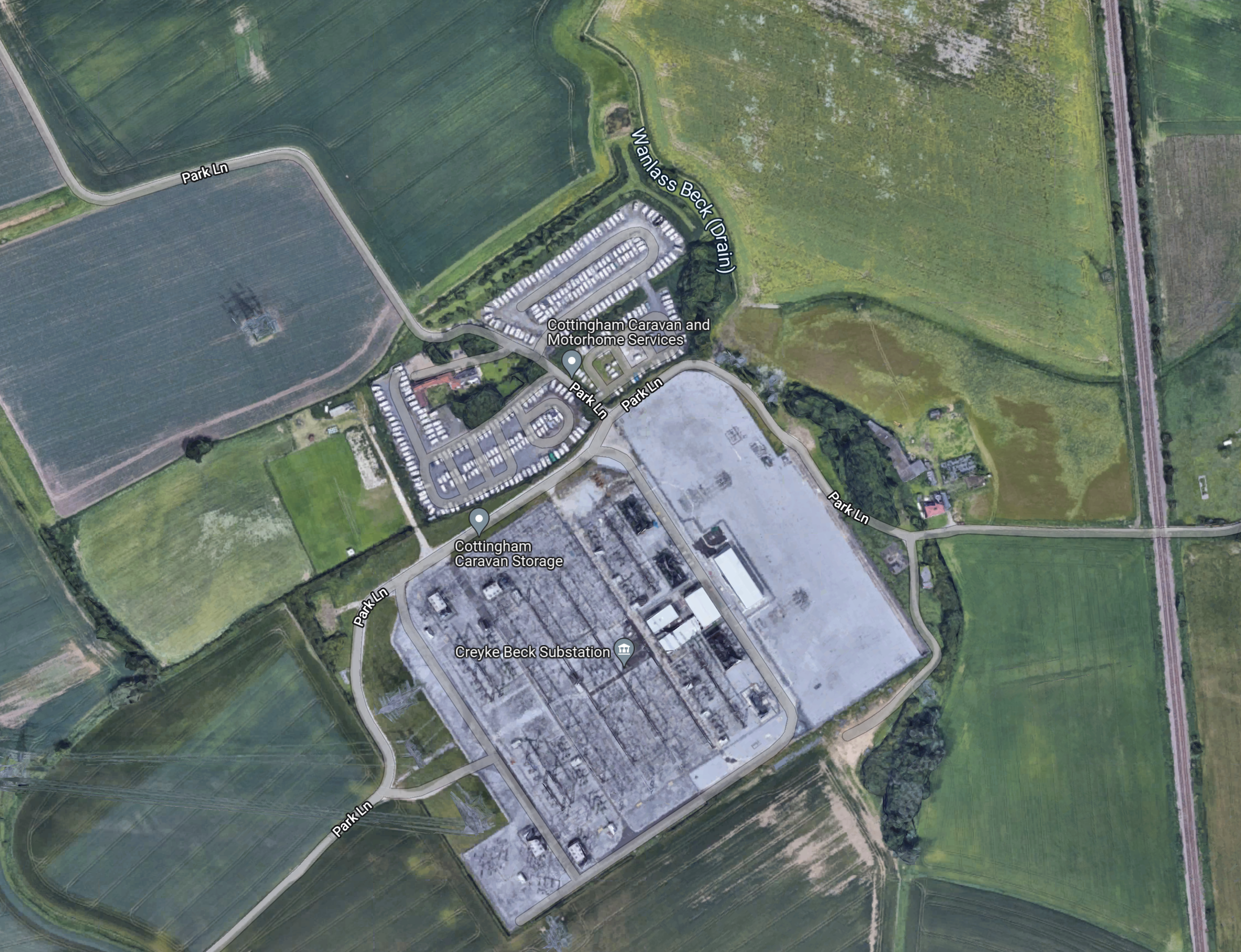
Could 30 GWh of liquid-air storage be accommodated on the site?
I can see a large insulated sphere, partly buried in the ground being used.
Designing, building and testing the first system will probably be the most difficult part of the project.
- But once the first system is successfully working reliably, the roll-out of other systems can be started.
- The biggest problem will probably be planning permissions, so the systems must be designed to be sympathetic to the local environment.
I can certainly see, twenty of these systems in the UK, but how many others will we see worldwide?
I
Renewable Power’s Effect On The Tory Leadership Election
I wouldn’t normally comment on the Tory Leadership Election, as I don’t have a vote and my preference has already been eliminated.
But after reading this article on the Telegraph, which is entitled Britain Will Soon Have A Glut Of Cheap Power, And World-Leading Batteries To Store It, I feel I have to comment both about this election and the General Election, that will follow in a few years.
These two paragraphs from the article illustrate the future growth of offshore wind power.
It is a point about the mathematical implications of the UK’s gargantuan push for renewables. Offshore wind capacity is going to increase from 11 to 50 gigawatts (GW) by 2030 under the Government’s latest fast-track plans.
RenewableUK says this country currently has a total of 86GW in the project pipeline. This the most ambitious rollout of offshore wind in the world, ahead of China at 78GW, and the US at 48GW.
If we assume that there is eight years left of this decade, that means that we should install about 4.9 GW of offshore wind every year until 2030. If we add in planned solar and onshore wind developments, we must be looking at at least 5 GW of renewable energy being added every year.
We have also got the 3.26 GW Hinckley Point C coming on stream.
I think we can say, that when it comes to electricity generation, we will not be worried, so Liz and Rishi can leave that one to the engineers.
If we have an electricity problem, it is about distribution and storage.
- We need more interconnectors between where the wind farms are being built and where the electricity will be used.
- National Grid and the Government have published plans for two interconnectors between Scotland and England, which I wrote about in New Electricity ‘Superhighways’ Needed To Cope With Surge In Wind Power.
- We need energy storage to back up the wind and solar power, when the wind isn’t blowing and the sun isn’t shining.
I think it is reasonable to assume, that we will get the interconnectors we need and the Telegraph article puts forward a very feasible and affordable solution to the energy storage problem, which is described in these two paragraphs from the article.
That is now in sight, and one of the world leaders is a British start-up. Highview Power has refined a beautifully simple technology using liquid air stored in insulated steel towers at low pressure.
This cryogenic process cools air to minus 196 degrees using the standard kit for LNG. It compresses the volume 700-fold. The liquid re-expands with a blast of force when heated and drives a turbine, providing dispatchable power with the help of a flywheel.
The article also talks of twenty energy storage systems, spread around the UK.
- They will have a total output of 6 GW.
- In total they will be able to store 600 GWh of electricity.
The first one for Humberside is currently being planned.
Surely, building these wind and solar farms, interconnectors and energy storage systems will cost billions of pounds.
Consider.
- Wind and solar farms get paid for the electricity they generate.
- , Interconnectors get paid for the electricity they transfer.
- Energy storage systems make a profit by buying energy when it’s cheap and selling it, when the price is better.
- In World’s Largest Wind Farm Attracts Huge Backing From Insurance Giant, I talked about how Aviva were funding the world’s largest wind farm at Hornsea.
- National Grid has a history of funding interconnectors like the North Sea Link from large financial institutions.
I believe that the islands of Great Britain and Ireland and the waters around our combined shores will become the largest zero-carbon power station in the world.
This will attract engineering companies and financial institutions from all over the world and we will see a repeat of the rush for energy that we saw for oil and gas in the last century.
If we get the financial regime right, I can see a lot of tax money flowing towards the Exchequer.
The big question will be what do we do with all this energy.
- Some will be converted into hydrogen for transport, the making of zero-carbon steel and cement and for use as a chemical feedstock.
- Industries that use a lot of electricity may move to the UK.
- A large supply of electricity and hydrogen will make it easy to decarbonise housing, offices and factories.
The Telegraph article also says this.
Much can be exported to the Continent through interconnectors for a fat revenue stream, helping to plug the UK’s trade deficit, and helping to rescue Germany from the double folly of nuclear closures and the Putin pact. But there are limits since weather patterns in Britain and Northwest Europe overlap – partially.
I suspect that more energy will be exported to Germany than most economists think, as it will be needed and it will be a nice little earner for the UK.
Given the substantial amount of German investment in our wind industry, I do wonder, if Boris and Olaf did a deal to encourage more German investment, when they met in April this year.
- BP have been backed with their wind farms by a German utility company.
- RWE are developing the Sofia wind farm.
- Only last week, the deal for the NeuConnect interconnector between the Isle of Grain and Wilhelmshaven was signed.
- Siemens have a lot of investments in the UK.
I wouldn’t be surprised to see more German investments in the next few months.
The Golden Hello
Has there ever been a Prime Minister, who will receive such a golden hello, as the one Liz or Rishi will receive in September?
The Tory Leadership Election
Some of the candidates said they would reduce taxes , if they won and Liz Truss is still saying that.
I wonder why Rishi isn’t saying that he would reduce taxes, as he must know the cash flow that is coming. It may be he’s just a more cautious soul.
Cleve Hill Solar Park
This document from the Department of Business, Industry and Industrial Strategy lists all the Contracts for Difference Allocation Round 4 results for the supply of zero-carbon electricity that were announced yesterday.
There were sixty-six solar power projects, that totalled up to 2.2 GW, which gives an average size of 33.3 MW.
I looked at the list and found the following.
- All contracts had the same strike price of £45.99 per MWh.
The largest solar farm with a contract is Cleve Hill Solar Park.
- ,Cleve Hill Solar Park received a contract for 112 MW.
- According to Wikipedia, the solar park will have a battery of 700 MWh.
- Will the battery enable the solar park to supply 112 MW on a twenty-four seven basis?
- According to Wikipedia, solar farms have a capacity factor of about 10 % in the UK.
- The Cleve Hill Solar Park will have a capacity of 350 MW.
- On a typical day, it will generate 350 * 24 *0.1 = 840 MWh
- The Contract for Difference mechanism means they get the strike price for each MWh of electricity up to the level in the contract, which is 112 MW.
- I suspect that for several months of the year, the solar park will be able to supply 112 MW to the grid.
- I do feel that overnight and on sunless winter days, the system will provide a lot less electricity.
- This page on the EMR web site explains Contract for Difference mechanism.
This extract from Wikipedia, describes, the solar park’s connection to the National Grid.
Across the marsh run the 400kV powerlines of the national grid. They are supported by eight 40m pylons. There is a large 150/400kV electricity substation at Cleve Hill, serving the London Array offshore wind farm that lies to the north beyond the mouth of the Thames Estuary. The output from the Solar Farm will use this substation to connect to the grid. Here, a battery array will placed, that will charge from the sunlight during the day and release the energy at night when it is needed.
I can build a table showing the earnings on a per day and per year basis, against average output.
- 20 MW – £22,076.20 per day – £8,057,448 per year
- 50 MW – £55,188 per day – £20,143,620 per year
- 70 MW – £77,263.20 per day – £28,201,068 per year
- 100 MW – £110,376 per day – £40,287,240 per year
- 112 MW – £123,621.12 per day – £45,121,708.80 per year
Note.
- I have assumed the year is 365 days.
- As a time-expired Control Engineer, I know that the battery can be optimised to supply the electricity, when it is needed and the price is highest.
- I wouldn’t be surprised to see co-operation between the London Array and Cleve Hill Solar Farm, as on a sunless but windy day, there may be scope to store excess wind energy in the battery for later release.
On this brief look, it appears that owning a solar farm, can be a nice little-earner.
Thoughts On The Battery
Consider.
- According to Wikipedia, the solar park will have a battery of 700 MWh.
- One of the largest lithium batteries in the UK is the one at Clay Tye in Essex, which is just under 200 MWh.
I suspect that lithium ion batteries will not be used.
Highview Power are building a 250 MWh battery in Manchester.
- This battery will be able to supply 50 MW.
- The batteries use liquid air as an energy storage medium.
- The company says the design can be extended up to a GWh by adding more tanks for the liquid air.
- The only fossil fuels used in Highview’s batteries is probably some lubricating oil.
I feel that a Highview battery or something similar would be an ideal solution at Cleve Hill Solar Farm.
I should be noted that the London Array is a 630 MW wind farm, so the London Array and Cleve Hill Solar Farm have a combined nameplate capacity of 980 MW.
I feel there is a case for a larger battery at the substation, to give the grid an almost-guaranteed GW all day.
It would be large than most if not all gas-fired power stations.
It could be used to balance the grid.
The controlling software would optimise the finances by buying and selling electricity at the right time.
UK Energy Exports To Europe At Record High
The title of this post, is the same as that of this article on The Times.
This is the first two paragraphs.
Britain has exported record amounts of gas to Europe so far this year as its liquefied natural gas terminals receive shipments destined for the Continent.
Electricity exports also have surged to unprecedented highs in recent weeks after an unexpected glut of gas pushed down short-term gas prices and resulted in gas-fired power plants generating more for export.
Who’d have thought it, that all those gas pipelines and electricity interconnectors between the UK and the Continent of Europe would be part of the replacementliqui for Russian gas.
According to Wikipedia, we have three liquified natural gas terminals; two at Milford Haven; South Hook and Dragon, and Grain on the Isle of Grain.
Note.
- South Hook is Europe’s largest liquified natural gas terminal and is owned by a partnership of the Qataris, ExxonMobil and Elf.
- South Hook and Dragon together can provide 25 % of the UK’s natural gas needs.
- Grain is owned by National Grid and according to Wikipedia, is in terms of storage capacity it is the largest LNG facility in Europe and the eighth largest in the world.
- Grain can supply 20 % of the UK’s natural gas needs.
- Grain has a reloading facility, so that gas can be exported.
- Grain seems to be continually expanding.
- Both Milford Haven and the Isle of Grain have large gas-fired power-stations.
Politicians say we don’t have enough gas storage, but we do seem to have world-class LNG terminals.
I have a couple of extra thoughts.
Blending Natural Gas With Hydrogen
HyDeploy is a project investigated blending hydrogen natural gas to cut carbon emissions. The project is described in this post called HyDeploy.
Surely, these terminals could be places, where hydrogen is blended with our natural gas supply.
- The terminals are connected to the UK gas network.
- Both Milford Haven and the Isle of Grain should have access to large amounts of offshore wind energy in the next few years, which could be used to generate green hydrogen.
- The terminals would need electrolysers to generate the hydrogen.
The Isle of Grain already has a blending capability.
NeuConnect
NeuConnect is an under-development interconnector between the Isle of Grain in Kent and Wilhelmshaven in Germany.
- It will have a capacity 1.4 GW.
- All the planning permissions seem to be in place.
- Prysmian have won a € 1.2 million contract to deliver the interconnector.
- Arup and German engineering firm Fichtner have formed a joint venture to provide project services for the interconnector.
- Construction could start this year.
It looks like the Germans will be replacing some of Putin’s bloodstained gas with clean zero-carbon energy from the UK.
Should We Develop More Gas Fields?
There are some gas fields in the seas around the UK, like Jackdaw, that could be developed.
Suppose, we extracted the gas and sent it to the reloading terminal on the Isle of Grain through the gas transmission network, where it could be exported by ship, to the Continent.
The UK would not be increasing its carbon emissions, as that would surely be the responsibility of the end-user.
Should We Develop More Gas Fired Power-Stations?
I believe it is possible to develop carbon-capture technology for gas-fired power stations.
The carbon dioxide would be either used in a beneficial way or stored in perhaps a worked-out gas field under the North Sea.
So long as no carbon dioxide is released into the atmosphere, I don’t see why more gas-fired power stations shouldn’t be developed.
What is happening at Keadby near Scunthorpe would appear to be one model for zero-carbon power generation.
Keadby Power Station
This is an existing
Conclusion
We will be exporting more energy to the Continent.
Ofgem Enables National Grid To Make Early Payment Of Interconnector Revenues, Helping To Reduce Household Bills
The title of this post, is the same as that of this press release from National Grid.
These are the first three paragraphs.
National Grid has offered to pay £200m of interconnector revenues ahead of schedule rather than at the end of the standard five-year review period to play its part in reducing household energy bills.
Interconnectors, which are subsea electricity cables connecting the UK and Europe, enable the import of cheaper, cleaner energy from European neighbours, supporting security of supply and reducing carbon emissions.
It’s estimated that National Grid’s interconnector portfolio will help the UK avoid around 100 million tonnes of carbon emissions by 2030.
Ofgem has approved National Grid’s request to make early payments.
These are my thoughts.
What’s In It For Consumers?
National Grid is making a payment early, so they are not getting anything, they won’t eventually get.
But they are getting it early!
What’s In It For National Grid?
As National Grid is making a payment early, they are forgoing interest on the £200 million.
In New Electricity ‘Superhighways’ Needed To Cope With Surge In Wind Power, I talked about National Grid’s plan to build new North-South interconnectors, that would handle all the extra wind-power.
National Grid currently owns all or part of these operating or planned interconnectors.
- BritNed
- HVDC Cross-Channel
- IceLink
- IFA-2
- Isle of Man to England Interconnector
- NemoLink
- North Sea Link
- Viking Link
- Western HVDC Link
National Grid would appear to have a substantial interest in the UK’s interconnectors and is the £200 million payment to ensure they get the contract to build and operate any new UK interconnectors? I’m not saying it’s a bribe, but it’s just operating the interconnectors in a manner that is an advantage to the UK and its electricity customers.
Surely, if the ultimate customers are happy, there will be less calls for the break-up of National Grid.
What Is A Cap And Floor Regime?
The press release explains a cap and floor regime like this.
Ofgem’s cap and floor regime sets a yearly maximum (cap) and minimum (floor) level for the revenues that the interconnector licensees can earn over a 25-year period. Usually, revenues generated by the interconnector are compared against the cap and floor levels over five-year periods. Top-up payments are made to the interconnector licensee if revenues are lower than the floor; and similarly, the licensee pays revenues in excess of the cap to consumers.
Ofgem’s approval enables National Grid to make payments of above cap revenues significantly earlier than originally planned, which will contribute to reducing consumer energy costs over the next two years. National Grid is now working with Ofgem to explore how to ensure the early payments can have the most impact for consumers.
I wonder if Ofgem and National Grid feel that a cap and floor regime is not only good for them, but for electricity consumers as well.
Cap And Floor Regimes And Energy Storage
There has been talk that cap and floor regimes should be used for energy storage.
This article on Current News is entitled Cap And Floor Mechanism The ‘Standout Solution’ For Long Duration Storage, KPMG Finds.
These are the first two paragraphs.
A cap and floor regime would be the most beneficial solution for supporting long duration energy storage, a KPMG report has found.
Commissioned by Drax, the report detailed how there is currently no appropriate investment mechanism for long duration storage. Examining four investment mechanisms – the Contracts for Difference (CfD) scheme, Regulated Asset Value (RAV) model, cap and floor regime and a reformed Capacity Market – it identified cap and floor as the best solution.
I also suspect that if the operator does a National Grid with the revenues, a cap and floor regime, must be even better.
I would not be surprised to see schemes like Coire Glas pumped hydro operating under a cap and floor regime.
Effect On Other Energy Companies
Wind farms seem to be operated under the Contracts for Difference scheme in many cases, but will we see cap and floor regimes being used in this market?
I can certainly see a new regime emerging, that is better for investors, wind farm builders, consumers and the Treasury.
In some ways keeping a happy relationship between the investors, Government and consumers is most important. So as National Grid, the Government and consumers don’t seem to be jumping up and down about their cap-and-floor regime, it must be working reasonably well!
Conclusion
Get the right regime and quality investors could be flocking to the UK’s energy generation and supply industry.
National Grid by their actions in paying up early, have thoroughly endorsed the system.
A Resilient Net Zero Electricity System Achievable By 2035 But Increased Investment Required, Regen Report Finds
The title of this post, is the same as that of this article on Current News.
This is the first two paragraphs.
The technical solutions needed to operate a net zero electricity system by 2035 are available or attainable, Regen has found, though a step-change in the level of investment is still needed.
The trade body has produced a new report for National Grid ESO into a ‘day in the life’ of a fully decarbonized electricity system by 2035, which the ESO is aiming for.
The article gives a lot of figures about our electricity supply in 2035.
Consumption of electricity will be between 450 and 500TWh per year, with the following sources.
- 55-65GW of offshore wind
- 25-35GW onshore wind
- 40-50GW of solar
- 6-10GW of other renewables
- 10-15GW of low carbon dispatch
- 8-10GW of nuclear
- 8-12GW of carbon capture and storage (CCS)
- 15-25GW of fossil fuel backup.
Note.
- 450-500 TWh is 51-57 GW per hour averaged out over the year.
- They emphasise the importance of energy storage.
- No mention is made of the massive Coire Glas pumped hydro storage.
- No mention is made of hydrogen.
- As is normal, with reports like this the authors don’t keep their GW and GWh separate.
- They also don’t explain the hierarchy of MW, GW and TW, which is 1000 x steps up the scale.
The full report is at this page on the Internet.
National Grid ESO And Reactive Technologies Launch Flagship Inertia System To Measure Grid Stability
The title of this post is the same as that of this article on Current News.
The first three paragraphs explain the project.
National Grid ESO and Reactive Technologies’ flagship grid stability measurement service has launched today, following the construction of the world’s largest continuously operating grid-scale ultracapacitor.
Using Reactive’s GridMetrix technology, the new services will provide instantaneous data to the grid operator, allowing for more efficient management than relying on estimates.
The ultracapacitor – constructed by Spanish technology group Ingeteam – sends pulses through the grid, which act like underwater sound waves used in sonar. These pulses will enable the ESO to measure power system stability.
As a Control and Electrical Engineer, I can just about get my brain around what is happening, but I do feel the explanation could be better.
- There is no mention of the size of the capacitor.
- Capacitors are often used to calm voltages in electrical circuits.
- How does the capacitor send pulses through the grid? It must be some other piece of kit linked to the capacitor.
In the end though, I don’t care, if it works.

