A New Design For Flow Batteries
The title of this post, is the same as that of this article in phys.org, which documents a development from the Mendeleev University in Russia.
The Russians are claiming they have developed a novel architecture.
Solar To Hydrogen Efficiency Record Broken By Australian National University Researchers
The title of this post, is the same as that of this article on Hydrogen Fuel News.
The traditional route to produce green hydrogen from solar panels, is to create electricity and then use electrolysis to create the hydrogen.
This process goes direct and an improvement in efficiency of 17.6 %.
Smartphone-Based Testing Device Cuts Time And Cost Of Diagnostics
The title of this post is the same as that of this article on The Engineer.
This is the sub-title of the article.
An inexpensive and sensitive smartphone-based testing device for viral and bacterial pathogens could reduce the pressure on testing laboratories during a pandemic.
These are a few important points from the article.
- The device has been developed by researchers and engineers at the University of Illinois.
- They are aiming for a $50 price.
- They started looking for a solution to look for viral and biological pathogens in horses.
- Tests work with a nasal or blood sample.
- Tests take about half-an-hour.
If this device can be productionised, so that millions can be turned out for their target price, this will be a major weapon in the fight against COVID-19.
Apparently, there is a great advantage of using horses in the trials of the device. The horse pathogens are harmless to humans, so it lowers the risk to researchers.
Climate Change: ‘Bath Sponge’ Breakthrough Could Boost Cleaner Cars
The title of this post is the same as that of this article on the BBC.
This is the introductory paragraph.
A new material developed, by scientists could give a significant boost to a new generation of hydrogen-powered cars.
The article is a must read and the development could make it a lot easy to store hydrogen in vehicles.
The problem is that hydrogen is extremely light and the article says this about storage.
In normal atmospheric pressure, to carry 1kg of hydrogen which might power your car for over 100km, you’d need a tank capable of holding around 11,000 litres.
That is rather large. This extract from the article describes the solution.
To get around this problem, the gas is stored at high pressure, around 700 bar, so cars can carry 4-5kg of the gas and travel up to 500km before refilling.
That level of pressure is around 300 times greater than in a car’s tyres, and necessitates specially made tanks, all of which add to the cost of the vehicles.
Now researchers believe they have developed an alternative method that would allow the storage of high volumes of hydrogen under much lower pressure.
The team have designed a highly porous new material, described as a metal-organic framework.
As ITM Power’s hydrogen filling stations can provide hydrogen at up to 350-700 bar, I’m sure that there could be a useful coming together, that will make hydrogen-powered vehicles more common.
Could for instance, the new material mean, that hydrogen becomes the fuel of choice for heavy trucks and railway locomotives?
My Past Is Worrying Me!
It must have been in the early 1970s, when I was acting as a mathematical-modelling consultant.
I was asked to do some modelling by a major drug company of the propagation of a virus through the UK population.
Their aim was to show how serious these pandemics could be and they wanted to get substantial grants from the Government to fund various lines of research.
With their data and the model I built, we were able to show how a dangerous pandemic could evolve.
But I never found out how successful they were in obtaining the money needed to start the research!
It does look like this pandemic could be the one that researchers at the company were predicting nearly fifty years ago.
Rail Research At Birmingham University
In Issue 898 of Rail Magazine, there is an article entitled Full Steam Ahead, which discusses the the work at the Birmingham Centre for Railway Research an Education (BCRRE).
Amongst many subjects three are mentioned where I have a big interest.
Aerodynamics
The article says this.
Aerodynamics is also an important area for research, as any reduction in drag and air resistance due to structures will improve the energy efficiency of rail vehicles.
I very much agree with this approach.
I also feel that due to their low noise profiles as they pass by, that Bombardier have applied aerodynamic knowledge, perhaps from their aircraft engineers, to the design of the new Aventra.
Hydrogen Supplies For Hydrogen-Powered Trains
The article says this.
Funding has also been secured from Innovate UK to create a company that can provide the necessary infrastructure needed to support hydrogen trains, including fuelling stations and hydrogen generation facilities.
This sounds very similar to the systems that ITM Power ae deploying for Shell to fuel hydrogen buses, cars and other vehicles.
I hope that there is not too much duplication going on.
Working With Michigan State University And Stadler To Bring Hydrogen Trains To California
Co-operation is always good and especially in rail projects, where the number of trains involved is fairly small.
A Quote From Dr. Stuart Hillmansen of BCRRE
This quote is in the article.
Is is possible to completely decarbonise, by using electrolysis that is powered using renewable energy to create the fuel.
I completely agree with that!
Conclusion
I would hope that the BCRRE develops into a one step shop for the solution of rail related problems.
It does seem that by putting various areas of expertise together, they could be a go-to institution for those that want to built a hydrogen-powered rail service.
Why Are Liverpool Good At Transfers?
This question was asked on BBC Radio 5, about Liverpool Football Club.
As an alumni, I raise money for cancer research at Liverpool University.
I get the impression, the University has no problem getting the best researchers to come to the Second City of England!
Everybody in the World has heard of Liverpool!
AI ‘Outperforms’ Doctors Diagnosing Breast Cancer
The title of this post is the same as that of this article on the BBC.
This is the first two paragraphs.
Artificial intelligence is more accurate than doctors in diagnosing breast cancer from mammograms, a study in the journal Nature suggests.
An international team, including researchers from Google Health and Imperial College London, designed and trained a computer model on X-ray images from nearly 29,000 women.
I have rarely worked with healthcare data, so I can’t comment on the accuracy of this trial.
However, over fifty years ago, I was able to make a lot of progress in the analysis of mass spectrometry data, by observing operators and asking how they identified various chemicals in the scan from the mass spectrometer.
I wouldn’t be surprised to find some detailed observation of the working methods of radiologists, formed the foundation data for this research.
The research seems to have done it well, judging by the published results.
Should we trust ourselves to methods like this in healthcare?
Undoubtedly! Yes!
Many systems like this are starting to be used in the maintenance of complex entities, as diverse as trains, planes, chemical works and advanced automated distribution depots.
But every fault, is always tested by a trained person.
This is a paragraph from the BBC article.
Prof Ara Darzi, report co-author and director of the Cancer Research UK (CRUK) Imperial Centre, told the BBC: “This went far beyond my expectations. It will have a significant impact on improving the quality of reporting, and also free up radiologists to do even more important things.”
I very much feel we will see very much more of this automated testing of the human body! And not just for cancer!
I already know of groups working on automatic diagnosis of arthritis!
MSU Research Leads To North America’s First Commercial Hydrogen-Powered Train
The title of this post, is the same as that of this article in Railway Age.
This is the introductory paragraph.
Research from Michigan State University’s Center for Railway Research and Education (CRRE) contributed to the San Bernardino County Transportation Authority’s (SBCTA) decision to order the first commercial hydrogen-powered train for use in North America.
These statements were also made.
- The research was conducted in partnership with the Birmingham CRRE and Mott MacDonald.
- Funding was from the California State Transportation Agency (CalSTA).
- The trains will be built by Stadler, probably in their US factory.
There is also a picture of the hydrogen-powered Flirt in the article, and it is very similar in formation to a Class 755 train, with a PowerPack in the middle.
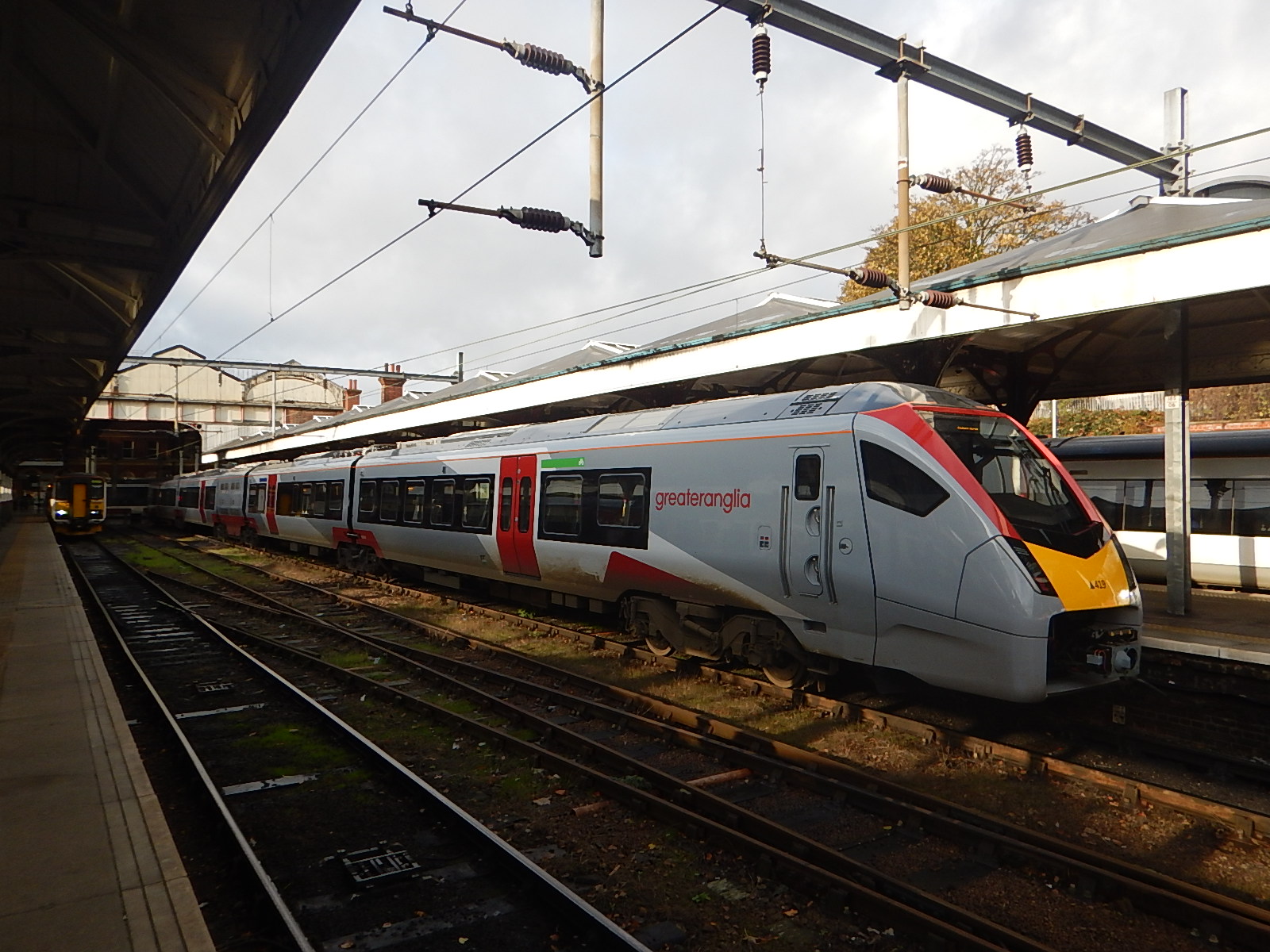
The picture shows a Class 755 train at Norwich station.
The article indicates that hydrogen-power was chosen, as the rail line may be extended by sixty miles to Los Angeles.
Conclusion
After reading the full article, it certainly looks like San Bernardino County Transportation Authority have planned their new railway in a very professional way.
 The Anonymous Widower