South Yorkshire Now Has Better North-South Connections
The December 14th 2025 timetable change was a big day for South Yorkshire.
Three big changes will transform, public transport in South Yorkshire.
The Opening Of A New Tram-Stop At Magna Science Adventure Centre On The Tram-Train Route Between Sheffield And Rotherham
The Magna Science Adventure Centre is described like this in the first paragraph of its Wikipedia entry.
Magna Science Adventure Centre is an educational visitor attraction in Rotherham, South Yorkshire, England.
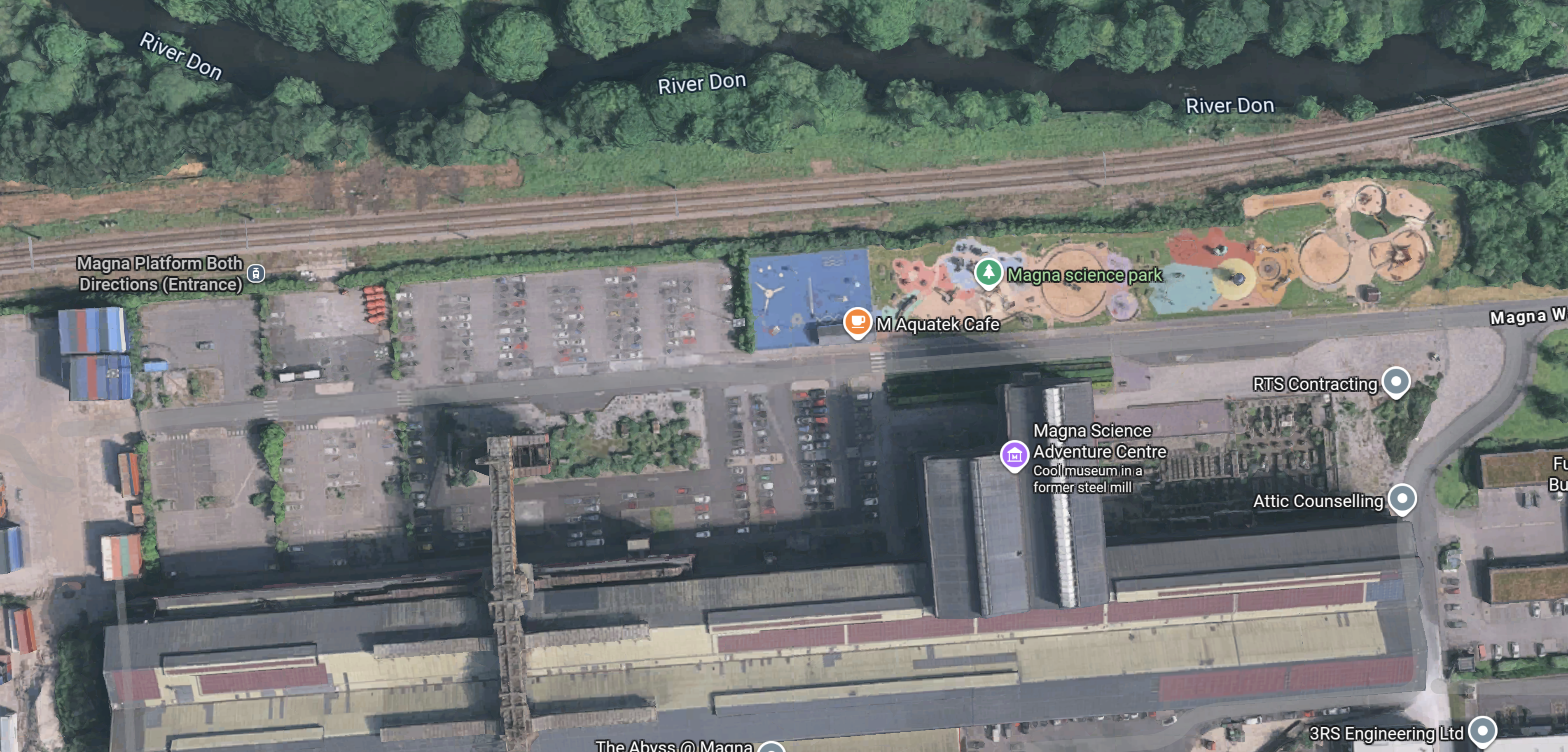
This map shows the site and the tram-train track between Sheffield and Rotherham.
Note.
- The tram-train track runs East-West across the top of the map.
- Sheffield is to the West and Rotherham is to the East.
- At the Western end of the site, a label indicates the position of the Magna Platform.
- The position of the tram-train stop is already marked.
- There will be 29 extra Park-and-Ride spaces.
- The Magna Science Adventure Centre is indicated by the purple arrow in the middle of the map.
- Magna Way runs East-West through the site.
- There are four pavilions: Earth, Air, Fire, and Water.
This article on the BBC is entitled Lifts And Bridge Added As Tram Stop Takes Shape.
This picture from the article shows the bridge with lifts.

Note.
It will be an impressive tram stop.
It doesn’t look like it will be long before it opens.
But as yet no information is available.
Google AI gave this answer.
The new Magna Tram Train stop is scheduled to open in early 2026.
Construction of the new £10 million station and Park & Ride facility in Rotherham, part of a wider investment in the South Yorkshire Supertram network, is currently on track.
The new stop will improve access to the Magna Science Adventure Centre, local businesses, and link up with existing walking and cycling routes, aiming to ease congestion in the Lower Don Valley.
I shall be going next week to take photographs of the tram stop.
The Increase In Frequency Of Express Trains Serving Doncaster On The East Coast Main Line
Since the December 14th 2025 timetable change, the Monday to Friday express trains, that stop at Doncaster on the East Coast Main Line have included.
- CrossCountry – 8 trains per day (tpd) in both directions.
- Grand Central – 4 tpd in both directions.
- Hull Trains – 7 tpd in both directions.
- LNER- 3.5 trains per hour (tph) in both directions.
- TransPennineExpress – 1 tph in both directions.
Note.
- This totals to 173 express trains per day stopping at Doncaster
- Or about 7 tph in both directions or a train every 8.5 minutes.
- This is about a thirty percent increase in frequency.
- Doncaster has become the Crewe of South Yorkshire.
I can see this large number of express trains to Doncaster bringing large numbers of visitors to go to the Magna Science Adventure Centre or its tram stop for onward connection to other destinations on the Sheffield Supertram network.
The trouble is, that at present the Magna tram stop is not connected to Doncaster station.
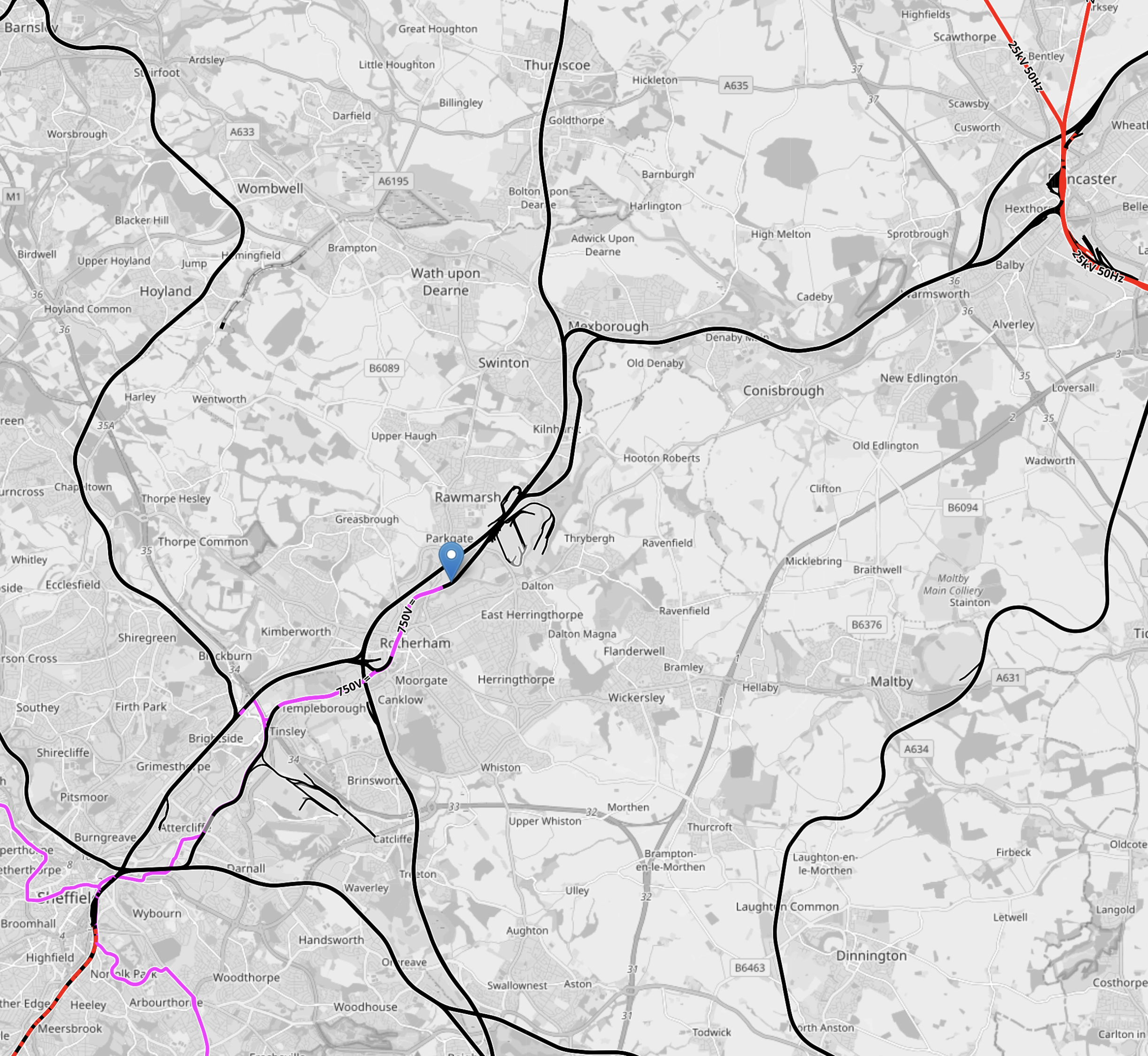
This OpenRailwayMap shows the rail lines between Doncaster and Sheffield stations.
Note.
- The short length of red track in the North-East corner of the map is the East Coast Main Line.
- Doncaster station can be picked out.
- The short length of red track in the South-West corner of the map is the Midland Main Line, which connects Sheffield to London.
- Sheffield station is at the Northern end of the electrification, which will be installed soon.
- The pink tracks are the 750 VDC electrified tracks of the Sheffield Supertram.
- The blue arrow marks Rotherham Parkgate station, which is the limit of the current tram-train route.
The tram-train route needs to be extended so that the tram-trains can go between Rotherham Parkgate tram stop and Doncaster station.
The route seems to have these characteristics.
- It is about 11.8 miles long.
- Stops are Rotherham Central, Swinton (South Yorkshire), Mexborough and Conisborough.
- Diesel trains take about thirty minutes between Rotherham Central and Doncaster.
- All platforms at Doncaster are electrified with 25 KVAC.
- Platform 5 is a convenient bay platform at Doncaster, that could be used by the tram-trains.
- Sheffield’s Class 399 tram-trains can use 25 KVAC for traction.
- South Wales have similar Stadler tram-trains, that are to be fitted with batteries.
I am fairly sure, that a solution can be found so that Sheffield’s tram-trains can be extended to Doncaster station.
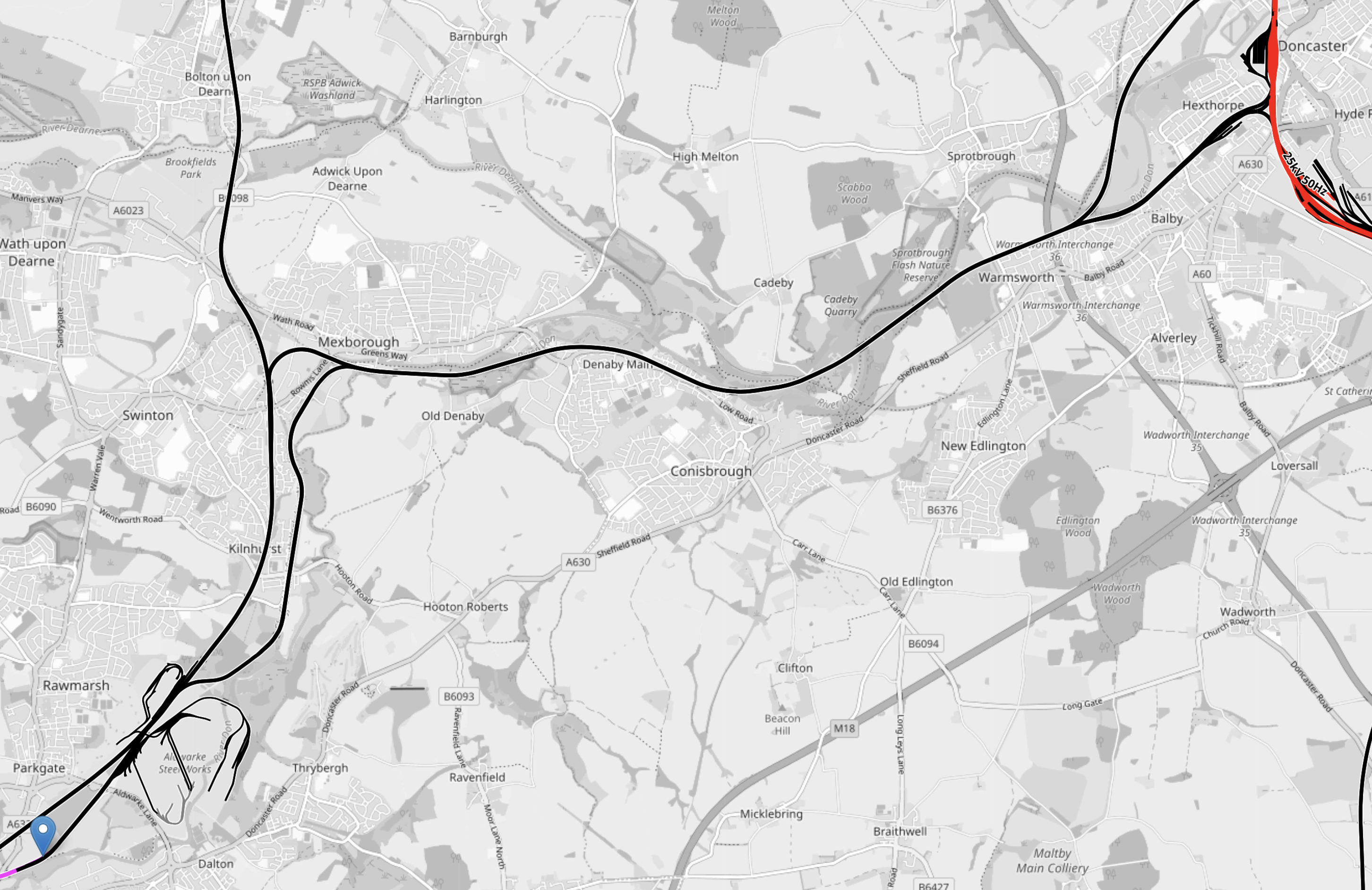
This OpenRailwayMap shows the route between Rotherham Parkgate tram stop and Doncaster station.
Note.
- The short length of red track in the North-East corner of the map is the East Coast Main Line.
- Doncaster station can be picked out.
- The short length of pink tracks are the 750 VDC electrified tracks of the Sheffield Supertram.
- The blue arrow marks Rotherham Parkgate station, which is the limit of the current tram-train route.
- Most of the route is not electrified.
As there is electrification at both ends, I suspect the easiest way of powering the trams would be to use batteries, as has been done in South Wales.
The New Class 810 trains between London St. Pancras And Sheffield On The Midland Main Line
These new Class 810 trains have started running this month and I suspect soe travellers will use these trains to go to Magna or its tram stop.
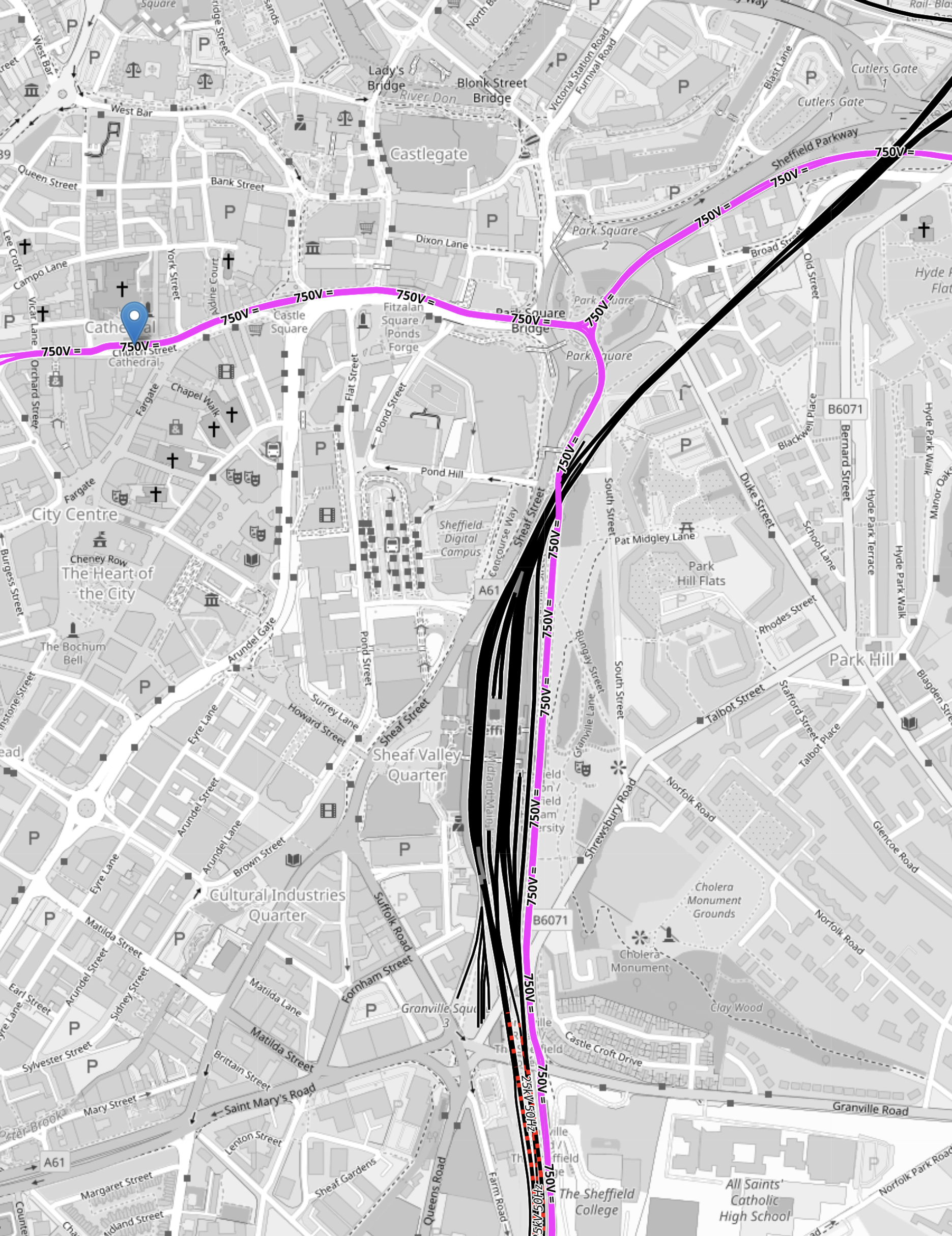
his OpenRailwayMap shows the tram routes in Sheffield city centre.
Note.
- The pink tracks are tram-tracks.
- The black tracks are unelectrified train tracks.
- The short lengths of red-and-black tracks are tracks to be electrified with 25 KVAC overhead, for the Class 810 trains.
- The blue error indicated the Cathedral tram-stop, where tram-trains will be caught to Magna.
- The mass of black tracks in the middle of the map is Sheffield station.
- There is a tram stop on the East side of the train station for the trams.
- Trams going South go to Halfway and Herdings Park.
- Trams going North-East go to Rotherham Parkgate and Meadowhall Interchange, and will go to Magna, when it opens.
- Trams going North-West go to Malin Bridge and Middlewood.
It is a difficult interchange between Cathedral and Sheffield station, if you are catching the tram-train, as it is a hard walk up hill, so it might be better if you are goinging between Sheffield station and the tram-train to change trams at Meadowhall South.
Mayors Head To Parliament With Plan For Northern Arc To Deliver Green Growth
The title of this post, is the same as that of this news item from Liverpool City Region.
These four bullet points act as sub-headings.
- Steve Rotheram and Andy Burnham take case for backing Northern Arc to Treasury – as new data shows North can drive green growth and unlock £90bn for UK economy
- Liverpool City Region and Greater Manchester Mayors will meet with ministers and MPs today, and Andy Burnham will give evidence at Business and Trade Select Committee on the UK’s industrial strategy
- Economic analysis shows that investing in transport infrastructure and a pipeline of projects across the North would benefit the whole UK economy, improving living standards and closing the North-South productivity gap
- Mayors will also address Innovation Zero World Congress in London, showing how city-regions can create high quality jobs by pioneering low-carbon innovation
These two paragraphs add a bit more detail.
The right investment would create a growth corridor, stretching from the Mersey to the Pennines and connecting into West and South Yorkshire, underpinned by transport networks that would include a new railway linking Liverpool and Manchester.
The Northern Arc area spans regions with close economic ties to Lancashire, North Wales, Hull and the North East. With international connections through the Port of Liverpool and Manchester Airport, it’s well positioned for global trade.
If I have a problem with the mayors’ thoughts, the plan outlined in the news item is rather Liverpool/Manchester-based with Hull being the only city outside that area getting a mention. Do Blackburn, Blackpool, Bradford, Burnley, Doncaster, Huddersfield, Leeds, Preston, Rotherham, Scunthorpe, Stockport, Wigan and York exist?
For instance you would expert a report from Liverpool and Manchester’s Mayors to call for a new railway between their two cities. And of course they do!
The current TransPennine Lines has two main routes across the Pennines between East and West.
If ever there was a rail route, designed by Topsy, it is the North TransPennine Route.
- There are six separate services, if you ignore Newcastle and Edinburgh Waverley, which is a shuttle to fill a gap in rail services.
- In the West trains terminate at Huddersfield, Liverpool Lime Street, Manchester Airport, Manchester Piccadilly and Manchester Victoria
- In the East trains terminate at Edinburgh Waverley, Hull, Leeds, Newcastle, Redcar Central, Scarborough and York.
- Terminals like Huddersfield, Hull, Liverpool Lime Street, Newcastle and York are some of the best terminal stations in the UK, but others are very second rate.
I suspect, this North TransPennine Route structure brought about the demise of TransPennine Express.
The South TransPennine Route on the other hand, although it was built by several different railway companies, they were all intent on the same thing. An East-West route across the Pennines through Doncaster, Manchester and Sheffield.
- The Western terminal is Liverpool Lime Street, which in my view is the finest grand terminus in the UK, in terms of architecture, onward connections and operation. It is also the oldest still-operating grand terminus mainline station in the world, in that it dates from 1836.
- The Eastern terminal is Cleethorpes, which is an efficient four-platform recently-refurbished station, that is within a hundred metres of some of the best gluten-free fish and chips, I’ve ever tasted on the pier.
- Intermediate stations include Liverpool South Parkway, Warrington Central, Birchwood, Irlam, Urmston, Manchester Oxford Road, Manchester Piccadilly, Stockport, Sheffield, Meadowhall, Doncaster, Scunthorpe, Barnetby, Habrough and Grimsby Town.
- Liverpool South Parkway has a bus connection to Liverpool Airport
- Liverpool Lime Street, Manchester Oxford Road, Manchester Piccadilly, Stockport, Sheffield and Doncaster are stations with comprehensive onward connections.
- The route is electrified between Liverpool Lime Street and Manchester Piccadilly and at Doncaster.Liverpool Lime Street and Cleethorpes is 148.2 miles
- Hazel Grove and Doncaster is without electrification and is 52.3 miles long.
- Cleethorpes and Doncaster is without electrification and is 52.1 miles long.
- I believe that Hitachi, Siemens and Stadler could supply battery-electric trains, that would be able to work the route, with the addition of a short length of overhead wires at Cleethorpes, so that trains could return to Doncaster.
- Trains go straight through all the intermediate stations, so there are no time-wasting reverses.
- Journey time is just over three and a half hours.
I believe that a mouse-quiet battery-electric train would pack in the punters, if only for the novelty.
But.
A battery-electric train would probably knock perhaps thirty minutes off the journey.
The timetable would be an hourly train at all stations.
The service would pass the mother’s birthday test, in that you could easily visit any station from any other and buy your mother lunch before returning on a convenient train.
There are connections to and from London at Liverpool Lime Street, Manchester Piccadilly, Stockport, Sheffield and Doncaster.
It could be a very useful East-West train service.
British Gas Partners With Strata And Daikin To Launch Eco-Tech Low Bill Homes
The title of this post, is the same as that of this press release from Centrica.
This is the sub-heading.
British Gas is set to supercharge sustainable living across the UK with the launch of Low Carbon Homes – a ground-breaking pilot in partnership with Strata and heat pump manufacturer, Daikin.
These are the first four paragraphs, which fill out a bit of detail.
In anticipation of The Future Homes Standard, customers will move into new build homes which have been fitted with a full range of the latest low-carbon technology at no extra cost to the housebuilder or owner. The homes will be equipped with a 6-8 kWh Daikin air source heat pump, 4 kWh solar panels, 5 kWh battery storage, Hive electric vehicle charger and thermostat. These items will be integrated into Hive’s award-winning app, providing customers with one-stop visibility and control of their energy usage.
The first trial phase will launch at a Strata’s “Breathe” development site in Kiveton, Rotherham. As a thank you for participating in the pilot, British Gas is giving homeowners access to a fixed rate tailored British Gas tariff. Participants in the trial will also have access to a dedicated British Gas energy manager to help them optimise the technology and keep bills as low as possible, while still meeting their desired comfort levels.
Each home will be fitted with a Hive hub, which connects to the WIFI network and acts as the home’s operating system, integrating all the sustainable technology. The customers energy and heat schedules and budget will be optimised by the Hive Hub for further savings.
When the customer connects to Hive’s app they will be able to control and maximise efficiency by setting schedules and spending budgets and allowing the Hub to help them reduce their bills.
Note.
- As a Control Engineer, this to me is a good start.
- I suspect that a 6-8 kWh Daikin air source heat pump, 4 kWh solar panels and 5 kWh battery storage will keep the average house warm.
- I would expect that the three companies have optimised the ratios between the sizes of the components to give the best performance.
It is amazing to think that it was in the early seventies, that in the two sections, where I worked at ICI, engineers had just started controlling and optimising flows, pressures and temperatures in complex chemical plants.
If you’d asked any of us, when our houses heating systems would be as fully controlled, we’d have given twenty years at most.
What kept the world so long?
I have a few thoughts.
Could The Housing Have Gas For Cooking??
Yes! Centrica owns a big share with Hyundai, Kia and others of a start-up company called HiiROC.
- This is the HiiROC web site.
- HiiROC can take any hydocarbon gas and split it into green hydrogen and carbon black.
- Green hydrogen is obviously useful and the carbon black can be used for making tyres for vehicles, anodes for lithium-ion batteries and in agriculture for soil improvement.
- Waste off-gas from a chemical plant can be split into green hydrogen and carbon black.
- Biomethane from a sewage plant can be split into hydrogen and carbon black. Could a sewage plant on an estate be used to create biomethane for cooking and feeding to the HiiROC plant? Yes!
- Could green hydrogen produced on the estate be used to drive vehicles like cars, vans and ride-on-mowers. Yes! If the manufacturer of the vehicle allows it!
- How convenient would it be to have Hydrogen-at-Home?
How Much Does A British Gas Hive Save On My Energy Bill?
I asked Google and I got this answer from Home Hive.
£119. A smaller carbon footprint and a smaller bill – our award-winning smart thermostat could cut your energy bills by up to £170 a year. Join Hive Plus to boost your thermostat’s savings – and get exclusive access to £60 bill credit with any fixed British Gas dual fuel tariff.
At present, I have no intention of changing my energy supplier, but come the summer or if my health or energy circumstances change, I might see what is available.
Will British Gas Develop A Hive For a Smaller Dwelling?
I suspect in ten years, if I’m still of this world, I shall be living in the following circumstances.
- Alone.
- In a two bedroom house, cottage or flat.
- Some form of probably electric central heating or perhaps even hydrogen.
- No car.
- A short walk to the bus stop and/or train station.
- Communal gardens to sit in.
- An Ocado style delivery for food, groceries and other essentials.
- A local gluten-free cafe.
- Full Wi-Fi
Perhaps, British Gas and others will develop a community for people like me?
Could Sheffield Station Become A Battery-Electric Train Hub?
Promised Improvements To Train Services At Sheffield
This news story from the Department of Transport is entitled Yorkshire And The Humber To Benefit From £19.8 billion Transport Investment.
Sheffield station gets several mentions of improvement to these routes.
Sheffield And Hull
This is said about train services between Sheffield and Hull.
The number of trains between Hull and Sheffield will be doubled, to 2 per hour, with capacity also doubled.
These points describe typical current services.
- The route is 59.4 miles long.
- Modern Class 170 trains take 78 minutes.
- There are stops at Meadowhall, Doncaster, Goole and Brough.
- The maximum speed of the line is mostly around 70 mph, with one short section of 100 mph.
- The average speed is 45.7 mph.
- The train continues to Scarborough after a six-minute stop at Hull.
I believe that if this route were to be electrified, that a time around an hour would be possible between Sheffield and Hull.
Sheffield and Scarborough takes two hours and 45 minutes. With electrification, this time could be less than two hours and 30 minutes.
But it would be around 113 miles of new double-track electrification.
I believe that Sheffield and Hull is a route that could be run by battery-electric trains, that would be charged at both ends of the route.
Sheffield And Leeds
This is said about train services between Sheffield and Leeds.
The line between Sheffield and Leeds will be electrified and upgraded, giving passengers a choice of 3 to 4 fast trains an hour, instead of 1, with journey times of 40 minutes. A new mainline station for Rotherham will also be added to the route, which could give the town its first direct service to London since the 1980s, boosting capacity by 300%.
These points describe typical current services.
- The route is 41.1 miles long.
- Modern Class 195 trains take 56 minutes.
- There is a few miles of electrification at the Leeds end.
- There are stops at Meadowhall, Barnsley and Wakefield Kirkgate.
- The maximum speed of the line is mostly around 60-70 mph.
- The average speed is 44 mph.
I believe that if this route were to be electrified, that a time around fifty minutes might be possible between Sheffield and Leeds.
That is not really good enough, but if they went through a new mainline station for Rotherham, the trains would be able to use 100 mph tracks all the way to Leeds. There would also be electrification between South Kirby junction and Leeds.
I suspect forty minutes should be possible with 100 mph running between Rotherham and Leeds.
I believe that Sheffield and Leeds is a route that could be run by battery-electric trains, that would be charged at both ends of the route.
Sheffield And Manchester
This is said about train services between Sheffield and Manchester.
The Hope Valley Line between Manchester and Sheffield will also be electrified and upgraded, with the aim of cutting journey times from 51 to 42 minutes and increasing the number of fast trains on the route from 2 to 3 per hour, doubling capacity.
In Electrification Of The Hope Valley Line, I talked about electrification of the line and how the services on the line could be run by battery-electric trains.
This was my conclusion in the linked post.
I believe that full electrification of the Hope Valley Line is not needed, if battery-electric trains are used.
I also believe that battery-electric trains and the current improvements being carried out on the Hope Valley Line will enable a forty minute time between Manchester Piccadilly and Sheffield.
I believe that the Hope Valley Line could be speeded up, by the use of intelligent engineering, rather than expensive and disruptive electrification.
Don Valley Line
This is said about the Don Valley Line.
Communities will be reconnected through the reopening of lines and stations closed under the Beeching reforms of the 1960s. This will include the restoration of the Don Valley Line between Stocksbridge and Sheffield Victoria, and new stations at Haxby Station, near York, Waverley, near Rotherham, and the Don Valley Line from Sheffield to Stocksbridge.
I’ve talked about the Don Valley Line before in Reopening The Don Valley Section Of The Former Woodhead Line Between Stocksbridge and Sheffield Victoria To Passenger Services.
The Don Valley Line has a comprehensive Wikipedia entry, which is well worth a read.
Could the Don Valley Line be worked by battery-electric trains?
It would appear that these promised improvements to and from Sheffield could be worked by battery-electric trains.
Now that battery-electric trains are being developed, it could also have services, using these trains.
Could Battery-Electric Trains Improve Other Services At Sheffield?
These are some possibilities.
Chesterfield And Sheffield Victoria
This news story from the Department of Transport is entitled East Midlands To Benefit From £9.6 billion Transport Investment.
This news story also talks about the Stocksbridge Line and Sheffield Victoria, where this is said.
Funding will also be provided for the Barrow Hill Line between Chesterfield and Sheffield Victoria, with a new station at Staveley in Derbyshire.
I wrote about the Barrow Hill Line in Reinstatement Of The Barrow Hill Line Between Sheffield And Chesterfield.
In the related post, this was my conclusion.
This looks to be a very sensible project.
- It could be run with either trains or tram-trams.
- It should be electrified, so it could be zero-carbon.
- Tram-trains could be used to make stations simpler.
- It could give an alternative route for electric trains to Sheffield station.
- The track is already there and regularly used.
But surely the biggest reason to built it, is that it appears to open up a lot of South and South-East Sheffield and North-East Chesterfield for development.
Now that battery-electric trains are being developed, Chesterfield and Sheffield could also have services, using these trains.
Sheffield And Adwick
Nothing is said in the news story about train services between Sheffield and Adwick.
Consider.
- Sheffield and Adwick is 22.7 miles.
- Journeys take fifty minutes.
- There are seven intermediate stations.
- This is an average speed of 27.2 mph.
- Adwick and Doncaster is 4.4 miles and electrified.
- There are generous turn-round times at both ends of the route.
- There are rather unusual reversing arrangements at Adwick.
I wonder if electric trains on this route, would knock a few minutes off the journey time because of the better acceleration and deceleration of electric trains.
Could this route be another route from Sheffield suitable for battery-electric trains?
- The train could fully charge between Adwick and Doncaster and at Adwick.
- It is only a short route with a round trip under sixty miles.
I believe this route could be very suitable for battery-electric trains.
Sheffield And Huddersfield
Nothing is said in the news story about train services in the Penistone Line between Sheffield and Huddersfield.
Consider.
- Sheffield and Huddersfield is 36.4 miles.
- Journeys take one hour and nineteen minutes.
- There are fifteen intermediate stations.
- This is an average speed of 27.6 mph.
- Huddersfield is being electrified as part of the TransPennine Upgrade.
I wonder if electric trains on this route, would knock a few minutes off the journey time because of the better acceleration and deceleration of electric trains.
Could this route be another route from Sheffield suitable for battery-electric trains?
Sheffield And Lincoln
Nothing is said in the news story about train services between Sheffield and Lincoln.
Consider.
- Sheffield and Lincoln is 48.5 miles.
- All Sheffield and Lincoln services start in Leeds.
- Journeys take one hour and twenty-five minutes.
- There are nine intermediate stations.
- This is an average speed of 34.2 mph.
- There is no electrification.
- Turn-round time at Lincoln is 26 minutes.
- All trains terminate in Platform 5 at Lincoln.
I wonder if electric trains on this route, would knock a few minutes off the journey time because of the better acceleration and deceleration of electric trains.
Could this route be another route from Sheffield suitable for battery-electric trains?
- Platform 5 could be electrified at Lincoln.
- There may need to be a battery top-up at Sheffield and Leeds.
I believe this route could be very suitable for battery-electric trains.
Electrification Between Sheffield And London
Consider.
- The Midland Main Line electrification is creeping up from London.
- It should soon be installed between St. Pancras and Market Harborough.
- Sheffield and Market Harborough is 81.9 miles.
- The Class 810 trains that will run the Sheffield and London route can’t be far off entering service.
There might be scope for running battery-electric trains on the route, until the electrification is complete.
A Battery-Electric Train Hub At Sheffield
I believe that a fair proportion of services to and from Sheffield could be run using battery-electric trains or bog-standard electric trains.
This OpenRailwayMap shows the platforms at Sheffield.

Note.
- The lilac tracks are those of the Sheffield Supertram.
- The darker lines are the tracks in the station.
- Tracks could be electrified as required.
Eventually, Sheffield will be a fully-electrified station, because of the Midland Main Line electrification.
But why not do it sooner rather than later, so that by running new or refurbished battery-electric trains to places like Huddersfield, Hull, Leeds, Lincoln, London and Manchester?
- Services would be speeded up by around a minute or two for each stop.
- Faster journeys may attract more passengers.
- Routes would be creating less carbon emission and pollution.
- In some cases, routes would be zero carbon.
Some routes would need electrification at the terminal to charge the trains, but Leeds, London St. Pancras and Manchester are already fully electrified.
Charging Long Distance Battery-Electric Trains When They Stop In Sheffield
These long distance services stop in Sheffield.
- CrossCountry – Plymouth and Edinburgh
- CrossCountry – Reading and Newcastle
- East Midland Railway – London and Leeds
- East Midland Railway – Liverpool Lime Street and Norwich
- Northern – Leeds and Lincoln
- Northern – Leeds and Nottingham
- Northern – Sheffield and Cleethorpes
- TransPennine Express – Liverpool Lime Street and Cleethorpes
battery-electric trains could be given a top-up, as they pass through.
I am assuming that CrossCountry, East Midland Railway, Northern and TransPennine Express will be running suitable battery-electric trains.
Battery-Electric Train Hubs
To be a battery-electric train hub, a station probably needs to have all or nearly all of its platforms electrified.
- It should be able to fully-charge any battery-electric trains terminating in the station, provided that the turn-round time is long enough.
- It should be able to give a through battery-electric train a boost if required, so that it gets to the final destination.
It would appear that there are already several battery-electric train hubs in the England, Scotland and Wales.
This map from OpenRailwayMap shows Liverpool Lime Street station, with electrified tracks shown in red.

It would appear that the station is fully electrified and is an excellent battery-electric train hub.
This map from OpenRailwayMap shows Manchester Piccadilly station, with electrified tracks shown in red.

It would appear that the station is fully electrified, except for the Northernmost platform, and is an excellent battery-electric train hub.
This map from OpenRailwayMap shows Leeds station, with electrified tracks shown in red.
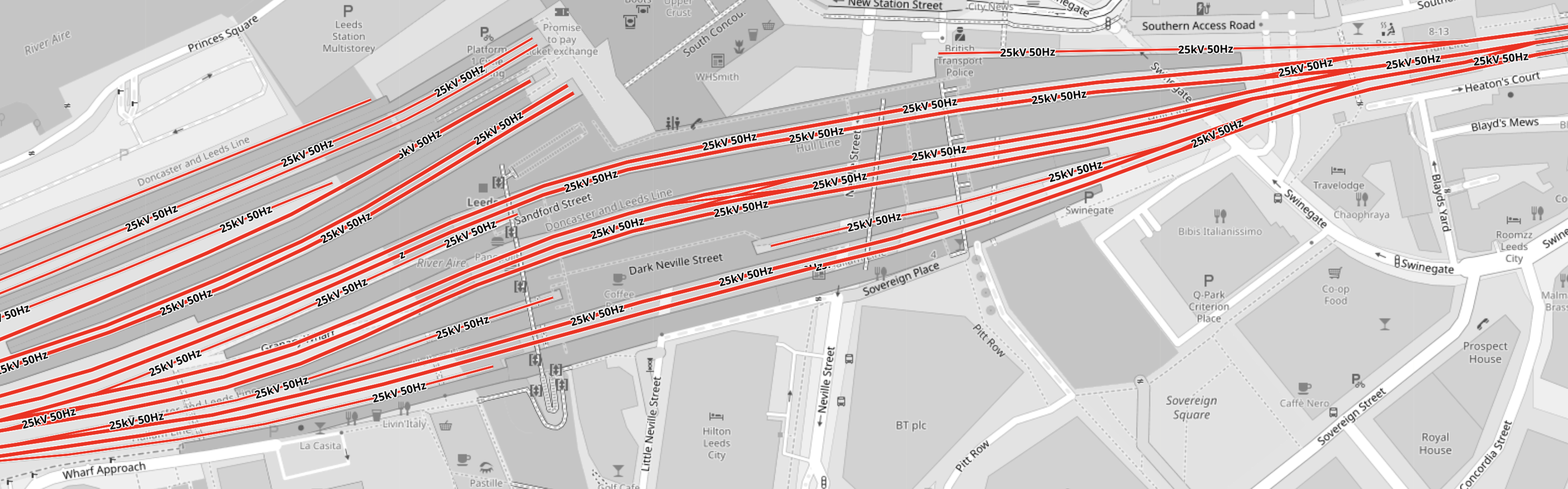
It would appear that the station is fully electrified and is an excellent battery-electric train hub, with twelve electrified bay platforms.
Conclusion
I can see a very comprehensive scheme being developed for Sheffield, based on a hub for battery-electric trains at Sheffield station.
Northern Powerhouse Rail – Connecting Sheffield To HS2 And On To Leeds
In this article on Transport for the North, which is entitled Northern Powerhouse Rail Progress As Recommendations Made To Government, one of the recommendations proposed for Northern Powerhouse Rail is connecting Sheffield to High Speed Two and on to Leeds.
Northern Powerhouse Rail’s Objective For The Sheffield and Leeds Route
Wikipedia, other sources and my calculations say this about the trains between Leeds and Sheffield.
- The distance between the two stations is 39 miles
- The current service takes around 40 minutes and has a frequency of one train per hour (tph)
- This gives an average speed of 58.5 mph for the fastest journey.
- The proposed service with Northern Powerhouse Rail will take 28 minutes and have a frequency of four tph.
- This gives an average speed of 84 mph for the journey.
This last figure of 84 mph, indicates to me that a fast route will be needed.
But given experience of 100 mph lines in other parts of the UK, 100 mph trains and infrastructure could make this demanding objective of twenty-eight minutes between Sheffield and Leeds a reality
Connecting Sheffield To High Speed Two
Sheffield is to be accessed from a branch off the Main High Speed Two route to Leeds.
This map clipped from High Speed Two’s interactive map, shows the route of the Sheffield Branch, from where it branches North West from the main Eastern Leg of High Speed Two.
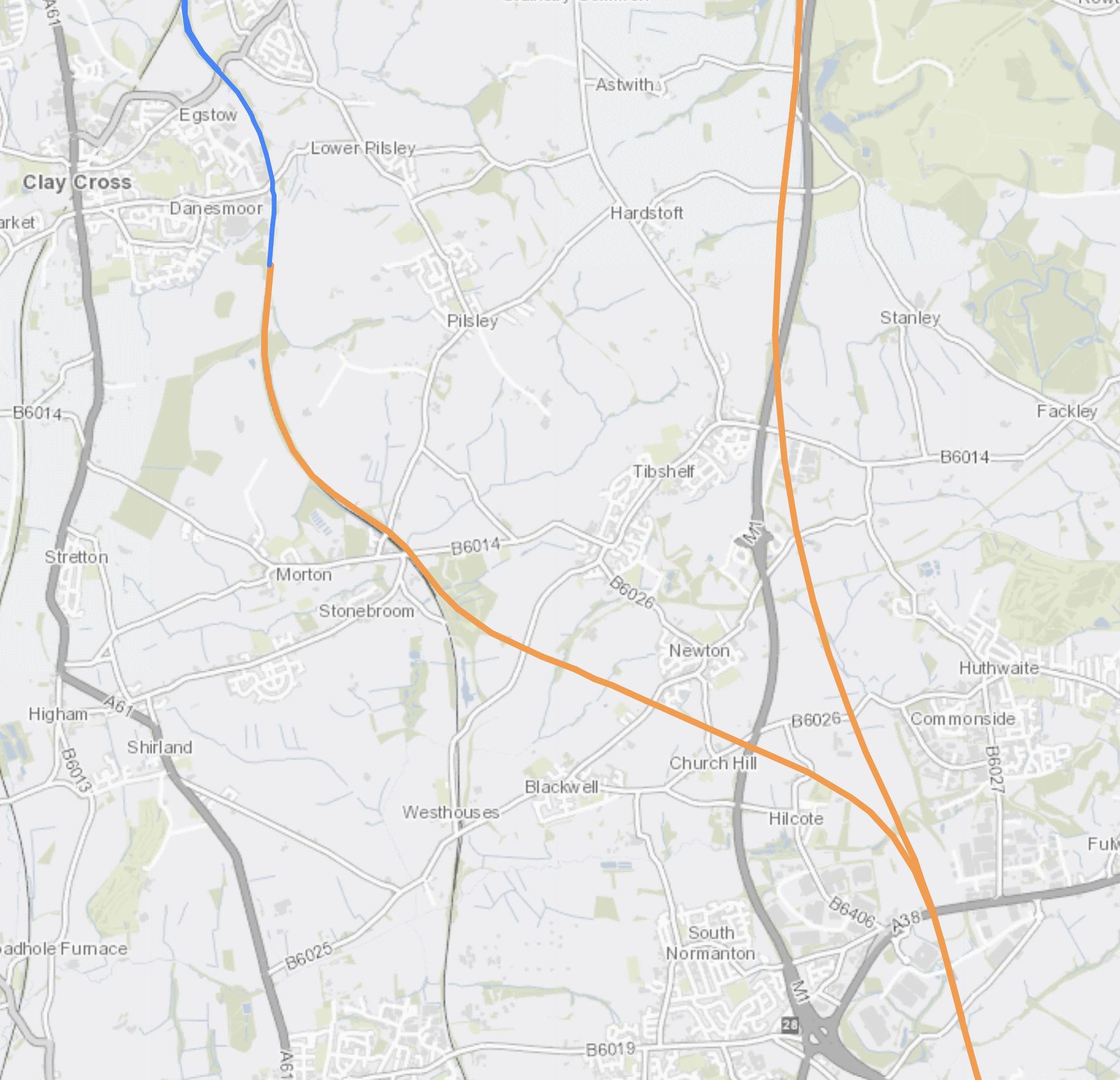
Note.
- Orange indicates new High Speed Two track.
- Blue indicates track that High Speed Two will share with other services.
- The orange route goes North to Leeds, along the M1
- The blue route goes North to Chesterfield and Sheffield, after skirting to the East of Clay Cross.
- The orange route goes South to East Midlands Hub station.
This second map, shows where the Erewash Valley Line joins the Sheffield Branch near the village of Stonebroom.
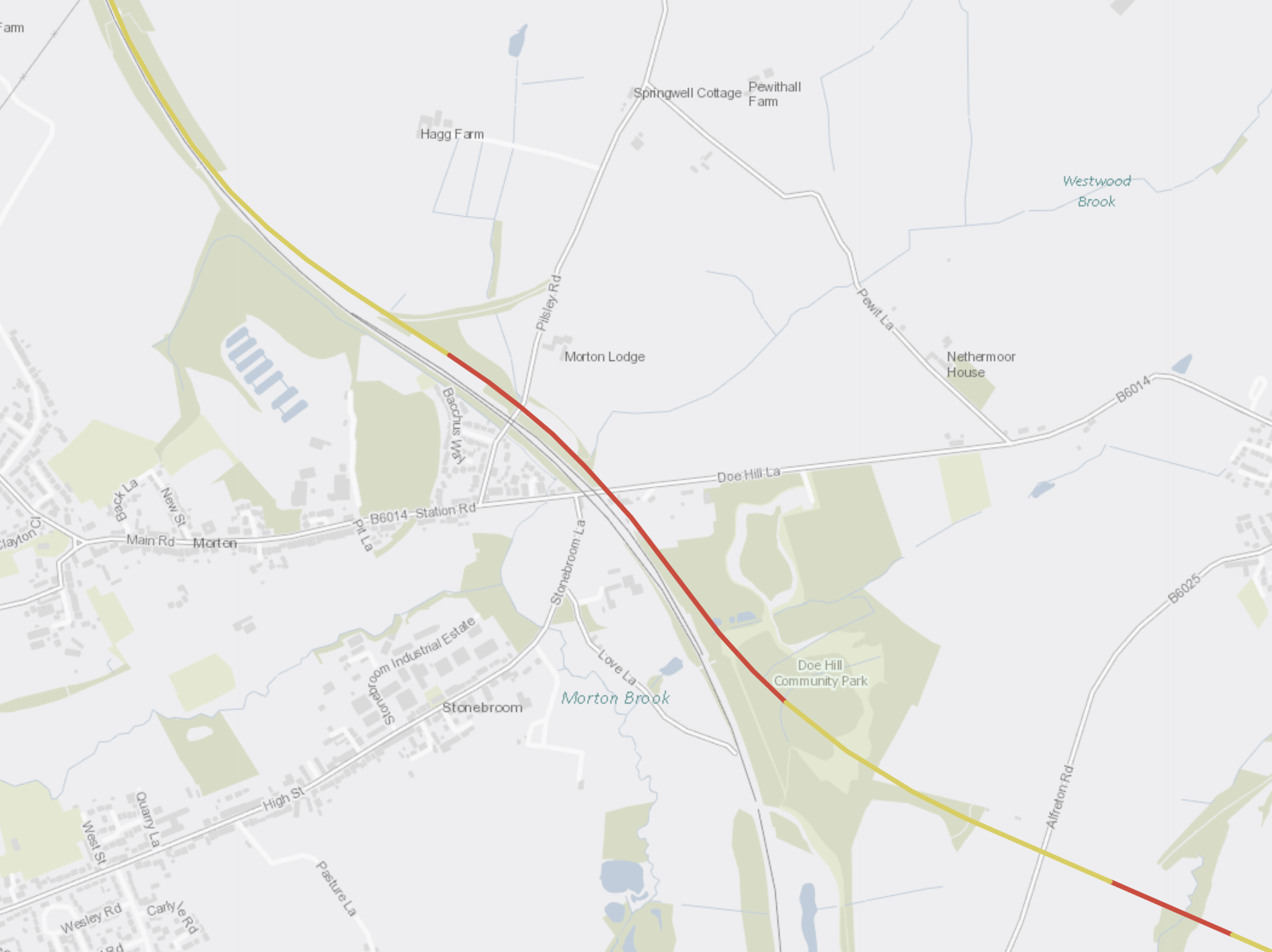
Note.
- Red is an embankment.
- Yellow is a cutting.
- The Sheffield Branch goes North-West to Clay Cross, Chesterfield and Sheffield
- The Sheffield Branch goes South-East to East Midlands Hub station.
- The Sheffield Branch goes through Doe Hill Country Park.
- The Sheffield Branch runs alongside the existing Erewash Valley Line, which goes South to Langley Mill, Ilkeston and the Derby-Nottingham area.
The Sheffield Branch and the Erewash Valley Line appear to share a route, which continues round Clay Cross and is shown in this third map.
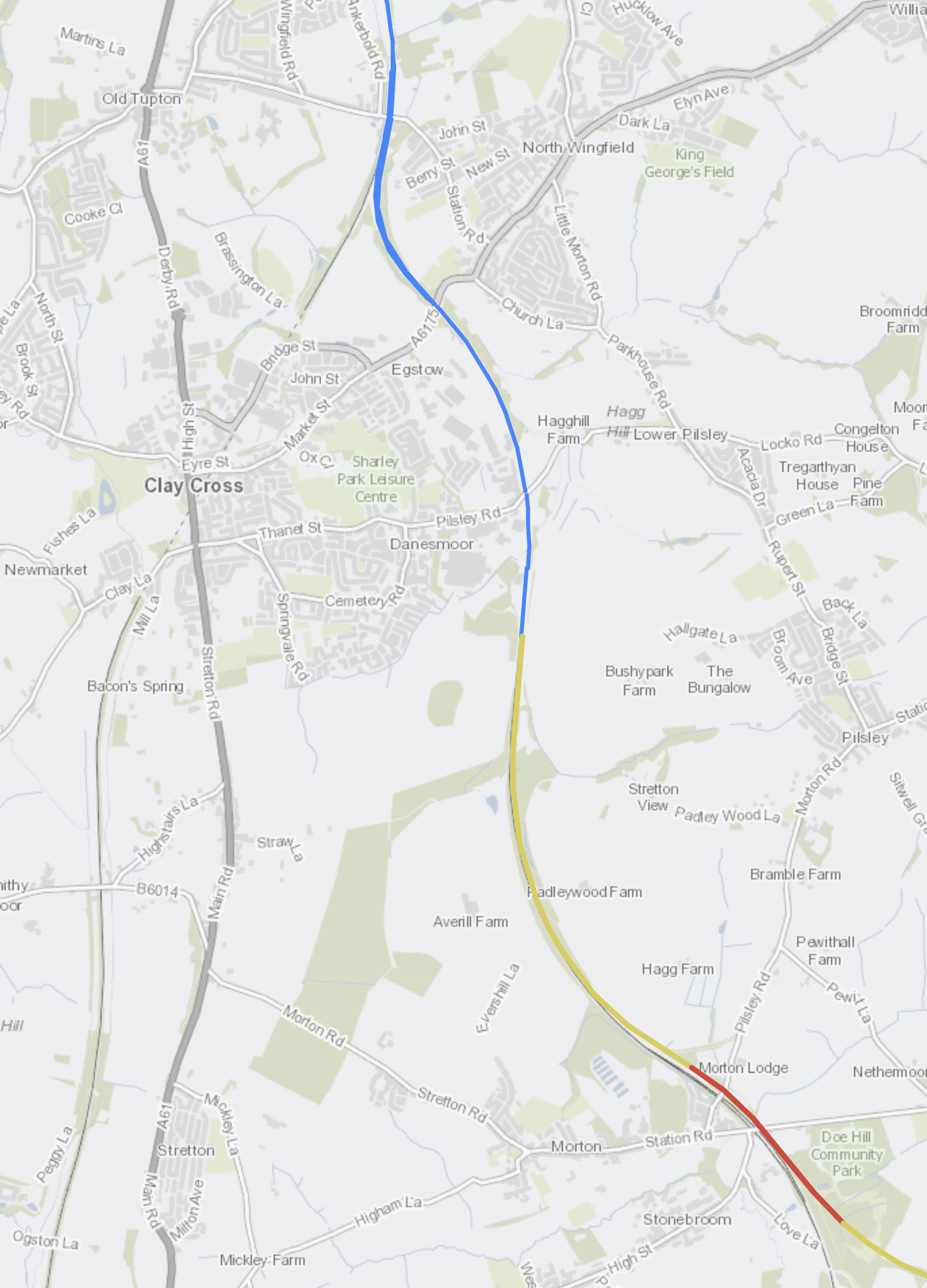
Note
- Doe Hill Country Park is in the South-East corner of the map.
- The dark line running North-South is the A61.
- Running to the West of the A61 is the Midland Main Line, which currently joins the Erewash Valley Line at Clay Cross North junction.
High Speed Two and the Midland Main Line will share a route and/or tracks from Clay Cross North junction to Sheffield.
This fourth map, shows where the combined route joins the Hope Valley Line to Manchester to the South West of Sheffield.
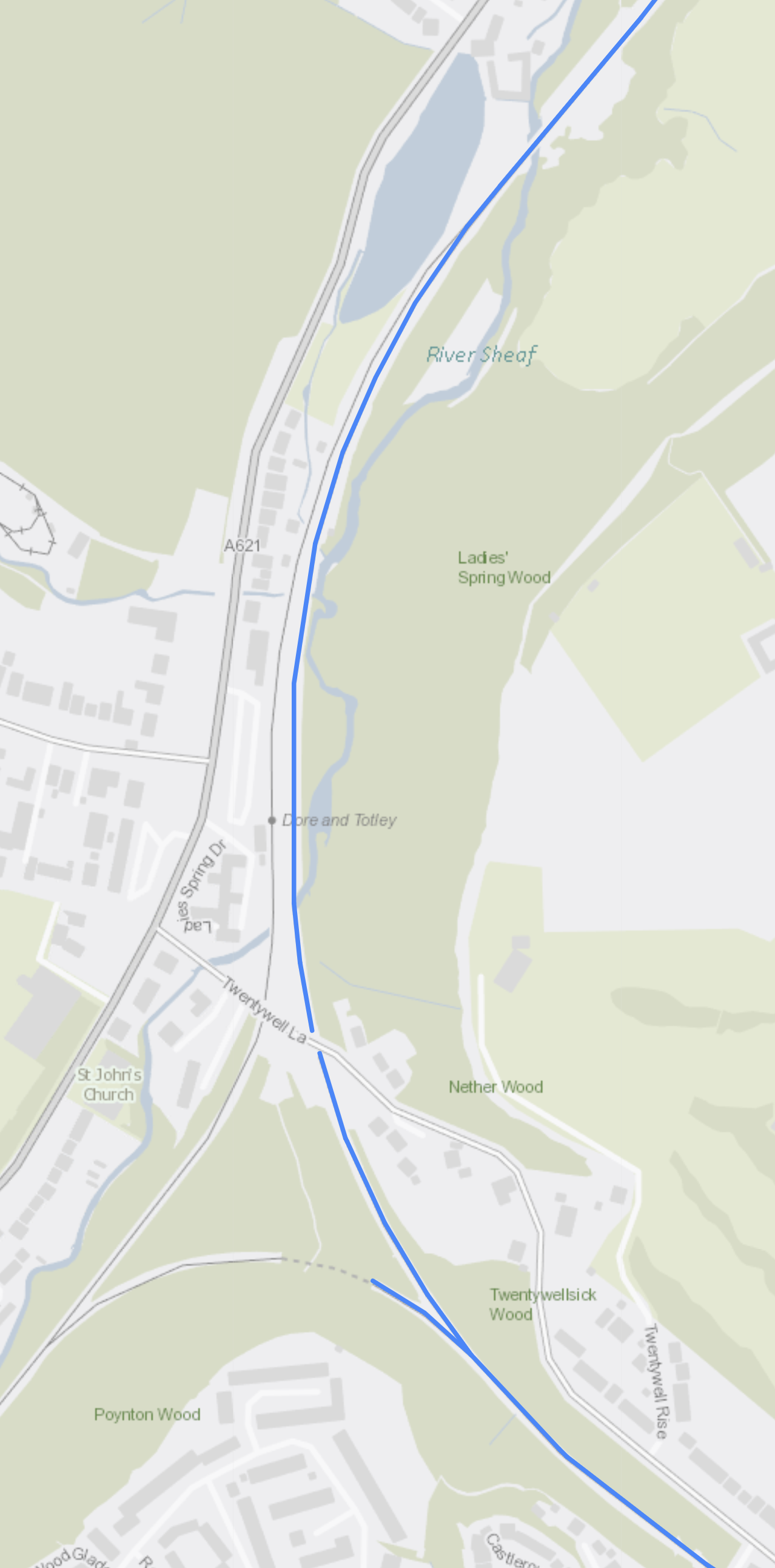
Note.
- Sheffield is to the North East.
- Chesterfield is to the South East,
- Totley junction is a large triangular junction, that connects to the Hope Valley Line.
These are some timings for various sections of the route.
- Clay Cross North Junction and Chesterfield (current) – 4 minutes
- Clay Cross North Junction and Sheffield (current) – 17 minutes
- Chesterfield and Sheffield (current) – 13 minutes
- Chesterfield and Sheffield (High Speed Two) – 13 minutes
- East Midlands Hub and Chesterfield (High Speed Two) – 16 minutes
- East Midlands Hub and Sheffield (High Speed Two) – 27 minutes
As Class Cross North Junction and Sheffield are 15.5 miles, this means the section is run at an average speed of 53 mph.
Can I draw any conclusions from the maps and timings?
- There would appear to be similar current and High Speed Two timings between Chesterfield and Sheffield.
- The various junctions appear to be built for speed.
The Midland Main Line will be electrified from Clay Cross North Junction to Sheffield, so that High Speed Two trains can use the route.
What will be the characteristics of the tracks between Clay Cross North Junction and Sheffield?
- Will it be just two tracks as it mainly is now or will it be a multi-track railway to separate the freight trains from the high speed trains?
- Will it have a high enough maximum speed, so that East Midland Railway’s new Class 810 trains can go at their maximum speed of 140 mph?
- Will it be capable of handling a frequency of 18 tph, which is the maximum frequency of High Speed Two?
Surely, it will be built to a full High Speed Two standard to future-proof the line.
Before finishing this section, I will answer a few questions.
Would It Be Possible For Class 810 Trains Fitted With Batteries To Run Between London St. Pancras And Sheffield?
East Midlands Railway’s new Class 810 trains could be fitted with batteries to become Regional Battery Trains with the specification, given in this Hitachi infographic.

Note.
- This would give the trains a range of 90 kilometres or 56 miles on batteries, if a number of diesel engines were exchanged for batteries.
- The trains would only be a few mph slower on batteries, than the current Hitachi trains on diesel.
- The Class 810 trains have four diesel engines. Is this to enable 125 mph running on diesel?
By perhaps replacing two diesel engines with batteries and using the remaining two diesel engines as range extenders or some other combination, I feel that Hitachi might be able to obtain a longer self-powered range for the train.
Consider.
- Between Sheffield and Clay Cross North Junction will be fully-electrified and at 15.5 miles, it will be long enough to fully-charge the batteries on the train.
- Between London St. Pancras and Market Harborough will be fully-electrified and at 83 miles, it will be long enough to fully-charge the batteries on the train.
- The section between Market Harborough and Clay Cross North Junction is not electrified and is 66 miles.
I feel that Hitachi and their partner; Hyperdrive Innovation can design a battery electric Class 810 train, that can travel between London St. Pancras and Sheffield, without using a drop of diesel.
A great advantage of this approach, is that, as more electrification is added to the Midland Main Line, as it surely will be, the trains will be able to use the wires to reduce journey times.
I believe there are two sections on the Midland Main Line. where traditional electrification is less likely.
- The bridge at the Southern end of Leicester station is low and would need to be rebuilt causing immense disruption to both road and rail in the city.
- Between Derby and Alfreton is the World Heritage Site of the Derwent Valley Mills. Will electrification be fought by the heritage lobby?
Both sections may eventually be electrified at some far off date in the future.
Why Is There A Spur Of Electrification At Totley Junction?
This map clipped from High Speed Two’s interactive map, shows the Southern Leg of Totley Junction, where the Hope Valley Line joins the Midland Main Line.
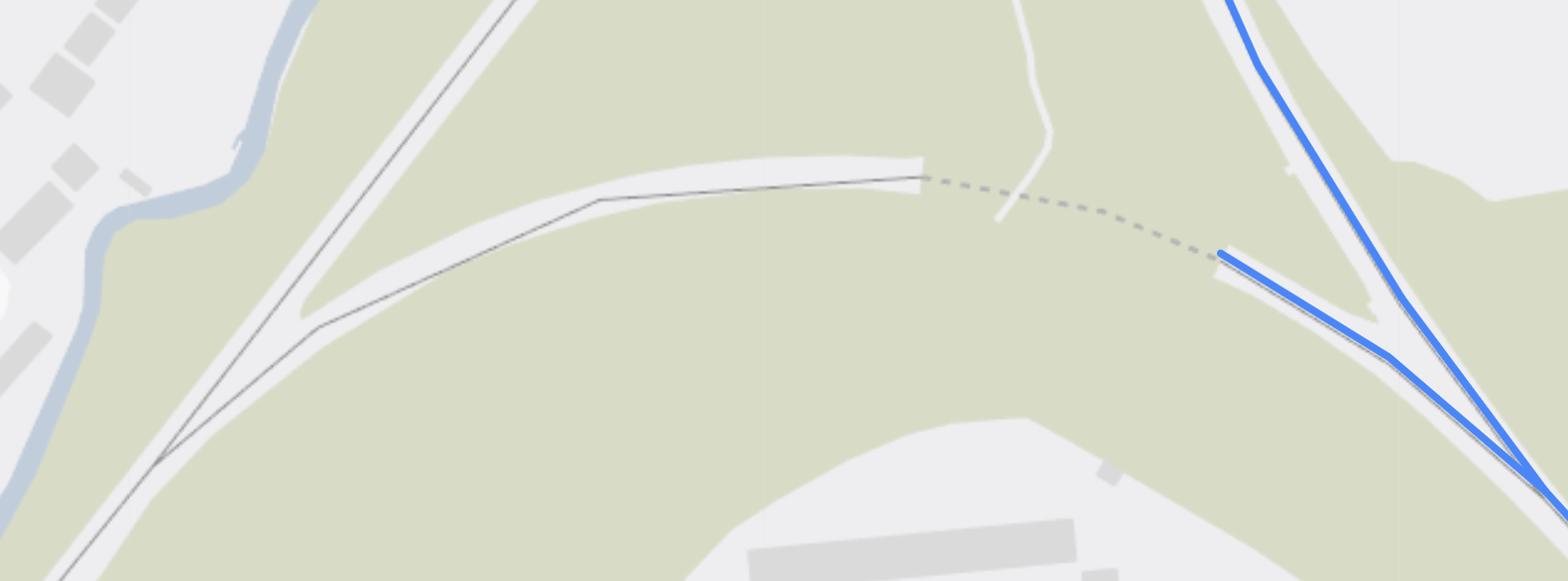
Note that a short length of electrification is shown, between the Midland Main Line and a tunnel on the Southern leg.
This Google Map shows the same area.

Note, that the line disappears into a tunnel.
- In Northern Powerhouse Rail -Significant Upgrades And Journey Time Improvements To The Hope Valley Route Between Manchester And Sheffield, I indicated, that running battery electric trains between Manchester and Sheffield would be a possibility and could be a way of meeting Northern Powerhouse Rail’s objectives for the route.
- A short length of electrification might help battery electric trains turn out to go South.
- I don’t think any passenger trains ever go that way now, but I have seen articles and heard complaints from passengers, that want a better service between Derby and/or Nottingham and Manchester.
- It might also help with the decarbonisation of freight trains to and from the quarries.
I also suspect, that if building High Speed Two in Manchester temporarily reduced the capacity of Manchester Piccadilly station, trains could use the Hope Valley Line to get to the city, as they have done previously, with Project Rio.
Accessing The Infrastructure Depot At Staveley
This map clipped from High Speed Two’s interactive map, shows the location of the infrastructure depot at Staveley.
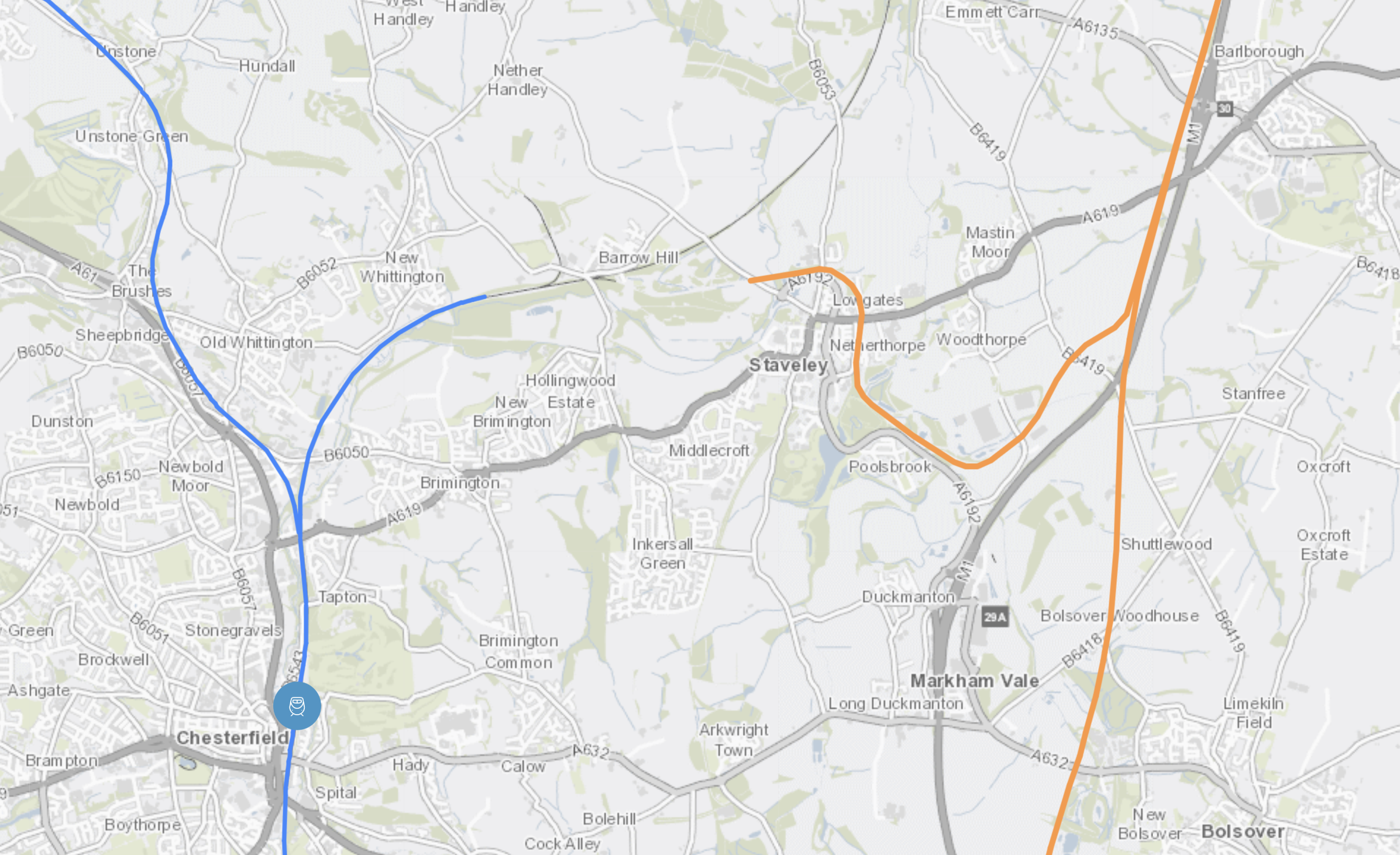
Note.
- Chesterfield is shown by the large blue dot.
- High Speed Two’s Sheffield Branch runs North from Chesterfield station.
- High Speed Two’s Eastern Leg runs down the Eastern side of the map.
- Two spurs from East and West go towards each other and would meet to the North of the town of Staveley.
The infrastructure depot will be located where they meet.
The route from the Sheffield Branch uses the Barrow Hill Line, which might be reopened as another passenger route between Chesterfield and Sheffield.
I wrote about this idea in Reinstatement Of The Barrow Hill Line Between Sheffield And Chesterfield.
If the line is being upgraded and electrified as far as Barrow Hill for the Infrastructure Depot, would it be worthwhile to create a new electrified route into Sheffield?
I also wrote in Could East Midlands Railway’s Liverpool And Norwich Service Avoid A Reverse At Sheffield By Using the Barrow Hill Line?, that the Barrow Hill Line might be an alternative route for the Liverpool and Norwich service.
When the railway routes in the area of the Infrastructure Depot are developed, I wouldn’t be surprised to see some routes changed.
Between Sheffield And Meadowhall Stations
One of the original designs for High Speed Two had it calling at Meadowhall station.
This map clipped from High Speed Two’s interactive map, clearly shows High Speed Two running across Sheffield.
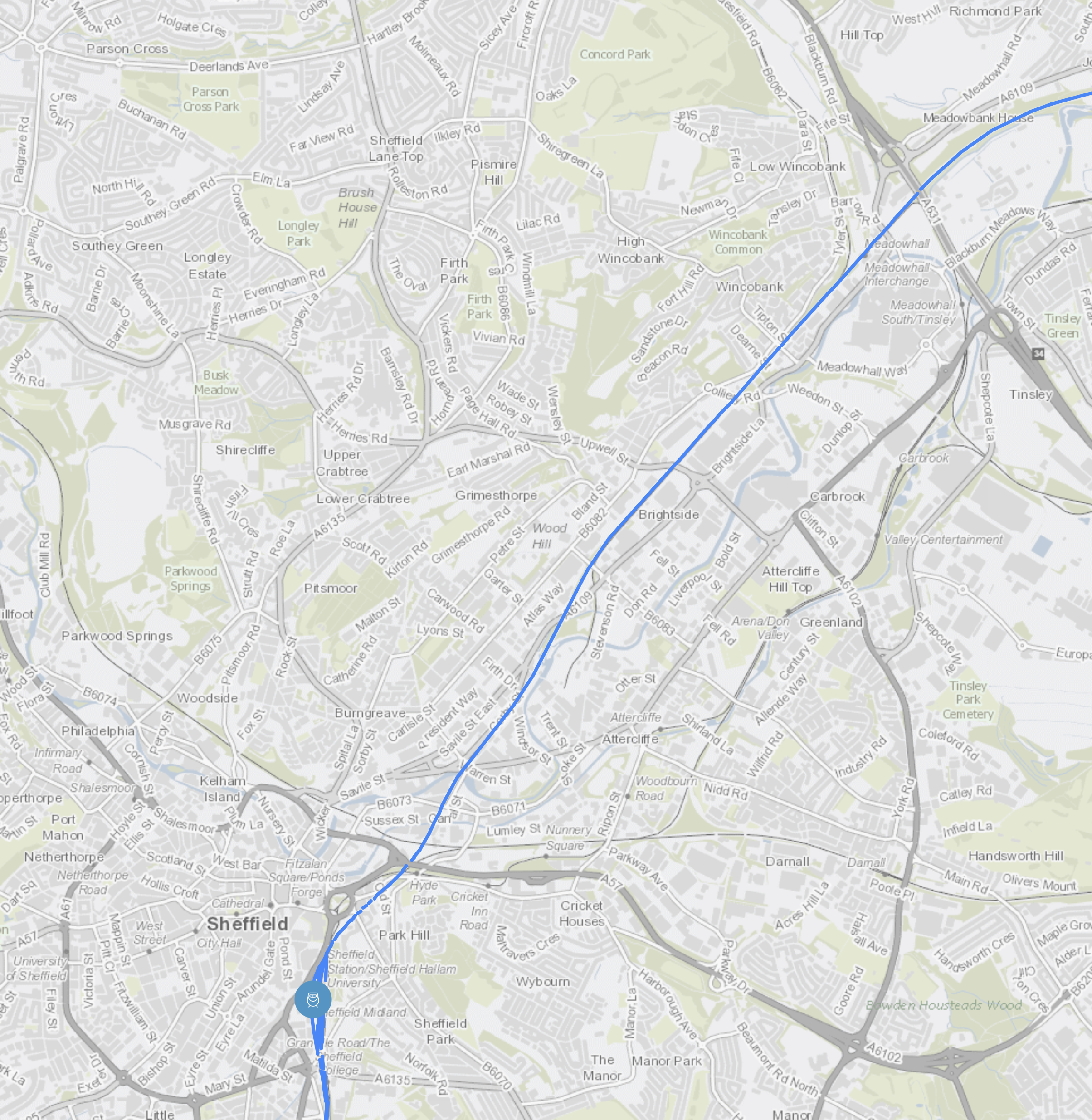
Note.
- Sheffield station is the big Blue dot in the South-West corner of the map.
- The M1 runs across the North-East corner of the map.
- The railway between Sheffield and Meadowhall stations already exists.
- Sheffield and Meadowhall stations are 3.5 miles apart and trains take seven minutes.
Is there any reason, why High Speed Two trains shouldn’t serve both Sheffield and Meadowhall stations, by just taking the existing line across the city?
Taking The Wakefield Line Towards Leeds
In extending to Meadowhall, High Speed Two’s route seems to be taking the current Wakefield Line.
This map clipped from High Speed Two’s interactive map, clearly shows High Speed Two passing through Sheffield and Rotherham and then going towards Leeds.
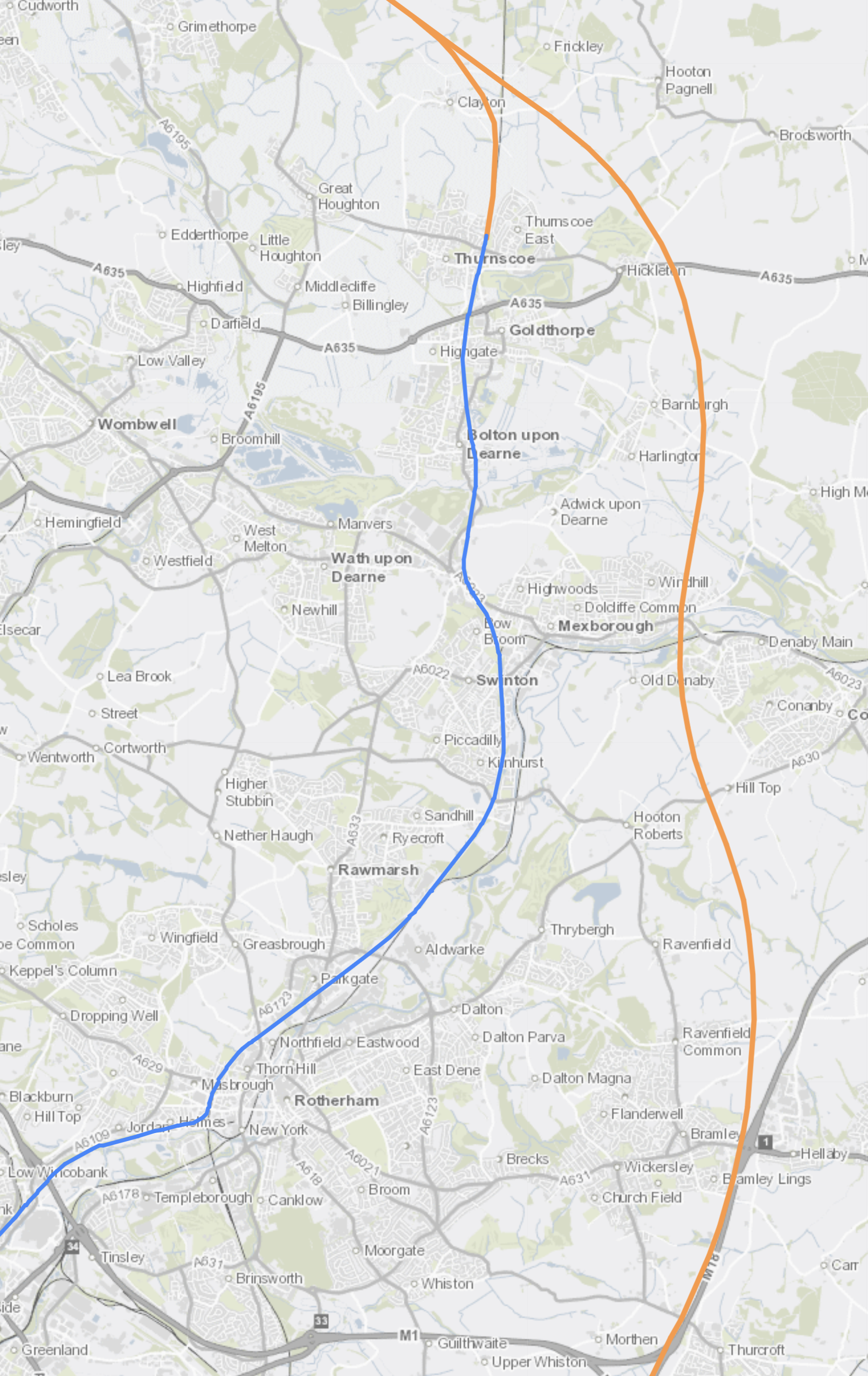
Note.
- Orange indicates new High Speed Two track.
- Blue indicates track that High Speed Two shares with other lines.
- The Wakefield Line is shown in blue and has stations at Meadowhall, Swinton, Bolton-upon-Dearne, Goldthorpe and Thurscoe.
- The main High Speed Two leg to Leeds is shown in orange.
It looks to me, that High Speed Two are aiming to provide a route, so that trains going to Sheffield can extend the journey to Leeds.
As Leeds will have three tph to and from London, why is this service being extended to Leeds?
I will explore a few reasons why in the next few sub-sections.
It’s Convenient For Running Trains
Consider.
- High Speed Two are saying London and Sheffield will be one hour and twenty-seven minutes.
- Northern Powerhouse Rail have an objective of Leeds and Sheffield in twenty-eight minutes.
- One hour and fifty-five minutes could be a convenient time for a London and Leeds service, as it could be a four hour round trip.
But High Speed Two are saying London and Leeds will be one hour and twenty-one minutes.
It looks to me, that it is a convenient way to serve Meadowhall, Rotherham, Bolton-upon-Dearne, Goldthorpe and Thurscoe stations
High Speed Two Through Rotherham
This map clipped from High Speed Two’s interactive map, clearly shows High Speed Two passing through Rotherham to the North of the Parkgate Shopping Park.
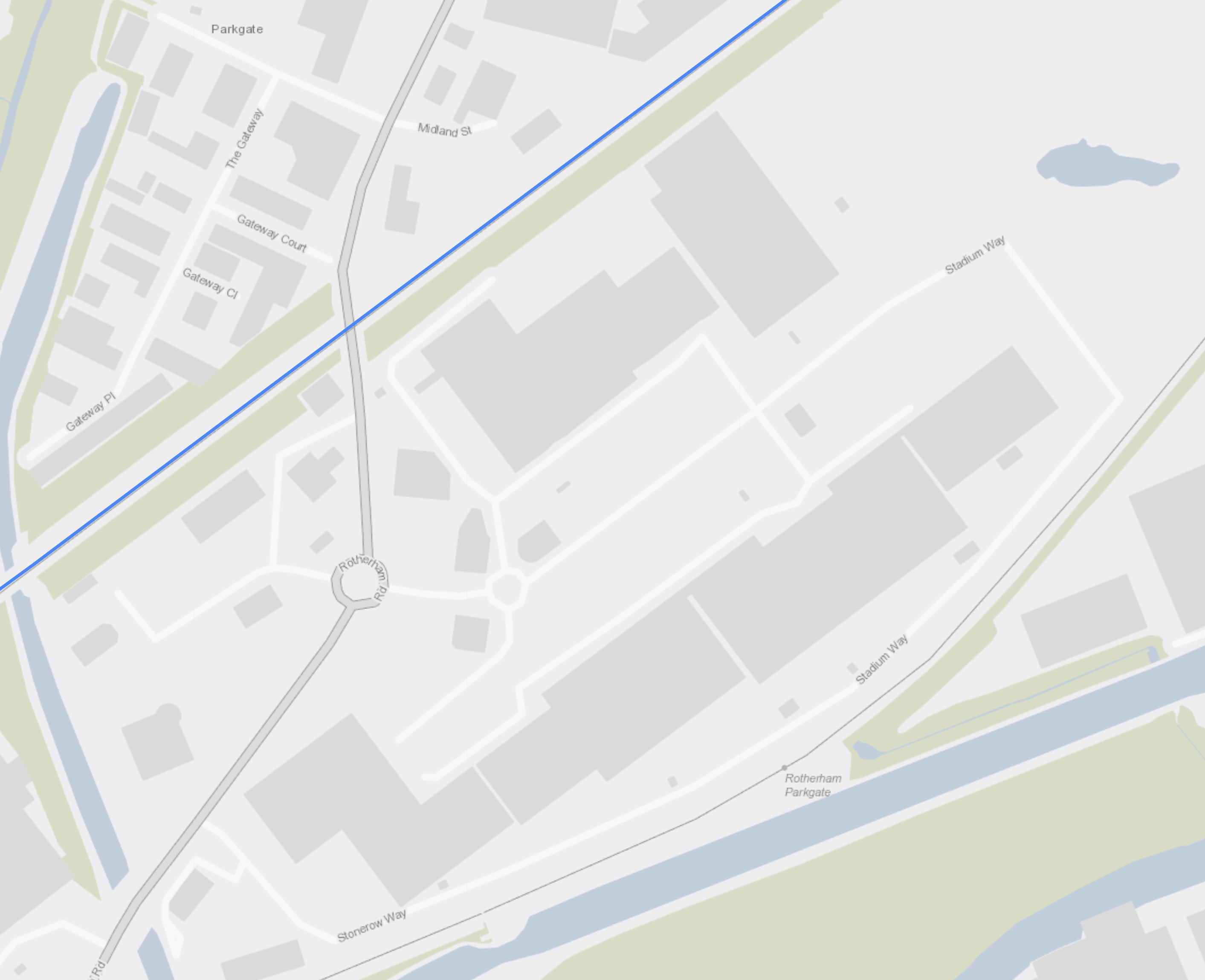
Note.
- High Speed Two is the bright blue line running North-East from the Western edge of the map.
- The grey blocks are the stores in the Shopping Park.
- The Rotherham Parkgate tram-train stop is marked.
This Google Map shows a similar area.
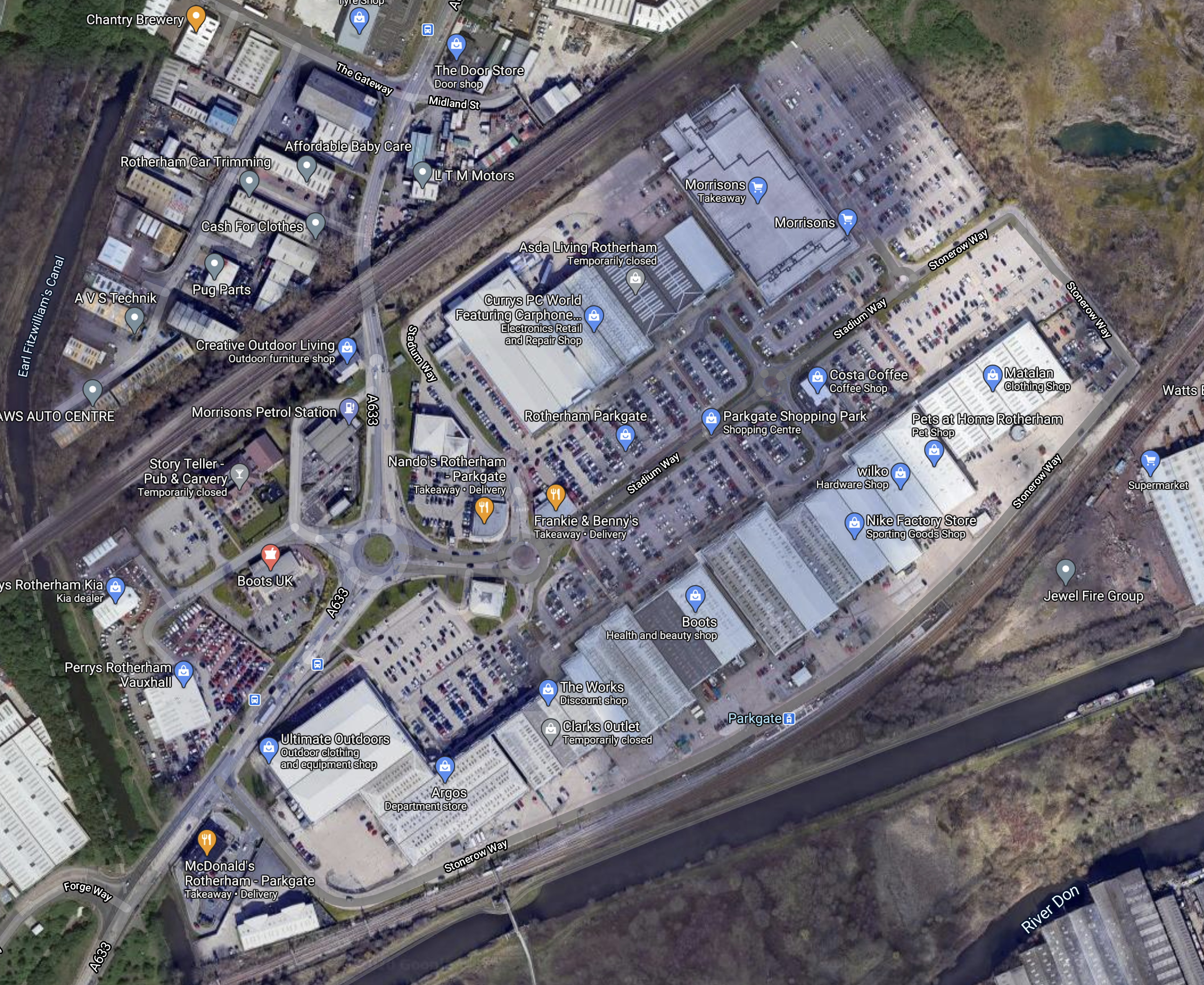
To the East of the Parkgate Shopping Park, is a large brownfield site, as this Google Map shows.

Could Rotherham have a station on the line North of this site?
- The rail line running SW-NE across this map is drawn in blue on High Speed Two’s interactive map.
- Rotherham Masborough station used to be in this area.
If High Speed Two is supposed to be a railway for all the people, or at least as many as possible, surely there should be a station in the town.
High Speed Two Through Bolton-upon-Dearne
In July 2019, I wrote a post called Sheffield Region Transport Plan 2019 – A New Station At Barnsley Dearne Valley.
So have High Speed Two taken on this feature of the Sheffield Region Transport Plan 2019, to add another station to their list of destinations?
Approach To Leeds
This map clipped from High Speed Two’s interactive map, clearly shows route High Speed Two will take to approach Leeds from the South East.
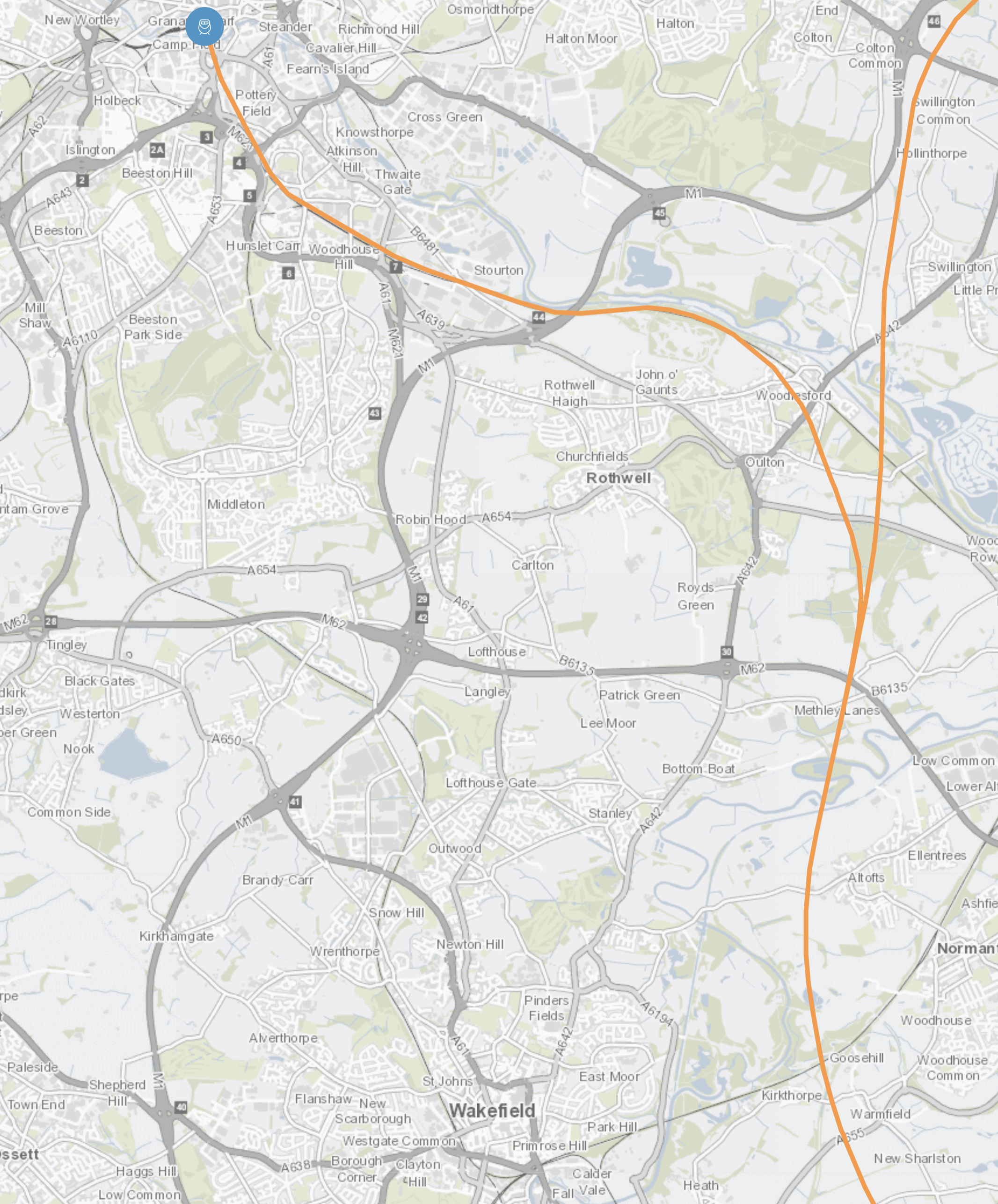
Note.
- Leeds station is the blue dot in the North West corner of the map.
- High Speed Two is shown in orange and continues North to York, where it joins the East Coast Main Line.
- Wakefield is in the middle at the bottom of the map and is on the Wakefield Line and the current route for LNER’s expresses from London.
It looks to me, that Leeds and Sheffield will eventually end up with two faster routes between the two cities.
- An upgraded Wakefield Line
- A route based on the Southern section of the Wakefield Line and the Eastern leg of High Speed Two route to Leeds.
If High Speed Two’s trains are to be able to get across Sheffield and call at Sheffield, Meadowhall, Rotherham and Barnsley Dearne Valley stations, then these conditions must be met.
- The trains must be High Speed Two’s Classic-Compatible trains or a train to a similar specification.
- Some platform lengthening might be needed to allow the two hundred metre long trains to call.
- The Wakefield Line must be electrified between Sheffield and just North of Goldthorpe station, where it will be able to join the link to the Eastern leg of High Speed Two.
It would probably be sensible to electrify the Wakefield Line all the way to Fitzwilliam station, from where the line is electrified all the way to Leeds.
This would enable the following.
- Electric trains to run between Sheffield and Leeds via Wakefield Westgate station.
- Would Northern Powerhouse Rail’s objective of a twenty-eight minute journey be achieved?
- East Midlands Railway could run their Class 810 trains between London St. Pancras and Leeds under electric power.
- High Speed Two could serve Leeds before the Northern infrastructure of the Eastern leg of High Speed Two is complete.
- High Speed Two could offer services to Wakefield, Barnsley and Rotherham via Sheffield.
I can see reasons for early upgrading of the Wakefield Line.
Conclusion
It appears that High Speed Two are planning an electrified route through Sheffield between Clay Cross North Junction on the Midland Main Line and Goldthorpe station on the Wakefield Line.
Once complete it would enable the following.
- Rotherham and Barnsley to have direct electric services to and from the capital.
- When East Midlands Railway introduce their new Class 810 trains, the electrification North of Clay Cross North Junction would mean faster services and less running on diesel power.
- I believe these Class 810 trains could run between London and Sheffield, if their four diesel engines are replaced with batteries, which would power the trains between Clay Cross North Junction and Market Harborough.
- The electrification at Sheffield would allow battery electric trains to work between Manchester and Sheffield as I outlined in Northern Powerhouse Rail -Significant Upgrades And Journey Time Improvements To The Hope Valley Route Between Manchester And Sheffield.
I think it is a good plan.
Project Management Recommendations
It is my view that the following projects should be started as soon as possible.
- Electrification between Clay Cross North Junction and Sheffield station.
- Electrification of the Wakefield Line between Sheffield and Fitzwilliam stations.
- Provision of new stations at Rotherham and Barnsley Dearne Valley on the Wakefield Line.
These projects could deliver worthwhile improvements in services in a couple of years, rather than the tens of years for High Speed Two.
Sheffield Region Transport Plan 2019 – A New Station At Barnsley Dearne Valley
This station will be to the East of Barnsley in the vicinity of the village of Goldthorpe.
In Changes Signalled For HS2 Route In North, I used this map of the proposed High Speed Two and Northern Powerhoiuse routes in East Yorkshire.
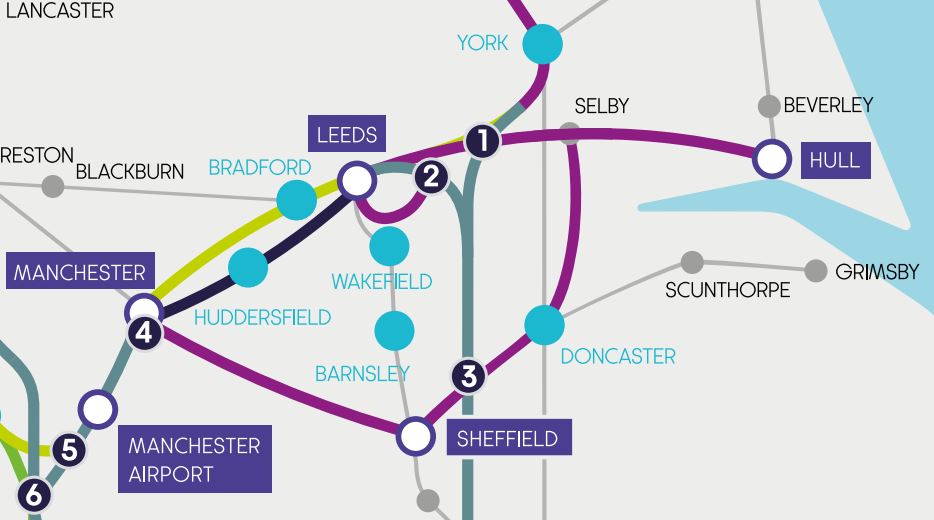
Note, these points about High Speed Two.
- It by-passes Sheffield and Barnsley and enters Leeds from the East, via Junction 2.
- It goes via Junction 1 to link up with the East Coast Main Line to York, Newcastle and Edinburgh.
- It links to the Leeds and Hull route at Junction 1.
- It has a Southern route via Chesterfield directly into Sheffield.
The current main route between Sheffield and Leeds is the Wakefield Line.
- It is thirty nine miles long.
- It is not electrified, except North of Wakefield Westgate station
- Trains stop at Meadowhall, Rotherhall Central, Swinton, Bolton-on-Dearne, Goldthorpe, Thurnscoe, Moorthorpe, Fitzwilliam, Sandal & Agbrigg, Wakefield Westgate and Outwood.
- Services take an hour and thirteen minutes
- The route is not very busy, with only, a total of around 4-6 trains per hour (tph) in both directions.
The Northern Powerhouse Rail improvements will see four tph between Sheffield and Leeds
- Journey times will be twenty-eight minutes.
- Some trains will extend past Sheffield to London St. Pancras.
- These fast services will probably stop less often.
- They will probably be backed up by stopping trains at perhaps two tph.
- I suspect the trains will be 125 mph bi-mode trains with batteries.
- I doubt there will be full electrification, as train developments will achieve the same objectives, in a more affordable manner.
- There will be full digital signalling to increase the capacity.
So where does the proposed Barnsley Dearne Valley station fit in?
- It will be on both the Wakefield Line and High Speed Two.
- It will have fast local trains between Leeds and Sheffield at four tph.
- It will have High Speed Two services between London and Leeds via East Midlands Hub at a frequency of at least two tph.
- It will have High Speed Two services between London and Newcastle via East Midlands Hub and York at a frequency of st least two tph.
- As I wouldn’t be surprised to see a Turn-Up-And-Go service on major legs of High Speed Two, will Barnsley Dearne Valley have four tph?
- Stopping trains to and from Sheffield could be at a frequency of four tph and be tram-trains.
The station would be a quality one, with ,lots of parking.
Barnsley would be welcomed to the Twenty-First Century.
I also believe, that the Wakefield Line could be improved, sooner rather than later.
I have flown my virtual helicopter along the route between Rohterham Central and Fitzwilliam stations.
- It is at least double-track all the way.
- It would appear to be fairly straight.
- There is plenty of room on either side, so third and possibly fourth tracks could be added.
- There are no level crossings and very few bridges.
- The stations are simple, but could be easily upgraded to full step-free access.
- Electrification could be a lot easier than some of the TransPennine routes.
So one way to give early benefits could be.
- Electrify between Sheffield and Fitzwilliam.
- Improve line speed to at least 100 mph and possibly 110-125 mph.
- Make all stations step-free.
- Build the Wakefield Line station at Barnsley Dearne Valley.
- East Midlands Railway could run two tph between Leeds and Sheffield using 125 mph bi-mode trains, with stops at Barnsley Dearne Valley, Swinton and Rotherham Central.
- Perhaps one tph could be between Leeds and London.
- Extend the Sheffield tram-train to Barnsley Dearne Valley.
I don’t think much of the engineering would be difficult and an opening date of 2023 would probably be possible.
The proposal would give these advantages.
- Twenty-eight minutes journeys between Leeds and Sheffield at a frequency of four tph.
- One or possible two tph between Leeds and London calling at Barnsley Dearne Valley and Rotherham Central.
- Extension of Leeds local electric trains to Barnsley Dearne Valley.
- A four tph tram-train service between Sheffield and Barnsley Dearne Valley.
- A direct service between Barnsley Dearne Valley and Doncaster is also a possibility.
The idea of a station at Barnsley Dearne Valley is a brilliant idea.
The Penistone Line And Rotherham Tram-Train Trials
The Penistone Line Tram-Train Trial
The Penistone Line from Sheffield to Barnsley, Penistone and Huddersfield was the line originally selected for the tram-train trial.
In the Wikipedia entry for the line, this is said about the tram-train trial.
On 18 March 2008, the Department for Transport released details of a proposal to trial tram-trains on the Penistone Line, the first use of such vehicles in the UK. The trial was to start in 2010 and last for two years. Northern Rail, the operator of passenger services on the line, asked potential manufacturers to tender for the design and construction of five new vehicles, which Northern Rail would subsequently lease. In addition, Network Rail planned to spend £15m modifying track and stations to make them compatible with the new vehicles.
However, it was announced on 15 September 2009 that a city tram-train trial between Rotherham and Sheffield would replace the Penistone Line scheme.
More about the trial is said in this article on Rail News, which is entitled Penistone Line Is Chosen For £24m Tram Trains Trial. In particular, this is said.
One of the biggest initial tasks is to set a specification for the building of the five diesel-electro hybrid tram trains at a cost of £9 million. The trains will have to be equipped with braking systems suitable for on-street running and a Train Protection Warning System which is required for running on lines with ‘heavy’ rail passenger and freight trains.
The article was written in 2008 and Chemnitz hybrid Citylink tram-trains didn’t enter service until 2016.
So was the trial on the Penistone Line a disaster before it even started?
It had the following problems.
- It was expecting a diesel-electric hybrid tram to be designed and built before 2010.
- A long distance was involved.
- The track-work needed to connect to the Sheffield Supertram could have been incredibly complicated.
- The first all-electric Citylink tram-trains weren’t delivered to Karlsruhe until May 2014, which was seven months late.
For these and other reasons, I think that the decision of the trial to be delayed and to use Rotherham, was a prudent decision.
The Rotherham Tram-Train Trial
Consider these characteristics of the current trial, between Cathedral and Rotherham Psrkgate.
- The tram-trains are virtually standard Karlsruhe Citylink tram-trains, adapted for UK 25 KVAC and painted blue!
- A simple chord connecting the two systems.
- A few miles of electrification, that could be powered by either 750 VDC or 25 KVAC.
- Modification of the recently-built Rotherham Central station.
- Building of a new terminal tram stop at Rotherham Parkgate.
It’s a simple plan, but one that covers a lot of design possibilities and has few, if any, risky elements, that haven’t been done in the UK or Karlsruhe.
The following can be tested.
- The Class 399 tram-trains on the Sheffield Supertram network and an electrified main line.
- Passenger entry and exit at Rotherham Central station and all over the Supertram network.
- Operation under both 750 VDC or 25 KVAC.
- Signalling systems on both tram and main line networks.
The one thing that can’t be tested is a diesel hybrid tram-train as they have in Chemnitz, as they haven’t ordered any!
But if they did want to order some, they could easily be tested between Cathedral and Rotherham Parkgate.
Conclusion
The original plan to use the Penistone Line and diesel-electric tram-trains was impossible.
Network Rail might have got this one right at the second attempt.
They could even run a UK version of the Chemnitz hybrid tram-train on the test route between Sheffield and Rotherham.
Progress On The Sheffield-Rotherham Tram-Train – October 13th 2017
It is only a couple of weeks since I wrote Progress On The Sheffield-Rotherham Tram-Train and progress seems to have accelerated in that time.
The Class 399 tram-trains are now running between Cathedral and Herdings Park, as I reported in Class 399 Tram-Trains In Service.
Progress On The Tinsley Chord
I took these pictures at Tinsley Chord, where the track connects theMeadowhall branch of the Supertram to the freight line to Rotherham.
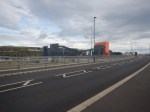
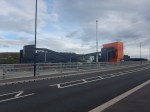
There isn’t really much to see, as trees obscure any good view from the road.
This Google Map shows the area.
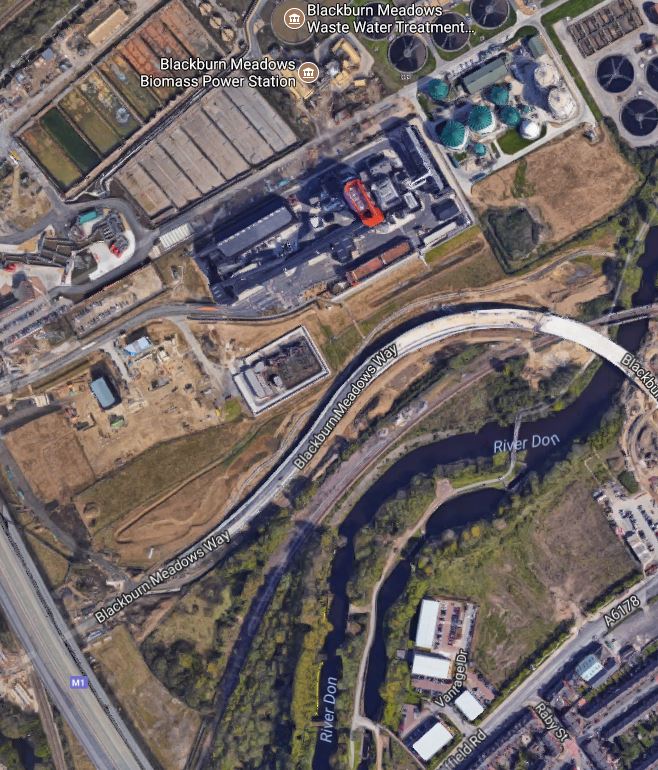
Note.
- The Tinsley Viaduct carrying the M1 cutting across the bottom-left corner of the map.
- Blackburn Meadows, with the Water Treatment Plant and Biomass Power Station, at the North of the map.
- The Blackburn Meadows Way linking into Meadowhall.
- The freight line to Rotherham runs to the outh of this road.
- The Supertram running along the West side of the motorway.
The Tinsley Chord, that links the tram and freight lines is hidden under the viaduct.
I did get some more pictures later.

The Tinsley Chord appears to be double-track, where it will join the existing tram line.
The Wires Are Going Up
These pictures show that the wires are going up between the freight line and Rotherham Central station.

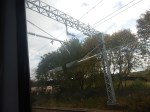
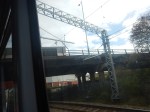
The gantries seem much more main line than tram.
But the Class 399 tram-trains, won’t care if they contain 750 VDC or 25 KVAC. Changing the volts is a lot easier than changing the catenary.
Rotherham Station
These pictures show the current state of Rptherham Central station.
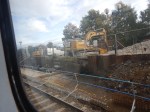
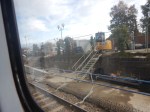
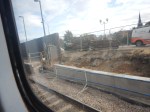


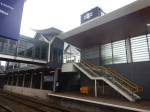
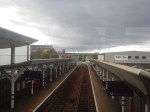
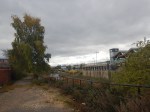
Note.
- The wires are going up.
- The low-level platform extensions need to be completed.
- Trains will use the high end of the platforms and tram-trains the low end.
Karlsruhe have much worse platform height problems, as they have two generations of tram-trains and German trains that need low platforms to cope with.
Walking To The Parkgate Shopping
I thought about using a taxi, but in the end, I walked to the Parkgate Shopping, as the weather was sunny.
I did manage to get an idea of the distance in a thirty minute walk.
Parkgate Shopping
Parkgate Shopping is the sort of shopping centre I rarely visit.
I am a guerrilla shopper, who decides what he needs and then chooses where to go and buy it. Being a coeliac, food shopping usually requires a couple of shops. One of these must be a Marks and Spencer, as their gluten-free staples like bread, biscuits, beer and muesli are better than most.
These days, I don’t drive, but a couple of doctors have told me, they reckon I could get my licence back.It’s just that not having a car, removes a whole chunk of hassle from your life. I don’t want it back!
I also often create shopping with a visit to either a friend, a restaurant, a museum or perhaps even a dentist.
I’ll often plan my day, so I come home via somewhere like the Angel, Moorgate, Eastfield or King Cross, where I pick up my supper.
Parkgate might be a place to go if it fitted my target requirements and I lived locally.
But it would need decent public transport like Meadowhall down the riad.
The Tram Stop At Parkgate Shopping
These pictures show the railway that passes Parkgate Shopping and the tram-train stop being built.

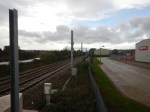
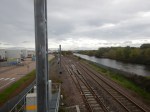

The stop needs finishing and a route to the stops would need to be created.
But it looks like the designers have developed a simple one platform stop capable of handling the required three trains an hour.
Conclusion
The project appears to be coming towards the end.
There are several things that need to be completed.
- The catenary.
- The connection of the tracks at the Tinsley Chord.
- Rotherham Central station pltforms
- Parkgate Shopping tram stop.
Then it would need to be tested.
If I have a question about the project, I wonder how they managed to be so late and over budget, as IS reported in this article in the Guardian, which is entitled Sheffield to Rotherham Tram-Train Is Five Times Over Budget, Says NAO.
My gut instinct tells me, that there are a few problems with this project, that would have been avoided by a little bit more thought before it started.
But I think it’ll come out alright on the end.
Progress On The Sheffield-Rotherham Tram-Train
I took these pictures in Sheffield and Rotherham, whilst trying to take pictures of Class 399 tram-trains.
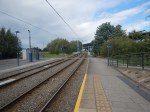
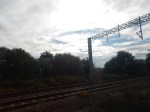
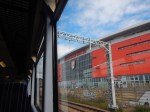

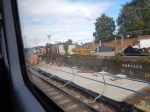
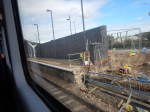
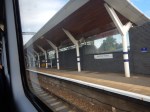
Note.
- The heavy-weight gantries for the electrification, which I suspect would support 25 KVAC electrification.
- It appears simple bi-level platforms are being built at Rotherham Central station.
- Could a stop being put at the New York stadium?
It certainly doesn’t seem to be an expensive system.
Single Or Double Track Electrified At 25 KVAC
The heavy rail route which is both single and double-track is electrified using standard 25 KVAC electrification.
Simple Voltage Changeover
In Karlsruhe, a ceramic rod is used to connect the overhead wires of different voltages. The pantograph of the tram-train runs on this rod, as the vehicle passes between the two voltages.
The different voltages would be handled automatically on the tram-train.
Kinetic energy or a battery will take the tram-train over the very short dead section.
I didn’t see it, but I suspect a similar system is used on the Tinsley Chord in Sheffield, where the two voltage systems meet.
The advantage of this simple system, is that voltage changeover can be completely automatic, with the driver only monitoring the changeover.
Simple Bi-Level Platform Extensions
This technique is used in Karlsruhe, where they have myriad problems due to various classes of tram-trains and conventional trains.
Modern construction methods will certainly help here.
How Did Network Rail Manage To Spend So Much Money?
The only feasible positive explanation is that this tram-train trial is being very comprehensive and covers all possible UK operations.
- The tram-trains are tested on 25 KVAC at Rotherham.
- Single and double-track.
- The tram-trains are tested on 750 VDC all over Sheffield.
- The tram-trains are tested on sharp curves and climbing hills on the Sheffield Supertram network.
- The voltage changeover is thoroughly tested on the Tinsley Chord.
- Platform designs get a rigorous test.
If the tram-train passes these tests and the regulators and operators like it, it’ll be passed for the UK network.
Is The Rotherham Trial A Tram-Train Or A Train-Tram?
When going from Sheffield to Rotherham, the Class 399 train, starts as a tram and changes to a train on the Tinsley Chord.
But when going from Rotherham to Sheffield, the vehicle starts as a train and changes to a tram.
So I suppose it’s both and it changes over where the voltage changes on the Tinsley Chord.
But just as in the Rotherham trial, provided there is an overhead wire with an acceptable voltage, the Class 399 tram-trains can run on any track, be it for trams or trains.
On What Routes Could A Class 399 Train Run?
There are several possibilities.
Extending An Existing Tram Network On A Heavy Rail Line
The tram-train runs normally on a standard tram line and then the route is extended on a heavy rail line, which is electrified with 25 KVAC overhead wires.
This is what is being done at Rotherham.
More possibilities exist in Sheffield and probably on other systems like Birmingham, Blackpool, Edinburgh, Manchester and Nottingham.
Creating A Tram Link Across A Town Or City
Suppose a town or city has two electrified stations on opposite sides. Perhaps one handles trains from the West and the other handles trains from the East.
If a tram route can be created between the two stations, which is connected to the lines at the station, then tram-trains can run across the town or city.
This has been done in Karlsruhe and other European cities, but I doubt we’ll see a cross-city link like this in the UK for a decade or two.
Creating A Tram Link Between Two Electrified Lines
This is similar to the previous application, except that the tram route might be in a rural area.
One possibility might be from Cambridge to Marks Tey along a rebuilt Stour Valley Railway.
Running A Branch On A Heavy Rail Line As A Tram
Creating a branch line to tram standards should be cheaper than creating it to heavy rail standards.
The proposed Glasgow Airport Tram-Train could be built this way, by building a tram track from the Inverclyde Line to the Airport.
The branch would have the following characteristics.
- Segregated single-track from the Inverclyde Line
- 750 VDC overhead electrification.
- Low floor tram-trains.
- Simple stations.
The tram-trains could run as normal electric trains from Glasgow Central station to West of Paisley St. James station, where they would take to the branch line and run as trams to the Airport.
As the performance of a Class 399 tram-train is not much slower than the current Class 314 trains that work some services on the Inverclyde Line, I feel that fitting the tram-train service into the service pattern on the line would be possible.
I estimate that a round trip from Glasgow Central to the Airport could be done within an hour, which would mean that to provide an adequate four tram-trains per hour, would require four vehicles.
Two other airports could be served in this way; Leeds and Liverpool
- Leeds Airport would require electrifying as far as Horsforth station, where a tram track would lead to the Airport.
- I suspect that the tram-trains could not only connect Leeds to the Airport, but Bradford as well.
- Liverpool Airport from Liverpool Lime Street services would change to a tram at Liverpool South Parkway station.
I think we’ll be seeing tram-trains used for services like these.
Consider these points.
- A suitable station on the electrified network is needed as a terminus.
- A suitable junction must be possible between the branch and the electrified network.
- Any number of stops could be built on the branch.
- Simple tram-style 750 VDC overhead wires can be used, which would be less visually intrusive.
Some schemes will be simple like perhaps the Slough to Windsor and Eton Line and others would be more complicated.
Conclusion
In a year or so’s time, we’ll know if tram-trains are another method of expanding and improving the UK’s rail network.
Electrification At Rotherham
These pictures show some of the electrification gantries around Rotherham Central station.
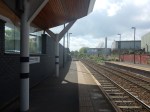
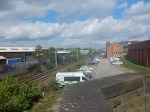
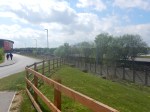
The overhead gantries would appear to be Network Rail’s standard for 25 KVAC, rather than the lighter-weight structures used on the Sheffield Supertram for their 1500 VDC.
So are Network Rail future-proofing the gantries for later conversion to 25 KVAC or are they being wired to that voltage, so that the tram-trains can be tested on the 25 KVAC as well?
The latter would be prudent, so that the problems and strengths of dual-voltage 25 KVAC/1500 VDC tram-trains can be assessed.
However, as I returned to Sheffield later, it appeared that the line connecting Rotherham and Sheffield had both heavy-weight and light-weight gantries in place.
Could there be a last minute change of project scope to include 25 KVAC running in the Sheffield tram-train trial, which also explains the timing of the rebuilding of the College Road Bridge?
This is said under Future in the Wikipedia entry for the Sheffield Supertram.
A tram-train extension to Rotherham is currently under construction and is scheduled to open in 2018, with a fleet of seven Vossloh Citylink Class 399 tram-trains in a UK first. This will involve trams operating on Network Rail’s Dearne Valley Line from Meadowhall Interchange to Rotherham station with a short extension to Rotherham Parkgate Shopping Centre. The proposed station will be a combined tram stop and railway station.[10] It is also planned that Rotherham Parkgate will be the hub for longer distance inter regional services,[11] while Central station will be the hub for local, Yorkshire based services. To cater for the tram train services, Rotherham Central will have a third platform built. It is thought that constructing the station will cost around £14 million (£53 million including the railway service to Leeds) and deliver economic benefits worth over £100 million. A study has concluded that it is not worth expanding Rotherham Central railway station because it would cost £161 million to expand the station but only deliver benefits worth £76 million. This is why constructing a new station is considered more viable.
That explains a lot, especially as it is a big change from what was being said perhaps a year ago.
There is an article in the Yorkshire Post, which is entitled Rotherham could get new rail station, which gives a lot more detail.
- Parkgate station could cost up to £53.2 million
- Parkgate would be the inter-regional station.
- Central would be more local
- Rotherham should have one train per hour (tph) to Leeds and Manchester, three tph to Doncaster and six tph to Sheffield.
As I came through the Rotherham Parkgate area on my train between Leeds and Rotherham earlier, I didn’t see any evidence of station construction.
I think that Network Rail by putting up gsntries that can accept 25 KVAC electrification have made sure that they can fit any future plans.
So long as they can get some sort of wiring along the route and a reversing facility somewhere in the Rotherham area, I can see tram-trains running next year.
If Parkgate station is built, then provided any tracks are in the right place, this shouldn’t be a problem.
But the interesting idea could be to use Class 319 Flex trains on the route to Leeds via the Wakefield Line. The gaps in the electrification would be initially covered by the trains onboard diesel power.
As electrification is installed, they would eventually be able to do Rotherham Central to Leeds under electric power.
Whilst, Network Rail were electrifying the tram-train route, would it not be prudent to put up the wires to Meadowhall Interchange station or even Sheffield station?
The other way they could also electrify the short Swinton to Doncaster Line, which would allow electric trains from London to reach Rotherham Parkgate, Meadowhall and Sheffield stations.
I can certainly see something like the following services through Rotherham when Parkgate station is open.
- 1 tph Sheffield to Leeds calling at Parkgate and Central
- 1 tph Doncaster to Manchester and Manchester Airport calling at Parkgate and Sheffield
- 2 tph Doncaster to Sheffield calling at Parkgate and Central
Add in three tram-trains per hour between Sheffield Cathedral and Parkway via Central and the required frequencies are achieved.
It will be interesting to see what finally happens.
 The Anonymous Widower