Ready To Charge
The title of this post is the same as that of this article in Issue 898 of Rail Magazine.
This is the sub-title of the article.
Vivarail could be about to revolutionise rail traction with its latest innovation
The article details their plans to bring zero-carbon trains to the UK.
These are a few important more general points.
- The diesel gensets in the trains can be eco-fenced to avoid unning on diesel in built-up areas.
- The Transport for Wales trains could be the last Vivarail diesel trains.
- A 100 kWh battery pack is the same size as a diesel generator. I would assume they are almost interchangeable.
- Various routes are proposed.
- In future battery trains will be Vivarail’s focus.
- At the end of 2020, a battery demonstration train will be dispatched to the United States.
- Two-car trains will have a forty-mile range with three-cars managing sixty.
- Trains could be delivered in nine to twelve months.
The company also sees Brexit as an opportunity and New Zealand as a possible market.
Modifying Other Trains
The article also states that Vivarail are looking at off-lease electric multiple units for conversion to battery operation.
Vivarail do not say, which trains are involved.
Vivarail’s Unique Selling Point
This is the last two paragraphs of the article.
“Our unique selling point is our Fast Charge system. It’s a really compelling offer.” Alice Gillman of Vivarail says.
Vivarail has come a long way in the past five years and with this innobvative system it is poised to bring about a revolution in rail traction in the 2020s.
Conclusion
Could the train, that Vivarail refused to name be the Class 379 trains?
- There are thirty trainsets of four-cars.
- They are 100 mph trains.
- They are under ten years old.
- They meet all the Persons of Reduced Mobility regulations.
- They currently work Stansted Airport and Cambridge services for Greater Anglia.
- They are owned by Macquarie European Rail.
I rode in one yesterday and they are comfortable with everything passengers could want.

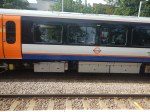
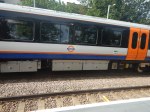
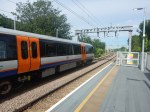
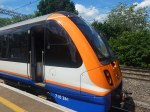
The train shown was used for the BEMU Trial conducted by Bombardier, Network Rail and Greater Anglia.
The only things missing, for these trains to run a large number of suitable routes under battery power are.
- A suitable fast charging system.
- Third rail equipment that would allow the train to run on lines with third-rail electrification.
- Third rail equipment would also connect to Vivarail’s Fast Charge system
As I have looked in detail at Vivarail’s engineering and talked to their engineers, I feel that with the right advice and assistance, they should be able to play a large part in the conversion of the Class 379 fleet to battery operation.
These trains would be ideal for the Uckfield Branch and the Marshlink Line.
If not the Class 379 trains, perhaps some Class 377 trains, that are already leased to Southern, could be converted.
I could see a nice little earner developing for Vivarail, where train operating companies and their respective leasing companies employ them to create battery sub-fleets to improve and extend their networks.
Raw Material For Southern’s Battery Trains
Porterbrook and Southern are proposing to convert a number of Class 377/3 trains to battery operation for the Uckfield Branch and the Marshlink Line, as I wrote about in Electroflex Battery EMU Plan To End Southern Diesel Operation.
This morning I took a ride in a ten-car Class 377 train formed by two three-car Class 377/3 units and one Class 377/4.
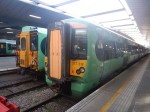
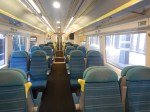
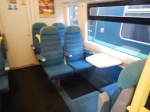
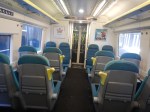
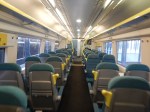
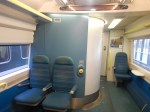
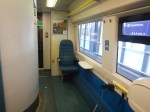
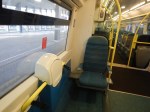
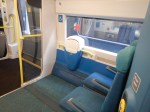
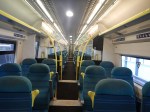
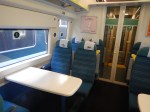
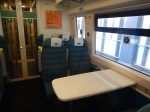
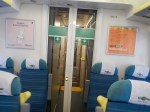
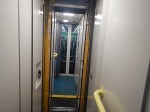
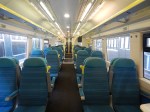
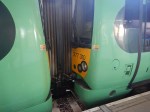
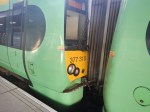
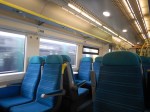
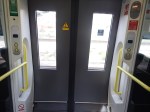
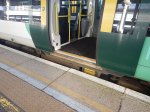
I will split my observations into various sections.
First Class
There is a small First Class section.
Is this really needed in a three-car train, considering that some franchises are going for one-class trains?
Gangways
On the Uckfield Branch and the Marshlink Line, I suspect that trains will work in multiple formations, so the gangway will be useful to allow passengers to pass between individual trains.
Interior
The interior is reasonably modern, as the trains were originally built in 2001-2002 and they meet all of the persons of reduced mobility legislation.
Multiple Working
The train I rode on consisted of three Class 377 Trains working together, so it would appear that six, nine and twelve car trains may be possible.
Tables And Cup-Holders
I would prefer full-size tables and perhaps these could be fitted, during the conversion, like they are in some Class 377 trains.
If not tables, then how about some cup-holders?
Universal Access Toilet
A universal-access toilet is fitted in the middle car.
Wi-Fi
Wi-fi appears to be fitted.
25 KVAC Operation
Although the trains are currently configured for operation on 750 VDC trird-rail electrification, these trains can be converted to run on 25 KVAC overhead electrification.
This would obviously mean that if the trains were no longer needed in Sussex, they could run anywhere else, where there is electrification.
Conclusion
They are a well-equipped train.
It would appear that very little will need to be done to the interior of the train in the conversion.
First may be downgraded to standard and I would fit full tables.
The operator would do what they wanted.
No News On Hydrogen Trains For The Midland Main Line
In April 2019, I wrote Hydrogen Trains To Be Trialled On The Midland Main Line, which was based on an article on Railway Gazette that is entitled Bimode And Hydrogen Trains As Abellio Wins Next East Midlands Franchise.
I said this in my post.
Abellio will be taking over the franchise in August this year and although bi-mode trains were certain to be introduced in a couple of years, the trialling of hydrogen-powered trains is a surprise to me and possibly others.
This is all that is said in the article.
Abellio will also trial hydrogen fuel cell trains on the Midland Main Line.
It also says, that the new fleet will not be announced until the orders are finalised.
Nothing has been heard since about the hydrogen train trial for the Midland Main Line.
But there have been several related developments, that might have implications for the trial.
East Midlands Railway Has Ordered Hitachi Class 810 Trains For EMR InterCity Services
Class 810 trains are Hitachi’s latest offering, that are tailored for the Midland Main Line.
The trains will have a few differences to the current Class 800,/801/802 trains.
But will they be suitable for conversion to hydrogen power?
Consider.
- The Hitachi trains have a comprehensivecomputer system, that looks at the train and sees what power sources are available and controls the train accordingly.
- Trains have already been ordered in five, seven and nine-car lengths. I have read up to twelve-car trains are possible in normal operation. See Do Class 800/801/802 Trains Use Batteries For Regenerative Braking?
- Hydrogen train designs, with a useful range of several hundred miles between refuelling, seem to need a hydrogen tank, that takes up at least half of a twenty metre long carriage.
- The Hitachi train design has pantographs on the driver cars and can support diesel generator units in the intermediate cars, as it does in current trains.
- The Japanese are researching hydrogen trains.
- The five-car Class 802 trains have 2,100 kW of installed generator power.
I think that Hitachi’s engineers can build another carriage, with the following characteristics.
- It could be based on a Motor Standard car.
- The passenger seats and interior would be removed or redesigned in a shorter space.
- Powered bogies would be as required.
- It would contain a hydrogen tank to give sufficient range.
- Appropriately-sized batteries and fuel-cells would be inside or under the vehicle.
- Regenerative braking would help to recharge the batteries.
- There would probably be no diesel generator unit.
There would need to be a walkway through the car. Stadler have shown this works in the Class 755 train.
A Hydrogen Power car like this would convert a five-car bi-mode diesel-electric train into a six-car hydrogen-electric hybrid train. Or they might just replace one Motor Standard car with the Hydrogen Power Car to create a five-car hydrogen-electric hybrid train, if the longer train would cause problems in the short platforms at St. Pancras.
- The computer system would need to recognise the Hydrogen Power Car and control it accordingly. It would probably be very Plug-and-Play.
- The weight of the train could probably be reduced by removing all diesel generator units.
- The passenger experience would be better without diesel power.
- The range away from the wires would probably be several hundred miles.
The drivers and other staff would probably not need massive retraining.
What Do I Mean By Appropriately-Sized Batteries And Fuel Cells?
I can’t be sure,, but I suspect the following rules and estimates hold.
- The batteries must be large enough to more than hold the kinetic energy of a full five-car train, running at the full speed of 140 mph.
- I estimate that the kinetic energy of the train,will be around 200 kWh, so with a contingency, perhaps battery capacity of between 400-500 kWh would be needed.
- Currently, a 500 kWh battery would weigh five tonnes, which is of a similar weight to one of the diesel generator units, that are no longer needed.
- In How Much Power Is Needed To Run A Train At 125 mph?, I estimated that the all-electric Class 801 train, needs 3.42 kWh per vehicle mile to maintain 125 mph. This means that travelling at 125 mph for an hour would consume around 2,000 kWh or an output of 2,000 kW from the fuel cell for the hour.
- Note that 1 kg of hydrogen contains 33.33 kWh of usable energy, so the hydrogen to power the train for an hour at 125 mph, will weigh around sixty kilograms.
From my past experience in doing chemical reaction calculations in pressure vessels, I think it makes the concept feasible. After all, it’s not that different to Alstom’s Breeze.
I would assume, that the train manufacturers can do a full calculation, to a much more accurate level.
Applying The Concept To Other Hitachi Trains
Once proven, the concept could be applied to a large number of Hitachi bi-mode trains. I suspect too, that it could be applied to all other Hitachi A-train designs, that are in service or on order, all over the world.
In the UK, this includes Class 385, Class 395 and Class 80x trains.
Bombardier Have Said That They’re Not Interested In Hydrogen Power
But Electrostars and Aventras have the same Plug-and-Play characteristic as the Hitachi train.
I wouldn’t be surprised to find that Bombardier have a Hydrogen Power Car design for an Aventra. All that it needs is an order.
They could also probably convert a five-car Class 377 train to effectively a four-car train, with a Hydrogen Power Car in the middle. This would be ideal for the Uckfield Branch and the Marshlink Lines. I suspect it could be done to meet the timescale imposed by the transfer of the Class 171 trains to East Midlands Railway.
There must be an optimal point, where converting an electric multiple unit, is more affordable to convert to hydrogen, than to add just batteries.
But then everybody has been dithering about the Uckfield and Marshlink trains, since I started this blog!
Stadler Have Shown That a Gangway Through A Power Car Is Acceptable To Passengers In The UK
Stadler’s Class 755 trains seem to be operating without any complaints about the gangway between the two halves of the train.
Stadler Have Two Orders For Hydrogen-Powered Trains
These posts describe them.
- Zillertalbahn Orders Stadler Hydrogen-Powered Trains
- MSU Research Leads To North America’s First Commercial Hydrogen-Powered Train
Stadler also have a substantial order for a fleet of battery Flirt Akku in Schleswig Holstein and they are heavily involved in providing the rolling stock for Merseyrail and the South Wales Metro, where battery-powered trains are part of the solution.
It looks to me, that Stadler have got the technology to satisfy the battery and hydrogen train market.
The Driver’s View Of Stadler
It’s happened to me twice now; in the Netherlands and in the UK.
- Both drivers have talked about hydrogen and Stadler’s trains with the engine in the middle.
- They like the concept of the engine.
- The English driver couldn’t wait to get his hands on the train, when he finished his conversion.
- Both brought up the subject of hydrogen first, which made me think, that Stadler are telling drivers about it.
Or does driving a hydrogen-powered vehicle as your day job, score Greta points in the pub or club after work?
Could The Hydrogen Train On The Midland Main Line Be A Stadler?
Greater Anglia and East Midlands Railway are both controlled by Abellio or Dutch Railways.
In The Dutch Plan For Hydrogen, I laid out what the Dutch are doing to create a hydrogen-based economy in the North of the country.
Stadler are going to provide hydrogen-powered for the plan.
In addition.
- Greater Anglia have bought a lot of Class 755 trains.
- A lot of Lincolnshire and Norfolk is similar to the North of the Netherlands; flat and windy.
- One of these trains with a hydrogen PowerPack, could be an ideal train for demonstrating hydrogen on rural routes like Peterborough and Doncaster via Lincoln.
But the promise was on the Midland Main Line?
Conclusion
Hydrogen trains seem to be taking off!
Even if there’s been no news about the trial on the Midland Main Line.
The Batteries For Bombardier Electrostars
This article on the Railway Gazette is entitle Bombardier And Leclanché Sign Battery Traction MoU.
This is the second paragraph.
According to Bombardier, Leclanché will deliver ‘imminently’ its first performance demonstrator battery systems, after which it will be in line to supply traction equipment worth in excess of €100m for use in more than 10 rolling stock projects.
In Stadler’s New Tri-Mode Class 93 Locomotive, I investigated who was providing two large suitcase-sized batteries for Stadler’s new Class 93 locomotive.
In the related post, I said this about the batteries in the Class 93 locomotive, which I describe as a hybrid locomotive.
The Class 93 Locomotive Is Described As A Hybrid Locomotive
Much of the article is an interview with Karl Watts, who is Chief Executive Officer of Rail Operations (UK) Ltd, who have ordered ten Class 93 locomotives. He says this.
However, the Swiss manufacturer offered a solution involving involving an uprated diesel alternator set plus Lithium Titanate Oxide (LTO) batteries.
Other information on the batteries includes.
- The batteries are used in regenerative braking.
- Batteries can be charged by the alternator or the pantoraph.
- Each locomotive has two batteries slightly bigger than a large suitcase.
Nothing is said about the capacity of the batteries, but each could be say 200 litres in size.
I have looked up manufacturers of lithium-titanate batteries and there is a Swiss manufacturer of the batteries called Leclanche, which has this data sheet, that describes a LT30 Power cell 30Ah.
- This small cell is 285 mm x 178.5 mm x 12 mm.
- It has a storage capacity of 65 Wh
- It has an expedited lifetime of greater than 15,000 cycles.
- It has an energy density of 60 Wh/Kg or 135 Wh/litre
These cells can be built up into much larger batteries.
- A large suitcase is 150 litres and this volume would hold 20 kWh and weigh 333 Kg.
- A battery of 300 litres would hold 40 kWh. Is this a large Swiss suitcase?
- A box 2.5 metres x 1 metre x 0.3 metres underneath a train would hold 100 kWh and weigh 1.7 tonnes
These batteries with their fast charge and discharge are almost like supercapacitors.
, It would appear that, if the large suitcase batteries are used the Class 93 locomotive will have an energy storage capacity of 80 kWh.
I wonder how many of these batteries can be placed under a Bombardier Eectrostar.
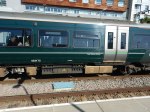
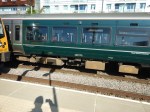
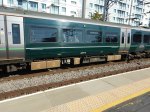
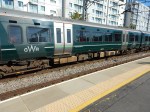
It looks rather cramped under there, but I’m sure Bombardier have the detailed drawings and some ideas for a bit of a shuffle about. For comparison, this is a selection of pictures of the underneath of the driver car of the new Class 710 trains, which are Aventras.

It looks like Bombardier have done a big tidy-up in changing from Electrostars to Aventras.
In Battery Electrostars And The Uckfield Branch, I came to the conclusion that Class 387 trains were the most likely trains to be converted for battery operation.
I also developed Excel spreadsheets that model the operation of battery trains on the Uckfield Branch and the Marshlink Line.
Feel free to download and examine.
Size Of Batteries Needed
My calculations in the two spreadsheets are based on the train needing 3 kWh per vehicle-mile to cruise between stations.
To handle the Uckfield Branch, it appears that 290.3 kWh is needed to go South and 310.3 kWh to go North.
I said this earlier.
A box 2.5 metres x 1 metre x 0.3 metres underneath a train would hold 100 kWh and weigh 1.7 tonnes.
So could we put some of these batteries under the train?
The Effect Of More Efficient Trains
My calculations are based on the train needing 3 kWh per vehicle-mile, but what if the trains are more efficient and use less power?
- 3 – 290.3 – 310.3
- 2.5 – 242.6 – 262.6
- 2 – 194.9 – 214.9
- 1.5 – 147.2 – 167.2
- 1 – 99.4 – 119.4
Note.
- The first figure is Southbound and the second figure is Northbound.
- More power is needed Northbound, as the train has to be accelerated out of Uckfield station on battery power.
The figures clearly show that the more efficient the train, the less battery capacity is needed.
I shall also provide figures for Ashford and Ore.
- 3 – 288
- 2.5 – 239.2
- 2 – 190.4
- 1.5 – 141.5
- 1 – 92.7
Note that Westbound and Eastbound energy needs are the same, as both ends are electrified.
I obviously don’t know Bombardier’s plans, but if the train’s energy consumption could be reduced to around 2 kWh per vehicle-mile, a 250 kWh battery on the train would provide enough energy storage for both routes.
Could this be provided by two of Leclanche’s batteries designed to fit a space under the train?
These would be designed to provide perhaps 250 kWh.
What Would Be The Ultimate Range Of A Class 387 Train On Battery Power?
Suppose you have a four-car Class 387 train with 25 kWh of battery power that leaves an electrified station at 60 mph with a full battery.
How far would it go before it came to a lifeless stop?
The battery energy would be 250 kWh.
There would be 20 kWh of kinetic energy in the train.
Ranges with various average energy consumption in kWh per vehicle-mile are as follows.
- 3 – 22.5 miles
- 2.5 – 27 miles
- 2 – 34 miles
- 1.5 – 45 miles
- 1 – 67.5 miles
Obviously, terrain, other traffic and the quality of the driving will effect the energy consumption.
But I do believe that a well-designed battery-electric train could easily handle a fifty mile electrification gap.
What Would Be The Rescue Range On One Battery?
One of the main reasons for putting batteries on an electrical multiple unit is to move the train to a safe place for passenger evacuation if the electrification should fail.
This week, there have been two electrification failures in London along, one of which was caused by a failing tree in the bad weather.
I’ll assume the following.
- The train is a Class 387 train with one 125 kWh battery.
- The battery is ninety percent charged.
- The train will be moved at 40 mph, which has a kinetic energy around 9 kWh.
- The energy consumption of the train is 3 kWh per vehicle-mile.
The train will use 9 kWh to accelerate the train to line speed, leaving 116 kWh to move the train away from the problem.
With the energy consumption of 3 kWh per vehicle-mile, this would be a very useful 9.5 miles.
Regenerative Braking To Battery On Existing Trains
This has been talked about for the Class 378 trains on the London Overground.
Regenerative braking to batteries on the train, should cut energy use and would the battery help in train recovery from the Thames Tunnel?
What About Aventras?
Comparing the aerodynamics of an Electrostar like a Class 387 train with an Aventra like a Class 710 train, is like comparing a Transit van with a modern streamlined car.
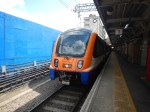
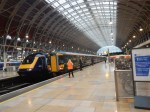
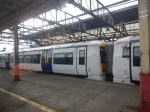
Look at these pictures some of which are full frontal.
It should be noted that in one picture a Class 387 train is shown next to an InterCity 125. Did train designers forget the lessons learned by Terry Miller and his team at Derby.
I wonder how much electricity would be needed to power an Aventra with batteries on the Uckfield branch?
These are various parameters about a Class 387 train.
- Empty Weight – 174.81 tonnes
- Passengers – 283
- Full Weight – 2003 tonnes
- Kinetic Energy at 60 mph – 20.0 kWh
And these are for a Class 710 train.
- Empty Weight – 157.8 tonnes
- Passengers – 700
- Full Weight – 220.8 tonnes
- Kinetic Energy at 60 mph – 22.1 kWh
Note.
- The Aventra is twenty-seven tonnes lighter. But it doesn’t have a toilet and it does have simpler seating with no tables.
- The passenger weight is very significant.
- The full Aventra is heavier, due to the large number of passengers.
- There is very little difference in kinetic energy at a speed of 60 mph.
I have played with the model for some time and the most important factor in determining battery size is the energy consumption in terms of kWh per vehicle-mile. Important factors would include.
- The aerodynamics of the nose of the train.
- The turbulence generated by all the gubbins underneath the train and on the roof.
- The energy requirements for train equipment like air-conditioing, lighting and doors.
- The efficiency of the regenerative braking.
As an example of the improvement included in Aventras look at this picture of the roof of a Class 710 train.
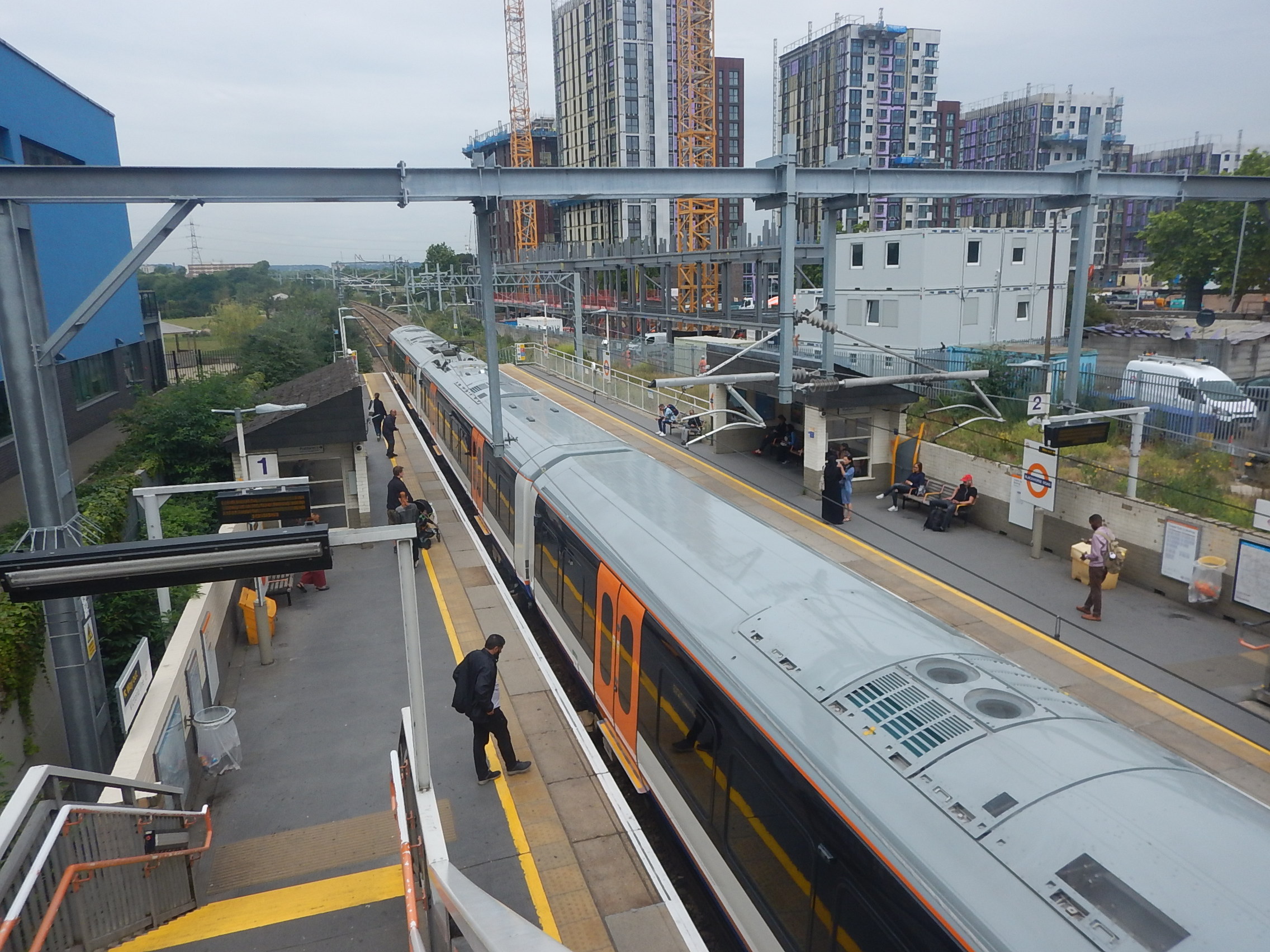
This feature probably can’t be retrofitted, but I suspect many ideas from the Aventra can be applied to Electrostars to reduce their energy consumption.
I wouldn’t be surprised to see Bombardier push the energy consumption of an Electrostar with batteries towards the lower levels that must be possible with Aventras.
Battery Electrostars And The Uckfield Branch
In Rounding Up The Class 170 Trains, I said this, which is based on a quote from an article in the October 2019 Edition of Modern Railways.
Are Battery Electrostars On The Way?
The article finishes with this paragraph about the Class 171 trains, that will come from Govia Thameslink Railway (GTR) and be converted back to Class 170 trains.
GTR currently uses the ‘171s’ on the non-electrified Marshlink and Uckfield lines, and the release of these sets to EMR is contingent on their replacement with converted Electrostar EMUs with bi-mode battery capability, removing these diesel islands of operation from the otherwise all-electric GTR fleet.
So are these battery Electrostars finally on their way?
The article got several comments, which said that some five-car Electrostars were to be converted and they would probably be Class 376 trains, that would be used.
The comments also said that Network Rail were working on using short lengths of third-rail to charge the train batteries.
That sounds like Vivarail’s system to me, that I wrote about in Vivarail Unveils Fast Charging System For Class 230 Battery Trains.
Southern’s Current Diesel Fleet
I will start by looking at Southern’s current diesel fleet that works London Bridge and Uckfield stations and the Marshlink Line.
Currently, Southern has a diesel fleet of Class 171 trains.
- 12 x two-car trains
- 8 x four-car trains.
According to Modern Railways, the following trains will transfer to EMR Regional in September 2021.
- 10 x two car
- 6 x three-car, which will be created by moving a few cars in the four-car trains.
It looks as if after the transfer Southern will be left with eight driver-cars and ten intermediate cars.
This would give them four four-car trains and two spare intermediate cars. I’m sure that someone will have a need for the intermediate cars to lengthen a two-car Class 170 train because of capacity issues.
The Marshlink Line Service
The service on the Marshlink Line is an hourly service between Ashford International and Eastbourne stations.
- It is run by Class 171 diesel trains.
- Trains were four-cars most times I’ve used it.
- Journey times are around one hour and twenty-minutes.
- A round trip takes three hours.
- It would appear that three four-car trains are needed to run the service.
So if there is a spare train, four trains would be ideal, After all the transfers, this is the remaining number of Class 171 trains, that would be left with Southern.
If they wanyted to get rid of the diesel trains, then they could replace the trains on the Marshlink Line with four four-car battery bi-mode Electrostars!
Network Rail’s Plan For The Uckfield Branch
This document on the Network Rail web site from 2016, is entitled Delivering A Better Railway
For A Better Britain – Route Specifications 2016 – South East.
In the document, this is said about the the route between Hurst Green and Uckfield.
The key issue presently is overcrowding on the shorter length services that operate on the route during and close to the peak hours. As the route is operated by Class 171 diesel units, there is only a small fleet available to the TOC to deploy on the route. As a result some peak and shoulder peak services are not able to operate at the maximum length the route is capable of (8-car).
Electrification schemes in the North West will displace rolling stock to strengthen existing peak services to 8-car and eventually of 10-car operation during CP5, so associated platform lengthening is currently being developed, this will also be compatible with 12-car 20m vehicle trains.
Electrification is still an aspiration for this route or use of battery-powered trains (currently under development) if they are deemed successful.
Signalling is controlled by Oxted Signal Box but during CP5 this will be transferred to Three Bridges ROC.
The key point is that the platforms have been lengthened for 240-metre long trains, which will also allow ten-car Class 171 trains, which have 23 metre vehicles.
The Uckfield Branch Service
The service on the Uckfield Branch is an hourly service between London Bridge and Uckfield stations.
- It is currently run by Class 171 diesel trains.
- The platforms on the route can accept ten-car trains with 23 m vehicles or twelve-car trains with 20 metre vehicles.
- A round trip takes three hours.
- It would appear that three ten- or twelve-car trains are needed to run the service.
So if we add in a spare and perhaps an extra train for the rush hour, it would appear that around half-a-dozen ten- or twelve-car battery bi-mode trains will be needed for the service.
- As a ten-car train would be two five-car trains, twelve five-car trains would be needed.
- As a twelve-car train would be three four-car trains, eighteen four-car trains would be needed.
Interestingly, Southern have three trains that could be candidates for conversion to battery bi-modes in their fleet.
- One hundred and fifty-two four-car Class 377 trains.
- Thirty-four five car Class 377 trains.
- Twenty-nine four-car Class 387 trains.
All trains were built for longer commuter journeys,
Which Electrostars Will Be Converted To Battery Operation For The Uckfield Service?
Obviously, the trains must be four- or five-cars and suitable for conversion to battery bi-mode trains, but I feel they must have other features.
- Toilets
- First Class seats.
- Plenty of tables.
- Wi-fi and plug sockets.
- Comfortable interiors.
- End gangways, to ensure staff and passengers can move around the train if required.
I’ll now look at the various fleets of Electrostars.
Class 357 Trains
The Class 357 trains can probably be discounted, as I suspect c2c need them and they are not third rail.
Class 375 Trains
The Class 375 trains can probably be discounted, as I suspect Southeastern need them.
But if the new Southeastern franchise should decide on a complete fleet replacement, as the trains are dual-voltage, they might be very useful if fitted with a battery capability.
Class 376 Trains
The Class 376 trains can probably be discounted, as I suspect Southeastern need them.
The trains are also third-rail only and lack toilets, so would probably need a rebuilt interior.
Class 377 Trains
The Class 377 trains are a possibility as Soiuthern has a large fleet of both four- and five-car trains.
But they would be losing the Class 171 trains, so would probably need to bring in some new trains to have a large enough fleet.
Class 378 Trains
The Class 378 trains can probably be discounted, as London Overground need them.
Class 379 Trains
The Class 379 trains are surely a possibility, as Greater Anglia will be releasing them before the end of 2020.
Consider.
- There have no new home to go to.
- I am suspicious that that NXEA overpaid for these trains and Macquarie are sitting on a very good deal, that will cost Grester Anglia a lot to cancel!
- They appeared to me to be a shoe-in for Corby services, so perhaps they lost out to the Class 360 trains on cost.
- They are only 100 mph trains, whereas others are 110 mph trains.
- They would need to be fitted with third-rail shoes.
- The trains are coming up to nine years old and probably need a refresh.
- They have an interior aimed at airport passengers.
If I was Macquarie, I’d convert these into go-anywhere battery bi-modes for use in small fleets by operators.
But, Porterbrook’s battery-bi-mode conversion of a Class 350 train may be available at a lower price.
Class 387 Trains
The Class 387 trains are surely a serious possibility, for the following reasons.
- Govia already has fifty-six of these trains on lease and in service.
- c2c has six trains, that could come off lease in 2021.
- The trains are dual voltage
- The trains are 110 mph trains.
- They can run as twelve-car walk-through trains.
- Many of the trains are leased from Porterbrook.
I’ve felt for some time, that these trains would make excellent battery bi-modes.
But they are a good fit for Southern, as surely one could be scrounged from their Great Northern fleet to create a prototype for test.
I would feel that having the required number of trains for the Uckfield Branch can be achieved by September 2021, when the Class 171 trains will be sent to the Midlands.
There is also a backstop, in that there are nineteen Class 365 trains in store, which were replaced by Class 387 trains on Great Northern services. If there is a shortage of Class 387 trains during the conversion, surely some of these Class 365 trains could stand in, just as they did successfully in Scotland recently.
My Choice
I would convert Class 387 trains.
- There are quite a few Class 387 trains, that could be converted.
- Southern already have fifty-six Class 387 trains.
- There are enough to convert eighteen for Uckfield and four for the Marshlink
- It could be possible to deliver the full fleet before the Class 171 trains leave.
- If during conversion of the trains, they are short of stock, Southern can hire in some Class 365 trains.
It looks to be a low-risk project.
It will also have collateral benefits.
- The hourly London Bridge and Uckfield service will be raised to maximum capacity without any new infrastructure, except the trains and a number of battery chargers.
- Diesel will be eliminated in London Bridge station making the station electric trains only.
- Diesel will be eliminated between London Bridge and Uckfield stations.
- Efficient regenerative braking to battery would be available on the complete route.
- A ten-car diesel service between East Croydon and London Bridge will be replaced by a twelve-car electric service. stations.
In addition, if the diesel trains on the Marshlink Line were to be replaced by battery bi-modes, Southern would be a diesel-free franchise.
What About New Trains?
It’s all about the money and whether the new trains could be delivered in time.
I would suspect that Bombardier, CAF, Stadler and others are making competitive proposals to Southern, but would they be more affordable and timely, than a conversion of Class 387 trains?
But could they be as competitive if Bombadier and Porterbrook co-operated to convert some of Porterbrook’s Class 387 trains, that are already leased to Great Northern?
You don’t usually move house if you need a new boiler, you replace the boiler!
What About Hydrogen Trains?
The Alstom Breeze based on a Class 321 train is scheduled to first come into service in 2022. This is too late, as the Class 171 trains are scheduled to leave in September 2021.
Hydrogen trains would need a hydrogen filling station.
Kinetic Energy Of Class 387 Trains
I will calculate the kinetic energy of a four-car Class 387 train.
I will assume the following.
- Empty train weight – 174.81 tonnes – Read from the side of the train.
- Seats – 223
- Standees – 60 – Estimated from the seats/standing ratio of a Class 720 train.
- Total passengers – 283
- Each passenger weighs 90 Kg, with baggage, bikes and buggies.
- This gives a passenger weight of 25.47 tonnes and a train weight of 200.28 tonnes
Using Omni’s Kinetic Energy calculator, gives the following kinetic energies.
- 40 mph – 8.89 kWh
- 50 mph – 13.9 kWh
- 60 mph – 20.0 kWh
- 70 mph – 27.2 kWh
- 80 mph – 35.6 kWh
- 90 mph – 45.0 kWh
- 100 mph – 55.6 kWh
- 110 mph – 67.3 kWh
These figures are for a full train, but even so many will think they are low, when you think that 60 kWh batteries are used in hybrid buses.
A Trip To Uckfield
I took a trip to Uckfield today and these are my observations.
- The maximum operating speed of the train was no more than 70 mph.
- For much of the journey the train trundled along at around 40-50 mph.
- The route is reasonably flat with only gentle gradients.
- I hardly noticed the diesel engine under the floor of my car.
- Obviously in the Peak, the engines will have to work harder.
It was a very good demonstration of five Turbostars working in unison.
I can understand why East Midlands Railway are using Class 170 trains, as their standard train for EMR Regional.
Modelling the Route
I have built a mathematical model of the route between Hurst Green and Uckfield using Excel.
Input parameters are.
- Cruise Energy Consumption in kWh per vehicle mile. I assumed 3 kWh per vehicle mile
- Cruise Kinetic Energy in kWh. I assumed a 70 mph cruise and used 20 kWh
- Regeneration Energy Loss as a ratio. I assumed 0.15.
These parameters showed that a battery of between 290 kWh and 350 kWh would be needed, that was full at Hurst Green and was recharged at Uckfield.
Note that Vivarail are talking about putting 424 kWh under a three-car Class 230 train.
This page on the Vivarail web site is entitled Battery Train Update.
This is a paragraph.
Battery trains are not new but battery technology is – and Vivarail is leading the way in new and innovative ways to bring them into service. 230002 has a total of 4 battery rafts each with a capacity of 106 kWh and requires an 8 minute charge at each end of the journey. With a 10 minute charge this range is extended to 50 miles and battery technology is developing all the time so these distances will increase.
So it looks like Vivarail manage to put 212 kWh under each car of their two-car train.
I don’t think putting 350 kWh of batteries under a four-car Class 387 train would be impossible.
I have also created an Excel model for the second route between Ashford and Ore stations.
This shows that a battery of about 300 kWh on the train should cover the route.
It might appear strange that the longer Marshlink route needs a smaller battery, but this is because it leaves both ends of the route with a full battery.
These two links give access to the two Excel models that I have used. Feel free to access and criticise them.
It does appear, that on both these routes, if a train starts with full batteries, the energy in the battery is reduced in these ways as it travels along the route.
- There is an energy use to power the train along the line which is proportional to the vehicle-miles.
- Energy is needed to accelerate the train to line speed after each stop.
- Energy is needed to operate stop-related functions like opening and closing the doors.
But there will also be energy recovered from regenerative braking from line speed, although this won’t cover the subsequent acceleration.
I suspect with better understanding and better data, Bombardier can create a simple formula for battery size needed based on the following.
- The length of the route.
- The number of stations.
- The line speed
- The gradient and speed profile of the route
- The kinetic energy of the train at various loadings and speeds
- The amount of energy needed for each vehicle mile
- The efficiency of the regenerative braking
It is not the most difficult of calculations and I was doing lots of them in the 1960s and early 1970s.
Charging The Train At Uckfield
This picture shows the long platform at Uckfield station.

The platform has been built to accept a twelve-car electric train and if traditional third rail electrification were to be installed, this could be used to charge the batteries.
I would use a Vivarail-style system, which I described fully in Vivarail Unveils Fast Charging System For Class 230 Battery Trains.
As trains take a few minutes at Uckfield to turnback, I’m sure enough time can be arranged in the timetable to charge the batteries with enough power to get back to the electrification at Hurst Green.
The train would switch the charging system on and off by automatically connecting and disconnecting.
Riding Sunbeams Deploys Solar Array
The title of this post is the same as that of this article on Railway Gazette.
These are the introductory paragraphs.
Riding Sunbeams Ltd has installed a 30 kWp solar test unit with around 100 panels near Aldershot which is directly supplying electricity to power signalling and lighting on Network Rail’s Wessex Route.
This will enable data to be gathered to assess how much larger solar arrays could be used to power trains.
Note that kWp is peak kW. On a very sunny day, 30 kW is the highest power level that will be supplied.
This page on the Energy Saving Trust is entitled Costs and Saving and this is said.about solar generation in the South of England.
A 4kWp system in the south of England can generate around 4,200 kilowatt hours of electricity a year – that’s the same amount of electricity as it takes to turn the London Eye 56 times. It will save around 1.6 tonnes of carbon dioxide every year.
For comparison, they say this about solar generation in Scotland.
A 4kWp system in Scotland can generate about 3,400 kilowatt hours of electricity a year – that’s the same amount of electricity as it takes to turn the Falkirk Wheel 2,200 times. It will save approximately 1.3 tonnes of carbon dioxide every year.
I’d be interested to know, the two locations, where they measured the sunlight.
It was a lovely sunny day recently, when I passed through Aldershot station, so I’ll use the Southern England figures.
- Uprating the Energy Saving Trust figures by 30/4 gives a yearly output of 31,500 kWh,
- The daily output is 86.3 kWh.
- The hourly output based on a 0600-2200 sixteen hour day is 5.4 kWh
There would probably be a battery to make the most of the electricity generated.
Powering Feeder Stations For Third-Rail Electrification
As the Railway Gazette article says, the trial installation at Aldershot station will be used to power signalling and the station, which will then give figures to assess how trains can be powered.
In the September 2017 Edition of Modern Railways, there is an article entitled Wires Through The Weald, which discusses electrification of the Uckfield Branch in Sussex, as proposed by Chris Gibb. This is an extract.
He (Chris Gibb) says the largest single item cost is connection to the National Grid, and a third-rail system would require feeder stations every two or three miles, whereas overhead wires may require only a single feeder station for the entire Uckfield Branch.
It would appear that 750 VDC rail-based direct current electrification needs many more feeder stations, than 25 KVAC overhead electrification.
Could a solar system from Riding Sunbeams supply power in the following situations?
- Places where there was space for a solar array.
- Remote locations, where a connection to the grid is difficult.
- Places, where the power supply needed a bit of a boost.
How large would an individual solar feeder station need to be?
Consider a feeder station on a rail line with these characteristics.
- Third-rail electrification
- Four-car trains
- Each train uses three kWh per vehicle mile.
- Two trains per hour (tph) in both directions.
- Electrification sections are three miles long.
- Trains run from six in the morning to ten at night.
- Trains pass at speeds of up to 100 mph.
The hourly electricity need for each section would be 144 kWh or 2304 kWh per day and 841 MWh for the whole year.
The Energy Saving Trust says this.
A 4kWp system in the south of England can generate around 4,200 kilowatt hours of electricity a year.
Using these figures says that a solar array of 800 MWp will be needed to provide the power for one feeder station.
Consider.
- The largest solar array in the UK is Shotwick Solar Farm, which has a capacity of 72 MWp.
- Shotwick covers 730 acres.
Am I right to question if that enough electricity to create a feeder station to power trains, can be produced reliably from a solar array and a battery?
I’d love to have the electricity usage and bill for one of Network Rail’s typical third-rail feeder stations. Not that I’d want to pay it!
How Would Station Stops Be Handled?
When a modern electrical multiple unit stops in a station, there is a three-stage process.
- The train decelerates, hopefully using regenerative braking, where the braking energy is returned through the electrification to hopefully power nearby trains.
- The train waits in the station for a minute or so, using power for air-conditioning and other hotel functions.
- The train accelerates away using track power.
Would a Riding Sunbeams system provide enough capacity to accelerate the train away?
In What Is The Kinetic Energy Of A Class 710 Train?, I calculated the kinetic energy of a very full Class 710 train, which is just about as modern and probably efficient, as you can get.
These were my results.
- 50 mph – 15.3 kWh
- 60 mph – 22.1 kWh
- 90 mph – 49.4 kWh – Operating speed of a Crossrail Class 345 train.
- 100 mph – 61.3 kWh – Operating speed of many electric multiple units.
These kinetic energy values are low enough to make it possible that a modern electric multiple unit can run using on-board batteries.
- Regenerative braking would be captured in the batteries.
- Hotel power in the station can be provided by batteries.
- Batteries can cruise the train through sections of line without electrification or with a poor electrical supply.
Suppose there is a twenty mile gap between two stations; A and B, where trains cruise at 90 mph.
- The train arrives at station A, with a battery that has been charged on previous parts of the journey from the electrification.
- Regenerative braking energy will be stored in the battery on braking.
- Acceleration to 90 mph will need 49.4 kWh of electricity from the battery.
- Using my 3 kWh per vehicle mile figure, going from A to B, will need 4 cars * 20 miles * 3 = 240 kWh of electricity.
It looks like a battery with a capacity of 300 kWh would handle this situation
Could this be fitted into a four-car train, like an Aventra?
In this article in Global Rail News from 2011, which is entitled Bombardier’s AVENTRA – A new era in train performance, gives some details of the Aventra’s electrical systems. This is said.
AVENTRA can run on both 25kV AC and 750V DC power – the high-efficiency transformers being another area where a heavier component was chosen because, in the long term, it’s cheaper to run. Pairs of cars will run off a common power bus with a converter on one car powering both. The other car can be fitted with power storage devices such as super-capacitors or Lithium-ion batteries if required. The intention is that every car will be powered although trailer cars will be available.
Unlike today’s commuter trains, AVENTRA will also shut down fully at night. It will be ‘woken up’ by remote control before the driver arrives for the first shift
This was published over eight years ago, so I suspect Bombardier have refined the concept.
If 424 kWh can be fitted under the floor of a two-car Class 230 train, I’m sure in a train designed for energy storage at least 500 kWh or maybe as high as 1000 kWh could be fitted to a four-car Aventra.
A 500 kWh battery would give a battery range of just under forty miles, whilst a 1000 kWh battery would give a ninety-five mile range.
Obviously, the battery would need to be charged, but in many cases the range would take the train between two existing electrified lines. Think Ipswich -Cambridge, Newcastle-Carlisle, the Fife Circle Line, the Uckfield Branch and Ashford-Hastings!
Conclusion
Riding Sunbeams may be suitable for providing local power for signalling and stations, but batteries on trains looks like it could be a better way of powering trains.
Battery Trains On The Uckfield Branch
The Uckfield Branch is not electrified and it only gets an hourly service to London Bridge.
However a few years ago, all platforms on the line were extended, so that twelve-car trains could run services.
I have always felt that this service was ideal for running using battery trains.
- Trains would run between London Bridge and Hurst Green using the third rail electrification.
- The batteries would be charged between London Bridge and Hurst Green stations.
- South of Hurst Green, the train would run on battery power.
- Top-up charging could be provided during the eleven minute turnround at Uckfield station.
These are distances and times between stations South of Hurst Green.
- Hurst Green – Edenbridge Town – 4.33 miles – 6.98 km. – 6 mins – 7 mins
- Edenbridge Town – Hever – 1.75 miles – 2.81 km – 4 mins – 4 mins
- Hever – Cowden – 2 miles – 3.21 km. – 4 mins – 5 mins
- Cowden – Ashurst – 2.77 miles – 4.47 km. – 4 mins – 4 mins
- Ashurst – Eridge – 2.31 miles – 3.72 km. – 6 mins – 6 mins
- Eridge – Crowborough – 3.74 miles – 6.01 km. – 6 mins – 6 mins
- Crowborough – Buxted – 4.71 miles – 7.58 km – 7 mins – 7 mins
- Buxted – Uckfield – 2.25 miles – 3.62 km – 6 mins – 4 mins
Note.
- The first time is Southbound and the second is Northbound.
- I only calculated distances to two decimal places.
It appears the route has a generally 70 mph operating speed.
What Is The Performance Of The Current Class 171 Trains?
Class 171 trains have the following characteristics.
- 100 mph operating speed
- Acceleration of 0.5 m per second²
- A weight of 90.41 tonnes.
- Seating for 109 passengers.
- On my trip today, the train rarely exceeded 50 mph.
What Would Be The Performance Of A Battery Train?
I will assume that the battery train is something like a Class 701 train fitted with batteries.
- Ten cars
- 100 mph operating speed
- Acceleration of 1.0 m per second² (taken from Class 345 train)
- A weight of 364.9 tonnes. (An estimate based on data from Weight And Dimensions Of A Class 345 Train.
- Based on the Class 345 train, I would reckon the train would have at least eight motored cars.
- I would put a battery in each motored car.
- Capacity of 546 seated and 673 standing passengers.
I will use this information to calculate the energy of the train.
Assuming each passenger with all their baggage is 90 kg., this gives a passenger weight of 109.71 tonnes
This gives a total train weight of 474.61 tonnes.
Calculating the kinetic energy for various speeds gives.
- 30 mph – 11.8 kWh
- 40 mph – 21 kWh
- 50 mph -30.9 kWh
- 70 mph – 64.5 kWh
- 80 mph – 84.3 kWh
- 90 mph – 106.7 kWh
- 100 mph – 131.7 kWh
Even the highest energy figure, which is way above the operating speed of the line could be handled under regenerative braking by a convenient size of battery.
How Would A Battery Train Operate?
This Google Map shows Hurst Green station and Hurst Green Junction, where the Uckfield and East Grinstead branches split.
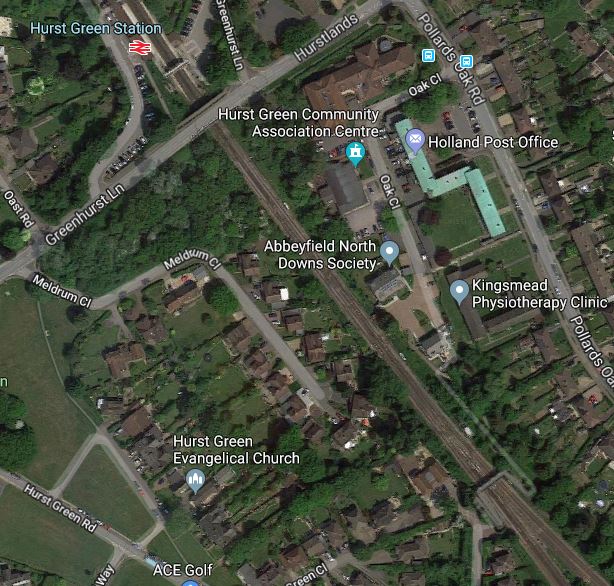
As the East Grinstead branch is electrified, after stopping at Hurst Green station, a train for Uckfield station will have something like two to three hundred metres of electrified track to accelerate it to the operating speed.
At present the operating speed appears to be 70 mph, but if it were higher, the train would enter the section of track without electrification, with more energy.
As it is, the train would probably be entering the branch with batteries, that had been fully-charged on the way from London.
The electrification would have been used like a catapult to impart maximum energy to the train.
At each stop, the following would happen.
- Regenerative braking will convert the train’s kinetic energy into electricity, which will be stored in the batteries.
- Battery power would then accelerate the train after each stop.
As regenerative braking is not 100% efficient, there would be a loss of perhaps fifteen percent of kinetic energy at each stop.
So gradually as the train progresses to Uckfield and back, the battery charge will be depleted.
There are seven stations between Hurst Green and Uckfield,so that means that fifteen stops will have to be made before the train returns to the electrification at Hurst Green.
If the train was operating at 70 mph, the kinetic energy would be 64.5 kWh and the losses in the regenerative braking at fifteen stations would be 64.5 *0.15 *15 or 145.57 kWh.
I will assume each battery train has eight 50 kWh batteries, as Bombardier have a 50 kWh PRIMOVE battery that would be suitable.
So if the train entered the Uckfield branch with 400 kWh in the batteries and 64.5 kWh in the train, it would be carrying 464.5 kWh, that could be used to power the train.
As I said, 145.57 kWh would be lost in braking, so that would leave 318.93 kWh to take a ten car train, a distance of 46 miles.
This works out at a figure of 0.7 kWh per car per mile for the journey.
In an article in the October 2017 Edition of Modern Railways, which is entitled Celling England By The Pound, Ian Walmsley says this in relation to trains running on the Uckfield Branch, which is not very challenging.
A modern EMU needs between 3 and 5 kWh per vehicle mile for this sort of service.
So it looks like running a battery train on the route could be impossible, as there is a large difference between 0.7 and 3.
Let’s see what the mathematics say for various ideas.
Put A 50 kWh battery In Each Car
The larger battery capacity would mean the train will enter the branch carrying 564.5 kWh, that could be used to power the train.
Thus after deducting the regeneration losses of 145.57 kWh, this would leave 418.93 kWh to run the 460 vehicle miles.
This works out at a figure of 0.9 kWh per car per mile for the journey.
Improve The Efficiency Of The Regenerative Braking
Suppose that the energy lost at each stop can be reduced from fifteen to ten percent, how much difference would that make?
If the train was operating at 70 mph, the kinetic energy would be 64.5 kWh and the losses in the regenerative braking would now be 64.5 *0.10 *15 or 96.75 kWh.
Using the 500 kWh battery would mean the train will enter the branch carrying 564.5 kWh, that could be used to power the train.
Thus after deducting the regeneration losses of 96.75 kWh would leave 467.75 kWh to run the 460 vehicle miles.
This works out at a figure of 1 kWh per car per mile for the journey.
Charge the Train At Uckfield
Trains take eleven minutes to turn round at Uckfield station.
So how much power could be put into the batteries in that time?
But the Aventra isn’t a normal train.
Crossrail’s Class 345 trains have the following formation.
DMS+PMS+MS1+MS3+TS(W)+MS3+MS2+PMS+DMS
Note that it is symmetrical with two PMS cars, which have pantographs and the heavy electrical gear.
I suspect that the trains are two half trains with a degree of independent systems, so that if there are problems in the Crossrail tunnel, the train doesn’t get trapped.
I wonder if Thameslink’s Class 700 trains are the same?
So will South Western Railway’s third rail Class 701 trains be similarly designed, so that they can bridge gaps in the third rail electrification. If the third-rail shoes were in the second and ninth cars, they would be around 160 metres apart.
So perhaps a charging point based on third rail technology could be a double one, with a connection to each half-train.
This picture shows the exceedingly long platform at Uckfield station.
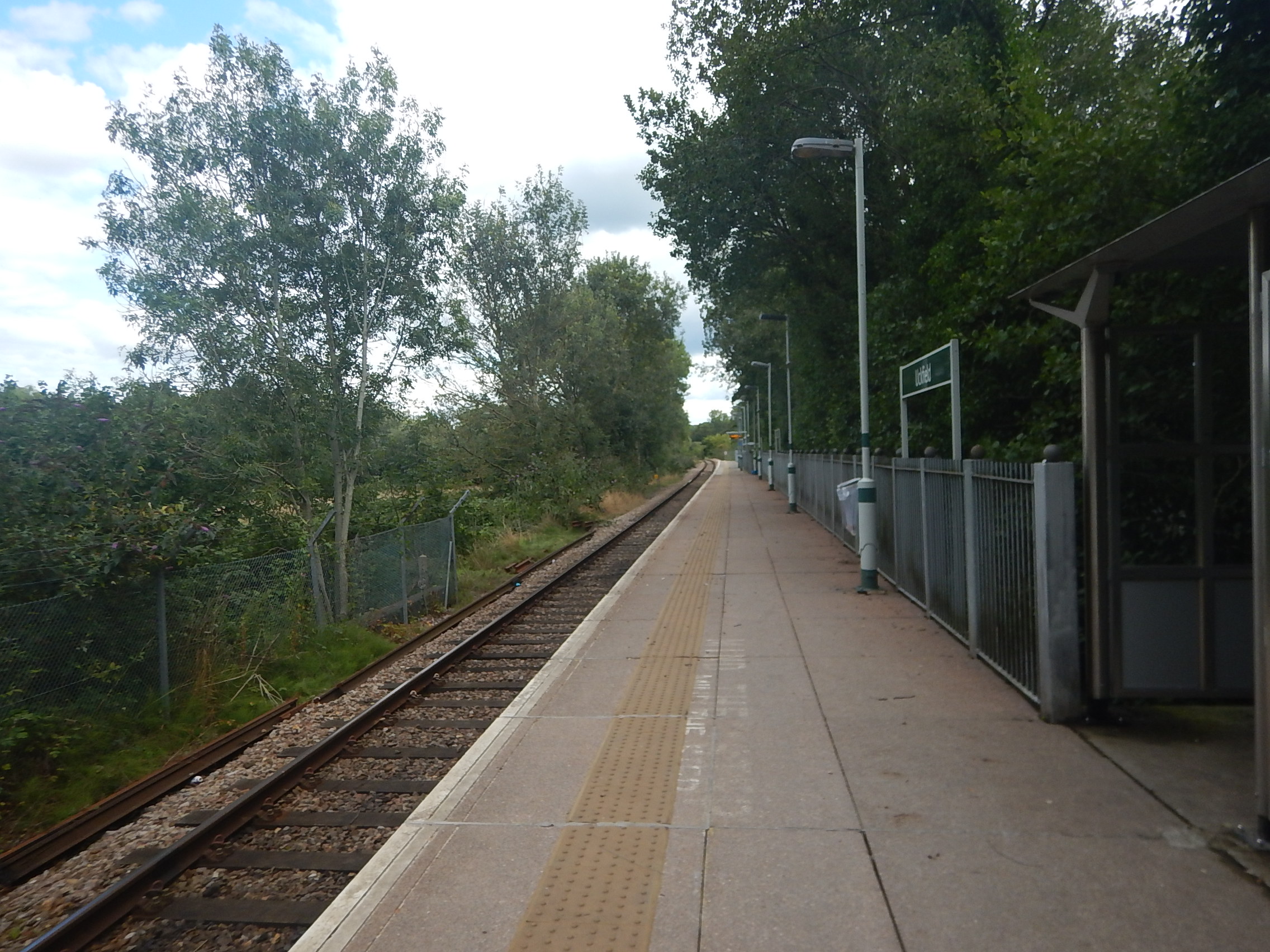
It could certainly accommodate a double third rail-based charging system.
- It would be on the far-side from the platform.
- It would only be activated with a train the platform and connected.
- It could be designed to have no serious safety problems.
The eleven minute charge would be equivalent to one of twenty-two minutes.
There must surely be the option to adjust the timetable, so that trains spend a few minutes longer at Uckfield and a few less at London Bridge, where charging isn’t necessary, as they charge the batteries all the way to and from Hurst Green.
Aventra Trains Have A Low Energy Mode
A few months ago, I was on a Crossrail train and I got talking to one of the driver/trainers.
I asked him what happens, if the power fails in the Crossrail tunnel.
He told me, that the driver switches systems off to reduce power requirements and switches to emergency power to move the train to a safe place to evacuate passengers.
Suppose though, when the train is running on batteries, power-hungry systems like air-conditioning were turned to a low energy mode. With judicious switching and innovation in design, I suspect that energy use can be lowered when running on batteries and raised when running on electrification to compensate.
Suppose, it was a very hot summer’s day.
The air-conditioning would be cooling the train from London Bridge to Hurst Green, getting more than adequate power from the electrification.
At Hurst Green, the train would be just the right temperature and the air-conditioning would be switched to eco-mode.
The train would be well-insulated and this would help maintain the cool environment, until the electrification was regained.
What about a cold day in the winter?
This post is entitled Aventras Have Underfloor Heating. On a cold day will this act a bit like a storage heating and keep the train warm if the power fails?
As I said I don’t think an Aventra is a normal train and although some of this is my deductions, we should be prepared for surprises as more of these trains start running on the UK’s railways.
Will Battery Trains Be Slower?
Much of the battery running on this route will be short hops of a few miles and minutes between stations.
The longest section will be between Crowborough and Buxted stations, which is 4.71 miles and currently takes seven minutes in both directions.
Both the Class 171 trains and the battery trains, will operate each section in the same way.
- Accelerate to the line speed, as fast as possible.
- Run at line speed for a measured distance.
- Slow down and apply braking to stop precisely in the next station.
As the battery train has 1 metre per sec² acceleration, as opposed to 0.5 metre per sec² of the diesel train, the battery train will get to line speed faster
Regenerative braking will also be smoother and possibly greater, than the brakes on the diesel train.
I am fairly sure, that a well-designed battery train will save a few minutes on each leg from Hurst Green to Uckfield.
These time savings could be used to extend the charging time at Uckfield
Conclusion
Running services on the Uckfield branch using battery-powered trains is a feasible proposition.
But these trains must have the following features.
- Regenerative braking to the trains batteries.
- A design where batteries are central to the traction system, not an afterthought.
- The ability to minimise power use for onboard systems.
But above all, the trains must have energy efficient systems.
Bombardier obviously have better figures and information than I do, so I think we should be prepared for surprises.
Solar Power Could Make Up “Significant Share” Of Railway’s Energy Demand
The title of this post is the same ass this article in Global Rail News.
This is the first three paragraphs.
Solar panels could be used to power a sizeable chunk of Britain’s DC electric rail network, a new report has suggested.
Climate change charity 10:10 and Imperial College London’s Energy Futures Lab looked at the feasibility of using solar panels alongside the track to directly power the railway.
The report claims that 15 per cent of the commuter network in Kent, Sussex and Wessex could be powered directly by 200 small solar farms. It suggested that solar panels could also supply 6 per cent of the London Underground’s energy requirements and 20 per cent of the Merseyrail network.
In another article in today’s Times about the study, this is said.
Installing solar farms and batteries alongside lines also could provide the extra energy needed to power more carriages on busy routes that otherwise would require prohibitively expensive upgrades to electricity networks.
Note the use of batteries mentioned in the extract from The Times. This would be sensible design as power can be stored, when the sun is shining and used when it isn’t!
If you want to read the full report, click here!
I will lay out my thoughts in the next few sections.
Is This Technique More Applicable To Rail-Based Direct Current Electrification?
All of the routes mentioned for application of these solar farms,; Southern Electric (Kent, Sussex and Wessex), London Underground and Merseyrail are electrified using one of two rail-based direct current systems.
Consider the following.
Powering The Track
In the September 2017 Edition of Modern Railways, there is an article entitled Wires Through The Weald, which discusses electrification of the Uckfield Branch in Sussex, as proposed by Chris Gibb. This is an extract.
He (Chris Gibb) says the largest single item cost is connection to the National Grid, and a third-rail system would require feeder stations every two or three miles, whereas overhead wires may require only a single feeder station for the entire Uckfield Branch.
It would appear that as rail-based direct current electrification needs a lot of feeder stations along the line, this might be better suited for solar power and battery electrification systems.
Consider.
- Most of the feeder stations would not need a connection to the National Grid.
- Solar panels generate low direct current voltages, which are probably cheaper to convert to 750 VDC than 25 KVAC.
- In installing electrification on a line like the Uckfield Branch, you would install the extra rails needed and a solar farm and battery system every two or three miles.
- With the situation mentioned in the extract from The Times, you might add a solar farm and battery system, to a section of track, where more power is needed.
- For efficiency and safety, power would only be sent to the rail when a train was present.
I trained as an Electrical Engineer and I very much feel, that solar power and battery systems are better suited to powering rail-based electrification. Although, they could be used for the overhead DC systems we use in the UK for trams.
Modular Design
Each of the solar farm and battery systems could be assembled from a series of factory-built modules.
This would surely make for a cost-effective installation, where capacity and capabilities could be trailored to the location.
Regenerative Braking
Modern trains use regenerative braking, which means that braking energy is converted into electricity. The electricity is handled in one of the following ways.
- It is turned into heat using resistors on the train roof.
- It is returned through the electrification system and used to power nearby trains.
- It is stored in a battery on the train.
Note.
- Option 1 is not efficient.
- Option 2 is commonly used on the London Underground and other rail-based electrification systems.
- Option 2 needs special transformers to handle 25 KVAC systems.
- Option 3 is efficient and is starting to be developed for new trains and trams.
If batteries are available at trackside, then these can also be used to store braking energy.
I believe that using solar farm and battery systems would also enable efficient regenerative braking on the lines they powered.
But again, because of the transformer issue, this would be much easier on rail-bassed direct current electrification systems.
Could Wind Turbines Be Used?
Both solar farms and wind turbines are not guaranteed to provide continuous power, but putting a wind turbine or two by the solar farm would surely increase the efficiency of the system, by generating energy in two complimentary ways and then storing it until a train came past.
Wind energy could also be available for more hours in the day and could even top up the battery in the dark.
In fact, why stop with wind turbines?
Any power source could be used. On a coastal railway, it might be wave or tidal power.
Could Hydrogen Power Be Used?
I think that hydrogen power could be another way to create the energy needed to back up the intermittent power of solar farms and wind turbines.
I put a few notes in Hydrogen-Powered Railway Electrification.
Would The Technique Work With Battery Trains?
Most certainly!
I haven’t got the time or the software to do a full simulation, but I suspect that a route could have an appropriate number of solar farm and battery systems and each would give the battery train a boost, as it went on its way.
Would The Technique Work With 25 KVAC Electrification?
It would be more expensive due to the inverter involved to create the 25 KVAC needed.
But I feel it would be another useful tool in perhaps electrifying a tunnel or a short length of track through a station.
It could also be used to charge a train working a branch line on batteries.
Would The Technique Work With Dual Voltage Trains?
Many trains in the UK can work with both third-rail 750 VDC third-rail and 25 KVAC overhead electrification.
Classes of trains include.
- The Class 319 trains built for Thameslink in the 1980s.
- The Class 345 trains being built for Crossrail.
- The Class 387 trains built for various operators.
- The Class 700 trains recently built for Thamelink.
There are also other classes that could be modified to run on both systems.
Provided they are fitted with third-rail shoes, there is no reason to stop dual-voltage trains running on a line electrified using solar farms and batteries.
The technique could surely be used to electrify a branch line from a main line electrified using 25 KVAC.
Consider the Henley Branch Line.
- It is four-and-a half miles long.
- It is not electrified.
- It connects to the electrified Great Western Main Line at Twyford station.
- The line can handle trains up to six-cars.
- All services on the line are worked by diesel trains.
Services consist of a shuttle between Henley-on-Thames and Twyford, with extra services to and from Paddington in the Peak and during the Regatta.
Network Rail were planning to electrify the line using 25 KVAC overhead electrification, but this has been cancelled, leaving the following options for Paddington services.
- Using battery trains, possibly based on the Class 387 trains, which would be charged between Paddington and Twyford.
- Using Class 800 bi-mode trains.
- Using Class 769 bi-mode trains.
All options would mean that the diesel shuttle continued or it could be replaced with a Class 769 bi-mode train.
An alternative would be to electrify the branch using third-rail fitted with solar farm and battery systems.
- All services on the line could be run by Class 387 trains.
- Voltage changeover would take place in Twyford station.
There are several lines that could be served in this way.
Installation Costs
I’ll repeat my earlier quote from the Modern Railways article.
He (Chris Gibb) says the largest single item cost is connection to the National Grid, and a third-rail system would require feeder stations every two or three miles, whereas overhead wires may require only a single feeder station for the entire Uckfield Branch.
If you were going to electrify, the twenty-four non-electrified miles of the Marshlink Line, with traditional Southern Electric third-rail, you would need around 8-12 National Grid connections to power the line. As the Romney Marsh is probably not blessed with a dense electricity network, although it does have a nuclear power station, so although putting in the extra rails may be a relatively easy and affordable project, providing the National Grid connection may not be as easy.
But use solar farm and battery systems on the remoter areas of the line and the number of National Grid connections will be dramatically reduced.
Good National Grid connections are obviously available at the two ends of the line at Hastings and Ashford International stations. I also suspect that the electricity network at Rye station could support a connection for the electrification.
This could mean that six to eight solar farm and battery systems would be needed to electrify this important line.
I obviously, don’t have the actual costs, but this could be a very affordable way of electrifying a remote third-rail line.
Which Lines Could Be Electrified Using Solar Farm And Battery Systems?
For a line to be electrified and powered by solar farm and battery systems, I think the line must have some of the following characteristics.
- It is a line that is suitable for rail-based direct current electrification.
- It is not a particularly stiff line with lots of gradients.
- It is in a rural area, where National Grid connections will be difficult and expensive.
- It has a connection to other lines electrified by rail-based systems.
Lines to electrify are probably limited to Southern Electric (Kent, Sussex and Wessex), London Underground and Merseyrail.
- Borderlands Line between Bidston and Wrexham.
- Kirkby to Skelmersdale
- Marshlink Line
- North Downs Line between Reading and Gatwick Airport.
- West of England Line between Basingstoke and Exeter
- Uckfield Branch
I also suspect there are several branch lines that could be reopened or electrified using rail-based electrification.
Riding Sunbeams
Note that the project is now called Riding Sunbeams.
Conclusion
It’s a brilliantly simple concept that should be developed.
It is well suited to be used with rail-based direct current electrification.
It would be ideal for the electrification of the Uckfield Branch.
What Will Happen To The Class 379 Trains?
Greater Anglia’s fleet of thirty Class 379 trains are being replaced by by a brand new fleet of Class 745 Stadler FLIRT EMUs which will be fixed 12-car trains on Stansted Express services and Class 720 Bombardier Aventra EMUs on Cambridge services.
These trains have a high specification.
- Four-car trainsets.
- Ability to work as four, eight and twelve-car trains.
- 2+2 seating in Standard Class.
- 2+1 seating in First Class.
- Plenty of luggage space.
- Wi-fi and power sockets.
- Full compliance with all Persons of Reduced Mobility rules.
- 100 mph capability.
- Regenerative braking.
I also suspect the following is true about the trains.
- The ability to run on 750 VDC third rail electrification could be added reasonably easily.
- Lithium-ion batteries to give a limited range, can be fitted.
- The top speed could be upgraded to the 110 mph of the closely-related Class 387 trains.
- The trains have end gangways and could be certified to run through the core route of Thameslink, like the Class 387 trains.
So they would appear to be a very useful train.
So what will happen to the trains?
This is my speculative list of possible uses.
Continued Use By Greater Anglia
In some ways it’s strange that these reasonably new trains are being replaced on Stansted and Cambridge services.
They are being replaced by Stadler Class 745 trains, which like the Class 379 trains are 100 mph trains.
In the next decade or so, the West Anglia Main Line is to be upgraded.
- There will be four tracks at least between Tottenham Hale and Broxbourne stations.
- Cambridge South station and the East West Rail Link will have been completed.
- Line speed will have been improved to at least 100 mph along its full length.
- The High Meads Loop will be developed to allow more trains from the West Anglia Main Line to use Stratford instead of the overcrowded Liverpool Street as a London terminal.
I suspect the number of fast services between London and Cambridge along the West Anglia Main Line will be increased.
So are performance upgrades available for the Class 745 trains, which will deliver these improved services?
If Stadler are late with their delivery of the Class 745 trains, the Class 379 trains will continue to be used on Stansted and Cambridge services.
This is discussed in this article in Rail Magazine, which is entitled Contingency Plans In Place For Greater Anglia’s Main Line Fleet.
But surely, this would only delay their cascade to other operators.
According to Wikipedia, all of the replacement Class 745 trains, are scheduled to enter service in 2019, which should mean that the Class 379 trains should be available for cascade to other operators, sometime in 2020.
St. Pancras to Corby
Under Future in the Wikipedia entry for Corby station, this is said.
It is planned that a half-hourly London St Pancras to Corby service will operate from December 2019 using new Class 387 trains, once the Midland Main Line has been electrified beyond Bedford as part of the Electric Spine project. Network Rail has also announced that it plans to re-double the currently singled Glendon Junction to Corby section as part of this scheme.
In the December 2017 Edition of Modern Railways there is an article, which is entitled Wires To Corby Now in 2020.
This is the first paragraph.
Carillion is to deliver electrification of the Midland Main Line to Corby, but electric services will not start until December 2020, a year later than previously envisaged.
The article also states the following.
- A fourth track is to be installed between Bedford and Kettering.
- Track and wires are to be updated so that new 125 mph bi-mode trains can run between St. Pancras and Derby, Nottingham and Sheffield.
- Improvements to the current electrification South of Bedford.
Everything should be completed, so that the new bi-mode trains could enter service from 2022.
It should be noted that Wikipedia says this about the Future of the East Midlands Trains franchise.
The franchise is due to end in August 2019. The Invitation to Tender is due to be issued in April 2018, which will detail what improvements bidders for the franchise must make. The contract will then be awarded in April 2019.
This could give the following project schedule on the Midland Main Line.
- April 2019 – Award of new East Midlands franchise.
- August 2019 – New East Midlands franchise starts.
- December 2020 – Electric services to Corby start.
- December 2022 – Bi-mode services to Derby, Nottingham and Sheffield start.
These dates would fit well with the retirement of the Class 379 trains by Greater Anglia in 2020.
Current timings between Corby and London are 71 minutes with four stops. I don’t think it would be unreasonable to assume that the improved track and new trains would be designed so that the timings between Corby and London would be reduced to under an hour, with a round trip of two hours.
If this can be achieved, then just four trains of an appropriate length will be needed to meet the required two tph timetable.
- Four-car services would need four trains.
- Eight-car services would need eight trains.
- Twelve-car services would need twelve trains.
It might not be possible to run eight and twelve car services due to platform length restrictions.
If the two hour round trip could be achieved by an existing Class 387 or an uprated Class 379 trains, then either of these trains would be a shoe-in for the route.
Otherwise we’ll be seeing something faster like a Class 801 train.
But if services are to start in 2020, there would be a problem to manufacture the trains in the available time, as the contract will only have been awarded in April 2019.
I think that St. Pancras to Corby is a possibility for Class 379 trains, which may need to be uprated to 110 mph. On the other hand, Class 387 trains wouldn’t need to be uprated.
West Midlands Trains, who have a similar need for their Euston to West Midlands services, have ordered 110 mph Aventras.
- So perhaps the new East Midlands franchise will do the same.
- This would be more likely, if Bombardier come up with the rumoured 125 mph bi-mode Aventra.
- Or they could buy a mixture of Class 800 and 801 trains.
I don’t think the Class 379 trains will work St. Pancras to Corby.
Battery Services
A Class 379 train was used for the BEMU trial, where a battery was fitted to the train and it ran for a couple of months between Manningtree and Harwich, using overhead power one way and battery power to return.
Was this class of train chosen, as it was one of the easiest to fit with a battery? After all it was one of the later Electrostars.
This article on the Railway Gazette from July 2007 is entitled Hybrid Technology Enters The Real World. It describes the experimental conversion of a Class 43 power-car from a High Speed Train into a battery-assisted diesel-electric power-car.
A second article in the Railway Gazette from October 2010 is entitled First New Stansted Express Train Rolls Out. It describes the Class 379 train in detail. This is an extract.
Although part of the Electrostar family, the Class 379 incorporates a number of technical changes from the original design developed in the late 1990s, making use of technologies which would be used on the Aventra next-generation Electrostar which Bombardier is proposing for the major Thameslink fleet renewal contract.
The body structure has been revised to meet European crashworthiness requirements. The window spacing has changed, with the glass bolted rather than glued in place to enable faster repairs. The couplers are from Dellner, and the gangways from Hübner. Top speed is 160 km/h, and the 25 kV 50 Hz trains will use regenerative braking at all times.
The last statement about regenerative braking is the most interesting.
To my knowledge electric trains that use regenerative braking had never run on the West Anglia Main Line before and that to handle the return currents with 25 KVAC needs special and more expensive transformers. The obvious way to handle regenerative braking at all times without using the electrification is to put an appropriately sized battery on the train.
If Bombardier have done this on the Class 379 train, then it might be a lot easier to fit a large battery to power the train. This would explain why the trains were chosen for the trial rather than a train from a more numerous variant.
The result was a trial of which few, if any,negative reports can be found.
The result was a trial of which few, if any,negative reports can be found.
Class 379 Train Performance On Batteries
Little has been said about the performance of the train.
However, in this document on the Network Rail web site, which is entitled Kent Area Route Study, this is said.
In 2015, industry partners worked together to investigate
battery-electric traction and this culminated with a
practical demonstration of the Independently Powered
Electric Multiple Unit IPEMU concept on the Harwich
Branch line in Anglia Route. At the industry launch event,
the train manufacturers explained that battery
technology is being developed to enable trains to run
further, at line speeds, on battery power, indeed, some
tram lines use this technology in the city centres and many
London buses are completely electric powered.The IPEMU project looked at the feasibility of battery power
on the Marshlink service and found that battery was
sufficient for the train to run from Brighton to Ashford
International and back but there was insufficient charge to
return to Ashford International on a second round trip. A
solution to this could be that the unit arrives from Ashford
International at Brighton and forms a service to Seaford and
back before returning to Ashford International with a
charged battery.The IPEMU demonstration train was a Class 379, a similar
type to the Class 377 units currently operated by Southern, it
was found that the best use of the battery power was to
restrict the acceleration rate to that of a modern diesel
multiple unit, such as a Class 171 (the current unit type
operating the line) when in battery mode and normal
acceleration on electrified lines.
|Ashford to Brighton is 62 miles, so a round trip would be 124 miles.
The document doesn’t say anything about how many stops were made in the tests, but I’m sure that Bombardier, Greater Anglia and Network Rail have all the data to convert a Class 379 into a viable IPEMU or Independently Powered Electric Multiple Unit.
As to how long it takes to charge the battery, there is an interesting insight in this article from Rail Magazine, which is entitled Battery-Powered Electrostar Enters Traffic. This is said.
It is fitted with six battery rafts, and uses Lithium Ion Magnesium Phosphate battery technology. The IPEMU can hold a charge for 60 miles and requires two hours of charging for every hour running. The batteries charge from the overhead wires when the pantograph is raised, and from regenerative braking.
The two-one ratio between charging and running could be an interesting factor in choice of routes.
What About The Aventra?
I quoted from this article in the Railway Gazette from October 2010 earlier. This is said.
Although part of the Electrostar family, the Class 379 incorporates a number of technical changes from the original design developed in the late 1990s, making use of technologies which would be used on the Aventra next-generation Electrostar.
So would it be a reasonable assumption to assume, that if batteries can be fitted to a Class 379 train, then they could also be fitted to an Aventra?
This article in Global Rail News from 2011, which is entitled Bombardier’s AVENTRA – A new era in train performance, gives some details of the Aventra’s electrical systems. This is said.
AVENTRA can run on both 25kV AC and 750V DC power – the high-efficiency transformers being another area where a heavier component was chosen because, in the long term, it’s cheaper to run. Pairs of cars will run off a common power bus with a converter on one car powering both. The other car can be fitted with power storage devices such as super-capacitors or Lithium-ion batteries if required.
This was published in 2011, so I suspect Bombardier have refined the concept.
But it does look that both battery variants of both Class 379 trains and Aventras are possible.
Routes For Battery Trains
What important lines could be run by either a Class 379 train or an Aventra with an appropriate battery capability?
I will refer to these trains as IPEMUs in the remainder of this post.
I feel that one condition should apply to all routes run by IPEMUs.
The 2:1 charging time to running time on battery ratio must be satisfied.
East Coastway And Marshlink Lines
As Network Rail are prepared to write the three paragraphs in the Kent Area Route Study, that I quoted earlier, then the East Coastway and Marshlink Lines, which connect Brighton and Ashford International stations, must be high on the list to be run by IPEMUs.
Consider.
- All the route, except for about twenty-four miles of the Marshlink Line is electrified.
- Brighton and Ashford International stations are electrified.
- Some sections have an operating speed of up to 90 mph.
- Brighton to Hastings takes 66 minutes
- Ashford International to Hastings takes 40 minutes
- There is a roughly fifteen minute turnround at the two end stations.
The last three points, when added together, show that in each round trip, the train has access to third-rail power for 162 minutes and runs on batteries for 80 minutes.
Does that mean the 2:1 charging to running ratio is satisfied?
I would also feel that if third-rail were to be installed at Rye station, then in perhaps a two minute stop, some extra charge could be taken on board. The third-rail would only need to be switched on, when a train was connected.
It looks to me, that even the 2015 test train could have run this route, with just shoe gear to use the third-rail electrification. Perhaps it did do a few test runs! Or at least simulated ones!
After all, with a pantograph ready to be raised to rescue a train with a flat battery, they could have run it up and down the test route of the Mayflower Line at a quiet time and see how far the train went with a full battery!
Currently, many of the train services along the South Coast are run by a fleet of Class 313 trains, with the following characteristics.
- There are a total of nineteen trains.
- They were built in the late 1970s.
- They are only three cars, which is inadequate at times.
- They are 75 mph trains.
- They don’t have toilets.
- The trains are used on both the East Coastway and West Coastway Lines.
Replacing the trains with an appropriate number of Class 379 trains or Aventras would most certainly be welcomed by passengers, staff and the train companies.
- Diesel passenger trains could be removed from the route.
- There could be direct services between Ashford International and Southampton via Brighton.
- One type of train would be providing most services along the South Coast.
- There would be a 33% increase in train capacity.
- Services would be a few minutes quicker.
- For Brighton’s home matches, it might be possible to provide eight-car trains.
- The forty-year-old Class 313 trains would be scrapped.
The service could even be extended on the fully-electrified line to Bournemouth to create a South Coast Seaside Special.
London Bridge To Uckfield
I looked at Chris Gibb’s recommendation for this line in Will Innovative Electrification Be Used On The Uckfield Line?
These actions were recommended.
- Electrification of the branch using 25 KVAC overhead.
- Electrification of tunnels with overhead conductor rail.
- Dual-voltage trains.
- Stabling sidings at Crowborough.
How would this be affected if IPEMUs were to be used?
The simplest way to run IPEMUs would be to install third-rail at Uckfield to charge the train.
Current timings on the route are as follows.
- London Bridge to Hurst Green – electrified – 32 minutes
- Hurst Green to Uckfield – non-electrified – 41 minutes
- Turnaround at London Bridge – 16 minutes
- Turnaround at Uckfield – 11 minutes
Hurst Green station is the limit of the current electrification.
Adding these times together, show that in each round trip, the train has access to third-rail power for 91 minutes and needs to on batteries for 82 minutes.
It looks like the 2:1 charging to running ratio is not met.
To meet that, as the round trip is three hours, that means that there probably needs to be two hours on electrification and an hour on batteries.
So this means that at least eleven minutes of the journey between Hurst Green and Uckfield station needs to be electrified, to obtain the 2:1 ratio.
It takes about this time to go between Crowborough and Uckfield stations.
- Crowborough will have the new sidings, which will have to be electrified.
- The spare land for the sidings would appear to be to the South of Crowborough station in an area of builders yards and industrial premises.
- Crowborough Tunnel is on the route and is nearly a kilometre long.
- The route is double-track from Crowborough station through Crowborough Tunnel and perhaps for another kilometre to a viaduct over a valley.
- The viaduct and the remainder of the line to Uckfield is single track.
- The single track section appears to have space to put the gantries for overhead electrification on the bed of the original second track.
If you apply Chris Gibb’s original recommendation of 25 KVAC, then electrification between Crowborough and Uckfield station, might just be enough to allow IPEMUs to work the line.
- The sidings at Crowborough would be electrified.
- About half of the electrification will be single-track.
- Crowborough Tunnel would use overhead rails.
- Power could probably be fed from Crowborough.
- The regenerative braking would be handled by the batteries on the trains.
- Changeover between overhead power and batteries would be in Crowborough station.
- Buxted and Uckfield stations wouldn’t be complicated to electrify, as they are single-platform stations.
I very much feel that running IPEMUs between London Bridge and Uckfield is possible.
Preston to Windermere
The Windermere Branch Line is not electrified and Northern are proposing to use Class 769 bi-mode trains on services to Windermere station.
Current timings on the line are as follows.
- Windermere to Oxenholme Lake District – non-electrified – 20 minutes
- Oxenholme Lake District to Preston – electrified – 40 minutes
If you add in perhaps ten minutes charging during a turnaround at Preston, the timings are just within the 2:1 charging ratio.
So services from Windermere to at least Preston would appear to be possible using an IPEMU.
These trains might be ideal for the Windermere to Manchester Airport service. However, the Class 379 trains are only 100 mph units, which might be too slow for the West Coast Main Line.
The IPEMU’s green credentials would be welcome in the Lakes!
The Harrogate Line
This is said under Services in the Wikipedia entry for Harrogate station, which is served by the Harrogate Line from Leeds.
The Monday to Saturday daytime service is generally a half-hourly to Leeds (southbound) calling at all stations and to Knaresborough (eastbound) on the Harrogate Line with an hourly service onwards to York also calling at all stations en route.
Services double in frequency at peak time to Leeds, resulting in 4 trains per hour (tph) with 1tph running fast to Horsforth. There are 4 tph in the opposite direction between 16:29 and 18:00 from Leeds with one running fast from Horsforth to Harrogate.
Evenings and Sundays an hourly service operates from Leeds through Harrogate towards Knaresborough and York (some early morning trains to Leeds start from here and terminate here from Leeds in the late evening).
Proposals have been made to create a station between Harrogate and Starbeck at Bilton, whilst the new Northern franchise operator Arriva Rail North plans to improve service frequencies towards Leeds to 4 tph from 7am to 7pm once the new franchise agreement starts in April 2016.
I believe that the easiest way to achieve this level of service would be to electrify between Leeds and Harrogate.
- IPEMUs might be able to go between Harrogate and York on battery power.
- Leeds and York are both fully electrified stations.
- If a link was built to Leeds-Bradford Airport, it could be worked on battery power and the link could be built without electrification.
- The electrification could be fed with power from Leeds.
- There is also the two-mile long Bramhope Tunnel.
Full electrification between Leeds and Harrogate would allow Virgin’s Class 801 trains to reach Harrogate.
I’m fairly certain that there’s a scheme in there that with minimal electrification would enable IPEMUsy to reach both a new station at Leeds-Bradford Airport and York.
Conclusion
These routes show that it is possible to use IPEMUs to run services on partially-electrified routes.
As I said earlier, the 2:1 ratio of charging to running time could be important.
Airport Services
Class 379 trains were built to provide fast, comfortable and suitable services between London Liverpool Street and Stansted Airport.
Because of this, the Class 379 trains have a First Class section and lots of space for large bags.
Surely, these trains could be found a use to provide high-class services to an Airport or a station on a high-speed International line.
But there are only a limited number of UK airports served by an electrified railway.
- Ashford International for Eurostar.
- Birmingham
- Gatwick
- Heathrow
- Luton
- Manchester
- Southampton
- Southend
- Stansted
Most of these airports already have well-developed networks of airport services, but Class 379 trains could provide an upgrade in standard.
In addition, the following airports, may be served by an electrified heavy rail railway.
All except Doncaster Sheffield would need new electrification. For that airport, a proposal to divert the East Coast Main Line exists.
Possibilities for airport services using IPEMUs, based on Class 379 trains with a battery capability would include.
Ashford International
The completion of the Ashford Spurs project at Ashford International station will surely create more travellers between Southampton, Portsmouth and Brighton to Ashford, as not every Continental traveller will prefer to go via London.
Class 379 IPEMUs,with a battery capability to handle the Marshlink Line would be ideal for a service along the South Coast, possibly going as far West as Bournemouth.
Birmingham
Birmingham Airport is well connected by rail.
I think that as train companies serving the Airport, have new trains on order, I doubt we’ll see many Class 379 trains serving the Airport.
Bristol
Various routes have been proposed for the Bristol Airport Rail Link.
In my view, the routes, which are short could be served by light rail, tram-train or heavy rail.
As the proposed city terminus at Bristol Temple Meads station would be electrified and the route is not a long one, I’m pretty sure that a Class 379 IPEMU could work the route.
But light rail or tram-train may be a better option.
Gatwick
Gatwick Airport station is well served by trains on the Brighton Main Line, running to and from Brighton, Clapham Junction, East Croydon, London Bridge, St. Pancras and Victoria, to name just a few.
Gatwick also has an hourly service to Reading via the North Downs Line, which is only partly electrified.
In my view, the North Downs route would be a classic one for running using Class 379 IPEMUs.
- The Class 379 trains were built for an Airport service.
- Four cars would be an adequate capacity.
- No infrastructure work would be needed. But operating speed increases would probably be welcomed.
- Third-rail shoes could be easily added.
- Several sections of the route are electrified.
- Gatwick Airport and Reading stations are electrified.
Currently, trains take just over an hour between Reading and Gatwick Airport.
Would the faster Class 379 IPEMUs bring the round trip comfortably under two hours?
If this were possible, it would mean two trains would be needed for the hourly service and four trains for a half-hourly service.
There may be other possibilities for the use of Class 379 trains to and from Gatwick Airport.
- Luton Airport keep agitating for a better service. So would a direct link to Gatwick using Class 379 trains be worthwhile?
- Class 379 IPEMUs could provide a Gatwick to Heathrow service using Thameslink and the Dudding Hill Line.
- Class 379 IPEMUs could provide a Gatwick to Ashford International service for connection to Eurostar.
I also feel that, as the trains are closely-related to the Class 387/2 trains used on Gatwick Express, using the Class 379 trains on Gatwick services would be a good operational move.
Also, if Class 379 IPEMUs were to be used to create a South Coast Express, as I indicated earlier, two sub-fleets would be close together.
Leeds-Bradford
Earlier I said that the Harrogate Line could be a route for IPEMUs, where services could run to York, if the Leeds to Harrogate section was electrified.
A spur without electrification could be built to Leeds-Bradford Airport.
Based on current timings, I estimate that a Bradford Interchange to Leeds-Bradford Airport service via Leeds station would enable a two-hour round trip.
An hourly service would need two trains, with a half-hourly service needing four trains.
Manchester
Manchester Airport is well connected by rail and although the Class 379 trains would be a quality upgrade on the current trains, I think that as Northern and TransPennine have new trains on order, I doubt we’ll see many Class 379 trains serving the Airport.
Conclusion
Looking at these notes, it seems to me that the trains will find a use.
Some things stand out.
- As the trains are only capable of 100 mph, they may not be suitable for doing longer distances on electrified main lines, unless they are uprated to the 110 mph operating speed of the Class 387 trains.
- The main line where they would be most useful would probably be the East and West Coastway Lines along the South Coast.
- Converting some into IPEMUs would probably be useful along the Marshlink and Uckfield Lines, in providing services to Gatwick and in a few other places.
I also feel, that Aventras and other trains could probably be designed specifically for a lot of the routes, where Class 379 trains, with or without batteries, could be used.
 The Anonymous Widower