UK And Welsh Governments To Explore New Rail Links Between South Wales And England
The title of this post, is the same as that of this press release from the UK Government.
These are the three bullet points.
- UK and Welsh governments today (2 February 2023) announce a new study to improve transport connectivity between south-east Wales and west of England
- the study, backed by £2.7 million of UK government funding, will look at options for new railway stations and rail services on the South Wales Main Line
- this project will focus on relieving congestion on the M4, a vital connector between south Wales and the rest of the UK
The stations are not named, but it is said that they could be between Cardiff and the Severn Tunnel.
The last paragraph changes direction a bit.
Lord Peter Hendy also proposed reviewing the route connecting north Wales to the north-west of England, better connectivity with HS2 and a package of railway improvements to increase connectivity and reduce journey times between Cardiff, Birmingham and beyond.
I find this development very interesting, but typical of the sensible approach one would expect from Lord Peter.
In Could High Speed Two Serve Holyhead?, I looked at the route and came to this conclusion.
London Euston and Holyhead could be a serious proposition.
With some development and a new fast ferry, it could also open up a practical zero-carbon route between Great Britain and Ireland.
Times of four and a half hours between London Euston and Dublin could be possible.
I suspect that time would appeal to green tourists, especially those in First with a good meal.
Funding Available For Rail Construction Innovation Projects
The title of this post, is the same as that of this article on Railway Gazette.
These are the two introductory paragraphs.
Innovators from across the UK are being invited to submit proposals for the Innovation in Railway Construction Competition, which is making £7·44m available for ideas which could be tested at the Global Centre of Rail Excellence in South Wales.
The competition is being run by Innovate UK with GCRE and the Department for Business, Energy & Industrial Strategy.
£7.44m doesn’t seem much, but it is only for feasibility studies, as the article explains.
Entries for the first phase close at 12.00 on December 14, with funding available for feasibility studies of up to £25 000. This would be followed by an invite-only phase two, with successful first phase projects able to develop and demonstrate their innovations.
As Innovate UK keeps coming up with these competitions, they must be judged to be worthwhile.
Do they use the same technique in areas like Health and the NHS? If not, why not!
Regulator Approves New Grand Union Train Service From Carmarthen To London Paddington
The title of this post, is the same as that of this press release from the Office of Rail and Road.
This is the sub-heading of the press release.
The Office of Rail and Road (ORR) has opened up the Great Western Main Line to competition and enabled a significant increase in rail services between London and South Wales.
These points are made in the press release.
- The rail regulator has approved the introduction of new train services between London, Cardiff and South West Wales from the end of 2024.
- The services will be operated by a new open access operator, Grand Union Trains, bringing competition to the Great Western route out of Paddington.
- Passengers travelling between London, Bristol Parkway, Severn Tunnel Junction, Newport, Cardiff, Gowerton, Llanelli and Carmarthen will benefit from an extra five daily return services and greater choice of operator.
- The decision opens up the Great Western Main Line to competition for the first time, with potential benefits in terms of lower fares, improved service quality and innovation for all passengers using the route.
- The application, submitted to ORR in June 2022, was disputed by Network Rail due to concerns about capacity on the network. But following careful consideration and analysis, ORR has directed Network Rail to enter into a contract with Grand Union.
- Grand Union has committed to significant investment in new trains.
- As an ‘open access’ train operator, however, it will not get paid subsidies from public funds, unlike current operators along the route.
ORR supports new open access where it delivers competition for the benefit of passengers. In making this decision, the regulator has weighed this up against the impact on Government funds and effect on other users of the railway, both passengers and freight customers.
These are my thoughts.
The Company
Grand Union Trains have certainly persevered to get this approval.
- The company was created by Ian Yeowart, who previously created open access operators; Alliance Rail Holdings and Grand Central before selling both to Arriva.
- After multiple negotiations with the Office of Road and Rail (ORR), Yeowart must know how to get an acceptable deal.
- Grand Union Trains have a similar application for a service between Euston and Stirling with the ORR.
Grand Union Trains also have a web site.
The home page has a mission statement of Railways To Our Core, with this statement underneath.
At Grand Union we are passionate about Britain’s railways. We are committed to the traditional values of providing a high-quality customer service and a comfortable journey experience at a fair price.
I’ll go with that.
The Financial Backing Of The Company
All the UK’s open access operators are well-financed either by Arriva or First Group.
The ORR would not receive any thanks, if they approved an operator, which duly went bust.
So what is the quality of the financing behind Grand Union Trains?
This article on Railway Gazette is entitled RENFE Looks At Entering UK Rail Market Through Open Access Partnership, which starts with this paragraph.
Open access passenger service developer Grand Union Trains is working with Spain’s national operator RENFE and private equity firm Serena Industrial Partners on a proposed service between London and Wales.
That is fairly clear and would surely help in the financing of Grand Union Trains.
The Route
Trains will run between Carmarthen and London Paddington, with stops at Llanelli, Gowerton, Cardiff, Newport, Severn Tunnel Junction and Bristol Parkway.
A new station at Felindre will replace Gowerton at some time in the future.
There will be five trains per day (tpd).
I have some thoughts and questions about the route
Felindre Station
Felindre station is named in Wikipedia as the West Wales Parkway station, where it is introduced like this.
West Wales Parkway is a proposed railway station north of Swansea, near to the boundaries of the neighbouring principal area of Carmarthenshire, and the villages of Felindre and Llangyfelach. The station is proposed to be situated at the former Felindre steelworks, near Junction 46 of the M4 and A48, and near Felindre Business Park and Penllergaer Business Park. The project is in the planning stages, as part of a wider Department for Transport proposal to re-open the Swansea District line to passenger traffic.
This Google Map shows where, it appears the Felindre station will be built.
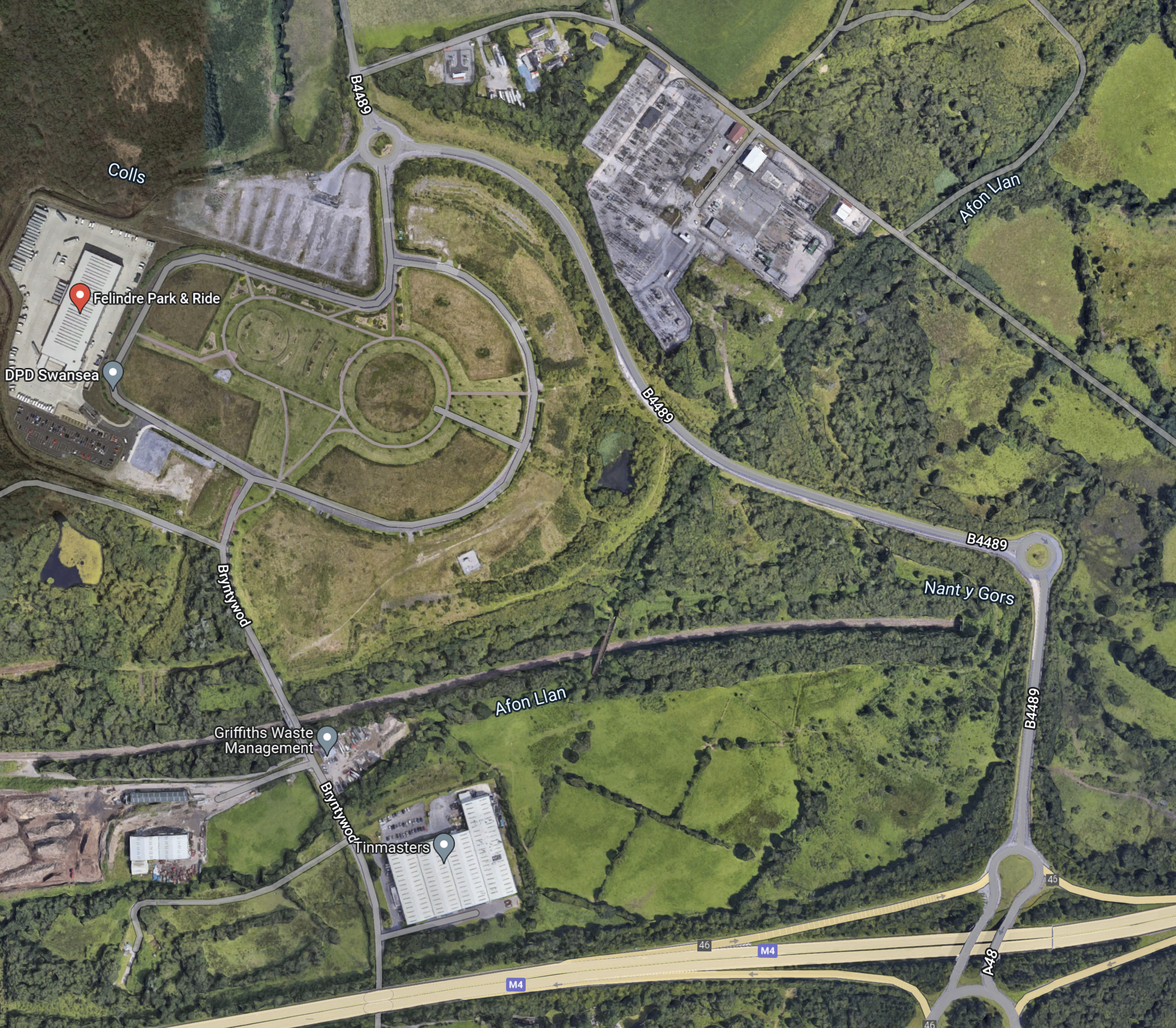
Note.
- The Felindre Business Park in the North-West corner of the map, with a Park-and-Ride.
- The M4 running across the bottom of the map.
- The Swansea District Line runs East-West between the motorway and the Business Park.
It looks that the new station could be located on the South side of the Business Park.
When High Speed Two Opens Will Trains Call At Old Oak Common?
When High Speed Two opens, all GWR trains will stop at Old Oak Common station for these connections.
- Chiltern for for Banbury, Bicester, High Wycombe and the West Midlands
- Elizabeth Line for Central and East London and the Thames Valley
- Heathrow Airport
- High Speed Two for Birmingham and the North
- Overground for Outer London
As Old Oak Common will be such an important interchange, I think they should.
Will The Platforms At Carmarthen Station Need Lengthening?
This Google Map shows Carmarthen station.
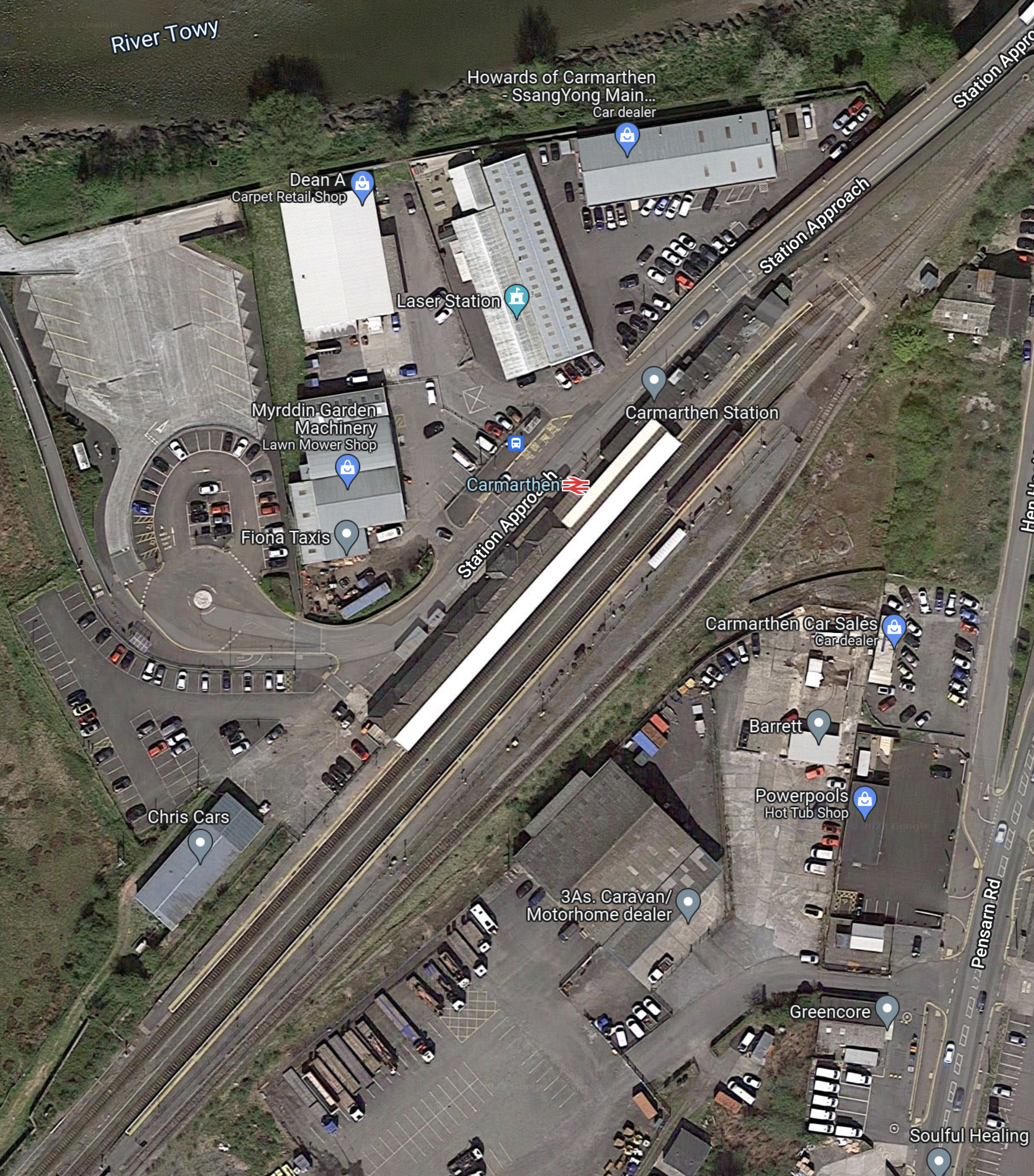
Note.
- The station has two platforms.
- There are certainly pictures of the station with an InterCity 125 in the station. There is a picture on the Wikipedia entry for Carmarthen station.
These pictures show the station.






I suspect that the station will be upgraded to accommodate Grand Union Trains.
The Trains
An article in the June 2022 Edition of Modern Railways, which is entitled Grand Union Bids For London To Carmarthen, gives these details of the trains.
- Three classes.
- 2023 start for the service.
- Cycle provision.
- Vanload freight will be carried.
- Electric trains could start between London and Cardiff by 2023.
- In 2025, trains could be nine-car bi-modes.
- South Wales-based operation and maintenance.
- 125 full-time jobs created.
It certainly seems to be a comprehensive and well-thought out plan.
I have a few thoughts on the trains.
What Make Of Trains Will Be Procured?
Consider.
- Lumo’s Class 803 trains were ordered from Hitachi in March 2019 and entered service in October 2021.
- So if they ordered their version of the Hitachi trains by the end of 2022, the trains could be in service by July/August 2025.
- It would probably be easier, if the only fast trains on the Great Western Main Line between London and South Wales were all Hitachi trains with identical performance.
But the Spanish backers of Grand Union Trains may prefer Spanish-designed trains assembled in South Wales. So would a bi-mode version of CAF’s Class 397 trains be suitable?
On the other hand, the Carmarthen and Cardiff section of the route without a reverse at Swansea is only seventy-five miles.
This Hitachi infographic shows the Hitachi Intercity Tri-Mode Battery Train.

Consider.
- Charging could be provided at Carmarthen using a short length of electrification or one of Furrer + Frey standard chargers.
- Charging would also use the electrification between London Paddington and Cardiff.
- A nine-car Class 800 or Class 802 train has five engines and a five-car train has three engines.
- The Intercity Tri-Mode Battery Train was announced in December 2022.
- In the intervening two years how far has the project progressed?
- For the last twelve months, Lumo have been running trains with an emergency battery-pack for hotel power. How are the batteries doing, whilst being ferried up and down, the East Coast Main Line?
Can Hitachi configure a train with more than one battery-pack and a number of diesel engines, that has a range of seventy-five miles? I suspect they can.
I suspect that CAF also have similar technology.
There is also a benefit to Great Western Railway (GWR).
If GWR were able to fit out their Class 802 trains in the same way, they would be able to run between Cardiff and Swansea on battery power.
- It is only 45.7 miles.
- Charging would need to be provided at Swansea.
- GWR could still run their one tpd service to Carmarthen.
It looks like both train operating companies could be able to do as Lumo does and advertise all electric services.
What Could Be The Maxmum Range Of A Hitachi Train On Batteries?
This Hitachi infographic shows the Hitachi Regional Battery Train.

Consider.
- It has a battery range of 90 km or 56 miles on the single battery.
- I would expect that by a regional train, Hitachi mean a five car Class 800 or 802 train, like those that go to Cheltenham, Lincoln or Middlesbrough.
- A five-car Hitachi Regional Battery Train would have a battery that could contain power equivalent to 280 car-miles.
- Five-car Class 800 or 802 trains have three engine positions.
- These Hitachi trains have a very sophisticated control system, which I wrote about in Do Class 800/801/802 Trains Use Batteries For Regenerative Braking?
I believe the engineers at Hyperdrive Innovation have designed the battery-packs that replace the diesel engines as simulations of the diesel engines, so they can be a direct replacement.
This would mean that battery-packs could be additive, so the following could apply to a five-car train.
- Two battery packs could have a range of 112 miles.
- Three battery packs could have a range of 168 miles.
GWR generally runs pairs of five-car trains to Swansea, which would be 90 miles without electrification.
If five-car trains with two battery packs, could be given a range of 112 miles, GWR could run an electric service to Swansea.
They could also run to Carmarthen, if Grand Union Trains would share the charger.
What ranges could be possible with nine-car trains, if one battery pack is good for 280 car-miles?
- One battery-pack, gives a range of 280/9 = 31 miles
- Two battery-packs, give a range of 2*280/9 = 62 miles
- Three battery-packs, give a range of 3*280/9 = 93 miles
- Four battery-packs, give a range of 4*280/9 = 124 miles
- Five battery-packs, give a range of 5*280/9 = 155 miles
- Six battery-packs, give a range of 6*280/9 = 187 miles
- Seven battery-packs, give a range of 7*280/9 = 218 miles
Note.
- I have rounded figures to the nearest mile.
- There are five cars with diesel engines in a nine-car train, which are in cars 2,3,5, 7 and 8.
- Diesel engines are also placed under the driver cars in five-car Class 810 trains.
- For the previous two reasons, I feel that the maximum numbers of diesel engines in a nine-car train could be a maximum of seven.
- I have therefor assumed a maximum of seven battery packs.
These distances seem sensational, but when you consider that Stradler’s Flirt Akku has demonstrated a battery range of 243 kilometres or 150 miles, I don’t think they are out of order.
But, if they are correct, then the ramifications are enormous.
- Large numbers of routes could become electric without any infrastructure works.
- Grand Union Trains would be able to run to Carmarthen and back without a charger at Carmarthen.
- GWR would be able to run to Swansea and back without a charger at Swansea.
Prudence may mean strategic chargers are installed.
Rrenewable Energy Developments In South West Wales
In Enter The Dragon, I talked about renewable energy developments in South West Wales.
I used information from this article on the Engineer, which is entitled Unlocking The Renewables Potential Of The Celtic Sea.
The article on the Engineer finishes with this conclusion.
For now, Wales may be lagging slightly behind its Celtic cousin to the north, but if the true potential of the Celtic Sea can be unleashed – FLOW, tidal stream, lagoon and wave – it looks set to play an even more prominent role in the net zero pursuit.
The Red Dragon is entering the battle to replace Vlad the Mad’s tainted energy.
South West Wales could see a massive renewable energy boom.
Grand Union Trains will increase the capacity to bring in more workers to support the developments from South Wales and Bristol.
The Celtic Cluster Launches New Regional Strategy To Maximise Offshore Wind Benefits
The title of this post, is the same as that of this article on offshoreWIND.biz.
This is the sub-heading.
The Celtic Sea Cluster has released a new Regional Strategy that outlines how Wales and South West England can maximise floating offshore wind technology benefits, in line with the forthcoming Celtic Sea leasing process being delivered by the Crown Estate.
Who comprise the Celtic Cluster? This paragraph gives the answer.
According to the Cluster, which is led by its founding partners, the Welsh Government, Cornwall, Isles of Scilly Local Enterprise Partnership, Celtic Sea Power, Marine Energy Wales, and the Offshore Renewable Energy Catapult, the strategy will allow the region’s stakeholders to ensure their activities are aligned and can achieve their common objectives.
I am surprised the Irish aren’t involved politically.
- The Irish Republic has a coastline on the Celtic Sea.
- There are a lot of Irish companies, finance and engineers involved in wind farm development.
But the cluster does have a firm ambition, according to the article.
The Cluster’s ambition is to establish the Celtic Sea region as a world leader in floating offshore wind by 2030 and to deliver 4 GW of floating wind in the Celtic Sea by 2035, with the potential to grow to 20 GW by 2045.
Note.
- The Wikipedia entry for the Celtic Sea, gives the sea an area of 300,000 km2.
- 20 GW or 20,000 MW is to be installed by 2045.
That is an energy density of just 0.067 MW/km2.
In ScotWind Offshore Wind Leasing Delivers Major Boost To Scotland’s Net Zero Aspirations, I calculated that ten floating wind farms had an average energy density of about 3.5 MW per km².
I wouldn’t bet against a few more floating wind turbines being squeezed into the Celtic Sea.
Floating Wind Farms At Sea To Create 29,000 Jobs – Crown Estate
The title of this post, is the same as that of this article on the BBC.
These three paragraphs introduce the article.
Plans to generate electricity through floating wind farms off the south Wales coast could create thousands of new jobs, according to the Crown Estate.
The property business owned by the monarch but run independently said the new industry could create about 29,000 jobs, including 10,000 in Wales.
It is leasing the space to generate enough power for four million homes.
Will Wales be the world’s next offshore wind powerhouse?
Wind power experts have said there is a potential for 50 GW of offshore wind power in the Celtic Sea and the BBC article talks of an investment of £43.6 billion by 2050.
The process has started, but will the engineers be able to tame the dragons?
Biden-Harris Administration Announces New Actions To Expand U.S. Offshore Wind Energy
The title of this post is the same as that of this fact sheet from the White House briefing room.
This is the sub-title.
Departments of Energy, Interior, Commerce, and Transportation Launch Initiatives on Floating Offshore Wind to Deploy 15 GW, Power 5 Million Homes, and Lower Costs 70% by 2035.
Some points from the fact sheet.
- The President set a bold goal of deploying 30 gigawatts (GW) of offshore wind by 2030, enough to power 10 million homes with clean energy, support 77,000 jobs, and spur private investment up and down the supply chain.
- Conventional offshore wind turbines can be secured directly to the sea floor in shallow waters near the East Coast and the Gulf of Mexico.
- However, deep-water areas that require floating platforms are home to two-thirds of America’s offshore wind energy potential, including along the West Coast and in the Gulf of Maine.
- Globally, only 0.1 GW of floating offshore wind has been deployed to date, compared with over 50 GW of fixed-bottom offshore wind.
- The Floating Offshore Wind Shot will aim to reduce the costs of floating technologies by more than 70% by 2035, to $45 per megawatt-hour.
- The Administration will advance lease areas in deep waters in order to deploy 15 GW of floating offshore wind capacity by 2035.
This all seems to be ambitious!
But!
- In ScotWind Offshore Wind Leasing Delivers Major Boost To Scotland’s Net Zero Aspirations, I looked at Scotland’s latest round of offshore wind leases.
- If the lessors carry out their proposals Scotland will add 9.7 GW of fixed-foundation offshore wind farms and 14.6 GW of floating offshore wind farms, which I estimate will be built by 2035.
- In Three Shetland ScotWind Projects Announced, I looked at three floating wind farms to the East of Shetland, which are a secondary deal after ScotWind, which could generate 2.8 GW by 2035.
- In Is This The World’s Most Ambitious Green Energy Solution?, I describe an ambitious plan called Northern Horizons, proposed by Norwegian company; Aker to build a 10 GW floating wind farm, which will be 120 km to the North-East of the Shetlands.
It could be possible that little Scotland installs more floating wind farms before 2035, than the United States.
And what about England, Wales and Northern Ireland?
- England hasn’t announced any floating wind farm projects, but has around 17 GW of fixed-foundation offshore wind farms under development in the shallower waters along the East and South coasts.
- In Two Celtic Sea Floating Wind Projects Could Be Delivered By 2028, I looked at prospects for the Celtic Sea between Wales, Ireland and Devon/Cornwall. It is possible that a GW of floating wind could be developed by 2028, out of an ultimate potential of around 50 GW.
- Northern Ireland is a few years behind England and Scotland and might eventually make a substantial contribution.
But Biden’s aims of a strong supply chain could be helped by Scotland, as several of the floating wind farms in Scotland are proposing to use WindFloat technology from Principle Power, who are a US company. The Principle Power website has an explanatory video on the home page.
UK In Hydrogen Breakthrough As New £26m Deal With Japan To Help Tackle Energy Crisis
The title of this post, is the same as that of this article on Hydrogen Central.
These two paragraphs explain the deal.
The UK has received a major boost to its hydrogen ambitions as a Japanese energy company is set to sign a £26million deal to develop green hydrogen projects in Wales.
The local council of Bridgend in Wales has signed a memorandum of understanding with Marubeni, a Japanese green energy specialist company. The agreement sets out proposals to develop a new 5MW-class green hydrogen initiative after the company decided to pick Wales as the preferred UK location for a green hydrogen demonstrator project.
These two paragraphs describe how the hydrogen will be used.
Through this deal, the Welsh Government hopes that the project would generate clean fuel for fleet vehicles ranging from council gritters to recycling and refuse collection lorries.
The company is also trying to figure out how hydrogen fuel might be used to heat buildings such as schools, residential homes, and local swimming pools.
We need more projects like these to cut carbon emissions.
When is Sadiq Khan going to produce a hydrogen strategy for London, to help clean up the city’s polluted air?
Speed Limit To Be Lowered To 20mph In Wales
The title of this post, is the same as that of this article on the BBC.
These four paragraphs describe the policy.
Speed limits in built-up areas look set to be reduced from 30mph to 20mph in Wales from next year – a UK first that is controversial among some drivers.
Ministers say a 20mph speed limit will lower road collisions and traffic noise and encourage people to walk and cycle.
The slower limit has been divisive in areas where there have been trials with some motorists complaining of more congestion and journeys taking longer.
The proposed new law will be put before a Welsh Parliament vote on Tuesday.
I’m not sure that it will work.
I live in a 20 mph zone in Hackney.
But cars and motor bikes still speed through at up to 50 mph, as there is no visible enforcement.
UK Energy Exports To Europe At Record High
The title of this post, is the same as that of this article on The Times.
This is the first two paragraphs.
Britain has exported record amounts of gas to Europe so far this year as its liquefied natural gas terminals receive shipments destined for the Continent.
Electricity exports also have surged to unprecedented highs in recent weeks after an unexpected glut of gas pushed down short-term gas prices and resulted in gas-fired power plants generating more for export.
Who’d have thought it, that all those gas pipelines and electricity interconnectors between the UK and the Continent of Europe would be part of the replacementliqui for Russian gas.
According to Wikipedia, we have three liquified natural gas terminals; two at Milford Haven; South Hook and Dragon, and Grain on the Isle of Grain.
Note.
- South Hook is Europe’s largest liquified natural gas terminal and is owned by a partnership of the Qataris, ExxonMobil and Elf.
- South Hook and Dragon together can provide 25 % of the UK’s natural gas needs.
- Grain is owned by National Grid and according to Wikipedia, is in terms of storage capacity it is the largest LNG facility in Europe and the eighth largest in the world.
- Grain can supply 20 % of the UK’s natural gas needs.
- Grain has a reloading facility, so that gas can be exported.
- Grain seems to be continually expanding.
- Both Milford Haven and the Isle of Grain have large gas-fired power-stations.
Politicians say we don’t have enough gas storage, but we do seem to have world-class LNG terminals.
I have a couple of extra thoughts.
Blending Natural Gas With Hydrogen
HyDeploy is a project investigated blending hydrogen natural gas to cut carbon emissions. The project is described in this post called HyDeploy.
Surely, these terminals could be places, where hydrogen is blended with our natural gas supply.
- The terminals are connected to the UK gas network.
- Both Milford Haven and the Isle of Grain should have access to large amounts of offshore wind energy in the next few years, which could be used to generate green hydrogen.
- The terminals would need electrolysers to generate the hydrogen.
The Isle of Grain already has a blending capability.
NeuConnect
NeuConnect is an under-development interconnector between the Isle of Grain in Kent and Wilhelmshaven in Germany.
- It will have a capacity 1.4 GW.
- All the planning permissions seem to be in place.
- Prysmian have won a € 1.2 million contract to deliver the interconnector.
- Arup and German engineering firm Fichtner have formed a joint venture to provide project services for the interconnector.
- Construction could start this year.
It looks like the Germans will be replacing some of Putin’s bloodstained gas with clean zero-carbon energy from the UK.
Should We Develop More Gas Fields?
There are some gas fields in the seas around the UK, like Jackdaw, that could be developed.
Suppose, we extracted the gas and sent it to the reloading terminal on the Isle of Grain through the gas transmission network, where it could be exported by ship, to the Continent.
The UK would not be increasing its carbon emissions, as that would surely be the responsibility of the end-user.
Should We Develop More Gas Fired Power-Stations?
I believe it is possible to develop carbon-capture technology for gas-fired power stations.
The carbon dioxide would be either used in a beneficial way or stored in perhaps a worked-out gas field under the North Sea.
So long as no carbon dioxide is released into the atmosphere, I don’t see why more gas-fired power stations shouldn’t be developed.
What is happening at Keadby near Scunthorpe would appear to be one model for zero-carbon power generation.
Keadby Power Station
This is an existing
Conclusion
We will be exporting more energy to the Continent.
Carbon-Cutting Test Run Sees Welsh Timber Return To Railway
The title of this post, is the same as that of this article on RailBusinessDaily.
These are the first two paragraphs.
For the first time since 2005, a freight train carrying Welsh timber left Aberystwyth as part of a trial that could see regular freight traffic return to the Cambrian line.
The successful trial, aimed at exploring the feasibility of transporting timber by rail to reduce carbon emissions, opens up the possibility of removing hundreds of large lorries from the rural roads of mid Wales.
These are a few details and points from the article.
- The terminal at Aberystwyth appears to have been just outside Aberystwyth station.
- The timber was taken to Kronospan at Chirk in North Wales.
- The 700 ton load of ten wagons was hauled by a pair of Class 37 locomotives.
- The pair was needed because of the route.
- Network Rail claim that upwards of sixteen trucks were taken off the roads of mid-Wales.
This Network Rail picture shows the loading of timber at Aberystwyth station.

And this Network Rail picture shows the two Class 37 locomotives.
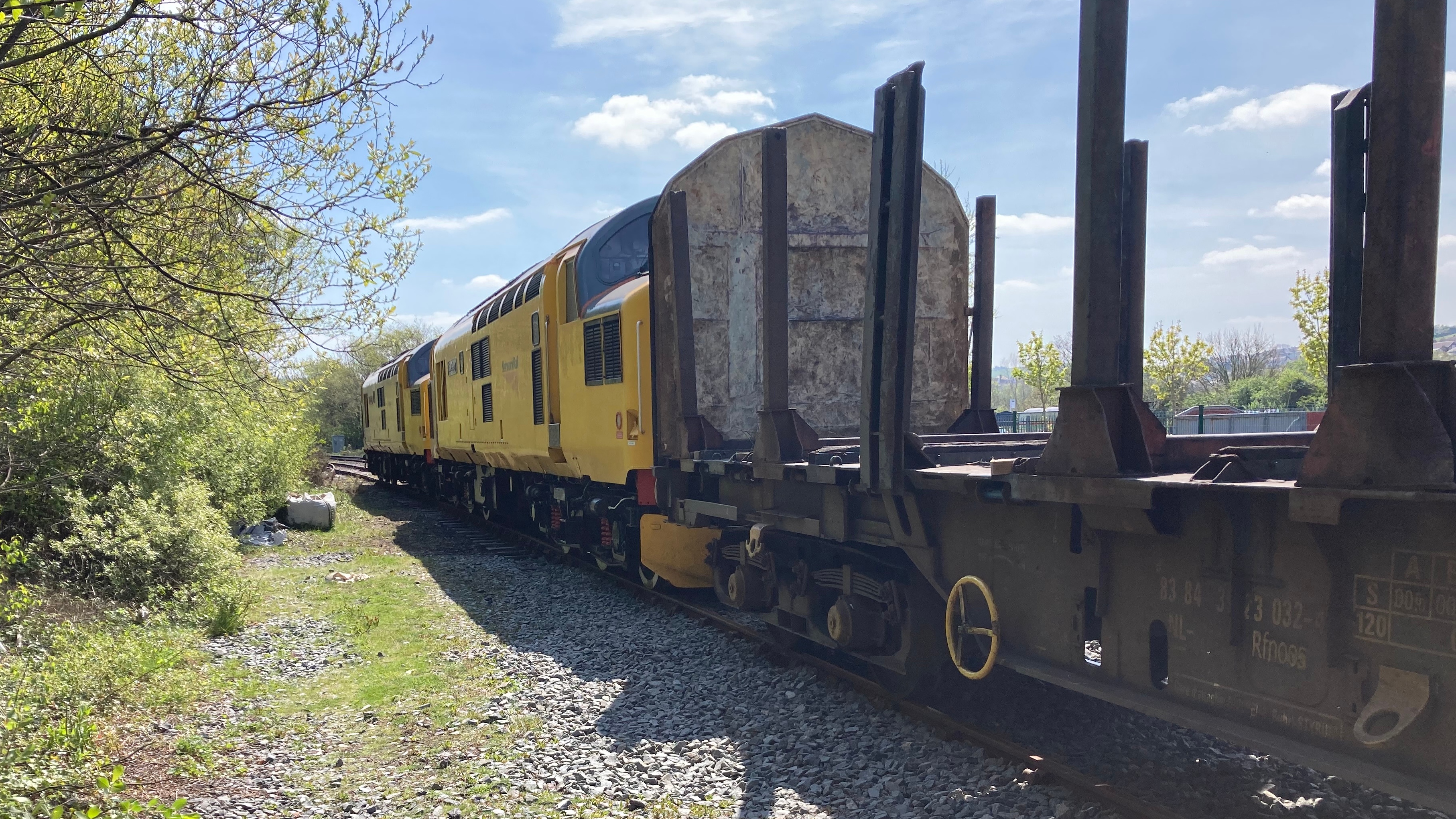
It looks to me, that the locomotives pushed the empty train in and pulled the full train out. Once on its way, the train took the Cambrian Line to Shrewsbury and then it was about twenty miles to tyhe Kronospan factory at Chirk.
This video shows the train leaving.
I appears to have been filmed at a convenient level crossing.
Conclusion
It must have been a success, as they are going to repeat the exercise.
There would appear to be only one problem. The pair of Class 37 locomotives make a bit of a noise.
- The pair have a power of 2610 kW.
- I estimate that the journey between Aberystwyth and Chirk will take around two hours and thirty minutes.
- Aberystwyth and Chirk is a distance of about a hundred miles.
It looks to me that this journey could be handled by one of the new Class 99 locomotives, that I wrote about in Class 99 Electro-Diesel Locomotive Order Confirmed.
I also doubt whether a battery-electric Class 99 locomotive could handle the route, but a hydrogen-powered locomotive, that fuelled at Aberystwyth might be able to do it.
I do think though, that passenger trains between Aberystwyth and Shrewsbury could in the future be hydrogen-powered.
So if hydrogen were to be provided at Aberystwyth, hydrogen haulage of the timber trains would be a possibility.
 The Anonymous Widower