Is Alstom’s Proposal For A Service Between London Euston And Wrexham Part Of A Cunning Plan?
Alstom have built and introduced into service between Buxtehude and Cuxhaven in Germany, the Coradia iLint hydrogen-powered train. The prototype has performed demonstrations in Austria, Canada, The Netherlands and Saudi Arabia.
This picture shows a Coradia iLint in Germany.

In the UK, Alstom had a plan to convert redundant Class 321 trains into a fleet of hydrogen-powered trains called Breeze, which I wrote about in Hydrogen Trains Ready To Steam Ahead, in January 2019.
This visualisation is from Alstom.
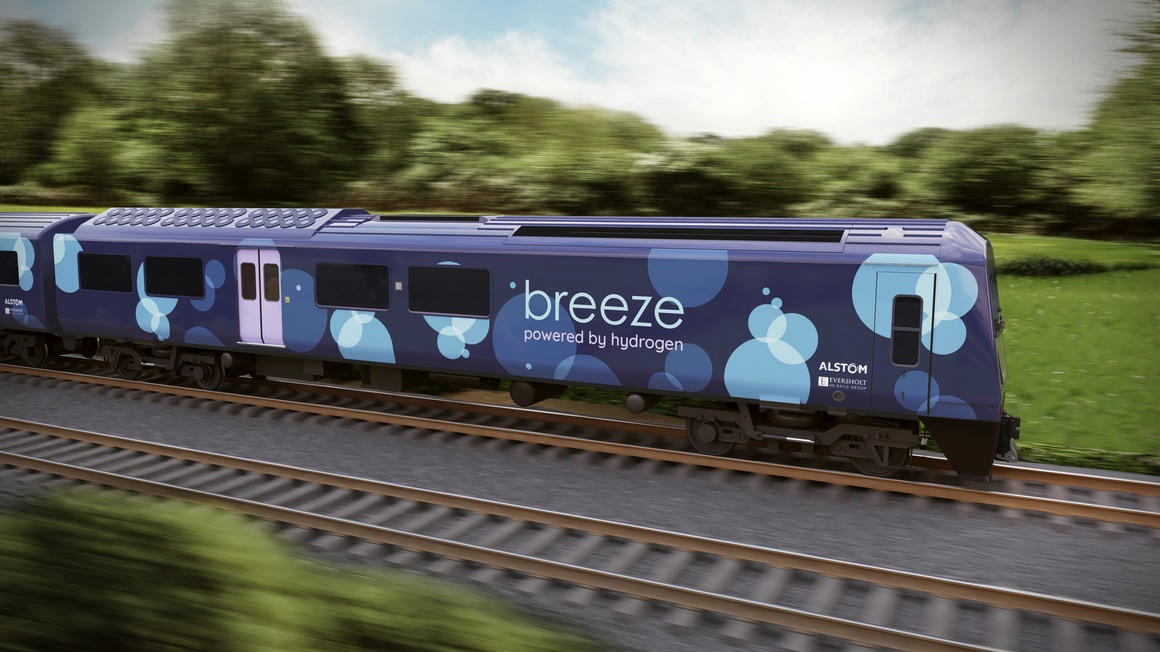
I suspect it didn’t appeal to train companies, as no orders appear to have been received.
But you can’t criticise Alstom for not trying, as in November 2021, they signed an agreement with Eversholt Rail Group to develop a hydrogen-powered Aventra, which I wrote about in Alstom And Eversholt Rail Sign An Agreement For The UK’s First Ever Brand-New Hydrogen Train Fleet.
This visualisation is from Alstom.
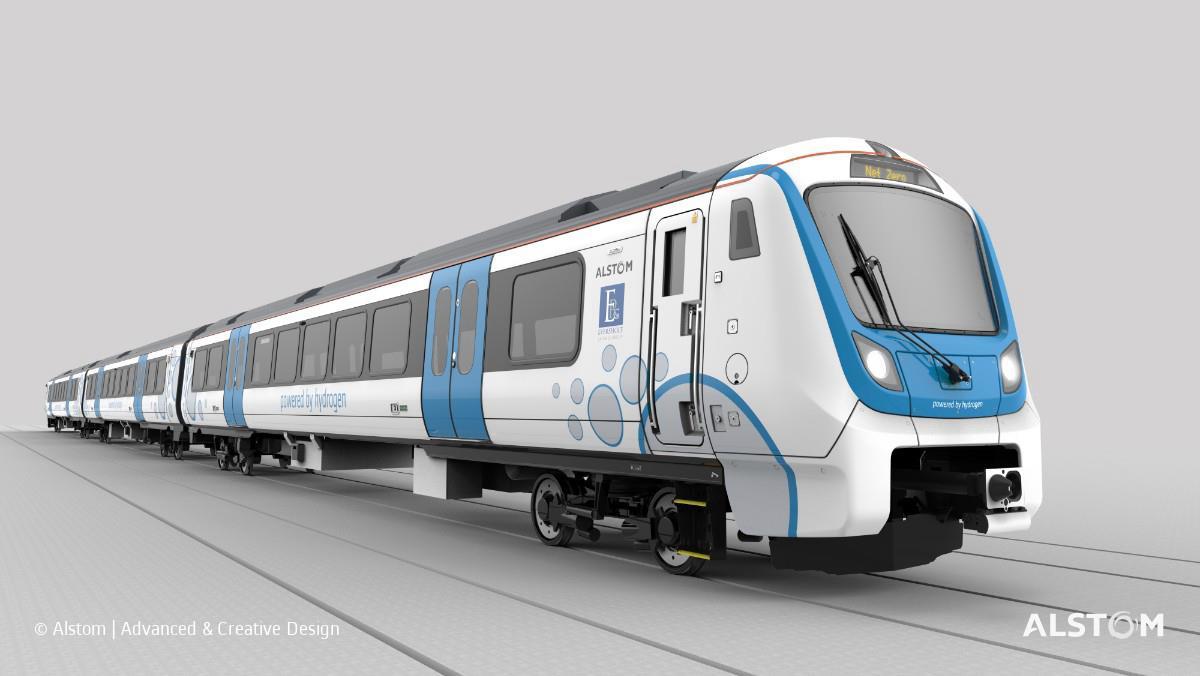
Visually, it looks just like any other Aventra and much better than the previous Breeze design.
In March 2018, I wrote Bombardier Bi-Mode Aventra To Feature Battery Power, which was based on this article in Rail Magazine.
These are a few points from the article.
- Development has already started.
- Battery power could be used for Last-Mile applications.
- The bi-mode would have a maximum speed of 125 mph under both electric and diesel power.
- The trains will be built at Derby.
- Bombardier’s spokesman said that the ambience will be better, than other bi-modes.
- Export of trains is a possibility.
- Bombardier’s spokesman also said, that they have offered the train to three new franchises. East Midlands, West Coast Partnership and CrossCountry.
Have Alstom looked at what they bought from Bombardier and decided the following train is possible, if they add some of their technology?
- A train the size needed by the customer, up to a length of at least ten cars.
- 125 mph under 25 KVAC overhead electrification.
- 100 mph with 750 VDC third rail electrification.
- Running on hydrogen away from electrification.
- 100 mph maximum speed running on hydrogen.
- A range of perhaps 500 miles, if it can emulate the hydrogen-powered Coradia iLint.
A train with this specification would have several applications in the UK.
- Fully-electric routes.
- Electric routes with perhaps a hundred miles of unelectrified track.
- Scenic routes, where the Nimbies wouldn’t like electrification.
These points should also be born in mind.
- There are now 110 mph Aventras in service with West Midland Trains on the West Coast Main Line.
- I recently came back from Cardiff to London in a twelve-car Class 387 train and there wasn’t too many unhappy passengers. It was certainly better than a rail replacement bus. I wrote about the trip in Cardiff To Reading In A Class 387 Train.
- Alstom believe you can certainly fit their hydrogen gubbins in an Aventra.
- The hydrogen gubbins appear to be from Cummins, who have a worldwide support network.
- Cummins can also supply complete hydrogen support systems. A truck can refuel the train, at one end of the route?
- Alstom have been doing the market research with the hydrogen-powered Coradia iLint, so I suppose they know what the market needs.
Could Alstom, with help from Cummins, have a zero-carbon 200 kph train and support systems, which has a hydrogen range of up to a thousand kms for export markets like the United States, Africa, Australia, India and South America?
Two big world-leading companies are surely better than one!
But Alstom has one big problem!
How do you fully test a 125 mph hydrogen-powered train?
- I know with aircraft, if you change the engine type on an existing aircraft, you only have to certify the engine and this is done on a Supplementary Type Certificate.
- Is it the same with trains, so a 110 mph Class 730 train, which is in service with West Midlands Trains, could be the basis of certifying a hydrogen-powered Aventra?
- The Coradia iLint was only a change from diesel to a hybrid hydrogen-electric engine, so was it certified this way?
- With the Coradia iLint, it seemed to go into service quite quickly, so did it do much of the testing in service?
I looks to me, that London Euston and Wrexham is an ideal route for a hydrogen bi-mode 125 mph train.
- The route has electrified sections, some of which have high operating speeds.
- The route has a convenient hydrogen supply from INEOS at Runcorn at the Northern end.
- Change between hydrogen and electric power would always take place in a station.
- A round trip needs less than 200 miles of running on hydrogen.
- South of Nuneaton, no hydrogen is used, so the train will be like a Class 730 train, that already uses the route.
- There are depots that can service Aventras on the route.
It is certainly a possibility, that the London Euston and Wrexham service will be used to test and showcase Alstom’s new Hydrogen Aventra.
SSE Renewables Partners With Fluence And OCU Energy To Deliver Its Battery Storage Project At Fiddler’s Ferry
The title of this post, is the same as that of this press release from SSE Renewables.
This is the sub-heading.
*The 150MW / 300MWh battery energy storage system will be built on the site of the former SSE-owned coal fired power station*
These four paragraphs give full details of the project.
SSE Renewables has announced its principal contractor and battery supplier for its 150MW battery storage project at Fiddler’s Ferry, Warrington.
OCU Energy – who are Stockport-based and are currently working with SSE Renewables on its Ferrybridge battery storage project – will be the principal contractor at Fiddler’s Ferry.
Fluence, a global leader in energy storage technology, digital solutions and services, has been selected as the supplier of the battery-based energy storage system.
Construction is set to begin at the site in the coming weeks after SSE Renewables took a final investment decision back in December 2023.
Note.
- This will be a two-hour battery.
- Good to see a press release with both battery output and battery capacity shown in the appropriate units.
It’s also good to see, SSE adding to the fleet of the UK’s battery storage.
This page on the SSE Renewables web site is entitled About Solar And Battery.
This is the sub-heading.
SSE Renewables is progressing a 1.2GW secured pipeline of utility-scale solar and battery projects across the UK and Ireland and a further 1.3GW of other prospective sites under development. These assets complement SSE’s existing portfolio of other low carbon infrastructure such as wind and hydro.
This is the first paragraph.
Our solar projects will be capable of harnessing the abundant power of the sun to bring renewable power onto the grid, while our battery projects will be able to store renewable power when the sun doesn’t shine or the wind doesn’t blow. The delivery of these projects is part of our commitment to a net zero transition.
What follows is a job advert.
As an electrical and control engineer, who has enjoyed over fifty years exploring the mathematics of big engineering projects, I don’t regret the choice of career I made.
Alstom Plans To Operate Its Own Passenger Train Service In The UK For The First Time
The title of this post, is the same as that of this press release from Alstom.
These two bullet points, act as sub-headings.
- Alstom is partnering with SLC Rail to form a new open access rail operation between North Wales, Shropshire, the Midlands and London
- Formal application now being submitted to the Office of Rail and Road (ORR) with passenger service sought from 2025
These are the first three paragraphs.
Alstom, global leader in smart and sustainable mobility, plans to operate a new passenger rail service across England and Wales. Working in partnership with consultancy SLC Rail, the open access operation will be known as Wrexham, Shropshire and Midlands Railway (WSMR).
As the country’s foremost supplier of new trains and train services, and a leading signalling and infrastructure provider, Alstom will operate its own rail service in the UK for the first time.
WSMR is seeking to introduce direct connectivity to and from North Wales, Shropshire, the Midlands and London that doesn’t exist today, linking growing communities and businesses, and making rail travel more convenient, enjoyable and affordable.
I can’t remember a service proposal being put forward by a train manufacturer since the privatisation of UK’s railways in the 1990s.
This is some more information and my thoughts.
The Route
This paragraph from the press release, describes the route.
The proposal envisages a service of five trains per day in each direction Monday to Saturday, with four travelling both ways on Sundays. Trains will stop at Gobowen, Shrewsbury, Telford Central, Wolverhampton, Darlaston, Walsall, Coleshill Parkway, Nuneaton and Milton Keynes on their journey between Wrexham General and London Euston.
Note.
- The proposed call at the new Darlaston station.
- The route is electrified between Euston and Nuneaton and Walsall and Wolverhampton.
- Much of the route North of Nuneaton is on tracks with a maximum speed of 70-80 mph.
The route is in these sections.
- Euston and Nuneaton – 96.7 miles – electrified
- Nuneaton and Walsall – 26.7 miles
- Walsall and Wolverhampton – 6.7 miles – electrified
- Wolverhampton and Shrewsbury – 29.7 miles
- Shrewsbury and Wrexham General – 30.3 miles
That is a total of 190.1 miles or 380.2 miles round trip.
I suspect that the service will need bi-mode trains.
Should The Service Call At Wellington?
This article on the BBC is entitled Rail Company Urged Not To Forget Wellington.
This is the sub-heading.
A rail company which is bidding to bring back a direct service between Shropshire and London has been urged not to forget a town.
These are the first three paragraphs.
Wrexham, Shropshire and Midlands Railway said it was preparing to apply to the government to run the service.
Trains would stop at Gobowen, Shrewsbury, Telford, Wolverhampton, Walsall, Coleshill and Nuneaton.
But Telford and Wrekin Council said the omission of Wellington as a stop was “short-sighted”.
Although Wellington is smaller than than Shrewsbury and Telford, it looks like a bit of analysis would provide a solution, that would be acceptable for all parties.
The Trains
In the press release, this phrase is used.
positive impact to both communities and the environment.
I can’t see any more electrification being erected on the route, so the trains will need to be bi-mode.
- Bi-mode diesel trains won’t have a positive impact on the environment.
- As the route between Wolverhampton and Wrexham General is not electrified, a battery-electric train would need a range of at least 60 miles or 120 miles for the round trip, if there were no charging at Wrexham General.
- But Alston are developing a Hydrogen Aventra, which I wrote about in Alstom And Eversholt Rail Sign An Agreement For The UK’s First Ever Brand-New Hydrogen Train Fleet.
So could Alstom be using this route to trial and showcase their new Hydrogen Aventra?
I believe that the route will be very suitable for a hydrogen train.
- Changeover between electric and hydrogen power can always take place in a station.
- All hydrogen refuelling could be performed at one end of the route.
- A large proportion of the UK’s green hydrogen is produced by INEOS at Runcorn, which is less than fifty miles from Wrexham. A refuelling tanker could supply the train, as they do on some hydrogen routes in Germany.
- London has only small amounts of hydrogen infrastructure.
I suspect that refuelling will be done at the Wrexham end of the route.
This Alstom visualisation shows the train.
But it is only a three-car train.
- That is not a problem, as Aventras can be lengthened as required to the length required for the number of passengers.
- Some Aventras, like the Class 701 trains for South Western Railway, have even been ordered as ten-car trains.
- Two three-car trains may also be the ideal capacity, running as a six-car train.
So capacity will not be a problem.
If it is assumed that Alstom’s trains for the WSMR route, can use the overhead wires, where they exist, each trip between Wrexham General and London will require a total of 86.7 miles or 140 kilometres of running on hydrogen.
- A round trip will therefor require 280 kilometres of running on hydrogen.
- But between London Euston and Nuneaton, it will just be another electric train.
- I suspect that like the similar Class 730 train, it will be capable of 110 mph on the West Coast Main Line.
- Alstom’s Coradia iLint hydrogen train has a range of around a 500-800 kilometres on hydrogen.
- The WSMR trains will probably be 100 mph trains using hydrogen on a route, where that speed is possible.
So if a Hydrogen Aventra has a similar range to the Coradia iLint, it will be able to do two round trips before refuelling.
How Long Will The Service Take?
West Midlands Trains, who use the similar Class 730 trains take one hour and eleven minutes between London Euston and Nuneaton with a single stop at Milton Keynes Central.
As the WSMR trains will use the same route, I suspect the same time can be used.
As Nuneaton and Wrexham General are 93.4 miles apart a table can be created showing the time for the rest of the journey for different average speeds
- 50 mph – 1 hour 52 minutes – 3 hours 3 minutes.
- 60 mph – 1 hour 33 minutes – 2 hours 44 minutes.
- 70 mph – 1 hour 20 minutes – 2 hours 31 minutes.
- 80 mph – 1 hour 10 minutes – 2 hours 21 minutes.
Note.
- The first time is the Nuneaton and Wrexham General time and the second time is the overall journey time.
- Typical Avanti West Coast services via Crewe and a change at Chester, take between two-and-a-half and three hours.
I suspect, if the WSMR trains can keep the speed up through the Midlands, that two hours and 30 minutes could be possible.
Could The Hydrogen Aventra Run At 125 mph Under The Wires?
In March 2018, I wrote Bombardier Bi-Mode Aventra To Feature Battery Power, which was based on this article in Rail Magazine.
These are a few points from the article.
- Development has already started.
- Battery power could be used for Last-Mile applications.
- The bi-mode would have a maximum speed of 125 mph under both electric and diesel power.
- The trains will be built at Derby.
- Bombardier’s spokesman said that the ambience will be better, than other bi-modes.
- Export of trains is a possibility.
- Bombardier’s spokesman also said, that they have offered the train to three new franchises. East Midlands, West Coast Partnership and CrossCountry.
Have Alstom looked at what they bought from Bombardier and decided the following train is possible?
- Five-cars or what the customer needs.
- 125 mph under the wires.
- Running on hydrogen away from the wires.
- 100 mph on tracks without electrification.
Obviously, maximum speeds would depend on track limits.
Looking at 125 mph Avanti West Coast trains that have a Milton Keynes stop between London Euston and Nuneaton, they can reach Nuneaton ten minutes quicker than West Midlands Trains 110 mph Class 730 trains.
Two hours and 30 minutes between London Euston and Wrexham is looking increasingly possible.
Are we seeing an audacious proposal from Alston to sell new trains to CrossCountry and a host of other franchises?
Conclusion
London Euston and Wrexham would appear to be an excellent route for an Aventra-based hydrogen train.
- It can probably cruise at 110 mph on the West Coast Main Line between London Euston and Nuneaton.
- All switchovers between electrification and hydrogen can be performed in electrified stations.
- Hydrogen would only be used North of Nuneaton.
- The train can be refuelled at Wrexham General, with fuel supplied from INEOS at Runcorn.
- Given the typical 1000 km. range of hydrogen trains, a train can probably do three round trips without refuelling.
I can see this being a service with an excellent operational record.
A Funny Wet Week
I’ve had a funny few days as regards my health.
Tursday morning, my INR was 2.1.
On Friday night, I wasn’t sleeping very well and got up at three on Saturday morning. But after a couple of mugs of tea, I was feeling a lot better.
I had my usual Saturday morning breakfast in Leon on Moorgate, but I did get slightly confused with my shopping in Marks & Spencer. I put this down to my eyesight having an off day. Is that normal after two cataract operations?
I slept better on Saturday night! But was this because I went to bed before instead of after Match of the Day and then watched it on Sunday morning.
On Sunday morning, I went out to do a bit of shopping, but it was really just to get out and then it was walking in the pouring rain.
Monday was a quiet day, after breakfast in Leon on Moorgate, I wrote for most of the day. My INR was a bit low at 2.2.
Tuesday morning, it was a repeat of Friday night and I got up at four and had a couple of mugs of tea. It was another breakfast in Leon on Moorgate and a visit to M & S. After I returned, I wrote for most of the day, as it was too wet to go outside.
In the afternoon, I started to get a bit unsteady on my feet and even thought about calling 999. But after two mugs of tea and a can of Adnams, I regained my balance and never fell. My blood pressure was fine and the only unusual thing, was that my left food was quite red. But it does this sometimes.
Wednesday was uneventful and I had lunch with a friend at Cote in Sloane Square.
Today, Thursday my INR is down to 2.
I feel OK, but it does seem, that for some reason my INR has tended to slump during the week.
I just wonder if my leaky skin, just lets water out, which surely must lower the INR.
Does my foot go red, as the red blood corpuscles are too big to get through my skin?
Dogger Bank D Welcomes Confirmation Of Grid Connection Location
The title of this post, is the same as that of this press release from SSE Renewables.
This is the sub-heading.
Project team now focusing full attention on electrical transmission system connection.
These four paragraphs describe the proposed connection to the National Grid.
SSE Renewables and Equinor have welcomed confirmation of a grid connection location from the Electricity System Operator (ESO) for a proposed fourth phase of the world’s largest offshore wind farm.
Dogger Bank D will now connect into Birkhill Wood, a proposed new 400kV substation located in the East Riding of Yorkshire which will be built as part of National Grid’s Great Grid Upgrade.
The announcement follows the publication of an impact assessment for the South Cluster by ESO, relating to energy projects which are due to be electrically connected off the east coast of England.
With the location of a grid connection confirmed, Dogger Bank D will now focus its full attention on connecting to the electrical transmission system.
This is a big change from December 2023, when I wrote Plans for Hydrogen Development At Dogger Bank D Gain Ground, which indicated that Dogger Bank D would be used to produce hydrogen, so the grid connection wouldn’t be needed.
Using A Offshore Hybrid Asset Between the UK And Another European Country
This is the next paragraph on the SSE Renewables press release.
The project is also exploring the future possibility of the development of Dogger Bank D to be coordinated with an Offshore Hybrid Asset between the UK and another European country’s electricity market to form a multi-purpose interconnector. This option would increase energy security for the UK and reduce the need to curtail offshore wind output in times of oversupply on the GB network.
Note that just over the boundary of the UK’s Exclusive Economic Zone are the Dutch and German Exclusive Economic Zones.
It is not unreasonable to believe that UK, Dutch and German grid could all be connected on the Dogger Bank.
Connecting Everything Up At Birkhill Wood
This is the next paragraph on the SSE Renewables press release.
The project team are undertaking a site selection process to identify potential cable corridors and where other onshore infrastructure associated with the grid connection at Birkhill Wood may be sited. Consultation will be held later this year to introduce the connection proposals to the local community.
At least now, with the connection to Birkhill Wood confirmed, SSE and Equinor will be able to supply any electricity generated at Dogger Bank D to the UK grid, up to limit of the connection.
The Value Of Electricity That Could Be Generated At Dogger Bank D
Consider.
- The wind farm has a capacity of 2 GW or 2,000 MW.
- There are 365 days in most years.
- There are 24 hours in the day.
- This means that 17, 520,000 MWh could be generated in a year.
- A large wind farm like Hornsea One has a twelve month rolling capacity factor of 46.6%.
- Applying this capacity factor says that 8,164,320 MWh will be generated in a year.
- The Contract for Difference Round 6 for this electricity will be £73/MWh.
Applying that figure gives a yearly turnover of £ 595,995,360 or £ 297,997,680 per installed GW.
It is not unreasonable to assume that half of this electricity were to be exported to power Germany industry.
It could be a nice little earner for the Treasury.
Contracts Signed For Eastern Green Link 2 Cable And Converter Stations
The title of this post, is the same as that of this press release from National Grid.
These four bullet points, act as sub-headings.
- Eastern Green Link 2 (EGL2) is a 525kV, 2GW high voltage direct current (HVDC) subsea transmission cable from Peterhead in Scotland to Drax in England delivered as a joint venture by National Grid and SSEN Transmission
- The joint venture has signed a contract with the Prysmian Group to supply around 1,000km of cable for the project and a contract with Hitachi Energy and BAM for the supply of converter stations at either end of the subsea cable
- Contract signing is a significant milestone for the project as it progresses towards the delivery phase
- EGL2 will be the longest HVDC cable in the UK and the UK’s single largest electricity transmission project ever, providing enough electricity to power two million UK homes
This paragraph outlines the project.
EGL2, a joint venture between SSEN Transmission and National Grid Electricity Transmission (NGET), has reached another milestone in the development of a new subsea electricity superhighway after sealing contracts this week with specialist HVDC cable supplier, Prysmian, and with Hitachi Energy and BAM for the supply of converter stations at either end of the project.
These four paragraphs add more detail.
EGL2 will see the creation of a 525kV, 2GW HVDC subsea transmission cable from Peterhead in Scotland to Drax in England. The longest HVDC cable in the UK and the UK’s single largest electricity transmission project ever, it will provide enough electricity to power two million UK homes.
Prysmian has confirmed it has the capability to deliver the project with its manufacturing facilities for the production of the HVDC cable and its cable laying vessels for the installation in the timescale required for EGL2 to meet its targeted energisation date in 2029, supporting the timely delivery of this project and mitigating risks associated with global constraints in the HVDC supply chain.
Hitachi Energy is partnering with BAM to provide the engineering works and technology for the HVDC converter stations which form the terminals for the HVDC cable and convert direct current to the alternating current used in the onshore transmission network. This latest milestone is another significant step as the project moves towards delivery and, following final approval from Ofgem, work is expected to commence later this year, with a targeted operational date of 2029.
The subsea HVDC cable system is approximately 436km in length with new converter stations at either end to connect it into the existing transmission network infrastructure. HVDC technology provides the most efficient and reliable means of transmitting large amounts of power over long distances subsea.
Note.
- EGL2 can handle 2 GW.
- There is a targeted operational date of 2029.
- Eastern Green Link 2 now has its own web site.
- Most of these links now seem to be HVDC.
A map in the press release, shows the undersea route may be shorter.

It also appears to me, that moving electricity around the UK under the sea, is possibly the most environmentally-friendly and least intrusive way to do it.
We already have four HVDC interconnectors.
There will be many more,
Ørsted Secures Exclusive Access To Lower-Emission Steel From Dillinger
The title of this post, is the same as that of this article on offshoreWIND.biz.
This is the sub-heading.
Ørsted will be offered the first production of lower-emission steel from German-based Dillinger, subject to availability and commercial terms and conditions. The steel plates are intended to be used for offshore wind monopile foundations in future projects.
These three paragraphs outline the deal.
Under a large-scale supply agreement entered into in 2022, Ørsted will procure significant volumes of regular heavy plate steel from 2024, giving the company access at scale to and visibility of the most crucial raw material in offshore wind while supporting Dillinger to accelerate investments in new lower-emission steel production, according to Ørsted.
The Danish renewable energy giant expects to be able to procure lower-emission steel produced at Dillinger’s facility in Dillingen, Germany, from 2027-2028.
Taking the current technology outlook into account, the reduction of the process-related carbon emissions from production is expected to be around 55-60 per cent compared to conventional heavy plate steel production, Ørsted said.
Increasingly, we’ll see lower emission steel and concrete used for wind turbine foundations.
This press release on the Dillinger web site is entitled Historic Investment For Greater Climate Protection: Supervisory Boards Approve Investment Of EUR 3.5 billion For Green Steel From Saarland.
These are two paragraphs from the press release.
Over the next few years leading up to 2027, in addition to the established blast furnace route, the new production line with an electric arc furnace (EAF) will be built at the Völklingen site and an EAF and direct reduced iron (DRI) plant for the production of sponge iron will be built at the Dillinger plant site. Transformation branding has also been developed to visually represent the transformation: “Pure Steel+”. The message of “Pure Steel+” is that Saarland’s steel industry will retain its long-established global product quality, ability to innovate, and culture, even in the transformation. The “+” refers to the carbon-neutrality of the products.
The availability of green hydrogen at competitive prices is a basic precondition for this ambitious project to succeed, along with prompt funding commitments from Berlin and Brussels. Local production of hydrogen will therefore be established as a first step together with the local energy suppliers, before connecting to the European hydrogen network to enable use of hydrogen to be increased to approx. 80 percent. The Saarland steel industry is thus laying the foundation for a new hydrogen-based value chain in the Saarland, in addition to decarbonizing its own production. In this way, SHS – Stahl-Holding-Saar is supporting Saarland on its path to becoming a model region for transformation.
It sounds to me, that Tata Steel could be doing something similar at Port Talbot.
- Tata want to build an electric arc furnace to replace the blast furnaces.
- There will be plenty of green electricity from the Celtic Sea.
- RWE are planning a very large hydrogen electrolyser in Pembroke.
- Celtic Sea offshore wind developments would probably like a supply of lower emission steel on their door-step.
I would suspect, that Welsh steel produced by an electric arc furnace will match the quality of the German steel, that is made the same way.
Japan Expands Offshore Wind Development Into Exclusive Economic Zone
The title of this post, is the same as that of this article on offshoreWIND.biz.
This is the sub-heading.
The Japanese Government has passed an amendment to the “Act on Promoting the Utilization of Sea Areas”, expanding the area for setting up offshore wind to the Exclusive Economic Zone (EEZ).
These two paragraphs give more details.
The Japanese government aims to deploy 10 GW of offshore wind capacity by 2030 and 30-45 GW by 2040, including floating wind, as part of its target to reach net-zero emissions by 2050.
The new legislation would allow wind farms to be installed further out to sea from current territorial and internal waters, according to a joint statement by the government, the Ministry of Economy, Trade and Industry and the Ministry of Land, Infrastructure, Transport and Tourism.
The Japanese seem to have devised a simple bid process, that gives rights to generate electricity for thirty years.
But then as a Director of Lockheed told me thirty years ago, the Japanese don’t have the same high levels of lawyers that the US, UK and other countries have, so they can move a lot faster and are easier to do business with.
This Wikipedia entry is entitled Wind Power in Japan.
This is the opening paragraph.
In Japan’s electricity sector, wind power generates a small proportion of the country’s electricity. It has been estimated that Japan has the potential for 144 gigawatts (GW) for onshore wind and 608 GW of offshore wind capacity. As of 2020, the country had a total installed capacity of 4.2 GW.
From the potential of 608 GW of offshore wind capacity, it looks like Japan is in a very similar position to the UK and the Japanese can also reap the wind.
National Gas To Trial Gravitricity’s H2 Storage Solution
The title of this post, is the same as that of this article on The Engineer.
This is the sub-heading.
Gravitricity’s H2FlexiStore system for underground hydrogen storage could see a pilot built in 2025 after National Gas secured Ofgem funding to explore the technology.
There is then a graphic, which gives a good visual explanation.
The patented system uses lined geological shafts to store up to 100 tonnes of pressurised hydrogen at 220 bar, equivalent to about 3.33GWh of energy. Unlike natural storage such as salt caverns and disused gas fields, the shafts can be sited anywhere. Gravitricity has previously stated its preference for co-locating the storage near to renewable generation and potential major consumers of hydrogen such as heavy industry.
I can see that this simple system can have a lot of diverse uses.
In Centrica Completes Work On 20MW Hydrogen-Ready Peaker In Redditch, I talked about how Centrica had refurbished a decommissioned peaker plant.
One of these stores would keep a 20 MW peaker plant running for a week.
It would also work well with a HiiROC hydrogen system.
Aurizon Secures Funding To Develop Next-Generation Freight Trains Using Renewable Energy
The title of this post, is the same as that of this press release from Aurizon.
These five paragraphs outline the project.
Australia’s largest rail freight company Aurizon, today received a major boost to its program to develop the next generation of Australian freight trains, aiming to replace diesel fuel with renewable energy sources on its locomotive fleet.
Aurizon has secured a $9.4 million grant from the Australian Renewable Energy Agency (ARENA) to develop, test and trial a battery electric tender (BET) to be used in conjunction with a modified locomotive. (refer graphic below).
The tender – essentially a big battery-pack on wheels – will couple with the modified locomotive to operate as a hybrid unit using both diesel and battery-electric power sources. The tender’s battery will also harness re-generative energy captured as the train travels down grades and brakes as part of normal operation.
The ARENA grant represents half of the required funding for the ‘Battery Powered Tender for Heavy Haul Fleet Decarbonisation’ project, with the balance of the investment to be funded by Aurizon. The battery-electric tender and modified locomotive project will be built by Aurizon and technology project partner, Alta Battery Technology (Alta) at a facility in Australia, with design and technology inputs from Alta.
Aurizon appreciates the Federal Government making funding available to support the development of a range of new zero emissions technologies in the transport sector, including technologies that can be developed for application in rail-based freight supply chains that are integral to Australia’s export and domestic industries that rely on transport services.
At a first glance it appears to be suited to Aurizon and its long routes with heavy freight trains across Australia.
These are some more specific thoughts.
Alstom Have Built A Train With a Hydrogen Tender
In From 2025, Nestlé Waters France Will Use The First Hydrogen-Powered Freight Train Through An Innovative Solution Developed by Alstom and ENGIE, I describe a train powered by an electric locomotive with an attached hydrogen power unit.
The Future Of The Class 68 Locomotives
Could these be given a reduced-carbon second life, by developing a specialised tender?
I wrote about this in The Future Of The Class 68 Locomotives.
I suspect Stadler, who seem to be excellent innovators will be watching.
There Seems To Be A Lot Going On In Australia
I have written several posts about decarbonisation of freight trains in Australia.
- BHP To Trial Battery Locos On Pilbara Iron Ore Network
- Battery-Electric Power Rides The Rails
- Wabtec And Roy Hill Unveil The First FLXdrive Battery Locomotive
- Fortescue Unveils World-First Electric Train Using Gravity To Recharge
- BHP Joins The Party On Electric Rail
- Rio Tinto Orders Wabtec FLXdrive Battery Locomotives To Reduce Emissions
The big mining companies certainly seem keen to decarbonise.
 The Anonymous Widower