Torvex Energy
Hydrogen And Chlorine Production At ICI Mond Division in The 1960s.
In my time in the late 1960s, when I worked For ICI Mond Division, I spent time in the Castner-Kellner works trying fairly unsuccessfully to develop an analyser to detect mercury-in-air in the Castner-Kellner process, that created chlorine and hydrogen from brine.
The process is not a nice one as it uses a mercury cathode and Wikipedia says this about safety.
The mercury cell process continues in use to this day. Current-day mercury cell plant operations are criticized for environmental release of mercury leading in some cases to severe mercury poisoning (as occurred in Japan). Due to these concerns, mercury cell plants are being phased out, and a sustained effort is being made to reduce mercury emissions from existing plants.
ICI felt that a mercury-in-air analyser would help to make the plant safer.
But ICI did have an alternative way to produce the chlorine they needed for selling as a gas or liquid or using as a base chemical for products like disinfectants, bleaches and dry cleaning fluids, without the use of mercury.
It was only a small plant and I was taken there once.
As with the Castner-Kellner process, it used a series of electrolyser cells.
- These were smaller and had a tub, with a concrete lid.
- The anode and cathode and the pipes collecting the hydrogen and the chlorine went through the lid.
- They were rebuilt regularly.
- As with the Castner-Kellner process, brine is electrolysed.
- The process was old and probably dated from before the Castner-Kellner process.
But of course as there was no mercury, the hydrogen and chlorine were pure and could be used for certain types of manufacture like pharmaceuticals.
Torvex Energy
This article on Hydrogen Fuel News is entitled Stockton R&D Firm Unveils New Hydrogen From Seawater Production Process.
These are some points from the article.
- Torvex Energy, a Stockton research and development company, recently unveiled a new technique for producing hydrogen from seawater.
- This unique method of producing hydrogen from seawater does not result in oxygen gas emissions.
- As such, it is clearly quite different from more traditional water electrolysis methods used for producing green H2.
- The team behind the production method call it an environmentally friendly technique.
- There is no desalination process.
- The firm has patents pending on this unique form of electrochemical process.
- It worked with the Material Processing Institute to establish proof of concept for this purpose.
I originally felt that Torvex Energy may have updated the ancient ICI process, that I saw over forty years ago, but when I asked the company, they said it was different.
It now appears that they haven’t, which means they must have found a totally new process.
There is certainly an ongoing patent application with a number of gb1900680.8.
How Efficient Is The Torvex Energy Process?
This will be key and there is nothing on their web site or on the Internet to indicate, if the Torvex Energy process is more or less efficient than traditional electrolysis.
Offshore Hydrogen Production
The main application for the Torvex Energy process must surely be in the production of hydrogen offshore.
- A fleet of floating wind turbines could surround a mother platform with a Torvex Energy process.
- The hydrogen could then be sent ashore in a pipeline.
- If there to be a handy depleted gas field, this possibly could be used to store the gas.
Depending on the efficiency of the Torvex Energy process, this could be a more cost-effective way to bring energy ashore, as gas pipelines can be more affordable, than HVDC electrical links. Especially, if the pipeline already exists.
Conclusion
Torvex Energy would have appeared to have made a major breakthrough in the production of hydrogen.
Crossrail is Over Budget And Very Late – But The End Is Nearly In Sight
The title of this post is a quote from this article on the BBC, which is entitled Elizabeth line: The Ambient Detailing Behind Crossrail’s New Stations.
There have been little signs appearing in the last few days.
- In Is The Paddington Bakerloo Line Link Opening Soon?, it looked like the new tunnel, that will form the Bakerloo Line Link to Crossrail could be opening soon.
- In The Covers Are Off At Tottenham Court Road Station, it looked like the builders were finishing off Tottenham Court Road station.
- I go through Moorgate station about six times a week.This morning, as I normally do, I took the rat-up-the-drainpipe route to the surface, that I described in Up From The Depths At Moorgate Station. The escalators have been reversed and there were a lot of staff around.
- I’ve also seen guys and gals walking around with clipboards.
This all indicates to me that D-Day is not far-off, when passengers will be allowed to set foot on Crossrail’s platforms and trains.
Shell To Develop Blue Hydrogen Plant
The title of this post, is the same as that of this article in The Times.
The article is based on this press release from Shell, which is entitled Shell And Uniper To Work Together On Blue Hydrogen Production Facility In The UK.
These are the three bullet points of the press release.
- Shell and Uniper sign co-operation agreement to progress plans for low-carbon hydrogen production at Uniper’s Killingholme site in North Lincolnshire
- Hydrogen produced could be used to decarbonise heavy industry, transport, heating and power across Humber and beyond.
- Project recently passed eligibility phase for UK Government’s Phase-2 carbon capture, usage and storage Cluster Sequencing Process.
Note.
- The Killingholme site is currently occupied by the 900 MW gas-fired Killingholme power station.
- Heavy industry on Humberside includes chemicals and oil refineries and the Scunthorpe steelworks.
This Google Map shows the location of Killingholme power station.
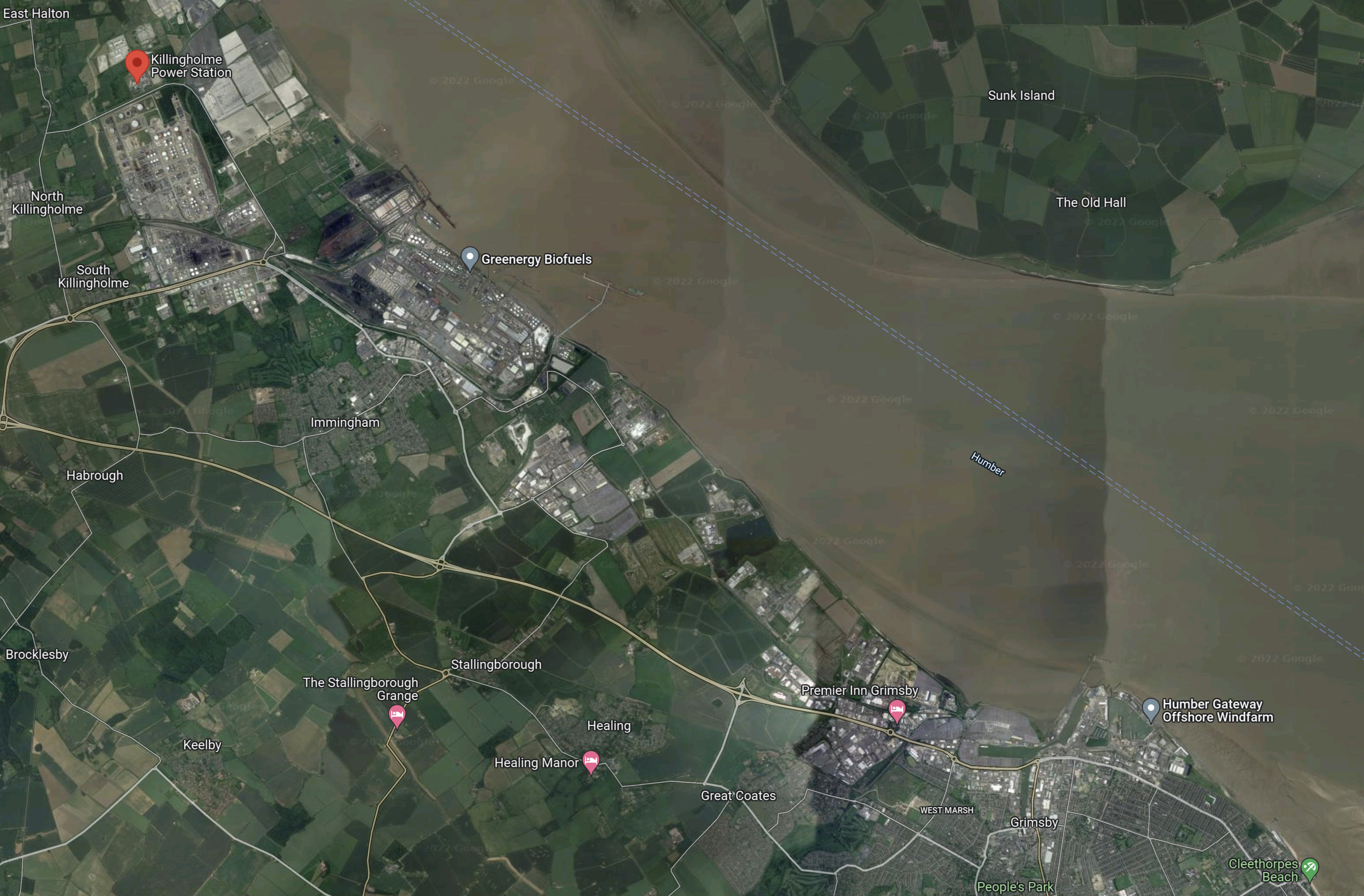
Note.
- Killingholme power station is marked by the red arrow.
- The river is the Humber.
- The Port of Immingham is on the power station side of the river.
- Cleethorpes Beach is marked by the green dot in the bottom-right hand corner.
- Grimsby is to the North of Cleethorpes.
- Between Grimsby and Killingworth power station is a mass of chemical works.
This second Google Map shows the area to the South-East of the power station.
Note.
- Killingholme power station is marked by the red arrow.
- The Hornsea 02 substation to the North of the power station.
- The large Uniper site to the South of the power station.
- The large number of tanks inland from the port and the chemical works.
I have some thoughts.
A Full Description Of The Project
This paragraph from the press release described the project.
Uniper has signed an agreement with Shell to progress plans to produce blue hydrogen at Uniper’s Killingholme power station site in the East of England. The hydrogen produced could be used to decarbonise industry, transport and power throughout the Humber region.
The Humber Hub Blue project includes plans for a blue hydrogen production facility with a capacity of up to 720 megawatts, using gas reformation technology with carbon capture and storage (CCS).
The captured carbon would be fed through the proposed Zero Carbon Humber onshore pipeline, part of the East Coast Cluster, recently selected as one of two CCS clusters to receive initial government support under the government’s cluster sequencing process.
I suspect that a lot of the plant from the existing Killingholme power station will be repurposed.
This is the specification of the power station.
The Uniper (Formerly E.ON UK) plant consists of two 450 MW Siemens V94.2 gas turbine modules each connected to a heat recovery steam generator using only a single steam turbine in a 2 into 1 configuration. Gas is supplied from a 26-mile pipeline from Theddlethorpe.
When it was built by Powergen (now called Uniper) and opened in April 1993 it was only the second gas-fired power station built in the UK. It was taken out of service in 2002 due to the lower price of electricity and was then restored to full service in August 2005, with one of the 450 MW units returning to service in April 2005.
It was announced that the power station will be closed in 2015.
Will The Project Use The Shell Blue Hydrogen Process?
Will the plant use the Shell Blue Hydrogen Process, that I described in Shell Process To Make Blue Hydrogen Production Affordable?
It appears the Shell Blue Hydrogen Process offers advantages.
- Shell are claiming, that with carbon dioxide costing $25-35/tonne, that their process is more economic than grey or green hydrogen.
- Steam reforming also needs steam, but this new process actually generates steam as a by-product, which further improves the economics, as integrated chemical plants use a lot of steam. Killingholme’s neighbours would probably welcome the steam.
- Shell are reporting capturing 99% of the carbon.
- It looks like savings of between 10 and 25 % are possible.
The most-fervent greens, may claim blue hydrogen is totally wrong.
But if it is more affordable than both grey and green hydrogen and all but one percent of the carbon dioxide is captured, I believe that this should be an option, that is fully investigated.
This appears to be a victory for top-class chemical engineering.
Northern Endurance Partnership
The Northern Endurance Partnership is described on this page of the Equinor web site, where this is said.
BP, Eni, Equinor, National Grid, Shell and Total today confirmed they have formed a new partnership, the Northern Endurance Partnership (NEP), to develop offshore carbon dioxide (CO2) transport and storage infrastructure in the UK North Sea, with bp as operator.
This infrastructure will serve the proposed Net Zero Teesside (NZT) and Zero Carbon Humber (ZCH) projects that aim to establish decarbonised industrial clusters in Teesside and Humberside.
There is also a map.
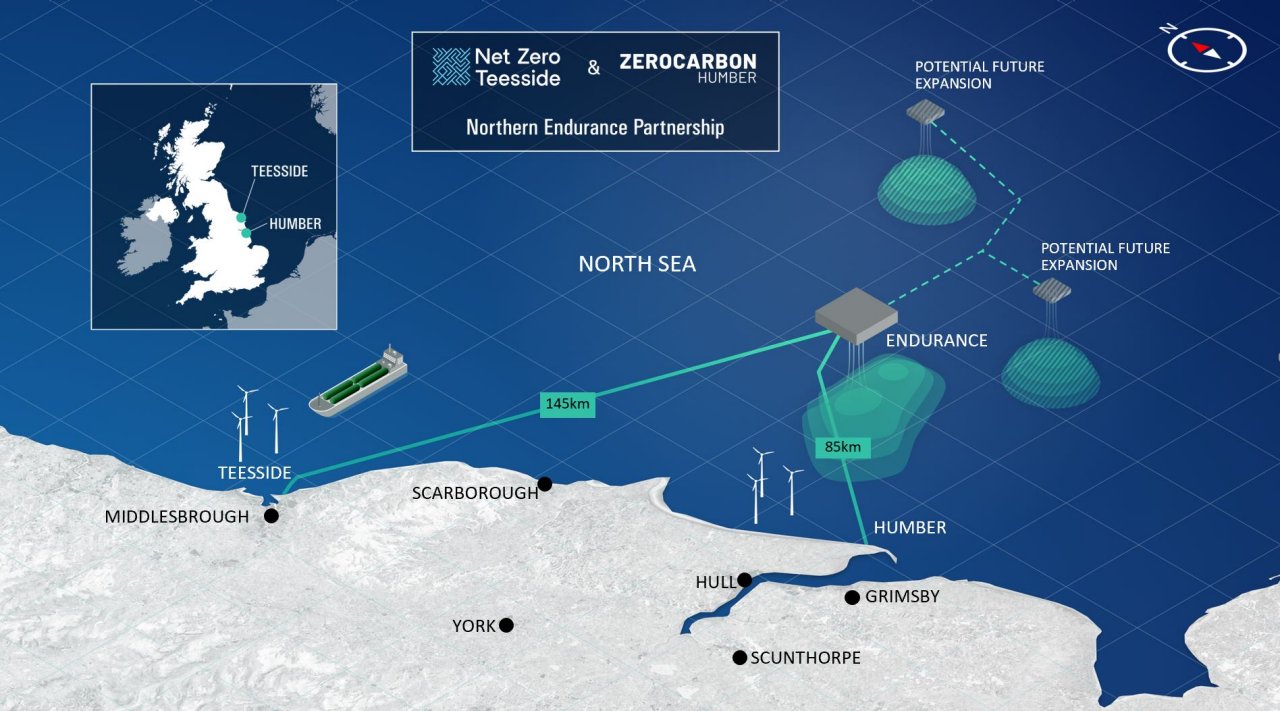
Note.
- One facility would appear to serve the Tees and the Humber.
It looks like the depleted gas fields could hold a lot of carbon dioxide.
Carbon Capture
Some points from the Equinor press release about carbon capture.
- Blue hydrogen production at Killingholme could see the capture of around 1.6 million metric tonnes (Mt) of carbon a year through CCS.
- The UK Government has set a target to capture 10 Mt of carbon a year by 2030.
- NEP has submitted a bid for funding through Phase 2 of the UK Government’s Industrial Decarbonisation Challenge, aiming to accelerate the development of an offshore pipeline network to transport captured CO2 emissions from both NZT and ZCH to offshore geological storage beneath the UK North Sea.
These projects could could decarbonise a lot of businesses on Teesside and the Humber.
Carbon Capture And Use
The Equinor press release says this about carbon capture and use.
The Northern Endurance Partnership will channel the extensive experience of its members to develop and deliver the offshore transport and storage infrastructure we need to unlock the enormous benefits of deploying CCUS across the Humber and Teesside. We’re delighted to start working together with five really world class energy companies to deliver a solution that will play a critical role in decarbonising the UK’s largest industrial heartland and protecting tens of thousands of jobs in the process.”
Uses include.
- Feeding to salad vegetables, tomatoes, soft fruit and flowers in giant greenhouses.
- Creating sustainable aviation fuel.
- Creating building products like blocks and plaster board.
- Making better concrete.
This is a list that will grow.
Making Hydrogen With An Electrolyser
The Shell press release says this.
Uniper continues to develop a separate green hydrogen project, using electrolytic hydrogen production technology, as part of the overall Humber Hub development at Uniper’s Killingholme site. Uniper, along with its project partners, will shortly complete the Project Mayflower feasibility study, part funded by the Department for Transport’s Clean Maritime Demonstration Competition, administered by InnovateUK, looking at the decarbonisation of port related activities at the Port of Immingham.
Note that the sub station for the 1.4 GW Hornsea 2 wind farm is close to both Killingholme power station and the Uniper web site.
What Will Happen To Shell’s Blue Hydrogen Plant?
I think there are two possible scenarios.
- It will be closed when Uniper’s electrolyser is fully on stream.
- It will become an emergency hydrogen source, when the wind is not blowing.
In both cases it will produce less carbon dioxide, thus leaving more space in the Northern Endurance Partnership.
Conclusion
It looks like there could be a comprehensive hydrogen production facility at Killingholme.
Is The Paddington Bakerloo Line Link Opening Soon?
I took these pictures on the Bakerloo Line platforms at Paddington station yesterday.







Note.
- There are new direction signs by the entrance, but they are covered in white plastic.
- The lights on the lift were showing sensible messages.
- The escalators behind the grill doors were running.
- It was only shut off using a barrier and black and yellow tape.
- The access between the Northbound Bakerloo Line platform and the escalator lobby, still needed to be opened up.
But it does look to me that this route is getting ready to be used.
In The Crossrail Article That Everyone Must Read, I review this article on Ian Visits, which is entitled A Sneak Preview Of London’s New Elizabeth Line Railway.
In a section, that is entitled The Bakerloo Line Link At Paddington Station, I wrote this.
Ian writes this interesting paragraph.
Something though that was added to Paddington station after the funding was approved was a new direct deep tunnel link from the platforms to the Bakerloo line. London Underground contractors built the link, and Andy Lord suggested that they are considering opening up the link before the Elizabeth line opens fully as it would help with offering step-free access for Bakerloo line customers.
Many people find getting to Paddington difficult, as I do from Dalston.
I typically use some roundabout and slow routes and most end up with arriving at Paddington on the Bakerloo Line.
Opening the link early would have the following effects.
- It would make things a lot easier for me and probably many other passengers.
- It would add passengers to London’s least-used Underground line.
- It would add capacity to the Bakerloo Line station at Paddington.
It would also give a piece of the infrastructure, a good soak testing with real passengers and may flag up some changes that needed to be made to details like signage.
Did Ian call it right?
Conclusion
I think he might have!
Highview Power Names Rupert Pearce Chief Executive Officer
The title of this post, is the same as that of this article on business wire.
This is the first paragraph.
Highview Power, a global leader in providing long duration energy storage and essential grid services, has named Rupert Pearce as its new CEO. In this role, Pearce will leverage his expertise in guiding technology companies through significant transformation and globalisation to position Highview Power as a leader in accelerating the energy transition.
He certainly seems to be type of CEO, that Highview needs to succeed.
NeuConnect Awards Two Major Contracts
This page on the NeuConnect web site is entitled NeuConnect Awards Over £1.5 billion Of Major Contracts As First Ever UK-German Energy Link Moves An Important Step Closer.
NeuConnect is a proposed interconnector between England and Germany.
- It will have a capacity of 1.4 GW.
- The interconnector will be around 450 miles long.
- It will be HVDC, like many similar undersea power cables.
- As the title says, it will be the first-ever UK-German energy link.
Wikipedia describes the route like this.
The cable will run between the Greystones substation on the Isle of Grain, in Kent in England to the new Fedderwarden substation in Wilhelmshaven in the Lower Saxony region of Germany. Landfall will be next to Grain Coastal Park, in Kent, and at Hooksiel, near Wilhemshaven in Germany.
Two contracts have been awarded.
- The contract to design, manufacture, install, test and commission the 725km interconnector has been awarded to Prysmian Group.
- The contract to design and build two converter stations in the UK and Germany has been awarded to Siemens Energy.
This sounds like a very simple plan to add an important interconnector between the UK and Germany.
I have some observations and thoughts.
The Isle Of Grain
The Isle of Grain is described in Wikipedia like this.
Isle of Grain (Old English Greon, meaning gravel) is a village and the easternmost point of the Hoo Peninsula within the district of Medway in Kent, south-east England. No longer an island and now forming part of the peninsula, the area is almost all marshland and is a major habitat for diverse wetland birds. The village constitutes a civil parish, which at the 2011 census had a population of 1,648, a net decrease of 83 people in 10 years.
Apart for the birds, over the last few decades it has been home to the following.
- Until 1982, it was the location of a BP oil refinery.
- In the 1990s, the isle was used to make the segments for the lining of the Channel Tunnel.
- Following completion of the Channel Tunnel, the site is now part-occupied by Thamesport, the UK’s third largest container port.
- Next to the former BP site is Grain Power Station, built in the 1970s, which previously burnt oil.
- This power station was demolished in the 2015 and replaced with a 1.275 GW gas-fired power station.
- Another major installation is a new Grain Liquefied Natural Gas (LNG) import facility, which takes heat from the gas-fired power station.
- The Isle of Grain is the landing point for the BritNed undersea power cable between The Netherlands and the UK.
The Google Map shows the Isle of Grain.
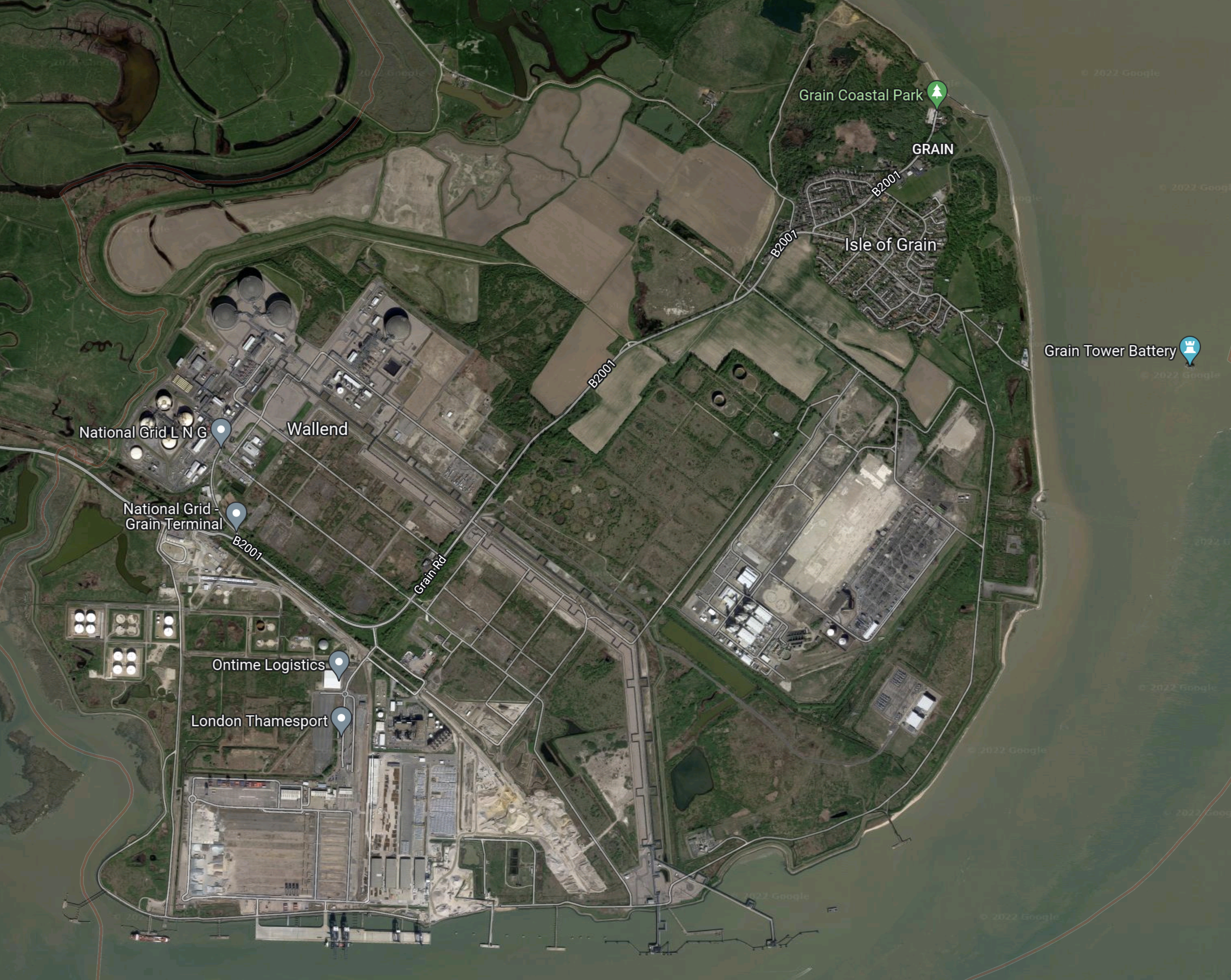
Note.
- Thamesport is in the South-West corner
- To its North is the LNG import facility.
- To the North-East of Thamesport is the 735 MW Medway power station.
- There is a rail connection to Hoo Junction on the North Kent Line.
This second Google Map shows the Eastern side of the Isle.
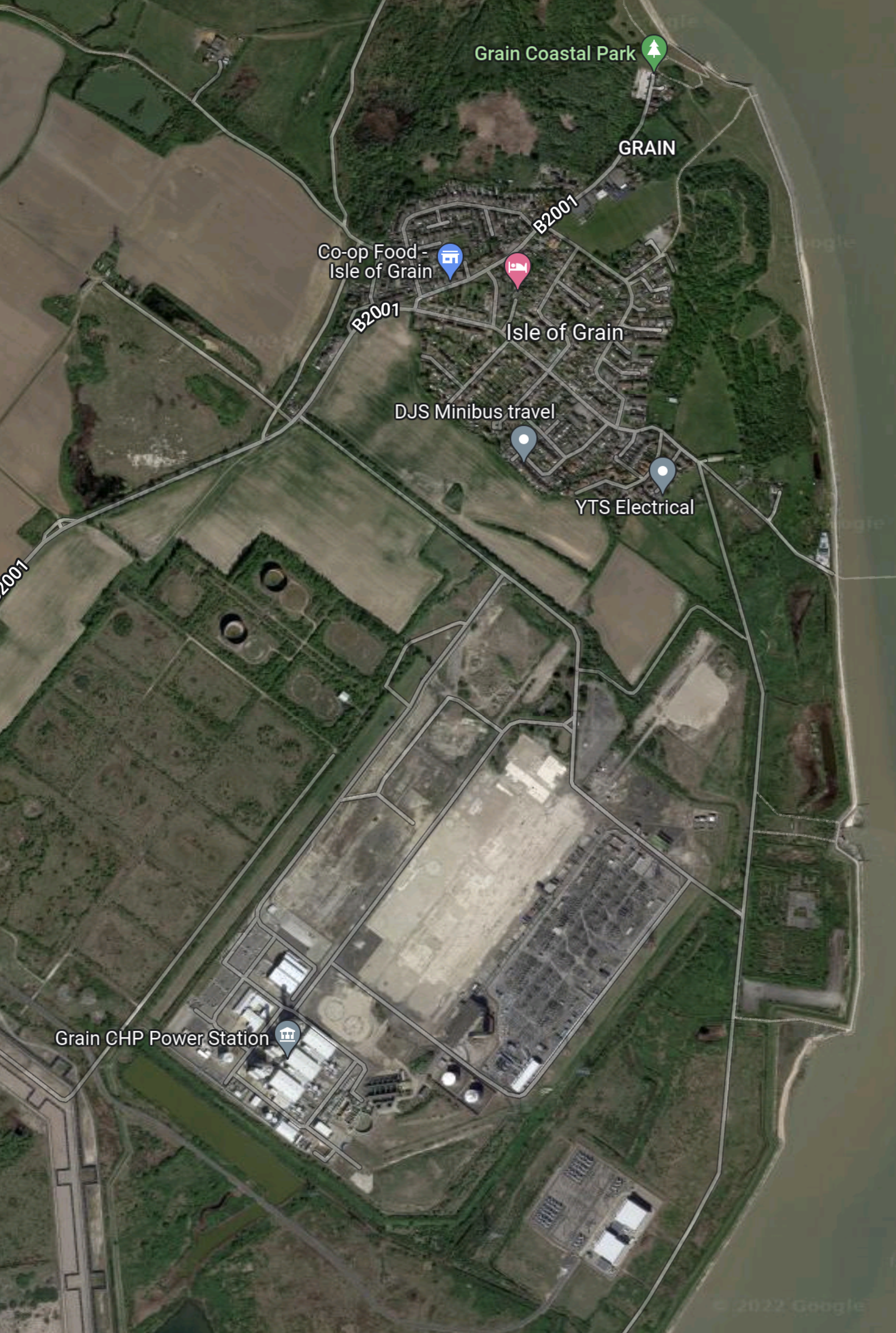
Note.
- Grain Coastal Park, where NeuConnect will make landfall, is marked by the green arrow at the top of the map.
- Towards the South-Eastern corner of the map is the 1.275 GW Grain gas-fired power station.
- To the East of the power station, there is more switchgear than you see in a bad Frankenstein film.
- The smaller square at the bottom with the two white squares could be the converter station for the BritNed interconnector.
I am sure there is space on the island for a connection for NeuConnect.
There is also a total of 2.01 GW of gas-fired power stations on the Isle of Grain.
Wind Power In The Thames Estuary
This Google Map shows the Thames Estuary.
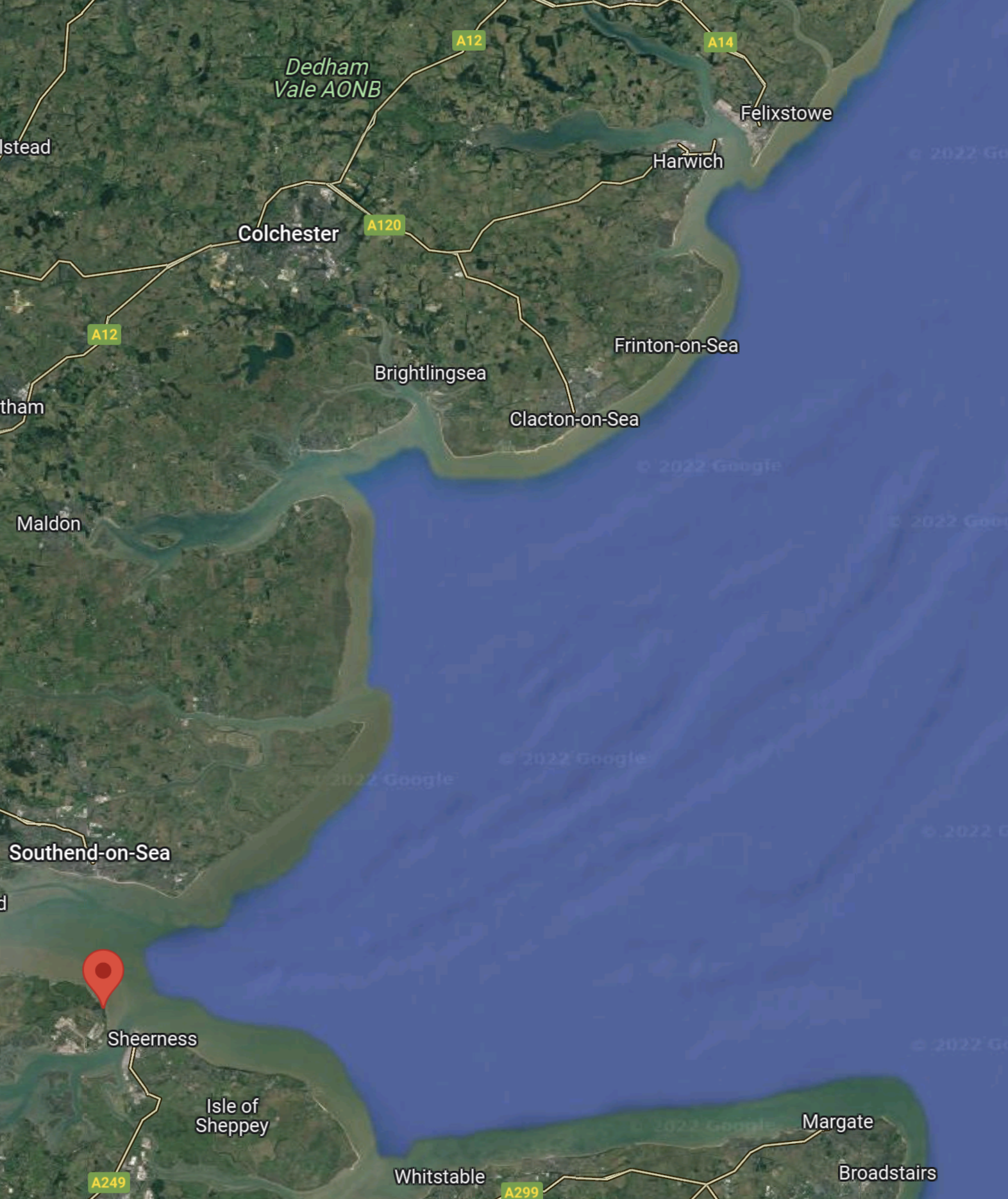
Note that the red arrow indicates the Isle of Grain.
This map from Wikipedia shows the wind farms in the area.
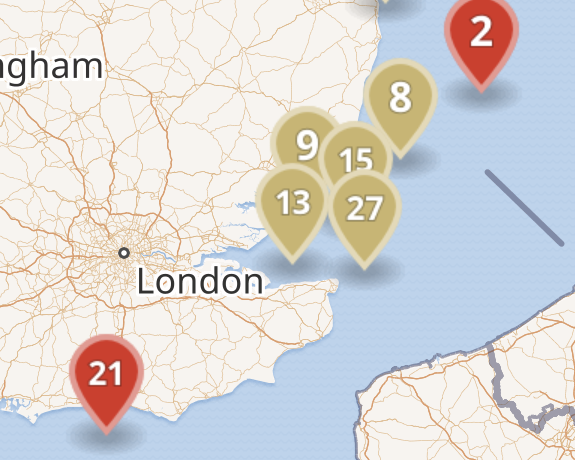
These are the ones that are operational.
- 2 – East Anglia Array – 714 MW
- 8 – Greater Gabbard – 504 MW
- 9 – Gunfleet Sands – 184 MW
- 13 – Kentish Flats – 140 MW
- 15 – London Array – 630 MW
- 27 – Thanet – 300 MW
Note.
- The Isle of Grain is just above the second o in London.
- I have ignored the Ramplion wind farm (21!), as it is too far from the Isle of Grain.
- This is a total of nearly 2.5 GW.
Planned extensions in the area include.
- East Anglia Array – 3.1 GW – Completion date of 2026
But the Wikipedia entry for the East Anglia Array says this about the wind farm.
The target capacity for the entire East Anglia Zone is 7200 MW which could require up to 1200 turbines.
Could we see one of the following?
- A connector from the East Anglia Array to the Isle of Grain.
- One or more new wind farms in the Thames Estuary connected to the Isle of Grain.
- German investment in a wind farm or farms connected to the Isle of Grain.
The Isle of Grain could become an island of energy providing power for London, the South-East of England, Germany and The Netherlands.
An Electrolyser On The Isle Of Grain
Consider.
- There will be plenty of renewable electricity.
- As there is a liquified natural gas terminal, there is plenty of gas storage.
- One or both of the gas-fired power stations can be converted to run on hydrogen.
- As more and more trucks are converted to hydrogen, there will be a large demand for hydrogen for heavy transport.
This must surely make a large electrolyser on the Isle of Grain a possibility.
The BritNed Interconnector
The BritNed interconnector is described like this in Wikipedia.
BritNed is a 1,000 MW high-voltage direct-current (HVDC) submarine power cable between the Isle of Grain in Kent, the United Kingdom; and Maasvlakte in Rotterdam, the Netherlands.
The BritNed interconnector would serve as a link for the foreseeable European super grid project.
Up to now, most of the electricity flow has been to the UK.
But surely, as more wind farms are developed power will flow the other way.
Wilhelmshaven Will Be A German Hub For Green Hydrogen
In Uniper To Make Wilhelmshaven German Hub For Green Hydrogen; Green Ammonia Import Terminal, I described plans by the Germans for a hydrogen hub at Wilhelmshaven.
The original story came from an article with the same name on Green Car Congress.
This is the first two paragraphs.
Under the name “Green Wilhelmshaven,” Germany-based international energy company Uniper plans to establish a German national hub for hydrogen in Wilhelmshaven and is working on a corresponding feasibility study.
Plans include an import terminal for green ammonia. The terminal will be equipped with an ammonia cracker for producing green hydrogen and will also be connected to the planned hydrogen network. A 410-megawatt electrolysis plant is also planned, which—in combination with the import terminal—would be capable of supplying around 295,000 metric tons or 10% of the demand expected for the whole of Germany in 2030.
As I said in the original post, I’m not happy about green ammonia, but the 1.4 GW NeuConnect interconnector has more than enough power to run a 410 MW electrolyser plant at full capacity.
It could even run three electrolysers of this size.
Hooksiel And Wilhelmshaven
NeuConnect will make landfall at Hooksiel.
This Google Map shows Hooksiel and Wilhelmshaven.
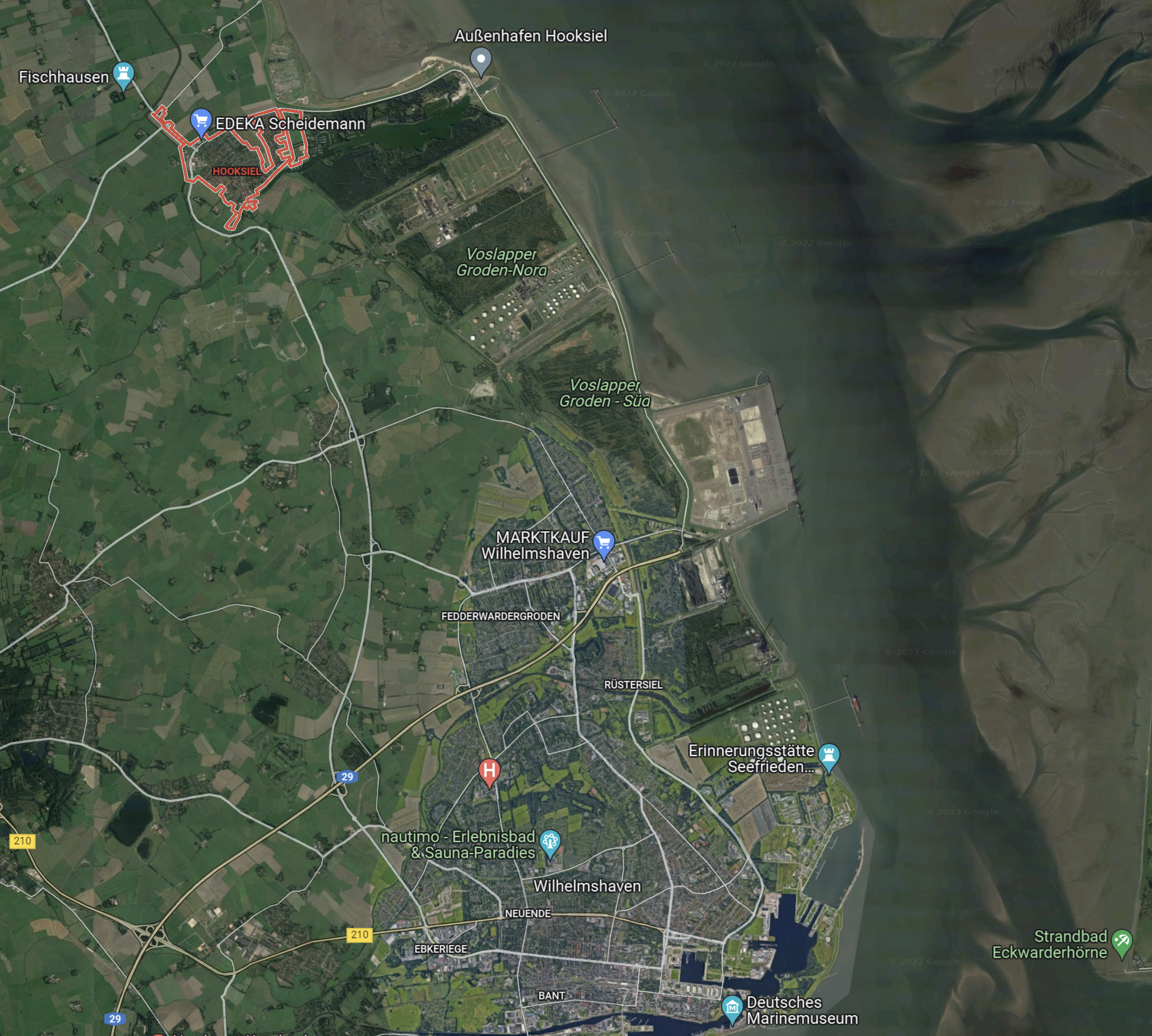
Note.
- Hooksiel is the village outlined in red.
- The water to the right of the map is the Jade Bight.
- The square block sticking out into the bight appears to be a container port.
- There appears to be chemical works or oil refineries North of the port.
- Wilhelmshaven is the town to the South of the port.
There would appear to be plenty of space for Uniper to construct Green Wilhelmshaven.
German And UK Wind Power Production
According to this page on Wikipedia, which is entitled Wind Power By Country, in 2020, these were installed wind power in various countries.
- Germany – 62,184 MW
- Spain – 27,089 MW
- UK – 24,665 MW
- France – 17,382 MW
- Italy – 10,389 MW
- Netherlands – 6,600 MW
In 2020 we were 37.5 GW behind Germany.
It looks like we’ll commission 3.3 GW this year and 6.1 in 2023, with Wikipedia saying that 12.9 GW is under development, which should close the gap to a certain extent.
In ScotWind Offshore Wind Leasing Delivers Major Boost To Scotland’s Net Zero Aspirations, I described how Scotland will add 15.1 GW of floating and 9.7 GW of fixed foundation offshore wind.
It looks like initially, we’ll be buying German wind-generated electricity, but in the future the direction could easily change around.
Boris And Olaf
There were mumblings from Boris, that energy was talked about in their meeting in Downing Street last week.
It does appear there is a lot of ways that the UK and Germany can co-operate in the future with respect to energy.
- German finance can be used to build wind farms in UK waters.
- German companies can build the turbines and the interconnectors we need to develop vast offshore wind farms.
- We can supply surplus energy to Germany through the NeuConnect interconnector.
I wouldn’t be surprised if Boris and Olaf had signed a very comprehensive energy co-operation agreement.
A Chiltern Class 68 Locomotive At Marylebone Station
As I was passing through Marylebone station, I took these pictures of a very clean Class 68 locomotive.

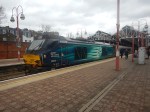


If I’m going to Birmingham, I generally use Chiltern, as often you get to travel in one of these well-restored Mark 3 coaches hauled by a Class 68 locomotive.
With the Mark 3 coach, you get a full size table and a large window to enjoy the countryside.
- The Class 68 locomotives were all built by Stadler in Spain, within the last ten years.
- The UK has a fleet of 34 Class 68 locomotives.
- They are powered by a Caterpillar diesel engine.
- The only problem with the trains is that the Class 68 locomotives are diesel.
But is Caterpillar working on a simple solution?
Search the Internet for “Caterpillar Hydrogen” and you find press releases and other items, like this press release, which is entitled Caterpillar to Expand Hydrogen-Powered Solutions to Customers.
I wouldn’t be surprised to find out, that Stadler and Caterpillar were working on a program to provide a solution to convert Class 68 locomotives to hydrogen.
One Broadgate – 9th April 2022
I haven’t walked down Eldon Street for some time from Moorgate to Liverpool Street station and last time, there was an office block on the North side of the street.












Note.
- Yesterday, there was just a large hole there, which will be filled by the new development of One Broadgate.
- The silver building in the background of many of these pictures is 5 Broadgate, which is the London offices of UBS.
- One Broadgate will be a ten story development.
- The development will be a mixed development with retail and leisure on the lower floors and offices above.
- The last three pictures show the developing plaza in front of Broadgate, with another new development in the South-West corner.
Despite Brexit, the Covid-19 pandemic and now the Russian attack on Ukraine, there seems to be no letup in the building of new offices in London.
The Covers Are Off At Tottenham Court Road Station
These pictures show some of the new signs at Tottenham Court Road station.








As the covers seem to have been taken off, does that mean that like with cricket, something is about to happen?
Is Volodymyr Zelenskyy Planning A Mosquito Moment?
Just imagine the scene in Berlin on January 30th, 1943, which was the tenth anniversary of Adolf Hitler’s rise to power.
A celebration had been planned with speeches by Goering and Goebbels to the Nazi faithful, which would be broadcast over the radio.
But precisely as Goering started to speak, three RAF Mosquitos arrived over Berlin.
This article on The Smithsonian Magazine, which is entitled When the RAF Buzzed Over Germany to Drown Out Nazi Broadcasts, describes the interruption like this.
When the bombs and the British engines intruded on the broadcast of Goering’s speech, radio engineers cut his feed and scrambled for safety. A bewildered German public instead heard the cacophony of bombers, which was soon replaced on their radios with a crackly recording of marching band music. It was more than an hour before a furious Goering returned to the airwaves.
Hours later, three more Mosquitos, gave Goebbels a similar treatment.
Wikipedia gives this quote from Goering about the Mosquito.
In 1940 I could at least fly as far as Glasgow in most of my aircraft, but not now! It makes me furious when I see the Mosquito. I turn green and yellow with envy. The British, who can afford aluminium better than we can, knock together a beautiful wooden aircraft that every piano factory over there is building, and they give it a speed which they have now increased yet again. What do you make of that? There is nothing the British do not have. They have the geniuses and we have the nincompoops. After the war is over I’m going to buy a British radio set – then at least I’ll own something that has always worked.
He was lecturing a group of German aircraft manufacturers.
It has been reported that Vlad the Mad is planning a spectacular parade on Victory Day, which is May 9th, 2022.
I can imagine that Ukrainian planners are working on ways to interrupt any speeches.
A drone spraying blue and yellow paint would be intensely funny and totally within the expertise of high-quality special forces.
 The Anonymous Widower