Major Revamp Of Wales’ Busiest Station Gets Go-Ahead
The title of this post, is the same as that of this article on the BBC.
This is the sub-heading.
Plans for a major revamp of Wales’ busiest railway station have received final approval.
These three paragraphs add more details.
The £140m upgrades to Cardiff Central – including a new brick arch rear entrance, larger concourse and improved waiting areas – aim to support passenger growth and reduce overcrowding.
Better accessibility for people with reduced mobility and additional retail and cycle facilities are also among the changes.
Work is due to start in the middle of next year with the aim of completing most of it within three years.
Note.
- The new entrance on the south side of the station, was opened in September 2015.
- A new Platform 8 was added in 2017, which allows sixteen local trains per hour to run between Cardiff Central and Cardiff Queen Street stations, to serve the twenty railway stations in the city.
- All platforms are bi-directional, which surely improves the flexibility of the rail network in Cardiff City centre.
- Access from the station to the Principality Stadium has improved greatly in recent years.
- The station will remain open during the works.
Cardiff’s railways are a comprehensive mix of local and inter-city trains.
I have some thoughts on Cardiff Station.
The Cardiff & Valleys Day Ranger
This very useful ticket, is the ideal way to explore the Cardiff and Valleys area and I’ve used it several times.
- I usually buy it from one of the two ticket offices in Cardiff Central station, but in one case, I did buy it in Paddington to save time.
- According to Transport for Wales, you can buy it on a local train from the conductor.
- It costs about £16 for an adult, but railcard apply.
I actually find taking a train up the valleys, is a good way to clean out my lungs.
Sights To See On The Cardiff & Valleys Lines
Google AI makes these suggestions.
The Cardiff & Valleys Lines offer historic castles (Cardiff, Caerphilly, Castell Coch), world-class museums (St Fagans, National Museum Cardiff, Big Pit), industrial heritage (Rhondda Heritage Park, Royal Mint Experience), and stunning nature in Bannau Brycheiniog National Park, with scenic railway journeys connecting these sites for history, culture, and outdoor adventure.
Hopefully, when the new Stadler trains and tram-trains are fully operational on the Cardiff & Valleys Lines, someone will write a full guide.
Is Formula One Likely To Go To Hydrogen Fuel?
Formula One has a long term aim of decarbonising or at least going net-zero.
I’ve never been to an electric-car race, but it must be more boring to many to have motor-racing without the smells and the noise.
I asked Google AI, the question in the title of this post and received this answer.
Formula One is unlikely to switch to hydrogen fuel in the immediate future, as its current strategy is focused on using 100% sustainable “e-fuels” from the 2026 season. However, F1 leadership has stated that hydrogen is a potential long-term solution for the 2030s and beyond.
This article on the BBC is entitled Formula 1 boss Ross Brawn Says Hydrogen Could Be Future Fuel.
But I do believe, that the trucks, vans and transporters that accompany Formula One will be decarbonised earlier and hydrogen could play a major part, due to its proven longer range.
Hydrogen coaches are being developed and could be launches next year and are likely to have a 1,000 km. range, so expect to see some of these vehicles in the fleet of vehicles following Formula One.
Hydrogen In Aviation Offers Potential For Growth And Deeper Emissions Reductions, New Study Shows
The title of this post, is the same as that of this press release from Rolls-Royce.
These five paragraphs compose the press release.
Rolls-Royce, easyJet, Heathrow and University College London Air Transportation Systems Lab (UCL ATSLab) published a report highlighting how hydrogen-powered aircraft could enable European and UK aviation to cut carbon emissions while supporting future growth.
The study, Enabling Hydrogen in the European Aviation Market, found that hydrogen in aviation offers a unique opportunity to achieve both emissions reduction and market expansion. The analysis shows that introducing hydrogen alongside Sustainable Aviation Fuel (SAF) can accelerate progress towards net zero, particularly when policy incentives reward low-carbon fuels and if hydrogen were to be included within the EU’s SAF mandate.
The research also found that targeted hydrogen infrastructure at around 20 major European airports, including Heathrow, could deliver more than 80% of the emissions benefits of full hydrogen availability across the continent. Concentrating investment at key ‘hydrogen hubs’ would therefore provide a practical and cost-effective path to early adoption.
Further modelling indicates that the earlier novel technologies, such as hydrogen, can be introduced, the more opportunity they present for CO2 emission reductions, underscoring the value of early technological transition where it is financially and technically viable.
The study is underpinned by UCL ATSLab’s Airline Behaviour Model (ABM), which represents the complexity of airline decision-making through specific behavioural variables. Building on this, the research evaluates how fuel costs, incentives and new technologies shape airline responses. This provides a research-based, realistic picture of how hydrogen adoption could evolve, highlighting both opportunities and potential challenges for adoption.
Note, these two sentences recommending early adoption of hydrogen.
- Concentrating investment at key ‘hydrogen hubs’ would therefore provide a practical and cost-effective path to early adoption.
- Further modelling indicates that the earlier novel technologies, such as hydrogen, can be introduced, the more opportunity they present for CO2 emission reductions.
I also suspect, that introducing hydrogen early, feeds back to reduce Co2 emissions.
But what is Trump’s considered view on hydrogen aircraft?
Google AI gives this answer to my question.
Donald Trump’s view on hydrogen for transportation, including potential use in aircraft, is highly skeptical due to perceived safety risks and effectiveness concerns, which generally aligns with his broader opposition to green energy initiatives. He has specifically criticized hydrogen-powered vehicles as being dangerous and “prone to blowing up”.
Note.
- I used to work in a hydrogen factory and it’s still producing hydrogen.
- I doubt Trump gets on well with Jennifer Rumsey, who is CEO of Cummins, who are one of the world’s largest diesel-engine companies, who are following a zero-carbon route.
- Is Formula One Likely To Go To Hydrogen Fuel? This would set the Cat Among The Pigeons
I also feel that this University College London study will create a string of converts to hydrogen.
Do Coeliacs Have More Varicose Viens?
I asked Google AI, the question in the title of this post and I received this answer.
Yes, studies suggest that people with celiac disease (CD) may have an increased risk of developing certain vein-related conditions, including a potential predisposition to varicose veins.
My mother had the worst varicose viens I’ve ever seen.
She was operated on in the 1950s, by an Indian lady surgeon, who performed her ward rounds in a sari, who my father told me, she was one of the most beautiful women, that he’d ever seen.
Although, my father was married twice, he didn’t seem to be a ladies’ man, although he had great loyalty from the ladies he employed, in his printing business. He also got on very well with my wife ; C, although they didn’t meet many times.
Is Carbon Black Used To Make Offshore Electrical Cable?
I asked Google AI, the answer to this question and received this answer.
Yes, carbon black is extensively used to make offshore electrical cables. It serves two primary functions: providing electrical conductivity to specific components and offering UV protection to outer jacketing materials.
That seems a positive answer.
It also could be a very complementary one.
HiiROC have a process that splits any hydrocarbon gas including natural gas, chemical plant off gas and biomethane, into turquoise hydrogen and carbon black.
Two methods of bringing energy to the shore from an offshore wind farm are electricity and hydrogen, through a cable or pipe respectively.
This looks to me, that there could be a possibility to use one of Baldrick’s cunning hybrid plans to bring energy onshore using both hydrogen and electricity.
Effectively, the transmission and use of the system, would use both the hydrogen and carbon black produced by HiiROC.
Artificial Intelligence To The Rescue
This evening, I had a Marks & Spencer Chicken jalfrezi with Basmati Rice for supper.
Marks put a green vegetable in the rice, which I’m not keen on as it gets stuck in the back of my throat.
So tonight, I picked it out with my hand before cooking, and put it in the food waste.
It didn’t make any difference to the cooking, but as I sat down to eat, I noticed that my right hand was going red.
As I’d never picked the dreaded green vegetable out of the rice before, I asked Google AI, if handling spices can make my hand go red and received this reply.
Yes, handling certain spices, particularly chili peppers, can definitely make your hands go red. This reaction is known as “Hunan hand syndrome” or “chili burn” and is caused by the chemical compound capsaicin.
That, certainly happened to me.
It might almost may have been worse for me because.
- My mother taught me to cook in the 1950s and she didn’t use lots of spices in her cooking. So I never learned about the dangers of spices.
- I have a leaking skin, which allows water in and out of my body easily.
- I have an immune system, like a platoon of the SAS on steroids.
So was this, why I was affected?
I then asked Google AI, “What do you do, if you react badly to chilli”, and received this reply.
If you experience a bad reaction to chili (caused by the compound capsaicin), consume dairy products (like milk or yogurt), acidic foods/drinks (lemonade or orange juice), or starches (bread or rice) for relief.
For severe symptoms like difficulty breathing or chest pain, seek immediate medical attention as it could be an allergic reaction.
For Reactions in the Mouth
The primary methods work because capsaicin is oil-soluble, not water-soluble. Water will only spread the burning sensation.
Dairy Products: Milk, yogurt, and sour cream contain a protein called casein, which acts like a detergent to strip away the oily capsaicin molecules from your pain receptors. Whole or full-fat dairy products tend to be more effective than low-fat versions.
Acidic Foods/Drinks: The acidity in items like lemon or lime juice helps to neutralize the alkaline capsaicin molecule.
Sugary Foods: A spoonful of sugar or honey can absorb the capsaicin oil and provides a distraction from the pain.
Starches/Carbohydrates: Eating plain bread, rice, or potatoes can help by creating a physical barrier and absorbing the capsaicin molecules.
Oils/Nut Butters: Capsaicin dissolves in fat. Swishing with a bit of olive oil or eating a spoon of peanut butter can help dissolve and remove the capsaicin.
For Reactions on the Skin
If you experience a burning sensation on your skin after handling chilies:
Wash the area thoroughly with dish soap and water several times, as dish soap is designed to cut grease and oil.
Soak the affected skin in milk or apply yogurt/sour cream.
You can also try a paste made of baking soda and water, or soaking the area in a diluted vinegar solution.
If the pain is severe and persistent, over-the-counter pain relievers or topical corticosteroid creams may offer relief.
When to Seek Medical Attention
While a normal reaction to chili is an intense sensation rather than actual harm, a true allergy can be serious.
Seek emergency medical care immediately if you experience:
Difficulty breathing, wheezing, or shortness of breath
Swelling of the mouth, lips, or tongue
Chest pain or heart palpitations
Uncontrollable nausea or vomiting
Luckily for me, a yogurt worked.
Conclusion
I shall use a suitable tool, like pliers or tweezers, when handling those dreaded green vegetables.
Network Rail’s Test Track Take Centre Stage As Hydrogen Is Delivered By Rail For The First Time
The title of this post, is the same as that of this press release from GeoPura.
These three paragraphs introduce the story.
Network Rail, working with rail and energy partners Freightliner and GeoPura, has transported hydrogen for the first time on Britain’s rail network, marking a major step forward for both the rail and energy sectors.
The milestone was achieved yesterday (Wednesday 3 December) at Network Rail’s Test Tracks* site in Tuxford, where freight operator Freightliner hauled a train of gas containers from Doncaster to High Marnham – marking Britain’s first shipment of hydrogen by rail.
It was part of a rail and energy industry innovation event showcasing several hydrogen initiatives. This included the first re-engineered hydrogen-powered shunting locomotive – seen as a step towards replacing diesel – another milestone towards the rail industry’s goal of becoming net zero. The event also demonstrated HPU hydrogen-powered generators, lighting towers and support vehicles.
These two paragraphs describe Network Rail’s test track at Tuxford and GeoPura’s hydrogen production facility at High Marnham.
Network Rail’s site at Tuxford runs all the way to High Marnham, where it sits adjacent to HyMarnham Power, the UK’s largest green hydrogen production facility operated by GeoPura and JG Pears. Built on the site of a former coal-fired power station, HyMarnham Power is one of the world’s first rail-connected hydrogen production facilities, and Network Rail’s Tuxford site will be the world’s first net-zero railway testing facility.
Currently, hydrogen is transported by road. This breakthrough marks a major step towards the rail network becoming a ready-made hydrogen distribution system, a rolling pipeline, with connections to all major industrial and urban centres across Britain – proving the practical capability of rail to transport hydrogen at scale. Hydrogen will also be utilised to decarbonise wider rail operations, from construction to ongoing maintenance and off-grid operations.
This OpenRailwayMap shows Tuxford and High Marnham.

Note.
- The blue arrow is Tuxford West junction.
- The North-South red track is the East Coast Main Line. East-West track indicated by the blue arrow is Network Rail’s Test Track
- The grey area, to the South of the Test Track in the East is the former site of High Marnham power station, where GeoPura have their hydrogen facility.
- If you continue East on the Test Track it connects to the Sheffield and Lincoln Line at Pye Wipe junction.
Sheffield could be the sort of city, that would need a lot of hydrogen to decarbonise.
Has Hydrogen Been Transported From ICI’s Former Site At Runcorn By Rail
I ask this question, as I used to work at Runcorn in the 1960s, and I don’t remember seeing any hydrogen railway wagons.
I asked Google AI, the question in the title of this section and received this answer.
Hydrogen is typically transported from the INEOS (formerly ICI) site in Runcorn via pipeline or by road in cryogenic liquid tanker trucks or gaseous tube trailers, but it has not been historically transported by rail from that specific site.
The first ever trial shipment of hydrogen by rail on Britain’s network took place only very recently, in December 2025, as part of an industry innovation event. This trial involved transporting hydrogen containers from Doncaster to High Marnham, adjacent to the HyMarnham Power green hydrogen production facility.
It looks like my memory and Google AI agree.
£100m ‘Global Players’ Wind Farm Deal To Create 300 Jobs
The title of this post, is the same as this article on the BBC.
This is the sub-heading.
A £100m deal which will create about 300 jobs has been agreed between the developers of two Irish Sea offshore wind farms and Belfast Harbour.
These three paragraphs add more detail.
The joint developers of the Mona and Morgan offshore wind farms will lease Belfast Harbour’s D1 terminal for the assembly and preparation of wind turbine components.
Work is being carried out to get the site ready for use from 2028.
Joe O’Neill, chief executive of Belfast Harbour, described it as a “huge deal”, not just for the harbour but for Belfast and the wider region.
Joe O’Neill seems happy with the deal, if you read the full BBC article.
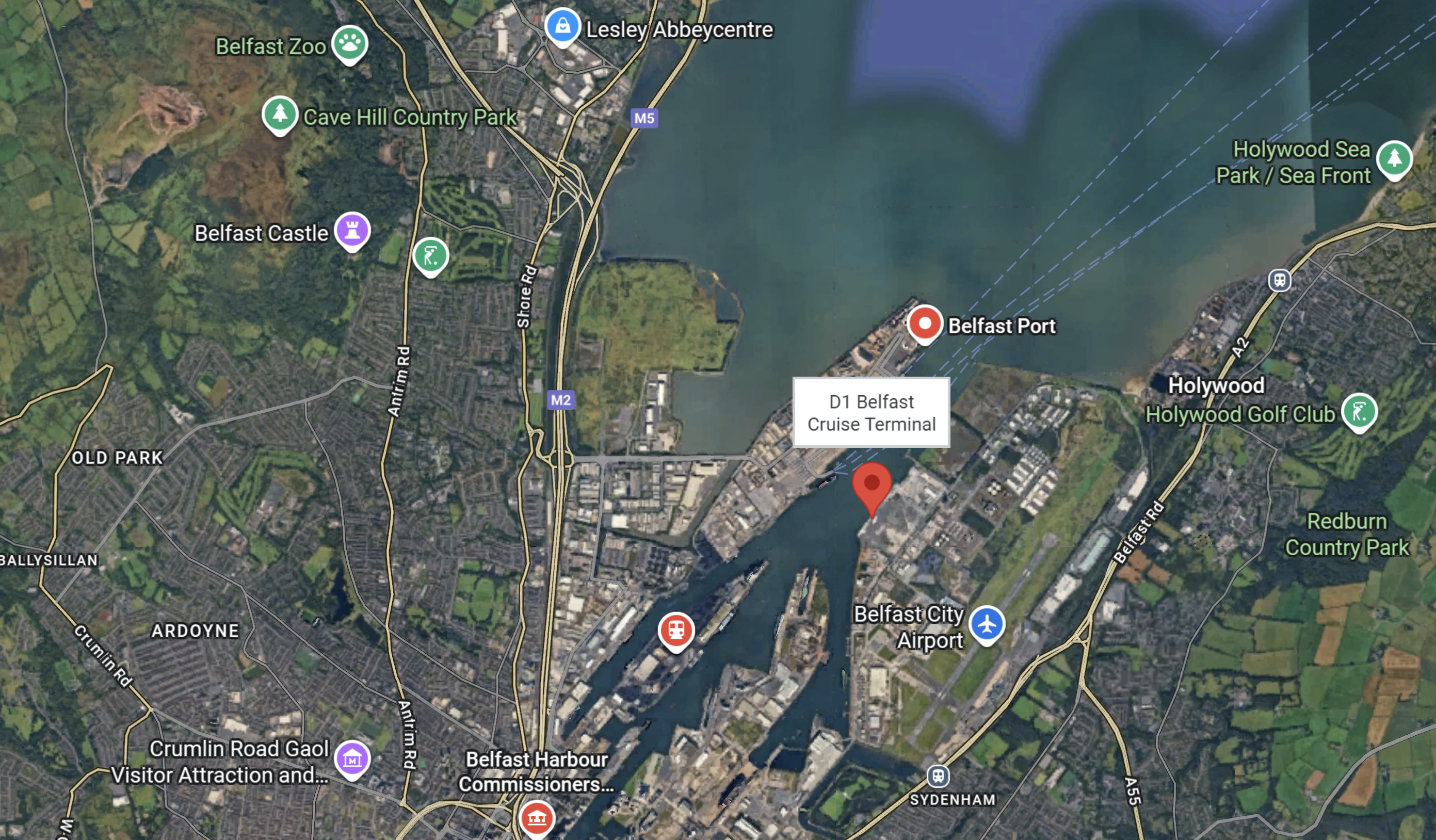
This Google Map shows Belfast Harbour with the D1 Terminal in the centre.
Note.
- The red arrow indicates the D1 Terminal.
- It appears to be within walking distance of Belfast City Airport.
- The harbour is not that far from the city centre.
I would expect, this could be an ideal harbour to prepare wind turbines for erection.
But Where Will The Cruise Ships Dock In Belfast, If The D1 Terminal Is Being Used To Prepare And Assemble Wind Turbines?
Google AI gave this answer to my question!
Cruise ships will dock at a new deepwater berth at Belfast Harbour’s D3 terminal starting with the 2028 cruise season. This new facility is a dual-purpose terminal being built to accommodate both the largest cruise vessels and the assembly and installation of offshore wind turbines.
Note.
- The date fits with the new site for turbine work being ready by 2028.
- The new D3 Terminal will take some of the largest cruise vessels.
- I suspect, it will be able to supply ships with suitable low-carbon fuel, as required.
- Could it also take the very large ships used to install turbines?
- It’s almost as if Belfast Harbour are making an attraction of the turbines.
Google AI gives this overview of the D3 Terminal.
The Belfast Harbour D3 cruise terminal is a new £90 million dual-purpose deepwater quay under construction, designed to accommodate the world’s largest cruise ships and support the offshore wind energy industry. Construction on the project, which is Belfast Harbour’s largest-ever investment, began in April 2025 and is expected to be operational for the 2028 cruise season. The facility will include a 340m quay and new terminal building for passengers, and will be converted for cargo handling during the cruise season.
It certainly looks like Belfast is designing a dual-purpose terminal, that will bring the maximum benefit to the city and its people.
Which Offshore Wind Projects Will Use Belfast Harbour?
Google AI gave this answer to my question!
The Mona and Morgan offshore wind farms, being developed by EnBW and JERA Nex bp, will use Belfast Harbour. The port’s D1 terminal will serve as the hub for the assembly and marshalling of wind turbine components for these projects, which are planned for the Irish Sea and are expected to be operational by 2028.
I suspect there will be others.
EDF Developing Offshore Wind-Powered Hydrogen Production Project In French EEZ
The title of this post, is the same as that of this article on offshoreWIND.biz.
This is the sub-heading.
EDF Power Solutions has invited applications for a tender for Environmental Impact Assessment (EIA) services and hazard studies as part of a project to develop an offshore hydrogen production station in France’s Exclusive Economic Zone (EEZ).
This is the first paragraph.
The project, dubbed HYODE (HYdrogen Offshore DunkerquE), will produce green hydrogen by coupling offshore wind farms with an offshore electrolyser near Dunkirk, France, and is planned to also include storage and transport by ship to port, forming what EDF describes as an “innovative solution” to help scale green hydrogen production.
I asked Google AI, if there are any operational offshore hydrogen electrolysers and received this answer.
Yes, there are operational offshore electrolyser projects, though large-scale, dedicated offshore hydrogen platforms are still in development. The first operational offshore production on an existing gas platform is planned for late 2024 with the PosHYdon project. Additionally, a pilot project in the UK is testing the full integration of a hydrogen electrolyser onto an existing offshore wind turbine, with another project in the Netherlands installing an offshore hydrogen production and storage platform.
But, I did get this page on page on the Ramboll web site, which is entitled The Rise Of Offshore Hydrogen Production At Scale, which has this introductory paragraph.
The stage is set for producing green hydrogen from offshore wind and desalinated seawater. Building on existing and proven technology, offshore wind farms have the potential to become future production hubs for green hydrogen production at scale to meet increasing demand.
That sounds very promising, especially, if proven technology is borrowed from the offshore oil and gas industry.
It’s
Centrica Energy And Exodus Sign Landmark LNG Agreement
The title of this post, is the same as that of this press release from Centrica.
This is the sub-heading.
Centrica Energy has announced the signing of a long-term Sale and Purchase Agreement (SPA) to supply liquefied natural gas (LNG) to Exodus for Honduras, marking a new milestone in the country’s energy development.
These two paragraphs add more details.
Under the terms of the agreement, Centrica will deliver approximately six LNG cargoes per year to Exodus through a ship-to-ship operation into the Floating Storage Unit (FSU) Bilbao Knutsen, located in Puerto Cortes. The 15-year contract is expected to commence in 2026.
“This agreement reflects Centrica Energy’s commitment to expanding global LNG access through strategic partnerships,” said Arturo Gallego, Global Head of LNG at Centrica Energy. “By leveraging our global reach and operational expertise, we’re proud to support Exodus and Honduras in its journey toward a more sustainable and resilient energy future.”
It looks a good deal for Centrica, that has been snatched from under the American’s noses.
I also asked Google AI, if Honduras produced any natural gas and received this reply.
No, Honduras does not produce natural gas, but it is importing it through a new liquefied natural gas (LNG) agreement that begins in 2026. The country relies on imports to meet its energy needs, and this new deal aims to diversify its energy mix and provide cleaner energy for power generation.
That’s clear and it’s interesting that Honduras are looking to provide cleaner energy.
These two paragraphs from Centrica’s press release add details on power generation in Honduras.
The LNG will be transported to the Brassavola Combined Cycle Power Plant, an operating 150 MW thermal facility with its combined cycle under construction and set to reach 240 MW of power capacity, marking the first-ever import of natural gas for power generation in Honduras. This initiative represents a significant step toward diversifying the nation’s energy mix and reducing its reliance on less environmentally friendly fossil fuels.
Once operational, the FSU will serve as the backbone of LNG storage at a new terminal currently under construction on Honduras’ Caribbean coast. The project is designed to enhance energy security, improve generation efficiency, and support industrial growth.
This article on Riviera is entitled Honduras Turns To LNG To Meet Energy Needs and provides these points.
- Honduras is grappling with a 250 MW power shortage.
- Genesis Energías is spearheading efforts to introduce a reliable and cost-effective energy source by importing liquefied natural gas (LNG).
- Hyundai, who are one of Centrica’s partners in HiiROC, are converting the Bilbao Knutsen for its new role as a Floating Storage Unit (FSU).
It would certainly help Honduras’s economy, if they had more power generation.
I asked Google AI, if Honduras was developing offshore wind power and received this reply.
While Honduras has been actively developing onshore wind power for over a decade, there is currently no information to suggest it is developing offshore wind power projects. The country’s wind energy development has focused exclusively on land-based projects, with a number of operational farms and more in the pipeline.
I also asked Google AI if Honduras was developing solar power and received this reply.
Yes, Honduras is actively and significantly developing its solar power capacity as a cornerstone of its national energy strategy. The country has been a regional leader in solar energy penetration and continues to invest heavily in new projects to reduce its dependence on fossil fuels.
But, whether its offshore wind, onshore wind or solar power, these renewals will need backup and the 240 MW Brassavola Combined Cycle Power Plant, will be a good start.
I have some further thoughts.
Does HiiROC Have A Part To Play?
If would be good, if the 240 MW Brassavola Combined Cycle Power Plant could be zero-carbon, so that Honduras could be more zero-carbon.
Consider.
- Centrica own part of HiiROC, who can generate turquoise hydrogen efficiently from natural gas.
- Honduras will from 2026, have plenty of natural gas.
- In Hydrogen Milestone: UK’s First Hydrogen-to-Power Trial At Brigg Energy Park, I talked about how Centrica powered Brigg power station with a hydrogen blend.
- If the Brassavola Combined Cycle Power Plant was reasonably-modern like Brigg, I suspect it could be run on hydrogen or a hydrogen-blend.
- A reliable supply of hydrogen in Honduras would have its uses.
I wouldn’t be surprised to see a HiiROC plant in Honduras to help decarbonise the country.
HiiROC Creates A Lot Of Carbon Black
When a HiiROC system produces turquoise hydrogen, it produces carbon black as a by-product.
I asked Google AI, if Honduras has a use for carbon black, and received this reply.
Honduras likely has a use for carbon black because the material is a vital component in the production of many common industrial and consumer goods that are used globally. The primary applications are universal across most countries, including those in Central America.
But carbon black can also be used to improve poor agricultural land.
So I asked, Google AI, if Honduras has a lot of land to improve and received this reply.
Yes, Honduras has significant land to improve, but this is complicated by issues like deforestation, land degradation, and a lack of clear land rights for many communities. There is a need to balance economic activities like coffee plantations with conservation, improve sustainable agriculture practices, and address illegal land occupation.
It seems to me, that a sensible hollistic approach could use some of the carbon black.
I also believe, that there are many universities, who could advise Honduras on land restoration.
Does Highview Power Have A Part To Play?
Consider.
- Centrica are one of the backers of Highview Power, who are building their first two environmentally-friendly liquid air batteries in the UK.
- Their flagship battery is a 300 MW/3.2 GWh monster that can incorporate a stability island, that controls the grid.
- Highview Power’s batteries are zero-carbon, with a 40-50 year life.
As a Control Engineer, I believe that one of these batteries would be superb backup for the Brassavola Combined Cycle Power Plant and all those renewables.
Where Will Centrica Get Their LNG For Honduras?
I have already reported on two deals, where Centrica is purchasing LNG.
- Centrica Enters Into Long Term Natural Gas Sale & Purchase Agreement
- Centrica And PTT Sign Heads Of Agreement For Long-Term LNG Supply
I can expect more deals like this around the world.
Also, as the Grain LNG Terminal has the ability to export LNG could we be seeing UK natural gas being exported by Centrica to Honduras and the other countries hinted at in the PTT purchase?
Are Centrica Proposing A Comprehensive Solution To A Nation’s Power Problem?
It certainly looks like they are.
And Honduras would be getting a zero-carbon energy system.
This could be repeated all around the world.
Conclusion
This certainly looks like a good deal for Centrica, that can be repeated in other places.
 The Anonymous Widower