Artificial Intelligence To The Rescue
This evening, I had a Marks & Spencer Chicken jalfrezi with Basmati Rice for supper.
Marks put a green vegetable in the rice, which I’m not keen on as it gets stuck in the back of my throat.
So tonight, I picked it out with my hand before cooking, and put it in the food waste.
It didn’t make any difference to the cooking, but as I sat down to eat, I noticed that my right hand was going red.
As I’d never picked the dreaded green vegetable out of the rice before, I asked Google AI, if handling spices can make my hand go red and received this reply.
Yes, handling certain spices, particularly chili peppers, can definitely make your hands go red. This reaction is known as “Hunan hand syndrome” or “chili burn” and is caused by the chemical compound capsaicin.
That, certainly happened to me.
It might almost may have been worse for me because.
- My mother taught me to cook in the 1950s and she didn’t use lots of spices in her cooking. So I never learned about the dangers of spices.
- I have a leaking skin, which allows water in and out of my body easily.
- I have an immune system, like a platoon of the SAS on steroids.
So was this, why I was affected?
I then asked Google AI, “What do you do, if you react badly to chilli”, and received this reply.
If you experience a bad reaction to chili (caused by the compound capsaicin), consume dairy products (like milk or yogurt), acidic foods/drinks (lemonade or orange juice), or starches (bread or rice) for relief.
For severe symptoms like difficulty breathing or chest pain, seek immediate medical attention as it could be an allergic reaction.
For Reactions in the Mouth
The primary methods work because capsaicin is oil-soluble, not water-soluble. Water will only spread the burning sensation.
Dairy Products: Milk, yogurt, and sour cream contain a protein called casein, which acts like a detergent to strip away the oily capsaicin molecules from your pain receptors. Whole or full-fat dairy products tend to be more effective than low-fat versions.
Acidic Foods/Drinks: The acidity in items like lemon or lime juice helps to neutralize the alkaline capsaicin molecule.
Sugary Foods: A spoonful of sugar or honey can absorb the capsaicin oil and provides a distraction from the pain.
Starches/Carbohydrates: Eating plain bread, rice, or potatoes can help by creating a physical barrier and absorbing the capsaicin molecules.
Oils/Nut Butters: Capsaicin dissolves in fat. Swishing with a bit of olive oil or eating a spoon of peanut butter can help dissolve and remove the capsaicin.
For Reactions on the Skin
If you experience a burning sensation on your skin after handling chilies:
Wash the area thoroughly with dish soap and water several times, as dish soap is designed to cut grease and oil.
Soak the affected skin in milk or apply yogurt/sour cream.
You can also try a paste made of baking soda and water, or soaking the area in a diluted vinegar solution.
If the pain is severe and persistent, over-the-counter pain relievers or topical corticosteroid creams may offer relief.
When to Seek Medical Attention
While a normal reaction to chili is an intense sensation rather than actual harm, a true allergy can be serious.
Seek emergency medical care immediately if you experience:
Difficulty breathing, wheezing, or shortness of breath
Swelling of the mouth, lips, or tongue
Chest pain or heart palpitations
Uncontrollable nausea or vomiting
Luckily for me, a yogurt worked.
Conclusion
I shall use a suitable tool, like pliers or tweezers, when handling those dreaded green vegetables.
Data Centre In The Shed Reduces Energy Bills To £40
The title of this post, is the same as that of this article on the BBC.
This is the sub-heading.
An Essex couple have become the first people in the country to trial a scheme that sees them heat their home using a data centre in their garden shed.
These three introductory paragraphs add some detail.
Terrence and Lesley Bridges have seen their energy bills drop dramatically, from £375 a month down to as low as £40, since they swapped their gas boiler for a HeatHub – a small data centre containing more than 500 computers.
Data centres are banks of computers which carry out digital tasks. As the computers process data, they generate lots of heat, which is captured by oil and then transferred into the Bridges’ hot water system.
Mr Bridges, 76, says keeping his two-bed bungalow near Braintree warm was a necessity as his wife has spinal stenosis and is in “a lot of pain” when it gets colder.
I think this simple idea is absolutely brilliant and very technically sound.
Here are some further thoughts.
It Would Be Ideal For A House Like Mine
My house is a modern three-bedroomed house with a garage and when I asked Google AI how many UK houses had garages, I received this answer.
Approximately 38% of dwellings in England have a garage, according to a 2020 report. While a specific UK-wide figure is not available, extrapolating this percentage to the total number of UK dwellings suggests there are over 10 million houses with garages, though the actual figure may vary across different regions.
Looking at the picture in the BBC article, I feel that this HeatHub could fit in my house.
I would expect that any house with a garage, a small garden or a big enough boiler space could accommodate a HeatHub.
Obviously, the house would need.
- A boiler, that provides heating and hot water.
- A good broadband connection.
My house has both.
Would My House’s Heating System Need To Be Modified?
It looks like it’s just a boiler replacement, so I don’t think so, but it may need to be moderbnised with digital controllers to get the best out of the system.
Will There Be Other Systems Like Thermify’s Heat Hub?
Some of our electricity suppliers seem very innovative and the market is very competitive.
Would they just sit back and let coompetitors take their customers? I doubt it!
So I suspect there will be other systems, each with their own features.
I have already, written about heata, which uses similar principles to give affordable hot water in British Gas Partners With heata On Trial To Reuse Waste Heat From Data Processing.
The BBC article gives some examples of data centres used to provide heating, so it is worth reading the full article.
I’ve Just Had An MRI Scan And I’ve Got A Pain In My Foot
I will try and use the AI functions of Google to make some sense of the title of this post.
These are the questions I asked.
Why Is My Left Foot Painful After An MRI Scan Of My Brain?
Google gave this AI Overview.
A foot pain after a brain MRI is likely unrelated to the scan itself. MRI scans are not known to cause pain in extremities, though some patients may experience temporary discomfort from having to lie still for an extended period. It’s more probable that the pain is coincidental, or due to another underlying issue unrelated to the MRI, such as a pre-existing condition or new injury.
Note.
- It is a hot day.
- I did a fair bit of walking to get to and from the MRI Scan.
- I don’t think it was lying still for an extended period.
- I felt a bit dehydrated after the scan.
Overall, my left foot is occasionally in pain and red. Certainly more often than my right! It doesn’t appear to be red today.
Can An MRI Scan Make You Dehydrated?
Google gave this AI Overview.
While MRI scans themselves don’t cause dehydration, staying well-hydrated is important, especially if contrast dye is used. Drinking plenty of fluids after an MRI with contrast helps flush the dye out of your system. Though dehydration can occur naturally, it’s not a direct effect of the MRI itself.
I didn’t have any dye.
But I was desperate for a drink, so I went into the first cafe, that I passed and had a coffee and cake.
Can An MRI Scan Stimulate Blood Flow?
Google gave this AI Overview.
While MRI machines don’t directly stimulate blood flow in the sense of causing it to increase, they can visualize and measure blood flow. Functional MRI (fMRI) specifically detects changes in blood flow related to brain activity as the brain uses more oxygen in active areas, leading to increased blood flow to those areas. Standard MRI can also be used to visualize blood vessels and assess blood flow, but it doesn’t directly cause the flow to change.
As I have now changed my shoes and socks to my slippers and the pain has disappeared, I suspect it was the new shoes.
I wrote this post, to show the quality of the answers of artificial intelligence to simple medical questions.
From my knowledge of data analysis, I suspect there’s much more to come with medical diagnosis using AI. Especially, if you login to a medical diagnosis computer system, that has details of your medical history.
I always remember my first B12 injection, after I had been diagnosed with coeliac disease.
What Caused The Amazon Web Services Failure?
This article on Reuters is entitled Amazon’s AWS Struggles To Recover After Major Outage Disrupts Apps, Services Worldwide, sums up today’s big news story.
But what went wrong?
I asked Google AI, where BT have their data servers and received this reply.
BT hosts its data servers in various locations across the UK, including London, Birmingham, and Dublin, Ireland, as well as in mainland Europe such as Frankfurt, Germany, and Amsterdam and Nieuwegein, Netherlands. They also have a presence in the United States, with facilities in locations like New Jersey.
Note.
- Nieuwegein is South of Amsterdam.
- There’s almost a direct straight-line route between Dublin and Frantfurt.
- Cambridge would lie on that straight-line route.
- BT’s Research at Martlesham in Suffolk would lie on that straight-line route.
- Is BT’s worldwide network closely monitored from BT Research?
- For more about BT Research read their Wikipedia entry.
- The straight-line route by-passes London.
The network seems comprehensive and well spread-out.
These are my thoughts.
The Value Of Research
I asked Google AI, if there were any spin-out companies from BT Martlesham and received this reply.
Yes, spin-out companies have been formed from BT’s Adastral Park research facility, including Real Time Content (RTC) and iome. Both companies were supported by BT and developed technologies based on research from the Martlesham site, with RTC focusing on personalized video services and iome providing location-based services through mobile internet.
I used to live near to BT’s Research Centre until 1990.
At the time, I was writing Artemis, the project management system and the multi-user version of that software and a BT research computer system used the same Hewlett-Packard hardware and an operating system written by BT at Martlesham.
Because of this connection, I learned a lot about their methods and the breadth of the research being carried out in Suffolk and was generally impressed.
I would suspect that legacy telecom companies like BT, France Telecom and Deutsche Telecom spend a lot of money on research. Do newer companies spend similar amounts?
Having a good research department behind you is an excellent form of insurance!
Will BT Research Have A Reliable 24/7 Power Supply?
Consider.
- By 2030, there will be upwards of 4 GW of offshore wind power along the Suffolk coast.
- Sizewell B will be 22 miles away, pumping out 1.2 GW until at least 2035.
- Sizewell C could be pumping out 3.3 GW from the mid-2030s.
- The 1.8 GW LionLink between Walberswick in Suffolk and The Netherlands could be in operation by 2030.
I am fairly sure that BT Research will have enough power, even if several data centres are built on the Martlesham site.
The Domain Name Res0lution Problem
Consider.
- The root causeof Amazon’s disaster appeared to be problems with its domain name resolution system.
- Executing fast lookup of domain names is critical.
I had a similar problem with the project management system ; Artemis, when I extended it to be one of the first relational databases in the 1980s. So I went to IBM’s library on the South Bank and dug out all their 1950s papers on looking up keys in tables.
In those days, with slower computers, which had smaller amounts of memory, the efficiency of the algorithm was very important and I got a significant improvement in look-up speed, by digging up ideas from the past.
If anybody wants to check out their algorithm with me, I’m always happy to oblige, but at 78 with poor eye-sight I’m probably past coding anything myself.
When I was dealing with BT Research, they would have made sure that something like domain name resolution was given the full research treatment.
My Conclusion
As I don’t have all the data, I will not speculate, but will await Amazon’s conclusion with interest.
NSTA Gives 1.1bn Barrel Boost To North Sea Oil Reserve Estimates
The title of this post, is the same as that of an article on Energy Voice.
As I don’t have access to Energy Voice articles, I asked Google AI what it can tell me of North Sea oil and gas reserves boost and received this answer.
North Sea oil and gas reserves have increased by 1.1 billion barrels, driven by new licensing rounds, with the North Sea Transition Authority (NSTA) reporting a 31% rise in potential resources. This boost could significantly impact the UK’s energy security and economy by potentially allowing the UK to meet half its oil and gas needs and support jobs. However, this development occurs alongside political debate over new drilling licenses and the UK’s Net Zero targets.
These are my thoughts.
Am I Using AI To Get Round The Paywall?
Some may argue that I am, but then as my tame and pleasureable lawyer has passed on, I shall leave this question to Google’s lawyers.
Although in the 1970s, I will admit to spending hours in libraries finding data and algorithms for the solution of these problems.
- The understanding of the dynamics of the sulphonation reaction, which may have led to a valuable patent.
- The linking between datasets, which may have led to the first relational database.
My searches these days, would be a lot easier with artificial intelligence.
A 31% Rise Is Very Worthwhile
This article in the Telegraph also looks at the NSTA report and these are three paragraphs.
Martin Copeland, the chief financial officer at Serica Energy, a North Sea oil and gas producer, said: “This NSTA report shows that there at least 11 billion barrels of oil and gas which could still be developed in the North Sea.
“This almost meets the amount that the Climate Change Committee says we will need before the net zero target year of 2050 of 13 billion to 15 billion barrels.
“So with the right policy changes and tax regime, the UK could effectively be self-sufficient on the oil and gas it will need and would otherwise have to import.”
The rise must surely be very worthwhile for the UK.
Ørsted Raises EUR 7.98 Billion In Oversubscribed Rights Issue
The title of this post, is the same as that of this article on offshoreWIND.biz.
This is the sub-heading.
Ørsted has completed its rights issue, raising DKK 59.56 billion (approximately EUR 7.98 billion) with a subscription rate of approximately 99.3 per cent, the company said on 6 October.
These two introductory paragraphs add more details.
Existing shareholders were offered new shares at DKK 66.60 (EUR 8.92) each. The demand for shares not taken up via the rights issue was “extraordinarily high,” according to the developer’s announcement of the Rights Issue results, and allocations were capped per application, meaning no subscriptions were required under the underwriting bank syndicate.
As reported in August, the company appointed a syndicate of BNP PARIBAS, Danske Bank A/S and J.P. Morgan SE as Joint Global Coordinators, next to Morgan Stanley & Co International, to jointly underwrite the rights issue for the approximately 49.9 per cent that would not be subscribed to by Ørsted’s majority shareholder, the Danish state (50.1 per cent).
I dread to think what spiteful punishment that Trumpkopf will inflict on Ørsted.
But the oversubscribed Rights Issue may be good news for the UK.
Ørsted has only one major project under development or construction in the UK.
But it is the large Hornsea Three wind farm, which has this opening paragraph on its web site.
Hornsea 3 Offshore Wind Farm will deliver enough green energy to power more than 3 million UK homes. An £8.5 billion infrastructure project, Hornsea 3 will make a significant contribution toward UK energy security, as well as the local and national economy.
Note.
- Ørsted are raising £7.98 billion and spending £8.5 billion, which must do something for the UK’s economy.
- Hornsea 3 will have a generating capacity of 2.9 GW.
- Ørsted are now delivering the world’s single largest offshore wind farm.
- Hornsea 3 will connect to the National Grid at Swardestone in Norfolk.
In Grid Powers Up With One Of Europe’s Biggest Battery Storage Sites, I describe how the 300 MW/600 MWh Swardestone BESS will be built, where Hornsea 3 connects to the grid.
As Swardestone will have 2.9 GW from Hornsea 3 and a powerful battery, I would expect someone will be looking to site a data centre or something with a need for a lot of stable electricity at or near Swardestone.
In Opportunity For Communities To Have Their Say On National Grid Proposals For Norwich To Tilbury Project, I talk about a line of pylons between Swardestone and Tilbury and show this map of the route.
This page on the National Grid web site has an interactive version of this map.

Note.
- The mauve line indicates the route of the Norwich to Tilbury project.
- Swardestone is at the Northern end of the project a few miles South of Norwich.
- Tilbury is at the Southern end of the project on the Thames estuary.
- The project connects Norwich, Ipswich, Colchester and Chelmsford to Hornsea 3 at Swardestone.
- I suspect the project will connect to Ipswich at the Bramford substation.
- The Sizewell nuclear site is to the North-East of Woodbridge and connects to the grid at the Bramford substation.
I know East Anglia well and I would suspect that Norwich, Ipswich, Colchester, Chelmsford and Southend-on-Sea could support one or more data centres.
Conclusion
I asked Google AI, who owns Hornsea 1 and received this reply.
Hornsea 1 is owned by a partnership including Ørsted, Equitix, TRIG, GLIL, Octopus, and Brookfield, with Ørsted also providing the operational management. A 2018 agreement between Ørsted and Global Infrastructure Partners (GIP) originally established the 50/50 joint venture for the project.
I then asked Google AI, who owns Hornsea 2 and received this reply.
The ownership of the Hornsea 2 wind farm is shared between several entities, including a 37.55% stake held by Ørsted, a 25% stake each by AXA IM Alts and Crédit Agricole Assurances, and a 12.45% stake held by Brookfield. The wind farm is located offshore in the UK’s North Sea, approximately 89 km off the Yorkshire coast.
In November 2019, I also wrote World’s Largest Wind Farm Attracts Huge Backing From Insurance Giant.
It does seem to me that Ørsted are past masters of developing a wind farm, then selling it on and using that money to develop the next wind farm.
The Rights Issue just makes that process easier.
Huddersfield Station – 30th September 2025
This press release on the Network Rail Media Centre is entitled Huddersfield Station Set To Reopen Next Week With New Temporary Layout.
As it is now next week, I went to have a look at the progress today.
I made a mistake and got on a Grand Central Train, which meant, I had to change at York.
Speeding past Drax power station on the Selby Diversion, I took these pictures.











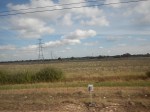
We were only in a 125 mph diesel, so we couldn’t take advantage of the 160 mph running, that the East Coast Main Line’s new signalling might allow on this section. The Wikipedia entry for the Selby Diversion, says this about the possible speeds.
The line was the first purpose-built section of high-speed railway in the UK having a design speed of 125 mph; however, research by British Rail in the 1990s indicated that the route geometry would permit up to 160 mph operation, subject to the necessary overhead line equipment and signalling upgrades. The new line also avoided the speed restriction over the swing bridge at Selby. The former ECML route, the NER’s 1871 York and Doncaster branch line, was closed from Selby northwards.
As the Selby Diversion opened in 1983, I wouldn’t be surprised that the calculations were performed on British Rail Research’s Pace 231-R, which was similar to the one I used at ICI and the pair, that NASA used calculate how to land Apollo on the moon.
When I eventually got to Huddersfield, I took these pictures.




























Note.
- In I’ve Just Glimpsed The Future Of Train Travel Across The North Of England And I Like It, there are pictures of Huddersfield station, that were taken on the 21st August, soon after the work started.
- In Huddersfield Station – 15th December 2023, there are pictures of Huddersfield before the work started.
- Much of the work seems to have been done at the Western end of the station to lengthen the platform on the Penistone Line to Sheffield.
- Platform 2 for the Penistone Line has also been renumbered Platform 1.
Work still to be carried out at Huddersfield station, includes refurbishing the roof, installing the electrification and adding a couple of new platforms.
These are my thoughts.
Which Platforms Will Be Electrified?
This OpenRailwayMap shows the proposed electrification in Huddersfield station.
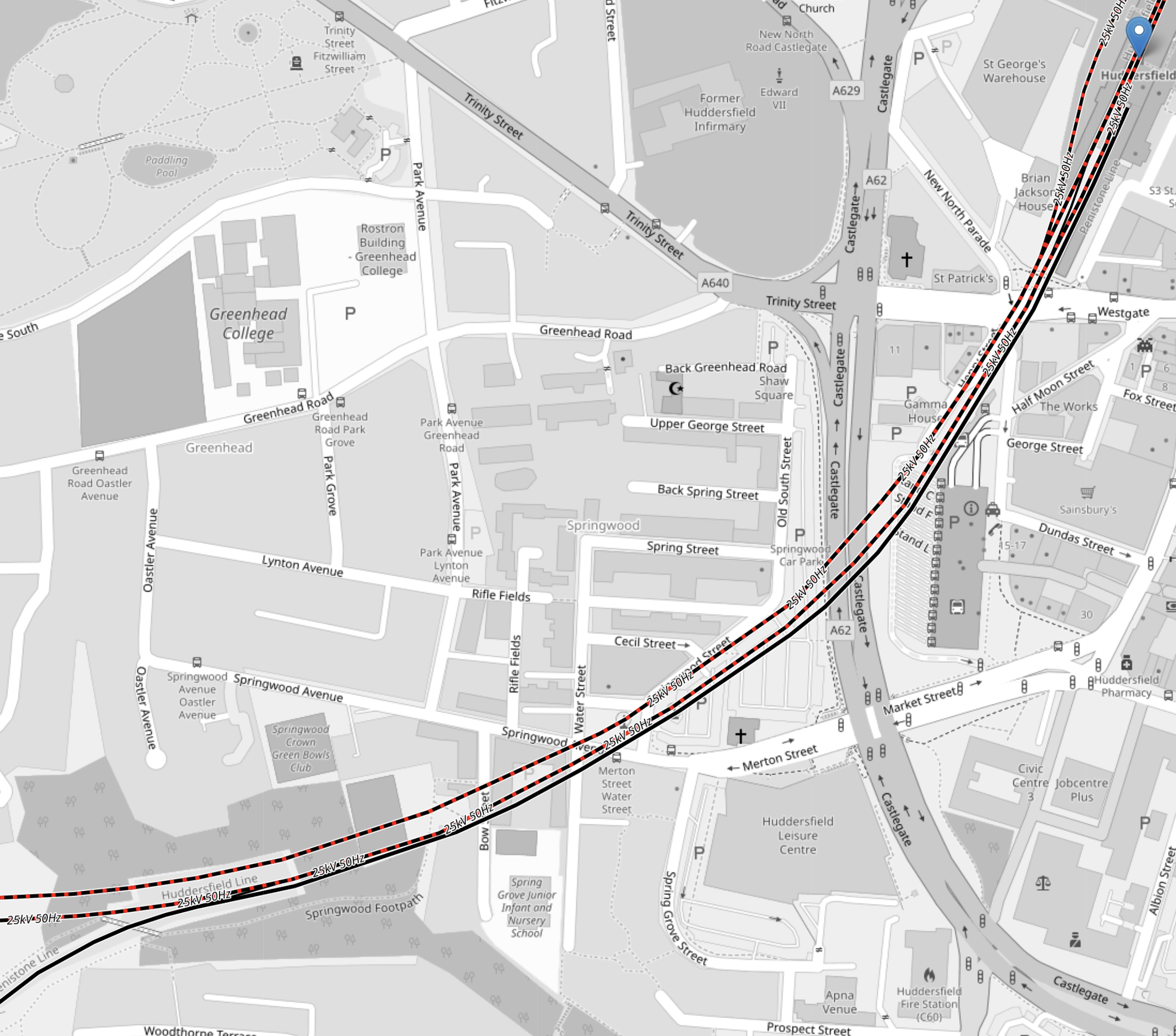
Note.
- The blue arrow in the North-East corner of the map indicates Huddersfield atation.
- The two red-and-black tracks going diagonally across the map are the Hudderfield Line.
- The red-and-black colour, indicates that the two tracks will be electrified.
- South of these two tracks, the Penistone Line sneaks into Platform 1 at Huddersfield station.
- The Penistone Line goes to Sheffield in a South-Westerly direction.
- There appears to be a crossover, so that trains from the Penistone Line can use both Platforms 1 and 2 in Huddersfield station.
- The OpenRailwayMap appears to show planned electrification between Stalybridge and Leeds stations.
- To the East of Leeds planned electrification is shown as far as Micklefield and Church Fenton stations.
Once installed, this electrification will create a complete electrified route across the Pennines from Liverpool Lime Street in the West to the East Coast Main Line in the East.
This OpenRailwayMap shows the planned electrification between Micklefield and Hull stations.

Note.
- Red tracks are electrified.
- Black tracks are not electrified.
- York is in the North-West corner of the map, with the electrified East Coast Main Line going through the station North-South.
- South of York, the East Coast Main Line now splits.
- The Western branch includes an electrified line to Micklefield station, Neville Hill depot and Leeds station.
- The Eastern Branch is the Selby Diversion, which is an electrified 160 mph line, that avoids the Selby coalfield.
- Running West-East across the map is the unlectrified Micklefield and Hull Line, which goes via Selby.
- Hull is in the South-East corner of the map.
- Hull is 42 miles from Micklefield and 36.1 miles from the Temple Hirst junction on the Selby Diversion, so it is within range of battery-electric trains, with charging at Hull station.
- Hitachi’s battery-electric Class 802 trains, used by Hull Trains and TransPennine Express, which are currently on test, should certainly be able to serve Hull.
Hull can become an electrified station, without the expense and disruption of full electrification.
How Long Is Platform 1 At Huddersfield Station?
This OpenRailwayMap shows the new Platform 1 at Huddersfield station.
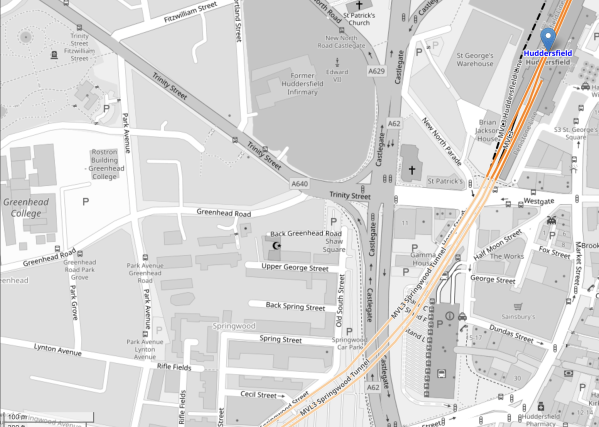
Note.
The blue arrow indicates Huddersfield station.
- The three darker orange lines indicate the two through platforms 2 and 3, and the reconfigured bay platform 1.
- There is a cross-over between platforms 1 and 2, which connects Platform 2 to the Penistone Line.
- In the South-West corner of the map is a hundred metre scale.
- Using the scale, I estimate that the length of the bay platform 1 is around 120 metres.
- In the last two rows of pictures in the gallery of this post, a three car Class 150 train is shown in Platform 1.
- A three car Class 150 train is approximately sixty metres long.
Looking at the pictures, I wouldn’t be surprised if the new platform has been designed to take two three-car Class 150 trains. It would certainly take a pair of two-car Class 150 trains.
Other trains and their lengths that might use the platform include.
- Class 170 – three-car – 70.85 metres
- Class 195 – two-car – 48.05 metres
- Class 195 – three-car – 71.40 metres
- Class 195 – 2 x two-car – 96.10 metres
- Class 810 – five-car – 120 metres
The Class 810 uses 24 metre cars, so that a pair of trains, will fit in St. Pancras. But with perhaps selective door opening could a single Class 810 train run a St. Pancras and Huddersfield service, perhaps with a split and join at Sheffield.
Electrification Across The Pennines
The TransPennine Route will be electrified between Liverpool Lime Street and Micklefield stations, once the current works between Huddersfield and Leeds are complete.
Sections without electrification include.
- Bradford Interchange and Doncaster – 52.1 miles
- Cleethorpes and Doncaster – 52.1 miles
- Harrogate and Leeds – 18.3 miles
- Hazel Grove and Doncaster – 52.6 miles
- Hull and Micklefield – 42 miles
- Hull and Temple Hirst junction – 36.1 miles
- Saltburn and Northallerton – 28.1 miles
- Sunderland and Northallerton – 46.8 miles
- Scarborough and York – 42.1 miles
I expect that Hitachi trains with batteries or CAF’s tri-mode trains will be able to handle these routes in a low-carbon manner.
Electrification Between Stalybridge And Huddersfield
This section is shown as being electrified on OpenRailwayMap.
But as it is only 18 miles and includes the Standedge Tunnels will the route use battery-electric trains?
Should New Stations Be Shown On Google Maps With Opening Dates?
I recently posted a comment on The Times recently, where I suggested a guy was opening one of his coffee shops in a town, that was getting a new railway station.
Another, who commented, suggested that I look at Google Maps to see their relative positions.
The coffee shop was shown, but the station wasn’t.
Surely, once the position of the station is known, it should be marked on Google Maps with an opening date, as this could help people take important decisions about their life.
Blyth Bebside station on the new Northumberland Line between Newcastle and Ashington is already shown with the familiar logo, despite not opening until the 19th of October.
The other two unopened stations on the line, which are Northumberland Park and Bedlington, are going to open next year, are also shown with familiar logos, but no opening date.
Someone in Network Rail, needs to be given the responsibility to make sure that details like this are correct.
In the case of Blyth Bebside station, I can see two different captions indicating the station on Google Maps.
- Before October 19th 2025 – Blyth Bebside – Opens 19th Octopber 2025.
- After October 19th 2025 – Blyth Bebside – Opened 19th Octopber 2025.
Detailed labeling may even help deliveries during construction.
Where Have The Special Characters Gone In WordPress?
I have just written Ørsted In Talks To Sell Half Of Huge UK Wind Farm To Apollo, where of necessity I have used Ørsted more than a few times.
There used to be an omega character in WordPress, that you used to access the special characters, but it seems to have disappeared.
Does anybody know where it’s gone?
TIA!
How Will The UK Power All These Proposed Data Centres?
On Wednesday, a cardiologist friend asked me if we have enough power to do Trump’s UK AI, so I felt this post might be a good idea.
Artificial Intelligence Gave This Answer
I first asked Google AI, the title of this post and received this reply.
The UK will power proposed data centres using a mix of grid-supplied low-carbon electricity from sources like offshore wind and through on-site renewable generation, such as rooftop solar panels. Data centre operators are also exploring behind-the-meter options, including battery storage and potential future nuclear power, to meet their significant and growing energy demands. However, the UK’s grid infrastructure and high energy prices present challenges, with industry calls for grid reform and inclusion in energy-intensive industry support schemes to facilitate sustainable growth.
Google also pointed me at the article on the BBC, which is entitled Data Centres To Be Expanded Across UK As Concerns Mount.
This is the sub-heading.
The number of data centres in the UK is set to increase by almost a fifth, according to figures shared with BBC News.
These are the first three paragraphs.
Data centres are giant warehouses full of powerful computers used to run digital services from movie streaming to online banking – there are currently an estimated 477 of them in the UK.
Construction researchers Barbour ABI have analysed planning documents and say that number is set to jump by almost 100, as the growth in artificial intelligence (AI) increases the need for processing power.
The majority are due to be built in the next five years. However, there are concerns about the huge amount of energy and water the new data centres will consume.
Where Are The Data Centres To Be Built?
The BBC article gives this summary of the locations.
More than half of the new data centres would be in London and neighbouring counties.
Many are privately funded by US tech giants such as Google and Microsoft and major investment firms.
A further nine are planned in Wales, one in Scotland, five in Greater Manchester and a handful in other parts of the UK, the data shows.
While the new data centres are mostly due for completion by 2030, the biggest single one planned would come later – a £10bn AI data centre in Blyth, near Newcastle, for the American private investment and wealth management company Blackstone Group.
It would involve building 10 giant buildings covering 540,000 square metres – the size of several large shopping centres – on the site of the former Blyth Power Station.
Work is set to begin in 2031 and last for more than three years.
Microsoft is planning four new data centres in the UK at a total cost of £330m, with an estimated completion between 2027 and 2029 – two in the Leeds area, one near Newport in Wales, and a five-storey site in Acton, north-west London.
And Google is building a data centre in Hertfordshire, an investment worth £740m, which it says will use air to cool its servers rather than water.
There is a map of the UK, with dots showing data centres everywhere.
One will certainly be coming to a suitable space near you.
Concerns Over Energy Needs
These three paragraphs from the BBC article, talk about the concerns about energy needs.
According to the National Energy System Operator, NESO, the projected growth of data centres in Great Britain could “add up to 71 TWh of electricity demand” in the next 25 years, which it says redoubles the need for clean power – such as offshore wind.
Bruce Owen, regional president of data centre operator Equinix, said the UK’s high energy costs, as well as concerns around lengthy planning processes, were prompting some operators to consider building elsewhere.
“If I want to build a new data centre here within the UK, we’re talking five to seven years before I even have planning permission or access to power in order to do that,” he told BBC Radio 4’s Today programme.
But in Renewable Power By 2030 In The UK, I calculated that by 2030 we will add these yearly additions of offshore wind power.
- 2025 – 1,235 MW
- 2026 – 4,807 MW
- 2027 – 5,350 MW
- 2028 – 4,998 MW
- 2029 – 9,631 MW
- 2030 – 15,263 MW
Note.
- I have used pessimistic dates.
- There are likely to be more announcements of offshore wind power in the sea around the UK, in the coming months.
- As an example in Cerulean Winds Submits 1 GW Aspen Offshore Wind Project In Scotland (UK), I talk about 3 GW of offshore wind, that is not included in my yearly totals.
- The yearly totals add up to a total of 58,897 MW.
For solar power, I just asked Google AI and received this answer.
The UK government aims to have between 45 and 47 gigawatts (GW) of solar power capacity by 2030. This goal is set out in the Solar Roadmap and aims to reduce energy bills and support the UK’s clean power objectives. The roadmap includes measures like installing solar on new homes and buildings, exploring solar carports, and improving access to rooftop solar for renters.
Let’s assume that we only achieve the lowest value of 45 GW.
But that will still give us at least 100 GW of renewable zero-carbon power.
What will happen if the wind doesn’t blow and the sun doesn’t shine?
I have also written about nuclear developments, that were announced during Trump’s visit.
- Centrica And X-energy Agree To Deploy UK’s First Advanced Modular Reactors
- Is Last Energy The Artemis Of Energy?
- National Grid And Emerald AI Announce Strategic Partnership To Demonstrate AI Power Flexibility In The UK
- Nuclear Plan For Decommissioned Coal Power Station
- Raft Of US-UK Nuclear Deals Ahead Of Trump Visit
- Rolls-Royce Welcomes Action From UK And US Governments To Usher In New ‘Golden Age’ Of Nuclear Energy
This is an impressive array of nuclear power, that should be able to fill in most of the weather-induced gaps.
In Renewable Power By 2030 In The UK, I also summarise energy storage.
For pumped storage hydro, I asked Google AI and received this answer.
The UK’s pumped storage hydro (PSH) capacity is projected to more than double by 2030, with six projects in Scotland, including Coire Glas and Cruachan 2, potentially increasing capacity to around 7.7 GW from the current approximately 3 GW. This would be a significant step towards meeting the National Grid’s required 13 GW of new energy storage by 2030, though achieving this depends on policy support and investment.
There will also be smaller lithium-ion batteries and long duration energy storage from companies like Highview Power.
But I believe there will be another source of energy that will ensure that the UK achieves energy security.
SSE’s Next Generation Power Stations
So far two of these power stations have been proposed.
Note.
- Both power stations are being designed so they can run on natural gas, 100 % hydrogen or a blend of natural gas and hydrogen.
- Keadby will share a site with three natural gas-powered power stations and be connected to the hydrogen storage at Aldbrough, so both fuels will be available.
- Ferrybridge will be the first gas/hydrogen power station on the Ferrybridge site and will have its own natural gas connection.
- How Ferrybridge will receive hydrogen has still to be decided.
- In Hydrogen Milestone: UK’s First Hydrogen-to-Power Trial At Brigg Energy Park, I describe how Centrica tested Brigg gas-fired power station on a hydrogen blend.
- The power stations will initially run on natural gas and then gradually switch over to lower carbon fuels, once delivery of the hydrogen has been solved for each site.
On Thursday, I went to see SSE’s consultation at Knottingley for the Ferrybridge power station, which I wrote about in Visiting The Consultation For Ferrybridge Next Generation Power Station At Knottingley.
In the related post, I proposed using special trains to deliver the hydrogen from where it is produced to where it is needed.
Could HiiROC Be Used At Ferrybridge?
Consider.
- HiiROC use a process called thermal plasma electrolysis to split any hydrocarbon gas into hydrogen and carbon black.
- Typical input gases are chemical plant off gas, biomethane and natural gas.
- Carbon black has uses in manufacturing and agriculture.
- HiiROC uses less energy than traditional electrolysis.
- There is an independent power source at Ferrybridge from burning waste, which could be used to ower a HiiROC system to generate the hydrogen.
It might be possible to not have a separate hydrogen feed and still get worthwhile carbon emission savings.
Conclusion
I believe we will have enough electricity to power all the data centres, that will be built in the next few years in the UK.
Some of the new power stations, that are proposed to be built, like some of the SMRs and SSE’s Next Generation power stations could even be co-located with data centres or other high energy users.
In Nuclear Plan For Decommissioned Coal Power Station, I describe how at the former site of Cottam coal-fired power station, it is proposed that two Holtec SMR-300 SMRs will be installed to power advanced data centres. If the locals are objecting to nuclear stations, I’m sure that an SSE Next Generation power station, that was burning clean hydrogen, would be more acceptable.
 The Anonymous Widower