A Massive Task For Ukraine?
After the Russians are thrown out of Ukraine, it will be a massive task to rebuild Ukraine.
But one of Ukraine’s traditional industries can also be used to transform the world.
The Transformation Of Energy Production To Floating Offshore Wind
I believe that over the next few years, we will see an enormous transformation of zero-carbon energy to floating offshore wind.
- The floating offshore wind industry is planning to use the next-generation of larger wind turbines of up to 20 MW.
- These turbines are too large and intrusive to install onshore.
- Floating wind turbines generally have a higher capacity factor of over 50 %, than onshore turbines.
- Each wind turbine will be mounted on a substantial semi-submersible float, which is built out of large-diameter steel tubes
- The wind turbines are of the same design, as those installed onshore.
- There are several designs for the floats and they are usually based on designs that have worked in the oil and gas industry.
The world will need millions of floating turbines and an equivalent number of floats to fully decarbonise.
Could The Ukrainians Build The Floats?
Consider.
- The Russians have destroyed Mariupol, whilst the Ukrainians have defended the city in the steelworks.
- Mariupol used to have a large shipbuilding industry.
- Ukraine is in the world’s top ten of iron ore producers.
- There is a lot of scrap steel available in the Ukraine, that the Russians have left behind.
- The Ukrainians probably have a lot of workers, who have the skills to build the floats.
I’m sure something could be arranged for the benefit of everybody.
Two More Floating Wind Projects In The Celtic Sea
In Two Celtic Sea Floating Wind Projects Could Be Delivered By 2028, I said this.
There now appears to be four floating wind farms under development in the Celtic Sea between the South-West corner of Wales and the Devon and Cornwall Peninsular.
- Blue Gem Wind – Erebus – 100 MW Demonstration project – 27 miles offshore
- Blue Gem Wind – Valorus – 300 MW Early-Commercial project – 31 miles offshore
- Falck Renewables and BlueFloat Energy – Petroc – 300 MW project – 37 miles offshore
- Falck Renewables and BlueFloat Energy Llywelyn – 300 MW project – 40 miles offshore
But they do create a starter for a GW.
Last night, I found two other projects being developed in the Celtic Sea, under the collective name of the Llŷr Project.
The sponsoring company, which appears to be called Llŷr Wind has a web site, with a title of Harnessing Welsh Energy, which has this outline description underneath.
Situated off the Pembrokeshire coast, in southwest Wales, is a flagship project that could transform the world’s ability to generate renewable electricity from wind. The Llŷr projects are exploring the potential of two innovative floating offshore wind technologies.
The next statement is key.
Combined, the two 100MW projects will generate enough renewable electricity to power around 250,000 homes. If successful, we will be able to offer highly cost-effective, floating offshore wind farms to the rest of the world by 2030.
The Llŷr Project would appear to be a research project to find the best way to generate electricity using floating wind turbines in deep water.
- It appears that the two wind farms will use different floats for the turbines.
- The Llŷr projects are located in the approaches to the Bristol Channel in the Celtic Sea approximately 40 kilometres offshore at depths averaging 60-70 metres.
- These offshore sites enjoy high average windspeeds which are, typically, in excess of 10 metres per second. That is over twenty miles per hour.
- Each 100MW project will comprise 6 to 8 next-generation turbines which are too large to be deployed on land.
- 6 x 20 MW turbines will be 120 MW.
- 8 x 12 MW turbines will be 96 MW.
- Each project will have an offshore substation.
- There will be up to two connections for each substation.
- Will the Llŷr Projects test manufacturers’ new turbine designs?
- It is hoped that installation of the turbines will start in 2025/26, with power being delivered in 2026/7.
- The project is being developed by Floventis Energy, which is a joint venture of SBM Offshore and Cierco.
It does look to me that SBM Offshore, who are a Dutch company, are using their extensive oil and gas experience to develop floating offshore wind.
This appears to be a very well-thought out research project in a location, where there is everything needed.
- Lots of wind, which can be boosted by dragons if needed.
- Deep water.
- Ports for assembly of turbines onto floats.
- Steelworks and fabrication.
- Good electrical connections to the National Grid.
- Excellent universities.
- Good transport connections.
- An experienced engineering workforce.
There is also the ultimate potential of 50 GW of floating offshore wind in the Celtic Sea.
Conclusion
The Llŷr Project could have a very positive input into the worldwide development of floating offshore wind.
I have read the web sites of Floventis, SBM Offshore and Cierco and these companies appear to be aiming to dominate the floating offshore wind industry.
Their strategy is stated on the Floventis web site.
Our strategy is simple. We plan to maximize the local benefits of our projects and minimize their impact. Our technologies are far more benign than conventional offshore wind and more suited for deployment in remote and sensitive environments.
Already driving demonstration projects in California and the UK, Floventis is building a portfolio of projects to take floating offshore wind, through a stepwise process – increasing project size, to full scale commercial development proposals by 2030.
We believe that the floating offshore wind industry is a model for a “just transition” to clean energy, at scale, which will reward communities, in the broadest sense, with skilled jobs and enhanced social equity.
I can certainly live with that! And I’m certain the world can too!
Consortium Plan To Build & Operate Scotland’s First Low Carbon, Energy Efficient, Soil-Free Vertical Farms In The Central Belt
The title of this post, is the same as that of this press release from RheEnergise.
These four paragraphs introduce the project.
A consortium of four British companies have earmarked a series of sites between Dumbarton and Dundee for the locations of Scotland’s next generation of hectare+ scale vertical farms, powered by 100% Scottish renewables. These farms would provide locally produced fresh foods (salads and fruits) to over 60% of the Scottish population.
The vertical farms will help meet the Scottish Government’s ambitions to produce more homegrown fruit and vegetables. Each vertical farm would be powered by locally produced renewable energy.
Next generation vertical farms use advanced soil-free growing techniques and stack crops in specially designed beds and trays. They minimise water, fertiliser and pesticide use which is highly beneficial to the environment and make use of artificial lighting and climate control to get the desired results.
The V-FAST consortium comprises UK Urban AgriTech (UKUAT), Vertegrow Ltd, Light Science Technologies Ltd and RheEnergise Limited, the UK energy storage company.
The press release is certainly worth a detailed read.
An Interview With Stephen Crosher, CEO Of RheEnergise
The title of this post, is the same as that of this article on UK Investor.
As the title says, Stephen Crosher is the CEO of RheEnergise, who are an innovative energy storage company.
The article is very much a must-read and an interesting insight into RheEnergise.
Highview Chief Rupert Pearce On The Cold Batteries That Could Save The Planet
The title of this post, is the same as that of this article on The Sunday Times.
It is an article very much worth a read, as it talks about former Inmarsat boss; Rupert Pearce and his new position as boss at Highview Power.
I have followed Highview Power for a few years.
I first wrote about the company in British Start-Up Beats World To Holy Grail Of Cheap Energy Storage For Wind And Solar, after reading about the company in the Daily Telegraph in August 2019.
They seem to have had good press in the last three years and have generated a steady stream of orders from Spain, Chile and Scotland.
But progress seems to have been slow to get the first full-size system at Carrington completed.
It does seem , that Rupert Pearce could be the professional boss they need?
Highview Power ‘s CRYOBatteries certainly have potential.
Highview Power CRYOBatteries Compared To Lithium-Ion Batteries
Highview Power ‘s CRYOBatteries do not use any exotic metals or materials, that are not readily available, whereas lithium-ion batteries use lots of rare metals and electricity in their manufacture.
CRYOBatteries can also be expanded in capacity by just adding more liquid-air tanks.
Highview Power CRYOBatteries Typically Cost £500 Million
This figure is disclosed in the Sunday Times article.
For that you probably get a power station, with these characteristics.
- 50 MW Output.
- Five to eight hour storage.
- No emissions.
- Well-understood maintenance.
- An environmentally-friendly plant.
- Long battery life.
But my experience tells me, that like large lithium-ion batteries used for grid storage, that CRYOBatteries could be an asset that will appeal to large financial companies.
- At present, Highview Power have not run a 50 MW CRYOBattery, but once they show high reliability, I can envisage the energy storage funds taking a good look.
- At £500 million a throw, they are a good size with probably a decent return for insurance companies and pension funds.
See World’s Largest Wind Farm Attracts Huge Backing From Insurance Giant for Aviva’s view on investing in massive green infrastructure.
I very much feel, that with his City connections and experience, that Rupert Pearce might be the right person to arrange financing for CRYOBatteries.
I will add a story from the financing of Artemis, which was the project management system, that I wrote in the 1970s.
Normally we leased or rented the systems, but some companies wanted to buy them outright, so we came up with a price of something like £125,000. Our bank were happy to fund these systems, when the purchaser was someone like BP, Shell, Bechtel, Brown & Root or British Aerospace. Later on, the bank would package together several systems and get us a better deal.
Intriguingly, £125,000 in the late 1970s is about half a billion now. I suspect, I’m being naive to suggest that Highview’s problem of funding multiple sales is similar to the one we had fifty years ago.
Highview Power CRYOBatteries And Wind And Solar Farms
I discussed the use of CRYOBatteries with solar power in The Power Of Solar With A Large Battery.
As the Highview Power press release, on which I based the article has now been deleted, I would assume that that project has fallen through. But the principles still apply!
But surely, a wind farm paired with an appropriately-sized CRYOBattery would ensure a steady supply of power?
Could CRYOBatteries Be Used With Floating Offshore Wind Farms?
In ScotWind N3 Offshore Wind Farm, I described an unusual wind farm proposed by Magnora ASA.
- This page on their web site outlines their project.
- It will be technology agnostic, with 15MW turbines and a total capacity of 500MW
- It will use floating offshore wind with a concrete floater
- It is estimated, that it will have a capacity factor of 56 %.
- The water depth will be an astonishing 106-125m
- The construction and operation will use local facilities at Stornoway and Kishorn Ports.
- The floater will have local and Scottish content.
The floater will be key to the whole wind farm.
- It will certainly have an offshore substation to connect the wind turbines to the cable to the shore.
- Magnora may be proposing to add a hydrogen electrolyser.
- Tanks within the concrete floater can be used to store gases.
I wonder if CRYOBatteries could be installed on the concrete floaters, that would be used to smooth the electrical output of the wind farm?
Note that in the past, concrete semi-submersible concrete structures have been used to host all kinds of gas and oil processing equipment.
Conclusion
I feel that Highview Power have made a good choice of Chief Executive and I have high hopes he can awaken a company with masses of potential.
Two Celtic Sea Floating Wind Projects Could Be Delivered By 2028
The title of this post, is the same as that of this article on offshoreWIND.biz.
This is the first paragraph.
Falck Renewables and BlueFloat Energy have said that they are looking at early delivery of their two floating wind projects in the Celtic Sea, called Llywelyn and Petroc, which have grid connections secured and almost a year’s worth of bird surveys already completed.
These would add two extra 300 MW wind farms to the Celtic Sea.
In Enter The Dragon, I indicated the potential of renewable energy around Wales based on this article on the Engineer is entitled Unlocking The Renewables Potential Of The Celtic Sea. This sentence from the article talks about the possibilities of offshore wind in the Celtic Sea.
The Celtic Sea – which extends south off Wales and Ireland down past Cornwall and Brittany to the edge of the continental shelf – is estimated to have around 50GW of wind generating capacity alone.
The article also talks about Blue Gem Wind and their Erebus and Valorous wind farm projects in the Celtic Sea, that I wrote about in Blue Gem Wind.
There now appears to be four floating wind farms under development in the Celtic Sea between the South-West corner of Wales and the Devon and Cornwall Peninsular.
- Blue Gem Wind – Erebus – 100 MW Demonstration project – 27 miles offshore
- Blue Gem Wind – Valorus – 300 MW Early-Commercial project – 31 miles offshore
- Falck Renewables and BlueFloat Energy – Petroc – 300 MW project – 37 miles offshore
- Falck Renewables and BlueFloat Energy Llywelyn – 300 MW project – 40 miles offshore
But they do create a starter for a GW.
Both consortia seem to have similar objectives.
- To use a stepping-stone approach, gradually building in size.
- To involve the local community in creating a supply chain.
- Create long-term benefits for the region.
If these and other consortia fill the Celtic Sea with 50 GW of floating wind turbines, then we’ll all benefit.
How Britannia With Help From Her Friends Can Rule The Waves And The Wind
The Government doesn’t seem to have published its future energy plans yet, but that hasn’t stopped the BBC speculating in this article on their web site, which is entitled Energy Strategy: UK Plans Eight New Nuclear Reactors To Boost Production.
These are the first two paragraphs.
Up to eight more nuclear reactors could be delivered on existing sites as part of the UK’s new energy strategy.
The plan, which aims to boost UK energy independence and tackle rising prices, also includes plans to increase wind, hydrogen and solar production.
Other points include.
- Up to 95% of the UK’s electricity could come from low-carbon sources by 2030.
- 50 gigawatts (GW) of energy through offshore wind farms, which would be more than enough to power every home in the UK.
- One of the big points of contention is thought to have been the construction of onshore wind turbines.
- Targets for hydrogen production are being doubled to help provide cleaner energy for industry as well as for power, transport and potentially heating.
- A new licensing round for North Sea oil and gas projects.
- A heat pump accelerator program.
In this post I shall only be looking at one technology – offshore wind and in particular offshore floating wind.
Who Are Our Friends?
I will start with explaining, who I see as our friends, in the title of this post.
The Seas Around Us
If we are talking about offshore winds around the the UK, then the seas around the UK are surely our biggest and most-needed friend.
The Island Of Ireland
The seas are shared with the island of Ireland and the UK and the Republic must work together to maximise our joint opportunities.
As some of the largest offshore wind farm proposals, between Wales and Ireland involve a Welsh company called Blue Gem Wind, who are a partnership between Irish company; Simply Blue Energy, and French company; TotalEnergies, we already seem to be working with the Irish and the French.
The City Of London
Large insurance and pension companies, based in the City of London like, abrdn, Aviva, L & G and others are always looking for investments with which to provide income to back their insurance business and our pensions.
In World’s Largest Wind Farm Attracts Huge Backing From Insurance Giant, I describe why and how, Aviva back wind farms.
Germany
Germany are certainly on our side, despite being in a mess of Mutti Merkel’s making, because she got the country too deeply dependant on Vlad the Mad’s tainted gas.
- German utilities are providing finance to build wind farms in British waters.
- German company; Siemens is manufacturing turbine blades in Hull.
- Germany wouldn’t mind buying any electricity and hydrogen we have spare. Especially, as we haven’t invaded them since 1944.
I suspect a mutually-beneficial relationship can be negotiated.
Norway
I have customised software for a number of countries, including Iran, Saudi Arabia, South Korea and the United States and despite selling large numbers of systems to Norway, the Norwegians never requested any modifications.
They are generally easy-going people and they are great friends of the UK. They were certainly a fertile country for the sale of Artemis systems.
Just as the UK worked together with the Norwegians to deliver North Sea Oil, we are now starting to work together to develop renewable energy in the North Sea.
In UK To Norway Sub-Sea Green Power Cable Operational, I describe how we have built the North Sea Link with the Norwegians, which will link the British and Norwegian energy networks to our mutual benefit.
In Is This The World’s Most Ambitious Green Energy Solution?, I describe an ambitious plan called Northern Horizons, proposed by Norwegian company; Aker Solutions to build a 10 GW floating wind farm, which will be 120 km to the North-East of the Shetlands.
Floating Wind Turbines
This is the introduction of the Wikipedia entry for floating wind turbines.
A floating wind turbine is an offshore wind turbine mounted on a floating structure that allows the turbine to generate electricity in water depths where fixed-foundation turbines are not feasible. Floating wind farms have the potential to significantly increase the sea area available for offshore wind farms, especially in countries with limited shallow waters, such as Japan, France and US West coast. Locating wind farms further offshore can also reduce visual pollution, provide better accommodation for fishing and shipping lanes, and reach stronger and more consistent winds.
At its simplest a floating wind farm consists of a semi-submersible platform, which is securely anchored to the sea-bed to provide a firm platform on which to erect a standard wind turbine.
There are currently two operational floating wind farms off the East Coast of Scotland and one in the Atlantic off the Portuguese coast.
- These wind farms are fairly small and use between three and five turbines to generate between 25-50 MW.
- The largest current floating turbines are the 9.5 MW turbines in the Kincardine Wind Farm in Scotland, but already engineers are talking of 14 MW and 20 MW floating turbines.
- Experience of the operation of floating wind turbines, indicates that they can have capacity factors in excess of 50 %.
- Floating wind turbines can be erected on their floats in the safety of a port using a dockside crane and then towed into position.
- Floating wind turbines can be towed into a suitable port for servicing and upgrading.
Many serious engineers and economists, think that floating wind farms are the future.
The Energy Density of Fixed Foundation And Floating Wind Farms
In ScotWind Offshore Wind Leasing Delivers Major Boost To Scotland’s Net Zero Aspirations, I summarised the latest round of Scotwind offshore wind leases.
- Six new fixed foundation wind farms will give a capacity of 9.7 GW in 3042 km² or about 3.2 MW per km².
- Ten new floating wind farms will give a capacity of 14.6 GW in 4193 km² or about 3.5 MW per km².
Note.
- Floating wind farms have a small advantage in terms of energy density over those with fixed foundations.
- Suppose these energy densities are achieved using 14 MW turbines.
- Engineers are talking of 20 MW turbines.
- Using large turbines could increase the energy density by 20/14 or 43 %
We could see in a few years with 20 MW turbines, fixed foundation turbines having an energy density of 4.6 MW per km², with floating turbines having 5 MW per km².
The Potential Of A Ten-Mile Square In The Seas Around Us
I will assume.
- It is at least 100 km from land.
- The water would be at least 100 metres deep.
- There are no structures in the area.
And calculate.
- The area will be a hundred square miles, which is smaller than the county of Rutland.
- This will be 259 square kilometres.
If it were to be filled with floating wind turbines at a density of 5 MW per km², the capacity would be 1300 MW or 1.3 GW.
There must be hundreds of empty ten-mile squares in the seas around us.
Offshore Hydrogen Production And Storage
I believe in the near future, that a lot of offshore wind energy will be converted to hydrogen offshore.
- Electrolysers could be combined with wind turbines.
- Larger electrolysers could be combined with sub-stations collecting the electricity.
- In Torvex Energy, I discuss a method to create hydrogen from seawater, without having to desalinate the water. Surely, this technology would be ideal for offshore electrolysis.
Hydrogen would be brought to shore using pipelines, some of which could be repurposed from existing gas pipelines, that are now redundant, as the gas-fields they served have no gas left.
I also suspect that hydrogen could be stored in a handy depleted gas field or perhaps some form of specialist storage infrastructure.
Combining Wind And Wave Power In A Single Device
Marine Power Systems are a Welsh company, that has developed a semi-submersible structure, that can support a large wind turbine and/or a wave-power generator.
This is the mission statement on their home page.
Marine Power Systems is revolutionising the way in which we harvest energy from the world’s oceans.
Our flexible technology is the only solution of its type that can be configured to harness wind and wave energy, either as a combined solution or on their own, in deep water. Built on common platform our devices deliver both cost efficiency and performance throughout the entire product lifecycle.
Our structurally efficient floating platform, PelaFlex, brings excellent stability and straightforward deployment and maintenance. The PelaGen wave energy converter represents market-leading technology and generates energy at an extremely competitive cost of energy.
Through optimised farm layout and the combination of wind and wave energy, project developers can best exploit the energy resource for any given area of seabed.
We are unlocking the power of oceans.
There is a link on the page to more pages, that explain the technology.
It looks to me, that it is well-designed technology, that has a high-chance of being successful.
It should also be noted that according to this news page on the Marine Power Systems web site, which is entitled MPS Lands £3.5M Of Funding From UK Government, the UK government feel the technology is worth backing.
I certainly believe that if Marine Power Systems are not successful, then someone else will build on their original work.
If wind and wave power can successfully be paired in a single float, then this must surely increase the energy production at each float/turbine in the floating wind farm.
Energy Storage In Wind Turbines
The output of wind farms can be very variable, as the wind huffs and puffs, but I believe we will see energy storage in wind turbines to moderate the electricity and deliver a steadier output.
Using lithium-ion or other batteries may be possible, but with floating offshore turbines, there might be scope to use the deep sea beneath the float and the turbine.
Hybrid Wind Farms
In the latest round of Scotwind offshore wind leases, one wind farm stands out as different. Magnora ASA’s ScotWind N3 Offshore Wind Farm is described as a floating offshore wind farm with a concrete floater.
I can see more wind farms built using this model, where there is another fixed or floating platform acts as control centre, sub-station, energy store or hydrogen electrolyser.
How Much Electricity Could Be Produced In UK And Irish Waters?
I will use the following assumptions.
- Much of the new capacity will be floating wind turbines in deep water.
- The floating wind turbines are at a density of around 5 MW per km²
This Google Map shows the British Isles.
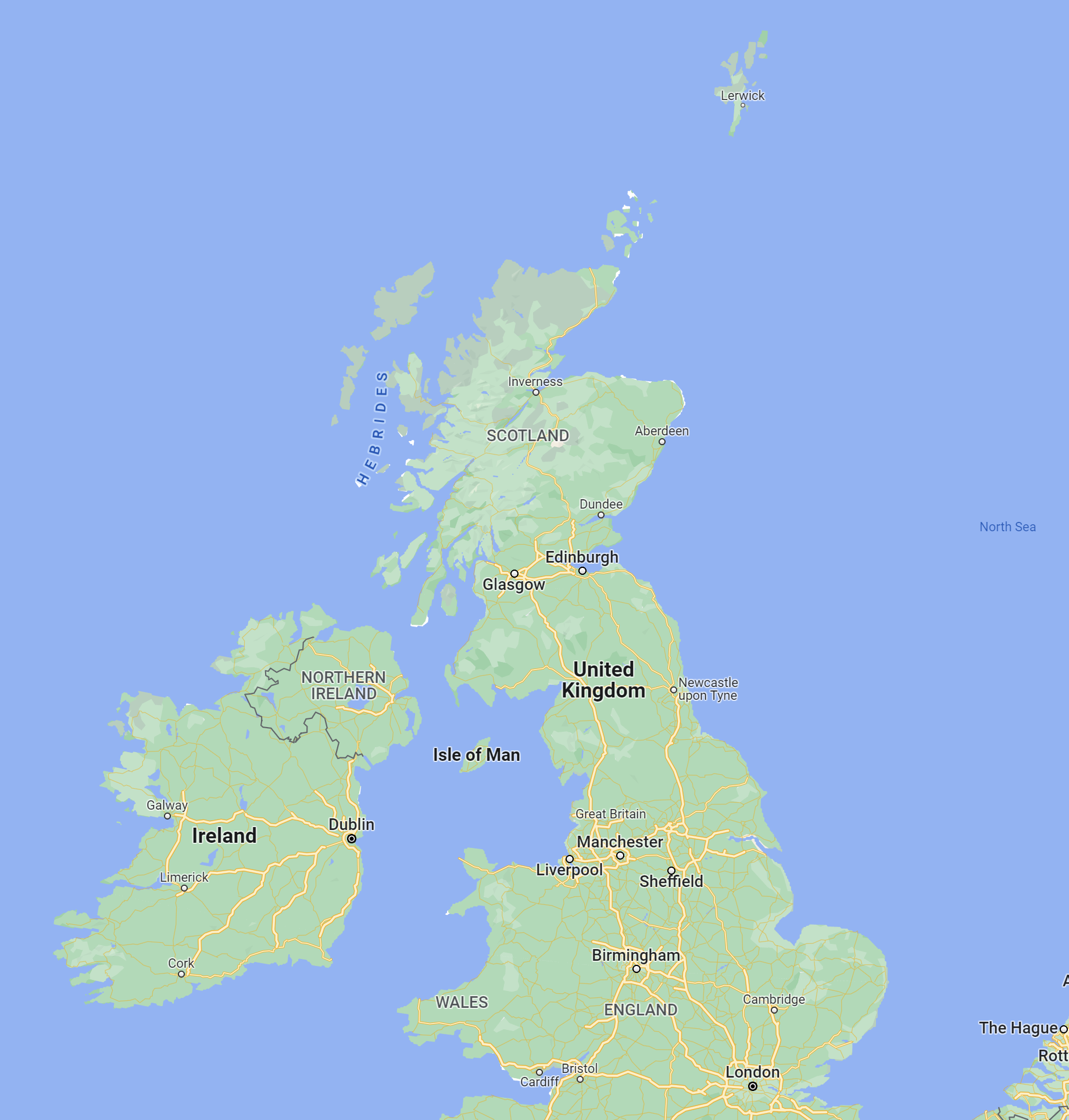
I will look at various seas.
The Celtic Sea
The Celtic Sea is to the South-West of Wales and the South of Ireland.
In Blue Gem Wind, I posted this extract from the The Our Projects page of the Blue Gem Wind web site.
Floating wind is set to become a key technology in the fight against climate change with over 80% of the worlds wind resource in water deeper than 60 metres. Independent studies have suggested there could be as much as 50GW of electricity capacity available in the Celtic Sea waters of the UK and Ireland. This renewable energy resource could play a key role in the UK meeting the 2050 Net-Zero target required to mitigate climate change. Floating wind will provide new low carbon supply chain opportunities, support coastal communities and create long-term benefits for the region.
Consider.
- The key figure would appear 50 GW of electricity capacity available in the Celtic Sea waters of the UK and Ireland.
- Earlier I said that floating turbines can have a wind turbine density of 5 MW per km².
- According to Wikipedia, the surface area of the Celtic Sea is 300,000 km².
To accommodate enough floating turbines to generate 50 GW would need 10000 km², which is a 100 km. square, or 3.33 % of the area of the Celtic Sea.
This wind generation capacity of 50 GW would appear to be feasible in the Celtic Sea and still leave plenty of space for the shipping.
The Irish Sea
According to Wikipedia, the surface area of the Irish Sea is 46,000 km².
Currently, there are ten wind farms in the Irish Sea.
- Six are in English waters, three are in Welsh and one is in Irish.
- None are more than sixteen kilometres from the coast.
The total power is 2.7 GW.
I feel that the maximum number of wind farms in the Irish Sea would not cover more than the 3.33 % proposed for the Celtic Sea.
3.33 % of the Irish Sea would be 1532 km², which could support 7.6 GW of wind-generated electricity.
I can’t leave the Irish Sea without talking about two wind farms Mona and Morgan, that are being developed by an enBW and BP joint venture, which I discussed in Mona, Morgan And Morven. This infographic from the joint venture describes Mona and Morgan.

That would appear to be a 3 GW development underway in the Irish Sea.
Off The Coast Of South-East England, East Anglia, Lincolnshire And Yorkshire
These wind farms are proposed in these areas.
- Hornsea – 6 GW
- Triton Knoll – 900 MW
- Dogger Bank – 3.6 GW
- Norfolk Boreas – 1.8 GW
- Norfolk Vanguard – 1.8 GW
- East Anglia Array – 7.2 GW
- Rampion Extension – 1.2 GW
Note.
All wind farms have comprehensive web sites or Wikipedia entries.
The total capacity of these wind farms is 22.5 GW
The North Sea
According to Wikipedia, the surface area of the North Sea is 570,000 km².
Would it is reasonable to assume, that perhaps a tenth of this area would be available for new wind farms in UK waters?
3.33 % of the available North Sea would be 1898 km², which could support 9.5 GW of wind-generated electricity.
On The East Coast Of Scotland
In Wind Farms On The East Coast Of Scotland, I summarised the wind farms off the East coast of Scotland, that are being built in a cluster in the First of Forth.
This map shows the proposed wind farms in this area.
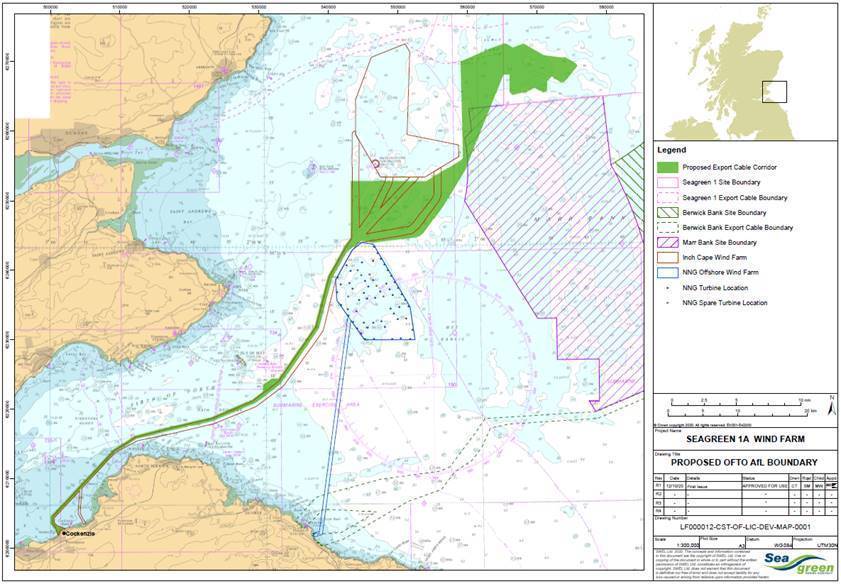
There are five wind farms in the map.
- The green area is the cable corridor for Seagreen 1a
- Inch Cape is the odd-shaped wind farm to the North and West of the green area
- Seagreen at the top of the map, to the North of Inch Cape.
- Marr Bank with the pink NE-SW hatching
- Berwick Bank with the green NW-SE hatching
- Neart Na Gaoithe is edged in blue to the South of the green area.
Berwick Bank and Marr Bank are both owned by SSE and appear to have been combined.
The capacity of the wind farms can be summarised as follows.
- Seagreen – 1075 MW
- Neart Na Gaoithe – 450 MW
- Inch Cape – 1000 MW
- Berwick Bank and Marr Bank – 4100 MW
This gives a total of 6625 MW or just over 6.6 GW.
Around The North Of Scotland
This map shows the latest successful ScotWind leases.

Note.
- Several of these proposed wind farms have detailed web sites.
These seventeen leases total up to 24.3 GW.
An Interim Total
I believe these figures are realisable.
- Celtic Sea – 50 GW
- Irish Sea – 7.6 GW – 3 GW already underway
- South East England, East Anglia, Lincolnshire And Yorkshire – 22.5 GW
- North Sea – 9.5 GW
- On The East Coast Of Scotland – 6.6 GW
- Around The North Of Scotland – 24.3 GW
Note.
- I have tried to be as pessimistic as possible.
- Irish and North Sea estimates are based on Blue Gem Wind’s professional estimate for the Celtic Sea.
- I have used published figures where possible.
My estimates total up to 120.1 GW of extra wind-power capacity. As I write this, current UK electricity production is around 33 GW.
Vikings Will Invade
This Google Map shows the Faroe Islands, the North of Scotland, Norway and Denmark.
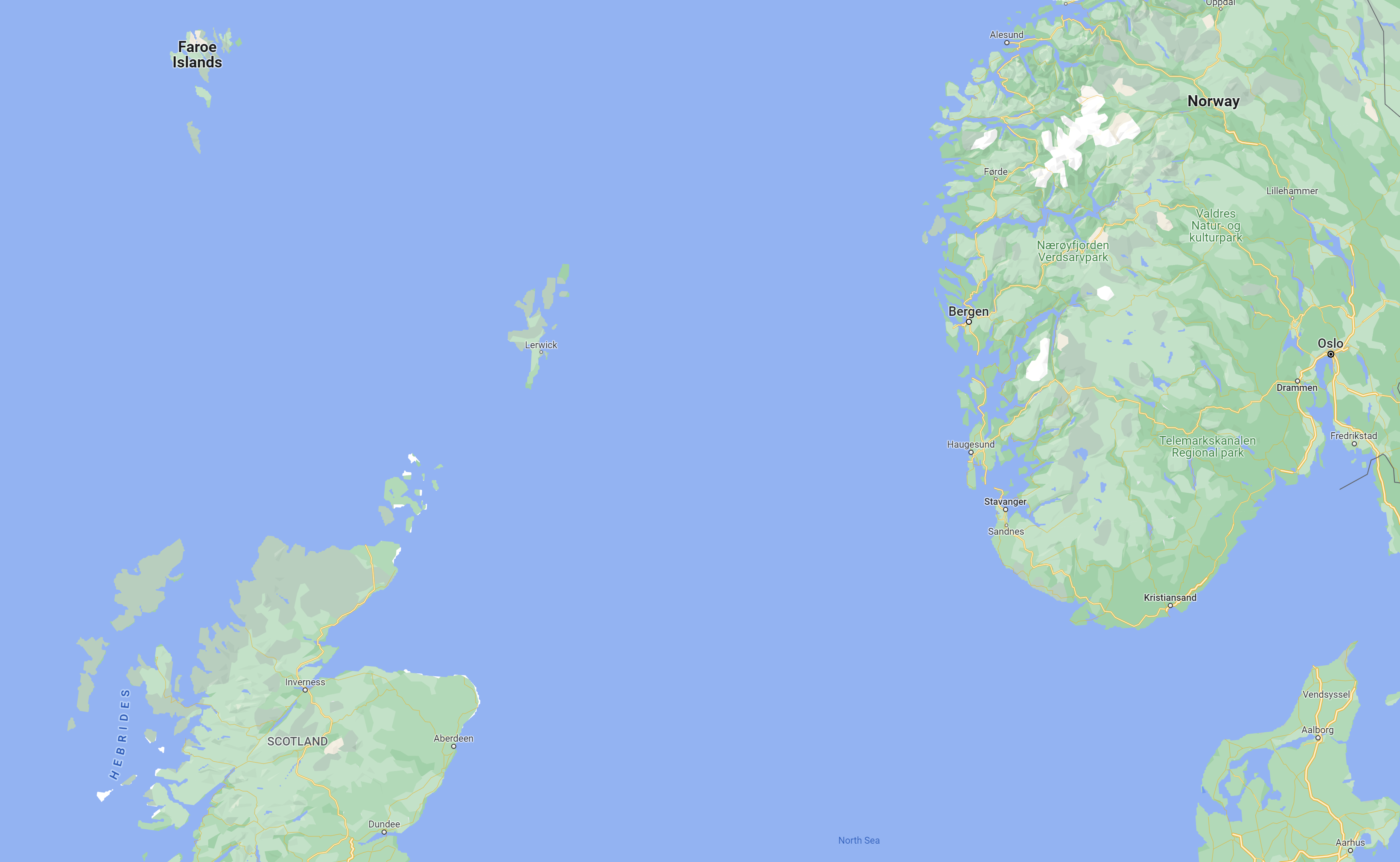
To get an idea of scale, the Shetland Isles are around 70 miles or 113 km. from North to South.
In Is This The World’s Most Ambitious Green Energy Solution?, I talked about Norwegian company; Aker Solutions’s plan for Northern Horizons.
- It would be a 10 GW offshore floating wind farm 136 km to the North-East of the Shetlands.
- This position would probably place it about halfway between the Faroes and the Norwegian coast.
- The project is best described in this article on the Engineer, which is entitled Northern Horizons Plans Clean Energy Exports For Scotland.
- In the article, there is a good graphic and a video.
This will be offshore engineering of the highest class, but then I first came across Norwegian offshore engineering like this in the 1970s, where nothing was too difficult for Norwegian engineers.
There are two major points to remember about the Norwegians.
- They have the Sovereign Wealth Fund to pay for the massive investment in Northern Horizons.
- They need to replace their oil and gas income, with a zero-carbon investment stream.
I feel that Northern Horizons will not be a one-off and the virgin sea in the map above will be liberally carpeted with more floating wind farms.
- On Shetland, electricity can be fed into the UK grid.
- On Norway, electricity can be fed into the Norwegian grid or stored in Norwegian pumped storage systems.
- On Scotland, more pumped storage systems can be built to store energy.
- Hydrogen can be piped to where it is needed to decarbonise heavy industry and transport.
- Norwegian fjords, Shetland harbours, Scottish lochs and possibly Scapa Flow would be ideal places to assemble and service the giant floating turbines and build the other needed floating infrastructure.
- I can also see Denmark getting in on the act, as they will probably want to decarbonise the Faroe Islands.
I estimate that between the Faroes, Scotland and Norway, there are 510,000 km² of virgin sea.
With a potential of 5 MW per km², that area has the potential to create an amazing amount of both electricity and hydrogen.
Exporting Power To Europe
There will need to be more interconnectors from the UK to Europe.
These are already working.
- BritNed – 1 GW – Isle of Grain and Rotterdam
- ElecLink – 1 GW – Through the Channel Tunnel
- HVDC Cross-Channel – 2 GW – England and France
- IFA-2 – 1 GW – England and France
- NemoLink – 1 GW – Kent and Belgium
- North Sea Link – 1.4 GW – Blyth and Norway
- Viking Link – 1.4 GW – Lincolnshire and Denmark
These are proposed.
- GridLink – 1.4 GW – Kent and Dunkirk
- NeuConnect – 1.4 GW – Isle of Grain and Germany
- North Connect – 1.4 GW – Scotland and Norway
There are also gas interconnectors, that could be converted to hydrogen.
This press release from National Grid, which is entitled Undersea Electricity Superhighways That Will Help Deliver Net Zero Move A Step Closer, has these bullet points.
- Positive progress on plans for £3.4bn electricity super-highway projects – Scotland to England Green Links.
- Ofgem opens consultation that recognises the “clear case” and “consumer benefit” of two subsea high voltage cables to transport clean between Scotland and England.
- The cables form part of a planned 16 project £10 billion investment from National Grid to deliver on the government’s target of 40GW of offshore wind generation by 2030.
This paragraph expands on the work by National Grid to meet the third point.
These projects are part of National Grid’s work upgrading the electricity transmission system to deliver the UK government’s target of 40GW of offshore wind generation by 2030. In addition to the Eastern Links, it is developing 14 major projects across its network to facilitate the target representing a £10 billion investment. This includes two further Scotland to England high voltage links (also in partnership with the Scottish transmission network owners) and proposals in the Humber, Lincolnshire, East Midlands, North of England, Yorkshire, North Kent, as well as four in East Anglia (one of which is a proposed offshore link between Suffolk and Kent).
I think we can assume, that National Grid will do their part to allow the UK government’s target of 40GW of offshore wind generation by 2030 to be met.
Will The UK Have 40 GW Of Offshore Wind Generation By 2030?
In the Wikipedia entry for Windpower In The UK, this is the opening sentence.
The United Kingdom is one of the best locations for wind power in the world and is considered to be the best in Europe. By the beginning of March 2022, the UK had 11,091 wind turbines with a total installed capacity of over 24.6 gigawatts (GW): 14.1 GW of onshore capacity and 10.4 GW of offshore capacity.
It would appear an extra 30 GW of wind power is needed.
In An Interim Total earlier, I gave these figures.
- Celtic Sea – 50 GW
- Irish Sea – 7.6 GW – 3 GW already underway
- South East England, East Anglia, Lincolnshire And Yorkshire – 22.5 GW
- North Sea – 9.5 GW
- On The East Coast Of Scotland – 6.6 GW
- ScotWind – 24.3 GW
The wind farms in South East England, East Anglia, Lincolnshire And Yorkshire and ScotWind and Mona and Morgan are either being planned or under construction, and in many cases leases to construct wind farms are being paid.
I would feel, that at least 30 GW of these 56.4 GW of wind farms will be completed by 2030.
Conclusion
Boris’s vision of the UK becoming a Saudi Arabia of wind is no fantasy of a man with massive dreams.
Standard floating wind turbines, with the possibility of also harvesting wave power could be assembled in ports along the coasts, towed into position and then connected up.
Several GW of wind-power capacity could probably be added each year to what would become the largest zero-carbon power station in the world.
By harvesting the power of the winds and waves in the seas around the British Isles it is an engineering and mathematical possibility, that could have been developed by any of those great visionary Victorian engineers like Armstrong, Bazalgette, Brunel and Reynolds, if they had had access to our modern technology.
Up Yours! Putin!
Will Twiggy Save The World?
This article on the Sydney Morning Herald is entitled ‘No One’s Married To Coal’: How Forrest Is Taking On The World To Save The Climate.
The article is the story of Andrew ‘Twiggy’ Forrest’s Damascene conversion to hydrogen.
These three paragraphs sums up Andrew Forrest‘s vision and ambitions.
Forrest’s companies, including its mining arm, Fortescue, and its green energy arm, Fortescue Future Industries, would be net zero by 2030. This would necessitate inventing and then developing hydrogen-powered trucks, trains and ships. This way the mining operation would avoid burning up to a billion litres in diesel a year.
The project would include the construction of vast solar and wind power stations in the Pilbara that would create green hydrogen to first fuel the trains, trucks and ships of the iron ore empire and then for export to a clean-energy starved world. The electrolysers needed to make the hydrogen for the early phases of the plan would be built by a vast new factory in Queensland, that itself would double the global supply of the machines.
Hydrogen would soon become the world’s largest shipborne trade. The Fortescue revolution would occur at a blistering pace set by the demands of addressing global warming, and it would be done for profit, to remove the excuses of governments and businesses that objected to ambitious climate action.
Note.
- How many other companies are intending to be net-zero by 2030?
- Certainly not many Chinese, German or Russian companies.
- And how many companies have planned to achieve net-zero at a profit?
If Forrest achieves his ambitions, the world will be a much better place.
Torvex Energy
Hydrogen And Chlorine Production At ICI Mond Division in The 1960s.
In my time in the late 1960s, when I worked For ICI Mond Division, I spent time in the Castner-Kellner works trying fairly unsuccessfully to develop an analyser to detect mercury-in-air in the Castner-Kellner process, that created chlorine and hydrogen from brine.
The process is not a nice one as it uses a mercury cathode and Wikipedia says this about safety.
The mercury cell process continues in use to this day. Current-day mercury cell plant operations are criticized for environmental release of mercury leading in some cases to severe mercury poisoning (as occurred in Japan). Due to these concerns, mercury cell plants are being phased out, and a sustained effort is being made to reduce mercury emissions from existing plants.
ICI felt that a mercury-in-air analyser would help to make the plant safer.
But ICI did have an alternative way to produce the chlorine they needed for selling as a gas or liquid or using as a base chemical for products like disinfectants, bleaches and dry cleaning fluids, without the use of mercury.
It was only a small plant and I was taken there once.
As with the Castner-Kellner process, it used a series of electrolyser cells.
- These were smaller and had a tub, with a concrete lid.
- The anode and cathode and the pipes collecting the hydrogen and the chlorine went through the lid.
- They were rebuilt regularly.
- As with the Castner-Kellner process, brine is electrolysed.
- The process was old and probably dated from before the Castner-Kellner process.
But of course as there was no mercury, the hydrogen and chlorine were pure and could be used for certain types of manufacture like pharmaceuticals.
Torvex Energy
This article on Hydrogen Fuel News is entitled Stockton R&D Firm Unveils New Hydrogen From Seawater Production Process.
These are some points from the article.
- Torvex Energy, a Stockton research and development company, recently unveiled a new technique for producing hydrogen from seawater.
- This unique method of producing hydrogen from seawater does not result in oxygen gas emissions.
- As such, it is clearly quite different from more traditional water electrolysis methods used for producing green H2.
- The team behind the production method call it an environmentally friendly technique.
- There is no desalination process.
- The firm has patents pending on this unique form of electrochemical process.
- It worked with the Material Processing Institute to establish proof of concept for this purpose.
I originally felt that Torvex Energy may have updated the ancient ICI process, that I saw over forty years ago, but when I asked the company, they said it was different.
It now appears that they haven’t, which means they must have found a totally new process.
There is certainly an ongoing patent application with a number of gb1900680.8.
How Efficient Is The Torvex Energy Process?
This will be key and there is nothing on their web site or on the Internet to indicate, if the Torvex Energy process is more or less efficient than traditional electrolysis.
Offshore Hydrogen Production
The main application for the Torvex Energy process must surely be in the production of hydrogen offshore.
- A fleet of floating wind turbines could surround a mother platform with a Torvex Energy process.
- The hydrogen could then be sent ashore in a pipeline.
- If there to be a handy depleted gas field, this possibly could be used to store the gas.
Depending on the efficiency of the Torvex Energy process, this could be a more cost-effective way to bring energy ashore, as gas pipelines can be more affordable, than HVDC electrical links. Especially, if the pipeline already exists.
Conclusion
Torvex Energy would have appeared to have made a major breakthrough in the production of hydrogen.
Shell To Develop Blue Hydrogen Plant
The title of this post, is the same as that of this article in The Times.
The article is based on this press release from Shell, which is entitled Shell And Uniper To Work Together On Blue Hydrogen Production Facility In The UK.
These are the three bullet points of the press release.
- Shell and Uniper sign co-operation agreement to progress plans for low-carbon hydrogen production at Uniper’s Killingholme site in North Lincolnshire
- Hydrogen produced could be used to decarbonise heavy industry, transport, heating and power across Humber and beyond.
- Project recently passed eligibility phase for UK Government’s Phase-2 carbon capture, usage and storage Cluster Sequencing Process.
Note.
- The Killingholme site is currently occupied by the 900 MW gas-fired Killingholme power station.
- Heavy industry on Humberside includes chemicals and oil refineries and the Scunthorpe steelworks.
This Google Map shows the location of Killingholme power station.
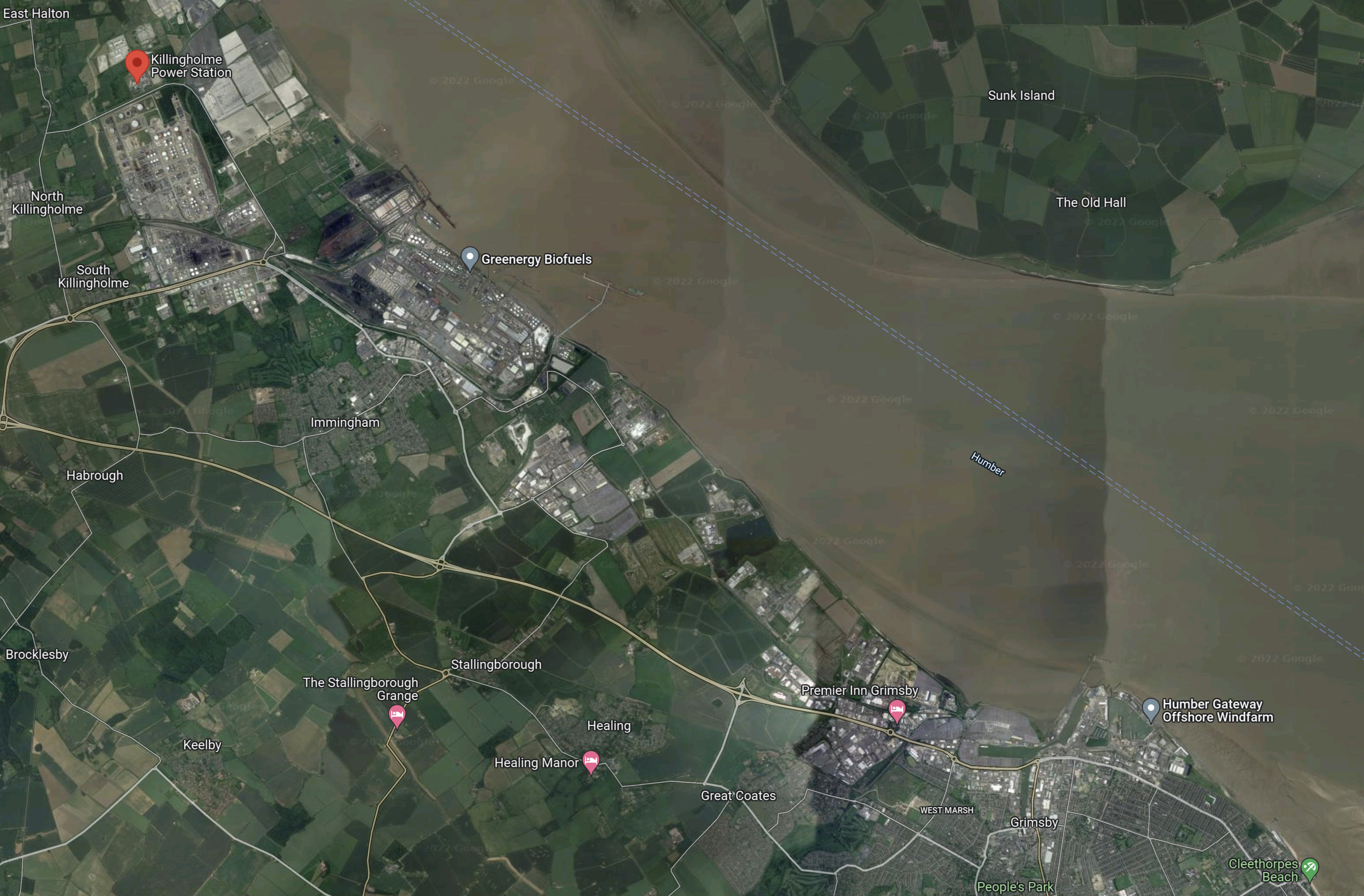
Note.
- Killingholme power station is marked by the red arrow.
- The river is the Humber.
- The Port of Immingham is on the power station side of the river.
- Cleethorpes Beach is marked by the green dot in the bottom-right hand corner.
- Grimsby is to the North of Cleethorpes.
- Between Grimsby and Killingworth power station is a mass of chemical works.
This second Google Map shows the area to the South-East of the power station.
Note.
- Killingholme power station is marked by the red arrow.
- The Hornsea 02 substation to the North of the power station.
- The large Uniper site to the South of the power station.
- The large number of tanks inland from the port and the chemical works.
I have some thoughts.
A Full Description Of The Project
This paragraph from the press release described the project.
Uniper has signed an agreement with Shell to progress plans to produce blue hydrogen at Uniper’s Killingholme power station site in the East of England. The hydrogen produced could be used to decarbonise industry, transport and power throughout the Humber region.
The Humber Hub Blue project includes plans for a blue hydrogen production facility with a capacity of up to 720 megawatts, using gas reformation technology with carbon capture and storage (CCS).
The captured carbon would be fed through the proposed Zero Carbon Humber onshore pipeline, part of the East Coast Cluster, recently selected as one of two CCS clusters to receive initial government support under the government’s cluster sequencing process.
I suspect that a lot of the plant from the existing Killingholme power station will be repurposed.
This is the specification of the power station.
The Uniper (Formerly E.ON UK) plant consists of two 450 MW Siemens V94.2 gas turbine modules each connected to a heat recovery steam generator using only a single steam turbine in a 2 into 1 configuration. Gas is supplied from a 26-mile pipeline from Theddlethorpe.
When it was built by Powergen (now called Uniper) and opened in April 1993 it was only the second gas-fired power station built in the UK. It was taken out of service in 2002 due to the lower price of electricity and was then restored to full service in August 2005, with one of the 450 MW units returning to service in April 2005.
It was announced that the power station will be closed in 2015.
Will The Project Use The Shell Blue Hydrogen Process?
Will the plant use the Shell Blue Hydrogen Process, that I described in Shell Process To Make Blue Hydrogen Production Affordable?
It appears the Shell Blue Hydrogen Process offers advantages.
- Shell are claiming, that with carbon dioxide costing $25-35/tonne, that their process is more economic than grey or green hydrogen.
- Steam reforming also needs steam, but this new process actually generates steam as a by-product, which further improves the economics, as integrated chemical plants use a lot of steam. Killingholme’s neighbours would probably welcome the steam.
- Shell are reporting capturing 99% of the carbon.
- It looks like savings of between 10 and 25 % are possible.
The most-fervent greens, may claim blue hydrogen is totally wrong.
But if it is more affordable than both grey and green hydrogen and all but one percent of the carbon dioxide is captured, I believe that this should be an option, that is fully investigated.
This appears to be a victory for top-class chemical engineering.
Northern Endurance Partnership
The Northern Endurance Partnership is described on this page of the Equinor web site, where this is said.
BP, Eni, Equinor, National Grid, Shell and Total today confirmed they have formed a new partnership, the Northern Endurance Partnership (NEP), to develop offshore carbon dioxide (CO2) transport and storage infrastructure in the UK North Sea, with bp as operator.
This infrastructure will serve the proposed Net Zero Teesside (NZT) and Zero Carbon Humber (ZCH) projects that aim to establish decarbonised industrial clusters in Teesside and Humberside.
There is also a map.
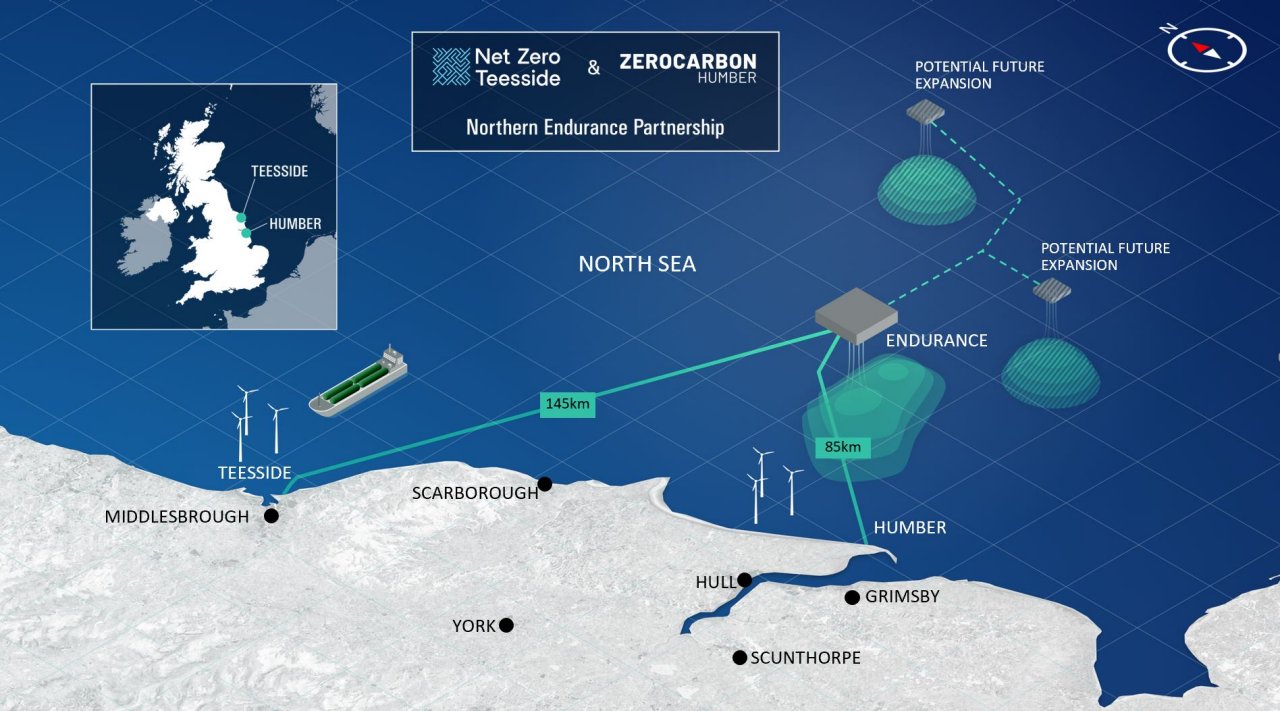
Note.
- One facility would appear to serve the Tees and the Humber.
It looks like the depleted gas fields could hold a lot of carbon dioxide.
Carbon Capture
Some points from the Equinor press release about carbon capture.
- Blue hydrogen production at Killingholme could see the capture of around 1.6 million metric tonnes (Mt) of carbon a year through CCS.
- The UK Government has set a target to capture 10 Mt of carbon a year by 2030.
- NEP has submitted a bid for funding through Phase 2 of the UK Government’s Industrial Decarbonisation Challenge, aiming to accelerate the development of an offshore pipeline network to transport captured CO2 emissions from both NZT and ZCH to offshore geological storage beneath the UK North Sea.
These projects could could decarbonise a lot of businesses on Teesside and the Humber.
Carbon Capture And Use
The Equinor press release says this about carbon capture and use.
The Northern Endurance Partnership will channel the extensive experience of its members to develop and deliver the offshore transport and storage infrastructure we need to unlock the enormous benefits of deploying CCUS across the Humber and Teesside. We’re delighted to start working together with five really world class energy companies to deliver a solution that will play a critical role in decarbonising the UK’s largest industrial heartland and protecting tens of thousands of jobs in the process.”
Uses include.
- Feeding to salad vegetables, tomatoes, soft fruit and flowers in giant greenhouses.
- Creating sustainable aviation fuel.
- Creating building products like blocks and plaster board.
- Making better concrete.
This is a list that will grow.
Making Hydrogen With An Electrolyser
The Shell press release says this.
Uniper continues to develop a separate green hydrogen project, using electrolytic hydrogen production technology, as part of the overall Humber Hub development at Uniper’s Killingholme site. Uniper, along with its project partners, will shortly complete the Project Mayflower feasibility study, part funded by the Department for Transport’s Clean Maritime Demonstration Competition, administered by InnovateUK, looking at the decarbonisation of port related activities at the Port of Immingham.
Note that the sub station for the 1.4 GW Hornsea 2 wind farm is close to both Killingholme power station and the Uniper web site.
What Will Happen To Shell’s Blue Hydrogen Plant?
I think there are two possible scenarios.
- It will be closed when Uniper’s electrolyser is fully on stream.
- It will become an emergency hydrogen source, when the wind is not blowing.
In both cases it will produce less carbon dioxide, thus leaving more space in the Northern Endurance Partnership.
Conclusion
It looks like there could be a comprehensive hydrogen production facility at Killingholme.
 The Anonymous Widower