Gravitricity Celebrates Success Of 250kW Energy Storage Demonstrator
The title of this post, is the same as that of this article on the Solar Power Portal.
I have already posted about this success in Gravitricity Battery Generates First Power At Edinburgh Site.
But the news story has now been mentioned in several respected publications and web sites.
So this idea, based on traditional Scottish products of heavy weights and girders seems to be getting valuable publicity.
The demonstrator is only small and uses two 25 tonne weights and a fifteen metre tower.
This is only a storage capacity of only 2.04 kWh, but the company is talking of weights totalling up to a massive 12,000 tonnes.
With a fifteen metre tower, that would be 490 kWh.
Note.
- The shafts at Kellingley Colliery in Yorkshire are 800 metres deep.
- The TauTona mine in South Africa is 3.9 kilometres deep
- In this article in The Engineer, Gravitricity talk about weights of up to 12,000 tonnes.
These are typical storage capacities.
- Kellingley – 50 tonnes – 109 kWh
- Kellingley – 12,000 tonnes – 26.15 MWh
- TauTona – 50 tonnes – 531 kWh
- TuaqTona = 12,000 – 127.5 MWh
Accountants before they invest in a company look at the financial figures. As an engineer, I look at the numbers in the science behind their claims.
If the engineering can be made to work, these figures are to say the least; very promising.
They are also beautifully scalable.
If say your application needed a 2 MWh battery and you had a 400 metre shaft available, you can calculate the weight needed. It’s around 1836 tonnes.
The Solar Power Portal article finishes with these two paragraphs.
The company will now look to rollout the technology in a series of full-scale 4-8MW projects, with conversations already underway with mine owners in the UK, Scandinavia, Poland and the Czech Republic, it said. Additionally, in South Africa Gravitricity is working closely with mine operator United Mining Services as part of a programme funded by an Innovate UK Energy Catalyst programme to identify potential schemes.
“A key feature of our full-scale projects will be their long life” added Blair. “Once built, our system can last for over 25 years, with no loss in output or degradation over time. This makes gravity storage cost-effective. And unlike batteries, we have no reliance on rare metals such as cobalt and nickel which are becoming increasingly scarce in the global drive to electrification.”
Note.
- I assume that they are 4-8 MWh projects.
- Charlie Blair is the Managing Director of Gravitricity.
- A weight of 1836 tonnes would give 4 MWh in the 800 metre shaft at Kellingley.
I wouldn’t be surprised that those owning a deep empty hole in the ground will be starting conversations with Gravitricity!
Conclusion
I am not worried, that I bought a few shares in Gravitricity in the crowd-funding last year!
All this good publicity from the BBC, Good News Network, Science, The Engineer, The Times and other media sites won’t harm my investment.
H2 And NH3 – The Perfect Marriage In A Carbon-Free Society
The title of this post, is the same as that of this article on The Chemical Engineer.
It is an article, which explains in detail, how we can use hydrogen and ammonia in the future.
Could Current Airliners Be Fuelled With Ammonia?
The title of this post, surely falls into the category of tabloid stories, that you get on a slow news day, when the Science Editor has been drinking in a pub, with a fantasist, who claims he runs his Ford Cortina on carrots.
But read this article on the Ammonia Association web site, which is entitled Zero Emission Aircraft: Ammonia For Aviation.
This is a paragraph from the article.
The propulsion system was devised by Reaction Engines and investigated by a team at STFC’s Rutherford Appleton Laboratory … It would have the potential to efficiently crack the ammonia fuel using heat harvested from the jet engine through Reaction Engines’ ground-breaking heat exchangers to provide a zero-carbon fuel blend of ammonia and hydrogen that burns stably just like jet fuel. The density of liquid ammonia allows for conventional aircraft configurations to be used and it may be possible to retrofit into an existing engine, resulting in a zero-carbon jet that could start serving the short haul market well before the 2050 target currently set by the industry.
Note.
- The Rutherford Appleton Laboratory is based at Harwell.
- Reaction Engines Wikipedia entry is interesting.
Read the Ammonia Association article in full.
Conclusion
I believe that the answer to the question in the title of this post is Yes!
MAN Energy Partners With Highview Power On Liquid-Air Energy-Storage Project
The title of this post, is the same as that of this article on Renewable Energy Magazine.
This is the introductory paragraph.
Highview Power, a leader in long duration energy storage solutions, has selected MAN Energy Solutions to provide its LAES turbomachinery solution to Highview Power for its CRYOBattery™ facility, a 50 MW liquid-air, energy-storage facility – with a minimum of 250MWh – located in Carrington Village, Greater Manchester , U.K.
The article is almost a word-for-word copy of this press release from MAN Energy Solutions, which has a similar title to this post and the Renewable Energy Magazine article.
As an Electrical Engineer who has done a lot of work in Project Management, I find these two paragraphs significant.
Construction will proceed in two phases. Phase 1 will involve the installation of a ‘stability island’, to provide near-instantaneous energy grid stabilisation. This will be achieved using a generator and flywheel, among other components. Enabling short-term stabilisation will provide the basis for Phase 2 and the completion of the more complex liquid air energy storage system that includes various compressors, air expanders and cryogenic equipment.
Phase 2 will represent the integration of stability services with a full-scale long-duration energy storage system, and in doing so promote the full integration of renewable energy. The Carrington project will offer a blueprint for future projects and cement the partnership between MAN Energy Solutions and Highview Power.
I first became acquainted with the use of flywheels to stabilise energy, when I was working in Enfield Rolling Mills as a vacation job at sixteen.
The centerpiece of their factory was a rolling mill, which took heated copper wirebars about two metres long amd ten centimetres square and rolled them into thick copper wire just a few millimetres in diameter. The mill was driven by a powerful electric motor, to which it was connected with a 97 tonne flywheel perhaps four metres in diameter in between. The flywheel spun at probably 3000 revolutions per minute.
The wirebar used to meander through the rolling mill several times and at each turn, the head would be caught by a man with a pair of tongs and turned back through the mill.
Each time the wire-bar went through a new pair of rolls the energy needed increased, as there was more rolling to do. So this extra energy was taken from the flywheel!
The rolling mill incidentally had been built by Krupp before the First World War. It still had the Krupp trademark of three interlocked railway tyres all over it. It had ended up in Enfield as reparations after the First World War. Enfield Rolling Mills added a fourth ring to create their own trademark.
It would appear that the kinetic energy of that flywheel could be as high as 1.6 MWh. Flywheels also react very fast.
Flywheel energy storage would appear to be a feasible intermediate energy store for this type of application.
I always remember Shimatovitch, who was the Chief Engineer of the company had jokingly once said that if the flywheel came off its bearings, it would have ended up a couple of miles away and would have demolished all the houses in its path. But he was a man with a dark sense of humour, who had spent most of the Second World War in a Nazi concentration camp.
Could it be that Phase 1 is the installation of a similar system to that I saw working in the 1960s, but upgraded with modern electronics, which exchanges power with the grid to create the stability island referred to in the press release.
In Phase 2 electricity can be passed to and from the CRYOBattery.
Looking at the MAN Energy Solutions web site, I suspect that they don’t care what sort of energy store they connect to the grid.
They would appear to be an excellent choice of engineering partner for Highview Power.
I also wonder how many other applications and customers, they will bring into the partnership.
Conclusion
This looks like a very sensible and low-risk strategy to connect the CRYOBattery to the grid.
Gravitricity Battery Generates First Power At Edinburgh Site
The title of this post, is the same as that of this article on the BBC.
This is the first paragraph.
A project to create electricity from gravity has generated its first power at a demonstrator site in Edinburgh.
This is only a demo to prove the technology, but all great oaks start as acorns.
I have great hopes for Gravitricity and I should declare an interest, as I bought a few shares in a crowdfunding.
Australian Coal Mine To Transform Into Pumped Hydro Facility
The title of this post, is the same as that of this article on PV Magazine.
This is the introductory paragraph.
Australian utility AGL is transforming its operations in a number of ways, from restructuring the company itself, to building energy storage facilities for flexible distribution of renewable energy into the future. The company is also planning to build a pumped-hydro facility at a disused open-cut coal mining site in eastern Australia.
It is an interesting proposition to say the least to reuse an opencast coal mine for something useful.
It would appear to be able to supple 250 MW for eight hours, which would make it a 2 GWh facility.
But then Australia is a country, that needs a lot of energy storage as they transform their economy to zero carbon.
Uniper To Make Wilhelmshaven German Hub For Green Hydrogen; Green Ammonia Import Terminal
The title of this post, is the same as that of this article on Green Car Congress.
This is the first two paragraphs.
Under the name “Green Wilhelmshaven,” Germany-based international energy company Uniper plans to establish a German national hub for hydrogen in Wilhelmshaven and is working on a corresponding feasibility study.
Plans include an import terminal for green ammonia. The terminal will be equipped with an ammonia cracker for producing green hydrogen and will also be connected to the planned hydrogen network. A 410-megawatt electrolysis plant is also planned, which—in combination with the import terminal—would be capable of supplying around 295,000 metric tons or 10% of the demand expected for the whole of Germany in 2030.
I can’t help feeling that there is some bad thinking here.
The Wikipedia entry for ammonia, says this about green ammonia.
Even though ammonia production currently creates 1.8% of global CO2 emissions, a 2020 Royal Society report claims that “green” ammonia can be produced by using low-carbon hydrogen (blue hydrogen and green hydrogen). Total decarbonization of ammonia production and the accomplishment of net-zero targets are possible by 2050.
So why is green ammonia imported rather than green hydrogen, which may have been used to manufacture the ammonia?
Green ammonia would appear to have two main uses in its own right.
- As a feedstock to make fertiliser and other chemicals.
- As a possible fuel for large ships, which could also be powered by hydrogen.
The only thing, I can think of, is that as liquid hydrogen boils at -253 ° C and liquid ammonia at -33 ° C, ammonia may be easier to transport by ship.
It may make a better fuel for large ships for the same reason.
This policy briefing from The Royal Society is entitled Ammonia: Zero-Carbon Fertiliser, Fuel And Energy Store.
This is the introductory paragraph.
This policy briefing considers the opportunities and challenges associated with the manufacture and future use of zero-carbon or green ammonia.
It is an excellent explanation of green ammonia and a must read.
Hydrogen for Wilhelmshaven
On the other hand, Wilhelmshaven, which is situated on Germany’s North West Coast would be in a good position to be a terminal for a hydrogen pipeline or electrical interconnector from the Dogger Bank, where both the Netherlands and the UK have plans for some of the largest windfarms in the world.
The UK’s Dogger Bank Wind Farm, which is being developed by SSE, looks to have an initial capacity of 4.8 MW, whereas the North Sea Wind Power Hub, being developed by the Danes, Dutch and Germans on their side of the Dogger Bank could be rated at up to 110 GW.
Wikipedia says this about how the two huge projects could be connected.
The power hub would interconnect the three national power grids with each other and with the Dogger Bank Wind Farm.
We could be seeing a 200 GW power station in an area of the sea, generally only known to those who listen to the shipping forecasts and fans like Marti Caine.
Under a section in the Wikipedia entry for the North Sea Wind Power Hub, which is entitled the North Sea Wind Power Hub Consortium, these points are made.
- It is hoped that Norway, the United Kingdom, and Belgium will join the consortium.
- Dutch gas-grid operator Gasunie has joined the consortium, suggesting converting wind power to gas and using near offshore gas infrastructure for storage and transport.
- The Port of Rotterdam became the fifth member of the consortium.
This looks like a party, where some of our North Sea gas fields and infrastructure, lying in the triangle of the Humber, Teesside and the Dogger Bank could add a lot of value.
We could even see hydrogen generated in the European Eastern part of the Dogger Bank, stored in a worked-out gas field in the UK sector of the North Sea and then when needed, it could be pumped to Germany.
A 410 Megawatt Electrolyser
Ryze Hydrogen are building the Herne Bay electrolyser.
- It will consume 23 MW of solar and wind power.
- It will produce ten tonnes of hydrogen per day.
This would produce just 5.6 percent of the hydrogen of the Wilhelmshaven electrolyser
In H2 Green Steel Plans 800 MW Hydrogen Plant In Sweden, I wrote about a 800 MW electrolyser, that would produce 380 tonnes of hydrogen per day.
It looks like the Wilhelmshaven electrolyser is very much a middle-sized one and would produce around 65,000 tonnes per year.
Conclusion
It looks like the Germans will be importing lots of green ammonia and green hydrogen from the North Sea.
The Edmonton Incinerator
Although it is officially known these days as the Edmonton EcoPark, as a North Londoner, I will always know it as the Edmonton Incinerator.
I took these pictures with my drone.



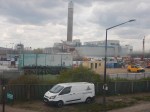







These are a few facts from Wikipedia about the waste-to-energy plant.
- It was commissioned by the Greater London Council in 1971.
- It burns waste from the seven North-East London boroughs.
- It generates 55 MW of electricity.
It certainly dominates the landscape alongside the North Circular Road.
But.
It is probably not amongst the greenest of incinerators.
It is probably very much a design of the 1960s.
It is approaching fifty years old.
But it appears that things could be improving.
- There is a large composting and recycling facility being built on the site on the site.
- Plans exist to bring in the rubbish by barge.
This Google Map shows the site.
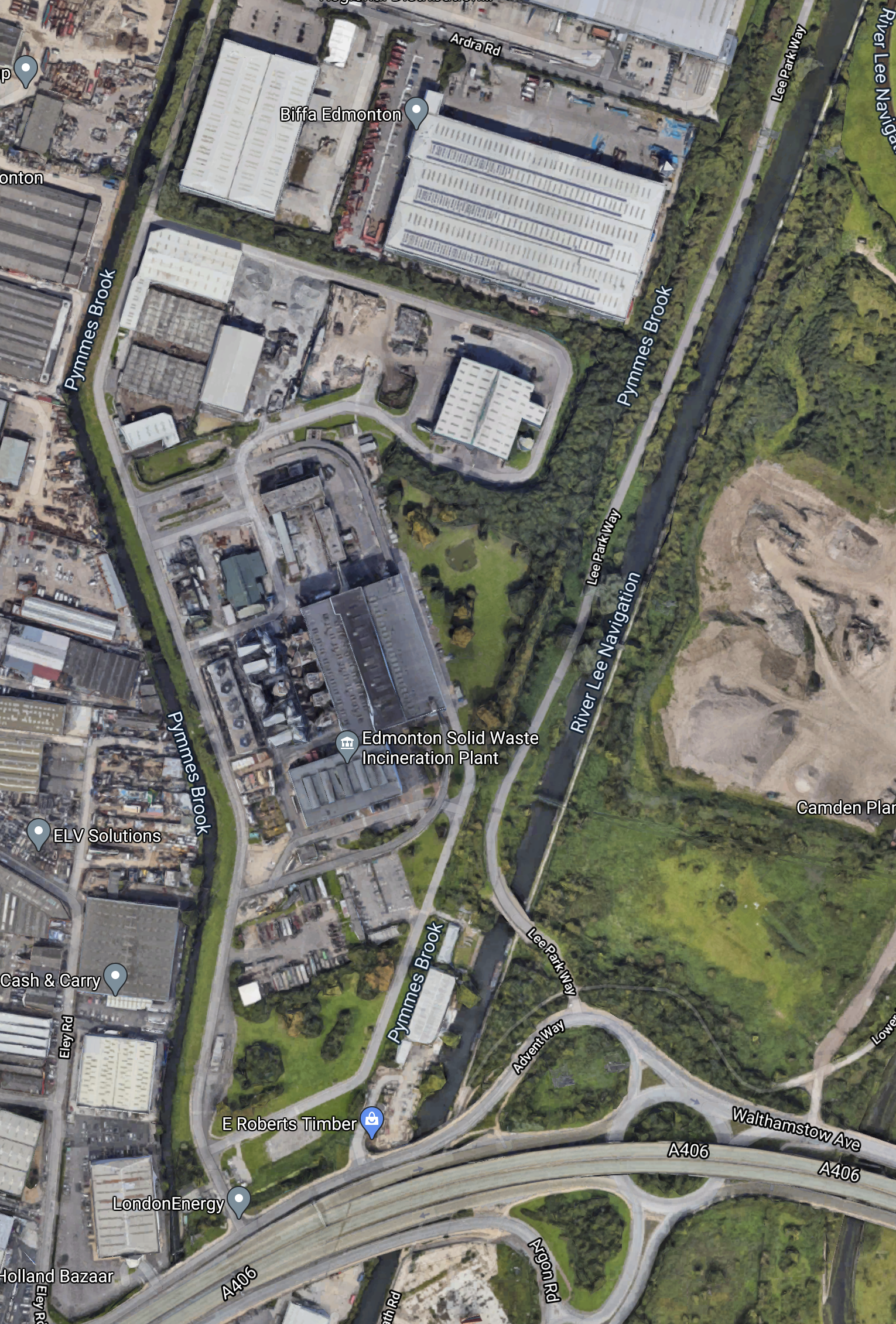
Note.
- The North Circular Road runs across the bottom of the map.
- All of the roads obliterated the famous Cooks Ferry Inn, where I saw the Animals play in the 1960s.
- The River Lee Navigation runs past the incinerator.
- Pymme’s Brook runs on the other side.
It looks from the map, that another reservoir is being built to the East of the canal.
The Guy Who Built The Edmonton Incinerator
I used to work with the guy, who was one of those in charge of the building of the incinerator, who when I met him, was head of the Greater London Council’s Construction Branch, who were using my project management software.
I can’t remember Mr. Samuels first name, even if I ever knew it.
- He was an Austrian Jew, who had trained as an engineer, who arrived in the UK sometime in the 1930s.
- He taught himself English in six weeks and got a job at Lucas.
- At the start of World War II, he volunteered and joined the Royal Engineers.
- He spent the whole war in bomb disposal.
- After the war he became an observer at the Nuremberg Trials.
After all he’d been through, he told me, the worst time of his life, was those years in the early seventies when I knew him, as his wife was dying of cancer.
But he taught me a lot about project management and the real horror of war.
He never told me, how many of his relatives survived the Nazis.
What Will Happen To The Edmonton Incinerator?
This year it will be fifty years since the Edmonton Incinerator was commissioned. It must be coming to the end of its life.
I can’t find any plans, but endless groups, who want it closed rather than rebuilt.
This article in the Hackney Gazette, which is entitled Campaigners Urge North London Incinerator Bidders To Pull Out, is typical.
I am very pro recycling, but then others aren’t as these pictures show.








So if some won’t recycle properly, it will all have to go to landfill.
An Odd Tale About Recycling
I applied to be a member of the Independent Monitoring Board of a prison near, where I used to live.
I had a very interesting tour of the prison, where I met several of the inmates.
One thing surprised me.
The prison had a very comprehensive internal recycling system, whereby everything was fully sorted.
One course of training, that was offered to prisoners was how to sort and process all of the rubbish. According to the guy running the course, it was one of the most popular in the prison.
Possibly, because I was told, it prepared prisoners for a job, where there were lots of vacancies.
I wonder if the new £100million recycling centre at Edmonton will use labour trained in the Prison Service?
ScottishPower’s Green Hydrogen Project Looks To Build UK’s Largest Electrolyser
The title of this post, is the same as that of this article on Current News.
This is the first paragraph.
ScottishPower has submitted a planning application for the UK’s largest electrolyser as part of the Green Hydrogen for Scotland project.
Other points from the article include, these about the electrolyser.
- It will be built close to the Whitelee wind farm.
- It will be 20 MW.
- It will produce eight tonnes of green hydrogen per day.
- The electrolyser will be built by ITM Power in Rotherham.
- It is hoped that green hydrogen will be produced by 2030.
Other points include.
- The windfarm will be backed up by 40MW of solar panels and a battery capable of supplying 50 MW.
- The capacity and type of the battery is not stated.
The article finishes with a must-read section, about how hydrogen will help the UK meet its decarbonisation targets.
Editorial: Our jobs Are Bound Up With The Future Of Four Hydrogen Atoms And One Carbon
The title of this post, is the same as that of this long and reasoned editorial on the Houston Chronicle.
It is definitely a must-read.
This is the last few paragraphs.
As this editorial board has argued before, the energy transition to address climate change offers opportunities that Houston should embrace. Hydrogen’s potential for the Houston region is to give new life to infrastructure we have, to take the emissions out of fossil fuel, to spur a revolution in materials and to sustain the jobs of well-paid oil and gas workers.
It won’t be easy to realize that promise. But few big things are.
“I am an American scientist brought up in the Midwest during the Sputnik era,” Smalley, with less than a year to live, told Congress in his 2004 speech, “and like so many of my colleagues in the U.S. and worldwide, I am a technological optimist. I think we can do it.”
Richard Smalley was a joint winner of the Nobel Prize for Chemistry for the discovery of buckminsterfullerene.
I suspect Buckminster Fuller himself, who is very much one of my heroes, would have been a believer in renewable energy.
 The Anonymous Widower