SSE Goes Global To Reap The Wind
The title of this article on This Is Money is Renewable Energy Giant SSE Launches Plan To Become Britain’s First Global Windfarm Business As it Invests Up To £15bn Over Next Decade.
The title is a good summary of their plans to build wind farms in Continental Europe, Denmark, Japan and the US, in addition to the UK and Ireland.
I can also see the company developing more integrated energy clusters using the following technologies.
- Wind farms that generate hydrogen rather than electricity using integrated electrolysers and wind turbines, developed by companies like ITM Power and Ørsted.
- Reusing of worked out gasfields and redundant gas pipelines.
- Zero-carbon CCGT power stations running on Hydrogen.
- Lots of Energy storage.
I talked about this type of integration in Batteries Could Save £195m Annually By Providing Reserve Finds National Grid ESO Trial.
In the related post, I talked about the Keadby cluster of gas-fired power stations, which are in large part owned by SSE.
Conclusion
I think that SSE could be going the way of Equinor and Ørsted and becoming a global energy company.
It is also interesting the BP and Shell are investing in renewable energy to match the two Scandinavian companies.
Big Oil seems to be transforming itself into Big Wind.
All these companies seem to lack grid-scale energy storage, although hydrogen can be generated and stored in worked-out gas fields.
So I would expect that some of the up-and-coming energy storage companies like Gravitricity, Highview Power and RheEnergise could soon have connections with some of these Big Wind companies.
Batteries Could Save £195m Annually By Providing Reserve Finds National Grid ESO Trial
The title of this post, is the same as that of this article on Current News.
The title gives the findings of the Arenko-led trial.
What Is The National Grid Reserve Service?
It’s all about providing capacity for the National Grid Reserve Service, which is described in this Wikipedia entry. This is the introductory paragraph.
To balance the supply and demand of electricity on short timescales, the UK National Grid has contracts in place with generators and large energy users to provide temporary extra power, or reduction in demand. These reserve services are needed if a power station fails for example, or if forecast demand differs from actual demand. National Grid has several classes of reserve services, which in descending order of response time are: Balancing Mechanism (BM) Start-Up, Short-Term Operating Reserve, Demand Management and Fast Reserve.
The Wikipedia entry is very comprehensive.
A Collateral Benefit
This is a paragraph from the article.
Additionally, unlike CCGT plants, batteries do not need to be producing power in order to provide Reserve as they can charge when there is abundant renewable energy on the grid, and then wait to react when needed. As CCGT’s need to be producing power to provide this service, it can led to renewables switched off in favour of the more carbon intensive fossil fuel generation, to ensure Reserve is available if needed.
The article concludes that Reserve from Storage could help National Grid ESO’s reach their target of net-zero operation by 2025.
Could We Replace CCGT Plants With Batteries?
CCGT or combined cycle gas-turbine power plants are efficient ways to turn natural gas into electricity.
- Typical sizes are around 800 MW.
- They are reasonably quick and easy to build.
- As their fuel comes by a pipeline, they don’t need to be connected to the rail network, unlike biomass and coal power plants.
Because they burn methane, they still emit a certain amount of carbon dioxide, although levels much less than an equivalent coal-fired power station.
In Energy In North-East Lincolnshire, I described the three Keadby power stations.
- Keadby – In operation – 734 MW
- Keadby 2 – Under construction – 840 MW
- Keadby 3 – In planning – 910 MW
In total, these three power stations will have a capacity of 2484 MW.
By comparison, Hinckley Point C will have a capacity of 3200 MW.
Add Keadby 4 and the four CCGTs would provide more electricity, than Hinckley Point C.
I think it would be very difficult to replace a cluster of CCGT gas-fired power stations or a big nuclear power plant with the sort of batteries being deployed today. 2.5 to 3 GW is just so much electricity!
I do believe though, that instead of building a 3200 MW nuclear power plant, you could build a cluster of four 800 MW CCGTs.
But What About The Carbon Dioxide?
Using the Keadby cluster of CCGTs as an example.
- Keadby 2 and Keadby 3 are being built to be upgraded with carbon-capture technology.
- The HumberZero gas network will take the carbon dioxide away for storage in worked-out gas fields in the North Sea.
- Some carbon dioxide will be fed to salad vegetables and soft fruits in greenhouses, to promote growth.
- Keadby 2 and Keadby 3 are being built to be able to run on hydrogen.
- The HumberZero network will also be able to deliver hydrogen to fuel the power stations.
I’m certain we’ll see some of the next generation of wind turbines delivering their energy from hundreds of miles offshore, in the form of hydrogen by means of a pipe.
The technology is being developed by ITM Power and Ørsted, with the backing of the UK government.
- Redundant gas pipelines can be used, to bring the hydrogen to the shore
- The engineering of piping hydrogen to the shore is well-understood.
- Redundant gas pipelines can be used if they already exist.
- Gas networks can be designed, so that depleted gas fields can be used to store the gas offshore, in times when it is not needed.
But above all gas pipelines cost less than DC electricity links, normally used to connect turbines to the shore.
I can see very complicated, but extremely efficient networks of wind turbines, redundant gas fields and efficient CCGT power stations connected together by gas pipelines, which distribute natural gas, hydrogen and carbon dioxide as appropriate.
Could Offshore Hydrogen Storage And CCGTs Provide The Reserve Power
Consider.
- Using a CCGT power station to provide Reserve Power is well understood.
- Suppose there is a large worked out gasfield, near to the power station, which has been repurposed to be used for hydrogen storage.
- The hydrogen storage is filled using hydrogen created by offshore wind turbines, that have built in electrolysers, like those being developed by ITM Power and Ørsted.
- One of more CCGTs could run as needed using hydrogen from the storage as fuel.
- A CCGT power station running on hydrogen is a zero-carbon power station.
Effectively, there would be a giant battery, that stored offshore wind energy as hydrogen.
I can see why the UK government is helping to fund this development by ITM Power and Ørsted.
Could We See Cradle-To-Grave Design Of Gas Fields?
I suspect that when a gas field is found and the infrastructured is designed it is all about what is best in the short term.
Suppose a gas field is found reasonably close to the shore or in an area like the Humber, Mersey or Tees Estuaries, where a lot of carbon dioxide is produced by industries like steel, glass and chemicals!
Should these assessments be done before any decisions are made about how to bring the gas ashore?
- After being worked out could the gas field be used to store carbon dioxide?
- After being worked out could the gas field be used to store natural gas or hydrogen?
- Is the area round the gas field suitable for building a wind farm?
Only then could a long-term plan be devised for the gas-field and the infrastructure can be designed accordingly.
I suspect that the right design could save a lot of money, as infrastructure was converted for the next phase of its life.
Conclusion
It does appear that a lot of money can be saved.
But my rambling through the calculations shows the following.
Wind Turbines Generating Hydrogen Give Advantages
These are some of the advantages.
- Hydrogen can be transported at less cost.
- Hydrogen is easily stored if you have have a handy worked-out gas field.
- The technology is well-known.
Hydrogen can then be converted back to electricity in a CCGT power station
The CCGT Power Station Operates In A Net-Zero Carbon Manner
There are two ways, the CCGT station can be run.
- On natural gas, with the carbon-dioxide captured for use or storage.
- On hydrogen.
No carbon-dioxide is released to the atmosphere in either mode.
The Hydrogen Storage And The CCGT Power Station Or Stations Is Just A Giant Battery
This may be true, but it’s all proven technology, that can be used as the Power Reserve.
Power Networks Will Get More Complicated
This will be inevitable, but giant batteries from various technologies will make it more reliable.
Spanish Govt Approves Energy Storage Strategy, Sees 20 GW In 2030
The title of this post, is the same as that of this article on Renewables Now!
This is the introductory paragraph.
The Spanish government on Tuesday approved the energy storage strategy, targeting some 20 GW of storage capacity in 2030 and reaching 30 GW by 2050 from today’s 8.3 GW.
How will Spain increase their storage capacity?
Pumped Storage Systems
Spain already has a couple of large pumped storage systems.
The La Muela II Pumped Storage Power Station
The La Muela II Pumped Storage power station is based on the Cortes-La Muela Reservoir
This Google Map shows the dam.
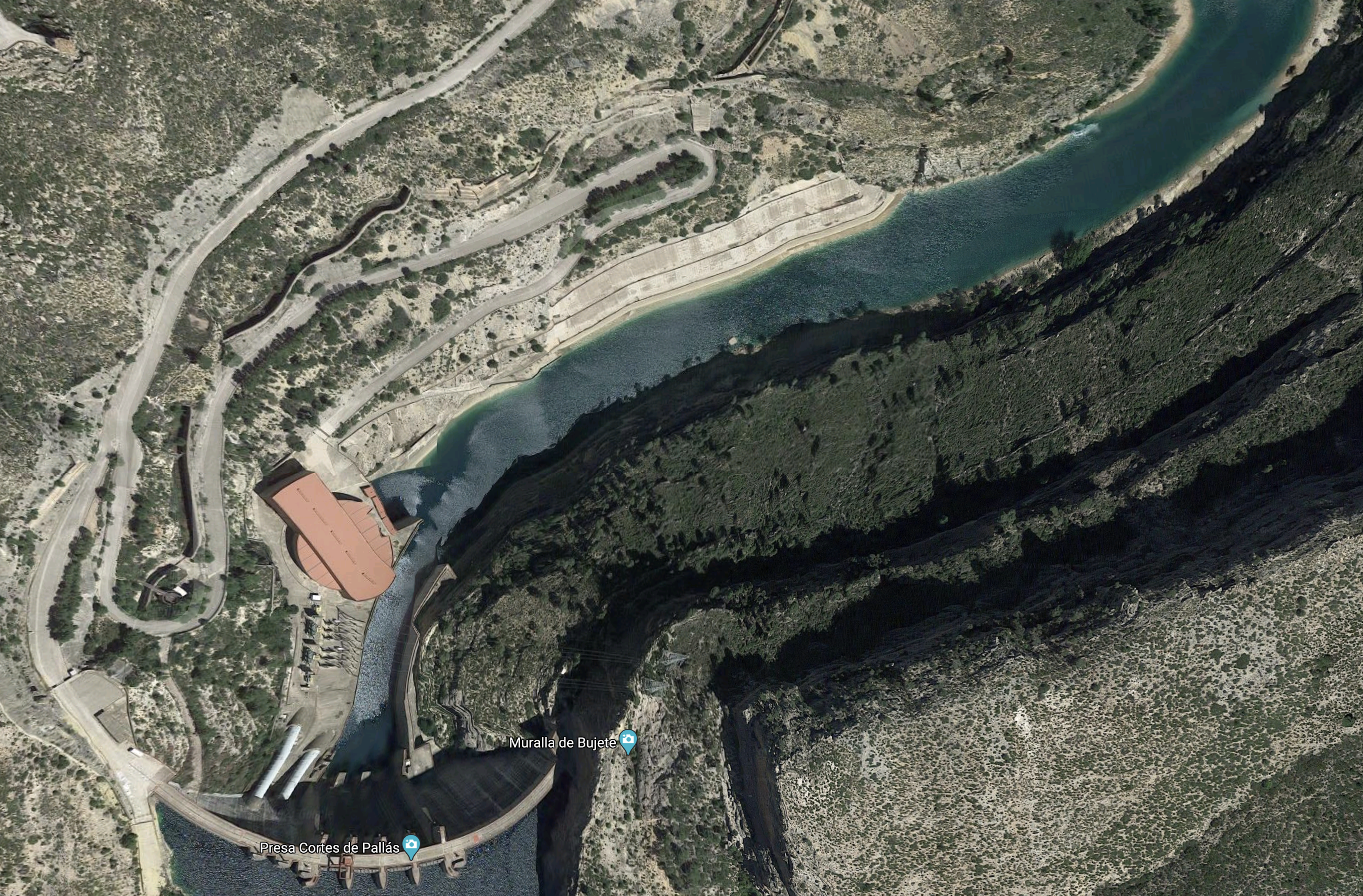
In terms of generating capacity, it is about the same size as Dinorwig power station in Snowdonia., which is the UK’s largest pumped storage power station.
The Aldeadávila Dam
The Aldeadávila Dam is a 1243 MW hydro-electric power station with a pumped storage addition on the River Douro between Spain and Portugal.
This Google Map shows the dam.
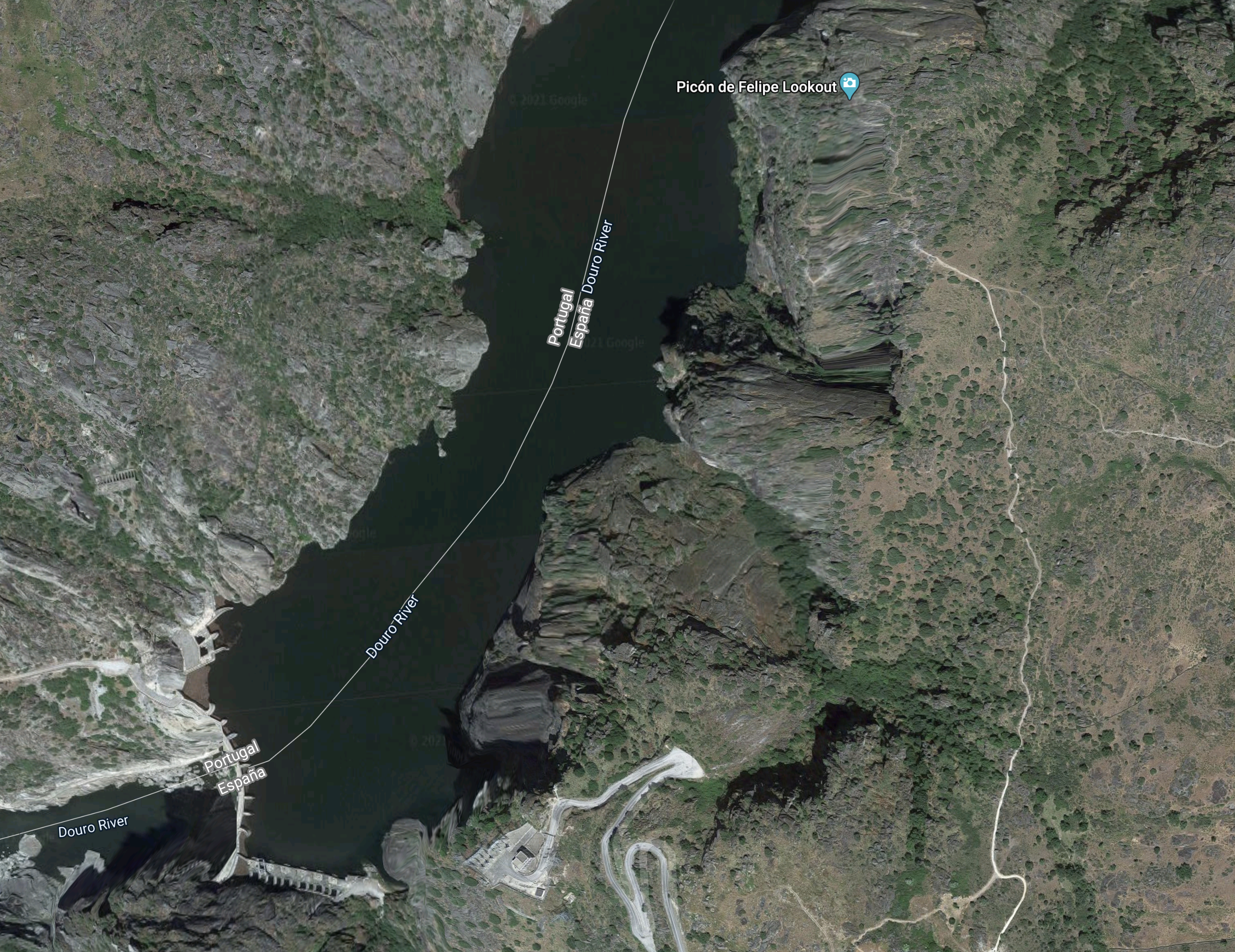
It certainly looks like a place to visit.
Both these pumped storage station seem to have been converted from earlier hydro-electric power stations.
I wouldn’t be surprised to learn, that the Spaniards, were going to increase their number of pumped storage power stations.
- Spain certainly has the mountains, with big rivers running through!
- Bolarque dam already uses pumped-storage techniques.
Are there any other existing hydro-electric power stations in Spain, that can be converted to pumped storage or be upgraded?
Concentrated Solar Power
Spain has around thirty concentrated solar power or CSP power stations, either in operation, under construction or planned.
Some also store electricity as heat.
Spain is not short of sun.
Spain is considered a world leader in this technology.
This Google Map shows the Andasol solar power station.
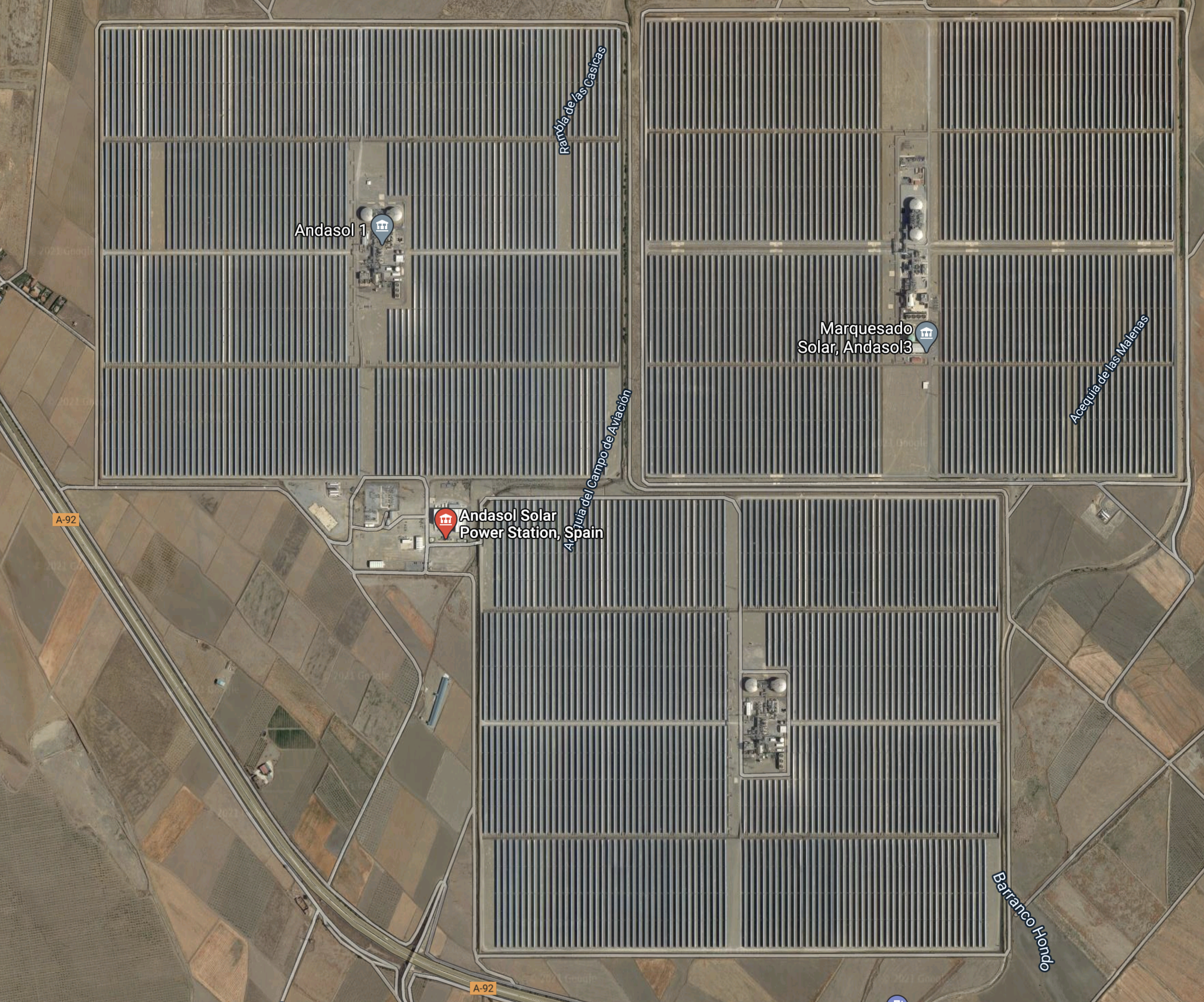
The specification includes.
- It uses technology called a parabolic trough.
- A nameplate capacity of 149.7 MW
- A capacity factor of 37.7 %
- Annual net output of 495 GWh
- a storage capacity of 1.123 GWh
- The energy storage is based on a mixture of potassium and sodium nitrates.
- The power station takes up an area of six square kilometres.
Will Spain build more of these CSP power stations or add energy storage to some of the existing stations?
Batteries
The article has this sentence.
the government wants to add large-scale batteries, behind-the-metre batteries — minimum 400 MW in 2030 — and make the most of the vehicle-to-grid technology, according to the document.
It should be noted that Spain has installed capacity of over 25 GW of wind power, according to this article on Wikipedia, which is entitled Wind Power In Spain.
These are some points from the article.
- Spain has a lot of indigenous wind turbine manufacture.
- The Spanish wind-power industry employs upwards of 60,000 people.
- A central control centre for Spanish wind power needs to be developed.
- There is little opposition to onshore wind, although perhaps somewhat surprisingly, there is some opposition to offshore wind.
After reading what Wikipedia had to say, it appears to me, that Spain needs a ;pt of batteries to support all these wind turbines.
The world’s second largest wind-turbine manufacturer is Siemens Gamesa, who are Spanish-based.
Siemens Gamesa have an innovation storage battery based on hot volcanic rock, which I wrote about in Siemens Gamesa Begins Operation Of Its Innovative Electrothermal Energy Storage System.
This gives a brief description of the pilot plant.
The heat storage facility, which was ceremonially opened today in Hamburg-Altenwerder, contains around 1,000 tonnes of volcanic rock as an energy storage medium. It is fed with electrical energy converted into hot air by means of a resistance heater and a blower that heats the rock to 750°C. When demand peaks, ETES uses a steam turbine for the re-electrification of the stored energy. The ETES pilot plant can thus store up to 130 MWh of thermal energy for a week. In addition, the storage capacity of the system remains constant throughout the charging cycles.
It was taken from this press release from Siemens Gamesa.
This page on the Siemens web site gives the nominal output of the system as 30 MW.
So it would need just over a dozen systems like these to perhaps be strategically-placed near large wind farms to meet Spain’s target of 400 MW of energy storage.
Highview Power’s liquid air systems would be another possibility, but I doubt, they’d perform as well in the heat of Spain, as a system based on hot rocks.
Conclusion
Spain’s plan seems achievable and could create a lot of employment.
It also seems to me, that their natural resources of mountains, big rivers and lots of sun are a great help.
Aberdeen-Based Energy Storage Firm Aims To Raise £300 Million
The title of this post, is the same as that of this article on insider.
I like the Carbon Neutral Energy’s concept.
- It will provide small energy storage systems with an output of between 1 MW an 5 MW
- The energy storage systems appear to be mobile.
- It will create 200 Scottish jobs.
The company has signed an agreement with Muirden Energy, who are a wind energy developer. This is Muirden’s mission statement, from their web site.
Muirden Energy is a successful renewable energy developer specialising in onshore wind energy. We deliver sensitively designed wind projects across Scotland and forge strong working relationships with local communities. We are committed to contributing to Scotland’s renewable energy needs and supporting the economic development of surrounding communities.
They have installed 60 MW of generating capacity across 30 sites in seven years.
Conclusion
This looks like a company and a concept to follow.
How many villages, factories and stations, could be powered partly by one or more wind turbines and a battery?
World’s Biggest Battery Storage Project Announced By Australian Renewables Fund
The title of this post, is the same as that of this article on Energy Storage News.
This is the introductory paragraph.
CEP. Energy, a specialist renewable energy fund company in Australia, has just announced the largest proposed grid-scale battery project in the world so far, with up to 1,200MW rated output.
If you read the whole article, you get the impression, that the Australians are going big on energy storage.
But then Australia must be one of the best countries for solar energy in the world.
This paragraph contains an interesting concept.
Construction is anticipated to begin in early 2022 for completion in 2023, so it’s possible even bigger schemes will be announced or even built by then, but for now the project is setting the pace for scale. Another Australian project, proposed by integrated energy company Origin Energy would site 700MW / 2,800MWh of batteries at a retiring coal power station, also in New South Wales and French developer Neoen has filed a plan, to build a 500MW / 1,000MWh battery storage project in the state. New South Wales’s government has implemented an ambitious roadmap to deploying vast shares of renewable energy on its networks, including a handful of multi-gigawatt Renewable Energy Zones.
Note that Origin Energy are replacing a coal-fired power station with a 700 MW/2,800 MWh battery.
We shall see a lot of fossil-fuel-fired power stations replaced by batteries.
Italy’s Hardest-Hit Covid-19 Region To Become ‘Hydrogen Valley’
The title of this post, is the same as that of this article on Energy Live News.
This is the first paragraphs.
Lombardy, Italy’s hardest-hit Covid-19 region, will soon become home to the ‘country’s first hydrogen valley’.
Enel Green Power has signed a memorandum of understanding (MoU) with the Italian transport group FNM, to purchase new hydrogen-powered trains, replace the current diesel-powered trains and build hydrogen production facilities powered by renewable energy.
These facilities will be constructed to support the journeys of hydrogen trains.
It sounds like good thinking.
Denmark To Build ‘First Energy Island’ In North Sea
The title of this post, is the same as that of this article on the BBC.
This is the first three paragraphs
A project to build a giant island providing enough energy for three million households has been given the green light by Denmark’s politicians.
The world’s first energy island will be as big as 18 football pitches (120,000sq m), but there are hopes to make it three times that size.
It will serve as a hub for 200 giant offshore wind turbines.
It seems to follow the bigger-is-better offshore principle, I talked about in Crown Estate’s Auction Of Seabed For Wind Farms Attracts Sky-High Bids.
The BBC article says this about the energy generation of the island and its turbines.
The new island would supply an initial 3 gigawatts, rising to 10 over time.
For comparison the coal-fired Fiddlers Ferry power station on the banks of the Mersey near Widnes was a 2 gigawatt station and the nuclear Hinkley Point C will hopefully generate 3.2 GW.
These are my thoughts.
The Location Of The Island
According to the BBC, the Danes are being secretive about the location of the island, but the BBC does say this about the location of island.
While there is some secrecy over where the new island will be built, it is known that it will be 80km into the North Sea. Danish TV said that a Danish Energy Agency study last year had marked two areas west of the Jutland coast and that both had a relatively shallow sea depth of 26-27m.
According to Wikipedia, Denmark has a sizeable offshore gas industry and I did wonder, if the island would be built near to a large worked out field, so that the field could be used for one of the following.
- Store hydrogen produced on the island from surplus electricity.
- Store carbon dioxide produced on the mainland.
But the gas fields are further than 80 km. from the shore being closer to where Danish, German, Dutch and British waters meet.
Hydrogen And The Island
In ITM Power and Ørsted: Wind Turbine Electrolyser Integration, I talked about a joint project between, electrolyser company; ITM Power of the UK and turbine manufacturer and developer; Ørsted of Denmark.
The post was based on this press release from ITM Power.
These were points from the press release.
- Costs can be saved as hydrogen pipes are more affordable than underwater power cables.
- It also stated that wind turbines produce DC electricity and that is ideal for driving electrolysers.
So will the island be connected to the mainline by a hydrogen gas line?
- Cost will play a big part.
- I don’t like the concept of electrical cables on the sea floor,
- Gas pipes have been laid everywhere in the North Sea.
- A hydrogen connection might better support different types of future turbines.
- If there is a worked-out gas-field nearby, the hydrogen can be stored offshore until it is needed.
I think it is a distinct possibility.
Hydrogen could be generated in one of two ways.
- Wind turbines based on the ITM Power/Ørsted design could generate the hydrogen directly and a gas network could deliver it to the island.
- Conventional turbines could generate electricity and an electrical network could deliver it to the island, where a large electrolyser would convert water into hydrogen.
Both methods would be better suited to a hydrogen connection to the mainland.
Connection To Other Islands
The Dutch are already talking about a North Sea Wind Power Hub on their section of the Dogger Bank.
So could we see a network of islands in the Southern North Sea?
- Some like the Danish island would support a network of wind turbines.
- Some would store energy as hydrogen in worked-out gas fields.
- Some would store captured carbon dioxide in worked out gas fields.
- Some would supply hydrogen to onshore hydrogen and carbon dioxide networks like HumberZero.
- Islands could be linked by electrical cables or gas pipelines.
- Gas pipelines would allow both hydrogen or carbon dioxide to be stored or moved
The North Sea could become the largest power station in the continent of Europe, or even the world.
Crown Estate’s Auction Of Seabed For Wind Farms Attracts Sky-High Bids
The title of this post, is the same as that of this article on The Times.
This is the opening paragraph.
An auction of seabed rights to build offshore wind farms around England and Wales has attracted frenzied bidding that could be worth hundreds of millions of pounds a year to the Treasury and the Queen.
I don’t find this surprising.
Bigger Seems Better Offshore
Wind turbine technology is getting better and much larger. It also seems that the new larger floating turbines are much more efficient and generate power for a greater proportion of the day.
- Hywind Scotland is the world’s first commercial wind farm using floating wind turbines.
- It is situated off Peterhead.
- It consists of five 6 MW turbines.
- Wikipedia says it has a capacity factor of over 50 %.
My project management software helped to harvest North Sea Oil and I have been told by many in the industry, that North Sea Oil really took off when platforms and the equipment like cranes used to build them got truly enormous.
I feel, we could be seeing the same size effect happening as we harvest the wind!
Hydrogen And Wind Power
The latest development is not to generate electricity, but to use it in the turbine to generate hydrogen, which is then piped to the shore.
- The UK Government is funding this technology in part with a grant to ITM Power.
- I wrote about the technology in ITM Power and Ørsted: Wind Turbine Electrolyser Integration.
- Existing gas networks can be reconfigured to bring the hydrogen to the shore.
- Piping hydrogen costs less than cabling electricity.
- Hydrogen networks are being built at several places in the UK, to fuel homes, power stations and industry like steel-making and petrochemicals.
Could all this explain Big Oil’s involvement?
Do they want to exchange fossil fuels for green hydrogen?
They certainly know how to distribute it.
Energy Storage
For my own investments, I’m looking at energy storage, where the UK has at least three promising new ideas, all of whom have had Government grants.
- Gravitricity
- Highview Power
- ReEnergise
The Government has also indirectly-backed Cornish Lithium
Spot The Battery
RheEnergise have just released this picture, of one of how one of their pumped storage systems might look.
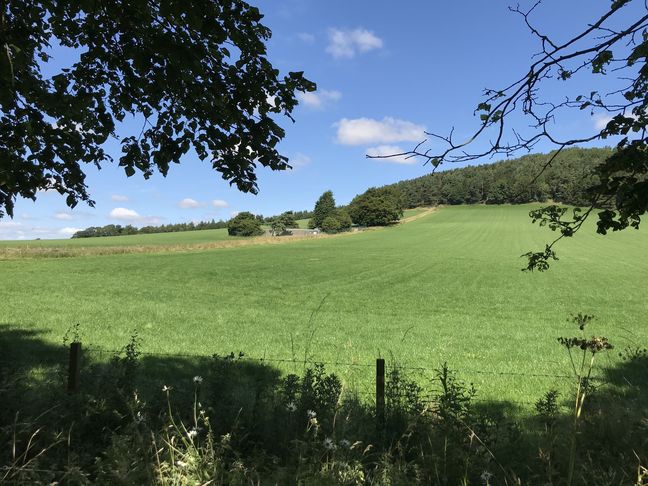
They describe it as a typical small site after landscaping.
This is their description of the image.
This is an image of a small water works in Fife Scotland, you can just see 2 small water tanks at the base of the hill. This is an example of what a small High-Density Hydro project could look like after landscaping.
How many times have you seen a scene like this in the UK, Europe and all over the world.
They didn’t disclose the storage capacity of this system.
 The Anonymous Widower