Hydrogen Train To Be Demonstrated In Québec
The title of this post is the same as that of this article on the Railway Gazette.
These two paragraphs outline the project.
An Alstom Coradia iLint hydrogen fuel cell multiple-unit is to operate demonstration passenger services on the Chemin de fer de Charlevoix from June 17 to September 30.
The return service along the St Lawrence River between Parc de la Chute-Montmorency on the outskirts of Québec City and Baie-St-Paul is being organised by the province, short line operator Chemin de fer Charlevoix, tourist train operator Train de Charlevoix, hydrogen production technology company HTEC and Harnois Énergies, which will produce the green hydrogen at its Québec City site.
The Train de Charlevoix runs along the St. Lawrence River and is described on the web site as a unique experience.
I have felt for some time, that one of the uses of zero-carbon trains is as tourist trains, on quiet lines, where noise is probably not welcome.
It might even change the future of some lightly-used lines.
Nikola Highlights Its Integrated Hydrogen Solution And Introduces New Hydrogen Energy Brand “HYLA”
The title of this post, is the same as that of this press release from Nikola Motor.
This is the first paragraph.
Nikola Corporation, a global leader in zero-emission transportation and energy supply and infrastructure solutions, announced at a special event today that it has created a new global brand, HYLA, to encompass the company’s energy products for producing, distributing and dispensing hydrogen to fuel its zero-emissions trucks. More than 300 fleet, government, supplier, energy and media representatives were on site for the announcement at Nikola’s U.S. headquarters in Phoenix, which highlighted the progress made by Nikola’s energy and truck businesses.
The CEO is also quoted as saying.
Nikola is the only company that is successfully integrating a revolutionary new product, the hydrogen fuel cell truck, and the full hydrogen energy infrastructure supply chain under one roof
I suspect that other companies are or will be making similar claims, about similar products.
JCB are certainly showing everything you need for hydrogen-powered construction and agricultural equipment on their web site, as I pointed out in JCB: Building A Hydrogen Future.
When I see anything about Nikola Motor, I feel Elon Musk made a big mistake.
He chose well with the name Tesla, but shouldn’t he have registered Nikola and all its derivatives.
JCB: Building A Hydrogen Future
The title of this post, is the same as that of this page on the JCB web site.
The page contains this statement from Lord Bamford, who is JCB’s chairman.
I’m often asked, why hydrogen? Two years ago, I set the challenge that we should be making hydrogen engines for the construction industry and for agriculture. Two years later, we have hydrogen engines working in the kind of equipment that JCB makes. A solution that delivers power in the same way as conventional engines, but with none of the fossil fuels. We’re proving daily that hydrogen does work, that it’s a clean, renewable, transportable fuel.
Bold thinking, a lot of hard work, a lot of innovation – the kind of thing JCB has been delivering for over 75 years.
It is followed by a series of articles on hydrogen and JCB.
ITM Signs 200MW Electrolyser Deal
The title of this post, is the same as that of this article on renews.biz.
This is the sub-heading.
Agreements with Linde Engineering will be for installation at RWE’s GET H2 Nukleus project in Germany
These paragraphs outline the deal.
ITM Power has signed two contracts for electrolysers, totalling 200MW, which will be installed in green hydrogen plants in Germany that will be supplied by North Sea offshore wind.
The contracts, both with Linde Engineering, are each for 100MW of PEM electrolysers.
The machines will be installed at two plants operated by RWE in Lingen, Germany.
Note.
- Linde Engineering and ITM Power were preselected by RWE for these orders.
- ITM Power seem to be going through scale-up problems.
But the comments in the article and the orders, surely show that ITM Power is now more likely to recover.
Centrica Announces Hydrogen Ready Combined Heat And Power Partnership With 2G
The title if this post is the same as that of this press release from centrica.
This is the sub-heading.
Centrica Business Solutions is partnering with 2G Energy AG to provide customers with 100% hydrogen ready Combined and Heat Power (CHP) systems.
This paragraph outlines the project.
The move is in response to the growing need for integrated hydrogen solutions which are a key tool in the decarbonisation of decentralised energy. As the hydrogen network develops, the highly efficient units can continue to run on traditional fuel sources, helping future proof investments by ensuring an extended life for the assets.
It does appear that the 2G units can run on biogas or natural gas and switch to hydrogen, when it is available.
2G Energy have a web site, with lots of case studies.
Cummins’ First Female Engineer Retiring After Nearly 40 Years In A Pioneering Role
The title of this post, is the same as that of this article on Commercial Carrier Journal.
The article was picked up by my Google Alert for the Cummins X15H, which is their new hydrogen internal combustion engine for large trucks.
This is the first paragraph.
Amy Boerger, Cummins vice president and general manager of on-highway for North America, is retiring in March following a nearly 40-year career. Srikanth Padmanabahn, president of Cummins’ engine business segment, said Boerger has been critical to the company’s success and leaves behind a legacy that will propel the company ahead. “She is a trusted partner and advisor and has strengthened many customer relationships that are more important than ever as they look to us for the solutions of today and tomorrow during this period of energy transition,” Padmanabahn said.
The article is an interesting long read for anybody, who is interested in the future of large diesel engines and the thinking of one of the world’s biggest players in the diesel engine industry.
This is an important paragraph.
“When we go to customers and they ask us ‘Hey, is electric for me?’ or ‘Is hydrogen for me?’ we try to steer them away from those questions,” said Samperio, who serves . “Instead, why don’t we start with the question on what are you trying to achieve. What are your goals? How do you operate? And then after we understand that, then we’ll be in a better position to say (whether) this technology fits your operation a little better or … that technology fits your operation a little better. That way, I think it allows us to just have a conversation more about what they’re trying to achieve rather than picking winners and losers.”
Samperio will be the lady’s successor.
Green Hydrogen Powered, Off-Grid Data Center-As-A-Service Is A World First
The title of this post, is the same as that of this article on Hydrogen Fuel News.
This is the first paragraph.
ECL has announced the world’s first off-grid Datacenter-as-a-Service, fully powered by green hydrogen, with 99.999% uptime at a much lower cost compared to traditional colocation data centers.
This paragraph gives details of an installation.
It runs with zero emissions at very low noise levels. The data center’s modularity combined with having no need to depend on local utilities means that it can be designed and delivered far more rapidly than other companies’ data centers. Instead of typical construction cycles that take between 18 – 24 month, ECL’s data centers take between six and nine months.
The product looks like a promising development.
I think this is the company’s web site.
ZeroAvia – Dornier228 – First Flight
Does Anyone Remember Suckling Airways?
They started by flying a Dornier 228 between Ipswich and Manchester airports.
But look at this Dornier 228 in a short flight from Cotswold Airport in Gloucestershire.
This press release from ZeroAvia is entitled ZeroAvia Makes Aviation History, Flying World’s Largest Aircraft Powered With a Hydrogen-Electric Engine.
This paragraph describes the aircraft’s engines in this testbed configuration.
The twin-engine aircraft was retrofitted to incorporate ZeroAvia’s hydrogen-electric engine on its left wing, which then operated alongside a single Honeywell TPE-331 stock engine on the right. In this testing configuration, the hydrogen-electric powertrain comprises two fuel cell stacks, with lithium-ion battery packs providing peak power support during take-off and adding additional redundancy for safe testing. In this testbed configuration, hydrogen tanks and fuel cell power generation systems were housed inside the cabin. In a commercial configuration, external storage would be used and the seats restored.
As I suspect a Dornier 228 can fly on one Honeywell engine, this must be a very safe way to prove the concept of the hydrogen-electric powertrain.
This paragraph indicates their path to full certification and entry into service in 2025.
ZeroAvia will now work towards its certifiable configuration in order to deliver commercial routes using the technology by 2025. The Dornier 228 will conduct a series of test flights from Kemble and later demonstration flights from other airports. Almost exactly two years ago, ZeroAvia conducted the first of more than 30 flights of a six-seat Piper Malibu aircraft using a 250kW hydrogen-electric powertrain.
That is an ambitious date, but, they haven’t got to develop and certify a new airframe.
Suffolk: Sizewell C To Explore ‘Innovative’ Waste Heat Lido
The title of this post, is the same as that, of this article on the East Anglian Daily Times.
This is the sub-heading.
The developers of the new Sizewell C nuclear power station have expressed an interest in an “innovative” plan to use waste heat from the plant to heat a new lido.
And this is the first paragraph.
Creating the outdoor pool was one of a number of ideas contained within the Leiston masterplan – a blueprint for transforming the Suffolk town – and now the Sizewell C company has pledged to explore the proposal with the town council.
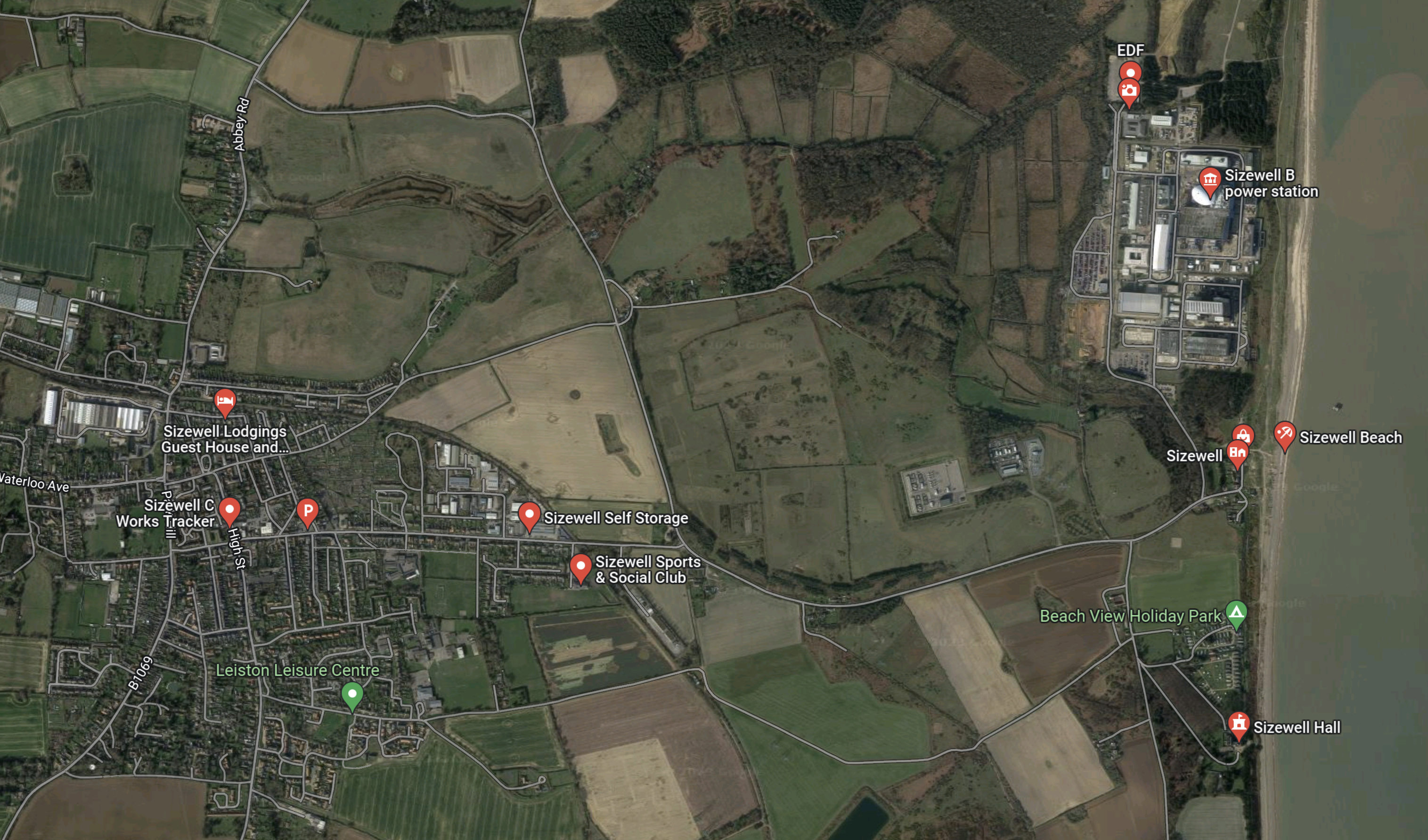
This map shows the town of Leiston and the Sizewell power stations site.
Note.
- Leiston is in the South-West corner.
- The power station site is in the North-East corner.
I have a few thoughts.
Pink Hydrogen
Pink hydrogen is zero-carbon hydrogen produced using nuclear power.
The production of hydrogen is already part of the plans for Freeport East, which I wrote about in Ryze Hydrogen’s Suffolk Freeport Hydrogen Vision Takes Shape.
In that article, I said this.
This would mean that Sizewell’s 6 MW electrolyser could be producing around a thousand tonnes of hydrogen per year or 2.6 tonnes per day.
The more efficient high temperature electrolysis can be used, using some of the waste heat from the nuclear power station. I wrote about this in Westinghouse And Bloom Energy To Team Up For Pink Hydrogen.
I also suspect that it may be more efficient to use seawater to produce the hydrogen.
Could high temperature electrolysis be used at Sizewell?
District Heating
The waste heat can also be used for district heating.
A Train Service To Ipswich
This Google Map shows the railway through Leiston, which is currently used to bring fuel to Sizewell B power station and remove waste.

Note.
- The railway starts in the North-West corner of the map.
- The green dot in that corner marks Leiston cemetery.
- The railway then goes East before turning to the South-East corner of the map.
- In that corner, there are two sidings for loading and unloading the flasks.
Surely, Leiston also needs a new railway station, with at least an hourly service to Saxmundham, Wickham Market, Woodbridge and Ipswich. And possibly even Aldeburgh!
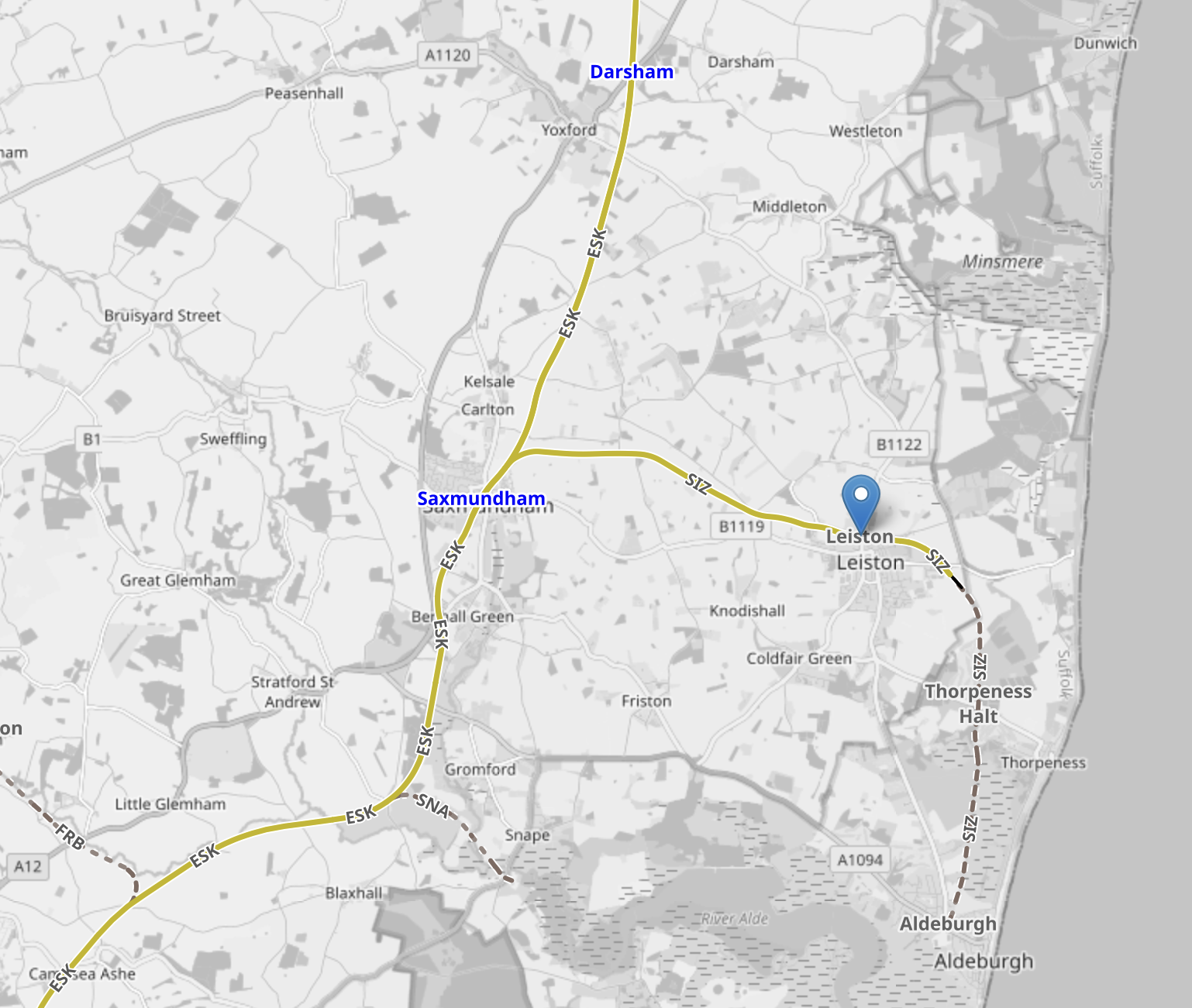
This map from OpenRailwayMap shows the route of the Aldeburgh branch.
Note.
- The North-South yellow line is the East Suffolk Line.
- Their were three stations; Leiston, Thorpeness Halt and Aldeburgh.
- Leiston station was in the North of the town.
The intact section of the branch is shown in yellow.
There would be no need for any electrification, as Stadler, who built Greater Anglia’s Class 755 trains, are the masters of battery-powered trains and could convert these trains to battery operation. Recently, one of the smaller metro trains, that Stadler are building for Liverpool, ran for nearly 90 miles on battery power alone, which I wrote about in New Merseyrail Train Runs 135km On Battery.
An hourly train service would double the frequency of the train service between Saxmundham and Ipswich.
Does the Leiston masterplan include a train service?
And if it does, does it terminate at a new Aldeburgh station?
Conclusion
Integrating development around a nuclear power station could be a way of levelling up.
It would bring electricity, heat, a rail link and jobs to an area.
Will Rolls-Royce use these benefits to sell one of their SMRs to those living around a site?
Rolls-Royce Successfully Tests mtu Engines With Pure Hydrogen
The title of this post, is the same as that of this press release from Rolls-Royce.
These are the two bullet points.
- mtu gensets and cogeneration units to be further developed for 100% hydrogen use
- First use in the new CO2-neutral container terminal in the German inland port of Duisburg
This is the first paragraph.
Rolls-Royce (LSE: RR., ADR: RYCEY) today announces that it has conducted successful tests of a 12-cylinder gas variant of the mtu Series 4000 L64 engine running on 100% hydrogen fuel. The tests, carried out by the Power Systems business unit, showed very good characteristics in terms of efficiency, performance, emissions and combustion. These tests mark another important step towards the commercial introduction of hydrogen solutions to meet the demand of customers for more sustainable energy.
Note.
- Rolls-Royce mtu have converted and tested a natural gas version of the Series 4000 L64 engine.
- The Class 43 power cars used in the iconic InterCity 125 train and powered by mtu V16 4000 R41R engines.
Are the two engines related? If so, can Rolls-Royce mtu build a hydrogen engine that could power an InterCity 125?
It was a rapid development.
Andrea Prospero, an engineer at Rolls-Royce responsible for the development of the hydrogen engine, is quoted as saying.
We are very pleased with the rapid progress. The very low engine emissions are well below the strict EU limits, no exhaust gas aftertreatment is required.
Due to the different combustion behaviour of hydrogen compared to natural gas, some engine components including fuel injection, turbocharging, piston design and control, were modified in the test engine. However, by using proven technologies within the Power Systems’ portfolio, such as mtu turbochargers, injection valves, and engine electronics and control, the development of the engine to use hydrogen was advanced quickly and efficiently.
Diesel and natural gas internal combustion engine manufacturers like Cummins, Rolls-Royce mtu and several other companies, have a long history of research, that they have the knowledge to convert diesel or natural gas engines to hydrogen.
So far only Cummins, JCB and Rolls-Royce mtu have disclosed a multi-fuel line of engines.
First Deployment For CO2-Neutral Power Supply At Duisport
There is a section in the press release called First Deployment For CO2-Neutral Power Supply At Duisport, where this is said.
Duisport, one of the world’s largest inland ports, is working with several partners to build a hydrogen-based supply network for its new terminal, ready for operation in 2024. In the future, most of the electricity required by the port itself will be generated directly on site from hydrogen in a CO2-neutral manner. This will be achieved by two combined heat and power plants with mtu Series 4000 hydrogen engines (with a total installed capacity of 2MW) as well as three mtu fuel cell systems (with a total installed capacity 1.5MW).
As part of its sustainability program, Rolls-Royce is realigning the product portfolio of Power Systems towards more sustainable fuels and new technologies that can further reduce greenhouse gas emissions.
There is also this Rolls-Royce graphic, which shows the energy sources.

It would appear batteries, combined heap and power (CHP), grid electricity, hydrogen electrolyser, hydrogen storage and renewable electricity are being brought together to create a climate-neutral energy system.
Is this a world-first, where hydrogen engines and fuel cell systems will be working together?
 The Anonymous Widower